THE IMPLEMENTATION OF A HELP DESK PROGRAM TO
ENSURE AN EFFECTIVE AND EFFICIENT INFORMATION
DELIVERY SERVICE
Thys Lourens
Directorate Management Information
Strategic Information & Planning
Technikon Pretoria
ABSTRACT
At Technikon Pretoria we developed a program to assist us in Creating an interface for our end users to log a request Keeping track of all requests and changes
Reporting on time spent by developers Communicating with the end users
This program has been designed to improve our ability to provide high quality support and service to our end users. End-users call when they find they cannot proceed with their work until they get an answer from you. They may have a problem, a question, or even a suggestion. No matter what the issue is, your customer’s efficiency becomes dependent upon your ability to resolve it.
The MIS Help Desk supplies all the tools we needed. It is a full-featured program that simplifies the gathering of information. More importantly, it then manages and tracks all aspects needed to resolve the issue.
When end users contact you for assistance, they expect you to be knowledgeable, responsive and accurate. Since the same information is available to all MIS Help Desk users in real time, end-users do not have to repeat the reason for their call to different people.
As a support professional, we need to be able to respond to our end-users quickly and efficiently. With the MIS Help Desk, requested information is always at our fingertips.
INTRODUCTION
Everybody knows what to expect from an information delivery department. The developers on the one hand know how annoying some end-users can be, especially when the end-users request information at the last minute and expect the developers to assist them with this urgent request. The end-user on the other hand doesn’t know what effort it takes to complete a simple request. For example, one Deputy Vice-Chancellor once asked a simple question,
How many Qualifications were awarded in 2000 and 2001 per faculty and campus.
This seems like a five-minute query. However, on our operational database Integrated Tertiary Systems (ITS) the graduation ceremony table design does not carry the campus variable. This resulted in developing a separate query to determine the last campus where a student attended his classes for that particular qualification. Suddenly the simple five-minute query turns into a four hour struggle where some assumptions, (use the first or last campus attended) was made in order to answer the query.
The most important factor in determining the quality of your information is the fact that you as the developer and the end-user must be speaking the same language. Sometimes the following simple question is asked:
How many students do we have?
Simple enough? Lets look at the different criteria that you have to consider in order to answer this question.
Are we talking about headcounts, qualification registrations, subject registrations or FTE? Must we include or exclude cancellations?
Do we include contact, distance, and non-formal students? Do we include full-time part-time or block registrations? Do we include exam only registrations?
Do we include all the satellite campuses or only the main campuses?
Not only do you need to understand the request but also does it take time to manage the different users with their different requests. Since January 2002 the MIS Directorate at Technikon Pretoria received nearly 1400 different types of requests. This varies from a simple 5-minute query to long-term projects.
End-users need to feel special and this special attention from the MIS developers resulted in the developers working longer hours while the output of the MIS team stayed constant. The
following is meant by special attention: Entering end-user requests
Answering routine questions which solutions already exists on the MIS Discuss telephonically the requests of end-users and the status thereof
Working hard to solve new problems while someone else had already implemented an applicable solution
For this reason the MIS directorate at Technikon Pretoria developed an interface to assist them in their main task of producing timely, relevant and quality information to the institution and its environment.
To assist in understanding the background of Helpdesks, Customer Relations Management Systems (CRM) the following definitions are highlighted;
CRM
The technique of establishing and maintaining a long-term business relationship with your customers. CRM involves utilizing the data collected during your customer interactions to determine the demographics and future needs of each customer. (Source
WWW.helpdesklist.com)
HELPDESK
A centre providing a service to internal or external callers to facilitate the use of their technology assets. (Source WWW.helpdesklist.com)
When examining the above two definitions one can identify the familiarity between the CRM and Helpdesk systems.
A Helpdesk is simply an information storage and presentation device. The simplest CRM systems are spreadsheet type databases that assign individual reference numbers to input textual
information. The more sophisticated helpdesks provide customized web interfaces for both end-users and developers, knowledge bases that 'learn' from previous calls, data manipulation producing reports and graphs, time allocation, scheduled tasking functions etc.
The Technikon Pretoria solution does not only cater for the above but also includes a management module that enables the department to monitor all of its activities.
In the design phase, emphasis was placed on user acceptance. The following three types of users are being catered for
Developers
The Request system enables them to respond quickly and effectively to internal support requests. The Request system is easy to use. The consistent, refined interface makes utilizing the system intuitive and natural. Developers do not have to look for their work because a personalized welcome page shows by default them only their assignments. The Request system minimizes data entry and ensures that the same End-user is not calling two different people to resolve the same problem.
End-users
The Request system enables them to help themselves. End-users who need assistance can explore solutions in the "knowledge base." The “knowledge base” is a complete search engine, which provides access to your data base content. Closed requests and solutions are automatically shared through out the organization using Internet connectivity; End-users actively participate in the request system by logging help requests and checking the status of active requests.
Managers (MIS/Information System)
The Request system streamlines the operations of a management Information Department and enables them to meet performance goals. The Request system enables MIS managers to manage and measure the performance of their section. The WEB Manager provides an up-to-the-minute overview of all aspects of request system operations. Management reports and graphs make it easy to communicate the status of help desk operations.
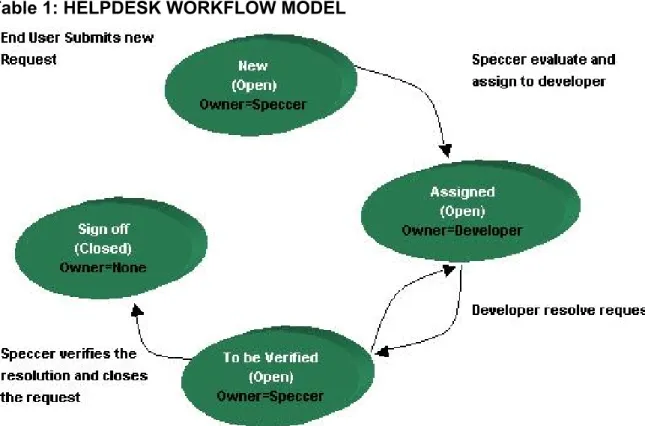
Table 1 illustrates a basic workflow model of a typical Helpdesk system.
The request/log is either being classified as an open or closed state. Each of these two
basic states includes a number of sub states. For example, an Open requests can be either
New, Assigned or to be Verified
Table 1: HELPDESK WORKFLOW MODEL
The following procedure or workflow model (Table 2) is being used by the MIS Department at Technikon Pretoria.
With this model we ensure that there is ample opportunity to validate the quality of our information.
When designing the specifications of the Request system at Technikon Pretoria the following goals and or benefits were recorded as benchmarks in order to measure success of the system.
Benefits of the Request System:
Reduce Call Length: A rapid access to the correct solution using an integrated knowledge base brings an issue to a prompt resolution.
Reduce Operational Cost: Instant access to the right solution not only reduces call length, but also allow support personnel to be more efficient and productive.
Enhance End-user Satisfaction: A quick and effective resolution to End-user issues enhances End-user satisfaction and loyalty to your institution and its information. Satisfied End-users enhance your business by becoming a good source of referrals and positive word of mouth. Minimize Escalation of Issues: A knowledge base provides frontline support staff easy access to effective solutions eliminating the need for expensive escalation.
Enhance Response Consistency: Since every support member has access to the same information, the response will inevitably be constant. This also eliminates End-users' desire to reach their favorite developer--a practice that creates confusion in call queuing and slows down support process.
Reduce Training Costs: Unlike the traditional model where support knowledge resides within support personnel, the request system makes it tangible and accessible to all. Thus, new employees require less training when years of knowledge is available at their fingertips. Reduce Call Volume: By providing access to a set of knowledge on the intranet, the end-users can easily find solutions to their problems, without picking up the phone.
Eliminate Duplicate Efforts: Once a problem is solved, the solution is verified and entered into the knowledge base for others to access. Thus, there is no struggling over the same issues by other developers.
Capture Tacit Knowledge: The Request system provides a convenient way to tap into the tacit knowledge and experience of developers by capturing it in the form of a knowledge base. By sharing it with others, it makes the hidden knowledge tangible and a usable asset.
Improve Product Quality and Related Documentation: Help identify most frequently used reports and most frequently asked questions. Also, collects user feedback with respect to the
quality/usefulness of solutions. This helps train new employees quickly, and improves products and related documentation.
Improve Communication and Teamwork: The Request System keeps everyone in the loop, so they can work as team and share information. Everybody on the team, developers, tech writers, support, QA, and project managers can participate, contribute, and keep track of the requests assigned to them. Automatic e-mail notifications inform team members of changes to requests (for example, when requests are assigned to them), and escalate potential problems to project managers (for example, when there are too many new, unassigned requests).
In order to benefit from these goals the following features were added to the Request System.
What are the main features?
Easy to use WYSIWYG knowledge editing interface.
Provides complete search flexibility. Search just request titles or entire knowledge database including solutions and attached documents.
Building a knowledge base is a part of workflow rather than a separate task. Knowledge is captured as soon as a problem is solved.
You can attach any type of document to a solution/request. The document may contain a detailed solution with tables, graphs and diagrams. The attachment may even be a data set.
Distributing knowledge on intranet.
With a single click solutions can be sent to End-users through e-mail. Collects user feedback with regard to the quality/usefulness of a solution.
Entering keywords in the search field can do searching. Keywords can be used individually or combined in the form of an exact phrase.
Easily build FAQ's and Top 10 lists. Supports both IE 4.0+ and Netscape 6.0+.
Build on Microsoft SQL Server and scalable enough to be hosted on an Access or MySQL Database
A solution may contain everything you need to solve the problem: screen shots, diagram, video, and hyperlinks to related documents on the Web or in the knowledge base.
Built-in reports help identify most frequently asked questions. Also track usage by request category for pinpointing quality control issues.
Controlled access to information provides security and eliminates the likelihood of sensitive, unverified, and even irrelevant information from certain users.
The Request System supports multi-level access control to ensure that only authorized users have access to pertinent information.