EXPERIMENTATION METHODOLOGY FOR SEEDS SEPARATION WITH
PLAN SIEVE AND IN AIRFLOW
BIRSAN MARIANA1), CASANDROIU TUDOR2),
PĂUN ANIŞOARA1), BUNDUCHI GEORGE1)
1)INMA Bucharest;2)U.P. Bucharest / Romania; E-mail: [email protected]
Keywords: separator, cleaning, impurities removal, wheat, seeds
ABSTRACT
After the harvesting process, the material obtained must undergo cleaning and sorting operations to remove foreign bodies, which determines the increase of purity so that it can meet the quality requirements imposed. In order to achieve these operations, the most used machines are the ones with flat sieves and with airflow. Thus, in this paper was aimed to develop the working methodology for researching the process of separating wheat seeds on the plane sieves and the airflow of the TC600 Combined Separator in order to optimize the performance of this machine.
INTRODUCTION
After the harvesting process, the obtained material is presented as a mixture formed of the basic culture and various impurities of mineral or organic origin (vegetable scraps, minerals and/or weed seeds), which is why it cannot meet the quality requirements imposed by the standards in force (SR ISO 11051: 1999 SR 13548: 2013 for wheat).
The permissible foreign content of wheat for nutritional purposes is maximum 3%, in this content limiting the content of corn-cockle to a maximum of 0.5% and other harmful bodies to a maximum of 0.2% [2]. Broken, damaged or undeveloped seeds are less resistant for storage being easily attacked by fungi and pests [2, 3, 4].
The presence of weed seeds in the mass of seeds destined for sowing leads to decreasing crop yields or even compromising it, while in the mass of seeds dedicated for storage in the view of preservation, it can lead to the degradation of main crop seeds. For seeds destined for consumption, seed impurities decrease the nutritional value and the quality of food products, some even being poisonous (ergot fungus, corn-cockle, other types of fungi, etc.).
Thus, before receiving a particular destination (sowing, consumption, processing, storage, etc.), the harvested product must be subjected to cleaning and sorting operations aimed at removing foreign bodies, such as chaff, straw waste, weed seeds, soil, dust, metal scraps [2].
Through these operations is aimed to increase product purity, also achieving the better conditions for preservation, storage, commercialization, consumption, etc.
These operations require machines that have at the base of their working process the difference between the physical characteristics of seeds and those of foreign bodies. The most used are those that combine the oscillatory movements of the working surface (sieve) with the action of airflow, thus combining the separation on the principle of specific mass the separation based on the aerodynamic principle.
MATERIAL AND METHOD
The experimental researches were carried out in laboratory conditions on modern equipment Combined Separator TC 600 existing in the laboratory of Agricultural Machinery of the Milling Collective of the National Institute of Agricultural Machinery Bucharest, in the period of time between February-May 2015.
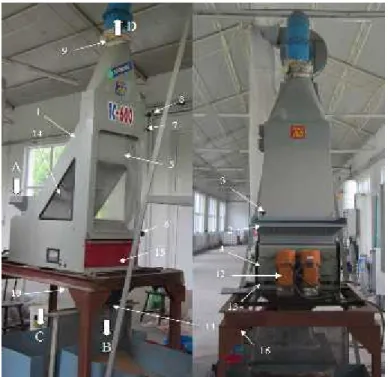
The Combined Separator TC 600 (Fig. 1) is a modern equipment designed and built within INMA Bucharest, for pre cleaning and cleaning cereal seed (wheat, barley, rye), maize, pulses and oilseeds, which uses in the working two combined principles: sieving on sieves and aspiration in counter current of the product that is processed.
The penetration of the product to be cleaned in the equipment occurs through the feeding funnel (2) and is perform controlled by the flow control device (3). Once it reaches the sieve driven by the two electro-vibrators (12), the material is subjected, both to separation by size, and to separation in airflow. The inlet channel is double, provided with independent air control devices (7, 8), so that a suction channel is located above the vibrating sieve and controls the layered suction and the other is mounted vertically and controls the suction of impurities from the light product fraction.
Removing impurities is done progressively: with product sliding on the sieve (removing small impurities - C), under the action of the ascending airflow (light impurities situated on the sieve - D), as well as in the second suction channel where the cleaned product undergoes a new removal the light impurities.
The experiments have been oriented for the purposes of determinations on the process of separating seeds on plane sieves and in airflow depending on the feed rate, the amplitude of the oscillation and the speed of the airflow through the double aspiration channel.
Fig. 1. Diagram for the equipment Combined Separator TC 600: 1. - Framework; 2. – feeding funnel; 3. – system for adjusting the flow;
4. – vibrating sieve (separation plane); 5. – adjustable wall; 6. - valve for adjusting the sizes of the vertical suction channel; 7. – valve for adjusting the flow of the air aspirated from the sieve; 8. - valve for adjusting the air flow in the vertical channel; 9. – aspiration inlet; 10. – Funnel for evacuating small impurities;11. –
Funnel for evacuating clean product; 12. – Electro-vibrator; 13. – elastic elements; 14. – side view; 15. – inspection cover;
A – product feeding; B – evacuating clean product;
RESULTS AND DISCUSSIONS
Elaboration of the working methodology for experiments consisted in:
1. Analyzing the material for processing
In order to conduct experimental researches, winter wheat of the Dropia variety originated in the area of Ialomiţa County was used, from the production of 2014.
For the correct study of the process of separation was necessary to analyze the material to be processed, carrying of the following steps:
a) taking samples- sample extraction was achieved from the product for processing (wheat) that was in bulk state, according to current standards.
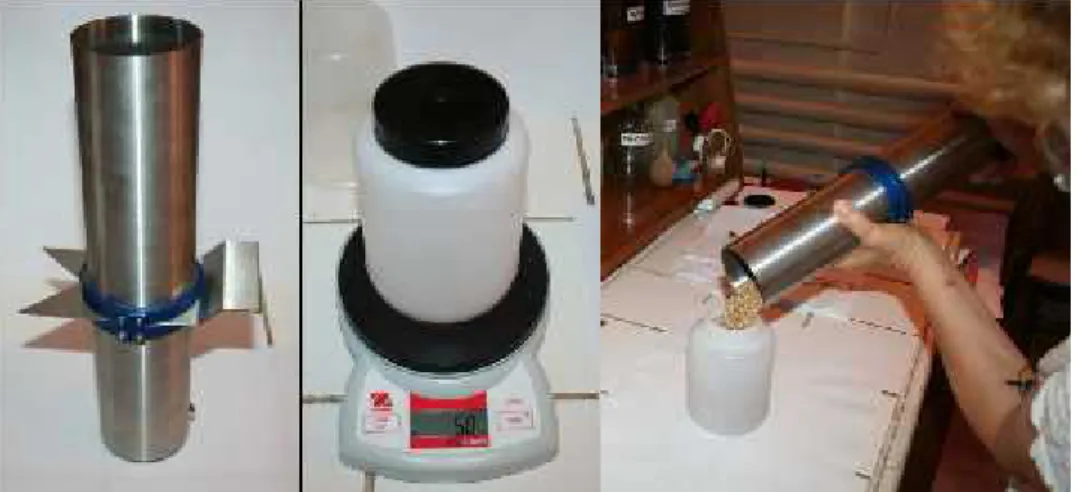
b) determining the characteristics of particles of cereals subjected to research, namely: seed size (l, b, c), seed humidity u (%), mass of one thousand seeds(MTS) purity [%], hectoliter weight [kg/hl ] (fig. 2), respecting recommendations from literature and from a series of authors, and using adequate equipment, corresponding for determining the different physical properties. [1, 4, 5]
Fig.2. Determining the hectoliter weight
From the qualitative point of view, the values of the main characteristics determined are given in the table below.
Table 1 Characterization in terms of quality of the product for processing
No. Characteristic MU Parameter
value Obs. 1 The mass of one thousand grains (MTG) – average value [g] 38.76
2 MTG- Coefficient of variation [%] 2.23
3
Variation of seed dimensions:
Δl Δb Δc
[mm] 1.6 1.43
1.2
4 Humidity [%] 12.96
5 Purity [%] 93.74
6 Hectoliter weight [kg/hl] 74.2
7
Light foreign bodies
(plant scraps, straws, weeds, husk, dust, etc. with a thickness < 1.5 mm),
CsuiandCsue
[%] 2.69
Total foreign bodies [%]: 4.09 Small foreign bodies (< 2 mm),
CsmişiCsme [%] 0.15
Large foreign bodies (> 2 mm),
CsMişiCsMe [%] 1.25
Broken seeds [%] 1.0
One can notice that the total content of foreign bodies is 4.09%, to which are added 1% broken seeds and 0.96% shriveled seeds of wheat. In figure 3 are shown the components of the material to be processed.
Fig.3. The content of material to be processed
2. Preparing the equipment for conducting experiments
The installation on which experiments were conducted allows adjusting certain parameters, namely: product feed rate, oscillation amplitude and speed of the airflow through the double suction channel.
For conducting the experiments it was necessary to determine experimentally the limits of adjustment allowed by the machine for each parameter and to establish the values of these parameters at which the experiments will be carried out for the process of separating seeds of wheat on plane sieves and in airflow.
a. Calibrating the seed feed rate
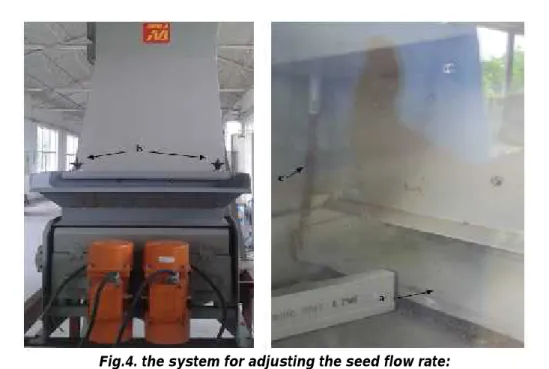
The system for adjusting the feed rate (3), shown in figure 4, is composed of a damper plate and two identical devices for adjusting the feed rate. Each feed control device acts on the damper plate through a tension spring. For a balanced change of the damper plate position, the two rosette handles that drive on vertical the axles of feed rate control devices (two screws) are equally turned. Thus, turning the handles clockwise closes the damper plate, and in the opposite direction it opens it.
We closed the damper plate, put seeds in feeding funnel and noticed that is not flowing. Then we open the damper plate to maximum and measuring with the tape line inside the feed funnel, we determined that the damper plate opening range is 0 ~ 30 mm.
From this range we have chosen four values of damper plate opening, namely 30 mm, 25 mm, 20 mm and 15 mm for which is performed the calibration of the seeds feed rate.
Thus we tuned the damper plate opening to 25 mm. At that moment, using a red permanent marker we signed the first winding spindle handle visible for the rosette handle to mark the position 3 corresponding to the Q3 flow for opening the damper plate at 25 mm. We adjusted the damper plate opening to 20 mm and with a blue permanent marker we signed the first winding spindle visible after the rosette handle to mark the position 2 corresponding to the flow Q2.
Fig.4. the system for adjusting the seed flow rate:
a. damper plate; b. device for adjusting the feed rate; c. traction spring
Taking into consideration that the adjustable inclined plane (damper plate) is mounted on the framework 1 with hinges, was necessary to extract the sieve bed through the inspection door (15) in order to collect the material flowing through the hopper, so that it can be weighed.
Therefore, to manner of conducting the measurements was: open the damper plate, fill the hopper, the material starts to flow and simultaneously the chronometer is started and the material is collected, after the time agreed passes, stop both the chronometer and collecting of material, which is weighed .
For each position of the damper plate, three repetitions were done at different times (40 s, 50 s, 60 s), and using the values obtained, was determined by calculation the feed rate (q = m / t).
The values obtained did not vary considerably, so the average was calculated. So, for the damper plate position i, flows the Qi flow rate with the value - the average of threeqirepetitions. Table 2 summarizes the values for the calibrated flow rate.
Table 2 Values for the calibrated flow rates
Position number
(i)
Damper plate opening
(mm)
Characteristic
Measured values Average value Time
(s)
Mass
(kg)
Flow rate
qi(kg/h) Qi(kg/h)
1 15
40 15.5 1395
1407
50 19.51 1405
60 23.7 1420
2 20
40 26.6 2394
2399
50 33.3 2398
60 40.1 2406
3 25
40 40.5 3647
3653
50 50.7 3652
60 61 3660
4 30
40 49.9 4491
4501
50 62.5 4500
b. Calibration regarding the size of oscillations amplitude of the sieve depending on the position of counterweights of the oscillation generator
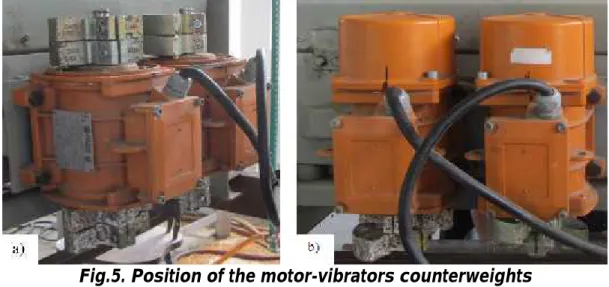
Adjusting the oscillations amplitude for the sieve is done by changing the positions of counterweights of the oscillations generator (Fig. 5), in the case of the equipment used, of the motor-vibrators.
Fig.5. Position of the motor-vibrators counterweights a. 100% overlap; b. 60% overlap.
The size of the sieve’s oscillations amplitude was determined using a pencil and a clamp attached to the frame of the sieve. A sheet of paper was placed under the pencil, the machine was started, and the oscillating movement of sieve described a line whose length depends on the position of the counterweights.
Thus, the values obtained are shown in the table below:
Table 3 Values of calibrated amplitudes
No. Counterweight position (%) Sieve oscillations amplitude (mm)
1 100 10
2 80 7
3 60 5
c.Measuring the speed of the airflow
Given that we only have one ventilator and that the two channels of aspiration communicate, it results that the position of the damper plates for regulating the flow of air aspirated influence each other, so if the position of the valve of one channel is changed, the characteristics of the airflow from the other side are modified, and vice versa.
Thus, by adjusting all the damper flaps at the maximum indication on the machine and fixing the adjustable wall – to a vertical position, we measured the speed of the airflow using an type Testovent anemometer, and we obtained the data presented in the table below:
Table 4 Values of the speed of air
Characteristic M/U
Value of the characteristic Measurements at experimentations
Average
P.I P.II P.III
Air speed in theverticalchannel m/s 8.60 8.10 8.80 8.500
The influence of adjustments of airflow in the two aspiration channels is a a problem that was not solved in useful time for preliminary experiments. Its research is taken into consideration for future experiments, the actual ones.
CONCLUSIONS
The elaboration of this methodology was made for preparing the machine for conducting experiments concerning the process of separation on sieves and in iar currents.
Calibrations were made regarding the feeding flow rate, the oscillations amplitude and the speed of air.
Therefore:
- Feed rates for feeding wheat seeds are in the range of 0 ~ 4501 kg/h and the values at which the experiments will be conducted are: 1407 kg/h, 2399 kg/h, 3653 kg/h and 4501 kg/h;
- The values of amplitudes are: 10 mm, 7 mm and 5 mm;
- The speed of air is of 8.5 m/s in the vertical channel and of 7.693 m/s in the horizontal channel.
Preliminary experiments will be conducted with these values, following the separate influence of each factor, considering constant the other factors for each group of experiments.
Also, it will be kept in mind the necessity to research the influence of the adjustments of airflow from the two channels of aspiration on the process of separation.
BIBLIOGRAPHY
1. Anghel Gh., Bucurescu N., et al. – Determining the quality of seeds, Academy R.P.R. Publishing, Bucharest, 1960;
2. Căsăndroiu Tudor – Equipment for primary processing and storing of agricultural products, Course, Vol. 1, UPB, 1993;
3. Căsăndroiu Tudor - Equipment for primary processing and storing of agricultural products, course notes, UPB,1993;
4. Căsăndroiu T., David L. – Equipment for primary processing and storing of agricultural products, Guidelines for laboratory work, UPB, 1994;