175
SEWAGE SLUDGE INFLUENCE UPON
SOIL FERTILITY IMPROVEMENT
IONESCU NICOLAIE1, TRAŞCĂ FLORIAN1, IONESCU SORIN GABRIEL2 1Staţiunea de Cercetare- Dezvoltare Agricolă Piteşti,şos. Piteşti- Slatina, km.5
2Universitatea de ştiinţe Agricole şi Medicină Veterinară Bucureşti e-mail: [email protected]
Keywords: processed and composted sludge, TOC, maize, soybean, wheat
ABSTRACT
Soil like culture is part of the environment in which the fertility momentary expression through a specific energy balance. On the hand, permanent reactions occur between soil phases (solid, liquid, gas), with release of energy, on the other hand the biological activity of plants (nutrient uptake, growth and development) makes various forms of energy and stored it. Sludge waste or processed or composted, representing organic fertilizer can contribute to amplification reactions due to the wealth of cultural soil organic
matter (OM), commonly around 25 %. By using it in different doses (0-50 t.ha-1) improved
soil carbon (C) as the main chemical element of OM and humus, with macro- and microelements. Due to improved soil total organic carbon (TOC) crops like maize, wheat, soybean, have formed useful production (grains) in addition.
INTRODUCTION
176
wheat. Effect of residual sludge was observed in soybean and wheat crop in the last two years. In another step to cultivate maize groing in pots and in the field, using compost waste sludge from the same source, the same dose but different composting processes: a precess of composting ECOIND held in Bucharest, and the second composting process within the resort Piteşti agricultural research and development (after Bruce et Newmann, 1992). Chemical fertilizers were applied at the same doses: 0, ½ and 1/1 of the needs. The
experimental variants were each 100 m2 where processed slurry, each 700 cm2 in
vegetation vessels and one 25 m2 for compost sludge. The number of repetition was 3 in
the case of processed sludge and 5 and 4 repetitions maize composted sludge. During the stage of maturity the plants were harvested and the production of grain per hectare obtained was reported for the first stage and the production of maize grain on the average plant in the next step. Samples of the original slurry, both types were analyzed in accordance with ISO 13877-99. Macronutrients such as total nitrogen (tN,%), phosphorus
(P2O5) and potassium (K2O) were analyzed by the following methods: tN by STAS
7184/2-85, phosphorus by STAS 7184-79, and potassium with STAS 3223/21-92. Soil samples were collected from agrochemical deep surface soil horizon: 0-20 cm in all the repetitions of the experiment. For these repeats to average the samples were made that chemical abalysis (Baizi, 1988). The chemical analysis of total organic carbon (TOC) was carried out according to ISO 13877-99. Research data obtained were processed statistically by means of analysis of variance (Anova test) and for the correlations and regressions using Excel.
RESULTS OBTAINED
The content of macronutrients of sludge processed and composted
The sludge analysis were carried out several periods, in advance, in order to observe its classification within the legal requirements. Limits obtained strenghths average total organic carbon (TOC) and the macronutrients is considered good. Values shown are considered to be appropriate and useful for organo- mineral fertilization proposed (Table 1).
Table 1. Macroelements contents from processed and composted sludge
Chemical elements Limits Media
TOC, % 23,42 – 30,11 26,16
tN, % 2,24 – 4,32 3,51
P2O5, % 1,25 – 5,13 2,57
K2O, % 0,18 – 2,88 0,81
177
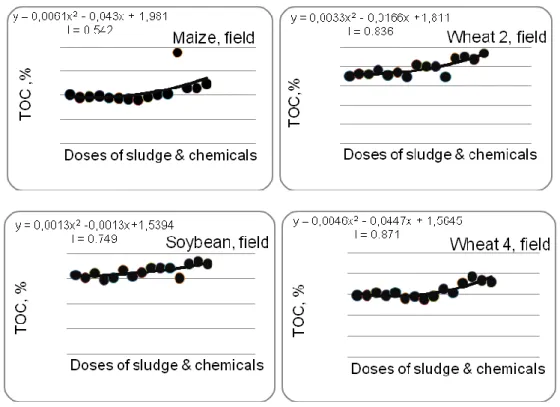
Fig. 1. Evolution of TOC concentrations from the soil treated with processed sludge doses & chemical fertilizers
In all four graphs (Figure 1) shows that by organo- mineral fertilizer doses of sludge formed with chemical doses, increasing soil culture was enriched in total organic carbon (TOC). The first year maize TOC increased from about 2 % up to 2.6 %- according to the equation. Winter wheat in the second year, amid new dose application of sludge, TOC increased from 1.75 % to 2.4 %. In both cases observed direct effect of two doses of sludge applied to field: maize and wheat sophomore. Soybean third year of TOC content between 1.5 % and 1.8 % TOC and wheat in the past year between 1.5 % and 1.9 % TOC. The two plants have had/ showed the effect of soil residual waste sludge culture.
State of the soil fertilized with composted sludge showed some characteristic features (Figure 2).
Fig. 2.Evolution of TOC concentrations from the soil treated with
composted sludge doses & chemical fertilizers
178
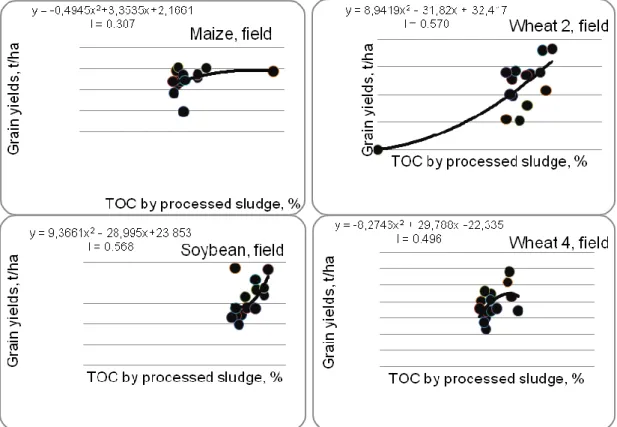
or less obvious. These states were expressed in a final phase with accumulation of plant biomass. From a practical standpoint, and therefore economic interests as biomass accumulation result in the production of grains bigger. The following charts highlight how increased grain yields by increasing doses of sludge (Figure 3 and Figure 4). As expected, by improving the soil with organic fertilizers: processed and composted sludge, grain production plants formed more. From these graphs show that sludge increased maize
grain yield from about 6 to about 8 t.ha-1. Sophomore wheat produced between about 4 to
7 t.ha-1 grains. Soybean size between 1.4 and 2.2 t.ha-1. In the last year (4) wheat that
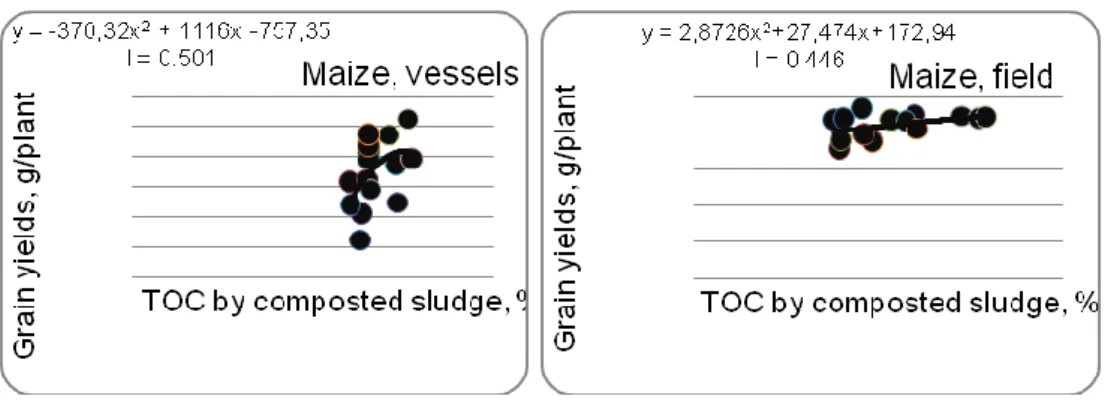
production increased from 3 to 4.3 t.ha-1. With increasing doses of sludge compost product
to increase the production of maize, both in vessels and in the field. Maize grown in plots
of vegetation produced between about 44 and 82 g.plant-1, and the experimental field
between 200 and 225 g.plant-1.
CONCLUSIONS
Sewage sludge processed or composted contains important nutrients, all useful for ensuring agricultural environment to increase the specific energy capacity. The doses studied to favor the accumulation of organic matter (OM) with the decisive role in the activation and amplification of biological and physico-chemical processes which were made available plants nutrients increased concentrations of ions ranging from macro- and micro-elements.
179
Fig. 4. Correlations between TOC and vessel/field maize plants grain yields
Accumulation of OM from agriculture improved mud expressed as concentrations of total organic carbon (TOC,%). TOC of processed sludge accumulated in the first two years as a direct result, 0.7 %, and in the next two yeasr as a residual effect, by 0.4 %. TOC sludge compost increases experienced by direct application between 0.3 % and 1.3 % growing in vessels and in the field.
Plant response to the generation of different seeds in all six cases considered, due to the specific growing conditions, thus confirming the relative uncertainty in the case of slurry applied to the relation between the dose and the formation of useful production (such as grain).
Doses of mud processed (between 0-50 t.ha-1) increased production of maize with
1.5 t.ha-1 in the first year, the wheat with 3.0 t.ha-1 in two, the soybean 0.9 t.ha-1 and that
of wheat last year, up to 1.3 t.ha-1 grains.
Doses of sludge compost (between 0-50 t.ha-1) contribute to the formation of maize
in addition to 30 g.plant-1 both in the growth vessel and where it was cultivated in the
experimental field.
BIBLIOGRAPHY
Baize D., 1988. Guide des analysses courantes en pédologie. Éditure de Institute Nationale de Reserches Agronomique, INRA, Paris, pag. 21-22.
Borlan Z., Hera C., Dornescu D., Kurtinecz P., Rusu M., Buzdugan I., Tănase G.,
1994. Fertilitatea şi fertilizarea solurilor (Compendiu de agrochimie). Editura Ceres,
Bucureşti, pag. 33- 49, 289- 307.
Bruce A.M., Newmann P.J., 1992. Processing of organic sludge and liquid agricultural
wastes. Rewue of COST 68/681 Programme.
Campbell C.A., 1978. Soil organic carbon, nitrogen and fertility. Soil organic matter. Developing in Soil Science, vol. 8, Elsevier Scientific Publisher Company, Amsterdam, The Netherlands.
Chao T.T. & Harward M.E., 1987. Nature of acid soil clays and relationships to ion
activities and ion ratios in equilibrium solutions. Soil Science, vol. 34.
Cooke G.W., 1977. The roles of organic manures and organic matter in managing soils for
higher crop yields – review of the experimental evidence. Proceedings of International
Seminar SEFMIA, Tokyo, pag. 53- 64.
Davidescu D., Davidescu V., 1981. Agrochimia modernă. Editura Acedemiei R.S.R., Bucureşti, pag. 91- 205.
180
Kolenbrander G.J. 1974. Efficiency of organic manure in increasing soil organic matter
content. 10th International Soil Science Congres, vol. 2, pag. 129- 136.
L’Hermite P., Ott H., 1983. Processing and use of sewage sludge. Reidal Publishing Company, London, UK.
Sameç F., 1998. Organic and organo- mineral fertilizers in Europe- past, present and