
357
ASPECTS ON THE CONSTRUCTION AND OPERATION OF SPRAYING
EQUIPMENT FOR REDUCING DRIFT IN FIELD CROPS
NIŢU M.1)
, MATACHE M.1), PRUTEANU A.1), GĂGEANU I.1), MATACHE A.2), DUMITRU D.N.3), SÎRBU F.D.4) 1)
INMA Bucharest / Romania; 2)SAFE SMART SYSTEM Câmpina;
3)
SC IOR SA Bucharest / Romania; 4) AGROMAD Crops SRL / Romania
E-mail: [email protected]
Keywords drift, spraying machines, nozzles, environment protection.
ABSTRACT
The paper presents innovative solutions on the construction si operation of spraying machines in the view of reducing drift in field crops: with innovative electrostatic spraying system, with special panels with static condenser, nozzle protection system, spraying devices provided with hoods, downward air curtain system and with shielded
system with caps for controlling drop dispersion.
The paper is important, on the one hand, for producers of spraying equipment for reducing drift and, on the other hand, for farmers in the view of efficiently applying treatments in field crops, but also for reducing environmental pollution.
INTRODUCTION
Concerns for the protection of the natural environment have been felt since the end of the nineteenth century, the central axis of environmental policies being to ensure a clean environment for the health of mankind and to reduce its deterioration, as well as to ensure a regenerative and innovative economic growth [5, 6].
Agriculture is a basic economic branch by its impact on the social environment (the source of human subsistence) and on the environment. We cannot talk about practicing agriculture without referring to its consequences on the environment [6].
Agricultural productivity is influenced by the level of applied work technologies, phyto-sanitary protection having a very important place in these technologies [5].
Current studies and researches on the methods and equipment for applying phytosanitary treatments are part of the new trends for sustainable agriculture,
knowing that phyto-sanitary protection is one of the main sources of reducing environmental pollution with chemicals [ 5].
From the complex of technological works for maintaining crops, the ones for controlling diseases and pests have a special significance for the quantity and the quality of the yield. Reducing yield losses due to diseases and pests is only possible in integrated combating, the method in which chemical treatments occupy the most important place [5].
In the technology of combating diseases and pests through the chemical method, the most used are spraying machines and devices, because approx. 90% of the total treatment volume isdone by spraying. When solutions are pulverized in agricultural crops, part of the droplets move, due to air currents, in the surrounding areas, thus occurring the phenomenon of drift [5, 6].
358 pesticided, with an intense concern of spraying equipment manufacturers to improve them [5].
Drift is the amount of plant protection product that is transported from the immediate vicinity of the surface treated to another area under the action of air currents during the application process [8].
The consequence of drift is that part of the volume of solution applied is transported by the air currents and can lead to the contamination of watercourses, sensitive areas, urban environment, or unintentional solution deposition on adjacent crops. This may lead to the release of active substance residues which are not allowed or can cause direct damage (phytotoxicity) to neighboring crops [4].
The main protective measures for the aquatic environment and drinking water “are represented by the necessity of:
a) to prevent drift by "using as a matter of priority the most efficient application techniques, such as the use of low-drift pesticide application equipment, especially in tall crops such as hop plantations and in the case of orchards and vineyards";
b) to reduce exposure to risk by "using reduction measures that minimize the risk of external pollution caused by drift, surface leakage and erosion [9].
These include the establishment of adequate buffer zones for the protection of aquatic organisms and protection zones for surface and groundwater sources used for the extraction of drinking water, areas where pesticides should not be used or stored [2, 9].
When applying phytosanitary treatments in the field, drift reduction is important both for the reduction of substance losses and for the protection of the environment.
MATERIAL AND METHOD
To reduce the phenomenon of drift, you can apply:
- Direct measures aimed at reducing the drift at source. These measures are mainly addressed through application technologies, devices designed to reduce the drift and correct regulation of equipment and machinery;
- Indirect measures aimed at reducing drift by "retention", such as buffers, untreated areas or barriers. It is very important for the operator to comply with the recommendations for optimal weather and environmental conditions for application [1].
As follows, a series of representative models of anti-drift spraying equipment, produced by various international and national companies, will be presented.
In Italy, Martignani produces Duo Wing Jet Hill anti-dirt sprayer (figure 1), which is able to reduce the water used for spraying by 90%, the work time and workforce by 70% and reduces the drift
up to 95%, being suitable for inclined terrains [11].
The equipment uses two protective screens with pressure-controlled air cushions that capture droplets that could escape the electrostatic field. According to the plant phenological state, the operator can adjust the volume, velocity and impact of the air flow of the electrostatic spraying nozzle as well as the size of the micro droplets. Moreover, the operator blower can adjust the treatment doses depending on the characteristics of the plant. Duo Wing Jet does not recycle pesticides, but produces an anti-drift effect to minimize chemical residues. Like other Martignani equipments, the electrostatic spraying nozzles of the sprayer apply an electric charge identical to the micro-droplets emitted, which means they are attracted to the vegetation [11].
359 recognized institutions abroad. Compared to high-pressure nozzles, low-volume pneumatic sprayers, electrostatically charged micro-droplets proved to be more efficient, with 90% less water, 25-30% fewer chemical substances and 70%
soil (Run-Off). With the static electrostatic charging turned off, the equipment still offers an average reduction of 25-30% of the active substance consumption and lower a 70% decrease [11].
Fig. 1 –Duo Wing Jet Hill spraying machine [11]
Also, IDEAL SRL (Italy) produces a low-volume "DROP SAVE" spraying machine with panels to reduce drift. "DROP SAVE" was designed to operate at a low volume, but its main feature is the special static condenser panels, allowing users to save the product and reduce drift, especially when the vegetation is low. The liquid recovered from the static condenser is filtered, aspirated through a special vacuum cleaner and then taken to the main tank, passing through a patented depressurization tank [13].
DROP SAVE 2000 (fig 2) has been studied and designed to work on 2 full rows at each pass and is available in the 1000 liter version for crop treatments with planting systems from 2 to 3 m wide and in the 2000 liter version for crop treatments with planting systems from 2.5 to 3.5 meters wide [13].
The DROP SAVE 2000 machine is equipped with: galvanized and gilded frame, polyethylene tank, external tank level pipe, hand wash tank, rinsing device, diaphragm pump 170/200 l / min 50 bar, rotor 8/57/13 , centrifugal clutch, 2-speed gearbox plus neutral position, electric control for opening and closing the water supply, double pressure control, dpa calculator with tank level sensor, power management software with automatic device for opening and closing of the panels, opening and closing of the stirrer, individual loudspeaker closure, suction filter with valve, linear filter for injection, anti-flow device, hydraulic stirrer, patented tilting device, traction bar, ramps adjustable width, tandem with tilting arm, dist electro-hydraulic sprayer, hydraulic expansion of panels [13].
Fig. 2 –DROP SAVE 2000 spraying machine [13]
Self-propelled AIR RIDE AR 3000 sprayer - fig. 3 (Househam Company - UK) is a classic example of equipment
360 and increase yields without compromising operator comfort and productivity [14].
It is equipped with a GPS mapping system, working widths up to 36 m, automatic balancing of the boom, different spray diameters, independent tilt, hydraulic
adjustable axis, high capacity spraying pump. The machine is equipped with a nozzle protection system in order to reduce drift during phytosanitary treatments in field crops [14].
Fig. 3 –AIR RIDE – Model AR 3000 spraying machine [14]
Fig. 4 presents a Househam Veg Boss spraying machine, specially designed to meet the requirements of low-weight horticultural industry with an anti-drift system consisting of a protective curtain that
creates a downward curtain of air for preventing drift, while producing a turbulent spraying pattern to ensure that the solution reaches the bottom of the leaf [14].
Fig. 4 –Veg-Boss model spraying machine [14]
In the US (Benson, Minnesota), Willmar Fabrication company, LLC produces sprayer with dispersion hood designed for a wide range of operations. This helps to provide a uniform overage, while reducing the concerns about the spraying drift [15]. Model 645 (fig. 5) has
spraying devices fitted with hoods to reduce the drift under adverse conditions mounted on the spray booms; The machine offers: efficient spraying, faster application, increased productivity, reduced costs [15].
Fig. 5 - 645 model spraying machine [15]
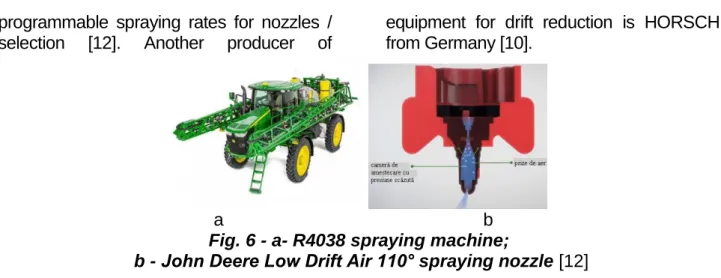
Fig. 6 shows a self-controlled sprayier with individually controlled air jet nozzles (John Deere - USA) to reduce the drift. With these nozzles, there will be an increase in productivity and spraying speed,
better drift management and improved spray quality and precision.
361 programmable spraying rates for nozzles / selection [12]. Another producer of
equipment for drift reduction is HORSCH from Germany [10].
a b
Fig. 6 - a- R4038 spraying machine;
b - John Deere Low Drift Air 110° spraying nozzle [12]
At national level, the machines manufactured by Tehnofavorit Bontida are equipped with the best computers, which ensure a constant dose per hectare, regardless of the movement speed, as well as with the GPS guiding system of the
machine. The special quality of the spraying operation is ensured by equipping the machines with IDK and IDK-T (double-jet) or ID anti-drift nozzles manufactured by LECHLER in Germany (fig. 10, fig. 11) [18].
Fig. 10 – IDK anti drift nozzles [17] Fig.11–IDK-T anti-drift nozzles (double jet) [17]
EEP 1500 carried quipment (fig.
12) manufactured by Tehnofavorit Bontida can be equipped with AD – anti-drift
nozzles (fig 13) for large droplets or IDK - with air injection for wind speeds up to 7 m / s [ 19].
Fig. 12 – EEP 1500carried spraying equipment [19]
Fig.13–AD anti drift nozzles [17]
Also, GREGOIRE produces
spraying machines that use both the pneumatic system (the liquid valve is micronized by the air flow) and the air convection (the pressurized liquid atomizes when passing through a nozzle and is transported by an air stream produced by an axial fan). In this direction, Gregoire has developed and
362
Ecoprotect machine (fig. 14) has a spraying system on both sides of the row and an air curtain to reduce the drift, but also a surplus solution recovery system.
Among the strengths of this machine, the following are worth mentioning: optimal application of the treatment on both sides of the row, complete elimination of the drift due to the system with two curtains covering each row, the high application rate (5-9 km / h), the reduction of the damage risk by impact due to supple unbreakable inflatable modules, the recovery of
excess solution through a simple and efficient system, atomization and perfect distribution of the product. The machine is designed to reduce the dose, use a higher concentration of solution and optimal application regardless of atmospheric conditions. [16]
The protection / recovery panels (fig. 15) are supple (Gregoire patent), their structure stiffens under the effect of air generated by the turbine. Their shape is preserved due to inflatable cylinders on the periphery of the panels. The structure has no rigid element in the row area and is unbreakable [16].
Fig. 14 – Ecoprotect spraying machine[16]
Fig. 15 - Construction of the protection and spraying panel [16]
At the beginning of vegetation, 50-80% of the solution is recovered; the air flow being as in fig. 16 a, and during vegetation, the last treatments recover approximately
10% of the solution, depending on the thickness of the leaf layer (fig. 16 b), the beaks of the diffusers being arranged in cross flow to optimize the application quality.
a) b)
Fig. 16 – Air current direction [16]
The machine is built in two versions S2 and L2, for different distances between rows and different heights, the air flow being produced by a 520 mm diameter turbine
and the air being conducted through 5 special 3D DYNADiff spraying nozzles (fig. 17).
363 Among the advantages of this machine are: achieving a significant saving of the active substance depending on the vegetative phase of the crop at the time of treatment compared to conventional face-to-face treatment, reducing the dose of phytosanitary products by up to 17% evem from the beginning of preparing the solution, comfortable treatment even when it is a bit windy, recovering up to 80% of the solution during the first treatments and
10% during the last treatments. The idea of this machine is to apply a maximum amount of active substance recovering the excess solution.
Ecoprotect is the machine of the future in terms of treatments in viticulture, achieving important savings, increasing the quality of treatments and the timeframe when application can be made and reducing the impact of pesticides on the environment [16].
RESULTS AND DISCUSSIONS
In the following, the results of reducing the drift obtained by other researchers in the field will be presented. Paper [3] presents a system for reducing the drift in vineyards. It has been assumed that in intensive agricultural systems, spray drift is one of the major potential routes of diffuse pollution for pesticides and poses a risk to the environment.
A field experiment with an "event method" was conducted in northeastern Italy under windless conditions in the hilly area known for Prosecco wine production, using an air sprayer to assess possible spraying deviations from the equipment, and the effectiveness of practical mitigation measures, either singly or in combination. A definition of mitigation measures is proposed and a
method for calculating the overall effectiveness of a series of measures to mitigate certain scenarios of interest. [3]
The results showed that low-drift equipment (fig. 8) reduced the potential of spray drift by 38%, and that a fully-developed curtain of vine reduced by at least 70% its capacity; when the last row was treated without the mitigation of air assistance was about 74%; wind fences have always been very effective in reducing down to 98%. In conclusion, the spraying drift is not inevitable and can be significantly reduced by the use of mitigation measures, most of which are already available to farmers, which can be strongly recommended for environmental regulation systems and for community research based on participation. [3]
Fig. 7 - Diagram of the “add-on low-drift equipment” mounted on a standard air-sprinkler [3]
In paper [1] is presented a shielded sprayer equipped with caps to control the dispersion of droplets around the nozzles. Shields may be present
364
a b
Fig. 8 - Shielded spraying equipment [1]
In paper [7] are present some spraying experiments using a conventional towed machine (reference) and a machine equipped with the MagGrow system (fig. 9) with a similar working width for three types of nozzles. The crops sprayed were onion and potatoes in an experimental farm, performing 10 repetitions for each crop.
Spray displacement storage was measured as deposition on the soil up to a distance of 25 m from the edge of the field crop / from the last nozzle and at a distance of 5.5 m to a height of 6 m as a spraying derivative in the air. To quantify the spray deposition, a monitoring device was added to the water in the spray tank, the collectors being placed on the surface of the soil in double panels to measure the breakage of spray on the surface of the soil. Collector filters on the soil surface, in the 0.5 m -10 m distance from
the edge of the field / last nozzle, were in a continuous line. The drift was measured at a vertical measuring pole at a distance of 5.5 m from the edge of the field, using passive collectors in a double row of collectors with a distance of 1 m. The collectors were analyzed using fluorimetry. [7].
After conducting the experiments, it was found:
• Reduction of spray drift by 33% for MagGrow system equipped with standard nozzle flat fan (Hypro 11003 + end nozzle) and boom height of 40 cm;
• Reducing spray drify by 88% for the MagGrow system, equipped with 50% reduction nozzles (AI11003 + end nozzle) and 40 cm boom height;
• Reducing drift by 96% for the Maggrow system with 90% reducer nozzles (ID12003 + end nozzle) and 40 cm boom height. [7]
Fig. 9 –MaGrow system mouted on the boom of a spraying machine [7]
Due to the multitude of factors involved in the process of spraying field crops, its theoretical and practical study for reducing drift and for optimizing spraying equipment continues to pose a
challenge for specialists. In this case, finding the most appropriate systems to reduce drift is achieved in the context of minimum losses of phytosanitary substance.
CONCLUSIONS
Droplet drift is the result of inappropriate choice of the technical equipment (nozzle type, orientation in
365 and direction of air currents, air turbulence, stability or atmospheric inversion).
Losses caused by drift are manifested in two ways: losses due to evaporation of volatile components in the phytopharmaceutical liquid and losses due to the entrainment of liquid droplets in areas outside the perimeter of the treatment. Selection of a particular type of nozzle is based on a compromise between the degree of coverage and the reduction of droplet drift.
In order to reduce evaporation losses, active substances whose vapor pressure is reduced are used. To reduce losses by droplet drift, spraying heads at which the dispersion spectrum is low and the average volumic diameter is greater than 150 μm are used.
The changes in the trajectory of liquid droplets under the action of air flows (drift) causes them to move to other places than the treated ones and implicitly leads to losses of toxic liquid, also causing the contamination of other crops, surface waters, soil, etc., constituting an issue of environmental protection.
In order to ensure the protection of the environment, but also the effectiveness of the treatment, compromise solutions are made: performing treatments with dispersers that produce droplets with average and coarse diameters, less affected by the phenomenon of drift; combined with the use of tunnel-type booms and recycling tunnels, which reduce the percentage of drift losses; reducing the superficial tension of the toxic liquid by adding additives; the use of hydropneumatic dispersers, which form droplets with larger diameters, due to air bubbles in the drops, etc.
Currently, nationally and internationally, there are systems to reduce the drift of spraying machines in the form of rigid skirts or air cushions that are attached to the boom of the spraying machine for field crops. These have the major drawbacks of large gauge dimensions that negatively influence the forwarding resistance of the machine and, implicitly, have relatively large fuel consumption and masses, negatively affecting the stability of the sprayer boom.
BIBLIOGRAPHY
1. Balsari P., Marucco P., Doruchowski
G., Ophoff H., Roettele M., 2015 - Best Management Practices to reduce spray drift
2. Hofman V., Solseng E., 2014- Spray Equipment and Calibration, Agricultural and Biosystems Engineering, North Dakota State University;
3. Otto S., Loddo D., Baldoin C., Zanin
G., 2015 - Spray drift reduction techniques for vineyards in fragmented landscapes, Journal of Environmental Management 162 pg. 290-298;
4. Rus F., 2009 - Aspects on the drift of liquid drops in phytosanitary treatments, Scientific Papers (INMATEH), Vol. 28, No.2, pp.16-22.
5. Walter S., Bungescu S.,2006 –
Devices, equipment and machines for
plant protection, AGROPRINT USAMVBT Pub., Timişoara;
6. Walter S., 2003 - Machines for
applying phytosanitary treatments and foliar fertilization of vegetable crops, Agroprint Pub. House, Timisoara;
7. Zande J.C., Butler Ellis C., Douzals J.P., Stallinga H., P. van Velde, Michielsen J.M.G.P., 2017 - Spray drift reduction of the MagGrow spray system. Effect of magnetism, nozzle type, end nozzle and spray boom height, Wageningen University;
8. *** ISO 22866, 2005 - Equipment for crop protection -- Methods for field measurement of spray drift
366 10. *** LEEB PT 330/ 350 User manual, Producator Horsch, Germania
11.***www.international-pest-control.com/ reducing-drift-innovative-electrostatic-spraying-system
12. *** www.deere.com/en
13.***www.idealitalia.it/en/products/drop_ save.php
14.***www.househamsprayers.co.uk/prod ucts/air-ride-range
15.*** www.willmarfab.com/645.php
16.***www.nhr.ro/gregoire-ecoprotect- masina-pentru-tratamente-fitosanitare-in-vii-cu-recuperarea-surplusului-de-solutie 17. *** www.lechler.de
18.***www.revista- ferma.ro/articole/masini-agricole/noutati-
din-gama-masinilor-fitosanitare-tehnofavorit
![Fig. 1 –Duo Wing Jet Hill spraying machine [11] Also, IDEAL SRL (Italy) produces](https://thumb-us.123doks.com/thumbv2/123dok_us/8067360.2136642/3.892.322.573.229.385/fig-wing-hill-spraying-machine-ideal-italy-produces.webp)
![Fig. 3 –AIR RIDE – Model AR 3000 spraying machine [14] Fig. 4 presents a Househam Veg](https://thumb-us.123doks.com/thumbv2/123dok_us/8067360.2136642/4.892.347.551.534.669/fig-air-ride-model-spraying-machine-presents-househam.webp)
![Fig. 7 - Diagram of the “add-on low-drift equipment” mounted on a standard air-sprinkler [3]](https://thumb-us.123doks.com/thumbv2/123dok_us/8067360.2136642/7.892.292.623.868.995/fig-diagram-add-drift-equipment-mounted-standard-sprinkler.webp)
![Fig. 9 –MaGrow system mouted on the boom of a spraying machine [7] Due to the multitude of factors](https://thumb-us.123doks.com/thumbv2/123dok_us/8067360.2136642/8.892.78.819.109.889/fig-magrow-mouted-boom-spraying-machine-multitude-factors.webp)
