
470
ADVANCED METHODS OF BIOGAS PURIFICATION – A REVIEW
ZĂBAVĂ B.ȘT.1), VOICU GH.1), PARASCHIV G.1), DINCĂ M.1), UNGUREANU N.1), IONESCU M.1), FERDES M.1), DUȚU I.1), VLĂDUȚ V.2)
1)U.P. Bucharest / Romania; 2)INMA Bucharest;
E-mail: [email protected]
Keywords: biogas, biomass, advanced methods, purification
ABSTRACT
One of the main environmental problems of today’s society is the continuously increasing production of organic wastes. The discovery of abundant natural gas resources has greatly increased the study of using methane as a feed stock to produce transportation fuels. Biogas (primarily containing methane and carbon dioxide), which is generated from biomass or organic waste via anaerobic digestion or from landfills, is regarded as a renewable source of methane, and has the potential to achieve sustainable production of transportation fuels. Since biogas also contains a significant amount of impurities (e.g.,hydrogen sulphide, ammonia, water vapor and siloxane), a procedure is generally required to clean it before its final use.In this paper are presented the advanced methods of biogas purification.
INTRODUCTION
In an effort to satisfy the rising global demand for energy and at the same time to combat the environmental impacts such as global greenhouse gas (GHG) emissions, it’s worth searching for potential energy alternatives. As a base line for most approaches, the issues of producing sufficient quantity of energy with high quality, economical viability and environmental sustainability are the actual concern.
One of such vital components of the world's supply of energy that has fulfilled the aforementioned requirement is natural gas. In addition to its primary importance as a fuel, natural gas is also a source of hydrocarbons for petrochemical feed stocks. Many researches have been undertaking on natural gas field as the presence of high component of methane in natural gas contributes for the production of other potential products such as syngas and high purity hydrogen [2].
Biogas is an energy carrier produced by microbial degradation of organic matter. This process, called anaerobic digestion (AD), requires specific conditions, such as a low redox potential (lack of oxygen). This condition is common for natural environments, for example marine sediments or animal stomachs. When it is used for energy production, AD takes place in specially designed digesters. Manure, agricultural residues, organic waste from households, food and agro-industries, sewage sludge, etc. can serve as raw material for AD.Depending on the composition of the raw material, the degradation time varies from a few hours to a few weeks. Average retention times of 60 to 120 days are common for agricultural digestors. After degradation, two products result from the process: biogas and digestate.
Biogas is mainly composed of methane and carbon dioxide. It can be used to generate electricity, heat and fuel.
471
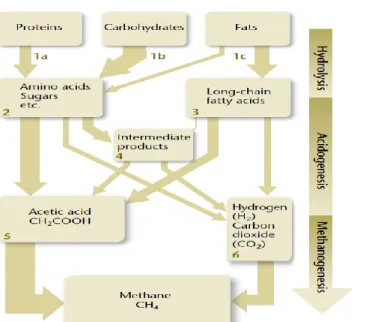
Fig. 1 - The anaerobic decomposition of organic matter consists of three main phases: A. Hydrolysis (1a, 1b, 1c). B. Acidogenesis, also called fermentation (2, 3, 4).
C. Methanogenesis (5, 6). [5]
The complete biological decomposition of organic matter to methane (CH4) and carbon dioxide (CO2) under oxygen-depleted conditions – i.e. anaerobic – is complicated and is an interaction between a number of different bacteria that are each responsible for their part of the task.
What may be a waste product from some bacteria could be a substrate (or food) for others, and in this way the bacteria are interdependent. Compared with the aerobic (oxygen-rich) decomposition of organic matter, the energyyield of the anaerobic process is far smaller. The biogas process is often divided into three steps: hydrolysis, acidogenesis and methanogenesis, where different groups of bacteria are each responsible for a step (see Fig. 1).
Biogas formed in the methane fermentation process contains about 50÷60% of methane. Other ingredients such as carbon dioxide, hydrogen sulphide, water, water vapor and small amounts of nitrogen and oxygen are the ballast lowers heating value of biogas. The calorific value of raw biogas is much lower than natural gas or compressed natural gas used as motor fuel CNG.
Biogas most is often used for processing into electricity and/or heat. Purification of biogas for these applications is reduced mainly to remove hydrogen sulphide and water, which affect negatively the functioning and viability of power equipment, causing them to corrode [6].
MATERIAL AND METHOD
472
In order to obtain biogas in a productive and profitable way, it must be processed before use. Thus, prior to use, raw biogas is subjected to conditioning (purification) operations, resulting in the properties required by users.
Biogas purification is the operation of retention of unwanted biogas components before it is used in the combustion process. Whatever the ultimate way of using biogas, it is impossible to use it in the raw state. The only recyclable component is methane. To enable the use of biogas by cogeneration, the substances to be eliminated are: water, organohalogen, carbon dioxide and sulfur [4]. The most important reasons for improving the quality of biogas include the need to meet the requirements of the installations in which it is used (engines, boilers, fuel cells, etc.), increasing its calorific value but also for standardizing the quality [6].
The method of conditioning the raw biogas must be determined from the construction of the biogas plant for the fact that it may require some specific details in the construction of the plant.
RESULTS AND DISCUSSIONS
Raw biogas needs to be cleaned to remove toxic and harmful constituents (e.g., hydrogen sulphide, ammonia, VOCs, halides, moisture, siloxanes, particulates, etc.) to meet regulatory and technical standards. The main methods of advanced biogas treatment currently used include membrane separation, supersonic and cryogenic separation.
Membrane separation
Membrane techniques allow the separation of pollutants mainly carbon dioxide and hydrogen sulphide. This processes are still relatively new but growing up very rapidly [6]. Membrane separation utilizes high gas pressures to create a large pressure differential across a nano‐porous material (membrane) causing gas separation by several different mechanisms: molecular sieving (size exclusion), Knudsen diffusion (mean path difference), solution‐diffusion (solubility difference), surface diffusion (polarity difference), and capillary condensation (adsorption).
Gas separation membranes are mostly constructed from bundled polymeric (e.g., polysulfone, polyimide, polydimethylsiloxane) hollow‐fiber membrane or carbon membrane, as opposed tonatural organic or sheet, for superior structural integrity and higher surface‐area‐to‐volumeratios. The hollow‐fibers are bundled within small self‐
contained vessels, allowing for easy membrane unit replacement (Fig. 2).
Fig. 2 - Hollow-Fiber High-Pressure Gas Separation Membrane Design and Process Configuration [8]
473
H₂S or inerts (e.g., O₂, N₂) very well.In order to achieve higher methane content in the product, several stages may be used.
For instance, biogas can be upgraded to around 92% methane content with a single membrane, or 96% with two or three membranes in series. However, the use of more membranes leads to higher methane loses and greater energy consumption. Membrane separation processes can have low or high energy consumption (0.18 – 0.77 kWh/Nm³), with the potential for low power consumption (< 0.22 kWh/Nm³) with highly selective membranes.
Fig. 3 - System of membranes mounted in series [6]
Membrane is a filter through which can pass without any obstacle,at least one of the components of the separated mixture, while others are stopped by it because of their size or affinity. It is associated with different permeability of the membrane. Transport through the membrane occurs thanks to an appropriate driving force, i.e.the chemical potential difference in both site of the membrane [6].
Cryogenic Separation
In addition to the continuous improvement of already existing biogas purification technology are developed also new technologies. One of them is a cryogenic purification of biogas. This process takes place under very low temperatures (about -100°C) and high pressure (40 bar).
The raw biogas is cooled down to a temperature at which the carbon dioxide is condensed or sublimation, and can be separated from the biogas in liquid or solid fraction, while the methane accumulates in the gas phase [6].
474
Fig. 4 - Cryogenic Distillation Process Diagram, Acrion Technologies CO2 Wash [8]
The main advantage of cryogenic separation is possible to obtain biogas with high methane content of up to 99%. The main disadvantage is that for the upgrading process is necessary to use many of technological equipment, especially compressors, turbines and heat exchangers. This significant demand for equipment makes cryogenic separation extremely expensive.
Supersonic Separation
A recent, novel approach to gas clean‐up is supersonic separation, consisting of a compacttubular device that effectively combines expansion, cyclonic gas/liquid separation, and recompression. A laval nozzle is used to expand the saturated feed gas to supersonic velocity, which results in a low temperature and pressure (Fig. 5). This causes the formation water and hydrocarbon condensation droplet mist.
Fig. 5 - Supersonic Separator Cross-Section [8]
CONCLUSIONS
One of such vital components of the world's supply of energy is natural gas. Biogas formed in the methane fermentation process contains about 50÷60% of methane. Other ingredients such as carbon dioxide, hydrogen sulphide, water, water vapor and small amounts of nitrogen and oxygen are the ballast lowers heating value of biogas. The main methods of advanced biogas treatment currently used include membrane separation, supersonic and cryogenic separation.
475
The main advantage of cryogenic separation is possible to obtain biogas with high methane content of up to 99%. The main disadvantage is that to the upgrading process is necessary to use many of technological equipment, especially compressors, turbines and heat exchangers.
A recent, novel approach to gas clean‐up is supersonic separation, consisting of a compact tubular device that effectively combines expansion, cyclonic gas/liquid separation, and recompression.
ACKNOWLEDGEMENT
This work was supported by a grant of the Romanian National Authority for Scientific Research and Innovation, CNCS/CCCDI–UEFISCDI, project number PN-III-P2-2.1-BG-2016-0266, ctr. 24 BG / 2016.
BIBLIOGRAPHY
[1] Bachmann N., Wellinger A., Ionescu D., 2012 - Plan de măsuri pentru biogazul din România (TRINERGI GRUP), D.6.2. / WP6
[2] Biruh S., Hilmi M., Natural Gas Purification Technologies – Major Advances for CO2 Separation and Future Directions, Department of Chemical Engineering, University of
Teknology PETRONAS, Malaysia
[3] Brown D, Shi J., Li Y., 2012 - Comparison of solid-state to liquid an aerobic digestion of lignocellulosic feed stocks for biogas production. Bioresour. Technol; vol. 124, pp. 379–86 [4] Istrate B.I., Minciuc E., 2003 - Utilization of biogas for the production of electric and thermal energy (Valorificarea biogazului pentru producerea energiei electrice și termice), Cartea Universitară
[5] Jørgensen P. J., 2009 - Biogas – green energy, PlanEnergi and Researcher for a Day – Faculty of Agricultural Sciences, Aarhus University 2nd edition
[6] Krzysztof B., Samson-Bręk I., 2011 - Review of technology for cleaning biogas to natural gas quality. CHEMIK 2011, vol. 65, issue 5, pp. 435-444
[7] Liangcheng Y., Xumeng G., Caixia W., Fei Y., Yebo L., 2014 - Progress and perspectives in converting biogas to transportation fuels,Renewable and Sustainable Energy Reviews 401133–1152
[8] Matthew D.O., Williams R.B., Kaffka S.R., 2014 - DRAFT Comparative Assessment of Technology Options for Biogas Clean‐up, California Biomass Collaborative University of California, Davis
![Fig. 2 - Hollow-Fiber High-Pressure Gas Separation Membrane Design and Process Configuration [8]](https://thumb-us.123doks.com/thumbv2/123dok_us/8068583.2137143/3.892.121.758.821.1038/hollow-fiber-pressure-separation-membrane-design-process-configuration.webp)
![Fig. 3 - System of membranes mounted in series [6]](https://thumb-us.123doks.com/thumbv2/123dok_us/8068583.2137143/4.892.174.727.294.657/fig-system-of-membranes-mounted-in-series.webp)
![Fig. 4 - Cryogenic Distillation Process Diagram, Acrion Technologies CO2 Wash [8]](https://thumb-us.123doks.com/thumbv2/123dok_us/8068583.2137143/5.892.106.794.90.390/fig-cryogenic-distillation-process-diagram-acrion-technologies-wash.webp)
