82
EFFECTS OF SUCROSE MEDIUM CONTENT AND STERILANT
TREATMENT ON MICROBIAL CONTAMINATION OF SWEET POTATO
CULTURES INITIATED
IN VITRO
CIOLOCA MIHAELA(1), TICAN ANDREEA(1), POPA MONICA(1), BĂDĂRĂU CARMEN LILIANA(1,3), DIACONU AURELIA(2), DRĂGHICI RETA(2)
(1)National Institute of Research and Development for Potato and Sugar Beet, 2 Fundaturii Street,
500470, Brasov, Romania, Phone: +40268.476.795; e-mail: [email protected]
(2)Research and Development Center for Plant Growing on Sands,
Victoriei Street, 207220, Dabuleni, Dolj, Romania
(3)Transilvania University of Brasov, Faculty of Food and Tourism,
148 Castle Street, 500014, Brasov, Romania
Keywords: sweet potato, in vitro culture initiation, microbial contamination
ABSTRACT
The main objective of this study was finding solutions for reducing the level of microbial contamination occurred during in vitro cultivation of sweet potato introduced from the ex vitro environment. For this purpose, growth medium variants with different concentrations of sucrose (20 g/L, 30 g/L and 40 g/L) were tested as well as different periods of time during the biological material was in contact with the sterilizing agent: 70% ethanol for 3, 4 and 5 minutes followed by 1% sodium hypochlorite (NaClO) solution for 10, 13 and 16 minutes respectively. Culture medium variants with a sucrose content of 20 g/L and 30 g/L combined with an explants sterilant treatment in 70% ethanol for 4 minutes followed by 1% NaClO for 13 minutes were the most effective in reducing the percentage of microbial contamination.
INTRODUCTION
Having rich content in fiber, carbohydrates, proteins, vitamin A, B6 and C, iron and calcium, the sweet potato is considered a vegetable with high nutritional value (Ram Chandra Jena and Kailash Chandra Samal, 2011).
The frequent introduction and exchange of sweet potato cultivars and clonal propagation exposes the crop to viral infections (Xiansong, 2010 cited by Ogero, 2012 ). Cuttings sourced from old plants in propagation are often a channel for transmission of systemic infections from one generation to the other, leading to poor yields in successive seasons (Roca and Mroginski, 1991, cited by Hammond, 2014). The multiplication rate of
cuttings is also very low compared to grain crops which are propagated by true seeds. In
vitro propagation of sweet potato helps surmount these challenges by producing disease-free planting materials in large numbers (Hammond, 2014).
Plant tissue culture is uniquely suited for obtaining and maintaining mass propagation of specific pathogen-free plants. The provision of a steady supply of indexed planting
materials through in vitro culture appears feasible economically and technologically
(Mervat M.M. El Far, 2007).
Tissue culture allows the rapid clonal propagation of a large number of plantlets over a short period, as well as the maintenance of germplasm under controlled conditions in
small spaces (Lizarraga et al., 1992). The micropropagation of sweet potato by in vitro
culturing can be carried out continually and allows production of larger numbers of uniform, well-rooted plants using node explants (Doliński and Olek, 2013). Plant tissue culture carried out under aseptic conditions has important applications in plant biotechnology. However, microbes are common cause of contamination in tissue culture. Sterilization is one of the reliable means to control the pathogenic effect of microbes (De Almeida et al.,
83
promotes direct regeneration of cultures, but may cause high levels of microbial contamination due to large size of the explants (Amissah et al., 2016).
In order to reduce the level of microbial contamination of sweet potato cultivated in
vitro, this study intended to find an optimal amount of sucrose added to the growth medium and an optimal time for explants sterilization.
MATERIAL AND METHOD
The study was carried out at the National Institute of Research and Development for Potato and Sugar Beet (NIRDPSB) Brasov, Research Laboratory for Plant Tissue Culture. The biological material analyzed in the experiment was represented by five sweet potato varieties: Yulmi, KSC1, KSP1, Hayanmi și Juhwangmi. The sweet potato storage roots used for obtain vine cuttings were provided by Research and Development Center for Plant Growing on Sands (RDCPGS) Dabuleni, Dolj county, based on a joint research
project (ADER 2.2.2.). Vine cuttings used to initiate in vitro culture were taken from mother
plants obtained in protected area, approximately 80 days after tubers planting (Fig. 1).
Fig. 1 Sweet potato shoots 80 days after tubers planting
Healthy looking sweet potato vines were rinsed under running tap water for 3 minutes. After removing the leaves (keeping a petiole portion to protect the bud during sterilization), the shoots were cut into 2 cm segments containing one axillary bud. Explants were then transferred to clean containers, covered and sent to flow hood. All surfaces were wiped with sterile tissue paper soaked in 70% ethanol. Culture vessels, work tools, spirits, tissue paper and all other materials required for inoculation have been pre-sterilized and then placed in the hood.
For surface sterilization, sweet potato explants were subjected to different sterilant conditions. Thus, the uninodal segments were dipped in 70% ethanol for 3, 4 and 5 minutes respectively, after which, without rinsing, they were immersed in 1% sodium hypochlorite (NaClO) solution for 10, 13 and 16 minutes, respectively. Four drops of Tween-20 were added to the NaClO solution.
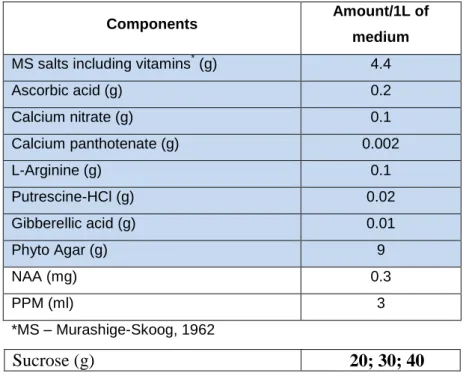
For initiation of in vitro sweet potato culture, a specific growth medium (Namanda et
al., 2015) was used in which composition (Table 1), in addition to Murashige-Skoog (MS) salts and vitamins (Murashige and Skoog, 1962) other compounds were added: ascorbic acid, calcium nitrate, calcium pantothenate, arginine, putrescine-HCl, gibberellic acid, sucrose and phytoagar. In order to stimulate plant rooting, 1-naphthylacetic acid (NAA) was used.
84
The pH of the medium was adjusted to 5.7 and solidified with phytoagar. Test tubes containing the culture medium were sealed with aluminum foil and autoclaved at 121 °C for 20 minutes.
Table 1
Growth medium used for initiation of in vitro sweet potato culture
Components Amount/1L of
medium
MS salts including vitamins* (g) 4.4
Ascorbic acid (g) 0.2 Calcium nitrate (g) 0.1
Calcium panthotenate (g) 0.002
L-Arginine (g) 0.1
Putrescine-HCl (g) 0.02
Gibberellic acid (g) 0.01
Phyto Agar (g) 9
NAA (mg) 0.3
PPM (ml) 3
*MS – Murashige-Skoog, 1962
The sweet potato explants were subjected to three sterilization treatments, further
noted T1, T2 and T3 (Table 2) and then repeatedly rinsed with sterile distilled water. After
trimming, the explants were inoculated on the three medium variants (Table 2) containing different concentrations of sucrose (20 g/L, 30 g/L and 40 g/L respectively), using one explant per test tube. In the literature, culture medium supplemented with 30 g/L sucrose it
is conventional for in vitro propagation of sweet potato. In this study, other amounts of
sucrose were used to see if there was a connection between the sucrose content in the culture medium and the level of microbial contamination.
Table 2
Sterilant conditions and sucrose content in growth medium for in vitro initiation of
sweet potato cultures
Sterilant conditions Sucrose content (g/L)
T1 70% ethanol for 3 minutes
1% NaClO for 10 minutes
20
30
40
T2 70% ethanol for 4 minutes
1% NaClO for 13 minutes
20
30 40
T3 70% ethanol for 5 minutes
1% NaClO for 16 minutes
20
30 40
85
After explants inoculation, the test tubes were closed with aluminum foil and sealed with Parafilm. The cultures were transferred to a growth chamber and exposed daily to 16
hours light. The growth chamber temperature was maintained at 24±2 oC. Observations
and notes regarding the evolution of microbial contamination were performed every two days for 4 weeks.
The experiment was a two factor factorial arrangement of three sterilization treatments and three concentrations of sucrose in a completely randomized design with three replications. As a control, the variants with the lowest values of the two factors were chosen: for sterilization time, 3 minutes in ethanol 70% and 10 minutes in sodium hypochlorite 1%, and culture medium variant with 20 g/L sucrose. Statistical determination was made by analysis of variance (Săulescu N.A. and Săulescu N.N., 1967).
RESULTS AND DISCUSSIONS
Observations were made every two days for culture contamination and general growth of plantlets for 4 weeks. The first microbial contamination occurred 6 days after
cultures initiation, on the medium with 40 g/L sucrose and T1 and T3 sterilization
treatments.
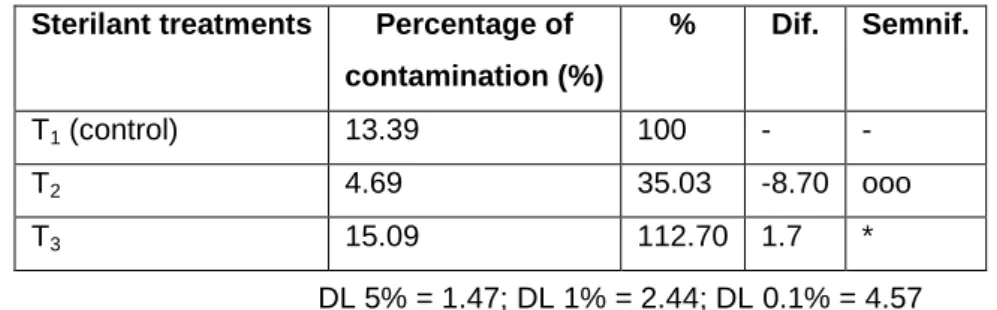
Regarding the influence of sterilant treatment (Table 3) the lowest percentage of
microbial contamination (4.69%) was obtained with T2 variant which recorded a very
significant negative difference (-8.70) compared to the control. The highest percentage of
microbial contamination was recorded for T3 variant (15.09%).
Table 3
The level of microbial contamination of sweet potato cultures using different sterilant treatments, 4 weeks after culture initiation
Sterilant treatments Percentage of
contamination (%)
% Dif. Semnif.
T1 (control) 13.39 100 - -
T2 4.69 35.03 -8.70 ooo
T3 15.09 112.70 1.7 *
DL 5% = 1.47; DL 1% = 2.44; DL 0.1% = 4.57
Table 4 presents the results of the culture medium sucrose concentrations influence on the percentage of microbial contamination. It can be seen that the lowest percentage of contamination was obtained on the medium variant with an addition of 20 g/L sucrose (4.32%), and the highest percentage of contamination was recorded on the medium variant with an addition of 40 g/L sucrose (18.57%).
Table 4
The level of microbial contamination of sweet potato cultures using different concentrations of sucrose in culture medium, 4 weeks after culture initiation
Sucrose
content (g/L)
Percentage of
contamination (%)
% Dif. Semnif.
20 (control) 4.32 100.00 - -
30 10.28 238.15 5.96 ***
40 18.57 430.12 14.25 ***
86
The combined influence of sterilant treatment and concentration of sucrose in the
medium (Table 5) determined the lowest percentage of infection (0%) at the T2 sterilization
treatment and concentration of 20 g/L sucrose. On same sterilization treatment (T2), but a
concentration of 30 g/L sucrose a low percentage (4.55%) of microbial contamination was also obtained. The highest percentages of microbial contamination (Table 5) appeared in
the medium variant with a concentration of 40 g/L sucrose and T3 (28%) and T1 (18,18%)
sterilant treatments.
Table 5
The combined influence of sterilant treatment and concentration of sucrose in the culture medium on the level of microbial contamination, 4 weeks after culture
initiation
Sucrose content (g/L)/
Sterilant treatments
20 30 40
T1 7.69 14.29 18.18
Dif. - 6.6 10.49
Semnif. - *** ***
T2 0 4.55 9.52
Dif. - 4.55 9.52
Semnif. - *** ***
T3 5.26 12 28
Dif. - 6.74 22.74
Semnif. - *** ***
DL 5% = 0.76; DL 1% = 1.07; DL 0.1% = 1.52
In this study, beside the level of microbial contamination, the percentage of sweet potato plantlets regeneration was also determined. Explants that regenerated directly but got contaminated were still considered to have directly regenerated. Figure 2 shows healthy and contaminated sweet potato cultures 4 weeks after initiation.
Fig. 2 Sweet potato plantlets 4 weeks after in vitro culturing: healthy cultures (A); contaminated cultures (B)
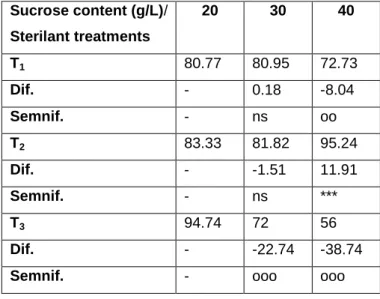
From the analysis of the combined influence of sterilant treatments and the sucrose concentration on the plant regeneration percentage (Table 6) it can be noted that by
87
applying T2 treatment and by using in the nutrient medium of a quantity of 40 g/L sucrose a
higher percentage of regeneration is obtained (95.24%), followed by T3 sterilization
treatment and using in the nutrient medium of a 20 g/L sucrose (94.74%).
Table 6
The combined influence of sterilant conditions and concentration of sucrose in the culture medium on plantlets regeneration percentage, 4 weeks after cultures
initiation
Sucrose content (g/L)/
Sterilant treatments
20 30 40
T1 80.77 80.95 72.73
Dif. - 0.18 -8.04
Semnif. - ns oo
T2 83.33 81.82 95.24
Dif. - -1.51 11.91
Semnif. - ns ***
T3 94.74 72 56
Dif. - -22.74 -38.74
Semnif. - ooo ooo
DL 5% = 3.15; DL1% = 5.22; DL 0.1% = 9.76
The lowest percentage of regeneration was obtained in the T3 sterilant treatment and
the medium variant with a concentration of 40 g/L sucrose (56%).
CONCLUSIONS
By applying a suitable sterilization treatment and using a lower concentration of sucrose in the culture medium, it is possible to reduce the level of microbial contamination
in the sweet potato initiated in vitro cultures.
In this study it was observed that as the concentration of sucrose in the culture medium was higher, the number of contaminated cultures increased. Also, the use of a higher amount of sucrose (40 g/L) combined with a longer exposure of the explants to the
sterilizing agent (T3 - 70% ethanol for 5 minutes followed by 1% NaClO for 16 minutes) led
to the highest percentage of microbial contamination of the cultures and the lowest
percentage of in vitro regeneration of sweet potato plantlets.
Based on the results obtained in this study, T2 sterilization treatment (70% ethanol for
4 minutes followed by 1% NaClO for 13 minutes) combined with the addition of 20 g/L and 30 g/L sucrose respectively in the nutrient medium, is recommended to reduce the level of
microbial contamination in sweet potato initiated in vitro cultures.
BIBLIOGRAPHY
1. Amissah, S., Coleman, Priscilla A., Sintim, H.Y., Akromah, R., 2016 - In vitro control
of microbial contamination of sweet potatoes cultured with nodal explants. Anual Reasearch & Review in Biology, 9(3): 1-8.
2. De Almeida, W.A.B., de Matos, A.P., de Sousa, A.S., 2007 - Effects of
benzylaminopurine (BAP) on in vitro proliferation of pineapple (Ananas cosmosus (L.) Merr.). Acta Horticut. (ISHS), 425: 242-245.
3. Doliński, R., Olek, Ana, 2013 - Micropropagation of sweet potato (Ipomoea batatas (L.)
88
4. Hammond, R., Buah, J.N., Asare, P.A., Acheampong, S., 2014 - Optimizing
sterilization condition for for the initiation of sweet potato (Ipomoea batatas) culture in vitro. Asian Journal of Biotechnology 6 (2): 25-37.
5. Lizarraga, R., Panta, Ana, Espinoza, N., Dodds, J.H., 1992 - Tissue culture of Ipomoea batatas: Micropropagation and maintenance. CIP Research Guide 32. International Potato Center, Lima, Peru, 21 p.
6. Mervat, M.M. EL Far, 2007 - Optimization of growth conditions during sweetpotato micro-propagation. African Potato Association Conference Proceedings, Vol. 7, Egypt, p. 204 - 211.
7. Murashige, T., Skoog, F., 1962 - A revised medium for rapid growth and biossays with
tabacco tissue culture. Physiol. Plant 15, p. 473-479.
8. Ogero, K.O., Mburugu, G.N., Mwangi, M., Ngugi, M.M., Ombori, O., 2012 - Low Cost
Tissue culture technology in the regeneration of sweet potato (Ipomoea batatas (L) Lam). Pak. J. Bot.; 2:51-58.
9. Ram Chandra, Jena and Kailash Chandra, Samal, 2011 - Endogenous microbial
contamination during In vitro culture of sweet potato [Ipomoea batatas (L.) Lam]: identification and prevention. Journal of Agricultural Technology 7(6): 1725-1731.
10. Roca, W. and Mroginski, L.A., 1991 - Tissue culture in agriculture: Foundations and
applications. International Center for Tropical Agriculture (CIAT), Cali, Colombia.
11. Săulescu, N.A, Săulescu, N.N., 1967 - Câmpul de experienţă. Ediția a II-a. Ed.
Agro-Silvică, București.