Essay
TECNOSCIENZA
Italian Journal of Science and Technology Studies 7 (2) pp. 103-127 - ISSN 2038-3460
www.tecnoscienza.net 2016
From Linearity to Circulation
How TV Flow Is Changing in Networked Media Space
Alberto Marinelli
University of Rome “Sapienza” (IT) University of Rome “Sapienza” (IT)
Romana Andò
Abstract: This article discusses the evolution of the concept of flow from the producer-controlled phase to the user-controlled phase, thus proposing the concept of circulation as a new framework for understanding the new TV ecosystem. The multiplication of screens (from the traditional TV set to handheld mobile devices) has made TV content accessible anytime and anywhere and, furthermore, has provided an interactive space where the digital life of content is managed by the audiences on social media. Such multiplication of screens has created forms of TV consumption that lead to the deconstruction and subsequent reformulation of the concepts of space, time and medium. This article examines this ongoing process, beginning with observations of audience consumption practices that are analysed using Osservatorio Social TV 2015, an Italian research project.
Keywords: TV flow; social TV; audience; digital circulation; networked media space.
Corresponding author: Alberto Marinelli, Department of Communica-tion and Social Research (CoRiS), Sapienza University Rome, Via Salaria 113, 00198 Rome, Italy. Email: [email protected]
1. Introduction
Flow is not just a concept or something intangible and immaterial; it reflects the TV viewing experience and our perception of the medium. It is a complex set of variables that includes productive and distributive models, content structure and organisation and, above all, cultural and social practices enabled by a specific technological screen configuration. Although Williams ([1974] 2003) introduced the concept in the early 1970s, it has remained valid even now, when television (both as a medium and a device) seems to finally be converging with the Internet.
expression in the linear form (producer-controlled flow) through which broadcasters managed their full control over the schedule, genres and au-dience experience (Ellis 2000b). The technological limits of the TV set and its user interface (remote control), in addition to constraints in the broadcasting systems (number of channels) and business models (license fee and/or ADV), have guaranteed the long-term success of the “planned flow” as “technology and cultural form" (Williams [1974] 2003). Accord-ingly, TV content had a top-down circulation, and content life was re-stricted by TV scheduling.
At the beginning of the new century (in the so-called “age of plenty”; Ellis 2000a) we saw the first major transition in television in the most de-veloped markets. This phase led to some important changes such as new distribution systems, which provided an unlimited number of TV chan-nels, and the introduction of a pay-per-view business model that trans-formed the medium in terms of content accessibility. The medium, there-fore, becomes “an aggregator of a broad range of niche and on-demand viewing audiences” (Lotz 2007, 34), and flow is thus no longer a required condition for audience consumption. Even if the notion of flow has basi-cally remained the default television structure on which the viewing expe-rience is based, the disciplinary power of flow is substantially compro-mised for an increasingly large sector of the audience. Emerging technol-ogies (such as PVR – Personal Video Recorder) produced an initial shift in the viewing experience; they changed the audience’s relationship with the timetables of TV content by providing more access points.
The viewer-centred model started to become dominant as television progressively began to converge with the Internet and online distribution systems. Linear flow, which expresses the medium structuring power, is increasingly being replaced by a circular flow where the user – as in all other contexts characterised by technological convergence – becomes the center of the system. Place-shifting enhances the time-shifting process; the experience of television takes place in a plurality of multiple screens (personal and/or domestic devices) at different moments of the day, in accordance with the viewer’s needs. Thanks to the interface of each indi-vidual device, control and choice features are completely in the hands of each user. Viewers can access TV content using different screens for dif-ferent purposes (search, watch, share, and participate). In fact, multi-screening practices relocate the viewing experience within the networked media space (Chamberlain 2011); the set of connected and interchangea-ble devices (smart TV, smartphone, PC and tainterchangea-blet) that are currently available provide viewers with real-time access to audiovisual content and online platforms that enhance the TV experience.
However, this does not lead to fragmented and isolated media consump-tion. Instead, television flow may be perceived in terms of content circu-lating on different platforms, and audience participation in content creat-ing and sharcreat-ing within social media. In other words, this new conception of flow requires devoted audiences who actively consume television con-tent and engage in its production on screens and technological interfaces where the flow itself is continuously renewed (actualised).
Thus the viewing experience overcomes the boundaries between dif-ferent devices, distribution platforms, and content forms and genres; it actually results in an expanded creative process. At the same time, TV content has become spreadable (Jenkins et al. 2013) on various distribu-tion platforms and it requires engaged audience participadistribu-tion to define and complete its value. The digital life of content and its circulation de-pend on both producers and consumers. Producers provide multiple “touch points” to make the content accessible, thereby focusing on multi-platform storytelling and audience engagement strategies. Consumers manage and improve the circulation of content by appropriating and sharing online meanings and pleasures connected to the consumption ex-perience (Fiske 1992), and by expanding the television text beyond its pre-defined boundaries. Television flow can now be effectively under-stood as a content circulation process that takes place within a networked media space.
This article examines this ongoing process, starting with the observa-tion of audience consumpobserva-tion practices. More specifically, we discuss these issues in relation to research data collected in 2015 by Osservatorio Social TV (http://www.osservatoriosocialtv.it/) that was concerned with transformations in the television viewing experience. Osservatorio, a re-search project that explores innovative audience practices from multi-screening to social TV, was established by the Sapienza University of Rome in collaboration with major Italian television networks (RAI, Medi-aset, SKY, FOX Channels Italia, Discovery, VIACOM, Laeffe and AXN).
2. TV Flow: From Linearity to Circulation
As noted earlier, the concept of television flow was developed by Wil-liams when the structural power of the medium was absolutely decisive. “In all developed broadcasting systems the characteristic organisation, and therefore the characteristic experience, is one of sequence or flow. This phenomenon, of planned flow, is then perhaps the defining charac-teristic of broadcasting, simultaneously as a technology and as a cultural form. [….] The difference in broadcasting is not only that these events, or events resembling them, are available inside the home, by the operation of a switch. It is that the real programme that is offered is a sequence or set of alternative sequences of these and other similar events, which are then available in a single dimension and in a single operation” (Williams [1974] 2003, 86-87).
The “disciplinary power” of the TV medium found its expression in the linear form (producer-controlled flow) whereby broadcasters man-aged absolute control over the schedule, genres and audience experience. Viewers only have to turn on the television and proceed to consume the flow of programmes, commercials, promotions and advertisements that are graphically attached to the identity of the channel (Ang 1991). The technological limits of the TV set and user interface (remote control), in addition to constraints in the broadcasting systems (number of channels) and business models (license fee and/or ADV), guaranteed the long-term success of the “planned flow” as a technology and as a cultural form. In other words, the producer-controlled flow expresses a type of “televisual essence” (Uricchio 2004, 234) that, in part, has survived some of the transformations of television and still maintains its imprint in the general channels of digital terrestrial TV.
transformations in the medium during the phase of multi-channel seg-mentation (Ellis 2000a; Lotz 2007, 2009; Scaglioni and Sfardini 2008) be-fore being completely redefined by the current hybridisation of the televi-sion medium with the Internet (Uricchio 2004; 2009; 2010; Gripsrud 2010; Gillan 2011; Kackman et al. 2011; Strangelove 2015). In examining the transformation of the concept of flow, it is possible to trace the transi-tion of television to its hybridisatransi-tion with media environments arising from the development of ICT (information communication technology) and the Internet. At one end of the spectrum we can see television broad-cast in its purest form in the United States, as analysed by Williams. This is a mainstream medium embedded almost uniformly in domestic and family lifestyle practices and human cognitive processes. At the other end of the spectrum we can see the current situation where the segmentation of content, the plurality of platforms, the ubiquity of (personal) screens and profound alteration of the temporal regime – no longer limited to the disciplinary power of broadcasters – have given rise to a strong diver-gence in how to access to the television medium and in related social practices. This seems to question the very nature of the medium, which becomes hardly recognisable in some consumer practices, especially gen-erational ones that are being reinforced by the widespread use of multi-screening. In the middle of this continuum there is a long transitional phase whose various steps are still highly visible in the complex ecosystem of technologies and viewing practices known as “connected television” (Marinelli and Celata 2012).
The state of flux between innovations in technology, distribution methods, and consumption practices signals a “shift away from the pro-gramming-based notion of flow that Williams documented, to a viewer-centered notion” (Uricchio 2004, 239). The introduction of a device that we now consider trivial because of its very limited original functions, the remote control device (RCD), was significant. With the mere touch of a button the viewer mastered the function of control and choice, even if this was initially limited to channel change only. As the RCD became do-mesticated and used almost exclusively to change channels during com-mercial breaks, broadcasters became alarmed because this questioned the basic logic of commercial television, that is, the convergence of pro-gramme flow and economic flow. This is why Uricchio (2004, 243) cor-rectly considered this innovation as to be “subversive technology”, and its effects have continued to have a major impact on the viewing practices of contemporary television.
(VCR) dealt a second blow to the programme-driven temporality of the producer-controlled flow. This not only allows the audience to escape planned flow by changing channels, but it gradually re-defined viewing practices by favoring the choice of specific content, whether serial or sin-gular. Consumers could now be segmented, also generationally, in ac-cordance with their preferences and they became increasingly mobile and unpredictable. Time-shifting dismantles the isochronic logic and unique-ness of the experience. The criterion of repetition thus became a constitu-tive component of the flow.
New important changes also emerged as television entered the “age of plenty” (Ellis 2000a). New distribution systems (cable, satellite and video-on-demand) provided an unlimited number of TV channels, and the in-troduction of the pay-per-view business model transformed the character-istics of the medium, which became “an aggregator of a broad range of niche and on-demand viewing audiences” (Lotz 2007, 34). The general linear channels of free-to-air television, which continued to collect a sig-nificant portion of the audience, could not avoid “redoubling their efforts to maximize something like Williams’s notion of flow in its most literal sense, linking program units in such a way as to maximize continued viewing” (Uricchio 2004, 247). As broadcasters began to follow the logic of multi-channel television, they had to adopt a strategy that relinquished their function as central agency, and invested in the viewers’ autonomy. Narrowcasting proposes the aggregation of content planned by television producers in a “vertical” and highly segmented mode. A hundred chan-nels were created and any topic could require its own specific televised flow (for example, not just one sport channel but a channel for each sporting activity, including horseback riding, fishing and billiards; not just live events but also time-shifting and/or re-runs). “In this new regime – the era of narrowcasting – not only was the once mass audience frag-mented, but it gained a greater degree of agency in arranging its own pro-gramme sequence, in shaping its own patterns of interpenetration (zap-ping through advertisements, switching channels) and, thanks to the VCR, in defining its own course of programme repetition and recycling” (Uricchio 2010, 35).
may be. We have entered the era of anytime-anywhere TV where the tele-vision flow incorporates interactivity (as for all other IP-based technolo-gies) as the driving principle of the viewing experience (Jensen 2008; Marinelli 2015). This is an era in which broadcasting linear channels are flanked, and progressively replaced, by a new form that Amanda Lotz (2007, 244) identifies with the expression “personcasting”.
We can agree with Jensen’s assertion that in contemporary television, “thanks to digital technology, interactivity, convergence, etc. now differ-ent forms of user-controlled contdiffer-ent emerge”, and that the viewing expe-rience is deeply conditioned by “three prevailing forms of shifting: time shifting, space shifting, and format shifting” (Jensen 2008, 131). These technological innovations for distribution systems and screen devices give the user a greater power of control and more choices; the user is no long-er “just a viewlong-er” but is now increasingly skilled at handling multi-screening practices and multi-touch interfaces. However, this technologi-cal redefinition of television flow would be unable to express its full po-tential if it were not backed up by another form of audience leadership that was the product of the “convergence culture”, as described by Jen-kins in 2006. User-generated flow (Uricchio 2010), which redefines televi-sion viewer practices, corresponds with user-generated content, which re-fers to content appropriation, creation and sharing processes carried out by the audience on platforms for online video aggregation (such as YouTube), peer-to-peer sharing, and the practices of conversation and sharing of content, links, and recommendations that have played a role in the extraordinary rise of social media.
When every single television screen operates as a “network node", each user becomes a potential “node” that is increasingly active in the practice of remixing and sharing content and in all other social practices related to TV viewing; this is the so-called social TV (Andò 2014; Andò and Marinelli 2014; Barra and Scaglioni 2014; Colombo 2015). Thus, the extreme segmentation of tastes and consumption practices (per-soncasting), that characterises a large part of contemporary television, in no way implies a isolation of viewers and the end of the dimension of shared cultural experience that has always accompanied viewing. On the one hand, television producers have learned to promote and manage, along with viewers, an experience of flow that radically differs from the flow exemplified by the broadcasting powers. As Gillan (2011, 76) notes, “Today’s flow is more circular, with one platform encouraging viewers to access another, which, hopefully, prompts them to return to the on-air-text”. On the other hand, the transformation of television into a medium that requires audience engagement necessarily implies an appreciation of the discursive production that is independently generated by the audi-ence, and an extension of the viewing experience on second screen devic-es and social network sitdevic-es.
their interactions with the expanded television text” (Askwith 2007, 154), then the practices of social TV represent one of the basic elements of the format-shifting process that redefines the circular television flow. In the social TV experience, both inter-user and user-to-content relationships are at stake. On the one hand, social TV deals with the way that people stay in touch with each other and this includes all kinds of interaction generated by audiences with respect to the devices used (tablet, smartphone, laptop), inhabited in online environments (social media and apps), live/non-live interaction flows, before-during-after programme conversations, TV genres, and motivations for interactions (such as shar-ing, support for the programme, looking for rewards). On the other hand, social TV involves a digital relationship with the content, namely all the interaction – managed on second screens – aimed at gathering and shar-ing information about television content, and related to different pro-grammes, celebrities (TV show hosts, actors), content, brands, and com-mercials (Andò and Marinelli 2014).
This circularity is therefore the new regime that characterises the evo-lution of television flow. On the one hand, it involves the practices that allow users to perform personcasting on the different screens available to them – these may be screens that alternate, overlap and recall each other in the flow configuration, depending on the time of day, the type of con-tent, the device available at the moment, and their potential for connec-tivity and sharing. On the other hand, it involves practices that, on the basis of participatory cultures, consider media content not as a closed ob-ject but, rather, as an expressive form that extends to conversation, and the rewriting and sharing of practices that contribute to its circulation and constant redefinition through audience interpretation.
3. Circulation: The Life of Digital Content
The changes described above in terms of technological convergence and evolution of the user-interface, have actually released the audience from the constraints of space and time. The evolution of the concept of flow – from producer-controlled flow to user-generated flow – has the advantage of ultimately highlighting the changes that affect the relation-ships between viewers and content and, more specifically, the issue of au-dience agency with respect to digital circulation and the life of digital content, which we observe today in the most innovative consumer prac-tices.
views media content as something unfinished – as an ongoing project, en-abled by networking technologies and supported by audience participa-tion that make its boundaries permeable with respect to space and time and its own materiality. “In other words we refer to the circulation in terms of digital life of a content that is definitely spreadable” (Jenkins et al. 2013, 4).
The concept of spreadability clearly refers to circulation. “Spreadabil-ity refers to the technical resources that make it easier to circulate some kinds of content than others, the economic structures that support or re-strict circulation, the attributes of a media text that might appeal to a community’s motivation for sharing material, and the social networks that link people through the exchange of meaningful bytes” (Jenkins et al. 2013, 4). However, we prefer the notion of circulation. Spreadability ac-tually refers to structural elements of the content (and, to some extent, the logic of the medium) that benefit from – and require – audience par-ticipation (“if it doesn’t spread, it’s dead”). In this sense it overcomes the idea of transmission and virality, but it is not necessarily opposed to TV linearity and flow. Instead, the concept of circulation, as the effect of con-tinued audience manipulation on the digital life of content, refers more effectively to a structural condition of the consumption experience, re-sulting in the consequent transformation of television flow.
It is therefore appropriate to take a step back and to rethink flow and its related concepts in the framework of circulation. For example, time-shifting and place-time-shifting are key concepts that, when applied to the idea of flow, underline the audience’s freedom to choose when, what and where they want to view, regardless of the media and scheduling. These practices are clearly significant in justifying extending the framework boundaries, not only of traditional television but also of singular media, and in identifying the new producer-audience balance of power in the management of user-generated television flow. However, for scholars studying these phenomena, significance goes well beyond the tangible dimensions of content consumption, which (not coincidentally) continue to be calculated by market research that adapts various metrics systems to the multiplicity of screens and viewing slots. In fact, audience and media scholars regard these practices as the momentary expression of a wider circulation of content performed through audience practices in a net-worked media space, blurring the boundaries of traditional versus online social media.
The processes of “shifting” (time, space, format) (Jensen 2008) can be placed at the intersection between the interfaces of emerging media
de-vices and pervasive communications networks, producing an
of this new networked media space, which is made up of “flexible techno-social-spatial relations” (Chamberlain 2011, 15), is precisely its ever-changing and temporary nature; it is a space that needs to be constantly worked by the user and that takes on individualised and short-lived con-figurations.
We will try to define this networked media space where contemporary television viewing practices are performed, by presenting data collected by Osservatorio Social TV in Italy in spring 2015. We have selected the most significant data from the quantitative survey (CAWI) that was con-ducted with a sample of 1,082 Italians aged from 12 to 641. The aim of
the study was to analyse the transformation of TV consumption experi-ences in relation to increased technological availability, which means more screens to access TV content and multi-screening practices to ex-pand the viewing experience on online platforms.
More specifically, the research addressed: 1) the definition of various TV consumption scenarios with respect to settings, technologies, content and level of engagement; 2) the mapping of several online practices of sharing, fandom and searching that definitely expand the consumption experience; and 3) the evidence of a TV content circulation that happens on different screens, on diverse online platforms, and by means of audi-ence practices without limits of space and time.
For the purpose of this article we have selected data regarding audi-ence practices that can demonstrate our theoretical reflections on circula-tion in the new media ecosystem with which we are faced. We used gen-erations as interpretive category of such phenomena (Aroldi and Colom-bo 2003) to discover the audience that has a greater or lesser tendency to use the more innovative ways of consumption. Obviously, this means that the most innovative practices are more commonly used among the young-er genyoung-eration, especially with respect to regular behaviours (“usually”). However, in presenting the data we intentionally emphasise the “not usu-ally” statistics because they can be considered as indicators of the aware-ness of TV transformation. These exploratory behaviours effectively rep-resent the starting point in broadening the understanding of more ad-vanced consumption practices.
3.1 Screens and Multi-screening
Even if not so evidently associated with the notion of circulation, in
1 The CAWI survey was managed in two different tranches (May 2015) through
order to see what part of the audience engages in innovative forms of flow construction we first have to consider the use of different screens for watching TV (Tab. 1), the use of time-shifting and place-shifting practic-es, the user experience and motivations for multi-screening. As suggested by Uricchio (2004, 236), the transformations of television flow are actual-ly a valuable indicator of the “coherence of generation, of clustered ex-pectations, technological capacities, daily practices”.
Tab. 1 – The use of different screens for watching TV content (only regular use).
GenZ Millennials GenX Baby
boomers Total
PC 20.0% 9.7% 8.5% 3.9% 9.4%
Laptop 28.2% 16.4% 6.9% 3.2% 11.8%
Tablet 20.6% 8.8% 5.0% 1.1% 7.4%
Smartphone 36.5% 13.9% 6.6% 3.2% 12.2%
Age Groups (yrs): GenZ (12-20); Millennials (21-34); GenX (35-49); Baby boom-ers (50-64). Source: Osservatorio Social TV 2015 – CAWI – 1,082 Italians aged from 12 to 64 in May 2015.
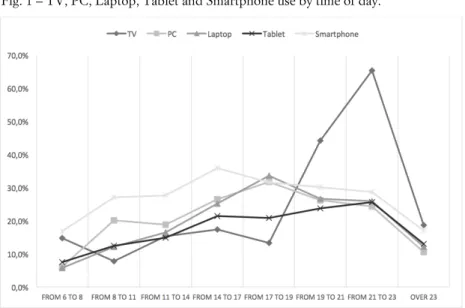
Fig. 1 – TV, PC, Laptop, Tablet and Smartphone use by time of day.
Source: Osservatorio Social TV 2015 – CAWI – 1,082 Italians aged from 12 to 64 in May 2015.
under the age of 34 predictably exhibit the most innovative practices since they have rapidly become familiar with screen devices, using them in their daily activities (work/study/leisure time). The Smartphone is the preferred screen for users under the age of 20: more than 70% use it to watch TV content, with 36.5% stating that they use it for their usual viewing practices.
As for the temporality of consumption, the multiplication of screens is managed by the audience, who consciously and naturally do so during the day and progressively absorb time slots not previously destined for television.
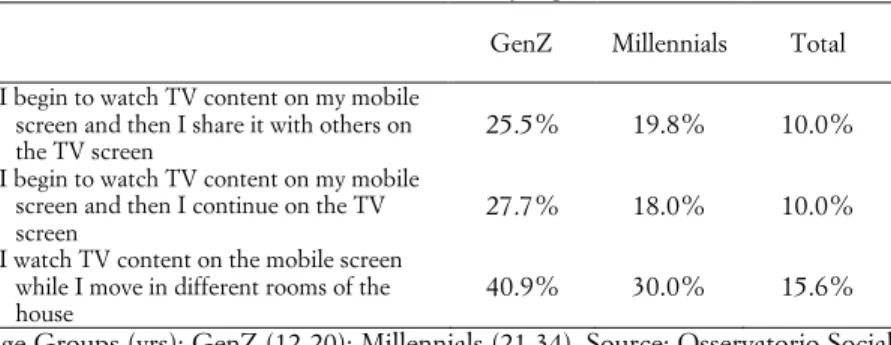
Young people are exceptionally willing to circulate content across screens: more than a quarter of GenZ usually start watching TV content on a mobile screen and continue on a traditional TV screen; or they start to watch individually and then continue on a bigger screen sharing the experience with others.
Tab. 2 – Content circulation across screens (only regular users).
GenZ Millennials Total
I begin to watch TV content on my mobile screen and then I share it with others on the TV screen
25.5% 19.8% 10.0%
I begin to watch TV content on my mobile screen and then I continue on the TV screen
27.7% 18.0% 10.0%
I watch TV content on the mobile screen while I move in different rooms of the house
40.9% 30.0% 15.6%
Age Groups (yrs): GenZ (12-20); Millennials (21-34). Source: Osservatorio Social TV 2015 – CAWI – 1,082 Italians aged from 12 to 64 in May 2015.
Screen availability, along with access to time-shifting services, create a variety of consumption scenarios that take place during the day, providing a new definition of TV temporality that is actually based on audience needs. Due to greater complexity in managing work and other obligations, viewing pre-recorded content with PVR devices is used by the majority of people up to age 50, especially by the middle-aged group. As for the contexts of usage, where time-shifting and place-shifting over-lap, we observe that watching TV on the web is also a viewing practice that is uniformly present across generations. “On demand” services pro-moted by broadcasters (Sky and Mediaset in Italy) is the usual viewing practice for almost 25% of teenagers but it decreases as age advances, in large part because current technological devices are not necessarily user-friendly.
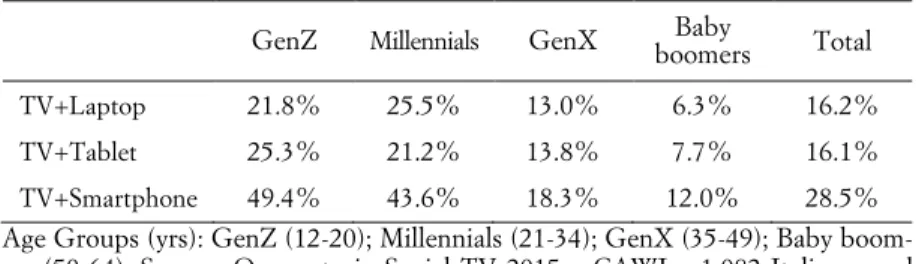
used, at least for the Smartphone, by a major component of the popula-tion (over 60%) and is split between regular and non-regular users. Around 20% fewer combine TV viewing practices with a laptop and/or tablet. The profile analysis shows significant generational differences: se-cond screening involves a high proportion of people up to age 34 (80% on a Smartphone, and more than 50% on a laptop), whereas the mature and older generations are not far behind in these multi-screening practic-es, although their usage is, for the most part, “non-habitual”.
Tab. 3 – Second screening while watching TV (only regular users).
GenZ Millennials GenX boomers Baby Total
TV+Laptop 21.8% 25.5% 13.0% 6.3% 16.2%
TV+Tablet 25.3% 21.2% 13.8% 7.7% 16.1%
TV+Smartphone 49.4% 43.6% 18.3% 12.0% 28.5%
Age Groups (yrs): GenZ (12-20); Millennials (21-34); GenX (35-49); Baby boom-ers (50-64). Source: Osservatorio Social TV 2015 – CAWI – 1,082 Italians aged from 12 to 64 in May 2015.
3.2 Multiple Touch Points with the Content
If we try to identify the reasons underlying the practices of time-shifting, place-shifting and multi-screening, we realise that these forms of access to television content, that no longer depend on the medium’s logic, are the result of the availability of multiple touch points with the content. These can originate from producers and their engagement strategies, but increasingly come from the construction of meaning that is produced and shared by the audience.
In terms of the media content, this is related to the growing narrative complexity of television (Mittell 2015) and the emergence of media busi-ness models that are built for a world of participatory circulation. On the other hand, In terms of the audience, this is the result of audience en-gagement (Askwith 2007) with media content, of the environment of par-ticipation (Jenkins 1992), and of fandom practices that have become normalised in everyday consumption (Andò and Marinelli 2012; Booth 2015). Thus, circulation is “a mix of top-down and bottom-up forces [which] determine how material is shared across and among cultures in far more participatory (and messier) ways” (Jenkins et al. 2013, 1).
con-tinually explorable, completable, spreadable, and shareable by the en-gaged audience. As Mittell (2015, 53) states with regard to serial forms:
This account of narrative complexity suggests that a new paradigm of television storytelling has emerged over the past two decades, with a reconceptualization of the boundary between episodic and serial forms, a heightened degree of self-consciousness in storytelling mechanics, and demands for intensified viewer engagement focused on both diegetic pleasures and formal awareness. By exploring the formal structure of this mode of storytelling we can appreciate connections with broader concerns of media industries and technologies, creative techniques, and practices of everyday life, all of which resonate deeply with contemporary cultural transformations tied to the emergence of digital media and more interactive forms of communication and entertainment.
It is these formal structures of television storytelling – and their re-working by the audience – that serve daily as touch points between the audience (and among the audience) and the content, in a continuous pro-cess of circulation that takes place in a networked media space, vertically and horizontally, synchronously and diachronically.
To empirically understand the circulation process we can attempt to represent content digital life on a map by tracing the process activation (who) and its temporal dimensions (when). With respect to process acti-vation, we can consider media content circulation to be the result of pro-ducer and distributor planning or audience activation. For the temporal dimensions we can look at the temporality of circulation by comparing of-ficial content release and the timing of audience consumption.
In the TV broadcast framework – as much in a regime of scarcity as in the age of plenty (Ellis 2000a) – content circulation was directly linked to its broadcast and essentially contained within it; in the connected digital TV circulation inevitably relies on distribution logic (such as the latest modalities introduced by Netflix) along with audience engagement in the process of content diffusion. In other words, along a continuum, at one end we find circulation that is fully managed from the top, which was typ-ical of the broadcasting era. At the other end, we see circulation that is mostly managed by consumers, originating primarily from fandom expe-riences (Jenkins 1992; Bacon Smith 1992) and reflected in contemporary consumption strategies.
Although it is currently difficult to isolate such widely varying modes of circulation, co-participation between producers and audience under the label of social TV (Andò and Marinelli 2014) appears to be prevalent. As stated earlier, within this definition there are very broad and diverse practices that are carried out by the audience and the producers, both of whom work on expanding television consumption beyond the boundaries of individual content through activities of commenting, sharing, searching and producing.
To better understand this step it is worth considering one of the sim-plest aspects of television content circulation: the launch phase of the product, which is ideally considered as the starting point of the circula-tion process. In the framework of broadcast television and television flow described by Williams, the television promo had the purpose of announc-ing the start of a new product in a specific time scale (the next few hours, the same day or, at most, the next few days) and a specific space (that of the TV network), essentially enabling the viewer to be pulled into a view-ing experience from which it was difficult to escape, also due to these narrative junctions (Johnson 2013). Osservatorio’s data confirm the relevance of TV promotions (74% considering usual and not usual haviours), of zapping activity (91% considering usual and not usual be-haviors) and of EPG (electronic programming guide) (84% considering usual and not usual behaviours).
Today, in addition to these more or less traditional communication formulae, there are others that depend on the social strategies of the broadcaster (see Tab. 4). In a context of strong competition for the atten-tion of a niche audience, networks tend to personalise the relaatten-tionship with the audience using quasi-informal channels of interaction through which new content is signalled in order to urge viewing, create engage-ment and participation, and strengthen audience loyalty.
Tab 4 – Social strategy of the broadcaster
Usually Not usually
I follow the Facebook account of the
channel/network 13.4% 25.3%
I follow the Twitter account of the
channel/network 10.2% 22.3%
I follow the Facebook account of the
programme 12.4% 25.5%
I follow the Twitter account of the
programme 10.6% 21.6%
I follow the Facebook account of the
programme’s anchorman/star 11.9% 22.8%
I follow the Twitter account of the
programme’s anchorman/star 10.4% 21.4%
This continuous production of (supplemental) content related to (original) television content that is created by networks, programs, and presenters/stars, acts as a multiplier of visibility and access (see Tab. 5). The circulation of content can therefore be initiated by any of the differ-ent differ-entities that produce the contdiffer-ent, with their digital narration commu-nicated through social media.
Tab 5 – TV content as expanded text in consumption experience
GenZ Millennials GenX Baby boomers
I watch only TV programmes
(original format) 50.0% 56.1% 73.3% 83.5%
I watch both TV programmes and
related contents (UGC on social
media, mobi/webisodes, video extra)
44.1% 33.9% 18.3% 12.0%
Age Groups (yrs): GenZ (12-20); Millennials (21-34); GenX (35-49); Baby boom-ers (50-64). Source: Osservatorio Social TV 2015 – CAWI – 1,082 Italians aged from 12 to 64 in May 2015.
As a matter of fact, content appropriation and constant engagement encourage the audience to take charge of the viral diffusion process, cre-ating more potential touch points for the connected audiences (as exem-plified in Facebook’s algorithm that weighs the actual and potential audi-ence – friends of friends – of a particular post).
Tab 6 – How to decide what to watch
Usually Not usually
I turn on the TV because of Whatsapp interactions
about what’s on the air 13.6% 25.8%
I turn on the TV because I am on social media and I
am discussing something on air that intrigues me 13.6% 30.1%
I choose what to watch because of the information
and/or suggestions on social media before airing 18.3% 40.7%
Source: Osservatorio Social TV 2015 – CAWI – 1,082 Italians aged from 12 to 64 in May 2015.
of their interaction and online sharing practices. Falling into this type of behaviour are all those cases where audiences access media content on the basis of suggestions, recommendations, and live interactions. Consid-ering both regular and not regular users, over 58% of the sample sur-veyed by Osservatorio Social TV decide what to watch on TV based on the information received from interactions on Facebook and/or Twitter, or decide to turn on the TV (44%) on the basis of online discussions ac-cessed or participated in, or receive suggestions and/or recommendations via Whatsapp (40%).
3.3 The Expanded Digital Life of the TV content
In the cases described above, content circulation begins in a broader environment than one that defines the medium of television and its logic. Content comes to the attention of the audience through forms of hybridi-sation between the TV and the Internet, as in the case of television social media strategy, or from collective online sharing, as in the case of social networking sites or chat.
In this broad transmedia and connected environment, the expanded television texts that the audience interacts with offer other touch points with content that guarantee a more substantial consumption experience that enlarges the boundaries of simple viewing. Returning to the question of the narrative complexity of television content, today’s media content offers the audience infinite points of access and opportunities for en-gagement that revolve mostly around the recreational aspect of consump-tion. In learning from fandom practices, from textual poaching to collect-ing and cosplaycollect-ing (Fiske 1987; Jenkins 1992) that expand the borders of the cult content to a total appropriation of the product, media producers now know that they have to respond to the desires of the audience to build an intense relationship with the product. In search of a relationship that is defined by Meyrowitz (1985) as para-social, which guarantees me-dia content a life far beyond viewing practices, they have created the op-tion of following and/or interacting with the stars of the media content.
Tab 7 – Audience practices off screen.
Usually Not usually
Buying premium content related to the
programme (music, dvds) 9.6% 20.2%
Online shopping of products shown in TV
content or during commercials 9.8% 21.9%
Following the celebrity on Twitter, Facebook
or Instagram 11.9% 21.8%
As documented by Osservatorio Social TV, a third of audiences are engaged in following celebrities on social media and posting and sharing their images in order to satisfy a need to feel close to the content (Mar-wick 2011); they may even be interested in copying outfits (Andò 2015) or buying product brands seen on screen and using them as transitional objects (Hills 2002) or identity markers. In all these cases we find con-sumer behaviour that becomes a true replication of television content, which definitively goes beyond the screens and is reflected in everyday life, where it is used in interactions with others, thereby initiating further processes of circulation and sense-making. According to Osservatorio, these practices that take advantage of the potential use of a connected se-cond screen, either during or after watching TV content, are seen in about 30% of the Italian sample (as both an habitual and non-habitual practice), mostly in the younger generations, but they potentially involve a further 15% of the subjects.
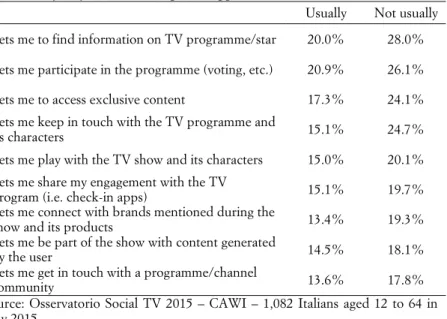
Tab. 8 – Why do you use TV companion apps?
Usually Not usually
It lets me to find information on TV programme/star 20.0% 28.0%
It lets me participate in the programme (voting, etc.) 20.9% 26.1%
It lets me to access exclusive content 17.3% 24.1%
It lets me keep in touch with the TV programme and
its characters 15.1% 24.7%
It lets me play with the TV show and its characters 15.0% 20.1%
It lets me share my engagement with the TV
program (i.e. check-in apps) 15.1% 19.7%
It lets me connect with brands mentioned during the
show and its products 13.4% 19.3%
It lets me be part of the show with content generated
by the user 14.5% 18.1%
It lets me get in touch with a programme/channel
community 13.6% 17.8%
Source: Osservatorio Social TV 2015 – CAWI – 1,082 Italians aged 12 to 64 in May 2015.
consump-tion. The digital life of content expands along a greater spectrum that crosses the same time and space while taking on another form of the con-tent and thereby representing an extension, a reference, a continuation. The programme’s music becomes a further segment of the original media content that can be claimed and which keeps the content alive; the pur-chase of the DVD becomes a collecting strategy to replicate the viewing experience whenever you want.
At the same time, the downloading of applications built for the se-cond screen allows the audience to expand the recreational content space using innovative means that are unavailable in the original content and are experienced in transmedia forms, as seen in our research data. Apps enable users to discover additional information about programmes and characters (48% of the sample), and to play with (35%) and participate in (47%) the programme. They encourage audiences to follow the stars even after the programme has aired (40%), maintaining an ongoing rela-tionship with the familiar faces of the stars and providing access to exclu-sive content (41%) that represents a transmedia expansion of the original content.
In a way, this group of practices represents an extension of the con-tent itself and its re-actualisation in audience consumption experiences. This practices and media forms clearly indicate the rigidity of theoretical reflections that focus on an individual device and its original technologi-cal form.
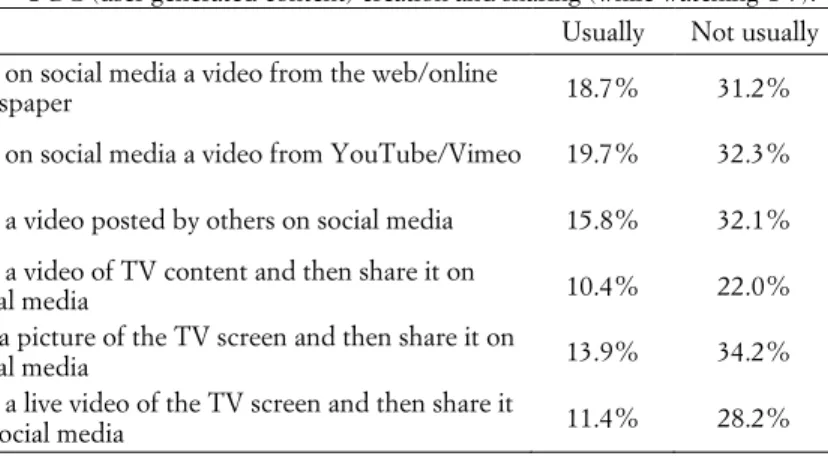
Tab. 9 – UGC (user generated content) creation and sharing (while watching TV).
Usually Not usually
Share on social media a video from the web/online
newspaper 18.7% 31.2%
Share on social media a video from YouTube/Vimeo 19.7% 32.3%
Share a video posted by others on social media 15.8% 32.1%
Make a video of TV content and then share it on
social media 10.4% 22.0%
Take a picture of the TV screen and then share it on
social media 13.9% 34.2%
Make a live video of the TV screen and then share it
on social media 11.4% 28.2%
Source: Osservatorio Social TV 2015 – CAWI – 1,082 Italians aged from 12 to 64 in May 2015.
on the web. The screen shot of a programme broadcast on a television screen or any other device is not the programme itself, even if it contrib-utes to the circulation of the original content. In the same way, videos, photographs, and drawings that the audience use to produce their own revised version of the original content act as a reinforcement of – or a touch point to – a specific content and determine its long tail in the mar-ket (Anderson 2006; Napoli 2010). We are speaking of practices that, tak-ing account of both habitual and sporadic consumption, are not so un-common, especially among the younger generations (their statistics are 7 to 10 percentage points higher than the total audience average).
These are no longer exclusively fandom or niche practices whose pur-pose was primarily to strengthen the relationship with the object of wor-ship among the fans within the framework of a closed community, but they are becoming normalised daily activities that nourish the social life of the audience and make the media content pervasive and timeless.
The question of viewing times leads us back, then, to our map and the management of content circulation time with respect to the needs of pro-ducers or consumers. This is the battlefield where propro-ducers and audi-ences are constantly engaged, which the latter are still unable to domi-nate. Or at least this is true as far as regards the first release of a product on the market. Even when we look at the most innovative OTT (Over the Top Television: see Wolk 2015) strategies (as in the case of Netflix) (Braun 2013), which make a serial product available to its subscribers in its entirety, ultimately dismantling the logic of the schedule (Ellis 2000b), we should keep in mind that the timing of the release is still set from the top and that in these cases the liveness, understood as content (and im-agery) that is available to all the audience, remains a constitutive and de-fining aspect of the television experience. However, it is equally clear that the degree of audience freedom in the creation of new user-generated consumption practices is still greater than it is in traditional television flow, even when based on market strategies that try to anticipate audience viewing behaviours. In on-demand television systems, therefore, it is worth referring to De Certeau’s idea of trajectory: the audience can act in environments defined by strategies using tactics (De Certeau 1984) and adjusting and modeling the temporal dimension of consumption,
alt-hough this happens anyway in the framework imposed from above.
intelligence, set forth by Jenkins (2006) regarding the affirmation of the Web 2.0. Once the touch point with the content is activated, the audience can appropriate it, freeing it from the logic of the medium, as seen in the phenomenon of binge watching (Jenner 2016) or post-object fandom (Williams 2015). The first phenomenon is useful in understanding how the time of consumption can be placed directly in the hands of the view-er, and even condensed to the maximum. A significant example of this is the experiment by fans of “24” (Imagine Entertainment, 20th Century Fox Television) who watch an entire season in 24 hours to adapt to the temporality of the story (Mittell 2006). The second phenomenon is ex-tremely relevant with respect to the persistence of content over time and its infinite circulation: the online presence of fandom communities en-courages their emotional bonds through media content beyond the time of cancellation, through user-generated content shared with other enthu-siasts. This is indicative of the effects of audience participation in the con-tent circulation process.
4. Conclusion
The evolution of the concept of flow from producer-controlled to us-er-controlled to circulation, as discussed, describes a trajectory that leads to the deconstruction and subsequent reformulation of the concepts of space, time, and medium.
The space is deconstructed in two senses. First, it is broken down through the use of different screens in which the flow is construct-ed/generated/exchanged and the specific use of contexts that govern or induce the choice of technology. Second, it is deconstructed by extending the conversations and social contacts that begin during consumption and which form a major part of the networked media space.
Data from Osservatorio Social TV confirm that place-shifting practic-es are widpractic-espread, practic-especially among the younger generations (GenZ, Mil-lennials), and TV content circulates on different screens during the day, accompanying other activities such as studying, working or relaxing. At the same time, multi-screening practices, mostly using a smartphone, pro-vide real time access to the networked media space where it is possible to find information and to start social interactions.
Time loses its original constraints and is restructured on the basis of a continuous negotiation. The circulation of content is nurtured and re-vived by the producer in expanded ways across multiple platforms and modes of release of digital content; audiences selectively choose the con-tent produced in their own personal flow, assigning it a time and, there-fore, a digital life.
plat-forms, constantly searchable, accessible on demand, and consumable at the right time by users.
Finally, with respect to the medium, the evolution from the concept of flow to that of circulation inevitably blurs the well-established boundaries between technological and cultural forms, leading to their hybridisation with the formats of interpersonal conversation in online environments. In the networked media space, the domains of communication are defini-tively mixed through “techno-social-spatial relations” (Chamberlain 2011) that can be established through the audience’s active contributions and participation.
As demonstrated by research data on TV content circulation within online environments, social media act as an inter-change platform where needs, desires, and pleasures of the audience converge. This results in the perception of an endless experience of TV consumption and the simulta-neous extension and independence of content life-time from those boundaries imposed by producers and broadcasters.
It is evident that the crumbling of technological and space-time barri-ers represents a condition that encourages and supports the extreme se-lectivity of the user in flow construction. Likewise, the visibility and traceability of consumer behaviour and interactions online provide a wealth of knowledge (Big data) that establishes new forms of potential audience discipline.
As for television, the ancient wisdom exercised by broadcasters in the construction of linear schedules will probably be replaced by the wisdom in Big data management by new-generation television operators (OTT services such as Netflix). What appears to the users’ free expression of their selectivity in the construction of personal flow within the circulation framework, will remain as a form of mediation between the careful plan-ning of the flow from producers/distributors/market researchers and the consumption practices carried out by the audience in the complexity of the pre-selected media content.
References
Anderson, C. (2006) The Long Tail: Why the Future of Business is Selling Less of
More, New York, Hyperion.
Andò, R. (2014) What Does TV Actually Mean? New Consumer Experience and
Generations, in “Participations. Journal of Audience & Reception Studies”, 11 (2), pp. 156-181.
Andò, R. (2015) ‘I Dress Really Well’. Fandom Identification and Fashion
through TV Series and Social Media: The Case of Claire Underwood’s Power Dressing, in “Critical Studies in Fashion & Beauty”, 6 (2), pp. 207-231.
Andò, R. and Marinelli, A. (2012) Dal textual poachers al Like/Dislike: quale
(2), pp. 347-357.
Andò, R. and Marinelli, A. (2014) Multiscreening and Social TV. The Changing
Landscape of TV Consumption in Italy, in “View. Journal of European Tele-vision History & Culture”, 3 (6), pp. 24-36.
Ang, J. (1991) Desperately Seeking the Audience, London, Routledge.
Aroldi, P. and Colombo, F. (2003) Le età della TV, Milano, VP Università.
Askwith I.D. (2007) Television 2.0: Reconceptualizing TV as an Engagement
Me-dium, Master’s Thesis, Cambridge, Massachusetts Institute of Technology.
Bacon Smith, C. (1992) Enterprising Women. Television Fandom and the
Crea-tion of Popular Myth, Philadelphia, University of Pennsylvania Press.
Barra, L. (2015) Palinsesto. Storia e tecnica della programmazione televisiva,
Ro-ma, Laterza.
Barra, L. and Scaglioni, M. (2014) TV Goes Social. Italian Broadcasting Strategies
and the Challenges of Convergence, in“View. Journal of European Television
History & Culture”, 3 (6), pp. 110-124.
Booth, P. (2015) Playing Fans: Negotiating Fandom and Media in the Digital
Age, Iowa, University of Iowa Press.
Braun, J. (2013) Going over the Top: Online Television Distribution as
Soci-otechnical System, in “Communication, Culture & Critique”, 6 (3), pp. 432-458.
Buonanno, M. (2008) The Age of Television: Experiences and Theories, Bristol,
Intellect Books.
Chamberlain, D. (2011) Media Interfaces, Networked Media Spaces, and the
Mass Customization of Everyday Space, in M. Kackman, M. Binfield, M.T.
Payne, A. Perlman and B. Sebok (eds.), Flow TV: Television in the Age of
Media Convergence, New York, Routledge, pp. 13-29.
Colombo, F. (ed.) (2015) Social TV. Produzione, esperienza e valore nell’era
digi-tale, Milano, Egea.
Couldry, N. (2004) Liveness, ‘Reality’, and the Mediated Habitus from Television
to the Mobile Phone, in “The Communication Review”, 7 (4), pp. 353-361.
De Certeau, M. (1984) The Practice of Everyday Life, Berkeley, University of
Cal-ifornia Press.
Ellis, J. (1982) Visible Fictions: Cinema, Television, Video, London, Routledge.
Ellis, J. (2000a) Seeing Things: Television in the Age of Uncertainty, London, IB
Tauris.
Ellis, J. (2000b) Scheduling: The Last Creative Act in Television?, in “Media,
Cul-ture & Society”, 22 (1), pp. 25-38.
Fiske, J. (1987) Television Culture, London, Routledge.
Adoring Audience: Fan Culture and Popular Media, London, Routledge, pp. 30-49.
Gillan, J. (2011) Television and New Media: Must-Click TV, New York,
Routledge.
Grasso, A. and Scaglioni, M. (2003) Che cos’è la televisione, Milano, Garzanti.
Gripsrud, J. (1998) Television, Broadcasting, Flow: Key Metaphors in TV Theory,
in C. Geraghty and D. Lusted (eds.), The Television Study Books, London,
Arnold, pp. 17-32.
Gripsrud, J. (ed.) (2010) Relocating Television. Television in the Digital Context,
London and New York, Routledge.
Hartley, J. (1992) Tele-ology. Studies in Television, London, Routledge.
Hills, M. (2002) Fan Cultures, London, Routledge.
Jenkins, H. (1992) Textual Poachers: Television Fans and Participatory Culture,
New York, Routledge.
Jenkins, H. (2006) Convergence Culture: Where Old and New Media Collide,
New York, New York University Press.
Jenkins, H., Ford, S. and Green, J. (2013) Spreadable Media: Creating Value and
Meaning in a Networked Culture, New York, New York University Press.
Jenner, M. (2016) Is This TVIV? On Netflix, TVIII and Binge-Watching, in
“New Media & Society”, 18 (2), pp. 257-273.
Jensen, J.F. (2008) The Concept of Interactivity – Revisited. Four New Typologies
for a New Media Landscape, in UXTV ‘08 Proceedings of the 1st Interna-tional Conference on Designing Interactive User Experiences for TV and Video, pp. 129-132.
Johnson, C. (2013) The Continuity of ‘Continuity’: Flow and the Changing
Expe-rience of Watching Broadcast Television, in “Key Words: A Journal of Cul-tural Materialism”, 11, pp. 23-39.
Kackman, M., Binfield, M., Payne, M.T., Perlman, A. and Sebok, B. (2011) Flow
TV: Television in the Age of Media Convergence, New York, Routledge.
Lotz, A. (2007) The Television Will Be Revolutionized, New York, New York
University Press.
Lotz, A. (2009) What is U.S. Television Now?, in “Annals of the American
Acad-emy of Political and Social Science”, 625 (1), pp. 49-59.
Marinelli, A. (2015) L’interattività della televisione. Da innovazione mai realizzata
a pratica quotidiana nel networked media space, in S. Arcagni (ed.), I Media digitali e l’interazione uomo-macchina, Roma, Aracne, pp. 275-304.
Marinelli, A. and Celata, G. (eds.) (2012) Connecting Television. La televisione al
tempo di Internet, Milano, Guerini e Associati.
Marwick, A. (2011) To See and Be Seen: Celebrity Practice on Twitter, in
Technolo-gies”, 17 (2), pp. 139-158.
Meyrowitz, J. (1985) No Sense of Place: The Impact of Electronic Media on
So-cial Behavior, Oxford, Oxford University Press.
Mittell, J. (2006). “Narrative complexity in contemporary American television”.
The Velvet Light Trap, vol. 58, issue 1, pp. 29–40.
Mittell, J. (2015) Complex TV: The Poetics of Contemporary Television
Storytell-ing, New York, New York University Press.
Napoli, P.M. (2010) Audience Evolution. New Technologies and the
Transfor-mation of Media Audiences, New York, Columbia University Press.
Scaglioni, M. and Sfardini, A. (2008) MultiTV. L’esperienza televisiva nell’età
del-la convergenza, Roma, Carocci.
Strangelove, M. (2015) Post-TV: Piracy, Cord-Cutting, and the Future of
Televi-sion, Toronto, University of Toronto Press.
Uricchio, W. (2004) Television’s next generation: technology/interface
cul-ture/flow, in L. Spigel and J. Olsson (eds.), Television After TV: Essays on a Medium in Transition, Durham, Duke University Press, pp. 232-261.
Uricchio, W. (2009) The Future of a Medium once Known as Television, in P.
Snickars and P. Vonderau (eds.), The YouTube Reader, Stockholm, National
Library of Sweden, pp. 24-39.
Uricchio, W. (2010) TV as Time Machine: Television’s Changing Heterochronic
Regimes and the Production of History, in J. Gripsrud (ed.), Relocating Tele-vision. Television in the Digital Context, London and New York, Routledge, pp. 27-40.
Williams, R. ([1974] 2003) Television: Technology and Cultural Form, London,
Routledge.
Williams, R. (2015) Post-Object Fandom: Television, Identity and Self-narrative,
London, Bloomsbury.
Wolk, A. (2015) Over the Top. How the Internet is (Slowly but Surely) Changing