Abstract— The capacity of the available buffer size in a
node is limited. The limited buffer size of each node leads to congestion in the network. In such a case management of buffer in a node plays important role. We propose compression technique that helps to reduce the burden on the buffer and increases the throughput of the network. The proposed compression technique is implemented on hardware and operates real-time to capture data. For the implementation of proposed compression technique we are using a hardware called AVR kit AT mega 32.There are two kits which are act as two nodes in the network. These two nodes are sending data packets in form of bytes to each other. For the data compression we are using Run Length encoding algorithm which show that the proposed technique gives better compression result compared to prior works.
Keywords:
AVR kit AT mega 32, buffer management, compression of data
I. INTRODUCTION
Delay tolerant network (DTN) or wireless sensor network is a highly heterogeneous network, where end-to-end connection cannot be guaranteed. In this network the link often breaks, link delay and transmission capacity change over time. In delay-tolerant network two major issues should be considered to achieve data delivery in such challenging networking environments: a routing strategy for the network and a buffer management policy for each node in the network [1]. The routing strategy determines which messages should be forwarded when nodes meet and the buffer management policy determines which message is purged when the buffer overflows in a node [1].
Manuscript received May 20, 2012..
Ms. Amruta A. Deshmuk, Computer Science and Engineering, G.H.Raisoni College of Engineering Affiliated to Rashtrasanth Tukdoji Maharaj Nagpur University, Nagpur, India,
Ms. Veena A. Gulhane, Computer Science and Engineering, G.H.Raisoni College of Engineering Affiliated to Rashtrasanth Tukdoji Maharaj Nagpur University., Nagpur, India.
Data compression is also called as source coding. It is the
process of encoding information using fewer bits than an uncoded representation is also making a use of specific encoding schemes. Compression is a technology for reducing the quantity of data used to represent any content without excessively reducing the quality of that data. It also reduces the number of bits required to store and/or transmit. Compression is a technique that makes storing easier for large amount of data [2]. This proposes an enhanced buffer management policy that utilizes compression technique. In this paper, we are using compression technique for buffer management in such networks. Primarily we compared two algorithms of compression i.e. Huffman coding and Run Length encoding. We will use the generic term message for the objects we want to compress, which could be either packets or messages. The task of compression consists of two components, an encoding algorithm that takes a message and generates a “compressed” representation, and a decoding algorithm that reconstructs the original message or some approximation of it from the compressed representation. We are using Run length encoding for compression of data or messages in buffer. This algorithm helps us to compress the buffer in the network when it gets overflow. As this buffer gets compressed it will make some space for new incoming packet and thus by doing this repeatedly we can reduce the burden on the buffer. Here the buffer size of the node is limited which is 512 bytes. For this implementation we are using a hardware called AVR kit AT mega 32. There are two kits of AVR which will act as two nodes in the wireless network. These kits are having transmitters and receivers which are used to transmit and receive wireless data to and from the network.The expected results on real-world mobility trace data and synthetic data will show that the proposed buffer management technique yields better results over the history-based drop and traditional policies, such as the shortest lifetime first, the most forwarded first in terms of the number of message deliveries and average delay.
In this paper we try to solve buffer overflow problem by using compression technique. This compression technique includes Run Length Encoding (RLE).When the buffer gets overflow in the network; by using RLE we will compress the buffer size. We will divide this buffer size into three levels l1, l2, and l3. Until now work done on buffer management is using the policies like drop tail and drop front policy [10], first in first out policy, the most forwarded first (MOFO)
Use of Compression Technique
to Improve Efficiency of Buffer
in Mobile Network
policy [11]. But we are trying to reduce the buffer size using compression technique like RLE and uses FIFO policy.
II. Review of Literature:
The performance of a WSN or DTN can be deteriorated as the network has high load of packets or messages since the
limited buffer size of each node leads to serious traffic congestion. Buffer management policy is crucial for wireless sensor network (WSN) as well as Delay Tolerant Networks. Many buffer management policies for WSN are adopted to release the burden of the buffer to increase the throughput of the network without increasing the transmission delay. But the buffer management policy for DTN has not been studied adequately.
Another important issue that must be considered in DTN is the impact of buffer management policies because DTN basically uses a store-carry-forward routing protocol [10]. In store-carry-forward routing, if the next hop is not immediately available for the current node to forward a message, the node should store the message in its buffer and carry it along while moving until the node gets a communication opportunity to forward this message farther [8]. Therefore the nodes must be capable of buffering messages for a considerable time. Moreover, to increase the probability of delivery, we need to ensure the messages are replicated many times in the network because of the lack of complete information about other nodes [8]. As a result, the limited buffer in each node is likely to be consumed rapidly when the flooding messages are stored.
DTN is expected to become increasingly important in next generation Internet structures. One of the important research issues in DTN is buffer management [5]. The suggested policy utilizes the properties of each message such as the number of replicas, the remaining TTL and the age to calculate the utility value of each message. With these utility values, a node can decide which message should be purged from its buffer whenever the buffer overflows. The experimental results on the real-world mobility trace data and synthetic data confirm that the proposed policy works well in DTN regardless of the size and structure of the network [1]. By analyzing the scenario of connectivity of nodes in DTN, some article designs two-layered node movement model, divides the DTN into mobile nodes layer and the backbone nodes layer [2]. On this basis, a new data forwarding algorithm MDL, combined with mobile node‟s moving direction and relative position, is designed. MDL data forwarding algorithm is simulated through simulation experiment. Simulation results show that, compared with CAR algorithm, MDL algorithm [6] is more accurate in the choice of the message as the next hop node, more efficient in forwarding rate and success rate, and with the node‟s speed increasing, the advantage of MDL algorithm performs better [6].The control of forwarding in DTNs employing epidemic relaying, and obtained the optimal policy has been studied already [9].
An asymptotically optimal policy that does not require any information on the dynamic network state, and hence is feasible [3].DTN, which is one of the ultimate edges of the scientific researchers, represents a specific solution for
delivering messages in intermittent networks using a store-and-forward approach. There is an optimal theory to give a deep insight into the sequence of message forwarding
and discarding. In particular, buffer management
optimization strategy considering delivery ratio, delay, and overhead simultaneously is presented to significantly improve the overall performance of routing algorithms in DTNs [4].
Advanced buffer management policies for DTN have recently been proposed called the global knowledge-based drop, which is based on global knowledge about the network and also proposed a distributed algorithm called the history-based drop (HBD) which uses statistical learning to approximate the global knowledge required by the global knowledge based drop policy. This is applicable in situations where the bandwidth is limited and messages vary in size [9].
Summary of Literature Survey
Thus it is showed that widely used traditional buffer management policies, such as drop tail and drop front, can be applied to DTN though they perform poorly in DTN. Also evaluated diverse traditional buffering policies with the following strategies: first in first out policy, evict the most forwarded first (MOFO) policy [9], evict the most favorably forwarded first policy, evict the shortest lifetime first (SHLI) policy and evict the least probable first policy. They concluded that the MOFO is the best buffering policy in terms of the message deliveries and that the SHLI is the best in terms of the average delay.
These traditional buffer management policies are very reasonable and easy to implement as long as the buffer size on all hosts is larger than the expected number of messages at any given time. But whenever the available buffer size is limited in relation to the number of messages, these policies perform poorly in a DTN environment.
III. The Proposed Scheme
A.Objectives of the Study
The objective of this study is to develop an efficient space based buffer management using compression. (1) Latency: the average duration between a message‟s generation and the arrival time at the last destination. (2) Compression: makes space in buffer for incoming node when the buffer is overflow. For maximization of the message deliveries and minimization of the average delay, two utility functions are proposed on the basis of message properties, the number of replicas and the remaining time-to-live.
B.Impact Of Buffer Size On Network
for long period of time. This means that intermediate routers require enough buffer space to store all the messages that are waiting for future communication opportunities. For this, compression at buffer will make some space to store the message. However, it is typically possible to achieve robust delivery rates with substantially less buffer space. In general, the different nodes will have different buffer capacities.
C.Run Length Encoding Performance on various
Strings
In this section, we explain the algorithm which we are
using in compression technique i.e. Run Length encoding Here we are getting the compression ratio by RLE whe we applied it on any string dada. The work done is in MATLAB. Result shows that Run Length encoding is better and it gives 70% compression. There are n users in the network and buffer manages all this users on the basis of global information. If there is another user in the network and if the buffer size is full then buffer will get compressed using RLE algorithm. After this, there will be lot of space in the buffer for more users. When data will send out of buffer, it will first decompress and then send to respective node. The algorithm shows the ratio of compression i.e. with what ratio the data is compressed and the time elapsed of each algorithm.
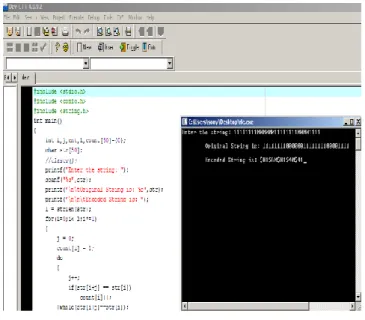
Fig 1: Snapshot for output
Fig shows the output of the algorithm i.e. Run Length Encoding. The output shows that there are 30 bits in the original string. But after applying Run Length Encoding this will get compress to 15 bits. By dumping this c code into the AVR kit we will compress the buffer up to some extent and will make space for new incoming packets.
OUTPUT:
Enter the string: 111111110000001111111100001111 Original string is: 111111110000001111111100001111 Encoded string is: $81$60$81$40$41
Graphical result
Fig 2 : Compression % given by RLE for different strings
From the result we can say that Compression percentage given by RLE is increases for different string values. The graphical result show output for various inputs taken and show the result in form of % values. Color lines indicate the output for various inputs.
IV. Proposed Scheme Result
The proposed technique uses Run Length encoding for compression in buffer. For this we are using two AVR kits AT mega 32. These kits act as two nodes in the wireless network. These kits are having transmitters and receivers which are used to transmit and receive wireless data to and from the network. With the help of this algorithm, we try to minimize buffer load by compression. We focus on buffer overflow, if buffer gets overflow then by using this algorithm we compresses the data in the buffer.
Features of AVR kit AT mega 32:-
• High-performance, Low-power Atmel AVR 8-bit Microcontroller
• Advanced RISC Architecture
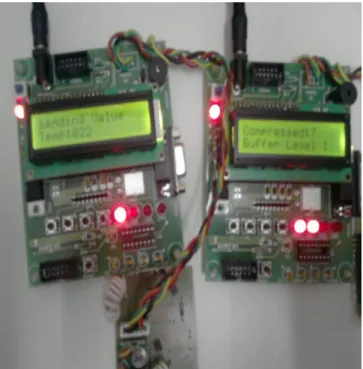
Fig 3: AVR kit showing compression at buffer level 1 Figure shows the proposed system for buffer compression which is showing compression at buffer level 1. Here these two kits are act as both transmitter and receiver. Node 1 is sending data to Node 2, and Node received that data at the same instant. When node 2 received data of 50 bytes, it will glow the LED on AVR kit and gives compressed data of 7 byte at buffer level 1 according to the values.
Fig 4: AVR kit showing compression at buffer level 2.
Figure shows output for hardware module. Here at level 2
compressed data is of 9 byte. In level 1 2nd LED glows which
shows that data reception of 50 bytes are over and shows compressed data of 7 bytes means the compression ratio of
buffer level 1 is 86%. And at buffer level 2 3rd LED glows
which shows that data reception of 50 bytes are over and shows compressed data of 9 bytes means the compression
ratio for buffer level 2 is 82% in the same pattern it will show compression ratio for buffer level 3 also.
Fig 5: AVR kit showing buffer fully compressed at buffer level 3
Once we get input from nodes in the wireless network, then we apply Run Length encoding for compression of data this will give us about 70% compressed data. Each time when buffer get full at its respective level the buzzer goes on and gives the indication for buffer full. Fig 5 shows buffer fully compressed at level 3 and all LED‟s glow and buzzer gives long beep.
A.Run Length Encoding:
RLE is suited for compressing any type of data regardless of its information content, but the content of the data will affect the compression ratio achieved by RLE. Although most RLE algorithms cannot achieve the high compression ratios of the more advanced compression methods, RLE is both easy to implement and quick to execute, making it a good alternative to either using a complex compression algorithm or leaving your image data uncompressed.
RLE works by reducing the physical size of a repeating string of characters. This repeating string, called a run, is typically encoded into two bytes. The first byte represents the number of characters in the run and is called the run count. In practice, an encoded run may contain 1 to 128 or 256 characters; the run count usually contains as the number of characters minus one (a value in the range of 0 to 127 or 255). The second byte is the value of the character in the run, which is in the range of 0 to 255, and is called the run value.
B.H/W and S/W REQUIREMENT:
1. H/W Requirement: AVR Controller, RF Module
The Atmel AVR ATmega32 is a low-power CMOS 8-bit microcontroller based on the AVR enhanced RISC architecture. By executing powerful instructions in a single
approaching 1 MIPS per MHz allowing the system designed to optimize power consumption versus processing speed.
2. S/W Requirement: Embedded C, Win AVR, mat lab
For the implementation of this space based buffer management using compression technique we are using a
hardware module i.e. AVR kit AT mega 32. For this we are
having two kits of AVR. These kits act as two nodes in the wireless network. These kits are having transmitters and receivers which are used to transmit and receive wireless data to and from the network. This two AVR kits act as two nodes in the network. These two nodes are sending data packets in form of bytes to each other. There is a buffer of limited size in each node. This nodes are node A and node B. Node A is
sending datapackets to node B,When node B‟s buffer size is
gets overflow it will show message on the LCD of AVR kit i.e. Buffer Full and then show message for purging buffer i.e. we need to purge buffer up to some extent to get incoming data from other nodes. The buffer size will be limited which we have to set for this buffer compression technique ex. 800 bytes.
C.Performance Comparison:
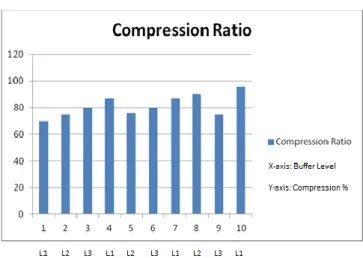
Fig 6: Comparison in form of compression ratio
Figure shows graphical representation for various outputs in form of compression ratio. 1, 2, 3 shows compression ratio for level L1, L2, L3 again 4, 5, 6 shows compression ratio for level L1, L2, L3 and similarly 7, 8, 9 for level L1, L2, L3 are respectively on X-axis. And Y-axis shows compression percentage for each level respectively.
D.DESCRIPTION
With the help of this algorithm, we try to minimize buffer load by compression. We focus on buffer management in nodes; if buffer gets full then by using RLE we compress the data in the buffer. EEPROM (Electronically Erasable Programmable Read Only Memory) is used as buffer at this two nodes. EEPROM is inbuilt memory in AVR kit AT mega 32.
In the 1st module we showed that RLE is better to use than Huffman Coding. And we showed C code for Run Length Encoding. There are two AVR kits AT mega 32 which are act as two nodes in the network. These two nodes are sending and receiving data with the help of transceiver. There is a buffer of size 512 bytes. If this buffer gets full then we apply Run Length Encoding so that it will compress the recursive bits and make space for new incoming node in the network. By dumping C code into the AVR kit we can compress the buffer size so that new incoming data will get the space in buffer.
Once we get input from nodes in the wireless network, and if the buffer size gets full then we apply RLE to the input So that it will give us about 80% to 90% compression in buffer. Also we showed graphical representation for compression ratio by taking various inputs at level L1, L2, L3.
V. CONCLUSION
In this work, we investigate the buffer management problem in mobile Network. First of all we showed the performance of RLE on various strings. And result show that RLE algorithm is better when it applies on large number of string. The proposed scheme for buffer compression uses RLE algorithm. When the buffer of a node is full, our buffer compression technique is able to reduce the buffer size up to 70% so that new incoming nodes in the network will get the space in the buffer.
Proposed scheme uses a hardware called AVR kit AT mega 32 and EEPROM as buffer at nodes. These are two kits, which are acts as two nodes in the network. These two kits will show the buffer overflow and buffer compression in the network. The buffer size limits the amount of memory and network resources consumed through routing. In the prior work for buffer management distributed algorithm like HBD or the policies like MOFO used, but for the compression in buffer we use RLE. The result gives about 70% to 80% compression as compared to existing techniques of buffer management. This will reduce the problem of buffer overflow in the network. Results indicate that our approach yields better compression at each node in mobile networks.In future works, we plan to implement suggested buffer compression technique into real devices so that we can verify the performance of the compression technique used in real situations.
REFERENCES
[1] K. Shin S. Kim “Enhanced buffer management policy that utilises message properties for delay-tolerant networks” IET Commun.,Vol. 5, Iss. 6, pp. 753–759 2011
[2] Du Xuehui ,Wang Yadi ,Chen Xingyuan ,Wang Zhen “Research on DTN Data Forwarding Algorithm Based on Node‟s Position and Moving Direction”978-1-61284-459-6/11/©IEEE 2011
[3] Chandramani Singh, Anurag Kumar, Rajesh Sundaresan, Eitan Altman “Optimal Forwarding in Delay Tolerant Networks with Multiple Destinations” 978-1-61284-824-2/11/© IEEE 2011
[4] Lei Yin, Hui-mei Lu, Yuan-da Cao, Jian-min Gao “Buffer Scheduling Policy in DTN Routing Protocols” 978-1-4244-5824-0/ c IEEE 2010
[6] L. Yin, Y.D. Cao, and W. He, “Similarity Degree based Mobility Pattern Aware Routing in Delay Tolerant Neworks”, in Proc. IEEE IUCE, pp.345-348, 2009
[7] K. G. Sandulescu, S. Nadjm-Tehrani, "Opportunistic DTN routing with window-aware adaptive replication", in Proc. ACM Asian Conference on Internet Engineering, pp. 103-112, 2009
[8] Amir Krifa, Chadi Barakat, Thrasyvoulos Spyropoulos “Optimal Buffer Management Policies for Delay Tolerant Networks” 978-1-4244-1777-3/08/© IEEE 2008
[9] Zhang, X., Neglia, G., Kurose, J., Towsley, D.: „Performance modeling of epidemic routing‟, Comput. Netw., 51, (10), pp. 2867–2891 2007 [10] Krifa, A., Barakat, C., Spyropoulos, T.: “An optimal joint scheduling
and drop policy for delay tolerant networks”. Proc.Int. Workshop on Autonomic and Opportunistic Communication, Newport Beach, CA, pp. 16 ,June 2008
Ms. Amruta A. Dshmukh received the B.E. degree in Computer Science and Engineering from Sipna College of Engineering, Santa Gadge Baba Amravati University in 2009 and persuing M.E. degree in Wireless Communication and Computing from G.H.R.C.E college, Nagpur university. Her research work includes wireless communication, wireless sensor network.