Modeling Discriminative-Based Features with Genetic
Algorithm for Human Identity and Gender Recognition
from Gait Sequences
Ms.M.RAJANANDHINI.,M.E., (CSE),
JAY SHRIRAM GROUP OF INSTITUTIONS, TIRUPPUR.
Abstract— Gait recognition is a challenging image processing technology for biometric identification that has been developed rapidly during the past few years. There is a challenge exist that human identity and gender recognition from gait sequences with arbitrary walking directions is promising, so that a more practical human gait analysis system can be developed. Earlier work used cluster-based averaged gait image as features for human identity and gender recognition from gait sequences. However, this approach failed when the walking style in the testing sequence is significantly different from that in the training sequences. That is because there are large differences for the C-AGI features of the same subject in such scenarios. To address this, the present work extracts more discriminative modal-based features to improve the performance of human identity and gender recognition from gait sequences. The proposed work investigates the fusion of several features extracted from manually-labelled human silhouettes. More discriminative modal-based features for human gait recognition are based on the combination of three discriminative features, such as the area, the gravity centre, and the orientation of each body component. The optimal features from this are selected using Genetic algorithm. Finally the selected features are used for recognition purpose by learning the distance metric by using sparse reconstruction based metric learning method. Experimental results show that the proposed method exhibits considerably better performance, in comparison to all existing method.
INTRODUCTION
Data mining is the process of extracting or mining knowledge from large amount of data. It is an analytic process designed to explore large amounts of data in search of consistent patterns and systematic relationships between variables, and then to validate the findings by applying the detected patterns to new subsets of data. It can be viewed as a result of natural evolution of information in development of functionalities such as data collection, database creation, data management, data analysis. It is the process where intelligent methods are applied in order to extract data patterns from databases, data warehouses, or other information repositories. The data mining is a step in the knowledge discovery process. The data mining step interacts with a user or a knowledge base. There are different data repositories on which mining can be
Mr.T.YOGANANTH.,M.E., ASSISTANT PROFESSOR/CSE, JAY SHRIRAM GROUP OF INSTITUTIONS
TIRUPPUR
performed. The major data repositories are relational databases, transactional databases, time-series databases, text databases, heterogeneous databases, and spatial databases. The data mining concept can be classified into two types: descriptive and predictive. Descriptive mining tasks characterize the general properties of the data in the database. Predictive mining tasks perform inference on the current data in order to make predictions. Data mining systems can be classified according to the kinds of databases mined, the kinds of knowledge mined, the techniques used, or the applications adapted. This query language can be designed to support adhoc and interactive data. The functionalities are concept and class descriptions, associations and correlations, classification and prediction, cluster analysis and outlier analysis. Concise and precise descriptions of a class or a concept are called concept and class description. Frequent patterns are the patterns that occur frequently in data. Mining frequent patterns lead to the discovery of interesting associations and correlations within data. Classification is the process of finding a model that describes and distinguishes data classes or concepts. The process of finding interesting, interpreted, useful and novel data from a large set of data is known as Knowledge Discovery in Databases (KDD). The steps involved in mining the data are as follows: Pre-processing, mine the data and interpret the results. The Foundations of Data Mining
Data mining techniques are the result of a long process of research and product development. This evolution began when business data was first stored on computers, continued with improvements in data access, and more recently, generated technologies that allow users to navigate through their data in real time. Data mining takes this evolutionary process beyond retrospective data access and navigation to prospective and proactive information delivery.
Steps in the data mining
Data Integration: First of all the data are collected and integrated from all the different sources.
Data Selection: We may not all the data we have collected in the first step. So in this step we select only those data which we think useful for data mining.
Data Cleaning: The data we have collected are not clean and may contain errors, missing values, noisy or inconsistent data. So we need to apply different techniques to get rid of such anomalies.
appropriate for mining. The techniques used to accomplish this are smoothing, aggregation, normalization etc.
Data Mining: Now we are ready to apply data mining techniques on the data to discover the interesting patterns. Techniques like clustering and association analysis are among the many different techniques used for data mining. Pattern Evaluation and Knowledge Presentation: This step involves visualization, transformation, removing redundant patterns etc from the patterns we generated. Decisions / Use of Discovered Knowledge: This step helps user to make use of the knowledge acquired to take better decisions.
Data mining process Profitable Applications
A wide range of companies have deployed successful applications of data mining. While early adopters of this technology have tended to be in information-intensive industries such as financial services and direct mail marketing, the technology is applicable to any company looking to leverage a large data warehouse to better manage their customer relationships. Two critical factors for success with data mining are: a large, well-integrated data warehouse and a well-defined understanding of the business process within which data mining are to be applied (such as customer prospecting, retention, campaign management, and so on).
INTRODUCTION ABOUT INFORMATION
FORENSICS AND SECURITY
Information forensics and security (sometimes known as computer forensic science) is a branch of digital forensic science pertaining to legal evidence found in computers and digital storage media. The goal of computer forensics is to examine digital media in a forensically sound manner with the aim of identifying, preserving, recovering, analyzing and presenting facts and opinions about the digital information. Although it is most often associated with the investigation of a wide variety of computer crime, computer forensics may also be used in civil proceedings. The discipline involves similar techniques and principles to data recovery, but with additional guidelines and practices designed to create a legal audit trail.
Evidence from computer forensics investigations is usually subjected to the same guidelines and practices of other digital evidence. It has been used in a number of high-profile cases
and is becoming widely accepted as reliable within U.S. and European court systems.
INTRODUCTION: GAIT RECOGNITION
Gait recognition is an emerging biometric technology which involves people being identified purely through the analysis of the way they walk. While research is still underway, it has attracted interest as a method of identification because it is non-invasive and does not require the subject’s cooperation. Gait recognition could also be used from a distance, making it well-suited to identifying perpetrators at a crime scene. But gait recognition technology is not limited to security applications – researchers also envision medical applications for the technology. For example, recognizing changes in walking patterns early on can help to identify conditions such as Parkinson’s disease and multiple sclerosis in their earliest stages.
Gait recognition technology is, however, still in its developing stages. No model has, as of yet, been developed that is sufficiently accurate and marketable. The technology is moving ahead at a rapid pace, however, with government-sponsored projects supporting research such as that going on at the Georgia Institute of Technology, MIT, the Lappeenranta University of Technology, and others academic institutions.
There are two main types of gait recognition techniques currently in development. The first, gait recognition based on the automatic analysis of video imagery, is the more widely studied and attempted of the two. Video samples of the subject’s walk are taken and the trajectories of the joints and angles over time are analyzed. A mathematical model of the motion is created, and is subsequently compared against any other samples in order to determine their identity.
The second method uses a radar system much like that used by police officers to identify speeding cars. The radar records the gait cycle that the various body parts of the subject create as he or she walks. This data is then compared to other samples to identify them.
Efforts are being made to make gait recognition as accurate and usable as possible, and while it may never be as reliable as other biometrics such as fingerprint or iris recognition, it is predicted that gait recognition technology will be released in a functional state within the next five years, and will be used in conjunction with other biometrics as a method of identification and authentication.
Gait and Gait Recognition
Gait analysis is the systematic study of animal locomotion, more specifically the study of human motion, using the eye and the brain of observers, augmented by instrumentation for measuring body movements, body mechanics, and the activity of the muscles. Gait analysis is used to assess, plan, and treat individuals with conditions affecting their ability to walk. It is also commonly used in biomechanics to help athletes run more efficiently and to identify posture-related or movement-related problems in people with injuries.
gait repeat as a walker cycles between steps with alternating feet. It is both the coordinated and cyclic nature of the motion that makes gait a unique phenomenon.
Examples of motion that are gaits include walking, running, jogging, and climbing stairs. Sitting down, picking up an object, and throwing and object are all coordinated motions, but they are not cyclic. Jumping jacks are coordinated and cyclic, but do not result in locomotion.
Therefore, define gait recognition to be the recognition of some salient property, e.g., identity, style of walk, or pathology, based on the coordinated, cyclic motions that result in human locomotion. In the case of biometric gait recognition, the salient property is identity. It make the distinction between gait recognition and what we call quasi gait recognition in which a salient property is recognized based on features acquired while a subject is walking, but the features are not inherently part of the gait. For example, skeletal dimensions may be measured during gait and used to recognize an individual. However, skeletal dimensions may be measured other ways, and are therefore not a property of the gait.
DATA IN GAIT RECOGNITION
This section describes an overview of the types of data used in gait and motion analysis systems
Background Subtraction
Background subtraction is a method for identifying moving objects against a static background. Although there are many variations on the theme, the basic idea is to
1. Estimate the pixel properties of the static background, 2. Subtract actual pixel values from the background estimates, and
3. Assume that if the difference exceeds a given threshold that the pixel must be part of a moving object.
Normally one follows the last step by forming connected components, or blobs, of moving pixels that correspond to the moving objects. Factors that confound background subtraction include background motion, moving objects that are similar in appearance to the background, background variations over long periods of time, and objects in close proximity merging together. In general, the variations on the theme of background subtraction involve selecting pixel properties to compare, background models, and innovations to address any number of confounding factors.
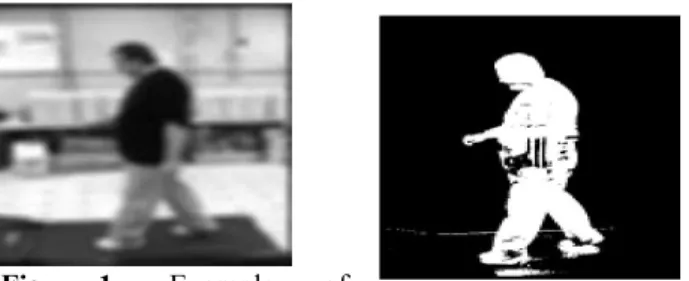
The following figure shows the background subtraction taken from the MoBo database
Fig. 1. Example of
background subtraction from MoBo database: (a) original image (deliberately blurred to conceal the subject’s identity), and (b) segmented image
Silhouettes
A silhouette is the image of a person, animal, object or scene represented as a solid shape of a single colour, usually black,
its edges matching the outline of the subject. The interior of a silhouette is featureless, and the whole is typically presented on a light background, usually white, or none at all. The silhouette differs from an outline which depicts the edge of an object in a linear form, while a silhouette appears as a solid shape. Silhouette images may be created in any visual artistic media, but the term normally describes pieces of cut paper, which were then stuck to a backing in a contrasting colour, and often framed.
Cutting portraits, generally in profile, from black card became popular in the mid-18th century, though the term “silhouette” was seldom used until the early decades of the 19th century, and the tradition has continued under this name into the 21st century. They represented a cheap but effective alternative to the portrait miniature, and skilled specialist artists could cut a high-quality bust portrait, by far the most common style, in a matter of minutes, working purely by eye. Other artists, especially from about 1790, drew an outline on paper, then painted it in, which could be equally quick. The leading 18th-century English "profilist" in painting, John Miers, advertised "three minute sittings", and the cost might be as low as half a crown around 1800. Miers' superior products could be in grisaille, with delicate highlights added in gold or yellow, and some examples might be painted on various backings, including gesso, glass or ivory. The size was normally small, with many designed to fit into a locket, but otherwise a bust some 3 to 5 inches high was typical, with half- or full-length portraits proportionately larger.
From its original graphic meaning, the term "silhouette" has been extended to describe the sight or representation of a person, object or scene that is backlit, and appears dark against a lighter background. Anything that appears this way, for example, a figure standing backlit in a doorway, may be described as "in silhouette". Because a silhouette emphasises the outline, the word has also been used in the fields of fashion and fitness to describe the shape of a person's body or the shape created by wearing clothing of a particular style or period.
PROBLEM DEFINITION
Human gait is an identifying feature of a person that is determined by his/her weight, limb length, and habitual posture. Hence, gait can be used as a biometric measure to recognize known persons and classify unknown subjects. Gait can be detected and measured at low resolution, and therefore it can be used in situations where face or iris information is not available in high enough resolution for recognition. We have designed a representation for the dynamics of human gait that facilitates the recognition and classification of people by their gait.
MOTIVATION
we have included appearance as part of our gait recognition features.
I. OBJECTIVE
1. More discriminative modal-based features to improve the performance of human identity and gender recognition from gait sequences.
2. The fusion of several features extracted from manually-labelled human silhouettes.
3. The optimal features from this are selected using Genetic algorithm.
4. Finally the selected features are used for recognition purpose by learning the distance metric by using sparse reconstruction based metric learning method.
II. EXISTINGSYSTEM
In existing human identity and gender recognition from gait sequences used cluster-based averaged gait image as features. C-AGI feature differs from the conventionally used GEI feature. C-AGI feature is the average silhouette of all frames within the same cluster where the GEI feature is the average silhouette of a complete gait cycle. In an image A pixel with higher intensity value in C-AGI represents more variations of static poses in gait feature, and a pixel with lower intensity means that human walking occurs more frequently at this position and more dynamic information is represented. DISADVANTAGES
1. Fails if the walking style in the testing sequence is significantly different from that in the training sequences
2. Better recognition performance is not obtained 3. Outdoor human gait analysis is not performed ADVANTAGES
1. Better recognition performance is obtained
2. Efficient recognition is done when the testing sequence is significantly different from that in the training sequences.
3. Optimal features are selected for gait recognition 4. No computational complexity is obtained
III. PROPOSEDSYSTEM
In proposed system, the performance of human identity and gender recognition from gait sequences are improved by proposing more discriminative modal-based features and selection of optimal features by using Genetic algorithm from these extracted features. The proposed framework works in following sequence.
1. Given a gait sequence collected from arbitrary walking directions, first obtain human silhouettes by background subtraction and cluster them into several clusters.
2. For each cluster, compute the more discriminative modal-based features such as the area, the gravity centre, and the orientation of each body component is extracted. Area feature considers the area of each body component. Gravity feature considers the gravity centre of each body component.
And the component centre reflects the position of the component with respect to the body centre.
Initially, the frames are temporally aligned by resampling each sequence to a constant length. Subsequently, three features are extracted from each frame of each sequence; they include both shape and dynamic gait information. Then, component and temporal weights are calculated. This process takes temporal information into account during the recognition process.
3. From the extracted feature, optimal features are selected by using Genetic algorithm. The features are assumed to be chromosome in which best feature is calculated by evaluation of fitness. The optimal features are selected by using crossover and mutation operation to select the best features. 3. Finally a sparse reconstruction based metric learning method is presented to learn a distance metric to minimize the intra-class sparse reconstruction errors and maximize the inter-class sparse reconstruction errors simultaneously, so that discriminative information can be exploited for recognition.
3.2.1ADVANTAGES
1. Better recognition performance is obtained
2. Efficient recognition is done when the testing sequence is significantly different from that in the training sequences.
3. Optimal features are selected for gait recognition 4. No computational complexity is obtained
IV. MODULEDESCRIPTION
1. PREPROCESSING
In this module, for the given gait sequences the human silhouettes are extracted by background subtraction. To make gait feature representation insensitive to the distance between the camera and the subject, align each gait silhouette into 64 × 44.The result of preprocessing shows large variations within the same gait sequence because the person walks from arbitrary directions and the viewpoint between the person and the camera in each frame is arbitrary.
2. FEATURE EXTRACTION
The gait energy image (GEI) feature is powerful in representing human gaits owing to its robustness against preprocessing noises.
Given a gait sequence, assume there are Nk frames in the kth cluster. Then compute the cluster-based averaged gait image (C-AGI) as the gait feature:
(x,y) = (x,y)
where Ipk(x, y) is the pth human silhouette in the kth cluster, and x and y are 2-D image coordinates.
C-AGI feature is the average silhouette of all frames within the same cluster where the GEI feature is the average silhouette of a complete gait cycle. However due to the fact that gait period estimation is very challenging for sequences captured from arbitrary walking directions, the C-AGI feature is used.
Area feature
two-dimensional feature function, defined as fA(m, n) = Amn, where Amn is the area for the m
th
component, m = 1, . . . , M, in the nth frame, n = 1, . . . , N.
Gravity centre feature
Due to the availability of labelling information for each pixel, it is possible to calculate the gravity centre gm of each body component. After calculating the gravity centres, calculate the vector distances vm between each one of the body component centres gm and the centre g of the entire silhouette, i.e., vm = gm − g. Subsequently, a two-dimensional feature function for area information, fV (m, n) = vmn, is calculated.
Orientation feature
The gravity centre of person described above reflects the position of the component with respect to the body centre, while the positions and distributions of the rest of the pixels remain unknown; the area gives size information, while shape information is disregarded. When the areas and gravity centres of two corresponding body components in two subjects are identical, they cannot be discriminated by those two features. In order to capture the structure of the silhouettes in a more accurate way, a feature known as orientation of each body component is extracted, which is defined as fO(m, n) = omn, where omn is a vector that denotes the principle orientation of the mth body component in the nth frame.
3. FEATURE SELECTION USING GENETIC
ALGORITHM
GAs is computational models of evolution. They work on the basis of a set of candidate solutions. Each candidate solution is called a “chromosomes”, and the whole set of solutions is called a “populations”. The algorithm allows movement from one population of chromosomes to a new population in an iterative fashion. Each iteration is called a “generations”.
At each generation, two (and only two) chromosomes are selected as parents for reproduction. The algorithm works as follows.
Step 1: Define a representation of the chromosomes (features) for the given problem. Each chromosome is a string of alphabets representing a candidate solution to the problem. Binary chromosomes are commonly used. Some GAs use chromosomes formed from real numbers.
Step 1.1: Choose an objective function to optimise (called the fitness function). This function is directly related to the given problem. In gait recognition, the usual criterion to evaluate the performances is the percentage of correct classification of the learning data.
Step 1.2: Define the parameter values of the GA, such as the size of the population, “initialisation probability”, “crossover probability” and “mutation probability”.
Step 2: Generate an initial population of chromosomes. This initialisation is often achieved at random, but the population may be initialised by chromosomes which are already known to perform well. When random initialisation of binary chromosomes is used, each bit of the chromosomes is randomly set to 0 or 1 according to a probability which is called the initialisation probability
Step 3: Evaluate the fitness value of each chromosome. The more adapted chromosomes will receive higher fitness values. When the GA is used for function minimisation, a
transformation is necessary to derive a function maximisation problem.
Step 4: Select 2 individuals from the whole population of individuals. The selection is dependent on the value of the fitness function of each individual. The well-adapted individuals have a greater chance at being selected. The two selected chromosomes are called “parents”.
Step 5: Eventually crossover is applied on the two selected individuals according to a probability which is called the crossover probability. The crossover operation consists of randomly selecting a position in the two selected chromosomes. Each of the two parents are then divided into two segments. The segments of the two selected chromosomes are exchanged in order to create two new chromosomes (two children). The second segment of parent 1 becomes the second segment of child 2, and vice versa. As an example of crossover, consider the two binary parents: Parent 1: 1010010111
Parent 2: 1000010010
Suppose the random crossover occurs after the sixth bit. Then each new child receives one segment of bits originated from each parent:
Child 1: 1010010010 Child 2: 1000010111
The crossover is performed in the hope that the combination of two well-adapted chromosomes may give two new better adapted ones. Crossover is the main operation which allows the exploration of the feature space in order to find a near to optimal solution. When all the individuals of the population are identical, the application of the crossover operator on two chromosomes will generate the same chromosomes. This means that the crossover operator is not able to generate diversity within a population. The diversity can be maintained by the mutation operator.
Step 6: Mutate the two new chromosomes. The operation of mutation consists in randomly altering the value of each element of the chromosome according to a probability which is called the mutation probability. This probability usually has a very low value. When binary chromosomes are used, mutation consists in inverting the value of a component (from 0 to 1, or the inverse). Mutation acts as a population perturbation operator and is a means of avoiding premature convergence of the algorithm. The random perturbation of a chromosome may be of great importance when there is a lack of diversity in the population.
Step 7: Evaluate the fitness of the two created chromosomes, and replace the two less adapted chromosomes, which have the two lowest fitness values in the population, by these two new chromosomes. Go back to step 4. The algorithm stops when the maximum number of generations is reached.
4. SRML
Given a testing gait sequence T, extract and human silhouettes using background subtraction and then cluster them into K groups. For each group, calculate the gait features and selected by using GA. For the selected features, the residuals using the Sparse Representation based Classification (SRC) under the learned metric M is calculated.
Where
) =|| - X ( ||2
( is a coefficient vector whose only nonzero entries in ( that are associated with the cth class, and δ(Tk ) is the coefficient vector for the testing sample which is sparsely reconstructed from X.
ALGORITHM
Input: Training set: X = [X1, X2, . . . , Xc], iteration number T
, convergence error , where Xc
=[ , ,... ]
Output: Distance metric W Step 1 (Initialization): Initialize W: W=
Step 2 (Local optimization): For r = 1, 2, . . . , T , repeat 2.1. Compute A and B by using
=arg min|| || s.t .||
=arg min|| || s.t .|| - for a given error tolerance ε > 0.
2.2 Compute Z1 and Z2 of Z1
Z2
2.3 Solve the eigenvalue problem in (Z1 − Z2)w = λw. 2.4 Obtain Wr = [w1,w2, . . . , wl ].
2.5Update : =
2.6 If r>2 and | - |< , goto step 3 Step 3 (Output distance metric): Output distance metric W = Wr .
V. SYSTEMARCHITECTURE
VI. SYSTEMREQUIREMENTS
HARDWARE REQUIREMENTS
PROCESSOR : PENTIUM IV 2.4 GHZ RAM : 512 MB
HARD DISK : 80 GB HDD DISPLAY TYPE : SVGA
KEYBOARD : 110 KEYS/ (LOGITECH) MOUSE : LOGITECH MOUSE/OPTICAL MONITOR : DELL
CAMERA : BASLER 504kc WITH CAMERALINK INTERFACE OPERATING AT 200 fps. 4.2 SOFTWARE REQUIREMENTS
PLATFORM : WINDOWS XP APPLICATION DEVELOPMENT : MATLAB
VII. CONCLUSION
The present work is proposed for human identity and gender recognition from gait sequences which are improved by proposing more discriminative modal-based features and selection of optimal features by using Genetic algorithm from these extracted features. The proposed method uses three discriminative component-based features, namely, the area and the orientation of body components, as well as the vector distance between gravity centres of body components and the whole body. By combining these three features, improved performance is achieved in comparison to other existing methods that use manually extracted silhouettes. The best feature is selected by using Genetic algorithm. By selection of best features, the proposed system improves the performance result and produces higher recognition accuracy. Experimental results show that the proposed algorithm is an effective and efficient gait representation.
VIII. FUTUREWORK
IX. SCREENSHOTS
X. REFERENCES
[1] Bobick .F and Johnson .A.Y., “Gait recognition uses static, activity specific parameters,” in Proc. IEEE Int. Conf. CVPR, vol. 1. Dec. 2001, pp. 423–430.
[2] Gofferedo.M ,Bouchrika.I, Carter.J and Nixon.M, “Self-calibrating view-invariant gait biometrics,” IEEE Trans. Syst., Man, Cybern. B, Cybern., vol. 40, no. 4, pp. 997–1008, Aug. 2010.
[3] Kale.A,Sundaresan.A,Cuntoor.N,Roy-Chowdhur y, et al., “Identification of humans using gait,” IEEE Trans. Image Process., vol. 13, no. 9, pp. 1163–1173, Sep. 2004. [4] Kusakunniran .W. ,Wu.Q , Zhang .J , Ma.Y ,Li .H , “A new viewinvariant feature for cross-view gait recognition,” IEEE Trans. Inf. Forensics Security, vol. 8, no. 5, pp. 1642–1653, Oct. 2013
[5] Kusakunniran .W. ,Wu.Q , Zhang .J , Ma.Y ,Li .H, “Support vector regression for multi-view gait recognition based on local motion feature selection,” in Proc. IEEE Int. Conf. Comput. Vis. Pattern Recognit., Jun. 2010, pp. 974–981
[6] Lu . J Wang .G, ,Haung.T.S., “Gait-based gender classification in unconstrained environments,” in Proc. 21st IEEE Int. Conf. Pattern Recognit., Nov. 2012, pp. 3284–3287.
[7] Lu .J and Tan .Y-P, “Ordinary preserving manifold analysis for human age and head pose estimation,”
IEEE Trans. Human-Mach. Syst., vol. 43, no. 2, pp. 249–258, Mar. 2013.
[8] Makihara .Y ,Sagawa .R ,Mukaigawa.Y ,Echigo .T and Yagi.Y, “Gait recognition using a view transformation model in the frequency domain,” in Proc. Eur. Conf. Comput. Vis., 2006, pp. 151–163.
[9] Matovski .D.S.,Nixon .M.S.,Mahmoodi.S , Carter .J.N., “The effect of time on gait recognition performance,” IEEE Trans. Inf. Forensics Security, vol. 7, no. 2, pp. 543–552, Apr. 2012
[10] Wang.L ,Tan.T,Ning.H and Hu.W., “Silhouette analysis-based gait recognition for human identification,” IEEE Trans. Pattern Anal. Mach. Intell., vol. 25, no. 12, pp. 1505–1518, Dec. 2003.
AUTHORS BIOGRAPHY
Ms.M.RAJANANDHINI received her B.E. degree in Nehru Institute of Engineering and Technology , Coimbatore . Currently pursuing M.E. degree in Computer Science and Engineering at Jay Shriram Group of Institutions, Tiruppur. Her research interests include Image Processing.
E-mail: [email protected]
Mr. T.YOGANANDTH received his B.E. degree in
Coimbatore Institute of Technology, Coimbatore, India and M.E. degree in Hindustan, university, Chennai, India. Currently he is working as an Assistant Professor in Jay Shriram Group of Institutions, Tirupur, India. His research interests include Data mining, Cloud Computing and Big Data.