Specifying Services for ITIL Service Management
Alain Wegmann
1, Gil Regev
2, Georges-Antoine Garret
3, François Maréchal
41, 2
Ecole Polytechnique Fédérale de Lausanne (EPFL),
School of Communication and Computer Science, CH-1015 Lausanne, Switzerland
3Itecor, Avenue Paul Cérésole 24, CH-1800 Vevey, Switzerland
4
SIG, Geneva, Switzerland
{
1[email protected],
2[email protected] ,
3[email protected],
4[email protected] }
Abstract
The Information Technology Infrastructure Library (ITIL) is a collection of best practices for the management of IT services. ITIL helps organizations to become aware of the business value their IT services provide to internal and external stakeholders. Understanding this value is crucial to the definition of Service Level Agreements (SLA) between an IT department and its stakeholders. However, it is not ITIL’s objective to define how this value is to be elicited from stakeholders. This creates an opportunity for the use of RE methods in businesses. This paper describes the main principles of ITIL Service Management and illustrates how the SEAM RE method can contribute to the definition of an SLA by modeling the service provided by an IT department, the stakeholders of this service and the value the stakeholders expect from this service. A real industrial example is presented and analyzed.
1
Introduction
The Information Technology Infrastructure Library (ITIL) is a collection of good practices for the management of IT services. Whereas the first version of ITIL dates back to the 1980s, it had only recently become widely adopted by corporate IT departments. The perceived value of ITIL is the improvements of the interface between the business and the IT service providers, both internal and external. ITIL recommends that service provision be formalized in Service Level Agreements (SLA). Defining SLAs requires negotiating what services need to be provided by the IT department to its stakeholders, and the value these services represent for them. In principle, this is the realm of RE. Even though the ITIL documentation frequently uses the term requirements, concrete recommendations on specific RE practices is outside of ITIL’s scope.
In this paper, we illustrate the application of an RE method in the ITIL context with an example of a concrete ITIL project currently in progress. This project is done for the public utility of Geneva, Switzerland: SIG (http://www.sig-ge.ch/). SIG provides, among other services, water, gas, and electricity to Geneva residents. Public utilities face deregulation in the coming years. As a consequence, they need to provide services on a competitive basis. The SIG IT department has chosen to adopt ITIL as a framework to guide the definition of the services provided to the department’s stakeholders. These definitions will be useful for negotiating the services provided and the value associated with these services. In this project, the SIG, the consulting company Itecor and the EPFL University have partnered to apply the SEAM method for the definition of service level agreements for some of the SIG IT department services. The SEAM method is an RE and Enterprise Architecture (EA) method developed at EPFL [17] [18]. We illustrate the use of SEAM with a pilot project where we defined an SLA for the PC supply service. This service is provided by the SIG IT department – called ASI - to internal customers. ASI has to develop an application to support the PC supply business process.
We first present concepts related to ITIL and illustrate the relation between ITIL and RE in general (Section 2). We then describe how the SEAM method can contribute to the definition of an SLA by providing a tool for structuring the understanding of the IT service provider‘s environment (Section 3) and of the value created (Section 4). We briefly explain what we learned from this project (Section 5). Finally, we present some related work and the relation between RE and service management (Section 5), as well as the conclusion (Section 6).
2
ITIL Overview
ITIL was created by the UK’s Office of Government Commerce (OGC) to organize IT management in the public sector. ITIL is now managed by the Information Technology Service Management Forum (itSMF). ITIL is in its third edition, called ITIL V3, released in 2007. One of the main goals of ITIL is to transform IT departments into service oriented organizations.
Service management “is a set of specialized organizational capabilities for providing value to customers in the form of services” [8]. Service management includes (Figure 1): Service Strategy, Service Design, Service Transition, Service Operation, and Continual Service Improvement. Service Strategy [8] addresses techniques to specify and evaluate services (e.g. principles, economy, and risks). Service Design [9] describes how to specify services (e.g. service level management, catalog management, capacity/ availability management). Service Operation defines the main operational processes (e.g. incident/problem management, monitoring/ control, database /server). Service Transition addresses change management (e.g. change/ configuration management, validation/testing). Continual Service Improvement focuses on improvement techniques (e.g. Deming quality cycle, roles in the improvement process).
Figure 1: ITIL’s Service Management [8] A service is “a means of delivering value to customers by facilitating outcomes customers want to achieve without the ownership of specific costs and risks” [8]. Value is defined in terms of customer’s business outcomes as well as customer’s perceptions [8]. The value includes utility (“fitness for purpose”) and warranty (“fitness for use”) [8]. In RE terms,
utility can be considered as functional requirements; warranty as non-functional requirements.
A service provision is formalized in a Service Level Agreement (SLA). An SLA is defined as “an agreement between an IT service provider and a customer”. The SLA describes “the IT service level, documents service level target and specifies the responsibilities of the IT service provider and the customer” [9]. Once an SLA is defined, the service provider needs to develop its capability to deliver the specified service. This is done with people, IT systems and external providers. ITIL defines additional agreements to specify the responsibilities of these actors. They are the Operational Level Agreements (OLA) and the Underpinning Contracts (UC). An OLA is defined as an “agreement between an IT Service Provider and another part of the same Organization” [9]. A UC is defined as “a contract between an IT Service Provider and a Third Party” [9]. Both kinds of agreements specify what needs to be provided to be able to deliver what is specified in the SLA.
Service level management is useful to work at the interface between business and IT. The benefits can be multiple. For example, it helps organizations to become aware of the mutual expectations between business and IT. It also brings some objectivity in the definition of the service and in the performance monitoring. Hence, ITIL contributes to structure the interaction between business and IT; it encourages collaboration between both parties. Moving to service level management requires the “negotiation of a common understanding” [4] between IT and business. This is where RE methods can be most useful.
3
Identification of the service’s
customers
Specifying a service requires an understanding of the environment in which the service is delivered. In particular, it is necessary to define: who is the service provider; who is the direct customer of the service; and possibly who is the “end customer”. Experience shows that this can be very challenging. For example, our project considers an organization that provides PCs: anyone in the organization can benefit from the service offered. So, how can we analyze the needs of “anyone”? It is also unclear whether an “end customer” exists. It is therefore very challenging to find a convincing way to structure the environment of the organization that provides the service.
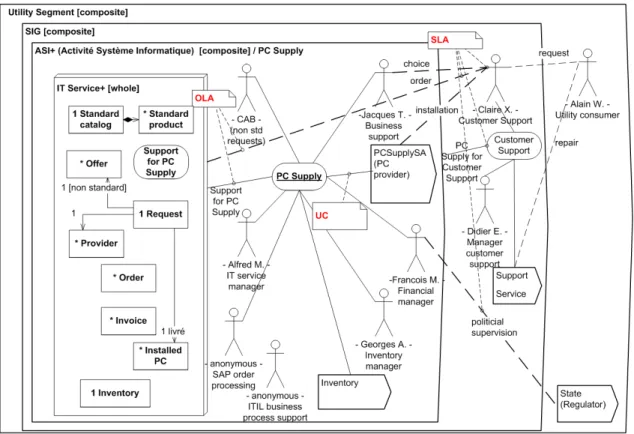
Figure 2: SEAM model representing the hierarchy of systems: IT Service+ as part of the IT department ASI+, itself as part of the utility company SIG, itself as part of the Utility Segment (that includes the end
customer). ITIL suggests working with the concept of system
to structure the analysis of the IT service provider and of its environment. ITIL defines a system as: “a group of interacting, interrelated, or interdependent components that form a unified whole, operating together for a common purpose” [8].
In SEAM, we conceptualize the organization of interest and its environment as a hierarchy of systems. The definition of system is similar to ITIL’s but we augment it with the concept of the observer - the person defining the system and its interrelated components. This means that the system components might change depending of what service is provided. To accept this interpretation, we have to accept that the notion of system is useful to structure the perception of the environment for a given observer and is not an objective representation of reality. So, defining which systems exist requires building an agreement between the project stakeholders. This is a direct application [13] of the concepts developed in systems thinking [3] [20]. In SEAM, we consider a hierarchy of systems. Each system corresponds to a different observer and a different service offered. Modeling a hierarchy of systems is useful for specifying a hierarchy of services. For example, in Figure 2, SIG represents the overall
organization. Modeling the overall organization is useful to represent the “end” service (Customer Support in Figure 2) provided to the end customer
(AlainW – Utility Consumer) and how this
service is implemented (by ClaireX – Customer Support, together with DidierE – Manager
Customer Support and the Support
Service). Understanding this service is important to
validate which PC to select for ClaireX and how to
deliver this PC without impacting the service to the end customer. The next level of service, called PC Supply, is provided by the components of ASI+: the
organization that delivers the PC. ASI+ is composed
of: The people who provide hardware and software recommendations (JacquesT - Business Support), the Change Advisory Board (CAB) that
manages non standard requests, the person in charge of
the budget (FrancoisM - Financial
Manager), PCSupplySA - PC provider that
delivers the PCs and several others. The
PCSupplySA is considered as a part of ASI+ even if
it is a company that does not legally belong to the SIG.
Indeed, from the point of view of the customer benefiting from the PC Supply service (i.e.
ClaireX), whether PCSupplySA fails to deliver
the PC or some other participant prevents the delivery, the result is the same, i.e. the PC has not been delivered. This is why the IT department (called ASI) is named ASI+ in the SEAM model. The “+” hints to
the addition of actors in the ASI that – in principle – are not considered as belonging to the organization (in this case, PCSupplySA). A last and important
component of ASI+ is IT Service+. As previously
explained, the “+” hints to the existence of actors (such as the operator who does the backup) that are involved in the quality of the provided service from the point of view of the service’s customer. IT Service+
represents the software system that supports the PC Supply service. To do so it provides a Support for PC Supply service.
All systems can be represented as whole (black box) or as composite (white box). In Figure 2, we chose to represent ASI+, SIG and Utility Segment as
composite. This is useful to understand who the stakeholders benefiting from the service are (i.e. members of SIG) and who participates in the service
delivery (i.e. the members of ASI+). In Figure 2, we
chose to represent IT Service+ as a whole, hiding
the “components” of the IT system, i.e. the specific applications that implement the service. This is useful for specifying the service Support for PC Supply provided by the IT Service+ system and
the properties this system exhibits as part of this service. The specification of a system as a whole abstracts away implementation details (e.g. applications that are part of the IT system). Examples of properties of IT Service+ are: Request a
property that holds the status of the PC supply, or
Standard Catalog the list of PCs from which ClaireX can select the PC that fits her needs. In
advanced versions of SEAM, it is possible to formally describe the service in terms of pre and post-conditions that check and change the properties [14].
Having defined this hierarchy of systems and services, it is now possible to identify where to locate the SLA, the UCs and the OLAs. The SLA formalizes the service provided by the organization to its customer. In our case, it is the service of PC Supply
for Customer Support provided by ASI+ to
the members of SIG. This SLA needs to be defined by
taking into consideration the needs of ClaireX and
her colleagues in supporting the end customer (AlainW). Once the SLA is defined, it is possible to
identify the UCs and OLAs. They are inside ASI+ (i.e.
the system in charge of providing the service specified by the SLA). In our example, the UC formalizes the service offered by PCSupplySA. The OLA
formalizes the service offered by IT Service+.
ITIL does not define how to specify the services offered by CAB, Business Support, etc. This
could be done using a specification similar to a UC or an OLA.
4
Specification of the SLA
Specifying the SLA requires a precise understanding of the customer needs. For example, the acceptable duration of a service interruption can vary depending on the service and the time at which the interruption occurs. For a financial service, for example, it may be less of a problem to have an interruption in the middle of a month than at month end, during the financial closing. For this reason, it is important to concretely understand the value for the beneficiary of a service to be able to correctly specify the SLA. This explains why it is important to understand the service provided to the end customer, to make sure that the service provided to the internal customer is optimal for the overall goal of the organization.
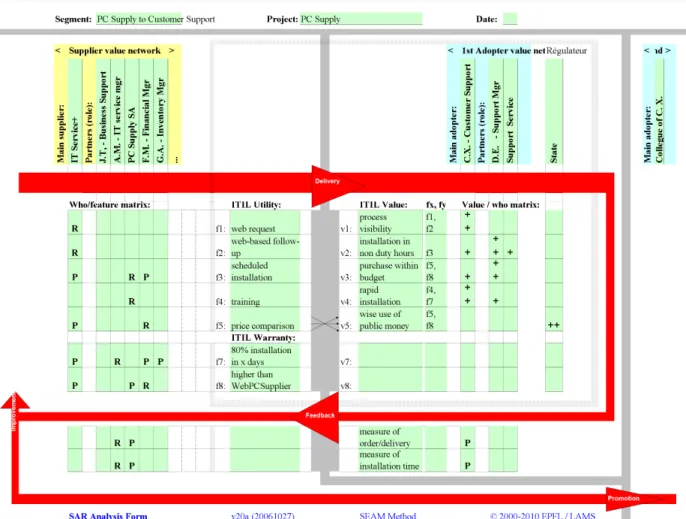
In SEAM we have defined a form to analyze the relationship between the provider of a service and its beneficiary, in the form they are called supplier and adopter respectively. The form is therefore called Supplier/Adopter Relationship (SAR) [19]. Figure 3 illustrates the SAR that corresponds to PC Supply
between ASI+ and SIG. Once this relation is
specified, the SLA between these two organizations can be defined. In a similar way, we could have defined a SAR between SIG and AlainW. This can
be done in a second phase. The SAR is a generic tool to analyze the provision and adoption of services.
The SAR has three main parts. On the left side of the form, we represent the service providers, on the right side, the service adopters and the regulators, in the middle part we represent the features provided by the suppliers and their related value from the point of view of the adopters and regulators. In Figure 3, the service providers (left part of the SAR) are the actors visible in ASI+ (Figure 2). The service adopters – or
beneficiaries (right side) are the actors in SIG -
without ASI+ - and the state (as regulator).
The SAR underlying principle is that suppliers are responsible for delivering features. The features correspond to outputs of the supplier system. These features bring value to the adopters and to the regulators. The relation between the feature and the value can be explained in terms of observers. A feature for the supplier becomes a value for the adopter. These are two different perceptions of the same entity.
Figure 3: SEAM Supplier/Adopter Relationship (SAR) form applied for the description of the PC Supply service
between ASI+ and SIG
To understand the feature / value relationship is one of the main challenges of service modeling. In SEAM, we have developed a technique called goal-belief modeling [13] to identify features and values. With this technique (not presented in this paper), it is possible to describe the beliefs of the actors and from these beliefs to infer their goals. The goals of the supplier appear as features in the SAR, whereas the goals of the adopters appear as values. The features are divided into utilities (functional requirements) and warranties (non functional requirements). Let’s detail two feature/value sets from Figure 3. The first one is the utility price comparison (f5) and the warranty price within x% of the WebPCSupplier
(f8). This means that the price charged to ClaireX is
visible and a comparison is possible with the current market prices. This is of importance for ClaireX’s
manager, who is responsible to purchase
within budget (v3). It is also important for the state; the political organization that owns SIG and
wants to ensure wise use of public money
(v5). The SAR also shows who provides the features.
For example, the price comparison (f5) is the
responsibility of the financial manager and is supported
by IT Service+. The second example is the
feature/value set in which the feature scheduled
installation (f3) brings the value
installation during non-duty hours
(v2). The benefit for the end customer is the
non-interrupted support service.
In addition to the feature/value mapping, the SAR also represents the life cycle relation (large arrows in Figure 3). The main phases are: delivery of the service, monitoring of the service value, improvement of the service and provision of the service to a new adopter. In Figure 3, we detail some of the adopter’s feedbacks: the measure of order/delivery time and the
measure of the installation time. This
market it to other adopters (e.g. colleagues of ClaireX).
To summarize, applying the SAR for specifying an SLA brings the following benefits: (1) analysis of the service’s features and of the service’s values; (2) understanding of the responsibilities in delivering the service; (3) understanding of the customer’s benefits and identification of critical issues (e.g. time at which the service is especially critical); (4) analysis of the overall lifecycle of the service.
Once the SAR is defined, the SLA can be deducted from the features and values identified between the supplier and the adopter (ASI+ and SIG in our
example). Once the SLA is defined, it is possible to define the UCs and the OLAs necessary to support the SLA. The UCs and the OLAs define the responsibilities in supplying the service described in the SLA. In our example, ASI+ delivers the service as
specified in the SLA if and only if PCSupplySA and IT Service+ deliver their services. An OLA has to
define the quality of the service provided by IT Service+ and a UC has to specify the quality of the
service provided by PCSupplySA.
5
Initial Experience from the Field
The application of our method to ITIL is fairly recent. We can therefore only mention some early results.
Our experience has shown that one of the major challenges in IT service level management is the definition of who the customer of the service is and what value he or she expects from the service. Whereas it is often straightforward to identify the features provided by a service, it is far more difficult to specify the values of these features for its beneficiaries.
Our limited experience in applying this technique shows (and this still needs to be confirmed) that in two to three workshops of two hours it is possible for business and IT people to agree on the definition of the actors and of the services. The method proved to be especially useful for identifying regulators and for understanding how the service formalized in the SLA contributes in the larger services offered by the organization.
We also noticed that the richness of the forms combined with the concrete use of actual names was a powerful combination. The formats of the analysis forms encourage the analysis of the service at a level of detail that draws attention to critical interactions. Using the names of actual members of the organization makes the model very concrete. This was especially appreciated.
6
Related Work
SEAM [17, 18] integrates concepts from systems thinking [3, 20]. SEAM federates different business approaches such as Porter’s Value System [12] and Stabell and Fjeldstad’s Value Network 16]. The supplier / adopter relationship analysis extends the House of Quality method [7].
ITIL briefly refers to [2] as a possible technique to analyze the structure of the service provider and of its environment. ITIL could also refer to RE techniques other than SEAM such as: the onion model [1] or Adora [5] to model hierarchical systems; E3Value [6] or i* [21] to analyze value creation.
To the best of our knowledge very few RE papers refer to ITIL. One of them is [11], in which a service desk is specified. RE for services is a new research domain, e.g. the REFS conference series1. Most
research on ITIL is published in business conferences and focuses on experience using ITIL. Two related papers are [15] that analyze a service desk and [10] that propose a conceptual model for problem tracking. The IBM initiative on service science2 should also be
mentioned.
7
Conclusions
In this paper we presented how an RE method can contribute to the identification of the customer of a service and the specification of the corresponding SLA. We also give hints on how the contributors of the service can be identified and how the corresponding OLAs and UCs can be defined. With this, our goal is to illustrate the promising synergy between RE methods and ITIL.
The presented work is still at an early stage. We plan to pursue our investigations to more rigorously relate the goal-belief model (that analyzes the motivations of the actors), the description of the supplier and adopter relationship and the actual ITIL SLA document. Another avenue of future work is to join the non functional requirements formalized in the SLA with the functional requirements. We also intend to formalize the relation between the SLA and the supporting OLAs and UCs.
1 http://conferences.computer.org/compsac/2008/
workshops/REFS.2008.htm
8
References
[1] Alexander, I., A Taxonomy of Stakeholders, Human Roles in System Development”, International Journal of Technology and Human Interaction, Vol 1, 1, 2005, pages 23-59
[2] Allee, V., The Future of Knowledge Increasing
Prosperity Through Value Networks, Butterworth-Heinemann, 2003.
[3] Checkland, P. and Scholes, J., Soft System Methodology in action, Wiley, Chichester UK, 1990.
[4] Gause, D. C. and Weinberg, G. M., Exploring
Requirements, Quality Before Design”, Dorset House, New-York, 1989
[5] Glinz, M., Berner, S., Joos, S., Ryser. J., N. Schett, N., Xia, Y., The ADORA Approach to Object-Oriented Modeling of Software, Proceedings of CAiSE 2001, Interlaken, Switzerland, 2001
[6] Gordijn, J. and Akkermans, J.M., Value-based
requirements engineering: exploring innovative e-commerce ideas, Requirement Engineering J., p. 114 – 134, July 2003 [7] Hauser, J. R. and Clausing D., The House of Quality, Harvard Business Review: 3 - 13, 1988
[8] Office of Government Commerce, ITIL Service Strategy, TSO, London, 2007
[9] Office of Government Commerce, ITIL Service Design, TSO, London, 2007
[10] Janetti, M. and Eerola, A.., A Conceptual Model of IT Service Problem Management, International Conference on Service Systems and Service Management, 2006
[11] Lichtenstein S., Lemai N., Hunter A., Issues in IT Service-Oriented Requirements Engineering, 9th Australian
Workshop on Requirements Engineering (AWRE’04), 2004 [12] Porter, M.E., Competitive Advantage: Creating and Sustaining Superior Performance, Free Press, 1985
[13] Regev, G. and Wegmann, A., Where do Goals Come
from: the Underlying Principles of Goal-Oriented Requirements Engineering, Proceedings of the 13th IEEE
International Requirements Engineering Conference (RE’05), Paris, France, 29 August - 2 September 2005.
[14] Rychkova, I., Regev, G. and Wegmann, A., High-Level Design and Analysis of Business Processes. The Advantages of Declarative Specifications, Second IEEE International Conference on Research Challenges in Information Science (RCIS), Marrakech, Morocco, 3-6 june, 2008.
[15] Shwartz, L., Ayachitula, N., Buco, M., Grabarnik, G.,
Surendra, M.N., Ward, C., Weinberger, S.; IT Service
Provider's Multi-Customer and Multi-Tenant Environments, 9th IEEE Int. Conference on E-Commerce Technology and 4th IEEE Int. Conference on Enterprise Computing, E-Commerce, and E-Services, 23-26 July 2007 Page(s):559 - 566
[16] Stabell, C. B. and Fjeldstad, Ø. D., Configuring value for competitive advantage: on chains, shops, and network, Strategic Management J. 19(5): p. 413 – 437, 1998
[17] Wegmann, A., On the Systemic Enterprise Architecture Methodology (SEAM), International Conference on Enterprise Information Systems (ICEIS), Angers, France, 2003
[18] Wegmann, A. ; Lê, L.S.; Regev, G.; Wood, B., Enterprise Modeling Using the Foundation Concepts of the RM-ODP ISO/ITU Standard, Information Systems and E-Business Management, vol. 5, num. 4, 2007, p. 397-413 [19] Wegmann, A., Regev, G., Rychkova, I., Julia, P., , Perroud, O., Early Requirements and Business-IT Alignment with SEAM for Business, 15th IEEE International Requirements Engineering Conference, New Delhi, India, Oct.15-19th, 2007.
[20] Weinberg, G.M., An Introduction to General System Thinking, Wiley & Sons. New York, 1975
[21] Yu, E., Towards modelling and reasoning support for early-phase requirements engineering, Proceedings of the Third IEEE International Symposium on Requirements Engineering, Annapolis, Maryland, January 1997.
![Figure 1: ITIL’s Service Management [8]](https://thumb-us.123doks.com/thumbv2/123dok_us/8994514.2384309/2.918.156.416.600.837/figure-itil-s-service-management.webp)