October 31
st, 2012
The Delphi Group and Corporate Knights have assessed Canadian Tire Corporation‘s (CTC) Q3 2012 Business Sustainability Performance Report to provide CTC stakeholders with an independent review. The objective of this review is to determine if the appropriate due diligence is in place for accurate public disclosures. In addition, a comparison of four of Canadian Tire‘s peers‘ sustainability reporting (Mountain Equipment Co-Op, Home Depot, Staples, and Wal-Mart) was conducted to see how CTC is performing with regards to public disclosures. For CTC‘s response to the previous quarter‘s (Q2 2012) recommendations please see Appendix A.
Overall, we found the following:
1. Comprehensive business sustainability accounting system: CTC continues to demonstrate that they have a strong accounting system in place for their Business Sustainability Performance Reporting. There are minor recommendations to update the currently referenced energy rates (2010 average rates based on CTC latest Energy Footprint) to more accurately account for year-to-year fluctuations in these costs.
2. Unique reporting framework with longer than average reporting cycle: CTC uses a sustainability reporting framework that is self-defined and unique in that it focuses on forecasted future business benefits. Three out of four peer companies are referencing the Global Reporting Framework (GRI) and CTC should consider whether this is an appropriate framework based on stakeholder and internal disclosure priorities. Most companies, including CTC, are referencing the GHG Protocol for their carbon accounting. Although CTC reports its forecasted annual future benefits from sustainability projects on a quarterly basis, CTC‘s environment footprint data has a 13-month lag from the actual reporting year to the time it is externally disclosed. Most companies within the peer comparison set have a 3-6 month reporting lag.
This Letter of Review briefly outlines CTC‘s Data Review Findings, a Peer Comparison of Sustainability Reporting, and Recommendations Moving Forward. For an overview of the methodology used to conduct our review please see Appendix B.
Data Review Findings:
This quarter we reviewed projects that were included in CTC‘s Q3 2012 Business Sustainability Performance Report: CTR Roofing Retrofits and CTP Cooler Retrofits (eCube). These initiatives were selected because they have not been reviewed previously (Roofing Retrofits) or they were new projects entered into this system for Q3 (Cooler Retrofits).
CTR Roofing Retrofits:
The CTR Roofing Retrofit program is one that upgrades and replaces roof insulation as needed from 15 to R-20. This helps to reduce electricity and natural gas consumption due to the enhanced insulating value of the new material. All electricity and natural gas avoidances are based on modeling assumptions provided by the third-party contractor conducting the retrofits and the assumptions used are appropriate. The energy rates by province, which were used to determine cost avoidance, are based on 2010 averages from CTC‘s latest Energy Footprint. We suggest that these rates be updated on a yearly basis to reflect more accurately the changing price of electricity and natural gas over time.
After reviewing the methodology, calculations, and accountability, we found that CTC has the appropriate due diligence system in place to ensure accounting accuracy and are operating in accordance with best practices.
CTP Cooler Retrofits
:The CTP Cooler Retrofit program installs a new technology called ―eCube‖ within existing coolers which more accurately sets the temperature of the cooler by simulating food and beverage thermal qualities and automatically
relaying this information to the existing thermostat or telemetry. This helps to reduce cooling cycles and in turn reduces electricity consumption.
In order to determine the energy savings, CTC conducted a pilot study at four sites within their network. While the pilot sites were determined based on more pragmatic considerations, such as proximity to headquarters, the variance in cooler size and manufacturer across all stores was not a main determinant in selecting test sites. This is a potential area for improvement in future studies to ensure that a representative sample is used to determine the average energy use avoidance. As above, the energy rates by province, which were used to determine cost avoidance, are based on 2010 averages. We suggest that these rates be updated on a yearly basis to reflect more accurately the changing price of electricity and natural gas over time.
After reviewing the methodology, calculations, and accountability, we found that CTC has the appropriate due diligence system in place with regards to the Cooler Retrofit projects.
Peer Comparison of Sustainability Reporting:
Introduction
The purpose of this review was to compare the sustainability reporting practices of Canadian Tire against those of four peers in the global retailing sector:
Mountain Equipment Co-Op Home Depot
Staples Wal-Mart
Corporate Knights selected the peer group in consultation with Canadian Tire based on industry comparability and existing sustainability reporting systems.
This review was largely concerned with answering three key questions:
1. Reporting Cycle: How long does it take for a company to externally report its environmental performance data (i.e. GHG emissions, energy use, water use, waste) versus the actual year of the data?
2. Reporting Standards: What external reporting standards does each company reference (i.e. Global Reporting Initiative [GRI], ISO 26000, the Greenhouse Gas Protocol, etc.).
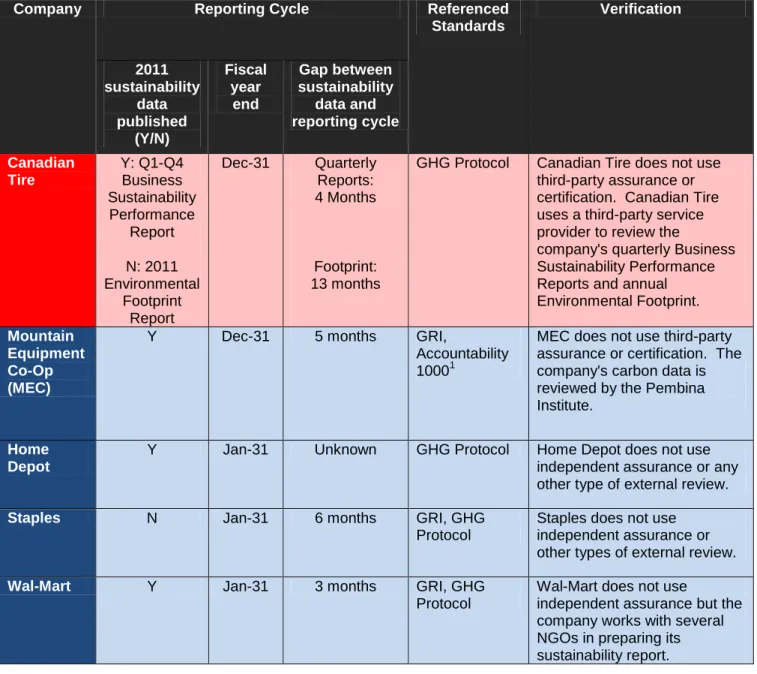
3. Verification: Are companies‘ sustainability reports verified by a 3rd party? A brief summary of our analysis is found in Figure 1.
Figure 1: Summary of Results
Company Reporting Cycle Referenced Standards Verification 2011 sustainability data published (Y/N) Fiscal year end Gap between sustainability data and reporting cycle Canadian Tire Y: Q1-Q4 Business Sustainability Performance Report N: 2011 Environmental Footprint Report Dec-31 Quarterly Reports: 4 Months Footprint: 13 months
GHG Protocol Canadian Tire does not use third-party assurance or certification. Canadian Tire uses a third-party service provider to review the
company's quarterly Business Sustainability Performance Reports and annual Environmental Footprint.
Mountain Equipment Co-Op (MEC)
Y Dec-31 5 months GRI,
Accountability 10001
MEC does not use third-party assurance or certification. The company's carbon data is reviewed by the Pembina Institute.
Home Depot
Y Jan-31 Unknown GHG Protocol Home Depot does not use independent assurance or any other type of external review.
Staples N Jan-31 6 months GRI, GHG Protocol
Staples does not use independent assurance or other types of external review.
Wal-Mart Y Jan-31 3 months GRI, GHG Protocol
Wal-Mart does not use
independent assurance but the company works with several NGOs in preparing its sustainability report.
Findings by Company
Canadian Tire
Reporting Cycle: Unlike three of the four companies in the peer set, Canadian Tire does not publish a consolidated sustainability report on an annual basis. Instead, the company publishes, on a quarterly basis, a Business Sustainability Performance Report. The reports summarize the future Economic and Environmental benefits that are expected to accrue to Canadian Tire from the company‘s sustainability projects. The benefits are
expressed in terms of ‗avoidance,‘ with the specific indicators including ‗Cost Avoidance‘, ‗Sales Generated‘, ‗Energy Avoidance‘, ‗GHG Avoidance‘ and ‗Waste Avoidance.‘
In addition, Canadian Tire releases an annual Environmental Footprint report, which includes total GHG Emissions and Energy Use, at the beginning of each year in conjunction with its Q4 Business Sustainability Performance Report of the previous year. For example, the 2010 Corporate and Supply Chain Environmental Footprint report was released at the end of January 2012, giving CTC a 13-month reporting gap for their environmental performance data. Canadian Tire has not yet published their 2011 Environmental Footprint2 but it is anticipated at the beginning of Q1 2013.
Standards:Canadian Tire uses the GHG Protocol to report its energy use and GHG emissions.
Verification: Canadian Tire uses a third-party service provider to review the company's quarterly Business Sustainability Performance Reports and the Environmental Footprint3.
Mountain Equipment Co-Op (MEC)
Reporting Cycle: MEC‘s ―2011 Accountability Report‖ is based on data from 2011, which MEC defines as data from January 1 to December 31, 2011. The report was released in May 2012. The company therefore has a 5 month reporting gap.
Standards: MEC follows the Global Reporting Initiative (GRI G3.0 Guidelines) and Accountability 1000 Principles (AA1000APS). MEC self-declared its 2010 Accountability Report to be Application Level B of the Global Reporting Initiative's Sustainability Reporting Guidelines. It is presumed that the declaration also applies to the company‘s 2011 Accountability Report. MEC use a GRI index4 to align its reporting with the GRI methodology. The company reports that its GHG inventory is ―based on the GHG Protocol5.‖ However, in practical application, MEC does not
use the GHG Protocol6.
Verification: MEC does not use independent assurance. MEC reports that its carbon data is reviewed by the Pembina Institute. MEC reports that it uses an ―independent reporting consultant‖ to support ―(its) reporting process and stakeholder engagement7.‖ However, the company does not indicate the name of the consultant.
Home Depot
Reporting Cycle:Like Canadian Tire, Home Depot does not publish an annual Sustainability Report. Rather, the company offers stakeholders a sporadic range of data points under the ―Corporate Responsibility‖ section of the company‘s website8
. As we noted in our Q2 assessment, Home Depot tracks a very limited array of sustainability data points. In fact, in terms of conventional environmental indicators, only GHG emissions are measured. The company‘s GHG emissions for 2011 are available on its website9
. At this point it cannot be determined when the data were uploaded to the company‘s website.
2
As of October 15, 2012.
3 Delphi and Corporate Knights conducts quarterly reviews of CTC‘s Business Sustainability Report and Year-End Environmental Footprint
and Delphi also provides a Statement of Confidence for CTC‘s annual GHG and Energy Footprint.
4 A GRI index precisely identifies for stakeholders where corresponding sections of the GRI methodology can be found in the company‘s
sustainability reporting. 5
http://www.mec.ca/AST/ContentPrimary/Sustainability/AccountabilityReport/Operations.jsp?CONTENT%3C%3Ecnt_id=10134198674184322
6 For instance, MEC does not segment its emissions using Scopes 1, 2 and 3 in accordance with the GHG Protocol. 7 http://www.mec.ca/AST/ContentPrimary/Sustainability/AccountabilityReport/Approach.jsp?CONTENT%3C%3Ecnt_id=10134198674183530 8 Available at https://corporate.homedepot.com/CorporateResponsibility/Pages/default.aspx 9 Available at https://corporate.homedepot.com/CorporateResponsibility/Environment/Pages/CarbonFootprint.aspx
Standards: Home Depot uses the GHG Protocol to report its emissions data. The company‘s actual inventory was prepared by a third-party contractor.
Verification:Home Depot does not use independent assurance or any type of external review.
Staples
Reporting Cycle: Staples‘ most recent sustainability report, dubbed ―Staples Soul,‖ contains data for its 2010 fiscal year (January 31, 2010 to January 29, 2011). The report became available in July 2011. While this would normally indicate a 6 month reporting gap, Staples did not publish a report covering its 2011 fiscal year in July 2012. This could point to a lengthening reporting gap.
Standards:Staples uses GRI (G3.0 Guidelines) in the development of its sustainability report. They self-declare an Application Level of B. Staples also uses the GHG Protocol to report its emissions data. The company also reports using several third-party tools and assessments, including ENERGY STAR10, and the Environmental Paper Assessment Tool (EPAT)11.
Verification: Staples does not state that it uses independent assurance or another type of external review process.
Wal-Mart
Reporting Cycle: Wal-Mart‘s ―2012 Global Responsibility Report‖, which includes data for the company‘s 2012
fiscal year (February 1, 2011 to January 31, 2012), was published in April 2012. This implies a 3 month reporting cycle.
Standards: Wal-Mart uses GRI,3.1 Guidelines and together with MEC, is the only company in the peer set to include a GRI index. Wal-Mart also uses the GHG Protocol to prepare its GHG emissions inventory.
Verification: Wal-Mart does not state that it uses independent assurance. The company works with several NGOs, including the Live Greener Working Group (LGWG), in preparing its sustainability report.
Recommendations Moving Forward:
1.
Update Energy Rates used in Forecasting Assumptions: CTC should consider updating the energy rates used to calculate cost avoidance to more current electricity and natural gas rates (CTC currently uses 2010 rates). CTC does have a system in place to update calculation factors annually based on the annual Environmental Footprint Reporting cycle. The quarterly Business Sustainability Performance Report references the most recently published Environmental Footprint calculation factors. If the Environmental Footprint reporting cycle is reduced, as mentioned in the 4th recommendation, this may help to update calculation factors for the Business Sustainability Performance Report to more current factors2.
Use Representative Samples in Pilots: While it may not always be feasible to pick a representative sample for pilot studies, we recommend that this be considered to ensure increased accuracy of forecasted benefits. When it is not possible to use a representative sample for pilots, we recommend that these projects are
prioritized in the comparison of forecasted versus actual benefits testing after completion and the assumptions revised accordingly.
3.
Sustainability Reporting: Canadian Tire uses a self-defined sustainability reporting framework which includes three parts: Quarterly Business Sustainability Reports, Annual Environmental Footprint Report, and Online Sustainability Content. Three out of four of CTC’s peer set is referencing GRI as their framework for their sustainability reports. Canadian Tire should assess if the GRI is also an appropriate framework to use in order to achieve CTC’s sustainability disclosure objectives.4.
Shorten Environmental Footprint Reporting Cycle: Currently, Canadian Tire has a 13-month reporting gap for the release of its environmental footprint data. Companies within the peer set, with known reporting cycles, are between 3-6 months. CTC should consider releasing its Environmental Footprint data on a shorter cycle.Overall, Canadian Tire continues to demonstrate that they have a strong due diligence process in place regarding their Business Sustainability Performance accounting methodologies, data management, assumption setting, and accountability structure. With regards to sustainability performance reporting, Canadian Tire uses a unique approach which accounts for the economic and environmental benefits accrued from the initiation of various projects. This self-defined approach—while different than traditional CSR reporting practices—is an innovative reporting practice as it accounts for and links business and sustainability performance. Many companies still struggle to do this and CTC should be commended for its efforts and leadership.
Bruce Dudley
Senior VP, The Delphi Group
Doug Morrow
Appendix A: Canadian Tire Response to Q2 2012 Recommendations
# Delphi/Corporate Knights Q2 2012 Recommendations
Canadian Tire Response
1 Embed Calculation Formulas into Main Working Documents: CTC should ensure that all calculation formulas are embedded directly into all working and final documents.
Completed.
2 Calculate Waste Avoidance for Lighting Retrofit Projects: CTC should consider including waste avoidance from upgraded energy efficient lighting equipment as it is currently not calculated. This would add additional value to CTC‘s environmental benefits.
May be considered for future reporting.
3 Include Product Shipping Packaging Weights for Damage Reduction Projects: CTC should consider including changes in product shipping packaging weights that result from projects to reduce damage from transportation. This will increase the accuracy of the economic and environmental benefits calculated. This should only be done if the data is readily available as the overall avoidances due to product packaging may be minor.
May be considered for future reporting.
4 Increase Scope of Sustainability Indicators Publicly Disclosed: CTC should consider expanding the scope of its sustainability reporting to include the four first generation indicators that it does not currently publicly disclose: water consumption, waste produced, employee turnover and lost time injury rate.
Water consumption – currently out-of-scope. Waste produced – work in progress.
Employee turnover – currently out-of-scope. Lost time injury rate – currently out-of-scope.
Appendix B:
Overview of Methodology:
1.
Document Review: Review all internal and external documentation provided.
2.
Metric Selection: Independently select a sample of two metrics within the data sets provided to
the public in order to review the methodologies, data management/calculations, assumptions, and
accountability system. Only a sample of the data was reviewed as a proxy for the entire data set
12.
For the purposes of this assessment the following metrics were reviewed:
Q3 Business Sustainability Performance Report:
Energy Use Avoidance: 1,630GJ, CTR Roofing Retrofits, 7 Projects
Cost Avoidance: $62,501, CTP Cooler Retrofits (eCube), 106 Projects
3.
Interviews and Supporting Documentation:
Interviews were conducted with key CTC staff in
charge of the data and supporting documentation was requested in order to verify the accuracy of
statements.
4.
Findings: A final statement on each area discussing due diligence in methodology, data
management and calculations, assumptions, and accountability will be written based on the results
of the review.
5.
Peer Comparison of Sustainability Reporting:
Analysis: Analyze the most recent cycle of sustainability reporting by each company in a
pre-determined peer set (Canadian Tire, Mountain Equipment Co-Op, Home Depot, Staples
and Wal-Mart):
Reporting Cycle
Referenced Reporting Standards
3
rdParty Verification
6.
Recommendations: Make recommendations to CTC in terms of disclosure and reporting.
12
If the random sample data set has no major issues then we are reasonably confident that the organization has the appropriate due diligence in place for the rest of its metrics. However, we must note that a complete audit of the data was beyond the scope of this review and we cannot comment on accuracy beyond the data in which we reviewed directly.