MBA Program Revision and the
Impact on the CIS Option
Doris G. Duncan
California State University, East Bay
(formerly California State University, Hayward)
Hayward, California USA
Abstract
Leaders at California State University, East Bay, in the College of Business and Economics de-cided to review and revise the MBA Program prior to the upcoming accreditation visit. The out-come was a program with fewer foundation courses, more core course requirements and fewer options (sometimes called areas of specialization or tracks). The number of foundation courses was reduced from nine to three, the number of required core courses was increased from three to nine and the number of specialized option courses was reduced from about five (depending on the option) to three. The number of options was reduced from 16 to 8. The Computer Information Systems option was revised and named Information Technology Management. CIS/ITM survived the reduction in options – for now.
Keywords: MBA revision, MBA curriculum, MIS graduate curriculum, CIS graduate curricu-lum, ITM graduate curriculum
Introduction
California State University, East Bay is a mid-sized university located in the San Francisco Bay Area. It has enrollment of about 14000 (9000 full time equivalent) students. It was established in 1957 and the College of Business and Economics (CBE) shortly after that. By 1973 the CBE achieved AACSB (Association to Advance Collegiate Schools of Business) accreditation and has maintained it ever since, the most recent renewal being in February, 2009. The normal AACSB accreditation renewal cycle is every five years.
As part of preparing for maintenance of accreditation, California State University, East Bay lead-ership decided in fall 2007 to evaluate and update its MBA program. Several people participated in the evaluation process including the new Dean of CBE, the five-member curriculum commit-tee, the Director of MBA Programs and four Department Chairs. Feedback was also sought from
faculty, students and employers. The revision of this part-time, evening MBA program that many of the more than 600 students enrolled are able to complete in two years was a major focus for an en-tire academic year, as shown in Figure 1.
Material published as part of this publication, either on-line or in print, is copyrighted by the Informing Science Institute. Permission to make digital or paper copy of part or all of these works for personal or classroom use is granted without fee provided that the copies are not made or distributed for profit or commercial advantage AND that copies 1) bear this notice in full and 2) give the full citation on the first page. It is per-missible to abstract these works so long as credit is given. To copy in all other cases or to republish or to post on a server or to redistribute to lists requires specific permission and payment of a fee. Contact [email protected] to re-quest redistribution permission.
Figure 1: Decision Flow for MBA Revision at California State University, East Bay
Fall 2007: New dean focuses
on AACSB accreditation re‐
view scheduled for fall, 2008
Fall 2007: Decision to focus on
MBA modification in prepara‐
tion for accreditation visit
Fall 2007: CBE Curriculum com‐
mittee formed (five faculty
members)
Winter 2008: Conduct market
research: competitive analysis,
survey students, employers, seek
faculty input
Winter 2008: Analyze market re‐
search data
Spring 2008: Draft the modified
MBA curriculum, seek feedback
Spring 2008: Modify and ap‐
prove revised curriculum at
CBE level
Spring 2008: Revised curricu‐
lum reviewed and approved by
University curriculum commit‐
tee
Summer 2008: Revised curricu‐
lum approved by administra‐
tion (academic programs)
Summer 2008: Curriculum
changes for fall 2009 catalog
and offering submitted by July
deadline
The primary focus was on what topics should be included in the core requirements and how much emphasis should be placed on specialized options. Options that had small enrollment or that were experiencing declining enrollments, for example CIS, were also closely scrutinized as part of the MBA program review.
Background and Literature Review
We relied more on primary market research than on any review of the literature insofar as wheth-er and how to modify the MBA Program at California State Univwheth-ersity, East Bay. Once the
au-1) providing a specific clientele with information, 2) in a form, format, and schedule, 3) that max-imizes its effectiveness (Gill, 2009).
Cohen describes “Informing Science” as an evolving transdiscipline that studies issues in inform-ing clients (Cohen, 2009). In discussinform-ing his philosophy of informinform-ing science, Cohen addresses how terms that mean different things get used interchangeably, for example, “Computer Science”, “Management Information Systems”, “Information Science” as well as “Intelligent Services” (Cohen, 2009). Perhaps additional terms as “Computer Information Systems,” “Information Technology Management” and “Business Information Systems” need to be added to this growing list. Cohen also distinguishes between broad “lantern” and focused “laser” forms of research. In the case of the MBA Program at California State University, East Bay, stakeholders include students, faculty, administrators, perhaps alumni and employers, and prospective stakeholders. The MBA is intended to be a general degree comprised of a broad range of business topics on management, marketing, accounting, finance, operations, supply chain, economics, governmental regulation, technology, globalization, etc. Compared with an MS in Information Technology Program, the MBA is more interdisciplinary and less specialized. Furthermore, the 2009 revised MBA places more emphasis on general business and interpersonal skills and less emphasis on the options/areas of specialization.
Consistent with this broad focus is the revision of the CIS option to ITM which suggests a shift from adapting computer information systems technology to the user toward the management of the information technology function (hardware, software, networks, and data). Systems analysts and others who help adapt the technology to user needs normally work within the information technology department.
The extent of discussion and debate regarding what courses to include or exclude in the required set of fundamental (prerequisite) or core courses varied substantially depending on the
course/topic. The information systems topic encountered more scrutiny than most others. This may not be unusual. David Avison wrote that there is continual pressure at many universities to re-examine the MBA curriculum, with particular emphasis on reducing the compulsory core por-tion. One of the courses that may be taken out over time is information systems. Avison then proceeded to present a case that information systems faculty can use to defend keeping informa-tion systems in the core (Avison, 2003). Among the universities with IS in the MBA core are: Harvard, Berkeley, Stanford, Columbia, Cornell, and London Business School. At California State University, East Bay we also decided to retain IS/ITM 6015 Information Systems Develop-ment and ManageDevelop-ment as a fundaDevelop-mental course. Students have the choice of testing out of all three fundamental courses: Financial Accounting, Data Analysis and Decision Making, and In-formation Systems Development and Management.
As the MBA revision process at California State University, East Bay unfolded, it became in-creasingly obvious how much our MBA program was in need of updating, perhaps continuous updating. As Robert Winter succinctly explained, in many industries, business structures once considered stable for decades have undergone enormous change, leading to complex and dramatic transformation needs in many organizations (Winter, 2002). For example, due to deregulation, outsourcing, business networking and the Internet, retail banking has changed more in the past few years than an entire generation before. This has tremendous implications for what the content of MBA programs should be.
Curriculum Modification
Mission, Objectives, and Learning Outcomes
At a CBE faculty retreat, the CBE revised its mission as follows:The mission of the College of Business and Economics is to prepare students to make ethical choices and succeed in a dynamic business environment shaped by the challenges of a competi-tive global economy, emerging technologies, and diverse stakeholders. All CBE programs are accredited by the Association to Advance Collegiate Schools of Business International (AACSB). The MBA program objectives and student learning outcomes were revised to be consistent with the current mission:
Objectives
:
1. The MBA program will prepare students in important management skills.
2.Students graduating from the MBA program will experience positive career outcomes includ-ing salary increases, opportunities for promotion, and advancement into management positions as a result of their experiences in the program.
Student learning outcomes
:
Students graduating with an M.B.A. from this University will have achieved the following: 1. Leadership and Teamwork. Each graduate will be able to analyze how to use
high-performance management behaviors to lead a team task that results in effective team per-formance.
2. Integrative and Strategic Perspective. Each graduate will integrate functional areas of busi-ness knowledge to generate a strategic busibusi-ness plan.
3. Global Perspective. Each student will analyze the global business factors impacting current business issues, and evaluate the effects of these factors on specific management situations. 4. Communication. Each student will communicate a complex business issue in a coherent
written statement and oral presentation.
Competitive Analysis
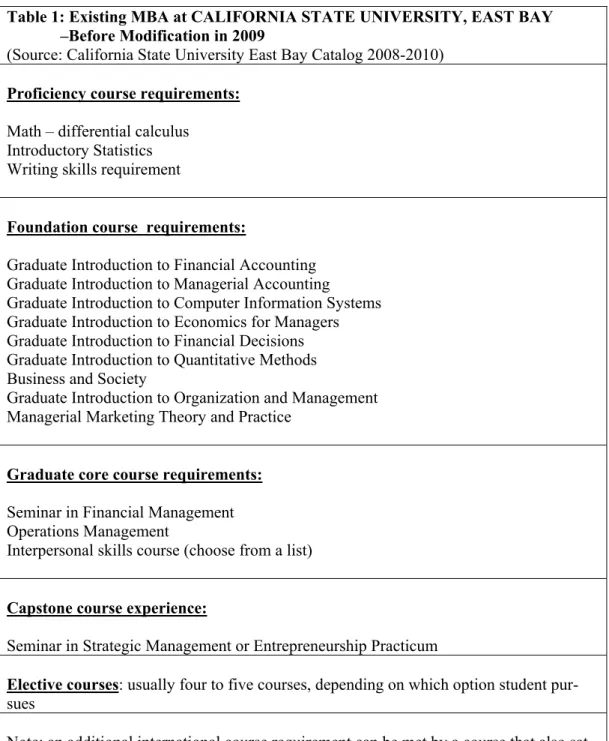
Next, we conducted a competitive and comparative analysis by surveying existing MBA pro-grams 1) in our geographic proximity - San Francisco Bay area, both public and private universi-ties; 2) the California State University System; 3) research institutions in the San Francisco Bay area; 4) peer institutions identified; and 5) aspirant institutions. The focus was on admission re-quirements, proficiency rere-quirements, foundation work, options offered, and required courses vs. elective courses. Later a survey of students was conducted. Feedback from current and prospec-tive employers was also sought. The “old” MBA program is summarized in Tables 1 and 3.
Table 1: Existing MBA at CALIFORNIA STATE UNIVERSITY, EAST BAY –Before Modification in 2009
(Source: California State University East Bay Catalog 2008-2010)
Proficiency course requirements:
Math – differential calculus Introductory Statistics Writing skills requirement
Foundation course requirements:
Graduate Introduction to Financial Accounting Graduate Introduction to Managerial Accounting
Graduate Introduction to Computer Information Systems Graduate Introduction to Economics for Managers Graduate Introduction to Financial Decisions Graduate Introduction to Quantitative Methods Business and Society
Graduate Introduction to Organization and Management Managerial Marketing Theory and Practice
Graduate core course requirements:
Seminar in Financial Management Operations Management
Interpersonal skills course (choose from a list)
Capstone course experience:
Seminar in Strategic Management or Entrepreneurship Practicum
Elective courses: usually four to five courses, depending on which option student pur-sues
Note: an additional international course requirement can be met by a course that also sat-isfies an option requirement.
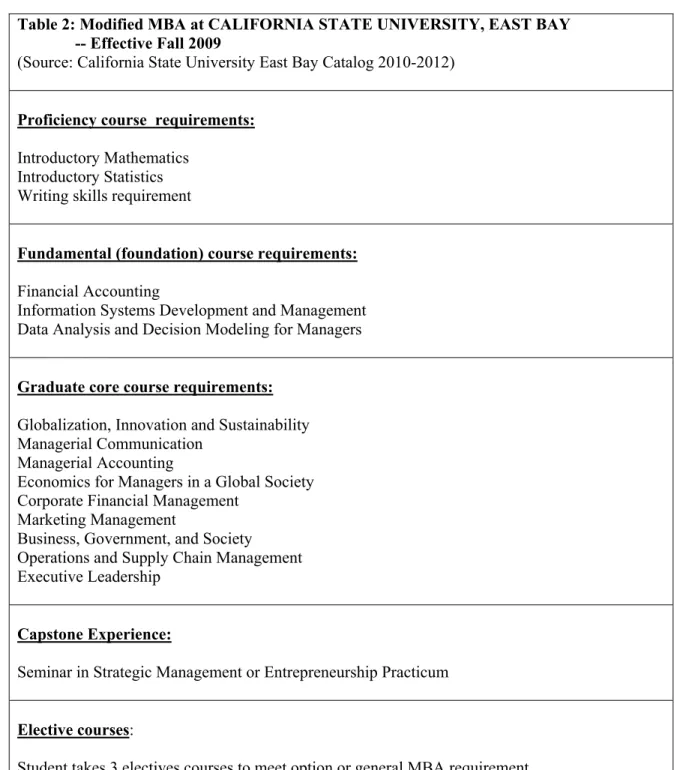
Table 2: Modified MBA at CALIFORNIA STATE UNIVERSITY, EAST BAY -- Effective Fall 2009
(Source: California State University East Bay Catalog 2010-2012)
Proficiency course requirements:
Introductory Mathematics Introductory Statistics Writing skills requirement
Fundamental (foundation) course requirements:
Financial Accounting
Information Systems Development and Management Data Analysis and Decision Modeling for Managers
Graduate core course requirements:
Globalization, Innovation and Sustainability Managerial Communication
Managerial Accounting
Economics for Managers in a Global Society Corporate Financial Management
Marketing Management
Business, Government, and Society Operations and Supply Chain Management Executive Leadership
Capstone Experience:
Seminar in Strategic Management or Entrepreneurship Practicum
Elective courses:
Student takes 3 electives courses to meet option or general MBA requirement
Emergence of Updated MBA
From the competitive analysis and surveys, we found our program at California State University, East Bay placed more emphasis on foundation/prerequisite work and options than on a required core. This influenced the resulting MBA modification shown in Tables 2 and 4. As part of the
more emphasis is placed on the common core requirements, less emphasis is placed on specializa-tion. These changes, including the switch from calculus to college algebra, were made to make our MBA program more competitive and cost effective. The revised MBA was first offered in fall 2009.
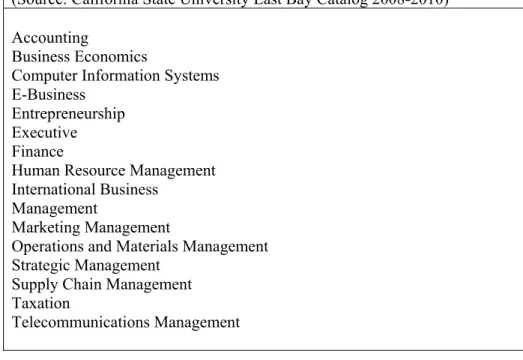
Table 3: 16 Existing MBA Options/areas of specialization at
CALIFORNIA STATE UNIVERSITY, EAST BAY to Choose from Before Modification in 2009
(Source: California State University East Bay Catalog 2008-2010) Accounting
Business Economics
Computer Information Systems E-Business
Entrepreneurship Executive Finance
Human Resource Management International Business
Management
Marketing Management
Operations and Materials Management Strategic Management
Supply Chain Management Taxation
Telecommunications Management
Table 4: 8 Options/areas of specialization to Choose from in Modified MBA at CALIFORNIA STATE UNIVERSITY, EAST BAY
Effective Fall 2009
(Source: California State University East Bay Catalog 2010-2012) Entrepreneurship
Finance
Human Resources and Organizational Behavior Information Technology Management
Marketing Management
Operations and Supply Chain Management Strategy and International Business
What Became of the Computer Information Systems
MBA Component?
Generalization of the MBA Program
By comparing Table 1 with Table 2, it is evident that Computer Information Systems (CIS) does not appear on Table 2 as a foundation course. However, Information Technology Management does. The same holds true when comparing Tables 3 and 4. Computer Information Systems is one of sixteen options listed in the “old” MBA program. Information Technology Management is one of eight options to choose from in the revised MBA program. About a year prior to overhaul-ing the MBA, we modified the CIS program at both the undergraduate and graduate level and renamed it Information Technology Management.
Emergence of MBA/ITM Option
At many Universities, including California State University, East Bay enrollments in the CIS op-tion, and programs of a similar name, have gradually declined since the peak in year 2001 or so. It became obvious that we needed to do something to reverse this trend or discontinue the pro-gram. By 2006 the CIS and other business faculty began talking about modifying the CIS option and promoting it more. Several people participated and what emerged was a “new” ITM option comprised of 3 courses (12 quarter units) to “replace” the CIS option which consisted of 7 courses (28 units) but two of which had to be outside the field of CIS. By comparing the two pro-grams summarized in Table 5, it is apparent that the ITM option is more about business and man-agement and less about technology than the CIS option. Early indicators suggest that the enroll-ment decline has leveled off and that there may be a gradual upward trend. It will take more time to ascertain whether the trend is upward. If not, the ITM option may become vulnerable to dis-continuation just as have other programs.
Conclusion
There was some discussion of eliminating entirely the CIS, now ITM option, due to declining enrollments. However, the faculty members who normally teach ITM courses, including the MBA Director, were able to save the area of CIS, now ITM, in anticipation of future enrollment growth. So far we have a very modest increase in ITM enrollments since restructuring. Faculty must work hard at attracting more students to the ITM option or it may be eliminated as has been the case at other institutions. Now that MBA students at California State University, East Bay have just eight options (including the general MBA) to choose from, the author expects enroll-ments will grow in all eight options. However, in the event that ITM enrollenroll-ments do not suffi-ciently increase and the program is eliminated, ITM faculty members will most likely still have a foundation course to teach at both the undergraduate level and in the MBA program. Only time will tell how well CIS and ITM programs will evolve and succeed in the future. A survey of alumni and employers would provide additional insights.
Table 5: Comparison of former CIS and new ITM options in MBA Program at CALIFORNIA STATE UNIVERSITY, EAST BAY
Former Computer Information Systems Option (28 quarter units)
(Source: California State University East Bay Catalog 2006 – 2008) Prerequisite courses
CIS 3275 Object Oriented Programming or CS (Computer Science) 3340 Intro to Object Oriented Programming and Design or any advisor approved object-oriented programming language taken during the last three years.
CIS 3281 Systems Analysis and Design Required courses (4 courses, 16 units):
CIS 6270 Advanced Study of Computer Information Systems CIS 6274 Data Base Theory and Administration
CIS 6275 Decision Support and Expert Systems CIS 6276 Data and Voice Communications
Electives within Computer Information Systems (4 units):
Select one graduate level CIS or TC (Telecommunications) course that is not listed as required. Electives outside Computer information Systems (8 units):
Select two courses (8 units) of 6100-6999 level College of Business and Economics courses out-side of CIS or any other department-approved graduate-level course (including Mathematics and Computer Science) outside of CIS. Management 6110 Business and Economic Forecasting is strongly recommended as one of these elective courses.
New Information Technology Management Option (12 quarter units, also called the “modi-fied” CIS option) (Source: California State University East Bay Catalog 2008-2010)
Required courses (two courses, 8 units):
ITM 6271 Data Base Management and applications
ITM 6273 Business Intelligence and Knowledge Management Elective within ITM: Choose one of the following courses (4 units): ITM 6130 Enterprise Management Systems
ITM 6278 E-Business Systems Development MGMT 6155 Applied Project Management
References
Avison, D. (2003). Information systems in the MBA curriculum: An international perspective. Communica-tions of the Association for Information Systems,11, 1-23. Retrieved on March 2, 2009 from
Cohen, E. (2009). A philosophy of informing science. Informing Science: The International Journal of Emerging Transdiscipline, 12, 1–14. Retrieved on March 2, 2009 from
Gill, T. G. (2009). An open letter to the informing science community. Informing Science: the International Journal of an Emerging Transdiscipline,12, v-x. Retrieved on March 2, 2009 from
California State University East Bay Catalog2006-2008. West Sacramento, CA: Delta Web Printing, Inc. California State University East Bay Catalog 2008-2010. West Sacramento, CA: Delta Web Printing, Inc. California State University East Bay Catalog. 2010-2012. West Sacramento, CA: Delta Web Printing, Inc. Winter, R. (2002). An executive MBA program in business engineering: a curriculum focusing on change.
Journal of Information Technology Education,1(4), 279-288. Retrieved on March 2, 2009 from
Biography
Dr. Doris Duncan, CCP, CSP, CDP, CDE, is a Professor of Computer Information Systems and past Director of MBA Programs (2006- 2008) at California State University, East Bay, USA. Extensive ser-vice to CSUEB includes serving as the CIS area coordinator and grad-uate advisor for CIS and e-business programs. Duncan was a Visiting Professor of Information Systems at the University of Washington, Seattle, 1997-98 and the Program Director of Information Systems at Golden Gate University, San Francisco, 1982-83. Her thirty plus years of experience in information technology include communications con-sultant and marketing manager for AT&T, program director for Input, Inc., and member of senior management consulting staff at Quantum Science Corporation. She has had consulting engage-ments with several businesses, including Dialog Information Services, Pacific Bell Telephone Co., Valicert, Golden Gate University, Prentice Hall, McGraw-Hill Book Co. Dr. Duncan au-thored a book, Computers and Remote Computing Services, and has published about 70 refereed journal articles and conference presentations. She is also a frequent speaker before professional groups. Duncan is past president of the Data Processing Management Association, San Francisco Chapter, and has served on the Board of Directors of several professional societies, including DPMA, the DPMA Special Interest Group in Education, and the Institute for Certification of Computer Professionals Education Foundation. Duncan served as the Associate Editor for the
Journal of Informatics Education Research and has served on the editorial review board for the JIER and Journal of Information Systems Education, Journal of Information Technology Educa-tion and as a reviewer for many textbooks and conference proceedings. Duncan was selected “Computer Educator of the Year” in 1997 by the International Association of Computer Informa-tion System, served as a Fulbright Specialist in 2009, and is listed in over 30 Who’s Who publica-tions, including Who's Who in America and Who’s Who in the World.