HAL Id: hal-01607734
https://hal.archives-ouvertes.fr/hal-01607734
Submitted on 3 Oct 2017
HAL is a multi-disciplinary open access
archive for the deposit and dissemination of sci-entific research documents, whether they are pub-lished or not. The documents may come from teaching and research institutions in France or abroad, or from public or private research centers.
L’archive ouverte pluridisciplinaire HAL, est destinée au dépôt et à la diffusion de documents scientifiques de niveau recherche, publiés ou non, émanant des établissements d’enseignement et de recherche français ou étrangers, des laboratoires publics ou privés.
Distributed under a Creative CommonsAttribution - ShareAlike| 4.0 International
Using models to inform policies to meet multiple
objectives. Sustainable development, climate change
mitigation and biodiversity conservation in Central
Africa
Rebecca Mant, S. Garcia-Rangel, M. Tadoum, C. Nchoutpouen, P. Tonga, A.
Makoudjou, D. Bokelo Bile, R. G. Ndinga, Aline Mosnier, Michael
Obersteiner, et al.
To cite this version:
Rebecca Mant, S. Garcia-Rangel, M. Tadoum, C. Nchoutpouen, P. Tonga, et al.. Using models to inform policies to meet multiple objectives. Sustainable development, climate change mitigation and biodiversity conservation in Central Africa: Assessing the contribution of brazil’s forest code to biodiversity conservation. 2016, 8 p. �hal-01607734�
USING MODELS TO INFORM
POLICIES TO MEET MULTIPLE
OBJECTIVES
SUSTAINABLE DEVELOPMENT,
CLIMATE CHANGE MITIGATION
AND BIODIVERSITY CONSERVATION
IN CENTRAL AFRICA
SUMMARY
● Land-use change models can help in developing a holistic understanding of the range of potential impacts
of different land-use related policy options, and so strengthen the development and implementation of policies to meet a range of objectives; including sustainable development, climate change mitigation, food security and biodiversity conservation.
● Member countries of the Central Africa Forest Commission (COMIFAC) have committed to sustainable
management of the region’s forests, including under the COMIFAC “Convergence Plan”, and to achieving the Sustainable Development Goals (SDGs). Achieving these objectives is dependent on the development, and implementation, of new and existing national
policies and approaches.
● Projections from land-use modelling identify
potential trade-offs and synergies in the achievement of the SDGs under different macro-economic and land-use policy related scenarios.
● In particular they highlight the importance of
effective protected areas and forest concessions for the conservation of Great Apes and other threatened species, and show that maintaining these areas has negligible impact on agricultural production in the region.
● As development continues in the region, further increasing the extent of protected areas could play a role in
greatly reducing the number of species losing a large proportion of their habitat. However, protected area expansion needs to be well planned to avoid adverse impacts on particular species and societal challenges such as food security.
@ Olli vier Gir ar d/CIF OR © C orinne Staley/flickr .c om
Box 1 Sustainable Development Goals
The Sustainable Development Goals are a global commitment based on the integration of economic, social and environmental dimensions. They are a framework of 17 goals and 169 targets promoting specific action within the coming 14 years, including:
Zero hunger:
End hunger, achieve food security and improved nutrition and promote sustainable agriculture.
Decent work and economic growth:
Promote sustained, inclusive and sustainable economic growth, full and productive employment and decent work for all.
Climate action:
Take urgent action to combat climate change and its impacts.
Life on land:
Protect, restore and promote sustainable use of terrestrial ecosystems, sustainably manage forests, combat desertification, and halt and reverse land degradation and halt biodiversity loss.
The goals and targets are defined as aspirational and global, with each of the 193 countries that have adopted them setting their own national targets guided by the global level of ambition but taking into account national circumstances. Each government will also decide how these aspirational and global targets should be incorporated in national planning processes, policies and strategies.
BACKGROUND
Member countries of the Central Africa Forest Commission (COMIFAC) have committed to join global efforts to deliver the Sustainable Development Goals (SDGs) (Box 1), achieve the Convention on Biological Diversity’s Aichi Biodiversity Targets and achieve targets set in their Intended Nationally Determined Contributions (INDCs) under the United Nations Framework Convention on Climate Change (UNFCCC). At the regional level, COMIFAC have also develop the “Convergence Plan for sustainable management of the environment and forest ecosystems of Central Africa” and signed the Kinshasa Declaration on Great Apes, which commits them to protect these emblematic species.
The forests of Central Africa form the second largest area of tropical forest in the world, and are found in the ten COMIFAC member countries: Burundi, Cameroon, Congo, Gabon, Equatorial Guinea, Central African Republic, Democratic Republic of Congo, Rwanda, Sao Tome and Principe and Chad. These forests make well-documented contributions to subsistence and national economies in the region, including through non-timber forest products, fuel wood and timber. They also harbour, rich biodiversity.
Over 2000 species of mammals, amphibians and birds are found in the region, including four species of Great Apes: the chimpanzee, bonobo, eastern gorilla and the western gorilla. These emblematic species, like many others in the region, are heavily dependent on forest ecosystems, and are of great interest for ecotourism.
Although large extents of the Congo Basin forests remain intact, deforestation and degradation are occurring at increasing rates, in turn depleting biodiversity, and risking forest-based livelihood options of local communities. Actions to conserve the forest can affect progress towards countries’ multiple commitments regarding sustainable development, climate change mitigation and biodiversity conservation. Therefore, countries require tools and information to assess the effect of existing and future policies on different objectives. For example, it is useful to assess the multiple potential impacts of action in relation to the UNFCCC initiative on REDD+ (Reducing Emissions from Deforestation and Forest Degradation plus the conservation of forest carbon stocks, sustainable management of forests and enhancement of forest carbon stocks).
MODELLING POLICY IMPACT
To support Central African countries in meeting their national objectives in relation to the SDGs and other commitments, an economic land-use model (GLOBIOM-Congo Basin; Box 2), was used to assess the potential impacts of eight different development and land-use scenarios (Figure in Box 2) in relation to the four SDGs highlighted in Box 1.
The model projections for each scenario were assessed in relation to the following indicators relevant to the SDGs:
● domestically produced calories per inhabitant
(Goal 2),
● net food imports (Goals 2 & 8), ● total CO2 emissions (Goal 13),
● CO2 emissions from deforestation (Goals 13), ● loss of Great Ape habitat (Goal 15),
● number of species (of 2115 mammals, amphibians
and birds assessed) losing more than 10% of their habitat (Goal 15).
This pioneering assessment was carried out at the regional level, to identify potential synergies and trade-offs in policies for achieving multiple commitments.
Box 2: GLOBIOM-Congo Basin
The model simulates the production and trade patterns of 18 crops, and 5 forestry and 6 livestock products. It provides projections between 2000 and 2030 of the change in extent of 6 land-use classes: ‘Mature Forest’, `Managed
Forest’, short rotation plantations, ‘other natural land’, cropland, and pasture (spatial resolution ≈ 50 km2). The model
was validated by comparing the 2000-2010 model projections with available land-use and crop production statistics for 2010. For detailed information on the model, the model validation results and the methods used to carry out the biodiversity assessment please refer to Mosnier et al 2016 available at: www.redd-pac.org
Development and land-use scenarios used are illustrated in the figure below. The main assumptions within the Business As Usual (BAU) scenario are described on the left. The white boxes on the right describe changes made to the BAU assumptions in each of the seven alternative scenarios (one scenario per white box).
POTENTIAL IMPACTS ON SDG COMMITMENTS
According to conservative projections, close to 200 million people will be living in COMIFAC countries in 2030, and average GDP per capita will experience a strong increase. This will pose greater pressures on natural goods and services. Under the Business As Usual (BAU) scenario GLOBIOM-Congo Basin projections suggest a 30% increase in annual deforestation levels by 2020-2030 compared to historical deforestation (2000-2010). This leads to the emission of 10 billion tCO2 over 2010–2030, and the loss of more than 10% of potential habitat for 371 species, including 51 threatened species.
However, likely future land-use change impacts on deforestation reductions and other objectives related to the SDGs (Table 1), will vary depending on the socio-economic context, the extent to which agricultural expansion is prevented within the permanent forest domain and agricultural development, among other factors.
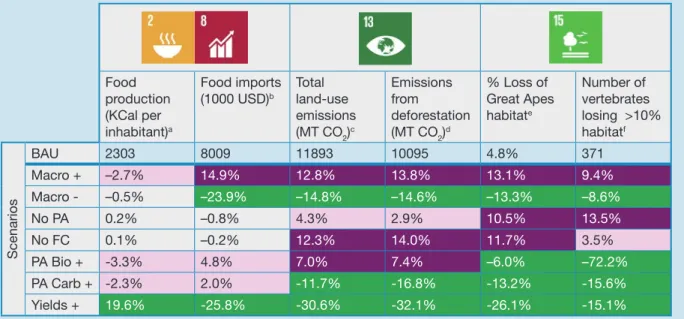
High population and GDP growth (Macro + scenario) may increase the challenge in meeting all of the SDGs according to the indicators assessed, due to the increase in demand for agricultural products. On the other hand increasing agricultural productivity/ yields (Yields + scenario) could reconcile agricultural development, climate change mitigation and biodiversity conservation. Failure to prevent agricultural expansion into protected areas and forest concessions (No PA and No FC scenarios respectively) leads to little economic and development gain, but causes increases in greenhouse gas emissions and loss of habitat. The latter could also increase contact between wildlife and humans, thus raising the risk of poaching. Further increases in the extent of protected areas (PA Bio + and PA Carb + scenarios), could substantially reduce the number of species losing a large proportion of their habitat; however, such expansion needs to be carefully planned to avoid detrimental effects on progress towards other objectives.
Table 1. Comparison of scenarios in respect to their contribution to Sustainable Development Goals. For the Business
As Usual (BAU) scenario, the indicators are expressed in absolute terms, while for each of the other scenarios the percentage difference from the BAU scenario is given; the green colour indicates progress towards achieving a specific objective whilst the purple indicates a greater distance from it. No colour indicates no substantial change. See figure in Box 2 for a description of the scenarios.
Food production (KCal per inhabitant)a Food imports (1000 USD)b Total land-use emissions (MT CO2)c Emissions from deforestation (MT CO2)d % Loss of Great Apes habitate Number of vertebrates losing >10% habitatf Scenarios BAU 2303 8009 11893 10095 4.8% 371 Macro + –2.7% 14.9% 12.8% 13.8% 13.1% 9.4% Macro - –0.5% –23.9% –14.8% –14.6% –13.3% –8.6% No PA 0.2% –0.8% 4.3% 2.9% 10.5% 13.5% No FC 0.1% –0.2% 12.3% 14.0% 11.7% 3.5% PA Bio + -3.3% 4.8% 7.0% 7.4% –6.0% –72.2% PA Carb + -2.3% 2.0% -11.7% -16.8% -13.2% -15.6% Yields + 19.6% -25.8% -30.6% -32.1% -26.1% -15.1%
a) production of calories in KCal per inhabitant per annum in 2030 on the basis of the crops represented in the model, b) value of imports of agricultural products in 1000 USD in 2030 on the basis of the crops represented in the model, c) total emissions from the agricultural sector and changes in land-uses in Megatons CO2 between 2010 and 2030, d) total emissions from deforestation in Megatons CO2 between 2010 and 2030, e) proportion of the area of the potential habitat of Great Apes converted to other uses between 2010 and 2030, f) number of species (among 2115 assessed mammals, amphibians and birds) that lose more than 10% of their potential habitat within the region between 2010 and 2030.
VARIATION IN BIODIVERSITY IMPACTS
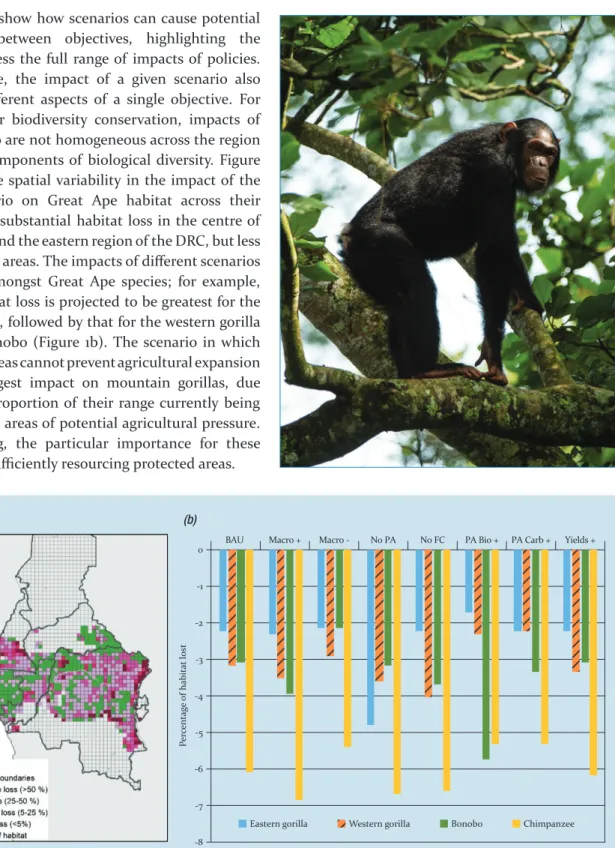
The results show how scenarios can cause potential trade-offs between objectives, highlighting the need to assess the full range of impacts of policies. Furthermore, the impact of a given scenario also vary for different aspects of a single objective. For example, for biodiversity conservation, impacts of any scenario are not homogeneous across the region or for all components of biological diversity. Figure 1a shows the spatial variability in the impact of the BAU scenario on Great Ape habitat across their range, with substantial habitat loss in the centre of Cameroon and the eastern region of the DRC, but less loss in other areas. The impacts of different scenarios also vary amongst Great Ape species; for example, future habitat loss is projected to be greatest for the chimpanzee, followed by that for the western gorilla and the bonobo (Figure 1b). The scenario in which protected areas cannot prevent agricultural expansion has the largest impact on mountain gorillas, due to a large proportion of their range currently being protected in areas of potential agricultural pressure. Highlighting, the particular importance for these species of sufficiently resourcing protected areas.
© J
oseph
King/flickr
.c
om
Figure 1. Habitat loss for Great Apes according to each scenario evaluated using the GLOBIOM-Congo Basin model:
(a) spatial variation in the percentage of habitat loss for all Great Apes according to the Business As Usual scenario (BAU), (b) percentage of habitat loss for each species according to the different scenarios.
-3 -2 -1 Per centag e of habitat lost
Eastern gorilla Western gorilla Bonobo Chimpanzee BAU Macro + Macro - No PA No FC PA Bio + PA Carb + Yields +
-4 -5 -6 -7 -8 0 (a) (b)
Which scenario is most beneficial also varies depending on whether all species are being considered or just a single species. Overall, the greatest reduction in habitat loss across all the species assessed resulted from expanding protected areas to encompass those locations that contained the most threatened habitat under the BAU scenario (PA Bio +, Table 1). However targeting protected area expansion based on the threatened habitat of all assessed species, could increase pressure on bonobos due to displacement of agriculture to areas where they occur.
This assessment focuses on the impacts of agriculture and forestry-related land-cover change and how they may affect the potential for the region to achieve the SDGs. Many other aspects, such as infrastructure development and associated impacts, governance
and institutional development, land degradation and disturbance, the role of bush meat hunting in food security or the impacts of climate change would need to also be taken into consideration to get a full picture of whether and how the region could best reach the SDGs.
Nonetheless, it can help to inform the development and implementation of policies directly related to land-use that support effective sustainable development, climate change mitigation and biodiversity conservation. Such analysis can for example, make a significant contribution to the formulation and implementation of National Biodiversity Strategies and Action Plans (NBSAPs) and national REDD+ strategies across Central Africa.
© Olli vier Gir ar d/CIF OR
© Christina Ber gey/cr eati vec ommons .or g
NEXT STEPS
Key actions for supporting the achievement of multiple commitments within Central African nations include:
● Carefully assessing the impacts, both positive and negative, of future development and land-use policies
in relation to multiple commitments. This could help to reduce the potential trade-offs between them.
● Strengthening planning for economic growth in COMIFAC countries in relation to all of the SDGs.
This could help to take account of the potential negative impacts on climate change mitigation and biodiversity conservation which the combination of large population and economic growth could have through increasing demand for agricultural and forest products.
● Enhancing technical and financial support for the effective management of protected areas in COMIFAC
countries. This could reduce the number of species losing a large proportion of their habitat, and improve their persistence in remaining habitat, thus contributing to achieving SDG 15 and Aichi Biodiversity Target 12.
● Carefully planning the future expansion of protected areas so as to enhance the economic, livelihood
The United Nations Environment Programme World Conservation Monitoring Centre (UNEP-WCMC) is the specialist biodiversity assessment centre of the United Nations Environment Programme (UNEP), the world’s foremost intergovernmental environmental organisation. The Centre has been in operation for over 30 years, combining scientific research with practical policy advice.
The International Institute for Applied Systems Analysis
(IIASA) is an international scientific institute located in Laxenburg, near Vienna, Austria. It conducts policy-oriented research into the critical issues of global environmental, economic, technological, and social change that we face in the twenty-first century.
The Central African Forest Commission (COMIFAC) is an
intergovernmental organisation whose main goal is to provide political and technical guidance, coordination, harmonization and decision-making in conservation and sustainable management of forest and savannah ecosystems in Central Africa.
This publication may be reproduced for educational or non-profit purposes without special permission, provided acknowledgement to the source is made. Reuse of any figures is subject to permission from the original rights holders. No use of this publication may be made for resale or any other commercial purpose without permission in writing from UNEP. Applications for permission, with a statement of purpose and extent of reproduction, should be sent to the Director, UNEP-WCMC, 219 Huntingdon Road, Cambridge, CB3 0DL, UK. Available online at:
http://wcmc.io/REDDPAC_Central_Africa_SDG_Policy_Brief
Copyright © UNEP, COMIFAC, IIASA, 2016
Acknowledgements
This policy brief was produced by UNEP World Conservation Monitoring Centre in collaboration with the International Institute for Applied Systems Analysis (IIASA), and the Central African Forest Commission (COMIFAC), as part of the REDD-PAC project. The REDD-PAC project is financed by the International Climate Initiative (IKI) of the Federal Ministry of Germany for the Environment, Nature Conservation, Building and Nuclear Safety (BMUB). Many thanks go to all those who provided insight, technical contributions and/or technical feedback on the development of this policy brief. To derive the scenarios and help analyse the results, the REDD-PAC team held various rounds of meetings with regional stakeholders. We thank all of the participants of the REDD-PAC regional workshops for their advice and guidance.
Disclaimer
The contents of this report do not necessarily reflect the views or policies of UNEP, contributory organisations or editors. The designations employed and the presentations of material in this report do not imply the expression of any opinion whatsoever on the part of UNEP or contributory organisations, editors or publishers concerning the legal status of any country, territory, city area or its authorities, or concerning the delimitation of its frontiers or boundaries or the designation of its name, frontiers or boundaries. The map presented here does not represent any official assessment or statement on the part of UNEP, COMIFAC or any other entity. The mention of a commercial entity or product in this publication does not imply endorsement by UNEP.
Contributors
COMIFAC: Martin Tadoum, Chouaibou Nchoutpouen, Peguy Tonga, Adeline Makoudjou, Didier Bokelo Bile, Roland Gyscard Ndinga. IIASA: Aline Mosnier, Michael Obersteiner, Florian Kraxner, Johannes Priker, Geraldine Bocqueho, Petr Havik.
UNEP-WCMC: Rebecca Mant, Shaenandhoa García-Rangel, Valerie Kapos.
Citation
Mant, R., S. García-Rangel, M. Tadoum, C. Nchoutpouen, P. Tonga, A. Makoudjou, D. Bokelo Bile, R. G. Ndinga, A. Mosnier, M. Obersteiner, F. Kraxner, J. Priker, G. Bocqueho, P. Havik, K. Valerie. “Using models to inform policies to meet multiple objectives. Sustainable development, climate change mitigation and biodiversity conservation in Central Africa”. Cambridge, Laxenburg, Yaoundé. UNEP-WCMC, IIASA, COMIFAC. May 2016.
UNEP promotes environmentally sound practices globally and in its own activities. Our distribution
policy aims to reduce UNEP’s UNEP World Conservation Monitoring Centre
219 Huntingdon Road, Cambridge CB3 0DL, UK Tel: +44 1223 277314 www.unep-wcmc.org