Program Analyses of Web Applications for Detecting
Application-Specific Vulnerabilities
By FANGQISUN B.S. (Wuhan University) 2005 M.S. (Wuhan University) 2007 DISSERTATIONSubmitted in partial satisfaction of the requirements for the degree of DOCTOR OF PHILOSOPHY
in
COMPUTER SCIENCE in the
OFFICE OF GRADUATE STUDIES of the
UNIVERSITY OF CALIFORNIA DAVIS
Approved:
Zhendong Su, Chair
Shyhtsun Felix Wu
Hao Chen
Committee in Charge 2013
Program Analyses of Web Applications for Detecting Application-Specific Vulnerabilities
c
Dedication
Contents
List of Figures vi
List of Tables vii
1 Introduction 1
1.1 Overview of Web Application Security . . . 1
1.2 Web Application Vulnerabilities . . . 2
1.2.1 XSS Worms . . . 3
1.2.2 Access Control Vulnerabilities . . . 4
1.2.3 Logic Vulnerabilities in E-commerce Applications . . . 4
1.3 Thesis Structure . . . 5
2 Client-Side Detection of XSS Worms by Monitoring Payload Propagation 7 2.1 Introduction . . . 7
2.2 Our Approach . . . 10
2.2.1 Background of XSS Worm Propagation . . . 10
2.2.2 High-level Overview . . . 11
2.2.3 Approach Details . . . 12
2.3 Implementation . . . 15
2.4 Empirical Evaluation . . . 17
2.4.1 Real-World XSS Worms . . . 17
2.4.2 Effectiveness of Our Approach for Obfuscated JavaScript Code . . . 20
2.4.3 Overhead Measurements . . . 21 2.4.4 Parameter Settings . . . 23 2.4.5 Discussion . . . 23 2.5 Related Work . . . 24 2.5.1 Worm Detection . . . 24 2.5.2 Client-Side Protection . . . 25
2.5.3 Server-Side Analysis . . . 25
2.6 Conclusion . . . 26
3 Static Detection of Access Control Vulnerabilities in Web Applications 27 3.1 Introduction . . . 28 3.2 Illustrative Example . . . 31 3.3 Approach Formulation . . . 32 3.4 Analysis Algorithm . . . 34 3.4.1 Vulnerability Detection . . . 35 3.4.2 Building Sitemaps . . . 36 3.4.3 Link Extraction . . . 37 3.5 Implementation . . . 41 3.5.1 Specification Rules . . . 42 3.5.2 Sitemap Builder . . . 42 3.5.3 Vulnerability Detector . . . 47 3.6 Empirical Evaluation . . . 47 3.6.1 Analysis Results . . . 48 3.6.2 Performance Evaluation . . . 53 3.6.3 Discussions . . . 55 3.7 Related Work . . . 56 3.8 Conclusion . . . 58
4 Detecting Logic Vulnerabilities in E-commerce Applications 59 4.1 Introduction . . . 60 4.2 Illustrative Example . . . 64 4.3 Approach . . . 67 4.3.1 Definitions . . . 67 4.3.2 Automated Analysis . . . 70 4.4 Implementation . . . 74 4.4.1 Symbolic Execution . . . 76 4.4.2 Path Exploration . . . 77 4.4.3 Logic Flows . . . 79 4.5 Empirical Evaluation . . . 80 4.5.1 Analysis Results . . . 82
4.5.2 Experiments on Live Websites . . . 86
4.5.3 Performance Evaluation . . . 87
4.6 Related Work . . . 91 4.7 Conclusion . . . 93 5 Conclusion 94 5.1 Summary . . . 94 5.2 Future Work . . . 95 Bibliography 98
List of Figures
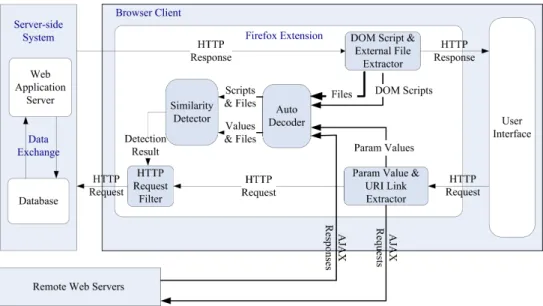
2.1 Client architecture for XSS worm detection. . . 11
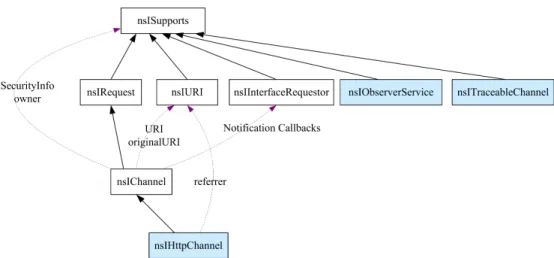
2.2 The interface collaboration diagram. . . 16
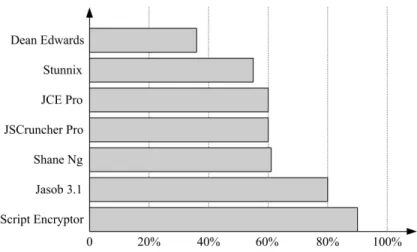
2.3 Similarity results for common JavaScript obfuscators. . . 21
3.1 An Example of Access Control Vulnerability. Solid arrows represent explicit links, and dashed arrows represent inclusion relationship between pages. Arrows correspond to edges in sitemaps and are labeled with roles. The intended sitemap for privileged rolea has four edges while the intended sitemap for role bhas only one edge. . . 31
3.2 Algorithm for Vulnerability Detection. . . 35
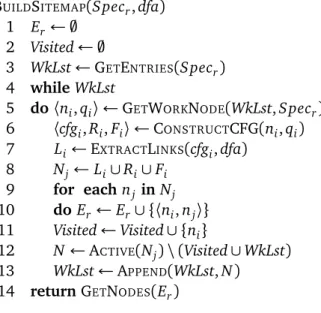
3.3 Algorithm for Building Sitemaps. . . 37
3.4 Algorithm for Link Extraction. . . 39
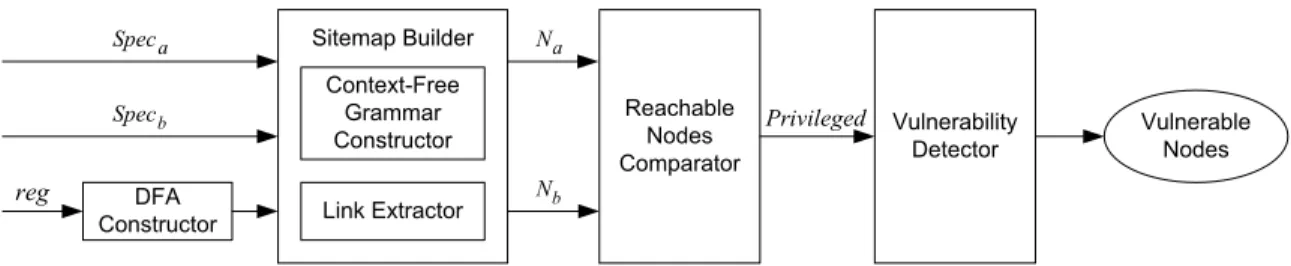
3.5 System Architecture. . . 41
3.6 An Example of Path Exploration. . . 44
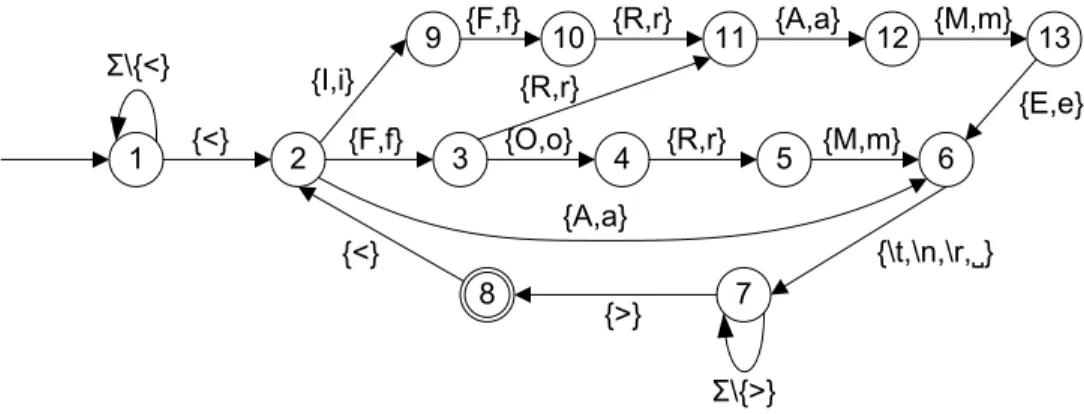
3.7 A Deterministic Finite Automaton Example. . . 45
4.1 Logic Flows in E-Commerce Web Applications. . . 61
4.2 Received Products from Vulnerable Websites. . . 62
4.3 Algorithm for Vulnerability Detection. . . 71
4.4 Symbolic Execution Framework. . . 75
List of Tables
2.1 Statistics of XSS worms in the wild. . . 18
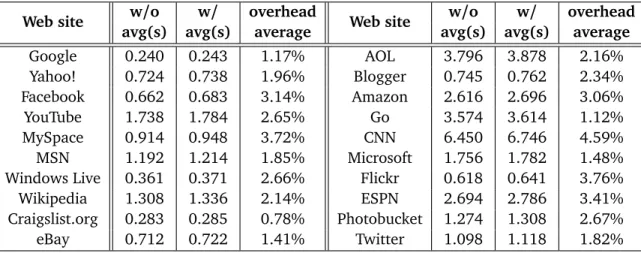
2.2 Performance overhead for top 20 websites. . . 22
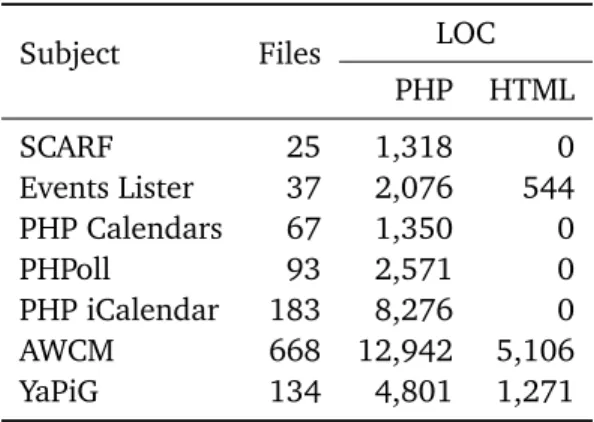
3.1 Statistics on Evaluation Subjects. . . 48
3.2 Vulnerability Analysis Results. . . 49
3.3 Coverage and Performance Results. . . 53
3.4 Analysis Time. . . 54
4.1 Payment Modules for Cashiers. . . 81
4.2 Logic Vulnerability Analysis Results. . . 82
Abstract
Web applications are prevalent in the modern era, regulating access to sensitive information, functionality and resources. Due to the difficulty in designing and implementing proper security checks for untrusted user inputs and actions, web applications often fall victim to various online attacks. In particular, application-specific vulnerabilities are easy to exploit and often have severe consequences. While the detection of application-independent injection vulnerabilities, such as Cross-Site Scripting (XSS) and SQL injection vulnerabilities, examines individual web pages in isolation, the detection of application-specific vulnerabilities necessitates the examination of both logic flows among web pages and user inputs of each page. The detection of application-specific vulnerabilities is more challenging because such vulnerabilities vary across different applications and designing general detection rules for them is difficult. Since manual code review is error-prone and time-consuming, it is important to develop automated detection techniques.
This dissertation presents novel, practical program analyses to detect web application vulnerabilities, especially application-specific ones. It begins by providing the first pure client-side solution to detect XSS worms which exploit XSS vulnerabilities. Unlike XSS worms, logic vulnerabilities are application-specific. Two important types of logic vulnerabilities are access control vulnerabilities in web applications and logic vulnerabilities in e-commerce applications. This dissertation formulates their respective core characteristics and introduces corresponding server-side techniques to detect them. Specifically, for access control vulnerabilities, it describes the first static analysis that infers and enforces implicit access control assumptions, and for logic vulnerabilities in e-commerce applications, it presents the first static detection of logic attacks that cause incorrect payment status. In addition, this dissertation presents practical algorithms and tools which are shown to be scalable and capable of finding unknown vulnerabilities in real-world web applications.
Acknowledgments
This dissertation would not exist without the assistance, advice and encouragement from many people. I would like to thank my family, friends and coworkers from the bottom of my heart.
I thank my doctoral advisor Prof. Zhendong Su for his invaluable advice and support. He set an excellent example of dreaming big, working hard and never giving up. Prof. Su inspired me to conduct top-notch research and taught me to view difficulties as opportunities rather than hurdles on the road. He did his best to help me and I am indebted to him for his wonderful guidance along the way.
I also thank the other members of my committee, Prof. Hao Chen and Prof. Felix Wu. The upbeat and insightful lectures of Prof. Chen introduced me to influential research in computer security. I also learned a lot from Prof. Wu’s carefully prepared lectures on operating systems and enjoyed modifying a Linux kernel for the course project.
I am deeply grateful to my father for his unconditional love and support. He sparked my initial interests in science and technology in my upbringing. He has provided me with counseling and honest feedback. I would not be where I am without his encouragement.
I would like to thank also my labmates in Kemper 2249: Mehrdad Afshari, Earl Barr, Mark Gabel, Zhongxian Gu, Dara Hazeghi, Lingxiao Jiang, Taeho Kwon, Vu Minh Le, Andreas Sæbjørnsen, Martin Velez, Thanh Vo, Ke Wang and Gary Wassermann. They made working in the lab a fun experience. I appreciate their constructive and detailed feedback on research ideas, paper drafts and practice talks. Special thanks to my partner both in life and in research, Liang Xu, for his constant love and support. It has been great to share all the joy, excitement and trying times with him.
Chapter 1
Introduction
Web applications have become increasingly pervasive and so have web-based attacks. While bringing a degree of interoperability and integration of data never before dreamed of, few web applications are immune from being compromised. The sheer size and complexity of web applications leave open a large attack surface. Additionally, the sophistication of application-specific vulnerabilities increases the difficulty of implementing perfect lines of defense. Consequently, the security of web applications is of vital importance.
1.1
Overview of Web Application Security
Web applications serve a wide range of purposes, from social networking, sensitive data management to online shopping. The advent of smart mobile devices enables users to access web applications even on the go. A recent Symantec Internet security threat report states that the number of reported web vulnerabilities increased from 4,989 in 2011 to 5,291 in 2012, incurring an average cost of $591,780 for businesses[68]. Furthermore, web vulnerabilities are widespread. A WhiteHat security statistics report published in 2013 shows that 86% of all the surveyed websites had at least one serious vulnerability during 2012, and the number of serious vulnerabilities per website was 56 on average[82].
Recent years have witnessed the rapid growth of web applications and their code complexity. Web applications have evolved from sets of simple, static web pages, to feature-rich Web 2.0 applications
which frequently integrate third-party services. Unfortunately, the more features that a modern web application possesses, the larger attack surface it often exposes to attackers. With the incorporation of client-side JavaScript code, attackers can inject malicious JavaScript code in user inputs and exploit various ways that web browsers invoke their JavaScript engines. In cases where web applications behave differently to administrators and normal users, attackers can break authentication processes and access sensitive information and functionality. In recent years, the integration of third-party services has become popular, giving attackers a new opportunity to exploit miscommunications between servers and service providers. The best practice for web security is to build an application with security in mind end-to-end. However, many web developers are unfamiliar with various attack vectors, especially application-specific ones.
Application-specific vulnerabilities in web applications are especially challenging to detect. When building an application, developers often have a clear picture of what the ideal application should be in their minds. Unfortunately, in practice, the implemented application often does more than what is intended. Put it another way, unexpected user inputs and logic flows can allow attackers to abuse implemented but insufficiently guarded application-specific functionality in dangerous ways. The uniqueness and complexity of logic flows complicate the establishment of a general line of defense against application-specific attacks.
This dissertation focuses on detecting crucial, ungrounded assumptions that web developers make about user inputs and logic flows in web applications. While existing solutions mainly focus on vulnerabilities related to untrusted user inputs, the key observation of this dissertation is that it is also important to validate critical assumptions on logic flows which are application-specific. Less traveled paths in web applications may indeed lead to fruitful attacks. Inferring and enforcing such implicit assumptions on logic flows are vital yet challenging for web application security.
1.2
Web Application Vulnerabilities
This section describes three distinct types of web application vulnerabilities: XSS worm, access control vulnerabilities in web applications and logic vulnerabilities in e-commerce web applications. While
injection vulnerabilities are the most common, their impact is not always significant. In addition, injection vulnerabilities have been extensively studied over the past few years, and there already exist clear understandings of their essence. In contrast, application-specific vulnerabilities that this dissertation focuses on often have serious impact, and their uniqueness poses significant challenges for automated detection.
1.2.1
XSS Worms
An XSS worm is a piece of self-replicating JavaScript code that exploits an XSS vulnerability to propagate itself within one web application. XSS worms often share two common characteristics. First, to avoid unwanted attention from users, they often spread silently using Asynchronous JavaScript and XML (AJAX) and only process HTTP requests and responses in the background. Second, to avoid detection,
they often use encoding or obfuscation techniques.
As an example, the following code snippet shows how the Samy worm[39], a worm that affected more than one million MySpace users in less than 20 hours, avoided detection and invoked JavaScript engines. Notice that there is a newline character between stringsjavaandscriptof the background URL.
<DIV id=mycode style="BACKGROUND: url(’java
script:eval(document.all.mycode.expr)’)" expr="..."></DIV>
The Samy worm exploited an XSS vulnerability caused by the extra newline character. The newline character helped the Samy worm avoid keyword-based detection but still invoke JavaScript engines. In other words, MySpace servers viewed the worm as a benign user input, while browsers interpreted the worm as legitimate JavaScript code. The payload of the worm, which is written in theexprproperty of aDIVtag, replicates itself and writes “Samy is my hero” in infected users’ profiles. The connections among MySpace users served as channels for worm propagation.
1.2.2
Access Control Vulnerabilities
Access control vulnerabilities are the culprit of privilege escalation attacks which expose sensitive information or operations. Often in violation of developers’ intentions, attackers predict and directly access sensitive, hidden URLs for privileged information or functionality which are usually application-specific. The root cause of access control vulnerabilities is that developers often implicitly assume that attackers will not access hidden URLs. However, security by obscurity offers insufficient and unreliable protection.
For example, Bloomberg leaked unpublished earnings of NetApp in November, 2010[58]. The leaked earnings report was obtained via the first URL shown below. The second and third URLs are two examples of previous report URLs.
http://media.netapp.com/documents/financial-fy11-q2.pdf (leaked) http://media.netapp.com/documents/financial-q1-fy11.pdf
http://media.netapp.com/documents/financial-10-q4.pdf
As can be seen from the URLs, the unpublished URL is highly predictable. The administrator of NetApp assumed that unprivileged users would not access that URL. However, Bloomberg predicted the first sensitive URL based on previous URLs. The breach led to arguments between the two companies. Bloomberg claimed that the file was posted without any required password, but NetApp stated that the file was obtained from a restricted area of its website. This example illustrates the importance of explicitly protecting privileged accesses.
1.2.3
Logic Vulnerabilities in E-commerce Applications
Logic vulnerabilities in e-commerce web applications refer to missing or insufficient checks that can be exploited to cause inconsistent payment status between third-party cashiers and merchants during checkout. By using unexpected application-specific logic flows, an attacker can lead a merchant to mistakenly believe that an order has been paid correctly while the designated cashier actually has received nothing or only an insufficient payment. Once exploited, such vulnerabilities often result in serious consequences, including financial loss and merchant embarrassment.
Take for example an unknown logic vulnerability that we detected in an open source application osCommerce[1]. Suppose a user places two orders with IDs of 1001 and 1002 on a merchant’s server. For either order, the designated cashier is assumed to generate a secretMD5value and visit a URL based on pagecheckout_process.phpwith the secret value only when a full payment has been made to the cashier. The secret values of orders 1001 and 1002 should be different and unpredictable. The URLs for the two orders are shown in the following.
http://merchant.com/checkout_process.php?orderID=1001&LKMAC=SecretMD5For1001 http://merchant.com/checkout_process.php?orderID=1002&LKMAC=SecretMD5For1002
The key problem for the detected logic vulnerability is that this e-commerce application does not check the request parameter values oforderID andLKMAC against trusted order ID andMD5value. Consequently, an attacker can skip payment and jump directly to a forged merchant URL. The attacker can use the request parameter values of order 1001 for order 1002 to avoid payment. This substitution leads the merchant to mistakenly believe that order 1002 has been paid, while the cashier actually has received nothing on behalf of the merchant for this order. Essentially, this detected vulnerability allows attackers to pay once and bypass payment for future orders.
1.3
Thesis Structure
This dissertation addresses several important vulnerabilities in web applications. It presents runtime protection against XSS worms and static analyses for application-specific vulnerabilities. The rest of this dissertation is organized as follows.
Chapter 2 An XSS worm tends to spread rapidly, sometimes even exponentially, within a web application. Based on the key observation that an XSS worm must spread from one user to another by reconstructing and propagating its payload, Chapter 2 presents the first client-side approach to detect and stop the propagation of XSS worms early on. This runtime approach identifies XSS worms by monitoring outgoing requests that send self-replicating payloads. A cross-platform Firefox extension
is built to demonstrate the effectiveness and efficiency of this approach. The evaluation shows that the browser extension detects all known real-world client-side XSS worms, produces no observed false positives and exhibits low overhead when tested on popular websites.
Chapter 3 Automated detection of access control vulnerabilities is challenging because of the lack of a general characterization and specification for access control vulnerabilities. Specifications are the basis of automated detection. Manual specification is time-consuming and often absent, while probabilistic-based inference is imprecise and computationally expensive. The key observation is that source code of an application implicitly documents intended accesses of each role. This insight enables precise extractions of access control policies from differences between per-role sitemaps. Chapter 3 presents the first role-based static analysis which detects access control vulnerabilities with minimal manual effort. This approach automatically infers privileged pages based on constructed per-role sitemaps and performs forced browsing to detect vulnerabilities. The implemented tool detects both known and new access control vulnerabilities in web applications with few false positives, demonstrating its effectiveness and scalability.
Chapter 4 Logic vulnerabilities in e-commerce web applications have serious impact due to its direct tie to financial loss. The introduction of third-party cashiers increases the difficulty of designing and implementing secure checkout processes. A chain is as strong as its weakest link, therefore any loophole in a checkout process leaves attackers an opportunity for playing tricks to avoid or reduce payment. Chapter 4 presents a key invariant of successful payments in e-commerce applications: A secure payment occurs when critical components of payment status (order ID, order total, merchant ID and currency) are tamper-proof and authentic. This chapter also shows a symbolic execution framework that integrates taint analysis to analyze critical logic flows during checkout. The implementation scales to real-world payment modules and effectively detects logic vulnerabilities, the majority of which are new.
Chapter 2
Client-Side Detection of XSS Worms by
Monitoring Payload Propagation
Cross-site scripting (XSS) vulnerabilities make it possible for worms to spread quickly to a broad range of users on popular websites. To date, the detection of XSS worms has been largely unexplored. This chapter proposes the first purely client-side solution to detect XSS worms. Our insight is that an XSS worm must spread from one user to another by reconstructing and propagating its payload. Our approach prevents the propagation of XSS worms by monitoring outgoing requests that send self-replicating payloads. We intercept all HTTP requests on the client side and compare them with currently embedded scripts. We have implemented a cross-platform Firefox extension that is able to detect all existing self-replicating XSS worms that propagate on the client side. Our test results show that it incurs low performance overhead and reports no false positives when tested on popular websites.
2.1
Introduction
Web applications have drawn the attention of attackers due to their ubiquity and the fact that they regulate access to sensitive user information. To provide users with a better browsing experience, a number of interactive web applications take advantage of the JavaScript language. The support for JavaScript, however, provides a fertile ground for XSS attacks. According to a recent report from
OWASP[59], XSS vulnerabilities are the most prevalent vulnerabilities in web applications. They allow attackers to easily bypass the Same Origin Policy (SOP)[54]to steal victims’ private information or act on behalf of the victims.
XSS vulnerabilities exist because of inappropriately validated user inputs. Mitigating all possible XSS attacks is infeasible due to the size and complexity of modern web applications and the various ways that browsers invoke their JavaScript engines. Generally speaking, there are two types of XSS vulnerabilities. Non-persistent XSS vulnerabilities, also known as reflected XSS vulnerabilities, exist when user-provided data are dynamically included in pages immediately generated by web servers;persistent XSS vulnerabilities, also referred to as stored XSS vulnerabilities, exist when insufficiently validated user inputs are persistently stored on the server side and later displayed in dynamically generated web pages for others to read. Persistent XSS vulnerabilities allow more powerful attacks than non-persistent XSS vulnerabilities as attackers do not need to trick users into clicking specially crafted links. The emergence ofXSS wormsworsens this situation since XSS worms can raise the influence level of persistent XSS attacks in community-driven web applications. XSS worms are special cases of XSS attacks in that they replicate themselves to propagate, just like traditional worms do. Different from traditional XSS attacks, XSS worms can collect sensitive information from a greater number of users within a shorter period of time because of their self-propagating nature.
The threats that come from XSS worms are on the rise as attackers are switching their attention to major websites, especially social networking sites, to attack a broad user base[67]. Connections among different users within web applications provide channels for worm propagation. In community-driven web applications, XSS worms tend to spread rapidly — sometimes exponentially. For example, the first well-known XSS worm, the Samy worm[39], affected more than one million MySpace users in less than 20 hours in October 2005. MySpace, which had over 32 million users at that time, was forced to shut down to stop the worm from further propagation. In April 2009, during the outbreak of the StalkDaily XSS worm which hit twitter.com, users became infected when they simply viewed the infected profiles of other users. We show a list of XSS worms in Table 2.1 (Section 2.4.1). Common playgrounds for XSS worms include social networking sites, forums, blogs, and web-based email services.
vulnerabilities, little research has been done to detect XSSworms. This is because XSS worms usually contain site-specific code which evades input filters. XSS worms can stealthily infect user accounts by sending asynchronous HTTP requests on behalf of users using the Asynchronous JavaScript and XML (AJAX) technology. Spectator[48]is the first JavaScript worm detection solution. It works by monitoring worm propagation traffic between browsers and a specific web application. However, it can only detect JavaScript worms that have propagated far enough and is unable to stop an XSS worm in its initial stage. In addition, Spectator requires server cooperation and is not easily deployable.
In this chapter, we present the first purely client-side solution to detect the propagation of self-replicating XSS worms. Clients are protected against XSS worms on all web applications. We detect worm payload propagation on the client side by performing a string-based similarity calculation. We compare outgoing requests with scripts that are embedded in the currently loaded web page. Our approach is similar in spirit to traditional worm detection techniques that are based on payload propagation monitoring[75, 76]; we have developed the first effective client-side solution to detect XSS worms.
This chapter makes the following contributions:
• We propose the first client-side solution to detect XSS worms. Our approach is able to detect self-replicating XSS worms in a timely manner, at the very early stage of their propagation.
• We have developed a cross-platform Firefox extension that is able to detect all existing XSS worms that propagate on the client side.
• We evaluated our extension on the top 100 most visited websites in the United States[4]. Our results demonstrate that our extension produces no false positives and incurs low performance overhead, making it practical for everyday use.
The rest of the chapter is organized as follows. Section 2.2 describes our worm detection approach in detail. Section 2.3 presents the implementation details of our Firefox extension. Section 2.4 evaluates the effectiveness of our approach and measures the performance overhead of our Firefox extension on popular websites. Finally, we survey related work (Section 2.5) and conclude (Section 2.6).
2.2
Our Approach
Section 2.2.1 describes the background of how an XSS worm usually propagates. Section 2.2.2 gives an overview of how we detect the propagation behavior of an XSS worm. We describe the details of our detection routine in Section 2.2.3.
2.2.1
Background of XSS Worm Propagation
The Document Object Model (DOM) is a cross-platform and language-independent interface for valid HTML and well-formed XML documents[73]. It closely resembles the tree-like logical structure of the document it models. Every node in a DOM tree represents an object in the corresponding document. With the DOM, programs and scripts can dynamically access and update the content, structure and style of documents.
In practice, building a flawless web application is an extremely difficult task due to the challenges of sufficiently sanitizing user-supplied data. Site-specific XSS vulnerabilities become a growing concern as attackers discover that they can compromise more users by exploiting a single vulnerability within a popular web site than by compromising numerous small websites[67]. Exploiting persistent XSS vulnerabilities, XSS worms are normally stored on the servers of vulnerable web applications. The typical infection process of an XSS worm is as follows:
1. A user, Alice, is lured into viewing a malicious web page that is dynamically generated by a compromised web application. The web page, for example, can be the profile page of Alice’s trusted friend.
2. The XSS worm payload, which is embedded in the dynamically generated web page, is interpreted by a JavaScript engine on the client side. During this interpretation process, an XSS worm usually replicates its payload and injects the replicated payload into an outgoing HTTP request.
3. The crafted malicious HTTP request is sent to the web application server on Alice’s behalf. By exploiting the server’s trust in Alice, the XSS worm also compromises Alice’s account. Later on, when Alice’s friends visit her profile, their accounts will also be infected.
Figure 2.1: Client architecture for XSS worm detection.
2.2.2
High-level Overview
Our goal is to detect the self-replicating characteristics of XSS worms with no modification to existing web applications or browser architecture. To this end, we compare outgoing HTTP requests with scripts in the currently loaded DOM tree. Figure 2.1 shows the architecture of our client-side XSS worm detection mechanism. Our solution captures the essential self-propagating characteristics of XSS worms and protects users from infection. We choose to detect XSS worms on the client side because the propagation process of an XSS worm is normally triggered during the script interpretation process on the client side. Moreover, a client-side solution is easily deployable.
Scripts can be directly embedded in web pages or dynamically loaded from remote servers. Therefore, it is necessary to examine all external JavaScript files that are pointed to by Uniform Resource Identifier (URI) links in both outgoing HTTP requests and loaded DOM trees. The steps we take to detect an XSS worm are as follows:
1. We intercept each outgoing HTTP request that may contain the payload of an XSS worm. We extract parameter values from each intercepted request. From these parameter values, we then extract URI links which may point to malicious JavaScript files.
2. If there exist embedded URI links, we send asynchronous requests to retrieve external JavaScript files according to the extracted URI links. We do not begin our decoding process (Step 4) until we receive all responses or signals of timeout events from remote servers. We call the set of parameter values and retrieved external files setP.
3. We extract scripts from the DOM tree of the current web page. Next, we retrieve external JavaScript files, which are dynamically loaded into the current web page, from cached HTTP responses. We call the set of extracted scripts and cached external files setD.
4. We apply an automatic decoder on code from both setP and setD. We repeat this decoding process until we find no encoded text.
5. Finally, we use a similarity detector to compare decoded code from set P with decoded code from setDin search of similar code, which indicates the potential propagation behavior of an XSS worm. If we detect suspiciously similar code, we redirect the malicious HTTP request and alert the user.
2.2.3
Approach Details
This section describes the details of our XSS worm detection algorithm: how we extract parameter values and URI links; possible locations where scripts might appear in web pages; our decoder, which can handle a number of encoding schemes; and the string similarity detection algorithm that we use.
Parameter Values and URI Links from HTTP Requests
The payload of an XSS worm could be sent in the form of plaintext or as a URI link pointing to an external file stored on a remote server. In either case, the plaintext or the URI link needs to be embedded in the parameter values of an outgoing HTTP request in order to propagate. The extracted parameter values and retrieved external files compose setP.
As it is impossible to tell whether an HTTP request is sent by an XSS worm or a legitimate user, we intercept and process each outgoing HTTP request. We first extract parameter values, if there are any,
from thepathproperty of the requested URI. We then examine the request method of the outgoing HTTP request. If thePOSTmethod is used, we retrieve the request body and then extract additional parameter values from it.
Since attackers may store XSS worm payloads on remote servers and propagate URI links instead of plaintext, we extract URI links from parameter values of HTTP requests using JavaScript regular expressions. We send requests to retrieve external files according to the URI links.
DOM Scripts and External Files from web pages
To enumerate possible locations where scripts may exist, we studied the source code of several XSS worms in the wild, the XSS Cheat Sheet[36], and some other documentation[73, 80]. We classify possible locations where scripts may reside into the following categories:
• scriptelements. A script can be defined within thescriptelement of a DOM tree.
• Event handlers. W3C specifies eighteen intrinsic event handlers[73]. In addition, some browsers have implemented browser-specific event handlers.
• HTML attributes. Attackers sometimes exploit the attributes of standard DOM elements to dynamically load external files into a document.
• Scripts specified by browser-specific attributes or tags. Some browsers implement browser-specific attributes and tags.
• javascript: URIs. By declaring the JavaScript protocol, JavaScript code can be put into a place where a URI link is expected.
Based on the possible locations discussed above, we extract scripts directly embedded in the currently loaded DOM tree and retrieve cached external files pointed to by the attributes of DOM elements. Extracted scripts and cached external files compose setD. If an XSS worm exists, its payload should be embedded in at least one of these locations in order to trigger script interpretation.
Automatic Decoder
Taking into consideration that the payload of an XSS worm may be encoded, we perform a decoding process before carrying out our similarity detection process. We decode all extracted parameter values, retrieved external JavaScript files, extracted DOM scripts, and cached external JavaScript files. In order to automate the decoding process, we use a regular expression for each encoding scheme.
It is possible that a JavaScript obfuscator applies multiple layers of encoding routines. To handle such situations, we keep track of the total match count for all regular expressions in each decoding routine. If the total match count in a decoding routine reaches zero, it means that no encoded text is found. For this case, we stop our decoding routine; otherwise, we repeat the decoding routine.
Similarity Detection
We detect both suspicious URI links and similar strings.
An XSS worm may propagate by sending a URI link pointing to itself instead of directly sending its payload as plaintext. Therefore, before comparing the elements from setP with the elements from setD, we compare the URI links extracted from the parameter values of an outgoing HTTP request with the URI links embedded in the current DOM tree. If a match is found, we immediately redirect the current request and alert the user of the suspicious URI link; otherwise, taking into account the possibility that attackers may use different URI links for the same payload, we examine the contents of external files. Although we have not seen such attacks in real-world XSS worms, we conservatively examine file contents. We do not begin our URI detection process until the decoding process completes. Once we have all the decoded code, we perform a similarity detection routine in search of a possible XSS worm payload. We use a string similarity detection algorithm based on trigrams[3]for its robustness in dealing with some JavaScript obfuscation techniques such as code shuffling and code nesting.
In our implementation, we use character-level trigrams, which are three character substrings of given strings, to detect the similarity between two strings. Note that a trigram is a special case of an n-gram wheren=3. We introduce formal definitions of the trigram algorithm as follows.
Definition 2.1 T(s)denotes the set of character-level trigrams of strings.
Definition 2.2 S(p,d)denotes the similarity between two stringspandd, where p∈ P,d∈ D, and bothP andDare sets of strings.
We compute the similarity ofpandd in the following way:
S(p,d) = T(p) ∩ T(d) T(p) ∪ T(d) (2.1)
In our current settings,P is the set of parameter values and contents of retrieved external files, and
Dis the set of scripts extracted from the DOM tree and contents of cached external files.S(p,d)has a value between 0 and 1, inclusive.
To make our implementation scalable, we sort the elements in each set into ascending order before calculating their union or intersection. The average-case time complexity of the trigram algorithm is determined by the time complexity of the sorting algorithm, which isO(nlogn).
Definition 2.3 If∃p∈ P,d ∈ Dsuch thatS(p, d)exceedsa customized threshold t, we say that an outgoing HTTP request may contain an XSS worm payload because it exhibits self-propagating behavior.
2.3
Implementation
We have developed a standard cross-platform Firefox 3.0 extension to detect XSS worms. Most Firefox extensions are written in JavaScript because the bindings between JavaScript and XPCOM are strong and well-defined. We wrote most components of our extension in JavaScript, except that we implemented the trigram algorithm using C++for its better execution efficiency over JavaScript.
We show key user interfaces that we have used in our extension in Figure 2.2. This diagram is taken from Mozilla Cross-Reference to show the collaboration among the interfaces.
nsIObserverService. To monitor parameter values in each HTTP request, we first get a service from the XPCOM componentobserver-service through the interface nsIObserverService. We then
Figure 2.2: The interface collaboration diagram.
register anhttp-on-modify-requestobserver and anhttp-on-examine-responseobserver in our extension with the observer service we just obtained.
nsIHttpChannel. Through annsIHttpChannelobject, we can obtain annsIURIobject to read its asciiSpec property for an ASCII representation of the requested URI. To get the body of a POST request from annsIHttpChannel object, we gain access to the post data by obtaining a pointer to thensIUploadChannelinterface, and then rewind the stream of the post data with a pointer to the nsISeekableStreaminterface. If an XSS worm is detected, we obtain a pointer to thensIRequest interface, and then call the cancel method in that interface to cancel the malicious HTTP request.
nsITraceableChannel. ThensITraceableChannelinterface enables us to directly retrieve external files from cached HTTP responses rather than sending asynchronous requests and waiting for their responses. This interface was recently introduced in Firefox 3.0.4, which was released in November 2008. Through this interface, we can replace a channel’s original listener with a new one, and collect all the data we need by interceptingOnDataAvailablecalls. We examine the Multipurpose Internet Mail Extensions (MIME) types of all HTTP responses to determine which responses might trigger script interpretation.
2.4
Empirical Evaluation
This section shows the effectiveness of our approach on real-world XSS worms, as well as obfuscated JavaScript code produced by some common JavaScript obfuscators. We then present the performance overhead results, reason about parameter settings, and discuss potential threats to the validity of our approach.
2.4.1
Real-World XSS Worms
The XSS worms examined in this section are all XSS worms released on popular real-world Web applications. All of these worms exploited persistent XSS vulnerabilities in different Web applications.
The Samy Worm
Based on the source code of the Samy worm[39], we wrote and tested an XSS worm on a small-scale Web application that we constructed. We named our Web application SamySpace. SamySpace mimics the necessary functionality of MySpace to allow the propagation of an XSS worm. We stored each user’s profile in a backendMySQLdatabase. We modified the original Samy worm code[39]as little as possible to make it work on SamySpace. As in the Samy worm, our worm sends five AJAX requests in total.
The original Samy worm is only slightly obfuscated using short variable names and few newline characters to fit itself into the limited space of theinterestfield in a user’s profile. Our implementation is able to detect the XSS worm released on SamySpace by observing a high similarity of 91% between a parameter value sent in a request and a script extracted from the DOM tree.
The Orkut Worm
Different from the Samy worm, the Orkut worm is a heavily obfuscated XSS worm. During its outbreak, a user’s account on Orkut was infected when the user simply read ascrapsent by the user’s infected friend. The Orkut worm payload is contained in an external JavaScript file namedvirus.js, the URI
XSS worm Propagation Triggering Payload Release
method method location date
Samy Worm XHR javascript: URIs DOM Oct. 2005
Xanga XHR javascript: URIs DOM Dec. 2005
Yamanner XHR onloadevent handler server Jun. 2006
SpaceFlash XHR javascript: URIs URI link Jul. 2006
MyYearBook form submission innerHTML DOM Jul. 2006
Gaia XHR srcattribute URI link Jan. 2007
U-Dominion XHR srcattribute URI link Jan. 2007
Orkut XHR srcattribute URI link Dec. 2007
Hi5 form submission -moz-binding/expression URI link Dec. 2007
Justin.tv XHR srcattribute URI link Jun. 2008
Twitter XHR srcattribute/expression URI link Apr. 2009 Table 2.1: Statistics of XSS worms in the wild.
of which is included in an <embed>element. The <embed> element is injected into the value of a parameter, which is used to store the message body of a scrap.
The Orkut worm works in three steps. To begin with, the worm payload embedded invirus.js reconstructs itself. It then propagates the worm payload to everyone present in the victim’s friend list. Finally, it sends an asynchronous request to add the victim to a community, which tracks the total number of infected users, without the user’s approval.
The parameter values sent by the Orkut worm include a malicious URI link. Since the URI link contained in the outgoing request is also embedded in the DOM, we are able to detect the propagation behavior of this XSS worm.
XSS Worms In the Wild
We carefully examined the available source code of XSS worms in the wild. Table 2.1 lists eleven of them. The first column of the table shows the names of XSS worms. We use the names of the infected websites to represent released worms when there is no ambiguity. The second column shows the propagation methods that were used. XMLHttpRequest (XHR) denotes asynchronous requests sent in the background, while form submission denotes HTTP requests which are sent when HTML forms are submitted or links are clicked. The third column of the table shows the triggering methods of
worm payloads. Theexpressionfunction, which takes a piece of JavaScript code as its parameter, is supported in both Internet Explorer and Netscape; the-moz-bindingattribute, which binds JavaScript code to a DOM element, is supported in both the Firefox and the Netscape browsers. The fourth column shows where worm payloads were extracted for payload reconstruction. Finally, the last column shows the release dates.
Yamanner was released onYahoo!Mail; theXangaworm was released on a blog; theGaiaworm and theU-Dominionworm were released on gaming websites; theJustin.tvworm was released on a video hosting Web site; and all of the six remaining worms were released on social networking websites. MySpace, a popular social networking Web site, is one of the favorite targets of XSS worms. Both the Samy worm and the SpaceFlash worm were released on it.
With regard to worm propagation methods, most attackers chose to use XHR for its advantage over form submission: asynchronous requests sent quietly in the background often go unnoticed. There are various kinds of XSS vulnerabilities, and so are script triggering methods. Most methods work on major Web browsers, except-moz-bindingandexpression, which are browser specific.
For XSS worms that propagate by reconstructing their payload from the loaded DOM tree, our approach is able to detect high similarity between parameter values of outgoing HTTP requests and DOM scripts; for XSS worms which propagate by sending links to external files, our approach is able to detect the existence of identical URI links that appear in both parameter values of outgoing requests and HTML attributes of the current DOM tree.
The Yamanner worm is a special case of XSS worms because its propagation process is actually performed on the server side rather than on the client side. Back in 2005 when the Yamanner worm was unleashed, the Yahoo!Mail system provided two ways to forward an email: either as inline text or as an attachment. For forwarded email with inline text, the message body of the original email was embedded in the message body of the forwarded email. For forwarded email with an attachment, only the message ID of the original email was embedded in the forwarded email; the message body of the original email was later retrieved when the attachment was opened or downloaded. The Yamanner worm used the attachment method to forward malicious emails; therefore, outgoing requests sent by Yamanner to forward emails only contained the message IDs of original emails. To obtain the message
body with the actual worm payload on the client side, we would need to write application-specific code to retrieve message bodies from the application server.
2.4.2
Effectiveness of Our Approach for Obfuscated JavaScript Code
When JavaScript code obfuscation was introduced a few years ago, it was mainly used to provide control over intellectual property theft. With the advent of XSS worms, we see the increasing abuse of legitimate JavaScript obfuscators by malware authors. We have seen an online XSS worm tutorial suggesting people obfuscate their code using a legitimate JavaScript packer[25]. We believe unsophisticated malware authors normally would not take the effort to write their own JavaScript obfuscators. When we first examined the obfuscated source code of the Orkut worm, we noticed that it used an unusual decoding function which has six parameters:“(p, a, c, k, e, d)”. After some research, it turned out that the obfuscated code was generated by a legitimate and publicly available JavaScript packer written by Dean Edwards[25]. The decoding function acts as a signature function of his JavaScript packer.
The purpose of using JavaScript obfuscators is to turn JavaScript source code into functionally equivalent JavaScript code that is more difficult to study, analyze and modify. Eventually any obfuscated JavaScript code must be read and correctly interpreted by a JavaScript engine. Common JavaScript obfuscation techniques include the following:
• Code shuffling and code nesting.
• String manipulations such as string reversion, split and concatenation.
• Character encoding.
• Insertions or deletions of arbitrary comments, spaces, tabs, and newline characters.
• Variable renaming and randomized function names.
• The use of encryption and decryption.
With the combination of our automatic decoder and trigram algorithm, our approach is robust in dealing with the first four obfuscation techniques. For example, the code shuffling technique has
Figure 2.3: Similarity results for common JavaScript obfuscators.
no impact on our string-based similarity detection process. We tested our approach on widely used JavaScript obfuscators that we have collected. We used each obfuscator to obfuscate five real-world XSS worms, namely the Samy, Orkut, Yamanner, Hi5, and Justin.tv worms. We computed the similarity between original source code and obfuscated code, and calculated the average similarity for each JavaScript obfuscator. We show the results in Figure 2.3.
Based on the real-world XSS worms and obfuscated JavaScript code that we have collected, we set the string similarity threshold for the trigram algorithm to 20%. As can be seen in Figure 2.3, the similarity results for these obfuscators all exceed the conservative 20% threshold. Although the similarity result for Dean Edwards’s JavaScript packer is relatively low, code obfuscated by this tool can be easily discerned by its signature function. An alternative is to simply replace theevalfunction with aprintequivalent function for the complete exposure of the original worm payload. We observed that Stunnix, a commercial JavaScript obfuscator, applied multiple encoding routines using different character encoding schemes. Thanks to our automatic decoder, our extension was still able to detect a high similarity between the original and obfuscated code generated by Stunnix.
2.4.3
Overhead Measurements
To estimate the performance overhead imposed by our extension, we visited the top 100 most popular United States websites ranked by Alexa[4]. We measured the page load time for the top 100 websites
Web site w/o w/ overhead Web site w/o w/ overhead
avg(s) avg(s) average avg(s) avg(s) average
Google 0.240 0.243 1.17% AOL 3.796 3.878 2.16% Yahoo! 0.724 0.738 1.96% Blogger 0.745 0.762 2.34% Facebook 0.662 0.683 3.14% Amazon 2.616 2.696 3.06% YouTube 1.738 1.784 2.65% Go 3.574 3.614 1.12% MySpace 0.914 0.948 3.72% CNN 6.450 6.746 4.59% MSN 1.192 1.214 1.85% Microsoft 1.756 1.782 1.48%
Windows Live 0.361 0.371 2.66% Flickr 0.618 0.641 3.76%
Wikipedia 1.308 1.336 2.14% ESPN 2.694 2.786 3.41%
Craigslist.org 0.283 0.285 0.78% Photobucket 1.274 1.308 2.67%
eBay 0.712 0.722 1.41% Twitter 1.098 1.118 1.82%
Table 2.2: Performance overhead for top 20 websites.
with Firebug[28], an open source Firefox Extension for Web development. To eliminate the impact of cache on measured time, we disabled browser cache by setting bothbrowser.cache.disk.enable andbrowser.cache.memory.enabletofalsein our browser configuration. We first visited each Web page five times with our extension disabled, and then visited the same page another five times with our extension enabled. Due to space limitation, we show in Table 2.2 the performance overhead imposed by our extension for the top 20 websites. Column 1 and 5 show the names of the websites; column 2 and 6 show the average page load time in seconds without our extension; column 3 and 7 show the average page load time in seconds with our extension enabled; column 4 and 8 show the performance overhead for each Web site tested.
For all the 100 websites we visited, the number of requests a page load generates ranged from 3 to 390. All generated HTTP requests were monitored by our Firefox extension. The average number of requests a Web page generates on a page load event was 89; the average content length of corresponding HTTP responses was 666KB. Our extension increased page load time by 2.62% on average.
The primary overhead of running our extension is due to the latency introduced by the decoding and similarity detection processes. Websites that sent more outgoing HTTP requests with a large number of parameters incurred higher performance overhead than other websites. Among the listed top 20 websites,CNNsent out the largest number of requests, 249 requests in total, for a page load event; our extension incurred the highest overhead onCNN. Most websites ran smoothly with our extension
enabled. Of all the Web pages tested,Craigslist.orggenerated the fewest number of requests; we observed only minor performance overhead forCraigslist.org. Overall, the overhead incurred by our extension is reasonably low for everyday use.
2.4.4
Parameter Settings
Minimum URI link length
To avoid unnecessary computation and increase the efficiency of our algorithm, we conservatively set the minimum URI link length to 12. Protocol declarations, such ashttp://which has seven characters, are also counted in URI links. If the length of a parameter value is of length less than 12, we skip that parameter value all together without searching for URI links in it.
Minimum length of XSS worm payloads
We conservatively set the minimum length of an XSS worm payloadpto 155 characters according to the result of an XSS worm replication contest[2]. This contest aimed to find the smallest amount of code necessary for XSS worm propagation. Having to deal with application-specific requirements, real-world XSS worms should have larger code base than the winners of this contest. In order for an XSS worm to propagate itself, it needs to at least obtain, reconstruct and embed its payload, and send an HTTP request. The smallest real-world XSS worm we have seen so far, the MyYearBook worm, is composed of 769 characters after a normalization process. If any element in setP or setDis of length less thanp, we remove it from the set.
2.4.5
Discussion
Of all the websites that we have tested, most of them exhibit normal behavior. Only a few websites propagate advertisement URI links with long query strings similarly to the way that XSS worms propagate their payloads. However, files pointed to by these URI links are not dynamically loaded into the DOM tree and thus do not pose any threats. To limit the impact of these URI links on the similarity detection process, we used a URI query string filter to remove such query strings. We tested
our extension on the top 100 websites and enabled our extension in our everyday browsing for two weeks. With the current settings, we have not observed any false positives.
Some websites include identical style sheets or JavaScript library modules in multiple Web pages. However, such websites do not raise false alarms because these remote files are only loaded in the Web pages, but not propagated through outgoing requests.
As mentioned in Section 2.4.1, our approach does not deal with server-side self-replicating worms. This is because worms that propagate on the server side store their payloads directly on the Web application server rather than in parameter values or external files. In such cases, triggering the worm payload requires additional user actions rather than simply viewing Web pages. For this reason, server-side XSS worms are relatively rare in the wild. To detect such XSS worms, server-server-side coordination is necessary.
We have shown that our solution is effective with regard to popular JavaScript obfuscators. However, determined attackers might be willing to take the effort to create their own obfuscation techniques and write their own encryption and decryption routines to create highly obfuscated worms. For advanced obfuscation techniques, we expect behavior-based approaches to be more effective.
2.5
Related Work
We survey closely related work in this section.
2.5.1
Worm Detection
Researchers have proposed signature-based approaches to detect polymorphic worms. The key idea for signature generation is to find invariant substrings[46]or structural similarities in all variants of a payload. Such techniques can also be applied to highly obfuscated XSS worms.
Techniques for the detection of traditional Internet worms include content filtering[19], network packet analysis [21], honeypots, and worm propagation behavior analysis. Wang et al. [75, 76] proposed a similarity-based approach using an n-gram based detection algorithm.
worms. In particular, it tags the traffic between browsers and web applications, and sets a threshold to detect worm-like long propagation chains. Although it is effective in detecting JavaScript worms, their approach can only detect JavaScript worms that have propagated far enough. Different from their approach, we can detect XSS worms in a timely manner.
2.5.2
Client-Side Protection
Several client-side approaches have been proposed to address XSS vulnerabilities. Most of them are not purely client-side solutions and require server-side cooperation.
Client-side policy enforcement mechanisms aim to enforce security policies provided by web application developers to make sure that browsers interpret web pages in expected ways. BEEP[37] provides two kinds of policies: a whitelist policy for trusted scripts and a blacklist policy for DOM sandboxing. Similarly, Noncespaces[32]use whitelist and ancestry-based sandbox policies along with the Instruction Set Randomization technique to constrain the capabilities of untrusted content.
To prevent injection attacks, several approaches[51, 55, 65]in the literature rely on the preservation of intended parsing behavior. BLUEPRINT[51]seeks to minimize the trust placed on browsers for interpreting untrusted content by enabling a web application to effectively take control of parsing decisions. DSI[55]ensures the structural integrity of HTML documents.
Noxes[42]is the first purely client-side solution to mitigate XSS attacks. It works as a personal web firewall that helps mitigate XSS attacks with both manually and automatically generated rules to protect against information leakage. However, as most of the above approaches, it aims to detect XSS attacks but may not work in the face of XSS worms, which exploit the trust between users and cause damage without accessing sensitive user information.
2.5.3
Server-Side Analysis
Previous server-side techniques mostly address web application vulnerabilities using information flow analysis. Static analysis[80, 83]aims to detect cross-site scripting vulnerabilities before the deployment of web applications, while dynamic analysis[12, 47, 56] aims to provide detailed information of
vulnerabilities and exploits at run time. Saner [8] uses both static analysis and dynamic analysis to analyze custom sanitization processes. Sekar[63]recently proposed a black-box taint-inference technique that works by observing inputs and outputs of a web application.
The challenge of applying server-side analysis lies in the difficulty of finding all XSS vulnerabilities in web applications. Our approach, in comparison, seeks to detect XSS worm payloads rather than to find all XSS vulnerabilities within a web application.
2.6
Conclusion
This chapter presents the first purely client-side solution to effectively detect XSS worms by observing the propagation of worm payloads. The main idea of our approach is to identify similar strings between the set of parameter values in outgoing HTTP requests and retrieved external files, and the set of DOM scripts and loaded external files. We implemented our approach as a cross-platform Mozilla Firefox extension. We evaluated its effectiveness on some real-world XSS worms and its resilience against some common JavaScript obfuscators. Finally we measured the performance overhead incurred by our Firefox extension on the top 100 U.S. websites. Our empirical results show that our extension is effective in detecting self-replicating XSS worms on the client side with reasonably low performance overhead. Because our approach is general and effective, it can be applied to other browsers besides Firefox to detect self-replicating XSS worms on the client side.
Chapter 3
Static Detection of Access Control
Vulnerabilities in Web Applications
Access control vulnerabilities, which cause privilege escalations, are among the most dangerous vulnerabilities in web applications. Unfortunately, due to the difficulty in designing and implementing perfect access checks, web applications often fall victim to access control attacks. In contrast to traditional injection flaws, access control vulnerabilities are application-specific, rendering it challenging to obtain precise specifications for static and runtime enforcement. On one hand, writing specifications manually is tedious and time-consuming, which leads to non-existent, incomplete or erroneous specifications. On the other hand, automatic probabilistic-based specification inference is imprecise and computationally expensive in general.
This chapter describes the first static analysis that automatically detects access control vulnerabilities in web applications. The core of the analysis is a technique that statically infers and enforcesimplicit access control assumptions. Our insight is that source code implicitly documents intended accesses of eachroleand any successfulforced browsing to a privileged page is likely a vulnerability. Based on this observation, our static analysis constructs sitemaps for different roles in a web application, compares per-role sitemaps to find privileged pages, and checks whether forced browsing is successful for each privileged page. We implemented our analysis and evaluated our tool on several real-world
web applications. The evaluation results show that our tool is scalable and detects both known and new access control vulnerabilities with few false positives.
3.1
Introduction
Web applications often restrict privileged accesses to authorized users. While bringing the convenience of accessing a large amount of information and operations from anywhere into people’s daily lives, web applications have opened a new door for attacks and the number of web-based attacks is on the rise. A Symantec Internet security threat report published in April 2011 points out that the volume of web-based attacks in 2010 increased by 93% over the volume observed in 20091. Researchers of web security have focused their attention on injection vulnerability, which is the most common vulnerability in web applications. Although not as prevalent as injection vulnerability, access control vulnerability poses a more serious threat because of exposed privileges, and has started attracting the attention of researchers[22]. Compared with those in traditional software, access checks in web applications are harder to get right because of the stateless nature of the HTTP protocol. In traditional software, once a user has passed an authentication check, the system remembers the identity of the user until she logs out or a timeout event happens. This is not the case for web applications, which must parse each new HTTP request to identify a previously logged-in user. A statistics report published in 2007 states that 14.15% of the surveyed web applications suffer from vulnerabilities of insufficient authorization2.
Traditional injection vulnerabilities such as Cross-Site Scripting (XSS) and SQL injection are not application-specific and have a clear and general definition[65]: an injection vulnerability exists when an untrusted input flows into a sensitive sink without proper sanitization. To detect injection vulnerabilities, it is sufficient to analyze individual pages separately to examine where untrusted user inputs can flow. In contrast, access control vulnerabilities are application-specific, and it is necessary to examine connections between pages.
Web application developers frequently make implicit assumptions of allowed accesses and protect privileged pages by hiding links to these pages from unauthorized users. However, security by obscurity
1http://www.symantec.com/business/threatreport 2http://projects.webappsec.org/f/wasc_wass_2007.pdf
is insufficient to prevent a determined and skilled attacker from accessing these pages, viewing sensitive data or performing dangerous operations. As an example, Business Wire used a web server to store files of important trade information, which were supposed to be accessible to registered members only. Although the URLs to these files were hidden in the presentation layer from unauthorized users, the date-based URLs were highly predictable. By simply accessing these privileged files, an investment bank Lõhmus Haavel & Viisemann profited over eight million dollars based on the disclosed trade information3. Similarly, in November 2010, Blooming News obtained and published valuable financial earnings data of Disney and NetApp to its subscribers hours before official data releases by predicting resource locations inside secure corporate networks. As yet another example, accesses to the videos of USENIX conference presentations are restricted to USENIX members for a short period after a conference. However, the authors of this chapter were able to predict the author-name-based URLs of the videos and download a few videos as public users.
Researchers have proposed various static and dynamic analysis techniques[7, 22, 27, 35]to detect violations of application logic, including access control attacks. Unfortunately, these techniques have limited effectiveness on detecting access control vulnerabilities. Dynamic analyses have difficulty finding hidden pages and determining intended accesses for each role. Furthermore, sitemaps covered by dynamic executions tend to be shallow and incomplete as user inputs are usually limited. Despite that static analyses typically have better coverage, they often require good specifications in order to generate useful reports, whose false positives do not overwhelm users. In practice, deriving precise specifications is challenging, especially when diverse authentication and access control management schemes are in use. As manually writing specifications is time-consuming and probabilistic-based inference is error-prone, it is desirable to precisely infer implicit assumptions on intended accesses from the source code of applications.
In this chapter, we useroleto represent a unique set of privileges that a group of users has. Most web applications have at least three types of roles: the role for administrators, the role for normal logged-in users and the role for public or anonymous users. Access control checks must be performed before granting access to any privileged resource to prevent privilege escalation attacks. When implicit
assumptions are not matched by explicit access checks, unauthorized accesses are possible.
We propose the first role-based static analysis to detect access control vulnerabilities with automatic inference on implicit access control assumptions. Our key observations are that each role represents a unique set of privileges, and intended accesses for each role are reflected in explicit links shown in the presentation layer of an application. Guided by these observations, our analysis automatically derives specifications on privileged accesses by comparing explicit links presented to different roles. It then directly accesses privileged pages for unprivileged roles, and examines whether these accesses are allowed to detect vulnerable pages which have missing or insufficient access checks. Our main contributions are:
• A formal definition of access control vulnerabilities in web applications.
• The first role-based static analysis which automatically detects access control vulnerabilities in web applications with minimal manual efforts.
• An implementation of our analysis which constructs intended per-role sitemaps. Given role-based specifications, our prototype can systematically explore feasible execution paths based on the satisfiability of constraints.
• An evaluation of our tool on real-world web applications. Our tool works on unmodified code, and is able to detect both new and known vulnerabilities before the deployment of web applications. The evaluation results show that our approach is scalable and effective, with few false positives.
The rest of the chapter is organized as follows. We first use an example to illustrate the main steps of our approach (Section 3.2) and then present our formalization of access control vulnerability in web applications (Section 3.3). Section 3.4 describes our detailed algorithms. Section 3.5 presents the implementation details of our static analyzer, and Section 3.6 shows the effectiveness, coverage and performance of our analyzer on real-world web applications. Finally, we survey related work (Section 3.7) and conclude (Section 3.8).
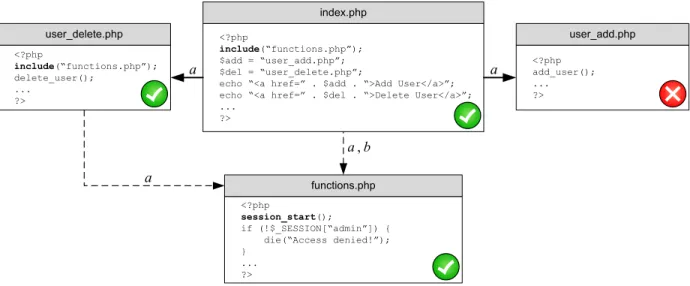
<?php session_start(); if (!$_SESSION[“admin”]) { die(“Access denied!”); } ... ?> functions.php <?php include(“functions.php”); delete_user(); ... ?> user_delete.php <?php include(“functions.php”); $add = “user_add.php”; $del = “user_delete.php”;
echo “<a href=” . $add . “>Add User</a>”; echo “<a href=” . $del . “>Delete User</a>”; ... ?> index.php <?php add_user(); ... ?> user_add.php b a, a a a
Figure 3.1: An Example of Access Control Vulnerability. Solid arrows represent explicit links, and dashed arrows represent inclusion relationship between pages. Arrows correspond to edges in sitemaps and are labeled with roles. The intended sitemap for privileged roleahas four edges while the intended sitemap for rolebhas only one edge.
3.2
Illustrative Example
Figure 3.1 shows a simple web application based on one of the real-world web applications in our test suite. For illustration, suppose that the application has two roles: roleafor administrators and role b for normal users. In our approach, we require developers to only specify application entry points and role-based application states, which serve as the basis for automatically inferring the set of privileged pages. Suppose that in the given specifications, the entry sets for both roles are identical and contain only “index.php”, and the value of $_SESSION[“admin”]is specified astruefor roleabutfalsefor role b. As we can see from the source code, only “functions.php” checks accesses. This file is included via PHP inclusion in both “index.php” and “user_delete.php”, but not “user_add.php.” Consequently, access checks are missing in “user_add.php” but present in the other three pages.
The first step of our analysis constructs per-role sitemaps with a worklist-based algorithm. Initially, worklists for both roles are[“index.php”]. While a worklist is not empty, our analysis pops a work node from the front of the worklist each time. Let us look at the sitemap construction for roleafirst. The first analyzed node is “index.php”. From this node, users of roleacan explicitly reach both “user_add.php”