7-2005
Design and implementation of a reusable type
inference engine and its application to Scheme
Brian Dorn
Iowa State University
Follow this and additional works at:
http://lib.dr.iastate.edu/cs_techreports
Part of the
Programming Languages and Compilers Commons
This Article is brought to you for free and open access by the Computer Science at Iowa State University Digital Repository. It has been accepted for inclusion in Computer Science Technical Reports by an authorized administrator of Iowa State University Digital Repository. For more information, please [email protected].
Recommended Citation
Dorn, Brian, "Design and implementation of a reusable type inference engine and its application to Scheme" (2005).Computer Science Technical Reports. 323.
application to Scheme
Abstract
Static type checking allows programmers to locate potential bugs prior to code execution. However,
developing a static type checker is a complicated endeavor. Implementers must address a number of concerns including recursion over syntax elements, unification of type variables within environments, and generation of meaningful error messages for users. The inherent complexity of type checkers can lead to code that is difficult to both understand and maintain. This thesis presents the design and implementation of an abstract type inference engine and its use in the revision of a student-oriented type checker for the Scheme programming language. Our inference engine provides a complete set of unification facilities to programmers for the specication of a type checking system. It allows for a clean separation of unification algorithms, inference rules, and error generation. We also demonstrate the applicability of the engine by using it to construct a type checker for Scheme targeted at novice programmers. This checker borrows a student-friendly type notation from a previous version and extends its system, providing for language native module support, a more complete treatment of advanced data types, and better error messages.
Keywords
type inference, Scheme language, Typedscm language Disciplines
Programming Languages and Compilers
inference engine and its application to Scheme
Brian J. Dorn TR #05-16
July 2005
Keywords: type inference, Scheme language, Typedscm language
2005 CR Categories:
D.2.13 [Software Engineering] Resuable Software — reusable libraries; D.3.2 [Programming Languages] Language Classifications — applicative (functional) languages, Scheme; D.3.3 [ Pro-gramming Languages] Language Constructs and Features — abstract data types, data types and structures; D.3.4 [Programming Languages] Processors — preprocessors; F.3.3 [Logics and Meanings of Programs] Studies of Program Constructs — type structure;
Copyright c° 2005, Brian Dorn, All Rights Reserved.
Department of Computer Science 226 Atanasoff Hall
Iowa State University Ames, Iowa 50011-1041, USA
TABLE OF CONTENTS LIST OF FIGURES . . . iv ABSTRACT . . . v CHAPTER 1. INTRODUCTION . . . 1 1.1 Design Overview . . . 2 1.1.1 Problem . . . 2
1.1.2 Goals for Solution . . . 3
1.1.3 Solution Overview . . . 3
1.2 Outline . . . 5
CHAPTER 2. NOTATION . . . 6
2.1 Literate Programming . . . 6
2.2 Variant Record Definitions . . . 7
CHAPTER 3. TYPE HELPER DESIGN AND IMPLEMENTATION . . . 9
3.1 System Specification . . . 9
3.2 Data Structures and Rule Interfaces . . . 10
3.2.1 Interfaces for Type Rules . . . 13
3.3 Rule Processing . . . 14 3.3.1 Base Cases . . . 18 3.3.2 Error Cases . . . 18 3.3.3 Side Procedures . . . 18 3.3.4 Hypothesis Judgements . . . 19 3.3.5 Subtyping Judgements . . . 21 3.4 Summary . . . 22
CHAPTER 4. USER DEFINED COMPONENTS . . . 24
4.1 Type Expressions . . . 24
4.2 Method Dictionary . . . 25
4.3 Annotation Rules . . . 27
4.3.1 Examples of Simple Rule Use . . . 27
4.3.2 Example of Complex Rule Composition . . . 28
4.3.3 Example of Side Definitions with Rule-Seq . . . 28
4.4 Error Handling . . . 30
4.4.1 Error Generation . . . 30
4.4.2 Error Output . . . 31
CHAPTER 5. LANGUAGE AND TYPING EXTENSIONS . . . 32
5.1 Module System . . . 32
5.2 Bidirectional Type Checking . . . 34
CHAPTER 6. IMPLEMENTATION CHALLENGES . . . 37
6.1 Delayed Evaluation . . . 37
6.2 Unification Environment . . . 38
6.3 Runtime Speed . . . 38
CHAPTER 7. FUTURE WORK . . . 40
7.1 DrScheme Integration . . . 40
7.2 Experimental Study . . . 42
CHAPTER 8. CONCLUSION . . . 43
8.1 Related Work . . . 43
8.2 Contributions . . . 44
APPENDIX A. LAMBDA CALCULUS TYPE CHECKER . . . 45
APPENDIX B. APPLICATION DERIVATION COMPLETION . . . 49
LIST OF FIGURES
Figure 1.1 If-Exp Inference Rule in TypedScm00 . . . 2
Figure 1.2 Conditional Expression Rule . . . 3
Figure 1.3 TypedScm05 Architecture . . . 4
Figure 1.4 If-Exp Inference Rule in TypedScm05 . . . 4
Figure 3.1 Lambda Calculus Grammar . . . 9
Figure 3.2 Lambda Calculus Types . . . 11
Figure 3.3 Lambda Calculus Inference Rules . . . 11
Figure 3.4 Judgement Datatype . . . 12
Figure 3.5 Mixed Datatype . . . 13
Figure 3.6 tc:rule-or Example in TypedScm05 . . . 13
Figure 3.7 tc:rule-if Example in TypedScm05 . . . 14
Figure 3.8 tc:rule-seq Example in TypedScm05 . . . 15
Figure 3.9 Initial Step in Type Derivation . . . 15
Figure 3.10 Outstanding Derivation Parts . . . 16
Figure 3.11 Recursive Derivation on Hypothesis . . . 19
Figure 3.12 TypedScm00 Type Hierarchy [JL96] . . . 21
Figure 4.1 TypedScm05 Type Expressions . . . 24
Figure 4.2 Basic Axiom Use . . . 28
Figure 4.3 Dealing with Lists of Subterms . . . 28
Figure 4.4 Combining Rules using tc:rule-or . . . 29
Figure 4.5 Using Side Definitions to Add Bindings . . . 29
Figure 4.6 Example Error Generation for Conditional . . . 31
Figure 4.7 Example Error: Bad Subtying Relationship on Conditional . . . 31
Figure 5.1 TypedScm05 Module Syntax . . . 33
Figure 5.2 Module for Box ADT . . . 33
Figure 5.3 Error Message in TypedScm00 . . . 35
Figure 5.4 Error Message in TypedScm05 . . . 35
Figure 7.1 DrScheme and the TypedScm Tool . . . 41
ABSTRACT
Static type checking allows programmers to locate potential bugs prior to code execution. However, developing a static type checker is a complicated endeavor. Implementers must address a number of concerns including recursion over syntax elements, unification of type variables within environments, and generation of meaningful error messages for users. The inherent complexity of type checkers can lead to code that is difficult to both understand and maintain.
This thesis presents the design and implementation of an abstract type inference engine and its use in the revision of a student-oriented type checker for the Scheme programming language. Our inference engine provides a complete set of unification facilities to programmers for the specification of a type checking system. It allows for a clean separation of unification algorithms, inference rules, and error generation.
We also demonstrate the applicability of the engine by using it to construct a type checker for Scheme targeted at novice programmers. This checker borrows a student-friendly type notation from a previous version and extends its system, providing for language native module support, a more complete treatment of advanced data types, and better error messages.
CHAPTER 1. INTRODUCTION
Learning to program in Scheme is hard. At least some of this difficulty can be attributed to its lack of a static type system. Dynamically-typed languages, like Scheme, provide program-mers a great deal of freedom when defining operations over data. They do not unnecessarily restrict programmers to specify particular types for each variable or element of a data struc-ture. By definition,dynamic languages do not attempt to validate type correctness at compile time, but rather, they rely on run-time checks to ensure proper data handling. Though there is no explicit notation for types in such languages, typing is still important. Expert programmers have a great deal of intuition about the types associated with their program’s data structures and procedures, regardless of dynamic typing mechanisms.
One of the greatest detractors to dynamic typing is that code is inherently difficult to debug [Lin93][WC93][CF91]. This is mainly caused by the fact that errors are not detected until run-time, at which point most systems raise an error condition and execution is aborted. The actual source of the type error may or may not be easily identifiable given the location at which execution terminates.
Static type checking, on the other hand, attempts to identify errors prior to program exe-cution. Typically, static approaches provide more intuitive error messages and aid in locating and correcting errors. However, these systems are more restrictive than those that are dynamic due to the fact that their conservative analysis results in errors for things that only “might” be real problems depending on the run-time context.
Despite the fact that dynamically-typed programming languages have more expressive power than their static counterparts [CF91], the large majority of Scheme programs, and those written by novices in particular, are in fact statically typeable. This is because experience shows that only small portions of typical Scheme programs rely on dynamic typing.
Classroom observations seem to indicate that novice programmers struggle with typing issues when writing code. Misuse of interfaces, improper type casting, and inability to connect type error messages to source code errors are common problems that new programmers make. We believe these problems are amplified by a dynamically-typed language in which students may or may not be confronted with an error, depending on the actual program flow path during runtime. From an educational perspective, static type checking offers an avenue to reinforce good practice in the early stages of learning a language.
The lack of tools for type error discovery traditionally associated with dynamic typing and the impact such tools can have on novice programmers provide motivation for incorporating static type checking features into languages like Scheme in an educational setting.
This thesis presents a variation on a static type checker for Scheme originally created by Jenkins and Leavens [JL96] to aid introductory students at Iowa State University. The original system, hereafter referred to as TypedScm00, includes a student-friendly notation for data types and has been used for several years. Since its original release, ease of maintenance has become increasingly important. However, the nature of its implementation made this
inherently difficult. This complexity provided the impetus for a new implementation that expressly addresses the maintenance problem.
The new type checker, referred to as TypedScm05, uses the simple type notation of Type-dScm00 but provides a novel implementation approach as well as several enhancements to the original type system. Among the improvements, TypedScm05 is itself designed to be highly extensible. It provides a reusable type checking engine that can be applied to many type check-ing problems outside of the Scheme language. This engine allows for a separation of concerns within TypedScm05, thereby simplifying the maintenance process. The original polymorphic type system used in TypedScm00 has also been extended to allow for a greater degree of modularity in user code and is more complete in its handling of advanced datatypes.
1.1 Design Overview
Development of a static type checker is by no means a trivial task. These systems must take into account a myriad of concerns including abstract language syntax, type inference rules, unification algorithms, and generated error messages. The inter-relationships between these concerns can be quite complicated. Programmers who write type checkers are, of course, subject to the same difficulties experienced by other software engineers. It is not uncommon for software systems to be designed around the predominant architectural concern while others are forced to take a back seat. Systems which operate on programming languages themselves are influenced strongly by the language’s syntax and semantics. However, if other concerns are not also taken into account, the resulting code can become an entangled mix of unification methods, type inference rules, and error generation.
1.1.1 Problem
The previously mentioned TypedScm00 system developed by Jenkins, Clifton, and Leavens is an example of a primarily syntax-driven decomposition. The code in Figure 1.1 provides a tangible, albeit small, example of the problem.
1 ( tc : conditional - exp
( position test consequent alternate ) ( tc : check - for - boolean
rec - typ - env seq - typ - env unif - env test ( lambda ( ue )
6 (( tc : one - must - subtype - other
" Arms à of à if à expression à have à different à types " " Left à à arm "
" Right à arm " )
rec - typ - env seq - typ - env ue
11 consequent alternate result - cont ))))
Figure 1.1 If-Exp Inference Rule in TypedScm00
This code fragment is responsible for handling the type checking of a conditional expression in Scheme. Essentially it encodes the inference rule1 given in Figure 1.2. However, the
1The notation used for inference rules here is essentially that given by Cardelli in [Car87]. The judgement
Π`e:τ means that in a type environment Π, it can be inferred thatehas typeτ. Within a type environment, x:τ denotes the binding of variable xto typeτ. Π, x:τ represents the extension of environment Π by the
underlying rule for any given code section is not obvious to an outside reviewer due to the other concerns dealt with in the same code. Notice that lines 7-9 above contain messages that will be used in error message generation and that there is a good deal of verbosity centered around passing environment parameters (rec-type-env,seq-type-env, etc).
Π`test:boolean Π`cons:t
Π`alt:s t <> s:sub super Π`(if test cons alt) :super Figure 1.2 Conditional Expression Rule
Even this small example leaves something to be desired for the programmer responsible for maintaining TypedScm00. The reader can imagine the even greater complexity associated with a less trivial piece of Scheme syntax in this system. Put simply, the problem here is to devise a means of implementation that allows for a cleaner and more maintainable approach to type checking.
1.1.2 Goals for Solution
Simplification of the maintenance process in the type checker serves as our primary moti-vation for the work that makes up a substantial portion of this paper. Our main goal was to develop a system in which type rules can be easily added or changed independently of other concerns in the system, while at the same time preserving TypedScm00’s behavior from the end user’s standpoint. In other words, the type system and errors generated needed to be at least as helpful as those that already existed.
1.1.3 Solution Overview
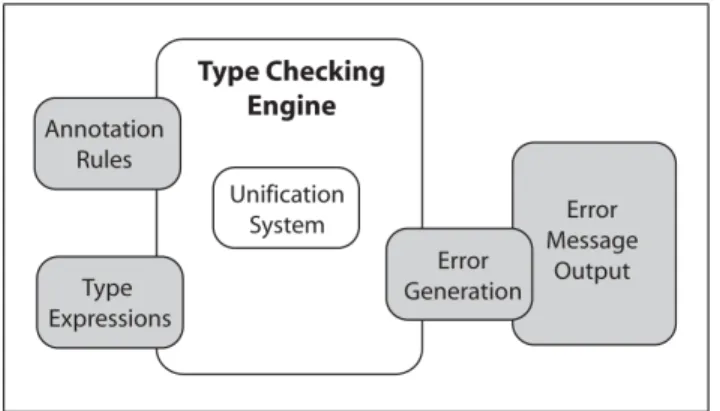
The design of TypedScm05 abstracts many of the previously mentioned concerns into inde-pendent modules that come together to form the type checker. Figure 1.3 illustrates the basic architecture.
At the heart of the new system is the type checking engine. This abstract component is responsible for implementing a slightly modified Hindley-Milner unification algorithm [Mil78] [Car87]. Internally this engine is oblivious to the representation of syntax, types, and errors; however, it does make use of abstract procedures that must be provided through a method dictionary in order to manipulate the specific representations. The method dictionary is a data structure which encapsulates several required procedures defined outside of the scope of the type checking engine. This engine is therefore reusable and may be applied to various forms of type checking problems, limited only by the components which are “plugged in” through the dictionary.
The external modules (shown in grey in the diagram) are required to provide a basic set of procedures in order to work with the type checking engine, but they typically implement
bindingx:τ. The notationt <> s:subtype suptypeis used to specify that either tis a subtype ofsor sis a subtype oft, wheresubtypeandsuptypeare aliases for the appropriate values on the left-hand side. Clauses appearing above the horizontal bar are said to imply those below it.
Figure 1.3 TypedScm05 Architecture
a great deal of functionality within themselves related to their specific function. Depending on the application, the programmer may specify an optional error output mechanism. Given that this component is entirely separated from type checking, it is possible that a programmer could specify multiple output methods to customize the system to a particular environment.
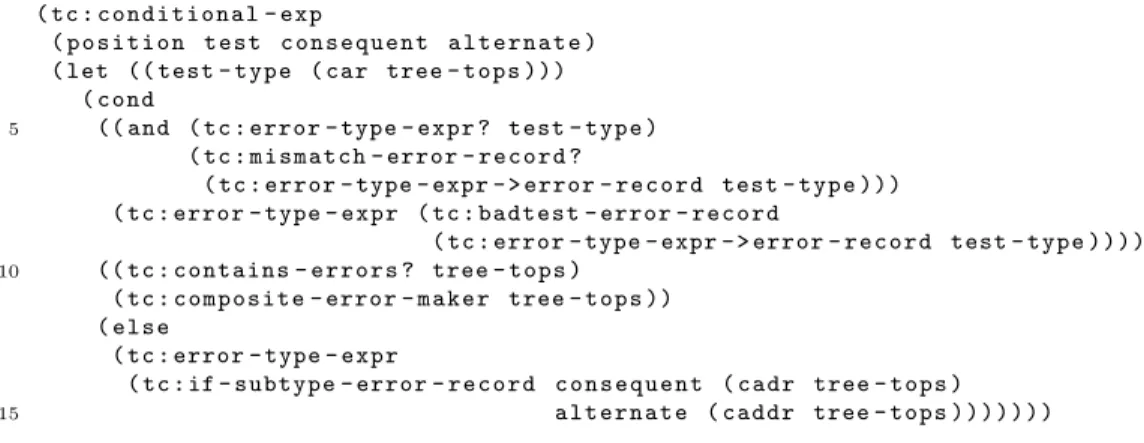
Perhaps the most important aspect of the type checking engine is its ability to separate rule definitions from the other concerns. Not only are these rules no longer tangled with error message text and unification, but they are also defined using a syntax that directly corresponds to a mathematical notation, like that shown in Figure 1.2. The engine provides a type checker implementer a set of procedures which are used to specify a rule. For comparison, the Figure 1.4 illustrates the code for the same conditional expression shown earlier. Here lines 8-14 correspond directly to the mathematical way in which we specify the same rule, with the minor exception that the ordering of the syntax is slightly modified (prefix operators:-and :
versus infix operators `and : ).
( tc : conditional - exp
( position test consequent alternate ) ( let * (( t1 ( tc : new - variable - type - expr ))
( t2 ( tc : new - variable - type - expr ))
5 ( supertype - var ( tc : new - logicalvar )) ( subtype - var ( tc : new - logicalvar ))
( supertype ( tc : variable - type - expr supertype - var ))) ( tc : rule ( list
(: - pi (: test * tc : boolean *))
10 (: - pi (: consequent t1 )) (: - pi (: alternate t2 ))
( <: > t2 t1 subtype - var supertype - var ))
; ;
-(: - pi -(: e supertype )))))
Figure 1.4 If-Exp Inference Rule in TypedScm05
In addition to the simple rule shown here, the type checking engine allows programmers to make use of side conditions and side definitions with in their rules. These features are outlined in more detail in chapter 4.
TypedScm05 utilizes this engine for its implementation, but also makes several other im-provements beyond those impacting readability and maintainability. This work introduces a
module system that is a typeable subset of modules in MzScheme [FFF+97]; MzScheme’s mod-ule system allows users to specify a modmod-ule that only uses names from modmod-ules it explicitly imports. This feature allows for independent type checking of modules and was not available in TypedScm00.
Where possible, TypedScm05 also makes use of more advanced typing rules in an effort to provide better error messages to end users. Specifically we implement a bidirectional inference method like that described in [PT98a]. The ability to switch from traditional bottom-up inference to top-down checking when a previous type definition exists allows a greater degree of accuracy for generating error messages. The top-down approach enables the type checker to point users to a particular expression within a procedure body that is suspected to be the cause of the error, rather than simply reporting a mismatch between a procedure’s declared and inferred types as in TypedScm00. Additionally, this implementation provides insight into the power of the type checking engine, as it is able to handle features like bidirectionality when given the appropriate rules.
1.2 Outline
Throughout this paper, it is assumed that the reader has a functional knowledge of basic type checking and is literate in the Scheme programming language. The remainder of this thesis proceeds as follows. Necessary notation is introduced in chapter 2. Chapter 3 highlights important aspects of the type checking engine implementation. Use of the engine is discussed in chapter 4 through example components taken from our Scheme system. Chapter 5 examines new additions to the original type system and their impacts on the system’s overall usability. A brief overview of notable implementation challenges is given in chapter 6 followed by a discussion of future work in chapter 7. Lastly, chapter 8 concludes.
CHAPTER 2. NOTATION
We begin by presenting a brief introduction to the notation used throughout this paper. A style of coding and documentation known asliterate programming is defined in section 2.1. We elaborate on a variant record syntax for Scheme used in later code examples in section 2.2.
2.1 Literate Programming
At various points in the explanation of our system it is necessary to examine source code from the actual implementation. These sections consist of a mix of Scheme source code and exposition. In an effort to keep code segments and their comments to a digestible length for the reader, we adopt a notation similar to that used in literate programming.
The idea of literate programming was introduced in the mid-1980s by Knuth as a way to interleave source code and descriptive text into a single document [Knu92]. His work frees authors from trying to explain programs in the order required by a compiler and allows them to choose an order that more naturally fits how a program actually operates.
In addition to notation, Knuth developed a tool called Web that can manipulate literate programs for either compilation or display. His original system uses the Pascal language, but the approach is applicable to any programming language. In fact, similar tools have been developed for nearly every language imaginable [Ram94].
Though TypedScm05 is not implemented using one of the many literate programming tools, Knuth’s notation will be used here for descriptive simplicity. His notation defines the notion of a code fragment orchunk. These chunks can appear in any order, interleaved with textual information, and may internally reference other chunks. The following is an example code chunk:
< F indDuplicates2.1>≡
1 ( define tc : find - duplicates
( letrec (( look - for - dups
< Lookf orDuplicates 2.1> )) ( lambda ( ls )
( look - for - dups ls ’()))))
Each code chunk is given a unique name made up of an identifier and a section number (e.g., < F indDuplicates 2.1>). Section numbers refer to this document, rather than the files containing the actual code. The names are used to refer to chunks which appear elsewhere in the text. Typically, code that needs more detailed description is abstracted into its own chunk. In the above program the reference to< Lookf orDuplicates2.1> illustrates this use; its definition appears on the next page.
< Lookf orDuplicates2.1>≡
( lambda ( ls dups ) ( cond
(( null ? ls ) dups )
(( member ( car ls ) ( cdr ls ))
5 ( look - for - dups ( cdr ls ) ( cons ( car ls ) dups )))
( else ( look - for - dups ( cdr ls ) dups ))))
Thus, the meaning of < F indDuplicates 2.1>in the actual source program combines all references to internal chunks in one procedure:
( define tc : find - duplicates ( letrec (( look - for - dups
( lambda ( ls dups )
4 ( cond
(( null ? ls ) dups )
(( member ( car ls ) ( cdr ls ))
( look - for - dups ( cdr ls ) ( cons ( car ls ) dups ))) ( else ( look - for - dups ( cdr ls ) dups )))) ))
9 ( lambda ( ls )
( look - for - dups ls ’()))))
2.2 Variant Record Definitions
On several occasions, this paper and the code to which it refers requires the creation of special datatypes within Scheme. These situations are treated using variant record definitions presented with the define-datatypesyntax specified inEssentials of Programming Languages (second edition)[FWH01]. Variant records are data structures that allow a particular record instance to take on one several possible forms, calledvariants. For example, suppose we want to represent a binary tree with its own datatype.
A binary tree is a tree that is either empty or a root node with two descendant nodes, left and right, which are also binary trees. Here we also allow a number to be associated with each node in the tree. The Scheme code below defines a type,bintree, for a binary tree record and its two possible variants using thedefine-datatypesyntax.
( define - datatype bintree bintree ? ( empty - bintree )
( root - node ( num number ?)
5 ( left bintree ?) ( right bintree ?)))
This syntax also defines a type predicate, bintree?, and constructors for each variant case,
( bintree ? 8675309) == > # f
( bintree ? ( empty - bintree )) == > # t
( bintree ? ( root - node 5 ( empty - bintree ) ( empty - bintree ))) == > # t ( bintree ? ( root - node 1 ( root - node 2 ( empty - bintree ) ( empty - bintree ))
5 ( root - node 3 ( empty - bintree ) ( empty - bintree )))) == > # t
Variants are manipulated using a new expression calledcases. The following code illustrates how to define a procedure that computes the sum of all node values in a tree.
( define sumtree ( lambda ( tree )
( cases bintree tree
( empty - bintree () 0)
5 ( root - node ( num left right )
CHAPTER 3. TYPE HELPER DESIGN AND IMPLEMENTATION
The abstract type checking engine described in chapter 1 is a collection of Scheme modules which provide type checking functionality to client code. The implementation strategy is taken from an unpublished prototype for such a system written in Haskell by Leavens, but has been enhanced to support additional functionality like subtyping within an implementer’s type system. (The original system attempted to model ideas from Schmidt’sThe Structure of Typed Programming Languages [Sch94].) The aspects of interest to the reader here are collectively called the type helpers. Procedures making up the type helpers are responsible for processing type annotation rules and define the interface used by implementers to specify a complete type checker.
This chapter highlights the design and implementation of the type helpers. We begin with a high-level specification of the system in section 3.1, followed by a discussion of our representation for data and rules in section 3.2. A detailed description of how inference rules are processed is given in section 3.3. The chapter is summarized in section 3.4.
3.1 System Specification
Before we examine the implementation details of the type helpers, it is useful to get a better picture of the general goal. In this section, we examine a design approach for specifying an automated type checker for Church and Curry’s lambda calculus with constants [CFC58]. The aim is to implement a type checker using Scheme that can process the lambda calculus language and infer types using Hindley-Milner inference rules [Mil78]. Before a discussion of type checking is possible, it is necessary to first define the language on which we will operate. A grammar for the lambda calculus is given in Figure 3.1. The formal concrete syntax is shown on the right of the figure and a corresponding Scheme variant record definition appears on the left. This Scheme datatype will serve as the abstract syntax for the type checker.
Scheme Representation λ Calculus
( define - datatype tc : lambda - calc tc : lambda - calc ? ( tc : le - self - evaluating
( datum datum ?))
4 ( tc : le - varref
( variable symbol ?)) ( tc : le - procedure - call
( operator tc : lambda - calc ?) ( operand tc : lambda - calc ?)) ( tc : le - lambda - exp
9 ( formal symbol ?) ( body tc : lambda - calc ?)))
hei ::=
se | x | he0i he1i
| λx. hei
With a grammar for syntax defined, the next step in developing a type checker is to specify a representation for the types associated with data in the language. Figure 3.2 on the following page depicts type expressions within the system (where a basic type, B ∈ {number, symbol, string, char, boolean}). Note that the final two type expression variants in the Scheme code are outside those defined by the formal syntax. Polymorphic type variables are represented withtc:variable-type-expr, and errors are detected withtc:error-type-expr. These special types will allow rules to be type checked and are discussed in greater detail in subsequent chapters.
With these notions in place, it is possible to discuss type checking rules. Ideally, a type checker’s implementation would closely mirror the inference rules defined for the language. Thus, we propose a system that is capable of directly evaluating type rules. Figure 3.3 illus-trates our implementation style versus the formal notation of the lambda calculus.
In the code appearing on the left, we define the manner in which each of the lambda calculus expression variants are checked. The free variable e is used to represent the cur-rent syntax element being checked (as if this entire figure were specifying the clauses of
(cases tc:lambda-calc e ...)). The formstc:axiom,tc:rule, andtc:rule-ifare introduced to model the axioms, rules, and rules with side conditions in the formal specification. In each case, there is a direct correspondence between the Scheme and formal representations.
Lines 1-5 of the code define the axiom used to assign a type to a self-evaluating expression. Specifically, line 3 looks up the associated basic type,B, which is used in the axiom definition on line 5. Variable references require the use of a rule with a side condition in order to specify that x : τ ∈ Π. Such variable references are handled in the clause given on lines 6-16. The side condition that the identifier name,variable, is bound in the environment,pi, appears on lines 11-12. The side definition that follows on lines 13-14 allows the conclusion to refer to the associated type value found inpi.
More involved rules for applications and lambda expressions are shown on lines 17-26 and lines 27-35, respectively. In the application variant case, tc:le-procedure-call, we begin by declaring two new type variables,rtandoperand-type, that correspond to the variablesτ0 and τ in the formal rule. A simple rule is written with tc:rule that encodes the two hypotheses using these type variables and the identifiers operator for e0 and operand for e1. Similarly, the clause for lambda expressions (lines 27-35) is translated usingtc:ruleand the appropriate type variables. Extension of type environment Π in the hypothesis is modeled with a call to
tc:extend-envseen on line 32.
Clearly, the notation presented here is analogous to the type rules themselves and can easily be understood. Given an infrastructure capable of processing the somewhat “magical”tc:rule
and tc:rule-if, it is entirely possible to treat type checker implementation in this manner. Just as people manipulate type checking rules to perform derivation proofs, one could imagine a system that automatically creates proof trees from these rule definitions. In fact, the type helpers mentioned in the introduction to this chapter do just that. The remainder of this chapter explores exactly how this process takes place within our type checking engine.
3.2 Data Structures and Rule Interfaces
Before looking at processing, we introduce the type helper interfaces. Logical variables are the most basic element used in the type checker (denotedtc:logicalvar in our system). We define a logical variable here as a variable bound to a specific value, another logical variable,
Scheme Representation λ Calculus
( define - datatype tc : type - expr tc : type - expr ? ( tc : basic - type - expr ( symbol symbol ?)) ( tc : function - type - expr
( arg - type tc : type - expr ?) ( result - type tc : type - expr ?))
5 ; ; For type helpers
( tc : variable - type - expr ( lvar tc : logicalvar ?)) ( tc : error - type - expr ))
hτi ::=
B
| hτ0i → hτ1i
Figure 3.2 Lambda Calculus Types
Scheme Representation λ Calculus
( tc : le - self - evaluating ( datum )
3 ( let (( B ( tc : infer - simple - datum - type datum )))
; ;
-( tc : axiom -(: - pi -(: e B ))))) Π`b:B ( tc : le - varref
( variable )
( let (( lv ( tc : new - logicalvar ))) ( tc : rule - if
10 ’() ; ; no hypotheses here
( lambda ( ts )
( tc : env - bound ? variable pi )) ( lambda ( ts )
( tc : type - expr - bind lv ( tc : env - value variable pi )))
15 ; ;
-(: - pi -(: e ( tc : variable - type - expr lv ))))))
x:τ ∈Π Π`x:τ
( tc : le - procedure - call ( operator operand )
( let (( rt ( tc : new - variable - type - expr ))
20 ( operand - type ( tc : new - variable - type - expr ))) ( tc : rule ( list
(: - pi (: operator
( tc : function - type - expr operand - type rt ))) (: - pi (: operand operand - type )))
25 ; ; -(: - pi -(: e rt ))))) Π`e0 :τ →τ0 Π`e1:τ Π`e0 e1:τ0 ( tc : le - lambda - exp ( formal body )
( let (( rt ( tc : new - variable - type - expr ))
30 ( formal - type ( tc : new - variable - type - expr ))) ( tc : rule ( list
(: - ( tc : extend - env pi formal formal - type ) (: body rt )))
; ;
-35 (: - pi (: e ( tc : function - type - expr formal - type rt ))))))
Π, x:τ `e:τ0 Π`(λx:τ. e) :τ →τ0 Figure 3.3 Lambda Calculus Inference Rules
or nothing at all in the unification system’s environment. They are used during unification to gather typing constraints on various pieces of syntax.
Additionally, there are three primary data structures used by the type helpers in the processing of rules: attributed syntax pairs, typing judgements, and mixed hypothesis elements. Of these, syntax pairs are the most straightforward. Attributed syntax pairs are simply a pair that contains a piece of syntax and some attribute. We provide a procedure named “:” as the constructor for such pairs. For our concerns, the attribute consists of a type expression, and these pairs associate the given type information with a particular piece of syntax.
By themselves, these syntax pairs are not very interesting. Things become more complex when they are incorporated into typing judgements. A judgement is used to specify a typing constraint to be checked by the system. The code in Figure 3.4 defines a variant record for judgements. Each variant represents a different type of judgement in TypedScm05.
( define - datatype tc : judgement tc : judgement ?
(: - d ( env tc : environment ?) ( attr - pair ( tc : attrib - pair - of datum ? datum ?))) (:? - ( lvar tc : logicalvar ?) ( attr - pair ( tc : attrib - pair - of datum ? datum ?))) ( <: ( subtype datum ?) ( supertype datum ?))
5 ( <: > ( t1 datum ?) ( t2 datum ?)
( subtype - var tc : logicalvar ?) ( supertype - var tc : logicalvar ?)))
Figure 3.4 Judgement Datatype
We provide four different forms of typing judgements. The first, :-d, is the most com-mon type of judgement and corresponds to a simple assertion that in environmentenva given attributed syntax pair, (: syn type), holds2,3. The second form,:?-, allows for the environ-ment field to be a logical variable which can be defined elsewhere. This is only useful in certain declaration forms. The last two judgement forms allow for the specification of subtyping re-lationships in the system. In most cases the simple subtype assertion form, <:, is sufficient; however, we also provide a more general form, <:>. This form is used to specify that one of two types, t1and t2 must subtype the other. It also allows for two logical variables that will be bound to the appropriate types if the relationship holds. It is made available primarily as a convenience to the rule programmer as it is possible to convert it into a composition of two or more rules using the simple subtype judgement.
These data structures are adequate for most judgements a programmer would want to encode. However, an additional structure is needed in the case where a programmer needs to mix true hypotheses with side conditions and side definitions that are to be executed to either alter the unification environment or to test for some correctness condition before proceeding to a subsequent hypothesis. The variant record shown in Figure 3.5 defines the mixed datatype used in these cases.
The tc:mixed type provides three different possibilities. The first, tc:hyp, is a wrapper for the standard judgements described above. The tc:when variant is used to specify side conditions, and tc:def allows for incorporation of side definitions. Examples of how each of these used is specified in greater detail in chapter 4.
2Examples shown thus far have used the notation
:-for this simple judgement case. While:-dand:-are technically different things, the reader may consider them aliases for one another for the moment. The need for two separate operators is discussed later in section 6.1.
3The term holds in this sense means that the relationship denoted by the syntax pair is valid within the
( define - datatype tc : mixed tc : mixed ? ( tc : hyp ( judgement tc : judgement ?))
( tc : when ( f ( - > ( list - of datum ?) boolean ?)))
( tc : def ( f ( - > ( list - of datum ?) ( tc : subst - of datum ?)))))
Figure 3.5 Mixed Datatype
3.2.1 Interfaces for Type Rules
These datatypes are used in conjunction with one of five procedures defined by the type helpers to specify a type rule. The given procedures are: tc:axiom, tc:rule, tc:rule-or,
tc:rule-if, and tc:rule-seq. The axiom procedure, tc:axiom, is used to specify a rule that has no hypotheses; the judgement provided in an axiom is always treated as true in the type checker. Thetc:le-self-evaluatingrule of the lambda calculus in Figure 3.3 exemplifies the use of tc:axiom.
The most common rule helper is tc:rule, and we have already seen several examples of it in Figures 1.4 and 3.3. Using this helper, implementers specify a list of judgements which serve as hypotheses and conclusion judgement which is true if and only if no type errors are found while processing the hypotheses.
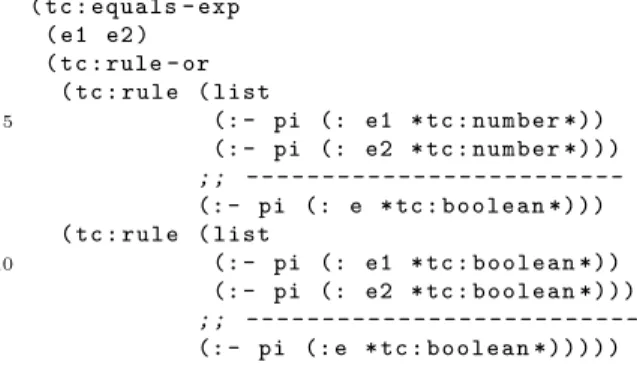
More advanced type rules are specified using the other three type helpers. A convenience that allows a more fine-grained splitting of rules into cases is the tc:rule-or combinator. It combines two or more rules and checks that at least one of them holds.
An example rule for a hypothetical equals expression is shown in Figure 3.6. This rule asserts that a tc:equals-exp expression is valid with a boolean type if its two subforms, e1
and e2, have either both number or both boolean types.
( tc : equals - exp ( e1 e2 ) ( tc : rule - or ( tc : rule ( list 5 (: - pi (: e1 * tc : number *)) (: - pi (: e2 * tc : number *))) ; ; -(: - pi -(: e * tc : boolean *))) ( tc : rule ( list 10 (: - pi (: e1 * tc : boolean *)) (: - pi (: e2 * tc : boolean *))) ; ; -(: - pi -(: e * tc : boolean *)))))
Figure 3.6 tc:rule-or Example in TypedScm05
Rules with simple side conditions can be specified using the tc:rule-if form. It requires a list of hypotheses and a conclusion like standard rules, but it also takes two procedures that define side conditions. The first is a function from type attributes to a boolean value. If this returns true, then the type attributes are passed to the second procedure which can return a substitution defining any number of new variables in the unification environment. When no definitions need to be made, the second procedure returns the null substitution.
Figure 3.7 depicts a simple use of this rule form that checks a lambda expression with multiple formal parameters. First, thebody is checked in an environment containing bindings
for theformals, as in the lambda calculus. The side condition enforces the restriction that the formal parameters must be unique, and the side definition is not used.
( tc : lambda - exp ( formals body )
( let (( rt ( tc : new - variable - type - expr ))
( formal - ts ( tc : listof - new - variable - type - expr ( length formals ))))
5 ( tc : rule - if ( list
(: - ( tc : extend - mult - env pi formals formal - ts ) (: body rt )))
( lambda ( ts ) ; ; Side Condition
( tc : no - duplicates ? formals ))
10 ( lambda ( ts ) ; ; Side Definition
( tc : type - expr - null - subst ))
; ;
-(: - pi -(: e ( tc : function - type - expr formal - ts rt ))))))
Figure 3.7 tc:rule-if Example in TypedScm05
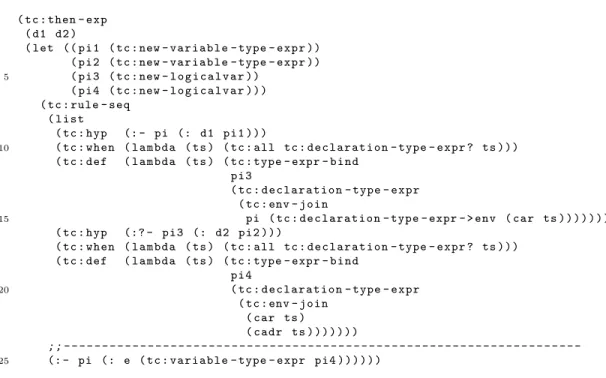
The only thing one cannot accomplish with the above type helpers are rules that, like sequential declarations, need to alter the environment in the middle of the rule. For this we provide a specialized form, tc:rule-seq. This helper requires a list oftc:mixeddata elements and a conclusion which is a normal judgement. Rather than the independent processing of hypotheses present in the other helpers, tc:rule-seq processes its argument list sequentially. The list may contain hypotheses, side conditions, and side definitions in any order. Elements tagged withtc:defortc:whenare passed the list of attributes computed thus far. Ones marked as side definitions can define new values for logical variables to be used later, and those which are side conditions are tests which are used to terminate type checking when they return false. A sample appears in Figure 3.8 for a simple sequential declaration form, tc:then-exp, is checked here. If the first declaration, d1, type checks, its bindings are added to original environment to check the second declaration, d2. When both declarations successfully check, their bindings are combined and provided in a declaration type used as the conclusion’s inferred type.
These datatypes and type-helping procedures provide the functionality needed by an ex-ternal programmer to specify how type checking should proceed in their specific application.
3.3 Rule Processing
Each of the five type helpers supplies a slightly different feature set to programmers. How-ever, it is not necessary to discuss each of them individually due to the fact that tc:rule
and tc:rule-ifcan be converted into special instances of the more generaltc:rule-seq form. These translations are quite straightforward and merely involve wrapping up existing judge-ments and side procedures with the correspondingtc:mixedvariants. For this reason, we limit the remaining discussion totc:rule-seq.
The processing of sequential rules (and thus all rules) proceeds in a manner that is analogous to standard type derivation. The item of syntax being checked serves as the starting point for type inference. For example, assume we would like to check the application:
( tc : then - exp ( d1 d2 )
( let (( pi1 ( tc : new - variable - type - expr )) ( pi2 ( tc : new - variable - type - expr ))
5 ( pi3 ( tc : new - logicalvar ))
( pi4 ( tc : new - logicalvar ))) ( tc : rule - seq
( list
( tc : hyp (: - pi (: d1 pi1 )))
10 ( tc : when ( lambda ( ts ) ( tc : all tc : declaration - type - expr ? ts )))
( tc : def ( lambda ( ts ) ( tc : type - expr - bind pi3
( tc : declaration - type - expr ( tc : env - join
15 pi ( tc : declaration - type - expr - > env ( car ts )))))))
( tc : hyp (:? - pi3 (: d2 pi2 )))
( tc : when ( lambda ( ts ) ( tc : all tc : declaration - type - expr ? ts ))) ( tc : def ( lambda ( ts ) ( tc : type - expr - bind
pi4
20 ( tc : declaration - type - expr
( tc : env - join ( car ts )
( cadr ts )))))))
; ;
-25 (: - pi (: e ( tc : variable - type - expr pi4 ))))))
Figure 3.8 tc:rule-seq Example in TypedScm05
Figure 3.9 shows the first step of derivation. Based on the type of syntax (an application in this case) we choose the correct rule. At this stage, we assign type variables to the elements since we do not know anything more specific.
Π`(λx:τ1. x) :τ3 →τ2 Π`n:τ3 Π`(λx:τ1. x) n:τ2
Figure 3.9 Initial Step in Type Derivation
This step is analogous the invocation oftc:rulegiven the arguments as specified in Figure 3.3. Verifying that the application is correctly typed requires us to examine each of the hypotheses for the sub-expressions and ensure no errors exist in them. All rule processing begins in a similar fashion and is depicted in< RuleSeqHelper 3.3>.
As with manual derivations, we must process the sub-expressions based on the hypotheses given in the rule definition. Here, we invoke a helping procedure to validate the list oftc:mixed
hypotheses, hs(line 8). If no type errors result during the processing of this list, we generate a new attributed syntax pair that associates the syntax item and type given in the original conclusion for the rule (lines 14-16). The system also adds type information gleaned during hypothesis checking4 which can be used at a later point in error processing. If errors occur, the resulting syntax pair contains an error type instead of the type given in the conclusion. Here we make use of one of the procedures from the method dictionary, gen-error-rule, allowing complete flexibility for the handling of errors which occur during rule processing (line 19).
< RuleSeqHelper 3.3> ≡
( define tc : rule - seq - helper ( lambda ( md annotate )
< U npackM ethodDictionary 4.2>
( lambda ( hs conc )
5 ( cases tc : judgement conc
(: - d ( env attr - pair ) ( let (( result_trees
(( tc : sequence md annotate ) hs ’() )) ( syn ( tc : attrib - pair - > syn attr - pair ))
10 ( tau ( tc : attrib - pair - > type attr - pair )))
( if ( not ( tc : error - noted ?))
( let * (( s ( tc : get - current - subst ))
( ts ( tc : map - tops ( app s ) result_trees ))) (: syn ( tc : node (( app s )
15 ( tc : force - if - promise tau ))
ts )))
; ; Type error
(: syn ( tc : node
( gen - error - rule syn result_trees )
20 result_trees )))))
( else ( error " Conclusion à judgement à must à be à a à : - à judgement " ))) )))))
In reality only a small portion of the type inference work (that relating to conclusions) pertains to this code. The majority of the complexity comes in processing the sub-expressions and checking their mutual constraints. Revisiting the same procedure application example, Figure 3.10 illustrates the outstanding areas in the derivation with vertical ellipses.
.. . Π`(λx:τ1. x) :τ3 →τ2 .. . Π`n:τ3 Π`(λx:τ1. x) n:τ2
Figure 3.10 Outstanding Derivation Parts
The missing parts of the derivation must be filled in by further annotating each sub-expression and its hypothesis in turn. Our internal helping procedure for processing lists of hypothesis and optional side procedures appears above in < tc:sequence 3.3>. The code may appear daunting at first, but the general idea behindtc:sequence is quite simple. If the list of terms passed as an argument, hs, contains at least one element, we determine how to proceed based on a case analysis of the first element of hs. The kind of tc:mixedelement we are considering leads to an appropriate action. Remember that, in addition to hypotheses, our lists may contain optional side procedures that must be handled specially. Furthermore the typical tc:hyp hypothesis elements, must be separated by their type of judgement. Thus any one of six normal actions will be taken; error checking from previous hypothesis adds another four cases as seen on lines 17, 22, 29, and 33.
The subsections that follow define the specific behaviors for each of the six cases referred to within < tc:sequence 3.3>. Subsection 3.3.1 cover the base case, and subsection 3.3.2 reviews the error cases. Implementation for side conditions and side definitions is outlined in subsection 3.3.3. The judgements containing environments are handled by subsection 3.3.4, and those pertaining to subtyping are dealt with in subsection 3.3.5.
< tc:sequence3.3>≡
( define tc : sequence ( lambda ( md annotate )
< U npackM ethodDictionary 4.2>
( lambda ( hs attrs )
5 ( letrec (( recurse ( tc : sequence md annotate )) ( vars - in ( tc : vars - in md )))
( let (( check - subtype - judgement
( tc : check - subtype - judgement hs md app bind attrs recurse ))) ( if ( null ? hs )
10 < BaseCase 3.3.1>
( cases tc : mixed
( tc : force - if - promise ( car hs )) ( tc : def ( f ) ( if ( tc : error - noted ?) 15 < ContinueCase 3.3.2> < SideDef initionCase 3.3.3> )) ( tc : when ( p ) ( if ( tc : error - noted ?) < ContinueCase 3.3.2> 20 < SideConditionCase 3.3.3> )) ( tc : hyp ( judgement )
( cases tc : judgement judgement (: - d ( env attr - pair )
25 ( if ( tc : error - noted ?)
< ContinueCase 3.3.2>
< N ormalHypothesisCase 3.3.4> )) (:? - ( lvar attr - pair )
( if ( tc : error - noted ?)
30 < ContinueCase 3.3.2>
< V ariableEnvironmentHypothesisCase3.3.4> )) ( <: ( subtype supertype )
< SimpleSubtypeCase 3.3.5> )
( <: > ( t1 t2 subtype - var supertype - var )
35 < EitherSubtypeCase 3.3.5> )))
3.3.1 Base Cases
The most simple case is the base case, which executes when the list of hypotheses contains no elements. Its implementation is trivial; we simply return the list of type information gathered for the sub-expressions,attrs, accumulated earlier. This is a list of annotated syntax trees with one tree for each sub-expression.
< BaseCase3.3.1> ≡
attrs
3.3.2 Error Cases
Another relatively simple case also requires little additional processing. This case primarily arises when a type error has already been encountered in a previous judgement. Rather than processing anything further at this stage, we just continue to the next judgement. The current one is effectively ignored.
< ContinueCase 3.3.2>≡
( recurse ( cdr hs ) attrs )
3.3.3 Side Procedures
As mentioned earlier in this chapter, there are two different types of side procedures: those that are conditions and others that provide additional definitions. Side conditions are used to incorporate additional constraint checking into a rule. For example, one could use them to require that no duplicate identifiers occur in a list of formal parameters. Evaluation of a condition, shown in < SideConditionCase 3.3.3>, involves calling the given procedure, denoted p in line 1, with the type information gathered thus far. If this condition holds and results in a true value, unification continues normally. Unsuccessful tests of the side condition are noted as errors prior to continuation (line 5).
< SideConditionCase 3.3.3>≡
( if ( p ( map tc : root attrs )) ( recurse ( cdr hs ) attrs ) ( begin
; ; Update unification env with error
5 ( tc : note - error !)
< ContinueCase 3.3.2>))
Side definitions are processed in a manner similar to their conditional counterparts by < SideDef initionCase3.3.3>. We first begin by evaluating the given procedure, denoted below byf. Its result is a substitution which provides additional definitions for logical variables that are to be added to the current unification environment. This is accomplished by first composing additional definitions with those already present and then updating the global environment accordingly (lines 3-7). Evaluation then proceeds with the next element in the list.
< SideDef initionCase3.3.3>≡
( let (( delta_subst ( f ( map tc : root attrs ))))
; ; Update the current environment
( tc : set - current - subst - list ! ( list
5 ( tc : subst - compose
( tc : get - current - subst ) delta_subst )))
( recurse ( cdr hs ) attrs ))
3.3.4 Hypothesis Judgements
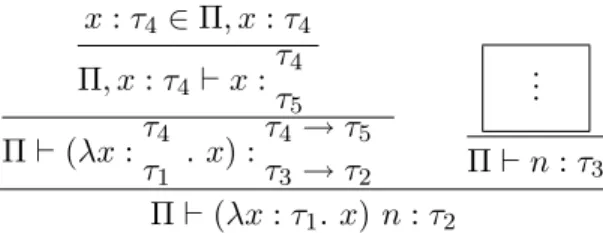
The most interesting of the cases is the one that processes a normal hypothesis. To verify the first hypothesis in our sample derivation, we must recursively annotate its syntax and check that our previously guessed expected type and the inferred type unify. Figure 3.11 shows this process5. Similarly, the code in< N ormalHypothesisCase 3.3.4>performs this task.
x:τ4 ∈Π, x:τ4 Π, x:τ4`x: τ4 τ5 Π`(λx:ττ4 1 . x) : τ4 →τ5 τ3 →τ2 .. . Π`n:τ3 Π`(λx:τ1. x) n:τ2
Figure 3.11 Recursive Derivation on Hypothesis
Processing this form begins by annotating the inner piece of syntax with its inferred type and determining whether an error occurs on the subform (lines 1-6). We then resolve any known type variables in the inferred type and extract the expected type from the original judgement form (lines 9-15). The expected and inferred types are then adjusted to make sure that they have mutually exclusive type variables (lines 16-21).
The unification algorithm, tc:mgu, is invoked on line 22 in an attempt to compute a most general unifier for the expected and inferred types. If the types can not be unified we note that an error has occurred and place a type mismatch error into the annotation list (lines 24-30). It is important to note that this is the sole location of error type generation in the sequence routine. The only errors which occur at this level are simple mismatches between given and actual types. This does not, however, limit the error notification capabilities of the system. A greater degree of error information can be obtained when tc:sequence returns to its caller, tc:rule-seq-helper, and context information for an entire rule can be analyzed by the user-defined proceduregen-rule-error.
When no unification error is detected, the resulting substitution is added to the current unification environment (lines 32-36) and the remaining hypothesis are processed with the newly inferred type added to the accumulation list (lines 37-40).
The other hypothesis case, < V ariableEnviornmentHypothesisCase3.3.4>, dealing with variable environments involves much less work. Judgements of this form have a logical variable instead of a concrete environment. Thus, processing begins by attempting to resolve the
5In this diagram we show all type variables used as per the rules. If two variables appear in a vertical column,
the variable on top is the inferred type from the upper judgements, and the one on the bottom is the expected type specified by the conclusion below.
< N ormalHypothesisCase3.3.4>≡
( let * (( syn ( tc : attrib - pair - > syn attr - pair ))
2 ( recur - result ( annotate env syn ))) ( if ( tc : error - noted ?)
; ; Unification error on sub annotation
( recurse ( cdr hs )
( append attrs ( list ( tc : attrib - pair - > type recur - result ))))
7 ; ; So far so good ...
( let * (( result - attr ( tc : attrib - pair - > type recur - result )) ( attr
( tc : node
(( app ( tc : get - current - subst )) ( tc : root result - attr ))
12 ( tc : leaves result - attr ))) ( expected
(( app ( tc : get - current - subst ))
( tc : force - if - promise ( tc : attrib - pair - > type attr - pair )))) ) ( let * (( renaming
17 ( if ( null ? ( tc : intersect ( vars - in ( tc : root attr )) ( vars - in expected ))) ( lambda ( trm ) trm )
(( tc : rename - vars md )
(+ 1 ( tc : max - list ( map cdr ( vars - in expected ))))))) ( rt ( renaming ( tc : root attr )))
22 ( delta - substl (( tc : mgu md ) expected rt ))) ( if ( null ? delta - substl )
; ; no result substitution
( begin
( tc : note - error !)
27 ( recurse ( cdr hs ) ( append attrs
( list ( tc : node ( gen - error - mismatch syn expected rt ) ’())))))
( begin
32 ( tc : set - current - subst - list ! ( list
( tc : subst - compose ( tc : get - current - subst ) ( car delta - substl ))))
37 ( let (( t2 (( app ( tc : get - current - subst )) rt ))) ( recurse ( cdr hs )
( append attrs
given variable to a value within the global unification environment (lines 1-2). If resolution is successful and the returned binding does indeed contain a type environment, we rewrite the current judgement using the normal form and process it as usual (lines 5-7). A bad binding here is considered a fatal error and type checking terminates (line 8).
< V ariableEnviornmentHypothesisCase 3.3.4>≡
( let (( te (( app ( tc : get - current - subst )) ( to - term lvar ))))
( cond
(( is - dec - type - expr ? te )
5 ( recurse ( cons ( tc : hyp (: - d ( dec - type - expr - > env te ) attr - pair ))
( cdr hs )) attrs ))
( else ( error " tc : sequence : à Bad à binding à for à logical à var : à " lvar ))))
3.3.5 Subtyping Judgements
The current type helpers support a primitive notion of subtyping. Our restricted subtyping stems from the type system specified for TypedScm00 in [JL96]. It defines two special types,
datumand poof, which are used as the top-most (i.e., most super) and bottom-most (i.e., least specific) types, respectively. All other types exist directly betweendatumandpoof. Figure 3.12 depicts the hierarchy.
Figure 3.12 TypedScm00 Type Hierarchy [JL96]
Given that the type system to be plugged into the type checking engine for TypedScm05 would also only require a bare minimum in terms of subtyping, support for more advanced subtyping was not included in the initial design of the type helpers.
The actual processing of subtyping cases makes use of an additional procedure shown in < tc:check−subtype−judgement3.3.5>. The simple subtyping case just invokes this procedure with the types it was given and two new logical variables, which are not used further here: < SimpleSubtypeCase 3.3.5>≡
( check - subtype - judgement subtype supertype
( tc : new - logicalvar ) ( tc : new - logicalvar ))
Judgements making use of the <:> constructor are handled specially. Recall that judge-ments of this form look like (<:> t1 t2 sub-var super-var). The intended behavior is to verify that either t1 is a subtype of t2 or vice versa. The implementation for this begins in < EitherSubtypeCase3.3.5> by saving a copy of the current global environment to be re-stored if needed (line 1) and by testing whether t1 is a subtype oft2 (line 2). If this check
ends in success, execution continues to the nexttc:mixedform. However, if the first test fails, we must restore the global environment to its original status and test the opposite relation (lines 7-10).
< EitherSubtypeCase3.3.5> ≡
( let (( saved - subst - list ( tc : get - current - subst - list ))
(t1 - sub - result ( check - subtype - judgement t1 t2 subtype - var supertype - var ))) ( if ( not ( tc : error - noted ?))
; ; t1 <: t2 passed , pass along answer
5 t1 - sub - result
; ; t1 <: t2 failed , try other way
( begin
; ; restore subst - list
( tc : set - current - subst - list ! saved - subst - list )
10 ( check - subtype - judgement t2 t1 subtype - var supertype - var ))))
We rely on < tc:check−subtype−judgement 3.3.5> for the bulk of the work in subtype processing. In essence it requires the same four parameters as the <:> judgement. The first two are used for the actual test, and the second two are logical variables that are to be bound as result-like values so that the supertype and subtypes can be used elsewhere inside rule definitions easily. When checking a subtyping judgement, the two types must first be resolved in the global unification environment (lines 8-10). The unification algorithm for subtyping is then invoked upon the resolved types (line 11). At present, the algorithm implemented by
tc:subtype-mgu is the same as that described in [JL96], but could feasibly be extended to allow for a more general treatment of subtyping. When a subtype relationship is successful, the unification environment is updated with any constraints gathered as a result of subtype unification and bindings which provide correct values for the two logical variables given as parameters (lines 19-29).
3.4 Summary
The various data structures and type helping procedures described in this chapter comprise an abstract type checking engine that can be used to specify a type checking system for an arbitrary language. The variety of mechanisms made available to programmers provide enough support to implement common type inference rules. Effectively, the type helpers construct type derivation trees based on the rules to accomplish checking6. The syntax chosen for interac-tion with these interfaces is designed explicitly to correspond to a type checker implementer’s concept of typing rules.
Most importantly, a separation of concerns within the type checker is accomplished under this design. All code manipulating type judgements and rules exists solely within this module. Users of the engine provide definitions for those procedures required by the method dictionary in external modules. A detailed look at the structure of these external components is the focus of the following chapter.
< tc:check−subtype−judgement 3.3.5>≡
( define tc : check - subtype - judgement ( lambda ( hs md app bind attrs recurse )
( lambda ( subtype supertype subtype - var supertype - var ) ( if ( tc : error - noted ?)
5 ; ; Type error already , so just pass it on
< ContinueCase 3.3.2>
; ; Attempt subtype test , first apply current substitution to vars
( let * (( cur - app ( app ( tc : get - current - subst ))) ( subtype - val ( cur - app subtype ))
10 ( supertype - val ( cur - app supertype )))
( let (( subtype - substl (( tc : subtype - mgu md ) subtype - val supertype - val ))) ( if ( null ? subtype - substl )
; ; subtype relationship failure
( begin
15 ; ; Update unification environment
( tc : note - error !)
< ContinueCase 3.3.2> )
; ; subtype relation is valid , pass on subst
( begin
20 ; ; Update unification environment
( tc : set - current - subst - list ! ( list
( tc : subst - compose ( tc : get - current - subst )
25 ( tc : subst - compose
( car subtype - substl ) ( tc : subst - compose
( bind subtype - var subtype - val )
( bind supertype - var supertype - val ))))))
CHAPTER 4. USER DEFINED COMPONENTS
The previous chapters have alluded to the external modules which must be added to the type checking engine to completely specify a type checker. However, most examples have ignored these details (the type checker outlined for the lambda calculus pretended as if they did not exist). Here we more closely examine each of the typical components needed and a portion of their specific implementations in the TypedScm05 system. In essence, this allows users to customize the type checking engine to meet the needs of their system. An example set of type expressions from TypedScm05 appears in section 4.1. Section 4.2 discusses each of the procedures contained within the method dictionary. Sample annotation rules of interest are shown in section 4.3, and an example strategy for error generation in this system is given in section 4.4.
4.1 Type Expressions
Any type checker must provide a representation of data types in order to annotate syntax elements. The method dictionary requires a bare minimum of two basic types for checking: variables and errors; however, most type checkers would contain definitions for many other type expressions. We have already seen an example of a minimal type system in the lambda calculus grammar given in the figures of section 3.1. A more advanced grammar for type expressions is that used in the TypedScm05 implementation, which defines eleven different types. Its datatype definition is shown in Figure 4.1.
( define - datatype tc : type - expr tc : type - expr ? ( tc : basic - type - expr ( symbol symbol ?)) ( tc : function - type - expr
( arg - types ( list - of tc : type - expr ?)) ( result - type tc : type - expr ?))
5 ( tc : intersection - type - expr ( conjoined - types ( list - of tc : type - expr ?))) ( tc : type - predicate - for - type - expr ( type tc : type - expr ?))
( tc : variant - record - type - expr
( variants ( list - of tc : type - expr ?))) ( tc : applied - type - expr
10 ( operator - type tc : type - expr ?) ( operand - types ( list - of tc : type - expr ?))) ( tc : variant - type - expr
( variant - name symbol ?)
( fields ( list - of tc : type - expr ?))) ( tc : field - type - binding - type - expr
15 ( field - name symbol ?) ( type tc : type - expr ?))
; ; Those required for type helpers
( tc : variable - type - expr ( lvar tc : logicalvar ?))
( tc : declaration - type - expr ( pi ( tc : environment - of tc : type - expr ?))) ( tc : error - type - expr ( error - record tc : error - record ?)))
The first eight variants (lines 2-15) are used to implement the types specified in the no-tation from TypedScm00 [LCD05], while the latter three add functionality needed in order to use the type helpers. Implementation of a method dictionary for these type expressions is straightforward.
4.2 Method Dictionary
Type checker implementers wishing to use our engine need to specify a number of procedures that allow the abstract system to work with the concrete, user-defined type expressions declared externally. This collection of functionality has earlier been referred to as the method dictionary, but its contents have largely been glossed over. This dictionary is defined as a record containing several procedures used by the inference engine. The type helpers extract the various proce-dures from a record instance, md, as shown in the chunk < U npackM ethodDictionary 4.2> below.
< U npackM ethodDictionary 4.2>≡
( cases tc : unifiable - md md ( tc : unifiable - md - dict
( to - term get - var subterms same - kind nullSubst bind app contravar - subterms covar - subterms invar - subterms
5 subtype - replace is - intersection - type ?
find - intersection - subtyping find - intersection - supertyping is - bottom ? is - top ? is - error ? gen - error - mismatch gen - error - rule is - dec - type - expr ? dec - type - expr - > env )
This section enumerates each element of the dictionary, providing insight into its purpose. A sample invocation is used in the explanation of items which are procedures. Throughout, the wordterm is used to refer abstractly to a value that is a type expression. The exact definition of a term is specified concretely by the external module.
The following seven elements are the most basic and would be required for even the most rudimentary type checking. They allow for the manipulation of logical variables and simple terms within the type checking engine.
(to-term lv) converts the logical variable,lv, into a term that represents the same variable. Typically, such a procedure would just incorporatelvas a data member of the new term.
(get-var t) extracts a logical variable from a term, t. Its value is a maybe type7 that is
(make-something lv) when t represents a logical variable lv, and (make-nothing)when it does not.
(same-kind t s) is true if and only if t and s are the same “kind” of term, which is to say that they have the same operator. For example, when t and s are both error types,
(same-kind t s)returns true.
nullSubst is the empty substitution. It is like the identity function in that, for all logical variables lv, (tc:subst-apply nullSubst lv) = (to-term lv). Often the nullSubst is used as an initial value for the unification environment.
7Like in Haskell, an instance of amaybe typerepresents a value that is either an actual value or nothing at
(bind lv t) represents a substitution that maps a particular logical variable,lv, to a specific term, t. In all other cases, this substitution behaves like nullSubst. In other words, when the resulting substitution is applied tolv, the original termtis returned.
(app s) transforms the substitution s into a function that maps terms to terms. This is particularly useful within the type helpers for direct manipulation of terms, rather than logical variables.
(subterms t) is a list of all subterms contained in t.
The type helpers allow for subtyping, but it requires several additional procedure definitions from the external modules. These eight method dictionary members specify the functionality related to subtyping.
(contravar-subterms t) is a list of all subterms intwhich are to be considered contravariant in the unification of subtypes. Contravariant subterms are treated in the inverse direction from their containing types with respect to subtyping. For example, assumeA <: B. Then
(contravar-subterms A)returns a list of terms that should be checked as supertypes (i.e.,
:>) to the terms in(contravar-subterms B).
(covar-subterms t) extracts the covariant subterms of t. Covariant subterms are checked in the same direction as their containing types for subtyping purposes.
(invar-subterms t) provides the subterms that are invariant in t. Invariant subterms are those terms which are not to be handled with the subtype unification algorithm. They are instead checked with the same algorithm used for terms in(subterms t).
(subtype-replace sub super) returns a pair, like (sub . super), except that any special replacements due to subtyping have been made. This is useful for the treatment of advanced type constructs that need to be de-sugared to more simple types during the tests for subtyping (e.g., variable arity function types).
(find-intersection-subtyping intersection sought) attempts to subtype unify its ar-guments and returns the result substitution of the first type inintersectionthat unifies withsought
(find-intersection-supertyping sought intersection) attempts to find a substitution that makes sought a subtype of each type contained inside intersection. If no such substitution exists, it results in the empty list.
(is-bottom? t) returns true when t is the bottom type within the type hierarchy.
(is-top? t) tests whether or nottis the top type.
The final six procedures needed allow the type checker to test and manipulate three special terms: error types, intersection types, and declaration types. These particular terms are the only three required to be defined by the method dictionary procedures aside from polymorphic variable types. However, it is possible to provide stubs for these three procedures in the event that the implementer’s type system has no need for them. All other types are entirely left to the user’s discretion.

![Figure 3.12 TypedScm00 Type Hierarchy [JL96]](https://thumb-us.123doks.com/thumbv2/123dok_us/8683540.2348755/28.918.349.592.566.697/figure-typedscm-type-hierarchy-jl.webp)