ABSTRACT PURPOSE
The purpose of this study was to characterize the CDI population at this institution according to known risk factors and to examine the effect of appropriate evidence-based treatment selection on length of patient stay and outcome of infection.
METHODS
The institutional review board at the study facility approved this retrospective, observational study. All patients at least 18 years of age with a positive Clostridium difficile toxin test by enzyme-linked
immunosorbent assay (ELISA) from January to December 2011 were included in this study. The
electronic medical records of patients meeting inclusion criteria were reviewed for both patient specific and medication associated risk factors. Secondly, the medical record was utilized to assign disease severity and assess corresponding appropriateness of treatment for each documented CDI occurrence according to IDSA/SHEA criteria. Finally, the effect of appropriate treatment on patient length of stay and infection outcome was analyzed.
RESULTS
Over 96 percent of patients had more than one risk factor for CDI in this study. The effect of appropriate treatment on patient outcome, specifically resolution of infection versus recurrence or patient death, was assessed by chi-square test. A significant increase in treatment failure was observed in patients who did not receive the appropriate regimen according to IDSA/SHEA recommendations. However, the potential for confounding by indication was then examined by controlling for infection severity. The analysis revealed that there was in fact no significant difference in patient outcome regardless of the initial CDI treatment chosen. The relationship between appropriate initial treatment and length of stay was not significant, regardless of whether deaths were excluded from the data set.
CONCLUSION
BACKGROUND
Clostridium difficile is the most frequently encountered nosocomial pathogen in community hospitals in the United States. Increased use of flouroquinolones and the emergence of the
hypervirulent BI/NAP1/027 strain have been linked to an increase in Clostridium difficile infection (CDI) frequency and severity, as well as a shift in the epidemiology of CDI. The most dramatic increase in infection rate has been observed in patients 65 years of age or older but formerly low-risk populations, including peripartum women and young members of the community, are increasingly vulnerable to CDI. Perhaps most importantly, the CDI-associated mortality rate has increased more than 400 percent since the year 2000.1 Up to 3% of adults may be asymptomatic carriers.2 In the past 10 years, an emergent
hypervirulent C. difficile clonal group has been attributed to increasing morbidity and mortality rates worldwide. Over the 5-year period from 1999 to 2004, associated mortality increased from 5.7 to 23.7 deaths per 1 million persons globally.The strain is known as North American Pulsed Field type 1(NAP1), restriction-endonuclease analysis (REA) type B1, polymerase-chain-reaction ribotype 027 or collectively as NAP1/B1/027. The strain is highly resistant to flouroquinolones.3 Patients typically respond well to treatment with either oral vancomycin or metronidazole. However, the cost of treatment with vancomycin and presence of resistant bacterial strains may give preference to metronidazole utilization.2 Recurrence rates with both drugs are increasingly high.
In May 2010, the Infectious Diseases Society of America and the Society for Healthcare Epidemiology generated the updated treatment guidelines for C. difficile. The guidelines indicate that the first-line treatment of choice should depend on disease severity. Oral metronidazole is considered the first-line treatment for an initial episode of mild-to-moderate CDI. In cases of severe CDI, oral vancomycin is the drug of choice. A combination regimen of oral vancomycin, rectal vancomycin and/or intravenous metronidazole is indicated in severe, complicated CDI. The same initial therapy should be used for the first recurrence, but metronidazole cannot be used thereafter. Vancomycin is the preferred treatment for patients with multiple instances of CDI.3
The exact reason for recurrence of CDI has not been determined. Factors believed to be associated with recurrent disease include disruption of the normal intestinal flora, antibiotic-induced bowel changes that decrease natural resistance to colonization and an impaired immune response to C.difficile and its toxins. Up to 30% of CDI patients will experience a recurrence of infection, often within the first 2 weeks after completion of initial treatment. Patients experiencing such a recurrence have a 45% chance of additional recurrences of CDI.1
Reduced rates of clinical response to treatment coupled with increasing rates of recurrence, mortality and incidence in low-risk populations make the research and development of effective CDI treatment protocols imperative. The recently updated guidelines for treatment of CDI call for the evaluation of 3 major outcomes when comparing drug therapy: time to symptom resolution, incidence of recurrence, and the frequency of major complications.3 This study will examine all of the cases of CDI at our institution over a 12-month period. The updated treatment guidelines, current practice outcomes and available drug therapies will all be considered in the development of a new treatment protocol for CDI.
METHODS DATA COLLECTION
The institutional review board at the study facility approved this retrospective, observational study. All patients at least 18 years of age with a positive Clostridium difficile toxin test by enzyme-linked immunosorbent assay (ELISA) from January to December 2011 were included in this study. The
immunosuppressant agents. Secondly, the medical record was utilized to assign disease severity and assess corresponding appropriateness of treatment for each documented CDI occurrence according to IDSA/SHEA criteria (Table 1). Severity data including degree of leukocytosis, increase in serum
creatinine, and presence of shock or ileus were collected. As outlined by the IDSA, these criteria were then used to categorize each CDI as mild or moderate, severe, or severe and complicated. The number of prior episodes of CDI was also noted for each case. Once categorized, the initial treatment for each CDI episode was documented and assessed for adherence to IDSA/SHEA guidelines 3.
STATISTICAL ANALYSIS
Descriptive statistics were used to describe CDI risk factors present in the patient cohort. The effect of appropriate treatment on patient length of stay and infection outcome was analyzed. Infection outcome was classified as successful treatment, treatment failure, or death with differences assessed by chi-square test. Effect of treatment on length of stay, both including and excluding patients who died was analyzed using both a student’s t-test and a Wilcoxon rank sum test. A Fisher’s exact test was used during the assessment of potential confounders.
RESULTS
BASELINE CHARACTERISTICS
Epidemiological factors of the CDI cohort were determined with most cases falling into the healthcare-facility acquired, community-onset subgroups (Table 2). Additionally, 55% of patient had mild-to-moderately severe disease according to IDSA guidelines. Over 96 percent of patients had more than one risk factor for CDI in this study (Table 3). The most common risk factors were antibiotic use (81.6%) and proton pump inhibitor use (56.3%) in the 90-day period before index date.
EFFECT OF GUIDELINE ADHERENCE ON PATIENT OUTCOMES
on oral metronidazole regardless of the severity of patient’s CDI. This could potentially increase the number of patients with mild-to-moderate disease who received the correct initial CDI treatment according to IDSA guidelines. The potential for confounding by indication was then examined by
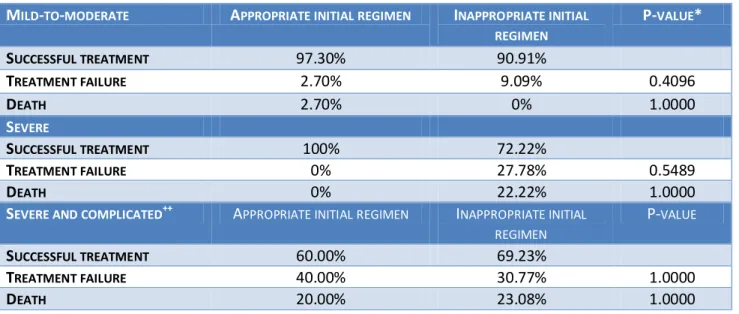
controlling for infection severity. The analysis revealed that there was in fact no significant difference in patient outcome regardless of the initial CDI treatment chosen (p = 0.4096, Table 6). There appears to be a relationship between treatment adherence and patient outcome for patients with severe disease but the sample size was too small to detect a difference. Additionally, the results in the severe and complicated category indicate that there is little association between adherence to guidelines and patient outcome.
DISCUSSION
There are many potential limitations to this study including the retrospective design and lack of randomization, a multitude of potential covariates, limited patient follow-up time, and limited available data for some patients prior to admission. However, this study is consistent with the strengths of the recommendations provided by the IDSA CDI guidelines. The recommended treatment for patients in the severe and complicated category is a C-III recommendation and it is not surprising that no relationship was found between guideline adherence and patient outcome in this study.
CONCLUSION
Table 1: Assessment of Disease Criteria
DISEASE SEVERITY CRITERIA
MILD-MODERATE WBC<15,000 CELLS/µL
AND
SERUM CREATININE <1.5X BASELINE
SEVERE WBC≥15,000 CELLS/µL
OR
SERUM CREATININE ≥1.5X BASELINE
SEVERE AND COMPLICATED HYPOTENSION /SHOCK
OR ILEUS
OR
MEGACOLON
Table 2: Epidemiological Factors
CHARACTERISTIC N=87
AGE (YR), MEAN±SD 69±19.6
FEMALE GENDER (%) 57.5
PREVIOUS EPISODE OF C.DIFFICILE INFECTION, N (%) 14(16.1%)
SEVERITY OF DISEASE AT BASELINE, N (%)
MILD-TO-MODERATE 48(55.2%)
SEVERE 21(24.1%)
SEVERE AND COMPLICATED 18(20.7%)
PLACE OF CDI ACQUISITION, N (%)
COMMUNITY-ACQUIRED 33(37.9%)
HEALTHCARE-FACILITY ACQUIRED 38(43.7%)
INDETERMINATE 16(18.4%)
PLACE OF CDI ONSET, N (%)
COMMUNITY-ONSET 53(60.9%)
HEALTHCARE-FACILITY ONSET 18(20.7%)
Table 3: Patient risk factors for CDI
FACTOR INCIDENCE, N (%)
MALE GENDER 37(42.5%)
COMORBID CONDITIONS IN THE 2-YEAR PERIOD BEFORE INDEX DATE
INFLAMMATORY BOWEL DISEASE 13(14.9%)
GASTROINTESTINAL MANIPULATION 28(32.2%)
GASTROINTESTINAL GRAFT-VERSUS-HOST DISEASE 0
DIABETES 16(18.3%)
SOLID-ORGAN TRANSPLANT 1(1.1%)
MALIGNANCY 23(26.4%)
HIV 0
CONCOMITANT BLOOD INFECTION 5(5.7%)
PREGNANCY 2(2.3%)
MEDICATIONS RECEIVED IN THE 90-DAY PERIOD BEFORE INDEX DATE
ANTIBIOTIC 71(81.6%)
PROTON PUMP INHIBITOR 49(56.3%)
H2-RECEPTOR ANTAGONIST 25(28.7%)
SUCRALFATE 5(5.7%)
IMMUNOSUPPRESSANT AGENT 10(11.5%)
>1 RISK FACTOR FOR C.DIFFICILE INFECTION, N (%) 84(96.6%)
Table 4: Effect of appropriate treatment on patient outcome
APPROPRIATE INITIAL REGIMEN INAPPROPRIATE INITIAL REGIMEN
P-VALUE*
SUCCESSFUL TREATMENT 93.33% 76.19%
TREATMENT FAILURE 6.67% 23.81% 0.0250
DEATH 4.44% 16.67% 0.0614
*CHI-SQUARE TEST
Table 5: Effect of appropriate treatment on patient length of stay (LOS)
APPROPRIATE INITIAL REGIMEN++
INAPPROPRIATE INITIAL REGIMEN
P-VALUE*
MEAN LOS(SD), DEATHS EXCLUDED 8.81 DAYS ±8.89 15.03 DAYS ±18.9 0.0594
MEAN LOS(SD), DEATHS INCLUDED 8.88 DAYS ±8.92 14.76±17.72 0.0518 *T-TEST,[WILCOXAN RANK SUM TEST P=0.0681]
Table 6: Effect of appropriate treatment when controlled for disease severity
MILD-TO-MODERATE APPROPRIATE INITIAL REGIMEN INAPPROPRIATE INITIAL REGIMEN
P-VALUE*
SUCCESSFUL TREATMENT 97.30% 90.91%
TREATMENT FAILURE 2.70% 9.09% 0.4096
DEATH 2.70% 0% 1.0000
SEVERE
SUCCESSFUL TREATMENT 100% 72.22%
TREATMENT FAILURE 0% 27.78% 0.5489
DEATH 0% 22.22% 1.0000
SEVERE AND COMPLICATED++ APPROPRIATE INITIAL REGIMEN INAPPROPRIATE INITIAL REGIMEN
P-VALUE
SUCCESSFUL TREATMENT 60.00% 69.23%
TREATMENT FAILURE 40.00% 30.77% 1.0000
DEATH 20.00% 23.08% 1.0000
*FISHER’S EXACT TEST
++THERE APPEARS TO BE NO RELATIONSHIP IN THIS SEVERITY CATEGORY AT ALL; POSSIBLY DUE TO THE INTENSITY OF ILLNESS OF THESE PATIENTS.
1 Lo Vecchio A and Zacur GM. Clostridium difficile infection: an update on epidemiology, risk factors, and
therapeutic options. Curr Opin Gastroenterol. 2012; 28(1):1-9.
2
Drekonja DM, Butler M, MacDonald R, et al. Comparative effectiveness of clostridium difficile treatments: a systematic review. Ann Intern Med. 2011;155(12):839-847.
3 Cohen SH, Gerding DN, Johnson S et al. Clinical practice guidelines for clostridium difficile infection in adults: 2010