Sewage Waste on San Cristobal Island: It’s Not Just a Numbers Game
By Shannon Steel
Honors Thesis Geography
University of North Carolina at Chapel Hill 14 April 2014
Acknowledgements
To my thesis advisor, Dr. Steve Walsh, I don’t think I will ever be able to describe how grateful I am that I decided to take your UNC class about the Galapagos Islands during my freshman year. I had been enchanted by the Islands since my trip there in high school, but not until I met you had I begun to consider the Galapagos as a place with complex social and ecological issues. I knew by my second year at UNC that I wanted to write an honors thesis under you, and I feel incredibly fortunate not only to have done that, but also to have worked with you in many other capacities throughout much of my college career. I cannot thank you enough for the guidance and amazing opportunities you have offered me during my time as an undergraduate.
To my reader Dr. Jill Stewart, before I met you last year, I remember hearing Katie’s high regards of you as a researcher and mentor. Having gotten to know you over the past several months, I can confidently say that you deserve the very high praise your lab members continually give you. Thank you so much for your help with my thesis and in making last summer’s VIMY water quality research in the Galapagos possible.
Phil McDaniel, your GIS expertise helped with the development of so many geospatial figures that are included in the analysis section of my thesis. You helped me turn my ideas into finished products. Thank you also to Amanda Henley for your help in various steps of the GIS procedures included in this thesis.
Thank you Qi Zhang and Haruna Suzuki for the incredible insight you both gave me on areas of my thesis that I needed help developing. Thank you both for your advice and support.
Thank you Katie Overbey and Billy Gerhard for providing the domestic and recreational water bacterial concentrations referred to in this thesis. Both of you are incredible researchers, and it was a pleasure to work with you two. Thank you also to Sarah Hatcher for helping us develop our VIMY proposal and for being available for research advice.
Thank you Phil Page and Laura Brewington for your help teaching my to use the GPS device last summer so that I could collect coordinates in the field. Thank you also for trouble-shooting any issues I had with any stage of processing the coordinates. Thank you also to Brian Frizzelle and the Galapagos Science Center for supplying me with the WorldView 2 imagery of San Cristobal Island.
Thank you to the UNC Center for Global Initiatives for granting Katie, Billy and me the 2013 VIMY Global Team Award. This funding is what enabled us to travel to San Cristobal Island and to collect water quality data and information on the island’s water related-infrastructure.
Thank you to the staff of the Municipio de San Cristóbal, such as Juan Tigua, and to Diana Amoguimba Yandun and Luis Tasipanta for your help with obtaining information on the water infrastructure of San Cristobal and with coordinating our research permission and data collection dates with the Galapagos National Park.
Thank you to Daniela Madriz, Dr. Grace Aaron, and Sarah Booker for your help translating documents about sewage infrastructure in the Galapagos. Thank you Kelly Houck for sending me information on locations of barrios on San Cristobal.
Abstract
The purpose of this research is to examine the dynamic relationship between the growing human presence and the availability and functionality of wastewater infrastructure in the Galapagos Islands, Ecuador. The basic intent is to describe how both components of this relationship impact a sewage network’s management of fecal contaminants from entering domestic water supplies and the marine environment. Primary data have been collected from San Cristobal Island in the Galapagos Islands. Chapter 1 describes geographic, political, and social
characteristics of the Galapagos that make it important and difficult to adequately manage the wastewater produced in the Islands. Chapter 2 provides an overview of scholarly and non-scholarly discourses regarding the causes of human-related environmental impacts in the Galapagos Islands. This thesis supports the notion, common among scholarly discourse, that environmental impacts in the Galapagos are not simply due to residential population increase, tourism growth, and lack of population control. Rather, the magnitude of these environmental impacts occurs from the implementation and management of public services like recycling and trash collection and the maintenance of infrastructure such as the San Cristobal sewage system. Chapter 3 includes a description of the primary data collection methodology and the figures created using this primary data. Chapter 4 provides a discussion of anecdotal evidence and information from the figures to describe how the data suggests possible deficiencies in the maintenance and functionality of the sewage network system of Puerto Baquerizo Moreno on San Cristobal Island. Chapter 4 also promotes the notion that the apparent leakage of sewage residuals into coastal marine areas and the possible contamination of the domestic water supply through cross-contamination of pipelines is not only a product of a growing human population on San Cristobal; it is also the result of the limited governance, maintenance, and functional
Table of Contents
Introduction
Located about 600 miles off of the coast of Ecuador, the Galapagos Islands have the potential to demonstrate to the rest of the world how ecologically-sensitive human development should look. However, with a growing residential population and increasing annual tourist visits, the inhabited islands of this archipelago are experiencing negative ecological impacts associated with the combined effect of a rising human presence and the limitations of the public
infrastructure and management practices. This is of utmost concern for environmentalists, conservationists, and scientists throughout the world, as the Galapagos has held the distinction of a UNESCO World Heritage Site since 1978 (Walsh & Mena, 2013). In 1959, the Galapagos National Park (GNP) was established, and soon after in 1973, the Galapagos archipelago became a province of Ecuador (Walsh & Mena, 2013).
Painted on many public buildings and signs throughout the Galapagos are the words “Ecuador: bien vivir”, translated to “Ecuador: living well” (Political Database of the Americas, 2008). This three-word phrase refers to aspects of the Ecuadorian constitution that promise the dual goals of quality of life and quality of environment. The Constitution of the Republic of Ecuador states that “[humans have a] guaranteed right to water, food, …and healthy
Thus, upon the establishment of a sewage network and treatment system, the discovery of elevated levels of fecal bacteria in the surrounding environment or water supply becomes a question of whether the infrastructure is fundamentally failing or whether the human presence has surpassed the current carrying capacity of a functioning infrastructure. This research explores the capacity of the sewage treatment and network system of Puerto Baquerizo Moreno in light of the increasing residential and land-based tourism populations on San Cristobal.
The central objectives of this research are to 1) present a contextual background of the importance of and difficulties with addressing sewage treatment needs in the Galapagos, 2) provide a review of popular discourses related to the environmental impacts of the growing human presence in the Galapagos Islands, 3) discuss how population pressure combined with quality of infrastructure and management of sewage waste on San Cristobal can create an environmental impact, and 4) suggest the possible impacts that human sewage waste has on bacteria levels in the surrounding marine environment and in the island’s domestic water supply, in light of apparent deficiencies within Puerto Baquerizo Moreno’s sewage pipeline network and sewage treatment plant.
Chapters 3 and 4 of this thesis include discussion of primary data. Data collected for this thesis was completed in June and July of 2013 on San Cristobal Island in the Galapagos,
Ecuador. Most of the data analyzed in this study were collected in or near the coastal town of Puerto Baquerizo Moreno, the capital of the province of Galapagos. In 2010, Puerto Baquerizo Moreno had over 6,000 residents (GADMSC, 2012). Having one of the two main airports of the Galapagos, the town is also frequently visited by tourists.
CHAPTER 1: Place-Specific Significance and Challenges in Addressing Growing Human
Presence and Sewage System Capacities in the Galapagos, Actor Analysis, and Stakeholder
Theory
Chapter 1 serves to provide contextual information for this thesis. Place-specific attributes of the Galapagos, that highlight the importance of providing treatment to wastewater before its disposal into the marine environment, are examined. Discussion of the importance of sewage treatment in the Galapagos provides legitimacy for this research. Chapter 1 also includes a discussion of the difficulties in maintaining human services such as sewage collection and disposal given population growth, population density, and the increasing number of annual tourists in the Galapagos. The discussion of these difficulties is included to show that population pressures of a growing human presence increase the need for maintenance, management, and additional extensions of sewage-related infrastructure. This discussion gives context and rationale for the evidence of sewage-related bacteria in the marine environment and domestic water supply of San Cristobal, as described in Chapters 3 and 4. Chapter 1 also introduces “actor analysis method” and “stakeholder theory” to provide a framework for the identification and inclusion of the sewage-related entities that are listed in the Stakeholder Table (Table 2) in the Analysis section of Chapter 3.
The Significance of Place: Why it is Important to Acknowledge Sewage Waste Disposal in
the Galapagos
composed of natural characteristics and human-made constructs. The Galapagos possess natural and human-made aspects that make it essential, for public health and ecological reasons, to provide proper human waste disposal. Some characteristics of the Galapagos create a situation where a high level of pressure is being placed on the sewage pipeline systems and sewage
treatment plants on inhabited islands that have these facilities. These characteristics reinforce the likelihood of current and future sewage-originated bacterial contamination in marine
environments stemming from municipal infrastructural limitations. These characteristics also underline the importance and difficulty in properly addressing inadequacies in sewage
infrastructure in the Galapagos to meet population demands.
protected areas. Only 29 years after it was awarded the distinction of a UNESCO World
Heritage Site, the Galapagos was placed on the list of World Heritage Sites “in Danger”due to a number of issues surrounding unsustainable human-environmental interactions including
overfishing, introduction of invasive species, and “high levels of poorly regulated tourism” (National Geographic, n.d., p. 1). In 2010, the Galapagos was taken off the World Heritage “in Danger” list as a way to recognize Ecuador’s efforts toward better conservation in the Galapagos (National Geographic, n.d.). Even with being taken off this “in danger” list, the Galapagos experiences growing issues as the archipelago seeks to maintain ecological health in the face of a rapidly increasing human presence and rising population demands.
Another reason that the Galapagos provides a significant site for studying the potential of sewage-related pollution of near-by coastal sites is that the Galapagos is surrounded by a marine reserve. Encompassing 133,000 km2, the Galapagos Marine Reserve (GMR) is the second largest in the world. It is included in the UNESCO list of World Heritage Sites, and, therefore, it is to be protected to uphold its ecological, economic, and cultural value (Parque Nacional
to not only include restrictions related to invasive species management and the prevention of overfishing but also the control of human waste and pollution entering the marine reserve. Another geographic factor that makes proper disposal of sewage waste essential is the fact that the waste, subsequent to treatment, must either be pumped into the porous volcanic rock that makes up the foundation of each Galapagos Island, or it must be pumped into the ocean. On San Cristobal Island, most of the population’s sewage waste is collected via pipelines, sent through the sewage treatment plant, and then expelled into the surrounding ocean water (GADMSC, 2012).
Implications of sewage waste contaminants on marine environments can be large if sewage infrastructure is not properly maintained and regularly monitored. This is particularly so as the density of the population that relies on this sewage system rises. Fecal contaminants can be harmful to ecosystems and to humans. In coastal locations, fecal pollutants are most
prevalent in intertidal areas because sewage effluence from a sewage treatment center or ground waste-deposit site creates a pollution source from which run-off can occur and enter ocean shorelines. Also, sewage waste is often pumped from a populated coastal town and into the surrounding ocean. Fecal bacteria such as Enterococcus can grow as microfilm on sand particles (Piggot et al., 2012). Thus, if the bacteria are not pumped far enough off the coast or there are leaks in the pipelines, sewage-related bacteria can enter shore areas and maintain growth within intermittently dry or shallowly submerged sand grains (Piggot et al., 2012). Pathogens
associated with these bacteria can pose a threat to marine wildlife (Islam & Tanaka, 2004). In the Galapagos, the health of marine and coastal ecosystems is very important for the
A main aspect of attraction for the Galapagos is the archipelago’s high level of species endemism. People travel from all over the world to see such animals as the Blue-Footed
Boobies, Giant Tortoises, Marine Iguanas and the Galapagos Finches. The Galapagos primarily draws and is currently most fit to accommodate tourists who are interested in science and/or nature. Based on anecdotal evidence, one of the types of wildlife that Galapagos tourists are most excited to encounter is the sea lion. Sea lions have shown susceptibility to human influence. Sea lion populations can develop weakened immune systems and become more vulnerable to illnesses when pathogens are present. Sewage waste can be a source of these harmful pathogens. Harmful water-borne pollution byproducts can affect the stability of future sea lion populations in the archipelago (Stumpf et al., 2013, pp. 173-176). A study by Islam and Tanka (2004) claims “some viruses are transferred to marine mammals by human sewage
waste.” Examples of pathogens that have been transferred from humans to marine animals via human waste have included Escherichia coli, Mycobacterium tuberculosis, and Vibrio cholera (Islam & Tanaka, 2004). E. coli is the common indicator bacteria that is tested for in freshwater (Water: Monitoring & Assessment, 2012). In marine waters, Enterococcus is the standard indicator bacteria tested for to determine the possible presence of harmful pathogens, viruses, and bacteria. Detection of these fecal indicators points to possible corresponding presence of unwanted waterborne microorganisms. In a study by Stumpf et al. (2013), Enterococcus pathogen-indicator bacteria were found near sewage outfall sites in the Galapagos. Sewage-waste can include other residuals besides bacteria and pathogens that are harmful to coastal ecosystem health and stability.
processes that have unprecedented bacteria-killing technologies still create highly nutrient residue that must be disposed (Stumpf et al., 2013). Some of the main nutrients identified from the sewage waste include nitrate, nitrite, ammonium, phosphate, and silicate (Yin et al., 2012). Organic and inorganic nutrients from sewage sludge are often directly dumped or make their way into marine environments causing algae and phytoplankton growth and, subsequently, low levels of dissolved oxygen (Stumpf et al., 2013). Oxygen is lowered after these blooms of
phytoplankton and algae die off after too rapid of a population outbreak. Respiring bacteria decompose the dead algae and phytoplankton resulting in hypoxic conditions (Yin et al., 2010). Many species are vulnerable to such negative conditions that happen as a result of the presence of sewage waste byproducts. A study by Yin et al. (2010) on nutrient sources in the South China Sea and Hong Kong waters reports that a main contributing nutrient source to these waters was domestic sewage waste. Another study, conducted by Futch et al. (2011) in Southeast Florida, describes that sewage run-off increased pathogenic bacterial presence in near-by waterways. The study states that the dense human population of the study site area is putting demands on sewage infrastructure, and thus insufficiently treated sewage waste is introducing pathogens into the water that can be harmful to intertidal and coral reef ecosystems (Futch et al., 2011). The vulnerabilities exhibited by coastal environments in the presence of the unwanted
microorganisms, that are associated with the mismanagement of sewage waste, provide yet another reason that quality collection and disposal of wastewater should be at the forefront of infrastructural updates and regulations in the Galapagos.
The coastal/intertidal ecosystem is of upmost importance in the Galapagos. As
improper disposal of sewage waste; contact with these pollutants can be a threat to public health for both tourists and locals.
Sewage waste also poses potential public health risks. Skin diseases and gastrointestinal illnesses are some of the most common health effects associated with contact with sewage waste residuals. Studies have shown that exposure to poorly treated sewage waste corresponds strongly with contraction of ear, nose and throat infections. Sewage waste has been known to aid in spreading viruses such as Salmonella and Hepatitis A among populations (Waterborne Disease, 2013). These harmful microorganisms can be contracted by humans who are exposed to sewage if they, for instance, swim near sewage outfall sites that have been depositing high
concentrations of human-associated bacteria into the marine environment. Thus, sewage waste puts both local and tourist populations in the Galapagos at risk if coastal areas that are popular recreational and relaxation spots are vicinal to sewage outfall pipes. Another element of place that underlines the importance of discussing possible inadequacies with the current sewage infrastructural capacity on San Cristobal is the lack of healthcare quality throughout the Galapagos.
trained on the mainland and often prefer not to live in the Galapagos, in part, due to the lack of hospital resources, poor education, and geographic isolation. As a result, hospital supplies and the number of healthcare professionals are low compared to the growing demand of the
Galapagos population. Having the ability to treat the health effects associated with exposure to human sewage waste in the Galapagos should be a central concern. As mentioned by Stumpf et al. (2013, p. 176), “based on information from a physician of Puerto Villamil, as many as 70% of local illnesses were related to contact (either consumption or exposure) to contaminated water.” Since sewage waste is likely a source of the water contamination, this rough statistic highlights the importance of achieving an adequate sewage system and promoting proper waste disposal as a service to public health protection, especially in this situation where local healthcare resources are poor. It is also important to be continuously monitoring recreational marine sites to protect the tourist and residential populations from exposure to fecal contaminants in the water. Given certain social and geographic features of the Galapagos, it can be difficult to prevent and mitigate issues with waste disposal, but it is none-the-less important to maintain and improve upon
current sewage systems on inhabited islands in the Galapagos.
considering the possibility of existing infrastructural deficiencies or exceeding the current infrastructural capacities.
Place-Specific Difficulties in Meeting the Growing Population Demands in the Galapagos
An interesting and fairly prevalent paradox across the world is the tendency for tourist-related infrastructural development and residential population increase to occur in areas immediately surrounding protected areas. A general definition of tourism is the temporary movement of people to areas that are apart from their normal destinations such as work and home (Graci & Dodds, 2010). As more tourists are attracted to the natural beauty of an area, tourist accommodations are constructed, advertisement of the destination increases, and jobs for locals develop. Over the past 30 years, there has been a rise in the popularity of nature-based tourism around the world. According to Newsome et al. (2001), nature-based tourism grew from making up about 2% of all tourism in the late 1980s to representing approximately 20% of all recreational travel by the year 2000. Natural areas are those composed mostly of spaces unaltered by humans, such as the Galapagos. The designation of protected areas discourages resource harvesting such as mining or logging but enhances economic activity such as the construction of houses and tourist infrastructure in vicinal human-use areas. The designation of the Galapagos as a National Park was a driving factor for tourism growth. The similar dates of the Galapagos National Park establishment and the first year when tourism became prevalent in the Galapagos, 1973 and the early 1970s respectively, indicate the possible correlation of such.
growth rates of the residential and annual tourist populations in the Galapagos add to the stress of the necessary, basic maintenance of current sewage infrastructure on Santa Cruz and San
Cristobal.
The residential Galapagos population has grown rapidly over the past 20 years largely as a response to the growth of the tourism industry, particularly that of land-based tourism, in the Galapagos (Watkins & Cruz, 2007). Land-based tourists distinguish themselves from ship-based tourists in their use of hotels located on the inhabited islands within the Galapagos, and thus can be defined as tourists who stay on land rather than a ship in port for one or more nights. This implies that land-based tourists are making use of basic amenities and public infrastructure such as showers, restrooms, and local food resources. A Galapagos tourism study conducted by Epler (2007) and the Charles Darwin Foundation defines land-based tourism infrastructure as hotels, restaurants, and bars. Over the last 15 years, “hotel-based tourism has grown at the same rate as boat-based tourism” (Watkins & Cruz, 2007, p. 5). In 2006, Santa Cruz and San Cristobal had 431 and 217 hotel rooms respectively, which are both significantly larger numbers than the 91 hotel rooms reported on the third most populated Galapagos island, Isabela (Epler & Charles Darwin Foundation, 2007). Between 1982 and 1991, the hotel capacity on San Cristobal Island more than tripled, likely a consequence of the airport that was opened in Puerto Baquerizo Moreno in the mid-1980s (Epler & Charles Darwin Foundation, 2007). Because the tourism industry in the Galapagos provides such high economic gains, the residential population in the Galapagos has increased largely in response to this growth in land-based tourism and the opportunity for employment of local residents.
generated by the Galapagos economy (Epler et al., 2007). According to the Galapagos Conservancy (2012), “since …the 1960s, tourism has been the most important factor contributing to population growth.”
Beyond providing job opportunities that cultivate residential population growth, tourists themselves are a transient population with demands. Tourism is a resource and energy intensive industry, and consequently many studies have discussed the impacts of tourism in areas across the world in terms of a location’s infrastructural and environmental capacity to host visitors. According to Gössling (2013), “tourism is often a major user of freshwater where water is scarce and where renewal rates of aquifers are limited.” Stonich (1998, p. 27) states “tourism
development [in an area] may affect the water supply both quantitatively (by reducing the total availability of freshwater) and qualitatively (by increasing the degree of contamination and pollution of fresh and marine sources).” In the Galapagos Islands, the total number of land-based tourists arriving over the course of a year currently outnumbers the local residential population. For some areas, this may be true at even a snapshot in time. Total resource
consumption by these land-based tourists in island destinations across the world is increasingly becoming greater than that of the local population. Thus, often is the case that island
growing presence of land-based tourism in the Galapagos creates additional demand for waste disposal services and provision of infrastructure beyond residential population needs. The limited space designated as human land-use area in the Galapagos adds to the stress—created by the large residential and annual tourist populations—that is placed on infrastructure and areas of development. Particularly in the towns of Puerto Ayora of Santa Cruz and Puerto Baquerizo Moreno of San Cristobal, population density is increasing. These dense populations have large, concentrated waste production that must be managed efficiently.
porous lava foundation is one example of how even though human development is restricted to 3% of Galapagos land, humans are still impacting natural areas. Invasive species introduced by humans still spread beyond human land-use borders, roads are still existent in some areas considered “low impact natural areas,” and pollution from the human population certainly
penetrates natural areas of the Galapagos archipelago (Zoning System, 2009). The density of the populations in the coastal towns of San Cristobal and Santa Cruz leads to high concentrations of human waste with a limited flow time before reaching the sewage treatment plant. This could lead to occurrences of waste inundation in the sewage treatment plant, particularly during peak tourist season. If sewage is inadequately treated and subsequently pumped into the ocean, high concentrations of pollutants enter the marine environment.
Higher population densities require more complex pipeline systems for collection and transport of sewage. The pipeline systems in the Galapagos must be designed with durable material and must be laid out in a very organized manner so that future connections to this
system are both feasible and safe (Parque Nacional Galapagos Ecuador, 2009). Urban infilling in towns across the United States called for a reformation of sewage pipeline layout from
decentralized to centralized to capably and reliably meet the population’s waste displacement and disposal demands (Burian et al., 2000). Even though the Galapagos does not have a
continue to be amplified by the current growth trends of the residential populations. Regardless of tourism, there are a number of social factors within the Galapagos that encourage a high population growth rate among the current legal residents of the Islands.
One such social element is the presence of discrimination against women in the workforce in the Galapagos. According to a study involving INEC (Instituto Nacional
Estadística y Censos), survey data indicates that women are disproportionately hired for lower-wage, lower-level jobs than men in the Galapagos (Rosero & Valdivieso, 2008). Thus, women tend to be encouraged to stay home and raise children while men earn money in the workforce. This allows women to have more children in their lifetime than if they too were more frequently sustaining careers. Since any child born to permanent residents also is given permanent
Galapagos residency under current Ecuadorian law, high birth rates among legal Galapagos residents translates to a quickly growing residential population (The National Congress of Ecuador, 1998).
Research supports that low percentages of higher-level education completion among individuals of a population encourages high birth rates. Census data from 2007 shows that only 36.5% of women and 39.1% of men in the Galapagos completed secondary education (Martin & Juarez, 1995). Less than one-half of those who finished secondary education had obtained a college degree when this census was taken (Rosero & Valdivieso, 2008). Couples with lower levels of education on average tend to have more children in their lifetime than those who obtain higher levels of education. A survey of nine Latin American countries showed that women with no education gave birth to an average of 6 to 7 children, whereas women who were better educated tended to only have 2 to 3 children on average (Martin & Juarez, 1995). This
only pertinent to women’s education. A study by Reading (2011) showed that out of 185 countries surveyed “countries in which more children are enrolled in school—even at the primary level—tend to have strikingly lower fertility rates.” Gender-related and educational elements of the Galapagos encourage a high residential population growth rate. With current rates, population studies estimate growth toward 40,000 residents by 2015 and 80,000 residents by 2027 in the Galapagos (Ley, 2011).
With so many natural and man-made sensitivities to sewage waste production, the
Galapagos archipelago has a multitude of governing documents and organizations that have been designed to protect the environment and public health from human-induced pollution.
Stakeholders, such as political bodies, organizations, and companies play large roles in influencing the quality of design and thus capacity of a destination’s infrastructure. These stakeholders also create and/or enforce natural resource regulations, environmental policies, and infrastructural quality.
Actor Analysis Method and Stakeholder Theory
In discussing the intricate interplay between population demands and the capacities of services and infrastructure acting as buffers between human populations and the environment, acknowledging stakeholders responsible for addressing these complex problems is advisable. Political ecology provides a flexible framework to examine the relationships between these government or business-oriented stakeholders and environmental impacts that result from population growth, demands on resources, and the quality of infrastructure designed to deal with these demands. One such political ecology framework, referred to as a “methodological
directly and indirectly, in some aspect of environmental change (Gössling, 2003). These actors and actor-groups influence decision-making, planning, monitoring, and create/enforce
regulations that surround important scenarios of human-environmental interactions. When describing the governing parties of a location or situation, this framework includes “place-based” and “non-place based” actors (Gössling, 2003). Place-based actors work at the local level of the study area’s environment, and, therefore, include such entities as “villagers, local governments [such as local municipalities], tourists, managers ([including] those working in accommodation establishments and restaurants), staff, migrants, nongovernmental organizations, and police” (Gössling, 2003, p. 12). Non-place based actors refer to stakeholders at the national or international level and include such entities as national/international tourism agencies,
national/international political bodies and ministries, airline companies, and supra-international organizations. When applying this approach in the Analysis section of this study to identify stakeholders involved in sewage-waste management, distinctions will not be made based on place-based and non-place based classifications. Stakeholders will instead be distinguished as either “direct” (entities that construct public-service infrastructure or promise/supervise the provision/quality of infrastructure) or “indirect” (entities that are designed to protect
environmental and/or public health). “Stakeholder theory” is an approach that can essentially be considered a subset of the actor analysis methodology in that it provides a similar structural layout in defining stakeholders yet goes further to include legal documents in its classification of said stakeholders (Graci & Dodds, 2010, p. 18).
theory, a policy or piece of legislation can also be defined as a stakeholder. This approach provides that “a stakeholder has either the power to affect [a] firm’s performance or has a stake in the firm’s performance”(Graci & Dodds, 2010, p. 19). Stakeholder theory provides an important subsection of political ecology’s actor analysis methodology in that it allows for the incorporation of legal contracts that issue the promise of adequate management of a location or situation.
Actor analysis and stakeholder theory provide an approach for deducing primary stakeholders involved in a common goal or interest. The definitions of a “stakeholder” according to these frameworks help identify necessary entities related to sewage-waste management. These actors are described in Table 2 of the Analysis section in Chapter 3.
disposal is affected by the relationship between human population growth and the capacity and management of sewage infrastructure. Chapter 2 reviews scholarly and non-scholarly
CHAPTER 2: Review of Scholarly versus Non-scholarly Discourse on the Topic of Human
Presence and Human-Related Environmental Impacts in the Galapagos Islands
Beyond the built and natural characteristics of the Galapagos Islands described in Chapter 1, a factor that further adds significance to discussing sewage management in the Islands is the fact that there is a disconnect between scholarly and non-scholarly discourse on the general topic of human-induced environmental impacts in the Galapagos. Scholarly discourse includes
research that has been peer-reviewed. While scholarly literature tends to be inclusive of the dynamic relationship between the management and availability of infrastructure and the resulting environmental impacts that the growing human presence has in the Galapagos Islands, non-scholarly discourse frequently blames the ecological effects humans impose in the Galapagos on the numbers of residents and/or annual tourists, disregarding infrastructural influences. This non-scholarly discourse includes dialogue and critiques of management schemes as well, but generally only in the context of human population control including such things as restrictions on immigration, annual tourist visitation allowances, and natural site visitation permits. Although some non-scholarly discourse includes discussion of over-arching administrative influences on the human presence in the Galapagos, there is sparse inclusion of mechanisms that affect the human carrying capacity of the Islands, e.g. invasive species control plans, recycling services, and infrastructure quality and availability. Non-scholarly discourse includes non-governmental organization (NGO) reports, news articles, and other mass-distributed writing that has not been peer-reviewed.
Neo-Malthusian versus Cornucopian Thought on Human-Induced Environmental Impacts
Discussion of two opposing, popular schools of thought surrounding
scholarly and non-scholarly discourse on the topic of humans impacting the Galapagos environment. The debate between Neo-Malthusian and Cornucopian belief underlies many current arguments on how human populations affect the natural environment. As a brief introduction to these ideologies will portray, these opposing theories each blame an aspect of management for the presence of environmental issues: either on a lack of human population control or a lack of technological advancement but not both. One focuses on management issues regarding population growth, while the other attacks management issues regarding system capacities to support population growth. The exclusion of either the relevance of population size and growth or the quality of systems serving to support the needs of a population has been a point of criticism for both Neo-Malthusian and Cornucopian theoretical dialogue.
There is a considerable amount of discourse in environmental discussion that still upholds a “Malthus” point of view. Neo-Malthusians generally support concepts established by Malthus in the late 1700s—primarily the idea that Earth’s resource supply cannot sustain a human population with unchecked growth (Wolfgram, 2005). Malthus’ main principles for this basis stem from the idea that uncurbed human population growth increases at an exponential rate, while food supply can only ever grow at an arithmetic rate. This central concept has been
adopted in Neo-Malthusian views and applied to many environmental examples on the basic idea that human population growth is the reason for overconsumption of natural resources and general environmental degradation. However, one critique of Neo-Malthusian arguments is the failure to recognize that technological innovations and quality of management play important roles in how and to what extent a human population impacts their surrounding natural environment.
continually adequate food supply, “population growth has a negative and potentially destructive impact on the environment” and inevitably leads to “an explosion of pollution” (Wolfgram, 2005, p. 3). This specific perspective from modern Neo-Malthusian theory is exactly the kind of thought that cannot adequately describe human-environmental interactions in the Galapagos, e.g. the introduction of invasive species, solid waste production, sewage waste production and
disposal, and the subsequent environmental impacts of these human-related alterations. An alternative form of thought that is essentially the antithesis of Neo-Malthusian thought is Cornucopian theory.
As described by Sherbenin et al. (2007), the fundamental idea behind Cornucopian thought is that with the proper technological support, earth has enough natural resources to sustain an ever-growing human population. Based on environmentally applied Cornucopian logic, management deficiencies or insufficient technological application, rather than current population size and growth, is the cause of environmental degradation. Sherbenin et al. (2007) states that technology and management are the cause for environmental problems as well as the potential solution for reducing negative environmental impacts. Some Cornucopian thought contrasts Neo-Malthusian thought further by suggesting that human population growth will be the key to solving environmental issues. This suggestion stems from the idea that within a greater population size, there is a higher likelihood of talented individuals who can come up with innovative ideas.
context. Most non-scholarly discourse sides with Neo-Malthusian ideas in their frequent arguments that population size and growth are the direct cause of environmental impacts. In non-scholarly discourse, there is frequently no criticism of the technology or infrastructure needed to support a human population and lessen their environmental impact on a surrounding space. Similar to Neo-Malthusian thought, non-scholarly discourses often still incorporate a systems management critique, but only related to human population dynamics. The shortfall that often arises in non-scholarly discourse related to the Galapagos is the fact that it frequently focuses only on population-related management faults (such as lack of tourism regulations or insufficient residential population management) but fails to also incorporate ideas of
infrastructural deficiencies and poor upkeep of environmental-protection oriented services that would aim to buffer the impact of the growing human presence.
Non-scholarly Discourse
pressure.” This statement is a small, stand-alone paragraph. There is no dialogue in the article that balances human-pressure claims with alternative suggestions that perhaps better technology or higher-quality infrastructure could curb the environmental effects of the large human presence in the Galapagos.
Kueffner’s article does include some critique of management structures in the Galapagos, but it is superficial in manner. The BBC article criticizes the lack of funding going into alien species eradication programs, but there is no mention of creating plans for invasive species prevention strategies (Kueffner, 2013). The current number of invasive species in the Galapagos is not affected by the growing population or annual tourists arriving. Thus, criticizing the lack of invasive species eradication funds does not suggest management that will lessen the impact of the growing human presence, which this article claims is at the leading cause of environmental problems in the Galapagos. Furthermore, although they arrive via accidental or purposeful human transportation, invasive species are not completely dependent on the numbers of people coming to the Galapagos Archipelago. Even few people arriving in the Galapagos can transport many invasive species to the Islands. Technological and management initiatives such as the inspection of luggage by SICGAL or spraying the reportedly harmless insect repellant, “disinsection” on baggage entering the Galapagos lessens the number of invasive species
entering the islands (Wolff and Gardener, 2012, p. 172). In some ways, high numbers of visitors and residents can have positive impacts on invasive species prevention and control. Some tourists come to serve as volunteers and remove invasive species in the highlands of the Galapagos. Also, more residents living in human land-use areas, particularly in farming
immigrants coming to the Islands. There is no discussion of quality of infrastructure or use of technology as a means to protect the natural environment in the Galapagos from the growing human presence. There is also no dialogue regarding ways the increased human presence could alleviate certain environmental issues such as the spread of invasive species that have already entered the Galapagos. Thus, the claim that the presence of more people in the Galapagos unconditionally translates to increased environmental degradation is perhaps an oversimplified thought and should be reconsidered.
Another non-scholarly essay called “Environmental issues of the Galapagos” (n.d.) published online by a travel agency, galapagosislands.com, discusses current environmental issues in the Galapagos. This online document is informal in nature, but it is a popular account of environmental problems in the Galapagos. This piece of writing lists pressures of climate change, overfishing, overpopulation, and introduction of invasive species as the key issues leading to negative environmental impacts in the Galapagos. While these factors are legitimate causes of environmental concern, overpopulation is certainly a superficial claim when one does not surround this stance with a critique of infrastructural capacities and other forms of service that are designed to meet population demands and protect the surrounding environment. The essay states that most environmental issues in the Galapagos are caused by overpopulation. As with Kueffner’s article, there is no dialogue of factors that allow a human population to make a greater or lesser impact on its natural environment nor is there dialogue on how, in some scenarios, more humans could mean more guardians of or more financial resources for environmental protection.
accumulation of large amounts of waste on the Islands. This non-scholarly source blames the amounts of inorganic waste, such as plastic bags and cans that litter Galapagos shorelines, on the high numbers of people living in the Galapagos today. There is no criticism or mention of waste management or recycling programs, which influence to what extent a population’s trash is likely to impact the surrounding natural environment.
A New York Times article, called “To protect Galapagos, Ecuador limits a two-legged Species” by Romero (2009), reports that human population growth in the Galapagos is causing harm to natural ecosystems of the Galapagos. The essay claims that “by limiting the population, officials hope to preserve the natural wonders [of the Galapagos].” The essay continues to report on the logic that simply decreasing the number of humans in the Galapagos is the key to ensuring future environmental protection for the Islands. It mentions that human population growth has become such an environmental concern for the Galapagos that, at the time of the article’s publication, the Ecuadorian government had recently sent 1,000 Ecuadorians back to the Ecuadorian mainland. In this article, the human population size in the Galapagos is blamed as the sole environmental offender. There is no discussion of infrastructure or environmental protection technology or services; all of which affect the amount of environmental impact of even a large human population.
tourists each year.” Although there is an allusion to infrastructural concerns by way of using the word “demands” of tourists when describing the need for more infrastructure, the webpage does not mention infrastructural deficiencies outright as part of the cause for environmental issues even though infrastructural quality is a main factor in either amplifying or suppressing a population’s the environmental impact. Most of the text on the page describes the prominent causes of environmental degradation as overfishing, litter from non-degradable items, and unsustainable tourism. Beyond mentioning that the growing tourism industry creates greater infrastructural needs in the Galapagos, the webpage includes no discussion of how infrastructural quality affects environmental health outcomes in natural areas surrounding human land-use zones.
presence unequivocally leads to environmental issues in the Galapagos, and this webpage is what most people skimming for general information on the Galapagos will see.
Scholarly Discourse
Scholarly discourse often describes the many factors affecting human-environmental interactions in the Galapagos. This allows for a more holistic, multivariable interpretation of a situation than non-scholarly discourse frequently provides. Scholarly discourse tends to fall somewhere in the middle on the spectrum of the opposing Cornucopian and Neo-Malthusian theories. Unlike non-scholarly discourse, which tends to blame environmental issues in the Galapagos on uncontrolled population and tourism growth, scholarly discourse more often includes the dependency-factor of the built environment’s capacity to support a human population and to buffer the natural environment from human activity.
A study related to water infrastructure assessment in the Galapagos completed by Walsh et al. (2010) provides data and discussions that resonate the notion that infrastructural
deficiencies combined with a human presence create environmental and public health threats. This study titled, “Community Expansion and Infrastructure Development: Implications for Human Health and Environmental Quality in the Galápagos Islands of Ecuador,”provides important insight on the sewage infrastructure of Isabela, the third most populated island in the Galapagos. A survey of the sewage pipeline layout of the coastal town of Puerto Villamil showed, that at the time of the study (2010), only about 40% of households in the town were connected to the municipal sewage system (Walsh et al.). Houses that lack connectivity to this system use simple septic tanks, latrines, or deposit waste into the lava terrain surrounding their homes. This kind of lack of regulation can lead to seepage of contaminants through the porous lava bases of these islands and eventually enter the marine environment. Stumpf et al. (2013, p. 174) describes the kind of geologic subsurface of the Galapagos Islands as “non-ideal” for harboring inadequate sewage infrastructure due to its perviousness and vulnerability to percolation of pollutants. At the time of the Walsh et al. (2010) study, the sewage treatment plant was not functioning. Also, the wastewater was not receiving consistent chemical treatment. Resultantly, during this study, non-treated sewage was being pumped into the lava subsurface (Walsh et al., 2010). As Walsh et al. (2010) explains, this raises public health and ecological concerns as fluid-based contaminants such as sewage residuals can enter groundwater and reappear in coastal marine waters. Thus, the availability of technology and infrastructure on Isabela influences the impact of sewage waste produced by the human population of the Island.
environmental impacts include research on the idea of urban carrying capacity. Integrating the effects of increased tourism rates and the frequent residential population increase that follows in response to the economic draws of providing tourism services, ‘urban carrying capacity’ of a location can be determined using the ‘urban carrying capacity assessment system’ (Jeong, 2005). According to Jeong et al. (2005), the idea behind this assessment system is that as population density increases within an area, so does the pressure and demand put on the infrastructure servicing this population (Jeong, 2005). The urban carrying capacity assessment system uses seven evaluation factors including an area’s energy supply capacity, green spaces, roads, subway systems, water supply, sewage treatment capacity, and waste treatment capabilities. The concept of a constructed environment having a carrying capacity for a human population resonates the idea that human presence and infrastructural services create a combined effect on the natural environment.
Another example of scholarly discourse that discusses the relevant dimensions of the carrying capacity of an urban landscape and is titled “Urban carrying capacity,” by Sarma et al. (2012). This report gives insight into why it is beneficial to interpret a human-environmental relationship while considering both population size and capacity of the infrastructure,
management, and other demand-meeting population services. As this review explains, the carrying capacity of a built environment can change based on the effectiveness of its
capacity level, perceptual capacity level, environmental capacity level, sustainable capacity level, and the bio-centric capacity level.” Urban carrying capacity analyses reiterate the important interplay between a human population and the infrastructure, technology, and services available to support that population and reduce human-related environmental impacts.
Scholarly discourse provides many examples of ways in which infrastructure,
management services, and technology can alter the environmental impact a human population has on its environment. The approach of analyzing human impacts within the context of the built environment serving a human population is neither Neo-Malthusian nor Cornucopian in theory, but rather somewhere in between. Non-scholarly discourse published online about human-environmental interactions in the Galapagos tends to exhibit a Neo-Malthusian tone. Often non-scholarly sources blame the human population on environmental disturbance in the Galapagos with little or no mention of how infrastructure or environmental protection management plans are successful or not in lessening these disturbances. Some non-scholarly sources claim that there is general “overpopulation” in the Galapagos but provide no clear contextual argument, i.e. in the sense of the built environment. Blaming general “overpopulation” on environmental impacts gives no insinuation that improved technology or additional infrastructure could curb the impact of the population.
CHAPTER 3: Geospatial Methods and Analysis
Methods
Spatial Software and Data Description
Data incorporated in this thesis came from a number of sources. A WorldView 2 satellite image was provided by the Galapagos Science Center of the University of North Carolina – Chapel Hill (UNC-CH). The satellite image has a spatial resolution of 2-meters and was acquired on October 23, 2011. A Trimble Geo XT GPS device was provided by the UNC-CH Geography Department. Bacteria levels of domestic and recreational water sites were provided by two UNC-CH undergraduates, Billy Gerhard and Katie Overbey respectively. Geospatial data files with locations of domestic and sewage water pipelines of Puerto Baquerizo Moreno and a document on San Cristobal’s sewage infrastructure were provided by the San Cristobal Municipality (Municipal del Cantón San Cristóbal). Data for this thesis were processed using ArcMap, ENVI, R, and GoogleEarth.
Collection and Processing of Water Sampling Coordinates and Pipeline Files
The methods of this study incorporate a variety of tools and the use of primary and secondary data analysis. GPS points were recorded for households and coastal sites where water samples were collected. A Trimble Geo XT GPS unit was used to collect corresponding earth coordinates at these sites. To ensure greatest possible accuracy for any single GPS point recorded, a minimum of 180 sample points were obtained for each site location with at least 5 satellites simultaneously contributing to the derivation of ground coordinates and their precision. Coordinates were recorded in UTM WGS 1984 projection, Zone 16S. After each day of
by ArcMap. The bacterial concentration data provided by Katie Overbey and Billy Gerhard were then joined with the GPS coordinate shapefiles. This allowed for the projection of bacteria levels of the water collected from their corresponding locations to specified geographic
locations.
Pipeline data provided by the San Cristobal Municipality were collected for the purpose of making observations regarding the bacteria levels that were found in domestic water sample sites. The pipeline data were provided as engineering files in .dwg form. These .dwg files were exported as shapefiles and then oriented so the pipelines would lay correctly over the satellite image. The tool ‘spatial adjustment’ in ArcMap was used to correctly orient the pipeline shapefiles to fit the town dimensions in the satellite image. To ensure the most accurate
adjustment of these pipelines, the building edge outlines and road dimensions that existed as part of the pipeline file were used to adjust the pipeline layer. All features including the pipelines of the shapefile shifted together using this tool. Once the adjustments were finished, the domestic and drinking water pipelines were selected and extracted from their multiple-feature shapefiles so that they could be projected without the presence of unwanted feature dimensions.
Boundaries of barrios (Spanish for neighborhoods) of Puerto Baquerizo Moreno were obtained as JPEG images. A shapefile of all the barrio boundaries was created so that general
characteristics of the sewage pipeline system within certain barrios, as described by the aforementioned sewage document, could be referred to upon providing suggestions for future studies related to bacterial concentration trends in water from households and buildings on San Cristobal.
Sand Classification and Quantification
Another analysis involved the classification and the quantification of the dry sand area of each beach where water samples were collected. This procedure was done using a single
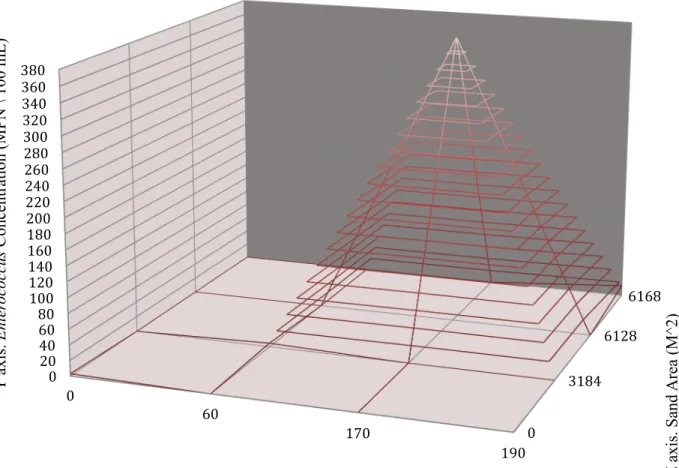
Coastline lengths and sand areas of each beach site of interest were graphed in 3-Dimensional space against the average bacterial concentration of the coastline water sample(s) that were taken at each beach included in this study. Although the coastline length and sand area of each beach are not independent variables of one another, this factor does not affect the
topographical trends of the graph. The coastline length and sand area for each beach were graphed on the x (horizontal) and z (depth) axes respectively so that they could express any possible correlation without affecting the vertical topography of the graph. In this layout, the graph’s vertical topography is only affected by bacterial concentration (graphed on the vertical y axis) so that a clear visualization of how bacterial concentrations might vary relative to these two geometric beach features is displayed.
Hotel Capacity Distribution Across Puerto Baquerizo Moreno
Stakeholder Engagement
Analysis
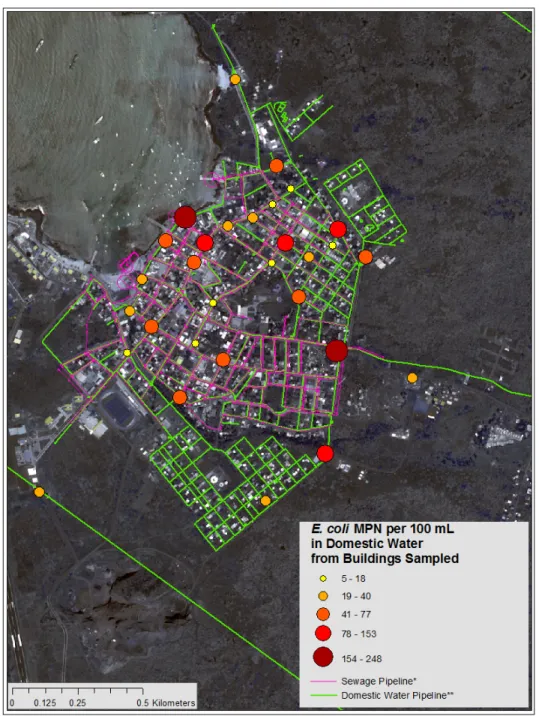
Figure 1 displays the E. coli bacterial concentration levels across the town of Puerto Baquerizo Moreno, San Cristobal. The graduated symbols display E. coli concentrations with five natural breaks in the numerical data. The larger and darker the circle hovering about the collection site, the higher the E. coli concentration detected in the domestic water supply for that site. The sewage pipelines shown in Figure 1 are not quite complete due to lack of data files. 13 of the 15 neighborhoods within Puerto Baquerizo Moreno proper have sewage pipelines
(GADMSC, 2012). Data of minor domestic water pipelines could not be obtained, and those missing files are also not projected.
As can be seen from the varying sizes and shades of circles in Figure 1, there is noticeable variability in bacterial concentrations among sampled sites. Sites where domestic water samples were collected include households, public buildings such as restrooms, and businesses such as stores, hotels, or the gas station. Some sites might show a relatively low concentration of E. coli due to the possible addition of chlorine tablets to cisterns containing domestic water. Although it was requested that the building owner or resident provide a water sample directly from the pipeline without further treatment, it is possible that there were communication or language barriers that might have interfered with this request.
Organization, 2011). All E. coli concentrations projected in Figure 1 are geometric averages of multiple water samplings. As can be seen in Figure 1, no sites met this sanitation standard suggested by WHO for domestic water quality.
Figure 1. Geometric averages for E. coli concentrations (MPN/ 100 mL) of domestic water samples collected within Puerto Baquerizo Moreno.
*This is not the full extent of sewage pipelines that exist in Puerto Baquerizo Moreno.
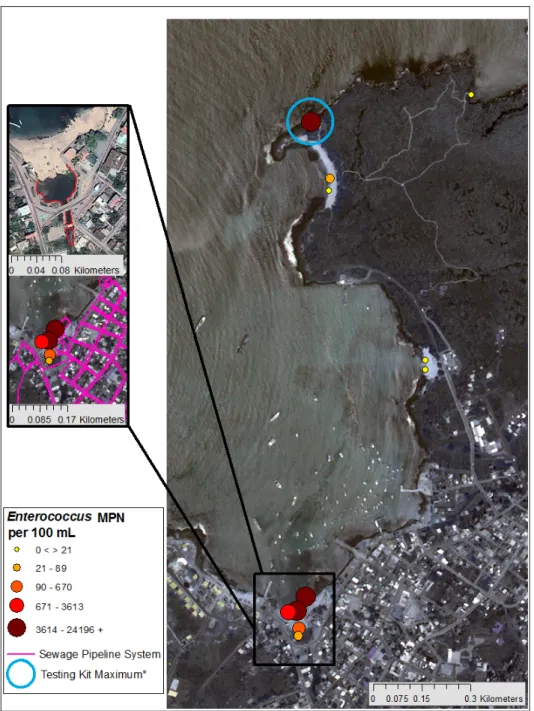
Figure 2. Geometric averages of Enterococcus in MPN per 100 mL at marine sites surrounding Puerto Baquerizo Moreno.
*The blue circle represents the sampling site where Enterococcus concentration reached the maximum indication level of the testing kit.
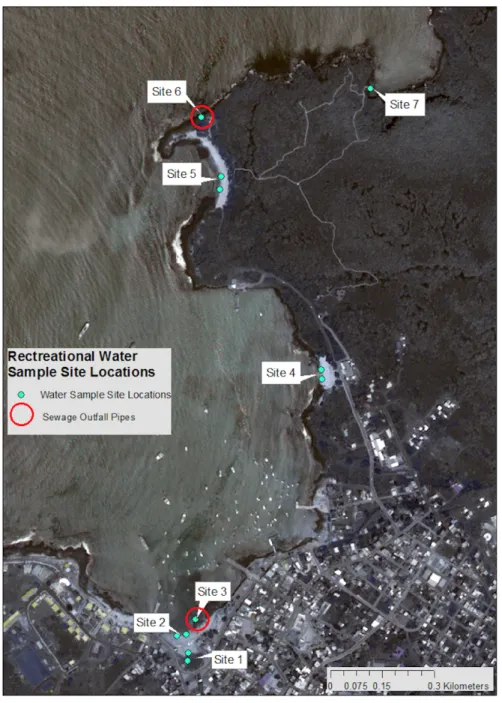
several meters from the shore. Site 6 shows where the Punta Carola sewage outfall pipe begins its entrance into the ocean. The Punta Carola outfall pipe extends 120 meters from the shoreline when the water is at high tide (GADMSC, 2012).
Figure 3. Numerically labeled ocean sample site locations.
obtained for the coastline of each beach. The entire length of the sand-ocean interface of each study beach was measured and recorded for this column. The column labeled ‘sand
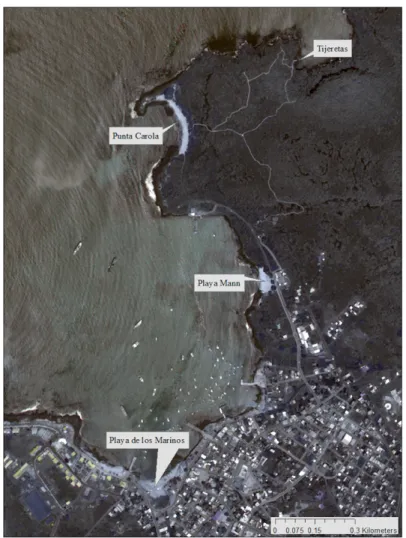
Figure 4. Names of beaches for which dimensions are given in Table 1. This map is a visual reference for Table 1.
Table 1. Beach Dimensions and Enterococcus Concentration Averages
Coastal Water
Sampling Site Name Sand Coast Length (m)
Sand Max.patch.area
(m2) Means (MPN per 100 mL) Enterococcus Geometric
Tijeretas* 0 0 3
Playa Mann 60 3184 5 5
Punta Carola 190 6168 21 7
Playa de los Marinos 170 6128 89 670 3613 15668
* = Does not have a sandy shore
this does not cause an issue with the representation of data due to the fact that the visual purpose of this graph is to display the varying vertical topography that is representative of bacterial concentrations at coastal testing sites. Any correlation between coastline length and sand area per beach is expressed only horizontally, and the result of graphing the beach dimensions on the x and z planes is that the diagonal created by these two horizontal axes creates the single
combined variable; i.e., “beach dimension.” The variation in Enterococcus levels is expressed topographically along this diagonal that runs from the x,z coordinate (0,0) to (190, 6168). The (x,z) coordinates (0,0), (60, 3184), (170, 6128), and (190, 6168) in Figure 5 represent the sand dimensions of Tijeretas, Playa Mann, Playa de los Marinos, and Punta Carola respectively.
Figure 5. Enterococcus concentrations versus beach dimensions 0
3184 6128
6168
0 20 40 60 80 100 120 140 160 180 200 220 240 260 280 300 320 340 360 380
0
60
170
190
Z a xi s. S and A re a (M ^2) Y a xi s. E nt er oc oc cus Conc ent ra ti on (M P N
\ 100 m
L
)
Table 2 displays the most prominent stakeholders, including policies and organizations, related either directly or indirectly to maintaining a promise of integrity in the sewage system on San Cristobal Island. Although there are other entities that influence the functionality of the sewage system, such as the organizations that maintain population control or the Department of Energy for the Galapagos (El Ministerio de Electricidad y Energia Renovable), these
stakeholders do not have a duty of ensuring adequate sewage infrastructure as part of their promises to uphold. Thus, they are not included in Table 2.
Table 2. Stakeholders directly or indirectly involved with sewage infrastructure maintenance, construction, or management
Name of Organization or Government Document
Relation to sewage infrastructure construction/upkeep or
maintenance (aka management)
Description
Political Constitution of Republic of Ecuador, Article
22, paragraph 2
Indirect Management Promises the right of all people to live in an environment that
is free of pollution Ecuadorian State Indirect Management One policy of the State is to
ensure the safety of terrestrial and marine ecosystems Special Regime Law for the
Preservation and Sustainable Development of the
Galápagos
Direct/Proximate management Promises that agencies will provide the population settlement areas in the Galapagos with services such
as sanitation INGALA and the Governing
Council of Galapagos (Consejo de Gobierno de
Galapagos)
Direct/Proximate Management Advises entities and creates guidelines and regulations to
ensure sustainable development of inhabited areas
of Galapagos Inter-institutional
Management Authority
Indirect Management A combination of entities that work together to approve plans
regarding the protection of marine reserve ecosystems Galapagos National Park
Administration
Political constitution of the Republic, Municipal Regime
Law, Decentralization and Popular Participation Law
Indirect Management All three function to layout pollution control regulations permitting that they are in line
with criteria established by INGALA
Municipalities of Province of Galapagos (for San Crisobal
this specifically is the Gobierno Autónomo Descentralizado Municipal del
canton San Cristóbal)
Direct/ Proximate
Construction/Maintenance To treat residues from waste such as sewage, to build sanitation infrastructure including twin water and sewage systems in accordance
with approval by INGALA Chapter III, Art. 32,
Educational and Training Regime
Indirect Management Among other tasks, to provide a one year training course to any sectional entity designed to
serve in the Galapagos for environmental protection Chapter IV, Title V, article 62
and 63 of the Genuine Book of Ecuadorian Laws
Indirect Management Art 62: Prohibits the emptying of residue from bilges, garbage, or sewage into crevices, aquifers or the marine
reserve
Art 63: that disposal of waste does not harm environment or
interfere with tourist activity sites
Sources: The Genuine Book of Ecuadorian Law (The National Congress of Ecuador, 1998) and “Governance” (Galapagos Conservancy, 2012)
Various geo-spatial procedures, including the collection of water sampling site
coordinates, the spatial adjustment of pipeline data files, and the quantification of sand area of each coastal marine sampling site, allowed for the compilation of Figures 1 through 5. Further work involving the translation of the San Cristobal Municipality sewage document and dialogue with the “Director de Gestion Ambiental” (Spanish for “the Director of Environmental
CHAPTER 4: Discussion and Conclusion
Discussion
The analysis section of this thesis offers evidence that sewage waste generated by the human population is entering the environment and possibly the domestic water distribution systems at detectable levels. E. coli that was tested for in domestic water samples taken from households and buildings is an indicator bacteria for fecal pollution (World Health Organization, 2011). According to the World Health Organization (2011), the water temperature and nutrient levels within a pipeline distribution system are not generally high enough to support E. coli growth. “Thus the presence of E. coli [in a pipeline] should be considered as evidence of fecal contamination” (World Health Organization, 2011). The World Health Organization mentions that E. coli detected in pipelines is therefore likely due to a fairly recent contamination event. One possible contamination event could be the occurrence of cross contamination between the domestic and sewage pipelines.
When water samples were collected for this study in June and July of 2013, the drinking water treatment plant was not functioning. Therefore, water with initially high levels of E. coli and other bacteria was entering the distribution system. However, the water was then sent through pipes from El Progreso, a town in the highlands, to the coastal town of Puerto Baquerizo Moreno. On the way to the households and buildings receiving this water, some E. coli likely died off due to reduced conditions for growing within the pipes, particularly in areas of continuous flow. As one can see in Figure 1 in the Analysis section, there are certain
pipeline system. As Figure 1 shows, both pipeline systems exist underneath the road network, but it is unknown as to exactly how close the two pipelines are to one another.
An interesting aspect of the E. coli concentrations of buildings from which water was sampled is that one of the two highest bacterial concentration levels was found in water from a building located near a sewage convergence point within the sewage system (GADMSC, 2012). The two sites with the highest domestic water bacterial concentrations are represented by the two darkest, largest circles in Figure 1. Of the two sites with the highest E. coli concentrations in Figure 1, the one that lies farthest from the coastline is proximal to a sewage pipeline
Figure 6. Sewage related infrastructure on San Cristobal.
A portion of the Sewage and Domestic water pipelines are shown. The red rectangle surrounding Puerto Baquerizo Moreno is not pipeline but, rather, the border of the domestic water pipeline shapefile.
Figure 2 shows Enterococcus concentrations across ocean sampling sites and displays some locations with relatively high bacterial concentrations. One can see that sites 1,2,3, and 6 (as labeled in Figure 3 and projected in Figure 2) are the locations with the highest levels of Enterococcus bacteria. Enterococcus is an indicator bacteria used to detect the possibility of human fecal pollution in marine waters. Although Enterococcus is not human-specific bacteria, the concentration patterns shown in Figure 2 indicate a high likelihood of human influence. Sites 1 and 2 likely have high Enterococcus bacteria levels for two reasons 1) both sites are