How Adolescents Use Social Media for Health
Information
By
Sumeet Banker, MD
A Master’s Paper submitted to the faculty of
the University of North Carolina at Chapel Hill in partial fulfillment of the requirements for
the degree of Master of Public Health in the Public Health Leadership Program.
Chapel Hill 2011
____________________________________ First Reader:
____________________________________ Date
_________________________________ Second Reader:
Page 2 of 35 TABLE OF CONTENTS
Systematic Review of the Evidence ………. 3 – 17
Abstract ……….. 3
Introduction ……… 4
Methods ……….. 5
Results ……….... 6
Discussion ……….……. 8
Conclusion ……… 11
References ……… 12
Tables and Figures ………... 15
Focus Group Data ……….. 18 – 35 Abstract ……….….. 18
Introduction ………..……… 19
Methods ………..……….. 21
Results ………..….... 23
Discussion ………..……….……. 27
Conclusion ……… 29
References ……… 30
Page 3 of 35 ABSTRACT
Purpose: To describe the reported uses of social networking sites to share health information
with adolescent patients and populations.
Data Sources: The MEDLINE database was searched from 2005 through March 2011. Other
relevant articles were located by hand-searching bibliographies.
Study Selection: The author reviewed studies that examined current and future uses of social
networking sites (Facebook, Twitter, and Myspace) to spread health information amongst
patients or between patient and provider.
Data Extraction: A single reviewer abstracted the relevant data from the included articles into
tables.
Results: Five articles met inclusion criteria and were reviewed in this analysis. Within
disease-specific interest groups on social networking sites, 56% of postings related personal stories or
experiences. Less than 15% asked questions or provided answers regarding specific medical
conditions. Though no firm measure of accuracy could be applied, overall credibility of health
information provided in this online setting was questionable.
Conclusions: Patient-to-patient communication via interest groups on social networking sites
serves an important role as a source of support and community, though there is the potential of
the spread of misinformation if credibility is not assured. Social networking sites could be used
to extend communication between patients and providers, while assuring credibility and
Page 4 of 35 INTRODUCTION
An increasing proportion of the United States population is regularly accessing the
Internet. From 2000 to 2009, internet use has risen from 49% to 74% among adults and from
75% to 93% among teens [1]. Internet-based social media are channels of creating and sharing
user-generated content, and are utilized by all age groups, though teens access these technologies
nearly twice as frequently as adults [1]. Teens access the internet and social networking sites for
a variety of reasons, including making new friends, connecting with existing friends, seeking
information, and joining groups [1].
Social scientists and researchers have noted the transformative power of this fundamental
shift in the way people send and receive information, suggesting significant implications for
health [3-9]. Patients are increasingly turning to the Internet and online sources when gathering
health information [1-2]. Teenagers are typically considered to be early adopters of technology
[10], and 80% of teens are accessing health information online [1].
Despite this major transformation in mainstream usage of these emerging technologies,
health care has been relatively slow to adopt social networking sites as a means of health
communication [11-12]. Providers and researchers have also been slow to report on these novel
means of reaching patients and populations. Though there are countless studies and
commentaries on the dangers of social networking sites as it relates to encouraging risky
behaviors and predatory acts, there have been few studies examining current or future
Page 5 of 35 To help determine what the body of evidence currently states, we conducted a review of
the literature on the use of online social networking sites (SNS) to share and communicate health
information within adolescent populations.
METHODS
To identify relevant articles, we searched the MEDLINE database from January 2005
through March 2011 using keyword searches for general terms, as well as the three most commonly used social networking websites (“social networking sites” or “social media” or
Twitter or Facebook or Myspace). These terms were then combined with age-defining categories
(teens or adolescents or students or youth). These searches were supplemented by hand searching
bibliographies of selected articles. The year 2005 was chosen as a start point since the major
modern social networking sites of interest – Myspace, Facebook, and Twitter – were launched in
2003, 2004, and 2006, respectively.
We reviewed articles that examined current or future uses of features within social
networking sites to connect with young populations around health topics. We reviewed the titles
and abstracts of the articles identified by the literature search and excluded articles that were not
eligible. Eligibility criteria were: 1) article addresses component(s) of social media sites Twitter,
Myspace, and/or Facebook; 2) study addresses health impact on site users; and 3) study
population includes teens. We did not consider quality of the articles when determining
eligibility, though it was assessed in analysis. We abstracted the relevant information from each
Page 6 of 35 RESULTS
Initial MEDLINE search identified 104 articles. One hundred of these articles did not fit
the inclusion criteria; the majority of these excluded articles were studies and commentaries
related to issues of online professionalism within social networking sites among medical/nursing
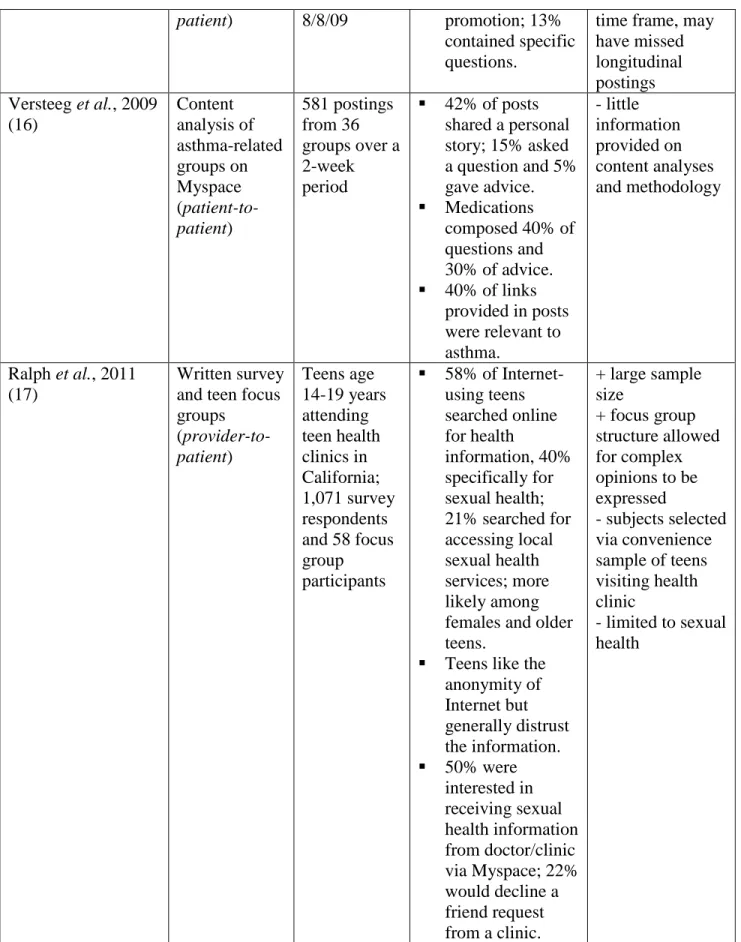
students and professionals (Figure 1). The four articles that were included represented content
analyses of disease-specific groups on Facebook [13-15] and Myspace [16]. Each employed a
specific search strategy to locate the interest groups within a given social networking site and
analyzed the nature of the groups, typically commenting on the types of postings and the general
veracity of the comments. After hand-searching bibliographies, one more article was included in
the analysis. This article was a qualitative study of teens’ perspectives on communicating with
clinics via Myspace to get information about sexual health [17]. Given the paucity of studies on
this topic, studies were not excluded based on design alone, therefore this study fit the criteria
and was included in the analysis.
The use of social networking sites to connect adolescents with health information was
examined in four content analyses [13-16] and one survey/focus group study [17]. The content
analyses evaluated 17 disease-specific groups related to concussions [13], 620 breast cancer
groups [14], the 15 largest groups on diabetes [15], and 36 asthma groups [16]. Though each of
the studies included adolescents, two explicitly provided information on the age of the group
members. Among individuals posting within concussion groups whose age could be determined,
77.6% (n=76) were under 25 years old [13]. In support groups for breast cancer, 27 out of 57
groups made available information regarding the approximate age of the creator; ninety-three
Page 7 of 35 adolescents may not be the ones afflicted with the condition in the case of breast cancer, social
networking site groups provide convenient and familiar means to accumulate coping resources.
Outcomes for this analysis include types of postings, credibility of health information
provided, and physician involvement in social networking sites.
Types of Postings
In total, 56% (n=1416) of postings in disease-specific groups on social networking sites
shared personal stories experienced by group members. Less than 15% of posts contained
questions directed at fellow members and an even lower percentage answered questions by
providing health information.
In terms of the individuals who posted within these groups, Ahmed et al. [13] and Bender
et al. [14] noted that a relatively small proportion of group members actively participated by
posting publically. In 14 of the 17 Facebook groups on concussion that were studied, less than
40% of members posted comments [13], and 85% (n=620) of breast cancer-related Facebook
groups had less than 25 postings on the group’s “wall" [14].
Credibility of Health Information
Authors of each of the content analyses [13-16] noted that none of the postings were
written by health care professionals. In addition, none of the groups’ creators were health care
professionals or associated with health care organizations. Versteeg et al. [16] noted that many
postings in asthma-related groups “contained substantial misinformation.” Among postings with
Page 8 of 35 information” in diabetes-related groups. Ahmed et al. [13] did not specifically measure accuracy
and quality of information in concussion-related groups because they decided that postings
contain personal opinions, however they made note of the potential for misinformation if users
interpret opinion as fact.
Physician Involvement in Social Networking Sites
In their analysis of teen survey data, Ralph et al. [17] found that 58% of teens reported
searching online for information about health, dieting, or physical fitness. However, 50% were
interested in receiving health information from a clinic via Myspace. A greater proportion chose
other media, such as a website (70%) or e-mail (60%).
Ahmed et al. [13], Bender et al. [14], and Greene et al. [15] note the importance of social
networking sites as peer-to-peer forums for sharing mental and emotional support with other
individuals suffering from similar medical ailments. Though the quality of these discussion
groups may improve with monitoring from health care professionals, Ahmed et al. [13] point out
that this oversight may compromise the anonymity that users seek.
DISCUSSION
In our review of the pertinent literature on using social media for patient-oriented health
purposes, we found that in disease-specific interest groups on Facebook and Myspace, the
majority of postings were related to members sharing personal stories or experiences with the
Page 9 of 35 many opportunities for patient-provider communication via this ever-expanding system of social
networking sites.
Since they were created in the mid-2000s, social networking sites have allowed users to
connect with other members, share photos, videos, and comments, and join specific interest
groups. Many entities, from retailers to political parties and candidates, have been able to
successfully utilize the media to communicate consumers. The health sector, however, has been
slow to adapt to these changing technologies to reach patients and populations. Some reasons for
this include skepticism towards emerging technologies, uncertainty regarding the privacy of
patient information, and the lack of a feasible infrastructure to ensure adequate reimbursement
for time spent communicating with patients remotely [7,12].
The literature reviewed here shows that there are specific ways in which social
networking sites are being used to convey health information. In particular, user-generated
features such as posting pictures, videos, comments, and links to other websites have been used
in many interest groups centered on chronic diseases such as asthma, diabetes, and cancer.
Content analyses show that the majority of user postings have been to relate personal stories and
experiences of disease management with other group members. Though the veracity of these
comments cannot always be confirmed, there is a significant value to the process of sharing and
reading about the stories, struggles, and successes of others through online support groups [18].
Though a relatively small proportion of group members choose to visibly contribute by
posting comments, it has been shown that activity alone is not necessary to obtain the
empowering effects of online group participation. Non-posting members (“lurkers”) may obtain
Page 10 of 35 The relative scarcity of specific health questions and answers indicates that group users
among social networking sites are not seeking health information from their peers as much as
they are looking for emotional support. However, the presence of misinformed answers raises
concerns about the credibility of such forums, given that many group members may read these
comments and interpret them as medical facts. The authors did not assess whether emotional
support was achieved or if there are negative consequences with seeking this type of support in
this environment with little professional guidance.
Whereas the other articles reviewed evaluated Facebook and Myspace groups that
exhibited patient-to-patient communication, Ralph et al. [17] evaluated a patient-provider model
via Myspace using focus group and survey data. The concept was a sexual health clinic with a
Myspace profile that could connect with patients and local teens online. Data from this study
suggests that though some teens may have reservations about communicating with health care
personnel via social networking sites, a majority of teens are already going online for health
information and a significant number would read and benefit from accurate and consistent health
information provided by professionals.
There were limitations to this review. The lack of similarities in study design made it
difficult to fairly and equivalently compare strengths of studies or to aggregate data. Though the
qualitative focus group data introduced preferences and opinions unobtainable from the other
types of studies, there were no other studies of this type for comparison. Secondly, the content
analyses do not evaluate the effect of online communities and comments posted on an
individual’s practice or perceived medical knowledge. Third, the content analyses did not specify
the ages of the group members, therefore the study population may have included adults.
Page 11 of 35 the results of these studies are directly applicable to this age group. Lastly, the low number of
published studies reflects the novelty of these forms of communication and its lack of scientific
study. With the increasing number of Americans that get their news and information from online
media and social networking sites, it is increasingly important that health care providers
understand and adapt to the idea that health information can similarly be shared through these
avenues.
CONCLUSION
The current literature shows several examples of patient and
patient-to-provider health communication via social networking sites. Disease-specific interest groups tend
to be unmoderated, unverified forums for people to share personal experiences and occasionally
health information and advice, whereas the provider-based profiles could emerge as credible and
real-time sources of health information for online teens. More research is needed to further
elucidate the range of suitable interaction and information-sharing that could take place among
patients and between patients and providers to increase the health knowledge of the general
Page 12 of 35 REFERENCES
1. Lenhart, A., Purcell, K., Smith, A., Zickuhr, K. Social Media and Mobile Internet Use
Among Teens and Young Adults. Pew Internet & American Life Project. Washington,
D.C., 2010. Available at
http://pewinternet.org/Reports/2010/Social-Media-and-Young-Adults.aspx. Accessed March 2011.
2. Fox, S., Jones, S. The Social Life of Health Information. Pew Internet & American Life
Project. Washington, D.C., 2009.
3. Atkinson, N. L., Saperstein, S. L., & Pleis, J. (2009). Using the internet for health-related
activities: Findings from a national probability sample. Journal of Medical Internet
Research, 11(1), e4.
4. Gentles, S. J. (2010). Health information technology to facilitate communication
involving health care providers, caregivers, and pediatric patients: A scoping review. J
Med Internet Res, 12(2), e22.
5. Chou, W. Y. S. (2009). Social media use in the United States: Implications for health
communication. J Med Internet Res, 11(4), e48.
6. Boulos, M. N., & Wheeler, S. (2007). The emerging web 2.0 social software: An
enabling suite of sociable technologies in health and health care education. Health
Information & Libraries Journal, 24(1), 2-23.
7. Hawn, C. (2009). Take two aspirin and tweet me in the morning: How twitter, Facebook,
and other social media are reshaping health care. Health Affairs, 28(2), 361-368.
8. Dreher, H. M. (2009). Twittering about anything, everything, and even health. Holistic
Page 13 of 35 9. Lane, S. H., & Twaddell, J. W. (2010). Second opinion: Should social media be used to
communicate with patients? MCN, the American Journal of Maternal/Child Nursing,
35(1), 6-7.
10. Gray, N. J. et al. (2005). Health information-seeking behavior in adolescence: the place
of the internet. Social Science & Medicine, 60, 1467-1478.
11. Rozental, T. D., George, T. M., & Chacko, A. T. (2010). Social networking among upper
extremity patients. J Hand Surg, 35A, 819-823.
12. Vance, K., Howe, W., & Dellavalle R. P. (2009) Social internet sites as a source of public
health information. Dermatol Clin, 27, 133-136.
13. Ahmed, O. H., Sullivan, S. J., Schneiders, A. G., & Mccrory, P. (2010). iSupport: Do
social networking sites have a role to play in concussion awareness? Disability &
Rehabilitation, 32(22), 1877-1883.
14. Bender, J. L. (2011). Seeking support on Facebook: A content analysis of breast cancer
groups. J Med Internet Res, 13(1), e16.
15. Greene, J. A., Choudhry, N. K., Kilabuk, E., & Shrank, W. H. (2010). Online social
networking by patients with diabetes: A qualitative evaluation of communication with
Facebook. Journal of General Internal Medicine, 26(3), 287-292.
16. Versteeg, K. M., Knopf, J. M., Posluszny, S., Vockell, A. L. B., & Britto, M. T. (2009).
Teenagers wanting medical advice: Is MySpace the answer? Archives of Pediatrics and
Adolescent Medicine, 163(1), 91-92.
17. Ralph, L. J., Berglas, N. F., Schwartz, S. L., & Brindis, C. D. (2011). Finding teens in
TheirSpace: Using social networking sites to connect youth to sexual health services.
Page 14 of 35 18. Preece, J., Nonnecke, B., & Andrews, D. (2004). The top five reasons for lurking:
Page 15 of 35 TABLES AND FIGURES
Author, Year (Reference)
Design Sample Results + Strengths
- Weaknesses
Ahmed et al., 2010 (13) Content analysis of postings in concussion-related groups on Facebook ( patient-to-patient) 145 postings from 17 groups between 10/06 to 4/09
57% of postees were male; 87% from USA or Canada. 65% of posts
shared a concussion experience about self or friend. 8% asked
question and 2% provided advice.
+ considered all searchable groups; systematically chose relevant groups to study - did not explicitly evaluate credibility of postings
Bender et al., 2011 (14) Content analysis of breast cancer-related groups on Facebook ( patient-to-patient) 620 groups (1,090,397 members) identified on 11/19/08
45% of groups were for
fundraising, 38% to raise
awareness, 10% to promote a website to sell products or services, and 7% to generate
support for people affected with breast cancer. 86% of groups had 25 or fewer posts.
None of the support groups were created by health care providers or organizations
+ evaluated all public groups; provided search strategy
- did not analyze postings within groups for content
Greene et al., 2010 (15) Content analysis of postings in diabetes-related groups on Facebook ( patient-to-690 individual postings from 480 unique users in the 15 largest groups on
66% of posts described personal management experiences; 24% shared sensitive aspects; 27% were product
- no information regarding groups that were not among the 15 largest
Page 16 of 35
patient) 8/8/09 promotion; 13%
contained specific questions.
time frame, may have missed longitudinal postings Versteeg et al., 2009
(16) Content analysis of asthma-related groups on Myspace ( patient-to-patient) 581 postings from 36 groups over a 2-week period
42% of posts shared a personal story; 15% asked a question and 5% gave advice. Medications
composed 40% of questions and 30% of advice. 40% of links
provided in posts were relevant to asthma. - little information provided on content analyses and methodology
Ralph et al., 2011 (17)
Written survey and teen focus groups ( provider-to-patient) Teens age 14-19 years attending teen health clinics in California; 1,071 survey respondents and 58 focus group participants
58% of Internet-using teens searched online for health information, 40% specifically for sexual health; 21% searched for accessing local sexual health services; more likely among females and older teens.
Teens like the anonymity of Internet but generally distrust the information. 50% were
interested in receiving sexual health information from doctor/clinic via Myspace; 22% would decline a friend request from a clinic.
+ large sample size
+ focus group structure allowed for complex opinions to be expressed
- subjects selected via convenience sample of teens visiting health clinic
- limited to sexual health
Page 17 of 35 Figure 1. Flow Chart of Data Inclusion
Initial Keyword Search
[(“social networking sites” or “social media” or Twitter or Facebook or
Myspace) AND (teens or adolescents or students or youth)] from dates January, 2005 to March, 2011
104 articles identified
4 articles identified
1 article added 5 articles included in study
Titles and abstracts scanned
100 articles excluded
(Mostly articles about online professionalism of medical students and providers)
Page 18 of 35 ABSTRACT
Purpose: To identify the ways in which adolescents currently access general health information
resources through social media, explore potential uses of social networking sites to increase
health knowledge among adolescents, and evaluate the role of health care providers in
communication via social media.
Methods: Using a qualitative research design, 3 focus groups were conducted in Chapel Hill,
North Carolina. The 14 participants were ages 13 – 19 years and reflected diverse age and racial
background. Transcriptions were analyzed to identify major themes.
Results: Study participants typically used social media to communicate with friends, read news,
and perform school-related activities. They most frequently had health questions related to
nutrition and body image. Though they were concerned about the limited privacy and credibility
of information found online and in social networking sites, they were interested in
communicating with health care providers through various features on these sites.
Conclusions: Adolescents have many health information needs and often go online to search for
information. Communication with health care professionals via social networking sites provides
a safe and credible way for this population to retrieve health information and answers to their
Page 19 of 35 INTRODUCTION
Adolescence represents an important transition in life and it presents many challenges for
the health care practitioner. As children develop into adults, rules and structure turn into
independence and freedom. During this vulnerable period, adolescents are confronted by many
personal choices and form habits and health behaviors that they will keep for their adult lives
(eg. car safety, sexual practices, smoking, alcohol and drug use). Though they wish to discuss
health issues with professionals, they often do not use traditional health services [1,2] or they
face challenges in forming therapeutic relationships with their providers [2].
In the United States and around the world, internet and social media usage is on the rise,
and adolescents are often considered to be early adopters and active users of these new
technologies. Since 2000, internet usage among all Americans has increased from less than half
to over 75 percent of the population [3]. Internet usage is nearly ubiquitous among younger
populations, as ninety-three percent of teens and young adults ages 12-29 regularly go online [4].
Once social media emerged as a way for users to participate in the internet experience by
generating and sharing content online, social networking sites (SNS) such as MySpace and
Facebook began to experience rapid growth, with youth leading the surge. Among wired
American teens, 73 percent now use social networking websites, a significant increase from
previous surveys [3].
With the growth in general internet usage for a wide variety of purposes, personal health
is no exception. In 2009, over eight in ten wireless broadband users reported looking online for
Page 20 of 35 activity [5]. Social scientists and researchers have noted the transformative power of this
fundamental shift in the way populations send and receive information that influences their
health [6-12]. Considering that adolescents do not discuss issues with health care providers
despite their desire to, social networking sites could be used to reach this population with health
information.
With the rise in social media platforms as a way for teens to connect and share
information with a large population, a unique opportunity arises for the utilization of these media
to communicate health information on a population level. There is a growing body of literature
studying successes and challenges of delivering health interventions via the Internet, but there is
little regarding the use of SNS in particular. Qualitative analyses have evaluated the content of
asthma interest groups on MySpace [13]; and breast cancer [14], concussion [15], and diabetes
[16] interest groups on Facebook, finding that they are most often unmonitored and utilized to
relate personal experiences, while much of the clinical information may be false or misleading.
In a study of California teens, the anonymity of the Internet was comforting in searching for
answers to potentially embarrassing questions, though they expressed general distrust of
Internet-based information; yet half (50%) were interested in receiving sexual health information from a
doctor or clinic via MySpace or another SNS [17]. However, social networking sites remain
underutilized by health care providers and public health professionals [18,19].
The goals of this study are to (1) identify ways adolescents currently access general
health information through social media, (2) explore potential uses of social networking sites to
increase health knowledge among adolescents, and (3) evaluate the potential role of health care
Page 21 of 35 METHODS
Focus group methodology was used to engage youth participants in discussions about
their health information needs and the role of social media technology in attending to these
needs. The participants were asked questions [Appendix 1], to which they were permitted to
respond in a candid manner. This open-dialogue format was intended to allow youths to express
their thoughts and experiences without prompting from the moderator.
Participant Recruitment
We conducted three focus groups with adolescents between the ages of 13 and 19 years
from Chapel Hill, Durham, and Raleigh, North Carolina. For this study, volunteers were
recruited via two methods: 1) electronic “event invitations” in Facebook, circulated within online
networks of local high schools, and 2) email sent to employees (potential parents of teenagers) of
the University of North Carolina at Chapel Hill.
Based on eligibility, participants were placed in focus groups with an attempt to stratify
groups according to age (13-15 years and 16-19 years). This was done to attempt to create an
open environment where teens with similar health needs, experiences, and beliefs felt
comfortable expressing their opinions.
Focus Group Procedures
On average, focus group sessions lasted 60 minutes. For consistency, the same moderator
and co-facilitator coordinated and conducted each session. To ensure safety and confidentiality,
participants were assured that all comments would be kept private, unless there were questions of
Page 22 of 35 would follow up with the participant individually if safety seemed to be threatened. In addition to
assenting each child, we obtained parental or guardian consent in all cases in which an individual
participant was less than 18 years of age.
After obtaining informed consent and assent, participants were given a detailed
explanation of the focus group procedure and asked to complete a brief written survey. Prior to asking questions from the focus group guides, we defined the term “social media” as a collection
of online platforms (limited to Facebook, Twitter, and Myspace) where users create a profile and
may share comments and media. Next, we engaged in a brief session to brainstorm ideas about health. Since “health” would be used many times in the context of our focus groups, we found it
important to define the concept using words and ideas derived from the participants themselves.
The definitions agreed upon were quite similar between groups, and included elements of
prevention and treatment of both physical and mental disease.
Data Analysis
The audio from all focus group sessions was recorded and transcribed by SB. Transcripts
were randomly cross-checked against recordings to ensure accuracy. Analysis followed a coding
template that was developed based on major themes, categories, and issues raised by participants.
Some of these were summarized into figures to fully portray the thoughts and sentiments
Page 23 of 35 RESULTS
A total of 14 participants attended the focus groups. The sample was well balanced with
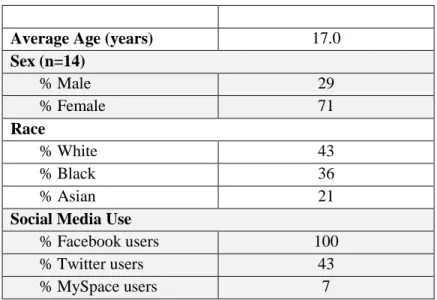
respect to age and race of subjects (Table 1). The average age was 17 years (range: 13 – 19
years) and the sample was 43% White, 36% Black, and 21% Asian. Twenty-nine percent of
participants were male and 71 percent were female. Forty-three percent were recruited via
Facebook event invitations and 57 percent were recruited after their parent responded to an email
message. All participants used social networking sites: 100 percent had a profile on Facebook,
while less than half had an account on Twitter or MySpace.
Health Needs
All participants indicated that they had questions about topics related to nutrition and
body image (dieting and nutrition, exercise and fitness, skin health, and puberty/body changes).
Nearly three quarters of subjects expressed personal safety concerns regarding sports,
automobiles, and injuries. Sixty percent had questions about high-risk behaviors such as sexual
health, and drugs and alcohol. Less than half had questions regarding diseases and specific
medical conditions (vaccines, mental health, diabetes, heart disease) (Table 2).
In each session, mental health was quickly included in the group’s discussion of health
and health needs. This included the concept of social health, or having friends and remaining
active with them:
Page 24 of 35 Concerns
The major concerns raised by participants regarding the use of social networking sites for
health purposes were the lack of privacy and anonymity and questionable credibility. Though
they visit SNS for a variety of uses, including communicating publically with friends and posting
photos and videos, many of them were hesitant to use SNS for personal health purposes because
their name and selected personal information would be attached to public postings. With respect
to high-risk behaviors in particular, teens want to keep their questions private:
Social media titles you. If you were to chat somebody then they would see your name, and so for that reason privacy goes away. If you have a serious question like if you were worried you had an STD, it is unlikely that you would get on chat and be like “does anybody know what this symptom means?” you’re not going to publically throw out your personal information. So you can hide behind being anonymous on Google. [Male, 16-18 years]
Credibility of health information was also a significant concern of teen subjects. Though
nearly all participants reported using search engines like Google or Yahoo to look for health
information, they commented that social networking sites are fundamentally different in the way
they are set up. Given that SNS content is typically user-generated, teens find it difficult to
determine the source of information:
I feel like social media is not reliable for any information on your health or personal life
because there’s no cited work or background behind it. There’s no way to check what’s real and what’s not. [Female, 16-18 years]
Participants would not trust health information provided by their peers on most topics
secondary to lack of knowledge, though they recognize the potential of SNS in this regard:
Page 25 of 35 age group it would work, but ours it probably won’t. It depends on who’s in your circle.
[Female, 16-18 years]
However, they sometimes seek social support for health topics that are perceived to be of
lower severity such as minor fractures, sports injuries, and advice on skin and nutrition.
If it’s not too serious, like if you had acne or something you could just ask somebody “I have acne what do I do?” And it’s really easy to get quick responses back. [Male, 16-18 years]
Sometimes I run cross-country and I have issues with my leg muscles. I can go to other cross country-type runners on Facebook and ask about a stretch or way to work it out. So I guess you could target audiences similar to you to answer your questions. But again, that’s relying on someone’s opinions. [Male, 16-18 years]
Implications for Health Care Professionals
Teens expressed interest in “friending” their health care provider or communicating with
him or her one-on-one via social networking sites. Participants were resistant toward connecting
with providers on SNS by posting questions publically. However, they liked the idea that their
provider could periodically supply them with health tips and links to credible online sources.
Specifically, one teen suggested that providers post short topic-focused notes on their page with
information for teens to access via SNS:
They can post notes and stuff about different things and you can click on the note that the person posted. And they can be about heart disease, diabetes, cancers, and ways to stay healthy. [Female, 16-18]
A major benefit of being friends with a health care provider was the ability to chat
privately about health questions and concerns. Not only did they find it more direct and more
Page 26 of 35 If I could talk to a doctor and have a conversation with them on Facebook, I would definitely be much more likely to do that. I would prefer that to going on Google. [Male, 16-18 years] If you had like a small question and you didn’t want to go all the way to your doctor and sit there and have to wait for an appointment, you could just ask them on Facebook. Maybe not post on their wall if it’s something serious because you don’t want everyone seeing it. [Female, 16-18 years]
You could do that through Facebook which would kinda be more convenient if the person would message you back quickly. [Female, 16-18 years]
Teens indicated they were most likely to communicate with their own health care
provider, though they would consider other providers upon verification of their credentials.
Scope of Prevention
Teens’ likelihood of seeking information on preventive behaviors was limited and varied.
Participants did not agree on whether or not they would find daily preventive health tips and
advice provided by a reputable health source useful in their daily life. Some suggested they
would enjoy reading the daily tips so they could learn more about general health and make
specific changes in their lives:
Participant 1: Like if a doctor added something on his Facebook like every day… like the number one disease in the country is such and such…that’s something I want to know. And how you can get it. I would like that. [Female, 16-18 years]
Participant 2: When they post things like that it makes me realize what I can change. [Female, 16-18 years]
Page 27 of 35 Other teens felt like they did not have frequent enough health problems to subscribe to
preventative tips. Further, they indicated this form of information may become annoying if the
topics were not relevant:
I don’t think the tips provided would be a “make it” factor, and if they got annoying then they would be the “break it” factor. [Male, 16-18 years]
These teens reported that they seek information only when they have a question about a specific
topic, adding that this way they felt they were more likely to remember the answer.
DISCUSSION
This study was conducted to elicit how adolescents use social networking sites for health
information, explore potential avenues to increase teen health knowledge, and consider the
implications for health care providers. We found that though most teens do not seek health
information from social networking sites, many of them are open to the idea of periodically
receiving small amounts of health advice or tips from a credentialed provider. Further, there is
potential for increased communication between patient and provider via SNS, so long as it is
initiated by the patient.
Adolescents and young adults use social networking sites at the highest rate of any age
group, and this use fills many needs and activities including staying in touch with friends,
posting pictures and videos of personal relevance, keeping up with news, and collaborating with
peers on school-related activities. To this point, they have rarely initiated public conversations
Page 28 of 35 answers to their health questions. Though they also seek information online, they find it difficult
to trust many of the sources encountered via search engines.
One way to address these challenges is to link adolescent patients with their health care
providers via social networking sites. This would allow health care professionals the opportunity
to guide their patients to credible sources of online health information through a highly popular
social interface. In addition, this arrangement increases availability of health providers to
adolescent populations, a demographic that can be difficult to reach at times. The results of this
study indicate that there may be interest among adolescents in this type of interaction, especially
in areas such as nutrition/body image and high-risk behaviors.
One barrier to this approach is maintaining privacy of patient information. Even though messaging may occur through “private chat,” there is always a risk of breach of confidentiality
on the internet. Providers and patients should share information to a level at which both feel
comfortable. Another potential barrier to this strategy is lack of provider reimbursement. As of
now, most providers are not able to bill for electronic correspondence. However, this
communication need not take the place of a regular office visit; rather, it should supplement and enrich the patient’s health experience. Again, the frequency of SNS use should be at the
discretion of the provider in consultation with the patient.
There were limitations to this study. First, subjects were recruited using two different
methods – some participants were contacted directly after responding to an invitation on a social
networking site (Facebook), whereas others were contacted after a parent responded to an email
invitation for their child. Though all subjects were given a chance to refuse participation during
Page 29 of 35 part by a parent. This potential difference in motivation secondary to recruitment method may
have differentially affected the quality of the respective focus group discussions. Second, though
we tried to roughly arrange subjects in groups based on their age, it is possible that a younger
teen was placed in a group with older teens and felt uncomfortable expressing their views if they
were different. This may have limited the subject’s participation and led to a misrepresentation
of his or her beliefs and opinions. Lastly, the small sample size of this pilot study limits the
generalizability of our findings. Further research is necessary to determine whether the results of
this study are reflective of adolescents’ opinions more generally.
CONCLUSIONS
This is one of the first studies to qualitatively explore adolescents’ thoughts and
perceptions of using social networking sites for health information. We cannot generalize the
findings of the study to particular populations, but the strong themes corroborated across groups
indicate a health information need among adolescents and an interest in communicating with
health care providers through specific features of SNS. Additional research is needed to
determine length and frequency of communication, health topics covered, visual layout, and
cost-effectiveness of this approach to prevention of childhood disease and disability. Health care
Page 30 of 35 REFERENCES
1. Klein J.D., Wilson K.M. (2002). Delivering quality care: Adolescents’ discussion of health risks with their providers. J Adolesc Health, 30(3), 190-195.
2. Gray, N. J., Klein, J. D., Noyce, P. R., Sesselberg, T. S., & Cantrill, J. A. (2005). Health information-seeking behavior in adolescence: the place of the internet. Social Science & Medicine, 60, 1467-78.
3. Lenhart, A., Purcell, K., Smith, A., Zickuhr, K. Social Media and Mobile Internet Use Among Teens and Young Adults. Pew Internet & American Life Project. Washington, D.C., 2010. Available at http://pewinternet.org/Reports/2010/Social-Media-and-Young-Adults.aspx. Accessed March 2011.
4. Fox, S., Jones, S. The Social Life of Health Information. Pew Internet & American Life Project. Washington, D.C., 2009.
5. Fox, S. Health Topics. Pew Internet & American Life Project. Washington, D.C., 2011. Available
at http://pewinternet.org/Reports/2011/HealthTopics.aspx. Accessed March 2011.
6. Atkinson, N. L., Saperstein, S. L., & Pleis, J. (2009). Using the internet for health-related activities: Findings from a national probability sample. Journal of Medical Internet Research, 11(1), e4.
7. Gentles, S. J. (2010). Health information technology to facilitate communication involving health care providers, caregivers, and pediatric patients: A scoping review. J Med Internet Res, 12(2), e22.
Page 31 of 35 9. Boulos, M. N., & Wheeler, S. (2007). The emerging web 2.0 social software: An enabling suite of
sociable technologies in health and health care education. Health Information & Libraries Journal, 24(1), 2-23.
10. Hawn, C. (2009). Take two aspirin and tweet me in the morning: How twitter, Facebook, and other social media are reshaping health care. Health Affairs, 28(2), 361-368.
11. Dreher, H. M. (2009). Twittering about anything, everything, and even health. Holistic Nursing Practice, 23(4), 217.
12. Lane, S. H., & Twaddell, J. W. (2010). Second opinion: Should social media be used to
communicate with patients? MCN, the American Journal of Maternal/Child Nursing, 35(1), 6-7. 13. Versteeg, K. M., Knopf, J. M., Posluszny, S., Vockell, A. L. B., & Britto, M. T. (2009).
Teenagers wanting medical advice: Is MySpace the answer? Archives of Pediatrics and Adolescent Medicine, 163(1), 91-92.
14. Bender, J. L. (2011). Seeking support on Facebook: A content analysis of breast cancer groups. J Med Internet Res, 13(1), e16.
15. Ahmed, O. H., Sullivan, S. J., Schneiders, A. G., & Mccrory, P. (2010). iSupport: Do social networking sites have a role to play in concussion awareness? Disability & Rehabilitation, 32(22), 1877-1883.
16. Greene, J. A., Choudhry, N. K., Kilabuk, E., & Shrank, W. H. (2010). Online social networking by patients with diabetes: A qualitative evaluation of communication with Facebook. Journal of General Internal Medicine, 26(3), 287-292.
17. Ralph, L. J., Berglas, N. F., Schwartz, S. L., & Brindis, C. D. (2011). Finding teens in
TheirSpace: Using social networking sites to connect youth to sexual health services. Sexuality Research and Social Policy, 1-12.
Page 32 of 35 19. Vance, K., Howe, W., & Dellavalle R. P. (2009) Social internet sites as a source of public health
Page 33 of 35 TABLES AND APPENDICES
Appendix 1. Focus Group Guide
1. What is your favorite social media tool? Why? 2. What do you use social media for?
3. What types of health topics do you typically have questions about? 4. Have you used social media sites to search for health information?
If so, how?
5. What are the pros of using social media for health purposes? 6. What are the cons of using social media for health purposes? 7. Would you friend/follow a feed of short bytes of information
targeted toward health topics?
8. Would you communicate with a health care practitioner (doctor, nurse) via social media?
9. What advice would you give a health care practitioner who is trying to use social media to reach you and your friends?
Page 34 of 35
Average Age (years) 17.0
Sex (n=14)
% Male 29
% Female 71
Race
% White 43
% Black 36
% Asian 21
Social Media Use
% Facebook users 100
% Twitter users 43
% MySpace users 7
Page 35 of 35
Category Health Topic % of Participants
indicating Interest (n=11) Nutrition and Body Image
Skin Health 55
Puberty/Body Changes 27
Dieting and Nutrition 55
Exercise and Fitness 91
Personal Safety
Sports Health 55
Car Safety 27
Injuries 64
Diseases/Medical Conditions
Vaccines 27
Mental Health 45
Diabetes 0
Heart Disease/Cholesterol 9 High-Risk Behaviors
Sexual Health 55
Drugs and Alcohol 55