By
Amanda McCoy
A Master’s Paper submitted to the faculty of the University of North Carolina at Chapel Hill in partial fulfillment of the requirements for the degree of Master of Public Health in the Public
Health Leadership Program.
Chapel Hill
2011
_______________________________________
Advisor:
________________________ Date
_______________________________________
Second Reader:
Table of Contents
Abstract ... 3
Systematic Review: Does the Bureau of Labor Statistics Survey of Occupational Injuries and Illnesses Accurately Capture Work-Related Musculoskeletal Disorders? ... 4
Introduction ... 4
Methods ... 7
Results ... 11
Discussion ... 18
Tables and Figures ... 22
20-Year Trends in Reported Work-Related Injury and Illness among Union Carpenters in Washington State ... 27
Introduction ... 27
Materials and Methods ... 29
Results ... 33
Discussion ... 37
Acknowledgements ... 47
Tables and Figures ... 48
Abstract
Background: The burden of work-related injuries and illnesses in the United States is great and
is accompanied by substantial direct and indirect costs. Construction workers are at higher risk
of work-related fatality, injury, and illness than most other working populations.
Materials and Methods: By combining administrative data sources, we identified a dynamic
cohort of union carpenters who worked in Washington State from 1989 to 2008, hours worked,
and their workers’ compensation claims; the data were linked on an individual basis using
blinded identifiers. We calculated incidence density rates for all claims, claims that were
considered Occupational Health and Safety Administration (OSHA)-recordable, and claims that
involved paid lost time (PLT); the latter were further stratified by the injury mechanism
groupings, “Struck by object,” “Fall to a lower level,” and “Overexertion with lifting.” Poisson
regression was used to assess risk by categories of age, sex, union tenure, and calendar time.
Results: The cohort of 26,591 carpenters worked 192 million hours over the 20-year period.
Significant declines of reported claims occurred in all categories over the observed period with
the greatest decline in “Fall to a lower level” claims that involved PLT. For all claim categories,
younger workers, female workers, and workers with less union tenure were at increased risk of
reporting injury when adjusting for other covariates. Comparisons of incidence rates from the
cohort to Bureau of Labor Statistics (BLS) incidence rates for the construction industry revealed
large absolute discrepancies (higher rates in the cohort) that converged as time proceeded.
Conclusions: Declines observed in injury incidence rates may reflect the combination effect of
improved construction workplace safety and changes in reporting practices, among other factors.
Though the absolute differences between the cohort’s incidence rates and BLS incidence rates
Systematic Review: Does the Bureau of Labor Statistics Survey of Occupational Injuries and Illnesses Accurately Capture Work-Related Musculoskeletal Disorders?
Introduction
Musculoskeletal disorders (MSD) may arise from acute injury, overuse, repetitive
trauma, or a combination of the three. In their review of the epidemiology of work-related
MSDs, Punnett and Wegman describe MSDs as “a wide range of inflammatory and degenerative
conditions affecting the muscles, tendons, ligaments, joints, peripheral nerves, and supporting
blood vessels” (Punnett and Wegman 2004). Accordingly, work-related MSDs encompass
common clinical conditions such as tendon inflammation disorders, nerve compression disorders,
and osteoarthritis, as well as less standardized conditions, such as myalgia, lower back pain, and
other regional pain syndromes without distinct pathology (Punnett and Wegman 2004). Most
commonly involved regions include the lower back, neck, shoulder, forearm, and hand.
The effects of work-related MSDs are vast. Work-related MSDs pose significant social
and economic costs to workers and their families (Morse, Dillon et al. 1998; Dembe 2001) across
all U.S. industries (US Department of Labor, Bureau of Labor Statistics 2010). In a
cross-sectional survey of 3,200 working-aged individuals in Connecticut conducted through random
digit dialing, workers identified as having suffered a work-related, upper extremity MSD were
more likely to have been divorced in the previous 12 months, to have moved for financial
reasons, to have lost a home due to financial reasons, or to have lost health insurance coverage
due to financial constraints. Furthermore, individuals identified as having suffered a
work-related, upper extremity MSD scored worse on activities of daily living (ADL) scales. Odds
ratios ranged from 8.2 to 35.2 for reporting of “a lot of” or “some” difficulty with carrying out
physical tasks such as opening jars, caring for a small child, and completing household chores
(Morse, Dillon et al. 1998).
Beyond the physical limitations associated with work-related MSDs, individuals may
experience other maladaptive responses to their conditions and the associated stigma, such as
drug abuse, sleep disturbances, sexual problems, depression, and lowered self-esteem (Dembe
2001). Such responses are not limited to the individual worker, but may include the worker’s
family and coworkers (Dembe 2001).
In addition to the effects of work-related MSDs on the individual, work-related MSDs are
responsible for a substantial cost burden on the national scale (Leigh, Markowitz et al. 1997).
MSDs represent up to a third of the total costs incurred for occupational disorders in the United
States (Leigh, Waehrer et al. 2006), and they contribute significantly to loss of productivity in
the workplace (Kennedy, Amick et al. 2010). Furthermore, because of cost-shifting ,
work-related MSDs may pose a significant economic burden to other payers of workers’ health care,
not just workers’ compensation (Lipscomb, Dement et al. 2009).
Characteristics of work-related MSDs create difficulty in establishing an MSD as, in fact,
work related (Blessman 1991). These qualities include: (1) long latencies between exposure and
disease occurrence, which is particularly complex when workers have multiple employers over
time; (2) multiple causes of disease, including those that are not occupational; (3) difficulty in
associating occupational exposures with employment experience; and (4) difficulty in
quantifying relevant occupational exposures (Blessman 1991). Consequently, work-related
MSDs may be less likely to be captured by national surveillance than acute injuries in which
In the United States, the Bureau of Labor Statistics’ (BLS) Survey of Occupational
Injuries and Illnesses (SOII) serves as the primary national surveillance system that tracks
work-related injuries and illnesses. Numerous reports in the literature question the reliability of BLS
data in capturing work-related injuries and illnesses, including work-related MSDs (Azaroff,
Levenstein et al. 2002; Punnett and Wegman 2004; Rosenman, Kalush et al. 2006; Friedman and
Forst 2007). Without reliable information, policy decisions derived from this BLS data may not
be in the best interest of workers, particularly workers whose jobs place them at increased risk of
developing a work-related MSD.
The SOII conducted by the BLS consists of a probability sample of employers’
Occupational Safety and Health Administration (OSHA) logs. OSHA defines recordable injuries
and illnesses as those that result in any of the following: loss of consciousness, time away from
work beyond the day of injury, work restrictions or transfer to another job, medical treatment
beyond first aid, or diagnosis of a significant injury or illness by a physician or other licensed
health care professional (US Department of Labor, Occupational Safety & Health Administration
2001). From these criteria, it is clear that a strain or sprain that does not result in documented
work restriction or transfer and is managed with over the counter anti-inflammatory medications
may not be considered a recordable injury (Welch and Hunting 2003). However, the
compounding effect of multiple sprains or strains to the same body part over the course of one’s
employment may amount to a disabling, work-related MSD, which still would not be captured by
BLS.
Another limitation is that the SOII does not include workers of federal, state, and local
government agencies, household workers, the self-employed, workers of employers with fewer
2001). These populations that are excluded from the SOII amount to a considerable portion of
the US workforce. Consequently, in addition to OSHA’s definition as to what is considered a
recordable injury or condition, the scope of surveyed populations in the SOII limits BLS’s ability
to capture work-related MSDs among all workers, particularly those who are contingently
employed by small employers.
Previous studies have investigated and/or documented BLS undercounting of
work-related injuries and illness in various sub-populations, during various time-periods, using
different comparison data sets, and using various methods of statistical analysis. Estimates of
under-counting vary. The goal of this systematic review is to identify and review the existing
literature that specifically documents the BLS undercount of work-related MSDs. Variation in
research methods across the literature will be explored to help us understand the heterogeneity of
reported estimates.
Methods
The question of interest, “Does the BLS accurately capture work-related MSDs?” was
one that was most appropriately addressed through review of observational studies. In this
review, we are not evaluating an intervention, but characterizing the accuracy of national
surveillance. We did not follow methods for conducting and reporting systematic reviews of
randomized controlled trials of clinical problems or issues. Additionally, methods used in
meta-analysis of observational studies were not appropriate for this aim because studies that assess
BLS surveillance may not be strictly observational in nature. For this review, we used a
combination of sources to establish our approach (Stroup, Berlin et al. 2000; German, Lee et al.
2001; Kennedy, Amick et al. 2010). Our aim was to provide clarity to our process such that
Outcomes of Interest
In developing the search strategy and criteria for this review, we were interested in the
work-related MSDs captured by the BLS compared to the work-related MSDs captured by other
sources. We defined work-related MSDs in accordance with Punnett and Wegman’s definition
as any inflammatory or degenerative conditions affecting the muscles, tendons, ligaments, joints,
peripheral nerves, and supporting blood vessels. With this definition, we excluded traumatic
fractures and amputations but included acute strains and sprains.
Inclusion/Exclusion Criteria
This systematic review was performed as a complement to ongoing research on workers’
compensation claim rates among a cohort of union carpenters in Washington State, who perform
a variety of construction industry tasks. Claim rates calculated from the cohort data were
approximated to BLS units of exposure time to make comparisons to BLS data so that we might
estimate BLS’s capture of work-related injuries and illnesses. Because the years of interest in
our Washington State carpenters study were 1989-2008, we wanted our systematic review to
cover a similar period of interest. Therefore, our search was limited to articles published in the
time period of January 1, 1989 to April 8, 2011.
A variety of study designs could be used to answer the question of whether or not BLS
accurately captures work-related MSDs. Study designs included for this review were
retrospective and prospective cohort studies, cross-sectional studies, and studies using
capture-recapture methods. We also considered articles that did not specify a cohort or cross-sectional
study design, but utilized existing, surveillance and administrative data sets, such as workers’
The BLS SOII is conducted through a probability sample of mandated employer OSHA
logs (US Department of Labor, Occupational Safety & Health Administration 2001). The
likelihood of the BLS statistics capturing the true burden of work-related MSDs is dependent on
the disorders being recorded on OSHA logs. However, assessing the proportion of recorded
injuries on OSHA logs for a specific employer does not translate into the accuracy of BLS data
because BLS data is compiled from a probability sampling strategy which provides another
source of potential error. As such, we excluded studies that used OSHA logs of specific
employers as a substitute for BLS data when comparing to alternative surveillance sources.
Search Strategy
We performed a search of MEDLINE and Cochrane databases using the terms presented
in Table 1. We constructed search categories in two broad areas: work setting terms and health outcome terms. The terms within each category were combined using Boolean “OR” operators.
Then the two categories were combined using a Boolean “AND” operator. The search was
limited to articles published in the time period of January 1, 1989 to April 8, 2011, the day we
conducted our initial search. In addition to the MEDLINE and Cochrane database searches, we
conducted hand searches of the references of retrieved articles that were to undergo full text
review to identify relevant, non-indexed articles.
Title Review
The primary author conducted a title review to identify potential articles pertaining to
measures of work-related MSDs compared to BLS data. In conducting our title review, we erred
on the side of inclusion rather than exclusion so that we would be sensitive in detecting articles
The titles retrieved by the search were reviewed by the same single reviewer. As the
question for the basis of this systematic review focuses on work-related MSDs, we excluded
titles that did not concern work-related injury or illness. To make comparisons to BLS data, the
study population must have been within the US. Given that surveillance of occupational injuries
and illnesses is predicated on assessing populations rather than individuals, we excluded titles
that denoted that the article did not endorse a population perspective. Hence, titles with terms
“case series” or “case report” were excluded. We excluded titles that indicated that the article
concerned work-related conditions exclusively in professional athletes and performing artists.
W excluded titles that indicated that the article was primarily concerned with etiology or
natural history of disease, symptoms, or diagnosis of work-related MSDs. This excluded titles
that denoted the article focused primarily on characterization of risk factors for work-related
MSDs without measures of the occurrence of work-related MSDs.
Abstract Review
After title review, the reviewer read the remaining abstracts to assess the pertinence of
the article to the question addressed in this review. Similar to the title exclusion criteria outlined
above, we excluded articles whose abstracts suggested no concern of work-related conditions, a
focus on non-US populations, lack of population perspective, a focus on professional athletes
and performers as a sub-population, and a focus on the etiology, risk factors, and natural history
of a disorder. Abstracts that failed to convey that a comparison was made to national
surveillance data through the use of reference terms such as, “Bureau of Labor Statistics,”
“BLS,” “Occupational Health and Safety Administration,” “OSHA,” “national surveillance,”
“undercount,” or “under-report,” were not considered for full text review. A full text review was
Full Text Review, Abstraction, and Evaluation
Articles that fit our above described inclusion and exclusions criteria underwent
abstraction with an in depth consideration of findings, strengths, and limitations. Given the
nature and specificity of our question, the reporting/evaluation systems used to explore clinical
or etiological questions were not appropriate to the quality evaluation of the articles included in
this review. After a review of traditional, randomized controlled trial reporting criteria (Begg,
Cho et al. 1996), observational study criteria (von Elm, Altman et al. 2007), and guidelines for
the evaluation of public health surveillance systems (German, Lee et al. 2001), we did not feel
that the application of a quality evaluation instrument for the purpose of this systematic review
would be as useful as an in-depth discussion of the findings, strengths, and limitations of the
limited articles we included in our final review.
Results
Search Findings
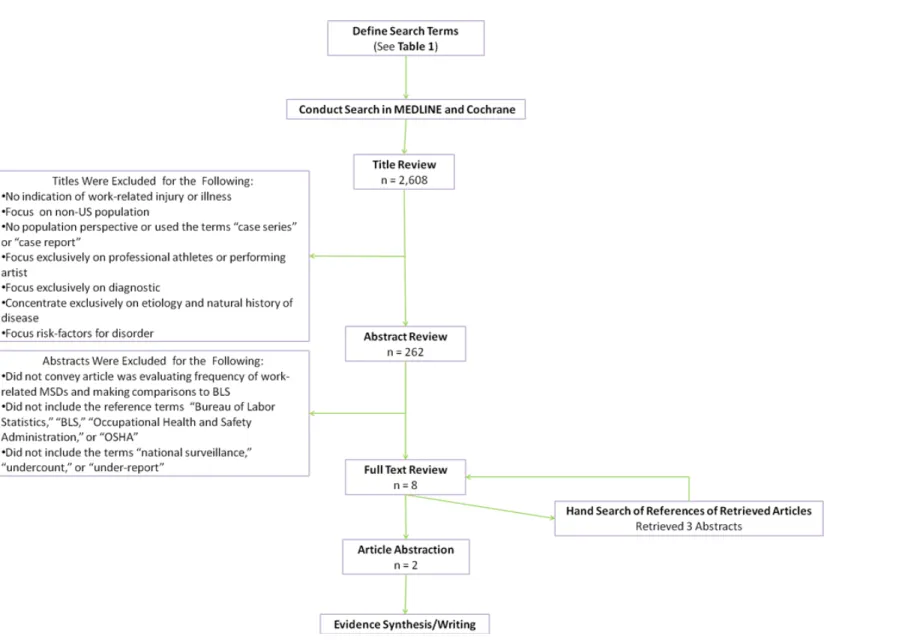
A flow diagram of our search and identification of articles is presented in Figure 1. The literature search of MEDLINE database using the defined terms retrieved 2,584 titles. A review
of the titles yielded 262 abstracts for review. Five articles were retrieved for full text review. A
hand search of the references of the full-text reviewed articles produced an additional three titles
that also underwent full-text review. The search of the Cochrane database using the defined
terms retrieved 24 titles (3 Cochrane Reviews, 1 Other Review, 14 Articles, and 6 Economic
Evaluations). After a title review, all of the articles from the Cochrane database were excluded.
After full-text review of the 8 articles identified through our search of the MEDLINE and
Cochrane databases and hand search of references, we excluded 6 articles for reasons outlined
Excluded Articles that Underwent Full Text Review (n=6)
In this section, we briefly describe the 6 articles that underwent full-text review and our
rationale for excluding them from this review.
In 2001, Morse et al. reported on the use capture-recapture analysis to estimate the true
incidence of work-related MSDs of the upper extremity (Morse, Dillon et al. 2001). Their
population of interest was all workers in the state of Connecticut in the year 1995. They used
Connecticut State workers’ compensation insurance data and State of Connecticut Physician
Occupational Disease Surveillance System (ODSS) data to carry out their analysis. Though they
used two datasets to estimate the true frequency of work-related MSDs of the upper extremity,
Morse et al. did not make comparisons to BLS data. As such, we did not include the report in
this systematic review.
A cross-sectional survey of 1,598 Michigan workers diagnosed with neck, upper
extremity, and low back work-related musculoskeletal disease was conducted from April to June
1996 (Rosenman, Gardiner et al. 2000). These workers were identified from their previous study
of occupational disorders among of 30,000 Michigan workers (Biddle, Roberts et al. 1998). The
research team identified demographic characteristics of the 1,598 Michigan workers as well as
elucidated their reasons for not reporting to workers’ compensation through telephone interview.
However, no frequency statistics were calculated, nor were comparisons to BLS data made. For
these reasons, the article was excluded.
For the year 1999, Leigh et al. created regression models to estimate the undercounting of
non-fatal work-related injuries and illnesses by BLS (Leigh, Marcin et al. 2004). They
calculated risks from the pooling of previous studies and used the results of the 1999 BLS SOII.
not stratify by type of injury or illness. Overall, they reported that BLS missed a substantial
fraction of non-fatal occupational injuries, with estimates that BLS missed 33-69% of all
work-related injuries in the US working population. Yet, since this estimate was not stratified by type
of injury or illness, we could not extrapolate the degree of under-reporting for work-related
MSDs specifically; consequently, this article was excluded from our systematic review.
Work-related MSDs of the wrist and hand were studied in workers in 5 automotive plants
from the years 1984 to 1987 (Nelson, Park et al. 1992). Incidence rates of cumulative trauma
disorders of the hand and wrist were estimated from the workers’ health insurance claims data
and were compared to incidence rates of the OSHA logs maintained at each facility during the
period of interest. Because health insurance claims were not necessarily work-related, only the
first available claims of specified International Statistical Classification of Diseases and Related
Health Problems (ICD-9) codes were considered cases to approximate work-relatedness. Prior
research has determined the attributable fractions of work-relatedness of private medical
insurance claims is reliable for the determination of work-related MSDs of the upper extremities
(Park, Nelson et al. 1992). Work-related MSDs of the hand and wrist had incidence rates of 2.8
and 7.2 per 1,000 person years for OSHA logs and health insurance data, respectively. Despite
these results, because the comparison was made to company-specific OSHA logs instead of BLS
data, this article was excluded from our analysis.
Silverstein et al. examined a combination of pre-existing, administrative, and newly
acquired surveillance sources in 8 departments at 4 U.S. automotive plants for the years
1986-1989 to assess prevalence, incidence, and risk factors associated with upper extremity MSDs
among the workers (Silverstein, Stetson et al. 1997). They found that from the years 1986-1988,
work-related MSDs as determined by self-reported medical treatment for work-related injuries.
Because comparisons were made against employer-specific OSHA logs, this article has
relevance to our question but was excluded from our review.
In a case study of 110 packers at a manufacturing plant that produced a variety of
children’s products, Pransky et al. compared the number of cases of work-related MSDs they
determined among packers to the number recorded on the OSHA log (Pransky, Snyder et al.
1999). They found that the OSHA logs captured only 5% of the cases they detected through a
modified version of the musculoskeletal symptoms questionnaire developed by the National
Institute of Occupational Safety and Health (NIOSH). However, like the Nelson et al. and
Silverstein et al. studies, this study was excluded from the analysis because it made comparisons
to company-specific OSHA logs.
Included Articles
The article abstractions of the two articles identified for inclusion in this systematic
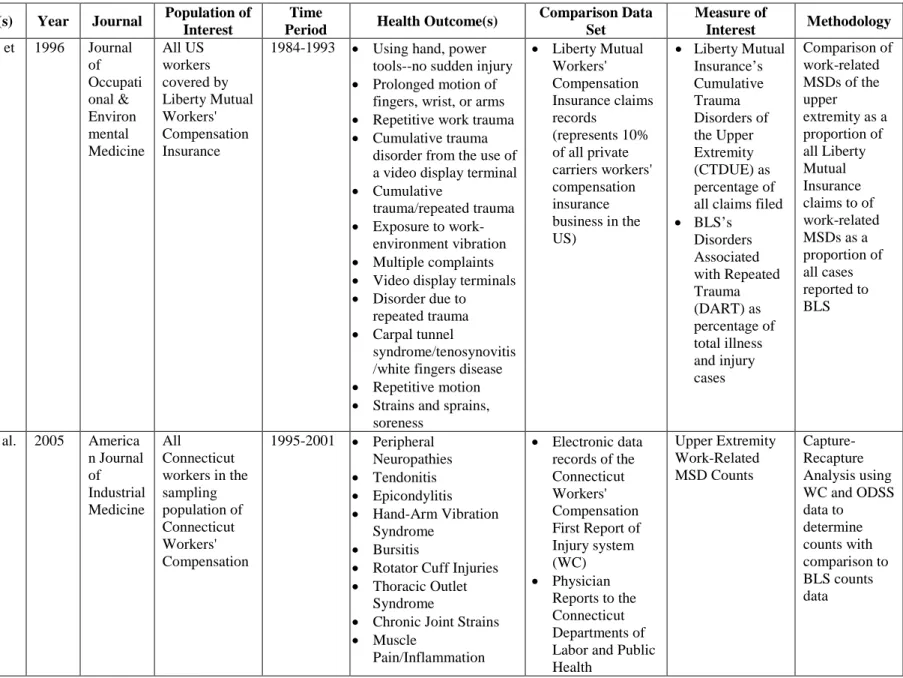
review are presented in Table 2.
In accomplishing their primary objective of analyzing the increasing trends of cumulative
trauma disorders of the upper extremities (CTDUE), Brogmus et al. compared data on CTDUEs
from Liberty Mutual Group Insurances workers’ compensation claims to BLS data for the years
1984-1993 (Brogmus, Sorock et al. 1996). In their article, they asserted that Liberty Mutual
Insurance was the largest writer of workers’ compensation insurance in the United States since
1936 and insured approximately 10% of the private-carriers workers’ compensation insurance
business in the United States during the period of observation (Brogmus, Sorock et al. 1996).
Cases in the Liberty Mutual Insurances claims data set were defined based on criteria presented
Using workers’ compensation data alone it is not possible to identify the population at
risk. As work-hour data were not available for all companies insured by Liberty Mutual
Insurance, Brogmus et al. were unable to calculate incidence rates to make comparisons to BLS
incidence rates. Instead, they assessed CTDUEs as a proportion of all claims submitted to
Liberty Mutual Insurance and made comparisons to Disorders Associated with Repeated Trauma
(DART) as a proportion of all injury and illness cases reported to BLS. For the years,
1984-1993, they found that DARTs as percentage of all injury and illness cases reported to the BLS
were consistently higher than CTDUEs as a proportion of all claims submitted to Liberty Mutual
Insurance. For both datasets, the proportion of work-related injuries of all claims/cases increased
substantially over the period of interest. BLS’s DARTs as percentage of all injuries and illness
rose from approximately 0.6% in 1984 to 4.5% in 1993; Liberty Mutual Insurance’s CTDUEs as
a proportion of all claims rose from approximately 0.45% in 1984 to 3.4% in 1993.
There are important issues to consider in evaluating the results of this study. Despite the
fact that the Brogmus et al. study was not limited to a geographic region within the US, their
failure to define their population at risk limits the application of their results. Because the
population at risk was not defined, we cannot evaluate if the companies insured by Liberty
Mutual Insurance over the observed time period were representative of US industry overall. One
would expect that workers’ compensation insurers are incentivized to seek contracts from
companies whose workers are at the lowest risk of occupational injury and illness. Because
Liberty Mutual Insurance has remained profitable over a long duration, we might assume that
workers insured by Liberty Mutual Insurance were at lower risk of work-related injury and
CTDUEs by Liberty Mutual may be lower than proportion of all work-related injuries and illness
due to CTDUEs for the general workforce.
Since the Liberty Mutual claims dataset was based on workers’ compensation claims, it
was subject to the same forces, such as burden of clinical findings required for a claim to be filed
and workers’ concern of reprisal for reporting, that characterize the accuracy of workers’
compensation claims in determining the frequency of work-related injury and illness. It has been
widely demonstrated that workers’ compensation claims are not an accurate characterization of
work-related injury and illness (Rosenman, Gardiner et al. 2000; Shannon and Lowe 2002).
Another consideration in evaluating the results of this study is that the Liberty Mutual
Insurance claims dataset only captured work-related MSDs of the upper extremity, while the
BLS repeated trauma disorder data captured work-related MSDs of the upper extremity and other
areas of the body, including the back. Because the Liberty Mutual Insurance claims dataset had
a narrower definition than the BLS dataset, naturally, fewer claims would be counted, and
CTDUEs as a percentage of all claims filed would be smaller than DARTs as a percentage of all
illnesses and injuries for BLS. We might expect the higher proportions in BLS may partially
reflect the narrower definition of work-related MSDs by Liberty Mutual Insurance.
In the second abstracted manuscript, Morse et al. estimated annual true counts of
work-related upper extremity MSDs using capture-recapture methods (Morse, Dillon et al. 2005).
They used the electronic data records of the Connecticut Workers’ Compensation (WC) First
Report of Injury system and physicians’ reports to the Connecticut Departments of Labor and
Public Health Occupational Disease Surveillance System (ODSS) as the source surveillance
systems to derive estimates for the counts of work-related upper extremity MSDs. They then
2001. Their results are summarized in Figure 2, where we present a graph of work-related upper extremity MSD counts obtained from WC, ODSS, and BLS as well as the estimates of the true
number of work-related MSDs derived from capture-recapture analysis. From this figure, it is
evident that the BLS substantially undercounted the number of upper extremity work-related
MSDs in the state of Connecticut.
Capture-recapture analysis is predicated on the assumptions that the population of interest
is closed and homogenous and that the likelihood of a case being captured by one surveillance
system is unaffected by its likelihood of being captured in another surveillance system (Hook
and Regal 1995). Morse et al. confirmed that the population of Connecticut workers was closed
and homogenous. However, they could not ascertain the correlation between the WC and ODSS
surveillance systems. A positive correlation between the two surveillance systems would
overestimate the number of cases, while a negative correlation between the two surveillance
systems would underestimate the number of cases. Morse et al. conducted a sensitivity analysis
to make comparisons to BLS data. They used the lower bound of 95% confidence intervals of
the total number of upper extremity work-related MSDs in Connecticut workers as estimated by
capture-recapture analysis. Even when comparing to conservative estimates derived from the
sensitivity analysis, BLS data still undercounted the number of upper extremity work-related
MSDs among Connecticut workers during the period of observation.
Because of the different reporting requirements of the WC, ODSS, and BLS surveillance
systems, we must consider the differential legal requirements of the respective surveillance
systems as a confounder in the interpretation of this study’s results (Oleinick and Zaidman
2010). Differences in the legal reporting requirements between the ODSS and WC surveillance
which reduces the validity of capture-recapture analysis. Furthermore, differences in legal
reporting requirements between ODSS and BLS and WC and BLS limit the reliability of
comparisons between the capture-recapture results and BLS data. If reporting requirements
cause one surveillance system to define an event as reportable while the other surveillance
system defines the same event as non-reportable, then it is difficult to compare the number of
events captured by each system given the inherent differences in the definition of events.
The Morse et al. study demonstrated that not only BLS, but ODSS and WC as well,
considerably undercounted the number of upper extremity work-related MSDs that occurred in
Connecticut workers of the period of interest. These results were in agreement with our
hypothesis that BLS undercounts work-related MSDs. Despite that the defined population of
interest geographically limited to all workers within Connecticut, cases of work-related MSDs
captured came from a variety workers. Though both datasets used for the capture-recapture
analysis had the inherent vulnerabilities associated with workers’ compensation data (Rosenman,
Gardiner et al. 2000) and physician reporting data (Baker, Melius et al. 1988), the use of both
datasets and the rigor of the statistical methods provided good internal validity to the study.
Overall, the Morse et al. study was a strong study that demonstrated that WC, ODSS, and BLS
data all undercounted the true counts of upper-extremity work-related MSDs.
Discussion
This systematic review sought to answer the question: “Does the BLS accurately capture
work-related MSDs?” We expected evidence that BLS would undercount work-related MSDs.
This expectation was based on the qualities of work-related MSDs that make it difficult to
establish them as, in fact, work related (Blessman 1991) as well as prior reports that document
Azaroff, Levenstein et al. 2002; Azaroff, Lax et al. 2004; Leigh, Marcin et al. 2004; Rosenman,
Kalush et al. 2006; Welch, Dong et al. 2007; Boden and Ozonoff 2008; Dong, Fujimoto et al.
2011). In addition to establishing the occupational nature of work-related MSDs, in some
workplaces, workers are disincentivized from reporting even overt cases by stigmatization and
other filters, which contributes to the phenomenon of under-reporting (Pransky, Snyder et al.
1999; Dembe 2001; Azaroff, Levenstein et al. 2002).
We must consider if the results of these studies merit equal weight in drawing
conclusions. The two manuscripts we reviewed presented somewhat different conclusions. The
characterization of the comparison datasets and statistical methods in the Morse et al. study was
superior to the characterization of the Liberty Mutual Insurance workers’ compensation claims
dataset by Brogmus et al. Though count data typically is not as informative as rate data, for the
purpose of capture-recapture analysis, as conducted by Morse et al., count data is a robust
measure (Papoz, Balkau et al. 1996) that can be used to compare datasets. On the other hand,
proportion data without a defined population of interest, like those used for comparisons to BLS
by Brogmus et al., is less reliable and influenced by changes in other claims.
Limitations
This review was subject to a number of limitations. First, it was limited by human
resources. In identifying the articles for this systematic review, we would have preferred to read
through every abstract that was retrieved in our initial search, rather than perform a title review.
However, we did not have adequate human resources available to accomplish this task. We
realize that not all occupational health literature is indexed in MEDLINE and Cochrane
databases. We chose not to attempt to perform searches of non-indexed, individual journals,
conduct a search of relevant gray literature, which may have contained studies relevant to our
question.
Our search criteria were very specific; we did not include articles that could have been
used to infer deficiencies in BLS reporting if they did not specifically seek to make such a
comparison. Since we limited our health outcome terms to the MeSH terms defined in Table 1, we failed to identify titles for review that assessed work-related MSDs that did not explicitly use
our specified terms. For example we did not include a study that assessed incidence of
overexertion back injuries in a cohort of Washington State carpenters and concluded the BLS
underestimated the risks of construction workers (Lipscomb, Cameron et al. 2008).
Additionally, we excluded abstracts that did not contain the terms, “national surveillance,”
“undercount,” or “under-report,” and failed to identify relevant articles that may have included
other terms describing BLS’s surveillance efforts, such as “underestimation.” As we excluded
studies that made comparisons to employer-specific OSHA logs, articles such as the Nelson et al.
and Silverstein et al., whose meaningful results would likely contribute to our understanding
BLS’s undercount of work-related MSDs were not used in the formulation of our conclusions.
Conclusions and Implications for Future Research
The results of the two included studies are limited and cannot fully characterize the
actuality of BLS reporting of MSDs. There are numerous reports that describe that work-related
injury and illness rates higher than BLS reports (Azaroff, Levenstein et al. 2002; Azaroff, Lax et
al. 2004; Leigh, Marcin et al. 2004; Rosenman, Kalush et al. 2006; Welch, Dong et al. 2007;
Boden and Ozonoff 2008) but there is a limited literature that specifically seeks to quantify
underreporting of work-related musculoskeletal disorders. This leaves a void in our
From this review, we did not identify variations in BLS undercounting of work-related
MSDs by occupation, race, ethnicity, gender, and other demographics. Evidence suggests that
the risk of occupational injury and illness among workers is related to these demographic factors
(Loomis and Richardson 1998; Lipscomb, Li et al. 2003; Dong, Ringen et al. 2007; Menéndez
and Havea 2010). Furthermore, work-related injuries and illnesses may contribute to health
disparities, such as access to health care and life lost years, in our society (Lipscomb, Loomis et
al. 2006). Given the inherent difficulty of attributing work-related MSDs as occupational in
nature and the differential risks of work-related injury and illness among workers, work-related
MSDs may compound the effect of work on health disparities. Thus, future research may entail
better characterizing the burden of work-related MSDs among minority populations through
sub-group analyses and comparisons to sub-sub-group stratified BLS data.
As policy decisions for the treatment and prevention of work-related MSDs rely on
epidemiologic evidence, such as that compiled by the BLS, the accuracy of BLS data has far
reaching implications. Continued assessments of the accuracy of BLS may better characterize its
shortcomings. Addressing these identified deficiencies might possibly lead to the improved
quantification of the burden of work-related MSDs and the differential risk it poses to
Tables and Figures
Table 1: MEDLINE and Cochrane Search Terms
Work Setting Terms Work Site, Workplace, Work Environment, Occupational Injury,
Occupational Disorder, Work-Related Health Outcome MeSH
Terms*
Sprains and Strains, Nerve Compression Syndromes, Hand Arm Vibration Syndrome, Tendinopathy, Tennis Elbow, Bursitis, Sciatica, Osteoarthritis
Table 2: Article Extraction
Author(s) Year Journal Population of Interest
Time
Period Health Outcome(s)
Comparison Data Set
Measure of
Interest Methodology
Brogmus et al.
1996 Journal
of Occupati onal & Environ mental Medicine All US workers covered by Liberty Mutual Workers' Compensation Insurance
1984-1993 • Using hand, power
tools--no sudden injury
• Prolonged motion of fingers, wrist, or arms
• Repetitive work trauma
• Cumulative trauma disorder from the use of a video display terminal
• Cumulative
trauma/repeated trauma
• Exposure to work-environment vibration
• Multiple complaints
• Video display terminals
• Disorder due to repeated trauma
• Carpal tunnel
syndrome/tenosynovitis /white fingers disease
• Repetitive motion
• Strains and sprains, soreness
• Liberty Mutual Workers' Compensation Insurance claims records
(represents 10% of all private carriers workers' compensation insurance business in the US)
• Liberty Mutual Insurance’s Cumulative Trauma Disorders of the Upper Extremity (CTDUE) as percentage of all claims filed
• BLS’s Disorders Associated with Repeated Trauma (DART) as percentage of total illness and injury cases Comparison of work-related MSDs of the upper extremity as a proportion of all Liberty Mutual Insurance claims to of work-related MSDs as a proportion of all cases reported to BLS
Morse et al. 2005 America
n Journal of Industrial Medicine All Connecticut workers in the sampling population of Connecticut Workers' Compensation
1995-2001 • Peripheral
Neuropathies
• Tendonitis
• Epicondylitis
• Hand-Arm Vibration
Syndrome
• Bursitis
• Rotator Cuff Injuries
• Thoracic Outlet Syndrome
• Chronic Joint Strains
• Muscle
Pain/Inflammation
• Electronic data records of the Connecticut Workers' Compensation First Report of Injury system (WC)
Figure 2: Morse et al. Work-Related Musculoskeletal Diseases of the Upper Extremity Counts by Year in Connecticut Workers as Determined by Connecticut Occupational Disease
Surveillance System (ODSS) Data, Workers’ Compensation First Report of Injury System (WC) Data, Bureau of Labor Statistics (BLS) Data for Connecticut, and Capture-Recapture Analysis
20-Year Trends in Reported Work-Related Injury and Illness among Union Carpenters in Washington State
Introduction
The burden of work-related injury and illness in the United States is great (Leigh,
Markowitz et al. 1997). In 1992, the direct and indirect costs associated with occupational injury
and illness were estimated to rival those of circulatory diseases, cancer, and musculoskeletal
conditions (Leigh, Markowitz et al. 1997). Along with the societal costs, the individual costs of
work-related injury and illness are considerable (Morse, Dillon et al. 1998; Dembe 2001;
Lipscomb, Dement et al. 2009). Because construction workers are at higher risk of work-related
fatality, injury, and illness than other working populations, they bear a disproportionate burden
of work-related injury and illness (US Department of Labor, Bureau of Labor Statistics 2010).
Bureau of Labor Statistics (BLS) data and workers’ compensation (WC) records are the
primary sources of information on work-related injury and illness in the United States. BLS data
on non-fatal injuries and illnesses are based on a probability sample of employers’ Occupational
Safety and Health Administration (OSHA) logs. National estimates generated from these
sampled data are presented each year in the BLS Annual Survey of Occupational Injury and
Illness (SOII). The SOII does not include workers of federal, state, and local government
agencies, household workers, the self-employed, and workers of employers with fewer than 11
employees (US Department of Labor, Occupational Safety & Health Administration 2001).
These exclusions translate to BLS’s failure to survey approximately 25% of the construction
labor force (Dong, Fujimoto et al. 2011).
OSHA does not require employers to record cases that only involve “minor” injuries or
time away from work beyond the day of injury, work restrictions or transfer to another job, or
medical treatment beyond first aid (US Department of Labor, Occupational Safety & Health
Administration 2001). Though some champion that the declines in work-related injury and
illness reflected in the SOII demonstrate the positive effects of surveillance, targeted
enforcement, and prevention methods, others challenge that these achievements have been
over-emphasized (Azaroff, Levenstein et al. 2002; Azaroff, Lax et al. 2004; Leigh, Marcin et al. 2004;
Rosenman, Kalush et al. 2006). There is growing evidence that BLS data significantly
underestimates risks to workers in the US (Azaroff, Levenstein et al. 2002; Leigh, Marcin et al.
2004; Rosenman, Kalush et al. 2006; Boden and Ozonoff 2008). Given the design, even a
perfectly conducted SOII with complete compliance of workers and employers in reporting
injuries would fail to capture a substantial number of work-related injuries and illnesses in the
US population.
Leigh et al. estimated that the BLS Annual Survey missed between 33% and 69% of all
nonfatal work-related injuries occurring in 1999 (Leigh, Marcin et al. 2004). Furthermore, there
are concerns about whether the reported declines in non-fatal work-related injury rates are in fact
indicative of improved safety, rather than a decline in the efficacy of documentation (Welch,
Dong et al. 2007). Under-reporting to BLS is attributed to a combination of factors: willful
neglect on the part of employers, as well as recent economic, legal, and political changes that
hinder the documentation of work-related injury and illness to US surveillance entities (Pollack
and Keimig 1987; Azaroff, Lax et al. 2004; Friedman and Forst 2007). The failure of BLS to
accurately capture occupational injuries and illnesses is a particular problem among construction
workers (Glazner, Borgerding et al. 1998; Welch and Hunting 2003; Welch, Dong et al. 2007;
their occupational injuries and illnesses and makes assessment of the effectiveness of prevention
efforts difficult to establish.
We evaluated temporal trends in injury and illness incidence rates among a large,
retrospective cohort of union carpenters in Washington State over a 20-year period using
work-related injury data provided by the State of Washington Department of Labor and Industries
(L&I) and employment records maintained by the Carpenters’ Trust of Western Washington
(CTWW). Previous reports (Lipscomb, Kalat et al. 1996; Lipscomb, Cameron et al. 2008) have
documented that these carpenters have higher injury rates than those reported by BLS for the
construction industry. Our objective was to describe trends in reported work-related injuries and
illnesses among this cohort, to identify high risk groups within the cohort, and to compare the
absolute and relative measures of risk among carpenters in the cohort to those reported through
BLS overtime.
Materials and Methods
Data Sources
Using data from the Carpenters Trusts of Western Washington (CTWW) and the
Washington State Department of Labor and Industries (L&I), the state agency that administers
the state-wide workers’ compensation program, we identified a cohort of union carpenters who
worked in the State of Washington between the years 1989 and 2008 and their reported workers’
compensation (WC) claims. Data were provided with a blinded, unique carpenter identification
number, such that we were able to merge records on an individual basis; these methods have
been previously described in detail (Lipscomb, Dement et al. 1997; Lipscomb, Dement et al.
2000; Lipscomb, Li et al. 2003). For each carpenter in the dataset provided by CTWW, we were
activity, and hours of union work recorded for each month. We limited our cohort to include
individuals who worked at least 3 months of union hours during this 20-year period.
The WC data included the unique carpenter identification number, date of injury, cost of
medical care received, if the injury involved paid lost time (PLT) (which occurs after the 3rd lost
day in Washington), and codes describing the nature of injury, the body part affected by injury,
the source of injury (brick, drywall, etc.), and the event or exposure causing the injury.
American National Standards Institute (ANSI) codes were used to code claims prior to 2003 and
Occupational Injury and Illness Classification System (OIICS) codes were used in later years.
Employers that self-insure for WC in the state of Washington are only required to report claims
to L&I if those claims result in PLT from work. Privately insured employers are not required to
report claims that do not involve PLT to L&I. Otherwise, we received all reported WC claims
for the period of interest. The data received from L&I and CTWW did not indicate the size of
the employer of if the employer was self-insured.
These union carpenters perform a wide variety of construction industry tasks, including
drywall installation, residential building, roadway and bridge construction, pile-driving, and light
and heavy commercial building, including high-rise construction. Because of the varied nature
of work performed by the union carpenters, we compared injury rates of the cohort to those of
the overall construction industry. We were provided BLS incidence rates of all recorded injuries
and illnesses and all time lost cases (cases in which time off extends beyond the day of injury)
for the construction industry for the years 1992-2008 by The Center for Construction Research
and Training, formerly known as The Center to Protect Workers’ Rights (CPWR). CPWR also
industry injury mechanism groupings: “Struck by object, “Fall to a lower level,” and
“Overexertion with lifting.”
Definition of Time at Risk
For this analysis, hours worked each month were the measure of time at risk. Each
carpenter was considered to be at risk of a work-related event in any month in which they
worked union hours. One full-time equivalent (FTE) was defined as an individual working full
time for one year; this assumes a 40-hour work week and 2 weeks of vacation per year, which
amounts to 2,000 hours.
Definition of Events
We only counted WC claims that occurred during months in which the individual worked
union hours to define events and time at risk on the same basis. Injury events were then limited
to those that approximated the OSHA reporting criteria. For the purpose of our analysis, we
considered claims that had medical costs or resulted in PLT to be OSHA-recordable. As we did
not have data available that documented associated loss of consciousness, work restriction, or
transfer to another job, we were unable to use these definitions as qualifiers in identifying
OSHA-recordable events.
Classification of Injury Mechanisms
After identifying the OSHA-recordable claims, we further stratified the claims involving
PLT into the injury mechanism groupings of “Struck by object,” “Fall to a lower level,” and
“Overexertion with lifting” for comparison to the BLS estimates for the construction industry
provided by CPWR. The associated ANSI and OIIICS codes for these injury mechanism
Statistical Analysis
We calculated the age of each carpenter upon first entry into the cohort and the
mean/median age of the cohort by year to allow comparisons to age distribution of the US
construction industry (The Center for Construction Research and Training 2007). Duration of
time observed in the cohort was calculated for each carpenter and was used to derive average
time observed in the cohort overall, by year, and by gender.
To assess the risk of sub-populations within the cohort, we conducted Poisson regression
analysis. We treated age and time in the union as time-varying variables. Poisson regression
was used to calculate crude incidence rates, crude rate ratios, and adjusted rate ratios for all
claims, OSHA-recordable claims, claims involving PLT, and claims involving PLT stratified by
injury mechanism groupings using the following variables: age (categorical), gender, time in
union (categorical), year (categorical), and indicator variable for injury classification system.
This regression technique is particularly useful in the analysis of longitudinal data for a dynamic
cohort, such as this one, by allowing maximal use of all data available for each individual
regardless of their observation time. The incidence rates for all claims and OSHA-recordable
claims were expressed per 200,000 hours worked, equivalent to the BLS metric of 100 full time
equivalents (FTE). For the claims involving PLT, the incidence rates were per 20,000,000 hours
worked (10,000 FTEs), the metric used by BLS to report incidence rates for work-related injuries
and illnesses involving lost time.
We assessed temporal trends of incidence rates for the cohort data and BLS data by
comparing absolute and relative risk measures over time. All statistical analyseswere generated
Institutional Review Board Approval
This research was approved by the Institutional Review Boards of Duke University
Medical Center, the University of North Carolina at Chapel Hill Gillings School of Public
Health, and the Washington State Department of Health and Human Services.
Results
The Cohort
A total of 26,591 carpenters who worked at least 3 months (consecutive or
non-consecutive) of union hours in the State of Washington between 1989 and 2008 were identified.
Overall, the average time of observation in the cohort was 63.2 months (standard deviation =
73.12 months, median = 27 months). For males, the average time observed in the cohort was
66.1 months (standard deviation = 74.08 months, median = 29 months). Females were observed
in the cohort for an average of 45.6 months (standard deviation = 53.61 months, median = 21.5
months). Over the 20-year period, the carpenters in the cohort worked for a total of 192,371,021
hours.
Overall, the proportion of females was 2.6%, ranging from 1.6 to 2.4% over time. The
proportion of female workers across years was similar to statistics published by BLS for the
construction industry (The Center for Construction Research and Training 2007). Carpenters
entered the cohort at a mean age of 29.4 years (median = 28.0). As time proceeded, the average
age of the carpenters increased. The average age started at 38.3 years in 1989, peaked at 44.9
years in 2005, and declined to 42.0 years in 2008. Compared to the BLS’s average age of
workers in the construction industry for the years 1985 to 2005, the average age of carpenters in
2007). A comparison of the average age of the cohort to BLS’s average age for workers in the
construction industry by year is provided in Figure 1. Claims Reported by the Cohort
A total of 27,551 claims were reported by the union carpenters over the period of interest.
The incidence rate for all claims reported by the cohort over the 20-year period was 28.6 (95%
CI: 28.3-29.0) claims per 100 FTEs. The peak incidence rate for all claims was 44.9 (95% CI:
42.9-46.9) per 100 FTEs in 1991. The lowest incidence rate occurred in 2008 with an incidence
rate of 15.9 (95% CI: 15.0-16.8) per 100 FTEs. Adjusting for age, gender, union tenure, and
injury classification system, we observed a relative reduction in the reporting of all claims of
52.4% (95% CI: 47.1-57.3%) over the 20-year period.
Out of the 27,551 claims that were reported by the union carpenters in the cohort, 23,766
(86.3%) were considered to be OSHA-recordable. Twenty-four percent of the OSHA-recordable
claims (n = 5,701) involved PLT. We observed a decline in both OSHA-recordable claims as a
proportion of all claims and claims involving PLT as a proportion of OSHA-recordable claims
by year (Figures 2A and 2B). There were a total of 842 “Overexertion with lifting” claims involving PLT, 679 “Struck by object” claims involving PLT, and 577 “Fall to a lower level”
claims involving PLT.
The distribution of time at risk, claim counts, crude incidence rates, and adjusted rate
ratios with 95% confidence intervals by age category, gender, union tenure category, and year
for OSHA-recordable claims and claims involving PLT are presented in Table 2. For OSHA-recordable claims, younger age, female gender, and less union tenure were associated with
significantly associated with increased reporting; the adjusted risk ratio of females compared to
males was 1.45 (95% CI: 1.22-1.72).
Women and individuals aged 20-30 years old had higher rates of “Struck by object”
claims that involved PLT with adjusted rate ratios of 1.51 (95% CI: 1.07, 2.12) when compared
to males and 1.45 (95% CI: 1.19, 1.77) when compared to individuals ≥ 50 years old,
respectively (Table 3). For “Fall to a lower level” claims involving PLT, gender was the only variable significantly associated with reporting; females were less likely to report claims than
males (adjusted risk ratio = 0.30, 95% CI: 0.13-0.69). Only individuals aged 30-40
demonstrated increased rates of reporting “Overexertion with lifting” claims that involved PLT.
When stratifying the incidence rates by age, we observed age to influence the temporal
trends in incidence rates for all claim categories in the early years of the observation period. The
most pronounced effect of age on the temporal trends of incidence rates was for
OSHA-recordable claims and claims involving PLT; we present the temporal trends of the age-stratified
data in Figures 3A and 3B. Age appeared to influence reporting of both OSHA-recordable and claims involving PLT in earlier years with younger workers reporting at higher rates. The
influence of age on reporting appeared to decline as time proceeded; the age-stratified incidence
rates for both OSHA-recordable claims and claims involving PLT converged at the end of the
period of observation.
Similar to the temporal trends observed for the total claims incidence rates, declines were
observed for OSHA recordable claims and claims involving PLT, including those involving the
more common injury mechanisms (Table 3). The largest decline was observed for “Fall to a lower level” claims involving PLT. A high of 135.8 “Fall to a lower level” claims involving
2008. This translated to an adjusted relative reduction of 93.1% (95% CI: 86.2-96.5%) from
1990 to 2008. “Struck by object” claims involving PLT declined from an observed high of 178.8
events per 10,000 FTEs in 1991 to 18.6 events per 10,000 FTEs in 2008, an adjusted relative
reduction of 88.2% (95% CI: 81.5-92.4%). An adjusted relative reduction of 82.5% (95% CI:
58.4-92.8%), a decline from a high of 198.6 events per 10,000 FTEs in 1990 to a low of 23.7
events per 10,000 FTEs in 2007 was observed for “Overexertion with lifting claims” involving
PLT.
We assessed the effect of changing injury classification systems in 2003 by evaluating
the adjusted rate ratios of the injury classification indicator variable for each category of claims.
After adjusting for age, gender, union tenure, and year, the rate ratio for claims coded using the
ANSI system (before 2003) compared to claims coded using the OIICS system (2003 and after)
was 1.00.
Comparisons to BLS Estimates
The cohort’s OSHA-recordable claims incidence rates with 95% confidence intervals are
compared to the BLS’s point estimates (standard errors were not available) for all injury and
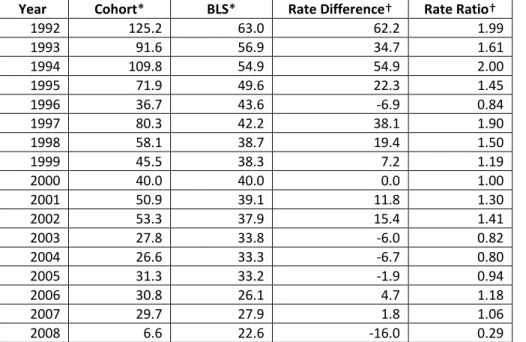
illness cases by year in Figure 4. The cohort’s OSHA-recordable claims incidence rates were consistently higher than BLS estimates for workers in the construction industry. The
discrepancy between cohort incidence rates for OSHA-recordable claims and all injuries and
illnesses rates from BLS data was large and decreased throughout the years. In 1992, the
absolute difference between the cohort’s OSHA-recordable claims incidence rate and the BLS
The comparison between the cohort’s incidence rates for claims involving PLT and BLS
incidence rates for lost time cases for the construction industry demonstrated a trend similar to
that of all OSHA-recordable injuries and illnesses. We present the comparisons by year in Table 5. As time proceeded the absolute discrepancy in the incidence rates of the cohort for claims involving PLT and BLS data for lost time cases diminished (Figure 5). We present the cohort’s incidence rates for claims involving PLT by the “Struck by object,” “Fall to lower level,” and
“Overexertion with lifting” injury mechanism groupings with their counterpart BLS point
estimates in Figures 6A, 6B, and 6C, respectively. Absolute and relative comparisons of the cohort data to BLS data by injury mechanism groupings are presented in Tables 6, 7, and 8. In earlier years, the cohort’s incidence rates were higher than BLS rates for “Struck by object” and
“Fall to a lower level” injuries. However, in later years, BLS incidence rates surpassed those of
the cohort’s. For “Overexertion with lifting” injuries, the cohort’s incidence rates were
consistently higher than BLS rates.
Discussion
We had the opportunity to study a large dynamic, retrospective cohort of 26,591
carpenters and their workers’ compensation claims over a 20-year period to analyze the trends of
their work-related injury and illness through the combination of two administrative datasets.
Their injury rates were then compared to BLS SOII data for construction industry for the years
1992-2008.
After adjusting for age, union tenure, and year, women had higher rates of reporting for
all claim categories with the exception of “Fall to a lower level” claims involving PLT (women
were found to have lower rates of reporting). After adjusting for the other covariates, age was
were rates for OSHA-recordable claims, “Struck by object” claims involving PLT, and
“Overexertion with lifting” claims involving PLT. Workers with the least union tenure reported
more claims overall and more OSHA-recordable claims.
Incidence rates in all categories of claims declined among the union carpenters and in the
BLS SOII data. The absolute discrepancy between the incidence rates of the cohort and BLS
data diminished substantially overtime, while the relative differences, as measured by incidence
rate ratios, demonstrated a more moderate decline. Temporal trends of incidence rates for claims
involving PLT and BLS lost time cases nearly converged in the later years of observation with
the exception of “Overexertion with lifting” claims involving lost time, for which BLS was
consistently lower. The increased severity of PLT claims among the cohort and BLS lost time
cases likely translated to improved sensitivity of detection by both L&I and BLS. This likely
amounted to a better correspondence between the cohort’s PLT claims incidence rates and BLS
lost time cases incidence rates as we demonstrated in our results.
We expected our results to correspond with prior research suggesting that BLS
undercounts work-related injury and illness in all working populations (Azaroff, Lax et al. 2004;
Leigh, Marcin et al. 2004; Morse, Dillon et al. 2005; Rosenman, Kalush et al. 2006; Boden and
Ozonoff 2008) and in construction workers, specifically (Welch, Dong et al. 2007). Our findings
are consistent with the literature that suggests BLS undercounts work-related injuries and
illnesses in construction workers as well as supports prior research that demonstrates younger
workers, workers with less union tenure, and female workers are associated with increased
reporting of work-related injuries and illnesses in the construction industry.
Oregon lies in close geographic proximity to Washington with many workers traversing
the Washington union carpenters to be similar to those calculated for Oregon construction
workers. We found that the overall claims incidence rate for the Washington union carpenters
cohort over the 20-year period was 28.6 per 100 FTEs, far higher than the workers’
compensation claims incidence rate of 3.5 per 100 FTEs in Oregon construction workers for the
years 1990 to 1997 (Horwitz and McCall 2004). However, this discrepancy is likely attributable
to the different legal requirements of reporting to workers’ compensation between the two states
(Oleinick and Zaidman 2010) as well as different methods used to calculate exposure time.
Oregon requires the reporting of claims where work-related injury and illness is believed to have
resulted in 3 or more days of disability or permanent disability. Whereas the workers’
compensation database of Washington State captures first aid claims and claims that do not
involve time away from work. The incidence rate of claims involving PLT, a better comparison
to the Oregon construction data, for the union carpenters in Washington State was 5.3 per 100
FTEs over the 20-year period, confirming out expectation that injury rates between Washington
carpenters and Oregon construction workers would be similar.
Our results from the comparison of the cohort’s incidence rates of “Overexertion with
lifting” claims involving PLT against BLS incidence rates of “Overexertion with lifting” lost
time cases confirm the conclusions we drew from the systematic review we performed to
accompany this research. Our systematic review suggested that BLS undercounts work-related
musculoskeletal diseases (MSD) in all working populations. As “Overexertion with lifting”
injuries are musculoskeletal in nature, the absolute discrepancy between the cohort’s and BLS
incidence rates observed reaffirms the conclusions of our systematic review. It is likely that the
difficult to establish their work-relatedness and results in under-reporting to both WC and BLS
(Blessman 1991).
The observed differences in the claims reporting rates by gender may be related to
differences in health care seeking behavior between men and women. Prior research has
suggested that women are more likely to seek care for all symptoms as well as musculoskeletal
symptoms compared to men (Verbrugge 1985; Klonoff and Landrine 1992; Almeida, Trone et al.
1999). Thus, the increased reporting of claims among women may reflect their increased
predilection to seek care for a perceived event or condition. However, it is interesting that we
observed lower rates of “Fall to a lower level” claims involving PLT among women. This lower
rate of serious falls could indicate that women have lower exposure to workplace environments
in which they are at risk of falling or they may control their risk more effectively than men. This
observation warrants further investigation.
Given the declines in injury and illness incidence rates observed in both the cohort and
BLS data, we must consider the context of our findings. Beginning in the late 1980’s, major
construction owners began to pre-qualify bidders with safety and health performance as a
criterion (Welch, Dong et al. 2007). This new attention to workplace safety served as the vehicle
through which workplace safety programs and return-to-work programs gained popularity among
construction employers and oversight agencies. The introduction of these programs may have
resulted in safer workplaces accompanied by a concomitant reduction in injuries. We observed
the greatest decline in incidence rates of the cohort to occur in “Fall to a lower level” claims
involving PLT, the one injury mechanism grouping for which a safety standard was instituted
during the period of observation by Washington State, subsequently followed by Federal OSHA
incidence rates we observed in the cohort over the 20-year period might be partially explained by
improved safety in which the actual rates of injuries were reduced. This scenario, in which
improved safety climates reduced actual injury rates, may also apply to BLS statistics for
construction workers nationally.
The declines in incidence rates observed in the carpenters’ union and BLS data may not
simply represent a reduction in the actual rate of injuries and illnesses. The observed declines
may also be an artifact of policy changes that have resulted in less rigorous reporting standards
(Friedman and Forst 2007). For example, in 2002, changes in OSHA recordkeeping required
that a work-related injury or illness that was caused by the aggravation of a pre-existing
condition must be a significant aggravation, rather than just an aggravation, to be considered
OSHA-recordable. Additionally, the 2002 changes expanded the definition of work restriction
such that a worker must suffer more impairment in order for his injury or illness to be considered
OSHA-recordable. These changes did not reduce the number events that occurred; though, they
might have reduced the number of events that would be recorded on OSHA-logs, the source of
BLS data.
The housing market slowdown in 2002 might have also contributed to the reduction in
reporting observed in the cohort and construction workers nationally. The housing market
slowdown, coupled with the inherent contingent nature of construction employment, could have
substantially reduced the job security of some construction workers. With reduced job security,
construction workers might have been incentivized to not report work-related injuries and
illnesses by fear of reprisal through the reduction of hours and/or job loss (Rosenman, Gardiner
et al. 2000; Shannon and Lowe 2002; The Center for Construction Research and Training 2007).