Attachment A Title Page
Community Research Advisors As Research Partners An Analysis of Their Training
By
Adebowale Odulana
A Master's Paper submitted to the faculty of the University of North Carolina at Chapel Hill In partial fulfillment of the requirements for the degree of Master of Public Health in
the Public Health Leadership Program.
Adebowale Odulana
Introduction
Clinical research is an increasingly important aspect of medical practice resulting
in benefits believed to be most pronounced at the level of the patient. The Lay Health
Advisor model has been identified as a useful modality for medical health education in
historically difficult to access communities. At present there is a paucity of information
concerning how the Lay Health Advisor model may be used to impact clinical research in
hard to reach communities and even less information concerning the training of Lay
Health Advisors used in this capacity. This paper attempts to assess the training of Lay
Health Advisors called Community Research Advocates with pre and post questionnaires
concerning their general knowledge about the clinical research process.
Background
Historically, African Americans and ethnic minorities have been under
represented in clinical research1 This trend is largely attributed to the egregious land
mark Tuskegee Syphilis Study, where vulnerable populations of poor African American
men were exploited in the name of research2• The feelings of mistrust engendered by the
Tuskegee study are still present today and have been widely cited as a perceived barrier
to research participation within the African American community3• 4. Other prominent
barriers within the minority community are misconceptions concerning the understanding
of research, misconceptions involving informed consent and research protocol, cultural
barriers, perceived benefit, perceived risk, transportation, and time availability5' 6• 7.
In efforts to address minority under representation the 1993 National Institute of Health Revitalization Act requires that all investigators receiving funds from NIH to include minority subjects7. Although such policy has resulted in more focus on minority communities there is still much to be learned concerning the recruitment and retention of this population. Present day research has pointed to the importance of culturally sensitive and culturally competent practices and staff in recruiting African Americans into research trials5• Additionally flexibility of research practices involving proactive and reactive
recruitment has shown benefit when tailored to the needs of the African American community8. Recently, researchers have turned to community based interventions such
as the Lay Health Advisor (LHA) model to better address the health needs of the African American and minority community. The Lay Health Advisor model has been used as an intervention for several health issues such as general health education, health access, screening services, dietary habits, and smoking cessation9. Much less is known
concerning how the Lay Health Advisor model effects minority research representation. In our study Lay Health Advisors called Community Research Advisors (CRA) chosen from 5 regional churches were invited to participate in training designed to raise awareness within the minority community about research in general and research
community outreach activities conducted by the CRAs in efforts to gain a sense of CRA
activity.
The ultimate goal of our study was to positively affect research awareness within
the minority community. However before this can be tested, the training itself must be
evaluated. The training was assessed to see its effects on CRA awareness and
understanding of research methods. CRAs that are comfortable explaining research
practices and participant protections to the minority community may effect change within
minority participation in clinical research. With increased minority representation,
research studies become more generalizable and more relevant in leading the way to
pursuing interventions that are better suited to the minority community and improved
minority health outcomes.
Focused Question
This study specifically looks at Community Research Advocates that were
identified through area churches or referred from other Lay Health Advisors, and assess
the CRA training session intervention concerning CRA research knowledge by
comparing pre and post questionnaires.
Literature Search
We conducted a literature search to identify important principles of the Lay
Health Advisor model, training strategies for Lay Health Advisors, and the ways in which
Lay Health Advisors may be used in research recruitment strategies for minorities.
Selection of Sources
The Medline/Pubmed database was searched for terms "lay health advisors",
"health advisors", "minority recruitment and clinical research", and "lay health advisor evaluation".
The search terms that yielded articles used in this paper are "lay health advisor", minority recruitment and clinical research", and "lay health advisor evaluation".
Abstracts were reviewed and articles that focused on the lay health advisor model in general, lay health advisors as agents of minority recruitment in research, or the training of lay health advisors were included. Additionally bibliographies were hand searched and sources deemed to be relevant were also included.
Lay Health Advisor Model
The "lay health advisor" search produced nine articles that were used in this paper
to provide general information concerning the principles of the Lay Health Advisor [--model.
The Lay Health Advisor model is an intervention based on the role of natural helpers. Natural helpers are individuals within a community who are identified by the community as compassionate and respectful sources of advice for a variety of issues 10.
Natural helpers are members of the indigenous community11 and have a firsthand understanding of their community's sociocultural origins, cultural challenges, cultural experiences, and cultural strengths12 Natural helpers deliver advice to community members in varied circumstances but most commonly, information exchange is
spontaneous and innate so that they themselves are unaware of the leadership that they provide13. Natural helpers differ from volunteers because they are selected by the
grasp of the beliefs, attitudes, and behaviors of the community. Natural helpers are a
source of instrumental, informational, emotional, and appraisal support within the
community14 Additionally natural helpers function as educators, advocates, advisors,
counselors, and agents that increase the community political power, the community
support system, and community capacity13• 15 Natural helpers are not an extension of the
health care system or research team; rather they are an advocate for the community who
bridge the gap between the two10
The social network is the second foundation of the LHA model. The importance
of strong social ties and supportive social relationships has been integral in improving
health behaviors, physical health, and mental health9• 13. The LHA model functions to
build on the ability of individuals to assist one another through the existing social
networks9. This model is culturally sensitive and develops the existing strengths within a
community13 through social relationships and social support systems that are already
present9. Typically LHAs work on but are not limited to an individual level of change 13;
they also impact change regarding behaviors of individuals within their social networks 13
The LHA intervention model has been used successfully in several health care
settings such as providing health education, access to screening services, health
behavioral change, smoking cessation, HIV I AIDS prevention, prenatal care, general
health advocacy, infant mortality, low birth weight, hypertension, cancer, and mental
health16• 9. Much less is known concerning the LHA intervention model and minority
Lay Health Advisor Model Recruitment Strategies
The "minority recruitment and clinical research" search produced six articles that
were used in this paper to demonstrate the significance and multitude of LHA recmitment
strategies.
The recmitment of Lay Health Advisors is essential to the LHA intervention
model because these natural helpers have such a prominent role within the community
social network17. There have been several different methods used over the years to
recmit lay health advisors.
Many of the Lay Health Advisor recruitment strategies come from the seven
strategies identified by E.J. Salber in 197918 One method of recruitment used
occupations with frequent and well established community contacts such as barbers and
ministers 18. A second approach was to use in home surveys that identified individuals
most commonly used for advice18 Departments and agencies that promoted community
outreach were also solicited for potential candidates18. A fourth method was to utilize a
social network search provided by individuals within the commmlity who descriptively
felt its pulse18 Another approach was to identify potential candidates through
organizations within the community such as churches18 A sixth method used was
predicated on the ability of natural helpers to identify other natural helpers18 Once a few
have been identified from the community, selected lay health advisors could identify
other potential advisors18 Finally study project staff could be utilized only if they had
In a pilot study involving lay health advisors, Rodriguez recruited LHAs that were
recommended by the indigenous community19 Potential candidates were then screened
based on their reasons for wanting to be lay health advisors, leadership potential, and
confidence in one's ability to affect community change19• Similarly the CHARP study
used the local community to identify lay health advisors and selected those who were
perceived as trusting and caring without the perceived desire for monetary gain20. The
Health Works for Women study identified lay health advisors through at work surveys,
management recommendations, and self identification based on interest in providing
health support and health promotion change9
Another study involving Vietnamese-American women recruited lay health
advisors through contracted partners that had the responsibility of selecting lay health
advisors based on age specifications, ethnicity, dedication, personable characteristics,
willingness to learn, and level of compassion21. Being that this method did not stress the
role of community involvement during the selection, there were obvious concerns that
selected lay health advisors would not reflect the community, however this was not a
significant issue discussed during the study.
More traditional methods of recruitment such as mass mailings, flyers,
newspaper advertisements, and health fairs have not been identified as recruiting
strategies for lay health advisors, probably because such strategies tend to select
individuals of higher socioeconomic and education levels than the community at large8
Ultimately most LHA programs use a combination of approaches that involve the
opinions of the local community; demonstrating the importance of the link between the
Lay Health Advisor Model in Minority Research Recruitment
The search for lay health advisors in minority research yielded two articles used in this paper to demonstrate the lack of knowledge concerning LHAs being used as research recruiters in minority populations.
There is a paucity of research regarding the role of the LHA model in minority research recruitment. This has largely been unaddressed. What little is known comes from the CHARPS feasibility study where LHAs were recruited as research partners in efforts to increase minority participation in research trials20. No measurements were
assessed to surmise the impact of LHAs on recruitment outcomes in comparison to conventional methods of recruitment; however the study does provide a model for related future studies. Substantially more information stems from the Women's Health Initiative and the use ofLHAs in recruitment of Hispanic women in Arizona. LHAs were shown to increase recruitment rates in Hispanic women when compared to women who received brochures and intermittent phone contact22 At present, research indicates that the LHA model is both potentially feasible and potentially beneficial to some minority populations. There are not enough studies to definitively support even these assertions, and we clearly have a lot more to learn about the LHA model and minority recruitment.
Lay Health Advisor Training Strategies
The "lay health advisor evaluation" search yielded eight articles that were used in this paper to show the varying types ofLHA training strategies and evaluation
disclosure there still is a considerable amount of information concerning the training
strategies used for Lay Health Advisors.
The training of Lay Health Advisors is very much study dependant, but overall
can generally be categorized into formal and non-formal approaches. Formal approaches
are based on the traditional educational system with didactic lectures, supplementary
books reinforcing the desired principles, and written tests. Non-formal methods of
training such as role play make use of participant involvement and are more concentrated
towards the learner13 The overwhelming majority of studies use a combination of both
strategies. In training African American Lay Health Advisors known as Community
Health Advisors Trained as Research Partners, Claudia Hardy combined lectures from
health care professionals with the more interactive clinical skills training sessions20.
These skilled training sessions involved clinical case studies and forum discussions as
teaching methods for the LHAs, In assessing the impact of Lay Health advisors on
cardiovascular health promotion, Sue Kim used a training manual based on lectures from
relevant health professionals and individualized Lay Health Advisor teaching practice
demonstrations to train Lay Health Advisors for CVD risk reduction in Los Angeles20
Lay Health Advisors used for smoking cessation in Latinos in San Diego were trained
using a combination of role playing, lectures, and mastery of skills testing23.
The total time for training is variable depending on the demands and expectations
of Lay Health Advisors within the particular study. Training times ranged from a total of
6 hours- 39 hours over a range of 3 weeks- 8 weeks21· 12· 24 The number of sessions
h d 'd bl . b'l' . f 2 . 1" . 21 12 24
s owe cons1 era e varia 1 1ty rangmg rom sess10ns- ~ sess10ns · ' .
Lay Health Advisors are taught skill sets that best suit their respective roles within
the community based on the particular study. However in general they were taught
leadership skills, presentation skills, communication skills, counseling skills, disease
specific health information, motivational skills, disease prevention, and health access
education21, 12, 24, 2s, 26,23
Evaluation of Lay Health Advisors is seldom addressed in the majority of studies.
The most common method of evaluation was surveys administered to the Lay Health
Advisors assessing satisfaction with the training, LHA attitudes/beliefs before and after
. . d . . LHA . . . 14 27 28 w 19 I "" d' h LHA
trammg, an post trammg activities · ' ' ' . n a iew stu 1es t e s were
evaluated with pre and post questionnaires testing LHA knowledge. Post intervention
interviews were occasionally used and were useful in identifying how well the training
prepared LHAs for expected roles28 Talking circles were rarely used but did provide
project staff with opinions and values of LHAs after the training. A few studies used the
participants of LHA outreach efforts to evaluate LHA training. Study participants who
were counseled by LHAs were compared with study participants counseled by health care
workers concerning changes in behaviors for cardiovascular risk reduction in the Latino
community12. Similarly a second study compared self reported abstinence from smoking
between individuals counseled by LHAs with a control group23 Another study surveyed
individuals counseled by LHAs concerning breast cancer screening, the types of support
received from LHAs, and the types of interactions with the LHAs14 As stated earlier the
majority of studies did not evaluate LHA training, but of those that did the most common
Study Methods
Recruitment of Community Research Advocates
Four Community Research Advocates were identified through pastors and
congregation leaders in regional churches and were invited for research advisor training.
After the first training session, three more CRAs were identified by the first group of
CRAs. The three newly identified CRAs were invited to attend the second and third
training sessions, and made up the first training session at a later date.
Training Day I
CRAs had to fill out a pre-training survey before beginning the training session.
Day 1 of training involved power point lecture slides, discussion sessions, and videos as
educational tools for the CRA training. CRAs learned about research in general
particularly the different types of research studies. They also learned a brief historical
overview of minority participation in research and barriers to research participation in the
minority community. Group discussions focused on identifYing barriers and perceptions
concerning research within the minority community. CRAs were informed about the
purpose of the project and their roles and responsibilities.
Training Day 2
Day 2 of training used power point lecture slides, discussion sessions, and role
play. CRAs learned about strategies to increase research awareness within the minority
community and the stages of change model with emphasis on the Ask-Advise-Assist
strategy as a counseling tool. Role Play was geared towards the application of the stages
of a CRA and the individual seeking counseling. Discussion groups focused largely on identifying methods to increase research awareness and how to assess where individuals are in relation to the stages of change model.
Training Day 3 and Graduation
Day 3 of training used power point lecture slides, role play, and discussion sessions as educational tools for CRA training. The CRAs learned about various outreach activities that can be used to educate community members about research. CRAs had to plan an outreach session in small groups and discuss strengths and
weaknesses of the planned outreach. Discussion groups focused on the application of the Ask-Advise-Assist strategy in CRA social interactions. Each CRA completed a post-training evaluation at the end of the post-training. Each CRA was given a certificate of completion and participated in a graduation ceremony at the conclusion of the training sesston.
Study Data Collection
Pre/Post Survey
All CRAs were administered pre and post surveys that were designed to assess CRA knowledge about the types of research studies, research participant protections, knowledge concerning the role of the IRB, and knowledge concerning informed consent. The survey also assessed CRA attitudes towards research, knowledge about the research process, and satisfaction with the training sessions. Questions dealing with CRA
satisfaction, CRA knowledge, and participant protections where dichotomized and then coded as numerical values.
l
L
CRA Tracking Forms
CRAs recorded the amount of interpersonal and community outreach activities that they conducted over a seven month period and reported them to our office as mail in surveys.
Study Results
Study Data Analysis
Descriptive statistics were used to present total number of CRAs, age, ethnicity, gender, marital status, education level, employment status, and prior research experience. Additionally number of individuals in CRA households, satisfaction with training, number of advisor role contacts per CRA, monthly advisor role contacts, and total contacts were reported using descriptive statistics. Paired T-test analyzed the difference between mean CRA responses on the pre-training and post training surveys. Statistical significance was defined asaP-value <0.05.
Study Subjects
Seven individuals participated in the June 2005 CRA training sessions sponsored by Project C.O.N.N.E.C.T. All seven were able to attend the entire training program and all seven reported follow-up advisor-role contact information. Therefore the final study population was seven.
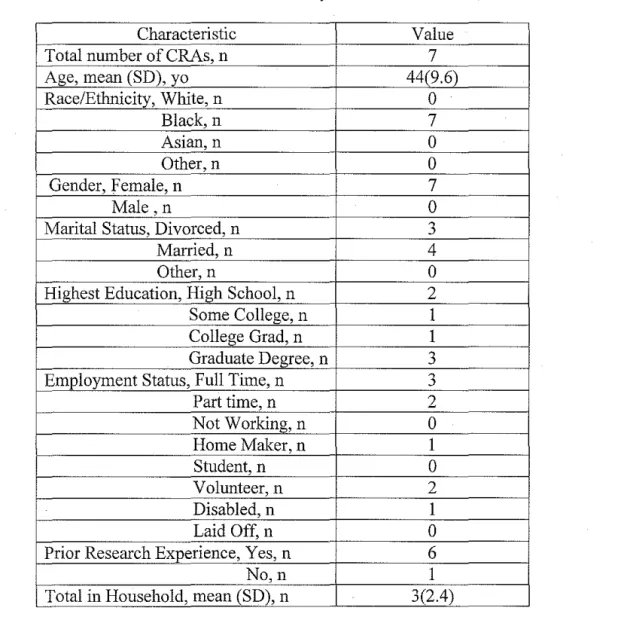
completed high school. Six out of the seven subjects reported having had prior research experience. The mean number of people in a participant household was three with a range of zero to seven. Three participants identified themselves as full time employees; two participants identified as part time employees, two participants identified as a volunteer, one participant identified as a home maker, and one participant identified as disabled.
Table 1. Characteristics of Community Research Advisors.
Characteristic Value
Total number ofCRAs, n 7
Age, mean (SD), yo 44(9.6)
Race/Ethnicity, White, n 0
Black, n 7
Asian, n 0
Other, n 0
Gender, Female, n 7
Male, n 0
Marital Status, Divorced, n 3
Married, n 4
Other, n 0
Highest Education, High School, n 2
Some College, n 1
College Grad, n 1
Graduate Degree, n 3
Employment Status, Full Time, n 3
Part time, n 2
Not Working, n 0
Home Maker, n 1
Student, n 0
Volunteer, n 2
Disabled, n 1
Laid Off, n 0
Prior Research Experience, Yes, n 6
No,n 1
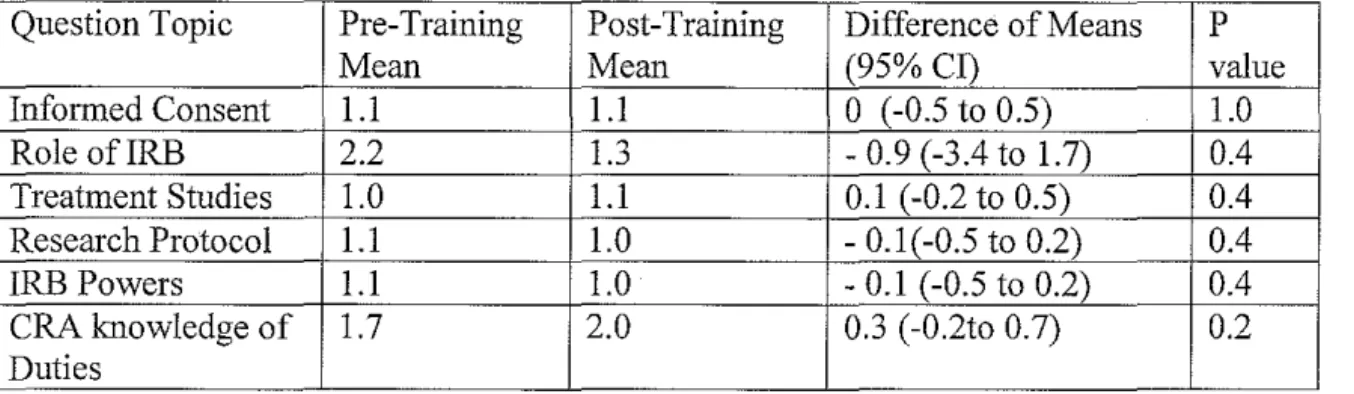
Analysis of Difference between Mean Responses of Pre and Post Surveys
Table 2. Analysis of difference between mean CRA pre-training and post-training responses
Question Topic Pre-Training Post-Training Difference of Means
Mean Mean (95% CI)
Informed Consent 1.1 1.1 0 (-0.5 to 0.5)
Role ofiRB 2.2 1.3 - 0.9 (-3.4 to 1.7)
Treatment Studies 1.0 1.1 0.1 (-0.2 to 0.5)
Research Protocol 1.1 1.0 - 0.1(-0.5 to 0.2)
IRB Powers 1.1 1.0 -0.1 (-0.5 to 0.2)
CRA knowledge of 1.7 2.0 0.3 (-0.2to 0.7)
Duties
CRA Satisfaction
p value 1.0 0.4 0.4 0.4 0.4 0.2
CRA self reported satisfaction is displayed in Table 3. CRAs reported very good to excellent satisfaction concerning training facilities, training staff, training content, information learned, and overall training satisfaction.
Table 3. CRA Reported Satisfaction
Excellent Very Good Good Fair Poor
Training 5 I I 0 0
Facilities
Training 5 2 0 0 0
Explanation
Training
"
' 4 0 0 0Goals match Training Content
Trainer's 6 I 0 0 0
Style/Delivery
Trainer's 7 0 0 0 0
Knowledge
Workshop 6 I 0 0 0
Usefulness
Workshop 7 0 0 0 0
met Personal
t.-Learned from Training
Overall 6 1 0 0 0
Training Satisfaction
CRA Contacts
The number CRA contacts were monitored from June 2005 -December 2005
with mail in tracking forms. Characteristics concerning CRA contacts are displayed in
Table 4. The mean number of contacts was twelve with a range of zero to thirty eight.
The mean contact per month was two with a range of zero to five. The total number of
contacts from June 2005 to December 2005 was eighty seven.
Table 4. CRA Advising Contacts from June 2005- December 2005
Value Mean number of CRA contacts, n (SD) 12 (15.2)
Mean Contacts per month, n (SD) 2(2.2)
Total number of CRA contacts, n 87
Discussion
The purpose of this study was to evaluate the impact of the CRA training sessions
on CRA knowledge concerning basic research principles, informed consent, the role of
institution review boards, participant rights, and the role of CRAs in the community.
With adequate training, CRAs can better educate and empower minority communities
concerning the research process in general. Ultimately, the long term goal of this study is
to ideutify a training method that effectively prepares CRAs to function as advocates and
educators for their communities regarding the research process and the community's
This study did not demonstrate a meaningful change in CRA survey answers
before and after the training, however CRA post training responses were more likely to
be correct. To our knowledge this is the first study to look at the impact of training on
CRA research knowledge beyond self reported surveys using statistical evidence.
Although this focus has not been discussed in the current body of available literature, the
training modalities used in this study (i.e. role play, lectures, surveys) are very much
consistent with those used in prior studies. Other studies have looked at Lay Health
Advisor's knowledge concerning STD's, cancer prevention, smoking cessation, and
healthy behaviors; however they do not specifically address the impact of the training
methods on LHA knowledge.
CRAs in general reported overall satisfaction with this study, and additionally
were satisfied with training methods, training facility/staff, presentation of information,
and the information learned. This finding was also consistent with prior research studies
involving lay health advisors surveyed for satisfaction. In general participants typically
report good satisfaction with training methods, however there is not much beyond these
opinion surveys to demonstrate effectiveness of training in the current body of literature.
In comparison with other studies the activity of our CRAs and the tracking time allotted
for follow up advisory contacts was low in this study.
Limitations
This study has several limitations. The small nature of this study, n = 7, does not
provide adequate power to detect a meaningful change in pre and post survey responses.
high level of understanding by the initial group of CRAs concerning the attributes needed
for CRA selection criteria. Furthermore this assumes that the initial group of CRAs has
knowledge about the respective communities of the newly selected CRAs. The survey
questions are another limitation. The questions assumed minimal knowledge concerning
the research process when six out of the seven participants reported prior involvement in
research studies. The depth of question may not have been sufficient to demonstrate a
difference in knowledge considering the exposure of this group of participants.
Despite these substantial limitations, we recognize that identifYing an effective
training modality that improves research awareness and knowledge for CRAs is
important to providing a voice for historically tmderserved populations.
Future Studies
Utilizing the Lay Health Advisor model within the health education/health
outcome scope has been documented well within the literature. However much less is
!mown concerning the LHA model and the research community. There is less published
information concerning the training of participants in such studies in regards to changes
in participant knowledge before and after the training. We conducted a literature review
on the LHA model, training methods for LHAs, and LHA recruitment so that we could
analyze our training methods for our CRAs within the minority community. We were
unable to demonstrate a meaningful impact of our training strategy on CRA research
knowledge. Similar studies used participant reported satisfaction with the training
process and participant reported acquired knowledge as evidence for effective training.
Although we also have satisfactory participant responses with the training, there was no
This study needs substantial expansion to include more subjects so that more
statistically relevant analysis may be conducted. With more power and statistical
analysis, an effective training method for CRAs may be discovered that improves their
general knowledge about research. Additionally steps should be taken to improve the
training program itself such as increasing the number of training sessions and bolstering
training content. Ultimately these trained CRAs function as advocates for their
underserved commuuities so that these communities can also benefit from the research
process.
Acknowledgements
I sincerely thank Dr. Giselle Corbie-Smith for her encouragement, mentorship, and
expertise throughout the thesis writing process. I also sincerely thank Dr. Russell Harris
for his support and guidance throughout the writing process. I thank Natasha Blakeney,
Audrina Bunton, Connie Blumenthal, and Ben Beatty for their help during the training
sessions and data analysis. Without these individuals this paper would not have been
possible.
References
1
Cox K & McGarry J (2002). Why patients don't take part in cancer clinical trials:
an overview of the literature. European Journal of Cancer Care, 12, 114-122
2.
3.
4.
Seto B (2001). History of Medical ethics and Perspectives on Disparities in · Minority Recruitment and Involvement in Health Research. The American
Journal of the Medical Sciences, 322, 246-250
Corbie-Smith G, Thomas S, Williams M, & Moody-Ayers S (1999). Attitudes
and Beliefs of African Americans Toward Participation in Medical Research. Journal of General Internal Medicine, 14, 537-546
Fouad M, Corbie-Smith G, Curb D, Howard B, Mouton C, Simon M, Talavera G,
5
· Dilworth-Anderson P & Williams S (2004). Recruitment and Retention
Strategies for Longitudinal African American Caregiving Research: The Family Caregiving Project. Journal of Aging and Health, 16, 137s-156s
6
· Freimuth V, Quinn S, Thomas S, Cole G, Zook E, & Duncan T (2001). African
Americans' view on research and the Tuskegee Syphilis Study. Social Science and Medicine, 52, 797-808
7
· Gilliss C, LeeK, Gutierrez Y, Taylow D, Beyene Y, Neuhaus J, & Murrell N
(2001). Recruitment and Retention of Healthy Minority Women into
Community-Based Longitudinal Research. Journal of Women's Health &
Gender-Based Medicine, 10,77-85
8
· Harris K, Ahluwalia J, Catley D, Okuyemi K, Mayo M, & Resnicow K (2003).
Successful recruitment of minorities into clinical trials: The Kick It at Swope
project. Nicotine & Tobacco Reasearch,
2.,
575-5849
· Tessaro LA., Belton L, Campbell M.K., Benedict S, Kelsey K, & DeVellis B
(2000). Adapting a natural (lay) helpers model of change for worksite health
promotion for women. Health Education Research,
D.,
603-61410
· Altpeter M, Earp J, Bishop C, & Eugenia E (1999). Lay Health Advisor Activity
Levels: Definitions From the Field. Health Education and Behavior, 26,495-512
1
1. Martijn C, Vries N, Voorham T, Brandsma J, Meis M, & Hospers H (2004). The
effects of AIDS prevention programs by lay health advisors for migrants in The Netherlands. Patient Education and Counseling, 53, 157-165
12
· Kim S, Koniak-Griffin D, Flaskerud J, & Guarnero P (2004). The Impact of Lay
Health Advisors on Cardiovascular Health Promotion Using a Community-bases Paricipatory Approach. Journal of Cardiovascular Nursing, 19, 192-199
13. Blumenthal C, Eng E, & Thomas JC (1999). STEP sisters, sex, and STDs: a
process evaluation of the recruitment oflay health advisors. Unpublished Masters paper, Chapel Hill , NC: University of North Carolina at Chapel Hill
14
· Flax V.L., & Earp J.L. (1999). Counseled women's perspectives on their
interactions with lay health advisors: a feasibility study. Health Education Research, 14, 15-24
15
· Raczynski J, Cornell C, Stalker V, Phillips M, Dignan M, Pulley L, & Leviton L
16
· Thomas J, Eng E, Clark M, Robinson J, & Blumenthal C (1998). Lay Health
Advisors: Sexually Transmitted Disease Prevention Through Community Involvement. American Journal of Public Health, 88, 1252-1253
17
· Hinton A, Downey J, Lisovicz N, Mayfield-Johnson S, & White-Johnson F
(2004). The Community Health Advisor Program and the Deep South Network for Cancer Control Health Promotion Programs for Volunteer Community Health Advisors. Family and Community Health, 22, 20-27
18
· Salber, E.J. (1979). The lay advisor as a community health resource. Journal of
Health Politics, Policy and Law,}, 469-478
19
· Rodriguez V, Conway T, WoodruffS, & Edwards C (2003). Pilot Test of an
Assessment Instrument for Latina Community Health Advisors Conducting an
ETS Intervention. Journal of Immigrant Health,
2,
129-13 720
· Hardy C, Wynn T, Huckaby F, Lisovicz N, & White-Johnson F (2004). African
American Community Health Advisors Trained as Research Partners. Family and Community Health, 28, 28-40
21. Lam T, McPhee S, Mock J, Wong C, Doan H, Nguyen T, Lai K, Ha-laconis T, &
Luong T (2003). Encouraging Vietnamese-American Women to Obtain Pap Tests Through Lay
22
· Larkey L, Staten L, Ritenbaugh C, Hall R, Buller D, Bassford T, & Altimari B
(2002). Recruitment of Hispanic women to the Women's Health Initiative: the case ofEmbajadoras in Arizona. Controlled Clinical Trials, 23, 289-298
23
· Woodruff S.I., Talavera G.A., & Elder J.P. (2002). Evaluation of a culturally
appropriate smoking cessation intervention for Latinos. Tobacco Control,
11,
361-367
24
· Johnson R, Anderson-Lewis C, & Wynn T (2005). Community Health Advisors
as Research Partners An evaluation of the Training and Activities. Family and
Community Health, 28,41-50
25
· Thomas J, Earp J, & Eng E (2000). Evaluation and lessons learned from a lay
health advisor programme to prevent sexually transmitted diseases. International
Journal ofSTD & AIDS,
11,
812-81826
· Kegler M & Malcoe H (2004). Results from a Lay Health Advisor Intervention to
27
· Earp J & Flax V (1999). What Lay Health Advisors Do An Evaluation of
Advisors' Activities. Cancer Practice,
1,
16-2128
· Rodney M, Clasen C, Goldman G, Markert R, & Deane D (1998). Three
evaluation Methods of A Community Health Advocate Program. Journal of Community Health, 23, 371-381
~