Estimating the Economic Burden of Abusive Head Trauma in
Children in North Carolina
By
Ivy Pointer, MD
A Master’s Paper submitted to the faculty of the University of North Carolina at
Chapel Hill in partial fulfillment of the requirements for the degree of Master of
Public Health in the Public Health Leadership Program.
Chapel Hill
2011
Advisor and First Reader
Date
Second Reader
Abstract
Introduction: Abusive head trauma causes significant morbidity and mortality in the
pediatric population. Information on the economic burden of this condition is limited, making it difficult to determine how much funding to direct toward prevention. The
Period of PURPLE Crying® is a promising abusive head trauma prevention program in
the state of North Carolina. By collecting cost data on abusive head trauma victims and comparing it to the cost of the prevention program, the objective of this study is to demonstrate cost savings and suggest potential policy changes nationwide.
Methods: Using ICD-9 codes, we identified all children less than 3 years old admitted to
the North Carolina Children’s Hospital Pediatric Intensive Care Unit with traumatic brain injury between 2005 and 2010. Demographic data (age, gender, year, payer type), hospital and physician charges, length of stay, intensive care unit days, and ventilator days were collected on each patient. Charges were further divided into pharmaceutical, laboratory, blood product transfusion, and radiology charges. The cases were classified as abusive head trauma and accidental head trauma based on the CDC
recommendations for determining abuse from ICD-9 codes. The mean cost of hospitalization per patient was calculated for each group. The cost of the prevention program per patient was calculated.
Results: 74 cases were identified with 27 cases of abusive head trauma and 47 cases
of accidental head trauma or unknown etiology. The mean charges for hospitalization of abusive head trauma victims were $99,970 with a median of $64,643. The mean
charges for the accidental head trauma group were significantly less at $46,406. This difference was statistically significant in the 25th and 50th quartiles. There were also significant differences between the two groups in length of stay, PICU days, and ventilator days. The cost of the Period of PURPLE Crying® program is $3.93 per infant exposed.
Conclusion: The charges of hospitalizing abusive head trauma victims average nearly
Table of Contents
Abstract
...2
Introduction
...5
Methods
...6
Results
...9
Discussion
...10
Conclusion
...15
Tables and Figures
...17
Appendix 1: Limited Systematic Review of the Cost of Abusive Head Trauma ...23
List of Tables and Figures
Table 1: Patient Characteristics ... 17
Table 2: Median Charges for Specific Categories ... 18
Table 3: Quartiles for Both Groups ... 18
Table 4: Summary Statistics of Key Variables ... 17
Figure 1: Scatterplot of Total Charges by Cause of Injury ... 18
Figure 2: Mean Charges by Category... 21
Figure 3: Comparison of Variables between Groups ... 22
Introduction
Abusive head trauma is the leading cause of infant death from injury and the
most common cause of lethal child abuse.1 Approximately 95% of all serious traumatic
brain injuries in children less than 12 months old are secondary to abuse.2 Based on a
population-based study in the United States, the incidence of abusive head trauma is
estimated to be 17 per 100,000 person-years in children less than 2 years old and 30
per 100,000 person-years in children less than 1 year old.1 Mortality rates range from
13% to 27%.3-5 Morbidity for survivors is high, with an estimated 45-60% percent of
victims with significant neurologic deficits at the time of discharge from the hospital 4-6
and 68% with late neurologic sequelae.7 Given the substantial morbidity and mortality
associated with abusive head trauma, this condition places an undue burden on society,
especially from an economic standpoint.
The exact economic burden of abusive head trauma is unknown. Studies in the
1990’s reported estimated hospital charges alone in the range of $25,000 to $40,000 per
victim.8-11 These studies found that charges were significantly higher for abusive head
trauma compared to accidental head trauma. Three of the four studies included only
hospital charges, and the data were generated almost two decades ago.8,10,11 The one
study that examined physician charges was a small study of 13 child abuse cases and
was not limited to abusive head trauma.9 More research is needed to provide valuable
insight into planning a prevention program and developing policy around that program.
The Period of PURPLE Crying® is a promising abusive head trauma prevention
program currently underway in the state of North Carolina.12 The program focuses on
preparing parents of newborns to deal safely and explicitly with infant crying. This goal
is accomplished through education about the nature of and appropriate responses to
effective at reducing abusive head trauma and provide demonstrable cost-savings. As
of June 2009, sixteen states had legislation requiring hospitals to provide some form of
education about abusive head trauma.13 By collecting cost data on abusive head trauma
victims and comparing it to the cost of the prevention program, the objective of this study
is to evaluate for possible cost savings and consider potential policy changes
nationwide.
Methods
Data Collection
This study was conducted at the N.C. Children’s Hospital, a 140-bed university
affiliated pediatric hospital with approximately 5900 annual admissions. The hospital
serves children from all 100 North Carolina counties. The Pediatric Intensive Care Unit
(PICU) is a twenty bed unit averaging almost 90 admissions per month. A database
containing treatment, demographic, and cost data for a retrospective cohort of all
patients less than 3 years old admitted to the PICU between September 1, 2005 and
September 30, 2010 with traumatic brain injury as defined by the Centers for Disease
Control and Prevention’s (CDC) ICD-9 based definition14, was developed by the first
author for this study.
The North Carolina Translational and Clinical Sciences (NC TraCS) Institute is
the NIH Clinical and Translational Science Awards research unit at the University of
North Carolina. NC TraCS staff assisted in creating a list of patients meeting the study
criteria and extracting data from NC Children’s Hospital records. The data were
de-identified and stored with the Carolina Data Warehouse for Health (CDW-H) at the
the identified patients, including age in months (calculated from birthday and admission
date), sex, and payer type. We also collected diagnosis codes, year of admission,
length of stay, PICU days, and ventilator days.
We used both hospital and physician billing information to determine total
charges of admission for each patient. All calculations of cost in this study are based on
charges, not actual costs or reimbursements. Charges were chosen due to the difficulty
of accessing information on costs and the differing rates of reimbursements depending
on payer type. All charges associated with the acute hospitalization were included in the
analysis. Charges for each patient were grouped by pharmaceutical, laboratory,
radiology (subdivided into MRI, CT, and X-ray charges), blood product transfusion, and
physician charges. Physician charges were subdivided by subspecialty. For patients
admitted from the N. C. Children’s Emergency Department, these hospital and physician
charges were also included. All data were de-identified prior to review and analysis by
study personnel.
Each case was classified as definite abuse, probable abuse, accidental, or
unknown cause based on the CDC’s draft matrix for diagnosing child abuse from ICD-9
codes and E-codes.15 Definite and probable abuse cases were consolidated as abusive
head trauma; accidental and unknown causes were consolidated as accidental head
trauma for this data analysis.
The Period of PURPLE Crying® is an ongoing abusive head trauma prevention
program in the state of North Carolina. To determine the cost of this program per
patient, the total cost was estimated and divided by the number of infants delivered at
each of the participating facilities. The delivery information was obtained from state vital
records. The total costs of the program included costs of materials, such as DVD’s,
personnel to coordinate the program at each hospital, and ongoing training. The
Carolina. Evaluation staff indicated that coordinators spent approximately twenty
minutes per month attending to the needs of the program. Training costs included
in-person training at participating facilities as well as internet-based training. Costs of initial
program implementation were excluded from the calculation. In addition, the costs of the
time nurses spend delivering the program were not included since 60% of the facilities
were already delivering education about child abuse prevention prior to implementation
of PURPLE. For the other 40% of facilities, it was assumed that the nurses could
integrate PURPLE into the regular discharge activities.
This study was reviewed and approved by the Institutional Review Board for the
Protection of Human Subjects. Requirement for informed consent was waived.
Data Analysis
Stata 11 statistical software was used for all data analysis.16 The main outcome
of interest was the total charges for hospitalization of a patient with abusive head
trauma. We calculated mean and median charges for each subcategory of expenditures
as well as for the total charges for each hospitalization. All charges were adjusted for
inflation to 2010 dollars by using the consumer price index for medical care services.17,18
Because charges were not normally distributed, nonparametric tests were used to
compare abusive head trauma and accidental head trauma groups. We used the
Wilcoxon Signed-Rank test to compare the total charges, length of stay, PICU stay,
ventilator days, radiology charges, and neurosurgery charges of the abusive and
accidental groups, and we used Pearson’s Chi-Square test to assess the difference in
categorical variables of the groups. Finally, we used multiple regression analysis to
compare the means of the abuse and accidental groups. Quartile regression analysis
was used to compare differences at levels of 25th percentiles, medians, and 75th
Results
We identified a total of 76 cases of head trauma in children less than 3 years old
admitted to the UNC PICU between 2005 and 2010. Of these cases, two patients were
admitted twice and only their first admission was used. The remaining 74 cases were
reviewed with 27 classified as abusive head trauma, based on the CDC guidelines, and
47 classified as accidental or unknown. Table 1 outlines the characteristics of patients in
the abusive and accidental head trauma groups. The unintentional injuries were
primarily due to motor vehicle accidents (49%) and falls (30%). Eight patients had no
diagnosis code to indicate the cause of injury and were included in the accidental head
trauma group; these unknown causes make up 17% of the accidental injury group. Total
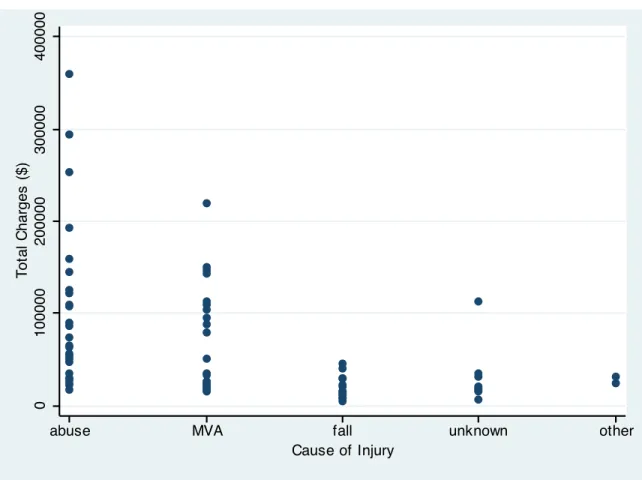
charges for each cause of injury are represented by a scatter plot in Figure 1.
The mean total charges for children with abusive head trauma were $99,970 with
a range of $17,276 to $360,160 and standard deviation of $86,925. The median total
charges were $64,643. Physician charges were the most costly subcategory, at an
average of $24,376, accounting for almost 25% of the average total charges. Radiology
charges and pharmacy charges were the other major categories, accounting for 7% and
5% of the average total charges respectively. Figure 2 displays the contribution of each
category of charges. The average length of stay for abusive head trauma patients was
19 days with an average of 9 days in the PICU and 8 days on a ventilator.
The abusive head trauma group also had significantly higher median charges for
hospitalization than the accidental head trauma group ($64,643 compared to $25,017
(p=0.002)). Table 2 shows the medians for each of the subcategories of charges, with a
significant difference between groups in pharmacy charges, laboratory charges, blood
Quartile regression was also used to compare the groups with a statistically
significant difference between the 25th and 50th percentiles of total charges. Table 3
shows the quartiles compared for both groups. We examined differences at the
quartiles to determine whether overall differences between the two groups were caused
simply by a clumping of particularly expensive cases, for example, rather than higher
costs across the board. Quartile analysis is a good way of illustrating the consistency of
the differences.
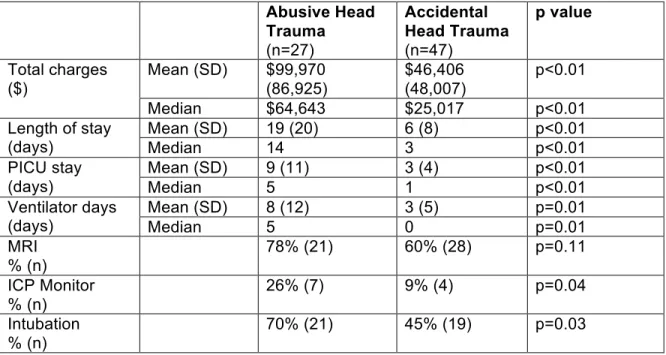
Length of stay, PICU days, and ventilator days were significantly higher in the
abusive head trauma group than in the accidental head trauma group, as shown in Table
4 and Figure 3. The categorical variables of MRI, intracranial pressure (ICP) monitor,
and intubation were compared between the two groups (Table 4). Abusive head trauma
patients were more likely to be intubated (p=0.03) and to have an ICP monitor (p=0.04).
There was no significant difference between groups in the use of MRI.
Regression analysis was used to determine if any of the demographic factors
explained charges for admission or other variables. The patient’s age, sex, and payer
type had no effect on the charges or any other dependent variables in the study.
The cost of the Period of PURPLE Crying® prevention program overall is an estimated $500,000 per year, and that expenditure is intended to cover the
implementation of the program at the time of each of the approximately 125,000 births in
North Carolina per year. The cost per child of PURPLE, then, is estimated to be approximately $3.93 per child exposed. The cost per child exposed is exponentially
lower than the cost of treating a single case of abusive head trauma.
The substantial morbidity and mortality associated with abusive head trauma has
been established by prior studies.1-7 The economic burden, however, has not been fully
or recently explored. The results of this study demonstrate the extensive costs
associated with the acute care of victims of abusive head trauma. Over 60% of the
abusive head trauma victims in this study were Medicaid recipients and another 26%
were covered by TriCare. Other studies have also found that more than half of abusive
head trauma victims are Medicaid recipients.8,10,11 Thus, a substantial portion of the
economic burden associated with caring for these children is born by the public. For the
cost of caring for one child with abusive head trauma, approximately 25,000 infants
could be exposed to the Period of PURPLE Crying® prevention program. The cost of prevention for the 125,000 births per year in the state of North Carolina is estimated to
be $500,000. If exposure to this program reduces abusive head trauma in North
Carolina by 6 cases per year, the program would be cost effective. As a part of the
necessary monitoring process to determine PURPLE’s true preventive effect, active surveillance to assess mortality and hospitalization rates is currently underway in the
state.
In a similar hospital-based prevention program targeting new parents at the time
of birth, Dias et al demonstrated an almost 50% reduction in cases of abusive head
trauma from 41.5 cases per 100,000 live births to 22.2 cases per 100,000 live births.19 If
the Period of PURPLE Crying® achieves similar results and prevents 19 cases per
100,000 live births, the state, private insurance companies, and families in the state of
North Carolina together would save up to $1.5 million in acute medical care costs.
The high cost of hospitalizing children with abusive head trauma has been
demonstrated in prior studies but those costs are significant underestimates of the true
charges in our analysis accounted for $25,000 or 25% of the total charges. Including
the physician charges is an essential step toward constructing true estimates of the cost
of caring for these children, and a more accurate estimate gives policymakers a better
idea of the cost effectiveness of prevention, quite apart from prevention’s potential to
spare a life.
The mean hospital charges of abusive head trauma in this study are higher than
those reported in prior studies, which may be due to the inclusion of three patients in the
abusive head trauma group who required tracheostomy and gastrostomy tube
placement. These charges were significant, resulting in total charges of over $200,000
for each patient. The 75th percentile comparison between the two groups did not
achieve statistical significance despite the difference in charges of close to $50,000,
likely due to the inclusion of these three patients in the study. The median hospital
charges of this study ($43,400) correlate more closely to mean charges reported in other
studies, which range from $25,000 to $40,0008,9. Ettaro et al. reported, median hospital
charges of $18,500 in 1999 dollars8. This amount converts to almost $30,000 in 2010
dollars, which correlates more closely to the median charges in this study17,18.
For patients who were admitted directly from the N.C. Children’s Hospital
Emergency Department, those charges were included in the hospital and physician
charges. Only 48 of the 74 patients had emergency department charges included and of
those, only 11 (23%) were in the abusive head trauma group. Most accidental trauma
patients are transferred from other facilities to the emergency department to be
assessed by the trauma team on arrival. Abusive head trauma cases may not be
recognized as trauma initially, as the history provided by the parents often does not
include a history of trauma. It is not until further evaluations are performed that the
diagnosis of abusive head trauma is assigned. These patients are frequently transferred
Department charges. In this study, the lack of emergency department charges for many
abusive head trauma patients likely underestimates the total charges and
underestimates the difference between the abusive and accidental head trauma groups.
Previous studies looking at the cost of abusive head trauma have not sorted the
charges by department to determine the specific expenses of caring for these children.
This study shows that physician charges, pharmacy charges, and radiology charges are
the most expensive subcategories. The abusive trauma group’s generally longer mean
length of stay and PICU days also contribute substantially to the high costs.
The differences between abusive head trauma and accidental head trauma in
cost and length of stay have been previously demonstrated. The present study,
however, provides more specific data on how the actual charges differ by department.
The differences achieved statistical significance in most departments except radiology
and neurosurgery. The total radiology charges were close to statistical significance and
it would be interesting to investigate this difference in a larger study. Many abusive head
trauma victims require additional radiologic studies in order to make a definitive
diagnosis of abuse. Therefore, we would expect charges for this group to be higher in
the radiology department. We expected that the increased severity of abusive head
trauma would lead to higher neurosurgery charges and more frequent neurosurgical
procedures. Although this group was more likely to have an ICP monitor placed, the
actual numbers were very small, with only 11 patients requiring ICP monitoring. Further
research with a larger sample population could determine if there are differences
between the two groups in these departments. Understanding the categorical costs of
caring for these children may lead to more efficient or judicious use of available
resources, thus decreasing the overall costs.
The major limitation of this study is the small sample size. Because the data
accidental head trauma groups. Previous studies have shown significant differences in
the cost and length of stay between these two groups and this study reinforces those
results.10 We also found significant differences between the groups in ventilator days
and PICU days, suggesting that abusive head trauma patients tend to suffer more
severe injuries.
Another limitation of this study is the single center location for data collection.
The location for this study is a regional pediatric trauma center and may be more likely to
admit the more severe cases of traumatic brain injury than do other facilities, thus
increasing costs. Because this center cares for more abusive head trauma patients than
does any other hospital in the state of North Carolina, however, it was deemed an
appropriate surrogate for determining the cost of caring for this population.
A third limitation that this study shares with several previous studies is the use of
ICD-9 codes to identify abuse cases. This method of diagnosing child abuse has been
validated in previous studies, although cases of abuse may be missed through this data
collection process.20 In addition, eight patients in this study had no E-code to determine
cause of injury and were included in the accidental head trauma group. If these cases
were missed abuse cases, the charges for abusive head trauma and the difference
between the two groups would likely be underestimated.
The use of charges as a surrogate for cost measurement is not the optimal way
to estimate the health care costs associated with this condition. However, charges were
chosen due to the impracticality of obtaining true cost data and the variability of
reimbursement rates. Charges reflect what the state and other payers are asked to pay
for the medical care, and they serve as a starting point to understanding the costs of
care.
This study examines the significant charges associated with the acute
larger total cost to society. The costs of these patients continue after hospital discharge
with rehabilitation and various therapies, home nursing care, foster care, and costs
associated with disability, including the potential for loss of a lifetime of productivity.
These subsequent costs are much more difficult to estimate, especially in the pediatric
population, given the limited literature available, but they need to be considered since
they likely present a substantial additional burden to the state.
Conclusion
The potential cost-savings from the prevention of abusive head trauma in infants
and young children is substantial. The immediate hospitalization of abusive head
trauma victims alone leads to average charges of almost $100,000. This estimate does
not include post-discharge therapies and societal costs. Given this sizeable economic
burden, increasing the funding of prevention programs, such as the Period of PURPLE
Crying®, could have significant political, economic, and societal implications. In the
absence of unlimited health care resources, advocates for prevention need to
demonstrate cost-savings in addition to improved health outcomes. Abusive head
trauma prevention has the potential to be a cost-effective way to improve the health and
wellbeing of children. Only sixteen states currently require some form of education for
new parents about abusive head trauma at discharge from the hospital, and there is no
standard or recommended program.13 Implementing a policy requiring hospitals
nationwide to engage in an effective, standardized abusive head trauma prevention
program and directing increased funding to support the policy could substantially
Tables and Figures
Table 1: Patient Characteristics for Children Less Than 3 Hospitalized at NC
Children’s Hospital Stratified by Accidental Versus Abusive Head Trauma
Characteristic Abusive Head Trauma (n=27)
Accidental Head Trauma (n=47)
Male Sex 15 (56%) 27 (57%)
Age:
< 12 months 19 (70%) 24 (51%)
12 to 23 months 4 (15%) 14 (30%)
> 23 months 4 (15%) 9 (19%)
Payer type
Medicaid 17 (63%) 27 (57%)
Private insurance 3 (11%) 13 (28%)
State health plan 0 (0%) 1(2%)
Tricare 7 (26%) 5 (11%)
Self-pay 0 (0%) 1 (2%)
Year of admission
2005 4 (15%) 2 (4%)
2006 6 (22%) 8 (17%)
2007 5 (19%) 12 (26%)
2008 5 (18%) 11 (23%)
2009 5 (19%) 10 (21%)
Table 2: Median Hospital Charges Comparing Abusive Head Trauma and
Accidental Head Trauma Victims at NC Children’s Hospital.By Specific Type of
Charge
Abusive Head Trauma
Accidental Head Trauma
p value
Pharmacy charges $2972 $724 p<0.01
Lab charges $2672 $358 p<0.01
Blood product charges $314 $89 p<0.01
MRI charges $1214 $1180 p=0.21
CT charges $1589 $904 p=0.37
X-ray charges $949 $398 p<0.01
Radiologist charges $2125 $1413 p=0.06
Total radiology charges $6356 $4215 p=0.06 Total hospital charges $43,380 $19,420 p<0.01 Physician charges $19,851 $6929 p<0.01
Neurosurgery charges $421 $388 p=0.97
Total charges $64,643 $25,017 p<0.01
Table 3: Quartiles for Total Charges Comparing Abusive Head Trauma and
Accidental Head Trauma Victims at NC Children’s Hospital.
Quartile Abusive Head Trauma
Accidental Head Trauma
p value
25th %ile $35,845 $17,068 p<0.01
50th %ile $64,643 $26,017 p<0.01
Table 4: Summary Statistics of Key Variables Comparing Abusive Head Trauma
and Accidental Head Trauma Victims at NC Children’s Hospital
Abusive Head Trauma
(n=27)
Accidental Head Trauma
(n=47)
p value
Mean (SD) $99,970 (86,925)
$46,406 (48,007)
p<0.01 Total charges
($)
Median $64,643 $25,017 p<0.01 Mean (SD) 19 (20) 6 (8) p<0.01 Length of stay
(days) Median 14 3 p<0.01
Mean (SD) 9 (11) 3 (4) p<0.01 PICU stay
(days) Median 5 1 p<0.01
Mean (SD) 8 (12) 3 (5) p=0.01
Ventilator days
(days) Median 5 0 p=0.01
MRI % (n)
78% (21) 60% (28) p=0.11
ICP Monitor % (n)
26% (7) 9% (4) p=0.04
Intubation % (n)
Figure 1: Scatterplot of Total Charges by Cause of Injury for Children Admitted to
NC Children’s Hospital with Traumatic Brain Injury
0
100000
200000
300000
400000
T
ot
al
C
harges
($)
abuse MVA fall unknown other
Appendix 1: Limited Systematic Review of the Cost of Abusive
Head Trauma
Abusive head trauma is the leading cause of infant death from injury and the
most common cause of lethal child abuse1. Approximately 95% of all serious traumatic
brain injuries in children less than 12 months old are secondary to abuse2. The
morbidity for survivors is also significant with an estimated 55 percent with neurologic
deficits and 65 percent with visual impairment4. Based on a population-based study in
the United States, the incidence is estimated to be 17 per 100,000 person-years in
children less than 2 years old and 30 per 100,000 person-years in children less than 1
year old1. The economic burden of this disease is likely significant considering the
substantial morbidity and mortality. However, the literature examining the extent of this
economic burden is limited. Gaining an understanding of the health care costs
associated with abusive head trauma could help guide prevention efforts.
The purpose of this limited systematic review is to review existing literature on
the cost of abusive head trauma in order to more thoroughly estimate the economic
burden of this form of child abuse.
Methods:
Using the MeSH heading of “shaken baby syndrome,” I performed an initial
search on PubMed on January 25, 2011. I limited the search to “humans,” “English,”
and “infants up to 23 months,” yielding 264 citations. I added the MeSH terms “cost,”
“economics,” and “health care cost” to “shaken baby syndrome” in three separate
searches (with the same limits), which resulted in zero citations. I subsequently
limits, generating 20 citations. These abstracts were reviewed for their relevance to the
study question, and six citations were found to be appropriate for inclusion.
The search was repeated on PubMed using the keywords “child abuse” and
“cost,” yielding 86 citations. These citations were reviewed and one additional study was
found to be relevant.
Search Results:
The published information on the cost of abusive head trauma in children is
limited. Of the seven studies reviewed, four studies evaluated the cost of child abuse.
One study focused on the cost effectiveness of using head computed tomography in the
diagnosis of abusive head trauma but not the overall cost of the disease, and therefore
not relevant to this clinical question21.
Two of the seven papers evaluated the role of home visits in decreasing child
abuse and neglect, and thus decreasing costs22,23. These papers, based on a single
study, provide interesting insight into an economic evaluation of a prevention program
targeting child abuse. The intervention in this case was parental education through
weekly visits from a health worker. The costs of care for the women were calculated for
the control group and intervention group. However, there were not statistically
significant cost savings in the intervention group in any of the variables assessed. The
cost of child abuse and neglect was not addressed.
Of the four studies that estimated the economic burden of child abuse with
specific data on abusive head trauma, all four used data from the 1990’s and report
mean charges of hospitalization for the patients in the study.8-11.
Rovi et al used the 1999 National Inpatient Sample of Healthcare Costs and
Utilization Project to collect cost data on children with diagnosis codes of abuse or
database for children with diagnoses of abuse, including “shaken infant syndrome.”
Demographic data including age, gender, race, and income as well as length of hospital
stay, hospital characteristics, number of diagnoses and procedures, and total charges,
were collected for each patient. Of the 966 identified abuse cases, twenty-one percent
were diagnosed as “shaken infant syndrome.” Overall, the patients with a diagnosis of
abuse or neglect had double the length of stay and total charges of those without a
diagnosis of abuse or neglect. They also had double the diagnoses and more
procedures. The mean total charges for patients diagnosed with “shaken infant
syndrome” was $30,311, with a standard error of $2928, the highest mean charges of all
of the abuse diagnoses11.
Libby et al collected data from 1993 to 2000 on 814 unintentional head injury
cases and 283 inflicted head injury cases. Their primary objective was to compare the
cost and length of stay between the two groups. They also collected gender,
race/ethnicity, and insurance type. They estimated severity using All Patient-Refined
Diagnosis-Related Groups severity index and collected mortality information. Mean total
charges for the inflicted cases were $25,481.26 with a standard deviation of $31,421.72
compared to $10,879.71 in the unintentional group with a standard deviation of
$22,932.13. This difference was found to be significant (p<0.01) with costs in the
inflicted head trauma group 89% higher than the unintentional head trauma group. The
study also found a significantly higher length of stay in the inflicted head trauma group of
8.9 days compared to 3.52 days (p<0.05). Other characteristics associated with inflicted
head injury in the study were younger age, higher severity level, mortality rate, and
Medicaid insurance10.
Ettaro et al reviewed medical records of all children under 3 years of age
admitted from 1995 to 1999 with traumatic brain injury. They identified 385 cases and
Information collected included basic demographic information, information about the
injury, insurance status, length of stay, and discharge status. Hospital charges
associated with the event were collected and adjusted to 1999 dollars using the Medical
Care Component of the Consumer Price Index. Of the 385 cases, 377 were included
with 61 identified as “presumptive abuse” and 28 as “suspicious for abuse.” These two
categories were then combined into one category of abused subjects. The abuse cases
were more likely to be less than one year old (p<0.001) and to have Medicaid as their
insurance provider (p<0.001). The mortality rate was also significantly higher in the
abused group at 10.1% compared with 2.1% (p=0.003). Abused subjects had
significantly higher hospital charges and lengths of stay than the non-abused subjects.
The mean hospital charges for abused subjects were $40,082 (standard deviation
$58,004) compared with $15,671 (standard deviation $41,777), which was a significant
difference (p<0.001). The range of charges in the abused group was substantial, $1,131
to $315,618 with a median of $18,494. The mean for abused subjects admitted to the
intensive care unit was even higher at $68,0748.
Irazuzta et al collected retrospective data on all patients admitted to the Pediatric
Intensive Care Unit between 1991 and 1994. Of the 937 admissions, 13 were child
abuse cases, all of which are described as inflicted head trauma. They collected age,
outcome, severity of illness, length of stay, and hospital and physician charges on each
patient. The child abuse cases in this study were found to be younger in age, greater in
severity, and more costly than the other cases. The mean hospital charges for the child
abuse cases were $30,684 with a standard deviation of $22,697. The mean total
medical bills (including physician charges) were $35,641. When compared to patients
with similar severity indices, the child abuse patients had significantly higher daily
The mean total charges for abusive head trauma reported in the studies
reviewed were between $25,000 and $40,000 based on data from the 1990’s. Each of
the studies reported a significant difference between abusive and non-abusive head
trauma in terms of cost and length of stay8-11. The increased length of stay compared to
the unintentional cases demonstrated by these studies further points to the significant
economic burden of abusive head trauma in children.
Discussion:
Each of these studies collected cost data on abusive head trauma patients and
estimated an average cost per patient. The study by Rovi et al explicitly focuses on
hospital charges only and does not take into account physician charges11. Only the
study by Irazuzta et al provides the mean total medical charges, including physician
charges9. The other studies do not specifically mention whether or not physician
charges are included but discuss “hospital charges.” Therefore, the data is not inclusive
of all costs incurred by patients with abusive head trauma.
The means reported for hospital charges have significant standard deviations in
each of the studies. The high standard deviation indicates that the data is spread out
over a large range. Only one study reports a median, which may be more useful in this
situation since the hospital charges data may not be normally distributed8.
Two of the studies rely on ICD-9 codes to identify the abusive head trauma
cases10,11. Using hospital discharge diagnoses to track abusive head trauma has been
researched and found to be an acceptable way to collect data for this condition20.
Although it is likely that some cases of abuse are missed through this strategy, it is
difficult to hypothesize whether the missed cases would change the mean costs of care
compared to non-abused patients would be strengthened if some cases of abuse were
missed.
Each of these studies offers insight into some of the financial cost of abusive
head trauma during the time period studied. More research is needed to examine
current costs given that it has been between 10 and 20 years since this data was
collected. Given the significant changes in health care costs since that time, it is difficult
to extrapolate the current costs of caring for these children.
All of the studies report total costs for the admission of children with abusive
head trauma but have no subtotal cost data, such as pharmaceutical costs, laboratory
costs, radiology costs, or procedural costs. Further research with more specific cost
data may provide greater insight into the economic burden of this condition.
An understanding of the economic burden of abusive head trauma in children
would provide valuable information in developing child abuse prevention programs. An
effective educational program to target abusive head trauma needs to both change
health outcomes and provide evidence of cost-savings to policymakers. Without a clear
estimate of the economic burden of the condition, it is impossible to compare prevention
costs. The studies in this review provide a starting point of the cost of abusive head
trauma, which can direct further research in this area.
Reference Study Design Study Population Number of Subjects Pertinent Outcomes Measured Mean Hospital Charges
Ettaro et al (2004)
Restrospective comparative case series
Children < 3 yo admitted with TBI 377 (288 unintentional, 89 inflicted) Length of stay, hospital charges Unintentional: $15,671 (SD $58,004)
median: $4249 Inflicted: $40,082 (SD $41,777)
median: $18,494 Irazuzta et al (1997) Retrospective cohort study All patients admitted to PICU, categorized by disease
937 (13 child abuse cases) Mortality, length of stay, hospital charges Child abuse: $30,684
Libby et al (2003)
Retrospective cohort study
Children < 3 yo admitted with TBI 1097 (814 unintentional, 283 inflicted) Hospital charges, length of stay Unintentional: $10,879.71 (SD $22,932.13) Inflicted: 25,481.26 (SD $31,421.72) Rovi et al
References:
1. Keenan HT, Runyan DK, Marshall SW, Nocera MA, Merten DF, Sinal SH. A population-based study of inflicted traumatic brain injury in young children.
JAMA. Aug 6 2003;290(5):621-626.
2. Billmire ME, Myers PA. Serious head injury in infants: accident or abuse?
Pediatrics. Feb 1985;75(2):340-342.
3. Reece RM, Sege R. Childhood head injuries: accidental or inflicted? Arch Pediatr
Adolesc Med. Jan 2000;154(1):11-15.
4. King WJ, MacKay M, Sirnick A. Shaken baby syndrome in Canada: clinical characteristics and outcomes of hospital cases. CMAJ. Jan 21 2003;168(2):155-159.
5. Jayawant S, Rawlinson A, Gibbon F, et al. Subdural haemorrhages in infants: population based study. BMJ. Dec 5 1998;317(7172):1558-1561.
6. Myhre MC, Grogaard JB, Dyb GA, Sandvik L, Nordhov M. Traumatic head injury in infants and toddlers. Acta Paediatr. Aug 2007;96(8):1159-1163.
7. Barlow KM, Thomson E, Johnson D, Minns RA. Late neurologic and cognitive sequelae of inflicted traumatic brain injury in infancy. Pediatrics. Aug
2005;116(2):e174-185.
8. Ettaro L, Berger RP, Songer T. Abusive head trauma in young children: characteristics and medical charges in a hospitalized population. Child Abuse
Negl. Oct 2004;28(10):1099-1111.
9. Irazuzta JE, McJunkin JE, Danadian K, Arnold F, Zhang J. Outcome and cost of child abuse. Child Abuse Negl. Aug 1997;21(8):751-757.
10. Libby AM, Sills MR, Thurston NK, Orton HD. Costs of childhood physical abuse: comparing inflicted and unintentional traumatic brain injuries. Pediatrics. Jul 2003;112(1 Pt 1):58-65.
11. Rovi S, Chen PH, Johnson MS. The economic burden of hospitalizations associated with child abuse and neglect. Am J Public Health. Apr
2004;94(4):586-590.
12. Period of PURPLE Crying: Keeping Babies Safe in North Carolina.
http://www.purplecrying.info/index.php?loc=mb1r3p6. Accessed February 18, 2011.
13. Shaken Baby Syndrome Prevention Legislation. National Conference of State
Legislatures 2009; http://www.ncsl.org/default.aspx?tabid=17669.
14. The Barell Injury Diagnosis Matrix.
http://www.cdc.gov/nchs/data/ice/final_matrix_post_ice.pdf. Accessed February 1, 2011.
15. Abusive Head Trauma Diagnosis Matrix. Paper presented at: Abusive Head Trauma Expert Panel Meeting2008; Atlanta, GA.
16. Stata Statistical Software: Release 11 [computer program]. College Station, TX:
StataCorp LP; 2009.
17. Consumer Price Index: Measuring Price Change for Medical Care in the CPI
http://www.bls.gov/cpi/cpifact4.htm. . Accessed March 21, 2011.
18. Tom’s Inflation Calculator http://www.halfhill.com/inflation.html.
19. Dias MS, Smith K, DeGuehery K, Mazur P, Li V, Shaffer ML. Preventing abusive head trauma among infants and young children: a hospital-based, parent
education program. Pediatrics. Apr 2005;115(4):e470-477.
21. Campbell KA, Berger RP, Ettaro L, Roberts MS. Cost-effectiveness of head computed tomography in infants with possible inflicted traumatic brain injury.
Pediatrics. Aug 2007;120(2):295-304.
22. Barlow J, Davis H, McIntosh E, Jarrett P, Mockford C, Stewart-Brown S. Role of home visiting in improving parenting and health in families at risk of abuse and neglect: results of a multicentre randomised controlled trial and economic evaluation. Arch Dis Child. Mar 2007;92(3):229-233.
23. McIntosh E, Barlow J, Davis H, Stewart-Brown S. Economic evaluation of an intensive home visiting programme for vulnerable families: a cost-effectiveness analysis of a public health intervention. J Public Health (Oxf). Sep