*PhD, Assistant Professor of Nursing Education, Department of Health, School of Nursing & Midwifery, Isfahan University of Medical Sciences, Isfahan, Iran.
** MSc of Nursing, Isfahan Education Organization, Isfahan, Iran. Correspondence to: Shayesteh Salehi PhD
Original Article
Nursing Students' Preferred Learning Style
Shayesteh Salehi
*
, Ehteram Shahnooshi
**
Abstract
Background: Academic success depends on curriculum planning and goals- setting, choosing suitable teaching methods, considering students' learning style and the teacher and the manner in which material is presented and effective time management. Learning style is the processing of information and comprehension. If teachers present contents in a style that matches a student’s preferred learning style, academic performance and success will improve and promote.
Assessing learning styles will benefit the student and the teacher as well as the educational system. If content retention improves it will result in an increase in the test scores. It is also important to determine if students, as a group, fit into a particular style or a particular cycle as they move through an educational program.
Methods: The study is a descriptive analytical research. Nursing Students at Isfahan Medical Sciences University com-pleted a questionnaire formulated to assess learning styles. Analysis of variance was used to investigate the possible relationship between learning cycle and student's grades in the curriculum (i.e. freshman, sophomore, junior, or senior). Cross tabulation was used to test for a relationship between learning style and student academic year of study in the curriculum.
Results: 294 students received the Kolb LSI questionnaire. The data demonstrated that juniors preferred a converger learning style and the senior students were in the abstract conceptualization cycle of learning. There were no relation-ships demonstrated between other groups in the study.
Conclusion: The junior and senior students appear to prefer the stage of learning involving thinking and problem analysis. When a group of students demonstrate a preference for particular learning style teachers can develop their curriculum along their learning style.
Key words: Learning styles, nursing students, freshman, sophomore, junior, senior
IJNMR 2007; 12(4): 153-157
nowledge is created through the trans-formation of experience (1). With every
new experience, learners earn the ability to learn something new and increase their knowledge base. It is the teachers who increase knowledge base when educating students. Academic success for the student may be consi-dered with setting-goal, choosing effective teaching methods, time management, study skills and proper assignments, and student's preferences for a particular style of learning (2).
A student’s learning style determines how he/she will comprehend and process informa-tion and is important for the student and the teacher (3). Various theories have been for-warded so far concerning learning styles. Field dependence and field independence, creative and fast learning, holistic and atomistic learn-ing, deep and shallow learnlearn-ing, theoretical and applied learning, active and thoughtful learn-ing are just some examples to be cited. One of these theories, which have been vastly utilized
K
in learning about the learning styles in stu-dents of nursing, is David Kolb taxonomy. Kolb, the founder of the experiential learning theory, believes that experience is a vital factor in learning (4).
According to this theory, learning is the ac-tive process of the individual’s interaction with his environment and life occasions (5). The way in which information is presented will affect the student’s ability to learn. Students learn in many different ways; some individuals grasp new material when it is presented using a kines-thetic style and others prefer an audio/visual style (6). Some individuals learn new subject with role playing or using a problem based me-thod [regardless of the style of learning, most teachers use only a small number of teaching styles].
For example, lecture is presented and fol-lowed weeks later with an exam at the end; though student's performance will be eva-luated. Teaching methods also varies greatly. Teachers must understand that students differ in their learning style and it is imperative to implement a variety of teaching styles to teach those (7). Incorporating diverse styles of teach-ing in the lesson plan would enhance compre-hension and retention of its content (8). Employ-ing strategies to improve teachEmploy-ing effectiveness will occur if teachers match their teaching styles with students learning style (9). There are a number of tests used to assess learning styles. One of the most common tests used today is the Kolb Learning Style Inventory (10).
Concrete Experience
(Active experimentation) Learning Cycle (Reflective observation) (Abstract Conceptualization)
According to him people are eventually placed at the end of either of the two extremes; thinking and feeling, observing and acting. As-similators prefer to learn using Reflective Ob-servation and Abstract Conceptualization. The learnerintegrates observations into the world of existing concepts. Convergers learn using Ac-tive Experimentation and Abstract Conceptua-lization. Kolb describes it as someone who
learns by thinking and doing. Accommodators learn using Active Experimentation and Con-crete Experience. The learner takes new con-cepts/experiences and adjusts them with the real world. These students are motivated by be-ing actively involved in the learnbe-ing process. Divergers learn using Concrete Experience and Reflective Observation. These students prefer specific information presented in a detailed, systematic and reasoned manner (11). Divergers need time to reflect on the information pre-sented. Although these types of learners incor-porate Concrete Experience into their style, they prefer to watch before getting involved (12).
Concrete Experiencing (CE)
Accommodation Divergent Active Reflective Expérimentation (AE) Observation (RO)
Convergent Assimilation Abstract Conceptualizing (AC)
Students move between learning cycles. Kolb stated that the actual process of growth in any single individual probably proceeds through successive oscillations from one stage to anoth-er. The learning process is dynamic and based on the learners' needs for different abilities at different times. Therefore, one should not as-sume that a student learns using only one style. Ideally, each student will possess a portion of each learning stage (13). Although students have a preference toward a particular style, most are able to comprehend contents when presented in a different style (14).
The objective of this study was to determine the learning style of nursing students at the nursing school of Isfahan University of Medi-cal Sciences in 2005.
Methods
The studied population was nursing students in the nursing school of Isfahan University of Medical Sciences in 2005. They were selected randomly and were in different academic years (freshman, sophomore, junior, or senior). They completed a Kolb LSI questionnaire. The Kolb LSI is a questionnaire consisting of 12 sentences which describe different learning styles. The questionnaire asks the student to
rank in likert ranking. Each statement on the questionnaire according to how well each statement describes the way she/he learns. All participants received an explanation of the study’s objective and assurance of confidential-ity of the results. Those students who did not want to participate in the study were excluded from the research.
The rankings from each questionnaire as well as demographic information were entered into SPSS software for data analysis. An analy-sis of variance was used to test possible rela-tionship between learning cycles and student's academic year. Cross tabulation was used to test possible relationship between learning style and student's academic year. A Pearson correlation was used to test correlation be-tween each learning cycle. P value<0.05 was considered to be significant.
Results
296 students participated in the study. Of the 296 subjects, 21.5% preferred the accommodator style, 29.44% preferred the diverger style, 23.25% preferred the converger style and 25.81% preferred the assimilator style (Table 1).
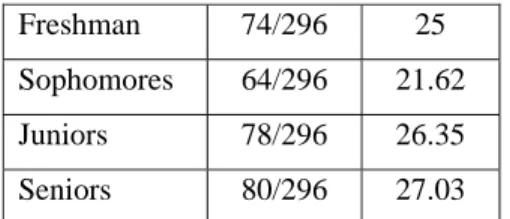
Table 1: Students' learning style Learning Style Number Percent (%) Converger 69/296 23.25 Assimilator 76/296 25.81 Diverger 87/296 29.44 Accommodator 64/296 21.50 32/296 (10.81%) students were male and 264 of them (89.19%) were female. The demograph-ic analysis by year of study demonstrates that 25% (74/296) of the students were freshman, 21.62% (64/296) were sophomores, 26.35% (78/296) were juniors and 27.03% (80/296) were seniors (Table 2).
Table 2: Students' Academic years
Academic year
Number Percent (%)
Freshman 74/296 25 Sophomores 64/296 21.62 Juniors 78/296 26.35 Seniors 80/296 27.03 No significant relationship was found be-tween the learning style and gender (p>0.05). There was no significant relationship between curriculum grade and the accommodator, di-verger (p>0.05). The relationship between aca-demic year and abstract conceptualization was found to be statistically significant as well as between academic year and active experimenta-tion (Table 3).
Table 3: ANOVA comparison of student' academic
years and Kolb’s learning cycles
Dependent Variable P value comparisons for
classification Concrete Experiencing
(CE) 0.0678 Not significant
Active Experimentation
(AE) 0.0432
Significant for juniors > seniors Abstract Conceptualizing
(AC) 0.0258
Significant for seniors > fresh-man, sophomore,
and juniors Reflective Observation
(RO) 0.5212 Not significant
Discussion
Nursing students seem to have a preference for the converger learning style. The students at the junior level seem to prefer this style of learning compared to the freshman, sopho-more, and senior students. Our data demon-strated that the junior level students are at the active experimentation cycle of learning. This is consistent with the type of learning the ju-niors are experiencing in the curriculum. Nurs-ing students in the third year of their education go to the hospital more often than the previous years and encounter patients more frequently. These students learn to utilize critical thinking skills when assessing and caring patients. The senior level students appear to cluster into the abstract conceptualization portion of the learn-ing cycle. This stage characterizes the stage when students learn by thinking or analyzing
problems which shows their ability to interpret has improved. This cycle also contains the converger learning style and is consistent with the level of learning the seniors are experienc-ing in the curriculum. Other studies of stu-dents' learning style also confirm these results (15). This is perhaps due to the similarity of the study discipline or personality characteristics of nursing students.
The learning preferences indicate that indi-viduals rely on a particular style to process and comprehend information in different stages (15). Nursing students, prior to their division course work do not fit into a particular learn-ing style. This indicates that faculty must em-ploy a variety of teaching techniques to effec-tively reach all students. The students must also become self-controlled in their learning process. They will need to identify the academ-ic strengths and weaknesses they possess (16). The teachers can assist the students in this process by administering the Kolb LSI
periodi-cally at the start of the curriculum and in the course of instruction. This will allow the students to be aware if their learning style has changed (10). It will also reveal students and faculty members where they are situated in the learning cycle. The junior and senior students seem to conform to a style or cycle of learning that involves thinking. This style of learning is very important when somebody working in a dynamic environment such as many units in the hospital. Upper level course work should incorporate a style of teaching that focuses on critical thinking skills. By matching the teach-ing style with the student’s preferred learnteach-ing style, content retention would improve, thus improving exam scores. Faculty should assess preferred learning styles throughout the stu-dents’ enrollment in the curriculum and should apply a variety of teaching approaches to effectively teach all students.
References
1.Cavanagh SJ, Hogan K, Ramgopal T. The assessment of student nurse learning styles using the Kolb Learning Styles
Inventory. Nurse Educ Today 1995; 15(3):177-83.
2.Van Wynen EA. Information processing styles. One size doesn't fit all. Nurse Educ 1997; 22(5):44-50.
3.Diaz DP, Cartnal RB. Students' learning styles in two classes: online distance learning and equivalent on-campus.
College Teaching 1999; 47(4):130-5.
4.Rakoczy M, Money S. Learning styles of nursing students: a 3-year cohort longitudinal study. J Prof Nurs 1995;
11(3):170-4.
5.Ridley MJ, Laschinger HK, Goldenberg D. The effect of a senior preceptorship on the adaptive competencies of
com-munity college nursing students. J Adv Nurs 1995; 22(1):58-65.
6.Hartman VF. Teaching and Learning Style Preferences: Transitions through Technology. VCCA Journal 1995;
9(2):18-20.
7.Campeau AG. Distribution of learning styles and preferences for learning environment characteristics among
Emer-gency Medical Care Assistants (EMCAs) in Ontario, Canada. Prehosp Disaster Med 1998; 13(1):55-62.
8.Hardigan PC, Cohen CS. A Comparison of Learning Styles Among Seven Health Professions: Implication for
Opto-metric Education. The Internet Journal of Allied Health Sciences and Practice:IJAHSP 2003; 1(1).
9.Healey M, Jenkins A. Kolb's experiential learning theory and its application in geography in higher education.
Jour-nal of Geography 2000; 99:185-95.
10.Duff V, Johnston N, Laschinger H. Learning styles of Chinese nursing faculty and career choice preferences. J Adv
Nurs 1992; 17(2):229-33.
11.Felder RM, Henriques ER. Learning and Teaching Styles in Foreign and Second Language Education. Foreign lang
ann 1995; 28(1):21-31.
12.Quinn FM. The Principles and Practice of Nurse Education. 3rd ed ed. London: Chapman and Hall;1995.
13.Willcoxson L, Prosser M. Kolb's Learning Style Inventory (1985): review and further study of validity and
reliabili-ty. Br J Educ Psychol 1996; 66(2):247-57.
14.Joyce-Nagata B. Students' academic performance in nursing as a function of student and faculty learning style
15.Russian C. Preferred learning styles for respiratory care students at Texas State University – San Marcos. The
In-ternet Journal of Allied Health Sciences and Practice:IJAHSP 2005; 3(4):1-6.
16.Pospisil R, Willcoxson L. Online teaching: Implications for institutional and academic staff development.
Proceed-ing of EdTech’98. Perth: Australian Society for Educational Technology 1998. Available from: http://www.tlc1.murdoch.edu.au/gen/aset/confs/edtech98/pubs/articles/p/pospisil.html.