Michele P. Hadburg. How Undergraduates Seek Career Information. A Master‟s paper for the M.S. in L.S. degree. April, 2011. 70 pages. Advisor: Barbara Wildemuth
The purpose of this study was to investigate undergraduate students‟ information seeking behaviors when searching for career information. No known current studies within the library and information science field address the career information seeking behaviors of college undergraduates, especially in the digital age. Qualitative interviews were
conducted with ten junior and senior humanities majors and two university staff members who provide career guidance to humanities majors. Analysis of this study focused on students‟ information needs, information source preferences, the nature of the career information seeking process, and how an aspect of personality (extraversion) was related to source preferences. Results showed that participants utilized a core set of both human and information sources, although several of these sources received mixed reviews, as well as a long tail of many other sources. For undergraduates, the career information seeking process is not always satisfying and is highly unique and repetitious in nature.
Headings:
Information needs College students Vocation
HOW UNDERGRADUATES SEEK CAREER INFORMATION
by
Michele P. Hadburg
A Master‟s paper submitted to the faculty of the School of Information and Library Science of the University of North Carolina at Chapel Hill
in partial fulfillment of the requirements for the degree of Master of Science in
Library Science.
Chapel Hill, North Carolina April, 2011
Approved by:
Table of Contents
List of Tables 2
Introduction 3
Literature Review 6
Methods 19
Results and Discussion 25
Conclusion 55
Acknowledgements 58
References 59
Appendix A: Definitions of Career Information Sources 62
Appendix B: Student Interview Guides 63
Appendix C: Test for Extraversion Preference 65
List of Tables
Table 1: Study Participants 25
Table 2: Mentions of Sources for Career 38
Information - by Participant
Table 3: Frequency of Each Rank of Each 40
Source for Career Information
Table 4: Relationship between Rankings of 52
Introduction
Information seeking is broadly defined as “a conscious effort to acquire information in response to a need or gap in your knowledge” (Case, 2007, p. 5).
Researchers in the field have investigated a variety of everyday life information seeking situations, which are daily life situations not related to work or academic endeavors. Looking for career information is an important everyday life information situation in that much of a person‟s livelihood and day-to-day activities can be influenced by their career. Career information has been identified as one of the three most frequently needed
information types in the United States (Bunch, 1982). Moreover, four nationwide surveys commissioned by the National Career Development Association (NCDA) found that nearly 7 in 10 adult workers said they would get more information about jobs if they were starting over (Brown, 2007, p. 10). But exactly how people look for career information has not been widely explored, especially not recently and not by scholars in the library and information science (LIS) field. Indeed, the development of a career and finding a job is a complex process that encompasses social norms, personal backgrounds, and general interests. However, service providers, especially career counselors and librarians, can better serve their customers if they have a clearer picture of the specific sources and information seeking behaviors associated with finding career information.
counseling, career decisions, personalities, and interests. Two previous LIS studies (Julien 1999; Webber & Zhu 2007) did explore career information seeking, in Canadian high school students and in Chinese young adults living in England, respectively. In Julien‟s (1999) study, 59% of participants reported finding it difficult to find all of the information necessary to make a career decision, 38% felt they needed to go to too many places to obtain the information they needed, and many participants either lacked
awareness of some sources of information or found the information to be scattered. In Webber and Zhu‟s (2007) study, 55% of participants reported experiencing barriers to finding career information.
While Webber and Zhu‟s study did encompass the Internet, Julien‟s study was just early enough that the Internet is barely discussed as a potential source of career information. Julien did discover some of the more affective issues surrounding the search for career information, and Webber and Zhu did identify some preferred career
information channels (the Internet, magazines, and newspapers). These studies, though, lack depth into why the participants chose certain sources and what process they used to locate information. The studies were also done on two specific populations, and one study (Julien‟s) may be outdated due to the current popularity of the Internet.
hiring fell 22% in 2009, and in spring of 2010 the Wall Street Journal reported that the outlook “remains grim” for recent college graduates (Murray, 2010). The good news is that, for the first time in 18 months, NACE reported that an “absolute majority” (51.5%) of the companies participating in its monthly hiring survey intended to add recent graduates to the spring 2011 payroll (Giegerich, 2011). Still, recent undergraduates are just beginning to recover from the recession in terms of post-college employment opportunities, and no current LIS research exists on how American undergraduate students look for career information.
This study aims to investigate undergraduate students‟ information seeking
behaviors when seeking career information. Specifically, it will investigate how they look for career information in terms of the steps they take, the sources they use, and the overall nature of the process for them. It will also explore whether one aspect of people‟s
Literature Review
While little literature has addressed the information seeking behaviors of undergraduate students specifically, combining several categories of previous research illuminates some of the current thinking in the field. Literature about seeking career information, undergraduates‟ everyday life information seeking, and extraversion
preferences in career information seeking provides a more comprehensive picture of what previous scholars have found in this area.
Seeking Career Information
Academic research into the question of career information seeking has historically been scattered amongst vocational, psychology, and education literature, with only a few studies from the library and information science (LIS) literature. The literature primarily has focused on how and why people seek career information and what types of
information they tend to pursue. The studies are most frequently geared toward career counselors‟ considerations; only two empirical studies focused on considerations for librarians.
Career, or vocational or occupational, information has been identified by
graduates reported using no source of occupational information. Brown also discusses the results of four nationwide surveys commissioned by the National Career Development Association (NCDA), in which nearly 7 in 10 adult workers said they would get more information about jobs if they were starting over (p. 10). Brown infers from this that there is a considerable need to improve the delivery of career information.
Some research has inquired into why people look for career information. Aiken and Johnston (1973) explored ways to promote career information seeking behaviors in vocationally undecided college freshmen and sophomore males. They found that vocational group reinforcement counseling (two to three one-and-a-half hour sessions) was related to an increase in career information seeking responses amongst the students. It was especially related to the students‟ cognitive responses; that is, the students reported spending more time thinking about seeking career information after experiencing the group reinforcement counseling. Furthermore, Aiken and Johnston found that the amount of information students seek may be related to their readiness or interest in making vocational plans. They determined that some career exploration behaviors can be taught, but some students are more ready to explore than others.
toward career information seeking led to a higher behavioral intention to search for this information, which in turn led to higher levels of career information seeking.
Researchers have also explored people‟s strategies for gathering career information. Gati and Tikotzki (1989) studied the paid use of MEITAM (the Hebrew acronym for Computerized Occupational Information System) by men and women ages 17 to 39, in order to determine their strategies for collecting career information. They found that most career information seekers intuitively used an elimination strategy, eventually limiting the number of career alternatives to which they gave serious
consideration. Gati and Tikotzki found that, as the number of potential career alternatives considered increased, the percentage of career alternatives that participants actually explored decreased. Conversely, at times the participants used a compensatory strategy if the number of career options presented by the system was small. Gati and Tikotzki point out that these strategies were sometimes used at specific points in the information seeking process: participants used the elimination strategy in the beginning stages when many options were present, and they used the compensatory strategy in the final stages when not many options were left.
information. Students seemed to “feel blocked by people having the authority to help,” including guidance counselors, librarians, and other “people [who] won‟t just give straight answers” (p. 43). Some students experienced emotional difficulties, such as feeling a lot of pressure, being scared and avoiding making a decision, or feeling stupid when asking for help. Other barriers included being overwhelmed by the quantity of information needed and institutional problems. Moreover, Julien‟s study revealed that the adolescents did not fully understand what decisions they needed to make about their future and were not clear on “an appropriate process of career decision making.” This confusion led to them feeling “anxious and overwhelmed by the decisions they made” (p. 47).
Julien also found that the adolescents lacked awareness of the existence of some sources for career information. Furthermore, even if students did possess awareness of most sources of help, the information overall was “scattered” (p. 47). Julien points out that many sources of career information provide pieces of information but not the
complete picture, so the adolescents might have been missing information since they did not know of all the information sources available to them. Many adolescents questioned the reliability of information in books, pamphlets, and career exploration software, as well as information given to them by guidance counselors. Julien suggests that “information providers must take steps to overcome this distrust” (p. 48).
getting support, reassurance, or confirmation, or making things calmer or easier. Julien found that the formal sources of information (materials in school career centers, school and public libraries, guidance counselors, teachers, and the Internet) provided more instrumental help than emotional help. Formal sources of information such as teachers and guidance counselors were described as particularly helpful when the relationship was like that of a friend or parent. Libraries were characterized as the least helpful formal source of information, and the adolescents gave only negative comments about the librarians they had encountered (p. 375). The informal sources of information were less likely to be “purposively” approached; instead, adolescents had more casual
conversations with friends, family members, and acquaintances, which provided support, reassurance, and motivation. Adolescents characterized people in a career of interest or people who shared their personal experiences of attending college as being of the greatest help. Interestingly, it was guidance counselors (categorized as a formal source) and parents (categorized as an informal source) who provided help that was both instrumental and emotional, although the guidance counselors were only occasionally of emotional help.
found with finding career information online: registering at employment sites takes a long time and then they receive junk e-mails afterwards, the authenticity of vacancy
announcements could not always be determined, and sometimes they could not tell if a posted vacancy was still current. Webber and Zhu‟s participants also utilized magazines and newspapers to some extent, and this was the information channel that participants recommended most to their friends. The Internet was the most heavily utilized by far, but it was not the most recommended channel. Similar to Julien‟s (1999) study, 55% of Webber and Zhu‟s respondents felt they had encountered barriers when seeking career information. Webber and Zhu did not explore the nature of the barriers.
It has been noted that social influences have a large effect on people‟s career information seeking. Barak, Carney, and Archibald (1975) and Julien (1999) argue that career information is filtered through people‟s unique personal systems of attitudes and values, which have been instilled during socialization and in school. Furthermore, Julien (1999) states that a number of human sources, such as family, peers, guidance counselors, teachers, library resources, and the mass media, also provide career information. We can imagine that this information, too, has been filtered through the source‟s personal system of attitudes and values. In this sense, career information is very different from other information types, such as scholarly or academic information.
decision-making was reflected in the diversity of information needs (gaps) and preferred sources of help” (p. 383). Millar and Shevlin (2003) found that 15 to 16 year old high school students engaged in “widely different” amounts of information seeking for careers over a four month period. Specifically, the students‟ total number of individual
information seeking activities ranged from 8 to 468 (p. 27). Sharf (1975), who studied non-college-bound high school youths, found that, not only did the types of career information sought vary, the amount of information sought varied even more.
Furthermore, students varied in what types of occupational information they examined most – descriptions of occupations were read the most, followed by educational information, qualifications, and salary, while working conditions and employment outlook were examined the least. Sharf describes the resulting styles of career
information seeking as “quite idiosyncratic” and encourages career counselors to make individual suggestions for career information seeking, rather than uniform suggestions to groups of students (p. 128).
There is general agreement that the availability of online career information is growing rapidly. Brown (2007) states that in the last five years the amount of
Undergraduates’ Everyday Life Information Seeking
There is a wealth of literature about how undergraduate students seek course-related information, but not nearly as much course-related to their everyday life information seeking. As Savolainen (1995) defined it, the concept of everyday life information seeking (ELIS) “refers to the acquisition of various informational (both cognitive and expressive) elements which people employ to orient themselves in daily life or to solve problems not directly connected with the performance of occupational tasks” (p. 266, 267). Similar to what Julien (1997), Sharf (1975), and Millar and Shevlin (2003) found in relation to career information seeking, Savolainen posits that the ways in which people search for information to solve specific problems “are determined by values, attitudes, and interests characteristic of their way of life” (p. 267). Savolainen found that people evaluate the relevance of different information sources and channels on the basis of the sources‟ familiarity and effectiveness in situations requiring information use.
In terms of studies that cover the ELIS of undergraduate students, Head and Eisenberg (2009, 2010) is one of the very few recent studies. As part of Project
Information Literacy at the University of Washington iSchool, their research surveyed several thousand college students nationwide during both 2009 and 2010. The resulting two reports contain a wealth of information about how undergraduate students seek information in the digital age, both for their courses and for their everyday lives.
personal use in everyday life, career information ranked fourth with 56% of respondents reporting they had looked for it. Interestingly, in the 2010 report that number increased, to 67% of student respondents reporting that they had conducted research for work and/or career information.
In the 2009 report, which focused broadly on how students seek information, Head and Eisenberg found that most students had developed an information seeking strategy that relied on a small set of known information sources. Students were driven by familiarity and habit and displayed little fondness for varying the frequency or order of the sources they used, regardless of their information goals. This means that, while the digital information landscape has increased tremendously, students have actually “dialed down the aperture” of all the resources that are available to them by sticking to the tried and true. Students‟ frustrations were exacerbated, not solved, by their lack of familiarity with the digital information landscape.
Head and Eisenberg (2009) broke down their study according to contexts, meaning how students get information for interpretation and definition of a topic at various stages of the information seeking process. Broadly, they defined four research contexts that students need to find:
1. Big picture – finding out background for defining and selecting a topic
2. Language – figuring out what words and terms associated with a topic may mean 3. Situational – gauging how far to go with research, based on surrounding
circumstances
4. Information-gathering – finding, accessing, and securing relevant research resources (p. 7)
research, 63% of students reported a need for big picture context “often” or “almost always.” Similarly, 64% of students reported first needing big picture context at the start of their everyday life research. The other contexts following big picture were not as common to the everyday life research process, but they were in fact more common to the beginning of the everyday life research process: in terms of needing to find a context “near the beginning” of the everyday life research process, 62% of students reported first needing to find language context then, and 39% reported first needing an information-gathering context then.
Head and Eisenberg (2009) explored respondents‟ information seeking strategies, and the results indicate that the student approach is “based on efficiency and utility.” Most students reported using public sites such as Google early in their research for both coursework and everyday life. The researchers posit that this may be one reason why students find research frustrating in the digital age: they are immediately faced with hundreds of thousands of search results, which they then need to evaluate. Students reported the most frustrations with narrowing down topics, finding relevant sources, sorting through too many results from online searches, and evaluating the credibility of what students choose to use.
networks, instructors, other search engines, encyclopedias, and blogs. Library shelves and librarians ranked last on the list of resources used for everyday life research. This is consistent with Julien‟s (1997) findings that adolescents characterized librarians as the least helpful formal source of career information.
Overall, Head and Eisenberg (2009) characterized students‟ conceptualization of research as “a competency learned by rote, rather than as an opportunity to learn,
develop, or expand upon an information gathering strategy which leverages the wide range of resources available to them in the digital age” (p. 1). Students tended to use a narrow world of resources and to revisit these resources frequently.
Head and Eisenberg (2010) also reported what criteria students use for evaluating web content for everyday life research. The respondents ranked the following criteria as the highest (composite score): interface design, familiarity with the site from previous usage, currency, URL, author‟s credentials, and having heard about the site before. The lowest-ranked criterion was a librarian referral to the source. In terms of whom students asked for help with evaluation for everyday life research, friends/family ranked first, classmates second, instructors third, licensed professionals fourth, and librarians last.
“nagging uncertainties with concluding and assessing the quality of their own research efforts” (p. 3).
Extraversion Preferences in Career Information Seeking
As has already been partially discussed, numerous factors go into career decision-making and career information seeking. These factors include personal values and beliefs, decision-making styles, career interests, motivation, proclivity for self-exploration, and personality characteristics. Vocational behavior research has demonstrated that personality characteristics may affect people‟s career information seeking. Miller (1982) found that greater vocational information seeking was associated with higher levels of occupational extraversion; that is, a higher preference for
Conclusion
The literature demonstrates a range of research studying the ways in which people seek career information, but large gaps remain in terms of literature that covers specific groups (such as undergraduate students) and that is up to date in terms of Internet
sources. Recent literature about undergraduate information seeking behavior does include everyday life information needs, but very few studies have examined career information seeking. This study aims to fill a gap in the research by learning about the ways in which undergraduate students today seek information for their careers. Specifically, this study investigates which career information sources undergraduates prefer to use and why, what steps undergraduates tend to take when seeking career information, how
Methods
In order to gain substantive insight, this study utilized qualitative in-depth interviews. Primary participants were a subset of undergraduate juniors and seniors majoring in the humanities. Secondary participants were university staffers who assist undergraduate humanities majors with their career planning. The researcher utilized semi-structured interviews with primarily open-ended questions. These methods are described in more detail in this section.
Participants
The primary population sampled in this study was undergraduate juniors and seniors majoring in the humanities at a university, which will be called University X. Humanities majors were selected because these majors generally do not feed into a strict career path, whereas majors such as accounting or chemistry are more likely (though not guaranteed) to have a direct path to a certain career. Humanities disciplines included American studies, art history, fine art, classics, communication studies, creative writing, cultural studies, dramatic art, English, comparative literature, Germanic languages and literatures, linguistics, music, philosophy, religious studies, Romance languages and literatures, Slavic languages and literatures, and women‟s studies. Subjects majoring in interdisciplinary studies were excluded from the sample, because the major can be
Humanities majors made up the primary sample in order to decrease sampling variability. Only juniors and seniors were utilized because they are generally closer to making a career decision (whether it be work or graduate school) than freshmen and sophomores, by virtue of the fact that they will graduate sooner. The juniors and seniors likely had thought about their post-graduation plans more than the lowerclassmen had, thus they were more appropriate for this research.
Primary participants were recruited using the university mass emailing system. The recruitment email was sent only to juniors and seniors in the university‟s College of Arts & Sciences. Participants were also recruited using fliers posted in campus buildings and libraries. Once a potential participant responded to the recruitment materials, the researcher verified that he or she was a junior or senior humanities major. If a participant passed the initial screen, then the researcher corresponded with the participant via email to set up the interview.
Ten primary participants agreed to be interviewed for this study. Of the ten, seven were female and three male. All were juniors or seniors majoring or double-majoring in a humanities discipline. Post-graduate plans included working, going straight to graduate school, and working before attending graduate school.
Secondary participants were recruited using email messages sent directly to four possible participants, who were identified as providing career guidance either to a
substantial humanities-only group or to one specific humanities major that was one of the largest humanities majors at University X. The researcher corresponded with the
participants via email to set up the interview. Of the four who were asked to participate, two secondary participants agreed to be interviewed for this study.
Description of Methods
This study was qualitative and exploratory in nature. According to Rubin and Rubin (2005), qualitative interviews allow the researcher to “understand experiences and reconstruct events” for which she was not present (p. 3). Both of the LIS studies
regarding career information seeking (Julien, 1999; Webber & Zhu, 2007) used surveys followed up with qualitative interviewing (Julien did 30 interviews, Webber and Zhu did nine). The researcher determined that, for this study, using a survey would have
“[stripped] away the context” of the participants‟ answers (Rubin & Rubin, 2005, p. 2). Utilizing semi-structured interviews allowed the researcher to ask follow-up questions and probe for more detail, in order to capture the contexts and emotions surrounding the search for career information.
Data Collection
that were mutually convenient for them and the researcher. The interviews were recorded, with participants‟ permission, using a handheld digital recorder.
Secondary participants were interviewed for approximately 30 to 45 minutes in their offices on the university campus. These interviews took place during business hours, at a time that was mutually convenient for them and the researcher. The interviews were recorded, with participants‟ permission, using a handheld digital recorder.
The researcher conducted the interviews using interview guides (see Appendix B). In addition to the questions on the interview guides, the researcher also utilized probes and follow-up questions to elicit more comprehensive responses. The primary participants‟ interview guide began with questions intended to clarify where the participant was in terms of finalizing his or her post-graduation plans. The following questions asked the participant to think about a specific incident in which he or she searched for career information. This technique was used in order to encourage the participant to think specifically as well as broadly about his or her career information seeking. The last open-ended question asked participants to discuss how much career information seeking they felt they had left to do before graduation.
Next, the primary participants were asked to discuss the sources they use for career information seeking via an exercise with index cards. The participants were asked to tell the researcher which sources they use for finding career information. The
Last, the primary participants completed a short test for extraversion preference (see Appendix C). The test was conducted in order to determine the strength of
participants‟ preference for extraversion.
Primary participants received $10 for their participation in this study. They were also offered an optional resume review by the researcher, who had participated in hiring committees professionally. One out of the ten participants utilized the resume review.
The secondary participants‟ interview guides were designed to elicit responses about patterns and trends in the kinds of career information undergraduate humanities majors are searching for, and how they search for it. Secondary participants were asked about the scope of their work in advising humanities undergraduates, what types of information the students tend to ask for, and how they provide services to the students. Interviews with the secondary participants were quite open-ended, and the researcher asked follow-up questions based on what the interviewees explained in previous questions. Secondary participants did not receive any monetary inducements for their participation.
Data Analysis
The researcher used open coding to analyze the data, in which she read through transcripts and recorded as many headings as necessary (Burnard, 1991). The headings accounted for much of the interview data. After identifying headings, the researcher grouped them into “freely generated” categories (Burnard, 1991, p. 462). The researcher then used a constant comparative process to identify further emerging themes and categories in the interviews. Using this process, the themes and categories became more evident as more interviews were conducted. As each new interview was transcribed and open coded, the results were compared with previous interviews. This allowed new categories to emerge and already existing categories to be expanded. This iterative process was used for all of the interviews, so that by the time the interviews were complete, a clear picture of themes and categories had been identified.
The participants‟ short tests for extraversion preference were analyzed
Results and Discussion Participants’ Career Plans
Table 1 illustrates the participants‟ gender, year in school, major(s), and post-graduation career plans.
Table 1: Study Participants
Name** Gender
Year in
School Major(s) Post-Graduation Career Plans
Audrey F Senior Music
Work (field undecided) before obtaining a Master‟s in Music Therapy
Carl M Junior
Philosophy* & Political Science
Work in consulting/politics/political strategy before possibly attending law school
Danielle F Junior
History* & Political Science
Work (field undecided) before attending law school; or go straight to law school
Ingrid F Senior
Linguistics* & Romance Languages*
Probably work in Asia before obtaining a Master's in Teaching
Jason M Senior
Communication
Studies Work in social media
Laura F Senior
Spanish* & Psychology
Obtain a Master's in Counseling (pending acceptance from the school)
Mary F Senior
Spanish* & Sociology
Work in social services before obtaining a Master's in Social Work
Patty F Junior
Music* & Spanish*
Study music in France before obtaining a Master's in Music Composition
Rebecca F Senior English
Work in publishing before obtaining an MFA in Creative Writing
Thomas M Junior Philosophy
Travel abroad and then find work in the U.S.
Of the ten participants who were interviewed, seven were female and three were male. A range of humanities majors were represented, including six double-majors. Participants‟ career interests varied widely, and most were closely or somewhat related to the students‟ majors. Three participants spoke of possibly attending graduate school directly after obtaining their Bachelor‟s degree, while five participants planned to work for one to three years before attending graduate school. Of those eight participants, all eight had already identified the type of graduate degree in which they were interested. None of the participants had already secured post-graduate employment, and nine out of the ten were actively searching for either post-graduation jobs or post-junior year summer internships. The other participant, Laura, was waiting to hear whether she had gotten accepted into a master‟s in counseling program, and, because she felt confident that she would get in, was not actively seeking employment in case she was denied acceptance.
Information Needs
openings that they were qualified for and interested in. A few students spoke of needing to discover what their options were and how to start. Thomas and Patty, both juniors, and Audrey, a senior, talked about needing to discover where to start finding information on jobs and careers. Audrey said, “I needed to know where I could start looking for jobs and opportunities, whether it be resources online, through classifieds, or if there are
networking nights where I can possibly obtain a full-time job.”
About half of the students spoke of their needs to locate job postings that were entry-level or for which their level of experience would be acceptable. All of these students were seniors who were searching for job postings in relatively specific
industries, such as social media, publishing, and social work. Jason, Rebecca, and Mary all said that information about years of experience required was their biggest information need, and all felt it was a barrier to finding jobs to apply for. Jason spoke of his concern with finding appropriate jobs to apply for: “I‟m nervous because most of [what] I‟ve seen, there‟s not a lot of entry-level jobs or they require at least one to three years‟ experience.” A couple of other students also mentioned wanting to know if employers would be okay with hiring someone “right out of college.” The students seemed unclear as to how their relevant experience, such as summer internships, would apply to
employers‟ experience requirements.
Two students, Carl and Laura, initially spoke of their information needs in terms of wanting to find what careers were available to them, given their career interests and academic majors. They described their information needs as a process of trying to
them – for Carl, it was working at a political strategy or consulting firm, and for Laura it was working as a counselor for girls. Carl and Laura initially framed their research needs within the idea that whatever career information they were seeking needed to line up with their interests and be available to students with their majors. Laura spoke of her
information need as “what can I do with my major with my interests. How can I find something that would fit my interests and what I want to do?”
Several more students spoke of needing to align their humanities major with available job opportunities. Carl, a junior majoring in philosophy and political science, spoke of his need to determine the opportunities afforded to him by his majors:
[I‟ve been] researching information [to find my] niche in a job or a career, especially with a degree that‟s not specialized… like, say, chemistry or computer science. The options are pretty open, and they‟re at the same time blocked from the specialized sciences. That‟s kind of like what can make it tricky – there‟s potential for a lot of possibilities, which I guess is important to be aware of. Other students found their humanities degrees to be more frustrating, rather than serving as a gateway to many possibilities. Mary, a senior studying Spanish and
sociology, spoke of wanting to work in the social services but feeling discouraged
because some of those jobs require a particular degree, such as an Associate‟s degree in a specialized field of study. She spoke of her frustration with earning a Bachelor‟s degree, which requires more schooling than an Associate‟s, but not being able to apply it
philosophy major, did not speak of any difficulties in aligning their majors with their future careers.
When asked why they needed the career information, students spoke of several reasons, often related to planning for the future, aligning their interests with careers, and simply trying to find a post-graduation job. For example, Patty and Danielle, both juniors, spoke of needing career information so that they could better plan for their future
financial and housing situations. Danielle was trying to determine if she should graduate early, so she needed career information in order to determine if it was feasible for her to find employment if she graduated this December. Patty, who was planning to go to France after graduation to study music, was trying to plan for the financial costs of such a trip and sought information about what grants were available and what job opportunities existed in case the trip fell through. Carl, also a junior, spoke of his information needs, not in terms of future planning, but in terms of needing to discover all of the types of jobs and careers that exist for him.
even have the degree to apply for,” she said. She seemed to be using a process of elimination to find viable job listings.
The variety of information needs that the students described are in line with what the University X career counselor talked about students needing and how she helps them:
It really spans the gamut, from, “I love English, now my parents want to know what I‟m going to do with it,” to graduate school counseling… Some need help with the self-assessment piece, some need help exploring their options, some need help trying to make a decision.”
The career counselor‟s statements indicated that students have a wide variety of career counseling needs. The humanities department advisor discussed how some students come to him asking for help translating their humanities major to a career. He said he usually gives them a little speech about the different skills they are learning as humanities majors, and how “they learn lots of things that they can then explain to an employer how those skills and how that knowledge they‟ve acquired as an [X] major is applicable to any number of careers.” He said that he tries to “build their confidence” that they can
successfully enter the work world as a humanities major. The students‟ responses, combined with the career counselor‟s and advisor‟s responses, indicate that, while the undergraduates‟ career information needs do vary by person, they fit into a set of needs, including open job postings, determining what careers interest them and what they are qualified for, determining how their humanities majors translate into a career, and general planning for the future.
entry-level jobs or jobs that were appropriate for their experience entry-levels. Other students who were not as close to identifying their post-graduation career field expressed a need for information about what career options were available to them – although some seniors needed this information, too, along with entry-level job openings. A couple of students‟ information needs were closely tied to determining what career fields were available to them given their humanities major(s), and most of these expressed frustration with aligning their degrees with a field.
Information Seeking Behaviors
During the discussion about a specific career information need, students described what steps they took to obtain the information they needed and what resources they used for that particular information need. They also talked about what they did after locating the initial information that they needed. In general, students‟ information seeking behaviors could be described as diverse. They employed a variety of methods to search for career information, and similarly, utilized an array of sources.
helpful to their career information search, and the remaining three found the office to not be helpful. The three found the office to not be helpful for different reasons: Ingrid, a senior, said they showed her jobs she was not interested in; Danielle, a junior, said they showed her resources that were unhelpful (specifically, the phone book); and Thomas, a junior, said they showed him how to find job openings but did not show him any specific people or connections to help him get the jobs.
Visiting the Career Services Office in person was not the only human source mentioned as part of students‟ specific searches for information, and students utilized these human sources at various points in their information seeking. Six students discussed utilizing human sources besides the Career Services Office advisors. Audrey talked about discussing her information needs with her parents, Danielle spoke with her parents as well as other adults in her hometown, Laura spoke with her friends, alumni, and people in her church, Patty spoke with the study abroad office and two of her music professors, Carl networked with two alumni, and Jason went to two local conferences about social media. The students spoke with their human sources at various points in their information seeking processes. Danielle and Laura began by speaking with their human sources, while Audrey, Carl, and Jason spoke with their sources towards the end of their
All ten students discussed utilizing a small set of websites at various points in their career information seeking process. Some students talked about starting with the Career Services Office website and then branching out to include other websites in their search. Many students went to, or had already started with, aggregated job listing sites such as SimplyHired, CareerBuilder, and Monster. Four students also used industry-specific or employer-industry-specific websites as ways to satisfy their research need. Rebecca used bookjobs.com, which lists jobs in the publishing industry, Mary used a county website to find social services jobs, Ingrid used a website about lateral entry teaching requirements and a website listing federal government jobs, and Jason started following certain companies on LinkedIn. In general, students mentioned no more than two to four websites – and occasionally only one website – as part of their resource selection for finding specific career information.
The actual search processes that students utilized seemed to follow no specific format, and students did not separate their information seeking process into certain steps. That is, students did not articulate their information seeking process as being a series of distinct steps that led to other steps; rather, their processes were more of an amalgamation of checking human and information sources. The Career Services Office, both in person and the website, was a logical place for many students to start their search. But after that, students checked and utilized a variety of information and human sources nearly
simultaneously and in no specific order.
the publishing industry. Similarly, Jason started using CareerBuilder because his
roommate had been offered a job that he had found through CareerBuilder. Mary started checking county websites for social work jobs based on a recommendation from a Career Services Office counselor, and Thomas also checked some websites recommended to him by a Career Services counselor. Laura found out about her possible graduate program through friends who had attended the program.
What students did next after they consulted their initial set of resources for their information needs varied widely. Several students, all seniors, said that they simply applied to whatever jobs or graduate programs they found that fit their requirements for interests, experience required, and location. Carl, a junior, began working on his resume and cover letter with the intent to apply to certain summer internships he had found. Jason, a senior, described his next steps not as applying to specific jobs but as expanding his universe of resources to include different websites than the Career Services Office website, UCareers1, which had previously been his chief source of career information, and attending the social media conferences. Two students, Audrey and Patty, both discussed how their next step was to make a list. Audrey made a list of the types of jobs and opportunities that interested her and that she was qualified for. She then used her list to research the pros and cons of each job. Patty made a list of options for her
post-graduation life. She then used her list to compile financial information related to each option: whether it would cost her money, such as an overseas situation, or whether she would be earning money in a job.
1 UCareers is a pseudonym for the password-protected part of the Career Services Office website
Two students, Danielle and Mary, said that after their search for career information, they essentially gave up. Danielle said that, after a disappointing
appointment with the Career Services Office, she “was just really frustrated and kind of vented about it.” Then, after researching current, posted job opportunities and being disappointed with her findings, she decided that she would not graduate early so she had more time. Since she is a junior she felt she could wait to do more searching, so she stopped. Mary, a senior, also stopped searching after an unsatisfactory experience with finding career information. She said:
I just kinda gave up. I mean, that whole thing about not really finding anything that‟s out there, so I kinda just stopped. The Career Services Office lady told me that more jobs are posted in March, I don‟t know why, but she said to look later. So I‟ve just kinda given up on that. It‟s just kind of annoying.
While some students were able to take action from their searches by applying for various jobs or internships, or making lists to help with decision-making, some students felt unsatisfied and/or disappointed, and ceased searching altogether.
The University X departmental advisor said that in terms of showing students how to actually seek career information, he usually refers them to the Career Services Office. Since the primary information seeking seemed to be taught by that office, the career counselor was asked to describe the steps that she takes with students in advising
appointments. She aims to give them an organized, structured approach. If the student has an idea of what she wants to do, the counselor starts by showing her the available
organized in an Excel spreadsheet. Students who visited the Career Services Office spoke about their visits not in terms of what steps they were advised to take, but rather how helpful the visit as a whole was to them.
These findings are similar to what Julien (1999) found in her study, in that even when the undergraduates possessed an awareness of most sources of help, the
information overall was scattered. This led the students to a process of information seeking that did not have a clear order or steps, so their process consisted of checking various sources at various times and compiling information as they went along. While students in this study were not asked specifically how they organized their career information, two students did discuss making lists, but no other students talked about keeping track of their information seeking or job hunting, such as in an Excel
spreadsheet. Service providers might be able to better serve students by giving them an outline or a continuum of possible information seeking steps to take, along with a suggested outline of ways to organize the information.
The students‟ information seeking behaviors displayed quite a bit of scatter and followed no clear pattern or order. A majority of students (eight out of ten) visited the Career Services Office in person or visited the UCareers website as a first or second step, but students‟ satisfaction with these sources varied. All of the students discussed using a combination of human and information sources, and rather than going source-by-source, they wove back and forth between these sources. Sometimes a human source would lead to an information source, such as a website referral from a Career Services Office
approach to learning about careers and searching and applying for jobs, similar to what the University X career counselor suggests to students, may help them keep track of their information resources and information seeking steps.
Preferred Sources of Career Information
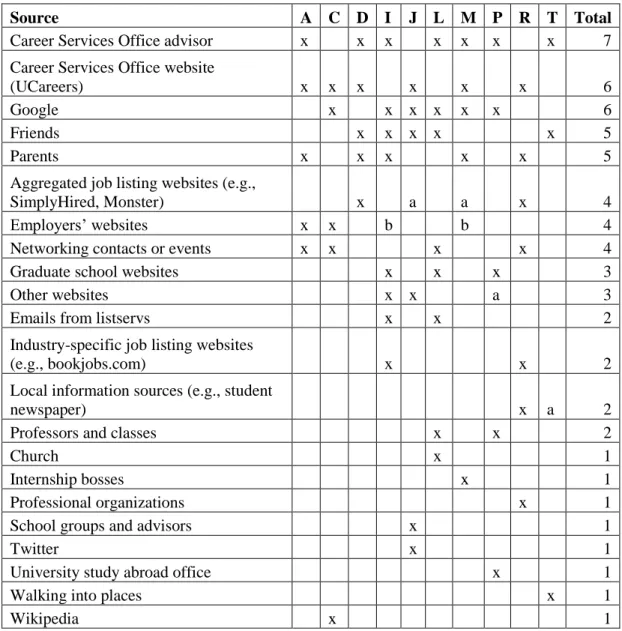
During the exercise with index cards, students ranked their preferred sources of career information and discussed why they preferred certain sources and disliked others. While some of these sources overlap with sources students discussed using for their specific information needs, the source rankings and accompanying discussions illuminated a vast range of uses of and opinions about career information sources.
Table 2:Mentions of Sources for Career Information - by Participant
Source A C D I J L M P R T Total
Career Services Office advisor x x x x x x x 7 Career Services Office website
(UCareers) x x x x x x 6
Google x x x x x x 6
Friends x x x x x 5
Parents x x x x x 5
Aggregated job listing websites (e.g.,
SimplyHired, Monster) x a a x 4 Employers‟ websites x x b b 4 Networking contacts or events x x x x 4 Graduate school websites x x x 3
Other websites x x a 3
Emails from listservs x x 2 Industry-specific job listing websites
(e.g., bookjobs.com) x x 2 Local information sources (e.g., student
newspaper) x a 2
Professors and classes x x 2
Church x 1
Internship bosses x 1 Professional organizations x 1 School groups and advisors x 1
Twitter x 1
University study abroad office x 1 Walking into places x 1
Wikipedia x 1
a = participant used two of these sources b = participant used three of these sources
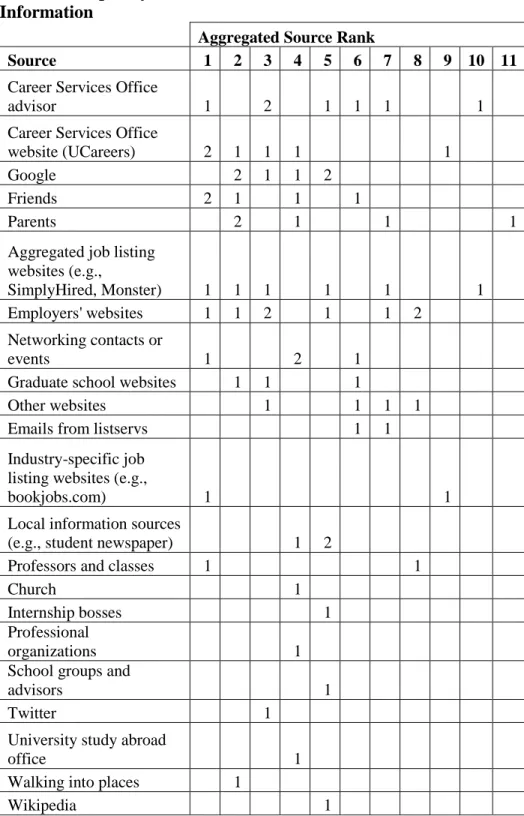
In order to further illuminate which sources the students prefer to use for career information, Table 3 shows the aggregated rankings of each source the students
Table 3: Frequency of Each Rank of Each Source for Career Information
Aggregated Source Rank
Source 1 2 3 4 5 6 7 8 9 10 11
Career Services Office
advisor 1 2 1 1 1 1 Career Services Office
website (UCareers) 2 1 1 1 1
Google 2 1 1 2
Friends 2 1 1 1
Parents 2 1 1 1
Aggregated job listing websites (e.g.,
SimplyHired, Monster) 1 1 1 1 1 1 Employers' websites 1 1 2 1 1 2 Networking contacts or
events 1 2 1
Graduate school websites 1 1 1 Other websites 1 1 1 1 Emails from listservs 1 1 Industry-specific job
listing websites (e.g.,
bookjobs.com) 1 1 Local information sources
(e.g., student newspaper) 1 2 Professors and classes 1 1
Church 1
Internship bosses 1 Professional
organizations 1 School groups and
advisors 1 Twitter 1 University study abroad
office 1
Walking into places 1 Wikipedia 1
sources are equally regarded. Some sources that received a lot of mentions, especially Career Services Office advisors, parents, and aggregated job listing websites, vary widely in how students ranked them. And sources that only a few students mentioned, such as industry-specific job listing websites and professors and classes, got some of the
students‟ number-one rankings. The charts reveal the highly individualized nature of how students search for career information.
Some themes emerged with how students described their preferences for various sources. Google, in particular, was described in an almost completely uniform way. The six students who listed Google as a source almost all described typing keywords into Google that had to do with whatever career or job they had just thought of, and how Google would lead them to sources that helped them better understand what they were curious about. Several of the students said that they typed “random things” into Google. Carl described how he uses Google as a tool to discover new things:
Google is a pretty easy basic search, normally… it leads you to information that‟s about a general job or about certain firms, or maybe ads or classifieds that are looking for something like that. Once you type in a search, you can also come up with results that you just don‟t expect and lead you to other things, and maybe you‟ll learn about… you‟ll stray off in places you didn‟t expect.
Jason said simply, “Google search has always just been easier for me to narrow down, like, keywords and what I‟m interested in.” Google is being used as a tool to expand students‟ universe of possible careers, and then to sometimes narrow those down.
specifically.” Audrey had established a relationship with this advisor and clearly trusted her as an information source. Mary ranked the Career Services Office advisors towards the end of her list, sixth, but said that her advisor gave her “new avenues” and was “probably the most helpful of anybody.” Mary did not have an established relationship with this advisor. For those who ranked the Career Services Office advisors lower on the list, they had been once or multiple times and all had different reasons for not ranking them highly. Ingrid said they showed her jobs for which she was not qualified and that it seemed like a “useless trip”; however, she said, “Maybe when I went I didn‟t know what I wanted to do, and I thought I did, but I really didn‟t.” She thought that the advisors would be more helpful once she had sorted out her own career plans. Thomas commented that the advisor he saw gave him “mostly websites” and he would have preferred more direct connections to employers. Patty, who ranked the advisors lower on her list, had not yet been to see one, and although she trusted that they would be helpful she simply had not seen them yet, so she could not be sure.
The Career Services Office website, UCareers, was described similarly by those who did prefer it, and similarly by those who did not prefer it. Those who did like using UCareers described it as “easy to use” and mentioned that they liked being able to submit their resume and cover letter all at once to employers. Furthermore, several students spoke of what UCareers meant to them in terms of being targeted directly at their
graduates, which I think gives me a leg up.” These students appreciated being able to access jobs and employers who, by using the system, indicated their desire to hire students from their university. Two of the six students who mentioned UCareers, however, did not prefer to use it, mostly due to difficulty of use. Danielle described her troubles with using the website:
I find [UCareers] extremely difficult to use, and I have a lot of difficulty
navigating it, so I wonder if there might be more in it than I‟m seeing, but I‟m not able to get the other information because I‟m not able to work that website
properly. It‟s just really hard to use.
Danielle seemed to know that more information was likely available to her, but she was frustrated because she felt like she could not access it.
was highly individual and seemed to be related to the context of the students‟ job search (e.g., Ingrid‟s search for international jobs).
For the more standalone sources that only one or two people ranked highly, there were very individual reasons for doing so. Patty, a double-major in music and Spanish, ranked her music professors number one and described why she did:
Spanish is also my major, but I‟m leaning more towards music. As far as my professors, I think it might be a little harder to go to [the Career Services Office] and for them to try to shape you and get you a job, because it‟s not as much what you know… it‟s strictly talent. You have to practice. My professors have been able to get me in contact with teachers or notice my weaknesses that would make me a better musician. I think their guidance is more focused, because they‟re also musicians so I kind of trust what they say more.
Patty‟s unique major, that she plays two instruments at the collegiate performance level, and that she hoped to study music in France after graduation dictated that her best information source was her music professors. Rebecca also rated an information source highly that no one else did: industry-specific job listing websites, specifically,
bookjobs.com. Rebecca, an English major, had completed an internship in publishing the previous summer and had decided that it was her ideal post-graduation industry. She hoped to be some sort of editor or writer. She had received the referral to bookjobs.com from a contact in the publishing industry, and spoke of visiting the website frequently.
involved” on Twitter and uses it to follow job search links. By utilizing Google Docs in order to share information and by sharing and receiving information on Twitter, these two students were utilizing social search methods to gather career information.
Overall, students utilized a relatively small universe of sources. The index card exercise was open for students to name as many sources as they wished. The average number of sources named was 7.1, with a standard deviation of 1.97. Four out of the ten students listed five sources, and only one student listed more than ten sources. While there is no “correct” number of information sources to use in a career search, it is
interesting to note that students seem to be using a compact set of resources. Furthermore, they are using these resources frequently, especially the websites. Students were not asked how many times they use a given resource, but many of the seniors spoke of checking certain websites, mostly containing job listings, frequently.
The students‟ preferred sources of information did not line up exactly with how the career counselor described them:
We know from research that the number one place students go when making a decision about their career is their parents, and number two is their professors. I would say that those are two likely places that students are going for their information, plus their peers.
While at least some students did mention these sources, only the peers received overall positive reviews as information sources – parents received mixed reviews and only two students talked about their professors and classes. It could be that making a career decision is different from seeking career information. But this study indicates that
Head and Eisenberg‟s (2009, 2010) research helps give some context as to how students are using certain resources for career information seeking. In their research, they found that undergraduates use Google early on in their research; in particular, 99% of respondents used Google for big picture context for everyday life research. Similarly, the University X students spoke of typing “random stuff” into Google to see what came up. The students were likely using Google to gain big picture context, the first context that Head and Eisenberg define. That is, students were using Google to gain background on different careers. They were likely also using Google to determine language context, in order to figure out what words and terms were associated with those careers. This study helps bolster Webber and Zhu‟s (2007) and Brown‟s (2007) statements that career information available on the Internet has grown rapidly; the only print source that students mentioned was the student newspaper.
This study is in line with Head and Eisenberg‟s findings that students rarely turn to libraries or librarians for help with everyday life research. No student in this study mentioned going to the library or asking librarians for help. Of course, University X‟s Career Services Office is the largest and most comprehensive resource for students on this campus to learn about careers. An opportunity may exist, however, for librarians at colleges or universities with smaller Career Services Offices to provide web-based subject guides, on the library website or even on individual department websites. If the subject guides are divided by major, this could help students determine which career information sources will help them specifically.
Results showed the most variation in this sub-category of how undergraduates seek career information. In comparison to the students‟ information needs, which varied according to individual but still fell into one of a few categories, students‟ rankings of career information sources and how they felt about each varied greatly. Overall students utilized a relatively compact set of sources. Several sources were named across
amongst people in terms of the amount of information people seek and the types of information they want.
Nature of the Career Information Seeking Process
Analyzing the students‟ interviews reveals that the nature of the career
information seeking process is highly unique. The possible outcome of the search for career information – a job or career – is a key component of people‟s lives. Thus the process of finding the right information consumes a lot of mental activity, in that it is top-of-mind for seniors and that it is an iterative process, which students said they will surely have to repeat.
just started thinking about it. The outcomes of searching for this type of information weighed heavily on nearly all of the students‟ minds.
Many students reported not being satisfied with the outcomes of their specific search for career information. Thomas and Audrey reported being satisfied because they secured part-time employment for while they are still in school. Patty said she was satisfied with her search, but went to on to qualify her answer: “I was satisfied, but I feel like even when you‟re satisfied, you‟re never at ease. I know that nobody can give me a job, or say to me, this is what you can do, so … nothing is certain.” Carl similarly reported being satisfied with his search but dissatisfied with the outcomes – his
dissatisfaction stemmed from knowing that he would be applying to highly competitive internships and not knowing if he would be invited to interviews. The remaining six students reported being dissatisfied. Two students‟ responses were “No, not yet,” after which they explained that they had not heard back from any of the jobs they applied for. Mary said that she was dissatisfied with her search, and described it as, “I know in my head what I want to do, but I don‟t know how to translate that into finding it, like in a job.” Overall, eight out of the ten students were not content with the outcomes of their search for career information.
probably have to search for it again after graduate school. Five students all answered “Yes, definitely” when asked if they would need to search again.
When asked how much searching for career information they felt they had left to do, three out of the four juniors said they had a lot of searching left to do. All of the seniors said that it was highly dependent upon what happened with their job or graduate school applications, but nearly all said that they knew they would have to continue searching at some point or another. Rebecca said that she would continue searching for career information if she got a less-desirable job: “It really just depends on who contacts me back and what I find out, but probably a lot more. Even when I‟m in the interview process or even if I‟ve been offered a job, I‟ll probably continue looking just to see if anything opens up [at my target employer]…” Mary said she had “weeks” left of searching and groaned at all of the steps required in the process: “It‟s not like you find one and then you apply and then you get it. You‟ve gotta apply to like a million of them to see what happens.” While the students were not asked to quantify precisely how much searching they have left to do, all of the students‟ responses indicated that they knew that they would need to spend more time searching for career information, either in the near or distant future.
The nature of the career information seeking process has similarities to the difficulties students had with everyday life research in Head and Eisenberg‟s study. While less than 50% of the students in Head and Eisenberg‟s study cited difficulties with this type of research, the most commonly cited difficulties could be seen at all levels of this study: filtering irrelevant results, knowing the answer is somewhere online,
different sources into the search. University X students spoke of having trouble filtering out job postings that were not relevant to them, and two students had trouble determining the credibility of job postings on SimplyHired and Monster. One student spoke of
knowing that information was in UCareers but being frustrated with not being able to find it. Nine out of the ten students said they had more searching to do and were not yet
finished. The final difficulty, integrating different sources into the search, such as websites, offices, and people, is likely another reason why students might have difficulties finding the career information they need.
The combination of students‟ career plans weighing heavily on their minds and their descriptions of their searches for career information being a repetitive process with no clear end contributes to the unsatisfying nature of students‟ searches for career
everyday life information seeking situations: students think about the outcomes often, are frequently dissatisfied with the outcomes, believe they will have to repeat their searching, and do not know exactly when they will stop searching.
Preference for Extraversion
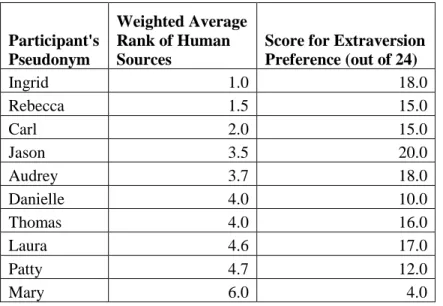
The students‟ personality tests, based on the short form Eysenck Personality Inventory, yielded a score for extraversion preference. The score, which was out of 24, was correlated with the weighted average rank of participants‟ Human sources. Both scores are shown in Table 4.
Table 4: Relationship between Rankings of Human Sources and Extraversion Preference
Participant's Pseudonym
Weighted Average Rank of Human Sources
Score for Extraversion Preference (out of 24)
Ingrid 1.0 18.0
Rebecca 1.5 15.0
Carl 2.0 15.0
Jason 3.5 20.0
Audrey 3.7 18.0
Danielle 4.0 10.0
Thomas 4.0 16.0
Laura 4.6 17.0
Patty 4.7 12.0
Mary 6.0 4.0
fact that eight out of the ten participants scored at the midway point or above on the extraversion scale means that this correlation does not take into account enough of those who are less extraverted. This further dampens the applicability of this correlation test. It seems that, while this aspect of personality, extraversion preference, is associated with higher amounts of career information seeking (as Miller, 1982 and Reed, et al., 2004 found), it is not necessarily correlated with utilizing more human sources within that information seeking.
Study Limitations
A key limitation of this study is that field research “can pose problems of reliability” (Babbie, 2010, p. 328). This is in part because the study participants, if questioned again, might give different answers depending on their situation, mood, or general feelings. Sharf‟s (1975) findings corroborate this and make it specific to career information seeking; because students‟ reports of their career information seeking behavior and their actual behavior differed for Sharf, it could mean that the information obtained from students is not a reliable description of their actual behaviors.
Another limitation is that the low number of study participants limits how well the study can be generalized to the undergraduate population of humanities majors as a whole. Within the study participants, there may be a weakness regarding who
Conclusion
This study attempts to build on previous research about career information seeking and to serve as an exploratory study into how undergraduate juniors and seniors in the humanities look for this type of information. The study illustrates that career information seeking for these students is a complex process in which a variety of sources and information seeking steps are integrated. Students utilize a core group of sources, especially Career Services Office advisors, UCareers, parents, friends, Google,
aggregated job listing websites, and employers‟ websites, but they do not rank all of those core sources equally. The remaining sources follow a “long tail” distribution and vary widely from person to person. The students‟ heavy use of Internet sources and total lack of print source usage shows that students in the digital age are heavily utilizing Web-based sources for career information.