Abstract
Nitric oxide (NO) has a vast range of biological functions; exhibiting tumoricidal and antimicrobial properties while also playing a role in angiogenesis, platelet adhesion, and inflammatory responses. Macromolecular scaffolds capable of storing and releasing NO have the potential to be used as antimicrobial agents to protect populations more prone to bacterial infection, such as people who suffer from cystic fibrosis (CF). Alginate, an anionic biopolymer composed of mannuronic acid and guluronic acid residues, represent an ideal NO-releasing vehicle due to low cytotoxicity, simple modification process, and water solubility even at high molecular weights (200-500 kDa). Herein, we report a systematic study to examine the antibacterial properties of different molecular weight alginate against planktonic Pseudomonas aeruginosa and Staphylococcus aureus, two of the most common pathogens present in CF patients. Lower
molecular weight (2 - 5 kDa) NO-releasing alginate was found to have improved bactericidal efficacy against Pseudomonas aeruginosa, requiring lower NO doses to achieve bacterial killing compared to the conventional antibiotic - tobramycin. However, NO-releasing alginates’ bactericidal efficacy against S. aureus did not exhibit a clear dependency on molecular weight.
Introduction
Cystic fibrosis (CF) is an autosomal disorder that affects over 30,000 individuals in the United States.1,2 Primarily, this disease affects the lungs by impeding mucociliary clearance from the airways,3 causing buildup of a thick, dehydrated and immobile mucus layer. The accumulation
health. These bacteria could proliferate throughout the airway, leading to acute pulmonary exacerbation, or develop into biofilm colonies. Biofilms are particularly problematic due to the formation of an exopolysaccharide matrix, which protects it from host immune response and antibiotics. As such, biofilm typically require ~1000 times more antibiotic dose to eliminate compared to planktonic bacteria. No cure currently exists for CF, but treatments can improve quality of life for patients by combating chronic bacterial infection. Unfortunately, bacterial species have developed potential cellular mechanism (e.g., self-alteration of cell membrane targets and the use of pumps to reduce internal concentration of antibiotics)8 that minimize the effects of traditional antibiotics such as tobramycin and methicillin. Specifically, multiple drug-resistant Pseudomonas aeruginosa (MDR-PA) and methicillin-resistant Staphylococcus aureus (MRSA)
infections present a difficult challenge for traditional treatment methods.3,9 Therefore, novel antibacterial agents that can effectively eliminate planktonic bacteria responsible for chronic infection in CF are greatly needed in the fight against emerging antibiotic-resistant pathogens.10
to develop resistance.16 Due to its antibacterial properties and endogenous production, NO is a good candidate for use as a therapeutic against chronic bacterial infections in CF lungs.
The hazards of gaseous NO such as high reactivity and toxicity concerns has led to the development of N-diazeniumdiolate NO donors. The use of N-diazeniumdiolates over gaseous NO is particularly attractive due to its ability to spontaneously release NO in aqueous solution at physiological pH.30 Alginate, an abundant naturally-derived biopolymer, has been widely used in numerous biomedical applications (e.g., drug delivery, and wound dressings).17-19 As a naturally
occurring anionic polysaccharide, alginate consist of 1,4-linked α-L-guluronic acid and β-D-mannuronic acid units.20,21 Alginates represent an ideal NO-delivering scaffold due to its biocompatibility, favorable toxicity profiles, and water solubility even at high molecular weight (critical property for in situ release).25-27 Nitric oxide-releasing biomacromolecules, such as alginate, are preferred over small molecule NO donors due to the latter’s precursor toxicity when larger concentrations are required to elicit bactericidal action.28-30
Herein, we describe the functionalization of alginates of various molecular weight and the subsequent modification with N-diazeniumdiolates, producing an anionic NO-releasing biopolymers. The bactericidal action of the alginates was examined with respect to NO-releasing kinetics, total NO storage, and molecular weight.
To summarize, the goal of my research is to:
1) Synthesize and characterize secondary amine-modified alginate of various molecular weight
3) Examine the bacterial efficacy of NO-releasing alginates against Pseudomonas aeruginosa and Staphylococcus aureus as a function of molecular weight
Experimental
MaterialsAlginic acid sodium salt from brown algae (low viscosity), bis(3-aminopropyl) amine (DPTA), 1-ethyl-3-(3-(dimethylamino)propyl)-carbodiimide hydrochloride (EDC), N-hydroxysuccinimide (NHS) were purchased from Sigma-Aldrich (St. Louis, MO). Common laboratory salts and solvents were purchased from Fischer Scientific (Fair Lawn, NJ). Unless otherwise specified, all chemicals were used as received without further purification. Tryptic soy broth (TSB) and tryptic soy agar (TSA) were obtained from Becton, Dickinson, and Company (Franklin Lakes, NJ). Pseudomonas aeruginosa (P. aeruginosa; ATCC #19143), and Staphylococcus aureus (S. aureus; ATCC #29213) were obtained from American Type Tissue
Culture Collection (Manassas, VA). Argon (Ar), carbon dioxide (CO2), nitrogen (N2) gas cylinders
were purchased from Airgas National Welders (Raleigh, NC). Pure NO gas (99.5%) was obtained from Praxair (Sanford, NC). Distilled water was purified to a resistivity of 18.2 MΩ•cm and a total organic content of ≤ 6 ppb using a Millipore MilliQ UV Gradient A10 System (Bedford, MA).
Instrumentation
1H and 13C nuclear magnetic resonance (NMR) spectra were recorded on a Bruker (600
MHz) spectrometer. Viscometry measurements were taken using an Ubbelohde Viscometer.
Alginate was degraded to lower molecular weight oligosaccharides by oxidative degradation following previously published protocols.30 Alginate was first dissolved in hydrogen
peroxide (50 mL) and stirred at high temperatures in an oil bath. Reaction parameters (i.e., H2O2
concentration, temperature, and time of reaction) were varied to obtain a range of alginate molecular weights (Table 1). The degraded sample was precipitated from the solution using ethanol, collected via centrifugation, washed copiously with ethanol, and dried in vacuum to yield a white powdery solid. Intrinsic viscometry data was converted to molecular weight using the Mark-Houwink equation where k = 0.0073 cm3/g and a = 0.92.31 Viscometry measurement revealed the molecular weight of the starting alginate material, as received, was 283 kDa (Alg300), the degraded alginates’ molecular weight was also measured using the same process (Table 1).
Synthesis of secondary amine functionalized alginate (AlgMW-DPTA)
Representative 1H NMR of alginate and the DPTA-modified alginates included the following peaks:
Alg300, Alg10, Alg5, and Alg2: 1H NMR (600 MHz, D2O, δ) 3.60−4.05
(OCHCH(OH)CH(OH)), 4.30 (OCHCH(OH)CH(OH)), 4.50−4.60 (NHCOCH), 4.90 (OCH(CHOH)O).
Alg300-DPTA, Alg10-DPTA, Alg5-DPTA, and Alg2-DPTA: 1H NMR (600 MHz, D2O,
δ) 1.60−1.80 (CH2CH2CH2NHCH2CH2CH2NH2), 2.60−2.30 (CH2CH2CH2NHCH2CH2CH2NH2),
2.80−3.10 (CH2CH2CH2NHCH2CH2CH2NH2), 3.60−4.05 (OCHCH(OH)-CH(OH)), 4.30
(OCHCH(OH)CH(OH), 4.50−4.60 (NHCOCH), 4.90 (OCH(CHOH)O).
Representative 13C NMR of alginate and the DPTA-modified alginates included the following peaks:
Alg300, Alg10, Alg5 and Alg2: 13C NMR (600 MHz, D2O, δ) 65.0−80.0
(OCHCH(OH)CH(OH)CH(OH)CH(O)), 100.0 (OCHCH(OH)), 175.0 (CHC(O)).
Alg300-DPTA, Alg10-DPTa, Alg5-DPTA, and Alg2-DPTA: 13C NMR (600 MHz, D2O, δ) 26.9−29.5 (C(O)NHCH2CH2CH2NH, NHCH2CH2CH2NH2), 37.6−46.0
(C(O)NHCH2CH2CH2NH, NHCH2CH2CH2NH2), 65.0−80.0
Scheme 1. Synthesis of secondary amine functionalized alginate via EDC/NHS reaction30
Synthesis and characterization of NO-releasing alginates
Secondary amine-modified alginate scaffolds (45 mg) were dissolved in 50 mM NaOH (3 mL) in a 1-dram glass vial to form N-diazeniumdiolate NO donors. The open vials were placed in a stainless steel reactor and stirred continuously using a magnetic stir bar. Oxygen was purged from the vessel with argon (10 s, 7 bar) three times followed by three additional long purges with argon (10 min, 7 bar). The vessel was then pressurized to 10 bar with NO gas and allowed to react for 3 d (Scheme 2). After 3 days, the argon purges were repeated to remove excess NO. The NO-releasing alginates were then precipitated in methanol, collected by centrifugation, dried overnight in vacuum, and stored in vacuum sealed bags at -20°C as a dry powder.
Scheme 2. Synthesis and NO release of N-diazeniumdiolate modified alginates30
H2O
pH 7.4 10 bar NO
Nitric oxide release was evaluated in real-time using a Sievers 280i Chemiluminescence NO analyzer (NOA; Boulder, CO). In a typical measurement, NO-releasing alginates (~1 mg) were dissolved in 30 mL of PBS (10 mM, pH 7.4, 37°C). The solution was purged with nitrogen gas at a flow rate of 70 mL/min to carry liberated NO from the solution to the analyzer. Nitric oxide analysis was terminated when NO levels fell below the detection limit of the instrument, 10 ppb of NO/mg of alginate.
Planktonic Bactericidal Assays
P. aeruginosa and S. aureus bacterial colonies from frozen (-80°C) stock were inoculated
in 3 mL of TSB overnight at 37°C. The colonies were recultured in fresh TSB (50 mL) to a concentration of 108 colony forming units per mL (CFU/mL). Aliquots of bacterial cultures were suspended in PBS, and diluted to 106 CFU/mL. Weighed samples of NO-releasing alginates with
various molecular weights were added to a 1-dram vial. Corresponding volumes of 106 CFU/mL bacteria were then added to obtain a range of alginate concentrations (0.25 - 32 mg/mL). These solutions were incubated for 4 h at 37°C. Blanks or untreated bacterial solutions were included in each experiment to ensure bacteria viability over the duration of the experiment. Following treatment, the bacterial solutions were spiral plated on TSA plates using an Eddy Jet spiral plater (IUL; Farmingdale, NY). The minimum bactericidal concentration after a 4 h exposure period (MBC4h) was defined as the minimum concentration required to achieve a 3-log reduction (i.e.,
99.9% decrease) in bacterial viability relative to the untreated cells. The limit of detection for this method is 2.5×10³ CFU/mL. The corresponding NO dose was calculated by multiplying the MBC4h
Results and Discussion
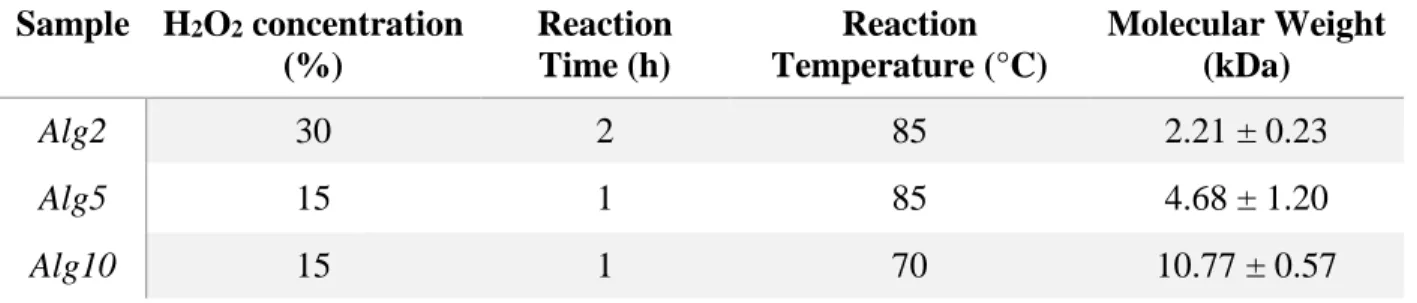
Oxidative degradation of alginateCommercial alginate (Alg300) was successfully degraded to alginate oligosaccharides of various molecular weight following the previously published protocols.31 The resulting alginate oligosaccharides ranged from 2 kDa to 10 kDa (Table 1).
Table 1. Oxidative degradation of alginate to various molecular weights
Sample H2O2 concentration (%)
Reaction Time (h)
Reaction Temperature (°C)
Molecular Weight (kDa)
Alg2 30 2 85 2.21 ± 0.23
Alg5 15 1 85 4.68 ± 1.20
Alg10 15 1 70 10.77 ± 0.57
The oxidative degradation process involved altering the reaction parameters of reaction temperature, reaction time, and hydrogen peroxide concentration. Increasing any of the three parameters led to a decrease in oligosaccharide molecular weight.
Synthesis of N-diazeniumdiolate-functionalized alginate
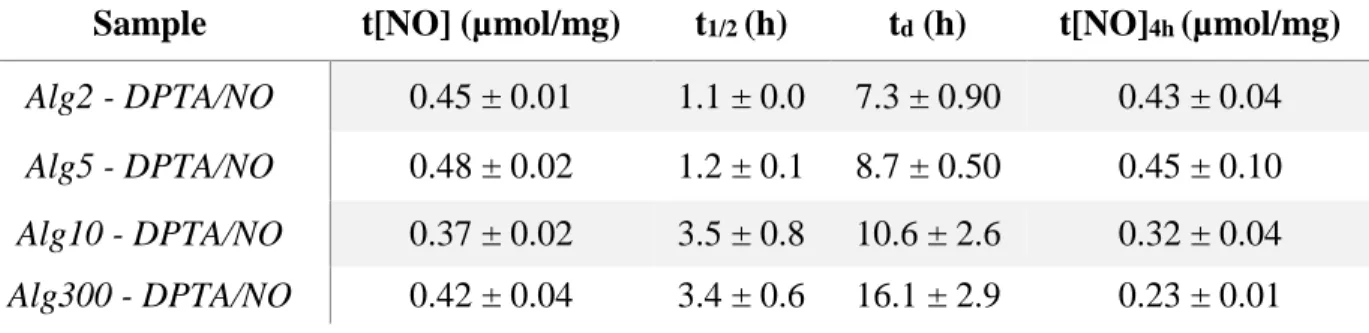
Following the secondary amine functionalization protocol (Scheme 1), various molecular weight alginates were charged with high pressures of NO (10 bar) in basic aqueous solution (50 mM NaOH) to allow formation of N-diazeniumdiolate NO donors. Nitric oxide-releasing profiles of the N-diazeniumdiolate-functionalized alginates in PBS (pH 7.4) are reported in Table 2. The difference in total NO release was not significantly different between the NO-releasing alginates
of various molecular weights (~0.4 µmol/mg). The molecular weight of the alginate, however,
5 kDa) released NO much more rapidly than NO-releasing alginate of larger molecular weight (10 - 300 kDa). The total release duration as well as the half-life of NO release all decreased as molecular weight decreased. In addition, the high flux and larger four hour NO total of the lower molecular weight alginate suggests that more NO is available over the course of the standard duration for the bactericidal assays.
Table 2. Nitric oxide storage capacity and release kinetics of N-diazeniumdiolate modified alginates
Sample t[NO] (µmol/mg) t1/2 (h) td (h) t[NO]4h (µmol/mg)
Alg2 - DPTA/NO 0.45 ± 0.01 1.1 ± 0.0 7.3 ± 0.90 0.43 ± 0.04 Alg5 - DPTA/NO 0.48 ± 0.02 1.2 ± 0.1 8.7 ± 0.50 0.45 ± 0.10 Alg10 - DPTA/NO 0.37 ± 0.02 3.5 ± 0.8 10.6 ± 2.6 0.32 ± 0.04 Alg300 - DPTA/NO 0.42 ± 0.04 3.4 ± 0.6 16.1 ± 2.9 0.23 ± 0.01
Of note, negligible NO release was observed for alginates modified with primary amine and amide functional groups as previous reported.30 This indicates that neither primary amine nor
amide groups are able to form the N-diazeniumdiolate NO donor.
Antibacterial action against planktonic bacteria
Antibacterial activity of control and NO-releasing alginates was evaluated against P. aeruginosa and S. aureus, two prevalent pathogens associated with infections in CF.3-5 Bacterial
viability assays were performed under static conditions to determine the minimum bactericidal concentration of the sample required to elicit a 3-log reduction (i.e., 99.9% killing) in bacterial viability over 4 h (MBC4h). Non-NO-releasing alginate control did not elicit any bactericidal
achieved a 3-log reduction against at low concentrations (≤ 2 mg/mL). In particular, Alg2 - DPTA/NO achieved the lowest MBC4h (0.25 mg/mL) and the lowest NO dosage (0.11 µmol/mL).
Antibacterial action proved to be molecular weight dependent, with lower molecular weight alginate demonstrating enhanced bactericidal efficacy. This is likely due to the molecular weight of the degraded alginate allowing for better association with the bacterial membrane, thus improving targeted NO release against P. aeruginosa compared to higher molecular weight systems. This follows similar trends previously reported in literature for NO-releasing materials.30 Another reason is the higher initial NO flux and higher t[NO]4h associated with lower molecular
weight NO-releasing alginates. That is, a greater alginate concentration was needed to achieve similar NO doses for the higher molecular weight system.
Table 3. Bactericidal efficacy of NO-releasing alginates against Pseudomonas aeruginosa compared to Tobramycin
Scaffolds MBC4h (mg/ml) t[NO]4h (µmol/mg) NO/Drug dose (µmol/ml)
Alg 2 – DPTA/NO 0.25 0.43 ± 0.04 0.11 ± 0.01 Alg 5 – DPTA/NO 0.25 0.45 ± 0.10 0.11 ± 0.03 Alg 10 – DPTA/NO 0.50 0.32 ± 0.04 0.16 ± 0.02 Alg 300 – DPTA/NO 2.00 0.23 ± 0.01 0.46 ± 0.02
Tobramycin 0.13 - 0.27
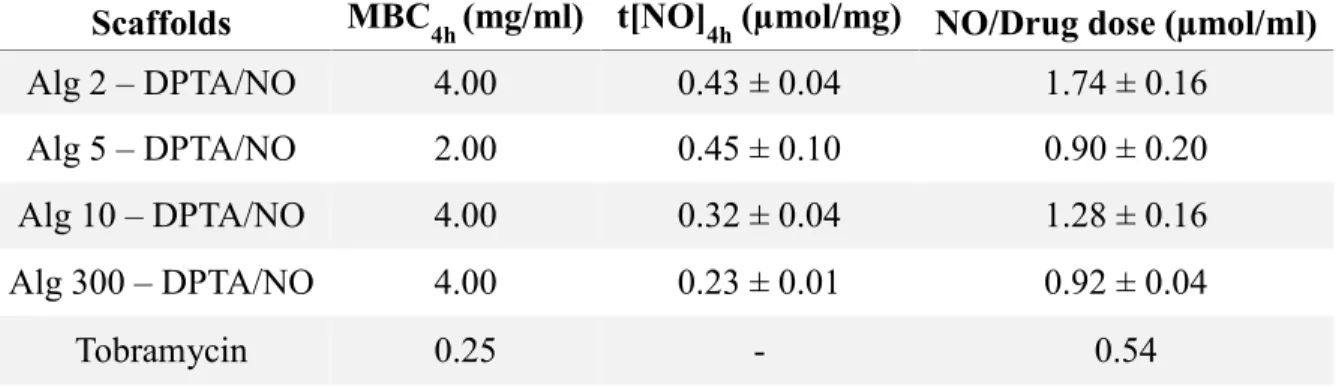
The ability of NO-releasing alginates to kill S. aureus was significantly reduced compared to its efficacy against P. aeruginosa, as indicated by the higher MBC4h and NO dose.The thicker
peptidoglycan layer of S. aureus likely decreases the diffusion of NO into the bacterium, necessitating larger doses of the macromolecule to achieve 3-log reduction in bacterial viability. P. aeruginosa, a Gram-negative bacteria, has a more lipid-rich outer membrane and thinner
antimicrobials.30 In addition, the bactericidal efficacy of NO-releasing alginate (5-300 kDa) against S. aureus were found to be equivalent. However, at a molecular weight lower than 5 kDa, the NO dose required to achieve 3-log reduction increases to 4 mg/ml. Future studies will explore why Alg5 - DPTA/NO was most efficient against S. aureus.
Compared to the commercial antibiotic tobramycin, the NO-releasing alginate oligosaccharides required lower NO dose to exhibit bactericidal action. This signifies that NO-releasing alginate is a more efficient therapeutic against P. aeruginosa infections than the traditional tobramycin. The bactericidal action of NO-releasing alginate was less efficient than that of tobramycin against S. aureus. This is likely due to the thicker peptidoglycan layer of the S. aureus that hinders NO diffusion.
Table 4. Bactericidal efficacy of NO-releasing alginates against Staphylococcus aureus compared to Tobramycin
Scaffolds MBC4h (mg/ml) t[NO]4h (µmol/mg) NO/Drug dose (µmol/ml)
Alg 2 – DPTA/NO 4.00 0.43 ± 0.04 1.74 ± 0.16
Alg 5 – DPTA/NO 2.00 0.45 ± 0.10 0.90 ± 0.20
Alg 10 – DPTA/NO 4.00 0.32 ± 0.04 1.28 ± 0.16 Alg 300 – DPTA/NO 4.00 0.23 ± 0.01 0.92 ± 0.04
Tobramycin 0.25 - 0.54
Conclusion
NO-releasing kinetics were determined to dramatically change as a function of molecular weight. Lower molecular weight alginates led to lower total NO-releasing duration (~9 h) and shorter release half-lives (~1 h). As a consequence, the lower molecular weight NO-releasing alginates had a larger burst of NO release during a four hour bacterial exposure assay, allowing for higher total NO released at 4 h.
The antibacterial activity was found to be molecular weight dependent against P. aeruginosa with Alg2-DPTA/NO requiring the least alginate concentration and NO dose to elicit
bactericidal action. In addition, NO-releasing alginate oligosaccharides (2 kDa, 5 kDa, and 10 kDa,) required lower NO dose compared to tobramycin, suggesting that the NO-releasing alginates are more efficacious against P. aeruginosa infections. Higher alginate concentrations and NO doses were needed to elicit bactericidal action against S. aureus than P. aeruginosa. No dependence on biopolymer molecular weight was found on the antibacterial activity of NO-releasing alginate against Gram positive bacteria such as S. aureus.
The antibacterial efficacy of NO-releasing alginates as potential CF therapeutics lies in its ability to combat the increasingly prevalent drug resistant strains of pathogens. Future work will focus on the determination of the bactericidal efficacy of NO-releasing alginates against other CF-relevant pathogens, especially drug resistant strains (e.g., MDR-PA and MRSA). This will help solidify NO-releasing alginate’s positon as an attractive alternative to traditional treatments.
Acknowledgement
like to thank Dr. Leslie M. Hicks and Dr. Andrew M. Moran for being on my Honors Committee. Lastly, I would like to give thanks to the UNC Chemistry Department for providing this undergraduate research opportunity.
References
1. Levy, S. B.; Marshal, B. Antibacterial Resistance Worldwide: Causes, Challenges and Responses. Nat. Med. 2004, 10, S122-S129
2. Robson, M. C. Wound Infection: A Failure of Would Healing Caused by an Imbalance of Bacteria. Surg. Clin. North Am. 1997, 77, 637-650.
3. Wright, G. D. The Antibiotic Resistome: The Nexus of Chemical and Genetic Diversity. Nat. Rev. Microbiol. 2007, 5, 175-186
4. Pruitt, B. a.; McManus, A. T.; Kim, S. H.; Goodwin, C. W. Burn Wound Infections: Current Status. World J. Surg. 1998, 22,135-145
5. Boucher, H. W.; Talbot, G. H.; Bradley, J. S.; Edwards, J.E.; Gilbert, D.; Rice, L.B.; Scheld, M.; Spellberg, B.; Bartlett, J. Bad Bugs, No Drugs: No ESKAPE! An Update from the Infectious Diseases Society of America. Clin. Infect. Dis. 2009, 48, 1-12. 6. Barraud, N.; Hassett, D.J.; Hwang, S. H.; Rice, S.A.; Kjelleberg, S.; Webb, J. S.
Involvement of Nitric Oxide in Biofilm Dispersal of Pseudomonas Aeruginosa. J. Bacteriol. 2006, 188, 7344-7353.
7. Carpenter, A. W.; Schoenfisch, M. H. Nitric Oxide Release: Part II. Therapeutic Applications. Chem. Soc. Rev. 2012, 41, 3742-3752.
8. Barraud, N.; Kelso, M. J.; Rice, S. A.; Kjelleberg, S. Nitric Oxide: A Key Mediator of Biofilm Dispersal with Applications in Infectious Diseases. Curr. Pharm. Des. 2014, 21, 31-42.
9. Riccio, D. A.; Schoenfisch, M. H. Nitric Oxide Release: Part I. Macromolecular Scaffolds. Chem. Soc. Rev. 2012, 41, 3731 - 3741.
10.Hetrick, E. M.; Shin, J. H.; Stasko, N. A.; Johnson, C. B.; Wespe, D. A.; Holmuhamedov, E.; Schoenfisch, M. H. Bactericidal Efficacy of Nitric Oxide-Releasing Sillica
Nanoparticles. ACS Nano 2008, 2, 235 - 246.
11.Privett, B. J.; Broadnax, A. D.; Bauman, S. J.; Riccio, D. A.; Schoenfisch, M. H. Examination of Bacterial Resistance to Exogenous Nitric Oxide. Nitric Oxide 2012, 26, 169 - 173.
12.Keefer, L. K. Fifty Years of Diazeniumdiolate Research. From Laboratory Curiosity to Broad-Spectrum Biomedical Advances. ACS Chem. Biol. 2011, 6, 1147−1155.
14.Lu, Y.; Slomberg, D. L.; Sun, B.; Schoenfisch, M. H. Shape- and Nitric Oxide Flux-Dependent Bactericidal Activity of Nitric Oxide-Releasing Silica Nanorods. Small 2013, 9, 2189−2198.
15.(20) Slomberg, D. L.; Lu, Y.; Broadnax, A. D.; Hunter, R. A.; Carpenter, A. W.; Schoenfisch, M. H. Role of Size and Shape on Biofilm Eradication for Nitric Oxide-Releasing Silica Nanoparticles. ACS Appl. Mater. Interfaces 2013, 5, 9322−9329.
16.Wo, Y.; Brisbois, E. J.; Bartlett, R. H.; Meyerhoff, M. E. Recent Advances in
Thromboresistant and Antimicrobial Polymers for Biomedical Applications: Just Say Yes to Nitric Oxide (NO). Biomater. Sci. 2016, 4, 1161−1183.
17.Worley, B. V.; Schilly, K. M.; Schoenfisch, M. H. Anti-Biofilm Efficacy of Dual-Action Nitric Oxide-Releasing Alkyl Chain Modified Poly(amidoamine) Dendrimers. Mol. Pharmaceutics 2015, 12, 1573−1583.
18.Duong, H. T. T.; Jung, K.; Kutty, S. K.; Agustina, S.; Adnan, N. N. M.; Basuki, J. S.; Kumar, N.; Davis, T. P.; Barraud, N.; Boyer, C. Nanoparticle (Star Polymer) Delivery of Nitric Oxide Effectively Negates Pseudomonas Aeruginosa Biofilm Formation.
Biomacromolecules 2014, 15, 2583−2589.
19.Sadrearhami, Z.; Yeow, J.; Nguyen, T.-K.; Ho, K. K. K.; Kumar, N.; Boyer, C. Biofilm Dispersal Using Nitric Oxide Loaded Nanoparticles Fabricated by Photo-PISA: Influence of Morphology. Chem. Commun. 2017, 53, 12894−12897.
20.Nair, L. S.; Laurencin, C. T. Biodegradable Polymers as Biomaterials. Prog. Polym. Sci.
2007, 32, 762−798.
21.Alnaief, M.; Alzaitoun, M. A.; Garcia-Gonzalez, C. A.; Smirnova, I. Preparation of Biodegradable Nanoporous Microspherical Aerogel Based on Alginate. Carbohydr. Polym. 2011, 84, 1011−1018.
22.Khan, S.; Tøndervik, A.; Sletta, H.; Klinkenberg, G.; Emanuel, C.; Onsøyen, E.;
Myrvold, R.; Howe, R. A.; Walsh, T. R.; Hill, K. E.; et al. Overcoming Drug Resistance with Alginate Oligosaccharides Able To Potentiate the Action of Selected Antibiotics. Antimicrob. Agents Chemother. 2012, 56, 5134−5141.
23.Pritchard, M. F.; Powell, L. C.; Menzies, G. E.; Lewis, P. D.; Hawkins, K.; Wright, C.; Doull, I.; Walsh, T. R.; Onsøyen, E.; Dessen, A.; et al. A New Class of Safe
Oligosaccharide Polymer Therapy to Modify the Mucus Barrier of Chronic Respiratory Disease. Mol. Pharmaceutics 2016, 13, 863−873.
24.Draget, K. I.; Taylor, C. Chemical, Physical and Biological Properties of Alginates and Their Biomedical Implications. Food Hydrocolloids 2011, 25, 251−256.
25.Liakos, I.; Rizzello, L.; Scurr, D. J.; Pompa, P. P.; et al. All-Natural Composite Wound Dressing Films of Essential Oils Encapsulated in Sodium Alginate with Antimicrobial Properties. Int. J. Pharm. 2014, 463, 137−145.
26.Paul, W.; Sharma, C. P. Chitosan and Alginate Wound Dressings: A Short Review. Trends Biomater. Artif. Organs 2004, 18, 18−23.
27.Matai, I.; Gopinath, P. Chemically Cross-Linked Hybrid Nanogels of Alginate and PAMAM Dendrimers as Efficient Drug Delivery Vehicles. ACS Biomater. Sci. Eng.
28.Nordgård, C. T.; Draget, K. I. Oligosaccharides as Modulators of Rheology in Complex Mucous Systems. Biomacromolecules 2011, 12, 3084−3090.
29.Nordgård, C. T.; Nonstad, U.; Olderø, M. Ø.; Espevik, T.; Draget, K. I. Alterations in Mucus Barrier Function and Matrix Structure Induced by Guluronate Oligomers. Biomacromolecules 2014, 15, 2294−2300.
30.Ahonen, M. J. R.; Suchyta, D. J.; Zhu, H.; Schoenfisch, M. H.; Nitric Oxide-Releasing Alginates. Biomacromolecules 2018, 19, 1189-1197