A
Report
Card
on
Urban
Erosion
and
Sedimentation
Control
in
North
Carolina
Raymond
J.Burby,
Edward
J.Kaiser,
Michael
I.Luger,
Robert
G.
Paterson,
H.
Rooney
Malcom,
and
Alicia
C.
Beard
In
1973 North Carolina enacted
what
has
become
one
of
the
most
stringenterosion
and
sedimentation
control
programs
inthe
nation.This
articlediscusseshow
a survey
of
128
construction
sitesinNorth
Carolina
turned
up
evidence
thatpractice
fallsshort
of
stategoals
tocurb
urban
erosion
and
sedimentation.
The
authors then
discuss
policy
options
toremedy
theseshortcomings.
Construction activity in urban areas can increase the
amount
of soil-upto500tonsforevery acrelaidbare-that washes from buildingsitesintonearbyrivers,streamsand
lakes.
When
erosionand
sedimentation go unchecked, avarietyofharmful
and
costly effectsresult. Aquatichabitatisdestroyed,decreasing aesthetic values
and
fishproduc-tion. Streamsaccumulatedirt,losingtheircapacitytostore
flood waters
and
increasing the frequencyand
severityofflooding. Reservoirssilt
up and
losetheircapacitytostoredrinking water, requiring additional expenditures for
re-placementsupplies.
Channels
become
clogged,requiringmore
frequent dredging to maintain navigation.Storm
drainage
works no
longer functionasintended, resultinginnuisance flooding
and
more
frequent maintenance.The
frequency
and
severityof thoseproblems haveledtwenty-one
states toformulateprograms
tocontrolurban erosion and sedimentation.In1973
North
Carolina enactedwhat
hasbecome
one
ofthe
most
stringent erosionand
sedimentation controlprogramsinthe nation,
matched
onlybysimilarlyvigorousstate
programs
inFlorida,Maryland
andVirginia.1Inthis
article
we
provideevidencethat inNorth
Carolinapracticefallsshort ofstategoalstocurburbanerosion
and
sedimen-tation.
The
shortcomingsinprogram
practiceare the resultof slippageateachof fourstages. First;asmall butsignificantproportion of urban construction evades the program's
regulatorynet (thatis,gradingis
begun
withoutattentionto erosion
and
sediment control). Second, erosionand
sediment control plans prepared for construction sites
sometimes
have serious technical deficiencies that limit theirpotential effectiveness. Third,erosionand sedimentcontrol measures specified by those plans frequently are
notinstalled. Fourth,even
when
measuresareinstalled as specified, they frequently are not maintainedadequately.As
a result of those problems, a third ormore
ofurbanconstruction sites release large
amounts
of sediment toadjacentproperty
and
tonearby streamsand
otherwaterbodies.
The
difficultiesencounteredinNorth
Carolinaareseri-ous,butthey arenot insurmountable. In concludingthis
article,
we
suggest anumber
of optionsthatstateand
localpolicy
makers
can considerto halt,and
even reverse, theslippage
we
identified.Most
of thosepolicies stress theimportance of establishing a cooperative
approach
toenforcementthat builds
commitment
inthe private sectorto the program's goals
and
private capacity tocomply
beforesanctions
must
be invoked.We
alsostress,however,the importance ofeffectivesanctions thatcan
be
appliedquickly
when
provisionsofthelawareignored.We
believeourresearch findings are relevant to a varietyoflocal
and
state regulatory
programs
and
have applicabilitybeyond
controlof urban erosion
and
sedimentationinNorth
Caro-lina.
Sources of
Data
Data
for this articlecome
from
acomprehensive
evalu-ation ofthe
North
Carolina Erosionand
SedimentationControlProgram,
commissioned
bythe N.C.Department
of the
Environment,
Healthand
Natural Resources.2A
number
ofdifferent approachesto data acquisitionwere
employed.
Raymond
J. Burbyand
Edward
J. Kaiser are professors,Michael I. Luger is an associateprofessor,
and
Robert G. Patersonisa researchfellowintheDepartment
ofCityand
Re-gional Planning, UniversityofNorth CarolinaatChapelHill.
H.Rooney
Malcom
is aprofessorand
Alicia C.Beard
is aWe
gathered information about ero-sionand sedimentationcontrolpracticesand effectiveness in ninelocales across
thestate.
The
ninelocalesinclude threefrom each of the three physiographic
regions of
North
Carolina-the coastalplain,the
piedmont and
themountains.In each region,
we
selectedone
countywhere
the state administered thepro-gram and one
cityand
one
countywhere
local
governments
administered theprogram
(seemap
below). After firstcompletingapilotstudyin
Orange
Countytodevelopafieldprotocol,
we
collected dataineach oftheninelocales throughstructured interviews with supervisors,
plan reviewers,
and
inspectors,throughinspection of records
and
otherdocu-ments, throughtechnicalreview of
con-trol plans developed for construction
projectsunderthe regulations,and
from
field inspectionsofthose projects.
The
control plan reviewsand
fieldinspections focused
on
arandom
sample
of128construc-tion projects,selectedfromtheactiveprojectsof the
agen-cies intheninelocales. This
approach
providedarepresen-tative
sample
ofresidential projectsand
non-residentialprojects (mostly retail
commercial and
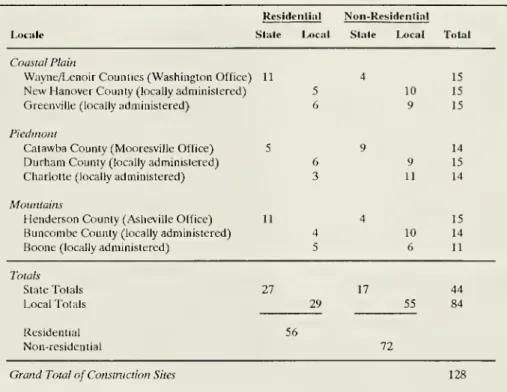
officedevelop-ments) in the privatesector. (SeeTable 1 for the
number
ofsitesby type of land usein each oftheninelocales.)
We
collected information
on
each project through technicalTable 1.
Number
ofConstructionSites inSample
forEach
ofNine LocalesResidential Non-Residential Locale Stale Local Stale Local Total
Coastal Plain
Wayne/Lenoir Counties (WashingtonOffice) 11 4 15
New
Hanover County(locallyadministered) 5 10 15Greenville(locallyadministered) 6 9 15
Piedmont
Catawba County(Mooresville Office) 5 9 14
DurhamCounty(locallyadministered) 6 9 15
Charlotte(locallyadministered) 3 11 14
Mountains
Henderson County(Asheville Office) 11 4 15
BuncombeCounty(locallyadministered) 4 10 14
Boone(locallyadministered) 5 6 11
Totals
StateTotals 27 17 44
LocalTotals
Residential
29 55 84
56
Non-residential 72
GrandTotalofConstructionSites 128
evaluation ofits erosion
and
sedimentation control plan,on-siteobservations of erosion
and
sedimentation controlmeasuresas installed
and
maintained,and
observations ofoff-sitesedimentpollution.
We
gatheredadditionalinfor-mation
aboutthe projectsfrom
amail surveyof theprojects'owners and
developers.We
received103responses, provid-ingdataon
thedevelopers of80
percent ofthe128projects.To
provide a broader perspectiveon
the program,we
surveyed by mail theBoone (WataugaCo.) Local
CatawbaCo.
State
Greenville
(PittCo.) Local
BuncombeCo.
Local
Counties
Comprising
the
9
Locales
and
128
Projects
Included
in
the
Sample.
Wayne/Lenoir Co.
State
NewHanover Co.
Local
administrators of all
sevenstate regional of-fices
and
27 of the 37cities
and
countieswithlocalprograms.
We
alsoconducted
a telephonesurveyofthe
represen-tativesof variousgroups
interested in the
pro-gram.
The
survey ofinterest
group
repre-sentativescovered 33
or-ganizations, including
oversightgroups suchas the
N.C
GeneralAssem-bly
and
N.C.Sedimen-tationControl
Commis-sion, professional
groups,tradegroups,and environmental groups.
These
structuredinter-views
probed
people'sstrengths
and
weaknesses oftheprogram and
their recom-mendationsforimprovement.
Finally,we
conductedamail surveytodetermineNorth
Carolinacitizens'willingness topay for the program.
We
obtained responsesfrom
319 households surveyed in three metropolitanareas-Bun-combe
County, representing the mountains;Durham
County,representing the piedmont;
and
New
Hanover
County,representing the coast
and
coastalplain.In combination, thedata collected for this evaluation
providethe
most comprehensive
set ofinformation everassembled about the
performance
of urban erosionand
sedimentationcontrolin anystate.
These
data provideasound
basis infactand
inopinion withwhich
toevaluate theprogram and
tosuggestimprovements.Slippage
atStage
One:
Coverage
of
the Eligible
Population
SlippageatStage
One
addresses casesinwhich
buildersdo
notsubmit erosionand
sedimentationcontrolplans orobtain approval of those plans before proceeding with
clearing, grading,
and
construction of projects overone
acreinsize.
About
25 percent oftheconstruction projects regulatedbythestateand
about 10 percent of thoseregu-latedbylocal
programs
which
were
inviolationofthelawwere
initiallydetectedthroughsurveillanceand
follow-upsto citizens'complaints.
They
didnotcome
totheattentionofagenciesthrough
normal
channels. Sinceneitherstateagencies norlocal
governments
devotedmuch
time-lessthan10percentofavailablepersonnel-togeneral
surveil-lancetodetect land disturbingactivitiestaking place
with-out
approved
erosionand
sedimentationcontrolplans,thedata suggest to us that slippage here could be serious,
particularlyinareasof
North
Carolinawhere
theprogram
isadministered bythestate.Slippage
atStage
Two:
Preparation of
Technically
Adequate
Erosion
and
Sedimentation Control Plans
The
erosionand
sedimentation controlprogram
doesnot prescribe
most
of the specific measures developersmust employ
toprevent erosionand
retainsedimentwithin thebounds
oftheir projects. Instead, it relieson
perfor-mance
standards thatdevelopersmust
meet
by preparing andimplementing
uniqueplansforevery constructionsite.Stage
two
slippage can occur if those plans,which
areapproved
bystateand
localregulators,havetechnical defi-ciencies.Even
ifperfectly implemented, theywould
not preventsedimentfrom
leaving the constructionsite.Interviewswith plan reviewstaffindicated that serious deficienciesinthe quality of plans
when
firstsubmitted bydevelopers
and
theirengineeringconsultants are the rule ratherthanthe exception.Even
after staffreviewand
thecorrection of plan deficiencies,
we
found thatapproved
planscouldstillhavea varietyofshortcomings.
The
most
frequent
problems
notedon
control planswere
thoseal-lowing drainageareas thatexceededthe capacityofcontrol
devices, leading to hydraulically overloadeddevices,
and
over-reliance
on
siltfences.Furthermore,we
inspected theperformance
ofthe plans in the fieldand
found that 27 percent ofthesample
projectshad
lostsediment becauseplans failed tospecifythe
placement
ofsedimentcontroldeviceseverywherethey
were
needed.To
further evaluate the overalladequacy
of controlplans,
we
developed systematic ratings ofeach ofthe 128controlplans.
The
rating scaleforthe plansrangedfrom
to 100,witha ratingof100representing aplan
which
ade-quatelyhandledallofthesediment generated
on
site.The
meaning
ofthe ratingsisasfollows:Rating Description 100-90 Excellent
90-80
Good
80-70 Satisfactory70-0 Unsatisfactory
The
ratingswere
calculated by startingwith a perfect scoreof100and
subtracting pointsforeach time anaspectof sediment control
was
not adequately handled.Bonus
points
were
given to planswhich
included exceptionalnotesto thecontractorconcerningspecificgrading
prob-lems.
The
followinglist indicatesthe areasofinadequacyand
theircorrespondingadditionsand
deductions.Area
ofInadequacy
Points RelatingtoNotes:Vagueness:"Siltfenceplaced
where
necessary" ....-20No
statedorder of construction -10Lack
ofclarityof notes -15Incomplete or missingdetails -15 Relatingtoplandrawings:
Perimeterpointnottreated -10
Constructionexitnot
shown
-10Water
escapessitewithoutencounteringany
measure
-20Basinsortrapsaretoosmall -15
Bonus
points:Notes concerning grading
+5
Note
tominimize
time ofexposure+5
Note
tominimize
disturbed area+5
We
foundthatthequalityofapproved
control planswas
on
averagesatisfactory-theaveragescoreforall128 proj-ectswas
75-but
the quality ofplans variedsignificantlyamong
theninelocaleswe
studied.The
scoresrangedfromalow of 57toahigh of89.
On
average,the qualityofplanssubmittedtoandapproved bystateregionalagenciesscored
adequatetoolsforenforcement These
problems
particularly plague stateadministration oftheprogram. Five of seven state regional offices
had
only
enough
staffto inspect construc-tion sitesonce
amonth
or lessfre-quentlytoensurethatrequired
meas-ures
were
installedand
maintained,and
towork
cooperativelywithde-velopers to correct
problems
(seeFigure 1). Incontrast, only 19 per-cent ofthe local
programs
we
con-tactedinspectedconstruction
once
amonth
or less frequently,and
44 percent inspected sitesmore
oftenthan monthly. Reflecting those
dif-ferences,
we
foundasomewhat
higherproportion ofsitesregulatedbylocal
programs
thanstateregionaloffices,40
percentversus30
percent,tobeincomplete compliance
withapproved
plans.
Badpractice:Thisretainingwallandassociatedsillfencesfailed,allowing waterandsoiltoseep through. Neither
State nor local
DrOPrams
quality ofplans
approved
by local agenciesnotto differ- P ursuedenforcement
vigorously during the year ofpro-ences in the proficiency of their respective staffs-state g
ram
operationwe
studied,possiblybecause ofapendingstaff, infact,tended to
be
more
highlytrained-buttothe court case thatquestioned thelegalityoffinesimposed
forfact that local agencies,
on
average, spenttwice asmuch
time per planon
plan review as did the state's regionaloffices.
Slippage
atStage Three:
Installation
of
Measures
Specified
by
Approved
Plans
Even good
control planswillfailtoprevent erosionand
sediment pollution ifthe
measures
they specify are neverinstalled.
The
fieldinspectionswe
conductedat 128con-struction sitesrevealed that on-site
compliance
withcon-trol plans
was
poor; 30 percent ofmeasures
specified inplans
were
neverinstalledatthe constructionsites. Itwas
theexceptionratherthanthe rule to findallofthe control
measuresspecified
on approved
plans actuallyinstalled.Contractors have
an
economic
incentive not to installrequired
measures
iftheirviolationsofthelawarelikelytogoundetected
and
unpunished.We
estimatedthe costsofimplementing
each ofthe 128control planswe
reviewed.On
average,fullcompliance
withthe planswould
havecostS2,700peracreoralmost $18,000for theaverage of6.64
acresofdisturbed areaperproject.
Because
ofincompleteinstallationof requiredcontrol
measures
theaveragecosts actuallyincurredwere
S1500 peracreor $9,960perproject.Thus, developers or their grading contractors saved an average of
$1200
peracre,almost$8000
fora typicalproj-ect, by not
complying
fullywith the specifications ofthecontrol plans. Slippage ofthat
magnitude
occurredbe-causeof lackof adequate stafftoinspectsites
and
lackofInspection
Frequency
State and LocalPrograms
Percent of Offices/Programs 100
80
60
40
20
>Weekly Weekly >Monthly Monthly <Monthly Frequency of Inspection
State Offices KWNWNLocalPrograms
noncompliance
withprovisionsofthelaw.3During
thelastyear ofrecord, state
and
local sediment control officersconducted over 57,000 inspections ofconstruction sites,
but they issuedonly1,655formalnoticesofviolation.
Only
182finesweresubsequentlyimposed,astrikinglylow
number
given thedegree of
noncompliance
we
foundinthefield.State administrators also lack a full
complement
ofenforcementtools,since unlikelocalprograms,thestateis
notauthorized to issue stop
work
orders. Since "timeismoney"
todevelopers,stopwork
orders are a formidableincentivetocomply; therefore,the state's inabilitytouse
thisdeviceisaserious constraint
on
regulatoryefficiency. Injunctions,the alternative available tothestate,arecumber-some
legallyand
takeconsiderabletime-a
month
ormore
-to
employ
(and time is critical in preventing sediment damage).As
a result, injunctionswere
rarelysoughtbyeither state or local programs. Additionally, the state
cannotrequire developers topost
performance
bonds
orlettersofcredit;thus,ifadeveloperceasesoperation,funds
may
notbeavailabletocomplete
permanent
stabilizationofthesitetoprevent erosion
and
sedimentationpollution.Slippage
atStage
Four:
Maintenance
of
Measures
Installed
Shortfalls ininspection
and
enforcementalsocontrib-uted toslippage inmaintenance. Thisacritical problem,
since failuretorepair
damaged
oroverloadedcontrol devicescan allowsedimenttoescape
from
constructionsites.For
bothstate
and
localjurisdictions,we
foundthat51 percentof controlmeasureswerenot adequately maintained.
Fewer
than
one
in fiveofthe 128constructionsiteswe
inspectedhadall ofits sediment control measures in full
working
order. Typical
maintenance
shortfalls includedproblems
suchas failing to
muck
outtrapswhen
theybecame
more
thanhalffull,failuretoreplacesiltfencingor stormdrain
inletprotection devices thathad been
knocked down, and
failure to repair gravel filters that
had been
damaged
byconstructionactivities orstorm events.
Those and
othermaintenancedeficienciesareillustratedbyFigure2,
which
shows
thepercentage of each ofthe tenmost
widely usederosion
and
sediment control measures thatwere
notmaintained adequately at the 128 construction sites
we
inspected.
The Bottom
Line:
Attainment
of
Program
Goals
As
a result of the technical deficiencies in plansand
failures to install
and
adequately maintain erosionand
sediment control measures specified in plans, the
North
Carolina erosion
and
sedimentationcontrolprogram
isnotiully achieving the goals set forth in the Sedimentation
PollutionControl Act.
Here
we
draw
upon
fieldinspec-tionsof constructionprojects,agencyadministrators'
evalu-Maintenance
Compliance
forTen
Most
Widely
Used
Measures
Measures in Orderof Use
Inletprotection
Sedimenttrap
Silt fence Drainage ditch
Velocity dissipator
Construction exit
Sediment basin
Filterberm Berm Check dam
20 40 60 80 100 PercentMaintained
Figure2.
ations,
and
interestgroup
evaluations tosupportthat as-sertion.The
primarygoalofthe SedimentationPollutionCon-trol
Act
istokeep
sedimentpollution withinthebounda-ries of construction projects. This
bottom
line goalwas
attainedcompletelyat
39
percent ofthe constructionsiteswe
inspected.The
factthat lessthanhalfofthe construc-tion sitescomplied
with the program's keyperformance
standard-retention of sediment
on
the site-reflects theinherent infeasibility
and
inefficiency of preventing allsediment
from
reaching water bodies. Part of thesedi-mentation
problem
obviously cannot or, foreconomic
reasons, should not be prevented
from
occurring.For
example,
some
particles are too fine tobe
captured inentrapment
devices. Inrecognitionofthatfact,we
distin-guished
between
minor
lossesofsediment(lessthanthirtycubicfeet)
and major
losses (lossesofthirtycubicfeetor more, orlossesofanymagnitude
directlyintostreamsand
otherwaterbodies).
We
found
seriouslossesofsedimentat33 percent ofthe constructionsites
we
inspected.Ap-proximatelyone-thirdofsites regulatedby both state
re-gionaloffices
and
localprograms
experiencedmajor
lossesofsediment.
However,
ahigher percentage of state-regu-latedconstructionsitesthan constructionsitesregulatedbylocal
programs
(41percentversus22percent)experiencedeach ofthe stagesofthe control process
we
examined.As
afinalway
of gaugingtheperformance
oftheerosionand
sedimentation control program,we
askedprogram
administrators
and
thegroup
representativeswe
consultedtoratethe
program
interms ofitsaccomplishment
oftwo
keygoals: protection ofwater quality
and
prevention of sedimentdamage
to property adjacent to constructionsites.
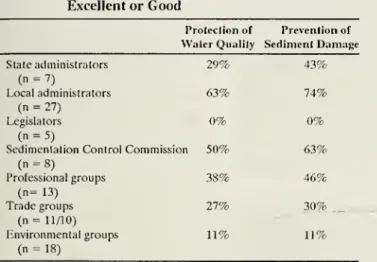
The
followingpercentagesratedprogram
perform-anceasexcellentor good:Table2. Percent Rating
Performance
asExcellentor
Good
Protection of Preventionof
WaterQuality SedimentDamage
Staleadministrators
29%
(n
=
7)Local administrators
63%
(n=27)
Legislators
0%
(n=5)
Sedimentation ControlCommission
50%
(n
=
8)Professionalgroups
38%
(n= 13)
Trade groups
27%
(n = 11/10)
Environmental groups
11%
(n = 18)
43%
74%
0%
63%
46%
30%
11%
Those
figures,we
believe, reflectratherwidespreadrec-ognitionofthe slippage incontrol
which
we
foundinthefield
and
document
in thisarticle. Until that slippage iscorrected,
we
do
not believe theprogram
will be able toachieve consistently high
performance
ratingsfrom
eitherprogram
administrators or groups interested inand
af-fectedbyitsoperation.
Policy
Options
for
Improving
Program
Performance
There
are anumber
ofwaystoimprove
theperformance
of the
North
Carolina Erosionand
Sedimentation ControlProgram.
Those
thatwe
thinkhavesome
meritand
deservefurther analysis arepresented hereforeach ofthe stagesof
the
program
where
slippagewas
detected.Readers
should beaware
that these are presented as ideas for further discussionand
analysis;we
have not analyzedthem
intermsof eithertheircost-effectivenessorfeasibility. Thus,
we
putthem
forwardtostimulate discussionand
additional policyanalysis
and
notasasetofpolicyrecommendations.
StageOne: FailureofEligible
Land
DisturberstoSubmit
and
ObtainApproval ofControlPlansPriortoClearing, Grading,
and
ConstructionA
1981 evaluation oftheNorth
Carolina Erosionand
Sedimentation Control
program
sponsored by theUni-versityof
North
CarolinaWater
Resources ResearchInsti-tuteestimatedthatfullyhalfofallland disturbingactivities
occurring at that time
were
not being captured by theprogram.
By
1990,we
estimatethatstageone
failurehadfallentoabout 10to20 percent oftheeligiblepopulation, a significant
improvement
over thedecade
ofthe 1980s.Improved
program
coveragemay
reflectgreaterpublicand
industryawarenessaswellas theeffectof1988 legislative
amendments
that prohibitissuanceofbuildingpermitstoprojects that are eligible for erosion
and
sedimentationcontrol
program
coverage buthave not obtained approvaloftheirerosion
and
sedimentcontrolplans.While
progresshasbeen made,
inour opinion, coverage ofthe eligible population isstill too low.The
followingpolicyoptions addressthatproblem:
1. Increasepromotionalactivitiesto attainpublic
aware-nessoftheprogram. Consider establishment ofa
1-800-Sediment
Control Hotlineand
theuseofstreamwatchprograms
tosupplement
agencysurveillance.2. Increase
program
funding ofsurveillanceactivities,in-cluding ground-level surveillance
and
aerial surveillance.3.
Enhance
intergovernmental cooperationinsurveillancebytraininginspectors associatedwith other
programs
so that theycandetect
and
report violationsofthelaw.4. Incorporatethe
emerging
technology of geographicin-formation systems(GIS)inthe detectionandsurveillance
functions.
Stage Two: TechnicalInadequacy of Approved
Erosion
and
SedimentControlPlansA
varietyoffactorscontributetothe qualityofthe ero-sionand
sediment control planswe
inspected.For
ex-ample,
when
agencies areoverloaded withplanssubmittedfor review,
some
control plans areapproved
by defaultwhen
the 30-day time limit for completion of agencyre-views is exceeded.
Overburdened
agency personnel findthat theyhave inadequate timetocheckallhydraulic
calcu-lations,particularly
when
the originalplan submittedis es-pecially rudimentary. Inaccurate topographicmaps
areanother source of problems. Ideally,planreviewersshould
visit
proposed
construction sites to check topographic accuracyand
tohold preplan conceptual conferences with plandesigners;however,program
staff inonlyafew ofthelocales
we
visitedhad
time for that. In addition,many
agencyadministrators
and
planreviewers strongly believeinthe
need
toimprove
the qualityofthecontrol planson
initialsubmission,
which
will require incentivesfordevel-opersto invest inbetterplans.
The
problem
of control planadequacy
also raises afundamentally important question concerning the
pro-gram's performance-standard rather than
specification-standardorientation.
Performance
standardsaremarkedlymore
difficult toadminister thanspecification standards.effec-Goodpractice:
A
slopedrain,anchoredin rip-rap,channels run-offlowhereitwon'terodethe slope.tivenessofvariouserosion
and
sedimentcontrolmeasures
becomes
more
certain,itmay
befeasible toswitch tomore
easily administered specification standards.That would
ensurethatcontrolplans incorporateadequatemeasures based
on
availabletechnicalinformationand
practicalex-perience,
and
itwould
make
controlplandesign,perform-ance,
and
costsmore
predictable and,we
think, thepro-gram
more
effective. Inthemeantime,
we
believeeachofthe following policy options will
contribute to
improvement
in thequalityof plans
preparedand
submit-ted forapproval.
1. Establishanerosionand sediment
control design certification
pro-gram
thatallcontrolplandesign-ersare requiredtocomplete.
2. Establish erosion
and
sedimentcontrol plansubmissionstandards
to set a baseline that all plans
mustmeetbefore they areaccepted
for review.
Those
criteria couldinclude use of base
maps
withadequate topographicdetail,
de-lineation of
proposed
clearinglimits, inclusion of the expected grading
and
constructionsched-ule, details
on
temporary stabil-ization measures, theproposed
erosion
and
sediment controlmeasures withassociated hydrau-liccalculationsforrunoff directed
toward devices, precautions for
critical areas, sequencing of
in-stallation
and removal
ofcontrolmeasures,
maintenance
schedul-ing,
and
procedures for finalsta-bilization.
3. Establish erosion
and
sedimentcontrol plan re-submittalfees to
create an
economic
disincentivefor submission of low quality controlplans.
4. Increasestaffingsothat
more
timecanbe givento plans duringthe
review
and
approvalprocess. Thatalso
would
allowmore
preplan submissionconferences. Possiblewaystoincreasereview personnel
include: (1)increasefunding for
permanent
plan reviewpositionsat the state
and
local levels; (2)cross-train inspection personnel
and
planreviewers,so personnelcanbeshiftedaccordingtoplansubmission
and
moni-toring/enforcement
demands;
and
(3) allocateinter-agency or departmental personneltoplan reviewtasks
during
peak
control plan reviewperiods in latespringand
summer.
5.
Change
the orientation ofplan preparationfrom
per-formance
standards tospecification standardsto helpensure greater consistency
and
reliability in controlBadpractice:
A
rip-rapchannel,designedtofilterout sediment,isineffectivebecauseatrap failed,allowing waterplandesign. Thiswilltakeadvantageofavailable knowl-edge about
what
willwork,ratherthanwaitingtoseeif questionabledesignswillfailinthe field.Stages Three
and
Four: FailuretoInstalland
MaintainErosion
and
SedimentControlMeasures AccordingtotheApprovedControlPlanWe
believeincreased attention tothree setsoffactorsmay
improve performance
of theprogram
by reducingslippageatstagesthree
and
four: (1)measures
tostimulatevoluntarycompliance;(2)
measures
toenhance
theabilityofagency personneltousepersuasioneffectively;
and
(3)measuresto
make
sanctions against persistent violatorsofthelaw
more
effective.To
enhancevoluntarycompliance:1. Establish greateruniformity in erosion
and
sedimentcontrolstandards withinregionsoracross thestate to
reducevariation inexpectations
from
one
jurisdictiontoanother.
When
standardsdifferfrom
one
jurisdictiontothenext,developerscan
become
confusedand
unsure about whatisconsideredadequateperformance,particularlyin terms
ofmaintenance. Greater
uniform-ity
would
easethat difficultyand
was
favored bymost
developersand
inspectorswe
contacted.2. Increase technical assistance to
increase developers'
and
gradingcontractors'understanding
and
ap-preciationofthe rationaleforand
legitimacyof
program
goalsand
procedures.
We
foundthatwhen
developers perceived the
pro-gram's goals as legitimate, they
were
more
likely tocomply
withprogram
requirements.To
enhance agencypersuasivecapacity:
1. Increasefundingfor stateregional
offices,so thatadequate
person-nelcanbehiredtopursuea
coop-erativeenforcementstrategy.
The
cooperative
approach
toenforce-ment
relieson
theestablishment ofcloseworking
rela-tionshipsbetween the regulatorandtheregulated,which over time results inmutual
trustand
confidence. Itrelies
on
thebackground
threatofsanctions,butfocuseson
persuasionand
bargaining inwhich
enforcementofficers
and
theregulatedwilleachmake
smalladjust-ments
to reflectthe other'sinterestsand
pointsofview.We
foundthat acooperativeapproach
toenforcementproduced
much
betterresultsthanone
thatreliedsolelyon
the threatofsanctionstoobtaincompliance.The
state has
had
particulardifficultyestablishing aco-operative
environment
forenforcement
due
to aheavy
work
load per inspectorand
the large geo-graphicareas forwhich
inspectors are responsible.For
thecooperativeapproach
towork
well forthestate,inspectors
must
visitthesitesof landdisturbingactivities
more
frequentlyand spend
more
timeon
eachsite.
2. Providestatefinancialassistanceto localprograms,
so that
more
personnel canbe
assigned tosurveil-lance
and
tocooperative enforcement.Not
alllocali-tieshave adequatestaffingtopursueatruly
coopera-tiveapproach; moreover, financialassistancecould providetheimpetusfora greaterpercentage oflocal
governments
toestablishtheirown
programs,which
would
remove
some
oftheburden from
theunder-staffedstateregionaloffices.
3.
Make
preconstruction conferences a preconditionfor finalapproval of
an
erosionand
sedimentcontrolplan.
Goodpractice:
A
well-designedsedimentpondincludesavertical riserandtrashguard.4. Increasestate effortsto train state
and
localinspec-tors in cooperative
enforcement
strategies. Thattraining should
emphasize
the importance ofone-on-one
discussions with developersand
gradingcontractors,informal verbalwarnings prior to
for-mal
written noticesofviolation, the importance ofbeingvisibleduringinspections,
and
conductingon-sitediscussionsduringvisitsto
monitor
constructionTo
enhance agencydeterrencecapacity:1. Authorize state sediment control officers to use stop
work
orderswhere
verbaland
written notices ofnon-compliance have
been
ignored.The
effectivenessofacooperative
approach
toenforcementiscontingenton
having enforcement sanctions that are quick, certain,andpotentiallycostly topersistent violators
who
do
nottakeremedialaction followingsuchnotices.
2. Authorize the state to require
performance bonds
orlettersofcredit forallland disturbancescovered bythe
program.
The
stopwork
order is effectiveon
active projects;however,itisofno
useon
projectswhere
the developerhasfiledforbankruptcy orwhere
landisleft idleforan extendedperiod of time. Financial perform-ance guarantees cover suchcontingencies.3. Provide enablinglegislation tohavecertificatesof occu-pancy withheld
on
allconstruction projectsuntilagency personnel verify that all necessary final stabilizationsteps have
been
taken. This check-off requirementensuresthatfinalcomplianceisobtainedbefore devel-opers
become
disassociatedwithprojects.4. Increase legal assistance
from
state attorneys foren-forcement ofcases. Inspectors
may
holdbackfrom
vig-orousenforcementiftheyperceivethat legalsupportis
orwillbeinadequate. Sincevirtuallyallof the available
sanctions
now
available to state regional agenciesre-quire legal intervention, that perception can createa
serioushindrancetoenforcement.
Citizens'
Willingness
toPay
forthe
Program
As
theprecedinglistssuggest,there arenumber
ofwaystheslippage
we
found intheNorth
Carolina erosionand
sedimentationcontrol
program
can bereversed sothatitismoreeffectiveinhaltingsedimentpollution.
Mostof
thosepolicyoptionswillrequire additionalstateappropriations
tothisprogram.
Our
survey ofNorth
Carolina householdsindicatedthatpeopleinthestatevaluethe
program
highlyandarewilling topayfar
more
thanstaleand
local govern-mentscurrentlyspend
on
itsoperation.Inrecentyears,thestate of
North
Carolinahasappropri-atedapproximately $2million peryearfortheurban ero-sion
and
sedimentationcontrolprogram,and
we
estimatethat altogether the thirty-seven local
governments
withprograms spend
between
$1.5and
$3 millon peryear. In contrast, our survey data indicate that the residents of metropolitancountiesinNorth
Carolinaare willingtopay approximately $44 million for the erosion and sedimentcontrolprogram. Thus,the
program
produceswhat
econo-miststerma
consumer
surplusofabout$40millionannu-ally.
Some
ofthat surplus,we
think,couldwellbe
devotedtoimproving
program
performance. In thisarticle,we'vedocumented
the degree towhich
theprogram
has fallenshortofits goal to control
urban
erosionand
sedimenta-tion,
and
we've suggested anumber
ofpolicy optionsforfurther analysis
and
actionbystate policymakers.Acknowledgements
Theauthorsgratefullyacknowledgethesupportof theNorthCarolina
Sedimentation ControlCommissionandtheLandQuality Section, Divi-sionofLand Resources, North Carolina DepartmentofEnvironment, HealthandNaturalResources,which providedfinancialsupportforthe
workreported in this article.
We
would also like toacknowledgethe assistanceofJoseCabralandMaureenHeraty, studentsintheDepart-mentof Cityand RegionalPlanning,whohelpedwithfieldworkanddata
analysis.
Endnotes
1. Themost ambitiousstateprograms have beenputinplaceineight states:Delaware,Florida,Georgia,Maryland, Michigan,
New
Hamp-shire,NorthCarolina,andVirginia.Thosestateshaveacomprehen-sive, statewideprogram thateither requireslocal governments to
adoptregulations tostatestandards,ortheirequivalent,orallows
themtodosoinlieuofstateadministration ofstatestandards. One
additionalstate,
New
Jersey,also requireslocalgovernmenttoadopt programs,but withoutasupplementarytactofdirect state-level ad-ministration. Thoseninestates thatapprovelocal programs haveauthoritytoemploysanctions,suchaspowertorescind thelocal
pro-gramorwithholdstate aid, toobtaincomplianceoflocalgovernments, andtheyactivelymonitorlocalgovernment performance,including
makingon-sitevisitsandrequiring written reports. Florida,Maryland, NorthCarolina,andVirginiamatchastringent regulatoryapproach
with asignificantcommitmentofstateresources toerosionaand
sedi-mentationcontrol,an averageof twenty-sevenpersonsperstate. In
theremaining stateswithstrongprograms (and eachof the twelve
stateswithweaker programs)statesseem much lesscommitted to
erosionand sedimentationcontrol,sincestatepersonnel resources
averagelessthan threepersonsperstate.
2.
A
reportonthefullfindings,Evaluation ofNorthCarolinaSedimenta-tion ControlProgram, VolumesOneandTwo, isavailablefromthe
LandQuality Section, Division ofLandResources,NorthCarolina
Department of Environment, Health and Natural Resources, ArchdaleBuilding,512 NorthSalisburyStreet,Raleigh,
NC
27611-7687.
3. Inthat case,Harris-Hallappealeda$4,200fineassessedfor violation
oftheSedimentationPollutionControlAct.
A
superior court vacated thepenalty as "arisingfromalegislativegrantofjudicialpower, pro-hibitedby Article IV, Section 3 of theNorthCarolina Constitution."That 1988judgment wasreversedbytheN.C.SupremeCourtin1989, but while theSupremeCourt's decisionwaspending, the casecast a
cloudoverthelegalityof theprogram'senforcement proceduresthat,
accordingtostateprogramadministrators,mayhaveled field
inspec-tors toshyawayfrom enforcementactions. (In reAppealfromthecivil
penalty assessed forviolationsof SedimentationPollutionControlAct,
92 N.C. App.1,373S.E.2d 572,disc. rev.allowed,323 N.C.625,374
S.E.2d873(1988), rev'dandremanded,324 N.C.373,379S.E.2d 30