DEVELOPMENT OF A MANUALLY OPERATED DOUGH
DICING MACHINE FOR COLD EXTRUSION
1I.A. OLA, 2G.A. MAKANJUOLA, 1E.S.A. AJISEGIRI, 3O. AREMU AND 1T.M.A. OLAYANJU
1Department of Agricultural Engineering, Federal University of Agriculture, Abeokuta,
Nigeria.
2Professor emeritus in the Department of Agricultural Engineering, Obafemi Awolowo
University, Ile-Ife, Nigeria.
3Department of Engineering, Federal Institute of Industrial Research Oshodi (FIIRO),
Lagos ,Nigeria.
*Corresponding author: [email protected] Tel: +2348033662968
into the required shapes. Moreover, this method of processing exposes the dough to contaminations from contacts with the working surface. Some caterers even make use of objects like bottles and home-made wood as rollers. Apart from aforementioned disadvantage, this method of dough prepara-tion is time consuming. Development of a manually operated dough-dicing for cold ex-trusion is inevitable since the existing meth-od of dicing the dough entails the rolling of the dough into flat shapes before dicing.
Al-ABSTRACT
The timely production of diced dough for the final preparation of chin-chin (a confectionery made of fried dough) have not witnessed any substantial development among the women folk that engaged in such activities in Nigeria. A manually operated dough-dicing machine was designed and developed for the timely production of diced dough. The dough dicer offers a better method of dicing dough into vari-ous desired shapes and lengths, which may not be possible with the existing processing method. Pre-liminary test of the manually operated dough dicer showed that a minimal pressure of 4473.122 Pa is sufficient to force out the dough through the die outlet. The low cost dough dicer requires the minimum manual power input of 0.16 Watt for the dicing of the dough with a density of 1126.4 Kg/m3. The
over-all performance of the manuover-ally operated dough dicer showed that the machine would be of great benefit to the small scale producers of the confectionery.
Key words: Dough dicer, die outlet, cold extrusion, dicing, worm shaft
INTRODUCTION
For a long time, the domestic mincing ma-chine had remained an outstanding house-hold or cottage machine used in the domes-tic preparation of dough before frying it into “chin chin”. Most of the caterers in Ni-geria still make use of the wooden boards with rollers for preparing the dough; and knives for dicing the dough. This method is rather cumbersome. The mixed dough must be flattened with the roller on the dough board before using a knife to slice and cut it
Journal of Natural Science, Engineering
and Technology
ISSN:
Print - 2277 - 0593 Online - 2315 - 7461 © FUNAAB 2014
so the products are diced into longer lengths of dough and these might still be required to be diced into shorter lengths. Using the manually operated dough-dicing machine eliminates all these time consum-ing procedure.
Harper, (1979) reported that cold extrusion has being an important method used for the production of certain confectionery prod-ucts such as pasta, hot-dogs, pastry dough and other confectionery. Cold extrusion entails the extrusion of products without pre-cooking it or distorting it as in the case of extrusion cooking. Extensive works have being done lately on food extrusion (Ranjit, and Subha, 2014; Bencomo, and Dominguez, 2000; van den Dungen, and Bergmans, 2000; Berry, 2000; Riaz et al., 2007; Harper, 1979, Olkku et al., 1980; Hu-ber, 1984; Iwe et al., 1997, Vincent, 1984; Slater, 1984). Fellows, 1988, explained that Extrusion is an example of a size enlarge-ment process, in which smaller granular foods or powdered particles are reformed into larger pieces. In spite of the extensive work done in food extrusion lately, in other parts of world considerable proportion of dough based confectioneries produced in Nigeria are still done manually with a less appropriate processing method.
The existing method of producing longer length of diced dough entails the use of a manually operated roller to flatten the dough before cutting it. This cumbersome exercise makes such an activity less attrac-tive to the women folk engaged in the pro-duction of “chin-chin”. In fact, this has posed severe limitations to the commercial pro-duction of the product. Quite a lot of such prospective producers still make use of the old method of production; that is, flattening of the dough with a roller on the board
while making use of knives to finish the cut-ting of the dough into required sizes.
This paper describes the development of a less cumbersome low cost machine for the processing of dough before frying. The ma-chine proffers a better solution to the prob-lem encountered by small scale chin-chin producers. It also reduces the processing time it takes to produce the much desired length and shapes of diced dough. The oper-ation of the developed dough dicer elimi-nates the customary flattening and cutting process associated with existing manual pro-cessing method. Moreover, this new method of processing is less rigorous. In addition, varied shapes and lengths of diced dough products can be produced on the machine.
THEORY AND DESIGN
PRINCIPLES
The basic principle of cold extrusion entails the extrusion of products at a minimal fric-tion (Harper, 1979). The minimal extruding pressure (P) required to process the dough was determined using the relation stated bel-low
……… (1)
where, F is the minimum force required to cause the continuous plastic de-formation of the dough in the barrel of the dicer.
and, A is the area of the barrel of the dicer.
The minimum force (F) was determined in-directly by using standard weights to observe the flow characteristics of the dough in a piston-cylinder arrangement. The upper end of the cylinder shown in Fig.1 arbors the pis-ton on which varied weights is placed. On the other extreme end of the cylinder is a
small orifice of precisely 6 mm diameter through which the effects of the varied
weight on plastic flow of dough can be ob-served.
PISTON
CYLINDER
ORIFICE
Figure. 1: Piston and Cylinder Arrangement
The mass flow rate (Me) of the dough
through the dicer was monitored using a stopwatch as a known mass of dough was fed into the hopper of the machine. The following relation was used to determine the mass flow rate:
)……… ….(2)
where M is the total mass output of dough being processed at a given time t.
The density of the dough was also deter-mined from the value of the mass and
vol-ume derived by water displacement method. The density (D) of the dough is given as:
)………..(3)
where Vs is the volume of equal of water
displaced by the dough of mass (Ms) inside a
standard measuring cylinder. Multiplying equations (1) and (2) together and dividing this combination by equation (3) gives the minimum power (Pm) required to turn the
manual handle of the dicing machine. That is;
)……….. (4)
)….……… (5)
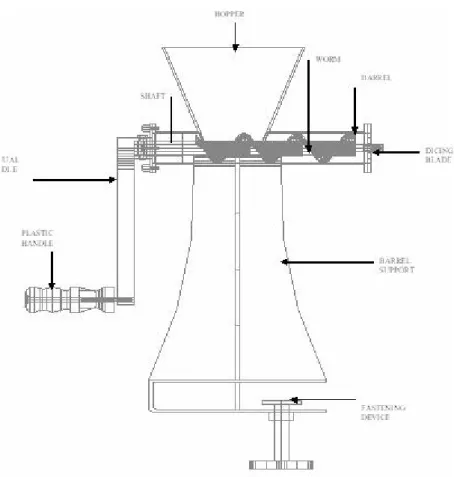
The above equations were used in the de-sign and the development of the dough-dicing machine. The essential component parts of the dough-dicing machine are the hopper, barrel, feed worm, dies, dicing blade, and the manual handle for turning the worm. The basic features of the compo-nents parts and the isometric view of the machine are shown in Fig 2 and Plate1 (a) and (b).
The machine operates as described briefly below. The kneaded dough is fed into the
barrel through a hopper at the feed end of the barrel. The worm shaft conveys the dough to the discharged end of the barrel. The dough is forced out through the die out-let at the discharge end while a knife at the die end cuts the dough into small lengths. The diced dough prepared in this manner is now fried. Fig. 2 shows the schematic illus-tration of the dough-dicing machine devel-oped for cold extrusion.
Fig. 2: The schematic illustration of the dough-dicing machine developed for cold extrusion
Plate 1 (a) Dough-dicing machine
Plate 1(b) Component parts of dough-dicing machine: (a) hopper and feed barrel, (b) plastic handle, (c) worm shaft, (d) cutter, (e) bolts and nuts (f) die outlets, (g) manual handle.
PRELIMINARY TESTING OF
THE MANUAL DOUGH
EX-TRUDING MACHINE
Dough preparation
Dough of density 1126.41kg/m3 was
pre-pared and divided into five equal parts. Each part weighed 200g. The first division of the dough was processed into the re-quired shapes using the traditional method. The traditional method involves the use of a wooden roller, board and knives for man-ual cutting of the dough. The dough pro-cessed by this method is marked “M” as shown in Plate 2. The products marked 1, 2, 3, 4 in Plate 2 were dough extruded using the manually operated dough-dicing ma-chine. The four categories of die plates shown in Plate 1 were being used for the extrusion respectively. The products marked 1, 2, 3, 4 Plate 2 were extruded from die having an outlets of 1, 2, 3, and 4
respectively. The processed dough was fried into the much-desired edible products “chin- chin” shown in Plate 2. The time to complete the processing of each division of dough was monitored using a stopwatch. The results of the preliminary test of the operation of the dough-dicing machine is presented in the next section.
RESULTS AND DISCUSSION
The time required to process kneaded dough into diced shapes was compared with that obtained from the traditional method and the result is presented in Table 1. The result showed that as the number of the extruding outlet increases the resident time of the dough increases which signifies that at high-est number of outlets there was a reduction in flow or extrusion of the dough from the outlets. This fact is collaborated by similar work done by Ryu and Walker (1995).Plate 2 Products from the dough-dicer: (m) fried dough processed using the tradi-tional method, (1) fried dough extruded through a single die outlet, (2) fried dough extruded through a dual die outlets, (3) fried dough extruded through a triple die outlets, (4) fried dough extruded through a quadruple die outlets.
It can be observed (from Plate 2) that there were longer lengths of extruded dough ob-tainable with the single die outlet as com-pared to the other dies with 2, 3, and 4 out-lets respectively. This also can be interpret-ed, as the number of die outlet increases there is definite reduction in flow rate of extruded dough hence the shorter the length of diced dough obtained. This pre-liminary result obtained showed that the manually operated
dough-dicing machine has a better pro-cessing advantage over the traditional meth-od. The plot shown in Fig.3 showed that having more than four extrusion outlet might not bring improvement on the pro-cessing time, however, the best machine per-formance is when the outlets is four.
CONCLUSION
A manually operated dough dicing had been developed. Preliminary tests showed that the
Table 1. Summary of the Rate of Processing Time in Dough Dicing Operation Processing
Method
Number of Outlets On Die
Weight of Dough Extruded (g)
Processing Time (sec.)
Density (Kg/m3)
Estimated Pressure at Die Outlet (KPa)
Traditional 0 221.85 458 1126.41 -
Dough Dicer 1 221.85 269 1126.41 219.18
Dough Dicer 2 221.85 185 1126.41 219.18
Dough Dicer 3 221.85 140 1126.41 219.18
machine could be suited for dicing of dough. Thereby, it is of great benefit for local confectionery producers. This ma-chine also has the capability of extruding various shapes and length of dough, which makes it more advantageous when com-pared to other domestic dough processing methods. This machine is also adaptable for fish farmers’ blending fish meals into pellet forms.
REFERENCES
Bencomo, C.E., Dominguez, M. 2000. Co-extrusion: a new method for the manu-facture of bread. Alimentaria, 37 (310),pp 77 -81.
Berry, D. 2000. New food solutions from extrusion. Prepared Foods, 169 (7),
pp67-68, 70, 72.
van den Dungen, W.J.E., Bergmans, P.J.C.M. 2000. Apparatus for manufactur-ing co-extruded food products and method for manufacturing a coextruded food prod-uct. PCT Patent Application, patent number WO-00-44233.
Harper, J.M. 1979. Food Extrusion. CRC.
Crit. Rev. Food. Sci. Nur., February 155-215
Huber, G.R. 1984. New extrusion
technol-ogy for confectionery products. Manuf.
Confect., May, 51-52,54.
Olkku, J., Hassinen,H., Antila, J., Pohjanpalo,H., Linko, P. 1980.
Automa-tion of HTST-Extrusion cooker. In: P.Linko, Y. Malkki, J. Olkku and J. Larinkari (eds.), Food Processing Engineering, Vol. 1. Applied Science, London, pp 777-790.
Slater, G. 1984. Application of extrusion to
the production of breakfast cereals. Food. Trade Rev. March 127-128.
Vincent M. W. 1984. Extruded confetionery
- equipment and process. Vincet Processes Ltd, Shaw, Newbury, Berkshire, RG132NT, UK.
Ranjit, B., Subha, G. 2014. Extrusion
tech-nique in food processing and a review on its various technological parameters. Ind. J. Sci. Res. and Tech. 2(1):1-3/Bordoloi & Ganguly ISSN:-2321-9262 (Online) Online Available at: http://www.indjsrt.com Date accessed February 2nd 2015.
Riaz, M.N., Anjum F.M., Khan M. I. 2007 Latest trends in food processing using extrusion technology PAK. J. FOOD SCI., 17(1), pp 53-138.
Ryu G.H., Walker C.E. 1995. The effect of
extrusion conditions on the Physical Proper-ties of wheat flour. Extrudates. Starch/ Stärke 47, Nr. 15. 33-36.