The Belk Boutique: An Evaluation from the Patient Perspective
By
Kaity Lohrei
Honors Thesis
Department of Health Policy and Management
University of North Carolina at Chapel Hill
April 2015
Approved:
“Attending to psychosocial needs should
be an integral part of quality cancer
care… it is not possible to deliver good-‐
quality cancer care without addressing
patients’ psychosocial health needs.”
-‐
Cancer Care for the Whole Patient (IOM
2007)
Introduction and Program Description
Cancer is the second leading cause of death in the U.S.,[1] and is often accompanied by a complex combination of physical, psychological, and social difficulties for patients and loved ones. Despite being a worldwide leader in cancer care and research, the U.S. is faced with an increasing cancer burden. The number of new cases of cancer per year is expected to reach 2.3 million by 2030, an increase of 45% since 2010.[2]
Cancer and cancer treatment can often result in severe disfigurement and changes in body functioning, as well as detrimental psychosocial difficulties.[3] A social stigma is attached to “the C-‐word,” and many patients experience changes in how they view themselves, their bodies, and their interpersonal
relationships.[4] Studies have shown that up to 40% of cancer patients have a difficult time adapting to these changes and develop depression and anxiety disorders, while an extra 25% are burdened by feelings of loss of control, lower self-‐esteem, or general emotional distress.[5] These problems not only lead to significantly lower quality of life for patients, but can also affect how well patients adhere to treatment plans and interact with care providers and loved ones.[5] It is important for standard cancer treatment to include psychosocial support, including services to address body image and functioning issues.[3]
Duke Cancer Center
Cancer patients from all over the world come to receive comprehensive treatment at the Duke Cancer Center (DCC). The 267,000-‐square-‐foot center includes disease-‐specific clinic areas, an on-‐site pharmacy specializing in serving cancer patients, spacious and comfortable infusion rooms, a Patient Education Resource Center, and a family garden and café for patients and their caregivers to relax between appointments.[6] The Cancer Center also offers a large variety of psychosocial services to patients through the Duke Cancer Patient Support Program (DCPSP). Created in 1987, the DCPSP focuses on “treating the whole person,”[7] rather than just the disease through support services such as group and individual therapy, support groups, oncology recreation therapy, educational workshops, and guided meditation. These professional support services are accessible to all cancer patients and their families at no cost, through all stages of illness or wellness.
The DCPSP also offers resources to help patients cope with body image and functioning issues. The Belk Boutique, located on the first level of the DCC, offers skincare products, wigs, scarves and other head coverings, professional salon services, self-‐image counseling, and volunteer support. However, only a small percentage of adult cancer patients at the DCC utilize the products and services available at the Belk Boutique. To increase its use and benefit to patients, the DCPSP staff requested an evaluation of patient satisfaction with the products, services, and staff and volunteers of the Belk Boutique, as well as an assessment of patient experiences in the boutique.
Evaluation Questions
1. How do patients who have visited the Belk Boutique perceive its current operation including the service provided by staff and volunteers and the suitability, quality, affordability, and
2. What types of products and services do adult cancer patients at the DCC want to help them cope with body image and functioning issues?
3. How do patients rate and describe their experiences at the Belk Boutique?
4. How have the products and services provided at the Belk Boutique affected patients overall, with particular attention to body image and functioning?
5. Why do only a small percentage of patients visit the Belk Boutique?
Background and Literature Review
Overall Cancer Burden in the United States
Current state & future trends
Cancer affects up to one-‐third of all Americans[1] and is often accompanied by a complex combination of physical, psychological, and social difficulties for patients and their loved ones. Despite being a worldwide leader in cancer care and research, the U.S. faces an increasing cancer burden.[8] Cancer is currently the second leading cause of mortality in the U.S., accounting for an estimated 585,720 deaths in 2014, roughly one-‐fourth of all deaths.[1] Furthermore, cancer incidence is expected to reach 2.3 million by 2030, an increase of 45% since 2010.[2, 8] One major reason for this projected increase in cancer incidence is the demographic transition of the U.S. The total population of the U.S. is expected to increase by roughly 55 million people from 2010 to 2030,[2] with rapid growth among older adults and minorities,[2] groups that experience higher rates of cancer.[9]
Growing cancer burden
oncologic care. A disproportionate number of people over the age of 65 are diagnosed with cancer; between 2010 and 2030, the number of adults over 65 years and older diagnosed with cancer will increase by 67%.[2] Thus, an increasing number of people will need comprehensive cancer care.[12]
Developments in cancer care
In addition to the growing incidence of cancer in the U.S., the number of cancer survivors, defined as those who have had a diagnosis of cancer and are living in any stage of illness or wellness, has been increasing dramatically.[16] One reason for this increase is the many developments in cancer care in the last 50 years. In the 1960s, only a few drugs were available for cancer patients, and the majority were very difficult to tolerate and not very effective.[17] However, patients today are benefitting from the investments that have been made in research. The FDA is approving more and more cancer drugs and therapies. Currently, over 170 drugs and therapies are available to cancer patients, many of which can be tailored to specific tumor types and molecular characteristics of individual patients.[17] Additionally, techniques in surgery and radiation have improved significantly, and the focus on comprehensive care, including support services and pain and symptom management, is growing. These advances in cancer treatment, coupled with efforts in prevention and early detection, have resulted in higher survival rates.[9] In the 1970’s, just 50% of all cancer patients lived five years after diagnosis, but now over two-‐ thirds of Americans diagnosed with cancer live five years or more.[1] These 5-‐year survival rates are increasing for men and women across the top 15 types of cancer.[3] The number of cancer survivors in the U.S. is projected to increase from 14.5 million in 2014 to 19 million by 2024.[16] Increasingly, cancer is being managed like any other chronic condition,[18, 19] with ongoing, comprehensive, and patient-‐ centered care even more vital to the health of cancer patients.[8]
Cancer as a Chronic Illness
Treating cancer as a chronic illness
The NIH defines chronic disease as having, “one or more of the following characteristics: they are permanent, leave residual disability, are caused by nonreversible pathological alteration, require special training of the patient for rehabilitation, or may be expected to require a long period of supervision, observation, or care.”(p.100) [20] Many cancer patients are now surviving arduous combinations of surgery, chemotherapy, and radiation, and are joining the increasing segment of Americans with chronic illnesses.[3] Treating cancer as a chronic condition requires patients to adopt long-‐term lifestyle and behavior modifications, and many cancer patients will require consistent surveillance and ongoing care for effects of cancer and treatment.[8]
Effects of cancer and cancer treatment
Cancer can cause a complex combination of detrimental physical, social, psychological, economic, and spiritual effects in the lives of patients and their families.[9] Depending on the type and location of cancer in the body, long-‐term physical effects can include chronic pain, changes in mobility, loss of a limb or another body part, decreased sexual functioning, fatigue, changes in bodily functioning and appearance, difficulties performing activities of daily living, cancer metastasis, organ failure, and loss of fertility.[3, 9] Cancer survivors also live with a higher risk of developing other chronic conditions such as diabetes and heart disease compared to the general population.[8]
Cancer and its treatment can also affect people psychologically and socially. For example, the
depression, as well as a sense of helplessness, lack of control, and lowered self-‐esteem. These
psychological and social effects may be associated with shifts in their roles within society, the family or workplace that can be hard to accept and adjust to.[9] These physical, psychological, and social issues faced by cancer patients are not independent of each other; they both result from and contribute to one another. Therefore, cancer is much like other chronic conditions in that it requires ongoing management and surveillance. Providing comprehensive care for cancer patients and caregivers that meets physical, psychological, and social needs is a daunting task, but a lot of research is being done to improve care quality and delivery. One essential domain of comprehensive cancer care is psychosocial care.[3]
Psychosocial Care for Cancer Patients
Psychosocial needs
Cancer patients and their caregivers face many different kinds of psychosocial needs. The Canadian Association of Clinical Oncology (CAPO), drawing internationally from major systematic reviews, population based surveys, and two major reports about psychosocial care for cancer patients, divide psychosocial needs into seven different domains: physical, informational, emotional, psychological, social, spiritual, and practical,[21] which are summarized in Table 1. Failing to meet any of these needs has the potential to have adverse consequences for cancer patients and their loved ones.
Domain Examples of Needs
Physical Needs Adequate nutrition, pain and symptom relief
Informational Needs Treatment education, help with navigating health care system
Emotional Needs Comfort, safety, grief counseling
Psychosocial issues and their impacts
Psychosocial issues caused by unmet needs of cancer patients can be psychological, emotional, developmental, and social in nature[3] and may greatly affect how patients cope with cancer. Studies have shown that 30-‐40% of cancer patients are unable to adapt to changes caused by cancer and are burdened by mental disorders such as depression, anxiety, and adjustment disorders.[4] Some studies have shown cancer patients often experience symptoms similar to PTSD.[22] In addition to mental health and emotional issues that reach the level of a clinical syndrome, studies have shown an additional 15-‐25% of cancer patients are faced with mood disturbance, sadness, health anxiety, fear, guilt, feelings of loss of control, anger, isolation, and lower self-‐esteem.[3, 4] Patients are often faced with anxiety caused by transformations of self-‐image—the way people view themselves[23]—because body image, roles within the family and workplace, and sexual function can all be impacted by cancer and
treatment.[3]
Addressing psychosocial issues is critical because they have a significant impact on overall health and wellbeing of cancer patients and their families. Clinically significant distress has been associated with longer rehabilitation time, poor adherence to medical treatment, maladjustment, lower quality of life, and even shorter survival times.[4] Psychosocial care may not be a cure for the physical disease, but the Institute of Medicine, the National Cancer Institute, the CDC, and the Agency for Healthcare Research & Quality recognize that psychosocial care should be included in the standard of care for cancer.[3, 9, 24]
Psychosocial care in cancer treatment
cancer, and supporting these cancer survivors in accessing resources and support to cope with the disease.[9] The American College of Surgeon’s Commission on Cancer, which provides accreditation for all cancer centers in the U.S., mandated that all cancer centers must have a plan to integrate
psychosocial services into routine care by 2015.[5] Psychosocial interventions are intended to
complement and optimize treatment[3] by managing the complex combination of psychosocial needs presented above in Table 1. Many different types of psychosocial health services are available for cancer patients such as patient education programs, programs that offer assistance with activities of daily living, financial planning services, peer support programs, and psychotherapy services.[3] The body of research supporting the idea that these programs can improve the quality of life of cancer patients is growing.[4] However, gaps in the literature exist regarding some types of psychosocial health issues and interventions aimed at alleviating them.[27] One example within this gap is the issue of body image.
Body Image Needs of Cancer Patients
Background of body image in cancer patients
Body image is a complex construct that includes not only how someone views their physical appearance, but also thoughts, feelings, perceptions, and behaviors related to the body and its functioning.[27] Attitudes about body image can be shaped by culture, experiences interacting with others, individual personalities, and changes in physical appearance and functioning.[28]
Because cancer and cancer treatment can result in severe disfigurement and changes in body
changes such as pain or numbness, as well as impaired functioning such as impotence, dysarthria, or decreased motor skills.[27] Research shows that patients who undergo mastectomies, have surgery for head and neck cancer, or utilize colostomy bags are especially likely to suffer body image
difficulties,.[27] Harmful treatment effects on sexual organs can also challenge gynecological, testicular, and prostate cancer patients because these organs have a large impact on feelings of masculinity or femininity.[27] These body image and functioning difficulties can have a significant effect on overall health and wellbeing of cancer patients.
The effect of body image issues on health
Generally, positive body image is associated with higher psychological adjustment; negative body image is associated with maladjustment, depression, anxiety, and lower self-‐worth.[23] Appearance changes related to cancer or treatment might result in severe distress or unhealthy behaviors such as social isolation.[27] A recent study by Fingeret et al. reviewed all relevant observational and intervention studies related to body image difficulties of adult patients with specific cancers (predominately breast cancer, but also cervical, colorectal, head and neck, hematological, melanoma, ovarian, prostate, renal, and testicular).[27] In the 79 observational studies reviewed, significant numbers of patients with cancer of the head, neck, and breast had concerns with embarrassment and bodily changes that persisted as long-‐term issues. This study also provided evidence that, across cancer sites, body image issues are associated with adverse psychosocial conditions such as heightened anxiety and depression, lower quality of life, and sexual dysfunction.[27] Because body image is subjective in nature, it’s important to proactively inquire about body image of patients even when no noticeable physical changes exist.[28]
Interventions to prevent or resolve body image and functioning issues
Although the body of research to support various types of psychosocial interventions to improve cancer patients’ quality of life is growing, limited information about body image and functioning interventions exists. Most research related to body image interventions for cancer patients involves women with breast cancer. For example, cognitive-‐behavior therapy (CBT) with groups or couples has been shown to significantly improve body image outcomes of breast cancer patients.[27] “Look Good Feel Better,” a national program that runs workshops to help women cope with changes in appearance due to cancer and its treatment, has been shown to improve body image in cancer patients in different disease groups.[30] Psychosexual therapy, physical fitness interventions, educational and lecture based interventions, and some cosmetic-‐focused interventions show promise,[27] but more research is necessary to determine efficacy. As cancer incidence in the United States is rising with the population, it’s becoming increasingly important to develop and evaluate interventions to address the psychosocial issues cancer patients face, including body image and functioning.
The Duke Cancer Patient Support Program (DCPSP) offers several types of psychosocial interventions including the Belk Boutique, which addresses body image and functioning needs by connecting patients to skincare products, wigs, hats and other head coverings, professional salon services, self-‐image and sexual health counseling, and volunteer support. However, only a small percentage of adult cancer patients at the DCC utilize the products and services available at the Belk Boutique. The goal for this evaluation is to help stakeholders of the DCPSP improve the quality and the impact of the Belk Boutique, and further equip them to address the body image and functioning issues of cancer patients at Duke. In doing so, the results of this project can improve the care and outcomes of cancer patients.
Methods
It is important for the program management of the DCPSP to understand how patients experience and perceive the suitability, quality, affordability, and accessibility, of services and products offered at the Belk Boutique, and how this program impacts the psychosocial health of cancer patients. As stated earlier, this study explored responses to five evaluation questions, listed in Table 2.
Table 2: Evaluation Questions
1. How do patients who have visited the Belk Boutique perceive the current operation of the Belk Boutique including such aspects as the service provided by staff and volunteers and the suitability, quality, affordability, and accessibility of products and services?
2. What types of products or services do adult cancer patients at the DCC want to help them cope with body image and functioning issues?
3. How do patients rate and describe their experiences at the Belk Boutique?
4. How have the products and services provided at the Belk Boutique affected patients overall, with particular attention to their body image and functioning?
5. Why do only a small percentage of patients at Duke visit the Belk Boutique?
Study Design
Data Collection
Participants were recruited through a combination of convenience and purposive sampling. [31] Each participant was 21 years of age or older and a current cancer patient at the DCC. Thirty-‐two patients participated in the evaluation, including 17 users and 15 non-‐users. This study utilized two survey instruments with closed and open-‐ended questions to explore these patients’ perspectives about the Belk Boutique.
Survey 1 was administered to patients who have visited the Belk Boutique since it opened in 2012.
Survey 1 consisted of four main sections: Products, Services, Staff and Volunteers, and Overall Impact. In the first three sections, participants were asked to rate domains of patient satisfaction such as quality, accessibility, affordability, and suitability. These constructs and their definitions were adopted in part from Hollander, Miller, and Kadlec [35] and are listed in Table 3. In each section, open-‐ended questions were posed to gather patient perspectives on ways the boutique can better serve patients at the DCC and what impact the boutique has had on patients. Please refer to Appendix A to view the entire survey.
Construct Measured
Construct Definition/Description
Quality Relates to patients' perceptions of quality or level of satisfaction with products and services provided Accessibility How well patients can access services or have their questions answered
Affordability Extent to which patients perceive products are priced reasonably, in relation to the same or similar products available elsewhere
Suitability
Extent to which the selection of products is appropriate for the patient population, adequate staff and volunteers are available to provide care, care is provided consistently and in accordance with hospital policies, and the process
in which care is provided is appropriate
Table 3: Domains of inquiry and definitions, adopted in part from Hollander, Miller, and Kadlec [35]
Survey 2 was administered to patients who have not visited the Belk Boutique. Participants were asked
with body image and functioning concerns, and reasons why they had never been to the Belk Boutique. Please refer to Appendix B to view the entire survey.
Data were collected between March 5th, 2015 and April 1st, 2015. The evaluator administered 24 of the 32 surveys on-‐site at the DCC and in the inpatient Adult Oncology Medical Units, but also provided paper copies of Surveys 1 and 2 to the Belk Boutique coordinator, boutique volunteers, the DCPSP volunteer coordinator, and family therapists at the DCC who distributed the remaining 8 surveys to patients. Before completing Survey 1 or 2, participants were briefed on the purpose of the evaluation and how their responses would be utilized. Participants were given the option of completing the survey by self-‐administration or face-‐to-‐face interviews with the evaluator. After each survey was completed, it was placed in an envelope and data were entered into Excel by the evaluator.
Data Analysis
Quantitative Analysis
Qualitative Analysis
For qualitative data from Survey 1 and 2, the evaluator followed the Describe-‐Compare-‐Relate method described by Bazeley [36], and related these findings to the quantitative responses to create a deeper understanding of patient satisfaction. First, responses from the open-‐ended survey questions were coded manually and themes that emerged from patient responses were identified and described. Second, differences in themes between users and non-‐users were identified, and meaningful associations were recorded. Third, the evaluator related these key themes and associations to the overall purpose of the evaluation—to provide useful information the DCPSP staff could use to improve this important program for their patients.
Findings
Comparing Users and Non-‐Users
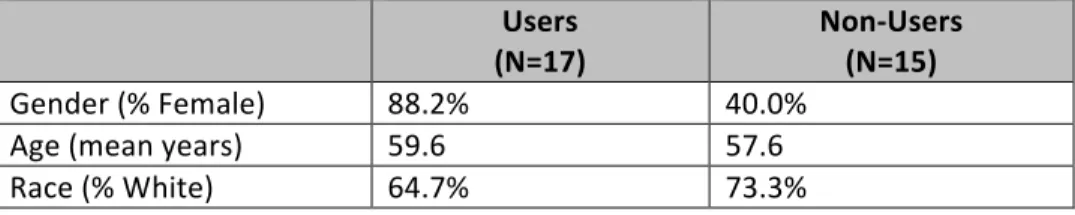
No significant difference was found in age or race among the patients who have used the boutique and those who have not. The mean ages for users and non-‐users were 59.6 years and 57.6 years,
respectively, while both user and non-‐user groups consisted of mostly White (64.7% and 73.3% respectively) and African American (29.4% and 26.6% respectively) patients. However, significant
differences in gender between users and non-‐users exist. Fifteen of the 17 users were female, while only two males reported ever visiting the boutique. Of the non-‐users, the majority were male patients (Table 4).
Users
(N=17) Non-‐Users (N=15)
Gender (% Female) 88.2% 40.0%
Age (mean years) 59.6 57.6
Race (% White) 64.7% 73.3%
Disease groups represented were diverse for both users and non-‐users. Some patients were classified into multiple disease groups if they had been diagnosed with multiple forms of cancer. Among users, the main disease groups represented were breast cancer (41.1%), and Non-‐Hodgkin lymphoma (17.6%). Other disease groups represented were leukemia, brain cancer, carcinoma, sarcoma, multiple myeloma, and ovarian cancer. Many non-‐users also had been diagnosed with breast cancer (26.6%), but also lung cancer (20%), and leukemia (13.3%). Other disease groups represented among non-‐users were multiple myeloma, lymphoma, liver cancer, ovarian cancer, colorectal cancer, melanoma, and cancer of the uterus, bile duct, tonsils, head, thyroid, and kidneys.
Products: Evaluation Questions 1, 2, and 4
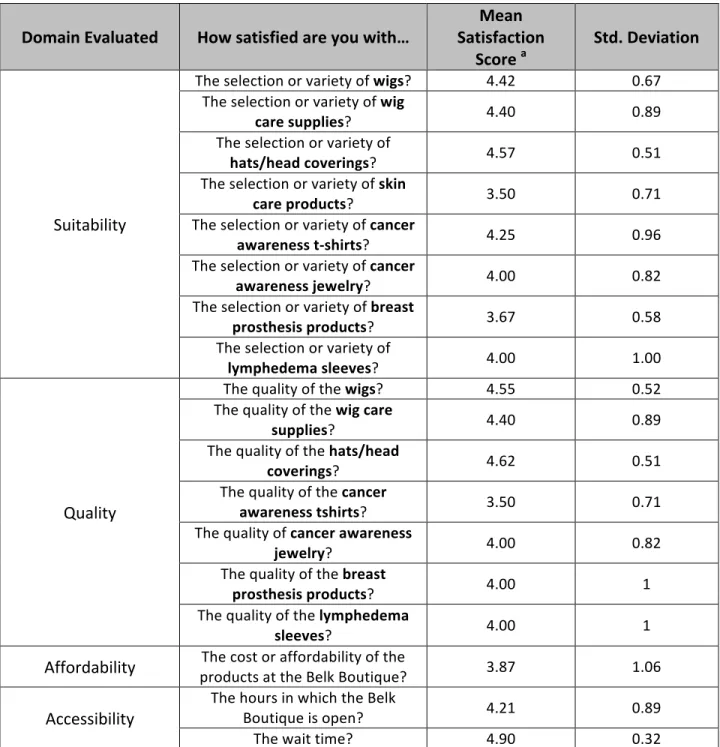
The Products section of Survey 1 was designed to explore evaluation questions 1, 2, and 4 from Table 2. The findings from the close-‐ended Likert scale questions measuring suitability, quality, affordability, and accessibility of the self-‐image products offered in the Belk Boutique are outlined in Table 5. The majority of the mean scores were above 4, which indicates high levels of satisfaction with the products provided at the Belk Boutique. The qualitative responses from patients reflected these high satisfaction scores; patients responded that the Belk Boutique offers quality products they need at a more affordable cost and convenient location than other stores (Table 6). Patients also felt the boutique was important to them as they were going through the process of losing their hair or shopping around for self-‐image products.
others suggest patients highly value items that are comfortable to wear, including clothes and head coverings.
While affordability of products was ranked relatively low (mean=3.87), users did not make any comments about being unable to afford the prices in the boutique. Instead, many patients expressed they were very happy with the prices and believed they were lower than stores outside of the cancer center, especially for wigs. It is more difficult to draw conclusions about the selection of skin care and breast prosthesis products, as no users made specific comments about these items.
Overall, patients were satisfied with the suitability, quality, accessibility, and affordability of the
products provided at the Belk Boutique. High satisfaction scores were reported in all of these domains. Patients reported being very satisfied with the hours in which the boutique is open and the time spent waiting, which is an important aspect of accessibility (see Table 3). While the mean satisfaction score was not very high for affordability of products, many qualitative responses were positive. Users also reported the products in the boutique, especially the wigs and head coverings, were of great quality. Except the possible exceptions of the skin care and breast prosthesis products, patients were very satisfied with the selection or suitability of wigs, hats and other head coverings, cancer awareness products, etc. When patients were asked to list different types of products they felt would improve the selection of the items offered at the boutique, 6 of the 17 responded, “I cannot think of anything.” Some suggestions included offering comfortable Duke t-‐shirts, products to help with the process of losing your hair from treatment, and smaller wigs (one woman expressed she would need the size “extra petite”).
Domain Evaluated
How satisfied are you with…
Satisfaction
Mean
Score
aStd. Deviation
Suitability
The selection or variety of wigs? 4.42 0.67 The selection or variety of wig
care supplies? 4.40 0.89
The selection or variety of
hats/head coverings? 4.57 0.51 The selection or variety of skin
care products? 3.50 0.71
The selection or variety of cancer
awareness t-‐shirts? 4.25 0.96 The selection or variety of cancer
awareness jewelry? 4.00 0.82
The selection or variety of breast
prosthesis products? 3.67 0.58 The selection or variety of
lymphedema sleeves? 4.00 1.00
Quality
The quality of the wigs? 4.55 0.52
The quality of the wig care
supplies? 4.40 0.89
The quality of the hats/head
coverings? 4.62 0.51
The quality of the cancer
awareness tshirts? 3.50 0.71
The quality of cancer awareness
jewelry? 4.00 0.82
The quality of the breast
prosthesis products? 4.00 1
The quality of the lymphedema
sleeves? 4.00 1
Affordability
products at the Belk Boutique? The cost or affordability of the 3.87 1.06Accessibility
The hours in which the Belk Boutique is open? 4.21 0.89The wait time? 4.90 0.32
Are there any different types of products you can think of that would better meet your needs?
Themes
Quotations
Patients value items
that are comfortable
to wear.
• Stuff to help with the process of hair falling out, and comfortable pants. • It would be nice if there were Duke shirts, the black and blue ones in
comfortable sizes for me like XL and 2XL. More comfortable clothes would be nice to have there.
•
Good styles. I enjoy what I have, but the wigs are very itchy though.Have the products provided at the Belk Boutique been important to you in any way?
Patients believe the
Belk Boutique offered
quality products they
needed at a more
affordable cost and
convenient location
than other stores.
• Yes. There is not a good place to shop in Fayetteville for these types of hats, the types that keep my ears and neck covered.
• Yes. It’s great being able to get them here, and not having to get them or find them anywhere else.
• I just started using these products and they have already been very helpful. The wigs are much less expensive than at other wig places. All of the wigs I tried on were under $100…
• Primarily the 3 wigs. I wear them all the time and am pleased with the quality.
• Where else would we go for these items? The items are cheaper there than anywhere else.
Patients feel the
boutique is important
to them as they go
through the process
of losing their hair or
shopping around for
self-‐image products.
• …When I went to wig places outside the cancer center, most were between $200 and $500. I received 5 hats and head coverings at no cost, and that was very nice. It was also nice to have the option to turn them back in if I changed my mind.
• I haven't lost my hair yet, but I think the products I have received form the Belk Boutique will be important to me!
Is there a specific service you have received from the Belk Boutique that you were especially
happy with?
Patients really enjoy
the products they
receive from the no-‐
cost section of the
boutique.
• I received 5 hats and head coverings at no cost, and that was very nice. It was also nice to have the option to turn them back in if I changed my mind.
• When I got my free hats and wig
Table 6: Themes and supporting responses about products from the Belk Boutique
Services: Evaluation Questions 1, 2, and 4
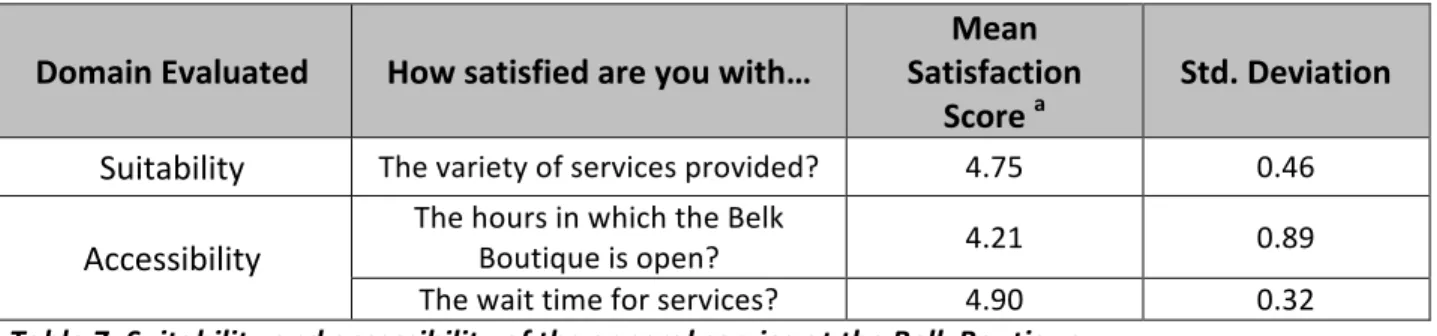
The Services section of Survey 1 was also designed to explore evaluation questions 1, 2, and 4 from Table 2. Each mean satisfaction score was above 4, indicating that the general service available at the Belk Boutique is both suitable and accessible for cancer patients at Duke (Table 7).
Domain Evaluated
How satisfied are you with…
Satisfaction
Mean
Score
aStd. Deviation
Suitability
The variety of services provided? 4.75 0.46Accessibility
The hours in which the Belk Boutique is open? 4.21 0.89The wait time for services? 4.90 0.32
Table 7: Suitability and accessibility of the general service at the Belk Boutique aVery unsatisfied=1, Unsatisfied=2, Neutral=3, Satisfied=4, Very Satisfied=5
Patients were also asked to rank their satisfaction with the specialty services such as hair styling and head shaving, wig styling, make-‐up tutorials, breast prosthesis services, and self-‐image counseling. Some `of these services are available at the boutique only on certain days of the month, so many patients have never used these services before. Of the 17 users surveyed, no patients reported having used the hair styling or head shaving services. Only one patient reported having used the wig styling services, and two each reported using the breast prosthesis services and self-‐image counseling. Although this evaluation did not capture many perspectives of patients who have utilized these specialty services, the patients who did use these services reported being “Satisfied” or “Very satisfied” with their quality.
positive: it is convenient for patients to have all needed self-‐image services available within the cancer center.
Staff and Volunteers: Evaluation Questions 1, 3, and 4
The Staff and Volunteers section of Survey 1 was designed to explore evaluation questions 1, 3, and 4 from Table 2. Both the quantitative and qualitative survey data show that the staff and volunteers significantly add to the suitability, quality, and accessibility of psychosocial care from the Belk Boutique. The mean score of each closed-‐ended Likert scale question in this section was above 4, as patients reported that the care and service provided by the staff and volunteers suited their needs, was of high quality, and was very accessible to them (Table 8).
The main themes of the qualitative responses about the staff and volunteers of the Belk Boutique supported these quantitative results (Table 9). Patients reported that the staff and volunteers provide quality care consistently, and they spend a great deal of time and effort assisting patients. One patient expressed, “They helped me to try on as many wigs as I wanted to, and let me take some and bring them back if I changed my mind or wanted to exchange them. They definitely went the extra mile.” Most patients felt the staff and volunteers are able to relate to them and offer valuable advice about self-‐ image products and services, and are pleased with how attentive, friendly, and supportive they are. In addition to the satisfaction of the staff and volunteers, patients also valued the aesthetically pleasing appearance of the Belk Boutique, and the overall enjoyable experience of visiting. Patients expressed, “It's a beautiful place, nice set-‐up,” and “The store looked very nicely laid out.”
training to help familiarize them with the products and services available. Some patients reported occasions when they had to wait a long time for service because there was only one volunteer in the boutique and several patients were requesting service at once. Overall, however, responses were very positive. Many patients are very satisfied with the current operation of the Belk Boutique, encouraging them to, “keep doing what they are doing!” Most experiences recounted through qualitative responses exceeded patient expectations, and it’s evident that the staff and volunteers at the Belk Boutique have had a largely positive impact on the patient population at Duke.
Domain Evaluated
The staff and volunteers…
Mean Score
aStd. Deviation
Suitability
Understand your needs. 4.44 0.89
Explain things well.
4.44
0.89
Understand your emotions, feelings, and
concerns.
4.60
0.63
Respect you.
4.40
0.83
Are sympathetic and reassuring when you
have a problem.
4.13
0.92
Care about your perspective.
4.40
0.83
Quality
Meet your service expectations. 4.33 0.90
Are willing to “go the extra mile” for you. 4.13
0.92
Spend enough time with you.
4.60
0.63
Have the skills needed to address your
concerns.
4.40
0.99
Accessibility
Are available to answer your questions. 4.69 0.60
Are willing to help you. 4.67 0.62
Respond promptly and courteously to your
problems. 4.53 0.64
Table 8: Suitability, quality, and accessibility of the staff and volunteers of the Belk Boutique
Has there been a time when the staff or volunteers addressed your needs in a way that
exceeded your expectations? Is there anything the staff and volunteers can do to better meet
your needs?
Themes
Quotations
Staff and volunteers
provide quality care
consistently.
• Yes, with each visit. Always patient, understanding, and willing to go the extra mile.
• Almost every time!
• They should keep doing what they are doing-‐-‐ a wonderful job. • Excellent service always.
Staff and volunteers
spend a great deal of
time and effort
assisting patients.
• They took the time to help me and find my sizes.
• They helped me to try on as many wigs as I wanted to, and let me take some and bring them back if I changed my mind or wanted to exchange them. They definitely went the extra mile.
• She spent a lot of time with my mom and offered helpful hints and information.
Most patients felt the
staff and volunteers
are able to relate to
patients and offer
valuable advice about
self-‐image products
and services.
• They are very knowledgeable. I really liked how they called the wigs by name! They were very helpful as I was deciding between colors. • Yes. They offered many suggestions when I visited.
• They are very helpful.
• The volunteers are very respectful to my needs and helpful.
• A lot of the volunteers can talk you through things because they know your concerns and might have been through the same thing.
Patients are pleased
with how attentive,
friendly, and
supportive the staff
and volunteers are.
• Attentiveness of staff is always excellent. • …Very nice and wonderful people. • The volunteers were very friendly.
• Everything is good. They have good salesmanship, they are polite, and they offer companionship and friendly attitudes.
• You know they are there for you.
Has there been a time when the staff or volunteers were unable to address your needs
adequately? Is there anything the staff and volunteers can do to better meet your needs?
Patients expressed
concerns about some
volunteers’ familiarity
with products
available.
• Yes. While the volunteers were very nice, they didn't seem to know the product lines the boutique offered. Their knowledge base seemed pretty low. We have been told to make sure to let Grace help you, to make sure you talk to Grace.
• There should be more training for boutique volunteers to increase knowledge base and to familiarize them with the products. If Grace isn't there when I go, I feel like I can’t really be helped.
Occasionally, patients
encounter difficulties
accessing the help
they need in a timely
manner.
• Yes. One time when we visited the boutique, there was only one staff member or volunteer. There were multiple other patients who needed help, so we had to wait a long time before we were helped.
•
Make sure to always have at least two staff or volunteers in the boutique, just to make sure everyone can be assisted when they come in.Overall Impact: Evaluation Questions 3 and 4
Designed to explore evaluation questions 3 and 4 (Table 2), the last section of Survey 1 measured Overall Impact. Overall impact of the boutique was not measured directly by any closed-‐ended
questions; rather, qualitative responses about impact were gathered from two open-‐ended questions. The qualitative and quantitative survey data suggest that the staff and volunteers have positively impacted patients. One main theme was the genuine concern shown by the staff and volunteers. One patient offered, “It really made [me] feel good about myself that people are concerned for my needs.” Another theme was the importance of feeling comfortable and confident after being assisted in the boutique. After visiting the boutique, several patients reported feeling a boost of confidence as a result of both the products and services received as well as their interactions with staff and volunteers.
The boutique also affects how patients perceive their care at Duke. Each patient who answered this question insisted the boutique positively impacts their feelings towards receiving care at Duke. Several called the boutique an “added bonus” to the already wonderful care they are receiving at the cancer center. Many were appreciative of the convenience of having this resource available on-‐site. These themes and supporting quotations are displayed in Table 10.
Have the services provided at the Belk Boutique impacted you in any way? If so, how?
Themes
Quotations
The genuine concern
of the staff and
volunteers greatly
impacted patients.
• Yes. My mother was diagnosed with cancer recently. Was assisted by an employee who also has a cancer diagnosis. She spent a lot of time with my mom and offered helpful hints and information. She showed genuine concern while assisting her. Excellent service always.
• Yes, it really made [me] feel good about myself that people are concerned for my needs.
Many patients feel
comfortable in the
boutique and more
confident after
visiting.
• Everyone is there for similar reasons, so no one feels uncomfortable. • It gives you confidence and makes you feel better about yourself.
To what extent does the Belk Boutique affect your feelings about receiving care at Duke?
The boutique has a
positive effect on
patients’ feelings of
receiving care at
Duke.
• It positively affects my experience at Duke. I am glad they have it. • Adds to the list of positives to have this resource on-‐site.
• The boutique is a good thing to have, and even though I've only been there once, it's had a positive effect on my feelings towards receiving care at Duke.
• It definitely improves my feelings about receiving care at Duke. • I am SO glad they are here. So convenient for me as a patient.
•
The boutique effects my feelings very positively!Table 10: Themes and supporting responses about the impact of the Belk Boutique
Reasons for Not Using the Belk Boutique: Evaluation Question 5
Survey 2 was administered to 15 patients who had never visited the Belk Boutique (non-‐users). Five non-‐users reported having body image or functioning concerns related to cancer treatment; all five were women between the ages of 47 and 65. The remaining 10 non-‐users reported not having been affected by any body image or functioning concerns; nine were men between the ages of 28 and 75.
example, some patients reported not needed services and products from the boutique because their hair had not fallen out yet or had already grown back, yet the boutique offers resources (i.e. sexual health counseling and skin care products) to help patients with other body image and functioning issues.
In addition to this reason, five of the non-‐users were unaware the boutique existed or were unable to find it, including a few patients who have been receiving care at the cancer center for years. Time was also a large factor in non-‐users decision to forgo visiting the boutique. Patients reported “running late” or being “in a rush to get to my clinics or doctors appointments” often, but also being in a rush to leave the cancer center. After a long day of appointments and chemotherapy treatments, patients reported they were usually eager to get home. The themes and supporting quotations from the single open-‐ ended survey question are displayed in Table 11.
Some patients at the Duke Cancer Center have not visited the Belk Boutique. Why haven’t you
shopped at the store at the cancer center?
Themes
Quotations
Some patients are
unaware the boutique
exists or are unable to
find it easily.
• “I only found out about it one hour ago.” – A patient who has received care at Duke since 2012
• “I did not know it was there.” –A patient at Duke since 2006
• I didn't know about it. The maps and signs in the cancer center are also hard to follow.
Time is a big factor
when patients decide
whether or not to
visit the boutique.
• I am usually running late, and I never felt like I needed the boutique enough to stop in.
• I am usually in a rush to get to my clinics or doctors appointments and then drive home to Chesapeake, VA (3.5 hours) in time to avoid rush hour traffic.
• I usually don't want to spend more time here. My chemo takes 5 1/2 hours and by the time I'm finished I want to get home.
Many patients
perceive that the only
products or services
available at the
boutique involve
dealing with hair loss.
• Mostly needed cream for the effects of radiation. No need for any new wigs or scarves.
• I haven't needed to go. My hair has grown back.
•
Someone else got what I needed because of my hair falling out (my hat).Discussion
Summary
Overall, patients who had visited the boutique believed the products and services offered were of high quality, suited their body image and functioning needs, and were made accessible and affordable. Patients highly valued comfort and convenience, as well as the genuine concern for their needs displayed by staff and volunteers. Patients appreciated the time the staff and volunteers spend with them, and felt as if they were very relatable and could offer helpful advice while going through the changes cancer brings. After visiting the boutique, patients felt more confident.
There were some areas for improvement, as a small minority of patients reported encountering
difficulties accessing the help they needed in a timely manner, and few expressed concerns about some volunteers’ familiarity with available products. Some barriers to utilizing the products and services at the Belk Boutique included patients being unaware the boutique existed, running low on time, and believing the boutique wouldn’t benefit them. However, almost all users expressed that the Belk Boutique
positively impacts their feelings of receiving care at Duke.
Relation to Prior Literature
different types of cancer. Thus, data were gathered from patients across over 15 different disease groups.
Research shows that psychosexual therapy and some cosmetic-‐focused interventions show promise in addressing body image and functioning difficulties of cancer patients,[27] but more research is
necessary to determine efficacy. In evaluating the Belk Boutique, valuable patient responses were gathered supporting the idea that these types of interventions are effective in addressing body image and functioning issues. As cancer incidence in the United States is rising with the population, it’s becoming increasingly important to develop and evaluate interventions to address the body image concerns faced by cancer patients.
Limitations
One limitation of this evaluation was the sample was small and included patients from a single site. These factors limit the generalizability of our findings. Second, face-‐to-‐face surveys may be biased if participants give more socially desirable answers, or if the survey administrator’s verbal or body language is not consistent throughout survey administration.[31, 33] Nevertheless, this evaluation gathered very useful information for the DCPSP to use to further address the body image and functioning concerns of their patients.
Recommendations for the DCPSP
1. Continue studying the body image and functioning needs of the patient population at Duke
Cancer Center. Because this phase of the evaluation was unable to collect a significant amount
![Table
3:
Domains
of
inquiry
and
definitions,
adopted
in
part
from
Hollander,
Miller,
and
Kadlec
[35]](https://thumb-us.123doks.com/thumbv2/123dok_us/8335269.2212364/13.918.98.823.719.922/table-domains-inquiry-definitions-adopted-hollander-miller-kadlec.webp)