Abstract
Introduction
Unmanned aerial systems (UAS) are becoming increasingly prevalent in the research of cetaceans (Nowacek et. al. 2016, Torres et. al. 2018) and are currently used to conduct body size measurements via photogrammetry (Durban 2015, Christiansen et. al. 2016, Dawson et. al. 2017), population estimates (Hodgson et. al. 2017) and even genetic sampling for large baleen whales (Apprill et. al. 2017). Photo identification work using UAS has been exhibited in a small number of studies, and more recently, effective behavioral work has been demonstrated with gray whales (Torres et. a. 2018). The feasibility of UAS technology for studying the behavior of delphinids and other small cetaceans has yet to be published. This work seeks to demonstrate the feasibility of studying dolphin behavior via UAS, namely a specific population of Atlantic spotted dolphins (Stenella frontalis).
used for photo identification studies, these identifying features are inefficient for the real-time tracking of individuals and their behavior.
UAS technology presents an effective solution to overcome these challenges. Many modern UAS are equipped with high resolution cameras, have superb stability and advanced gimbal technology, allowing them to produce high quality video. Modern UAS are easy to control precisely, which is vital for launching and landing on a vessel at sea. Multiple studies have demonstrated that UAS pose minimal if any disturbance to cetaceans during flight (Christiansen et. al. 2016, Torres et. al. 2018). Perhaps UAS’ greatest limitation is short battery life, which, depending on the model, averages between 15 and 30 minutes. This limitation will likely be resolved as UAS technology advances and can currently be resolved with back up batteries and an experienced UAS operator who can land and relaunch quickly.
In collaboration with the Denise Herzing and the Wild Dolphin Project (WDP), we collected data via UAS in an ideal field site. Our studied population of Atlantic spotted dolphins ranges in areas of the Northern Bahamas with relatively calm seas, low turbidity, and excellent visibility. Habituated to human activity, this population behaves naturally in our presence, allowing underwater and vessel-based behavioral observation (Herzing 1996, Herzing 1997).
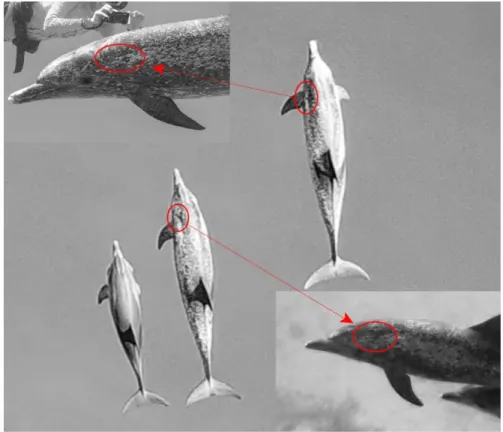
Atlantic spotted dolphins are identifiable throughout their lifetimes, developing distinct spot patterns as they mature (Figure 1). A dolphin’s age can be estimated by the density of these spot patterns, and the species is commonly categorized into four age classes: “two-toned” (calves with no spots), “speckled” (juveniles with at least 2 black spots), “mottled” (young adults with black and white spotting), and “fused” (mature adults with blended black and white spots) (Herzing 1997). This population exists as a fission-fusion society, where group size and composition change regularly. They display a wide range of social interactions, both intraspecies and with resident bottlenose dolphins (Herzing 1996, Miles & Herzing 2003). Similar to Hawaiian spinner dolphins, they rest and socialize in shallow water (6-16m) during daylight hours and feed nocturnally on squid and other prey in deeper offshore water (Herzing 2013, Tyne et. al. 2016, Fumagalli et. al., 2018). For 34 years, WDP has collected acoustic, population, and behavioral data for this population, tracking four generations of dolphins. Such a robust database allows features such as the age, sex, size, body markings, and spot patterns of individual dolphins to be easily identified.
Methods
Field Sites
Research surveys were conducted on the western edges of the Little Bahama Bank and Grand Bahama Bank where Atlantic spotted dolphins are commonly found (Figure 2). The Little Bahama Bank extends North from Grand Bahama Island and is approximately 95km from the Florida coastline. It averages depths of 6–16m and drops off sharply into the Gulf Stream where depths can exceed 500m. The Grand Bahama Bank is approximately 80km from Florida’s coast and has a similar depth pattern to that of the Little Bahama Bank with 6 –16m shallow sand banks descending steeply over 500m into the Gulf Stream. Our search area on the Little Bahama Bank is nearly twice that of the Grand Bahama Bank in accordance with the ranges of the resident Atlantic spotted dolphins.
Data collection
Vessel-based surveys were conducted in collaboration with the WDP during their 2018 field season, May through August. A team of 4–9 people aboard WDP’s research vessel conducted visual searches for Atlantic spotted dolphins in alternating 1-hour shifts from 0700–2000. When dolphins were found –– hereafter referred to as an encounter –– information regarding the number, identities and behavior of animals in the group was recorded. Underwater photos and video of the dolphins’ behavior were captured during the encounter if sea conditions were appropriate. This photo and video data were later used to affirm the identities of individual animals if possible (Figure 1). Following this preliminary observation, UAS flights were conducted in conjunction with other research priorities of WDP. At an encounter’s conclusion, the following gross behavioral categories as defined by WDP’s previous behavioral work were designated (Table 1):
Behavioral Category
Description
Travel Animals swimming in a maintained direction (within 45 degrees) for a minimum of two minutes; speed of travel can vary (Table 2).
Aggression Animals displaying repeated aggression behaviors such as head to head, chasing, group synchrony and tail slaps (Figure 2, Table 2).
Foraging Animals scanning and foraging on the seafloor; animals seen pursuing fish or other prey species.
Play/Socialize Animals displaying repeated play/bonding behaviors such as sargassum drag, pec- pec, fluke- body and leap (Figure 2, Table 2).
Courtship Animals displaying repeated courtship behaviors such as gen buzz, inverted swim (Figure 2, Table 2).
TABLE 1. Gross behavioral categories as defined by the Wild Dolphin Project’s previous research. All behavioral categories were observed with the exception of foraging.
collection was safe and effective, minimizing the risk of damage to the UAS during landing. Following the first UAS flight, we implemented a polarizing filter to reduce glare in subsequent footage. For flights in which there were few clouds and the sun angle was greater than 60 degrees to the horizon, the polarizing filter was used to reduce glare. Excluding these conditions, it was removed to allow maximum light to the camera’s sensor.
Data Analysis
UAS video from each encounter was reviewed in order to determine the identity of each individual dolphin. Dolphins in each video were identified from encounter notes and by comparison to photo-identification data. Appearance features such as spot patterns, body/fin scars and overall coloration were matched between individuals in drone video and ID photos (Figure 1). Behaviors were identified and defined from WDP’s extensive behavioral research history, cross checked by experts on this population of dolphins and organized into an ethogram (Table 2, Figure 3).
Results
Six UAS flights were conducted during the 2018 field season, during which 92 minutes of Atlantic spotted dolphin behavior was recorded. Behavior categories aggression, play/socialize, courtship, rest and travel were observed. Foraging was not observed. Within the identified behavior categories, 19 distinct behaviors were observed, four of which were not assigned to a social context (Table 2). Many behaviors occurred below the water’s surface, not visible to observers on the research vessel. Note that certain behaviors can have different purposes within categories (e.g., leap, chase, torus, pec- gen).
polarizing filter and consequent excessive glare the video. This allowed behavioral observation but limited individual recognition. 100% of individuals were identified in flights 2, 3 and 6 and 75% were identified in flight 4. For flight 5, individuals could not be identified from footage due to worsening sea conditions and a group size of more than 20 dolphins. Identification data was pooled across flights in which identities could be determined (flights 1–4 and 6) and partitioned by age class. With respect to age class, mottled (young adult) and fused (mature adult) individuals were recognized more frequently than speckled (juvenile) and two-toned (calf) individuals that lack distinct spot patterns. 92% of fused, 100% of mottled, 50% of speckled and 60% of two-toned individuals were identified.
TABLE 2. Behavioral ethogram for observed behaviors during video review. 19 distinct behaviors were
observed, with a total of 161 individual observations. Note that certain behaviors are representative of
Discussion
Our preliminary data suggests that UAS are effective tools for measuring delphinid behavior. Studying behavior in the wild has long been complicated by the limitations of vessel-based methodology, which is inadequate in viewing the animals’ full range of behavior, even when near the water’s surface (Berta et. el. 2005). The UAS provided an easy platform for observation, capturing recognizable behaviors and allowing identification of individual animals in varying environmental conditions (Figure 3, Table 2). In unfavorable sea conditions, use of the UAS allowed tracking of animals not visible to researchers on the vessel. Broad behavioral categories were more easily classified from UAS video than from the research vessel, as some behaviors are not exclusive to one context, and vessel-based observation does not enable real- time scrutiny of all animals’ behaviors (Table 2). Because the UAS could view the simultaneous behaviors of multiple individuals, determining the context of an individual behavior was easier to judge. For example, a dolphin may leap during play/socialize or aggression. Viewed horizontally from a vessel, this context distinction can be difficult to make. However, the UAS allows us to record the associated behaviors of that leap. If it is preceded by tactile behaviors such as pec- pec or fluke- body, the context would be determined as play/socialize, whereas if preceded by head- head and tail slap, it would be determined as aggression.
to their age class was possible and can provide valuable information about group structure and behavior.
Studying behavior with UAS has broad applications for further research. Like Hawaiian spinner dolphins, Atlantic spotted dolphins rest and socialize in shallow water during the day, and feed offshore at night (Herzing 2013, Tyne et. al. 2016, Fumagalli et. al., 2018). Tyne and Fumagalli suggest that the health of Hawaiian spinner dolphins may be negatively impacted by tourist activity and humans seeking to swim with them during times when they are resting and socializing. The extent to which the Bahamian Atlantic spotted dolphin is negatively impacted by tourism remains unquantified. Determining the behavioral response of this species to human exposure is crucial for informing and implementing regulations that will promote their protection. Assessment of vulnerability may be possible with examination of group formation and behavioral response to tourist-vessel traffic via UAS. Additionally, these parameters might be compared in sub-populations of Atlantic spotted dolphins subject to different levels of exposure to human activity.
handful of studies have been conducted regarding group leadership roles during travel in species such as killer whales and bottlenose dolphins (Whitehead 2015, Lewis et. al, 2011, Lewis et. al, 2013), yet there is little information regarding the characteristics of leaders and leadership variability between different group compositions.
We have demonstrated that the encompassing perspective of the UAS allows for detailed observation of individual dolphins’ behaviors and positions within a group. Paired with the knowledge of these dolphins’ identities and associated characteristics (age class, sex, appearance, lineage and behavioral traits), this perspective will allow for the identification of leaders within a group during travel and in different group compositions, enabling a deeper understanding of social dynamics in this species.
UAS have great potential to advance marine mammal behavioral field work in an efficient and non-invasive manner, allowing accurate study of individuals within groups. This technology provides unprecedented detail in observing dolphin behavior, making accurate group tracking and identification of individuals possible, and ultimately increasing the feasibility of behavioral field work for delphinids and other small cetaceans. We foresee UAS becoming increasingly prevalent in our research and that of other marine mammal scientists.
Acknowledgements
Literature Cited
Apprill, A. et al. Extensive Core Microbiome in Drone-Captured Whale Blow Supports a Framework for Health Monitoring. mSystems (2017). doi:10.1128/mSystems.00119-17
Christiansen, F., Rojano-Doñate, L., Madsen, P. T. & Bejder, L. Noise Levels of Multi-Rotor Unmanned Aerial Vehicles with Implications for Potential Underwater Impacts on Marine Mammals. Front. Mar. Sci. (2016). doi:10.3389/fmars.2016.00277
Dawson, S. M., Bowman, M. H., Leunissen, E. & Sirguey, P. Corrigendum: Inexpensive Aerial Photogrammetry for Studies of Whales and Large Marine Animals. Front. Mar. Sci. (2018). doi:10.3389/fmars.2018.00438
Durban, J. W. et al. Photogrammetry of blue whales with an unmanned hexacopter. Marine Mammal Science (2016). doi:10.1111/mms.12328
Elliser, C. R. & Herzing, D. L. Community structure and cluster definition of Atlantic spotted dolphins, Stenella frontalis, in the Bahamas. Mar. Mammal Sci. (2012). doi:10.1111/j.1748- 7692.2012.00576.x
Elliser, C. R. & Herzing, D. L. Long-term social structure of a resident community of Atlantic spotted dolphins, Stenella Frontalis, in the Bahamas 1991-2002. Mar. Mammal Sci. (2014). doi:10.1111/mms.12039
Fahlman, A. et al. Estimating energetics in cetaceans from respiratory frequency: why we need to understand physiology. Biol. Open (2016). doi:10.1242/bio.017251
Fearnbach, H., Leroi, D. J., Perryman, W. L., Barrett-Lennard, L. G. & Durban, J. W. Photogrammetry of killer whales using a small hexacopter launched at sea. J. Unmanned Veh. Syst. (2015). doi:10.1139/juvs-2015-0020
Fumagalli, M., Cesario, A., Harraway, J., Notarbartolo, G. & Slooten, E. Behavioural responses of spinner dolphins to human interactions Subject Category : Subject Areas : R. Soc. open sci. 5, 172044 (2018).
Herzing, D. L. Herzing 1996 vocalizations and associated underwater behavior. Aquatic Mammals (1996).
Herzing, D. L. The life history of free-ranging Atlantic spotted dolphins (Stenella frontalis): Age classes, color phases, and female reproduction. Mar. Mammal Sci. (1997). doi:10.1111/j.1748- 7692.1997.tb00085.x
Hodgson, A., Peel, D. & Kelly, N. Unmanned aerial vehicles for surveying marine fauna: Assessing detection probability. Ecol. Appl. (2017). doi:10.1002/eap.1519
Miles, J. A. & Herzing, D. L. Underwater analysis of the behavioural development of free- ranging Atlantic spotted dolphin (<I>Stenella frontalis</I>) calves (birth to 4 years of age). Aquat. Mamm. (2005). doi:10.1578/01675420360736541
Nowacek, D. P., Christiansen, F., Bejder, L., Goldbogen, J. A. & Friedlaender, A. S. Studying cetacean behaviour: new technological approaches and conservation applications. Anim. Behav. (2016). doi:10.1016/j.anbehav.2016.07.019
Perrin, W. F. Atlantic spotted dolphin: Stenella frontalis. in Encyclopedia of Marine Mammals (2009). doi:10.1016/B978-0-12-373553-9.00014-6
Sumich, J. L., Folkens, P. A., Berta, A., Kovacs, K. M. & Adam, P. J. Respiration and Diving Physiology. in Marine Mammals (2007). doi:10.1016/b978-012088552-7/50011-4
Torres, L. G., Nieukirk, S. L., Lemos, L. & Chandler, T. E. Drone Up! Quantifying Whale Behavior From a New Perspective Improves Observational Capacity. Front. Mar. Sci. (2018). doi:10.3389/fmars.2018.00319
Tyne, J. A., Johnston, D. W., Christiansen, F. & Bejder, L. Temporally and spatially partitioned behaviours of spinner dolphins: Implications for resilience to human disturbance. R. Soc. Open Sci. (2017). doi:10.1098/rsos.160626
Whitehead, H. Culture and Social Learning. Encyclopedia of Marine Mammals232–234 (2018). doi:10.1016/b978-0-12-804327-1.00099-6