Page 1 of 35 Core Competencies for Drug Safety/Pharmacovigilance Professionals
By Esther King
A Master’s Paper submitted to the faculty of the University of North Carolina at Chapel Hill
In partial fulfillment of the requirements for the degree of Master of Public Health in
the Public Health Leadership Program.
Chapel Hill 2011
___________________________ Advisor signature/printed name
___________________________ Second Reader Signature/printed name
Page 2 of 35 Abstract
Drug safety and pharmacovigilance have been brought to scrutiny of the public eye via the media through many recent marketed drug recalls and congressional hearings
involving the Food and Drug Administration. There is currently no formal education program, no professional certification and no list of core competencies for drug safety
professionals in the US. This paper will review the literature of the science of drug safety, the current regulatory climate of drug safety and also examine the current
Page 3 of 35 Title: Core Competencies for Drug Safety/Pharmacovigilance Professionals
Problem and Literature Review
Over the past decade, the safety of marketed drugs has been brought to scrutiny of the public eye via mass media, through recalls of marketed drugs, congressional
hearings involving the Food and Drug Administration (FDA), patient rights groups, and class-action law suits involving patients injured by drugs that are subsequently recalled or deemed restricted use. These events have ultimately led to the FDA receiving
heightened authority over marketed and investigational new drugs, and are also
reflected in a decreased annual rate of new drug application approvals.²⁹ The regulatory
climate for drug safety is currently similar in the European Union.³
Adverse drug reactions (side effects) due to marketed drugs are on the continued
rise and are now considered a public health epidemic. The U.S. FDA Sentinel Initiative report of 2008 reports that is it estimated that more than 2 million U.S. residents are harmed annually as a result of errors in the prescribing, selection, or use of
prescriptions or over-the-counter drugs (medication error), or because patients
experienced a side effect. It is estimated that up to 100,000 of these episodes result in
death annually.³³ In 2007, unintentional drug overdoses of prescription opioids led to
more deaths than unintentional drug overdoses of cocaine and heroin combined.⁶
Opioid analgesics Oxycodone, fentanyl, morphine, and methadone ranked among the top 6 most frequent suspect drugs of fatal serious adverse events reported to the US FDA’s spontaneous Adverse Event Reporting System (AERS) between 1998 and
2005.²¹ Fatal adverse drug events increased 2.7-fold during the same period, from 5,519
Page 4 of 35 to AERS, seven of the drugs were for pain, four had primary effects on the immune system (including TNF inhibitors, interferons) and four were
antipsychotics/antidepressants. It is estimated that as few as 0.3% of SAEs that occur
in the US are ever reported to the FDA or manufacturer, although some estimates are as high as 33%.²¹
When the FDA approves a new drug application, there is not always a robust safety profile in place due to the size of clinical trial populations – many types of
adverse events are rare and therefore do not occur until drugs are given to a larger, more diverse population after market approval.²⁹
Currently, there are no evidence-based practices for drug safety activities (i.e.
activities that have been proven to improve safety of drugs and reduce adverse events). There is also no formal set of competencies for drug safety professionals. This is
possibly due to industry viewing standard operating procedures and training programs as “proprietary”, in contrast with academic research organizations that are more likely to
share knowledge and publish. While industry leaders may share drug safety knowledge
and lessons learned at professional conferences, such as Drug Information Association (DIA) meetings, these success stories and "best practices" are not often published for
the larger drug safety community to digest.
While some authors differentiate between professional skill sets needed to perform pre and post-approval pharmacovigilance activities¹, the Sentinel Initiative
jointly issued by the US Department of Health and Human Services (DHHS) and US
Page 5 of 35 This life-cycle approach to pharmacovigilance will allow safety signals generated at any point in product development to be evaluated along with current benefit-risk data to better inform regulatory decision making.³³
Background and history
The FDA is the governmental agency primarily responsible for ensuring the
safety and efficacy of marketed drugs and investigational new drugs in the US. Over the previous century, a multitude of laws have been put into place to protect patients,
with a number of acts and amendments generated and passed in reaction to adverse drug effects. Figure 1 provides a general timeline of events and corresponding laws regarding drug safety, though it is not meant to be an exhaustive list of all events,
regulations and publications relevant to drug safety.³⁸
Page 6 of 35 the FD&C Act of 1938, which required new drugs to be shown as safe prior to
marketing.³⁸ In 1961, thalidomide was associated with thousands of birth defects to
babies born in Western Europe, and contributed to the passing of the Kefauver-Harris Drug Amendments Act of 1962 which required, for the first time, drug manufacturers to
prove to FDA the effectiveness of their products before marketing them (FDA history timeline cite).³⁸ The Kefauver-Harris Drug Amendments resulted in a prolonged
approval time for new drug applications (NDAs), two to three years by the last 1980’s. In
1992, the Prescription Drug User Fee Act (PDUFA) was enacted by Congress in order to expedite NDA reviews. While PDUFA provided industry user fees to expedite review times by the FDA, the Act did not provide the FDA with additional authority to require
drug sponsors to conduct safety studies post-approval and also did not provide the FDA with authority to order labeling changes to marketed drugs.²⁹
In 1997, Wyeth Pharmaceutical (formerly known as American Home Products)
withdrew its diet drugs Pondimin and Redux from the market, after off label use of drug cocktail fenfluramine- phentermine (fen-phen) was shown to be associated with
pulmonary hypertension and heart valve disorders. Over the next decade, about $20
billion was paid out from the manufacturer for lawsuit settlements.³⁰
In 2000, the FDA issued a public health advisory warning that
phenylpropanolamine (PPA), an ingredient found in common over-the-counter cold medications and dietary aids, may increase the risk of hemorrhagic stroke, and so
should be avoided.³² The warning was based on results of a highly controversial case
Page 7 of 35 England Journal of Medicine.¹⁷ The Consumer Healthcare Product Association,
representing manufacturers, countered that the Hemorrhagic Stroke Project findings were not conclusive with regards to a causal relationship between PPA use and hemorrhagic stroke. They argued that cases and controls were not matched for
confounding factors such as history of hypertension and/or family history of stroke, current smoking, current alcohol use and current illicit drug use, all of which were more
prevalent among cases than controls.³⁹ In response to the request made by FDA in
November 2000, many companies voluntarily reformulated their products to exclude PPA. In 1995, the FDA issued a proposed rule that reclassified PPA as non-monograph (Category II – not generally recognized as safe and effective).³²
In 2001, Bayer voluntarily removed Baycol (cerevastain) from the market due to a
ten-fold higher frequency of reports of rhabdomyolysis as compared to five other statins, with highest risk to patients with the highest cerevastatin dose and with concomitant use of Lopid (gemfibrozil).¹⁰ The recall of cerevastatin was widely publicized, partially due to
the fact that five other statins (lovastatin, pravastatin, simvastatin, atorvastatin, and
fluvastatin) remained on the market and also due to the nature of the event: rhabdomyolysis is usually a very rare disorder caused by the rapid breakdown of
muscle cells that overloads the kidneys and can cause renal failure and death.²² As
myagia (muscle pain) is an expected event for statins, but also a symptom of
rhabdomyolysis, spontaneous AE reports by consumers and health care professionals to manufacturers and the FDA increased in volume. Heightened public awareness of
Page 8 of 35 adverse event reports to the FDA Adverse Event Reporting System (AERS) between 1998 and 2005 ²¹.
In 2004, after more than 80 million patients had been prescribed Vioxx
(rofecoxib) and annual sales were at 2.5 billion³¹, Merck issued a voluntary worldwide
withdrawal of Vioxx (rofecoxib) from the market based on new, three-year data from the
APPROVe study results which showed an increased relative risk for cardiovascular events (heart attack and stroke) beginning after 18 months of treatment with rofecoxib
25 mg as compared to placebo.⁴⁰. The VIGOR study completed in 2000 had also
shown an increase risk of cardiovascular events with rofecoxib versus naproxen. Merck
stated that the phase III studies that were the basis for regulatory approval did not show an increase in risk of cardiovascular events.⁴⁰ Rofecoxib ranked as the 14th most
frequent suspect drug named fatal SAE reports and the 6th most frequent suspect drug
named non-fatal SAE reports to the spontaneous FDA Adverse Event Report System (AERS) between 1998 and 2005, part of which the volume of reports might be attributed to the highly publicized recall.²¹ Implications of the recall were great: in 2004 the FDA,
Merck and rofecoxib were subject to US Senate hearings, questioning the continued promotion of rofecoxib and the delay in withdrawal of rofecoxib from the market from the time cardiovascular risks were first known by Merck scientists and the FDA’s not taking
greater responsibility for the pharmacovigilance of the drug that they had approved.³¹
The withdrawal of rofecoxib resulted in a $4.85 billion dollar settlement with 47,000 groups of plaintiffs.³⁰
Page 9 of 35 Medical Devise Use Fee and Modernization Act (MDUFMA), Best Pharmaceuticals for Children Act (BPCA), Pediatric Research Equity Act (PREA), and also added new provisions to the FD&C Act by providing new authority to the FDA regarding
postmarketing safety of drugs.³⁶ Specifically, Title IX of the FDAAA provided the FDA
with authority to require sponsors to submit and implement Risk Evaluation and
Mitigation Strategies (REMS) for NDAs if the FDA determines that a REMS is necessary
to ensure the benefits of a drug outweigh its risks. The FDA may also require sponsors to conduct postmarketing safety studies in order to identify and assess serious drug risks, and order a labeling change after a 30-day period of negotiation.³⁶ Title VIII of
FDAAA increased the requirements for clinical trial information posted on the public
clinical trial registry (clinicaltrials.gov) including timely posting of clinical trial results by study sponsors.²⁹ The FDA initiated its REMS authority in 2008, by notifying sponsors
of drugs deemed to have already in effect an approved REMS, through established
elements to assure safe use that previously appeared in an approved risk minimization action plan (RiskMAPs). Also in 2008, the FDA initiated requirements of REMS in order to approve specific NDAs and notified sponsors with NDAs approved prior to the
FDAAA that a REMS was required, due to “new safety information”.⁴¹ In 2009, the FDA
met with opioid manufacturers to initiate development of REMS programs.¹⁶
The FDAAA also calls for development of methods to obtain access to disparate data sources and to establish a postmarket risk identification and analysis system to link and analyze healthcare data from multiple sources, with the goal of access to data from
Page 10 of 35 electronic system for monitoring product safety.³³ The Sentinel Initiative 2008 report indicated that the prior decade’s “increased focus on safety and quality was, in part, a
result of the emerging science of safety, which combines a growing understanding of disease and its origins with new methods of signal detection, data mining, and analysis,
enabling researchers to generate hypotheses about and confirm the existence and causal factors of safety problems in the populations using the products”.³³
The most recent major drug withdrawal/restricted use case was the suspension
of Avandia (rosiglitazone) from the European market and restricted use announcement by FDA in 2010, after several years of analysis and controversy regarding the
cardiovascular safety of the oral diabetes drug/ At the time, rosiglitazone was at $3
billion/year in sales.⁴³’⁴⁴ Rosiglitazone was shown to increase the incidence of new
heart failure and myocardial infarction, although the post-market study conducted by the sponsor (RECORD) did not show the same cardiovascular risk and was highly debated
due to early unblinding and actual length of time patients were treated with rosiglitazone.⁴³’⁴⁴
Scrutiny on drug safety continues to increase, as indicated by the recent draft revisions to the FDA Code of Federal Regulations (CFR) 312.32 in the fall of 2010, with
the ultimate goal of improving the overall quality of clinical safety reporting thereby strengthening the agency’s ability to review critical safety information, monitor the safety
Page 11 of 35 What comprises drug safety?
With the frame of reference of historical events and subsequent market withdrawals and increased regulatory authority, it is clear that a “safe drug” is an
oxymoron. The World Health Organisation (WHO) defines Pharmacovigilance (PV) as
'the science and activities relating to the detection, assessment, understanding and prevention of adverse effects or any other drug-related problem'.³⁸ The WHO
Programme for International Drug Monitoring was originally established in response to the thalidomide disaster in 1961. Currently, the WHO Collaborating Center for
International Drug Monitoring Uppsala promotes pharmacovigilance at the country level with 134 current member countries. The goals of this program are to “enhance patient
care and patient safety in relation to the use of medicines; and to support public health programmes by providing reliable, balanced information for the effective assessment of the risk-benefit profile of medicines”.³⁸
Comprehensive regulations exist for health authorities to monitor the safety of
investigational new drugs and marketed drugs. The FDA Code of Federal Regulations (CFR) 312.32 IND safety reports, 312.64 Investigator reports, and 314.80
Postmarketing reporting of adverse drug experiences provide definitions and reporting timelines for industry, to ensure that the FDA and study investigators will be informed of any unexpected serious suspected reactions by sponsors in a short timeframe.
Globally, the International Conference on Harmonisation (ICH) provides comprehensive guidelines for managing safety both pre and post approval.⁴⁶ The European Union (EU)
Page 12 of 35 As specifically detailed in its regulations, the FDA requires investigators to report to sponsors any serious adverse event that arises out of a clinical study, whether or not considered drug related, and investigators must include an assessment of whether
there is reasonable possibility that the drug caused the event.⁴⁵ According to FDA CFR
312.32, the FDA requires sponsors to submit expedited reports of serious adverse events that arise out of clinical trials for investigational new drugs to the FDA, if there is
evidence to suggest a causal relationship between the drug and the serious adverse event and the serious adverse event is considered unexpected according to the current investigator’s brochure (labeling document).³⁵ These “IND Safety Reports” must be
submitted to the FDA within 15 calendar days of initial receipt of the report by the
sponsor company or its representative (e.g. contract research organization or country office), and the timeline for notifying the FDA is reduced to 7-calendar days for related
unexpected serious adverse events that have a serious criteria of fatal or immediately life-threatening.³⁵ IND Safety Reports must also be submitted to active study
investigators within 15 calendar days for an IND drug.³⁵ The corresponding expedited
safety reporting regulation for marketed drugs, CFR 314.80, requires sponsors to submit individual case safety reports to the FDA for any reported serious adverse
events that are unlabeled according to the US package insert within 15 calendar days of receipt of the report by the sponsor company or its representative.³⁴
The FDA CFR also specifies requirements for annual IND reports to be submitted for any compound under an active IND, providing details of any new adverse events
and deaths.⁴⁶ There is also a requirement for drug manufacturers of both prescription
Page 13 of 35 in order to present an overview of all the safety-related information reported during the reporting period.³⁴ The European Union and ICH provide requirements for reporting of
adverse events from investigational new drugs and marketed drugs with very similar submission timelines as well as periodic safety update report (PSURs) requirements⁵⁰.
The FDA CFRs, ICH Efficacy Guidelines and the EU Directive 2001/20/EC
provide definitions and terminology for drug safety, as well as timeframes for reporting. Appendix 1 provides a list of current definitions and drug safety terminology.
Review of stakeholders: who is performing drug safety and who is reviewing? There are many stakeholders with interest in monitoring the safety of
investigational and marketed drugs to ensure patient safety and optimization of a drug’s
risk-benefit profile.
Sponsors, including pharmaceuticals and biotechnology companies, are
responsible for performing safety monitoring for their investigational new drug studies. These activities includes design of collection and reporting processes for both non-serious and non-serious adverse events, which should be detailed in the study protocol and
safety reporting plan, and design of a serious adverse event (SAE) report form to be consistent with variables included on the clinical study case report form adverse event
page. The sponsor also should set up and validate the safety database and register with EudraVigilance for electronic reporting (for studies conducted in the EU), train study investigators, study coordinators and study monitors/clinical research associates
(CRAs) on AE and SAE reporting instructions. Once patient enrollment begins,
sponsors will process any SAE reports, including writing of clinical narratives, coding of
Page 14 of 35 and expectedness assessment, and practice of due diligence with timely follow-up requests or queries to the reporting investigative site for additional information and clarification. For reports of SAEs that meet the expedited reporting requirements to
health authorities (as per applicable regulations), sponsors must submit these reports to the FDA (and other health authorities) within 7 and/or 15-calendar days from initial
receipt of the report from the investigative site. Sponsors are also responsible for sending these reports to central and local ethics committees (where required) and all
investigators within 15-calendar days from initial receipt. Sponsor medical monitors perform signal detection though regular reviews of safety and clinical database listings, patient vital signs, laboratory data, and other available clinical information in order to
assess for potential safety signals. Sponsors must submit annual IND reports to the FDA and bi-annual and annual safety reports in the EU for studies conducted in these
respective countries. Many of these safety activities are often outsourced by sponsors to a global contract research organization that is performing other services for the sponsor, such as site monitoring and data management.
There are many other responsible parties involved in ensuring patient safety in clinical trials with investigational new drugs. Study investigators are responsible for
following good clinical practices when enrolling and treating patients in clinical trials and for reporting any serious adverse events to the sponsor immediately (with the exception of study endpoints that must be recorded in accordance with the protocol).⁴⁵ Institutional
review boards (IRBs) and ethics committees (ECs) are responsible for patient safety
Page 15 of 35 reports of serious adverse events from sites at their institutions. Data and safety
monitoring boards (DSMBs) or data monitoring committees (DMCs) are also
responsible for monitoring the safety of investigational new drugs through independent
review of unblinded safety data at specified timepoints in the study to ensure the safety of the patients in clinical studies.
Health authorities are responsible for the safety of investigational new drugs and perform comprehensive activities in support of safety. Health authorities review study
protocols and provide feedback, receive expedited reports of serious adverse events, and perform inspections or audits of sponsors clinical trial records and documentation to ensure compliance with good clinical practices and the code of federal regulations.
Sponsors, such as pharmaceutical and biotechnology companies, are
responsible for monitoring the safety of their drug once it has been approved for market
use. In order to fulfill postmarket safety reporting regulations, sponsors are required to have in place a pharmacovigilance, drug safety, or medical affairs department to receive, triage, process, evaluate and report adverse events reported from marketed
use. Sponsors collect spontaneous reports of adverse events from consumers and health care professionals usually through a call center that receives calls from a toll-free
phone number that is included on medication bottles or labeling information. Sponsors also receive reports of adverse events on marketed drugs through a variety of other sources, including sponsor sales representatives, solicited information from patient
programs (such as discounted drug plans), and post-market (phase IV) studies. Sponsors conduct routine literature searches for reports of adverse events with their
Page 16 of 35 pharmaceuticals for co-suspect or co-licensed drugs, and also receive secondary
reports from health authorities. In addition to performing expedited safety report
submissions (15-day reports) to the FDA for any reports of serious adverse events that
are unlabelled according to the package insert (CFR 314.80), sponsors are responsible to perform periodic reporting to the FDA, providing cumulative adverse event reports for
the reporting interval. Sponsors perform analysis, data mining and signal detection for the adverse events reported for their marketed drugs, usually utilizing their global safety
database. They also create and maintain risk management plans (RMPs) and if applicable, risk evaluation mitigation strategies (REMS) for their marketed drugs.
Health care professionals share in the responsibility for ensuring continued safety
of marketed drugs, through spontaneous reports of adverse events to sponsors or health authorities. Physicians and pharmacists should report adverse events that their
patients experience through the FDA reporting MedWatch system. Health authorities bear great responsibility in receipt and review of analysis of expedited safety reports, periodic adverse event reports, and reports from consumers and healthcare
professionals through the MedWatch reporting system. Health authorities also perform inspections at sponsor companies to ensure compliance with FDA CFR 314.80 and
other regulations.
Examination of the current drug safety training programs
Currently, no formal expectations for professionals working in pharmacovigilance
exist, in regards to training and drug safety topics.⁹ There is no formal certification or
Page 17 of 35 professionals is great.¹ In India, for example, where large pharmaceuticals have
outsourced volumes of post-marketing safety work, it was noted that there are not many resources available, including the internet, literature or books, to provide new drug safety professionals with the requirements for setting up and maintaining a competent
pharmacovigilance department.¹
Europe is more advanced in development of formal drug safety training programs as compared to the rest of world. The Drug Safety Research Unit (DSRU) in the UK
recently established a post-graduate certificate program, post-graduate diploma, and master of science programs in Pharmacovigilance. These courses are directed towards professionals already working in pharmacovigilance or related areas.²⁰ There is a
EudraVilance user training program for electronic reporting of individual case safety
reports (ICSRs) in the European Economic Area (EEA), offered primarily in London by the European Medicines Agency (EMA) in coordination with the Drug Information
Association (DIA), which is the only training program officially recognized by the European Medicines Agency.⁵¹ Participants that pass the competency assessment
following the course will receive a certificate that will allow them to register with EudraVigilance and to report ICSRs to the European Medicines Agency and/or the
National Competent Authorities in the EEA.⁵¹ The EudraVigilance training program is
geared mainly towards training safety professionals how to perform data entry or electronic submission of ICSRs to the EVWeb, an affordable alternative to setting up E2B-compliant transfer modules in sponsor databases.⁵¹ The DIA held a
Page 18 of 35 reviewed current complexities and controversies of drug safety and risk management throughout all stages of drug development and marketed use.⁵²
Applying the literature review to the problem
There is much literature regarding the practice of public health and core
competencies for public health professionals. As of 2010, more than 50% of state and
local health departments and more than 90% of public health academic institutions utilized Core Competencies for Public Health Professionals to identify and meet workforce development needs.²⁸
In contrast, there is a lack of publication on the topic of drug safety or pharmacovigilance core competencies. A PubMed search for “drug safety core
competencies” and “drug safety competencies” produced 13 results, mostly topics of
prescribing competencies. Two articles had topics of pharmacy student-driven detection of adverse reactions in the community pharmacy setting.⁷ A search for “pharmacovigilance core competencies” produced 0 results. Search for
“pharmacovigilance competencies” produced 4 results, one of which was a white paper
on the topic at hand. Edwards, et. al. described in 2006 that the absence of accepted pharmacovigilance competencies was a key factor that hindered the development of
training and curriculum programs.⁹ The authors go on to describe a theoretical model of functional and behavioral competencies based on three staff levels: “evidence collectors
and gatherers”, “evidence processors and distillers” and “decision makers”.⁹ Search
results for “pharmacovigilance training” returned a number of results, of which two
publications were applicable. Lynn et. al. describes a new post-graduate qualification in
Page 19 of 35 include drug safety sciences, including an introduction to pharmacoepidemiology and regulations and guidelines.²⁰. A Google scholar literature search yielded one article from Perspectives in Clinical Research: “Training in post-authorization pharmacovigilance”,
which categorizes general and specific topics for pharmacovigilance employees in
support of set up and maintenance of a post-authorization pharmacovigilance department.¹
Utilizing the Core Competencies for Public Heath Professionals²⁸ as a model and
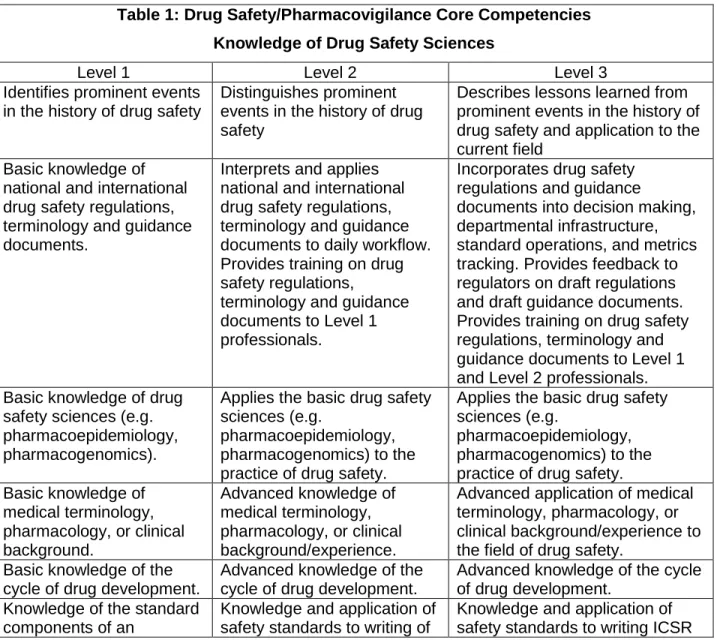
starting point for development of core competencies in the field of drug safety, Table 1 proposes Drug Safety/Pharmacovigilance Core Competencies which describe the drug
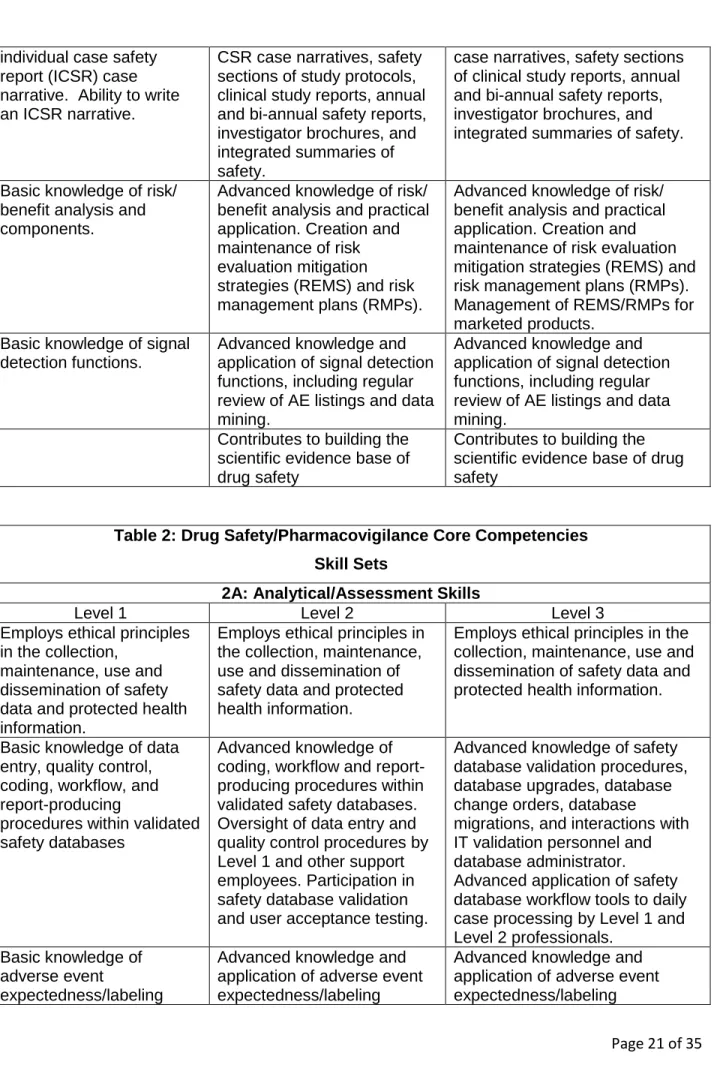
safety sciences knowledge that is necessary for competent performance as a drug safety professional. Table 2 proposes Drug Safety/Pharmacovigilance Core
Competencies skill sets that support application and implementation of drug safety sciences knowledge, including analytical/assessment skills sets, communication skills,
and leadership and systems thinking skills. These Core Competencies are not
considered to be an all-inclusive list of desirable skills and traits, but rather to serve as a core model for development of drug safety professional training programs and
professional development programs.
Similar standardization and acceptance of core competencies for drug safety
professionals may increase the consistency of the practice of pharmacovigilance activities as well as enable drug safety professionals to broaden their skills sets and identify and fill any gaps in knowledge. In addition, acceptance of core competencies in
Page 20 of 35 role and increase their involvement in the practice of pharmacovigilance through focus on both prevention and identification of adverse drug effects.
The Core Competencies for drug safety professionals are a set of skills
applicable to the broad field of pharmacovigilance. Level 1 core competencies apply to entry level drug safety professionals, i.e. new drug safety associates with
non-managerial positions. Level 2 core competencies apply to advanced and senior level drug safety associates, supervisors and managers. Level 3 core competencies apply to
associate directors, directors, and other drug safety department or organization leaders. Table 1: Drug Safety/Pharmacovigilance Core Competencies
Knowledge of Drug Safety Sciences
Level 1 Level 2 Level 3
Identifies prominent events in the history of drug safety
Distinguishes prominent events in the history of drug safety
Describes lessons learned from prominent events in the history of drug safety and application to the current field
Basic knowledge of national and international drug safety regulations, terminology and guidance documents.
Interprets and applies national and international drug safety regulations, terminology and guidance documents to daily workflow. Provides training on drug safety regulations,
terminology and guidance documents to Level 1 professionals.
Incorporates drug safety regulations and guidance
documents into decision making, departmental infrastructure, standard operations, and metrics tracking. Provides feedback to regulators on draft regulations and draft guidance documents. Provides training on drug safety regulations, terminology and guidance documents to Level 1 and Level 2 professionals. Basic knowledge of drug
safety sciences (e.g. pharmacoepidemiology, pharmacogenomics).
Applies the basic drug safety sciences (e.g.
pharmacoepidemiology, pharmacogenomics) to the practice of drug safety.
Applies the basic drug safety sciences (e.g.
pharmacoepidemiology, pharmacogenomics) to the practice of drug safety. Basic knowledge of
medical terminology, pharmacology, or clinical background.
Advanced knowledge of medical terminology, pharmacology, or clinical background/experience.
Advanced application of medical terminology, pharmacology, or clinical background/experience to the field of drug safety.
Basic knowledge of the cycle of drug development.
Advanced knowledge of the cycle of drug development.
Advanced knowledge of the cycle of drug development.
Knowledge of the standard components of an
Knowledge and application of safety standards to writing of
Page 21 of 35 individual case safety
report (ICSR) case narrative. Ability to write an ICSR narrative.
CSR case narratives, safety sections of study protocols, clinical study reports, annual and bi-annual safety reports, investigator brochures, and integrated summaries of safety.
case narratives, safety sections of clinical study reports, annual and bi-annual safety reports, investigator brochures, and integrated summaries of safety.
Basic knowledge of risk/ benefit analysis and components.
Advanced knowledge of risk/ benefit analysis and practical application. Creation and maintenance of risk evaluation mitigation strategies (REMS) and risk management plans (RMPs).
Advanced knowledge of risk/ benefit analysis and practical application. Creation and maintenance of risk evaluation mitigation strategies (REMS) and risk management plans (RMPs). Management of REMS/RMPs for marketed products.
Basic knowledge of signal detection functions.
Advanced knowledge and application of signal detection functions, including regular review of AE listings and data mining.
Advanced knowledge and application of signal detection functions, including regular review of AE listings and data mining.
Contributes to building the scientific evidence base of drug safety
Contributes to building the scientific evidence base of drug safety
Table 2: Drug Safety/Pharmacovigilance Core Competencies
Skill Sets
2A: Analytical/Assessment Skills
Level 1 Level 2 Level 3
Employs ethical principles in the collection,
maintenance, use and dissemination of safety data and protected health information.
Employs ethical principles in the collection, maintenance, use and dissemination of safety data and protected health information.
Employs ethical principles in the collection, maintenance, use and dissemination of safety data and protected health information.
Basic knowledge of data entry, quality control, coding, workflow, and report-producing
procedures within validated safety databases
Advanced knowledge of coding, workflow and report-producing procedures within validated safety databases. Oversight of data entry and quality control procedures by Level 1 and other support employees. Participation in safety database validation and user acceptance testing.
Advanced knowledge of safety database validation procedures, database upgrades, database change orders, database
migrations, and interactions with IT validation personnel and database administrator. Advanced application of safety database workflow tools to daily case processing by Level 1 and Level 2 professionals.
Basic knowledge of adverse event
expectedness/labeling
Advanced knowledge and application of adverse event expectedness/labeling
Page 22 of 35 assessments and labeling
documentation
assessments and labeling documentation. Participation in writing of labeling
documents, including Investigator Brochures, package inserts, summary of product characteristics
assessments and labeling documentation. Participation in writing of labeling documents, including Investigator Brochures, package inserts, summary of product characteristics
Basic knowledge of components of causality determination (i.e. temporal relationship, concomitant medical history and medication)
Advanced knowledge of components of causality determination. Interacts with medical monitors for
company causality assessments.
Advanced knowledge of components of causality determination. Trains medical monitors regarding company causality assessments.
Basic knowledge and practice of due diligence (i.e. queries for follow-up information) in case processing.
Advanced understanding and application of due diligence in case processing.
Ensure quality application of due diligence in case processing by staff (level 1, level 2).
Basic knowledge of study protocols for clinical safety
Advanced application of study protocol knowledge to SAE report processing, i.e.
recognize and report to study team inclusion/exclusion violations. Trains Level 1 staff on new study protocols.
Trains Level 1 and Level 2 professionals on new study protocols.
Basic knowledge and understanding of MedDRA coding dictionary
Advanced knowledge and application of commercial coding dictionaries (MedDRA, WHO-Drug), provides
oversight and feedback on adverse event and drug coding
Advanced knowledge and application of commercial coding dictionaries (MedDRA, WHO-Drug), provides feedback to commercial coding dictionary vendors, to improve content and mapping
Computer application proficiency (MS Word, MS Excel, MS Powerpoint, web-based) for access and entry of safety information.
Computer application expertise (MS Word, MS Excel, MS Powerpoint, web-based) for safety information tracking, assessment
information, reconciliation, and metrics.
Computer application expertise (MS Word, MS Excel, MS Powerpoint, web-based) for safety information tracking, assessment information, reconciliation, and metrics.
Basic knowledge of electronic data capture (EDC) systems in order to enter and retrieve safety data.
Advanced knowledge of electronic data capture systems in order to provide specifications to
programmers for adverse event reporting and serious adverse event reporting panels, specifications for system verification checks, and specifications for safety reports and transfers.
Page 23 of 35 2B: Communication Skills
Level 1 Level 2 Level 3
Communicates in writing and orally, in person, and through e-mail with linguistic proficiency and cultural sensitivity.
Communicates in writing and orally, in person, and through e-mail with linguistic
proficiency and cultural sensitivity.
Communicates in writing and orally, in person, and through e-mail with linguistic proficiency and cultural sensitivity.
Communicates with (adverse event) reporters and investigative sites in a professional manner.
Communicates with (adverse event) reporters, investigative sites, sponsors, departmental contacts, study project
managers, clinical research associates (CRAs), study vendors, data safety and monitoring boards (DSMBs), and auditors in a professional manner.
Communicates with sponsors, functional departmental heads, study vendors, data safety and monitoring boards (DSMBs), auditors, and health authorities in a professional manner.
Applies communication and group dynamic strategies in interactions with individuals and groups
Applies communication and group dynamic strategies in interactions with individuals and groups
Applies communication and group dynamic strategies in interactions with individuals and groups
Audience member of drug safety presentations
Develops and delivers presentations on drug safety topics, including training investigative sites and study teams on new safety
reporting protocols,
presentations at professional conferences and other venues.
Develops, delivers and provides feedback on presentations on drug safety topics, including presentations at professional conferences and other venues.
Reads scientific
publications relevant to drug safety.
Reads scientific publications relevant to drug safety and applies knowledge to daily work.
Applies evidence-based drug safety practices to safety operations.
Publishes on drug safety topics.
2C: Leadership and Systems Thinking Skills
Level 1 Level 2 Level 3
Performs timely coordination of safety information dissemination.
Practices effective pro-active decision-making with timely coordination of safety information dissemination.
Promotes and practices effective pro-active decision-making. Ensures timely coordination of safety information dissemination. Incorporates ethical
standards of practice as the basis of all interactions with sponsors, vendors, consumers, health care professionals, other
Incorporates ethical
standards of practice as the basis of all interactions with sponsors, vendors,
consumers, health care professionals, other functional
Page 24 of 35 functional groups, health
authorities, auditors and other drug safety
stakeholders.
groups, health authorities, auditors and other drug safety stakeholders.
auditors and other drug safety stakeholders.
Describes how pharmacovigilance
department operates within a larger system.
Incorporates systems thinking into the practice of
pharmacovigilance.
Incorporates systems thinking into the practice of
pharmacovigilance.
Ability to follow written documentation in support of pharmacovigilance activities, including standard operating
procedures (SOPs), safety management plans and working instructions.
Ability to follow written documentation in support of pharmacovigilance activities. Ability to develop various levels of documentation in support of pharmacovigilance department functions,
including standard operating procedures, safety
management plans, and working instructions.
Ability to develop and implement various levels of documentation in support of pharmacovigilance department functions, including standard operating procedures, safety management plans, and working instructions.
Ensure staff compliance with pharmacovigilance department documentation.
Participates in measuring, tracking and reporting activities that contribute to continuous quality
improvement (CQI) of departmental and organizational performance.
Participates in measuring, tracking, and reporting activities that continuous quality improvement (CQI) of departmental and
organizational performance.
Ensures the measuring, reporting and continuous quality
improvement (CQI) of
departmental and organizational performance.
Basic knowledge of interdepartmental standards and business practices.
Participates in
cross-functional collaboration and development of
interdepartmental standards, and business practices.
Promotes and ensures cross-functional team collaborations and interdepartmental standards and business practices.
Attends project team and departmental meetings and provides safety status updates.
Attends and leads project team and departmental meetings.
Attends and leads program team, departmental and organizational meetings.
Performs safety activities for safety projects
according to contract and budget parameters.
Provides input to safety project contracts and budgets.
Manages safety projects within current and forecasted budget constraints.
Develops budgets, proposals, and contracts for safety projects. Ensures that safety projects are managed within current and forecasted budget constraints.
Attends individual, team and organizational learning opportunities for
professional development.
Promotes and attends individual, team and organizational learning opportunities.
Advocates for individual, team and organizational learning opportunities.
Participates in mentoring and peer review or coaching opportunities
Performs mentoring, peer advising, coaching, or other professional development opportunities for
Page 25 of 35 pharmacovigilance
department staff
pharmacovigilance department staff
Receives regular performance evaluation and feedback.
Performs and receives regular performance evaluation and feedback to/from staff.
Ensures regular performance evaluation and feedback for staff.
Conclusion:
While advances in pharmacovigilance with the emergence of the science of safety and the availability of increasingly powerful information technologies allow the FDA to more actively monitor the safety of marketed drugs through data mining of
electronic health records and collaborations with various members of the public and privates sectors, stakeholders need to be cognizant that the safety of patients is a
shared responsibility.³³ Along with the need for healthcare professionals to detect and
prevent adverse events in their patients, there is need for consumers to advocate for themselves, armed with information of the potential for adverse drug effects and how to report adverse events. Development of evidence-based objective-driven public
pharmacovigilance communication strategies are in order.² Pharmaceutical and
biotechnology sponsors should pro-actively address the need for a competent and contemporary pharmacovigilance work force, through adoption of pharmacovigilance core competencies as the basis for developing expertise in the field of drug safety and
Page 26 of 35 Appendices
Appendix 1: Drug safety definitions and terminology
Adverse drug reaction (ADR)
All noxious and unintended responses to a medicinal product related to any dose should be considered adverse drug reactions.
The phrase "responses to a medicinal product" means that a causal relationship between a medicinal product and an adverse event is at least a reasonable possibility, i.e., the relationship cannot be ruled out.
Regarding marketed medicinal products, a well-accepted definition of an adverse drug reaction in the post-marketing setting is found in WHO Technical Report 498 [1972] and reads as follows:
A response to a drug which is noxious and unintended and which occurs at doses normally used in man for prophylaxis, diagnosis, or therapy of disease or for modification of physiological function.
(ICH E2A) Adverse
event (AE)
Adverse event means any untoward medical occurrence associated with the use of a drug in humans, whether or not considered drug related. (FDA CFR 312.32)
Adverse event: Any untoward medical occurrence in a patient or clinical investigation subject administered a pharmaceutical product and which does not necessarily have to have a causal relationship with this treatment.
An adverse event (AE) can therefore be any unfavorable and unintended sign (including an abnormal laboratory finding, for example), symptom, or disease temporally associated with the use of a medicinal product, whether or not considered related to the medicinal product. (ICH E2A)
CFR Code of Federal Regulations
CIOMS Council for International Organizations of Medical Sciences DMC/DSMB Data Monitoring Committee/Data Safety and Monitoring Board
FDA US Food and Drug Administration
IB/IDB Investigators (Drug) Brochure
ICH International Conference on Harmonisation of Technical Requirements for Registration of Pharmaceuticals for Human Use
IND Investigational New Drug Application
IND Safety Report
The sponsor must notify FDA and all participating investigators (i.e., all investigators to whom the sponsor is providing drug under its INDs or under any investigator's IND) in an IND safety report of potential serious risks, from clinical trials or any other source, as soon as possible, but in no case later than 15 calendar days after the sponsor determines that the information qualifies for reporting under paragraph (c)(1)(i), (c)(1)(ii), (c)(1)(iii), or (c)(1)(iv) of this section. In each IND safety report, the sponsor must identify all IND safety reports previously submitted to FDA concerning a similar suspected adverse reaction, and must analyze the significance of the suspected adverse reaction in light of previous, similar reports or any other relevant information.
(i) Serious and unexpected suspected adverse reaction. The sponsor must report any suspected adverse reaction that is both serious and unexpected. The sponsor must report an adverse event as a suspected adverse reaction only if there is evidence to suggest a causal relationship between the drug and the adverse event, such as:
Page 27 of 35
(B) One or more occurrences of an event that is not commonly associated with drug exposure, but is otherwise uncommon in the population exposed to the drug (e.g., tendon rupture);
(C) An aggregate analysis of specific events observed in a clinical trial (such as known consequences of the underlying disease or condition under investigation or other events that commonly occur in the study population independent of drug therapy) that indicates those events occur more frequently in the drug treatment group than in a concurrent or historical control group.
(ii) Findings from other studies. The sponsor must report any findings from epidemiological studies, pooled analysis of multiple studies, or clinical studies (other than those reported under paragraph (c)(1)(i) of this section), whether or not conducted under an IND, and whether or not conducted by the sponsor, that suggest a significant risk in humans exposed to the drug. Ordinarily, such a finding would result in a safety-related change in the protocol, informed consent, investigator brochure (excluding routine updates of these documents), or other aspects of the overall conduct of the clinical investigation.
(iii) Findings from animal or in vitro testing. The sponsor must report any findings from animal or in vitro testing, whether or not conducted by the sponsor, that suggest a significant risk in humans exposed to the drug, such as reports of mutagenicity, teratogenicity, or carcinogenicity, or reports of significant organ toxicity at or near the expected human exposure. Ordinarily, any such findings would result in a safety-related change in the protocol, informed consent, investigator brochure (excluding routine updates of these documents), or other aspects of the overall conduct of the clinical investigation.
(iv) Increased rate of occurrence of serious suspected adverse reactions. The sponsor must report any clinically important increase in the rate of a serious suspected adverse reaction over that listed in the protocol or investigator brochure. (FDA CFR 312.32)
Serious adverse event or serious suspected adverse reaction (SAE or SSAR)
Serious adverse event or serious suspected adverse reaction. An adverse event or suspected adverse reaction is considered “serious” if, in the view of either the investigator or sponsor, it results in any of the following outcomes: Death, a life-threatening adverse event, inpatient hospitalization or prolongation of existing hospitalization, a persistent or significant incapacity or substantial disruption of the ability to conduct normal life functions, or a congenital anomaly/birth defect. Important medical events that may not result in death, be life-threatening, or require hospitalization may be considered serious when, based upon appropriate medical judgment, they may jeopardize the patient or subject and may require medical or surgical intervention to prevent one of the outcomes listed in this definition. Examples of such medical events include allergic bronchospasm requiring intensive treatment in an emergency room or at home, blood dyscrasias or convulsions that do not result in inpatient hospitalization, or the development of drug dependency or drug abuse. (FDA CFR 312.32)
‘serious adverse event or serious adverse reaction’: any untoward medical occurrence or effect that at any dose results in death, is life-threatening, requires hospitalization or prolongation of existing hospitalisation, results in persistent or significant disability or incapacity, or is a congenital anomaly or birth defect (Directive 2001/20/EC)
Suspected adverse reaction
Suspected adverse reaction means any adverse event for which there is a reasonable possibility that the drug caused the adverse event. For the purposes of IND safety
reporting, “reasonable possibility” means there is evidence to suggest a causal relationship between the drug and the adverse event. Suspected adverse reaction implies a lesser degree of certainty about causality than adverse reaction, which means any adverse event caused by a drug. (FDA CFR 312.32)
Page 28 of 35
Adverse Drug Reaction
product information (e.g., Investigator's Brochure for an unapproved investigational medicinal product). (ICH E2A)
Unexpected adverse event or unexpected suspected adverse reaction
Unexpected adverse event or unexpected suspected adverse reaction. An adverse event or suspected adverse reaction is considered “unexpected” if it is not listed in the
Page 29 of 35 References
1. Ahuja, V., & Sharma, V. (2010). Training in post-authorization pharmacovigilance.
Perspectives in Clinical Research, 1(2), 70.
2. Bahri, P. (2010). Public pharmacovigilance communication: A process calling for
evidence-based, objective-driven strategies. Drug Safety, 33(12), 1065-1079.
3. Borg, J. J., Aislaitner, G., Pirozynski, M., & Mifsud, S. (2011). Strengthening and
rationalizing pharmacovigilance in the EU: Where is europe heading to?: A review of the
new EU legislation on pharmacovigilance. Drug Safety, 34(3), 187-197.
4. Brass, L. M. (2000). PHENYLPROPANOLAMINE & RISK OF HEMORRHAGIC
STROKE: Final Report of the Hemorrhagic Stroke Project,
5. Budnitz, D. S., Shehab, N., Kegler, S. R., & Richards, C. L. (2007). Medication use
leading to emergency department visits for adverse drug events in older adults. Annals
of Internal Medicine, 147(11), 755.
6. Centers for Disease Control. (2010). Unintentional drug poisoning in the United States.
Accessed Mar 15, 2011 at www.cdc.gov/injury
7. Christensen ST, Søndergaard B, Honoré PH, Bjerrum OJ. (2011). Pharmacy student
driven detection of adverse drug reactions in the community pharmacy setting.
Pharmacoepidemiol Drug Safety. ;20(4):399-404.
8. Department of Health and Human Services U.S. FDA. Office of Critical Path Programs
(May 2008). The Sentinel Initiative: National Strategy for Monitoring Medical Product
Safety. Accessed March 8, 2011 at
Page 30 of 35 9. Edwards, B., Tilson, H. H., & West, S. L. (2006). Defining the competencies of those
conducting pharmacovigilance. Pharmacoepidemiology and Drug Safety, 15(3),
193-198.
10. Furberg, C. D., & Pitt, B. (2001). Withdrawal of cerivastatin from the world market.
Current Controlled Trials in Cardiovascular Medicine, 2(5), 205-207.
11. Greener, M. (2005). Drug safety on trial. EMBO Reports, 6(3), 202-204.
12. Goozner, M. (2010). Oncologists want FDA to rethink REMS. Journal of the National
Cancer Institute, 102(23), 1748.
13. Hartford, C. G., Petchel, K. S., Mickail, H., Perez-Gutthann, S., McHale, M., Grana, J.
M., et al. (2006). Pharmacovigilance during the pre-approval phases: An evolving
pharmaceutical industry model in response to ICH E2E, CIOMS VI, FDA and
EMEA/CHMP risk-management guidelines. Drug Safety, 29(8), 657-673.
14. Hawker, G. A., Katz, J. N., & Solomon, D. H. (2006). The patient's perspective on the
recall of vioxx. The Journal of Rheumatology, 33(6), 1082.
15. IOM (Institute of Medicine). (2010). Ethical Issues in Studying the Safety of Approved
Drugs: A Letter Report. Washington, DC: The National Academies Press.
16. Jeffrey, S. (2009). FDA to require risk evaluation and mitigation strategies for opioids.
Medscape Medical News. Accessed March 20, 2011 at
http://www.medscape.com/viewarticle/588058
17. Kernan, W. N., Viscoli, C. M., Brass, L. M., Broderick, J. P., Brott, T., Feldmann, E., et al.
(2000). Phenylpropanolamine and the risk of hemorrhagic stroke. New England Journal
Page 31 of 35 18. Lenzer, J. (2004). FDA is incapable of protecting US “against another vioxx”. BMJ,
329(7477), 1253.
19. Lim, R. R. (2007). Model competencies in regulatory therapeutic product assessment:
Health canada's good review guiding principles as a reviewing community's code of
intellectual conduct. Pharmacoepidemiology and Drug Safety, 16(8), 933-941.
20. Lynn, E., Layton, D., & Shakir, S. (2011). New postgraduate qualifications in
pharmacovigilance from the drug safety research unit in the UK. Drug Safety, 34(1),
89-91.
21. Moore, T. J., Cohen, M. R., & Furberg, C. D. (2007). Serious adverse drug events
reported to the food and drug administration, 1998-2005. Archives of Internal Medicine,
167(16), 1752.
22. National Center for Biotechnology Information (2009). Rhabdomyolysis. Accessed March
15, 2011 at: http://www.ncbi.nlm.nih.gov/pubmedhealth/PMH0001505/
23. Paulozzi, L. J. (2011). Drug-induced Deaths—United states, 2003–2007. CDC Health
Disparities and Inequalities Report—United States, 2011, 60, 60.
24. Platt, R., Madre, L., Reynolds, R., & Tilson, H. (2008). Active drug safety surveillance: A
tool to improve public health. Pharmacoepidemiology and Drug Safety, 17(12),
1175-1182.
25. Prabhakar, U., & Edwards, B. (2010). Postmarketing safety surveillance: Issues with
data collection for postmarketing pharmacovigilance. Pharmaceutical Medicine, 24(6),
Page 32 of 35 26. Psaty, B. M., & Burke, S. P. (2006). Protecting the health of the public--institute of
medicine recommendations on drug safety. New England Journal of Medicine, 355(17),
1753.
27. Psaty, B. M., & Furberg, C. D. (2007). Rosiglitazone and cardiovascular risk. New
England Journal of Medicine, 356(24), 2522.
28. Public Health Foundation.(2010). Core Public Health Competencies. Accessed March 2,
2011 at
http://www.phf.org/resourcestools/Documents/Core_Public_Health_Competencies_III.pd
f
29. Schultz, W. B. (2007). Bolstering the FDA's drug-safety authority. New England Journal
of Medicine, 357(22), 2217.
30. Smith, Aaron. (2007). Merck settles Vioxx suits for $4.85B: Drugmaker aims to close
door on 3-year legal battle by resolving claims by 47,000 groups of plaintiffs over
blockbuster painkiller drug. CNNMoney.com. Accessed March 20, 2011 at
http://money.cnn.com/2007/11/09/news/companies/merck_vioxx/index.htm
31. Topol, E. J. (2004). Failing the public health—rofecoxib, merck, and the FDA. New
England Journal of Medicine, 351(17), 1707-1709.
32. U.S. FDA. (2005). Phenylpropanolamine (PPA) Information Page. Accessed March 15,
2011 at http://www.fda.gov/Drugs/DrugSafety/InformationbyDrugClass/ucm150738.htm
33. U.S. FDA. (2008). FDA's Sentinel Initiative: National Strategy for Monitoring Medical
Product Safety.US Food and Drug Administration.
34. US FDA (2011). Code of Federal Regulations, Title 21, Part 314.80. Accessed March
Page 33 of 35 35. US FDA. (2011). Code of Federal Regulations, Title 21, Part 312.32. Accessed March
20, 2011 at http://www.accessdata.fda.gov/scripts/cdrh/cfdocs/cfCFR/CFRSearch.cfm
36. U.S. FDA (2007). Food and Drug Administration Amendments Act (FDAAA) of 2007.
Accessed March 20, 2011 at
http://www.fda.gov/RegulatoryInformation/Legislation/federalfooddrugandcosmeticactfdc
act/significantamendmentstothefdcact/foodanddrugadministrationamendmentsactof2007
/default.htm
37. U.S. FDA (2011). Significant Dates in U.S. Food and Drug Law History Accessed March
20, 2011 at
http://www.fda.gov/AboutFDA/WhatWeDo/History/Milestones/ucm128305.htm
38. World Health Organization (2011). Pharmacovigilance. Accessed March 15, 2011 at
http://www.who.int/medicines/areas/quality_safety/safety_efficacy/pharmvigi/en/index.ht
ml
39. Consumer Healthcare Products Association (2000). CHPA Phenylpropanolamine
Working Group Comments on Yale Hemorrhagic Stroke Project Report. Accessed online
March 20, 2011 at http://www.fda.gov/ohrms/dockets/ac/00/backgrd/3647b1d.pdf
40. Merck, Inc. (2004). News Release: Merck announces voluntary worldwide withdrawal of
VIOXX. Accessed March 20, 2011 at
http://www.merck.com/newsroom/vioxx/pdf/vioxx_press_release_final.pdf
41. U.S. FDA (2008). Identification of Drug and Biological Products Deemed to Have Risk
Evaluation and Mitigation Strategies for Purposes of the Food and Drug Administration
Amendments Act of 2007. Docket No. FDA-2008-N-0174. Accessed March 15, 2011 at
Page 34 of 35 42. U.S. FDA (2010). Federal Register. Investigational New Drug Safety Reporting
Requirements for Human Drug and Biological Products and Safety Reporting
Requirements for Bioavailability and Bioequivalence Studies in Humans. Accessed
March 20, 2011 at
http://www.federalregister.gov/articles/2010/09/29/2010-
24296/investigational-new-drug-safety-reporting-requirements-for-human-drug-and-biological-products-and
43. Nissen, S. E. (2010). Setting the RECORD straight. JAMA: The Journal of the American
Medical Association, 303(12), 1194.
44. European Association for the Study of Diabetes (EASD) (2010). Statement on
withdrawal of Avandia (rosiglitazone) in Europe from the European Association for the
Study of Diabetes (EASD). Accessed March 20, 2011 at
http://www.easd.org/easdwebfiles/annualmeeting/46thMeeting/Press/Other/EASDAvandi
a.pdf
45. US FDA. (2011). Code of Federal Regulations, Title 21, Part 312.64. Accessed March
20, 2011 at http://www.accessdata.fda.gov/scripts/cdrh/cfdocs/cfCFR/CFRSearch.cfm
46. US FDA. (2011). Code of Federal Regulations, Title 21, Part 312.33. Accessed March
20, 2011 at http://www.accessdata.fda.gov/scripts/cdrh/cfdocs/cfCFR/CFRSearch.cfm
47. European Parliament and of the Council (2001). Directive 2001/20/EC on the
approximation of the laws, regulations and administrative provisions of the Member
States relating to the implementation of good clinical practice in the conduct of clinical
trials on medicinal products for human use. Accessed March 20, 2011 at
http://www.eortc.be/Services/Doc/clinical-EU-directive-04-April-01.pdf
48. European Parliament and of the Council (2004). Regulation (EC) No 724/2004 on laying
down Community procedures for the authorisation and supervision of medicinal products
Page 35 of 35 March 20, 2011 at
http://ec.europa.eu/health/files/eudralex/vol-1/reg_2004_726_cons/reg_2004_726_cons_en.pdf
49. International Conference on Harmonisation of Technical Requirements for Registration
of Pharmaceuticals for Human Use. (2011). ICH guidelines. Accessed March 21, 2011
at http://www.ich.org/products/guidelines/efficacy/article/efficacy-guidelines.html
50. International Conference on Harmonisation of Technical Requirements for Registration
of Pharmaceuticals for Human Use. (2005). ICH Guideline D2C (R1) Clinical safety data
management: periodic safety update reports for marketed drugs. Accessed March 21,
2011
http://www.ich.org/fileadmin/Public_Web_Site/ICH_Products/Guidelines/Efficacy/E2C/St
ep4/E2C_R1__Guideline.pdf
51. Drug Information Association. (2011). EudraVigilance training – electronic reporting of
ICSRs in the EEA. Accessed March 21, 2011 at
http://www.diahome.org/cgi-bin/MsmGo.exe?grab_id=0&page_id=1327&query=eudravigilance&hiword=EUDRAVIGI
LANC%20eudravigilance
52. Drug Information Association. (2011). DIA global educational programs:
Pharmacovigilance and risk management strategies 2011. Accessed March 21, 2011 at