Devon Murphy. The Information Worlds of Art Museum Curators and Registrars: an Institutional Ethnography of Practice in North Carolina Institutions. A Master’s paper for the M.S. in I.S. degree. April, 2018. 97 pages. Advisor: Ryan Shaw.
This paper presents an institutional ethnography analysis of the information worlds of art museum curators and registrars to determine what information sources were used by art museum staff in specific work tasks. This study was conducted in four art museums in North Carolina; the Mint Museum in Charlotte, NC, the Ackland Art Museum in Chapel Hill, NC, the Nasher Art Museum in Durham, NC, and the Weatherspoon Art Museum in Greensboro, NC. Six curators and four registrars took part in the study, which consisted of interviews and information horizon maps. The results demonstrate a wide use of both digital and print sources used in work tasks, with an emphasis on utilizing document surrogates in lieu of the physical art object. However, difficulties in accessing information about art objects in other collections was widely reported, making planning exhibitions and conducting research more time-intensive. Further study into museum websites and catalogs is encouraged.
Headings:
Libraries & museums
Information-seeking strategies
Information resources
Museum curatorship
Collection management (Museums)
THE INFORMATION WORLDS OF ART MUSEUM CURATORS AND REGISTRARS: AN INSTITUTIONAL ETHNOGRAPHY OF PRACTICE IN
NORTH CAROLINA INSTITUTIONS
by Devon Murphy
A Master’s paper submitted to the faculty of the School of Information and Library Science of the University of North Carolina at Chapel Hill
in partial fulfillment of the requirements for the degree of Master of Science in
Information Science
Chapel Hill, North Carolina
April, 2018
Approved by:
________________________________________
Table of Contents
Introduction... 3
Literature Review ... 6
Background ...12
Methods ...16
Information Worlds and Horizons...16
Interview Structure and Subjects ...17
Existing Data Collection ...21
Data Analysis Method: Institutional Ethnography ...22
Data Analysis ...22
Information Work Tasks ...23
Acquisitioning ...24
Exhibitions ...25
Gallery Rotations ...27
Loans ...28
Deaccessioning ...29
Staying Current ...31
Information Sources ...31
Colleagues ...32
Subsection: University colleagues ...36
Museum Websites ...39
Collectors and Art Dealers ...41
Auction Houses ...43
Museum Libraries and Museum Archives...44
Databases...47
Professional Organizations ...48
Online Materials ...50
Museums, Fairs, and Art Events ...52
Museum Policies...53
Permanent Collection ...57
Information Source Analysis ...61
Information Source Horizons ...64
Information Map Analysis ...65
Limitations ...74
Implications ...76
Appendix A: Email Recruitment to Interview Subjects ...87
Appendix B: Email for Permission to View Documents/Existing Documents ...88
Appendix C: Email and Phone Follow-Up for Interview Subjects ...89
Appendix D: Interview Guide ...91
Introduction
Museums, whether it be history, art, or natural sciences, currently face a wide
variety of challenges; funding may be difficult to come by due to tighter state budgets,
collections may lack a cohesive organizational system due to a varied or long
institutional history, or visitor attendance may be dropping over time. Much of recent
museology literature focuses on how to reorient these institutions to the present to
overcome these issues. From the rise of interactive exhibits in the 1990s to the
movement of “neighborhood” museums in the late 1990s to early 2000s to the
increasing integration of social media in museum exhibits and practice in the present,
museums have sought out a myriad number of strategies to stay relevant (Weil, 2002).
A crucial part of this program of strategies is the institutional mission or
purpose, usually expressed as a mission statement on museum websites and related
promotional materials. These statements, along with more specialized statements such
as collection documents, define what the museum space is and isn’t, and conversely,
what it does and doesn’t collect in terms of its object and text collections. However,
few museums have a clear institutional history, often passing from different hands,
such as the Smithsonian National Museum of the American Indian (NMAI) which
derived its starting collections from one collector but gradually grew into a body
administered by independent Native curators and the Smithsonian, or refocusing their
purpose over time in response to the pressures listed above, such as the North
Carolina Museum of Art (NCMA) in Raleigh, NC, which started its collection in
Western painting, but in the 1980s refocused to include African and Latin American
independently, but with the involvement of a wide variety of stakeholders, including
curators, registrars, administrative staff and directors, patrons (providing donations),
and importantly, the collections themselves. There has been much scholarship in the
fields of art history, museology/curatorial studies, and in library/information science
on how museum collections are organized, displayed, and consumed, but little on the
institutional life of those collections and those who do the work of creating them
(Duncan, 1995; Carrier, 2006; O’Neill, 2012; Cherry and Cullen, 2008). Through
examining museum professionals’ actions and the documents they create, one can
better understand how they play a part in influencing the systems of decisions that
create a museum’s lifeblood: exhibitions. Curators and registrars take note of what is
and is not available in the collection to show, allowing registrars to buy or loan new
objects, curators to assemble exhibitions, and related groups like marketing
professionals, grant writers, and directors to draft materials that promote and fund the
exhibition schedule. Without clear knowledge of a collection’s history, as represented
through its institutionalization through documents and decision making, an exhibition
program can appear disjointed from the rest of the permanent collection, an object can
be accidentally deaccessioned, or more seriously, a museum can lose its guiding
focus.
To this end, I aim to examine the relationships between an art museum’s
collection (including permanent holdings as well as temporary or traveling exhibits),
its curatorial and registrar staff, and other institutional bodies (leadership, professional
organizations etc.) to evaluate the art museum as an information space. In doing so, I
aim to describe the institutional informational worlds that curators and registrars use
to make collecting decisions through the use of institutional ethnography, an approach
Ethnography: A Sociology for People (2005), and refined by Marie Campbell and
Frances Gregor in Mapping Social Relations: A Primer in Doing Institutional
Ethnography (2004). Institutional ethnography aims to describe how information is
created, used, and described in the everyday, through the examination of oral
communication, texts, and objects. In doing so, these forms of communication can be
analyzed to determine institutional patterns of behavior (Smith and Turner, 2014).
Through this methodology, I can focus specifically on the information sources used
by individuals working within a wider institution, and in turn, determine how those
institutional values relate to the information sources used.
This line of inquiry also utilizes and builds upon the work of information
worlds and horizons in LIS theory, as conceptualized by Savolainen (2012) and
Sonnenwald (1999), the conception of information behaviors such as search and use
by Case (2012), and on the development of work-task information
searching/behaviors from Bystrom and Bystrom and Hansen (2007; 2005). While
information behaviors have been studied in museum visitors, there is a dearth of
studies about the information worlds and behaviors of museum professionals, let
alone art museum workers such as curators, registrars and directors. Without a full
understanding of what information sources art museum professionals consult to
execute decisions that affect both the museum’s trajectory and the
programs/exhibitions that impact visitors, a full understanding of how curatorial work
is accomplished is not present. In turn, studies on visitor engagement or exhibition
development are incomplete without an assessment of how these programs are
developed by their staff, and run the risk of wasting little funds and time on ventures
that are not fully examined in the light of the museum’s full range of information
To accomplish this, I collected data in the form of interviews with art museum
professionals (curators and registrars), information horizon maps from those same
professionals, and textual analysis of various collections records to assess
relationships between the staff’s information horizons and needs and the wider
institutional frameworks those are occuring in. I am choosing an art museum,
specifically, as art museum staff are underrepresented in LIS information
worlds/horizons literature, and because previous work available about museums and
information behaviors/worlds has largely been constrained to the digitization of
collections or records, instead of the wider constellation of information actors and
objects in that environment (McGarrigle, 2015; Smith, 2016). Understanding the
information space of the art museum through its most central staff to the collections
can help uncover certain information mysteries, such as the reluctance to share
images/information and the difficulty in creating standard museum cataloging
systems.
Literature Review
Curatorship has undergone a major shift since the late 1990s. This older
museum model (Weil, 2002) placed a great deal of intellectual authority onto curators
only, to a postmodern conception where curators and registrars must contend with a
myriad of agents/authors (Dewdney, Dibosa, and Walsh, 2013; Merrit, 2017; Lucia
Serrano, McTavish, Okwunodu Ogbechie, and Soussloff, 2011). This change
demonstrates not only the new diversity of authors of museum exhibitions, but also
the widening of curators and registrars’ information horizons, as they must consider
donors/boards of trustees, and their own curatorial interests (Weil, 2002; Carbonell,
2012; Cameron, 2008).
At the same time, curators and registrars must be aware of their industry
standards when making curatorial decisions, such as the American Alliance of
Museum’s standards on ethical treatment of collections and practices of accessioning
and deaccessioning works (AAM, 2017), or the Association of Art Museum Directors
and Association of Art Museum Curators guides to best practices in making curatorial
decisions (AAMD, 2011; AAMC, 2007). The AAM’s guidelines are especially
important as lapses in following them can cause an institution to lose accreditation, in
turn losing needed grants or partnerships with other organizations to fund their
exhibition programs (AAM, 2017). These issues are outlined by Varner (2013) in her
article exploring the deaccessioning process in American museums; unfortunately, not
all these standards are followed, in part due to funding/staffing issues but also due to a
lack of fundamental understanding of the collections themselves and of an
information poor horizon (Gardner, 2012). Thus, an understanding of a curators’ and
registrars’ full information horizon is key to understanding an institution’s work and
purpose, and to improve upon poor sources if needed.
However, the tools to evaluate curators and registrars’ information horizons
are not present in current museology/curatorial studies literature, thus the introduction
of LIS work like Sonnenwald’s (1999, 2001) work on information horizons, Wilson’s
(1997) and Bystrom and Harvelin’s (2007, 2005) work on information behaviors as
relating to work-tasks (searching, use, and Wilson’s concept of the information
feedback loop), and Savolainen and Case’s (2012; 2012) introduction of context into
the information behavior model are necessary additions to the understanding of the
visitor’s understanding of the exhibition they see is largely a black box, with little
information presented in the exhibition itself that points to any fact of its construction
(Duncan, 1995; Cherry et al., 2008). While a variety of studies have been conducted
(Chen, 2007; Skov, 2013; Martella, 2017; Kravchyna, 2004; Matassa, 2014;
Anderson, de Cosson, and McIntosh, 2015) on the information needs of visitors and
of museum workers’ use of informational systems that assist their work, there is little
consideration of what information is used by museum curators and registrars and how
this information world affects the institution they work in. Thus, the articles chosen
reflect recent LIS scholarship that focuses on museum curatorial/collections practices,
demonstrating strong scholarly communication between the two disciplines, but not in
the current field I aim to focus on.
There has been recent work in the fields of science and technology studies and
documentation studies (often within LIS) on the history and epistemology of
documents in various fields, including museums (Bowker and Leigh, 1999; Trace,
2017; Latham, 2014; Gorichanaz and Latham, 2016; Lund, 2010). These
investigations often focus on the document’s involvement in creating the various acts
we associate with processes such as reading or analyzing works, in that its format or
layout can shape our interactions (Latham, 2014) which Latham also applies to
museum objects. Document work also focuses on the specific aspects of documents
and the information they carry, which in turn can influence its content (Gorichanaz et
al., 2016; Lundh and Dolatkhah, 2016). This approach is highly similar to my chosen
methodology of institutional ethnography, with the slight difference in that the latter
includes in its framework speech as documents, and the more important
differentiation in that this method focuses on an institution as a unit, using aspects like
institution and the people within it (Smith, 2006). However, Lundh et al.’s (2016)
article arguing for more inclusion of this type of analysis in LIS research is relevant
for my work, in that it argues for consideration of the information source’s materiality
and its wider network, which is very similar to my study’s purpose and
methodological underpinnings.
Marty (2007b, 2005), Bearman (2008), and Urban (2014) also all provide and
argue for increasing incursions of LIS theory into the museum profession and
museum scholarship, including art museums, and Marty states explicitly (2007) about
the need for further scholarship exploring LIS concepts and their intersection with
museum studies. This call has seen a rise in articles on collections management in
museums and use of organizational and digitization technologies in these institutions
(McGarrigle, 2015; Smith, 2016; Franklin, 2003), but little work on applying LIS
theory to museum workers’ information behavior; i.e. there has been more emphasis
on the technical applications of LIS work such as organizational schemas and
metadata systems than the study of human information interaction/behavior. While it
is highly important to consider how new digital and organizational systems can
influence museums’ collections and in turn, curatorial practice, it is just as important
to understand what other sources of information exist in the information world of a
curator and registrar, as all of these sources collectively assist these professionals in
their decisions on what to keep, what to get rid of, and what to show (Buck and
Gilmore, 2010; O’Neill and Wilson, 2015). Thus, these articles illuminate a move
towards considering LIS theory in museums, though largely in a technical manner; the
call-to-arms series of articles by Marty is especially important to include to show a
period in the post-modern curatorial period and past the beginnings of digital
technologies in museum spaces.
Recent scholarship from the journals Museum, published by the AAM, and
Collections: A Journal for Museum and Archives Professionals, are also necessary to
consider as they provide examples of recent scholarship relating to the changing roles
of curators and registrars, and the different information sources that now must be
considered. While few if any of these articles explicitly refer to LIS theory, all
implicitly describe similar concepts using different terms, such as “belonging” in
Styles Tyson’s (2016) article on how museum collections should be constructed and
Wood, Zemanek, Weiss, & Garron’s articles (2016) on the changing roles of curators
based on the differing publics they are serving, thus needing to consult different
sources of information. Hildreth Chen (2016) and Stiefel’s works (2015) are
especially relevant as they examine the interplay of various actors in the construction
of the art museum as an institution and its related curatorial mission, widening the
potential pool of information sources that can be prevalent in a curator’s or registrar’s
information horizon. Works such as Bellizi’s (2016) and Cameron and Mengler’s
(2009) also follow this pattern, though the former focuses on the inclusion of
non-traditional curators (such as members of the general public) as new sources of
curatorial expertise, while the latter proposes a model of curatorship as a networked
space. All of these articles, published in either Museum or Collections: A Journal for
Museum and Archives Professionals, illustrate a growing trend towards the
examination of a curator’s information space. My study intends to fit into this gap by
researching those sources as a whole, including the collections documentation,
curatorial decisions/stated information sources (which could include non-curators),
world theory, more than just being novel in this case, aims to provide this holistic
assessment.
To that end, considering an art museum curator and an art museum registrar’s
information world necessitates an understanding of their everyday decision making
and what information sources they encounter. Smith’s (2006; 2005) methodology of
institutional ethnography helps parse everyday workplace actions as examples of
institutional action, giving researchers tools on how to understand and define
institutionally constructed information, terms, and methods of organization. Smith and
Turner’s (2014) updated manual on the subject allows for the consideration of texts as
well as oral/interview data as ways to examine the information created by an
institution, the placement of those actors, and what kinds of sources they use to
construct this information. This methodology is especially relevant for my study of
curator and registrar decisions, as it focuses on everyday work practices, examines
workers’ information worlds, and tries to make sense of more subaltern practices (i.e.
decision-making that a regular participant or viewer is usually unable to see). The
sources chosen to reflect this methodology provide a historic overview of its
development from Smith’s work as a sociologist to its later distillation as institutional
ethnography and then application to different contexts.
Throughout the following sections, including the background, research
findings, and data analysis, information derived from the interview subjects, in the
form of interview data and information source horizon maps, will be used to illustrate
these information worlds. This information forms the backbone of this study and
greatly informs my presentation and representation of art museum work tasks and the
Background
Integral to examining the information worlds and needs of art museum
curators and registrars, it is first important to understand what an art museum is and
what work curators and registrars do. It is important to note here that curators and
registrars in different types of museums may conduct different kinds of work or
varying intensities of work; a curator in an history museum has different duties when
it comes to acquisitions and gallery rotations than an art museum curator. This is not
to say that this study’s methods are not transferable to other settings or that the
information work tasks of art museums curators and registrars are wholly separate
from other types of museums, but that the different kinds of objects worked with
affects what information work takes place in these art museum spaces. An art museum
space, then, is one containing art objects, which can range wildly from paintings to
furniture to plastic materials, depending on the collecting mission of the museum
(Becker, 2008; Altshuler, 2006). For the purpose of this study, however, the terms art
objects and art works will be used to refer to a wide panoply of items that include 2D
works (painting, drawing, prints, photographs, etc.), 3D works (sculpture, furniture,
jewelry and metalwork, fabrics etc.), and variable media (installations, videos,
time-based art), as these are all items that the museums studied collect and are provided for
as materials by AAMC and CAA (College Art Association) (AAMC, 2018; CAA,
2018). At the same time, items that were previously considered ethnographic, or the
domain of the natural history/history museum, are also increasingly in art museums,
such as art from Africa, Asia, or South America (Becker, 2008). To that end, the
primary job of a curator, as defined by the Association of Art Museum Curators,
is,“the care, presentation, interpretation, and acquisition,” of those works of art that
researching and presenting information about possible new artwork acquisitions for a
collection, researching objects for exhibitions and gallery rotations, researching
objects for exhibition-related publications, and researching objects for possible
deaccessioning (AAMC, 2007). Also related to care is the careful negotiation of
loans, both from the collection to other institutions and loans to the collection from
outside museums (AAMC, 2007). Exhibitions often contain artworks from loans as
well as from objects in the collection; exhibitions can also vary in type, including
traveling (moving from institution to institution for a set period of time), gallery
rotations (changing out museum gallery spaces), to special exhibitions (shows that last
for a shorter amount of time from standard exhibitions), as derived from the
interviews conducted. While both the AAMC professional standards and the interview
data collected reflect a wide variety of tasks, from public outreach to working with
other museum staff and partners on legal or fundraising work, the central task of the
art museum curator is to manage the collection, furthering it through continued
research and presentation (AAMC, 2007).
Registrars have a bit different job description; registrars still work with the art
objects, but in a different manner, as they are concerned with the accurate
recordkeeping and documentation of the objects in the museum’s collection (Buck
and Gilmore, 2010). These work tasks include upkeep of collections databases,
handling accession and deaccession paperwork, filing and keeping loan/gift
paperwork and facilities reports, managing curatorial, object, and/or artist files of the
art objects, and shipping art (Buck et al., 2010). Registrars provide important layers of
information assurance and security for the art objects kept by a museum and help the
museum keep track of its institutional memory, such as in curatorial files or exhibition
exhibition history respectively) (Malaro, 1998). Here, information work tasks still
focus upon the art objects, but in terms of their physical location, condition, or
ownership status instead of its aesthetic or cultural importance.
But what does that work look like in the specific institutions studied? Before
launching into the study, an understanding of these institutions’ history is crucial in
order to follow why certain objects are in the museum, and in turn, certain types of
information sources are used or why certain information needs are present. The
institutions reviewed in this study include the Ackland Art Museum in Chapel Hill,
NC; the Weatherspoon Art Museum in Greensboro, NC; the Mint Museum (Uptown
and Randolph) in Charlotte, NC; and the Nasher Museum of Art in Durham, NC.
These institutions, while all art museums, still vary widely in terms of their stated
missions, collections scope, and institutional structure. The Ackland, Weatherspoon,
and Nasher are all affiliated with universities, with Chapel Hill,
UNC-Greensboro, and Duke respectively, while the Mint is an independent institution not
affiliated with any school nor with the state government (Ackland, 2018;
Weatherspoon, 2018; Nasher, 2018; Mint, 2018). While the first three museums have
some funding arriving from their affiliated university, the Mint is primarily funded
from endowments, donations, and trusts made by public and private donors (Duke,
2017; Ackland, 2018; Mint, 2017). These differences, while not substantial in terms
of what objects or information is collected, still subtly affect what kinds of
information sources curators and registrars can and choose to use for different kinds
of information needs, as will be explored later.
Each museum has its own collecting focus, though their areas often overlap;
this may explain why some of the information needs expressed by curators and
Ackland and the Nasher are the most alike, as both offer a broad survey collection of
materials from ancient works (Greek, Roman, Ancient American) up to contemporary
artworks, with objects reflecting various time periods and geographic regions in
between (Ackland, 2018; Nasher, 2018). However, each also has its own focus, with
the Ackland having a particularly strong collection of Japanese woodblock prints and
works on paper, while the Nasher devotes much of its gallery space to contemporary
exhibitions (Ackland, 2018; Nasher, 2018). The Weatherspoon historically has
collected modern and contemporary works, with very little material dating from
before the 1930s, and particularly has a large collection of works on paper, as well as
modernist painting (Weatherspoon, 2018). The Mint is the only museum studied that
exists in two locations, the Uptown location in downtown Charlotte containing
contemporary, 21st-century decorative arts, while the Randolph location in the old
U.S. Mint building contains largely 19th-century decorative arts and painting; these
collections were severed in 2010 to allow for a better exhibiting space for
contemporary works (Mint, 2018). In all, three of the institutions reviewed focus on or
have materials from before the 20th century, while two, counting Mint Museum
Uptown, only collect items from the 20th century onwards.
These different collecting missions reflect the varied institutional histories of
these museums, providing that a museum’s starting collection does have a substantial
effect on future collecting efforts, in positive (continuing a collection) or negative (not
collecting an area) terms. For the Mint, the museum originated as North Carolina’s
first art museum in 1936, in an effort by local citizens, collectors, and WPA workers
to transform the defunct U.S. Assay Office into a public art collection (Weaver,
2017). These collections focused on decorative arts such as pottery, furniture, and
collections of local collectors such as Mellanay Delhome over time (Mint, 2018).
These actions prompted the need for more space to exhibit these contemporary works,
prompting the initial form of Mint Museum Uptown, the Mint Museum of Craft +
Design in 1999, later being moved to its current location in the Levine Center for the
Arts (Weaver, 2017). Diverging from this genesis, the collections of the Nasher and
the Weatherspoon were built from existing collections, the former acquiring some of
Ernest Brummer collection of medieval works in 1969 and the latter a teaching
collection of modern artworks built by art instructors such as George Ivy in the 1940s;
both of these were the seeds for the wider collections surrounding them (Nasher,
2018; Weatherspoon, 2018). The Ackland was built from one individual’s funds,
William Hayes Ackland, who previously attempted to fund a university museum at
Duke; his curious stipulations, including his body to be entombed in the museum
itself, prevented Duke from acquiring the funds, leading UNC-Chapel Hill to be the
next choice (Ackland, 2018). However, the beginning collections came not from
Ackland but from UNC itself and from the Burton Emmett collection, consisting of
various types of Western art (Ackland, 2018). While the scope of all of these
museums have drifted somewhat, the primary focuses of each founding collection can
still be seen in these museums’ major areas of focus and are reflected in the
collections management policies that the curators and registrars interviewed in this
study use daily as part of their information worlds.
Methods
Information Worlds and Horizons
To adequately assess the information horizons of art museum staff as relating
on exhibition content and related research), I interviewed art museum curators and
registrars in a semi-structured format, along with collecting existing data in the form
of information horizon maps (drawn by the participants) and museum collections
documentation. The interview and map format are derived from the work of
Sonnenwald, Wildemuth, and Harmon (2001), Sonnenwald (1999), Savolainen
(2012), and Bystrom (2005, 2007). The existing documents/data I used are collection
management policies, loan forms, and facility/exhibition agreements, all derived from
the institutions themselves. These combined data sets fully explore what the art
museum staff themselves report as vital information sources, comparing those results
to institution-made documents to assess the varied layering of institutional
information needs and singular needs. This analysis assesses the position of various
parts of the institution and their relationships to each other, such as the permanent
collection, curators and registrars’ work tasks and expertise, and other staff/policies in
the museum.
Interview Structure and Subjects
My interview subjects are art museum curators and registrars from various art
museums in the North Carolina. Participating institutions include: the Mint Museum
(Uptown and Randolph locations) in Charlotte, NC; the Ackland Art Museum in
Chapel Hill, NC; the Nasher Art Museum in Durham, NC; and the Weatherspoon Art
Museum in Greensboro, NC. Institutions outside of these were also contacted. A wide
swath of museum type, sizes, and structures were chosen to create a more
generalizable sample. At least one curator and one registrar were interviewed at each
of these locations. In all total, 10 individuals were interviewed. Out of these ten, four
were registrars and six were curators. Out of the registrars, two were senior
records respectively. For the curators, three were senior employees and three were
mid-career. Each had a different specialty or scope of their position: curator of
permanent collections, curator of exhibitions, curator of 19th-century decorative art,
curator of 21st-century decorative art and craft, curator of Italian Renaissance/special
exhibitions, and curator of permanent collections/special exhibitions. Of those without
specific fields, two focus on modern and contemporary works only and the remaining
two work at survey-style institutions, thus working with a diverse collection of
materials. These individuals were chosen because of their professional expertise in
this field, utilizing purposive sampling to choose these individuals.
Recruitment was accomplished through email using my institutional email, to
give more authority, over the span of 4 weeks. This accounted for response time and
the possibility that some curators were busy with catalogs/exhibitions. My recruitment
email contained a shortened version of my proposal and an introduction to myself and
my research. No monetary or physical items were given in exchange for the
interviews. Instead, my position as a dual degree student at an area university who is
both interested in studying their specific institution and interested in museum careers
allowed me access. This in turn served the museums’ obligation as a research
institution as well as a place of display.
These interviews were semi-structured to allow for fuller answers to my
questions, to give the participants the chance to fully contemplate their information
horizons, and to invite other information I would not have considered that my
participants find important (this is essential as they are the experts, not me.) Each
interview lasted between 45-60 minutes, with the vast majority being 60 minutes long.
I pre-tested my interview guide on some of my colleagues, though in different fields
These interviews were conducted on location in their office or in a relevant meeting
space at the museum, in full privacy. Data collection took the form of audio
recordings, the drawn information horizon maps, and notes to record what each
curator and registrar provides. No video recording was needed, as I am not interested
in affective responses or observable behaviors that would necessitate video recording.
The notes acted as frames of the wider concepts/themes captured from the interview
data, while the audio assisted in providing exact details and quotes. The information
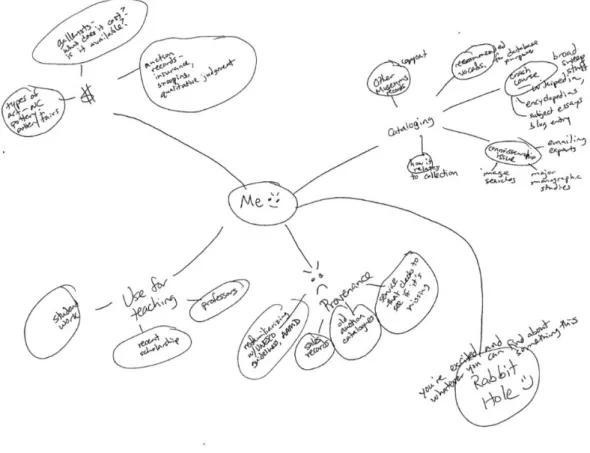
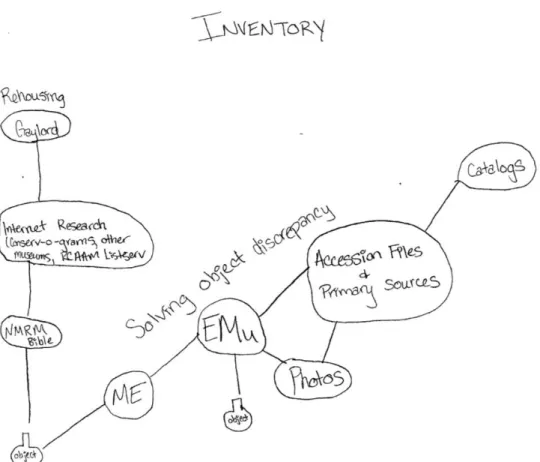
horizon maps drawn during the interviews were conducted at the end after the
interview questions to allow the participants time to think over the different
information sources they had discussed and their ways of using them, instead of
blindly prompting them at the beginning. This allowed for richer information to be
represented in the maps. This same structure is utilized by Sonnenwald, Wildemuth,
and Harmon in their initial use of the method in their study on the information worlds
of low-income students (2001). I did not provide any assistance or input on the
drawing of the maps, even though I was requested to do so by many of the
participants; I reiterated the prompt but did not give any further assistance than that. I
did allow the participants to choose a specific work task to think about while making
their information horizon map, to give a more specific context for the information
sources and work tasks described earlier in the interview. These maps, hand-drawn on
paper, and recordings were then kept by me on a password-protected computer with
randomly-generated numbers as the names for the recording data. The document
linking names to these numbers was kept on my personal private server, also
password-protected. I then transcribed these recordings partially word-for-word and
hand-coded them using the coding scheme provided by Smith and Turner (2014).
All interviews utilized the same framework, with a semi-structured flow of
questions and then ending with the information horizon map drawing. Each interview
began with an introductory question about their position and what work tasks they
completed in a normal work day. This opening question allowed me to probe for
specific work tasks where I could then ask about the information sources they used to
complete that work task, what sources they favored over others, detailed explanations
about work processes/institutional processes, and how they used those sources and the
associated information. (See the interview guide in the appendix for further
information.) Each interview involved questions on these topics, even if they were not
asked in the same way or at the same point in the interview, as that is the nature of the
semi-structured format. For this reason, each interview contained specialized
questions related to the registrar or curator’s expertise and work. I also asked in each
interview how the permanent collection was involved in their work tasks as an
information source if it did not come up over the course of the interview in other
questions.
Both of these items were analyzed utilizing content analysis, with institutional
ethnography as the guiding methodology for choosing units of analysis in the data. In
that process, I assigned a unique numerical identifier to each of my interview subjects
(to keep anonymity), and then reviewed the interview data and maps to determine
general themes. These themes are generated from the data itself and guided by the
institutional ethnographic approach; this approach is similar to grounded theory, but
diverges in that non-content related items such as specific format or arrangement of
forms and maps, word choice, and word/concept order are used as well as general
concepts described in the text (Smith et al., 2014). This methodology allows for
aims to see if the information’s composition is affected by its context. These practices
and coding methods are from Smith (2005), Smith and Turner (2014), and Campbell
and Gregor (2004).
Existing Data Collection
Relating to my existing data, I chose documentation used/created by the
museums that reflected the various work processes that art museum curators and
registrars conducted and sought out information for. These documents include the
collection management policy, an example loan form, and an example facilities
report. All of these items are located permanently at the institutions I held interviews
in, provided to me upon request by the museum’s registrar. Not all institutions chose
to send me documents, with the Weatherspoon citing their high similarity to example
policies on AAM’s website, which is accessible to current AAM members (though
they do send copies on request to non-members occasionally.) Other institutions
allowed me to look at these documents during my visit and take notes (Mint Museum)
but did not provide materials outside of the museum space. Because of the high
similarity between the policies viewed and the example AAM policy viewed at the
Weatherspoon, it is not a significant limitation to the study to not have example
documents from each institution. Curatorial and registrar policies are not owned by
each institution, but instead are based on models set by professional organizations
(AAM, Association of Art Museum Curators, and Association of Registrars and
Collections Specialists) and are then tailored to the specifics of their information.
These documents serve as an illustration of both the art museum curator and
registrar’s information horizon, as they are discussed in both the interview data and
information needs expressed by curators and registrars in terms of their relationship to
the needs of the wider institution.
Data Analysis Method: Institutional Ethnography
Data analysis of my interview data, information horizon maps, and existing
records/documents data took the form of content analysis, utilizing the methodology
of institutional ethnography as a guide for generating codes for both items and for
analyzing themes present in the maps, documents, and interviews. The inclusion of
institutional ethnography is significant as its purpose is to illuminate the inner
workings of everyday work tasks, namely, by coding and tracing language present in
interviews and documents that reflect institutional values and practices. This can
especially be seen in the codes provided by Smith and Turner, including suggested
codes such as how work processes relate to the institution and existing informational
orders (Smith et al., 2014). Features such as document headings, structure, and
references are also just as vital as the body of the text, and are evaluated against
interview data to discover what modes of discourse the institution uses to disclose its
interests. This approach will allow me to mine my interview and maps data for
information about what art museum curators and registrars value for their institution
(and if institutional language forms a part of their work), instead of viewing their
accounts in a solely personal, and thus restrictive, sense.
Data Analysis
All of the interview data was qualitatively coded based on code categories
derived from Dorothy Smith and Susan Turner’s book, Incorporating texts into
institutional ethnographies (2014). These codes are: information sources being used,
processes/order in the workplace, how the work is related/connected to others,
troubles/successes/emotion of doing the work, and what work is being conducted
(Smith et al., 2014). These codes aim to uncover what information needs are
expressed in different work processes, what information sources are used in those
work processes, what these information worlds look like as a whole, and how those
information worlds and needs are shaped by the museum institution.
Information Work Tasks
As defined by Bystrom and Hansen (2005) and Hansen (1999), work tasks are
collections of behavior that occur in a workplace and are related to the work that the
person is conducting. Bystrom and Hansen add to this concept of work task by
describing some work tasks as “information-intensive,” meaning they require a large
amount of information to initiate the task, carry it out, and complete it (2005, 1055).
Understanding how information is used, an area that is still little understood as
compared to other parts of the information searching process, is bound up in
understanding what the tasks are that are enacted to retrieve that information and that
also consume or require information to begin (Bystrom et al., 2005; Spink and Cole,
2006; Case, 2012). Bystrom and Hansen divide this process into three sections, of task
construction, task performance, and task completion; the following sections below
aim to describe the major work tasks provided by the interviewees in this manner to
understand more fully what work art museum curators and registrars are doing to
better contextualize the information sources used in these processes (2005). As their
model, and Cool’s concept of situation in information-seeking, illuminates,
information sources are sought out based on the task at hand in a workplace, and these
sources are further influenced by the worker’s situation, experience, and context
other materials that workers create or maintain also construct and reinforce an
institutional context that can affect how these work tasks operate (Smith et al., 2014).
As such, the work tasks are described below, then the information sources curators
and registrars reported using in these situations, then the wider maps the interviewees
constructed considering these items together, ending with my analysis on these
information-seeking and usage practices in their specific, institutional contexts.
Acquisitioning
Acquisitions are items that are purchased for the museum’s permanent
collection; works that are on loan from another institution or in traveling exhibitions
are not considered acquisitions to the museum as there is not a permanent transfer of
ownership between these parties. As described by the curators interviewed,
acquisitions begin by curators searching for objects to purchase; this can either be
with their department funds or with special funds that are earmarked for specific
collections, such as North Carolina pottery or French Rococo painting. Acquisitions
can also come in the form of gifts or donations from selling parties, a group as diverse
as artists themselves to private collectors, families, museums, or even businesses and
universities. After researching what objects are available to purchase, the curator then
writes a short document called a justification to assert why the item or items fit that
collection, how they further the collections management policy’s goals and goals of
the museum, how they have artistic/historical/material merit or are a good example of
that kind of object, and if the museum is associated with a university, how it can be
helpful to parties at the university. These justifications are no more than one to two
paragraphs and also include photos of the object as well as its basic information. The
curator presents these justifications to their board, director of the museum, and other
on the size of the institution, but generally the board and director are involved as the
curators interviewed provided), and all take part in deciding if the item should be
purchased.
Once it is purchased, the process of acquisitions moves over to the realm of
the registrars, who then assign it a specific number which can be tracked in their
database and in its related paper records, take photos of the item, and create files
(physical and digital) of the work that include documents such as its deed of gift or
bill of sale, a condition report, exhibition record (if it was from another museum or
collector), and over time, any related curatorial research about it. Specific processes
of how acquisitions are handled vary between institutions; some separate items into
object files and artist files, each having different curatorial information, some separate
curatorial research into its own file, and others separate new acquisitions and old
ones, to reflect the legal status of that object moving from one state of ownership to
the next. While not every new acquisition may appear on the front-facing website,
two of the registrars interviewed noted putting them online was a priority over other
materials, and all would be placed in the internal database.
Exhibitions
Exhibition is a broad term, encompassing a wide variety of exhibition formats
and work tasks that go into making an exhibition happen. At its basic form, an
exhibition in an art museum is a public show comprised of art objects, assembled
around a theme usually with supporting features such as wall text, labels, or
interactive panels (Duncan, 1995). Exhibitions range widely in content, as they can
focus on a single artist, time period, or medium, or explore a variety of items;
exhibitions can also be assembled around historical or cultural themes. As a brief slice
current and upcoming projects as varied as fashion materials from Oscar De La Renta,
to Wedgewood pottery, to art on the subject of fairytales, to the history of
photography. The primary organizing item here, as stated by one of the curators at the
Ackland, is that an exhibition is telling a narrative.
Exhibitions also vary on what kinds of materials are in them, consisting of
either items from the museum’s permanent collection or items on loan from other
museums, private collectors/lenders, or other parties. These exhibitions can also be
curated by the museum staff or can be hosted by other museums; each of which can
also be called a traveling exhibit, which moves to other museums for a specified
amount of time. Special exhibitions or temporary exhibitions are more generally
shows that are only up for a short period of time as compared to other shows in the
museum or to the exhibited permanent collection, with special also possibly referring
to a loan show (many works from on loan) or on a subject that is not commonly on
offer at the institution. The Weatherspoon curator’s show on fairy tales or the Nasher
curator’s co-curation on Latin American Pop Art fall into this category.
While the exact work tasks differ based on the institution, generally it starts
with the curators researching items in their collections or in other museums and
lenders, collecting images of the desired works, and great deal of researching
background information on the concept/narrative. These concepts, reported at various
meetings with the other curators, board, and director, are then formulated into a
planned exhibition with correspondence to any loaner institutions, a checklist of all
the works in the show, and sometimes educational programming or a catalog
manuscript planned alongside it. The registrars then keep that checklist and ensure
updated records and location information for those works, managing loans from other
receiving artworks, and handling rights and reproductions of the art images in any
publications. As reported by the interviewees, there is a great deal of communication
between curators, registrars, and museum workers in many other departments such as
education and marketing to ensure smooth installation and deinstallation of the
exhibition, as each person’s work is structured to be interrelated to the other (and in
turn, seeking out information for these work tasks relied upon these chains of
communication, as written about later.)
Gallery Rotations
Gallery rotations is a work task that applies only to the permanent collection,
as it is the movement of permanent collection items on display to other galleries or
back to storage (Altshuler, 2006). This practice varies on the institution, on how large
their permanent collection is, how much staffing they have, what their collections
management policy states etc., but generally a museum will endeavor to move some
items away from display or to other galleries over time. This can be for conservation
reasons, for example, works on paper cannot be on constant display due to fading nor
can fabric items because of fading and possible touch by visitors, or for updating the
gallery’s content; there may be a donation that the museum wants to highlight, a surge
in a particular collecting area that has happened over the years, or maybe simply the
gallery’s theme is shifting to meet the needs of the public. These are less common
than exhibitions however, when asking the the interviewees; a curator at the Mint
provided that their permanent collection galleries change out only one or two objects
over the course of a year and they are just now planning a whole new redesign after
10 years; the two curators at the Weatherspoon noted that their permanent galleries
gallery rotation after a similar length of time to the Mint. It is more common to
change out one or two items than to change the entirety of the gallery.
The work tasks in gallery rotations are not too dissimilar from exhibitions,
though, with the one exception being that there are no loans being requested. Objects
and themes are researched by curators, object lists created from the collection
(website, database, visiting storage etc.), objects are retrieved and tracked by
registrars, their conservation information reviewed, and then installed by preparators
(Becker, 2008; Buck et al., 2010). Items being removed from the gallery floor have
more involvement from the registrars, who ensure they are placed in the right storage,
update exhibition and location records, and conduct condition reports after the object
has been exposed to gallery conditions for an extended period of time (Buck et al.,
2010).
Loans
Processing loans from other institutions has a series of work tasks in itself, for
both curators and registrars. Loans, whether sought out from other museums or from
private lenders, begin with the curator looking at and then talking to the respective
museum’s curator and registrar(s) or private collector to see if loaning the item is an
option; the loan, if agreed upon, is then processed by both curator and registrar, in that
the former begins to research the item and speak to that museum’s curator or private
collector about the object’s history, while the latter also is in contact with the private
collector or museum curator and registrar about the object’s material information,
insurance value, where it is located, shipping information, and, most importantly, who
owns it. Ownership, as one registrar at the Weatherspoon provides, is integral to
managing art objects as the museum cannot loan works that they do not have in
was trying to retrieve was in limbo briefly because the private lender was not able to
be physically present to sign the work over to the museum. Documents such as loan
forms and facilities reports act as intermediaries in this process, providing proof of
ownership, exact locations, and security for museums in the case of the facilities
report, which details exactly the kinds of conditions the hosting museum will have for
that art object (Buck et al., 2010). A photo of the object and a brief description is also
included in the loan form as well as information about the lender, providing crucial
information about condition or installation. All is then entered into the registrar’s
database and records, so the item can be tracked if need be. These art objects are
picked up by the registrars, sometimes in person, sometimes with professional art
shippers, who then stay with the object constantly until it arrives at the museum.
When the loaned period ends (usually for an exhibition), the work is then shipped
back, in a similar manner as shipping to the museum, loan agreements are updated
and filed away, to serve as a record of what items have been exhibited and to legally
prove that the object is not in the museum’s domain. As museum storage is massive
and loaned objects indistinguishable from owned objects, documents both digital and
paper are vital surrogates, like a museum on paper.
Deaccessioning
Deaccessioning is a much more complex process than its sister, accessioning,
namely because of previous scandals (of collections deaccessioning works for profit
or to pay basic utilities) and because of the sensitive nature of the task; no one wants
to admit that an object may not be the best fit for an institution (Genoways and
Andrei, 1997). AAM and AAMC have many guidelines on how to deaccession
materials, and AAM carries strict penalties if they are not followed, including
curators are also important pieces to keep in mind when deaccessioning, as two
curators related; if objects no longer reflect the mission of the institution or are being
underserved because the museum does not have expertise in that area, then removal is
best, but is done carefully in regard to those relations.
As described by the six curators interviewed, deaccessioning is a group
process, not a solo one, because of that sensitive nature; no one person can be a target
by a disgruntled donor and agreement from all parties in the museum can be ensured.
The process begins with research about the objects by curators, much like accessions
or gallery rotations, to find out about the object’s history, provenance, and aesthetic
merit; this is meant to see if the object should or should not be kept by the museum, to
prove the curator wrong, as one interviewee put it. After research by the curator, this
work is reviewed by other curators, or if in a smaller museum, this work is more
quickly transported to a series of meetings with the curatorial and registrar staff, the
director, and the board, in which at least a majority of the parties should agree on
whether the item or items should be deaccessioned. As one curator described the
process, the idea is to try and determine if the object has enduring value and relation
to the collection and if there will be a reasonable expectation that there will be
information gathered about that object. If not, then the item will be deaccessioned so
other museums or collectors can research the material. This process is also mediated
by documents, with justifications written for the object’s removal and either updated
object records or new deaccessioned records that indicate the removal or sale of the
item. Deaccessioning is not a common event; only two curators had a ready example
Staying Current
While not a formal process, staying current in the field was a commonly
described work task amongst all curators and registrars interviewed. For curators, this
consisted of keeping abreast of new artists or materials (especially for those in
contemporary art) or new exhibitions, as well as keeping up with the academic
scholarship in their specific area of collecting, whether that be Mayan and Aztec
sculpture or Renaissance painting. Keeping in contact with colleagues (other curators,
artists, art historians, professors, etc.) was also described in a similar manner, with
curators reaching out to them for specific information about artworks or artists or to
see what new art events were happening in that area.
For registrars, staying current also included keeping up with colleagues (on
facilities information, conservation information, and specific materials knowledge, for
example, what new archival sheeting is available), new materials for storage and
conservation, new processes in conservation for new media (digital art, plastics, etc.),
changes in museum database programs, changes in forms, or new developments in
cataloging. Both curators and registrars reported that keeping current in their fields
was a daily part of their work, either sifting through information sent to them through
email or seeking out information when facing a gap in knowledge.
Information Sources
In coding the interviews, ten categories of distinct information sources were
found. There are myriad subcategories, of which a few I have chosen to elaborate
further on for clarity or because there are significant differences between curators and
registrars or between different types of information use. It is important to note that
this is not reflective of the full breadth of materials that an art museum curator or
which may have a bearing on the types of information sources used, nor did I
interview every type of possible position held by a registrar. Other information
sources may be used based on these differing work spheres. This is because of time
availability constraints in my area of study. The findings provided, however, have
been coded based on their appearance amongst at least two interviewees, allowing for
comparisons between curators and registrars and internal comparisons, as well as
serving as a basic foundation for future studies. The majority of these categories were
not prompted by specific questions during the interview, but came about from the
semi-structured discussion about their work processes and how they sought out
information to do that work; only the permanent collection and museum policies were
explicitly asked about as information sources. Colleagues were referred to in one
possible question but were not described as an information source in the question. The
following data findings presented below are wholly derived from the interview data;
any and all statements or assumptions stated come from this information.
Colleagues
For the registrars interviewed (four out of ten participants), all spoke about
working closely with the curatorial department, preparators/art movers, and education
departments on specific projects that either linked those departments (education,
marketing) or on a more long-term basis where information is constantly shared
(curatorial, preparators) because of the constant exhibition cycle or acquisitions,
which are always entered into the database. Two registrars spoke at length about the
importance of professional networks of other registrars (represented by phone calls,
list servs, conferences, websites, email) for information about new challenges in the
workplace or for clarification about existing knowledge. For example, one registrar
museum is located near an active railroad, requiring new kinds of hanging and care of
objects to ensure they are not affected by the vibrations. To find this information, they
sought out information from other registrars as well as colleagues in the museum
itself; interestingly, the registrar also noted that the change in institutional structure
(previously worked at a museum not affiliated with a university) also affected who
they could seek information from, citing a wider scope of individuals such as town
and university partners, which do no regularly figure in the information worlds of
independent museum workers.
While most of the registrars interviewed were comfortable with using other
colleagues as an information source, one registrar noted that they would not contact
the list serv for basic questions for fear of appearing unprofessional/unknowledgeable.
This is likely due to their professional stature, as they went on to explain that the list
serv and conferences were more likely to be used by newer registrars, and that to ask
certain questions could betray a lack of expertise. On the whole, the registrars
interviewed presented their professional contexts as a largely information-sharing one
between other registrars both within and outside their institution, sharing information
about industry standards, database tools, and facilities information. As one registrar
put it when describing information-sharing efforts between registrars within the
museum and to outside museums,
“Museums kind of help each other in that regard, where they understand that everybody’s information needs to be kept to as a limited number of people as possible, and so we all try to help each other out” (registrar, interview
transcript, 2017).
While initially this seems to display a closed information world, what the registrar
here is providing is that information about the institution such as facilities layouts and
materials or conservation methods are shared within the registrar network but rarely
across museums though do not silo their information but share it to other registrars,
since the possibility that their work may be shown in that museum or vice versa
means they should endeavor to have good relations and ensure all spaces are kept up
to standard.
One registrar and two curators talked about differences between curators and
registrars, stating that curators are less likely to share information between each other
in a museum and to other curators elsewhere. The reasoning behind this was because
of the specificity of a curator’s work and information needs and, as noted by the
registrar, because of a spirit of competition between curators. This specificity refers to
the narrow scope of a curator’s position, requiring them to collect and research
information about a small subset of artworks; for example, curators interviewed
included focuses such as contemporary ceramics and fibers, 19th-century ceramics
and decorative art, Italian Renaissance painting, and 21st-century American fine arts.
These focuses, as curators at the Weatherspoon, Mint, and Nasher noted, make it
difficult to have cross-curatorial collaboration because each curator’s job is highly
specialized and there is not (usually) a depth of staff in one area. As shown in several
of the interviews, information held by a museum about the collection is often viewed
as proprietary, which may demonstrate why other colleagues is not a common
information source used by curators. While this information is freely shared in the
forms of exhibition catalogs, talks, and websites, these are also forms that the museum
(curators and registrars alike) has control over, sharing their institution’s specific
narrative. It may also be, as one registrar suggested, that the information gathering
conducted by curators is heavily academic in terms of focus and sources used and thus
not readily shared. While this could be a factor, I would expand this view by
curators introduced themselves as the main manager of a specific collection, and for
those that were assistant curators, as the main head of a series of curatorial projects.
Their institutional role is singular, and the curatorial information needed for work
tasks like selecting objects for acquisitions or putting on exhibitions is highly specific
to the collection being worked on and to the institution.
At the same time, two different curators talked about the need to seek out
information from colleagues inside and outside their museum. The other two curators
interviewed did not mention or stated they did not need information from other
curators. Factors such as the objects worked with (the two who did not collaborate
were primarily permanent collection workers) also may explain this difference. The
two curators who did seek out information from other colleagues worked in temporary
exhibitions and contemporary art, suggesting tentatively that the art objects/area of
focus changed that information sharing behavior. Instead of viewing one’s work as
voice of a specific and institutionally-represented collection, those in
temporary/special exhibitions and contemporary works are already oriented outside
the institution based on the kinds of objects they work on. Works sought out for
traveling/special shows, as reported by these two curators, exist in other museums,
collections, or in the ownership of the artists themselves, while contemporary works
often have little available scholarly information. Thus there is a need to reach out to
these actors and share information in order to exhibit those works or learn about new
artworks.
Temporary/special shows are also often collaborative efforts between
institutions all across the country and world, requiring an open information
environment to accomplish such work. Beyond the basic sharing of facilities
must collaborate with other curators on composing the exhibition catalog, object
labels, and any other text associated with the show, meaning that research information
about the objects or themes are also shared. While this curatorial information is not
commonly reported as shared between colleagues or sought from other colleagues as
reported by the permanent collection curators interviewed, this does not mean that
these curators have no interest in collaboration. One curator at the Mint Museum
noted that they enjoy such opportunities when they arise, stating,
“We also really do like when there are opportunities to mix objects from different curatorial collections because we [Mint curatorial staff] all agree that generally makes the experience for visitors that much more meaningful, if they go into a gallery of 19th-century American art and not only see paintings and sculpture, but also silver and ceramics...that relate to the same culture and time period. It just makes a more well-rounded experience.” (curator, interview transcript, 2018).
Yet, the curator continues by stating that these collaborations are few and far between,
with information-sharing behaviors between curators or using other colleagues as
sources of curatorial information as a rare occurrence.
Subsection: University colleagues
Three of the four institutions visited are connected to universities (Nasher
Museum of Art with Duke University, Ackland Art Museum with UNC, and
Weatherspoon Art Museum with UNCG; the only standalone gallery is the Mint
Museum, Uptown and Randolph locations, in Charlotte, NC). All of the curators
interviewed in these university-affiliated museums, comprising four out of six
curators interviewed, noted other university staff as an important information
resource, including professors (not limited to art history/studio art but also in nursing,
kinesthesiology, humanities, etc.), staff at the university counsel office, budget office,
provost office, and marketing department. Information sought out included legal