Samantha A. Guss. Assessing the Effects of Institutional Review Boards on Social Science Data Archiving in Digital Repositories. A Master’s Paper for the M.S. in L.S. degree. April, 2009. 61 pages. Advisor: Helen Tibbo.
This study addresses the intersection of digital repositories and archives and institutional review boards (IRBs) with regard to opinions on data reuse from the IRB members themselves and researchers in social and behavioral science disciplines whose research requires IRB approval. The issue was examined from several perspectives, utilizing a survey of social and behavioral science researchers, interviews with IRB members, and an analysis of the language used in blank Informed Consent forms from previously approved studies related to potential data reuse. Combined, the data gathered provides multi-faceted insight into these two groups, especially regarding IRB application language and subjects' informed consent. It recommends early intervention by repositories, open discussion within Institutional Review Boards on data archiving in social and behavioral science, increased guidance by IRBs and repositories for applicants, continued education, and increased transparency and communication among IRBs and researchers.
Headings:
Digital preservation
Electronic data archives
Institutional repositories
Professional ethics
ASSESSING THE EFFECTS OF INSTITUTIONAL REVIEW BOARDS ON SOCIAL SCIENCE DATA ARCHIVING IN DIGITAL REPOSITORIES
by
Samantha A. Guss
A Master’s paper submitted to the faculty of the School of Information and Library Science of the University of North Carolina at Chapel Hill
in partial fulfillment of the requirements for the degree of Master of Science in
LibraryScience.
Chapel Hill, North Carolina
April 2009
Approved by
Table of Contents
1. Introduction... 3
2. Literature Review... 6
2.1 Data Reuse in Social Science... 7
2.2 Tension Between Researchers and IRBs... 10
2.3 Institutional Repositories and Data Archives... 12
2.4 Outreach and the Librarian's Role... 14
2.5 Summary of Literature... 16
3. Method... 18
3.1 Part A: Survey... 19
3.2 Part B: Interviews... 20
3.3 Part C: Content Analysis... 21
4. Results... 23
4.1 Part A: Survey... 23
4.2 Part B: Interviews... 35
4.3 Part C: Content Analysis... 39
5. Discussion... 43
5.1 Limitations... 48
5.2 Recommendations... 49
6. Notes... 52
References... 53
Appendix A: Survey Questions... 55
List of Figures
Figure 1: Survey respondents' academic status... 23
Figure 2: Survey respondents' school or department primary affiliation... 24
Figure 3: Distribution of coded "data management plans"... 26
Figure 4: Answers to Question 5: "Did you follow, or are you following,
your data management plan as outlined in your IRB application?"... 27
Figure 5: Answers to Question 6: "Based on your last application's wording, as it was approved by the IRB, would you feel comfortable
archiving the de-identified data resulting from your study in a
digital repository?"... 28
Figure 6: Answers to Question 7: "Have you ever archived data from a
study in a digital repository?"...30
Figure 7: Answers to Question 8: "Would you consider doing so
[archiving your study data in a digital repository]?"... 31
Figure 8: Answers to Question 12: "Do you think the IRB would approve a study that included a plan to archive de-identified data for
future use by you or other researchers?"...33
1. Introduction
This study addresses the intersection of digital repositories and archives and
institutional review boards (IRBs) with regard to opinions on data reuse from the IRB
members themselves and researchers in social and behavioral science disciplines whose
research requires IRB approval.
Digital repositories, including institutional repositories as well as disciplinary
archives, are difficult to define and can encompass many things, but at the most basic
they are institution-based digital archives in which digital scholarly output of many types
is curated over time and made available publicly. From a resource for teaching materials
to a new kind of scholarly publishing, IRs have a variety of potential uses. One area of
particular interest is for institutional repositories or other archives to acquire the raw data
sets generated from research studies or by researchers. This data would be maintained in
usable form so that later researchers could either verify the data reported in a resulting
article or reuse the data in a different way for their own study. Few researchers have yet
to embrace the use of institutional repositories. One potential reason for this is confusion
among researchers as to what is allowed concerning open access to data and reports. No
IR literature has addressed IRBs yet.
Institutional review boards preside over research involving human subjects at a
given institution (such as a university or hospital), and are federally mandated to ensure
that those human subjects are protected from any unnecessary harm resulting from the
Department of Health and Human Services, oversees institutional review boards and
provides resources, but individual IRBs operate independently and create their own
procedures and documentation. All IRBs exist to uphold professional research ethics, as
outlined in the Belmont Report (1978): Respect for Persons, Beneficence, and Justice.
Practical applications charged to ethical researchers and IRBs are Informed Consent,
Assessment of Risks and Benefits, and Selection of Subjects. Large institutions often
have several review boards, responsible for applications from different departments or
disciplines. IRBs have existed in the United States since 1974.
Researchers must apply for IRB approval before a study has started, outlining
specifically what will be done and to whom, and the IRB decides whether the study is
ethical and may be conducted as written or more commonly, what needs to be changed to
make the study more clearly ethical. Data resulting from social and behavioral research
studies sometimes contain confidential information about the subjects studied; IRBs are
very interested and often quite strict about how the researcher protects this data from
becoming public. In order to be shared, this data usually must be de-identified so that it
cannot be linked back to the individual who provided it. IRB applications differ slightly
among institutions, but the intent is the same. Since applications are lengthy and approval
often requires revisions (taking time they might prefer not to spend), researchers must be
careful and deliberate in documenting their intended actions, including data management.
When framed this way, it might seem that digital repositories and archives
collecting social science data are somehow in opposition to the goals of the IRB process.
However, the data collected in this study provides evidence that they are not truly at odds
perceptions of social and behavioral science data archiving in addition to researchers'
perceptions of what the IRB will or will not allow them to do. Increasing the transparency
of the process helps to remove obstacles for researchers' contributions to digital
repositories, furthering their development and use.
From reviews of the various literature informing this issue, the following research
questions were formulated to guide this study:
What are IRB members' perceptions and knowledge of digital repositories and the
practice of data archiving in social and behavioral science?
What guidelines and procedures do IRB members think should be followed when
making social and behavioral science research data available in a repository?
How do IRB considerations affect a researcher's decision whether to archive
his/her data in a digital repository?
If IRB considerations are indeed a barrier to archiving of social and behavioral
2. Literature Review
It is suspected that a variety of factors, including researchers' perceptions of IRB
procedures, is a factor impeding faculty participation in digital repositories and other data
sharing venues. A review of the literature reveals that this topic has not been directly
addressed before, providing justification for an exploratory study such as this one.
IRBs' intentions and procedures, and even their very reason for existence, seem to
be widely misunderstood or ignored. IRB applications are often seen as no more than an
annoying extra step requiring time and effort better spent elsewhere and the IRB itself as
inefficient, overly strict, or wanting to cause headaches for researchers. Speed is widely
cited as a source of contention with IRB applications and, at least anecdotally, it seems as
though researchers are interested in getting their applications approved as fast as
possible—and will fill them out with this in mind. For social science data archiving, this
practice could be harmful: if researchers suspect faster approval for applications that
propose destroying data, digital repositories will never have a chance to recruit this data
for their collections.
Disciplinary data repositories for social science have existed for close to a century
while institutional repositories are a much newer endeavor, but they share many of the
same challenges related to collection development. Institutional repositories have been
slow to catch on for a variety of reasons and a sizeable body of literature exists
contemplating these reasons and ways to address them. Overall, removing obstacles and
repositories, which is arguably beneficial to all of the stakeholders involved. The
librarians and archivists responsible for the creation and upkeep of the repository will
have to take an active role as liaisons between the repository and its contributors: the data
creators. For new repositories, this will include initial recruitment of materials as well as
ongoing outreach activities, both of which require open communication. To do this, they
will need as much information as possible to answer researchers' questions and instill
confidence. This study is meant to add to this body of useful information.
The literature related to this question spans social science disciplines like
sociology, psychology, and communication studies, ethics, studies of IRBs themselves, as
well as library and information science literature on digital repositories and librarians'
roles in facilitating faculty research.
2.1 Data Reuse in Social Science
The idea of reusing study data in social science disciplines is not a new idea and
data archives, especially for quantitative studies, have existed for many decades. The
H.W. Odum Institute for Research in Social Science at the University of North Carolina
at Chapel Hill was founded in 1924, the Inter-University Consortium for Political and
Social Research (ICPSR) at the University of Michigan was established in 1962, and the
Roper Center Public Opinion Archives at the University of Connecticut was founded in
1947 with data going back to the 1930s. Internationally, the Council of European Social
Science Data Archives (CESSDA) was created in the 1970s, bringing together individual
Although analysis of secondary data has not become commonplace, researchers in
social science have been arguing for its value for at least thirty years. Finifter (1975) was
one of the earliest to outline the benefits of storing data for later use. This article cited
various uses ranging from simple re-purposing and validity/methods testing to multiple
methods triangulation by later researchers. Even in the mid-seventies, well before the
birth of the Web, Finifter envisioned a system of alerting and sharing with other
researchers and argued that preserving the data is useless if no one knows about it or can
access it.
There are problems, however, with long term preservation of social science
research data particularly related to ensuring participants' confidentiality and privacy.
Professional research ethics call for informed consent--the subject must explicitly agree
to participate, knowing what will happen in the study and their risks for
participating--and careful protection of any personal details collected during the study that would allow
a third party to trace responses back to individuals. Both of these things can be
problematic for data archiving. When many social science data archives began, there
were no institutional review boards at all. Even in the last ten years, IRB applications
have become longer and more detailed. The IRB application at the major research
university studied here is approximately fourteen pages long. Compare this with a
filled-out, approved application from 2004 from the same university that totals four pages.
Parry & Mauthner (2004) argued that subjects sign informed consent agreements
only for the study at hand: they did not consent to other studies associated with secondary
use of that data, pulled from an archive by a different researcher perhaps years later. In
quantitative) research data. Instead of deleting a few columns of personal data from a
spreadsheet, it might involve censoring interview documents line by line, still possibly
missing identifying pieces. In addition, according to Parry & Mauthner, "ensuring
anonymity might require removing so much detail that the data are rendered
meaningless." This is not a complete impasse, but social scientists such as Parry &
Mauthner have not been satisfied so far with the recommendations and assistance with
de-identification for qualitative studies.
Scott (2005) also addressed issues of subject identification as it relates to
communications research, especially focusing on anonymity (never recording personal
data about participants at all) and confidentiality (carefully guarding any personal data
that is recorded). The study did not argue for anonymity but warned that researchers and
IRBs should carefully consider whether collection of personal information is necessary
considering the difficulties of keeping it absolutely private. In addition, the author
discussed the importance of researchers cultivating relationships with members of the
IRB to encourage open communication on these and other issues.
Easter, Davis, & Henderson (2004) discussed the issue of confidentiality in
survey research as new technology makes it difficult to ensure that participants cannot be
traced to their data, especially when more than one party is involved in the research (as is
often the case in social science endeavors). They, too, suggested that researchers and IRB
members think carefully about what personal data absolutely needs to be collected and
advocated open communication and education for both on data protection issues.
Additionally, they recommended a system that allows for reassessment and easy
2.2 Tension Between Researchers and IRBs
Another important issue impacting social science research that must be considered
is the tension between researchers and IRBs, which is probably better described as
researchers' animosity or annoyance for the IRB process. The American Psychological
Association (APA) created a task force in 2007 specifically to address this issue that
persists although, as the report argued, the IRB and researchers do ultimately have the
same goals (APA Presidential Task Force on Institutional Review Boards and
Psychological Science, 2007). The task force reported that one reason for this tension is
the perception that biomedical IRB procedures are unnecessarily applied to social science
researchers. One of its recommendations to alleviate the tension was to expand education
on ethics, the purpose of IRBs, and submission of IRB applications at all levels,
beginning in undergraduate psychology programs.
In an empirical study of social and behavioral researchers, Ashcraft & Krause
(2007) used a survey and open ended questions to learn about their subjects' experiences
with IRBs. Their survey results revealed a "surprising" amount of satisfaction with IRB
application processes, with nearly half claiming that their IRBs had a "reasonable"
turnaround time. However, the comments they received were largely negative or accounts
of IRB "horror stories." This study also found that, as expected, timeliness is a major
source of tension for researchers regarding IRBs and lack of time was cited as a major
reason among those who chose to bypass IRB approval. Much was revealed about
researchers' perceptions of their IRBs as well: for instance, many felt that their
applications were approved quickly because their methods presented no real risk to
that their personal reputation with IRB members was to their advantage. Many also
claimed that over the years they had learned to write their applications with an eye to
expediency. The authors found that several researchers questioned the need for IRBs at
all, and responded in their article with justification and a call for increased advocacy and
education about research ethics boards.
Along the same lines, Candilis, Lidz, & Arnold (2006) emphasized that the lack
of research on how IRBs function and make decisions leads to confusion, lack of
transparency, and questions about IRBs' necessity. They especially highlighted that IRBs
should be studied so that they can be more easily reformed and so that more stakeholders
can have a say in how that reform takes place. With more information and more input,
they argued, the researchers will not feel as frustrated by the process.
In an article specifically addressing IRB-researcher tension, Fitch (2005) provided
recommendations to improve the situation for both sides. Among these were promoting
open communication between the researchers and the board and asking (and preparing to
answer) questions about applications to make sure everyone is absolutely clear. It was
suggested that IRB members follow directions consistently and that researchers make an
effort to realize the complexity of an IRB's process as well as its importance, even when
it is not immediately apparent on a case-by-case basis. Perhaps most importantly, Fitch
recommended that social science researchers stop thinking that institutional review
boards are malicious and out to make their work more difficult.
Almost all of the literature in this category recommends education and openness
between IRBs and researchers seeking their approval as a mechanism to alleviate tension.
2.3 Institutional Repositories and Data Archives
While social science data archives have existed for many years, institutional
repositories are a relatively new venture for libraries and archives trying to capture and
preserve their university's output and assist researchers themselves. Institutional
repositories are difficult to define1 and can encompass many things, but at the most basic
are institution-based digital archives in which digital scholarly output of many types is
curated over time and made available publicly. For social science research, this output
could consist of things like data sets or interview transcripts generated by research
studies. Institutional repositories, in addition to other types of data archives, would
preserve this data in usable form so that later researchers could use the data as Finifter
(1975) and others suggested. Despite their potential benefits, IRs haven't been quick to
catch on among scholars; studies of reasons for use and non-use are useful in discussing
the IRB's role in social science data archiving.
Kim (2007) studied faculty to see what output they made public and why, their
contribution to IRs, and factors that make them contribute or not. The sample obtained in
the study did not include any contributors, so Kim learned more about non-contributors
and their motivations. Overall, knowledge about IRs was low, but faculty who planned to
contribute in the future were convinced of a variety of benefits, including larger
dissemination of their work and "altruistic impetus for making research work available to
other researchers." In addition, Kim found many to be confused about copyright issues
and whether they would be allowed by their publishers to contribute.
Davis & Connolly (2007) also studied faculty non-use of an institutional
repository promoters to take into consideration. Like Kim, they found that a lack of
knowledge about institutional repositories and their benefits was a big reason it was not
being utilized. In addition, various disciplinary cultures were not supportive of sharing
unfinished work and without any rewards system or recognition for deposit, the faculty
surveyed were not eager to do anything requiring extra work. Davis & Connolly's
findings also suggest that the inertia associated with the traditional scholarly output
model caused non-use; the authors discussed the risks associated with being an early
adopter of new technologies in relation to the way faculty are rewarded for their research.
The MIRACLE (Making Institutional Repositories in A Collaborative Learning
Environment) Project, funded by the IMLS, has employed surveys, phone interviews, and
case studies to investigate the status of institutional repositories in the United States, their
infrastructure and collections, and their users and potential users. Aside from numerous
findings regarding IR use and implementation, the MIRACLE study also confirmed the
findings of others that recruiting digital content for IRs is difficult (2007). This study also
found that "staff involved with the IR effort have voracious appetites for information
about IRs," highlighting the importance of continued research and documentation on IRs.
Foster & Gibbons (2005) conducted an anthropological study of faculty, hoping to
illuminate the non-use problem by determining what faculty do want. Their findings
inform both IR development and how librarians and archivists should market the IR to
encourage use. Most relevant to social science research and IRB members approving this
research are Foster & Gibbons' findings that faculty do want to make their work available
to others and keep up in their fields and are interested in easy version control,
digital tools (all of which such digital repositories can fulfill). They are also concerned
with ownership and security of their materials and want to be careful not to violate
copyright. In other words, the study's findings suggested that faculty want to play by the
rules, but want things to be easy that are not directly related to their own scholarship. The
authors also suggested that marketing and outreach of IRs will have to take faculty
desires into consideration in order to be successful.
2.4 Outreach and the Librarian's Role
Creating open and productive relationships between IRBs, digital repositories,
and social science researchers seems as though it will require someone to act as a liaison,
understanding the processes of all three and helping the entire research cycle operate
smoothly--a natural role for librarians. In a content analysis study of deployed or "live"
institutional repositories, McDowell (2007) found evidence that IR use is not growing
significantly; more specifically, that faculty output does not just "find its way" into IRs as
some early adopters had hoped. The discussion of these findings emphasizes that IRs are
not alleviating any kind of scholarly publishing crisis at this point. This too suggests that
future use of IRs and other digital repositories will require active prompting.
Watson (2007) also examined faculty perceptions of IRs, including reasons for
non-use and hesitation about use and found that faculty were largely unaware of IRs but
saw some benefit to them when they were explained. In addition, the author found that
researchers preferred to let others take care of the technical aspects of deposit and that
The study concluded that the appropriate next step is to integrate depositing of data into
the research process, therefore being involved early on in the data cycle.
Green & Gutmann (2007) also discussed early involvement in research as a
critical step in recruiting material to institutional repositories. According to the authors,
librarians and archivists should forge partnerships throughout the data lifecycle,
providing assistance and outreach to researchers as the data is created. This intervention
would work towards the goal of data created with best archiving practices in mind, in
addition to making researchers aware of archiving their materials in digital repositories.
The MIRACLE study (Markey et al., 2007) found that librarians are more often
IR developers and stewards than anyone else on campus and that IRs help the libraries
built new relationships. Responses to their survey suggested that the collaboration with
other entities like campus archives, student services, and digital asset management
systems, just to name a few, necessary to implement the IR lead to "increasing the
library's role as a viable partner in the research enterprise."
Gierveld (2006) discussed another method of outreach: applying the concept of
Social Marketing, which focuses on changing a group's behavior for the good of society,
to promotion and outreach for institutional repositories. In this piece, the IR is envisioned
as a product and its attributes and benefits are laid out in detail along with strategies to
promote each--essentially taking a marketing approach to "selling" institutional
repositories. Gierveld rationalized that this approach is appropriate because it is driven by
the technology available and visionaries who are not directly related to its use; it was not
a response to an articulated need by its target group. Therefore, a successful marketing
focused on making the users central to the IR's development and eventual importance.
Naturally it also requires someone to administer the marketing efforts.
In a review of the literature on institutional repositories, Allard, Mack, &
Feltner-Reichert (2005) determined that analysis of librarians' roles in IRs has not been
sufficiently studied and more research is needed in this area. They found that institutional
repository topics like defining IRs, implementation, management, and outcomes are well
represented in the professional discourse but outreach, a natural role for the librarian,
needs more attention in order for IRs to succeed.
It is important to note, however, that librarians should be liaisons encouraging a
wide range of digital repository uses and helping researchers to negotiate the process, but
not be gatekeepers, as Lynch (2003) argued in an early piece on institutional repositories.
He envisioned IRs as infrastructure for a new kind of scholarly publishing that responds
to the needs of its users rather than mandating what it will or will not support. This too is
a natural role for librarians and archivists, who already increasingly employ user-centered
practice.
2.5 Summary of Literature
From a review of the literature on this topic, several things are apparent. For one,
there seems to be a great deal of tension between institutional review boards and the
social science research community whose work requires their approval. This tension
appears to be caused by lack of transparency, communication, and lack of information
about IRBs' roles or how these could be modified or improved. The literature about
suggests that researchers in these fields might think that promising to destroy their data is
either necessary for quick approval or preferable to IRB members reviewing their
applications. It is also likely that these researchers give little or no thought to archiving
their study data at all at this stage, which possibly affects their participation in
institutional repositories or data archives after the fact. Meanwhile, very little is actually
known about IRBs' opinions or preferences regarding social science data archiving.
Generally, there is not sufficient literature at this time to explain the relationship
between IRBs, social science researchers, and digital repositories, making this an
important topic to study. This study is mainly exploratory, but seeks on a broader level to
add to this body of knowledge, addressing the issues outlined here and possibly inspiring
3. Method
The evidence gathered by this study is meant to clarify a piece of the IRB process
in order to assist researchers applying for IRB approval, support those recruiting content
for digital repositories, and inspire discussion within IRBs about issues of data archiving.
In order to accomplish these goals, both groups involved in the IRB application and
approval process were studied: the social and behavioral science researchers submitting
applications to an IRB and the institutional review board members themselves. From the
researchers, this study sought to learn about past IRB application behavior, opinions on
data archiving, and perceptions about the IRB and its process. From IRB members, it
probed general impressions on data archiving (especially related to ethics), past
encounters with researchers' data management plans, and how researchers might best
incorporate and execute data archiving plans. In addition to these survey and interview
responses, a simple content analysis was employed to further investigate researchers' and
IRB members' behaviors.
Because the research questions presented here are exploratory and rely on the
opinions (and actions) of two separate populations, a combination of methods was
deemed most appropriate to collect useful data. A large sample of social and behavioral
science researchers completed an online survey, while several members of a Behavioral
IRB at a large research university were interviewed via telephone. The content analysis
was carried out using Informed Consent forms from past Behavioral IRB-approved
from past approved IRB applications: they are the exact forms researchers used to attain
consent from their subjects, but have not been signed or dated by anyone.
3.1 Part A: Survey
The first part of the study was a survey of social and behavioral science
researchers at a large research university to collect data about their interactions with the
IRB related to data management plans and data archiving. A survey is a particularly apt
instrument to probe this population because it is relatively large, scattered, and diverse,
meaning that it would be difficult to gather a representative sample using many other
methods.
Using a report generated by IRB administrative staff at a large research
university, the sample of social and behavioral researchers was identified according to
which departments submitted the most Behavioral IRB applications in 2008. Email
addresses were gathered from these departments' websites (with help of the
university-wide directory when necessary), including all listed faculty, PhD candidates, and Master's
students from each department, and excluding adjunct faculty. A link to the survey,
created with Qualtrics survey software, was emailed to each of these addresses. Those
who had not responded within a week of the first email were sent a reminder, also
containing a link to the survey.
Subjects were asked a combination of open and closed questions (see Survey
questions in Appendix A), designed to learn about researchers' interactions with IRBs in
issues concerning the IRB in the past. Additionally, they were asked directly about their
perception of the IRB's stance on data archiving.
3.2 Part B: Interviews
The second component of the study was a series of short (10-15 minute)
telephone interviews with members of a social and behavioral science institutional review
board at a large research university, designed to explore their opinions and current
knowledge concerning data archiving, including ethical concerns and how the intention to
archive could affect the approval process.
Five out of thirteen Behavioral IRB members volunteered to be interviewed as a
result of several recruitment emails and a visit by the researcher to a regularly scheduled
IRB meeting. While the goal is similar to that of Part I, this population is small enough
that members can be studied individually instead of surveyed en masse. The interview
questions (see Appendix B) were designed to stimulate thought and discussion, with the
intention of exploring, rather than explaining, members' attitudes. While a focus group
could have allowed for more "pondering" of the issues among members (who already
know each other and are used to interacting with one another), interviews reduce any
disproportionate influence certain members might have had over others in a group
setting, allowing opinions to be shared with the interviewer in confidence.
At the beginning of each interview, the IRB member was given an overview of
the study's purpose to provide some context for the questions being asked, as well as
some potential reasons for data archiving in social/behavioral science and a short
asked in order, but instead as discussion led to them. The first question asked for general
thoughts or comments participants had after hearing the introduction and purpose of the
study. Other questions asked about specific ethical issues that need to be addressed for
archiving, and the IRB member could recall seeing the issue dealt with in applications.
Each member was asked about their preferences regarding applications, including how
and where data archiving might be addressed, and any affect the intention might have on
their approval process. Finally, participants were asked directly to what extent they felt
comfortable with de-identified social and behavioral science data being archived.
3.3 Part C: Content Analysis
In the third part of this study, a sample of Informed Consent forms were examined
to gain insight into the language typically used by researchers to describe their data
management plans. The Informed Consent form, officially called "Consent to Participate
in a Research Study (Adult Subjects)," is a place where researchers must explain
succinctly, in lay terms, what will occur in the study, for the benefit of their subjects. This
artifact was chosen for this study because here is where the most succinct "data
destruction" language has been found and where we might gain best insight into the
researcher's future plans for their data (if they have plans). While a waiver can be
obtained under certain circumstances, most studies involving direct interaction (and data
collection) from human subjects require a signed consent document. In addition, IRB
members pay close attention to consent forms as they look to protect subjects' safety and
confidentiality in their review process. Although content analysis offers straightforward
result is occurring. Informed Consent forms provide evidence into language used by
researchers to describe their data plans, they provide no explanation of why this language
was used or how much deliberation was involved at all.
The Informed Consent forms examined were obtained, with permission, from
Behavioral IRB records. All [94] Behavioral IRB applications on record for 2008
containing Informed Consent forms were included. The Informed Consent forms were
examined for a statement or statements about what will happen to the data after the study
is completed. Based on this information (or lack thereof), the forms were coded.
4. Results
4.1 Part A: Survey
Approximately 700 emails were sent out, to as many social/behavioral science
researchers possible on campus of a large research university, acknowledging that a
significant percentage of these individuals may not study human subjects, therefore not
requiring IRB approval (and subsequently not responding to the survey). There were 74
complete surveys returned, making the response rate just over 10%, although the
response rate of total social/behavioral science researchers whose research requires IRB
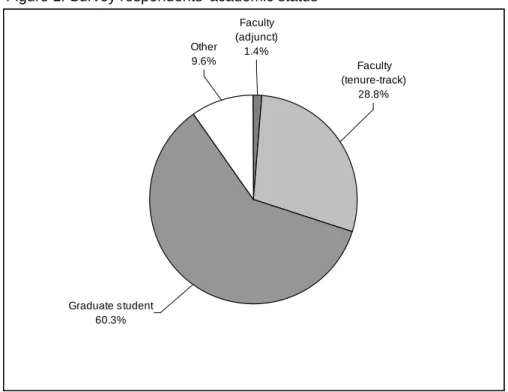
approval was likely higher. Of the respondents completing the survey, 29.9% were
faculty members, 60.3% were graduate students, and 9.6% described themselves as
"Other."
Figure 1: Survey respondents' academic status
Other 9.6%
Faculty (adjunct) 1.4%
Faculty (tenure-track)
28.8%
These 74 respondents claimed seven different schools or departments as their
primary affiliations, with 8% not responding or answering "Other."
Figure 2: Survey respondents' school or department primary affiliation
Anthropology 3.2%
Communication Studies
3.2% not specified
3.2%
Education 1.6% Geography
6.5%
Information and Library Science
35.5%
Other 4.8% Psychology
21.0%
Sociology 21.0%
This distribution can be compared to a report provided by IRB staff, in which
Psychology (102 applications) and Information & Library Science (82 applications) were
the top two departments submitting applications to the Behavioral IRB in 2008.
Education, Sociology, and Communication Studies were all in the top ten, with
Anthropology and Geography close behind.
More than six out of seven (86.5%) of respondents had previously submitted IRB
applications, further indicating that those who did not respond to the survey likely had
not previously use the IRB or plan to in the future. This could provide explanation for the
Of the 64 respondents that had previously submitted IRB applications, 53 (82.8%)
provided their data management plans from their previous applications. Respondents
were asked to recall their answers to the following questions when answering:
A.4.12. Data sharing. With whom will identifiable data be shared outside the immediate research team? For each, explain confidentiality measures. A.4.14. Post-study disposition of identifiable data or human biological materials. Describe your plans for disposition of data or human biological specimens that are identifiable in any way (directly or via indirect codes) once the study has ended. Describe your plan to destroy identifiers, if you will do so.
taken from study site's Application for IRB Approval of Human Subjects Research
Some respondents pasted their exact IRB application wording into the text box,
while others simply described how they had answered this question. Their responses were
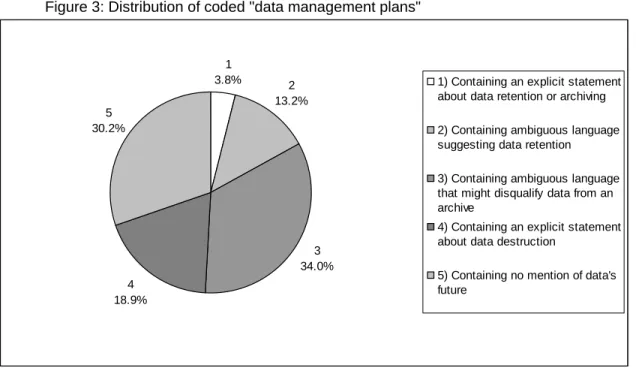
coded on the following five-point scale2:
Category 1: Containing an explicit statement about data retention or archiving.
Category 2: Containing ambiguous language suggesting data retention.
Category 3: Containing ambiguous language that might disqualify data from being archived. This includes suggestions that no data will be shared outside the research team, suggestion that data or some part of the data will be destroyed, or mention of retention/archiving that is for the sole use of the researchers.
Category 4: Containing an explicit statement about data destruction.
The distribution appears below:
Figure 3: Distribution of coded "data management plans"
5 30.2% 4 18.9% 3 34.0% 2 13.2% 1
3.8% 1) Containing an explicit statement
about data retention or archiving
2) Containing ambiguous language suggesting data retention
3) Containing ambiguous language that might disqualify data from an archive
4) Containing an explicit statement about data destruction
5) Containing no mention of data's future
Some common ways researchers pledged to protect their subjects' confidentiality
and anonymity included:
Never collecting identifiers
Using pseudonyms instead of names for subjects
Using a carefully protected (and later destroyed) "linking document" that links
subjects' identifying information to their pseudonym or code
Destroying audio and/or video tapes after they had been transcribed
Not sharing data outside the research team3
Destroying data after the study was complete or after a specified period of time
Maintaining data on a single computer only
Several researchers also mentioned professional associations' requirements, with
A few respondents declined to provide a data management plan because they only use
secondary data in their research that has already been de-identified and made available,
making the question irrelevant.
All respondents said that they followed their IRB data management plans exactly,
almost exactly, or mostly with a few changes. No respondents chose the answer
indicating that their data management practice had differed significantly from their
outlined plan.
Figure 4: Answers to Question 5: "Did you follow, or are you following, your data management plan as outlined in your IRB application?"
Yes; exactly or almost exactly as
outlined 73.0% Mostly as outlined,
with a few changes or exceptions
25.4%
Prefer not to answer 1.6%
Next, respondents were asked whether they would feel comfortable making their
data available in a digital repository based on what they said in their IRB application.
Approximately half (48.4%) said that they would not feel comfortable archiving their
Figure 5: Answers to Question 6: "Based on your last application's wording, as it was approved by the IRB, would you feel comfortable archiving the de-identified data resulting from your study in a digital repository?"
No 48.4% Don't Know
15.6% Yes
35.9%
Of those who said they were not comfortable (answered "No"), some common
reasons cited were that their data is not de-identifiable or that the population is too
sensitive, and that they were concerned about continued anonymity of their data. Others
answered "No" because they had not included this plan in their original IRB application
and/or had specifically stated that only the research team could access the data or had
promised to destroy the data. A few said that their data was too context-specific and
would not make sense or be of use to others. Several respondents were concerned that
they had not informed their subjects about archiving and therefore did not feel they had
received sufficient consent. One explained:
"My participants agreed to work with me, not with someone else. While they understand that the study will be a public document, I don't think my participants understand that their interviews and surveys could be used as data sets for other researchers. Doing that without having fully explained that to them already makes me very uncomfortable and is, I believe, unethical."
Those who said they would feel comfortable archiving their data (answered
included nothing personally identifiable and that deductive disclosure of identity or
personal information was impossible or very low risk. A few reiterated their belief in
open access to data, with one respondent stating "I do not agree to withhold information,
only to make it non-identifiable." Some mentioned federal grant mandates. Another
interesting response concerned ethnography research, with the respondent relating that
his or her participants generally want their data to be identifiable and easily available to
others. One respondent said he or she would feel comfortable archiving study data, but
was "not sure anyone would want it."
The respondents that answered "Don't know" were generally uncertain about
issues of ethics and control. Some felt their populations might be too vulnerable or that
they might have needed to include data archiving in their consent documents but were not
sure. One was not certain that he or she wanted others to be able to access their data
without their control. Another said that his or her data would need to be de-identified,
which would probably be too time consuming. One simply stated that he or she "[doesn't]
know enough about this process."
All respondents, regardless of whether they had previously submitted an
application to an IRB, were asked if they had ever archived datasets before. A majority
Figure 6: Answers to Question 7: "Have you ever archived data from a study in a digital repository?"
Have never archived data
84.9%
Have archived previously data
15.1%
Of the 9 respondents who had previously archived study data:
4 (44%) explicitly stated in their IRB application that they intended to archive
their data.
3 (33%) did not state in their IRB application whether they planned to save or
destroy their data.
1 (11%) explicitly stated in the IRB application that the data would be destroyed.
1 respondent did not remember
Of the 62 who said they had never previously archived data, 77.8% said they
would consider doing so. Thirteen percent said they would not consider archiving data
Figure 7: Answers to Question 8: "Would you consider doing so [archiving your study data in a digital repository]?"
Yes 77.8%
No 13.0% Don't Know
9.3%
Of those who answered "No," the most oft-cited reason was that they did not feel
their data could "stand alone"; that it was context-specific and they would not want others
manipulating their data without this background. It was also noted several times that the
respondent would not consider archiving data when their subjects had not been informed
about it; as one put it, "I would only consider [archiving my data] if I let participants
know this might occur. I would not do it post-hoc." Another respondent who answered
"No" noted that it might be "too much trouble." Interestingly, a respondent who answered
"Yes" also stipulated that his or her answer would change to "No" if it required
re-submitting to the IRB or took too much time.
Of those respondents who were unsure about archiving their study data (answered
goals of the repository were. One stated that he or she could not think of a reason why
one would archive data, but might be open to it if presented with a compelling reason.
Most of the respondents who were asked if they would consider archiving their
study data chose "Yes," indicating that they would consider archiving their study data.
Many reasons were given, including some that have already been discussed in this study:
It would be an effective way to share data with others.
It would be useful for meta-analyses and comparative studies, considering that we
have not always made full use of data collected.
It seems more secure than storing paper copies.
It increases academic transparency.
The data might be helpful for others' research.
It would allow for wider analysis and more minds trying to answer questions.
It is resource-intensive to collect data and the knowledge gained could not easily
be re-created.
It supports the goals of advancing science.
One respondent felt he or she would be compelled to contribute because others
have: "I've been helped by data from publicly available archives; if I collected original
data I would feel obligated to add to this resource." Another also spoke to the
advancement of science, musing that researchers have little excuse not to archive their
data: "Why should the data not help science tomorrow, as much as science today? I'm
surprised it's taken this long, actually. Mostly, the technology wasn't around to make it
A number of those who answered "Yes" did mention that they would only archive
data if ethical concerns had been accounted for and if they had received IRB approval to
do so. One emphasized the need for proper IRB language, admitting "I wouldn't know
where to start if I was writing a repository into my IRB." Others talked about copyright
and licensing issues and wanted to be sure of the security of the archive.
All respondents were asked whether they thought the IRB would approve an
application that included data archiving/sharing plans.
Figure 8: Answers to Question 12: "Do you think the IRB would approve a study that included a plan to archive de-identified data for future use by you or other researchers?"
Yes 61.6%
No 6.8% Don't Know
31.5%
Only a few respondents answered "No," but those who did seemed to base their
reasoning on past experiences with IRB applications. One respondent recounted:
Others cited protecting subjects as a possible reason that an IRB would not want data to
be disseminated.
Respondents who answered "Don't Know" indicating that they were not sure about
how the IRB would handle this situation, also expressed confusion and even disdain for
the IRB process. Some thought it might depend on the wording in the application or the
vulnerability of the population being studied. A very prevalent response from those who
chose this answer was that the IRB and its processes are mysterious, causing them not
even to hazard a guess. One respondent said, "I don't understand the reasoning behind the
IRB--sometimes their review ignores big issues and picks on small ones. Thus, I can't
really predict whether or not they would approve such a study." Also echoing the
sentiments of others, another respondent recounted that "sometimes it is such a chore to
get the IRB to accept a study that the tendency is to make it as easy as possible to get
approval by promising to delete everything, even if one would prefer not." Still another
hoped that the IRB would approve, but was reluctant to say because "in my experience
the IRB has been very cautious (in some cases to the detriment of social science
research)."
Nearly two thirds of respondents, however, thought that the IRB would approve an
application that included intentions to archive data. The overwhelming feeling among
these respondents was that as long as subjects' privacy and anonymity were properly
protected, the IRB would have no problem with data archiving. Speculated concerns
included de-identification and subjects' informed consent, as well as the security of the
archive and specification measures the researcher would take to ensure these things.
existence of such data archives must mean that someone is approving of the practice.
Some spoke from personal experience, relating that their IRBs had been accommodating
of these requests in the past provided that the subjects were adequately protected. A few
respondents also pointed out that in some cases, the IRB must approve--particularly
because the National Institutes of Health (NIH) and other major granting agencies
(especially publicly funded ones) are beginning to require that resulting data be made
available for other researchers.
It is also worth noting that many responses included statements about the IRB's
reason for existence and main goals--to protect subjects and uphold ethical standards--as a
reason why archiving de-identified data would be approved. One respondent articulated
this sentiment about the IRB's intentions: "I think as long as we are upfront with our
participants of all possibilities of use (use of the responses), they'd be pretty much ok with
anything." Along the same lines, several respondents acknowledged that IRB members
are also interested in the advancement of knowledge and research: "They're scientists
too...I'd be surprised if they didn't think it was valuable to [archive data]."
4.2 Part B: Interviews
Five members of a social/behavioral science institutional review board at a large
research university were interviewed over the telephone; this sample represented
approximately one third of all members of this board. The board consists of faculty
members as well as community members, many of whom are advocates for certain
results presented here are gathered from the interviewer's notes and the audio recordings
that were used to verify direct quotations.
When asked about their general thoughts and feelings regarding data archiving in
the social/behavioral sciences, all of the members interviewed responded positively,
though several had reservations. One member was resolute that it was "not a problem," a
sentiment also echoed by the other members interviewed. Another member came out in
full support of data archiving, citing verification of results as a reason, but also pointing
out that "a lot of time and effort goes into gathering the info and that it's great to use
technology to get additional value out of it." Two members stated that they had no issues
with researchers wanting to include data in archives, but were careful to say that
everything must be properly de-identified first. One put this in context of the duties of an
IRB member--to protect subjects' anonymity and confidentiality as much as possible and
protect them from harm or embarrassment--assuring that "as long as we are able to take
care of those areas, I'm fine with it." Another member had "never really thought about it,"
but supposed he or she was in favor of it, if it was going to advance the sciences. This
member also confessed that, in all honesty, he/she did not really care one way or the other
about the issue.
Most IRB members interviewed mentioned "anonymity," "confidentiality," and
"de-identification" at some point in the discussion as the important ethical issues
regarding data archiving in the social sciences. Another ethical gray area one member
discussed was a current practice where some data are kept ("archived") for a certain
amount of time--often almost a decade--because of professional associations (such as the
question, then, is whether it would be ethical to extend that period of time indefinitely, or
how one might go about getting consent for that.
None of the members could recall seeing applications in the past that addressed
archiving study data in a repository of some sort, although one recounted a few instances
where biological samples were to be retained. Although one member had not seen any
IRB applications that discussed data archiving, he or she had seen instances in federal
grant applications, where data sharing is sometimes mandated if the budget is over a
certain amount.4
Four of the five members interviewed said that they would prefer to see data
archiving plans explicitly indicated on IRB applications, as opposed to making do with
ambiguous language. One member was very adamant that ambiguous language is often
used for purposes of deception and that "there should never be something done through
deception for the benefit of the project itself." This member was against ambiguous
language in the entire application so that communication between subject and researcher
can be as clear as possible. One member thought that ambiguous language has been the
default but because archiving is becoming more prevalent and easier, "from a legal
standpoint and an informed consent standpoint it would be preferable to be clear about it
upfront." Another member was not comfortable with just anyone being able to archive
data after the fact, so felt that the researcher should have the foresight to think of future
potential uses and make a case for them in their initial applications. On the other hand,
one member had no problem with it being generally known and accepted that
As for where on the application the IRB members would like to see data archiving
addressed, three discussed including a straightforward statement on the consent document
for the subject. One member suggested that there be standard "boilerplate" language
created for the consent document saying that a de-identified version of the data collected
will be available for future analyses, and that this could be added into the existing section
that discusses protection of confidentiality and uses of the data. Another IRB member
imagined an informed consent form that allowed the subjects to choose whether their data
was included in archiving or not. That way they would have the option to consent to the
current study and then decide separately whether they also consent for their data to be
used in future studies--they would have the choice whether to opt in or opt out.
Several also discussed researchers' justifying data archiving within the IRB
application itself. One member found it important for the researcher to justify the reason
for archiving data in his or her IRB application, including what increased benefits
archiving would bring forth. The same member pointed out that archiving for unforeseen
future uses was not a good justification, because this could be argued for anything.
Another IRB member suggested creating a new section on the IRB application that
specifically dealt with data archiving, asking the researcher to declare this intention and
then state how the data will be stored, that it will be completely de-identified, and how
they are going to safeguard the anonymity of their subjects.
When asked how a data archiving plan might affect the approval process, all of the
IRB members interviewed essentially agreed with one member's statement that it would
be "just one more thing to consider." Several members reiterated that the subjects must be
mentioned that something truly not de-identifiable would give pause, but barring this
exception, "if anything, [seeing a well-crafted data archiving plan in an application]
would give me a warm fuzzy feeling--make me feel better about it--right on, doing the
right thing!"
Finally, each of the five IRB members interviewed was asked "To what extent are
you comfortable with social science data being archived for future use?" Their replies are
as follows, in random order:
I am very cautious.
I'm comfortable with it.
I guess I'm totally comfortable.
I like the idea a lot. Enthusiastic proponent.
I think I'm very comfortable with it. Like I said, as long as the subject's identity is
protected is for me I think the biggest issue.
When asked if there was anything else they would like to say on the issue of data
archiving in social and behavioral science, the only comments were from two members
who both noted that this topic is an important and timely one that they were glad to begin
considering. One member concluded by stating, "I believe that [we are going to receive]
more and more of those kinds of requests and we need to be prepared to handle them."
4.3 Part C: Content Analysis
Ninety-four blank Informed Consent forms from studies submitted to the
collected. These were coded using the same scale as the survey respondents' data
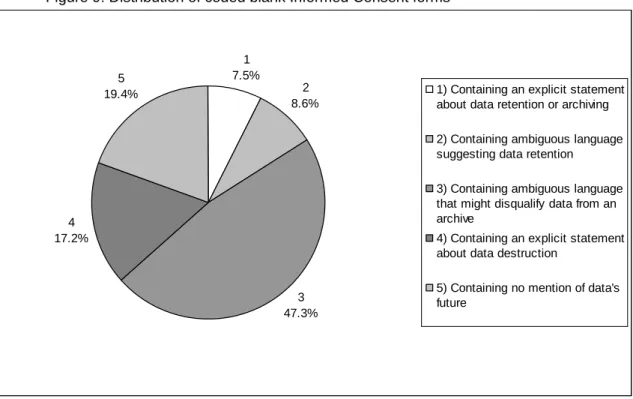
management plans (found in Figure 3). The findings are presented in Figure 9, below,
along with examples of language found in each category following.
Figure 9: Distribution of coded blank Informed Consent forms
5 19.4% 4 17.2% 3 47.3% 2 8.6% 1 7.5%
1) Containing an explicit statement about data retention or archiving
2) Containing ambiguous language suggesting data retention
3) Containing ambiguous language that might disqualify data from an archive
4) Containing an explicit statement about data destruction
5) Containing no mention of data's future
Category 1: Containing an explicit statement about data retention or archiving. Examples:
"Survey data will be compiled into a database and the data may be used in future publications or presentations."
"The information will be maintained for at least 20 years for possible use in additional studies."
Data can be destroyed after transcription per subject wishes, otherwise maintained safely "in case it proves to be useful in future anthropological investigations."
Category 2: Containing ambiguous language suggesting data retention. Examples:
"The interviews will be kept for an unspecified amount of time"
All survey data kept on personal computer and will not be destroyed.
Category 3: Containing ambiguous language that might disqualify data from an archive. This includes suggestions that data will not be shared outside the research team, suggestion that data or some part of the data will be destroyed, or mention of retention/archiving that is for the sole use of the researchers.
Examples:
"All video and audio data will be deleted and/or destroyed before the student participants' 18th birthday." [sic]
"All records stored and permanently archived in our locked lab at UNC"; only research team will have access.
"The transcriptions will be kept by the PI for future use and all audio tapes will be destroyed."
The audiotapes will be destroyed within 6 months of the study's completion.
Category 4: Containing an explicit statement about data destruction. Examples:
"After data are analyzed, we will destroy all information collected."
"The raw data will be kept for 7 years, keeping with requirements of academic journals, after which it may be destroyed."
Category 5: Containing no mention of data's future.
It is important to note that although the same set of codes was used to analyze the
blank Informed Consent forms and researchers' responses to the survey question about
their data disposition plans, these two sets of data cannot be meaningfully compared
statistically, due to their differences. Informed Consent forms are only included in studies
respondents could be referring to any number of study methods that involve human
5. Discussion
The findings of this three part study suggest a number of things about social and
behavioral researchers and the IRBs that serve them
Language used on IRB applications (as well as language that is not used), and the
underlying ethics of the issue are indeed a barrier to data archiving in social
science.
Neither researchers nor IRB members give significant thought to data archiving in
early stages of social/behavioral science research.
Social/behavioral researchers and IRB members are both interested in protecting
subjects and upholding professional ethics.
There is evidence that social/behavioral IRBs have and will approve applications
that include data archiving plans.
Data archiving in social and behavioral sciences is becoming a bigger issue that
IRBs and researchers will need to consider seriously.
Two parts of this study examined the language researchers use on their IRB
applications and in the consent documents provided for their subjects. Both their stated
data plans (Figure 3) and blank Informed Consent forms (Figure 9) showed similar
patterns: a very small percentage included explicit language describing archiving of data
Although there were many instances where researchers explicitly stated that they
would destroy all of their data after analysis or after the study was complete, interestingly
it was much more common to see other ambiguous language surrounding the data
management plan. The "Category 3" code was described as "Containing ambiguous
language that might disqualify data from an archive" in order to capture these various
instances. There were a few different ways researchers' language could be included in this
category. The specific IRB application questions they were to consider asks with whom
identifiable data will be shared and how identifiable data will be disposed of once the
study has ended5. Researchers' statements made in response to these questions often
dropped the word "identifiable"--so that they were claiming not to share any data outside
the research team, or that all data will be destroyed after the study has ended. Intentional
or not, these statements made the researchers' intentions for their data unclear and their
data unusable by others. When this same issue was observed on blank Informed Consent
forms, even if the researcher meant identifiable data, this language could have been
misleading to the subjects. Another instance included in Category 3 was when the
researcher stated that part of their data would be destroyed, whether it was audio and
video tapes, documents linking identifiers to codes, or survey forms that had been
recorded digitally. Although this is common practice, talk of destruction alone could be
confusing or misleading, especially to subjects. Some very clearly stated that the data
would be retained or archived, but that it would be solely for the researchers' own future
use. Others mentioned that only the researchers or PI would be able to view the data.
None of these promises outright destruction of data, but still makes archiving ethically
The comments from IRB members, however, indicate that these distinctions are
somewhat futile, because the members interviewed would prefer to see explicit mention
of data archiving plans. To most IRB members interviewed, even suggesting that datasets
might not be destroyed (as in Category 2) is not adequate or considered the most ethical
path.
It is not surprising that the language used in IRB applications about data archiving
was less than clear. Perhaps the IRB member interviewed summed it up best when he/she
said archiving of social science data was something he/she had "never thought about
before." Although many members of both populations studied had opinions on the issue,
the data gathered suggests that researchers are not thinking about the future of their study
data at the time of the IRB application. In addition to the large amount of ambiguous
language and possibly unintentional declarations already discussed, approximately 30%
(Figure 3) of researchers' stated data management plans and almost 20% of blank
Informed Consent forms (Figure 9) contained no mention of the study data's future at all.
More than three fourths (77.8%) of those who had not previously archived data said they
would consider doing so. However, nearly half (48.4%) of researchers who responded to
the survey said that they were not comfortable archiving their data based on how they had
presented the study to the IRB (Figure 5) suggesting that those who would consider it
were probably not considering it at the time they wrote their IRB application. In light of
the IRB members' interview responses obtained in this study, this lack of foresight for
data archiving is problematic. Since IRB members interviewed almost exclusively




![Figure 7: Answers to Question 8: "Would you consider doing so [archiving your study data in a digital repository]?"](https://thumb-us.123doks.com/thumbv2/123dok_us/8340494.2215104/33.918.187.791.143.547/figure-answers-question-would-consider-archiving-digital-repository.webp)