Cognitive and Behavioral Resilience Among Young
Gay and Bisexual Men Living with HIV
Sophia A. Hussen, MD, MPH,1,2Gary W. Harper, PhD, MPH,3Caryn R.R. Rodgers, PhD,4 Jacob J. van den Berg, PhD,5Nadia Dowshen, MD,6and Lisa B. Hightow-Weidman, MD, MPH7;
on behalf of the Adolescent Medicine Trials Network for HIV/AIDS Interventions (ATN)
Abstract
Purpose:
HIV/AIDS disproportionately affects young gay, bisexual, and other men who have sex with men
(Y-GBMSM). Resilience remains understudied among Y-GBMSM living with HIV, but represents a potentially
important framework for improving HIV-related outcomes in this population. We sought to explore cognitive
and behavioral dimensions of resilience and their correlates among Y-GBMSM to gain insights to inform future
interventions.
Methods:
Our study sample consisted of 200 Y-GBMSM living with HIV enrolled in a multisite study of the
Adolescent Medicine Trials Network for HIV/AIDS Interventions (ATN). Participants completed a one-time,
self-administered structured questionnaire, including validated scales capturing a range of cognitive, behavioral,
demographic, and psychosocial data. Utilizing these data, we examined cognitive and behavioral dimensions of
resilience and their potential psychosocial correlates using linear regression modeling.
Results:
Multiple regression analyses demonstrated that education, stigma, social support, ethnic identity,
inter-nalized homonegativity, and behavioral resilience were statistically significant predictors of cognitive resilience
(
P
<
0.001, R
2=
0.678). Social support satisfaction and cognitive resilience were significant predictors of
behav-ioral resilience (
P
<
0.001, R
2=
0.141).
Conclusions:
Our findings point to potential strategies for incorporating resilience-promoting features into future
interventions to support Y-GBMSM living with HIV. Specifically, strengths-based interventions in this
popula-tion should seek to enhance social support, promote positive identity development, and encourage educapopula-tion.
Future research can also seek to utilize and refine our measures of resilience among youth.
Keywords:
adolescents, HIV/AIDS, resilience, sexual minority health
Introduction
A
lthough HIV incidenceis stable in the United Statesoverall, rates continue to increase among youth aged
13–24, who make up 26% of new diagnoses.1This increase
is primarily driven by new diagnoses among young gay, bi-sexual, and other men who have sex with men (Y-GBMSM); 72% of all new infections among GBMSM occur among
per-sons aged 13–24.2Given the large numbers of Y-GBMSM
diagnosed with HIV each year in the United States, there is
a critical need to improve our understanding of influences on health-related behaviors in this population.
Of the studies that focus exclusively on the health behav-iors of Y-GBMSM, most utilize a risk or deficit paradigm, concentrating on risky behaviors that influence HIV acqui-sition or transmission (e.g., illicit drug use, inconsistent condom
use).3–6Although such studies provide important information,
some have alternatively called for strengths-based approaches to research involving Y-GBMSM and sexual minority
popu-lations more generally.7–9Such strengths-based research falls
1
Hubert Department of Global Health, Rollins School of Public Health, Emory University, Atlanta, Georgia.
2
Division of Infectious Diseases, Department of Medicine, Emory University School of Medicine, Atlanta, Georgia.
3
Department of Health Behavior and Health Education, University of Michigan School of Public Health, Ann Arbor, Michigan.
4
Department of Pediatrics, Albert Einstein College of Medicine, Bronx, New York.
5
Department of Behavioral and Social Sciences, School of Public Health, Brown University, Providence, Rhode Island.
6Department of Pediatrics, Craig-Dalsimer Division of Adolescent Medicine, Children’s Hospital of Philadelphia, Philadelphia, Pennsylvania. 7
Division of Infectious Diseases, Department of Medicine, University of North Carolina at Chapel Hill, Chapel Hill, North Carolina.
ªMary Ann Liebert, Inc. DOI: 10.1089/lgbt.2016.0135
into a long tradition of utilizingresilienceas a critically im-portant lens through which to view adolescent and young
adult health and development.10
Resilience is defined most succinctly as positive
adapta-tion in the context of adversity.9,11,12Our theoretical
fram-ing of resilience builds primarily on the work of Fergus and Zimmerman, but is also consistent with other foundational
work in the field.11,13,14Resilience refers not simply to the
achievement of positive outcomes in the setting of risk but also to the actual adaptive processes that enable these out-comes. The influences on resilient adaptation have been char-acterized as ‘‘promotive factors,’’ which include intrinsic assetswithin the individual (e.g., self-esteem) and extrinsic resources,which are external to an individual (e.g., social
sup-port).13Resilience and the promotive factors that enable it are
generally described with respect to specific populations and risk behaviors, and the positive effects of such factors in one setting are not necessarily generalizable to others.
Resilience is a particularly important framework to examine among Y-GBMSM living with HIV, who are likely to face high levels of adversity related to multiple stigmatized identi-ties. Despite these significant challenges, we have observed Y-GBMSM living with HIV to display adaptive coping skills
and achieve favorable health outcomes in our prior work.8,9,15
Improving our understanding of resilience in these youth has the potential to inform effective interventions that enhance positive adaptation as opposed to simply mitigate risk.
Based on prior research, certain constructs can be hypothe-sized to function as either promotive or risk-enhancing factors
among Y-GBMSM living with HIV.16 Specifically, positive
identity development and social support emerge as likely pro-motive factors. Identity development is central in the lives of all adolescents, and these youth are living with multiple salient identities—sexual minority identity, HIV-positive identity, and often ethnic minority identity. Positive views of one’s own ethnic identity have been previously linked with resil-ience in studies of minority youth, with respect to avoidance
of violent behavior.17In another study of Y-GBMSM, those
who identified as heterosexual or bisexual, exhibited lower
rates of resilience than those who identified as gay.18 A
prior analysis from our parent study also highlighted associa-tions between ethnic identity and engagement in HIV care
among Y-GBMSM living with HIV.15 Social supportis
an-other resilience resource that is highlighted in many youth
populations, across a range of behaviors.13 For example,
peer and family support has been shown to mitigate the
nega-tive effects of violence.19In one particularly relevant study,
Kubicek et al. described resilience among Black Y-GBMSM participating in the predominantly Black and gay House/Ball
subculture. They found that participation in the House/Ball community positively built on youth’s intersecting minority
identities while also enhancing social support.12
In many resilience-focused studies, the existence of resil-ience is inferred by documenting favorable outcomes among a population known to be at risk. However, scholars in the field have also developed and tested measures of resilience
to assess resilience processes more directly.20–22 While no
gold standard currently exists, most of these scales examine promotive factors (both intrinsic assets and extrinsic re-sources) that constitute resilience processes, which enhance an individual’s ability to withstand adversity.
To measure resilience in our current analysis, we drew specifically on descriptions of resilience in our own sample of Y-GBMSM living with HIV. A previous qualitative anal-ysis from our parent study (described in the next section) identified and described four dimensions of resilience within this group: (1) engaging health promoting cognitive process-es; (2) enacting healthy behavioral practicprocess-es; (3) enlisting so-cial support; and (4) empowering other gay/bisexual youth
(Fig. 1).8 The relationship between these dimensions was
often temporal, with cognitive resilience leading to positive behavioral change. Building on these findings, the goal of the present analysis was to quantitatively examine these cog-nitive and behavioral dimensions of resilience and their cor-relates among Y-GBMSM living with HIV.
Methods
Study design and procedures
This analysis is derived from a multisite, cross-sectional study conducted by the Adolescent Medicine Trials Network for HIV/AIDS Interventions (ATN). The parent study, ATN
070 (‘‘Psychosocial Needs of HIV+Young Men who Have
Sex with Men’’), was a mixed-methods examination of the psychosocial and developmental needs of Y-GBMSM living with HIV. Data collection was conducted at 14 geographi-cally diverse ATN clinical sites between March and June of 2009. Young men aged 16–24 who were living with HIV and enrolled in HIV care at ATN-affiliated clinics were eligible to participate. Inclusion criteria were as follows: (1) male sex assigned at birth and identification as male at en-rollment; (2) living with HIV; (3) HIV acquired horizontally through sexual or substance use behavior; (4) age 16–24; (5) ability to understand English; and (6) at least one sexual en-counter with a male during the previous year (by self-report). On verification of eligibility, coordinators obtained signed consent and enrolled participants in the study. Waivers of pa-rental consent were granted by the institutional review boards
(IRBs), to avoid selection bias that could result from recruiting only those youth whose parents were aware/sup-portive of their sexual identity. Each participant completed an audio computer-assisted self-interview (ACASI) con-taining the measures described below. In addition, a subset of participants underwent qualitative interviews that led to the description of the dimensions of resilience depicted in
Figure 1.8The ATN 070 protocol was approved by the IRB
at each site. IRB approval was not required for the analysis presented here, which was a secondary analysis of deiden-tified data. Compensation for participation was determined by each site.
Outcome measures
We derived two quantitative outcome measures from the ACASI questionnaire that aligned conceptually with the
di-mensions of resilience depicted in Figure 1.8For the
pur-poses of this analysis, we divided Harper’s processes into cognitive resilience(which included ‘‘Engaging Health
Pro-moting Cognitive Processes’’ in the original article) and
be-havioral resilience (a combination of ‘‘Enacting Healthy Behavioral Practices,’’ ‘‘Enlisting Social Support,’’ and ‘‘Empowering other gay/bisexual youth’’; Table 1).
In the qualitative study by Harper et al., three cognitive processes were described: (1) re-evaluating life goals, (2) gaining a sense of control, and (3) taking responsibility for
health outcomes.8To approximate these specific subthemes,
we assessed cognitive resilience using a composite measure consisting of the Future Orientation subscale of the Stanford
Time Perspective Inventory,23the Life Outcome Expectancies
Scale, and the Illness Cognition Questionnaire (ICQ).24 The
Future Orientation subscale23was used to assess the degree
to which participants were striving for future goals and
re-wards, to approximate the qualitatively described resilience process ‘‘re-evaluating life goals.’’ The Life Outcome Expect-ancies measure was designed specifically for ATN 070 and consists of questions measuring participants’ perceived con-trol over their life circumstances and perceived likelihood of reaching life milestones. We used this scale to measure
‘‘gain-ing a sense of control.’’ The ICQ24contains 18 items rated on
a 4-point scale regarding their attitudes toward living with a chronic disease. We used this scale to approximate the cog-nitive resilience process ‘‘taking responsibility for health out-comes.’’ When all of these dimensions of cognitive resilience were combined into a single outcome measure, it displayed
excellent reliability (a=0.86).
We assessed behavioral resilience using a series of questions that asked: ‘‘What types of changes have you made in your
life-style since learning you were HIV+?’’ Participants could
an-swer ‘‘Yes,’’ ‘‘No,’’ or ‘‘I don’t know’’ to a list of 17 items. This list of questions aligned with the three dimensions of
be-havioral resilience described in the qualitative study,8including
11 items that corresponded to ‘‘Enacting healthy behavioral
practices’’ (e.g.,‘‘Quit smoking,’’ ‘‘Increased exercise’’), 5
items that corresponded to ‘‘Enlisting social support’’ (e.g., ‘‘Joined support group’’), and 1 item that was potentially re-lated to ‘‘Empowering other gay/bisexual youth’’ (‘‘Edu-cated others about HIV’’). The sum of ‘‘Yes’’ answers to the 17 questions formed the behavioral resilience outcome
utilized in the subsequent analyses (a=0.82).
Demographics and covariates
Demographic variables included in this analysis were race, age, housing status, education, employment, and time since HIV diagnosis. We focused our selection of additional cova-riates on hypothesized promotive factors relating to identity
Table1. Selection of Measures to Approximate Cognitive and Behavioral Resilience
Description of resilience processes from Harper et al. qualitative analysis of Y-GBMSM living with HIV8
Scale or questions used to quantify the resilience dimensions in current analysis
Cognitive dimensions of resilience
Re-evaluating life goals Time Perspective Inventory: Future Orientation Subscale23
Assesses the degree to which respondents are striving for future goals and rewards
Gaining a sense of control Life Outcome Expectancies Scale
Measures respondents’ perceived control over life circumstances and perceived likelihood of reaching life milestones
Taking responsibility for health outcomes
Illness Cognition Questionnaire24
Measures helplessness, acceptance, and perceived benefits of living with a chronic illness
Behavioral dimensions of resilience
Enacting healthy behavioral practices Have you.
Increased exercise? Changed your diet? Quit/reduced smoking? Etc.
Enlisting social support Have you.
Joined a support group?
Begun to attend church/synagogue/temple? Etc.
Empowering other gay/bisexual youth Have you.
Educated others about HIV?
and social support, as these have been demonstrated to be theoretically and/or empirically related to resilience in other
studies. These included scales measuring ethnic identity,25
inter-nalized homonegativity,26HIV stigma,27and social support.28
Ethnic identity was assessed using Phinney’s multigroup ethnic identity measure, which has been validated in
numer-ous studies with diverse youth (a=0.87 in our sample).25,29
Internalized homonegativity was assessed using Mayfield’s 23-item Internalized Homonegativity Inventory (IHNI),
which had excellent reliability as well (a=0.92).26
Partici-pants’ attitudes toward their identity as young men living
with HIV were assessed using the 13-item Negative
Self-Imagesubscale of the HIV Stigma Scale (a=0.90).27 Partic-ipants’ satisfaction with the quality and availability of their
social support was assessed using the Emotional Support
subscale of the Social Support for Adolescents Scale (a=0.70).28
Data analysis
Descriptive analyses were performed for all variables. We examined distributions and associations between hypothe-sized promotive factors, demographics, and resilience
out-come variables. Univariate analyses included frequencies and measures of central tendency and variability (Table 2).
We conductedt-tests, one-way ANOVA, or simple linear
re-gressions to assess bivariate relationships between predictors and resilience outcome variables (Tables 3 and 4). We cre-ated a correlation matrix to assess for multicollinearity be-tween predictor variables (data not shown). Associations
that were significant atP<0.10 were retained in the
multi-variate models, as were the background demographic vari-ables. Multivariate models were constructed using forward stepwise linear regression; demographic variables were in-cluded regardless of significance, however, the covariates were only retained in the model if they remained significant and improved the model. Separate multivariate regression models were developed for cognitive and behavioral resil-ience. All data analysis was conducted using SPSS statistical software (IBM Corp., Armonk, NY).
Results Demographics
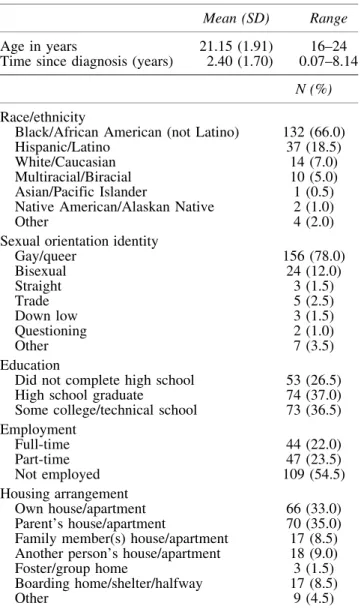
Two hundred Y-GBMSM participated in this study. Demo-graphic characteristics are presented in Table 2. The majority of our participants identified as Black/African American, most identified as gay, most had completed high school, and approximately half were employed. The majority reported sta-ble housing, either independently or with family members. The mean age of our sample was 21 years, and Y-GBMSM were di-agnosed with HIV an average of 2.4 years before participation.
Bivariate analyses
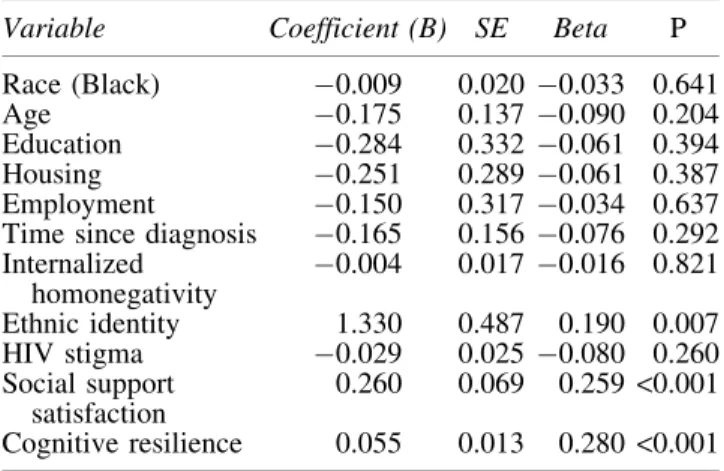
In bivariate analyses, education, housing, employment, inter-nalized homonegativity, ethnic identity, HIV stigma, social sup-port satisfaction, and behavioral resilience were all significantly associated with cognitive resilience (Table 3). Ethnic identity, social support satisfaction, and cognitive resilience were signif-icantly associated with behavioral resilience (Table 4).
Regression analyses
Stepwise multiple linear regressions were used to exam-ine the relationship between the demographic/psychosocial
Table2. Characteristics of the Sample (n=200)
Mean (SD) Range
Age in years 21.15 (1.91) 16–24
Time since diagnosis (years) 2.40 (1.70) 0.07–8.14
N (%)
Race/ethnicity
Black/African American (not Latino) 132 (66.0)
Hispanic/Latino 37 (18.5)
White/Caucasian 14 (7.0)
Multiracial/Biracial 10 (5.0)
Asian/Pacific Islander 1 (0.5)
Native American/Alaskan Native 2 (1.0)
Other 4 (2.0)
Sexual orientation identity
Gay/queer 156 (78.0)
Bisexual 24 (12.0)
Straight 3 (1.5)
Trade 5 (2.5)
Down low 3 (1.5)
Questioning 2 (1.0)
Other 7 (3.5)
Education
Did not complete high school 53 (26.5)
High school graduate 74 (37.0)
Some college/technical school 73 (36.5)
Employment
Full-time 44 (22.0)
Part-time 47 (23.5)
Not employed 109 (54.5)
Housing arrangement
Own house/apartment 66 (33.0)
Parent’s house/apartment 70 (35.0)
Family member(s) house/apartment 17 (8.5)
Another person’s house/apartment 18 (9.0)
Foster/group home 3 (1.5)
Boarding home/shelter/halfway 17 (8.5)
Other 9 (4.5)
Table3. Bivariate Linear Regression Analysis of Variables Potentially Associated with Cognitive Resilience Among Y-GBMSM
Variable
Coefficient
(B) SE Beta P
Race (Black) 0.015 0.102 0.010 0.886
Age 0.816 0.704 0.082 0.248
Education 5.487 1.666 0.228 0.001
Housing 3.416 1.486 0.163 0.021
Employment 4.318 1.600 0.188 0.008
Time since diagnosis 0.105 0.759 0.010 0.890
Internalized homonegativity
0.405 0.084 0.325 <0.001
Ethnic identity 9.653 2.456 0.269 <0.001
HIV stigma 0.833 0.117 0.451 <0.001
Social support satisfaction
2.309 0.328 0.447 <0.001
predictor variables and the two types of resilience. Variables that were significantly associated with each outcome in the bivariate analyses were entered into the model using a for-ward stepwise elimination procedure to examine their rela-tionship to the dependent variables. Multivariate regression analyses are presented in Tables 5 and 6.
Level of education, HIV-related stigma, social support satis-faction, behavioral resilience, ethnic identity, and internalized homonegativity were all significant predictors of cognitive resilience. The final model accounted for a substantial
percent-age of the overall variance (R2=0.678,P<0.001). For
behav-ioral resilience, the two predictors that remained in the final model were social support satisfaction and cognitive resilience. This model accounted for a smaller proportion of the variance
in this outcome, but remained highly significant (R2=0.141,
P<0.001).
Discussion
Y-GBMSM living with HIV face multiple social stressors and intersecting stigmas; despite this, resilience with resultant positive health outcomes is often observed. In the current study, our aim was to examine factors associated with such resilience to inform future interventions in this key population. We found that several psychosocial and demographic fac-tors were significantly associated with cognitive resilience:
level of education, HIV stigma, social support satisfaction, behavioral resilience, ethnic identity, and internalized
homo-negativity. In terms of Fergus and Zimmerman’s framework,13
these primarily represent assets, resilience factors that lie
within the individual. The associations with HIV stigma, ethnic identity, and internalized homonegativity highlight the impor-tance of positive identity beliefs among these young men. The association between a positive view of one’s ethnic identity and resilience has been similarly demonstrated in other studies
of Black and Latino youth.30–33In these studies, positive
eth-nic identity acted as a buffer between adverse circumstances and health outcomes. Prior research has also demonstrated that positive views of gay identity can be protective among gay youth and are often associated with favorable health
out-comes despite concomitant stresses.34,35In addition to these
assets, social support satisfaction emerged as a significant predictor in our model and is a well-described resilience
re-source in adolescence and young adulthood.16This has also
been shown in studies focused on sexual and ethnic minority
youth and their communities.36–38
When we examined associations with behavioral resil-ience, only two factors emerged as significant predictors: cognitive resilience and satisfaction with social support. The relationship between cognitive and behavioral resilience is consistent with the framework outlined in the preceding
qualitative study (Fig. 1),8in which the behavioral resilience
processes seemed to represent an evolution from the cogni-tive resilience processes as participants acclimated to their HIV diagnosis.
Our findings about associations between identity con-structs, social support, and resilience are consistent with
pre-vious literature.17–19However, a somewhat unique feature of
this analysis was that we focused on resilience dimensions themselves as our outcomes, as opposed to other resilience research that infers resilience based on positive physical or mental health outcomes as markers of resilience; while both approaches are important, our approach may help to shed more light on the mechanisms behind these favorable
trajectories.39,40Our study is also unique in that it explores
resilience among Y-GBMSM living with HIV, a group among whom the bulk of the existing research focuses on risk.
Implications
Our findings have significant implications for the field, as there is an urgent need to develop interventions to support the health and well-being of Y-GBMSM, given their HIV burden. Currently, few evidence-based interventions exist specifically for Y-GBMSM living with HIV. Furthermore, those behavioral interventions that do exist focus mainly
Table4. Bivariate Linear Regression Analysis of Variables Potentially Associated with Behavioral Resilience Among Y-GBMSM
Variable Coefficient (B) SE Beta P
Race (Black) 0.009 0.020 0.033 0.641
Age 0.175 0.137 0.090 0.204
Education 0.284 0.332 0.061 0.394
Housing 0.251 0.289 0.061 0.387
Employment 0.150 0.317 0.034 0.637
Time since diagnosis 0.165 0.156 0.076 0.292
Internalized homonegativity
0.004 0.017 0.016 0.821
Ethnic identity 1.330 0.487 0.190 0.007
HIV stigma 0.029 0.025 0.080 0.260
Social support satisfaction
0.260 0.069 0.259 <0.001
Cognitive resilience 0.055 0.013 0.280 <0.001
Table5. Stepwise Regression Analysis Summary for Full Model Variables Predicting
Cognitive Resilience
Variable B SEB Beta Delta R2
Less than high school education
6.452 2.397 0.160** —
HIV stigma 0.589 0.107 0.339*** 0.214
Social support satisfaction
1.061 0.302 0.211** 0.095
Behavioral resilience 0.940 0.278 0.194** 0.037
Ethnic identity 5.898 2.022 0.173** 0.022
Internalized homonegativity
0.187 0.071 0.160** 0.019
R2=0.678 (P<0.001). **P<0.01;***P<0.001.
Table6. Stepwise Regression Analysis Summary for Full Model Variables Predicting
Behavioral Resilience
Variable B SEB Beta Delta R2
Cognitive resilience 0.052 0.016 0.254** 0.097
Social support satisfaction 0.189 0.078 0.182* 0.023
R2=0.141 (P<0.001).
on decreasing the risk of secondary transmission. Our find-ings could inform more holistic interventions that aim to im-prove generalized coping mechanisms and well-being in this population. The associations between positive identity de-velopment and cognitive resilience suggest that programs which aim to strengthen cultural awareness and pride, with respect to race/ethnicity, gay/bisexual identity, and HIV-positive identity, could help to promote resilience among these young men. Certain programs like this have al-ready been developed for HIV prevention purposes, such as the Many Men, Many Voices intervention for Black GBMSM, and could potentially be modified for youth
al-ready living with HIV.41The prominence of social support
satisfaction, as a predictor of both behavioral and cognitive dimensions of resilience, suggests that there may also be a particularly useful role for group-based interventions or those that involve peers or other support persons from Y-GBMSM social networks. Finally, given the association be-tween education level and cognitive dimensions of resil-ience, initiatives to promote educational attainment may also be helpful for building resilience among Y-GBMSM living with HIV.
Strengths and limitations
Our study examined cognitive and behavioral dimensions of resilience using quantitative methods, which build on and correspond well with previous qualitative findings from
our parent study.8This mixed methods approach adds to
the extant literature by confirming findings previously
reported by Harper et al.8In addition, we are contributing
to the small but growing body of research in youth living with HIV that focuses on resilience as opposed to a pure risk paradigm.
However, there are limitations that warrant mention. This was a secondary data analysis that did not originally aim to measure resilience. That being said, our measures of cogni-tive and behavioral resilience were grounded in our prior
qualitative work,8 theoretically similar to established
mea-sures of resilience,20–22 and demonstrated good reliability.
Future work could build on these preliminary findings to fur-ther refine these measures, so that they could be used again in future studies of youth living with HIV.
Our measurements of resilience dimensions were depen-dent on self-report, and the behavioral dimensions in particu-lar might be vulnerable to social desirability and recall biases (e.g., participants might report stopping smoking). Future studies could aim to incorporate biologic health outcomes (e.g., HIV viral load) to depict health behaviors more accu-rately. It is also important to note that resilience is not theo-rized to be a static characteristic, but rather made up of
dynamic processes that change with time and context.13
Given this, a more ideal study of resilience would be longitu-dinal; the cross-sectional nature of this analysis is a limitation that we hope can be addressed in future work.
Finally, our patients were recruited from clinical care set-tings for youth living with HIV and, therefore, had the re-sourcefulness and motivation to test for HIV and seek healthcare. It is estimated that over 50% of youth living with HIV are unaware of their status, and many youth who
are living with HIV are not linked to care.42Our participants
may, therefore, represent a more resilient population relative
to Y-GBMSM overall, even though wide variability was still seen in our group.
Conclusions
Our study highlights the importance of both cognitive and behavioral dimensions of resilience among Y-GBMSM liv-ing with HIV, an area that is understudied in the literature. Our findings highlighted identity development, education, and social support satisfaction as key psychosocial factors that were closely related to resilience. Future intervention de-velopment should focus on these promotive factors to more effectively support health and well-being in this population. Ultimately, this line of research can inform positive, resilience-based efforts to optimize healthcare outcomes among Y-GBMSM living with HIV.
Acknowledgments
The Adolescent Medicine Trials Network for HIV/AIDS Interventions (ATN) is funded by grants 5 U01 HD 40533 and 5 U01 HD 40474 from the National Institutes of Health
through the Eunice Kennedy Shriver National Institute of
Child Health and Human Development (Bill Kapogiannis, MD; Sonia Lee, PhD) with supplemental funding from the National Institute on Drug Abuse (Nicolette Borek, PhD) and National Institute of Mental Health (Susannah Allison, PhD; Pim Brouwers, PhD). We acknowledge the contribu-tion of the investigators and staff at the following ATN sites who participated in this study: University of South Flor-ida, Tampa (Emmanuel, Rebolledo, Callejas), Children’s Hospital of Los Angeles (Belzer, Flores, Tucker), Children’s National Medical Center (D’Angelo, Hagler, Trexler), Children’s Hospital of Philadelphia (Douglas, Tanney, DiBenedetto), John H. Stroger Jr. Hospital of Cook County and the Ruth M. Rothstein CORE Center (Martinez, Bojan, Jackson), University of Puerto Rico (Febo, Ayala-Flores, Fuentes-Gomez), Montefiore Medical Center (Futterman, Enriquez-Bruce, Campos), Mount Sinai Medical Center (Steever, Geiger), University of California-San Francisco (Moscicki, Molaghan, Irish), Tulane University Health Sci-ences Center (Abdalian, Kozina, Baker), University of Mary-land (Peralta, Flores, Gorle), University of Miami School of Medicine (Friedman, Maturo, Major-Wilson), Children’s Diagnostic and Treatment Center (Puga, Leonard, Inman), St. Jude’s Children’s Research Hospital (Flynn, Dillard), and Children’s Memorial Hospital (Garofalo, Cagwin, Brennan). The authors acknowledge the input and support of the ATN Coordinating Center for Network scientific and logistical support (Craig Wilson, MD; Cynthia Partlow, MEd); the ATN Data and Operations Center at Westat ( Jim Korelitz, PhD; Barbara Driver, RN, MS); the ATN Community Advisory Board; and the youth who participated in the study.
Disclaimer
Parts of this work were presented previously at the na-tional meeting of the Adolescent Trials Network in Bethesda, Maryland, October 5, 2015.
Author Disclosure Statement
References
1. Centers for Disease Control and Prevention (CDC): Vital signs: HIV infection, testing, and risk behaviors among youths-United States. MMWR Morb Mortal Wkly Rep 2012;61:971–976.
2. Prejean J, Song R, Hernandez A, et al.: Estimated HIV inci-dence in the United States, 2006–2009. PLoS One 2011;6: e17502.
3. Forney JC, Miller RL: City Project Study Team: Risk and protective factors related to HIV-risk behavior: A compari-son between HIV-positive and HIV-negative young men who have sex with men. AIDS Care 2012;24:544–552. 4. Balaji AB, Bowles KE, Le BC, et al.: High HIV incidence
and prevalence and associated factors among young MSM, 2008. AIDS 2013;27:269–278.
5. Hart T, Peterson JL: Community Intervention Trial for Youth Study Team: Predictors of risky sexual behavior among young African American men who have sex with men. Am J Public Health 2004;94:1122–1124.
6. Celentano DD, Sifakis F, Hylton J, et al.: Race/ethnic differ-ences in HIV prevalence and risks among adolescent and young adult men who have sex with men. J Urban Health 2005;82:610–621.
7. Herrick AL, Stall R, Goldhammer H, et al.: Resilience as a research framework and as a cornerstone of prevention re-search for gay and bisexual men: Theory and evidence. AIDS Behav 2014;18:1–9.
8. Harper GW, Bruce D, Hosek SG, et al.: Resilience processes demonstrated by young gay and bisexual men living with HIV: Implications for intervention. AIDS Patient Care STDS 2014;28:666–676.
9. Hussen SA, Andes K, Gilliard D, et al.: Transition to adult-hood and antiretroviral adherence among HIV-positive young black men who have sex with men. Am J Public Health 2015;105:725–731.
10. Cameron CA, Ungar M, Liebenberg L: Cultural understand-ings of resilience: Roots for wunderstand-ings in the development of af-fective resources for resilience. Child Adolesc Psychiatr Clin N Am 2007;16:285–301.
11. Luthar SS, Cicchetti D, Becker B: The construct of resil-ience: A critical evaluation and guidelines for future work. Child Dev 2000;71:543–562.
12. Kubicek K, McNeeley M, Holloway IW, et al.: ‘‘It’s like our own little world’’: Resilience as a factor in participating in the Ballroom community subculture. AIDS Behav 2013;17: 1524–1539.
13. Fergus S, Zimmerman MA: Adolescent resilience: A frame-work for understanding healthy development in the face of risk. Ann Rev Public Health 2005;26:399–419.
14. Ungar M: The social ecology of resilience: Addressing con-textual and cultural ambiguity of a nascent construct. Am J Orthopsychiatry 2011;81:1–17.
15. Harper GW, Fernandez IM, Bruce D, et al.: The role of mul-tiple identities in adherence to medical appointments among gay/bisexual male adolescents living with HIV. AIDS Behav 2013;17:213–223.
16. Zimmerman MA, Stoddard SA, Eisman AB, et al.: Adoles-cent resilience: Promotive factors that inform prevention. Child Dev Perspect 2013. doi: 10.1111/cdep.12042. 17. Caldwell CH, Kohn-Wood LP, Schmeelk-Cone KH, et al.:
Racial discrimination and racial identity as risk or protective factors for violent behaviors in African American young adults. Am J Community Psychol 2004;33:91–105.
18. Gwadz MV, Clatts MC, Yi H, et al.: Resilience among young men who have sex with men in New York City. Sex Res Social Policy 2006;3:13–21.
19. Jain S, Buka SL, Subramanian SV, Molnar BE: Protective factors for youth exposed to violence: Role of developmen-tal assets in building emotional resilience. Youth Violence Juv Just 2012;10:107–129.
20. Windle G, Bennett KM, Noyes J: A methodological review of resilience measurement scales. Health Qual Life Out-comes 2011;9:8.
21. Clauss-Ehlers CS: Sociocultural factors, resilience and cop-ing: Support for a culturally sensitive measure of resilience. J Appl Dev Psychol 2008;29:197–212.
22. Liebenberg L, Ungar M, LeBlanc JC: The CYRM-12: A brief measure of resilience. Can J Public Health 2013;104: e131–e135.
23. Zimbardo PG, Boyd JN: Putting time in perspective: A valid, reliable individual-differences metric. J Pers Soc Psy-chol 1999;77:1271–1288.
24. Evers AW, Kraaimaat FW, van Lankveld W, et al.: Beyond unfavorable thinking: The illness cognition questionnaire for chronic diseases. J Consult Clin Psychol 2001;69: 1026–1036.
25. Phinney JS: The multigroup ethnic identity measure: A new scale for use with diverse groups. J Adolesc Res 1992;7: 156–176.
26. Mayfield W: The development of an Internalized Homone-gativity Inventory for gay men. J Homosex 2001;41:53–76. 27. Berger BE, Ferrans CE, Lashley FR: Measuring stigma in people with HIV: Psychometric assessment of the HIV stigma scale. Res Nurs Health 2001;24:518–529.
28. Cauce AM, Felner RD, Primavera J: Social support in high-risk adolescents: Structural components and adaptive im-pact. Am J Community Psychol 1982;10:417–428. 29. Roberts RE, Phinney JS, Masse LC, et al.: The structure of
ethnic identity of young adolescents from diverse ethnocul-tural groups. J Early Adolesc 1999;19:301–322.
30. Uman˜a-Taylor AJ, Updegraff KA: Latino adolescents’ mental health: Exploring the interrelations among dis-crimination, ethnic identity, cultural orientation, self-esteem, and depressive symptoms. J Adolesc 2007;30: 549–567.
31. Umana-Taylor AJ, Tynes BM, Toomey RB, et al.: Latino adolescents’ perceived discrimination in online and offline settings: An examination of cultural risk and protective fac-tors. Dev Psychol 2015;51:87–100.
32. Sellers RM, Caldwell CH, Schmeelk-Cone KH, Zimmer-man MA: Racial identity, racial discrimination, perceived stress, and psychological distress among African Ameri-can young adults. J Health Social Behav 2003;44:302– 317.
33. Tynes BM, Umana-Taylor AJ, Rose CA, et al.: Online racial discrimination and the protective function of ethnic identity and self-esteem for African American adolescents. Dev Psy-chol 2012;48:343–355.
34. Bruce D, Harper GW, Bauermeister JA: Minority stress, positive identity development, and depressive symptoms: Implications for resilience among sexual minority male youth. Psychol Sex Orientat Gend Divers 2015;2:287– 296.
36. DiFulvio GT: Sexual minority youth, social connection and resilience: From personal struggle to collective identity. Soc Sci Med 2011;72:1611–1617.
37. Doty ND, Willoughby BL, Lindahl KM, Malik NM: Sexual-ity related social support among lesbian, gay, and bisexual youth. J Youth Adolesc 2010;39:1134–1147.
38. Hammack PL, Richards MH, Luo Z, et al.: Social support factors as moderators of community violence exposure among inner-city African American young adolescents. J Clin Child Adolesc Psychol 2004;33:450–462.
39. Bhana A, Mellins CA, Small L, et al.: Resilience in perinatal
HIV+adolescents in South Africa. AIDS Care 2016;28:49–59.
40. Zhao J, Chi P, Li X, et al.: Extracurricular interest as a resil-ience building block for children affected by parental HIV/ AIDS. AIDS Care 2014;26:758–762.
41. Wilton L, Herbst JH, Coury-Doniger P, et al.: Efficacy of an HIV/STI prevention intervention for black men who have
sex with men: Findings from the Many Men, Many Voices (3MV) project. AIDS Behav 2009;13:532–544.
42. Zanoni BC, Mayer KH: The adolescent and young adult HIV cascade of care in the United States: Exaggerated health disparities. AIDS Patient Care STDS 2014;28:128– 135.
Address correspondence to: Sophia A. Hussen, MD, MPH Hubert Department of Global Health Rollins School of Public Health 1518 Clifton Rd. NE Mailstop 1518-002-7BB Atlanta, GA 30322