BIOARCHAEOLOGY OF ADAPTATION TO CLIMATE CHANGE IN ANCIENT NORTHWEST CHINA
Elizabeth S. Berger
A dissertation submitted to the faculty at the University of North Carolina at Chapel Hill in partial fulfillment of the requirements for the degree of Doctor of Philosophy in the Department of Anthropology
in the College of Arts and Sciences.
Chapel Hill 2017
iii ABSTRACT
Elizabeth S. Berger: Bioarchaeology of Adaptation to Climate Change in Ancient Northwest China
(Under the direction of Dale L. Hutchinson)
The 4000 BP climate event was a time of dramatic change, including a cooling and drying climate and the emergence of pastoral practices and a distinct cultural identity across northern Eurasia. However, the link between the climatic changes and the cultural changes has not yet been thoroughly explored. This dissertation therefore assesses human biological measures such as frailty, physiological stress, and nutritional status to ask whether late Holocene climate change precipitated a crisis and collapse of subsistence practices, as has been claimed.
The dissertation employs the theoretical framework of the “adaptive cycle,” an
iv
have been resilient enough to adapt to the new climate, while the sociopolitical conditions of the Iron Age led to poorer health outcomes.
v
ACKNOWLEDGMENTS
The work of this dissertation was made possible by a National Science Foundation Graduate Research Fellowship (Fellow ID 2011120027), a National Geographic Society Young Explorers Grant (9310-13), a Sigma Xi Grant-in-Aid of Research, a UNC-Chapel Hill Graduate School Dissertation Completion Fellowship, and a Carolina Asia Center Pre-Dissertation Asia Travel Award. The work was also made possible by the generous support of the Department of Anthropology and the Research Laboratories of Archaeology, and by the help of Chris Wiesen in the Odum Institute.
vi
Many people in many institutions in China have been invaluable to this work. They welcomed me into their collections and gave me companionship, feedback, and resources without which this work would not have been possible. Zhu Hong of Jilin University wisely guided me towards Northwest China to answer my research questions; he and the faculty and students of the Research Center for Chinese Frontier Archaeology made this institution my first research base in China, and it will always feel like an intellectual home. Wang Hui of the Gansu Provincial Institute of Cultural Relics and Archaeology generously brought me into ongoing work that will form the basis for exciting research collaborations, hopefully for many years to come. The faculty and students of Northwest University welcomed me into their School of Cultural Heritage, and Chen Liang of the physical anthropology section continues to be a valued collaborator and colleague. Wang Weilin, Sun Zhouyong, and the entire Shaanxi Provincial Institute of Archaeology have a global outlook that makes working with them exciting and fruitful, and I hope to do so for many more years. Luo Feng and Fan Jun of the Ningxia Institute of Cultural Relics and Archaeology were welcoming and generous with their time and resources. Pauline Sebillaud has been such a friend and mentor that I can’t imagine having done this work without her companionship, guidance, and support; I look forward to visiting Jilin each year to catch up and share a bottle of Tonghua. Immense thanks to Ye Wa and the Yangguanzhai Archaeological Field School for taking me in as a fieldwork orphan, which was the start of a beautiful friendship. And to all the researchers, locals, and fellow travelers in China who shared meals with me, patiently spoke Chinese with me, and shared their stories with me, thank you.
vii
O’Connell, Maggie Morgan-Smith, Ashley Peles, Maia Dedrick, Sophie Dent, Isabelle and Augustin, the Bioarchaeology and Archaeology of Food working groups, and the entire 2011 cohort. The encouragement of Brian Miller, Jill Shapiro, and too many others to name in New York, China, Cyprus, and Mongolia started me on the first steps of my graduate career. The help and skills of Lisa-Jean Michienzi, Matt McAlister, Katie Poor, Irina Olenicheva, and Suphronia Cheek made it possible to reach the end of my graduate career.
viii
TABLE OF CONTENTS
List of figures ... xii
List of tables ... xv
Chapter 1 Introduction and Background ... 1
1.1 Project rationale... 3
1.2 Project background ... 6
1.2.1 Geography and climate ... 6
1.2.2 Cultural sequence ... 7
1.2.3 Evidence for the Bronze Age transition ... 10
1.3 Archaeology of the study sites ... 16
1.3.1 Qinghai Plateau... 20
1.3.2 Hexi Corridor ... 23
1.3.3 Loess Plateau ... 25
Chapter 2 Theory and Method ... 30
2.1 Explanations for the Bronze Age transition ... 30
2.1.1 Climatic explanations ... 31
2.1.2 Culture contact explanations ... 35
2.1.3 Hybrid approaches ... 36
2.2 Human ecology ... 38
2.2.1 Adaptive cycle ... 39
2.2.2 Resilience... 43
ix
2.3.1 Pastoralism as an adaptation ... 44
2.3.2 Limitations of the ethnographic record ... 47
2.4 Bioarchaeology of subsistence transitions ... 48
2.5 Hypotheses ... 50
2.6 Bioarchaeological methods ... 54
2.6.1 Sex estimation... 54
2.6.2 Age estimation ... 54
2.6.3 Paleodemography ... 55
2.6.4 Paleopathology ... 58
2.6.5 Growth and development... 59
2.6.6 Biodistance ... 60
2.7 Structure of the dissertation... 61
Chapter 3 Qinghai Plateau: a mid-altitude temperate loess zone ... 63
3.1 Climate and environment ... 63
3.1.1 Paleoclimate and paleoecology ... 63
3.2 Paleopathology ... 65
3.2.1 Oral health ... 66
3.2.2 Osteoarthritis ... 70
3.2.3 Trauma ... 72
3.2.4 Growth and development... 76
3.2.5 Infectious and metabolic conditions ... 79
3.3 Paleodemography ... 82
3.3.1 Age and sex distribution ... 82
3.3.2 Juvenility index... 85
x
3.5 Comparative dietary data ... 89
3.6 Summary: a complex adaptive system on the Qinghai Plateau ... 94
Chapter 4 Hexi Corridor: a cold steppe and desert zone ... 98
4.1 Climate and environment ... 98
4.1.1 Paleoclimate and paleoecology ... 99
4.2 Paleopathology ... 101
4.2.1 Oral health ... 101
4.2.2 Osteoarthritis ... 103
4.2.3 Trauma ... 104
4.2.4 Growth and development... 107
4.2.5 Infectious and metabolic conditions ... 110
4.3 Paleodemography ... 113
4.3.1 Age and sex distribution ... 113
4.3.2 Juvenility index... 116
4.4 Biodistance ... 116
4.5 Comparative dietary data ... 120
4.6 Summary: a complex adaptive system in the Hexi Corridor ... 126
Chapter 5 Loess plateau: a temperate loess zone ... 129
5.1 Climate and environment ... 129
5.1.1 Paleoclimate and paleoecology ... 129
5.2 Historical and archaeological record ... 130
5.3 Paleopathology ... 135
5.3.1 Oral health ... 135
5.3.2 Osteoarthritis ... 140
xi
5.3.4 Growth and development... 145
5.3.5 Infectious and metabolic conditions ... 148
5.4 Paleodemography ... 150
5.4.1 Age and sex distribution ... 150
5.4.2 Juvenility index... 153
5.5 Biodistance ... 154
5.6 Comparative dietary data ... 155
5.7 Comparative case: the Jiulongshan site ... 160
5.8 Summary: a complex adaptive system on the Loess Plateau ... 165
Chapter 6 Discussion and conclusions ... 169
6.1 Diet ... 171
6.2 Paleopathology ... 174
6.2.1 Osteoarthritis ... 174
6.2.2 Trauma ... 176
6.2.3 Growth and development: LEH, stature ... 177
6.2.4 Infectious and metabolic conditions: periosteal reaction, CO/PH ... 181
6.3 Paleodemography ... 185
6.4 Biodistance ... 187
6.5 Evidence for risk management ... 190
6.6 Conclusion: Bioarchaeological evidence for incremental adaptation ... 193
Appendix I: Adult postcranial measurements ... 197
Appendix II: Cranial nonmetric traits and biodistance analysis results ... 198
xii
LIST OF FIGURES
Figure 1.1 Map showing the approximate extent of Northwest China ... 3
Figure 1.2 A) Bronze horse fitting from Xigang cemetery grave M74; B) dog-shaped bronze plaque from Chaiwan'gang cemetery grave M5 ... 11
Figure 1.3 Location of sites in the study ... 17
Figure 1.4 Landscape around the Yangshan cemetery ... 21
Figure 1.5 View of the location of Shijiahe cemetery ... 28
Figure 2.1 The adaptive cycle ... 40
Figure 2.2 The three dimensions of the adaptive cycle ... 41
Figure 3.1 Trepanation lesion exhibiting healing on frontal bone of MHPM26 ... 73
Figure 3.2 Trepanation lesion with healing on parietal of MHPM29 ... 74
Figure 3.3 Deformed right humeral head in indvidual MHMM39 ... 74
Figure 3.4 Trepanation lesion exhibiting healing on frontal bone of MXYM107... 74
Figure 3.5 Amputation of right forearm in individual MXYM59:2 ... 75
Figure 3.6 Antemortem depressed skull fracture in individual MHXM256 ... 75
Figure 3.7 Healed left ulnar fracture in individual MHXM329 ... 75
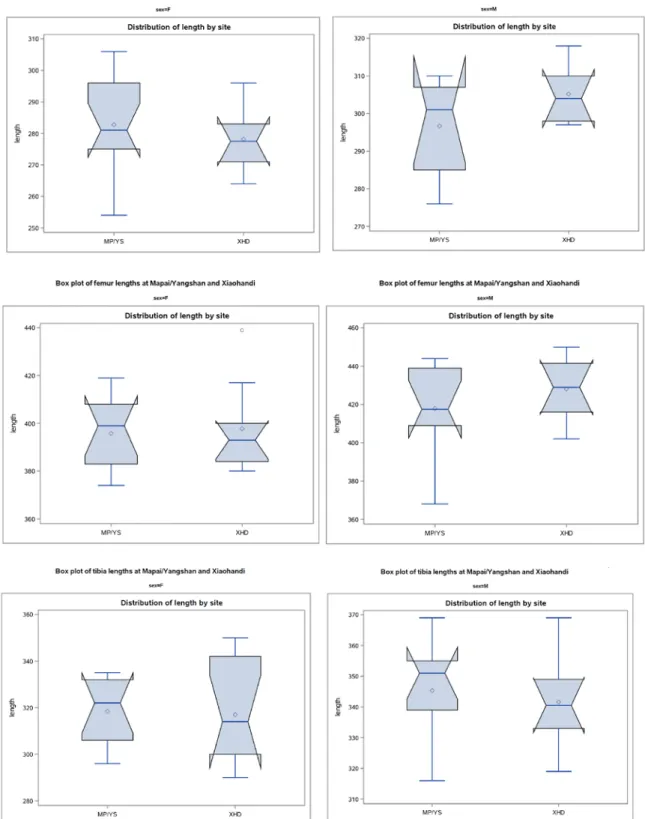
Figure 3.8 Notched box plots of long bones lengths by site and sex ... 78
Figure 3.10 Sex and age distribution at Mapai/Yangshan ... 84
Figure 3.11 Sex and age distribution at Xiaohandi ... 84
Figure 3.12 Ninety-five percent comparison intervals for the juvenility index of Mapai/Yangshan and Xiaohandi... 85
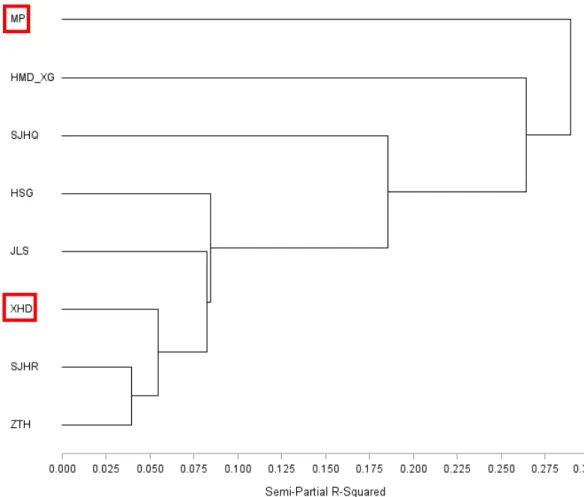
Figure 3.13 Ward's cluster analysis of dissertation study sites, highlighting the position of Mapai (MP) and Xiaohandi (XHD) ... 88
Figure 3.14 Published carbon and nitrogen stable isotope results from human bone collagen in eastern Qinghai ... 94
xiii
Figure 4.2 Deformed right humeral head in individual YSHM11 ... 105
Figure 4.3:A-B Innominate bones of individualsYSHM6 with deformed acetabula (a) and pseudo-joints (b) from bilateral congenital hip dysplasia ... 106
Figure 4.4 Notched box plots of long bones lengths by site and sex ... 109
Figure 4.5 Individual YHM117:1990, with rounded nasal aperture and periodontal reaction ... 112
Figure 4.6 Individual YHM109:2, with rounded nasal aperture and periodontal reaction ... 112
Figure 4.7 Age and sex distribution at Huoshaogou ... 115
Figure 4.8 Age and sex distribution at Hamadun/Xigang ... 115
Figure 4.9 Ninety-five percent comparison intervals of the juvenility index of Huoshaogou and Hamadun/Xigang ... 116
Figure 4.10 Ward's cluster analysis of dissertation study sites, highlighting the position of Huoshaogou (HSG) and Hamadun/Xigang (HMD_XG) ... 118
Figure 4.11 Published carbon and nitrogen stable isotope values from human bone collagen for sites in the Hexi Corridor and southern Gansu ... 126
Figure 5.1 Perimortem sharp edge trauma to the frontal bone on individual SHZM37 from Zhaitouhe ... 141
Figure 5.2 Proximal left femoral shaft with nonunion of complete fracture, individual SHZM73 from Zhaitouhe ... 143
Figure 5.3 Healed, misaligned complete fracture of the right femoral diaphysis in individual SHZM78 from Zhaitouhe ... 143
Figure 5.4 Probable Legg-Calvé-Perthes disease in individual SHSM22 from Shijiahe ... 144
Figure 5.5 Notched box plots of long bones lengths by site and sex ... 147
Figure 5.6 Sex and age distribution at Zhaitouhe ... 152
Figure 5.7 Sex and age distribution at Shijiahe (Rong) ... 152
Figure 5.8 Sex and age distribution at Shijiahe (Qin) ... 153
xiv
Figure 5.10 Ward's cluster analysis of dissertation study sites, highlighting the position of Zhaitouhe (ZTH), the Rong and Qin
groups from Shijiahe (SJHR and SJHQ), and Jiulongshan (JLS) ... 155 Figure 5.11 Published carbon and nitrogen stable isotope
values from human bone collagen from the Loess Plateau in Shaanxi ... 160 Figure 5.12 Paracondylar processes and abnormal atlas on the
occipital bone of individual YKJM1from Jiulongshan ... 163 Figure 6.1 Percent of observable teeth with carious lesions, by sex,
across all sites in the study ... 173 Figure 6.2 Average attrition score of all observable teeth at each site in the study ... 173 Figure 6.3 Percent teeth lost antemortem, by sex, across all sites in the study ... 174 Figure 6.4 Percent individuals exhibiting OA in different areas of
the body, across study sites ... 176 Figure 6.5 Percent individuals affected by LEH across all sites ... 178 Figure 6.6 Notched box plots of long bones lengths by site and sex ... 180 Figure 6.7 Tibial periosteal lesions that are active (woven) vs.
healing (compact) across all sites ... 181 Figure 6.8 Percent of all individuals with observable crania affected
by CO and PH across all sites ... 184 Figure 6.9 Ninety-five percent comparison intervals for the juvenility
index for all sites in the study (other than Jiulongshan) ... 186 Figure 6.10 Ward's cluster analysis of the biodistance of all sites
in the study, based on cranial nonmetric traits ... 187 Figure 6.11 Migrations described in the text, based on a biodistance
xv
LIST OF TABLES
Table 1.1 Major late Neolithic through late Bronze Age archaeological
cultures of Northwest China ... 9
Table 1.2 Skeletal series included in the study ... 19
Table 3.1 Periosteal reaction at Yangshan and Mapai ... 66
Table 3.2 Oral health measures at Mapai and Xiaohandi ... 67
Table 3.3 Osteoarthritis in Mapai/Yangshan and Xiaohandi ... 71
Table 3.4 Periosteal reaction at Qinghai sites ... 80
Table 3.5 Cases of cribra orbitalia (CO) and porotic hyperostosis (PH) at Mapai/Yangshan and Xiaohandi ... 82
Table 3.6 Distribution of sex and age categories at Mapai/Yangshan and Xiaohandi ... 83
Table 4.1 Oral health measures at Huoshaogou and Hamadun/Xigang ... 101
Table 4.2 Osteoarthritis at Huoshaogou and Hamadun/Xigang ... 104
Table 4.3 Periosteal reaction at Hexi Corridor sites ... 110
Table 4.4 CO and PH at Huoshaogou and Hamadun/Xigang ... 111
Table 4.5 Distribution of sex and age categories at Huoshaogou and Hamadun/Xigang ... 114
Table 5.1 Oral health measures at Zhaitouhe and Shijiahe ... 136
Table 5.2 Osteoarthritis at Zhaitouhe and Shijiahe ... 140
Table 5.3 Tibial periosteal lesions at Zhaitouhe and Shijiahe ... 148
Table 5.4 CO and PH at Zhaitouhe and Shijiahe ... 149
Table 5.5 Distribution of sex and age categories at Zhaitouhe and Shijiahe ... 151
Table 5.6 Oral health measures at Jiulongshan ... 162
Table 5.7 Tibial periosteal lesions at Jiulongshan ... 164
Table 5.8 CO and PH at Jiulongshan ... 165
xvi
Table 6.2 Numbers and percentages of individuals with active tibial
periosteal lesions, healing lesions, and no lesions across all sites in the study ... 182 Table 6.3 Numbers and percentages of individuals with CO and PH at each site in the study .. 184 Table 6.4 The juvenility index and 95% comparison intervals
1
CHAPTER 1 INTRODUCTION AND BACKGROUND
Bioarchaeologists have often focused on transitional times and places (Ventresca Miller et al., 2014). Consequently, the tools of the field, including paleopathology, paleodemography, and molecular methods of dietary reconstruction, have been used most intensively to investigate the origins of agriculture. This work has found that the impact of the agricultural transition on human health and population structure are not uniform across the globe (e.g., Cohen and Armelagos, 1984; Cohen and Crane-Kramer, 2007; Lambert, 2000; Larsen, 1997; Pinhasi and Stock, 2010; Steckel and Rose, 2002a).
In recent decades, a number of Chinese and international archaeological projects have turned their attention to the “Northern Zone” of China, which in the past was a transitional zone between China and the steppe. This area was once considered peripheral to the development of Chinese civilization, but recently, it has begun to be studied in its own right. As a point of contact between two apparently diametrically opposed ways of life, and the site of millennia of conflict between “the steppe and the sown,” it is a rich area of study for scholars of material culture, language, and bioarchaeology.
2
metallurgy, domesticated horses, and the cultivation of wheat and barley were introduced to East Asia (Di Cosmo, 2002; Flad et al., 2010; Frachetti et al., 2010; Garvie-Lok and Zhou, 2015; Han, 2008; Jia et al., 2013; Kahn, 2012). In historical times, it became part of the network of trade routes known as the Silk Road.
The Northern Zone, including the Northwest, was also one theater where the effects of late Holocene climate change on human culture played out. In the mid to late Holocene, the shift of the East Asian summer monsoon system led to greater climatic volatility and cooling and drying across the region. This period of dramatic and prolonged climate change is sometimes referred to as the 4000 BP climate change event. This is often cited as the cause of the Bronze Age transition to agropastoralism and later to the iconic highly specialized mobile pastoralism of Inner Asia (Han, 2008; Shelach, 2009), which has been less well-studied than the transition to agriculture (Gresky et al., 2016).
3
Figure 1.1 Map showing the approximate extent of Northwest China, in Xinjiang, Qinghai, Gansu, Ningxia, and Shaanxi Provinces
1.1 PROJECT RATIONALE
During the Neolithic (c. 6,000 BCE-2,000 BCE), populations across China’s Northern Zone (including Manchuria, Inner Mongolia, the Ordos region, and the Gansu Corridor)
4
For the better part of a century, archaeologists of China have pursued the discovery and classification of prehistoric cultures within the country’s borders. Though there are gaps in our understanding of the culture sequence and the forces that drove prehistoric change, the broad outlines of Northern Zone archaeological cultures are relatively well-understood (Di Cosmo, 2002; Gansu and Beijing, 2011; Han, 2008; Shelach, 2009; Xie, 2002). Other than material culture, however, certain elements of the Bronze Age transition are understudied. Quantitative paleobotanical and zooarchaeological data, possibly the most important in reconstructing ancient foodways (Marston, 2011), are almost entirely lacking for prehistoric Northwest China (Dong et al., 2015; Flad et al., 2007), though new and exciting work is ongoing. Human osteological data mostly consist of craniometric studies for the attribution of culture-historical groups to specific racial sub-groups (e.g., Han, 2001; Zhao et al., 2014; Zhu, 2002), though paleopathology and molecular analyses are now becoming more standard.
There have been numerous calls in Chinese and foreign publications to integrate data from multiple disciplines, and to fill in the gaps in our understanding of this period (Flad et al., 2007; Han, 2008; Shelach, 1999; Xie, 2002). Some recent projects, including in other parts of Eurasia, have begun to answer that call (Dong et al., 2013b; Hanks, 2010). In this project, I will present new bioarchaeological data from Northwest China and integrate it with published data on paleoclimate and paleoenvironment, as well as archaeological remains, to clarify the nature of the Bronze Age subsistence transition and what it can tell us about human adaptability to climate change.
To characterize changes in ancient human-environment systems, we have to first define the system that underwent change (Carpenter et al., 2001; Cumming et al., 2005). This is
5
density, and paleobotanical and zooarchaeological remains—though it is challenging, because archaeological data are mostly of a low resolution. Data from Northwest China are available on paleoclimate and paleoecology (particularly effective moisture and plant cover) (An et al., 2006; Chen et al., 2006; Zhao et al., 2009; Zhou et al., 2012), and much archaeological research has been undertaken there. However, there is not yet enough data on ancient foodways from plant, animal, and human remains to reconstruct the human-environment system in detail.
Therefore, as a preliminary step in assessing the Bronze Age transition in an ecological framework, I have adopted an approach that uses human biological data to characterize the Bronze Age transition. My general hypothesis is that subsistence change in the Bronze Age of Northwest China did not constitute a collapse and reorganization of the human subsistence system, precipitated by the 4000 BP climate change event; but rather represents the persistence of a resilient, complex human-environment system that was able to weather the climate changes of the early Holocene. In other words, this was an incremental, not a transformational, adaptation to climate change. In the case of an incremental adaptation, I would expect to see little
detrimental effect on the population, since the subsistence system would remain essentially unchanged, whereas in the case of a transformational adaptation, I would expect the changes in diet or lifeway to lead to categorical changes in population health and demography, including in oral health, physiological stress, frailty, and fertility, as has been found at the origins of
6 1.2 PROJECT BACKGROUND
1.2.1 Geography and climate
The Northern Zone of China can be divided into several sub-regions, defined by
geography and climate. From east to west, these are the semi-arid Inner Mongolian grassland, the semi-arid Loess Plateau, and the northwestern inland arid zone (Han, 2008). The area under study in this dissertation is the western portion of this area, and includes parts of the Loess Plateau and the arid zone, extending over modern-day Gansu Province, Qinghai Province,
Ningxia Hui Autonomous Region, and Shaanxi Province. As described above, this area served as a zone of contact between the societies of the Chinese heartland in the Yellow River Valley, the steppe societies to the north, and Central Asian societies to the west.
Geographically, Northwest China is characterized by an arid climate and a varied topography of high mountains and deep basins. There is low precipitation because of the
landlocked location and the presence of high mountains; outside the high mountain zones, annual precipitation is around 100-200 mm (Han, 2008), though there are significant differences
between lowland and highland zones. The influence of the continental air mass makes the region relatively cold, with extreme seasonal and daily fluctuations. For example, in the semi-arid Loess Plateau, average temperatures in January are 0-10° C, with an average in July of 24° C. The region’s basins are characterized by alluvial fans, along which many ancient agricultural settlements have been discovered (Gansu and Beijing, 2011).
7
processes taking place across Eurasia (Anthony, 2009; Di Cosmo, 2002; Shelach, 1999; Shelach, 2009; Tarasov et al., 2006; Teng and Shelach, 2011). These processes are attested by
paleoclimate data from sediment cores, loess microstrigraphy, lake cores, oxygen isotopes from ice cores (a proxy for temperature), precipitation data, and pollen profiles. Details of the climate change as it progressed in each study area are discussed in Chapters 3 through 5.
The label of “Northwest China,” which I will use throughout this study, privileges the Chinese perspective both in historical texts and in modern scholarly inquiry. However, this label captures a defining characteristic of the area: it was a zone of contact with ancient China, notable for its proximity to but distinctiveness from Chinese civilization. Referring to the Yellow River valley civilization of this time period as “China” is also anachronistic, as the concept of a unified Chinese civilization did not emerge until later. However, using this single term to refer to what is today central China does reflect that a common way of life, eventually encompassing language, material culture, and political organization, was emerging in the Chinese heartland at this time.
1.2.2 Cultural sequence
In this study, I focus on the late third through the mid first millennia BCE. Agriculture was practiced in Northwest China from about 6000 BCE, or the middle Neolithic, though not as intensively as in the Central Plains because of environmental constraints. By the middle
8
9
Table 1.1 Major late Neolithic through late Bronze Age archaeological cultures of Northwest China (after Xie, 2002: 240).
Name Dates Location (province[s]
and geographic area)
Subsistence practices
Late Majiayao
马家窑
~ 2500-2000 Gansu, Qinghai, Ningxia. Incl. Banshan and Machang types
Small-scale agriculture of foxtail and broomcorn millet. Millet grains found at many sites.
Sacrificial remains of domesticated livestock and wild game also found. Sites often located in river valleys, some quite large, up to 200,000 m2.
Important sites: Caiyuan (Ningxia), Liuwan (Qinghai), Zongri (Qinghai), Yangshan (Qinghai) Sites in this study: Mapai and Yangshan
(Qinghai)
Qijia 齐家1 ~ 2100-1400
BCE
Gansu, Qinghai, Ningxia, Inner Mongolia: upper reaches of the Yellow River and its tributaries (esp. Wei River, Tao River, Huangshui River)
Millet farming with pig husbandry; secondary sheep/goat herding and husbandry of cattle, horse, donkey, and dog; also evidence of hunting Important sites: Qijiaping (Gansu), Mogou (Gansu), Huangniangniangtai (Gansu), Zhangjiazui (Gansu), Liuwan (Qinghai)
Siba 四坝 ~ 1950-1430
BCE
Gansu: Hexi Corridor region
Agropastoralism: husbandry mostly of sheep/goat and secondarily of pig, also dog, horse, and cattle; cultivation of cereals (wheat, barley, millet, rye); evidence of hunting. Variable reliance on agriculture vs. animal husbandry across sites (Yang, 1998)
Important sites: Donghuishan (Gansu), Ganguya (Gansu)
Site in this study: Huoshaogou (Gansu)
Kayue 卡约 ~ 1600-600
BCE
Qinghai: upper reaches of the Yellow River and its tributary the Huangshui River
Variable: some sites agropastoralism, some sites primarily pastoralism (mainly sheep/goats, also horses and cattle), some sites primarily
agriculture; hunting at all sites Important sites: Sunjiazhai (Qinghai)
Xindian 新店 ~ 1400-700
BCE
Gansu, Qinghai, Shaanxi: upper reaches of the Yellow River and its tributaries
Agriculture supplemented by hunting and animal husbandry, primarily of sheep/goats, secondarily of pigs, also of dogs and horses
Important sites: Zhangjiazui (Gansu) Sites in this study: Xiaohandi (Qinghai)
Siwa 寺洼 ~ 1400-700
BCE
Gansu: Jingshui, Wei, Tao, Xihanshui, and Tao Rivers
Agropastoralism, including settled agricultural activities and husbandry of sheep/goats, horses, and cattle
Nuomuhong
诺木洪
~ 1000-800 BCE
Qinghai: Qaidam Basin Agropastoralist; husbandry primarily of
sheep/goat, also of cattle, horse, and camel; also evidence of agriculture and hunting
Shajing 沙井 ~ 900-409
BCE
Gansu: Minqin and Yongchang Counties, and Jinchang City
Primarily animal husbandry of sheep/goats, also of cattle, horses, donkeys, and camels; also evidence of agriculture and hunting
Sites in this study: Hamadun and Xigang (Gansu)
1 The Qijia culture is the earliest bronze-using culture to be discovered within China. See also Di Cosmo (2002), Li
10 1.2.3 Evidence for the Bronze Age transition
The rise of pastoralism in China’s Northern Zone was a local variant, or multiple local variants, of a process taking place across Eurasia (Di Cosmo, 2002). In the Chinese Northern Zone, pastoralism joined or replaced agriculture, while elsewhere in Eurasia it replaced foraging and hunting (Anthony, 2009). The transition was also complex: it was not a wholesale
replacement of agriculture by pastoralism, but was the development of mixed subsistence
systems resulting in a diversification of subsistence strategies across the region. Later, in the Iron Age, societies with strong pastoralist identities and specialized economic strategies dominated the political landscape of Inner Asia, though there is evidence that other subsistence strategies, including agropastoralism, persisted into the Iron Age and later (Barfield, 1989; Di Cosmo, 1994; Li et al., 1993). Multiple lines of archaeological evidence attest to this transition, including settlement pattern, artifactual, zooarchaeological, paleobotanical, and bioarchaeological
evidence.
1.2.3.1 Settlement evidence
11
Northern Zone also decreased during this time (Dong et al., 2013a; Shelach, 2009; Wagner et al., 2013), and many sites have few and small residential structures and shallow occupational layers (Han, 2008; Xie, 2002). This may have been the result of a shift from agriculture towards pastoralism, or of a diversification of subsistence strategy to include more pastoral production (Deng, 2014). Finally, corrals for domesticated animals have been found at some Bronze and Iron Age sites (Han, 2008).
1.2.3.2 Artifactual evidence
One type of evidence often cited to demonstrate that a group engaged in pastoralism is the presence of “animal style” art, which includes vessel, tool, and ornament types and
decorative motifs associated with pastoralist societies across Inner Asia in the Bronze Age and later (Figure 1.2). The style particularly includes bronze items bearing representations of herded and hunted animals (Xie, 2002), which indicates a cultural emphasis on animal resources and also widespread exchange and communication across the steppe (Di Cosmo, 2002; Han, 2008).
Figure 1.2 A) Bronze horse fitting from Xigang cemetery grave M74; B) dog-shaped bronze plaque from Chaiwan'gang cemetery grave M5 (Gansu, 2001: color plate III)
12
Also of interest is the presence of tools or implements associated with either agriculture or animal husbandry. In the early Bronze Age of the Northwest (early second millennium BCE), the presence of many arrows and knives, as well as artifacts with animal motifs on them, suggest an economy with a significant herding and/or hunting component. Even later Bronze Age
cultures of Northwest China (mid second millennium BCE) still had grindstones, sickles, and other tools for processing grains, in addition to bows and arrows and stone awls, which are associated with hunting and processing animal hides. These artifacts, along with the presence of sacrificial animal remains, furs, and artistic representations of animals, indicate a mixed
economy that emphasized both agriculture and pastoralism, to varying degrees in different places. Early Iron Age cultures (late second millennium BCE) still had agricultural implements, including mortars and pestles and grinding stones, though sites from this period also have abundant animal art, and the graves contain meat and dairy offerings, skins, and sacrificial animals (horses, cattle, and sheep). In the Iron Age, knives and weapons associated with hunting and herding, as well as artifacts associated with advanced horseback riding and horse herding, have also been found (Han, 2008; Xie, 2002).
1.2.3.3 Zooarchaeological evidence
The most direct evidence for the rise of pastoralism is the remains of domestic livestock species. Most animal remains so far excavated in the Northern Zone come from mortuary contexts rather than settlements. Though it is difficult to reconstruct foodways from these remains, they still offer information about which animals were present in a given context and which were culturally significant (Barfield, 1989; Di Cosmo, 2002; Han, 2008; Shelach, 2009).
13
such as Qijia in the Northwest, Zhukaigou in Inner Mongolia, and Upper Xiajiadian in the Northeast practiced settled agropastoralism rather than mobile pastoralism is the presence of pig remains at their sites (Di Cosmo, 2002). The eventual replacement of pig sacrifices with cattle and horse remains in the Kayue culture likely signaled the move away from agropastoralism and towards more mobile and more specialized pastoral forms of subsistence (Di Cosmo, 2002; Shelach, 2009). By the time of the late Bronze Age Shajing culture, the people of Northwest China had domesticated sheep, horse, and cattle, an assemblage that is quite familiar from the later Iron Age, though its adoption may have been a response to complex social factors and not a direct response to climate change (Flad et al., 2007; Shelach, 2009).
The relative number of animal remains at various sites, particularly of sheep/goats, horses, and other herd animals, suggests that the transition to agropastoralism and later
pastoralism was most dramatic in the Northwest (especially in the Ordos region, western Qinghai Province, and Gansu Province), and less dramatic or more gradual to the east (in Northeast China and eastern Inner Mongolia) (Di Cosmo, 2002; Owlett, 2016; Shelach, 2009).
14 1.2.3.4 Paleobotanical evidence
The most important early agricultural domesticates in Northwest China were broomcorn and foxtail millet, which are found throughout Northwest China beginning in at least the third millennium BCE (An et al., 2004; An et al., 2010; Barton et al., 2009; Garvie-Lok et al., 2004; Jia et al., 2013; Ma et al., 2014; Xie, 2002; Zhao et al., 2014). They seem to have been
domesticated in the east, and moved through Northwest China to reach Central Asia (Atahan et al., 2014; Frachetti et al., 2010). The opposite was true of wheat, oats, and barley, which were domesticated in Western Asia and reached Northwest China around 2000 BCE, before they reached the rest of East Asia, diversifying the crop base (Betts et al., 2014; Flad et al., 2010; Garvie-Lok et al., 2004; Li et al., 2010). Even in areas where pastoralism dominated the subsistence system in the Iron Age, such as the Tianshan Mountains, the Pamir Mountains, southern Xinjiang, the Qaidam Basin, and the Hexi Corridor, domesticated wheat, millet, and barley have still been found, indicating that crop cultivation continued into this period (Han, 2008; Zhang et al., 2005).
1.2.3.5 Bioarchaeological evidence
Though bioarchaeology is still a relatively small field in China (Pechenkina, 2015), a number of studies in the last two decades have begun to address the bioarchaeological evidence for subsistence change in the Northern Zone. A few are summarized here; more are discussed in relation to the findings of this study, in Chapters 3 through 5.
15
isotope values (δ15N 7.59—9.23‰) were in the range of local carnivores, suggesting humans consumed animal products.
Two studies comparing human and animal bone collagen at early Bronze Age sites in Northwest China also found that humans and omnivores appear to have had C4-based diets, while domesticated herbivores had mostly C3-based diets, probably from grazing on wild plants (Dong et al., 2015; Ma et al., 2014).
Zhang and colleagues (2005) analyzed trace elements from the Chawuhu cemetery in Xinjiang, which dates to the first half of the first millennium BCE. From their analysis of strontium, zinc, and barium, the authors concluded that the meat consumption of the Chawuhu population was high, though they likely consumed more plant foods than some other previously analyzed groups, e.g. the Lop Nur population farther to the west. These data, in addition to the contents of Chawuhu graves (sacrificial horses and sheep, horse fittings, bows and arrows, and felt), paleobotanical remains (barley and wheat found in ceramic vessels), and the common occurrence of dental carious lesions in the Chawuhu population, support the conclusion that the population had a diverse diet comprising both animal foods (such as cattle and sheep meat and dairy) and agricultural foods.
16
was between -18.39‰ and -17.85‰, which is roughly in the expected range for human bone collagen in a population with a diet dominated by C3 plants (approximately -19‰ to -23‰), and far from the range for C4 plant consumption (approximately -6‰ to -10‰) (Brown and Brown, 2011). This finding, in combination with paleobotanical remains recovered at the site, led the researchers to conclude that the predominant grain consumed by the population at Gumugou was wheat.
1.3 ARCHAEOLOGY OF THE STUDY SITES
In order to trace the Bronze Age transition in Northwest China, I have selected sites that span the two millennia from the late Neolithic to the Iron Age. They come from the provinces of Shaanxi, Gansu, Qinghai, and Ningxia (Figure 1.3), and are housed at universities and
17
Figure 1.3 Location of sites in the study: A=Mapai/Yangshan and Xiaohandi; B=Huoshaogou; C=Hamadun/Xigang; D=Jiulongshan; E=Zhaitouhe and Shijiahe
18
considerations. Additionally, in two cases I pooled skeletal series when they came from
cemeteries that were contemporaneous and excavated in the same location (see Table 1.2). These selection parameters have led to some unavoidable temporal gaps between study sites, which I hope to address in future research; but the data in this dissertation still reveal important patterns of change over time, which can address the principal research questions of this study.
19
Table 1.2 Skeletal series included in the study
Province/county/ site name Archaeological culture (period) Dates and dating technique Subsistence strategy (from publications) Collection * No. of indivi-duals (322 total) Sites from the Qinghai Plateau
Qinghai/Minhe/ Yangshan
(pooled with below)
Banshan and Machang (Late Neolithic) 2600-2300 BCE, ceramic typology (Qinghai, 1990)
Agriculture JLU-RCCFA
32
Qinghai/Minhe/ Mapai
(pooled with above)
Machang (Late Neolithic) 2400-2000 BCE, ceramic typology (Qinghai, 1990)
Agriculture JLU-RCCFA 11 Qinghai/Minhe/ Xiaohandi Xindian (Middle Bronze Age) 1500-1000 BCE, ceramic typology (Qinghai et al., 2004)
Agriculture JLU-RCCFA
44
Sites from the Hexi Corridor Gansu/Yumen/ Huoshaogou Siba (Early Bronze Age) 1700-1400 BCE, C-14 (Wu, 2014) Agro-pastoralism
GPICRA 75
Gansu/Yongchang/Ha madun
(pooled with below)
Shajing
(Late Bronze Age)
~1000-500 BCE, C-14 (Gansu, 2001)
Pastoralism GPICRA 17
Gansu/Yongchang/Xi gang
(pooled with above)
Shajing
(Late Bronze Age)
~1000-500 BCE, C-14 (Gansu, 2001)
Pastoralism GPICRA 33
Sites from the Loess Plateau Ningxia/Guyuan/
Jiulongshan
(Spring and Autumn Period)
771-256 BCE (Zhang et al., In preparation)
Pastoralism NICRA-GY
6
Shaanxi/Huangling/ Zhaitouhe
Rong
(Early to Middle Warring States)
475-221 BCE, ceramic typology (Shanxi et al., 2012)
Pastoralism NWU 72
Shaanxi/Huangling/Sh ijiahe
Rong, State of Qin (Late Warring States)
475-221 BCE, ceramic typology (Shanxi et al., 2015)
Agriculture NWU 32
*JLU-RCCFA=Jilin University Research Center for Chinese Frontier Archaeology (Changchun, Jilin); GPICRA=Gansu Provincial Institute of Cultural Relics and Archaeology (Lanzhou, Gansu);
20 1.3.1 Qinghai Plateau
1.3.1.1 Yangshan and Mapai, Minhe County, Qinghai Province (青海民和县阳山墓地
与马牌墓地)
The cemetery at Yangshan was excavated in 1980-1981, during which time 218 tombs were discovered and excavated (Qinghai, 1990; Qinghai, 2002). The skeletal remains from the cemetery are currently housed at the Jilin University Research Center for Chinese Frontier Archaeology (JLU-RCCFA) in Changchun, Jilin Province. Based on the material culture found in the graves, the site was attributed to the late Neolithic, with artifacts of both the Banshan and the Machang types represented. Ceramic seriation dates the site’s occupation to 2600-2300 BCE. The site is located on a terrace in a valley formed by the Songshu River, a tributary of the
21
Figure 1.4 Landscape around the Yangshan cemetery (Qinghai, 1990: plate I)
The Mapai cemetery was also discovered in Minhe County, and like Yangshan, is attributed to the late Neolithic (middle Machang period) based on its material culture. It was excavated in 1979-1987, and 62 graves were excavated (Qinghai, 1990; Xie, 2002). It is also stored at the JLU-RCCFA. As only 11 individuals from this site are included in my study, I have pooled them with the remains from Yangshan for analysis (see Chapter 3 for further discussion). Minhe County is located at the intersection of the Qinghai-Tibetan Plateau and the Loess Plateau, and is divided by the Yellow River drainage system. It is a critical agricultural area of Qinghai Province, with ample water resources and a mild climate despite its relatively high altitude, and has been cultivated since antiquity. In the west of the county there are high
22
the east. The area is characterized by very thick deposits of loess. Despite summer flooding in low-lying areas and high temperatures, there is water all year round, and it is a suitable area for agriculture. The area has rich natural resources, with more sunlight than the North China Plain and a long growing season. It has a temperate climate with mild seasonal differences in
temperature, and is well watered by rivers and runoff. Today, Minhe County’s river valleys are an important area in Qinghai Province for the cultivation of staple crops, fruits, and vegetables (Qinghai et al., 2004). The remains from both these sites are represented by cranial and
fragmentary postcranial remains. Crania are kept separately in archival boxes.
1.3.1.2 Xiaohandi, Hetaozhuang Township, Minhe County, Qinghai Province (青海民
和县核桃庄小旱地墓地)
The Xiaohandi cemetery is also located in Minhe County, Qinghai, at the intersection of the Qinghai-Tibetan Plateau and the Loess Plateau, in an area divided by tributaries of the Yellow River. The site is located on the eastern banks of the Milagou River, a tributary of the Huangshui River (Qinghai et al., 2004).
The site of Xiaohandi was excavated three times between 1978 and 1980, during which 367 graves were excavated, attributed by artifact typology primarily to the Zhangjiazui type of the Bronze Age Xindian Culture (Qinghai, 1995; Xie, 2002), which existed between 1500 and 1000 BCE. A smaller cemetery, Shanjiatou, was also excavated in Hetaozhuang in 1980, but is not included in this study.
23
remains are stored at JLU-RCCFA, and their condition is similar to that of the Yangshan and Mapai remains. They include crania, stored in archival boxes, and partial postcranial remains.
1.3.2 Hexi Corridor
1.3.2.1 Huoshaogou, Yumen City, Gansu Province (甘肃玉门市火烧沟墓地)
The Huoshaogou site is a key example of the early phase of the Bronze Age Siba Culture. It has been excavated over several seasons, primarily in 1976, when 312 graves were excavated (Xie, 2002; Yang, 1998). The site has been carbon dated with charcoal to 1950-1430 BCE (Xie, 2002), and with human bone to 1700-1400 BCE (Wu, 2014).
The site is located in an arid part of the Hexi Corridor, and both its location and its material culture suggest that the people at the site relied on a mixed economy of herding and farming (Yang, 1998). Grains of foxtail millet were found in one pot from the site. Animal remains found at the site represent both hunted and domesticated animals, and include
24
1.3.2.2 Hamadun and Xigang, Yongchang County, Gansu Province (甘肃永昌县蛤蟆
敦和西岗墓地)
The fortified late Bronze Age settlement of Sanjiaocheng in Yongchang County is associated with three nearby, contemporaneous cemeteries. The Hamadun cemetery was
excavated in 1979, with 20 graves found (Gansu, 1990). That year, a corner of the site containing four houses was also excavated. The Xigang cemetery was excavated the following year, in 1980, with a total of 452 graves excavated (Gansu, 2001). The third cemetery, Chaiwan’gang, was excavated in 1981 and included 113 graves, three houses, and two ash pits (Xie, 2002); the remains from this cemetery were not available for study. Because only 17 individuals from Hamadun were available for study, and Hamadun and Xigang are both closely associated with the same settlement, I pooled the remains from these two cemeteries for my analysis. The Hamadun remains were somewhat better preserved than the Xigang remains (Han, 2001).
Yongchang County is situated in a river basin at the eastern end of the Hexi Corridor. It is an agriculturally productive area with ample sunshine, fed by both meltwater and rainwater, and is also near an area of grassland to the northeast on the Alashan Plateau, so it is suitable for both herding and farming (Gansu, 2001).
25
data on food remains and mortuary sacrifices from the sites support the common interpretation of the Shajing lifeway, that it mainly consisted of a pastoral economy supplemented by agriculture. Animal remains found at the site include sheep/goat, dog, horse, cattle, donkey, and camel; sheep/goat specimens were the most abundant, and the donkey and camel may or may not have been domesticated varieties (Gansu Sheng Bowuguan, 1979; Li, 1994). Stone agricultural implements were also found, including hoes, spades, and grinding stones, as well as the remains of cereal crops. Sheep/goat, cattle, and horse skulls and lower legs are common grave offerings. There is significant stratification of graves in terms of the richness of the offerings, with the richest grave at Hamadun (M15) containing 35 animal skulls, among other offerings (Gansu, 1990; Xie, 2002). The remains from Hamadun and Xigang are stored at GPICRA, and their condition is similar to that of the remains from Huoshaogou. Other than pelves, the postcranial remains are very fragmentary, due to selective curation.
The published report includes one chapter by Dr. Han Kangxin of the Institute of
Archaeology, Chinese Academy of Social Sciences. The chapter includes estimations of sex and age, a study of paleopathology, and a craniometric study of 13 crania from Hamadun and
Xigang. These crania are pictured in the volume, but are no longer stored with the rest of the remains, and so were unavailable for inclusion in this study.
1.3.3 Loess Plateau
1.3.3.1 Jiulongshan, Guyuan City, Ningxia Province (宁夏固原市九龙山墓地)
26
The remains are housed at the Ningxia Institute of Cultural Relics and Archaeology (NICRA) field station in Guyuan City.
Based on artifact typology, the cemetery was attributed to the late Spring and Autumn period (771-476 BCE), and is thought by the original investigators to have been used by a mobile pastoral population. Sheep/goat, horse, and cattle remains were found at the site (Zhang et al., In preparation). Today, this region has a large year-to-year fluctuation in crop yields (Li et al., 1993), which would have encouraged residents to adopt an agropastoral or pastoral subsistence strategy, to mitigate the risks of agricultural production.
1.3.3.2 Zhaitouhe, Huangling County, Shaanxi Province (陕西黄陵县寨头河墓地)
The Zhaitouhe cemetery is located in Huangling County in northern Shaanxi Province, at the northwestern edge of the Loess Plateau and south of the Ordos region. The site is located on the north bank of the lower course of the Hulu River on a sloping tableland, on level open ground.
The cemetery was excavated in 2011 by the Shaanxi Provincial Institute of Archaeology (SPIA), though the human remains are currently housed in the collection of the physical anthropology section of the Northwest University School of Cultural Heritage (NWU-SCH) in Xi’an. The excavation uncovered 90 graves, two pits containing sacrificed horses, and one pit containing a short spear. Because there is no intrusion of graves on each other and the graves are laid out in a relatively orderly fashion, the excavators believe the cemetery was in use for only a short period (Shanxi et al., 2012).
27
artifacts are typical of those associated with the so-called “Rong” people, a term found in the Chinese historical literature that is used to describe western non-Han groups, especially pastoralists. The term is also used by archaeologists to describe this archaeological culture, which has clear differences from the material culture of settled Chinese populations. The
excavated Rong vessels bear a resemblance to vessels typical of other Northwest Chinese Bronze Age cultures and suggest cultural contact with the rest of the Northwest, while a few artifacts recovered at the site, including a bronze plaque, even suggest contact with the northern steppe. Cattle, sheep/goat, and horse remains are also found as mortuary sacrifices at Zhaitouhe. No settlement was discovered, though a survey found a large amount of pottery from the Eastern Zhou period (770-476 BCE) on lower ground about 500 m to the south, suggesting occupation may have been concentrated there (Shanxi et al., 2012; Guo et al., 2014; Sun et al., 2012).
A historical text, The Records of the Grand Historian, supports the interpretation that a group that would have been known to ancient sedentary Chinese people as the “Rong” existed at the margins of the State of Wei at this time (Shanxi et al., 2012). The excavators characterize Zhaitouhe as the first Rong cemetery discovered in Shaanxi, and state that it is distinct from other Rong cemeteries found in this region, as other Rong groups in this area had close relations with the State of Qin rather than the State of Wei. Therefore, this cemetery provides new
information about the migrations and material culture of Northwest Chinese people during the Warring States period.
28
1.3.3.3 Shijiahe, Huangling County, Shaanxi Province (陕西黄陵县史家河墓地)
The cemetery at Shijiahe was discovered in 2012 during the survey associated with the excavation of Zhaitouhe, and was excavated the same year. It is located 4 km from Zhaitouhe, on the same tongue of land, and also on the north bank of the Hulu River (Figure 1.5).
Figure 1.5 View of the location of Shijiahe cemetery (Shanxi, 2013)
A total of 37 graves were excavated at Shijiahe. The burials were quite stratified in terms of their offerings, and include both shaft graves and side chamber graves. Based on the grave types and contents, the excavators attribute the shaft graves to Rong people of the early to middle part of the Warring States period (475-221 BCE), meaning it was likely in use at the same time as, and by the same population as, the Zhaitouhe cemetery (Shanxi et al., 2015; Sun et al., 2015). The grave goods from this period exhibit some influence from the State of Wei, in whose
29
Ten graves from the site are side chamber graves. Their grave type and grave goods resemble those of the State of Qin and date to the late Warring States period, and possibly also the later Qin Dynasty (Shanxi et al., 2015; Sun et al., 2015). These graves may represent a second phase of use of the cemetery, after the conquest of this area by the State of Qin around 330 BCE and the area’s settlement by Qin colonists.
However, it is also possible that the Rong graves from this cemetery might date to the later part of the Warring States period as well (Shao Jing, personal communication). If this is the case, the Rong and Qin graves of Shijiahe were likely contemporaneous. In fact, my
paleopathological analysis supports this interpretation (see Chapter 5). However, my biodistance analysis concurs with the material culture remains, that the Rong of Shijiahe and the Rong of Zhaitouhe were very closely related to each other.
30
CHAPTER 2 THEORY AND METHOD
2.1 EXPLANATIONS FOR THE BRONZE AGE TRANSITION
The cause of the Bronze Age subsistence transition in Northwest China, and across Eurasia, has been the subject of much research in the archaeological and paleoclimatological literature. It seems that the transition was a multi-faceted, long-term development, and that no “prime mover” hypothesis is adequate to entirely explain the transition (Allard and Edenebaatar, 2005). In this study, I have emulated approaches that combine multiple lines of evidence and take into account multiple causal factors, and that make use of recent theoretical advances in human ecology and environmental archaeology.
The most common explanation for the transition in the Northern Zone of China is
31
Most likely, both internal and external factors contributed to the shift. Shelach (2009) considers both climate and population replacement to be “external factors,” while identity formation is an internal factor. Di Cosmo (2002: 33) classifies “overpopulation, aridization, or simply an increase in the degree of specialization and division of labor between agriculturalists and pastoralists” as internal, while “external” explanations for the appearance of nomadic pastoralism include “invasions or cultural contacts.”
To understand the transition fully, we must be able to detect the signature of pastoral practices and mobility in the archaeological record. Nomadism or mobility is often associated with pastoralism, and though mobility is described in historical sources, these are potentially unreliable sources of information about whether and how it was practiced (Cribb, 1991). Also, historical sources tend to emphasize ethnic affiliations, which are difficult to connect to specific material culture assemblages in the archaeological record.
While archaeology can push the search for the origins of pastoralism and nomadism into the prehistoric past, most models for the origins of pastoralism come from the ethnographic literature, and include economic, political, and social explanations (Barth, 1969; Dyson-Hudson and Dyson-Hudson, 1980; Lees and Bates, 1974; Salzman, 2004). These diverse models,
explored more below, reinforce the idea that the origins of pastoralism cannot be explained as a unitary phenomenon or with a single set of explanatory factors.
2.1.1 Climatic explanations
32
This has been attributed to the weakening of the Asian summer monsoon after 3000 BCE (An et al., 2006; Anthony, 2009; Chen et al., 2006; Li et al., 2014a; Zhang et al., 2000; Zhao et al., 2009; Zhou et al., 2012).
In some models of the origins of pastoralism, climate or ecological change is identified as the driving force behind subsistence change. Studies in human ecology provide us with models of this sort of transition. Abdi (2003) writes about subsistence diversification as a rational strategy in response to ecological risk. Similarly, Moran (2008) writes that East African
pastoralists increase their chances of success in their environment through diversification of food production, both within and between households. Spooner (1973) writes that pastoralism’s origins may be attributable to the spread of grassland after the intensification of agriculture, or possibly to population pressure leading to exploitation of more marginal environments.
The climate change explanation of the origins of pastoralism, and of other cultural
33
own climate does not seem to be an adequate explanation for the large-scale cultural changes occurring in the second millennium BCE across Gansu, Qinghai, and Ningxia provinces, where Qijia culture remains are found.
Similarly, Wu and Liu (2001) posit that a single climatic cooling event around 2000 BCE explains the collapse of civilizations in the Nile and Indus River Valleys, the collapse of the major Neolithic cultures of China, and the population pressures that led to the rise of urban Chinese civilization. This explanation is parsimonious, but it lacks a robust definition of “collapse” that can encompass all these scenarios, or any details about climate proxies, dating methods, or specific vegetation changes in various localities associated with this climate event. A more fine-grained analysis of both culture and climate change would be necessary assess to their model, as Holocene climate change was nonlinear, and varied from place to place (Miller, 2013; Zhang et al., 2000). It is also typical for monsoon-related dry intervals in monsoon marginal areas to be asynchronous across different settings (Li et al., 2014a), so it is risky to generalize the effects of a single climate event across large geographic regions. Also, few attempts have been made to link changes in temperature, precipitation, and other climatic variables to the actual carrying capacity and other characteristics of landscapes exploited by humans (Chifeng, 2003; d'Alpoim Guedes et al., 2016; Frachetti, 2008a; Linduff et al., 2002; Shelach, 2009; Tarasov et al., 2006). Chronological resolution of both paleoenvironmental and archaeological data, and characterizing human-environment interaction in ways that can be traced in the ancient past, remains a persistent challenge for scholars around the world (Contreras, 2017).
34
fragile (Mo et al., 1996) and even culturally marginal places where societies became “stuck” at an earlier “stage” of development of complexity (Han, 2008) or suffer “retrogression” (Zhao et al., 2012; Zhou et al., 2012). However, there is ample archaeological evidence that farming continued in the second millennium BCE, and was later practiced alongside specialized nomadic pastoralism, meaning that categorical frameworks do not accurately represent the transition. As Di Cosmo (2002: 23) writes:
Although herders became gradually more mobile and the aridization of the climate made agriculture more problematic in several areas, this evolutional trajectory did not
necessarily mean the abandonment of agriculture. The more common picture in central Asia during the first half of the second millennium BC, was the development of settled agro-pastoral societies that appear to have wielded considerable political and military power.
Climate change in the second millennium BCE was not unidirectional, but led to greater
uncertainty (Hong et al., 2001), so it is reasonable to expect that Bronze Age subsistence change was characterized by diversity and flexibility, not categorical change.
35
1995). Climate explanations must therefore be contextualized with analyses of other lines of evidence and sophisticated model-building.
2.1.2 Culture contact explanations
The importance of inter-group interactions to the formation of pastoralist and/or mobile lifeways is well-established in both the ethnographic and the archaeological literature. This interaction may take the form of economic specialization and trade (Cribb, 1991; Linduff et al., 2002), cultural exchange and adoption of technologies (Di Cosmo, 2002; Han, 2008), political strategy (Barfield, 1989; Barfield, 1993), expressing ethnic identity (Bernbeck, 2008; Shelach, 2009), or some combination thereof (Anthony, 1998; Frachetti, 2008a; Frachetti, 2008b; Lees and Bates, 1974).
In the formulation of Barth (1969: 15), interactions and borders are precisely what makes ethnic identity formation possible: “The critical focus of investigation from this point of view becomes the ethnic boundary that defines the group, not the cultural stuff that it encloses.” We should therefore expect to see separate territories occupied by, and separate ecological and economic niches being exploited by, groups with distinct ethnic identities. It is highly plausible that the desire of members of a group to distinguish themselves from their neighbors through economic practices was a driving force in the origins of Northern Zone pastoralism or
agropastoralism, as in Shelach’s (2009) model. In his reading of the data, pastoralism became dominant in the second half of the first millennium BCE at least partially because this suited the identity the people of this region had adopted.
Later interaction between nomadic pastoralists and sedentary states may be best
36
are included within regional polities (see also Chang, 2008). This is helpful in understanding the interaction of the people of Northwest China with early Chinese states (see Chapter 5).
For other parts of Inner Asia, population movement may in fact explain some of the spread of pastoralism, e.g. the possibility that Afanasievo pastoralists moved from the Altai south into the Tianshan Mountains and eventually into the Tarim Basin after 2000 BCE (Anthony, 2009; Mallory and Mair, 2000). However, it seems unlikely that such large-scale population movement can explain what appears to be gradual, in situ development of mixed economies in Northwest China in the Bronze Age.
2.1.3 Hybrid approaches
One challenge in researching the Bronze Age transition is defining the object of study. The prescription of Dyson-Hudson and Dyson-Hudson (1980: 56), that scholars of pastoralism should focus on variables rather than types, is quite powerful. They write: “The typology
‘nomadic pastoralism’ which locks together livestock herding and mobility into a single arbitrary category will then cease to define a subject suitable for review.” Cribb (1991) also emphasizes that multiple lines of evidence are needed to assign the label of nomadic pastoralism to an archaeological site, and we cannot impose a universal typology on ancient peoples, beyond heuristic devices that can guide our research questions but should not limit our interpretations of data.
37
interacting processes which in turn interact with the geographic and institutional environment in which they are situated, all in an iterative fashion. To this end, Frachetti’s (2008b) research program includes data pertaining to spatial relationships of burials and settlements, material culture, faunal and floral remains, and chronology, all at multiple scales. These are obtained through survey, excavation, and paleoecological reconstruction, and spatially modeled using GIS software.
Furthermore, most social-ecological systems comprise multiple stable states (Holling, 2003). Salzman (1980: 6-7) writes that subsistence changes are often “manifestations of shifts among institutionalized alternatives,” and are usually not “non-repetitive, directional and cumulative, [but are] often rather in the form of repetitive cycles of alternating phases.” He reiterates this in later work (2004: 5):
The assumption that socio-cultural change is discrete and absolute, that change is manifested in a formally (if not temporally) abrupt shift from one particular kind of society to another, is unnecessary and misleading given the understanding that a society is not a single, unalloyed, tightly-integrated system but rather is a complex entity which encompasses a multiplicity of practices and forms and which incorporates sets of behavioral, organizational, and ideological alternatives.
38
While it is possible that environmental change leading to dramatic reorganization in the distribution and abundance of moisture, plants and animals might have forced people into mass migration, it is equally (if not more) likely that such changes simply engendered local adjustments to patterns of human subsistence, mobility and social organization. For example, the addition of domestic herd animals and quick-growing cold-tolerant annual grasses to a pre-existing pattern of wild food procurement might have been an adaptation to food insecurity associated with environmental variability and uncertainty.
Thus, subsistence transitions, including the adoption of new domesticates or production strategies, are not necessarily the result of crisis, collapse, and reorganization, but can entail reforms or additions to an existing, stable, and persistent system.
These hybrid approaches point towards a non-typological orientation, and are consistent with the findings of archaeologists, ethnographers, and human ecologists, as well as with the adaptive cycle model of change in complex systems that will be described in the next section. Stripped of typological frameworks, different subsistence systems are not separated by such enormous gaps. Patterns do emerge from archaeological data, but they do not follow a neat dichotomy between “the steppe and the sown.” Rather, they lend themselves to ways of thinking that allow for complexity, recursion, and cyclicity, as embodied by these hybrid approaches to understanding the origins of pastoralism.
2.2 HUMAN ECOLOGY
Theoretical concepts from the field of human ecology are of great use in applying and evaluating these non-typological models of subsistence change. The models described below can
39 2.2.1 Adaptive cycle
The field of ecology has produced many bodies of theory that are of use to archaeological research, as sustainability and human adaptability have become topics of interest to
archaeologists in recent years (Contreras, 2017; Faulseit, 2016a; Kahn, 2012; McAnany and Yoffee, 2010; Moran, 2008; Redman, 2005). This study is concerned with the developments of the last several decades, when the idea of homeostatic equilibrium in ecosystems, e.g. fixed carrying capacity, has been replaced by more dynamic models. These models incorporate both persistence and change, and take the interaction between elements as the primary driving force (Barker and Gilbertson, 2000; Redman, 2005). For example, a “boom and bust” model is now widely employed in the study of pastoralist and arid human-environment systems (Barker and Gilbertson, 2000). This study’s general hypothesis relies on two such dynamic concepts from the field of ecology: complex adaptive systems, specifically the “adaptive cycle”; and resilience.
40
Figure 2.1 The adaptive cycle (Holling and Gunderson, 2002: figure 2-1)
In the K or conservation phase, the system is relatively stable and rigid, with all the elements and their relationships well-established. The system tends to be vulnerable in this phase, and is not very resilient, so in the face of a disturbance, it tends to suffer crisis and
collapse. This leads to the omega or release phase, also described as “creative destruction,” when relationships in the system break down and some elements may disappear entirely. The system moves quickly through omega into the alpha, or reorganization, phase, when the system is seeking out a new configuration, and innovations are occurring in the form of new elements colonizing recently opened niches, as well as new relationships forming. In the r, or exploitation, phase, the newly established elements are growing rapidly and competing for resources,
41
The cycle has three dimensions (Figure 2.2), all of which are key to understanding the behavior of a system at a given point in the cycle.
Figure 2.2 The three dimensions of the adaptive cycle (Holling and Gunderson, 2002: figure 2-2)
“Connectedness” refers to how strongly the relationships between system elements are established, and reaches its peak in the K/conservation phase. “Potential” refers to the ability of the system to change and incorporate new elements or relationships, and peaks in
alpha/reorganization. The final dimension is “resilience,” or the system’s ability to experience a disturbance and still maintain its identity. Resilience will be discussed in the next section.
The adaptive cycle is useful for characterizing human-natural systems, such as that of agropastoralist societies in a time of environmental change, because it accounts for the dynamic nature of complex systems. Such systems are iterative, reacting to feedback loops and the outcomes of previous cycles. They also function on multiple scales of space and time, each of which influences the others. This inter-scale interaction is what Holling et al. (2002) call the
42
scales, and between neighboring systems. This entire configuration is too complex for a single study; in that way, an “ecosystem” is a heuristic device, with artificial boundaries drawn around it to facilitate human understanding of its functions. Systems behave differently at different scales, so studies of ancient climate change and adaptive response must explicitly consider the scale at which the analysis is conducted—the household, the city, or the civilization; a year, a decade, or centuries (Roberts, 2015).
Integration of multi-scalar data is therefore important. Di Cosmo (2002) has likewise stressed the need for more analysis of Eurasian pastoralism at the regional scale, and that researchers should recognize divisions such as watersheds or mountain ranges rather than the less meaningful divisions imposed by modern scholars of the steppe, which are based on historical and current geopolitics (e.g. Manchuria, Mongolia, Xinjiang, etc.). Scholars have conducted such regional-scale analyses in some parts of Eurasia (Anthony et al., 2005; Chifeng, 2003; Frachetti, 2008a; Linduff et al., 2002), as well as publishing some supra-regional syntheses (Anthony, 2009; Di Cosmo, 2002; Mallory, 1989; Shelach, 2009).
Most importantly, paradigms such as the adaptive cycle eschew a simple, linear narrative of human cultural change. There is not a linear relationship between humans and their