DISCUSSING POLITICS ON FACEBOOK: CLUB MODEL AND ROWDY DELIBERATIVE TALK
Didem Türkoğlu
A thesis submitted to the faculty at the University of North Carolina at Chapel Hill in partial fulfillment of the requirements for the degree of Master of Arts in the Department of Sociology
in the College of Arts and Sciences.
Chapel Hill 2014
ABSTRACT
Didem Türkoğlu: Discussing Politics on Facebook: Club Model and Rowdy Deliberative Talk (Under the direction of Charles Kurzman)
Scholars who study deliberative democracy put a lot of emphasis on the importance of the way people talk about politics, which shapes their thoughts and practices. In online political settings people tend to talk about politics with like-minded individuals creating echo chambers. However, by focusing on overtly political venues, the literature understudies the political talk that takes place in non-political settings. In this paper I investigate the question of how we come across political discourse on a pre-dominantly non-political platform on social network sites (SNSs). Based on a mix-method analysis of over 80.000 comments from the 50 most popular public Facebook pages from Turkey, the findings suggest that we are more likely to find
TABLE OF CONTENTS
LIST OF TABLES vi
CHAPTER 1: INTRODUCTION 1
CHAPTER 2: DELIBERATIVE POLITICAL TALK 4
Facebook Pages 9
a) Overtly Political Pages 10
b) Entertainment 10
c) Sports 10
CHAPTER 3: METHODOLOGY AND DATA COLLECTION 13
CHAPTER 4: QUANTITATIVE ANALYSIS 15
Outcome Variable: Deliberative Talk 15
a) Deliberation Status 15
b) Response 16
Co-Variates 16
a) Civility 16
b) Us/Them Distinction 16
c) Outrage 17
d) Strong Emotional Support 17
e) Criticism of the Facebook Page Administrator 18
f) Rowdiness 18
Posts 20
Rowdy Deliberative Talk 21
CHAPTER 5: QUALITATIVE ANALYSIS 25
When and How Appropriate it is to Talk about Politics 25 Us/Them Distinctions and Inter-Ideological Conversations 27
Indirect Discouragement of Deliberative Talk 29
Rowdy Deliberation on Sports Pages 30
CHAPTER 6: CONCLUSION: CLUB MODEL AND FACEBOOK PAGES 33
APPENDIX 37
ENDNOTES 42
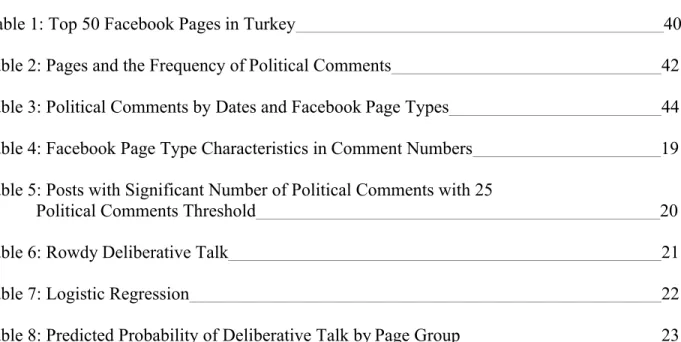
LIST OF TABLES
Table 1: Top 50 Facebook Pages in Turkey 40
Table 2: Pages and the Frequency of Political Comments 42
Table 3: Political Comments by Dates and Facebook Page Types 44 Table 4: Facebook Page Type Characteristics in Comment Numbers 19 Table 5: Posts with Significant Number of Political Comments with 25
Political Comments Threshold 20
Table 6: Rowdy Deliberative Talk 21
Table 7: Logistic Regression 22
CHAPTER 1: INTRODUCTION
On 6 September 2012, the Facebook page of the Galatasaray Sport Club (one of the most popular sport clubs in Turkey) hosted a heated discussion about which word should be used in reference to God: Tanrı or Allah. The reason for the discussion was a post made by the page’s administrator expressing condolences to the families of the soldiers who died as a result of an
explosion in a military armory. The admin used the word Tanrı2 instead of Allah. Tanrı is
Turkish. Allah is Arabic but also widely used in Turkish. This created a huge uproar. Some of the page members deemed Tanrı to be related to Christianity or polytheism, thus not Islamic enough, while others supported the usage by finding it more “modern,” more “secular” or more
“Turkish.” However, this wasn’t only a semantics debate because it took place against a background of emotional outrage in the mass media due to the increasing numbers of terrorist attacks, instability along the Syrian border, and a public discussion among politicians and the mass media about whether the state is losing its secular premise. Consequently, the sides taken by Facebook users also reflected their position on these issues as well as a criticism of the government and the party in power. The tone of the Facebook conversations was quite
antagonistic and in some instances expressed outrage, but there were also attempts by some users to provide information and convince people of opposing views. In some instances there were small indications of solidarity next to swearing or threats of unsubscribing from the page if the initial controversial post wasn’t edited.
The literature has a tendency to talk about deliberation as an outcome, focuses on exclusively political venues and relies heavily on research settings like forums and focus groups. In doing so it understudies the political talk that takes place in non-political settings. There is also a tendency to disregard the type of political talk that reflects some characteristics of deliberation and yet does not reach a well-defined outcome. In this paper, deliberative talk is operationalized in terms of the presence of inter-ideological questioning. It also includes tolerance for the presentation of ideas/ positions that are not shared by the main political position of the page (for overtly political pages) or a position different than one’s own (for the users in seemingly non-political page settings). Tolerance might be demonstrated through an explicit encouragement or it might be demonstrated by the absence of discouragement. In doing so, this paper contributes to the literature in the following ways.
Firstly, this paper aims to look at the way politics is discussed in a not exclusively political platform. Political talk does not exclusively take place in overtly political settings. Secondly, the type of deliberative talk can also be quite rowdy unlike the normative prescriptions proposed by some scholars. When the primary affiliation of the group is not political then
presentation of different political ideas, especially those that are not shared by the members at large, might not be perceived as a threat to the basis of the group and might be tolerated.
deliberation, this paper cautions against making generalizations about a certain site by demonstrating different dynamics of political talk within the same SNS.
In what follows, I elaborate on how deliberative talk is approached in previous works. I discuss how we can conceptualize deliberative talk and suggest two hypotheses. We are more likely to find deliberative talk in non-political pages and in some instances uncivil and outraged comments might encourage deliberative talk. In the quantitative analysis section I demonstrate that we are more likely to find deliberative talk in sports pages, even if deliberative talk in general is rare. In the qualitative conversation analysis section I discuss how political talk takes place by putting an emphasis on the mechanisms.
CHAPTER 2: DELIBERATIVE POLITICAL TALK
Civic engagement and deliberation are two of the major issues scholars discuss in democratic theory. Debates on deliberative democracy gained momentum in the late 1990s with the discussions of John Rawls and Jürgen Habermas. (Dryzek 2000; Habermas 1996; Rawls 1993) Problems of democracy and the limitations of the current political structures led to a concern with the future of democracy and civic engagement. Within this context the rise of the Internet as a new and popular medium attracted attention, and scholars began to inquire whether this new medium can open some new opportunities for deliberation and civic engagement.
In this paper, I take Facebook as a reflection of political conversations that occur in everyday life settings even if there are peculiarities due to being an online medium. Facebook gives us an opportunity to observe political conversations as they happen without the
interference of the researchers. Moreover, it allows us to capture the interactions between the users as a group as well as the interactions of the users with the particular context they are in. Consequently, bringing the discussions on SNSs and political conversations together give us an advantage to more closely scrutinize these dynamics.
Putnam was concerned about “cyberbalkanization” leading to atomization and segregation of communities (Putnam 2000). Even if there are studies showing that
revised further by the argument that Internet forums are not the place for democratic debate but they are merely “echo chambers”(Jamieson and Cappella 2008). Some scholars regard this as having caused an erosion of the common ground which is especially important for the
democratic theory and discussions on deliberation (Sunstein 2007).
If the cyberbalkanization argument is valid, then we would expect to see very little deliberation on the Internet especially in regard to inter-ideological conversations. For the political communities, this seems especially hard to achieve due to the prevalence of echo chambers. Consequently on Facebook, I would expect to find political pages reflecting echo chambers as well, where the people who interact with each other are the ones who share the same political position.
One of the approaches to the issue of civic engagement and the SNS is the argument that social networking sites enable more interaction, increase social capital, and facilitate offline social relations (Boyd 2006; Ellison, Steinfield, and Lampe 2007). In parallel to this argument, scholars also argue that SNSs facilitate and/or encourage civic and political engagement (Gaby and Caren 2012; Marzouki, Skandrani-Marzouki, jaoui, Hammoudi, and Bellaj 2012; Pasek, More, and Romer 2009; Valenzuela, Arriagada, and Scherman 2012; Zúñiga, Jung, and Valenzuela 2012).
Second, these conversations are also composed of deliberative, contentious as well as polarizing talk. New social media cannot provide a uniform effect on political action but at the same time they do provide a new setting as well as norms and rituals for political conversation.
Deliberation is a difficult aim to achieve which takes place only occasionally. (Button and Mattson 1999; Hendriks 2006; Theiss-Morse and Hibbing 2005)Deliberative political conversation is defined as composed of “openness to political conflict, the absence of
conversational dominance, clear and reasonable argument, and mutual comprehension.”(Moy and Gastil 2006) Also see. (Carpini, Cook, and Jacobs 2004)Moy and Gastil support the
argument that one needs to make a distinction between social conversation and problem solving conversation. In the former people are among like-minded individuals and their conversation does not have a clear goal. In the latter case, on the other hand, the conversation is public, leads to sound judgment, involves people with different ideas and beliefs, and finally has an egalitarian atmosphere that is non-tyrannical but politically equal(Conover, Searing, and Crewe 2002). Such a distinction is hard to make. Moreover, as Andrew Perrin suggests we cannot confine political talk to these types of situations because political talk takes place in formal as well as informal settings.(Perrin 2006) Furthermore, political conversations are rarely as problem-oriented as the supporters of rationality in deliberative conversation literature suggest.
Some scholars suggest that people might think that argumentative discussions are
talk and even discourses of outrage and see if we can find any instances where there are also elements of deliberative political talk. However in order to do that, the operationalization of deliberative talk needs to be more flexible. In that regard, civil-rational-solution oriented talk would be only one of the possible types of deliberative talk, not the only type of deliberative talk.
We also need to consider the contexts these comments are made such as how individual comments are positioned in the conversation and how they can be tied to the norms of
conversation prevalent in those specific group-conversational contexts(Polletta and Lee 2006). In a study on political micro cultures and logics used in political talk Andrew Perrin, for example, finds out that sports groups use “doubt” logics more and argues that this might be related to their “relative insulation from public sphere problems” compared to unions, business associations and churches (Perrin 2005). Likewise it would not be very fruitful to just look at the conversation made in the same general theme across all groups because the way those
conversations are made would also reflect the different characteristics of the groups as well as the differences of group members in those settings.
As I will demonstrate in the case of Facebook sports pages, people might be aware of different political positions among the audience they target and yet depending on the norms and group identity of the page they might still engage in political discussions. Based on the
In this regard, I would like to see to what degree presentation of different ideas are encouraged (explicitly) or tolerated (absence of discouragement). On Facebook, one might find formal discouragement in the form of deleting one’s comment or banning someone altogether. There are also less formal tactics that might be employed such as using the discourse of outrage to demonize and discredit opposing opinions, constructing a political identity that would
emphasize us/them or overwhelming use of emotional support that indirectly discourages diverse opposing opinions by creating the norms of behavior in a certain page. Consequently, my coding will be informed by these concerns as I will discuss below in the methodology section.
Following Dahlberg’s three model typology of democratic communication Freelon proposes to evaluate political talk on the Internet on the following models: liberal individualist, communitarian and deliberative. (Freelon 2010) According to him; in the deliberative model, according to Freelon, indicative metric is composed of rational-critical argument, public issues focus, equality between participants, focus on the discussion topic, inter-ideological questioning and inter-ideological reciprocity. This category is heavily influenced by a Habermasian
understanding of deliberation. Similarly, in their book Outrage Industry Jeffrey Berry and Sarah Sobieraj emphasize the negative consequences of the outraged discourses forming a barrier against potential deliberation.(Berry and Sobieraj 2013) In both of Freelon’s and Berry and Sobieraj’s arguments, most political talk on Facebook wouldn’t be considered fitting to this deliberative model because of a lack of rational-critical argument and the exclusive focus on the discussion topic.
some rowdy political talk in the Facebook conversations I analyze. There might be instances of incivility and outrage and yet the same uncivil and outraged comments might also encourage different political views in the conversation in the forms of deliberative political talk (Hypothesis 2).
Facebook Pages
Currently, Turkey ranks as the sixth country in terms of the number of Facebook users in the world. In 2012 Turkish Facebook users represent 90 % of the population who uses the Internet in Turkey.3 2013 PEW Global Attitudes survey reports that 79% of Internet users are also active in Social Networking Sites.4 In Turkey, roughly 42% of the population uses the Internet (TÜİK 2010). Based on the statistics provided by TÜİK (Türkiye İstatistik
Kurumu/Turkish Statistical Institute) an average Internet user in Turkey is more likely to be young (between 16 and 34), educated (high school graduate and above) and living in the urban areas of the country. Therefore the study of Facebook will also be reflecting these demographic characteristics. It is interesting that Turkey is ranking among the top countries whose Facebook users share political views or religious views. Based on PEW Global attitudes survey for 42%5 of the SNS users in Turkey, the share their views on religion and politics on these sites.
music and sports. The pages that can be considered overtly political are Atatürk, Hz.
Muhammed, Mehmetçik, Namaz, Recep Tayyip Erdoğan, Kemal Kılıçdaroğlu and Türk Silahlı Kuvvetleri.7
a) Overtly Political Pages
Overtly political groups analyzed in this paper refer to Mehmetçik (support page for soldiers/ army), Namaz (praying), Recep Tayyip Erdoğan (prime minister), and Kemal
Kılıçdaroğlu (main opposition party leader). As I will discuss further below, in those pages the political discussions are acceptable only if the person in question believes in the same things the group stands for. In Mehmetçik, anti-militarist comments or comments that criticize Turkish nationalism would not be welcomed; in Recep Tayyip Erdoğan or Kemal Kılıçdaroğlu’s pages criticism of the party lines would be considered treacherous. These pages reflect the political polarization in Turkey quite well.
b) Entertainment
Entertainment category, broadly construed, is the most common category in the top 50 which is not necessarily surprising considering the fact that Facebook is used mainly for communication and entertainment purposes. On the days I collected data, 21 pages in this
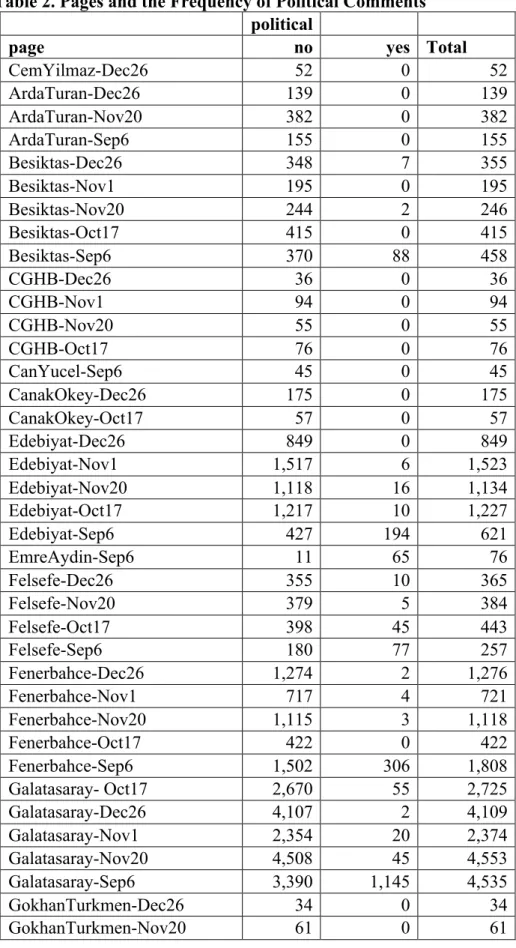
category had some political discussion but overall there were very few instances and were mostly restricted to a few comments rather than full-fledged conversations (see Table 2 for the
frequency of political comments). As I will discuss later this had a lot to do with the perceptions of users. In many cases, those pages are deemed inappropriate for political discussion.
c) Sports
known for their political positions like St Pauli of Hamburg known for its slogan “no more war, no more fascism.” Turkish teams’ rivalry is not akin to the one that used to be between FC Barcelona and Real Madrid under Franco in Spain when Real Madrid represented the authoritarian center and Barcelona represented socialist Catalonia.(Kuhn 2011)
There are different and multiple fan groups affiliated with big teams like Galatasaray, Fenerbahce and Besiktas. Overall political profile of the supporters of these teams is quite
diverse for these most popular and most commercialized teams. During the Gezi protests some of the fan clubs of these three major teams became quite visible. Some of the supporters
participated the protests with their team jerseys, which emphasized their fan identity as well as that identity’s presence in those events. However, this does not mean that supporters of these teams as a whole are situated at one side of the political spectrum.
Debates over the protests in the stadiums are cases in point to underline this political diversity. Some of the soccer fans continued their protest in the soccer games of these three clubs
by chanting “Everywhere is Taksim, everywhere is resistance” at the 34th minute of the games during the international matches as well as the first part of the national league in fall 2013. Çarşı fan group was the main organizer of protests among Besiktas fans9 which led to the
establishment of a pro-government Besiktas fan group, 1453 Eagles, and clashes during the games. GençFenerbahçeliler, the fan group that supported and participated Gezi protests, also had some backlash during their protests in the stadiums. Similarly, in Galatasaray matches the West and Southeast tribunes chanted pro-Gezi slogans which caused a reaction from another fan group Ultraslan. These tensions indicate the political diversity of the fans of these sports clubs.
CHAPTER 3: METHODOLOGY AND DATA COLLECTION
I collected Facebook comments between September-December 2012 by selecting five random days. (6 September, 17 October, 1 November, 20 November and 26 December) I located the posts made on these dates and downloaded all the comments made on these posts allowing for a week lag so that I did not cut an ongoing conversation. I downloaded 430 posts in total. The number of posts per page in a given day may vary between 0-21. There are 44 active pages in the top 50 list as indicated in Table 1. Among these 44 pages, 29 of them posted at least once in one of the five days selected. Most of the comments are made within the first two days but in some occasions the conversations continued for a couple more days. These dates did not coincide with a national holiday or a major prescheduled political event. However, this does not mean that there weren’t any major political events that might trigger political conversation.
On September the 6th, for example, a military armory exploded killing soldiers. On November 1, a hot debate on the news was the hunger strike of some of the Kurdish prisoners. These instances and their influence on Facebook discussions also reflect fast-moving political agenda on the news in Turkey, and helps us capture the “ordinary”(Yumul and Özkirimli 2000). In this sense it is more useful to use random date selection strategy rather than trying to focus on either politically loaded days or trying to avoid all major political events.
the content of the Facebook page (main motivation to like that particular page) I divided these pages into the categories of Entertainment, Sports, Overtly political pages.
The way comments are made on Facebook form nested data. Each comment is nested in a conversation and each conversation is nested in a post. Each post is nested in a public Facebook page and those pages are also nested in the categories I formed: entertainment, sports, overtly political. For coding this data, I took comments as the unit of analysis. I coded over 80.000 comments. The comments are coded if they are political. If they did not have a political content no further coding is done. Every comment is coded for each variable which means that one comment can be coded as civil, outraged, encouraging dissent and responding to someone all at the same time.
Reliability and replicability can be a serious concern in content analyses. Replicability means that different analysts can reproduce the same coding. A political science PhD student whose native language is Turkish helped me out to test this criterion. She coded a sample of 100 political comments and coded for all the variables. We reached 93% reliability score.
This paper employs a mixed methods approach. In order to demonstrate the relationships and general trends among and within the Facebook groups I make comment-level analysis and present post level percentages of variables. I also used logistic regression to tease out the effects of variables on deliberative talk. In the quantitative section, the unit of analysis is the comment in order to show the relationship among the characteristics of a comment and how these
characteristics differ among page types. In the qualitative section, on the other hand I would like to demonstrate the dynamics of conversations in order to highlight how we come across
CHAPTER 4: QUANTITATIVE ANALYSIS
Outcome Variable: Deliberative Talk
This variable is a combination of two variables; deliberation status and response. The discussions I presented in the literature review emphasize reciprocity and engagement with different ideas as the most important features of deliberation. Deliberation status focuses on whether political talk is encouraged, whether inclusive wording such as “my friend, my
sister/brother” is used, and whether a political point of view that is not supported by the page in general or the user in particular is encouraged to be presented. This measure focuses on
presentation of a dissenting view, not necessarily ideological differences.
Response variable on the other hand indicates whether that specific comment is made explicitly in response to a comment made earlier by another user. In doing so I measure if the comment is engaging with another position in a meaningful manner. The absence of explicit discouragement will be the key in my analysis of deliberative talk.
As a result, deliberative talk is a dummy variable that measures deliberative talk as a comment made in response to someone and whether it is not explicitly discouraging the presentation of different ideas.
a)Deliberation Status
also be encouraging if people are supported to discuss further or if an opposing ideological position is engaged with in an encouraging manner in response a comment made earlier. On the other hand, I consider negative content that alienates users from discussion, threats to ban someone or threats to leave the Facebook page as discouraging. This is important to distinguish deliberation and “echo chambers” as discussed in the literature.
b)Response
This is a dummy variable that indicates whether the comment is written specially in response to someone usually the user who wrote a comment previously in the same post.
Reciprocity is defined as one of the key elements of deliberation as discussed my many scholars including Freelon (2010).
Co-Variates
a)Civility
It takes the form of insulting or verbal fighting which affects the way the norms and the tone of conversation is established in conversations. It is coded as a dichotomous variable: 0 indicates incivility, 1 indicates civil talk. Most of the scholars studying deliberation and political talk consider civility a necessary condition but depending on the context uncivil language might also be used to encourage deliberative talk.
b)Us/Them Distinctions
There are two types of us /them distinctions. These distinctions might refer to an out- group (that is a group which is not part of the specific Facebook group in question.) It could also refer to an in-group pointing out the differences among the members of the Facebook group. The former is coded as 2 and the latter is coded as 1. The absence of any us/them distinction is coded as 0.
c)Outrage
Outrage is tied to the negative emotional responses that work against the ideal conditions of deliberative talk, which is usually attributed to a rational (i.e. not emotional) position as I discussed in the literature review. Outrage is defined as a “form of political discourse involving efforts to provoke visceral responses (e.g. anger, righteousness, fear, moral indignation) from the audience through the use of overgeneralizations, sensationalism, misleading or patently
inaccurate information, ad hominem attacks and partial truths about opponents, who may be individuals, organizations or entire communities of interest (e.g. progressives or conservatives) or circumstance (e.g. immigrants).” (Sobieraj and Berry. 2011) In this study presence of outrage is coded as 1 and its absence is coded as 0.
d)Strong Emotional Support
It is a dummy variable that indicates whether the comment contains a strong emotional support to the main line of the argument made in the initial post or strong emotional support to the political position taken by the group. The threshold for this variable is quite high but the
e)Criticism of the Facebook Page Administrator
This is a dummy variable coded for whether there is a direct criticism to the admin of the Facebook group for a certain post.
f)Rowdiness
This is a dummy variable that combines two variables I mentioned above: civility and outrage. The position I criticized in the literature review suggests that deliberative talk should not have the characteristics of outrage or incivility. Consequently, this variable combines the cases where there is incivility or outrage in a given comment. (no collinearity between variables) Since civility and absence of outrage are considered to be the tenants of rational-critical deemed necessary for the Habermasian understanding of deliberation, it is important to scrutinize how deliberative talk fare in relation to rowdiness.
Descriptive Analyses
Among the comments coded in this study roughly 10% is political. (see table 4) In the case of these political comments 84% were civil. Furthermore, 4% of the political comments is a comment of outrage, 2% contained strong emotional support for the Facebook group. 3% of the comments were explicitly encouraging and 6% were directly discouraging deliberative talk. Discouraging comments are twice the number of encouraging comments so in general one would come across discouragement of deliberative talk more frequently.
The table below shows the distribution of the characteristics of political comments among the Facebook page types. More than half the comments analyzed here are made on the entertainment pages yet those pages did not host many political comments. Sports pages on the other hand rank the second both in terms of the volume of comments in general and the
overtly political pages (57%) but not all comments made on the overtly political pages are political.
Table 4. Facebook Page Type Characteristics in Comment Numbers
Entertainment Sports Political Total
Political
no 40.026 (98%) 25.765(93%) 4525 (43%) 70316 (89%)
yes 924(2%) 1793(7%) 6111(57%) 8828(11%)
Deliberation status
discouraging 99(11%) 143(8%) 288(5%) 530(6%) neutral 793(86%) 1517(85%) 5699(93%) 8009(91%) encouraging 30(3%) 131(7%) 128(2%) 289(3%)
Outrage
no 583(63%) 1022(57%) 3864(63%) 5469(62%) yes 341(37%) 771(43%) 2247(37%) 3359(38%) Civil
no 120(13%) 141(8%) 1143(19%) 1404(16%)
yes 802(87%) 1652(92%) 4971(81%) 7425(84%) Us/them
none 777(84%) 1509(84%) 4773(78%) 7059(80%) ingroup 45(5%) 134(7%) 1099(18%) 1278(14%)
outgroup 100(11%) 153(9%) 238(4%) 491(6%)
Strong emotional support
no 888(96%) 1782 (99%) 4470(73%) 7140 (81%)
yes 36(4%) 13 (1%) 1639(27%) 1688 (19%)
Response to Someone
no 722(78%) 1299(72%) 5278(86%) 7299(83%) yes 202(22%) 495(28%) 833(14%) 1530 (17%) Criticism of Page
Admin
no 871(94%) 1494(83%) 5975(98%) 8340(94%)
yes 53(6) 299(17%) 136 (2%) 488(6%)
Deliberative Talk
No 774(84%) 1410(79%) 5492(90%) 7675(87%)
Yes 150(16%) 383(21%) 620(10%) 1153(13%)
Rowdy
No 560(61%) 1010(56%) 3668(60%) 5238(59%) Yes 364 (39%) 783(44%) 2447(40%) 3594(41%)
responsiveness is highest in sports pages (28%) while overtly political pages have the lowest percentage of responsiveness, half of what we see on sports pages (14%). Entertainment pages on the other hand are positioned somewhere in between with 22%.
Rowdiness on the other hand is quite a common feature among the Facebook types but sports pages still lead the page types with 44%. Strong emotional support for the page in the political comments is almost an exclusive characteristic of the overtly political pages. This might indirectly work against deliberation which I will discuss in the qualitative section.
Posts
Since the comments I analyze are also nested in the posts it is useful to look at how these characteristics are distributed as percentages at the post level. Table below demonstrates this distribution by including the posts with more than 25 political comments as an indication of a meaningful length of a conversation. With this threshold I have 58 posts (10 entertainment, 8 sports, and 40 political). This table confirms the same overall trend observed in the comment analyses.
Table 5. Posts with Significant Number of Political Comments with 25 Political Comments Threshold
type
Average # political
comments
%encouraging %rowdy %response %criticism(admin)
Entertainment Average 72 4 35 20 4
Political Page Average 147 2 30 14 3
Sports Page Average 203 8 45 28 4
The averages at the post level also confirm the point I made earlier. Average percent of explicit encouragement of different perspectives is highest on the sports pages with 8%
rowdiness is somewhat common on all the page types even if the sports pages host the highest percentage of rowdy comments.
The table above also suggests that the percentage of responsiveness on average is the highest in sports pages. People on sports pages responded to each other twice as much compared to overtly political pages. These findings suggest that we might find more deliberative talk on sports pages once a political conversation starts.
Rowdy Deliberative Talk
Depending on the context, incivility and even a discourse of outrage might go hand in hand with deliberative talk. In order to demonstrate this point I combined the variables of civility and outrage and called it rowdy. Below table demonstrates cross tabulation of rowdy with
deliberation status as well as deliberative talk.
Table 6. Rowdy Deliberative Talk
Deliberation Status
Sports Entertainment Political
Rowdy Non-rowdy Rowdy Non-rowdy Rowdy Non-rowdy Discouraging 120 (84%) 23 (16%) 85 (86%) 14 (14%) 238(83%) 50(17%) Neutral 623 (41%) 894 (59%) 277 (35%) 516 (65%) 2177 (38%) 3514(62%) Encouraging 38 (29%) 93 (71%) 2 (7%) 28 (93%) 27(21%) 101(79%)
Deliberative Talk
no 615 (44%) 795(56%) 312(40%) 462(60%) 2200(40%) 3292 (60%) yes 168 (44%) 215 (56%) 52(35%) 98(65%) 243(39%) 377(61%) Total 781 (44%) 1010 (56%) 364(39%) 558 (61%) 2442 (40%) 3665(60%)
pages were instances of rowdy talk that explicitly encouraged deliberation, only 1% of the comments in the overly political pages fell into this category.
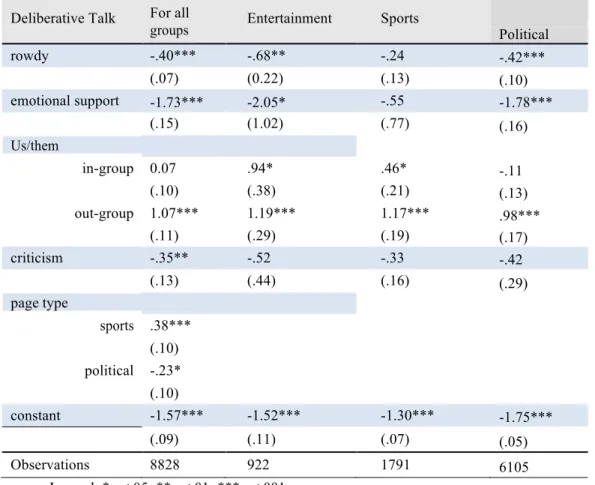
Furthermore, logistic regression results suggest that holding other variables constant rowdiness does not have a significant negative effect on deliberative talk on sports pages while it continues to have some effect on entertainment and political pages.
Table 7. Logistic Regression
Deliberative Talk For all
groups Entertainment Sports Political
rowdy -.40*** -.68** -.24 -.42***
(.07) (0.22) (.13) (.10)
emotional support -1.73*** -2.05* -.55 -1.78***
(.15) (1.02) (.77) (.16)
Us/them
in-group 0.07 .94* .46* -.11
(.10) (.38) (.21) (.13)
out-group 1.07*** 1.19*** 1.17*** .98***
(.11) (.29) (.19) (.17)
criticism -.35** -.52 -.33 -.42
(.13) (.44) (.16) (.29)
page type
sports .38*** (.10) political -.23* (.10)
constant -1.57*** -1.52*** -1.30*** -1.75***
(.09) (.11) (.07) (.05)
Observations 8828 922 1791 6105
Legend: * p<.05; ** p<.01; *** p<.001
Coefficients are presented above with standard errors in parentheses.
[I ran lrtest to test the fitness of the model. The additive model with all the variables I have (new deliberation variable, rowdiness, emotional support, usthem and criticism) was the best fit. Moreover, there weren’t any significant interaction effects between the co- variates.]
sport pages look like a more likely ground for deliberative talk. Overtly political pages on the other hand are less likely to host deliberative talk compared to the entertainment pages. If I change the reference group to overtly political pages, both entertainment and sports pages are shown to be more likely to host deliberative talk compared to political pages.
When I calculate the odds ratios based on the above table, the odds ratio of deliberative talk is 3 to 1 if there is out-group us/them distinction compared to making no us/them
distinctions. Strong emotional support on the other hand decreases the probability of deliberative talk considerably. The probability of deliberative talk is 0.17.
Most important finding for the comparison of logistic regression results for different page types (demonstrated in the last three columns of the above table) is related to rowdiness. As I have suggested in the above paragraphs that in general rowdiness seem to have a negative association with deliberative talk. However that association becomes insignificant in the sports pages. This confirms my second hypothesis. Rowdiness might not discourage deliberative talk depending on the groups contexts.
Table 8. Predicted Probability of Deliberative Talk by Page Group
Margins Standard Errors Entertainment .13*** .010
Sports .18*** .008
Political .11*** .004
non-political settings, especially sports. However, it is somewhat partially confirmed because the predicted probability of a comment to be encouraging deliberative political talk on
entertainment pages is not very different from the overtly political pages. As I discussed in the qualitative section, the difference between the sports and entertainment pages lies in the degree to which politics is considered to be an appropriate topic for conversation.
If the group identity is not based on politics and political talk is not looked down upon, we are more likely to see deliberative talk compared to overtly political pages. This is the case with sports pages.
In conclusion, based on the results of descriptive analysis and the logistic regression results there is support for two of the hypotheses presented in the conceptual framework. If there is a group identity that is not based on politics (as in the case of sports pages) and political talk is not deemed inappropriate we are more likely to see deliberative talk. This likelihood is
demonstrated in relation to overtly political pages (where the basis of the page is political) as well as the entertainment pages (the page is not based on a political position but political talk is not particularly encouraged)
CHAPTER 5: QUALITATIVE ANALYSIS
This part of the paper takes a conversation analysis approach. It approaches the data as a collaborative construction of conversation that is naturally taking place.(Heritage and Greatbatch 1986; Krippendorff 2012) The texts do not have a single meaning but are subjected to numerous perspectives, which are shaped through the conversation itself. In this respect the norms of the Facebook page, the norms attributed to the topic in that specific Facebook page as well as how the comments are embedded in conversations matter. However, this paper does not focus on the audience reception but rather focuses on the characteristics of conversations which are “context shaped and context renewing.”(Goodwin and Heritage 1990) The conversations in the Facebook pages determine and reflect the norms of talk on these pages and as I will demonstrate below there are mechanisms of compliance with those norms while being simultaneously challenged and negotiated.
When and How Appropriate it is to Talk about Politics
other teams. I have demonstrated in the quantitative analysis section that on soccer pages incivility does not correlate with a lack of deliberating talk.
There are mixed feelings among the Facebook users on sports pages about the
appropriateness of political talk but discussions continued even when some users indicated that they did not find it appropriate.
“Don’t be a partisan on a soccer page. This is the page of Galatasaray. If you want to do
politics go to the page of CHP, go to the page of AKP, go to the page of MHP. You are
making foolish comments. You will accuse the prime minister even when you slide and
fall. [even when it is just an accident] It is enough to make a saint swear. Be
reasonable!”12
Here the soccer club’s page is not seen as an appropriate place to comment on politics. Still, despite this comment some of the users continued to discuss politics on the same post and they did not suffer any retribution. This might have a signaling effect on other users. Continued political discussion even in the presence of such a criticism would indicate that a lot of people don’t agree with that comment and it is ok to talk politics on that specific page.
An example from Entertainment pages also demonstrates instances where a page’s administrator can also start a political conversation and yet most of the users might choose to ignore the political content. On October 17, an entertainment page that specialize on jokes, funny photos and videos post a joke with the title of “if oil/gas prices go up like this...”. The post was a picture of an empty highway where there are two silhouettes over looking the picture: a man and a girl. The man tells the child “years ago when oil prices were below 10 TL there used be cars going down this road.” This triggers some political conversation about price increases,
comments (22) the conversation on the post turned into quotidian greetings and chat among the users.
These examples illustrate an overall trend I observed in the conversations I analyzed. Most of the users consider entertainment pages as inappropriate venues to discuss politics. Political conversations might not be picked up or in some cases just declared to be inappropriate. However, in sports pages there were mixed feelings and mixed practices. When a political issue is brought up in most of the instances I analyzed people would respond (though not always). Especially when the issue is a contentious and sensitive one, some users would also voice their concerns that the sports pages are not the place to do partisan politics. However, even when there were such interventions conversations continued in a heated fashion, which indicates an
openness to discuss politics.
Us/Them Distinctions and Inter-Ideological Conversations
There are different types of in-group us/them distinctions. In the first type the in-group distinction might be made in order to maintain the group unity. “This is how we are.” On the other hand, in-group us/them distinctions might also be made by highlighting the differences among the members of the in-group. The way these distinctions are used also give us clues about the nature of inter-ideological conversations.
In certain instances of boundary drawing, “us” could refer to a within group differences. It might mean Turkish Galatasaray fans versus Kurdish Galatasaray fans or pro-AKP Galatasaray fans vs anti-AKP Galatasaray fans. Again in reference to armory explosion and the claims that PKK might be the culprit, discussions about the meaning of being Turkish and Kurdish arose.13 This outburst was followed by further discussions about the “Kurdish issue” as a side
families of the soldiers who died in the explosion. This highly controversial conversation did not lead to threats of banning from the page even if the tone of the conversation remained to reflect heightened emotional responses and outrage.
In-group solidarity might also be invoked to appease what is perceived to be polarizing discourses and encourage deliberative talk:
“Why the word Tanrı is bothering you friends? When you say Allah does anyone put
pressure on you to not use Allah. Not everybody has to think the way you do??”14
In a similar fashion who “we” are as Galatasay fans or as Turkish citizens can be invoked to overcome the ongoing discussion threaten the solidarity of the group:
“Well, brother, there are non-Muslims among the martyrs as well and they use Tanrı,
why are you such bone heads, ok we say Allah but they say Tanrı, we are all talking
about the same creator.”15
Intra-ideological conversations on the other hand might show themselves on overtly political pages. On the page of Mehmetcik, one can observe a very frequent usage of
“kardesim”(brother/sister) especially in nonpolitical posts. Common denominator in this page is the experience with the mandatory military service: these are either people who have done or are currently doing their military service or have relatives who are conscripted. The overall tone of the talks is very strongly Turkish nationalist and the most common outside group (which is usually mentioned with a discourse of outrage) is the Kurdish separationist group of PKK. In one of the conversation threads on September 6, people discuss their opinions of nationalist policies of the two right wing parties, MHP and AKP:
Mhp Mhp that is all you mention. We have seen both MHP and AKP. Martyr after
martyrs. Without discovering the real truth you took over all the police and the military.
However, even intra-ideological conversations might be deemed inappropriate in overtly political pages and comments can be deleted:
“You know very well how to delete the comments you don’t like. I didn’t hold the
opposition party responsible for what has happened. This is not something you can
mention and pass with a couple of words. If needed, you will take the millions who voted
for you to the streets. CHP is not the place to laze around.”17
This is an indication of a comment deleted before, on the grounds of its intra-ideological content even if it was not a direct attack on the party in question. As can be seen in these
examples, us/them distinctions are made in quite an intricate way. Both in-group and out-group references might be used to encourage inter-ideological conversations. Likewise they might be used to discourage such conversations as well. The way these distinctions are made might signify inter-ideological or intra-ideological stances and may indicate whether those positions are
welcome in a given conversation.
Indirect Discouragement of Deliberative Talk
Indirect discouragement might take the form of strong emotional support especially in overtly political pages. One example is the conversations that take place in Prime Minister’s page. On November 1st there were two posts about Prime Minister’s meeting with the Turkish president and German Chancellor Angela Merkel. There were no visible criticisms but the comments were marked by euphoria and strong emotional support to the Prime Minister.
“Look at the divine light on their faces, my friends. Their faces shine not like the moon
but like the sun in August.” [indicating that it burns very brightly as a sign of divinity]
Consequently, even if there is some ideological fragmentation on the overtly political pages it is mostly in the form of intra-ideological questioning. In some cases even this intra- ideological questioning might be discouraged by the dominance of strong emotional support for the ideological line or the party leader. There is not much room for inter-ideological
conversations.
Rowdy Deliberation on Sports Pages
In my discussion of us/them distinctions I already suggested how group identity might be deployed for deliberative talk. In one of the instances I mentioned above a user refer to his fellow fans as “brother/sister” and “bone heads” at the same time because they made us/them
distinctions earlier in such a way as to discourage a certain political position.
“Well, brother, there are non-Muslims among the martyrs as well and they use Tanrı, why are you such bone heads, ok we say Allah but they say Tanrı, we are all talking about the same creator.”
This is one of the examples of how rowdiness could be part of deliberative talk that encourages inter-ideological dialogue and engages with different political positions.
These types of comments especially come up when uncivil and/or outraged discourse threaten the perceived unity of the group. On Besiktas’s page, as a response to the heated discussions about who to blame for the explosion in the military armory when a user called another one stupid [which might have silenced that user] another fan responds:
In the same conversation, there were also instances of a discourse of outrage that started a parallel conversation about what the fans themselves can do about the situation:
“What can Besiktas do for the martyr, in other words what can we do, can you tell me? Just condolences and condemnation, I am sick and tired of hearing these two words. We no longer have a heroic Turkey but a helpless Turkey.”
Similar conversations occurred in Galatasaray’s and Fenerbahce’s pages as well. For example, on Fenerbahce’s page, in one of the instances some people were discussing the organization of a symbolic march for the dead soldiers. Some others were blaming the
government oversight when a user made the following comment: “God willing, this nation will wake up [from ignorance]” which received a skeptical and yet positively engaging response:
“You wish my brother/sister! You [keep] wish[ing] as long as this government stays in power!”
This is a clear case of outrage in the form of overgeneralization and reflection of anger and yet this comment was used in an engaging manner which contributed to the encouragement of deliberative talk.
In conclusion, in this section I tried to show the complexity of discursive boundaries established, maintained and reproduced on the Facebook pages. Depending on the context and the norms of acceptable behavior on a Facebook page discourse of outrage, incivility and
CHAPTER 6: CONCLUSION: CLUB MODEL AND FACEBOOK PAGES
Scholars who study deliberative democracy put a lot of emphasis on the importance of political talk. The way people talk about politics shape and reflect how they think about politics as well as how they practice politics. Talking politics is also a discursive act, which is closely tied to the discussions of political engagement. There is, however, an important concern when it comes to the analysis of political talk that people talk about politics with like-minded individuals creating echo chambers, the boundaries of which is heavily guarded by group dynamics. Since deliberative talk occurs quite rarely, do we expect to see it diminish further as a result of echo chambers?
Maybe not. I argue that we can analyze the way political talk takes place on Facebook pages like a club model. Influential insiders shape the conversation and create/enforce the norm of conduct through their practices. Moreover, just like different types of clubs, they are also quite different in how they accept outsiders to become insiders. Surprisingly, from the perspective of political talk, the pages that actually are related to real clubs (sports clubs pages) are the ones that seem to be the most inclusive.
determined by the members who are already in the club. Vertically, in these latter types of issue areas the interaction is concentrated within the club even if that club is part of a larger
organization. This has a horizontal effect as well. Even in the national domestic politics of the members of the organization, the club carries a lot of weight on the specific area because the decision the club makes is presented to the citizenry as a fait accompli.
The Facebook pages I discussed above work quite like the club model. These pages are open to public; they are open to all Facebook users. There are no formal rules that would turn them into clubs in the sense that participation is not subjected to predetermined criteria. However, if we look closely at the way interactions occur, the regulars of the page indeed turn them into clubs where those who do not comply with a certain criterion is heavily looked down upon and discouraged to participate in different ways.
As the scholars who support echo chambers argument suggest, deliberative talk is quite rare especially in overtly political pages. However, we can also find deliberative talk in non- political pages. Sports pages are more likely grounds of deliberative talk than the overtly
political ones when political conversations are picked up. As I have discussed earlier sport pages do not represent a dominant political ideology. They are not affiliated with a certain political party. The discussions that occur on these sports pages reflect inter-ideological conversations much more than the overtly political pages. In contrast to the focus in the literature, the analysis suggest that we are more likely to find deliberative political talk in sports pages even if
deliberative talk is rare to come by in general.
What type of deliberative talk we see is the next question. When we allow deliberative talk (that encourages, tolerates and engages with inter-ideological questioning) to reflect
sports pages. That has a lot to do with the accepted norms of behavior on these pages. The tendency in the literature to insist on the criteria of civility and rationality in political discussions is an important constraint on the analysis of everyday life political talk because it disregards the possibilities and repertoires of speech acts in different everyday life contexts. As I have
demonstrated in the previous sections we can also see rowdy deliberative talk that would include elements of incivility and outrage and yet would still encourage inter-ideological questioning.
In other words, we are more likely to come across deliberative political talk on the pages that are not based on politics exclusively if political talk is seen appropriate to be held. In the cases I analyzed sports pages fit the bill unlike the entertainment pages. Due to the nature of talk on those pages we are also more likely to see rowdy deliberative talk, which makes inter-
ideological questioning possible unlike the overtly political pages. I emphasized the importance of context throughout this paper. Considering the fact that the perception of Turkish political scene is quite polarized, I would expect to see deliberative talk in different political contexts as well.
Nevertheless, there are certain limitations to this study. Due to privacy concerns I could not gather data on the Newsfeed flows which might give us clues about the nature of political talk a user is exposed to in her own Facebook circle (Facebook friends.) If we were able to monitor Facebook Newsfeed activities we could have also seen which posts a user choose to respond to. That exposure/ response dynamic as well as the type of posts the user herself creates could also provide an additional context of political talk, which goes in parallel to the political talk on public pages.
period of time. Under which conditions political talk starts in non-political settings? In doing so, scholars can analyze what sorts of topics trigger political talk and how the tone of political talk differs in relation to the topics of discussion. In this paper I captured a fragment of political talk in relation to unfolding events. I demonstrated that we see deliberative political talk in non- political venues. The type of deliberative talk may differ in different Facebook pages based on the norms set by the group following a club model type of dynamic. Still the question remains to be explored as to what type of deliberative talk is more likely to occur in relation to group solidarity and the political topic.
In this paper I also did not make any claims about the degree of solidarity in these pages. Is there a difference between the strength of solidarity found in sports pages vis-a-vis
entertainment pages? Does it affect the acceptability of political talk? If there is a strong group identity that is not based on politics (as in the case of sports pages) we might be more likely to see deliberative talk. Perhaps in-group solidarity is not as strong on entertainment pages compared to the fandom of sports clubs. What also remains to be seen is how deliberative political talk fares when there is no strong group identity and the basis of the page is political. Unfortunately my data did not provide such a case to be analyzed.
APPENDIX
Table 1. Top 50 Facebook Pages in Turkey
Rank Likes Name category description
1 7,601,828 Galatasaray sports sports club (soccer) 2 6,118,335 Fenerbahçe sports sports club (soccer)
3 3,754,130 Beşiktaş sports sport club (soccer)
4 3,649,846 Okey entertainment game
5 3,734,061 Emre Aydın music singer
6 3,691,187 Cem Yılmaz entertainment comedian
7 3,529,068 Atatürk politics first president of the Republic of Turkey
8 2,925,498 MaNga music music band
9 2,850,958 Her Gün 1 Yeni Bilgi entertainment trivia
10 2,945,796 Hz. Muhammed religion prophet [Islam] 11 2,644,632 Çok Güzel Hareketler Bunlar entertainment comedy show
12 2,676,736 Mehmetçik politics support for soldiers/army 13 2,478,458 İzlesene.com entertainment TV series & movies 14 2,490,798 Alex de Souza sports soccer player 15 2,280,106 Beyazıt Öztürk entertainment comedian
16 2,359,640 Sıla music singer
17 2,291,366 Edebiyat kulübü literature literature club-daily quotations
18 2,500,669 Dr.Mehmet Oz health doctor
19 2,048,888 Arda Turan sports soccer player
20 2,304,901 Aşk Tesadüfleri Sever entertainment movie
21 2,054,668 Volkan Konak music singer
22 1,968,676 Namaz religion praying
23 1,904,668 Avea commercial mobile operator
24 1,825,439 Engelliler için Elele campaign campaign to support the disabled 25 1,876,392 Kurtlar Vadisi entertainment TV series
26 1,831,495 Felsefe Kulübü philosophy philosophy club-daily quotations 27 1,779,799 Kurtlar Vadisi Pusu entertainment TV Series
28 1,678,671 Recep Tayyip Erdoğan politics Prime Minister 29 2,155,897 Beren Saat entertainment actress
30 1,540,613 Müzik Keyfi music music
31 1,594,920 Teoman music singer
32 1,517,810 Can Yücel literature poet
35 1,577,958 Pis Yedili entertainment TV show 36 2,042,516 Turkcell commercial mobile operator 37 1,375,598 Kemal Kılıçdaroğlu politics leader of the main opposition party-CHP 38 1,348,358 komik ve ilginç videolar entertainment funny videos
39 1,547,776 Tuba Büyüküstün entertainment actress
40 1,369,353 ultraaslan sports soccer fan club
41 1,266,516 Komedi Dükkanı entertainment comedy show
42 1,263,559 Çikolata food chocolate
43 1,338,578 Ersin Korkut entertainment comedian
44 1,504,988 Nokia Türkiye commercial mobile phone company 45 1,457,472 hacı kop devir kopma devri entertainment funny videos
46 0 Türk Silahlı Kuvvetleri politics Turkish army
47 1,269,490 Gripin music music band
48 1,648,590 Volkswagen Türkiye commercial automobile company
49 1,256,436 Halil Sezai music singer
50 1,264,754 Gökhan Türkmen music Singer
Source: http://www.socialbakers.com/facebook-pages/turkey/ (ranking 29 August 2012, number of likes 20 November 2012)
The page ranking 18 on the list will not be considered in the analysis because the page is categorized from Turkey due to the ethnicity of the person but it is closely related to an
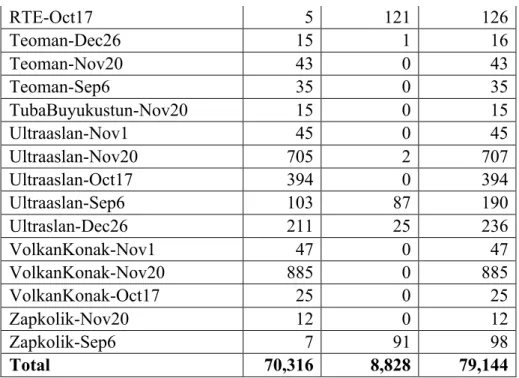
Table 2. Pages and the Frequency of Political Comments political
page no yes Total
CemYilmaz-Dec26 52 0 52
ArdaTuran-Dec26 139 0 139
ArdaTuran-Nov20 382 0 382
ArdaTuran-Sep6 155 0 155
Besiktas-Dec26 348 7 355
Besiktas-Nov1 195 0 195
Besiktas-Nov20 244 2 246
Besiktas-Oct17 415 0 415
Besiktas-Sep6 370 88 458
CGHB-Dec26 36 0 36
CGHB-Nov1 94 0 94
CGHB-Nov20 55 0 55
CGHB-Oct17 76 0 76
CanYucel-Sep6 45 0 45
CanakOkey-Dec26 175 0 175
CanakOkey-Oct17 57 0 57
Edebiyat-Dec26 849 0 849
Edebiyat-Nov1 1,517 6 1,523
Edebiyat-Nov20 1,118 16 1,134
Edebiyat-Oct17 1,217 10 1,227
Edebiyat-Sep6 427 194 621
EmreAydin-Sep6 11 65 76
Felsefe-Dec26 355 10 365
Felsefe-Nov20 379 5 384
Felsefe-Oct17 398 45 443
Felsefe-Sep6 180 77 257
Fenerbahce-Dec26 1,274 2 1,276
Fenerbahce-Nov1 717 4 721
Fenerbahce-Nov20 1,115 3 1,118
Fenerbahce-Oct17 422 0 422
Fenerbahce-Sep6 1,502 306 1,808
Galatasaray- Oct17 2,670 55 2,725
Galatasaray-Dec26 4,107 2 4,109
Galatasaray-Nov1 2,354 20 2,374
Galatasaray-Nov20 4,508 45 4,553
Galatasaray-Sep6 3,390 1,145 4,535
GokhanTurkmen-Oct17 16 1 17
Gripin-Dec26 24 0 24
Gripin-Nov1 27 0 27
Hacikop-Dec26 2,261 9 2,270
Hacikop-Nov1 7,347 158 7,505
Hacikop-Nov20 4,875 0 4,875
Hacikop-Oct17 8,708 46 8,754
Hacikop-Sep6 2,075 22 2,097
HalilSezai-Nov1 30 0 30
HalilSezai-Nov20 31 0 31
Izlesene-Dec26 702 0 702
Izlesene-Nov20 241 0 241
Izlesene-Oct17 40 0 40
Izlesene-Sep6 1,639 154 1,793
Kilicdaroglu-Dec26 8 106 114
Kilicdaroglu-Nov1 5 117 122
Kilicdaroglu-Nov20 7 247 254
Kilicdaroglu-Sep6 3 490 493
KurtlarVadisi-Dec26 236 4 240
KurtlarVadisi-Nov20 153 0 153
KurtlarVadisi-Sep6 206 0 206
Manga-Nov1 33 0 33
Manga-Nov20 14 0 14
Mehmetcik-Dec26 692 977 1,669
Mehmetcik-Nov20 2,392 1,672 4,064
Mehmetcik-Oct17 361 490 851
Mehmetcik-Sep6 703 885 1,588
Namaz-Dec26 20 0 20
Namaz-Nov1 36 0 36
Namaz-Nov20 73 25 98
Namaz-Oct17 109 137 246
Namaz-Sep6 66 14 80
Okey-Dec26 432 0 432
Okey-Nov1 302 0 302
Okey-Nov20 1,407 10 1,417
PisYedili-Dec26 675 0 675
PisYedili-Oct17 195 0 195
PisYedili-Sep6 137 0 137
RTE- Nov1 32 492 524
RTE-Dec26 8 65 73
RTE-Oct17 5 121 126
Teoman-Dec26 15 1 16
Teoman-Nov20 43 0 43
Teoman-Sep6 35 0 35
TubaBuyukustun-Nov20 15 0 15
Ultraaslan-Nov1 45 0 45
Ultraaslan-Nov20 705 2 707
Ultraaslan-Oct17 394 0 394
Ultraaslan-Sep6 103 87 190
Ultraslan-Dec26 211 25 236
VolkanKonak-Nov1 47 0 47
VolkanKonak-Nov20 885 0 885
VolkanKonak-Oct17 25 0 25
Zapkolik-Nov20 12 0 12
Zapkolik-Sep6 7 91 98
Total 70,316 8,828 79,144
Table 3. Political Comments by Dates and Facebook Page Types
Date Entertainment Sports Political Total
December 26 24 36 1148 1208
November 20 31 52 2217 2300
November 1 164 24 609 797
October 17 102 55 748 905
September 6 603 1626 1389 3618
ENDNOTES
1 Earlier versions of this paper has been presented in American Sociological Association
Annual Meeting in New York (2013) and European Consortium for Political Research Meeting, Bordeaux, France (2013). I would like to thank UNC European Union Center of Excellence for the conference travel grant.
2“We have been sadly informed that as a result of an explosion in Afyonkarahisar, 25 of
our soldiers became martyrs and 4 of our soldiers have been wounded. We ask mercy from God for the martyrs, wish quick recovery for the wounded.”
Afyonkarahisar'da meydana gelen patlamada, 25 askerimizin şehit olduğunu, 4
askerimizin de yaralandığını büyük üzüntüyle öğrenmiş bulunuyoruz. Şehitlerimize
Tanrı'dan rahmet, yaralı asker ve sivil vatandaşımıza acil şifalar dilerken, şehit
ailelerine başsağlığı ve sabır dileriz.
3 http://www.socialbakers.com/facebook-statistics/turkey [retrieved on 13 February 2014] (Turkey ranked seventh on October 4, 2012 according to same website)
4 http://www.pewglobal.org/2014/02/13/emerging-nations-embrace-internet-mobile-technology/
5 http://www.pewglobal.org/2014/02/13/emerging-nations-embrace-internet-mobile-technology/
6The ranking is taken from socialbakers which is a marketing company focusing on the
7Not all pages make posts, they might be dormant so the pages I have data on and the
complete list of top 50 are not the same. For further discussion, please see the data section of the quantitative analysis.
8Some of the most interesting discussions under study in this paper occurred in those
pages in the form of rowdy deliberation. All three of the major teams I discuss here were established at the turn of the century (Besiktas 1903, Fenerbahce 1908 and Galatasaray 1905) in the Ottoman Empire. In the Early Republican period soccer was an elite sport. Galatasaray and Besiktas started as gymnastic clubs and the former was restricted to the students and the alumni of Galatasaray high school. However, this elite basis of the early days of the sports teams changed dramatically over the 20th century. The membership to these sports clubs no longer requires any other affiliation. They are mainly known for their soccer teams, which are referred as the “big three” due to their success in the national soccer league (they almost have a monopoly on the championship in the last decades). Soccer and fandom is mostly discussed in relation to the identity building performances (Gigone and Hastie 1993; Maass and Arcuri 1996; Schulz-Hardt, Frey, Lüthgens, and Moscovici 2000; Wittenbaum, Hubbell, and Zuckerman 1999),
distinct identity positions taken by certain fan groups. (Erhart 2013; McManus 2013)There are also a few studies which look at soccer and its fans as a reflection of broader societal differences and conflicts(Gastil 2000; Goodin and Dryzek 2006) or the intersection of oppositional politics, protest and soccer(Edwards and Smith 1996; Gaines, Kuklinski, Quirk, Peyton, and Verkuilen 2007; Redlawsk 2002; Taber and Lodge 2006).
934 is the traffic code of Istanbul which symbolizes the slogan used by some of the fans
during the Gezi Park protests: “Istanbul United.” It is very significant since there used to be violent clashes and bloodshed between the fans of the “big three” especially in the 1990s. I also need to open a parenthesis here specifically for Carsi fan group. A in Carsi’s name is written with the anarchist symbol and it also incorporates some leftist discourses and causes. Its slogan is Carsi, her seye karsi. (Carsi, against everything). In line with the Ultra movement they are also against the commercialization of soccer. However, the leftist slogans and leftist positions in politics (through the banners and slogans they use in the games) are not always consistent and sometimes it blended with ultranationalist and religious discourses. Here are a few references on the political tenstions in the tribunes and how some soccer fans protested by chanting anti-government slogans and how some other fans opposed it.
http://www.bbc.co.uk/turkce/spor/2013/09/130923_bjk_gs_tepkiler.shtml (access 26 January 2014);
http://skorer.milliyet.com.tr/kadikoy-de-tribunler-karisti-/fenerbahce/detay/1754326/default.htm (access 26 January 2014);
http://skorer.milliyet.com.tr/tt-arena-da-siyasi-
10Ultras refer to a broader movement that is named in Italy in 1950s and influenced
European soccer fan culture in 1980s, 1990s and 2000s. Ultras are defined as a devoted fan group mainly known for colorful stadium choreography in support of their team, sometimes associated with fanaticism and hooliganism. However, most ultra groups declare that they embrace the anti-racist, anti-nationalist and anti-capitalist values since racism and capitalism ruin the game, which is supposed to be a game for all. (Kennedy and Kennedy 2013).
11A similar campaign was initiated on Twitter. It drew support from some Beşiktaş fans
with the campaign called “BEŞİKTAŞlı adının başına TC Yazıyor.” (Besiktas supporters write TC infront fo their names) Based on the references used in the calls for that
campaign the discourses was along neo-Kemalist lines. The removal of TC was
considered to be a symbolic attack to the republic by AKP administration. On the Twitter campaign members of Çarşı were quite visible in their calls.
12Uncivil slogans, especially cursing, and violence in the stadiums has been a concern of
136 September 2012. Galatasaray. “bu futbol sayfasinda particilik yapmayin burasi
galatasaray sayfasi siyaset yapacaksan git chp nin akp nin mhp nin sayfasina aptal aptal
yorumlar
yapiyosunuz ayaginiz kayip dusseniz basbakan yapti diyeceksiniz insani dinden imandan
cikarmayin el insaf ya”
14Bir damla göz yaşı döktünüz mü, Roboski de Battaniyelere sarılmış, katır ile insanların
karışmış yanık etlerini görünce? ozeman roboskideki 33 gencecik dah cocuktular kimse buna tepki ver ede türk halki gözünü kapati medayallar sustu sizin o basbakniz cikti medaya karsisina dedi yaslnis anlasilmama oldu hic bir ölüm kaza deyil onur almimisin herneysen herseyi gerillad bulmayin önce kendi devletinizin derin pisliklerini arstirin ondan sonar gel burda artislik yap daha kac gün eval sizin devletiniz dedi bir kac asker öldüdiye keyfimizi bozamyiz meclisi topliyamayiz niye demsin cünkü ölen asker onun evladi deyildi onun yüreyi yanmamis öyle der onun icn birakin bu fasa fiso lafllari vatn sag olsun didiginiz sürec dah cok canllar yanacak BIR TÜK CIKSAYDI DESEYDI BARIS ISTYIYORUZ BU GÜN HIC BIR ANNE AGLAMIYACAKTI... ????
15“tanrı cumlesı neden sizi rahatsiz ediyo arkadaslar sizler alah dediyinizde kimse alah
16“tanrı cumlesı neden sizi rahatsiz ediyo arkadaslar sizler alah dediyinizde kimse alah
demeyin diye baskı yapiyormu sizlere. herkes sizin gıbı dusunmek zurunda deyil.???” (Galatasaray, September 6)
17mhp mhp takmışsınız mhp ye akp nizide gördük şehit üstüne şehit aslını gerçeğini