THE SOUND OF THE OCCUPATION: STATE PACIFICATION AND SANITIZATION OF FAVELA CULTURE IN RIO DE JANEIRO, BRAZIL
Seana Monley
A thesis submitted to the faculty of the University of North Carolina at Chapel Hill in partial fulfillment of the requirements for the degree of Master’s of Arts in the Department of Anthropology.
Chapel Hill 2014
ABSTRACT
SEANA MONLEY: THE SOUND OF THE OCCUPATION: STATE PACIFICATION AND SANITIZATION OF FAVELA CULTURE IN RIO DE JANEIRO, BRAZIL
(Under the direction of Charles Price)
In preparation for the World Cup in 2014 and the Olympics in 2016, Police Pacification
Units (UPP) are being installed in the favelas, or shantytowns, of Rio de Janeiro in order to end
drug trafficker rule and to clean up the look and reputation of the city. After witnessing
residents’ dissatisfaction with the pacification project in the favela Rocinha, this paper addresses
why favela community members are concerned about the loss of community trafficking groups.
Traffickers provide services to communities, including security and funk dances--an essential
part of favela community life and cultural memory. Funk's performance highlights the unique
culture of the favela, rejecting the hierarchy of mainstream Brazilian society and promoting a
local culture and system. State occupations have led to the shutdown of many trafficker provided
ACKNOWLEDGEMENTS
I would like to thank my committee for their support and guidance during this process. I am so fortunate to work with people who make me feel confident and inspired to write each time we meet. To Yair, for always encouraging and supporting me in everything I do. Most
TABLE OF CONTENTS
LIST OF FIGURES...vi
LIST OF ABBREVIATIONS...vii
INTRODUCTION: FAVELA PACIFICATION AND COMMUNITY RESPONSE...1
Socio-Historical Context: Life in the Crossfire of Drug Traffickers and the Police...3
The Evolution and Criminalization of Funk Culture...5
METHODOLOGY AND RESEARCH DESIGN...9
Controlling the Internal Colony...11
Productive Cultural Memory...14
The Threat of Music: Outlaw culture in U.S. Hip Hop and the Criminalization of Funk...16
RESEARCH FINDINGS...19
Funk Cultural Memory and Attempted Erasure...28
The Day Funk Died: The "Post-Crisis Sound"...33
Pen to Paper: Recording the Past and Writing the New Wave Funk Movement ...37
Post-Occupation Rocinha ...43
CONCLUSION...50
LIST OF FIGURES
Figure 1.1 - Where would you prefer to pass?...11
Figure 4.1 - Club Emoções Flyer for Baile da Paz...30
Figure 4.2 - Club Emoções Flyer for Baile do Brasileirão...31
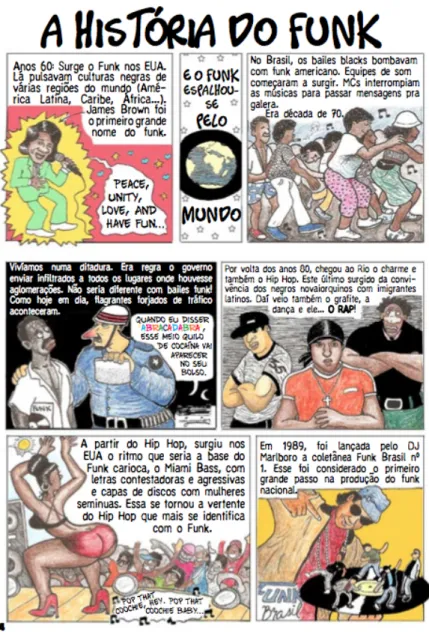
Figure 4.3 - The History of Funk...38
LIST OF ABBREVIATIONS
Introduction: Favela Pacification and Community Response
On November 10, 2011, Antônio Francisco Bonfim Lopes, the most wanted drug trafficker of Brazil and boss of the favela Rocinha, was captured after fleeing the police occupation of his community. In preparation for the world cup in 2014 and Olympics in 2016, the Brazilian government has begun a full assault against the drug trafficker controlled favelas, or shantytowns, scattered throughout Rio de Janeiro. After a combined effort of Elite Squad, army, and civil and military police takeovers, Police Pacification Units (UPP), or Unidade de Polícia Pacificadora, are being installed in communities to end drug trafficker rule and to clean
up the look and reputation of the city. Rocinha is the 19th favela that the state has been able to "successfully" occupy in Rio de Janeiro since the beginning of the operation in 2008. Police set up stations outside of the favela Rocinha on November 9, 2011, and occupied the community on November 13. The state claimed that favela funk dances and music were intrinsically linked to drug trafficking culture. This is, in part, due to the funding that gangs provide to pay for some community funk dances as well as the one style of funk, proibidão, that platforms gang power and success. The pacification plan included immediately enacting new regulations that restricted all community funk culture, arguably the most essential community gathering and largest sub-culture within Brazil. Why aren't favela residents satisfied with the government pacification? Favela residents want security, peace, social services, respect, and to have the opportunity to
contribute local knowledge to the reconstruction of their community order, services, and culture. The government and many non-favela residents believe that pacification will free favela
rather than improve conditions for residents in favela’s like Rocinha, the pacification and repression of traffickers has lead to increased crime and violence between residents, a rise in police violence, and a gang war. Many favela residents are protesting and questioning the intentions of the pacification programs as their community seems to be unraveling into violent chaos. Before Rocinha's pacification, many community members supported drug traffickers because they enforced strict laws to control crime in the community, provided social services, and allowed for community members to co-construct favela rules and activities specific to residents' needs and desires. Without an understanding of the intricate relationships between community members and favela residents turned gang members as well as the legacy of violence between police forces and favela residents, we will not be able to understand the needs and desires of community members and the work that will be needed to provide communities with a better option for security and welfare than trafficking gangs. I argue that most of Rocinha
residents are unsatisfied with the pacification process and UPP presence in their community, and prefer the previous system of drug trafficker control for two reasons. First, community members believe that drug traffickers were able to provide better social services, community security, solved and mediated community issues, and respected residents more that the UPP officers. Second, many residents believe that they are suffering from a state imposed social cleansing under the pacification. The government enacted strict rules limiting and prohibiting funk music and dances in the favela, making it difficult to partake in cultural activities that are central to favela culture and identity.
to favela community members as a countercultural creation within the complex social structures of Brazilian society.
Socio-Historical Context: Life in the Crossfire of Drug Traffickers and the Police
The violence and repression of Rio’s favelados did not begin with the rise of the drug trade in the 1980s; instead, it developed from a number of historical situations, including a history of repression in Brazilian society beginning with slavery and stretching through the
military dictatorship of 1964-1985. Since the creation of the favelas near the late 18th early 19th centuries, police repression has been a consistent force in the lives of favelados. The Brazilian government granted no support or reparations to freed slaves after enslavement’s abolition in 1888. Many of these freed slaves, in turn, moved from the countryside to city centers, where they hoped to find work. Unable to afford housing in the cities, they squatted land on the cities’ outskirts, developing communities that clung vertically to the surrounding hills. These communities became the favelas.1
Afro-Brazilians continue to make up the majority of the population.
Harsh repression of African-derived traditions continued long after the abolition of slavery, and was mainly concentrated in the favelas. For example, in the late 1800s favelas were regularly raided in order to shut down samba parties; this continued until samba became popular among the affluent class, and was eventually declared the national dance.2
Nearly every cultural form derived from African roots has been illegal at some point in Brazil’s history. For instance, capoeira, the martial arts dance developed by slaves, was illegal and repressed after slavery until
its popularization in the 1930s and 1940s as a national art.3
Likewise, articles in the 1890 Brazilian penal code outlawed African-based religions, classifying them as sorcery and
1 Guillermoprieto: 29.
2 Guillermoprieto: 8.
dangerous medical practice.4
All of these prohibitions arose out of a discourse that sees the celebration of African heritage—rather than that of a more overarching Brazilianess—as counter to the nationalistic ideology.
This prejudice since the times of slavery continues. Since the construction of the first favelas, police have regularly raided these communities, always using the excuse of stopping
these Afro-centered practices. These raids continue today, because the attitudes against
favelados and their culture remain fundamentally unchanged. African cultural practices continue
to be seen as challenging unless they are appropriated as national traditions and their rebellious themes are muted.
Continued repression of the favelas led to the control that traffickers have over the favelas of Rio de Janeiro. The organization and consolidation of drug trafficker power is due in
part to the repression of leftists during the military dictatorship that lasted from 1964-1985. During the military dictatorship, leftist political prisoners were put in jail with common criminals, and began to educate the criminals about socialist values.5
The criminals identified with the solidarity of the leftist prisoners and began to think collectively and organize inside the prison. It was here that the Commando Vermelho (Red Command) was created; it is now the largest and strongest drug-trafficking faction in Rio de Janeiro. The original philosophy of the group was “paz, justiça, e liberdade,” or peace, justice, and liberty—to live in peace while in prison, to have social justice for all, and to get out of prison at any cost. The group began to seek vengeance for crimes committed by guards on prisoners and would retaliate against prisoners who preyed on other inmates, with the final goal of providing for the poor what the government would not.6
By 1987, Commando Vermelho was well established as a faction and able to organize prison breaks, provide economic support for family members of prisoners, and grant new identities and income opportunities for criminals who wanted to leave trafficking. The
4 Johnson 2005: 82.
5 Guillermoprieto: 82.
Commando Vermelho is still commended by many favelados for influencing the current traffickers’ beliefs about “class consciousness, racial pride, and loyalty to one’s community.”7
Drug factions like Commando Vermelho increasingly operated outside the prisons, and became major social forces in the favelas. Currently, Rio de Janeiro is engaged in an undeclared civil war fought between the police and the four rival drug factions that control the city’s favelas. These drug factions include Comando Vermelho, or the Red Command (the oldest and most powerful faction); Terciero Comando Puro, or Pure Third Command (created after a split within Comando Vermelho); Amigos dos Amigos, or Friends of Friends (a faction made up of
ex-police); and Commando Vermelho Jovem (a dissident group that split with Commando Vermelho).8
Drug factions wield significant amounts of power within many of Rio's favelas, but traffickers are not the “narcodictators” reining only through fear and weapons as portrayed through the national media and many academic favela studies. This argument belittles the agency favelados have in their own lives and communities. Favelados often remain silent about drug
trafficking activities in exchange for social services, employment opportunities, and police protection. Historically, the only state entities that have entered the favelas have been police forces, as the government has typically neglected to provide the favelas basic services such as running water, sewage systems, and electricity. Therefore, community members view drug factions as providing services and security that are desperately needed.
The Evolution and Criminalization of Funk Culture
Rio's funk music has played a part in the debate around the justification of the criminalization and vilification of favelados from the time of its creation. Since the 1970s, Brazilian funk has evolved in the favelas, drawing upon pre-disco funk and soul, 1980s and 1990s Miami bass music, “old school” U.S. hip hop, and current-day Brazilian music, to create a
7 Guillermoprieto: 82.
hybridized Brazilian music.9
Adding to this mix, funk music includes elements that can range from gunfire and samba to soccer anthems and animal sounds. Many of the first well-known funk musicians, including DJ Marlboro and MC Galo, are still among the most popular musicians today. The songs speak of community pride, camaraderie, and love. Increasingly, they also address violence, poverty, and the fight for social and physical space inside and outside of the favela.
The main styles of funk are funk melody, montagem, funk sensual, and funk realidade. Funk melody is romantic with a soft, melodic singing style, with lyrics that generally deal with
love. Montagem is performed by a DJ who remixes funk songs and is usually mixed from a live recording of a funk performance as well as generic samples of gunshots and other sounds. Funk sensual includes the most explicit sexualized lyrics, including those of putaria, or “whorehouse.”
Funk realidade, or reality funk, is based on the reality of life in the favela. Its lyrics deal with
issues of inequality, poverty, police brutality, and drug trafficking gangs. Most funk realidade is proibidão.
Proibidão, meaning illegal or highly prohibited, is one of the most popular styles of funk.
This form of funk originated from drug lord-sponsored “bailes funk,” or community dances, as part of the social services provided to the community. During bailes, MCs and DJs in the favela may honor the ruling drug faction by mentioning the gang’s power, territory, or past crimes. When this occurs, drug lords will often shoot their sub-machine guns into the air to show
appreciation for the songs recognition. The lyrics of proibidão are based around the reality of life in the favela, including issues of inequality, poverty, police brutality, and drug trafficking gangs. Because these songs mention drug traffickers, favela warfare, and crime, proibidão has been deemed illegal. It violates Article 286 of the Brazilian Penal Code, which makes it illegal to incite violence, and Article 287, which prohibits the glorification of a crime.10
It is illegal to perform, record, sell, or listen to proibidão. Many citizens, politicians, and lawmakers in
9 Sneed 2003, 60.
opposition to the music claim that proibidão promotes lifestyles of crime and works to recruit favela youth to drug gangs. Artists and fans of proibidão believe that the music only speaks of
the reality of their lives.
Funk music and dances have held an important place in favela culture since the 1970s.
The music was originally seen as an exotic and enjoyable product of the United States; today’s Brazilian-created funk, in turn, is seen by many funkeiros as the voice of the favela and a tool to be used against its marginalization and repression. As such, it causes cultural friction between the favelados and the affluent class by allowing for another version of history to be heard by the public. Funk music is inescapable in Rio, as it is blasted out of car speakers and played on televisions in restaurants, confronting the affluent class with previously unheard voices and perspectives. The vilification and criminalization of funk should come as no surprise in a country famous for its economic and social inequality and its history of criminalizing favela culture. Grounded in class difference, cultural productions from the favela have historically been detested by the majority of the middle and upper-class Brazilians at one time or another. This history explains, in part, reasons why funk was targeted with harsh restrictions at the start of the occupation projects in Rio de Janeiro.
Funk is a difficult cultural resource with which to work with, as it involves drug
trafficking, local knowledge of respect and respectability, and a local aesthetic rooted in both favela and international culture. At the same time, it also finds its grounding in shared
experience, directly challenges repression, and allows for venting and enjoyment through the music and dance. A funkeiro, in turn, is a person who is involved in the cultural world of funk— through music and dances. For the purposes of this paper, I reserve this term for people who self-identify as funkeiros.
structure of Brazilian national society and embraces a local culture and system. Fueling the largest gathering in the favela, funk and all its themes of love, sex, community, pride, violence, and drugs have obvious influences and implications on the lives of favela youth--resulting in multiple voices of acceptance and rejection by people inside and outside the favela.
Methodology and Research Design
In preparation for this research, I spent six years studying favela social relations and funk carioca in years prior to my arrival to Rocinha in the summer of 2010. This included collecting
songs, lyrics, videos, and literature for analysis. My research interests prompted me to make contacts with a range of funk scholars and musicians, including one of the leading funk scholars, Dr. Paul Sneed, co-founder of the Instituto Dois Irmãos (Two Brothers Foundation) in Rocinha, the largest slum in Latin America, who invited me to conduct my research at the foundation. Dois Irmãos was created to promote cultural exchange and language education. Teaching at Dois
Irmãos allowed me to become involved in the community and gave me the opportunity to learn
about Brazilian and favela culture from the people who live there, in a more personal and intimate way than as an outside researcher.
Rocinha was a productive fieldsite not only because of my participation in Dois Irmãos, but more importantly, because funk is central to the culture of the community. Before the government occupation of Rocinha, bailes were by far the largest community gatherings, and occurred Friday through Sunday. On Fridays, small street dances, funded by traffickers, were held around the community. Every Saturday, the baile da comunidade, or community dance, was funded and hosted by the drug trafficking gang. This dance was the largest in the community, and drew in drug traffickers from the other Amigo dos Amigos drug-faction-controlled
at 8 p.m., and stretch into the adult baile at 11:30 p.m. In addition to these dances, Rocinha is home to some of the famous funk musicians, including Júnior e Leonardo, MC Dolores, and MC Galo.
While in Rio de Janeiro during the summer of 2010 and 2011, I attended funk bailes in Rocinha and the neighboring favela of Vidigal. I was able to meet many Rocinha residents and became friends with people who later became some of my most generous participants. In
addition to attending many bailes, I completed 20 in-depth and thirty short interviews during my research in the favela Rocinha in Rio de Janeiro.
During my data analysis, I found that participants would always voice their opinions about the impending occupation, drug traffickers, and funk music. Government occupations of Rio's favelas were announced to residents ahead of time by dropping flyers from helicopters. Although residents had always spoken to me about the advantages and disadvantages of
trafficker control in the community, I found that as the date for the state occupation drew nearer residents were much more vocal and defensive about the ways in which traffickers were
respectful of community members, kept order in the community, and would help people who requested assistance. Rocinha's residents began posting to social media sites, blogs, and we're contacting me to discuss their the reasons why drug trafficker control was the best option for the community.
While residents were open to the state replacing drug trafficker services, police control of Rocinha was not what residents had in mind as far as improvement. As the date for the
occupation grew closer, even participants who in previous years had told me that they hoped for a better option for the community than trafficking urgently defended their community's
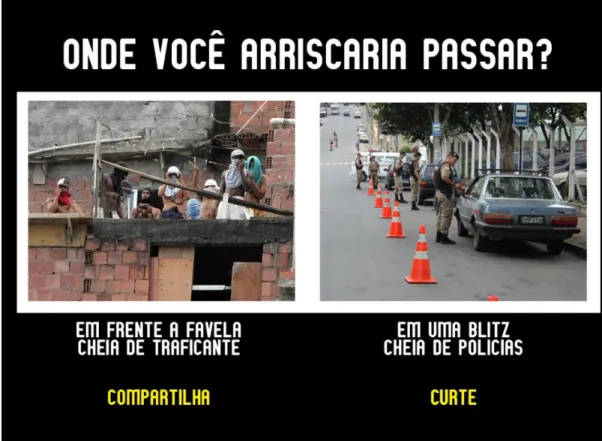
traffickers with guns on one side and on the other a group of politicians. The meme asks, "Who are the real criminals?" A second, similarly popular, example compares a picture of traffickers in the favela next to a photo of police checking cars at a roadblock asking, "Where would you rather risk passing?: in front of a favela full of traffickers or through a police roadblock?
Figure 1-Where would you prefer to pass?
While the majority of favela research claims that traffickers rule through fear, this research brings to light reasons why community members prefer community grown drug trafficker control to state control, mainly examining the loss of sovereignty over favela cultural events.
Controlling the Internal Colony
Rio de Janeiro is known as the “Divided City,” where the “asphalt,” or city proper, meets the “dirt,” or segregated area of the favela. This research situates the current favela pacification projects in Rio de Janeiro within an anthropology of colonialism by addressing the pacification process as an internal colonization of the favela. Works by scholars of coloniality, such as Walter Mignolo and Aníbel Quijano, illustrate the ways in which power dynamics, social
categorizations, and economic and social inequalities created by colonial systems in Latin America still exist today.11
In this research, I utilize the notion of "internal colonization," defined by Pablo Cassanova as the continuation of these structures and inequalities that are a legacy of colonization.12
Favelados continue to labeled and treated as second class citizens,
Twice colonized, once by the Portuguese and again by the affluent classes, favelados struggle with existing within the conflict over the physical and ideological control of their favela borderland. Up to the occupations, Brazilian government has only been able to physically control what is outside of the favela as the landscape of the favela is too difficult to maneuver. Maureen Sioh asserts that the modern state is composed from the ability of the leaders to “monopolize the legitimate use of physical force within a given territorial area” (Sioh, 731). Many favelas are built up a 30 to 40 degree incline, with weaving alleys and no street names. Sioh argues that the power of the state through force is limited within these spaces. The physical terrain combined with trafficker control resulted in Rocinha's occupation requiring maps to be created from helicopters while hovering over the community as well as a force of 3,000 people from the military and civil police, army, and navy. Sioh claims that the repressive laws that define contemporary political landscapes are very much rooted in colonial attempts to control its physical and demographic landscapes.13
Authors like Ann Laura Stoler and Bhabha illustrates how colonial states, like the British and Dutch, utilized categorization as a political tool to control colonial subjects. Stoler analyzes
11 Mignolo, Quijano.
12 Cassanova
the racialized politics of classification that legitimized and illegitimated violence. Those who did not fit into the strict categories provided by the colonial project would remain in-between
categories or rework the criteria for inclusion. Bhabha addresses the use of the stereotype in colonial discourse, explaining that the colonizer can only gain power over the colonized when he is able to create the categories of the colonizer and the colonized. Bhabha argues that the
stereotype is a moment of colonial discourse that "informs the discursive and political practices of racial and cultural hierarchization."14
For instance, the states ability to label favelado men as "dangerous" and "violent" through police reports and media legitimizes the government's use of force against favelados. By marking favelas as spaces controlled by narco-dictatorships, state pacification of favelas are legitimate in the eyes of non-favela dwelling Brazilians and foreigners alike.
The presence of favelas is dealt with as a permanent contamination, sometimes as one that cannot be solved, whereas favelado bodies have been easier to contain through the use of police and security officers who regulate access to middle and upper class locations within the city. Favelado bodies are often recognizable to non-favelas by Afro-Brazilian or North Eastern phenotypes and class markers such as clothing. Youth, in particular, are met with violence upon leaving the favela. For instance, in wealthy neighborhoods, favela youth are stopped and stripped searched. In addition, to enter movie theaters or shopping malls in wealthy areas of Rio, youth are required to show identification live in the neighborhood Therefore, drastic measures are taken to contain favela bodies behind walls, police blocks, and regulation of public space.
Favelas, or shantytowns, of Brazil are a borderland, where the marginal locations of the
favela crash into and are seen by the middle and upper class as “contaminating” the "beautiful"
and "clean" views of city proper. These borders, previously marking the division between the rule of the drug traffickers and the rule of the state, functions as a location that is surveilled and policed, a space that delineates who belongs/does not, is legal/illegal, normative/other, and
white/racialized.15
As such, young male favelados are often stripped searched openly in the street outside of favelas when coming and going. Borders are the areas where favelados are identified, by others, in an attempt to implement power. Favelados and funkeiros, in turn, use this
identification and power dynamics in performances at concerts and in lyrics where a favelado identity is reclaimed as positive and citizenship rights are demanded, helping favelados to construct identities as citizens, non-citizens, and partial citizens. According to Andzaldúa, in these border spaces, bodies are deemed "dangerous" and identity is performed in order to survive. Likewise, when favelados come in contact with outsiders, they are marked as "dangerous." This is where and why, previous to and during the occupations, funkeiros have been responding to the stereotypes and colonial discourse in an attempt to hold on to the culture with which they identify.
Specifically looking at Dutch colonies, Stoler shows how during European colonial projects, the personal was political, where racial membership depended more on the conduct of private lives than public. She claims that colonial states were invested in the knowledge
production surrounding intimate practices and respectability.16
The colonial project works to control the intimate by pushing colonial knowledge, such as claiming ownership of the terms of “respectability.” The affluent class is able to use the border of the favela to separate those who are respectable/non-respectable, white/non-white, or legal/illegal. These power relations legitimize the criminalization and vilification of favela culture, marking it as a "dangerous," "violent," and "vulgar," practice that supports drug trafficking, and encourages drug use and sexual exploitation of women.
Productive Cultural Memory
I utilize Diana Taylor's definitions of "spectacle" and "repertoire" to illustrate the importance of studying embodied culture in the favela, rather than texts. I utilize Taylor's
15 Hyndman and Mountz, 77.
definition of the spectacle as "not an image but a series of social relations mediated by images"17 because funk, as a spectacle, reflects the social changes, events, and voices in the favela. This musical form is a tool within the repertoire of cultural performance. Taylor argues that repertoire "enacts embodied memory: performances, gestures, orality, movement, dance, singing--in short, all those acts usually thought of as ephemeral, non-reproducible knowledge."18
Repertoire as an inventory, also allows for individual agency19
because funk acts as a vehicle of voice, calling attention to social problems specific to these spaces; through both music lyrics and embodied funk culture at dances. With technological advances, people use funk to spread knowledge and
share history through the sharing of songs, lyrics, music videos, and transferring oral history to cartoons to better propagate knowledge within their communities and movement. Even though funk is the largest cultural gathering within the favelas of Rio, the events drawing in more people
that any other favela event, funk is an understudied social medium. Favela identifications are created and re-recreated in relation to funk culture. Therefore, this space is essential for understanding other social formations and practices in these communities.
Historically, texts have been the preferred means to record cultural history and memories. This plays into the politics of cultural memory: Who uses texts? Whose history is recorded and for what purpose? Diana Taylor asks if texts had never been the focus of Latin American social history and cultural memory, what would the history look like? How would this change the cultural identity of Latin America? And whose voice, memories, and stories would appear?20
The history and culture of the favela have traditionally been passed down in oral histories, music, and other embodied practices. Funk is an important practice in the collection of favela histories and social problems. Cultural texts are embodied within the funk music in favelas; where many people, even famous musicians, are illiterate.
17 Taylor, 13.
18 Taylor, 20.
19 Taylor, 20.
Rodriguez and Fortier define "memory culture" as, "The process by which a society ensures cultural continuity by preserving, with the help of mnemonics, its collective knowledge from one generation to the next, rendering it possible for later generations to reconstruct their cultural identity."21
I build off of Rodriguez and Fortier's components of this definition to include: first, the cultural survival of a marginalized group of people, and secondly, the role a cultural identifier in resisting the erasure of cultural memory.22
Although faced with extreme suppression of funk culture, favelados are fighting to retain their cultural practices.
Rodriguez and Fortier discuss the ways in which culture becomes recognized as something that needs to be kept alive in crisis and that the larger the crisis, the more important these memories become.23
Rodriguez and Fortier recognize the ability that different aspects of memory have to liberate from oppression, provide a medium for transmission memory, inform the emotions of generations, and unite people through time for a common cause.
While the affluent classes in Brazil see the favela occupations a civilizing mission--a positive force that will bring progress. Cultural memory is essential to the survival of favelados as a community and identification. Rodriguez and Fortier recognize that, "One's present
existence is shaped irrevocably by recollections of the past and anticipations of the future. It is these memories that give meaning, direction, and shape to ethical choices. Without memory, the living of life would have no coherence at all."24
The Threat of Music: Outlaw culture in U.S. Hip Hop and the Criminalization of Funk
Brazilian Funk and U.S. Hip Hop are musics and performances that are vilified and criminalized because they confront dominant narratives of history and are associated with outlaw and gang culture. In her book, The Hip Hop Wars, ethnomusicologist Tricia Rose breaks down
21 Rodriguez and Fortier, 1.
22 Rodriguez and Fortier, 1.
23 Rodriguez and Fortier, 5.
the most common arguments about whether hip hop is a positive or negative cultural creation. Rose claims that many critics and defenders of hip hop exist within a continuum that stretches from believing the music is absolute social trash to defending it as a wrongly accused victim. She argues that critics refuse to recognize the urban racial discrimination that has resulted in the ghetto conditions portrayed in hip hop music, and instead use that music as “proof” that black bodies create those conditions through their own actions.25
Similar to funk, hip hop has been accused of glorifying and causing violence. Rose dates the concern linking hip hop to violence to the early 1990s, when hip hop artists such as Public Enemy began to call for resistance to racism by armed as well as unarmed means. These assertions on the part of hip hop artists raised concern among hip hop critics that the music’s lyrics would incite violence among youth. Rose argues that while no evidence correlates violent behavior with the consumption of violent music, negative consequences can certainly result from the stigmatization of musical styles which are associated with marginalized groups—in this case black youth.26
Hip hop in the United States confronts the turbulent social relations between the urban poor and the “normative” affluent class within the “city proper.” Within these spaces, it is not just black bodies that are criminalized and vilified. The culture coming out of these communities is also marked as “outlaw cultures.” Monica Evans (2000) defines “outlaw culture” within black communities as working on two different levels—first, as something imposed on black bodies by the law and discourses of fear, and second, as a choice made to position oneself or ones
community in “deliberate opposition to mainstream culture and legal norms when those norms ill serve such communities.” She uses the term “outlaw culture” to refer to a “network of shared institutions, values and practices through which subordinated groups elaborate an autonomous, oppositional consciousness” (Evans 2000: 503). In her book, Prophets of the Hood: Politics and Poetics in Hip Hop, Imani Perry argues that hip hop embraces the outlaw. Perry argues that in
25 Rose: 5.
hip hop, the outlaw can be claimed by an individual as an archetype “thug” or “convict” to gain status, or as a celebration of community outlawry (Perry 2004: 103). Hip hop in the U.S.
confronts inequality and embraces those who rise against it. The same dynamic plays out in Rio de Janeiro’s funk proibidão, or illegal funk, which draws on images of outlawry in order to platform the power of the drug traffickers.
Tricia Rose addresses the confrontation of power relations in hip hop through the concept of “thug mimicry” (Rose 2008: 109). “Thug mimicry” occurs when hip hop artists themselves perform African American stereotypes in order to confront social problems and disrupt white supremacy. She claims that by mimicking the “black monster,” hip hop artists gain power by utilizing white fear and disrupting white definitions of African American communities. Through these stereotypes, artists are able to implicate the oppressors through the explanation of social conditions that lead to “thug life” (Rose 2008: 109). It is here that a wider issue of culture and power surfaces most vividly. Whereas mainstream culture does not serve these subordinated communities, “outlaw” culture provides subordinated groups the opportunity to create their own culture, producing knowledge that reflects their lifestyles and benefits their communities.
Music is a cultural creation which allows readers to dive deeper into the meanings and workings of the social and power relations at play within communities, especially when
Research Findings
While drug traffickers complicate the lives of the favelados, they are also part of the community; they regulate crime in the favela, provide social services, and even offer protection from other gangs and from police brutality. Recent studies in poor communities in Latin America and Jamaica illuminate the ways in which traffickers provide support and security to community members, and in some cases, how residents will even put themselves in danger to protect gang members.27
Favelados feel better connected to the traffickers and understand the difficulties that the young, Afro-descended youth who constitute them face while trying to survive in one of the most unequal societies in the world.28
Drug lords are often perceived as Robin Hood-type figures who stand up to the government that ignores them and the police who violate them. Furthermore, traffickers are members of the communities themselves and have many of the same values, whereas the police are the outsiders, seen as offering little support and protection to community members while often instilling fear through ruthless violence.
This isn’t to say that the traffickers eschew violence. Indeed, they claim the power to kill whomever they choose. Yet they direct this killing to those who risk the security of favelados. This means that the people living in the favelas do not have to live in fear of crimes committed against them by other favelados. The traffickers dual out extremely harsh punishments for crimes committed in the community, often arbitrating the unwritten laws of the favela with a perceived sense of fairness. For example, crimes such as spousal abuse and theft are often punishable by
27 Price 2004; Charles 2002; Harrison 1988; Soto 2012; Magaloni 2011; Sneed 2007.
death after repeated offenses, whereas rape may garner an immediate death sentence. Because of this system and its harsh punishments, in most favelas the crime rate remains near zero. Although drug traffickers are sometimes feared by individuals or hated by those who lost family members murdered by them, many people feel secure from crime and police violence in their own favelas because of the traffickers’ presence.
The drug traffickers’ power is based in part upon work within the community. Traffickers often act as mediators during neighborly confrontations and build coalitions with the
neighborhood associations. Some of the social services that factions provide to the community include building daycares and soccer fields, and providing funds for housing repairs and medical costs. One of the participants I formed a close relationship with during fieldwork is an
ex-trafficker who was paid by the gang to paint murals in Rocinha. Traffickers paid him for murals not only to memorialize traffickers killed in battle, but also for cartoon character murals in Rocinha's schools, daycares, and non-profits. Drug traffickers also sponsor neighborhood funk dances, which are essential celebrations of community in the favela. Though few funk songs speak about the relationships between traffickers and community members, the following proibidão song demonstrates the loyalty bandidos expect from the community. 29
When the heart is pure and the act sincere It transmits security for all of the community
And so when the unexpected happens and the bullets get hot
The community member opens their door to demand that you come in 30
The song demonstrates, from the perspective of a trafficker, the symbiotic relationship that allows for the survival of both traffickers and community members. The discourse used in the song suggests that it benefits the entire community to give to one’s community as it does not only benefit the bandido during hard times, but lends to the wellbeing of the entire community.
In addition to community services that they provide, drug trafficking factions embrace the production of local favela knowledge and culture that has historically been prohibited in
29 These and all other lyrics have been translated by the author.
Brazil. The resentment felt towards the criminalization and vilification of favela culture is expressed in the following funk lyrics:
From Monday to Friday only reprimanded by the boss The weekend arrives and we want to have fun
Enjoy the funk dance, to make fun of samba
Could it be that this is prohibited? My god, how could they? Such a beautiful place, a grand and beautiful view
To enjoy something must it be taken out of the favela? I am a sufferer, my dear God, how could they?
They are suffocating me, they are beating me with neurosis31
Trafficking gangs provide secure spaces for the celebration of favela sub-culture that would be prohibited otherwise. Funk dances are paid for by traffickers who allow for free entry; pirated music is sold at an affordable price; and lack of police access to the favelas means free artistic expression.
The war against trafficking in Rio de Janeiro has been inflicted upon all favelados and has led to favelados being seen and treated as the enemy by police. Whereas the government affords traditional legal privileges to middle-class homes, unlawful search and seizure remains sanctioned in the favela, where police forcibly enter and ransack or shoot into homes. Raids are meant to target drug traffickers, but police have a reputation for close-range executions of non-traffickers with their hands up or fingers laced behind their heads.32
The transition to democracy and the creation of the 1988 Constitution did little to correct the abuse endured by favelados. During the transition, nearly every aspect of the government was changed with the exception of police institutions. The role of a democratic police institution is to protect the citizens, but Brazil’s police maintain their role of protecting the state and the “law abiding” people with money from favelados and vagrants, much as they did during slavery and especially through the dictatorship.33
31 Santos Mattos 2006: 70.
32 Frayssinet 2007.
As a consequence of the neglect favelados have suffered historically at the hands of the government, many favelados choose to support the drug gangs, whom they see as the lesser of the two corrupt and violent groups fighting for sovereignty. Anthropologist Donna M. Goldstein states:
The working and subemployed classes in Rio’s periphery have indeed found a powerful alternative to the order that has traditionally trapped them, and that these exist in the form of gangs, both local and paralocal. It is in this sense that we can view the rise of drug-trafficking gangs and the continued rejection of the police within the shared context of a delegitimized rule of law. These gangs provide an alternative justice system—a parallel state, if you will—among the poorest, who thoroughly reject a corrupt police force and, in their everyday lives, seek some organized entity that can administer “justice” in the local arena.34
Goldstein’s claim, that traffickers have created a completely parallel state, disregards the role that the outside state, especially government and police, plays in the facilitation and
perpetuation of the drug trade and system of power within the favela. Yet her argument clearly captures the sentiment that most favelados have for the police and the system that has been negotiated in the favela between traffickers and community members.
Due to the violence experienced by favelados at the hands of the state as well as the failure of the state to provide basic services, drug trafficking factions have created a system of favela security and provide social services. The costs for living within this system are high.
Traffickers implement a male dominated, non-democratic system where violence is utilized as an instrument of control. The other option is a state which has an engrained fear of African and favela derived culture. Furthermore, the state is at war with the traffickers and essentially with
the favelas as a whole. Both sides offer the promise of security and social services, and both sides fail. This results in the liminal status of funk music. The ways in which people identify with this music is related to all aspects of favela life.
Dorothy Holland and Kevin Leander build off of theories that address the ways in which power relations shape personal and group identities and subordinate social statuses through
categorizations.35
Hollland and Leander explore, "How subjectivities are created by experiences of being positioned, in turn, contribute to the production of cultural forms that mediate
subsequent experiences." Through its cultural performances, funk acts as a mediator for favelado's sense of self and group identity. Favelados employ funk music as a means of
expression, using it to bring attention to such social issues as police violence, rigid ideals of national identity, and the myths of social harmony. Not surprisingly, particularly given its overarching importance in the community, the theme of respect frequently appears in positive funk songs. Os Hawaianos’ song, ‘Eu Sou Brasileiro,’ for instance, speaks to the disrespect that
youth face as funkeiros and favelados; like many other funk songs, it calls for respect and dignity. This recent song—which I transcribe below— continues a longstanding tradition of storytelling that confronts social issues within the favela. It’s also the kind of song that Rogerio—with his preference for old-school funk—claims has disappeared. The ethnopoetic transcription below simultaneously captures the performance of a song as well as the personal emotional reaction of a group member in a video recording of a concert performance. Tellingly, during one of the song’s demands for respect, Tonzão, a singer and dancer in Os Hawaianos becomes emotional and starts to cry.
Os Hawaianos- Eu Sou Brasileiro
Five members of the group stand lined up on a white stage in front of a 15 foot high, 100 foot long wall of white and black speakers. Hundreds of fans are crowded together in a large auditorium.
Lead singer, Yuri, yells:
If you are Brazilian put up your hand!
Yuri is singing, and begins to walk the stage
I……….. am Brazilian,
I'm from Rio de Janeiro/I am from the hill (favela), I am a funkeiro.
Yes
Hello, please let me pass. Ahhhhh I…………..
am discriminated Tonzão, another group member, is seen on camera singing along with other members, smiling, and then he begins to cry.
but I am also educated. My mother gave me education,
and sent me to study. Ahhhhh
Tonzão covers his face, lets go, singing, smiles through his tears, and beats his chest with his pointer finger.
You can believe it/it says there/who would have thought the boy would grow.
Yuri walks over to Tonzão, puts his arm around him, and chuckles while singing I grew in
the City of God.
Foot on the ground, eyes and dreams above the clouds, the clouds.
Money no,
only heart.
Yuri walks over to sing into a camera on the left hand side of the stage
Humility, discipline, and health a discussion
I hope would help you.
I……….. am Brazilian,
I'm from Rio de Janeiro/I am from the hill (favela), I am a funkeiro.
Yes
Hello, please let me pass. Ahhhhh
The camera goes back to Tonzão who is crying harder than before, he hides his face in his shirt, wipes his eyes, and begins to listen without singing as he tries to smile. I…………..
am discriminated
but I am also educated. My mother gave me education,
and sent me to study. ahhhhh
Uncross the arm/go in front/Don’t wait for anything to fall from the sky.
Because…
because from there only rain is sure to fall Tonzão cries, closing his eyes and points upward
whereas our funk already carries a punch in the back and a slap on the chest
Tonzão, crying, slaps his chest
You know these things that happen that get you so pissed. This guy wanting to scream that you and I are crazy.
If you don’t want me to fight back, you cannot assault me or disrespect me. Don’t come to call me favelado and from a bad element.
I am a warrior and funk is my sustenance.
The crowd screams
With faith in God I credit him for my talent and dive into the movement.
and those who are closed talk about what we are . . .
Yuri laughs
I chose this song not only because it is popular in Rocinha, but also because it challenges the negative stereotypes surrounding favelados, and directly claims funk as a weapon against injustice. Os Hawaianos were not yet formed during the 1990s, but are now one of the most popular funk groups in Rio de Janeiro. This song is representative of the funk antigua lyrical and vocal style of the 90s, speaking to the discrimination and vilification of favelados and funkeiros. The performance of ‘Sou Brasileiro’ demonstrates how funk is used to call for respect, as the lyrics state, “I am discriminated, but I am also educated. . . . If you don’t want me to fight back, you cannot assault me or disrespect me . . . Don’t come to call me favelado and from a bad element, I am a warrior and funk is my sustenance.” Such lyrics directly link funk to the fight against abuse and disrespect that favelados face. Not only do they employ motifs of respect and discrimination, but they also include warrior analogies. The crowd celebrates the use of funk in the fight for respect, illustrating how they share this sentiment.
The lyrical claiming of identity within the song is a cultural artifact that illustrates the social, cultural, and historical contexts needed to understand the figured world of the favela. When the singers say, “I am Brazilian, I'm from Rio de Janeiro, I am from the favela (hill), I am a funkeiro. Yes,” the singers narrow their identities, moving from the national to the specifically and situationally cultural. Because favelados are marginalized from the strict national identity and from the city proper of Rio de Janeiro, Os Hawaianos open the song by claiming the identities of Brazilian and Carioca, or from Rio de Janeiro. The group also claims the status of funkeiro and favelado, though in a much different way, acknowledging that these are seen as
Funk music publicly voices the favelados’ frustration, while honoring those who do offer
some measure of protection and service. Proibidão portrays the drug traffickers as the legitimate defenders of the people who have been criminalized by the illegitimate power of the state. Proibidão especially criticizes the police and paramilitary death squads that raid the favelas
while legitimizing and promoting the drug traffickers’ sovereignty over the favelas. For example, a proibidão song called Rap das Armas, or Rap of Weapons, is illegal in Brazil because it
glorifies counter-attacks on police and justifies the rule of the drug traffickers. The song opens with a joyful-sounding chorus of vocalized gunfire, mimicking the staccato sounds a machine gun and the “clak clak boom” of a shotgun:
Parapapapapapapapapa
Paparapaparapapara clack clack bum Parapapapapapapapapa
The favela Dende is difficult to invade Like our enemy, we’ll also have fun
‘Cause in Dende I am going to tell you how it is done Here is not easy for the Drug Recognition Experts To come up here to the hill, even the Elite Squad fears It is not easy for the civil army or for the Military Police I have the best concept of my friends
But Dende’s hill is also land of God
The song tells of the counterattack that will be made against the police who raid the favela and how the drug gang, like the police, will engage in violence (here described as “fun”).
Opening by invoking how the police “invade” the favela, the singers justify their engagement in warfare, a rhetorical move that takes authority away from the police and dismantles their
supposed legality and legitimacy.
traffickers tend to better understand what the community members need and how to build support through social services, and are better able to cultivate a perception of law and order. At the same time, the drug trade—as well as the stigma of the favela as a dangerous place—allows people in power, such as the police, to enter favelas, many with no regard for life. This often results in some favelados viewing traffickers as a negative presence in the community, and the police as an even more negative force.
Funk Cultural Memory and Attempted Erasure
The favela occupation project is seen as civilizing mission by non-favelados as a solution to poverty, drug trafficking, and criminal culture like funk music. Cultural memory is vital to favelado identity. Excluded from mainstream culture, favelados use funk to participate and
reflect on social problems and challenge dominant narratives and stereotypes. After debating whether or not to make funk dances in favelas legal at all,36
the BOPE, or Special Police
Operations Battalion, have enacted strict regulations that are turning the funk culture of Rocinha on its head. Some of the new regulations stipulate that no noise can be made in the favela after 10pm. This includes anything from family barbecues to street dances. In Rocinha, although other dances are permitted in the streets, funk dances are only legal in Club Emoções. This was the only location able to meet the strict demands of the BOPE. This includes a mandatory R$28,000 charge for fire department approval as well as R$1,200 per dance for police security.
Furthermore, police are requiring that attendees of the baile pay an entrance fee of R$20 twice the price of the pre-occupation fee.37
The new restrictions are obviously a move on the part of the BOPE to the new power they wield in this community. Though they may seem like small changes, these new
requirements make it much more difficult with in the culture and limited resources within the favela. Previous to the occupation, the matinê, or youth dance last from eight-thirty and eleven at
36 MC Leonardo
night with the adult dances beginning at twelve and ending at three o'clock in the morning. The culture of the favela, or of Brazilians in general, is not conducive to going out before eleven o'clock at night. Additionally, many favelado youth work on Saturdays, and in Brazil, dinner is usually eaten between nine and ten. Moreover, clubs outside of Rocinha normally do not open their doors until eleven-thirty at night and close at four or five in the morning. On top of the social implications of these restrictions, most favelados will feel the strain of paying double the previous entrance fee with most favelados making R$120.00 (about US$72) per month. This means that in order for a funkeiro to participate once a week in the culture that he identifies with and helped to create, it will cost him or her R$80 (about US$45) per month. Not only will the Thursday through Saturday bailes no longer exist, now the many funkeiro may struggle economically to attend bailes more than twice a month. Most importantly, the mandatory presence of police means that for the first time, weapons will be a part of the dance at Emoções. If drug traffickers ever attended the dances at Emoções, they never brought weapons. Certainly, after such a negative history with police, the first time presence of police and guns should have a visceral effect on the crowd.
As far as the changes in Club Emoções, owner Wagner Beta claimed that he should be the only location in the area to host funk parties, stating that he already began implementing rules of safety before the BOPE mandates.38
Obviously, his monopoly over funk dances for more than 250,000 residents as well as the residents of neighboring Vidigal, will bring in lots of money, but the "pacification" of Rocinha is bringing something more lucrative to the funk dances--tourists and the affluent of Rio de Janeiro. For the first time, Beta began capitalizing on this situation by posting and handing out flyers in city proper as an attempt to draw in non-favelados. Previous events were announced in Rocinha on banners hanging in the streets and by advertisement cars that would drive through the favela with large speakers attached to the roof. The new flyers appear to be specifically aimed at members of the middle and upper class. The first of these flyers was for the 'Baile de Paz,' the Dance of Peace, which was the first dance to occur after the
occupation. The flyer announces that on Sunday, November 20, 2001, Club Emoções,
established 18 years ago, and home of the "Most Traditional Funk Carioca Dance" is hosting the "Baile de Paz" an "Homage to Black Consciousness Day." The flyer states that, "Those Who Wear White Get in Free!!!" The lower right corner features the logo of the sound system of the DJ. In the left hand corner, the flyer shows a fair-skinned woman with bright red hair and green eyes. She is who is wearing DJ style headphones and a gold necklace.
Figure 4.1 Club Emoções Flyer for Baile da Paz
"real" experience of the favela and black culture within a safe, multi-racial, and welcoming environment.
These sentiments are echoed in the second flyer released after the occupation. With same header, the flyer advertises "The Brazilian Dance," and features a Brazilian flag with a soccer ball in the middle of it. It states that anyone wearing a Brazilian t-shirt will get in for free. Again, the second flyer released replicates the notion that this dance is for all Brazilians.
Figure 4.2 Club Emoções Flyer for Baile do Brasileirão
The owner of Emoções is explicit about his intention to capitalize on middle class and tourists who will be willing to enter the favela since its occupation. But what will happen to funk culture with the influx of middle and upper class attendees? The history surrounding the
starting to pop up in the city proper and in occupied favelas cater to this trend with musicians who sing pop funk song about pretty girls and love at funk dances.39
If history is any indicator, these will be the only songs heard at Emoções as well.
The new flyers play into the civilizing mission discourse surrounding the current favela occupations. Countless news sources have flooded the favelas to report live showing that they can safely enter Rocinha and other favelas now that they are occupied.40
Reporters exoticise Rocinha as violent and scary place where community members were just liberated from oppressive drug trafficking gangs. Directly following the occupation, reporters posed on the Passarela foot bridge on the edge of Rocinha, wearing bulletproof jackets, fabricating stories about how they were unable to enter before the occupation, while many of the same news sources had gone in over the last few years to talk about the economic and social improvements in Rocinha. In one report covered on television and in newspapers, journalists claim that the mail had finally arrived to Rocinha after mailmen were far too afraid to enter the community before the pacification when in reality, everyone in Rocinha received mail during drug trafficker
control. Rocinha, and Emoções in particular, was multi-racial, welcoming, and safe for outsiders before the occupation. These instances of reporters insinuating that this environment has been created by the occupation, even after the media reported on this environment pre-occupation, illustrates the ways in which the current discourse of the favela "savages" being saved by the "colonizers" central to the occupations.
With the free bailes da comunidade now prohibited, and the changes in Emoções what will this mean for the maintenance of funk culture in Rocinha and other occupied favelas? All of these new restrictions and requirements as well as the attempt to fill the dances with outsiders might explain the low attendance during the first funk dance in Emoções, one week after the occupation. Whereas the normal turnout in Emoções is around 4,000, only 800 people attended
39 i.e. MC Marcinho and Marcio G
the 'Peace Dance.'41
It will be interesting to see whether youth tolerate the rules, if funk parties will go underground, and what favelado youth will do with the loss of certain segments of funk culture as many wait for the return of drug trafficker rule.
The Day Funk Died: The "Post-Crisis Sound"
In the early 1990s, funk artist began to create a style called funk realidade, or reality funk, writing lyrics that spoke to the social crisis that favelados were experiencing on a daily basis, including poverty, police violence, and social and economic inequalities between the favelas and the city proper. Many favelados describe this time as the golden era of funk, explaining that after this period, the music essentially died. Many of my participants claimed that today's favela youth were only interested in vulgar lyrics and hyper-sexualized dancing.
Today, funk is often criticized for being superficial and sexualized. Unlike funk realidade, I believe that todays popular superficial funk music about sex and having fun is a
purposefully opting out of politics as a "post-crisis sound." In his study of reggaetón versus hip hop in Cuba, Geoff Baker describes the "post-crisis sound" as music coming after crisis-time protest music.42
Though Baker briefly mentions how funk is likely the result of the youths disengaging after the military dictatorship, I believe it is more likely that funk is a product of the rise in police violence against favelados in the early 1990s, which produced the funk realidade of the same period. Similar to reggaetón, funk is accused of being apolitical and is devalued when compared to the lyrical value of Brazilian hip hop. Baker claims that genres focusing on political content have the ability to burn out youth who live in highly political societies.43
The current wave of funk includes pop love songs that typically speak to the culture of funk dances, putaria with its highly sexualized lyrics and dance moves associated with funk, and
proibidão. Criticized for being apolitical, favelados participate in funk dances in order to escape
41 Arújo, Isabel.
42 Baker, 191.
the politics of the undeclared civil war in which they live daily. Like the reggaetón dance space described by Baker, the baile funk is an oppositional space that promotes pleasure and the physical over lyrics and politics.44
Whereas the lyrics of funk have been censored and
criminalized by the state, the movement of the body through dance is much more difficult to control.45
Funkeiros in the space of the dance as well as many residents of Rocinha have
formulated a somewhat utopian vision of the community in which they live. Paul Sneed explores the idea of utopia within the funk dances of Rocinha and claims, "In the moment and space of the funk musical experience in the baile, participants are lifted above the limitations of their daily
lives to an emotional state that makes available to them the feeling of what it would be like to live in a better world."46
Though slightly more complicated, the pre-UPP favela sentiment that resonated in the comments people told me included that they live in a community that is not perfect, but are doing the best they could considering the alternative (i.e. state government). The idea was that under the traffickers, there was protection from police, safety in the community, funds for social services, and some freedom of expression in exchange for silence when it came to gang information. Only the future will tell what will happen with the breakdown of this utopia, the cut-off from social services provided by traffickers, and what will happen to this dance space.
Funkeiros and favelados alike have already begun to turn on the police in charge of the
pacification and recall a nostalgic past. Drug trafficking factions have controlled and often supported the community since the 1980s. Favelados often referred to the occupation as something they could not even imagine after such a long period living with a parallel power. Since the occupation of Rocinha, community members have been responding to the police
44 Baker, 175.
45 Baker, 177.
presence in surprising ways. Even community members who expressed their desire to live in a space free of traffickers are responding to this change with nostalgia for the recent trafficker past.
Proibidão song videos are being posted claiming that favelas are standing in unity against the UPP. There are also songs called 'Liberdade Já Mestre da Rocinha!,' meaning 'Liberate the Kingpin of Rocinha Now!'; as well as more aggressive songs such as 'Pau no Cu
Do Cabral UPP é o Caralho!', or 'A Dick in the Ass of Cabral47
and the UPP is Shit!" Aside from these expected musical productions, a number of new music videos are posted everyday
explaining how Nem, the drug boss of Rocinha, had no choice but to join drug trafficking due to the poverty he suffered. One especially poignant example a song released in early 2011, by MC Godô is called, 'Salvei Minha Filha,' or 'I Saved my Daughter', reflects upon the life of Nem and reasons why people join drug trafficking:
Life was cruel to me. I chose a path
To save what I loved most, I shut my mouth.
I ask for the love of God, that Jesus does not punish me. I went against his commandments to save my daughter. My soul cries, I am leaving now.
Many judge me, but they do not know my history. I live with death and lost my freedom.
But in the time it took, I was not a coward.
In this kind of society, they only know how to criticize.
But it is easy for them to talk, when they have never been in my place. Have you ever had to do this? Have you ever had to love? I'm not sorry. Today, that indebted sailing mile is worth the pain.
I ask the king of heaven to forgive the actions I took to save her. Just another citizen who had no choice.
Even I had reasons. I ask for forgiveness.
Never judge my story, because tomorrow it could be your story. This is more than a message I am sending, its' a reality.
This is to the people who have everything and love to criticize. But thank God, it is only he who can judge.48
This is the now well-known story of Nem da Rocinha. By embodying the criminal, the singer engages in thug mimicry, placing himself in a position where he is capable of justifying
47 Cabral is the current governor of Rio de Janeiro.
the actions of the trafficker.49
He reiterates over and over again that the choice he made was really no choice at all. The bandit believes that God will understand his reasons, and the singer, by taking on the role of the thug, is attempting to get the same reaction from the listener. Unsurprisingly, the popularity of the song has increased enormously since the capture of Nem outside of Rocinha. In days following the occupation of Rocinha, the drug leader became known for this story. After finding out that his ten year old daughter needed a surgery that would cost R$50,000, Nem asked to borrow the money from Lulu, the drug boss at the time. He joined the gang in order to work off his debts and in four years, became the leader of the Amigos dos Amigos faction of Rocinha, the largest grossing favela in the trade.
Since the presence of the police in Rocinha, residents have begun to make others aware this story. Many people who told me they disagreed with the presence of drug trafficking in Rocinha are using this story to describe the social and physical violence they have suffered as a community at the hands of the government. Recently, many of these community members have been posting comments on social networking sites following the story with personal opinions such as, "You think he is a monster?! Would you have let your daughter die? The government would have! If he is a monster, the state and their social inequality have made that monster!" Funk is reflective of the larger culture of the favela and if people in the favela are beginning to
talk about inequality, funk is sure to follow. Certainly residents of Rocinha are experiencing a crisis. Before the UPP, favelados spoke of the impending occupation as a reality hard to imagine, if imaginable at all. With uncertainties surrounding how the police plan to treat favelados
coupled with the violent reputations even the "pacification" police have had a hard time
forgetting, favelados are quickly questioning the intensions behind the World Cup and Olympic clean up of favelas as well as the lingering social inequalities. These referrals to the past function as nostalgic remembrances of a community drug traffic that protected people from police and provided fine-tuned social services. Community members now remember traffickers as a positive force, turning their attention to the next critique of power.
While nostalgia is often pegged as negative, it becomes a useful tool to people in crisis. Spitzer claims that nostalgic memory "sets up a positive within the 'world of yesterday' as a model for creative inspiration, and possible emulation, within the world of the 'here and now.' and by establishing a link between a 'self in present' and an image of a 'self in past,' nostalgic memory also plays a significant role in the reconstruction and continuity of individual and collective memory."50
This nostalgia recalls the collective community culture, which that after centuries of neglect and abuse by government forces, worked out and maintained its own system for police protection and social services. This nostalgic memory brings the community together, but also promotes a healthy amount of weariness and surveillance of police during occupation and "pacification" processes. As an embodied practice, funk cultural memory can be
"remembered" through performance. Then we must ask, by no longer allowing bailes da comunidade, funk radio, or any performance outside of the pop-funk love songs (funk melody)
dances of Emoções, how will funk cultural memory be forgotten? How can it survive if it cannot be performed? What will happen the histories and voices that are performed through more suppressed styles of funk?
Pen to Paper: Recording the Past and Writing the New Wave Funk Movement
Funk, and favela/trafficker, culture becomes recognized as a dangerous thing to lose in a
time of crisis. Funk has a part of everyday life in the favela since the 1960s. Pre-occupation, funk could be heard in multiple locations on every street twenty-four hours a day. Funk has always been under threat by the government, but was never seen as something that could be lost while traffickers continued to rule. Rodriguez and Fortier's claim that different aspects of memory have the ability to liberate people from oppression, provide a medium for transmission memory, inform the emotions of generations, and unite people through time for a common cause and becomes recognized as something that needs to be kept alive in crisis and that the larger the