A PERFORMANCE EVALUATION OF THE LIFESTRAW:
A PERSONAL POINT OF USE WATER PURIFIER FOR THE DEVELOPING WORLD
Adam Walters
A thesis submitted to the faculty of the University of North Carolina at Chapel Hill in partial fulfillment of the requirements for the degree of Master of Science in the
Department of Environmental Sciences and Engineering.
Chapel Hill 2008
Approved by,
ABSTRACT
Adam Walters
A Performance Evaluation of the LifeStraw: a Personal Point-of-Use Water Purifier for the Developing World
(Under the direction of Mark D. Sobsey, Ph.D.)
18% of people worldwide have no access to safe drinking water. Many household water purifiers have been documented to improve water quality and reduce diarrheal disease. One of these technologies is the LifeStraw, a low-cost, portable, point-of-use water purifier. The LifeStraw has been used worldwide to date, however, there is not yet conclusive
research about the performance of the LifeStraws ability to improve drinking water or reduce diarrheal disease burden. The purpose of this research was three-fold: to examine the
This work would not have been possible without support from Dr. Mark Sobsey, Dr. Louise Ball, Dr. Otto (Chip) Simmons III, Dr. Jen Murphy, Katherine, the friendly folks at WSM, and my stupendous
dog Ada.
TABLE OF CONTENTS
I. LIST OF FIGURES ... viii
II. LIST OF TABLES...x
III. LIST OF ABBREVIATIONS... xii
IV. INTRODUCTION AND AIMS...1
1.1Aims...2
1.2Experimental overview ...4
V. LITERATURE REVIEW ...8
2.1 Infectious disease and the burden of diarrheal disease ...8
2.2 Household water treatment ...10
2.3 LifeStraw design and treatment processes ...12
2.4 Indicators for waterborne pathogens...16
VI. METHODOLOGY ...24
3.1 Design of the LifeStraw feed water pumping station ...24
3.2 Aging days ...26
3.3 Challenge days ...28
3.4 Chemical tests ...29
3.5 Preparation of test indicator microbes ...31
3.6 Preparation of influent water ...35
3.9 Data management...38
3.10 LifeStraw series-specific experimental objectives, test conditions and methods ...39
VII. RESULTS ...42
4.1 Preamble ...42
4.2 Data management and statistics ...43
4.3 Test water characteristics...46
4.4 Lifetime LRV’s by LifeStraw model and test microbe ...48
4.5 Model L1 results ...49
4.6 Model L2 results ...54
4.7 Models L3-L5 results...59
4.8 Model F results ...61
4.9 Model NVO results ...65
4.10 Model YAO results ...67
4.11 Models C1-C5 results ...68
4.12 Trends in LifeStraw performance according to test water quality...71
4.13 Trends in LifeStraw performance among different models...72
VIII. DISCUSSION ...75
5.1 Preamble ...75
5.2 Lifetime microbial reductions...76
5.3 Disinfectant concentrations in effluent ...78
5.4 Temporal patterns of microbial reductions over aging volume ...79
5.5 Model L1...79
5.6 Model L2...80
5.7 Models L3-L5 ...82
5.8 Models F ...82
5.9 Models NVO and YAO ...83
5.11Comparison of LifeStraw performance according to
water types used for aging ...84
5.12Sources of variability and uncertainty ...85
IX. CONCLUSIONS AND RECOMMENDATIONS ...88
6.1 Introduction...88
6.2 Conclusions...89
6.3 Recommendations...91
X. APPENDIX A...93
7.1E. coli experiments...93
XI. APPENDIX B ...98
8.1Batch experiments...98
XII. APPENDIX C ...104
9.1Individual vs. mixed microbe performance study...104
LIST OF FIGURES
FIGURE 1: Plan of sequential LifeStraw experiments, including key variables ...5
FIGURE 2: Indicator and pathogenic test microbes ...7
FIGURE 3: Global burden of preventable diarrhea...9
FIGURE 4: Common point-of-use treatment methods...11
FIGURE 5: Advantages and disadvantages to the use of iodinated resins in point-of-use water treatment...14
FIGURE 6: Iodine binding capacity of charcoal ...15
FIGURE 7: Categories of indicator organisms...17
FIGURE 8: Desirable biological attributes of indicators...18
FIGURE 9: Bonde’s criteria for an ideal indicator...18
FIGURE 10: Flow chart for the LifeStraw experiments...43
FIGURE 11: Mean lifetime LRV’s for each LifeStraw model tested ...49
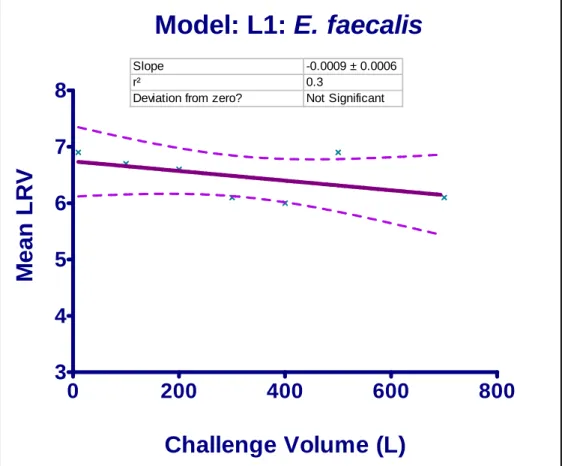
FIGURE 12: Regression of E. faecalis LRV’s over volume aged for model L1 ...52
FIGURE 13: Regression of E. coli LRV’s over volume aged for model L1...52
FIGURE 14: Regression of MS2LRV’s over volume aged for model L1 ...53
FIGURE 15: Regression of E. faecalis LRV’s over volume aged for model L2 ...57
FIGURE 16: Regression of E. coli LRV’s over volume aged for model L2...58
FIGURE 17: Regression of MS2 LRV’s over volume aged for model L2...58
FIGURE 18: Regression of E. faecalis LRV’s over volume aged for model F...63
FIGURE 19: Regression of E. coli LRV’s over volume aged for model F ...63
FIGURE 21: Overall Mean LRV for Models C-C5: MS2 and E. faecalis...70
FIGURE 22: Model L1 and L2: Water Type Comparison using ANOVA ...72
FIGURE 23: ANOVA Means L1, L2, F (SS)...73
LIST OF TABLES
TABLE 1: Test microbes ...3
TABLE 2: LifeStraw model details ...26
TABLE 3: Aging water measurements: pH and turbidity (NTU) ...47
TABLE 4: Aging water measurements: TDS (mg/L) and TOC (mg of C/L)...47
TABLE 5: Temperature (°C) and chlorine concentrations (mg/L) of aging water prior to challenge experiments...47
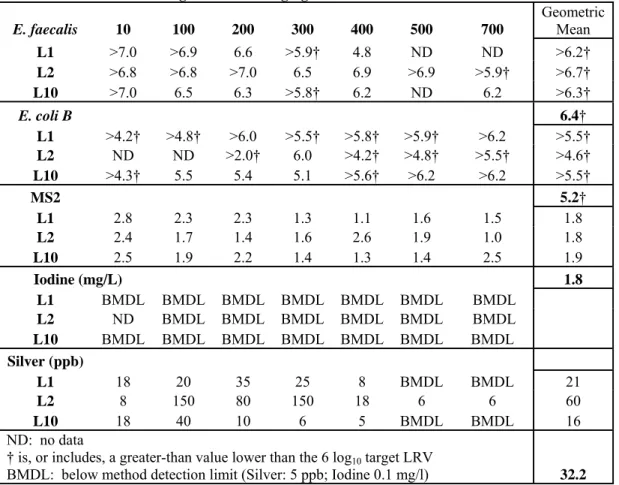
TABLE 6: Test microbe LRVs and chemical concentrations for model L1 LifeStraws at each challenge interval for aging water...50
TABLE 7: Test microbe LRVs and chemical concentrations for model L2 LifeStraws at each challenge interval for aging water...54
TABLE 8: Test microbe LRVs and chemical concentrations for models L3-L5 LifeStraws at each challenge interval for aging water ...60
TABLE 9: Test microbe LRVs and chemical concentrations for model F LifeStraws at each challenge interval for aging water...61
TABLE 10: Test microbe LRVs and chemical concentrations for model NVO LifeStraws at two challenge interval for aging water ...66
TABLE 11: Test microbe LRVs and chemical concentrations for model YAO LifeStraws at two challenge interval for aging water ...69
TABLE 12: Test Microbe LRVs Model C LifeStraws at three challenge interval for aging water...71
TABLE A13: Concentrations of E. coli KO11 on 4 different agar media ...94
TABLE A14: Concentrations of E. coli HMS174 on 4 different agar media...96
TABLE A15: Concentrations of E. coli HMS174 on 2 different agar ...96
TABLE B17: Expected and detected concentrations (CFU/ml) of individual vs. mixed microbes ...100
TABLE B18: Expected and detected concentrations (CFU/ml) of individual vs. mixed microbes ...102 TABLE C19: Expected and detected concentrations (log10) ...105
TABLE C20: Detected differences in concentrations in mixed seeded test waters ..105 TABLE C21: Expected and detected concentrations (log10) of
LIST OF ABBREVIATIONS
ANOVA Analysis of Variance
ASM American Society of Microbiology ATCC American Type Culture Collection BEA Bile Esculin Azide
BMDL Below Minimum Detection Limit CDC Center for Disease Control CFU Colony Forming Unit DAL Double Agar Layer
DTW Dechlorinated Tap Water
EPA Environmental Protection Agency
FIFRA Federal Insecticide, Fungicide, and Rodenticide Act HHWT Household Water Treatment
ID Inner Diameter
IWA International Water Association MCL Maximum Contaminant Level NTU Nephelometric Turbidity Unit NRC National Research Council NSF National Science Foundation OECD
Organization for Economic Co-operation and Development
PBS Phosphate Buffered Saline PFU Plaque Forming Units POU Point of Use
ppb parts per billion
TSB Tryptic Soy Broth
UV Ultra Violet
INTRODUCTION
Nearly 1.1 billion people around the world lack access to improved drinking water sources, and 2.2 million die from basic hygiene related disease (WHO, 2007). The majority of these deaths are wholly preventable through effective improvements in water, sanitation and hygiene. Point-of-use (POU) water treatment is by no means the silver bullet for eliminating the waterborne disease risks and burdens of these 1.1 billion people. POU technologies such as the LifeStraw are key components to reducing the disease burden in the short term. In some cases, they can provide a daily source of affordable, less contaminated or uncontaminated drinking water.
In most industrialized countries, waterborne disease has been of modest concern since the end of the sanitary reform movement in the early twentieth century (Andrews, 2006). Pathogens that have been of recent concern in the industrialized world are those that continue to evade treatment processes like chlorination and filtration. Enteric viruses and protozoan parasites (e g Giardia lambia and Cryptosporidium parvum) are of continued concern in the
developed world, whereas bacterial pathogens like Vibrio cholerae and Salmonella typhi are
1972). Common pathogens representing the two categories of transmission include Vibrio cholerae, Shigella, Salmonella typhi, Campylobacter jejuni, various pathogenic strains of Escherichia coli and Yersinia species (Schlosser, Robert, Bourderioux, Rey, & de Roubin,
2001).
Concern about waterborne disease in areas without established water treatment infrastructure has led to the development of small-scale, water treatment devices sized for household use that are affordable for the individual or family. The LifeStraw is one of the newest and most promising of the individual sized POU water treatment devices that can be used daily or for temporary use in emergencies.
1.1 Aims
1.1.1 Aim one
To evaluate the microbial effectiveness of candidate models of LifeStraws in reducing waterborne bacteria, viruses and protozoan parasites under laboratory conditions designed to mimic natural drinking water quality conditions typical of those found in developing countries. The ability of the LifeStraw to meet US Environmental Protection Agency (EPA) and National Science Foundation-International (NSF) regulatory standards and guidelines for the reduction of three major classes of microbes (i.e. bacteria, viruses and parasites) is a crucial gauge of its effectiveness as a POU water treatment device.
study. The design of the treatment device allows for complete exclusion of both the ova and adult worms in the effluent water by physical removal at the pre-filter.
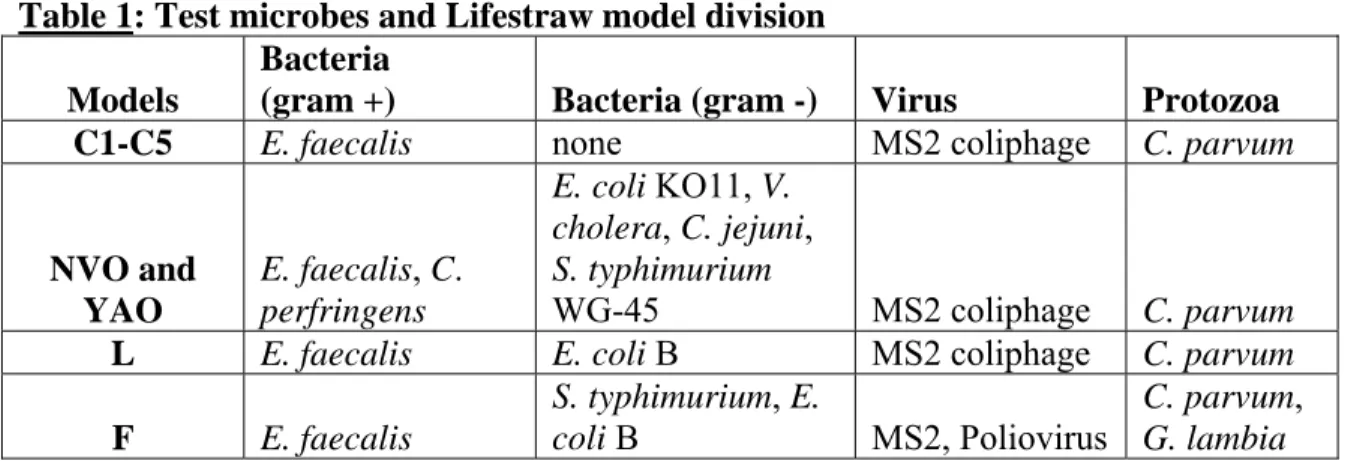
Table 1: Test microbes and Lifestraw model division
Models
Bacteria
(gram +) Bacteria (gram -) Virus Protozoa C1-C5 E. faecalis none MS2 coliphage C. parvum
NVO and YAO
E. faecalis, C. perfringens
E. coli KO11, V. cholera, C. jejuni, S. typhimurium
WG-45 MS2 coliphage C. parvum
L E. faecalis E. coli B MS2 coliphage C. parvum
F E. faecalis
S. typhimurium, E.
coli B MS2, Poliovirus
C. parvum, G. lambia
1.1.2 Aim two
The ability of the LifeStraw to reduce pathogens in water is only important in the context of a physically well-functioning device. Without the ability to pass a sufficient amount of water with minimal effort, the LifeStraw is of little benefit to its user, regardless of its efficacy at microbial reductions. World Health Organization (WHO) guidelines
recommend that two liters of water per day should be the universal minimum daily requirement for drinking water (WHO, 2007).
Backwashing temporarily improves ease of water flow through the device. With extensive use, or when used with high turbidity influent water, backwashing can become less effective. The goal is to determine if the target volume of 700 liters could be filtered with typical periodic backwashing procedures as used by the consumer.
1.1.3 Aim three
The third objective for testing is to track the concentrations of iodine and silver in the effluent water from the treatment processes within the LifeStraw. In many water treatment scenarios chemical surplus or residual in effluent water is intended to continue or maintain microbial reductions during storage. However, with a POU treatment device like the LifeStraw, the effluent water is not storable, but is immediately ingested. The EPA sets standards and WHO sets guidelines for a number of chemical contaminants in water. Goals for the third objective were set using EPA secondary standard for silver (≤100 ppb), and WHO’s recommendation for healthy iodine levels in drinking water (≤0.1 mg/L/day) (EPA, 2006; WHO, 2006). In the LifeStraw, iodine potentially originates from the iodinated anion exchange resin, while the silver potentially originates from a silver impregnated carbon block filter element. There are no other known chemical disinfectants or disinfectant byproducts produced or released by the LifeStraw.
1.2 Experimental overview
series of experiments were aging, passing water through LifeStraws that has no added test microbes, and challenging, periodically passing water through LifeStraws that contained known amounts of test microbes.
Figure 1: Plan of sequential LifeStraw experiments, including key variables
Aging water representing one of two types of water quality (“clean” and “dirty”) was pumped to versions of three different LifeStraw models in an attempt to assess two variables over time; (1) susceptibility to clogging and (2) extent of leaching of chemical disinfectant. “Clean” water was simulated by using dechlorinated tap water, while “dirty” water was simulated by the use of dechlorinated tap water supplemented with 1% pasteurized settled sewage.
individual device consistently fell below 150 ml/min and could not be restored by
backwashing, analysis was discontinued. Challenge procedures using microbe- seeded water occurred at regular intervals throughout the aging schedule, and were designed to assess the ability of the straws to consistently reduce microbial concentrations throughout the straw lifespan. Influent water was seeded with known concentrations of a variety of indicator and pathogenic microbes. This water was pumped through the LifeStraws, the effluent water was collected and analysis was then performed to determine the microbial concentrations in the effluent water as well as the influent challenge water. The difference in microbial
concentration between influent and effluent water represented the disinfection or microbial reduction ability of each respective LifeStraw. Chemical analyses for residual concentrations of iodine/iodide and silver were also a part of the challenge procedure. Aging procedures continued until a total of 700 L of water had passed through each straw. Challenges with microbe-seeded water occurred at increments of approximately every 100 L of aging water throughout the duration of the aging procedure.
Eleven microbes were used in challenge tests throughout four successive
Figure 2: Indicator and pathogenic test microbes
Indicator organisms Enteric pathogens
• Escherichia coli B
• Escherichia coli KO11
• Clostridium perfringens
• Enterococcus faecalis
• MS2 coliphage
• Campylobacter jejuni
• Cryptosporidium parvum
• Giardia lambia
• Poliovirus type 1, Strain LSc
• Vibrio cholera
LITERATURE REVIEW
2.1 Infectious disease and the burden of diarrheal disease
Throughout history, infectious diseases have undoubtedly been the single largest contributor to human morbidity and mortality. At least 13 million people die each year from preventable and often times curable infectious disease. Half of these deaths are children and nearly all occur in developing countries (Esrey, Feachem, & Hughes, 1985). In the past century we have seen the burden of infectious disease plummet in what are now the developed nations of the world (Esrey et al., 1985). In fact, the 20th century will likely be remembered for its leaps in technological advances, the reform of sanitation infrastructure in developed countries, the acceleration of global markets and communication, and the
urbanization of many nations.
Despite these changes, the majority of the world still battles with communicable disease; over a billion people lack access to adequate water and over twice that number are without adequate sanitation (WHO, 2001). There is no single answer to these enormous disparities. Strong political leadership, improvements in water and sanitation infrastructure, sustainable development of global markets, innovative ideas and technologies, and
community-level solutions are all required to make tangible, lasting improvements.
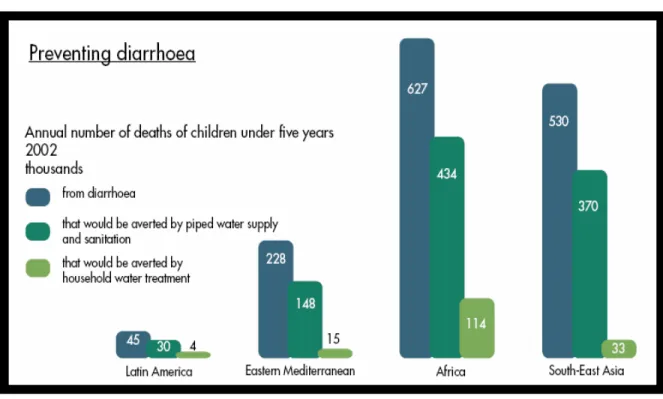
inadequate sanitation, over half the population of the world is affected. (WHO, 2006) The burden of diarrheal disease is particularly culpable because it is preventable through improved access to safe water and sanitation, and hygiene education. (Kosek, Bern, & Guerrant, 2003). The WHO estimates that 94% of diarrheal disease is preventable through changes in environment (WHO, 2006).
(WHO, 2007) Diarrheal diseases kill an estimated 1.8 million people each year (Kosek et al., 2003). In developing countries diarrhea accounts for 17% of deaths of children under five
(Eisenberg, Scott, & Porco, 2007). For the 1.1 billion people who lack access to improved water supplies, and many more with microbially contaminated water, diarrheal disease is highly endemic. (Clasen, Schmidt, Rabie, Roberts, & Cairncross, 2007) Studies have shown
reducing diarrheal illness, and water quality interventions such as POU treatment
technologies have been more effective than previously thought. (Fewtrell & Colford, 2005)
2.2 Household water treatment
Conventional piped water systems using effective treatment to deliver safe water to households may be decades away in much of the developing world. This leaves the majority of the poorest people in the world left with the task of collecting water outside the home, then treating and storing it themselves (Sobsey 2002). Taking steps to remove or inactivate enteric pathogens in drinking water immediately before consumption has been shown to be effective in reducing diarrheal disease (M.D. Sobsey, 2002). This somewhat intuitive finding is
significant because many households in less developed countries do not have individual connections to treated, piped water, or 24–hour access to water. Such households typically store water in the home, and this water is vulnerable to contamination during transport and storage, even if it is free from microbial or chemical contaminants at the source (Mintz, Bartram, Lochery, & Wegelin, 2001). In cases such as these, a water quality intervention at the point-of-use should be considered for any water supply program (Fewtrell & Colford, 2005). A safe water source refers to household connection, public standpipe, borehole, protected (lined) dug well, protected spring, or rainwater collection and safe storage (Cairncross & Valdmanis, 2006).
Several peer-reviewed studies support Fewtrell’s findings, reporting rate ratios that suggest household based interventions are more effective at preventing diarrhea than water source based interventions. (Clasen et al., 2007; Mintz et al., 2001; M.D. Sobsey, 2002)
developing countries. Treating drinking water at the household level to reduce the ingestion of pathogenic microbes is one suggested strategy (M.D. Sobsey, 2002). Devices that can be used to either treat water or prevent contamination of stored water in the home are referred to as POU technologies. These technologies provide a means for individuals and families to reduce microbial and chemical contaminants in drinking water at the household level. POU technologies have the potential to fill the service gap where piped water systems are not yet feasible, potentially resulting in positive health impacts in developing countries (Sobsey 2006). Two recent meta-analyses of field trials have suggested that household-based water quality interventions such as appropriate treatment and safe storage are effective in reducing diarrheal disease (Clasen et al., 2007; Fewtrell & Colford, 2005; M.D. Sobsey, 2002).
A variety of technologies for POU water treatment exist; some are based in historical water treatment techniques, however, there is new research that has found effective reduction of waterborne pathogens and diarrheal disease using innovative POU technologies like the Biosand filter and simple ceramic “candle” filters (Lantagne, 2007). Figure 4 describes a number of the most common POU water treatment methods.
Figure 4: common point-of-use treatment methods
Boiling
1. Simple method for the inactivation of viral, parasitic, and bacterial pathogens.
2. Often economically and environmentally unsustainable. 3. Provides no residual protection
4. There is a significant risk of scalding among infants.
(Mintz et al., 2001)
Solar Disinfection 1.2. Uses the synergy of solar UV and heat Simple, inexpensive, does not affect taste 3. Ineffective with turbid water
4. Not good for large volumes
(Mintz et al., 2001)
Chlorination
1. Sodium hypochlorite, has proven the safest, most effective, and least expensive chemical disinfectantfor point-of-use treatment.
2. It can be produced onsite or created onsite through electrolysis 3. Relatively ineffective against parasites and viruses
2. One Drop: an aqueous solution of ionic minerals, including silver, gold,
aluminum, zinc, and copper. It is a simple, low-cost, effective solution. (CDC, August 2005), (Murphy, 2007)
Filtration
1. Many types available for POU treatment
• Granular media: Bio-sand, slow sand
• Vegetable and animal derived depth filters
• Membrane filters: paper, cloth, plastic
• Porous cast filters: ceramic pots
• Septum and body feed filters
2. Filtration alone, at a household level, has not proved effective for viruses and acceptable reductions of bacteria.
(M.D. Sobsey, 2002)
Ultraviolet
1. Works very well on all waterborne pathogens in combination in parallel with a turbidity reducing treatment like coagulation/flocculation or filtration.
2. No odor or taste problems
3. Requires significant energy input: batteries or electricity
(M.D. Sobsey, 2002)
2.3 LifeStraw design and treatment processes
In 2005, Vestergaard Frandsen developed the first model of the LifeStraw. The Vestergaard Frandsen (VF) Company was founded by Kaj Vestergaard Frandsen in 1957 in Kolding, Denmark. The primary achievements of VF are as a designer and producer of insecticidal polyester bed nets to prevent the spread of malaria (Frandsen, 2007).
LifeStraw is a personal POU filtration device designed for daily use to decontaminate relatively small volumes of drinking water (2L per day) (Frauchiger, 2007). In response to a growing concern for microbial contamination of drinking water used by children, the
LifeStraw is designed for children both in its ease of use and its portability. The LifeStraw is low-cost, low-tech, easy to transport, and requires no electric or mechanical power input. These qualities make it a reasonable means of reducing waterborne microorganisms in drinking water in large-scale disasters like the Indian Ocean tsunami of 2005. However, the
The standard model LifeStraw is 31 cm long and 2.9 cm in diameter with a dry weight of 140 grams. The outer shell of the LifeStraw is made of high impact polystyrene. VF has designed the LifeStraw to be effective for up to one year of use based on
consumption of 2 L per day from the straw. There are three compartments within the straw that aid in microbial reduction. At the base of the straw there is a 15 micron (minimum) plastic mesh screen designed to filter relatively large particle contaminants and organic matter. After passing the screen, water enters a compartment of halogenated ion exchange resin that elutes an active halogen, most often free iodine.
Iodine is a halogen with strong oxidant chemical properties, giving it useful biocidal effects. The active disinfectant forms of iodine are elemental iodine and hypoiodous acid. Iodide is not a viable disinfectant. Water disinfection with iodine is a first-order chemical reaction. The disinfection of different classes of microorganisms by iodine vary in
effectiveness. Bacteria are sensitive to iodine, viruses are intermediate, and protozoan cysts are more resistant. Doses of iodine below 1 mg/L are effective for bacteria within minutes; however, at the same concentration, it would take many hours to kill protozoan parasites like
Giardia lambia and Cryptosporidium parvum. Recommended levels of iodine for
point-of-use water disinfection in unmonitored field situations are relatively high to allow for unanticipated reactions with organic contaminants and to allow for a short contact time for effective disinfection. (Backer, 2000)
growth of biofilm on the GAC. The duo of active disinfectants is intended to effectively inactivate waterborne bacteria and viruses. (Frauchiger, 2007)
2.3.1 Iodine and halogenated resins
The initial compartment of the LifeStraw contains an iodinated resin in the form of small polymer beads. The resin beads provide a cationic surface to which elemental iodine is attached. As water passes through the resin beads the iodine is released into the water
through the process of ion exchange. Ion exchange happens when the negatively charged particles in the water surrounding the resin displace the iodine leaving free iodine to attach to the cell wall or membrane of microbes in the water. The result of ion exchange is an
increased level of iodine in the contaminated water to provide a considerable biocidal effect (Edison, 2002). Figure 5 compares the advantages and the disadvantages of using iodinated resin in POU water treatment devices.
Figure 5: Advantages and disadvantages to the use of iodinated resins in point-of-use water treatment
Advantages Disadvantages
1. Effective against parasites, bacteria, and viruses 1. Does not work well with highly turbid water, turbidity should be less than 1 NTU
2. Low maintenance, no needed energy source 2. High pH and temperature can cause releases Iodine at harmful levels
3. Iodine is not prone to form harmful byproducts 3. Influent water with a high existing halogen demand can quench free Iodine decreasing biocidal effects
4. Contact time with the resin beads required for microbial reductions is relatively short
(Edison, 2002)
2.3.2 Silver impregnated carbon block
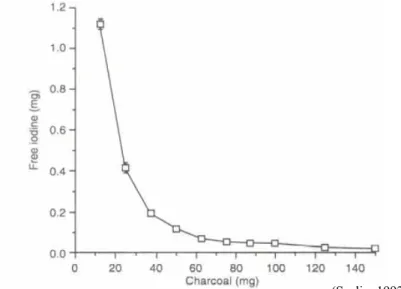
(Sahal, 1999) Figure 6 illustrates the capacity for carbon to bind free iodine. However, carbon blocks have been shown to develop biofilms on their outer surface. Insoluble organic compounds on the outer walls of the carbon block are a source of nutrients for bacteria found in water. When the carbon block sits in stagnant water, bacteria thrive on the nutrients from the ash and are flushed at relatively high concentrations during the next use (Seelig, 1992). Silver impregnated carbon uses the biocidial effects of silver to prevent the growth of biofilm on the carbon block. The process begins as microbes are adsorbed into the impregnated carbon block. Here it comes in contact with silver ions and the sulphurhydryl group within the cells react producing a silver-sulphur molecule. This silver-sulphur combination
immobilizes the respiratory activity of the cell by preventing the transfer of protons (Bayati, 1997). Silver is regulated as a pesticide under the Federal Insecticide, Fungicide and
Rodenticide Act (FIFRA) and its use is monitored by the EPA. The EPA has established a Secondary Maximum Contaminant Level (MCL) of 0.1 milligrams of silver per liter of water or 100 parts per billion (ppb). (EPA, 2006)
(Each data point represents the average of three observations)
2.4 Indicators for waterborne pathogens
2.4.1 Background
The use of bacterial indicators for water quality measures dates back to 1880 when Von Fritsch described Klebsiella pneumoniae and Klebsiella rhinoscleromatis as
micro-organisms routinely found in human feces. (Geldreich, 1969) Soon after Fritsch’s discovery, Escherich described Bacillus coli, later named Escherichia coli, from the feces of breast-fed
infants (Geldreich, 1969).
By the 1890s, it was decided that direct pathogen detection would be too complex for public health protection because 1) there are too many pathogens, 2) they are present in small concentrations, and 3) methods for their detection are delicate and expensive. Public health officials decided that monitoring would be conducted to detect fecal pollution rather than individual pathogens. (Leclerc, Edberg, Pierzo, & Delattre, 2000)
In the US, the original purpose for the use indicators was for the detection of contaminated drinking water. However, as the nation developed, indicators were used primarily in the detection of human fecal contamination of ambient and recreational waters. (NRC, 2004) In the developing world, indicator microbes are used primarily for the
detection of fecal contamination of drinking water because of the lack of effective large scale water treatment and wastewater infrastructure (Ashbolt, 2001).
2.4.2 Purpose and use
to identify environmental contamination or to evaluate the effectiveness of a microbial reducing technology. The latter use is especially important for the development of effective technologies to be used in a developing world setting because of the high burden of disease sourced from fecal contamination of drinking water. This high occurrence of fecal
contamination of water leading to waterborne disease paired with the consumption of untreated or ineffectively treated drinking water necessitate a simple, accurate, low-cost means of health risk assessment. (Moe, 1991)
2.4.3 Defining characteristics
Microbial indicators are used in three distinct practices as shown in Figure 7. The categories are not mutually exclusive; therefore a specific indicator could be used in any of the three use categories.
Figure 7: Categories of indicator organisms
Process Indicators Used in determining the efficacy of a process. i.e. coliforms for iodine Fecal Indicators Infers the presence of fecal contamination in natural waters
Model Organisms A species that is indicative of pathogen presence and behavior. i.e. E. coli
as an index for Salmonella
Adapted from, (Ashbolt, 2001)
Figure 8: Desirable biological attributes of indicators
o Correlated to health risk
o Similar or greater survival and transport to pathogen
o Present in greater number than pathogen in the environment o Specific to an identifiable source, e.g. human fecal matter o Applicable to various types of water
o Does not create false positives o Non-pathenogenic to humans
Other important attributes of a good indicator organism are the ease of use, a low cost for detection, easily quantifiable methods, precision, and oftentimes rapid results (NRC, 2004). A further criterion for a good indicator is offered in Bonde’s Critera for an Ideal Indicator published in 1966 and illustrated in figure 9.
Figure 9: Bonde’s criteria for an ideal indicator
An ideal indicator should:
1. Be present wherever the pathogens are present;
2. Be present only when the presence of pathogens is an imminent danger (i.e. they must not proliferate to any greater extent in the aqueous environment);
3. Occur in much greater numbers than the pathogens;
4. Be more resistant to disinfectants and to the aqueous environment than the pathogens;
5. grow readily on simple media;
6. Yield characteristic and simple reactions enabling as far as possible an unambiguous identification of the group
7. Be randomly distributed in the sample to be examined , or it should be possible to obtain a uniform distribution by simple homogenization procedures; and 8. Grow widely independent of other organisms present, when inculcated in
artificial media (i.e., indicator bacteria should not be seriously inhibited in their growth by the presence of other bacteria).
Best practice when using indicators is to use a “tool box” of indicators in which a diverse set of indicators and methods are matched to specific goals for water quality. Using a variety of indicator microbes can provide clues into the source and specific type of
contamination. (NRC, 2004) For example, a combination of indicator bacteria could be used to differentiate between fecal contamination by livestock and that of human fecal matter as well as providing insight into the source of contamination.
There are a variety of subsets of indicator organisms contained within the
classifications of either bacterial indicators or viral indicators. Two of the most common bacterial indicators are coliforms and fecal streptococci. Bacterial indicators not only serve as means of detecting pathogenic bacteria, but can also mark the presence of fecally
transmitted protozoan parasites, viruses and even helminthes. (NRC, 2004)
2.4.4 Coliforms
Total coliforms can be defined as aerobic and facultatively anaerobic, gram-negative, non-spore-forming, rod-shaped bacteria that produce gas upon lactose fermentation within 48 hours at 35°C (Bitton, 2005). Fecal coliforms are the most commonly used indicator
organisms,; they include all coliforms that can ferment lactose at 44.5°C. (Ashbolt, 2001) Coliforms occur in the intestines of all warm-blooded animals and are found in densities proportional to the degree of fecal contamination in polluted waters. Under the provisions of the National Primary Drinking Water Regulations, total coliforms are used as a standard for the microbial safety assessment of ambient and recreational waters throughout the US. Some of the most well known fecal coliforms are Escherichia coli (E. coli) and species within the
E. coli is a thermophilic coliform producing indole from tryptophan, as well as often
producing β-glucuronidase. (NRC, 2004) Of the coliforms, E.coli is by far the most common,
comprising 96.8% of coliforms detected in a 1977 study of 28 fecal samples (Dufour, 1977). The WHO affirms E. coli to be the most appropriate of the coliforms to indicate fecal
pollution from warm-blooded animals (Ashbolt, 2001). E. coli is so commonly used in part
because of its ability to be easily distinguished from other indicators of fecal pollution by the absence of urease and presence of β-glucuronidase (Bitton, 2005).
2.4.5 Enterococci
Fecal streptococci are present in the feces of most warm-blooded animals. A number of species have been consistently recovered from known contaminated waters and have not been found to endure in the environment (Geldreich, 1969). Fecal streptococci are gram-positive, grow on bile-esculin agar and at 45°C, belong to the genera Enterococcus or Streptococcus; they possess the Lancefield group D antigen. Fecal streptococci are tolerant of sodium chloride and alkaline pH levels; they are also facultatively anaerobic and grow in small chains or pairs (NRC, 2004).
indicators are E. faecalis and E. faecium; which are commensal organisms in the intestines of
humans. Enterococci are also facultative anaerobes. (Abbott, 2006)
Enterococcus was originally selected to be used as an indicator bacteria because, 1) it occurs in high numbers in the excreta of humans and other warm-blooded animals; 2) it is present in wastewater and other polluted waters; 3) it is absent from ecologically sound ambient waters and environments; and is persistent without multiplication in the
environment. (Clesceri, 1992)
Enterococci are detectable by simple, inexpensive cultural methods that require basic laboratory facilities. Commonly used methods include membrane filtration with incubation on selective media incubation at 35–37 °C for 18-24 hours. (Clesceri, 1992)
Water quality guidelines based on bacterial density have been proposed for U.S. recreational waters. For fresh waters the guideline is 33 enterococci/100mL while for marine waters it is 35/100mL. Each guideline is based on the geometric mean of at least five samples per 30 day period during the swimming season. (EPA, 1986)
2.4.6 Bacteriophages
In the 1970’s a new found awareness of the importance of enteric pathogens to water related public health led to the finding that viral contamination in drinking water could not be accurately measured by bacterial indicators such as coliforms (NRC, 2004). Since direct viral pathogen detection was complicated because of the large number of enteric viruses present in contaminated water and the difficulty of detection at low concentrations, scientific focus turned to the use of viral indicators. (Leclerc et al., 2000) Three groups of
Somatic coliphages have been shown to correlate the best of the three types of bacteriophages with enteric viruses. (Geldenhuys, 1989) Starting in 1948 Guelin was the first to use coliphages as indicators of fecal contamination. Twenty years later, a number of studies explored the use of coliphages as indicators of enteric viruses. Somatic coliphages can infect a number of species of the genus enterobacteriaceae, however, E. coli is the
primary host. Coilphages make good indicators because they are found in higher numbers than enteric viruses in wastewater, and they are easy and quickly detected. (Bitton, 2005) Somatic coliphages are characterized by their ability to attach to the cell membrane of the host. Once attached, the phage will send nucleic acid through the outer membrane, into the cell to alter the reproductive organs of the bacterial cell to create more viruses.
Male-specific RNA phages are single stranded phages, belonging to the family Leviviridae that attach to host cells at the male sex pili. FRNA phages are not considered as fecal indicators because they are not consistently found in human fecal matter and they do not have a direct relationship with the level of fecal contamination. (Bitton, 2005)
Phages infecting Bacteroides fragilis have been detected at low concentrations in
human feces and not at all in animal feces or in pristine environments. Phages of B. fragilis
do not multiply in environmental samples, and are more resistant to chlorine than bacterial indicators. Persistence and reductions of B. fragilis phages are similar to enteroviruses and
rotaviruses making them suitable as indicators of human fecal pollution. (Bitton, 2005) There has been controversy over the use of phages as indicators of fecal
contamination primarily because phages are in fact indicators of indicators. That is, they indicate the presence of bacteria like E.coli or coliforms that are themselves indicators of the
relatively high concentrations (104 CFU/mL) to support successful phage replication. In both ground and surface waters with fecal contamination, environmental conditions are often not suitable to support phage replication. (Leclerc et al., 2000) However, the use of indicator phage to mimic the physiological and biological characteristics of enteric viruses has been supported and provides a useful means of testing the efficacy of treatment processes without the use of enteric viruses.
2.4.7 Clostridium perfringens spores
Clostridium perfringens (C. perfringens) is a gram positive, anaerobic, sulfite
reducing bacteria known for producing extremely resistant spores. C. perfringens spores are
resistant to UV radiation, temperature and pH extremes, chlorination, and exposure to
ethanol (NRC, 2004). The Clostridium genus contains both pathogenic and indicator species;
C. perfringens is the characteristic species of the genus and is commonly found in the
intestinal flora of many warm-blooded animals including humans. (Ashbolt, 2001) C. perfringens is not normally found in natural waters making it a highly specific indicator for
METHODOLOGY
3.1 Design of the LifeStraw feed water pumping station
The LifeStraw pumping station consisted of two manifolds, each of which housed a maximum of five LifeStraw units mounted vertically. Influent and effluent tubing on the manifolds was ¼” ID, clear silicone. Two dual purpose oil filled pumps were used to pump influent water into the LifeStraws. The pumps were manufactured by the Little Giant pump company, pump model number 2E-38N: 115V. Before influent water entered each LifeStraw the water passed through an adjustable, acrylic flow regulator of the rotameter type, which was used to maintain an influent flow rate of 150 mL/min. The rotameter type flow meters were manufactured by Key Instruments: series FR4000. Effluent water discharged from the LifeStraws through clear silicone tubing that was directed into a floor drain.
LifeStraw models
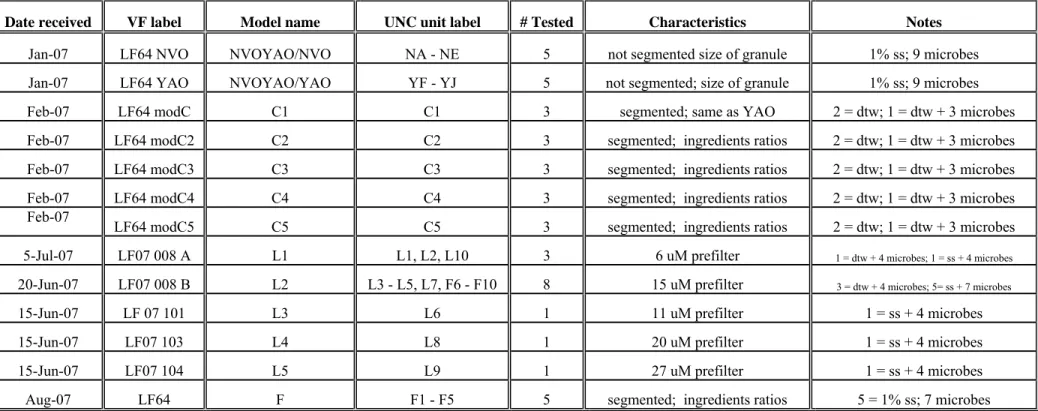
Table 2: LifeStraw Model Details
Date received VF label Model name UNC unit label # Tested Characteristics Notes
Jan-07 LF64 NVO NVOYAO/NVO NA - NE 5 not segmented size of granule 1% ss; 9 microbes
Jan-07 LF64 YAO NVOYAO/YAO YF - YJ 5 not segmented; size of granule 1% ss; 9 microbes
Feb-07 LF64 modC C1 C1 3 segmented; same as YAO 2 = dtw; 1 = dtw + 3 microbes
Feb-07 LF64 modC2 C2 C2 3 segmented; ingredients ratios 2 = dtw; 1 = dtw + 3 microbes
Feb-07 LF64 modC3 C3 C3 3 segmented; ingredients ratios 2 = dtw; 1 = dtw + 3 microbes
Feb-07 LF64 modC4 C4 C4 3 segmented; ingredients ratios 2 = dtw; 1 = dtw + 3 microbes
Feb-07
LF64 modC5 C5 C5 3 segmented; ingredients ratios 2 = dtw; 1 = dtw + 3 microbes
5-Jul-07 LF07 008 A L1 L1, L2, L10 3 6 uM prefilter 1 = dtw + 4 microbes; 1 = ss + 4 microbes
20-Jun-07 LF07 008 B L2 L3 - L5, L7, F6 - F10 8 15 uM prefilter 3 = dtw + 4 microbes; 5= ss + 7 microbes
15-Jun-07 LF 07 101 L3 L6 1 11 uM prefilter 1 = ss + 4 microbes
15-Jun-07 LF07 103 L4 L8 1 20 uM prefilter 1 = ss + 4 microbes
15-Jun-07 LF07 104 L5 L9 1 27 uM prefilter 1 = ss + 4 microbes
Aug-07 LF64 F F1 - F5 5 segmented; ingredients ratios 5 = 1% ss; 7 microbes
3.2 Aging days
The purpose of aging was to determine the effective water volume lifespan of the LifeStraws based on performance with respect to clogging and chemical leaching. Aging water was held in two 100+ liter plastic barrels, each containing 91L of aging water. Aging water was either dechlorinated tap water or dechlorinated tap water with 1% settled sewage. The type of aging water varied throughout the experimental series and between LifeStraws. The aging water used in each set or series of experiments is indicated in Table 2.
To prepare settled sewage for experimental use, secondary effluent was collected from Chapel Hill’s Mason Farm wastewater treatment plant, pasteurized by exposure to 70°C for 30 minutes, then decanted and stored at 30°C.
Muscle Testing, 2001). Personal communication with Dr. James Yankaskas and Dr. Robert
Tarran from the Pulmonary and Critical Care Medicine Center at the University of North Carolina supported the finding that 100 cm H2O (approximately 0.1 bar) would be a
reasonable number for the LifeStraw research.
Following backwashing, LifeStraws were aged for 10 minutes (~1.5 L/LifeStraw), after which time an effluent sample was collected from each LifeStraw for chemical analyses. Total iodine (iodide + iodine) was tested using the Taylor Midget Comparator Test; the detection limit is 0.2 mg/L. If there was detectable iodine, presence of iodide was tested using the same test kit. Effluent water was also tested for presence of silver using the Hach Rapid Silver test kit, the lower detection limit was 5 ppb. As aging resumed, flow rates were monitored and adjusted as necessary to maintain 150 ml/min until the remainder of the aging water for an increment of the ultimate total flow had passed through the LifeStraws. Throughout aging, effluent tubing directly emerging from LifeStraw outlets was routinely “pinched” to release build-up of air within LifeStraw (note: air was not present in influent tubing).
3.3 Challenge days
Challenge water refers to the water that was seeded with known concentrations of test microbes pumped through the LifeStraws on challenge days. Challenge water was
Temperature was also measured in the challenge water tank before water use. Prior to pumping the challenge water to LifeStraws, each LifeStraw was backwashed, maintaining a pressure of 3 – 4 psi (0.2 – 0.275 bar) on the mouthpiece for 15 seconds; backwashing flow rate was not measured. After backwashing, the entire volume of the challenge water was pumped through typically 10 LifeStraws set up in parallel; the effluent water from each LifeStraw was collected in 3L containers.
As the challenge water was pumped through, an effluent sample was collected from each LifeStraw for chemical analyses. Total iodine (iodide + iodine) was tested using the Taylor Midget Comparator Test. If there was detectable iodine, presence of iodide was tested using the same test kit. Effluent water was also tested for presence of silver using the Hach Rapid Silver test kit. When the entire volume of the challenge water had been
collected as effluent, the sample containers were immediately moved into the pathogen laboratory for microbial analysis. LifeStraws were backwashed following the challenge period, after which the aging procedure was resumed. Throughout the experiment, the flow rate for each LifeStraw was monitored and adjusted as necessary to maintain ~150 ml/min.
3.4 Chemical tests
Quenching residual iodine was an important step when testing a water treatment device such as the LifeStraw. This is because residual iodine discharged from the LifeStraw could continue to act on microbes in test water, However, under real-use conditions the LifeStraw effluent water immediately enters the consumer’s body and there is no further contact time between microbes and residual iodine disinfectant.
3.4.1 Iodine and iodide
The Taylor colorimetric midget test kit was used for the detection of iodine and iodide in effluent water from the LifeStraws. The Taylor kit indicates concentrations
between zero, and two parts per million. The Taylor test kit is a two stage kit: the first stage tests for presence of total iodine, the second stage tests for presence of iodide. When there was no detectable presence of total iodine (iodine and iodide) in a sample, it was considered unnecessary to test for iodide.
3.4.2 Silver
Hach Rapid Silver test kit was used to measure presence and concentration of silver in the effluent water from the LifeStraws. The Hach test is a colorimetric test that detects concentrations from 5-50 parts per billion.(ppb) Concentrations in excess of 50 ppb were detected by making a known volumetric dilution of the sample in reagent water
3.4.3 Chlorine
3.5 Preparation of test indicator microbes
3.5.1 E. faecalis
E. faecalis, ATCC strain 29212,was purchased and received on 3/2/2007. The strain
was streaked onto a plate of Bile Esculin Azide (BEA) agar; the plate was inverted, and incubated overnight at 37°C. The following day material from an isolated colony was selected from the incubated plate and inoculated into 25 ml of TSB. The culture was incubated overnight at 37°C with shaking. The following day, the broth culture was transferred into conical tubes and centrifuged at 14K for 5 minutes, the supernatant was removed and the pellet re-suspended in 25 ml of tryptic soy broth (TSB) with 20% glycerol. The final broth culture with glycerol was aliquoted into approximately 1 ml portions and stored at -80°C until needed to create spiking culture for experiments. To propagate a high titer of E. faecalis to use as spiking stock for challenge experiments, a broth culture method
was used. An overnight culture was inoculated into 25 ml TSB two nights before the first challenge experiment and incubated at 37oC with shaking. (Clesceri, 1992) On the third day a log-phase culture was prepared, incubated at 37oC with shaking for 3 hours, then tittered using standard membrane filtration procedure and BEA agar.
3.5.2 MS2 coliphage and double agar layer (DAL) propagation and assay method
The EPA DAL method was used to prepare a stock of MS2 coliphage. Known MS2 and E. coli Famp control strains were obtained within the Sobsey laboratory inventory. E. coli
and ampicillin at a concentration of 15μg/ml; the broth was incubated with shaking at 37°C for 18 – 24 hours.
After incubation the infected broth culture material was subjected to extraction with a half volume of Freon and emulsified by shaking for 5 minutes to partially purify viral
particles in stock broth culture. The mixture was then centrifuged at 2500x g for 20 minutes at 4°C. The top aqueous layer of supernatant containing viral particles was poured into 150mm Petri dishes and placed open under a biological hood for 30 minutes to allow any remaining Freon to evaporate. Freon-extracted viral particles were aliquoted as small volumes, stored at -80°C and thawed as needed prior to the challenge experiment. (U. S. EPA, 2001)
3.5.3 MS2 coliphage plaque assay by the single agar layer method
The single agar layer (SAL) method was used in the LFO7 and F series instead of the DAL method for time efficiency and the expectation of reliable results. E. coli Famp host
cells were infected within the developing lawn of a single agar medium plus host cells to develop MS2 viral plaques. An isolated viral plaque was extracted from the agar medium and enriched in a broth composed of TSB, E. coli Famp host cells, and streptomycin and
ampicillin at a concentration of 15μg/ml; the broth was incubated with shaking at 37°C for 18 – 24 hours.
A known E. coli KO11 control strain was obtained from the Sobsey laboratory
inventory. The strain was streaked onto Biorad Rapid E. coli 2 agar containing 40 μg/ml
chloramphenicol, inverted, and incubated overnight at 37°C. The following day an isolated colony with the expected appearance was selected from the incubated plate and inoculated into 25 ml of TSB containing 40 μg/ml chloramphenicol. The culture was incubated overnight at 37°C with shaking. The following day, the broth culture was transferred into conical tubes and centrifuged at 14K for 5 minutes, the supernatant was removed and the pellet re-suspended in 25 ml of TSB with 20% glycerol. The final broth culture with glycerol was aliquoted into approximately 1 ml portions and stored at -80°C until needed for
experimental use. To propagate a high titer of E. coli KO11 to use as spiking stock for
challenge experiments a small amount of frozen stock was inoculated into 25 ml of TSB with chloramphenicol, and incubated at 37oC with shaking two nights before the first challenge experiment
3.5.5 C. perfringens
A known C. perfringens control strain was obtained within the Sobsey laboratory
re-plated on each of 20 modified Duncan-Strong sporulation agar plates. The plates were incubated for 48 hours at 44°C anaerobically.
At 48 hours, spore crops were harvested from plates by gently scraping spores from the agar surface. A 5 ml volume of PBS was used to rinse remaining spores from each plate (5 plates per 50 ml conical tube for a total of 4 conical tubes). Harvested spores were washed by centrifuging at 3000 rpm and 4°C for 10 minutes, the supernatant was removed and the remaining pellet was re-suspended in 25 ml PBS. The sample was vortex mixed, then centrifuged again at 3000 rpm and 4°C for 10 minutes. The spore suspensions were heat-treated at 70°C for 30 minutes to kill any remaining vegetative cells. Spores were then washed by centrifuging at 3000 rpm and 4°C for 10 minutes, the supernatant was removed and the remaining pellet was re-suspended in 25 ml PBS. The sample was vortex mixed, then centrifuged again at 3000 rpm and 4°C for 10 minutes. Supernatant was removed again and the pellet was re-suspended in 8 ml of PBS. Suspensions were combined for a total of 32 ml.
The spore concentration was 105 spores/ml at this stage, as determined by viable count using the spread plate method. A 10-fold dilution series was created by serially
3.6 Preparation of influent water
Two separate 15-liter volumes of challenge water were prepared. One container received 15 liters of dechlorinated tap water; while the other received 15 liters of
dechlorinated tap water with 1% pasteurized settled sewage. Indicator microorganisms were added (spiked) to each of the two 15-L volumes of challenge water to achieve the following final concentrations:
E. faecalis: 106 CFU/100 ml (used in all four series)
E. coli B: 106 CFU/100 ml (used for LF07 and F series)
E. coli KO11: 106 CFU/100 ml (only used for NVO-YAO series)
MS2 coliphage: 106 PFU/100 ml (used in all four series)
C. perfringens: 105 CFU/100 ml (only used for NVO-YAO series) Following the additions of test microbes, challenge water was mixed for 30 minutes using a stir bar and plate prior to pumping it through the LifeStraw system.
Enumeration of indicator microbes in influent challenge water
3.6.1 E. coli KO11 and E. coli B
A serial ten-fold dilution series through 10-5 was made by transferring 2 ml of influent
water into 18 ml of PBS. Membrane filtration was done on 9-ml volumes of appropriate dilutions in duplicate on Bio-Rad Rapid E. coli 2 agar (for E. coli KO11 the medium also
contained 40 μg/ml chloramphenicol). Plates were inverted then incubated at 37°C for 18-24 hours. Colonies were counted and concentrations were expressed as colony forming units (CFU)/ml.
A serial ten-fold dilution series was made through 10-5 by transferring 2 ml of influent water into 18 ml of PBS. Membrane filtration was done on 9-ml volumes of appropriate dilutions in duplicate on BEA agar. Plates were inverted then incubated at 37°C for 18-24 hours. Colonies were counted and concentrations were expressed as CFU/ml
3.6.3 MS2 coliphage
A serial ten-fold dilution series was made through 10-5 by transferring 2 ml of influent water into 18 ml of TSB. The DAL or SAL plaque assay methods were used to enumerate MS2 in these dilutions as previously described above. Inoculum volumes per plate were 9 ml for the DAL and SAL methods. Plates were inverted then incubated at 37°C for 18 to 24 hrs. Plaques were counted and concentrations were expressed as plaque forming units (PFU)/ml (U. S. EPA, 2001)
3.6.4 C. perfringens
For the enumeration of C. perfringens in influent water, 250 ml of influent sample
was taken and heat treated at 60°C for 30 minutes. Three volumes of effluent were
membrane filtered in duplicate; (1) 1ml of sample in 9 ml PBS, (2) 9 ml of undiluted sample, and 90 ml of undiluted sample. The filters were then placed on TSC agar containing 40
μg/ml cycloserine. Serial ten-fold dilutions were made by transferring 1 ml of the effluent water into 9 ml of PBS. A 100 µl volume of dilutions 10-2 through 10-5 were spread plated in
duplicate on TSC agar containing 40 μg/ml cycloserine. Plates were inverted and incubated anaerobically at 44°C for 18-24 hours. Colonies that appeared to be C. perfringens were
counted and concentrations were expressed as CFU/ml.
Three volumes of effluent were membrane filtered in duplicate; (1) 1ml of sample in 9 ml PBS, (2) 9 ml of undiluted sample, and (3) 90 ml of undiluted sample. Filters were placed on Bio-Rad Rapid E. coli 2 agar (for E. coli KO11 40 μg/ml chloramphenicol was
added). Plates were inverted and incubated at 37°C for 18-24 hours. Distinctive E. coli colonies were counted and concentrations were expressed as CFU/ml.
3.7.2 E. faecalis
Three volumes of effluent were membrane filtered in duplicate; (1) 1ml of sample in 9 ml PBS, (2) 9 ml of undiluted sample, and 90 ml of undiluted sample. Filters were placed on BEA agar plates, and plates were inverted and incubated at 37°C for 18-24 hours.
Distinctive E. faecalis colonies were counted and concentrations were expressed as CFU/ml.
3.7.3 MS2 coliphage
SAL or DAL assay methods for MS2 coliphage were performed using the following four sample volumes; (1) 2 ml of sample in 18 ml of TSB, 0.2 ml of sample in 19.8 ml of sample, (2) 0.02 ml of sample in 19.98 ml of TSB, (3) 0.002 ml of sample in 19.998 ml of TSB, and (4) 0.0002 ml of sample in 19.9998 ml of TSB. Plates were inverted and incubated at 37°C overnight. The following day, plaques on plates were enumerated and MS2
concentrations were expressed as plaque forming units /ml. (U. S. EPA, 2001)
3.7.4 C. perfringens
For the detection of C. perfringens spores in effluent water, 250 ml of effluent was
ml of the effluent water into 9 ml of PBS. Volumes of 100 µl of dilutions 10-1 through 10-3 were spread plated in duplicate on TSC agar containing 40 μg/ml cycloserine. Plates were invert and incubated anaerobically at 44°C for 18-24 hours. Distinctive C. perfringens colonies were counted and concentrations were expressed as CFU/ml.
3.8 Data collection
Following the determination of LifeStraw effluent titers, comparisons were made between influent and effluent concentrations of test microbes to compute log10 microbe
reductions. Data were compiled for each challenge experiment using Excel worksheets. Microorganism concentrations were calculated as described in US EPA Method 1601. For each microorganism, log10 reduction values at each challenge point were calculated by
subtracting the log10 of the effluent concentrations from the log10 of the influent
concentrations. When no bacteria CFUs or virus PFUs were detected in the total volume assayed, the lower detection limit of the assay had been reached. In this case, a log10
reduction value was calculated using 1 CFU or PFU in the total sample volume assayed. This has been indicated by the use of a less-than symbol for the log10 concentration and a
greater-than-or-equal-to symbol (≥) for the log10 reduction. Overall log10 reduction values
for each LifeStraw (over the total 700 L water volume of ageing) were calculated using total number of CFUs or PFUs in all challenge experiments and total volumes assayed, compared to the average concentration of test microbes in the challenge waters.
3.9 Data management
calculated using 1 CFU or PFU in the total sample volume assayed. This is indicated by the use of a less-than symbol for the log10 concentration and a greater-than symbol (>) for the
log10 reduction. Lifetime log10 reduction values for each LifeStraw represent lower bound
estimates of log-reduction because they are calculated using the minimum threshold values.
3.10 LifeStraw series-specific experimental objectives, test conditions and methods
3.10.1 NVOYAO series objectives
1. Determine the efficacy of LifeStraws LF64 NVO and LF64 YAO to reduce the concentrations of the following indicator microbes in challenge water:
a. Enterococcus faecalis
b. Escherichia coli KO11
c. Clostridium perfringens spores
d. MS2 coliphage
2. Determine the residual concentrations of iodine, iodide, and silver released into effluent water
3.10.1.1 Additions and variations to general experimental design
The first challenge run was not preceded by an initial aging run.
3.10.2 C series objectives, test conditions and methods
1. Age five C series LifeStraws with ~700 L dechlorinated tap water
2. Challenge LifeStraws with indicator microorganisms representing two major microbial classes:
a. Bacteria: Enterococcus faecalis
3. Consistently measure release of iodine and silver from LifeStraws into effluent water over time
3.10.2.1 Additions and variations to general experimental design
(1) Each LifeStraw was aged with ~18 L of dechlorinated tap water prior to the first challenge. (2) Measurement of total iodine, chlorine, temperature and silver in test waters did not begin until the second challenge (6/20/07).
3.10.3 L series objectives, test conditions and methods
1. Age five different LF07 series LifeStraws with ~700 L dechlorinated tap water 2. Age five different LF07 series LifeStraws with ~700 L dechlorinated tap water
supplemented with 1% pasteurized settled sewage
3. Challenge LifeStraws with microorganisms representing two major classes: a. Bacteria:
i. Escherichia coli B
ii. Enterococcus faecalis
b. Virus: MS2 coliphage
3.10.3.1 Additions and variations to general experimental design
(1) Approximately 150 ml of the initial effluent water from each LifeStraw were discarded to ensure that the collected effluent was solely microbe-seeded challenge water. (2) Backwashing was routinely performed after every 45 L of test water was passed through LifeStraws or when flow rate dropped below 125 ml/min. (4) On aging days, LifeStraws received anywhere between 8 and 67.5 L of ageing water.
1. Age five LF64 series and five LF07-008B LifeStraws with 700 L dechlorinated tap water with 1% pasteurized settled sewage
2. Challenge LifeStraws with indicator microorganisms representing two classes a. Bacteria:
i. E. coli B
ii. E. faecalis
b. Virus:
RESULTS
4.1 Preamble
Fifteen LifeStraw models were tested over four experimental series. Throughout the experiments there were measurable results for three test microbes (E. faecalis, E. coli, MS2)
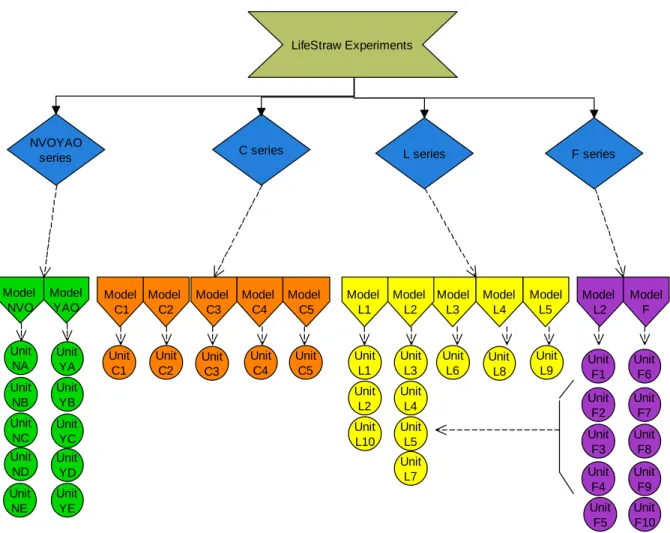
using two water types for aging and challenging. For some of the LifeStraw models there were a number of replicates tested, however, the majority of models were represented by only one test unit. Figure 10 illustrates the testing dichotomy for the LifeStraw experiments.
Results from the experiments are presented principally by model type. Results are presented for each model by first presenting overall lifetime reductions, followed by
Figure 10: Flow chart for the LifeStraw experiments
NVOYAO
series C series L series F series
LifeStraw Experiments Model NVO Model YAO Model C2 Model F Model L5 Model L3 Model L4 Model L2 Model L1 Model C1 Model C3 Model C4 Model C5 Unit L5 Unit L4 Unit L3 Unit L7 Unit F10 Unit F1 Unit F2 Unit F6 Unit F9 Unit F8 Unit F7 Unit C1 Unit L10 Unit L2 Unit L1 Unit C2 Unit C5 Unit C3 Unit C4 Unit L6 Unit L8 Unit L9 Unit F3 Unit F4 Unit F5 Unit NA Unit YA Unit NB Unit YB Unit ND Unit YD Unit NC Unit YC Unit NE Unit YE Model L2
4.2 Data management and statistics
The performance indicator value used throughout the LifeStraw experiments was the log10 reduction capability of specified test microbes. The log10 reduction value (LRV) is
based on the difference in log10 microbe concentrations of the influent/seeded test water and
the concentrations in the corresponding effluent water. For example, if the log10
concentration of E. faecalis was 1x10⁶ in the influent water and 1x10² in the effluent water,
of a LifeStraw challenge water filtrate assayed, the lower detection limit of the assay has been reached. In this case, a log10 reduction value is calculated using 1 CFU or PFU in the
total sample volume of the challenge water LifeStraw filtrate assayed. This is indicated by the use of a less-than symbol for the log10 concentration and a greater-than symbol (>) for the
log10 reduction. Overall log10 reduction values for each LifeStraw (over total 700 L water
volume of aging) represent lower bound estimates of log-reduction values because they are calculated using the minimum threshold values for log10 microbe concentrations, expressed
as less-than values. The detection limits of the microbe assays change for each challenge day. This is because the detection limit is defined by both the volumes of LifeStraw challenge water influents and their corresponding filtered effluents assayed and by the influent microbe concentrations in the seeded challenge water influents. Challenge days that had lower than intended influent microbe concentrations that did not allow detection of at least a 6 log10 microbe reduction by the LifeStraw inadequately reflect on its ability to meet
the 6 log10 reduction target set by US EPA and NSF-International for performance
certification. When greater than log10 reductions values were lower than the performance
target reductions, they are indicated by a dagger (†). While greater-than symbols indicate that there is uncertainty in extent above the detection limit that the real LRV lies, the dagger symbol indicates the mean lifetime LRV could possibly be below the target reduction due to the detection limit of the assay, not the reduction ability of the LifeStraw. Reduction of E. coli and E. faecalis by test LifeStraws were often higher than the detection limit of the assay.
Log10 microbe reduction data were entered into a Microsoft Excel spreadsheet and
accuracy of data input. Log reduction values (LRVs) were stratified by microbe, water type, challenge volume, and replicate. Statistical methods used include linear regression (with
95% confidence intervals), ANOVA, and standard deviation. Linear regression was used to describe trends over the volume of aging water applied to the LifeStraw. Statistical ANOVA were used to describe patterns of log10 reduction among model types, microbes, and water
types. Means comparison was also done using Tukeys HSD (Honestly Significantly
Different) method. Assumptions made in comparing LRV data in statistical testing were that data were presented a Gaussian distribution and groups had equal variances (these
assumptions were specified by GraphPad). All tests were compared using a significance level (P-value) threshold of 0.05.
Of the 15 LifeStraw models that were tested, three models (L1, L2, F) provided an adequate sample size (n) for statistical analysis. Thorough analysis of these three models was of particular importance to the manufacturer, VF, because they were the models expected to achieve the best overall performance as candidates to market. Results from the remaining 12 models are presented qualitatively showing the arithmetic mean of the LRV’s sequentially throughout the aging volume. It should be noted that for all LifeStraw models tested the sample size was too small for explicit outcome predictions to be made. Ideally, a sample size (n) of more than 30 would be appropriate for robust statistical analysis.(Ahn, 2006) Because of manufacturer priorities and design LifeStraw experiments, it was not possible to test enough LifeStraws to get an n of 30 for any of the models. Although no
found in our research (Clasen & Menon, 2007; Clasen, Nadakatti, & Menon, 2006; Schlosser et al., 2001).
4.3 Test water characteristics
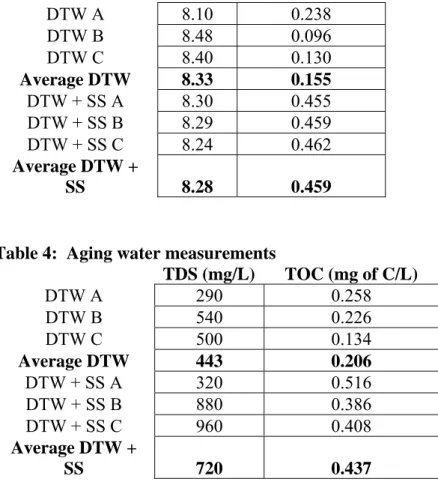
Throughout the challenge experiments, two types of test water were used for aging and challenging. In most cases, test LifeStraws were only aged with de-chlorinated tap water (DTW). .In order to more realistically simulate influent water used by consumers of the product, some L series LifeStraws and all the F series LifeStraws were aged using de-chlorinated tap water with 1% pasteurized settled sewage (DTW+SS). The physiochemical composition of the aging waters used was characterized by analyzing the pH, turbidity, total organic carbon (TOC), total dissolved solids (TDS), temperature at use, and the presence of chlorine. Tables 3-5 show the results of the analysis. Water quality guidelines for aging water were taken from the USEPA Guidelines for Testing Microbiological Water Purifiers
(EPA, 1987)
Water type DTW and DTW+SS had similar pH, temperatures, and concentrations of chlorine. Overall pH for the two water types was ~8.3, while the temperature of the aging water at the time of use ranged from 24°C to 27°C. No chlorine was detected in either aging waters. As expected, DTW+SS water type had a higher turbidity (DTW+SS: 0.46 NTU and DTW: 1.6 NTU) than de-chlorinated tap water alone. Aging water with settled sewage added also had higher TDS and TOC; mean values for TDS were 720 mg/L in DTW+SS and 443 mg/L in DTW, TOC means were 0.44 mg of C/L for DTW+SS and 0.206 mg of C/L for DTW.