Conceptual Plan for Residential Construction Project M/s. Alliance Villas Pvt Ltd.
Page _ 43 1.0 INTRODUCTION
1.1 GENERAL
M/s. Alliance Villas Pvt Ltd. Projects proposes to construct its residential complex in Thaiyur-B Village, Thiruporur Taluk, and Kancheepuram District in the state of Tamil Nadu. Total land area available is 52694.01 sqm. The total built-up area is 46901.66sqm.
As per EIA notification, 2006, any new or modernization building and construction project with built-up area more than 20,000 sq m falls under activity 8 a and category B and thus requires to obtain environment clearance from concerned authority prior start of the construction. As SEIAA Tamil Nadu is not formed till date after completion of tenure of last SEIAA, we are herewith applying in MoEF for obtaining environment clearance for the project.
1.2 SITE DESCRITPION
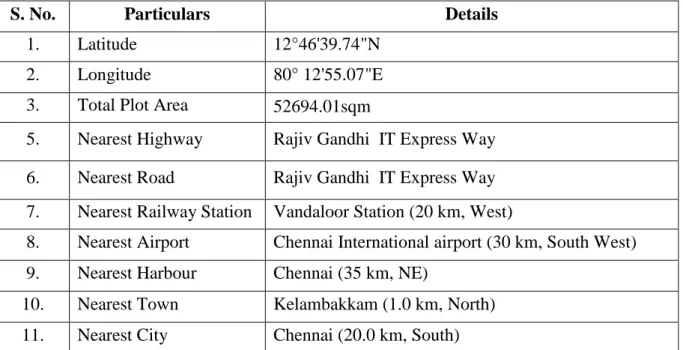
The project site is located 12°46'39.74"N latitude and 80° 12'55.07"E longitude. The site is located in Thaiyur-B Village, Thiruporur Taluk, and Kancheepuram District. No eco-sensitive zone is present within 2 km area of the project site. The environmental settings of the site are given below in Table 1.
Table 1: Details of Environmental Settings
S. No. Particulars Details
1. Latitude 12°46'39.74"N 2. Longitude 80° 12'55.07"E 3. Total Plot Area 52694.01sqm
5. Nearest Highway Rajiv Gandhi IT Express Way 6. Nearest Road Rajiv Gandhi IT Express Way 7. Nearest Railway Station Vandaloor Station (20 km, West)
8. Nearest Airport Chennai International airport (30 km, South West) 9. Nearest Harbour Chennai (35 km, NE)
10. Nearest Town Kelambakkam (1.0 km, North) 11. Nearest City Chennai (20.0 km, South)
Conceptual Plan for Residential Construction Project M/s. Alliance Villas Pvt Ltd.
Page _ 44 1.3 PROJECT COMPONENTS
The proposal involves construction of residential blocks with a total built up area of 46901.66sqm. The area split up and space utilization details are given below, the project consists of five blocks, detailed area break up is given in below Table 2.
Table 2: Land Use Break up Details
Details Area in (Sqm)
a) Total Land Area 52694.01
b) Total Ground Coverage Area of Buildings (38%) 20,023.72
c) Roads and Pavements Area (34.6%) 18,235.36
d) Surface or open Parking Area (if any) (1.63%) 864.00 e) STP, Solid Waste Disposal and Other Utilities Area (0.71%) 377.94
f) Greenbelt development Area (15%) 7904.11
g) OSR Area (10.03%) 5288.88
Total Built up Area and Details on Housing Units:
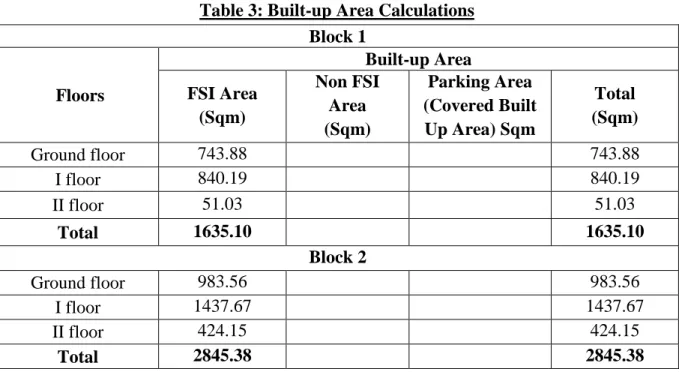
Built up area is calculated as per the latest Circular of MoEF, Dated: 2" April 2012. Built-up area is defined as ''The built-up or covered area on all the floors put together including basement(s) and other service areas, which are proposed in the building / construction project" as per the latest Circular of MoEF, Dated: 2" April 2012. Detailed built-up area calculations are given in Table 3 & 4 below
Table 3: Built-up Area Calculations Block 1 Floors Built-up Area FSI Area (Sqm) Non FSI Area (Sqm) Parking Area (Covered Built Up Area) Sqm Total (Sqm) Ground floor 743.88 743.88 I floor 840.19 840.19 II floor 51.03 51.03 Total 1635.10 1635.10 Block 2 Ground floor 983.56 983.56 I floor 1437.67 1437.67 II floor 424.15 424.15 Total 2845.38 2845.38
Conceptual Plan for Residential Construction Project M/s. Alliance Villas Pvt Ltd.
Page _ 45 Block 3
Floors Built-up Area
FSI Area (Sqm)
Non FSI Area (Sqm) Parking Area (Covered Built Up Area) Sqm Total (Sqm) Ground floor 1454.63 1454.63 I floor 1700.87 1700.87 II floor 69.57 69.57 Total 3225.07 3225.07 Block 4 Ground floor 1505.04 1505.04 I floor 1633.88 1633.88 II floor 810.85 810.85 Total 3949.77 3949.77 Block 5 Ground floor 839.47 839.47 I floor 923.62 923.62 II floor 386.47 386.47 Total 2149.56 2149.56 Block 6 Ground floor 115.15 115.15 I floor 129.68 129.68 II floor 53.35 53.35 Total 298.18 298.18 Block 7 Ground floor 7230 7230 I floor 785.37 785.37 II floor 254.60 254.60 Total 1762.97 1762.97 Block 8 Ground floor 750 750 I floor 856.92 856.92 II floor - - Total 1606.92 1606.92
Conceptual Plan for Residential Construction Project M/s. Alliance Villas Pvt Ltd.
Page _ 46 Block 9
Floors Built-up Area
FSI Area (Sqm)
Non FSI Area (Sqm) Parking Area (Covered Built Up Area) Sqm Total (Sqm) Ground floor 1979.80 1979.80 I floor 2330.36 2330.36 II floor 718.20 718.20 Total 5028.36 5028.36 Block 10 Ground floor 2141.36 2141.36 I floor 2376.65 2376.65 II floor 1133.84 1133.84 Total 5651.85 5651.85 Block 11 Ground floor 2026.87 2026.87 I floor 2162.40 2162.40 II floor 626.67 626.67 Total 4815.94 4815.94 Block 12 Ground floor 1673.92 1673.92 I floor 2047.40 2047.40 II floor 408.23 408.23 Total 4129.55 4129.55 Block 13 Ground floor 872.40 872.40 I floor 1035.05 1035.05 II floor 51.79 51.79 Total 1959.24 1930.38 Block 14 Ground floor 492.49 492.49 I floor 544.03 544.03 II floor 275.75 275.75 Total 1312.27 1312.27 EWS Block-1
Stilt floor Parking & Non FSI Area
I floor 1098.39 11.22 1109.61
II floor 1098.39 11.22 1109.61
IIIfloor 1098.39 11.22 1109.61
IVfloor 1098.39 11.22 1109.61
Conceptual Plan for Residential Construction Project M/s. Alliance Villas Pvt Ltd.
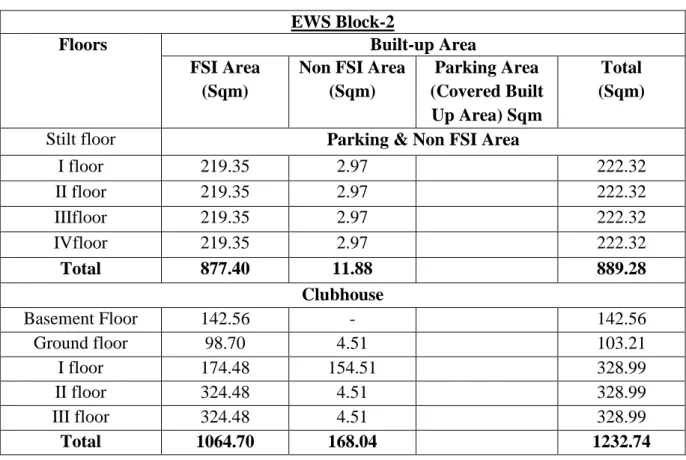
Page _ 47 EWS Block-2
Floors Built-up Area
FSI Area (Sqm)
Non FSI Area (Sqm) Parking Area (Covered Built Up Area) Sqm Total (Sqm) Stilt floor Parking & Non FSI Area
I floor 219.35 2.97 222.32 II floor 219.35 2.97 222.32 IIIfloor 219.35 2.97 222.32 IVfloor 219.35 2.97 222.32 Total 877.40 11.88 889.28 Clubhouse Basement Floor 142.56 - 142.56 Ground floor 98.70 4.51 103.21 I floor 174.48 154.51 328.99 II floor 324.48 4.51 328.99 III floor 324.48 4.51 328.99 Total 1064.70 168.04 1232.74
Table 4: Summary of Built up Area Blocks FSI Area
(Sqm)
Non FSI Area (Sqm) Parking Area (Covered Built Up Area) Sqm Total (Sqm) Block 1 1635.10 1635.10 Block 2 2845.38 2845.38 Block 3 3225.07 3225.07 Block 4 3949.77 3949.77 Block 5 2149.56 2149.56 Block 6 298.18 298.18 Block 7 1762.97 1762.97 Block 8 1606.92 1606.92 Block 9 5028.36 5028.36 Block 10 5651.85 5651.85 Block 11 4815.84 4815.84 Block 12 4129.55 4129.55 Block 13 1959.24 1959.24 Block 14 1312.27 1312.27 EWS Block 1 4393.56 44.88 4438.44 EWS Block2 877.40 11.88 889.28 Clubhouse 1064.70 168.04 1232.74 Total 46676.86 224.8 46901.66 Grand Total 46901.66
Conceptual Plan for Residential Construction Project M/s. Alliance Villas Pvt Ltd.
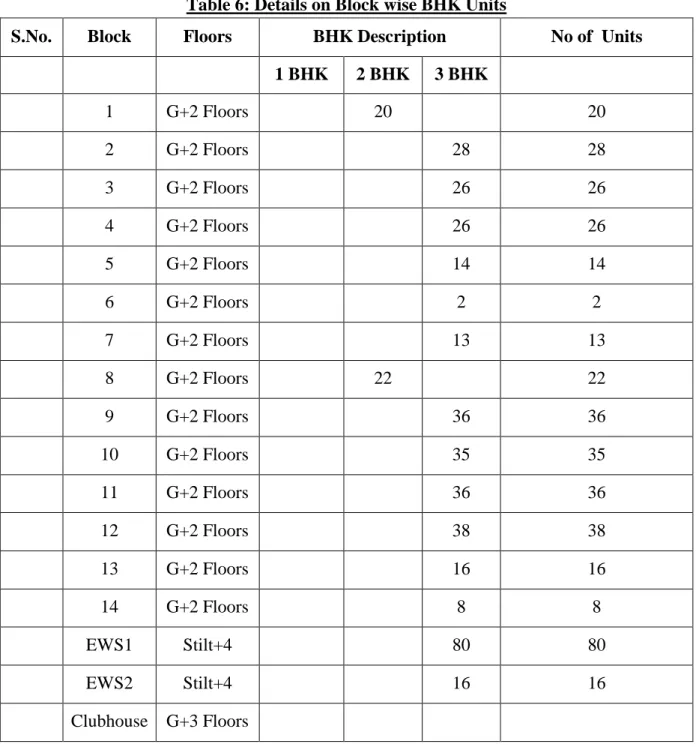
Page _ 48 Table 6: Details on Block wise BHK Units
S.No. Block Floors BHK Description No of Units
1 BHK 2 BHK 3 BHK 1 G+2 Floors 20 20 2 G+2 Floors 28 28 3 G+2 Floors 26 26 4 G+2 Floors 26 26 5 G+2 Floors 14 14 6 G+2 Floors 2 2 7 G+2 Floors 13 13 8 G+2 Floors 22 22 9 G+2 Floors 36 36 10 G+2 Floors 35 35 11 G+2 Floors 36 36 12 G+2 Floors 38 38 13 G+2 Floors 16 16 14 G+2 Floors 8 8 EWS1 Stilt+4 80 80 EWS2 Stilt+4 16 16 Clubhouse G+3 Floors
Total Number of Housing units = 416 units Total Built up Area = 46901.66sqm.
Conceptual Plan for Residential Construction Project M/s. Alliance Villas Pvt Ltd.
Page _ 49 1.4 VEHICLE PARKING FACILITIES
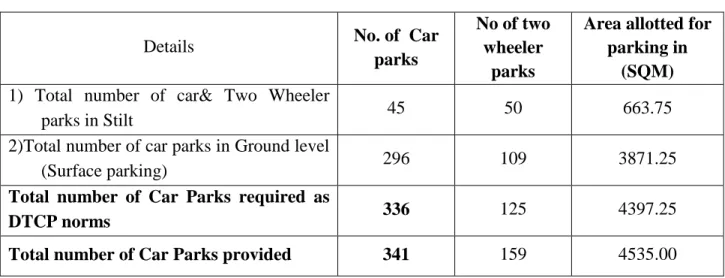
Parking will be provided as per the building bye laws of DTCP. Details of parking required and to be provided is given below in Table 5.
Table 5: Parking Provided
Details No. of Car
parks
No of two wheeler
parks
Area allotted for parking in
(SQM) 1) Total number of car& Two Wheeler
parks in Stilt 45 50 663.75
2)Total number of car parks in Ground level
(Surface parking) 296 109 3871.25
Total number of Car Parks required as
DTCP norms 336 125 4397.25
Total number of Car Parks provided 341 159 4535.00
1.4 POWER REQUIREMENT
The power requirement during operation is about 2250 KVA and it will be sourced from the nearby TNEB grid DG sets of capacity 1 nos of 250 KVA will be provided to cater essential load requirement during power failure.
1.5 BASELINE ENVIRONMENTAL STATUS
Baseline studies are carried out to provide a detailed description of the existing ecosystem, landscape, infrastructure, cultural heritage and urban environment. A baseline study describes the initial state of the environment within the selected boundaries of the study area.
The baseline data has been generated and secondary data collected from various Government and Semi-Government organizations. The details about the existing environmental values are projected based on the volume of the assessment accomplished during the period.
The various environmental attributes were divided into primary and secondary studies. Primary attributes such as air environment, water, soil, noise & biological environment were being assessed by conducting field studies, on-site monitoring. The baseline studies started with site visits and survey in the study area for fixing the monitoring locations for the primary data generation.
1.6 ENVIRONMENTAL COMPONENTS
The baseline environmental studies helped in assessing the existing environmental conditions of the study area and identifying the critical environmental attributes. This will facilitate the comparison of the resultant environmental conditions in the post study scenario with the pre- study conditions and will help in checking the environmental pollution. The baseline
Conceptual Plan for Residential Construction Project M/s. Alliance Villas Pvt Ltd.
Page _ 50 environmental data for Ambient Air, Noise, Soil and Ground water is enclosed separately in Annexure .
1.7 WATER REQUIREMENT
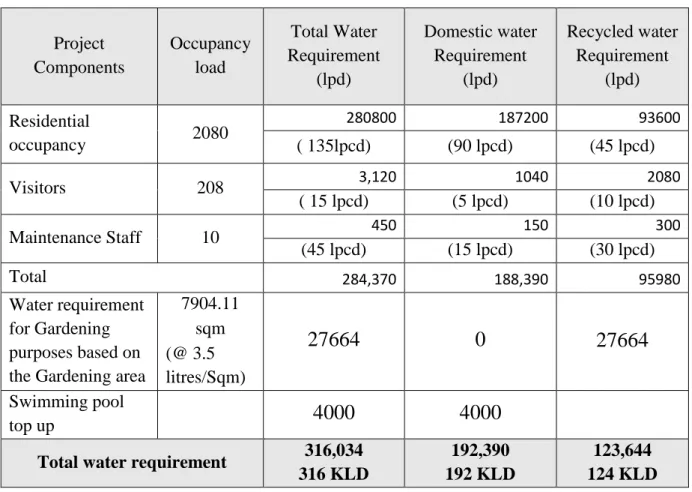
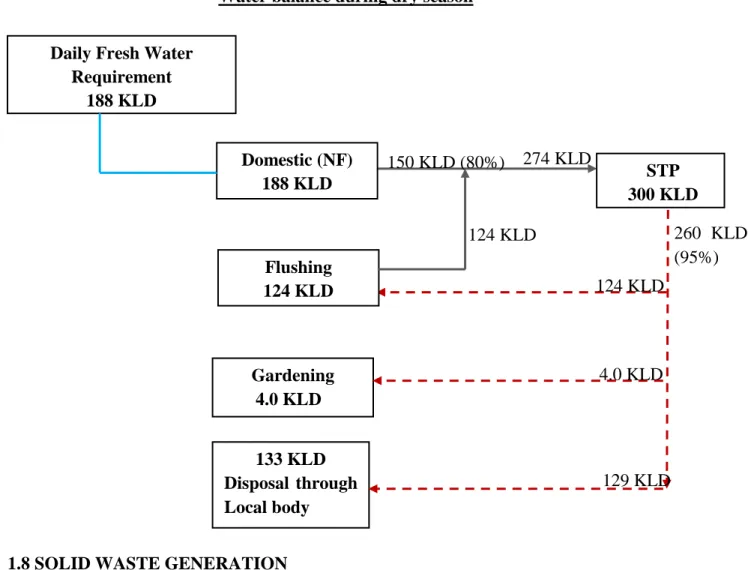
The total water requirement during operation is 316 KLD. Source of water is local body. The wastewater generation from the project is estimated to be about 271 KLD, which will be treated in proposed sewage treatment plant and will be recycled for flushing, gardening and the remaining will be disposed through the local body. The estimation of water requirement and the water balance chart is shown in Table 7, 8 and 9.
Table 7: Water Requirement and Water Balance - Occupancy Load Calculation
S.No Project Components Total Apartments Occupancy load
1 Residential units 416 2080
2 Visitors & Maintenance staff - Residential
10% of Resident
population 208
3 Club House 5% of residential
population 10 Total Occupancy 2298 Project Components Occupancy load Total Water Requirement (lpd) Domestic water Requirement (lpd) Recycled water Requirement (lpd) Residential occupancy 2080 280800 187200 93600 ( 135lpcd) (90 lpcd) (45 lpcd) Visitors 208 3,120 1040 2080 ( 15 lpcd) (5 lpcd) (10 lpcd) Maintenance Staff 10 450 150 300 (45 lpcd) (15 lpcd) (30 lpcd) Total 284,370 188,390 95980 Water requirement for Gardening purposes based on the Gardening area
7904.11 sqm (@ 3.5 litres/Sqm)
27664
0
27664
Swimming pool top up4000
4000
Total water requirement 316,034 316 KLD
192,390 192 KLD
123,644 124 KLD
Conceptual Plan for Residential Construction Project M/s. Alliance Villas Pvt Ltd.
Page _ 51 Table 8: Water Requirement Calculation
Table 9: Summary of Total Water Balance Water Requirement Summary:
Total Water Requirement = 316KLD
Fresh water requirement for domestic purposes = 188 KLD Treated water requirement for Flushing purposes = 124 KLD Treated water requirement for Gardening purposes = 4 KLD
Water balance during dry season
1.8 SOLID WASTE GENERATION
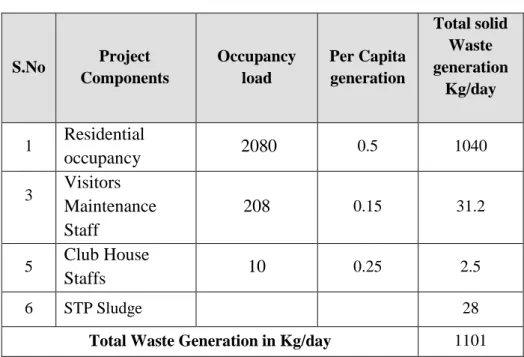
The solid waste from the proposed development will comprises of compostable wastes like domestic food waste, horticultural waste and recyclable waste like plastics, paper etc. As per the manual on municipal solid waste prescribed by Central Public Health and Environmental Engineering Organization (CPHEEO), the quantity of solid waste generated varies between 0.2-0.6 kg / capita / day. Quantity of solid waste generated from the proposed residential building is given below in Table 10
124 KLD STP 300 KLD 260 KLD (95%) Gardening 4.0 KLD 4.0 KLD 133 KLD Disposal through Local body 129 KLD 150 KLD (80%) Domestic (NF) 188 KLD Flushing 124 KLD Daily Fresh Water
Requirement 188 KLD
274 KLD
Conceptual Plan for Residential Construction Project M/s. Alliance Villas Pvt Ltd.
Page _ 52 Table 10: Quantity of solid waste generated from the proposed residential building
S.No Project Components Occupancy load Per Capita generation Total solid Waste generation Kg/day 1 Residential occupancy 2080 0.5 1040 3 Visitors Maintenance Staff 208 0.15 31.2 5 Club House Staffs 10 0.25 2.5 6 STP Sludge 28
Total Waste Generation in Kg/day 1101
Source: Central Public Health and Environmental Engineering Organization (CPHEEO), Per capita waste generation for residential are 0.5 kg / capita / day for staff population it is 0.25 kg/capita/day and for visitors it is 0.15 kg/day.
Table 11: Waste Composition
S.No Description Quantity
(Tons/day) Mode of treatment / disposal
1
Compostable Waste (@60% of waste generated)
0.643
Will be treated in organic waste convertor within the project site. Manure generated will be used for landscaping purpose within project site.
2
Recyclable waste (@40% of waste generated
0.429 Waste will be sold to authorized recyclers
4 STP Sludge 28 kg/day Will be used as a Manure for greenbelt
development
Wastes generated from the households will be segregated into compostable waste, recyclable and inert waste in the source itself (by the occupants) in separate bins. Door to door waste collection system will be adopted. Compostable waste will be treated in organic waste convertor within the site. Manure generated will be used within the site for landscaping purpose. Recyclable fraction of waste will be sold to authorized vendors and inert waste will be send for land filling through authorized agency for waste collection in the area.
Conceptual Plan for Residential Construction Project M/s. Alliance Villas Pvt Ltd.
Page _ 53 Organic waste convertor of various makes like Excel, Nachiket Engineering, Earth Care equipments are available. These OWC reduce volume of waste fed by 80% and convert it into manure that can be used for landscaping purpose. This manure can be stored, packed, sold and used for landscaping.
Apart from the municipal waste, E-waste comprising of rejected CFL, bulbs, laptops, TV sets, computers etc will be generated. This waste will be insignificant in initial stage. Room will be provided within project site for storing discarded electronics. These will be sold to authorized vendors on regular basis.
2.0 ENVIRONMENTAL IMPACT ASSESSEMNT 2.1 INTRODUCTION
This chapter presents the assessment of various impacts due to the proposed construction project in the study area. Generally, the environmental impacts can be categorized as either primary or secondary. Primary impacts are those, which are attributed directly by the project and secondary impacts are those, which are indirectly induced and typically include the changed patterns of social and economic activities by the proposed project. The Proposed construction project would create impact on the environment in two distinct phases:
Impacts during the construction phase Impacts during the operation phase
The construction and operational phase of the proposed construction project comprises of various activities each of which will have impact on some or other environmental parameters. Various impacts during the construction or operational phase and the environmental parameters have been studied to estimate the impacts on environment. The identification and details on impact of the project activity on each of the above environmental attributes are discussed below.
2.2 IDENTIFICATION OF IMPACTS
Construction of residential complex is for the benefit of general population, however, like any other projects, it also has impacts on existing Environmental settings and if not properly evaluated and controlled, it may lead to imbalances. These could be reversible, irreversible, temporary or permanent.
The identification of impacts is important as it leads to the other elements such as quantification and evaluation of impacts. Although a number of non-projects related impacts have been identified while describing the existing (baseline) environmental status, it is necessary at this stage to identify the types of the potential impacts which might be caused by the proposed development. Many techniques are available for identification of impacts. In
Conceptual Plan for Residential Construction Project M/s. Alliance Villas Pvt Ltd.
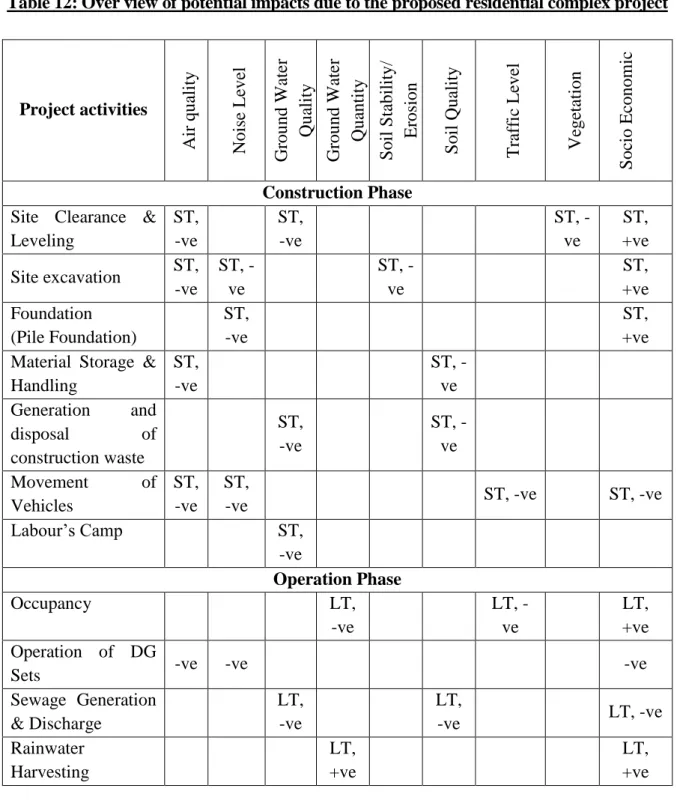
Page _ 54 case of this project, the "Matrix Method" was adopted, which involves an understanding of the cause-condition-effect relationship between an activity and environmental parameters. It is very useful as gross screening tool for impact identification method. This method has been basically advantageous in recognizing the series of impacts that could follow from the proposed activities.
The idea was to account for the project activity and identify the types of impacts that could initially occur. This process was repeated until all possible types of impacts were identified. With this method the potential impact of the proposed project has been identified.
Table 12: Over view of potential impacts due to the proposed residential complex project
Project activities Air q ua li ty Noise Le ve l Gr ound W ate r Qua li ty Gr ound W ate r Qua nti ty S oil S tabil it y/ Er osion S oil Qua li ty Tr aff ic Le ve l Ve ge tation S oc io Ec onomi c Construction Phase Site Clearance &
Leveling ST, -ve ST, -ve ST, -ve ST, +ve Site excavation ST, -ve ST, -ve ST, -ve ST, +ve Foundation (Pile Foundation) ST, -ve ST, +ve Material Storage &
Handling ST, -ve ST, -ve Generation and disposal of construction waste ST, -ve ST, -ve Movement of Vehicles ST, -ve ST,
-ve ST, -ve ST, -ve
Labour’s Camp ST, -ve Operation Phase Occupancy LT, -ve LT, -ve LT, +ve Operation of DG
Sets -ve -ve -ve
Sewage Generation & Discharge LT, -ve LT, -ve LT, -ve Rainwater Harvesting LT, +ve LT, +ve
Conceptual Plan for Residential Construction Project M/s. Alliance Villas Pvt Ltd. Page _ 55 Solid waste Generation LT, -ve Gardening & Landscaping LT, +ve LT, +ve LT, +ve LT, +ve LT, +ve LT, +ve
Note: ST - Short Term Impact, LT - Long Term Impact, -ve - Negative Impact, +ve – Positive Impact
2.3 IMPACT EVALUATION
Impact evaluation assesses the expected changes in the environment due to the proposed project. It is the tool for identifying the magnitude of impact and forms basis for the development of Environmental Management Plan. Weightage for each impact is given below. Evaluation of impacts considering both positive and negative effects on air, noise, land, water and socioeconomic environment during the construction and operation phase of the project is given in Table 13 and 14 respectively.
TABLE 13: EVALUATION OF CONSTRUCTION PHASE IMPACT
Environment al Parameter Project Activities Impact Type Sig n if ican t No n Sig n if ican t Dir ec t In d ir ec t Sh o rt T er m L o n g T er m Un av o id ab le Ir rev er sib le Mitig atio n R eq u ir ed Weight age CONSTRUCTION PHASE AIR ENVIRON MENT
Site Clearance &
Leveling Negative √ √ √ √ √ -4
Site excavation Negative √ √ √ √ √ -4
Foundation (Shallow Foundation)
Negative √ √ √ √ 0
Material Storage
& Handling Negative √ √ √ √ √ -4
Generation and disposal of construction waste Negative √ √ √ -4 Vehicular Movement Negative √ √ √ -4 Labour’s Camp No Impact -
Public Health & Safety No Impact - Economic Activity No Impact - NOISE ENVIRON MENT
Site Clearance &
Leveling Negative √ √ √ 0
Conceptual Plan for Residential Construction Project M/s. Alliance Villas Pvt Ltd. Page _ 56 Foundation (Shallow Foundation) Negative √ √ √ √ -4 Material Storage
& Handling Negative √ √ -1
Generation and disposal of construction waste No Impact - Vehicular Movement Negative √ √ √ -1 Labour’s Camp No Impact -
Public Health & Safety No Impact - Economic Activity No Impact - LAND ENVIRON MENT
Site Clearance & Leveling No Impact - Site excavation No Impact - Foundation (Shallow Foundation) Negative √ √ -1 Material Storage
& Handling Negative √ √ √ √ -4
Generation and disposal of construction waste Negative √ √ -4 Vehicular Movement Negative √ √ √ -1 Labour’s Camp No Impact -
Public Health & Safety No Impact - Economic Activity No Impact - WATER ENVIRON MENT
Site Clearance &
Leveling Negative √ √ √ -2 Site excavation No Impact - Foundation (Shallow Foundation) No Impact - Material Storage
Conceptual Plan for Residential Construction Project M/s. Alliance Villas Pvt Ltd. Page _ 57 Generation and disposal of construction waste Negative √ √ √ √ -4 Vehicular Movement Negative √ √ 0
Labour’s Camp Negative √ √ √ √ -4
Public Health & Safety No Impact - Economic Activity No Impact - SOCIO ECONOMI C ENVIRON MENT
Site Clearance &
Leveling Negative √ √ √ √ -2
Site excavation Negative √ √ √ √ -2
Foundation (Shallow Foundation)
Negative √ √ √ √ -2
Material Storage
& Handling Negative √ √ √ 0
Generation and disposal of construction waste Negative √ √ √ √ -2 Vehicular Movement Negative √ √ √ √ -2
Labour’s Camp Negative √ √ √ √ -2
Public Health &
Safety Positive √ √ √ 6
Economic
Activity Positive √ √ √ 6
TABLE 14: EVALUATION OF OPERATION PHASE IMPACT Environme
ntal Parameter
Project Activities Impact Type Sig n if ican t No n Sig n if ican t Dir ec t In d ir ec t Sh o rt T er m L o n g T er m Un av o id ab le Ir rev er sib le Mitig atio n R eq u ir ed Weigh tage OPERATION PHASE AIR ENVIRON MENT Occupancy No Impact - Operation of DG Sets Negative √ √ √ √ -8 Sewage Generation & Discharge Negative √ √ 0 Rainwater Harvesting No Impact - Solid waste Generation Negative √ √ √ -6
Conceptual Plan for Residential Construction Project M/s. Alliance Villas Pvt Ltd. Page _ 58 Gardening & Landscaping Positive √ √ √ 10 NOISE ENVIRON MENT Occupancy No Impact - Operation of DG Sets Negative √ √ √ √ -8 Sewage Generation & Discharge No Impact -- Rainwater Harvesting No Impact - Solid waste Generation No Impact - Gardening & Landscaping Positive √ √ √ 10 LAND ENVIRON MENT Occupancy Negative √ √ 0 Operation of DG Sets Negative √ √ √ 0 Sewage Generation & Discharge Negative √ √ √ √ -8 Rainwater Harvesting Positive √ √ √ 8 Solid waste Generation Negative √ √ √ √ -8 Gardening & Landscaping Positive √ √ √ 10 WATER ENVIRON MENT Occupancy Negative √ √ √ √ -8 Operation of DG Sets Negative √ √ √ √ -6 Sewage Generation & Discharge Negative √ √ √ √ √ -8 Rainwater Harvesting Positive √ √ √ 10 Solid waste Generation Negative √ √ 0 Gardening & Landscaping Positive √ √ √ 10 SOCIO ECONOMI C ENVIRON MENT Occupancy Positive √ √ √ 10 Operation of DG Sets Negative √ √ √ √ -6 Sewage Generation & Discharge Negative √ √ √ √ -6
Conceptual Plan for Residential Construction Project M/s. Alliance Villas Pvt Ltd. Page _ 59 Rainwater Harvesting Positive √ √ √ 8 Solid waste Generation Negative √ √ √ -6 Gardening & Landscaping Positive √ √ √ 8
2.4 IMPACT ON AIR ENVIRONMENT 2.4.1 Construction Phase
Impacts of construction activities on air quality are cause for concern mainly in the dry months due to dust particles. The main sources of emission during the construction period are the movement of equipment at site and dust emitted during the leveling, grading, earthworks, and other construction related activities. The dust emitted during the above mentioned activities depend upon the type of soil being excavated. However, the impact will be for short duration and confined locally to the construction site. The composition of dust in this kind of operation is, however, mostly inorganic and non-toxic in nature.
The impact of such activities would be temporary and restricted to the construction phase. The impact will be confined within the project boundary and is expected to be negligible outside the plant boundaries. Proper upkeep and maintenance of vehicles, sprinkling of water on roads and construction site are some of the measures that would greatly reduce the impacts during the construction phase. Thus, it is inferred that no significant impacts are expected on the overall ambient air quality due to the proposed construction activities.
Transportation and Storage of Construction Materials
Transportation of heavy machinery and building materials implies heavy traffic on the roads leading to the site with possible negative impacts to the surrounding area (dust, spillage, emissions and noise). Transportation of construction materials as well as improper storage of building materials, especially gravel, sand and cement in the construction site will lead to inadvertent dispersal of materials during heavy rain or high wind during dry periods. Measures will be adopted for proper handling of construction materials to reduce the negative impact.
2.4.2 Operation Phase
Ambient air quality at the proposed project site and its surroundings is monitored and values of the pollutants RPM, PM2.5, NOx and SO2 are within the limits of NAAQS, 2009 prescribed
by the central pollution control board.
There is no major pollutant envisaged from the proposed development. It is likely that the air quality may be affected slightly due to the emissions from the vehicular movement. The emission from DG sets will be very negligible since it will be used only during power cut in
Conceptual Plan for Residential Construction Project M/s. Alliance Villas Pvt Ltd.
Page _ 60 the necessary area. However in the case of DG sets the stack will be properly designed to meet the stipulations of CPCB. These emissions will be insignificant and the environmental pollutant levels will be maintained within the prescribed limits. Hence there shall not be any adverse impact on the air environment around the proposed Residential Complex.
2.5 IMPACT ON AMBIENT NOISE 2.5.1 Construction Phase
During the construction noise levels will increase due to use of machinery and heavy vehicles in the project area. In terms of noise emission; demolition, excavation and construction work can be divided into two phases, namely (1) Demolition and Earthworks and (2) building works. Loading and unloading of construction materials, fabrication, handling of equipment and material, operation of power shovels etc. will be the major source of noise during the construction phase. Various construction activities will cause short-term noise impact in the immediate vicinity of the project site.
The areas affected are those close to the site and hence the impacts are localized. At the peak of the construction, marginal increase in noise levels is expected to occur. The peak noise levels from continuous construction activity may be as high as 80 - 90 dB (A). The noise control measures during construction phase shall restrict the noise levels to lower levels. Hence the overall impact on the ambient noise levels will not be significant.
2.5.2 Operation Phase
There will not be any major impact from noise. This is because no equipment or other infrastructure facility in the project generates noise more than 50-60 dB (A). However, the only noise generation source is the DG set. The promoters have decided to adopt adequate steps to maintain the noise levels within the prescribed limits. For the same all the DG facility will be equipped with acoustic enclosure. Apart from this honking will be prohibited at the site and speed limits will be restricted within the site. This will significantly help in controlling noise levels at the site. Further the green belt provided within the site will act as noise barrier between inside and outside environment. This will act as buffer and protects the site from high noise levels outside the site.
Traffic Noise
Traffic will increase during both construction and operation phase of the project. Vehicles associated with construction would generate intermittent noise throughout the vicinity of the proposed action. In the operation phase, vehicular parking is being provided in the basement, ground floor and first floor of the building where noise levels are expected to increase substantially during the peak hours due to starting, idling and roaring of vehicles.
Conceptual Plan for Residential Construction Project M/s. Alliance Villas Pvt Ltd.
Page _ 61 2.6 IMPACT ON LAND ENVIRONMENT
No blasting will be done during construction phase of the project. The rehabilitation and resettlement issues are not involved in the project. Furthermore the existing environmental conditions of the project site reveal that the land is not contaminated or polluted.
Top soil will be excavated upto 15 cm from the project site. It will be stored in covered area during construction phase and will be used for landscaping in operation phase within project site. The upper/top level of soil will be affected during construction phase but this will be limited to a portion of the project area. Also the impact due to exploitation of ground water is insignificant in the site due to the sourcing of water from other sources during the operation phases. Hence there will not be any adverse impact on the surrounding land use during the construction period as well as during the operation phase.
2.7 IMPACT ON WATER RESOURCES 2.7.1 Construction Phase
The required water quantity for construction will be utilized from the available resource in the project area. Impact on water quality during construction phase may be due to non-point discharges of sewage generated from the construction work force, stationed at the site. Construction activities for the proposed development can have minor impact on hydrology and ground water quality of the area if the construction waste leaches into ground. Potential sources of impacts on the hydrology and ground water quality during the construction phase would be soil runoff, improper disposal of construction debris, spillage of oil and grease from the vehicles and wastewater stream generated from on site activities such as vehicles washing, workshop etc. Precautions and preventive measure will be taken at the site during construction to avoid any ground and surface water contamination hence the overall impact on water environment during construction phase due to proposed project is likely to be insignificant.
2.7.2 Operation Phase
The total quantity of wastewater generation is likely to be 274m3/day. No impact from wastewater, this is because the sewage generated will be treated and recycled within the project components for flushing and gardening. Therefore, surface and subsurface contamination due to treated wastewater will not be envisaged.
Conceptual Plan for Residential Construction Project M/s. Alliance Villas Pvt Ltd.
Page _ 62 2.8 IMPACTS DUE TO WASTE DISPOSAL
2.8.1 Stacking and Disposal of Construction Materials
Stacking of construction materials will be confined to the project site only and also temporary sheds will be provided to store the materials, hence no impacts on surrounding area will be envisaged. Solid wastes generated due to proposed project during construction phase include sand, gravel, stone, bricks, plastic, paper, wood, metal and glass. Recyclables will be sent to authorize recyclers. Hence there is no significant impact due to waste disposal during the construction phase.
2.8.2 Operation Phase
The solid waste generated from the project will be collected daily and moved to a common temporary storage facility by the staff dedicated for waste collection. The collected Solid waste will be disposed through Organic waste converter.
2.9 IMPACTS ON ECOLOGICAL RESOURCES 2.9.1 Construction Phase
The impact of construction activities will be primarily confined to the project site. The project site is a vacant land and devoid of any vegetation. Thus the site development work will not lead to any significant loss of any important plant species. Deposition of fugitive dust on leaves of nearby vegetation may lead to temporary reduction of photosynthesis. Such impacts will, however, be confined mostly to the initial period of construction phase. Hence the proposed development will not lead to habitat destruction, fragmentation or vegetation damage.
2.9.2 Operation Phase
No wastewater will be discharge into the surface water stream. Hence, there will not be any impact on the aquatic ecology. Also the proposed project is to be located in an earmarked residential zone, which does not have any natural park or sanctuary or forest area in the immediate vicinity. The flora and fauna pattern in the area will not be disturbed due to the project. Hence the overall impact on ecological resources due to proposed project is likely to be insignificant. Moreover the entire project area would be landscaped with variety of plants.
Conceptual Plan for Residential Construction Project M/s. Alliance Villas Pvt Ltd.
Page _ 63 2.10 IMPACT ON TRAFFIC LEVELS
2.10.1 Construction Phase
The movement of construction equipments will be mostly within the site during the project. Vehicles bringing in raw materials like sand, cement and aggregate materials will be moving into the site from outside, which will be strictly controlled and monitored as per the traffic rules, to avoid any sort of disturbance to the traffic and safety of the surrounding areas. Hence the impact due to the vehicular movement during the construction phase would be minor or insignificant.
2.10.2 Operation Phase
Based on the vehicular density observed during the traffic survey conducted on the main roads around the proposed site, the existing infrastructure is capable of taking up additional traffic loads. Also the project is to be executed phase wise; the increase in traffic will be easily handled by the existing as well as the future improvements in the transportation infrastructure. Hence there will not be any impact on the traffic pattern and density.
2.11 IMPACTS ON SOCIO ECONOMIC ENVIRONMENT
The required land for the development is owned by M/s.Alliance Villas Pvt Ltd.The proposed residential complex will be open to members of all communities and castes. The above measure will encourage mixing of different caste people for their respective festivals and occasions. This will improve the social welfare and brotherhood among the various communities and castes.
Also the state of the art facilities proposed in the development is planned to cater the needs of the occupants which would be able to provide healthy working atmosphere. Hence it is obvious to assume that the activities of the proposed development will produce some positive impacts in the socio-economic status of the area.
2.11.1 Public Health and Safety
As the project is only a construction of residential complex and all the construction activities are confined to the project site, no health related impact would be envisaged within the project area. The people engaged in the construction activities will be directly exposed to dust generation, which is likely to cause health related impact. Appropriate mitigation measures like spraying of water will be adopted to minimize dust emission in the construction site. Laborers will be provided with suitable Personal Protective Equipment (PPE) as required under the health and safety norms. Regular health checkups will be organized.
Conceptual Plan for Residential Construction Project M/s. Alliance Villas Pvt Ltd.
Page _ 64 2.11.2 Positive Impact
The project will facilitate maximum participation of the local work force for construction process; this will benefit the local economy, improvement in economic activity and enhancement in earning opportunities for the local population. The operation of the project and other allied facilities will improve the employment opportunities. The project will provide direct and indirect employment. About 100 – 150 persons will be employed during the operation stage for the purpose of day-to-day maintenance works. The employment will have positive impact on the local economy thereby increasing the quality of life. The proposed rainwater recharge facility will augment the ground water level in the project area. The proposed project will also improve the aesthetics of the area due to the development of modern buildings.
3.0 ENVIRONMENTAL MANAGEMENT PLAN 3.1 GENERAL
Environmental Management Plan (EMP) is aimed at mitigating the possible adverse impacts of the project and for ensuring to maintain the environmental quality. The environmental management plan consists of the set of mitigation, management, monitoring and institutional measures to be taken to eliminate the adverse environmental impacts or reduce them to acceptable levels.
3.2 AIR POLLUTION CONTROL AND MANAGEMENT 3.2.1 Construction Phase
The impacts will be due to the air emissions like Particulate matter (PM10 & PM2.5, CO2, NOx
and SO2 due to material handling, vehicular movements and other site activities. The
particulate matters will be reduced by frequent sprinkling water on the road surfaces and on other areas where dust is arising due to material handling. All the equipments and vehicles used in the construction and transportation of materials will be maintained properly and only low sulphur diesel will be used as fuel for DG sets and construction equipment and vehicles. The emissions from the DG sets will be let out only through the stacks with adequate heights as per CPCB norms. This will avoid the deposition of the particulate matters and other pollutants by facilitating the through dispersion of pollutants into the atmosphere. The stacking of all the construction materials will be confined only within the proposed site. Vehicles carrying the raw material and debris will be covered to minimize dust emissions while travelling. Adequate parking space will be provided for construction vehicle and machinery to prevent idling and thus will help in minimizing the emissions. Wheel wash facility will be provided at the exit point of the site.
Conceptual Plan for Residential Construction Project M/s. Alliance Villas Pvt Ltd.
Page _ 65 3.2.2 Operation Phase
Air emissions are observed during the operation phase of the project. The air emissions will be reduced by ensuring smoother flow of traffic within the premises by better traffic management plans. It is proposed to have trees all through the boundaries of the site and along the either side of the internal roads. This will reduce the particulate matters from being transported to the nearby areas. The air emissions from the Diesel Generators will be controlled by using low sulphur content high speed diesels, periodic maintenance of DG sets as per the defined schedule of manufacturer and by providing adequate stack heights as prescribed by CPCB. The stack height for the DG sets are calculated based on the CPCB guidelines as shown below;
The proposed project to have 1 nos of 250 KVA
Air Pollution Control (APC) Measures
The main source of air emissions from the proposed residential development is the Generator Sets the above proposed generator sets will be used only during TNEB power failure. To control the air emissions from these D.G sets, adequate stack height is provided to release the exhaust flue gases into the atmosphere at a height at which efficient dispersion takes place. Since the DG sets are operated only during power failure, the emission is not continuous and hence the impact due to these emissions is insignificant.
The stack height for the DG sets are calculated based on the CPCB guidelines as shown below;
Stack Height Design Calculation for 250 KVA Generator Set H = h + (0.2) (kVA) 0.5
= 33 + 0.2 (250) 0.5 = 33 + 3.16 = 36.16
Where, H = Total height of stack in meters from ground level h = height of the building in meters
Conceptual Plan for Residential Construction Project M/s. Alliance Villas Pvt Ltd.
Page _ 66 3.3 NOISE CONTROL AND MANAGEMENT
3.3.1 Construction Phase
The noise generated from the construction equipments will be reduced through proper maintenance of all the equipments which are involved in construction activities, confining the construction activities only during the day time and providing barricades all around the project area. The adverse impacts of noise especially on workers will be reduced by providing ear muffs to the workers in high noise zones. Noise control systems such as equipment foundation pads, dampeners, silencers and acoustic enclosures will be used for individual units as per the requirement to minimize the noise & vibration.
3.3.2 Operation Phase
The increase in the ambient noise levels due to the vehicle transportation will be controlled by the development of the green cover all along the internal roads and by implementing better traffic management plans inside the site premises. The better traffic management plans will significantly reduce the noise generated due to the congestion caused by the movement of vehicles.
The generator noise is controlled by providing acoustic enclosures. Proper air ventilation system is designed to allow the maximum aspiration and cooling airflow required so that the engines do not overheat. Axial flow fan of required size & numbers provided for proper air ventilation. Acoustic louvers, splitter & insulated ducts are provided to suppress the noise where required.
3.4 SOLID WASTE MANAGEMENT 3.4.1 Construction Phase
Separate raw material handling yard will be demarcated. This will prevent the contamination of the soil due to the spillage of the construction materials. Cement will be separately stored under cover in bales. The raw material handling yard will be located within the project site and separated by enclosures/barricades. This will keep the working area clean and reduce the soil contamination.
3.4.2 Operation Phase
During the operation phase the used oil from the DG sets will be collected in separate drums and handed over to the authorized recyclers by TNPCB.
Hazardous Waste: During the operation phase the used oil, DG filters, oil mixed cotton waste and oil containers from the DG sets will be collected in separate place.
Conceptual Plan for Residential Construction Project M/s. Alliance Villas Pvt Ltd.
Page _ 67 Generation and disposal of Hazardous waste Quantity per annum is given in Table 15
Table 15: Hazardous Waste Generation and Disposal
S.No Waste category Description of waste Quantity in Tonnes/per annum
Activity/Activities for which authorization is required
Collection &
Storage Transport & Disposal
1 35.1 DG Filters & filter material 0.6 MS drums within the premises Disposal through TSDF facility Gummudipoondi 2 5.1 Used oil 0.5 MS drums within
the premises
Disposed to authorized re -processors
Non- Hazardous Waste:
It is estimated that the municipal solid wastes will be generated in the following passion: Compostable wastes : 0.643 Tons/day
Recyclable wastes : 0.429 Tons/day Sludge from STP : 28 Kg/day
Wastes generated from the households will be segregated into compostable waste, recyclable and inert waste in the source itself (by the occupants) in separate bins. Door to door waste collection system will be adopted. Compostable waste will be treated in organic waste convertor within the site. Manure generated will be used within the site for landscaping purpose. Recyclable fraction of waste will be sold to authorized vendors and inert waste will be send for land filling through authorized agency for waste collection in the area.
Horticulture wastes leaves, grass and vegetative residues shall be collected at the secured location such that it will not hinder daily activity schedule or washed away by the surface run-off causing choking of drains, etc. and will be separately treated and disposed off along with biodegradable waste.STP sludge will be stabilized, and dewatered for separation of solids, which will be used as manure in horticulture.
Solid waste Source Separation
Biodegradable Waste Collection point Organic Waste Converter Collection point
Non Biodegradable Waste
Conceptual Plan for Residential Construction Project M/s. Alliance Villas Pvt Ltd.
Page _ 68 3.5 WATER AND WASTEWATER MANAGEMENT
3.5.1 Construction Phase
The wastewater generated by the construction workers will be treated and disposed through septic tank with soak pit arrangement. All the water storage tanks/containers will be maintained without any leaks. Necessary precaution and preventive measures will be taken at the site during construction to avoid any groundwater and surface water contamination. 3.5.2 Operation Phase
It is proposed to use the recycled water for the part of the daily water demand in the premises. The total water requirement during operation is 316KLD. The wastewater generation from the project is estimated to be about 274 KLD, which will be treated in proposed sewage treatment plant of 300 KLD STP. The technology adopted will be extended aeration system followed by disinfection. Treated sewage of 260 KLD will be reused for flushing, gardening and the excess will be disposed through local Municipality.
3.6 STORM WATER MANAGEMENT 3.6.1 Construction Phase
The surface runoff during the construction period will be directed into the drains separately provided for this purpose.
3.6.2 Operation Phase
The highest recorded monthly rainfall in that area and surroundings of Chennai 521.1 mm during November, 2008 considering the previous 5 years day peak rainfall (Refer Table below from IMD). Chennai receives considerable rainfall thus storm water management system has been proposed considering the peak hourly rainfall of 62 mm (Rakhecha & Pisharoty)
Table 16: Five Yearly Rainfall
Year
Rainfall (mm)
Jan Feb Mar Apr May Jun Jul Aug Sep Oct Nov Dec 2011 63.1 11.2 114.2 11.7 0.1 65.1 23 100.5 97.1 378 521.1 6.8 2012 13.1 0.0 0.7 0.0 14.0 11.3 41.8 93.9 73.6 46.5 493.8 259.5 2013 4.7 0.1 0.0 0.0 191.1 120.2 146.0 195.1 107.5 165.6 224.2 263.7 2014 11.8 41.8 0.0 19.4 10.0 118.0 85.6 330.5 235.5 241.1 447.3 147.5 2015 17 0.0 0.5 0.0 0.0 21.2 67.3 94.5 164 394.3 39.2 134.4
Rain water from internal roads etc will be discharged through storm water drain sloping towards rain water collection sumps. The Rainwater down comer pipes from terrace level directly connected to rainwater inspection chambers interlinked and discharged to filtration
Conceptual Plan for Residential Construction Project M/s. Alliance Villas Pvt Ltd.
Page _ 69 bed to store Rain water of min. An overflow pumping main pipe will be laid as lead pipe from rainwater harvesting trench up to the road for draining the excess water during rainy seasons. UPVC pipes of 6 kgf/sq.cm and specials of approved make are considered.
DESIGN PARAMETERS:
Total Plot Area Considered 52694.01 Sqm Total roads and pavement area 18020.94 Sqm Total Greenbelt Area 10093.83 Sqm
Total Roof Area 20509.74 Sqm
Peak Rainfall intensity 62 mm/hr
Co – efficient of runoff considered for roof area : 0. 90 Co – efficient of runoff considered for road/paved area : 0. 70 Co – efficient of runoff considered for landscape area : 0. 10
Description Area in Sqm coefficient runoff Rainfall intensity in m Total Rainwater Runoff Cum/hr Road area 18235.36 0.9 0.062 1017.53 Greenbelt area 7904.11 0.1 0.062 49.005 Roof area 20,023.72 0.7 0.062 869.02
Total Run-off (Road and Greenbelt area) 1066.53
Taking Retention of 15 min, run-off load is 266.63 Size of RWH Pit (diameter- 3 m , depth 4 m) 28.27
No. of Pits Required 10
No. of pits Provided 15Nos.
Note: Runoff generated from (STP, Solid Waste Disposal and Other Utilities) Area will not be directed into storm water drains to prevent contamination of storm water.
The runoff from rooftop will be collected in the rain water collection sump of 890 cum (3 nos of 290 cum) capacity.
During abnormal rains, the excess runoff after storage and recharge will be disposed off through the storm water drains.
Conceptual Plan for Residential Construction Project M/s. Alliance Villas Pvt Ltd.
Page _ 70 Details of recharge pit arrived based on soil conditions is briefed below
Recharge through Pits
Recharge pits are normally excavated as any shape, which are sufficiently deep to penetrate the low-permeability layers overlying the permeable layer. They are similar to recharge basins in principle, with the only difference being that they are deeper and have restricted bottom area. In many such structures, the infiltration occurs vertically through the permeable layer is much higher than the low permeable layer occurring in the top.
CROSS SECTION OF RECHARGE PIT
The developer has proposed to construct 10 numbers of pits in the premises. A portion of rain water falling over the road and paved area and the open area will be used for recharging the ground water. The dimension of pits is 3 m dia and, 4 meter depth, more rain water recharge to ground water. The pits will be filled with pebbles for 0.8meter depth at bottom, coarse sand the top, then followed by Activated charcoal, Course soil, Riverside pebble sand layer of the recharge pits will be periodically cleaned to ensure the proper recharge.
RECHARGE TRENCHES
Recharge trenches are normally excavated as linear pits, which are sufficiently deep to penetrate the low-permeability layers overlying the permeable layer. They are similar to recharge basins in principle, with the only difference being that they are deeper and have
800 mm 800 mm 800 mm 800 mm 800mm PCC 1:4:8 Pebble (1” –3”) Course Sand Activated Charcoal Course Soil Riverside Pebble (1” – 3") G.L G.L
Conceptual Plan for Residential Construction Project M/s. Alliance Villas Pvt Ltd.
Page _ 71 restricted bottom area. In many such structures, the infiltration occurs vertically through the permeable layer is much higher than the low permeable layer occurring in the top. Recharge Trench will be constructed in the premises of the company across the slopes.
Details of Recharge Trenches: Trench maintained all along the boundary, the depth of the trenches will be around 1.50 m. It is planned to remove the entire impervious layer to facilitate rain water recharge. The width of the proposed trenches is 1.0 m. Pebbles of different size will be provided in an ascending order in the tank and a layer of sand will be provided on top of the filter media. The rain water flowing through the open land, paved area and green belt area will be used for recharging to ground water through the above said trenches.
3.7 LANDSCAPE AND ECOLOGICAL MANAGEMENT 3.7.1 Construction Phase
It is proposed to plant plantation on landscape area and all through the boundaries of the site and along the either side of the internal roads. This will have positive impact over the fauna of the locality.
3.7.2 Operation Phase
It is proposed to have a landscape area of around 7904.11 Sqm (15% of plot area). It is also proposed to plant only the native species of plantations. In addition to augmenting present vegetation, it will also check soil erosion, make the ecosystem more diversified and functionally more stable, make the climate more conducive and restore balance. The following species are proposed for the plantations in the site. Adequate numbers of these species will be planted in the Landscape and along the boundaries of the site and along the either sides of the internal roads.
Table 18:Proposed Plantation Within project Site
Scientific Name Common Name Important Features Trees Proposed for border side plantation
Albizia lebbeck Vakai Shady tree, yellowish green fragrant flowers
Azadiracta indica Neem Large tree, good for roadside plantation
Ailanthus excelsa Agal Large tree, good for roadside plantation
Ficus retusa Indian Laurel Shady tree, good for roadside plantation
Alstonia scholaris Elilaipalai Shady Tree, white fragrant flowers
Pongamia pinnata Pungam Shady tree.
Saraca asoka Sita Ashok Shady tree, yellowish green fragrant flowers
Conceptual Plan for Residential Construction Project M/s. Alliance Villas Pvt Ltd.
Page _ 72
Trees Proposed for beautification in garden / building premises
Cassia fistula
golden shower tree Medium sized deciduous tree. Beautiful yellow flowers, Butterfly host plant
Mimusops elengi Spanish cherry Shady tree, small white fragrant flowers
Nyctanthes arbor-tristis Parijatak, Small deciduous fast growing tree, beautiful flowers.
Murraya paniculata
Vengarai Small tree, Fragrant white flowers, Butterfly host plant
Bombax ceiba Silk Cotton Tree Large deciduous tree. Flowers attract many birds.
3.8 SOCIO ECONOMIC DEVELOPMENT PLAN
3.8.1 Construction Phase
Only locally available workforce will be used for the construction purpose. This will result in the improved economic condition of the people of that area, at least during the construction period.
Medical checkups will be done at regular intervals to all the employees working. Trained first aid personnel will be made available round the clock throughout the construction phase.
The safety procedures will be made available with the respective shift in charges and the same will be pasted in the workplaces.
All the employees involved in the construction activities will be provided with the necessary Personal Protective Equipments (PPE) and instated to use it.
Occupational health and safety orientation training will be given to all employees consisting of basic hazard awareness, site-specific hazards, safe working practices, and emergency procedures
Monthly safety assessment meetings will be conducted to identify potential safety issues (e.g., site access, construction, work practices, security, transportation of heavy equipment, traffic management, emergency procedures and fire control and management) and measures to mitigate them.
3.8.2 Operation Phase
The people of the locality, especially women, may be employed in the households as service providers/maintenance staffs. This will improve the circulation of money in the study area. The project also stimulates the auxiliary developments around the project area. This will result in the development of necessary infrastructure and amenities at least around the project site.
Conceptual Plan for Residential Construction Project M/s. Alliance Villas Pvt Ltd.
Page _ 73 3.9 ENERGY CONSERVATION
Energy conservation will be one of the focuses during the project planning and operation stages. The detailed write up on energy conservation is enclosed as Annexure.
3.10 Soil Environment
Brown sandy silty sand occurs in the top 1.0 till 2.0 m, followed by Weathered Rock.
3.11 FIRE PROTECTION MEASURES
In the proposed residential complex, entire building design will be based on the National Building Code (NBC). The detailed write up on fire protection measures is enclosed as Annexure.
3.12 RISK ASSESSMENT, DISASTER MANAGEMENT AND SAFETY MEASURES A well - defined Risk Management Plan is made as follows:
STEP 1: Define the Projects/Tasks
Site Clearing
Excavation
Raft
RCC slab
Block work / plastering
External plastering
Joinery - frame fixing
Flooring Interior works Windows fixing Flooring False ceiling Painting Services I.Electrical II.Plumbing III.Fire fighting Equipments i. Elevator ii. STP /WTP
Conceptual Plan for Residential Construction Project M/s. Alliance Villas Pvt Ltd.
Page _ 74 STEP 2: Identify the Hazards
a) Are you using (Tick boxes) [ ] plant/equipment
[ ] portable electrical equipment [ x ] pressure vessels/boilers [ x ] hazardous substances [ ] scaffolding [ ] ladders [ ] lifts/hoists/cranes/dogging/rigging/load shifting machinery
b) Does the project/task involve (Tick boxes) [ ] using tools/equipment with
moving part(s)
[ ] using tools/equipment that vibrate
[ x ] working with x-rays ,or lasers [ ] electrical wiring
[ x ] asbestos removal [ ] welding
[ x ] hazardous waste
[ ] excavation / trenches (>1.5m)
[ ] working around electrical installations [ ] working near traffic
[ ] working at a height (>3m)
[ ] working in isolation
[] working in a confined space [ ] manual handling
[ ] repetitive or awkward movements
[ x ] lifting or moving awkward or heavy objects
c) Is there (Tick boxes) [ ] noise
[ ] dust/fumes/vapours/gases [ x ] extreme temperatures [ x ] risk of fire/explosion
[ ] slippery surfaces/trip hazards [ x ] poor ventilation/air quality
[ x ] a poorly designed work area for the project/task
STEP 3: Assess the Risk
Table 22: During Construction Phase:
Activities Air Pollution Water Pollution Noise Pollution Soil Pollution Occupational Hazard A. Material Handling: Cement +M - - +M +M Steel - - + - +M Sand - - - - - Stone - - - - +L Wood - - - - - Glass - - - - +H Hardware - - - - - Colour - +H - +H - B. Construction Machinery Rotary Driller +L - +H - +H
Conceptual Plan for Residential Construction Project M/s. Alliance Villas Pvt Ltd. Page _ 75 Mixers +M - +M +L +M Excavator +L - +L - +H Material Lift - - +L - +H Risk Factor: + : Positive - : Negative L : Low M : Medium H : High
For any projects/tasks that present a high or extreme risk, a Safe Work Method Statement must be completed.
STEP 4: Control the Risk
Note how you will control the risk following the priorities listed to the right. This may include controls like redesigning the workplace, using guards or barriers, ventilation, using lifting equipment or personal safety equipment.
Eliminate the Hazard
Keep the Hazard and People Apart
Change the Work Methods
Use Personal Protection
Note any specific risk assessments required for high-risk hazards. Check whether any hazards noted in step 2 require further assessment or action.
[ x ] hazardous substance risk assessment
[] test and tag electrical equipment
[ ] confined spaces risk assessment [ ] sound level test
a) Note Permits/Licenses/Registration required [x ] Demolition work
[ ] Electrical wiring [ x ] Pressure vessels
[ x ] Friable asbestos removal [ x ] Ionizing radiation sources
[ ] registers for chemicals, Personal protective Equipment, training, ladders, lifting gear
b) Note certificates of competency/licenses for operators [ ] Scaffolding
[ ] Rigging
[ ] Load shifting machinery operation
[ ] Pesticide application [ ] Crane operation [ ] Hoist operation c) Note emergency systems required
Conceptual Plan for Residential Construction Project M/s. Alliance Villas Pvt Ltd.
Page _ 76 [ ] first aid kit
[ ] extended first aid kit [ ] emergency stop button
[ ] additional emergency procedures
[ ] Fire control
[ ] remote communication mechanism [ x ] others
STEP 5: Actions Required to Control the Risk A. During construction to reduce pollution:
Manual water sprinkling during dust excavation
Using RMC to reduce air pollution
Dust cover for Trucks
New Construction Machinery
Equipment will work intermittently
Rotary drillers instead of acoustic drillers
Vehicular trips will not be at peak traffic hour
Ear Plugs to workers
No noise polluting work in night shifts B .Safety & Hygienic Measures:
Adequate drinking water, toilet and bathing facilities
There will be free medical camps and first aid rooms for workers
Safety equipments like helmets, safety shoes etc. to personnel and visitors
Personnel protective equipments like leather gloves, goggles and ear muffs when required
Personnel working on heights will wear safety equipments and will not work alone
To prevent any accidents, the entire area under construction will be cordoned off with tin sheets and safety tape is run outside this fence
Regular pest control will be done
Adequate fire fighting equipments will be provided Operational Phase:
Risks in the complex will be due to natural calamities like earthquake, flooding and others such as fire and accidental hazards. All precautions will be taken to control these risks. Fire fighting system shall be provided as per regulations of Chief Fire Officer. For earthquake resistance, the structural design shall be as per is certified as per IS code 875 and IS- 1893-2002 for Seismic Zone 3 of Chennai.
3.12.1 First Aid Facilities:
Construction projects will comes under the highly hazard or specific hazard category. Requirement of the first aid provision at work depends on several factors including size of the undertaking, number of employees, hazard arising , access to medical services, workers in
Conceptual Plan for Residential Construction Project M/s. Alliance Villas Pvt Ltd.
Page _ 77 isolated locations, etc., Construction phase we have plan to appoint one trained first aider for this proposed development project, and a registered nurse.
First Aid Room:
Location, Work Space, Work Environment, Signs & Management – the First Aid room easily accessible during working hours and also close to road access. The first aid room should be easily recognizable signs.
First Aid Minimum Requirements for this proposed construction project:
Furniture & Fittings: Wash basin with hot and cold water supplies, Desk, work bench or dressing trolley, Telephone, Electric power points, Couch with blankets and pillows.
Medical Requirements: Examination Table, Examination Lamp, Stretcher Lifting Frame or similar device for transporting patients, First aid kit, Dressing clothes and gloves, soap, disposable towels, trays and bowls.
3.13 Environment Monitoring Plan for Construction and Operation Phase
Environmental monitoring plan is a vital process of any management plan of the development project. This helps in signaling the potential problems that resulting from the proposed project and will allow for prompt implementation of effective corrective measures. The environmental monitoring will be required for the construction and operational phases. The main objectives of environmental monitoring area:
To assess the changes in environmental conditions,
To monitor the effective implementation of mitigation measures,
Warn significant deteriorations in environmental quality for further prevention action. The emissions from each of the diesel generator shall be monitored for exit concentration of Sulphur dioxide, Oxides of Nitrogen and Particulate Matter on regular intervals. The frequency of monitoring shall be decided in consultation with the TNPCB. Sampling ports in the stacks/vents shall be provided in accordance with CPCB guidelines.
Conceptual Plan for Residential Construction Project M/s. Alliance Villas Pvt Ltd.
Page _ 78 Table 20: Environmental Monitoring Plan
S. No. Description Frequency of Sampling and
Analysis Construction Phase
1. Ambient Air Quality Once in six month – 24 hourly 2. Stack Emissions from DG set Once in six month
3. Ambient Noise Level Once in six month
4. Soil Quality Once in six month
5. Ground Water Once in six month
Operation Phase
1. Ambient Air Quality Once in six month – 24 hourly 2. Stack Emissions from DG Set Once in six month
3. Ambient Noise Level Once in six month
4. Treated Sewage Once in a week
5. Ground Water Once in six months
Table 21: Budgetary allocation for environmental management during Construction phase
Description Budgetary Allocation (Rs. In Lakhs) Capital Expenses Operational Expenses Drinking Water & Sanitation
(Temporary Toilet) Facilities 5 6
Storm Water Management 1.5 4.0
Solid Waste/Debris Management 1.5 4.0
Environmental Monitoring 0 9
Dust Suppression Measures 4 5
Occupational Health & Safety 3 7