DSVIEW® 3
Installer/User Guide
DSView® 3
Version 3.7.2
Installer/User Guide
Avocent, the Avocent logo, The Power of Being There, DSView, DSR, MergePoint, MergePoint Unity, AlterPath, AutoView, OutLook, OSCAR, AVWorks,
Dambrackas Video Compression and Cyclades are registered trademarks of Avocent Corporation or its affiliates in the U.S. and other countries. All other marks are the property of their respective owners.
T A B L E O F C O N T E N T S
Product Overview 1
Features and Benefits 1
System Components 2
Third party products 3
Partner products 4 Supported Units 4 Target devices 7 Power devices 7 System Configuration 8 Installation 11 About Installation 11
Minimum requirements for the DSView 3 software 12 Before installing and configuring the DSView 3 software 12
Installing the DSView 3 Software 12
Upgrading the DSView 3 Software 15
Recommended upgrade process 16
Configuring the DSView 3 Software 17
Running the DSView 3 Software 19
Minimum client requirements 19
Opening a client session 19
Regaining access 20
Uninstalling the DSView 3 Software 20
Closing a DSView 3 Software Session 21
Java Installation 21
Avocent Viewer Plug-in Installation 23
Installing the DSR Remote Operations Software 23
DSView 3 Explorer Windows 25
Accessing Target Devices 26
Using the Side Navigation Bar 26
Using Windows 28
Sorting information in a window 28
Filtering information in a window 28
Saving information in a window 30
Using the Customize link in windows 30
Displaying pages 31
Bookmarking a window 32
Printing a window 33
Refreshing a window 33
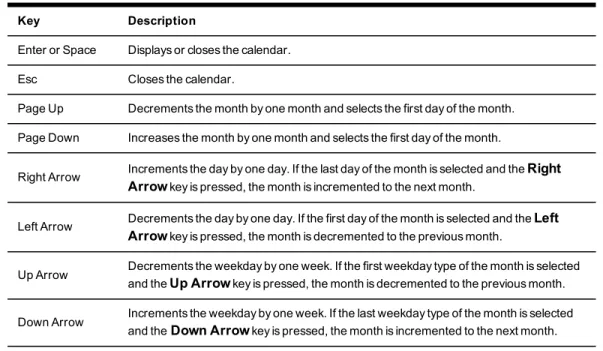
Using keyboard commands 33
Basic Operations 35
DSView 3 Help 35
Configuring the DSView 3 help location 35
Installing DSView 3 help on a local server 36
Global System Properties 36
Legal Notice 37
PCI Compliance Configuration 37
Power Settings 38
Profiles 39
Changing user options 39
Changing the color scheme 40
Changing your password 40
Choosing the serial session application 40
Specifying a user certificate 41
Specifying an SSH key 42
Enabling user credential caching 43
Built-in User Groups 43
Preemption Levels 45
Internet Explorer Considerations 46
Managing ActiveX® controls 46
Advanced Internet options 49
Certificates 50
System certificate policy and trust store 52
Integrated Windows Authentication 54
Firewalls 54
VPNs 55
NAT Devices 57
Licenses 59
Adding a new license key 61
System Information 61
ISV Partners 62
DSView 3 Servers 63
Server Properties 63
Server certificates 65
Avocent proxy server 70
Server trap destinations 71
Client session information 71
DSView 3 software modem sessions 72
Email 74
Unit status polling 74
Backing up and Restoring Hub Servers Manually 75
Spoke Servers 78
Replication 82
Authentication Services 85
Supported Authentication Services 85
DSView 3 software internal authentication service 86 Active Directory external authentication service 88
Windows NT external authentication service 95
LDAP external authentication service 97
RADIUS external authentication service 102
TACACS+ external authentication service 105
RSA SecurID external authentication service 109
User Authentication Services Window 111
Units View Windows 113
Types of Units View windows 113
Topology view 114
Accessing Units View windows 116
Showing and hiding units 117
Units View windows fields 118
Multiple unit operations from a Units View window 122
Unit Overview Windows 123
Unit Status Window 125
Adding and Deleting Units 127
Adding Units 127
Wizards that add units 128
Adding a single managed appliance 129
Adding a single embedded appliance 131
Adding managed appliances from a range or list of IP addresses 133 Adding a generic appliance or an EVR1500 environmental monitor 135
Adding a target device 135
Deleting Units 136
Automatically deleting attached units 136
Synchronizing the DSView 3 Software Database 139
Name Synchronization 139
Automatic name push 140
Automatic name pull 141
Manual name push 143
Manual name pull 143
Topology Synchronization 144
Topology synchronization options in the Add Unit Wizard 146 Topology synchronization options in the Resync Wizard 147
Merging target devices 148
Merging or splitting cascade switches 150
Automatic Discovery 150
Automatic Inheritance for Group Memberships and Properties 151
Managing Units 153
Appliance Configuration Templates 153
Saving appliance configuration templates 153
Modifying appliance configuration template properties 154
Applying appliance configuration templates 155
Unit Properties 156
About Access Rights 161
How access rights can be assigned 163
Unit Access Rights 163
Managed Appliance Settings 164
Managed Appliance Status 166
Managed Appliance SNMP Settings 167
Target Device Services 168
Target Device Settings 170
Target Device Naming 171
IQ Module Settings 172
KVM Switch and Cascade Switch Settings 173
OSCAR interface settings 175
Local Account Settings 176
Embedded Units 179
Launching embedded unit sessions 180
Changing embedded unit credentials 180
Asset and Usage Reports 182
Asset 182
Usage 183
Power Devices and Power Device Sockets 185
Power Devices 185
Power Device Input Feed 187
Power Device Sockets 189
Power Control of Devices Attached to Power Devices 190
Unit Sessions and Connections 193
Managed Appliance Session Settings 193
Customizing the Appliance Sessions window 193
Active Sessions 199
All active sessions 199
Active sessions on a target device 201
Active modem sessions 203
Connections to Units 205
Connection display format 205
Renaming a managed appliance connection 207
Adding and deleting target device connections 207 Merging virtual and physical target device connections 208
Data Logging 209
Configuring Data Logging 210
Enabling the SSH server 211
Enabling the Syslog server 212
Enabling and disabling data logging on units 212 Verifying the data logging settings for each connection 213 Viewing and customizing the SSH server settings 214 Configuring the buffer warnings events as SNMP 215 Specifying where data log files will be stored 215
Archiving and deleting data log files 216
Viewing Data Log Files 218
Configuring SSH Passthrough 221
Enabling SSH Passthrough 222
SSH port sharing 222
SSH Passthrough Sessions 223
Establishing an SSH Passthrough connection to a unit 224
Escape key sequence 226
Break sequences 227
Transferring read/write access 228
Disconnecting a session 229
Displaying session output 229
Supported service processor commands 230
Grouping Units 231
Site, Department and Location Groups 231
Custom Fields 234
Unit Groups 237
Unit group hierarchy 239
Adding or deleting a unit group 242
Changing the unit group properties 243
DS Zones 247
Managing and Accessing Zones 247
Enabling DS Zones 247
Creating zones 247
Accessing zones 248
Transferring units to a zone 249
Managing zone properties 250
Using Zones 252
Units actions in a zone 252
Managing User Accounts 259
User Accounts Windows 259
Adding User Accounts 261
Deleting User Accounts 264
Unlocking User Accounts 264
Resetting a User Account Password 264
Changing User Account Properties 265
Username 265
User certificates 266
User SSH key 266
User password 267
User account restrictions and expiration settings 267
User group membership 268
Preemption level 269
Address 269
Phone contact 269
Email contact 270
User notes 270
Custom field properties 270
User Access Rights 271
User Groups 273
Adding User-defined User Groups 274
Deleting User-defined User Groups 277
User Group Properties 277
Changing User Group Members 278
User Group Access Rights 279
Using the Video Viewer 283
About the Video Viewer 283
Window Features 284
Opening a KVM Session 286
Opening an exclusive KVM session 286
Connecting to an existing session 287
Session time-out 289
Closing a Video Viewer Session 289
KVM Session Profiles 289
General profile settings 290
Cursor profile settings 292
Toolbar profile settings 293
Video profile settings 293
Managing KVM session profiles 295
Using Menu Commands to Manage Session Settings 299
General commands 299
Cursor commands 300
Toolbar commands 301
Video commands 302
Mouse scaling command 302
Avocent Mouse Sync 303
Manual Video Adjustment 304
Saving the View 307
Displaying Video Viewer Users 308
Scan Mode 308
About scan mode 308
Thumbnail Viewer features 309
Performing Thumbnail Viewer tasks 311
Macros 312
Macro groups 315
Power Control of Devices Attached to Power Devices 318
Using Virtual Media 318
Virtual Media dialog box 319
Virtual media session settings 320
Opening a virtual media session 321
Closing a virtual media session 323
Using Smart Cards 323
Video Viewer Troubleshooting 324
Using the Telnet Viewer 325
About the Telnet Viewer 325
Telnet Viewer Window Features 326
Telnet Viewer window toolbar 327
Security Property 328
Opening a Session 329
Customizing the Telnet Viewer 329
Customizing Session Properties 330
Login scripts 333
Reviewing Session Data 334
Macros 335
Macro groups 337
Logging 339
Copying, Pasting and Printing Session Data 342
Power Control of Devices Attached to Power Devices 343
Closing a Telnet Viewer Session 344
Using Tools 345
Using Unit Tools 345
Exporting units 345
Exporting access rights 347
Merging target devices 348
Merging target device endpoints 349
Importing DSView 2.x software databases 349
Importing data 353
Using the Managed Appliance Tools 354
Rebooting 355
Upgrading firmware 356
Saving a managed appliance configuration 358 Restoring a managed appliance configuration 358
Saving a managed appliance user database 359
Restoring a managed appliance user database 359
Using Tasks 361
Using the Tasks Window 361
Adding tasks 362
Specifying when to run tasks 362
Adding Tasks Using the Add Task Wizard 365
Task: Backup DSView 3 software database and system files 365 Task: Configure SNMP trap settings on a managed appliance 366
Task: Power control a target device 367
Task: Exporting an event log .csv file 368
Task: Exporting an Asset Report to a .csv file 369 Task: Exporting a Usage Report to a .csv file 370
Task: Migrating units 372
Task: Sending an IPMI chassis control command to target devices 373 Task: Test modem connections to selected units 374 Task: Updating the firmware of an appliance type 375 Task: Validating user accounts on an external authentication server 376
Task: Pull names from selected units 376
Task: Update topology for selected units 377
Task: Backup Power Manager database 378
Restore Power Manager database 379
Running tasks manually 380
Displaying task results 380
Deleting tasks 381
Changing tasks 381
Firmware Management 382
Events and Event Logs 385
Event Severity and Categories 385
Event severity 385
Event categories 386
Email Notifications 386
Enabling and Disabling Event Logging 389
Displaying the Event Log 390
Event states 392
Using the date filter 393
Changing the Event Log Retention Period 393
Creating an Event Log .csv File 394
Plug-ins 397
Recommended Sequence for Adding/Upgrading Plug-ins 397
Adding Plug-ins 398
Displaying Plug-in Information 399
Managing Plug-ins 401
Upgrading a plug-in 401
Disabling and activating a plug-in 401
Appendix A: Technical Support 403
Appendix B: TCP and UDP Ports 405
Appendix C: DSR Remote Operations Software 413
Appendix D: Terminal Emulation 423
Appendix E: Regaining Access to the DSView 3 Software 441
Product Overview
1
1
The DSView®3 management software is a secure, web browser-based, centralized enterprise
management solution that allows users to remotely access, manage, monitor and control target devices through Avocent managed appliances. A session may be launched to a target device with a single point of access.
Features and Benefits
Network rebooting and troubleshooting
The DSView 3 software uses industry standard IP connections so that you can easily troubleshoot a server, or even reboot it, from the Network Operations Center (NOC), from your desk or from any location in the world. With the DSView 3 software, you can access all of your data center devices from a single screen - making complex network access and control remarkably easy. Using out-of-band management, the software can be used to reach and restart servers or other devices that are not functioning or responding to in-band commands, regardless of the state of the equipment’s operating system.
Web-based access and control
The DSView 3 management software provides secure “point-and-click” browser-based access to control virtually any data center device using managed appliances from DSView 3 software clients located anywhere in the world.
Secure authentication and communication
Secure Socket Layer (SSL) encryption may be used to encrypt data traveling within the DSView 3 software system. Users may be authenticated through internal or external services such as LDAP, Active Directory, NT Domain, TACACS+, RADIUS and RSA SecurID.
Unit and user management
The DSView 3 management software provides centralized network access, control and security for managed appliances. A DSView 3 software administrator may add, remove, delete and change
settings for managed appliances and target devices, including assigning permissions and per-device contact information, which are stored on the DSView 3 server. A DSView 3 software administrator may also assign unique permissions which allow individual users or a group of users access to units or groups of units.
Proxy server access
The proxy server feature allows keyboard, video and mouse (KVM) and serial sessions to be proxied through the DSView 3 server. When a session is initiated with a target device, the viewer communicates using the Avocent Proxy Protocol (APP) and the DSView 3 server makes a direct connection to the appliance.
Virtual media
On supported KVM switches, a virtual media capable IQ module and the virtual media feature allow the client workstation user to load files onto USB2-compatible target devices when the usual network resources are unavailable.
Mapping physical drives or image files on the client system as virtual drives on the target device can accommodate critical tasks required on the target device, such as operating system installation or recovery, BIOS updating and configuration backups.
Dual stack support for IPv4 and IPv6
The DSView 3 server is a dual stack host for IPv4 and IPv6 network protocols. Several Avocent appliances support IPv6, including DSR®switches, ACS advanced console servers, and
MergePoint®service processor (SP) managers.
Virtual segregation of resources with DS Zones
DS Zones provide virtual segregation of data center resources, including appliances, target devices and virtual machines. You can manage the users, licenses and authentication services assigned to each zone, and transfer units among zones.
System Components
The DSView 3 software system contains the following components. DSView 3 management software
The DSView 3 software resides on the DSView 3 server (host or hub computer) and provides a web gateway and services for managing units (appliances and target devices) using a web browser. The gateway allows for IP-based video, serial management, Telnet Viewer, third party Telnet viewer, web browser and other supported session types.
Users may connect to the DSView 3 server from DSView 3 software clients and use the DSView 3 Explorer windows to communicate with the system.
DSView 3 server
The DSView 3 server contains the DSView 3 management software. The server provides a centralized database for storing configuration, user, unit and system information. It also provides services for authentication, access control, logging events, monitoring and license management.
You may configure one or more spoke (backup) servers in addition to the hub server. The hub server is responsible for maintaining the master copy of the database in a DSView 3 software system. Only one server in a DSView 3 software system may be configured as the hub server. Spoke servers perform database replication with the hub server. The hub server acts as the coordinator for database replication between itself and all of the other spoke servers in a DSView 3 software system. A hub server and a spoke server both offer the same DSView 3 software functionality to a user. The distinction of hub or spoke refers only to the database replication role that the server plays and not with the functionality that the server provides. Adding one or more spoke servers to a DSView 3 software system provides redundancy and the ability to distribute DSView 3 software functionality across multiple sites.
After the hub server and optional spoke server(s) are configured, you may create and configure the type of access levels for users within your network environment. You may also set up event logs to record full details of user access and other events.
DSView 3 software client
A DSView 3 software client is a computer with a web browser that can access the DSView 3 management software installed on the DSView 3 server.
Third party products
Third party products are not a part of the DSView 3 software, but are supported for use with it. External authentication servers- An external authentication server enables the DSView 3 server to broker authentication requests from users requesting access to the DSView 3 software system.
SNMP managers- The SNMP (Simple Network Management Protocol) manager monitors the managed appliances and receives SNMP traps from the DSView 3 software on the server. An example of an SNMP manager is the HP OpenView product.
Third party Telnet viewers- A third party Telnet viewer may be used for serial sessions instead of the DSView 3 software Telnet Viewer.
Third party session software- Third party software such as RDP or VNC, when properly installed and configured on the target device, may be enabled for use within the DSView 3 software for initiating sessions with the target device. At the beginning of a session, the RDP viewer allows users to map local resources for use with virtual media.
NOTE:RDP is only available on supported Windows system clients.
Partner products
Environmental monitoring with Uptime Devices
DSView 3 software can help you access Uptime Devices SensorHub environmental monitoring equipment so you can quickly detect environmental conditions (equipment to track
temperature, humidity, airflow, water, voltage and contact closures) that could adversely affect operation of servers and other network devices. Visit www.uptimedevices.com for ordering information.
Proactive Network Security with NetClarity Auditor Enterprise
Integrate NetClarity Auditor Enterprise with the DSView 3 software and manage one or more Auditor appliances to alert, block and correct critical IT security and compliance problems in your data center and entire enterprise network. Visit www.netclarity.net for ordering
information.
Avocent DSView 3 Connector for HP®Software
The DSView 3 Connector for HP Software extends the capabilities of HP Software Network Node Manager (NNM) and Operations for Windows (OVOW). Seamless access and control allows critical management functions for dispersed IT environments. Out of band connectivity offers solutions for lights out data centers and ensures quick and efficient troubleshooting and repair from the HP console.
Supported Units
For management functions, the DSView 3 software client uses HTTPS (Hypertext Transfer Protocol with SSL encryption) to send a request to the DSView 3 server, which then sends a command to the managed appliance. The appliance then performs the requested function. The DSView 3 software supports the managed appliances listed in this section. Other appliances may be supported by plug-ins; see the Avocent web site, www.avocent.com, for a list of plug-ins that may currently ship with the DSView 3 software and/or that can be added to the DSView 3 software. SeePlug-inson page 397 for information about adding and managing plug-ins in the DSView 3 software system.
Cyclades®ACS advanced console server
ACS advanced console servers allow users to access serially attached devices over a standard TCP/IP connection using the Avocent Telnet Viewer, a third party Telnet viewer or a Secure Shell (SSH) client. These serial sessions can be shared among multiple users across multiple DSView 3 servers. For more information, see the ACS console server plug-in documentation. DSR®switches
DSR switches allow KVM signals to be transmitted over a standard TCP/IP network
connection. Some DSR switches may be connected using a modem, which provides benefits for branch offices such as low cost and dial-up performance.
The DSView 3 software supports the following DSR switch models:
800, 1010, 1020*, 1021*, 1022*, 1024*, 1030*, 1031*, 1161, 2010, 2020*, 2030*, 2035*, 2161, 4010, 4020*, 4030*, 4160, 8020*, 8030*, 8035*
*These models contain a dedicated serial port for connecting an external modem for use with the DSR Remote Operations software.
For DSR switches, a target device is first attached to an IQ module, which is then attached to a DSR switch. DSView 3 software clients communicate with target device ports using a Video Viewer connection between the client and the managed appliance.
The DSR switches allow the cascading of legacy analog KVM switches from DSR switch ports, which may be managed in a DSView 3 software system. Certain DSR switch models also allow the cascading of another switch. For more information, see the DSR Switch Installer/User Guide.
NOTE:PEM cascade devices are not supported.
MergePoint®service processor (SP) manager
The MergePoint service processor manager is a secure, centralized enterprise management solution for target devices equipped with IPMI, HP iLO and Dell DRAC service processors. You can use the DSView 3 software to access, monitor and control the MergePoint SP manager and attached target devices.
The MergePoint SP manager provides a standardized interface independent of the management protocols used to manage each target device. Management operations can be performed either by using commands or scripts over a Telnet or SSH version 2 session or by using the
appliance’s web interface from a standard web browser.
For more information, see the MergePoint appliance plug-in documentation.
Cyclades OnSite branch office appliance
OnSite branch office appliances may be used to access multiple traditional or headless servers, networking devices, infrastructure components or any other device with a serial console or KVM port. You can use the DSView 3 software to access, monitor and control the OnSite appliance and attached target devices. For more information, see the OnSite appliance plug-in documentation.
Virtual environments
The DSView 3 management software plug-in for Virtualization allows you to access and control virtual machines from the DSView 3 software. Supported unit types include VMware®
VirtualCenters, ESX Servers and virtual machines, as well as Citrix®XenServersTMand virtual machines. You can launch a Virtual Network Computing (VNC), Remote Desktop (RDP), Secure Shell 2 (SSH) or VMware viewer session to supported virtual machines from a single point of access. For more information, see the Virtualization plug-in documentation. Licenses may be required; see your Avocent representative or www.avocent.com for more information. Blade chassis
The DSView 3 software plug-in for Blade Chassis allows you to access multi-vendor blade chassis and blades from the DSView 3 software. You can launch a KVM session to any managed blade from a single point of access. For a list of supported blade chassis and other information, see the Blade Chassis plug-in documentation.
Generic appliances
Generic appliances manage data center devices such as routers. These devices may be managed within a DSView 3 software system by launching a standard web browser to the device URL or by opening a Telnet session.
Embedded units
Using the DSView 3 software, you may add/delete, configure/display properties, and launch video sessions to the following versions of third party embedded units:
• IBM®ASM (Advanced System Management) RSA II (Remote Supervisor Adapter II) -Version 5, Build GRE132AUS
• DRAC 4 (Dell™ Remote Access Controller) - Version 1.0, Build 06.14 • HP iLO (Integrated Lights-Out) - Version 1.20
• NEC IPF (Itanium Processor Family) - Version 0.5.1.20
For management functions (other than launching video sessions) that are not performed by the DSView 3 software, see the documentation for the unit.
Legacy units
The following legacy units are supported in the DSView 3 software. • DSI5100 IPMI proxy appliances
• EVR1500 environmental monitors • DS1800 digital switches
• Cyclades KVM/net KVM over IP switches • Cyclades KVM/net Plus KVM over IP switches • Cyclades TS appliances
• CCM console management appliances
• CPS810 and 1610 serial over IP network appliances
Target devices
Target devices encompass a wide range of data center components such as servers and routers that a DSView 3 software administrator may manage virtually through the DSView 3 software system. A target device is added automatically to your DSView 3 software system when the supported managed appliance is added. A target device may also be added individually.
Power devices
A power device is a type of target device that can be cascaded from a managed appliance. When a DSView 3 software client sends a power control request to a target device, an HTTPS request is sent to the DSView 3 server, which then sends a command to the managed appliance. The command is converted and serially sent to the power device. The power device then performs the requested action (for example, turning a power outlet on or off).
The DSView 3 software supports the following power devices: • Avocent SPC power control devices
• Server Technologies Sentry Switched CDU CW-8H1, CW-8H2, CW-16V1, CW-16V2, CW-24V2, CW-24V3, CW-32VD1 and CW-32VD2 (supported models may change; contact Avocent Technical Support for current information)
• Cyclades®Power Distribution Units (AlterPath®PM devices)
All of the above power devices are supported on DSR switches that contain one or more SPC ports. Avocent and Server Technologies power devices are also supported on CCM and CPS appliances.
System Configuration
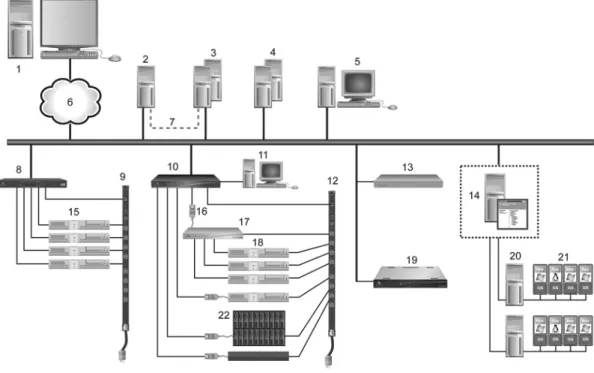
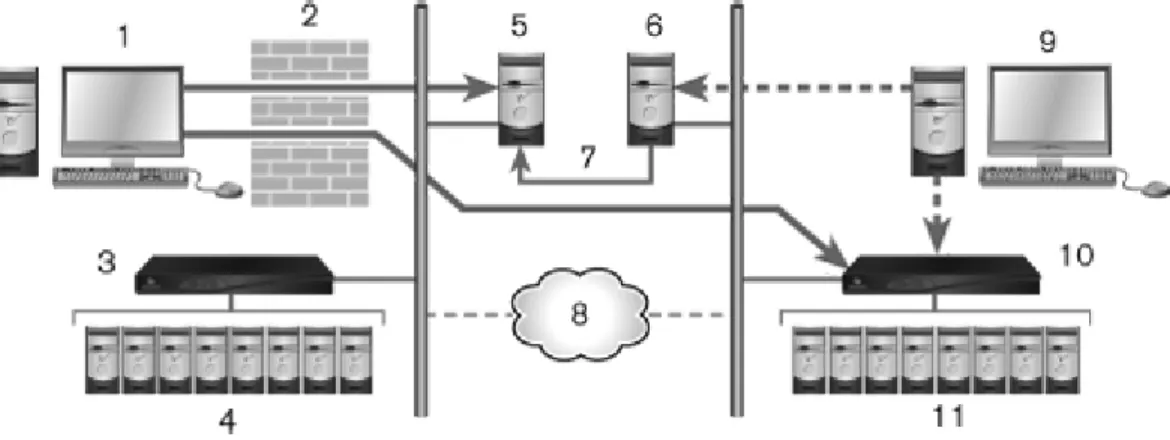
Figure 1.1 illustrates an example system configuration using the DSView 3 management software. For information about the TCP ports that the DSView 3 software uses, seeTCP and UDP Portson page 405.
Figure 1.1: Example System Configuration
Table 1.1: DSView 3 Software System Configuration Descriptions
Number Description Number Description 1 DSView 3 Software Client 12 Power Device 2 Hub DSView 3 Software Server 13 Generic Appliance
3 Spoke DSView 3 Servers (Optional) 14 Hypervisor Manager
Number Description Number Description 5 SNMP Manager (Optional) 16 IQ Module
6 TCP/IP 17 Cascade Switch
7 Replication 18 Target Devices
8 ACS Advanced Console Server 19 MergePoint SP Manager
9 Power Device 20 Hypervisor Server
10 DSR Switch 21 Virtual Machines
11 OSCAR® Interface 22 Blade Chassis
Installation
2
11
This chapter describes the following installation sequence for the DSView 3 software: • What you should do before installing the DSView 3 software
• Installing the DSView 3 software
• Configuring the DSView 3 software, plus considerations when upgrading • Running the DSView 3 software, that is, start a client session
Final sections describe how to change your password, uninstall the software, end a DSView 3 software session and install Java.
About Installation
When the DSView 3 management software is installed, the DSView 3 software database and a hub server are also installed on the dedicated server.
The DSView 3 software may be installed on a computer containing an existing DSView 2.x software authentication server without causing any interference with the operation of the DSView 2.x software system. The DSView 2.x software authentication server and the DSView 3 software may run on the same dedicated server at the same time.
Rebooting the dedicated server is not required prior to using the DSView 3 software.
Once the DSView 3 software is installed and you have configured the hub server, users may log in at another computer as a DSView 3 software client, using a supported web browser.
You may also install the DSView 3 software on additional computers and configure them as spoke servers. SeeSpoke Serverson page 78 andInstalling the DSR Remote Operations Software on page 23.
NOTE:A license key permits the operation of the DSView 3 software on the dedicated server. The license key also specifies the number of clients that may use the software and the number of spoke servers allowed on a system. See
Minimum requirements for the DSView 3 software
Visit http://www.avocent.com/software-requirements for the minimum requirements for installing the DSView 3 software on a dedicated hub or spoke server.
Before installing and configuring the DSView 3 software
Before installing the DSView 3 management software, install the managed appliance hardware. If the computer will be a hub server, you will need the license key obtained from Avocent and provide a username and password to use for initial log in.
If the computer will be a spoke server, you will need to identify the associated hub server and provide the name/password of the hub server’s DSView 3 software administrator.
To prevent potential mouse conflicts, you may configure certain settings on each server connected to a KVM switch or serial console appliance. For details, see the Mouse and Pointer Settings Technical Brief, which is available on the DSView 3 software DVD and on the Avocent web site.
Installing the DSView 3 Software
The DSView 3 management software may be installed using the DSView 3 software DVD or by downloading the software in a self-extracting .zip file from the Avocent web site.
NOTE:If you are upgrading the DSView 3 software from a previous version, it is strongly recommended that you perform a database synchronization between the hub and spoke servers; seeReplicationon page 82. You should also back up the hub server prior to upgrading the DSView 3 software; seeBacking up and Restoring Hub Servers Manuallyon page 75. Failure to perform synchronization and backup may have detrimental effects. A backup should be performed both before the upgrade and immediately following the upgrade.
To install the DSView 3 software on a supported Windows system: 1. Log on to the dedicated server as Administrator.
2. To install from a DVD:
a. Insert the DSView 3 software DVD. An autorun file opens a menu of installation options.
b. ClickInstall DSView 3 Software.
-or-If autorun is not enabled, type<drive:>\DSView\win32\setup.exe, where <drive:> is the letter of your DVD drive.
A dialog box will indicate that the server will be verified to ensure it meets the minimum requirements for installing the DSView 3 software.
To install from a downloaded file:
a. Using your web browser, download the DSView 3 software from the Avocent web site. Go to www.avocent.com and click theSupportlink. On the Technical Support page, click theProduct Upgradeslink, then selectDS Software Upgrades.
b. Double-click on the downloaded installation package (setup.exe). A dialog box will indicate that the server will be verified to ensure it meets the minimum requirements for installing the DSView 3 management software.
3. If the current or an earlier version of the DSView 3 software is already installed, the Installed Product Found: Same Version message box will appear. ClickOKto reinstall the DSView 3 software orCancelto exit setup.
4. The Check for an UPDATED version window will open. (If the DSView 3 software is already installed on the dedicated server, a message box will display. ClickOKto close the box.)
a. ClickNextto reinstall the software, or clickCancelto stop the reinstallation.
b. ClickCheck for UPDATESand then click Nextto check the Avocent web site for the most recent DSView 3 software installation package. Go to step 5.
-or-ClickNextto install the DVD or downloaded version of the DSView 3 software. Go to step 6.
5. If a newer version of the DSView 3 software is found, an Update Available message appears.
a. ClickOKto download the latest DSView 3 software installation package. The installation will be cancelled and the server’s default web browser will launch and open in the Product Upgrades and Options page of the Avocent web site.
-or-ClickCancelto resume installation of the older version of the DSView 3 software. Go to step 6.
b. Type your email address and password, and then clickSubmitto log in to the web site. c. Download the DSView 3 software installation package, log out and close the web
browser. Return to step 2.
6. The Introduction window will open. ClickNext. 7. The License Agreement window will open.
• If you accept the terms, clickI accept the terms of the License Agreementand then clickNext. Go to step 8.
• If you do not accept the terms, clickI do NOT accept the terms of the License Agreement. A License Agreement Warning message box will appear.
• If you clickQuit, the installation will exit without installing the DSView 3 software. • If you clickResume, you will be returned to the License Agreement window.
The DSView 3 software license agreement may also be viewed from the User Login window by clicking theAvocent DSView 3 End User License Agreementlink. The agreement will appear in a separate web browser window.
8. If the default TCP port used by the dedicated server hosting the DSView 3 software (TCP port 443) is not available, the Define Web Application Server TCP port window will open. Type the port you want to use in the TCP port # field, then clickNext. (ClickingCancel exits the Checking for an Updated version installation program.)
9. If the default TCP port used by the Avocent proxy server (TCP port 1078) is not available, the Define TD (target device) Session Viewer Proxy TCP port window will open. Type the port you want to use in the TCP port # field, then clickNext.
10. If the default ports used by the SSH server and the Syslog server for data logging are not available, appropriate windows will open. Type the port you want to use, then clickNext. 11. The Choose Destination Location window will open.
a. ClickChooseand use the Browse for Folder dialog box to select a directory in which to install the DSView 3 software.
-or-ClickRestore Default Folderto restore the installation directory to the default (C:\Program Files\Avocent DSView 3).
b. ClickInstall.
The Installing... window will open and display the progress of the installation. The software will be installed in the specified folder, a Start- Programs - DSView 3 shortcut menu will be generated and the DSView 3 software service startup will be verified.
If a previous version of the DSView 3 software already exists on the dedicated server, message boxes may appear, prompting you to confirm overwriting existing files. Click Yes to All.
12. When the software has finished installing, the Successful Service Startup message box will appear. ClickContinue.
13. The Installation Complete window will open.
• To begin configuration of the DSView 3 software, clickDone; seeConfiguring the DSView 3 Softwareon page 17. A Security Alert dialog box will appear containing certificate information and a warning that the generator of the certificate is not trusted. This occurs because the DSView 3 server certificate created when the server is
installed is a self-signed certificate. You may either import the certificate into the DSView 3 software client web browser (choosing to trust the certificate) or obtain a server certificate from a Certificate Authority (CA) trusted by the web browser. • To configure the DSView 3 software at a later time, clickX(Cancel)in the top right
corner of the window.
To install the DSView 3 software on a supported Linux or Solaris system: 1. Log in to the server as root.
2. Insert the DSView 3 software DVD into your DVD drive. If AutoMount is supported and enabled, open a command window and continue with step 3.
If your system does not support AutoMount, issue the following command to mount the DVD volume:mount <device> <mount point>, where <device> and <mount point> are the names of your server’s DVD Linux or Solaris device and mount point directory, respectively.
For example, to mount the first IDE cdrom on /media/cdrom, enter the command: mount /dev/cdrom /media/cdrom
3. Enter the following command to access the readme file:
less /<mount point>/DSView/readme
For example, the following command accesses the readme file on the /media/cdrom mount point.
less /media/cdrom/DSView/readme 4. Follow the instructions in the readme file.
Upgrading the DSView 3 Software
When upgrading to a newer version of the DSView 3 software, all DSView 3 servers should be upgraded at the same time. The DSView 3 hub server should be upgraded first, followed by each spoke server.
Before upgrading, a replication should be performed (seeReplicationon page 82), then a backup immediately before and after upgrading the DSView 3 software (seeBacking up and Restoring Hub Servers Manuallyon page 75).
The firmware for the appliances may also need to be upgraded in order to support new
functionality in the DSView 3 software. The DSView 3 software should work with the existing firmware revisions, but in cases where new functionality is not supported until the firmware is upgraded, the DSView 3 software will indicate this in the GUI.
Recommended upgrade process
NOTE:In order to safely upgrade the DSView 3 software, and to provide for a roll-back path in case of upgrade failures, perform each of the following steps. If your DSView 3 configuration does not include spoke servers, skip steps that refer to spokes.
To upgrade the DSView 3 software:
1. Ensure that you are able to upgrade the hub server and any spoke servers during the same upgrade time. The expected time to perform this procedure is 30 minutes. However, due to differences in DSView 3 configurations and amounts of data, your time may vary.
2. Verify that the installer files for both the new and old versions (in case recovery is needed) are available to you.
3. Perform a replication of all spoke servers. SeeReplicationon page 82.
4. Backup all hub and spoke servers. SeeBacking up and Restoring Hub Servers Manuallyon page 75. It is advised that all DSView 3 backup files be stored on an external device or network drive.
5. Verify basic functionality by navigating to a few DSView 3 windows and launching sessions to a few target devices.
6. Run the DSView 3 installer for the new version on the hub server. 7. Run the DSView 3 installer on all spoke servers.
NOTE:The hub server must be upgraded prior to the upgrading the spoke servers.
8. Verify basic functionality again by navigating to a few DSView 3 windows and launching sessions to a few target devices.
9. Perform another backup of the hub and spoke servers to have a baseline database of the upgraded environment. SeeBacking up and Restoring Hub Servers Manuallyon page 75. 10. Run replication to validate that there are no errors. Errors will either be displayed in the
11. The firmware for the appliances may also need to be upgraded in order to support new functionality in the DSView 3 software. SeeUpgrading firmwareon page 356. 12. Verify basic functionality one last time by navigating to a few DSView 3 window and
launching sessions to a few target devices.
Configuring the DSView 3 Software
After the DSView 3 software has been installed, it must be configured using a web browser. During configuration, you specify whether the computer will be a hub server or a spoke server. If this is your first DSView 3 server installation,hubshould be selected in the Select DSView Server Role window. The hub server should be installed before any spoke servers are added. What you will need
If the computer will be a hub server, you will need the license key obtained from Avocent and provide a username and password to use for initial log in.
If the computer will be a spoke server, you will need to identify the associated hub server and provide the name/password of the hub server’s DSView 3 software administrator.
To configure the DSView 3 software:
1. If you are configuring the DSView 3 software during the installation process, you have already clickedDonein the Launch Default Browser window.
If you quit after installing the DSView 3 software installation process (by closing the window), selectStart - Programs - Avocent DSView 3 - DSView Software.
2. A security alert box will appear containing certificate information. SeeCertificateson page 50.
3. The Select DSView Server Role window opens.
• ClickHubto assign the dedicated server as the hub server, then clickNext. Go to step 3.
• ClickSpoketo assign the dedicated server as a spoke server, then clickNext. Go to step 8.
4. The Type in Master License Key window opens. Type the Avocent-provided license key for the DSView 3 software hub server, then clickNext. (DSView 3 software license keys prior to version 3.0 are not valid.)
If you did not receive a license key, click thehttp://www.avocent.com/activationlink to obtain a license key.
If the entered license is already in use on another server, a license violation will occur when you log in, and you must configure the server as a spoke server.
5. The Type in Initial Administrator Account window opens. Type a username, a password and confirm the password of the user to whom you wish to give administrator privileges. Usernames are case sensitive and may contain up to 64 characters. ClickNext.
6. A Request in Progress message will appear. The license key will be installed and a DSView 3 software administrator account will be created. The built-in user groups will also be created.
7. The Completed Successful window will open when configuration is completed. Click Finish.
8. The User Login window will open in the DSView 3 Explorer.
You may now log in using the username and password specified during configuration. If you chose to configure the server as a spoke server in the Select DSView Server Role window or if you entered a duplicate software license key in the Type in Master License Key window, continue with the following steps.
NOTE:The DSView 3 software versions of the spoke server and the hub server must match in order to register the spoke server. For example, you may not register a spoke server running DSView 3 software version 3.0 with a hub server running DSView 3 software version 3.2.
9. The Type in Hub Server Address and Port window will open. Type the address of the DSView 3 software hub server using standard dot notation (xxx.xxx.xxx.xxx) or type the DNS name in the Address field. ClickNext.
10. The Accept DSView Server Certificate window will open. ClickNextto accept the certificate.
11. The Type in Hub Administrator Credentials window will open. Type a valid username and password for a user with DSView 3 software administrator privileges on the DSView 3 software hub server. ClickNext.
12. The Registering Spoke Server window will open with the messageRequest In Progress Please WaitThe configuration of the spoke server will be saved to the database of the hub server and the spoke server’s certificates will be installed on the hub server.
13. The Completed Successful window will open when the spoke server has been added. Click Finish.
Running the DSView 3 Software
DSView 3 software clients access the DSView 3 management software host using a supported web browser. Any software required by the client, such as applets and the Java Runtime Environment (JRE), will be automatically installed by the DSView 3 server host.
The DSView 3 software uses Secure Sockets Layers (SSL) encryption to send data between the DSView 3 software host and the web browser on the client to ensure data integrity and privacy. When a user attempts to log in to a DSView 3 software client session, the authentication service configured in the DSView 3 software by the DSView 3 software administrator verifies the credentials of the user. Security alerts related to the certificates on the DSView 3 software host may appear. SeeCertificateson page 50.
Minimum client requirements
Visit http://www.avocent.com/software-requirements for minimum client requirements.
Opening a client session
Before opening a client session
• Enable cookies and JavaScript on the client’s web browser.
• Configure the web browser. If you are using Internet Explorer, seeInternet Explorer Considerationson page 46.
To open a client session:
NOTE:If DSView 3 Software Client Certificate Authentication or DSView 3 Software Client Integrated Windows Authentication is being used, the user will not be required to log in. SeeCertificateson page 50.
1. From the DSView 3 software client web browser, enter the URL of the server host in the address bar in the format:
https://<servername>/dsview
In this case, <servername> is the DNS name of the host system, or the IP address in standard dot notation (xxx.xxx.xxx.xxx).
NOTE:To avoid multiple security warnings, enter the DNS name.
-or-If you are opening the session on the DSView 3 server, you may selectStart -Programs - Avocent DSView 3 - DSView Software.
2. Accept all security alerts that may appear as the client computer connects to the DSView 3 server. The DSView 3 Explorer User Login window will open.
If an RSA SecurID external authentication service has been added to the DSView 3 software, seeRSA SecurID loginon page 20 below for the login procedure. 3. Type a valid username and password in the fields provided.
Depending on the settings specified by the administrator, you may be required to change your password before being allowed to complete the login process. SeeAdding User Accountson page 261.
4. ClickLogin. The window that appears depends on the rights assigned to the DSView 3 user that is logging in.
If the client machine uses an onboard video controller and experiences video problems, be sure the BIOS is updated to the latest version.
RSA SecurID login
When an RSA SecurID external authentication service has been added to the DSView 3 software, the login credentials include a username and a passcode. The passcode includes a PIN and an RSA SecurID tokencode. The login request is sent to the RSA Authentication Manager. Depending on the user configuration and state on the RSA Authentication Manager, the user may be prompted for a second successive tokencode.
The user configuration also specifies how the 4-6 digit PIN will be generated: • User defined - the user must enter a PIN
• System generated - the user cannot enter a PIN; it must be generated by the RSA server • User selectable - the user may choose to enter a PIN or allow the RSA server to generate it If a PIN has not yet been assigned to the user or if security policy requires a PIN change, the user will be prompted accordingly. If the RSA server generates the PIN, the user will be given a brief interval to memorize it.
Regaining access
If access to a DSView 3 software system is lost, seeRegaining Access to the DSView 3 Softwareon page 441.
Uninstalling the DSView 3 Software
To uninstall the DSView 3 software on a supported Windows system: 1. SelectStart - Settings - Control Panel. The Control Panel will appear.
2. From the Control Panel, clickAdd/Remove Programs. The Add/Remove Programs dialog box will appear.
3. SelectAvocent DSView 3and then clickChange/Remove. The Uninstall Avocent DSView window will open.
4. ClickUninstall.
To uninstall the DSView 3 software on a supported Linux or Solaris system: 1. Log in to the server as root.
2. Insert the DSView 3 software DVD into your DVD drive. If AutoMount is supported and enabled, open a command window and continue with step 3.
-or-If your system does not support AutoMount, issue the following command to mount the DVD volume:mount <device> <mount point>, where <device> and <mount point> are the names of your server’s DVD Linux or Solaris device and mount point directory, respectively.
For example, to mount a DVD which is the second IDE unit on /media/cdrom, enter the command:
mount /dev/cdrom /media/cdrom
3. Enter the following command to access the readme file.
less /media/cdrom/DSView/readme
Follow the instructions in the readme file.
Closing a DSView 3 Software Session
Files are copied to DSView 3 software clients when you log in to the DSView 3 software. When using Internet Explorer, temporary files may be removed by selecting theDelete Temporary Internet Filescommand and active web components may be uninstalled by selecting theRemove Objectscommand. See the Internet Explorer documentation for more information.
To close a DSView 3 software session:
From the DSView 3 Explorer, clickLOGOUTor the logout icon.
Java Installation
On non-Windows clients, the Video Viewer, Telnet and VNC Viewers require Java version 1.5. The Telnet/SSH applet may work with other versions; the Video Viewer requires that version. On Windows clients, Java is required to run the Avocent Telnet/SSH Viewer. If the Win32 PuTTY Telnet/SSH Viewer is selected in the user’s profile, then Java is not required on the
client. On a Windows client, it is recommended that the JRE (Java Runtime Environment) be installed in the C:\Program Files\ location. If your system automatically installs programs in another location, you may not be able to launch the Video Viewer. In this case, you can configure Java to find the JRE.
To configure Java to find the JRE: 1. Access the Java Control Panel. 2. Select theJavatab.
3. In the Java Application Runtime Settings panel, clickView. 4. Change the path to the installed JRE.
5. ClickOK.
For Windows, Linux and Solaris operating systems, the DSView 3 software client automatically downloads and installs the JRE the first time it is needed. For Macintosh operating systems, you must update Java and install the JRE using the Macintosh software updates. Refer to the Macintosh operating system documentation for more information.
To install the JRE on a Windows client:
1. In a DSView 3 software Units View window (seeAccessing Units View windowson page 116), click an Action link.
2. A window will open, containing a link for downloading the JRE installer. Download the JRE installer, then close all browser windows.
3. Click on the JRE icon to launch the installer. 4. Restart the browser, and click an Action link. To install the JRE on a Linux or Solaris client:
NOTE:Only one version of the JRE can be installed in the browser for DSView 3 software support. Depending on your system’s configuration, you may have to log in as the root user to install the JRE. Contact your system administrator if you need help with installing software as the root user.
1. In a DSView 3 software Units View window (seeAccessing Units View windowson page 116), click an Action link.
2. A window will open, containing a link for downloading the JRE installer. Download the JRE installer, then close all browser windows.
3. Run the installer.
Avocent Viewer Plug-in Installation
On Windows clients, the Video Viewer, Telnet and VNC Viewers require the Avocent Viewer Plug-in. If you are using Firefox 2 or Internet Explorer, the plug-in downloads automatically from the browser window. If you are using Firefox 3, additional set up is required.
To install the Avocent Viewer Plug-in when using Firefox 3 on a Windows client: 1. In a Units View window containing the target device you want to access (seeAccessing
Units View windowson page 116), click an Action link.
2. The Installing Avocent Viewer Plug-in pop-up window opens. ClickDownload Avocent Viewer Plug-in.
3. ClickSave, then open the saved file. The Firefox downloads window opens. 4. ClickOK, the follow the instructions in the installer wizard to install the file. Once the installation is complete, the viewer session starts automatically.
Installing the DSR Remote Operations Software
NOTE:Installing and using the DSR Remote Operations software is optional.
If your DSView 3 software system includes DSR1021, 1022, 1024, 1020, 1030, 1031, 2020, 2030, 2035, 4020, 4030, 8020, 8030 or 8035 switches, you may use the DSR Remote Operations software for switch access using a dial-up point to point protocol (PPP) modem connection when an Ethernet connection is unavailable.
SeeDSR Remote Operations Softwareon page 413 for information about installing and using the DSR Remote Operations software.
DSView 3 Explorer Windows
3
25
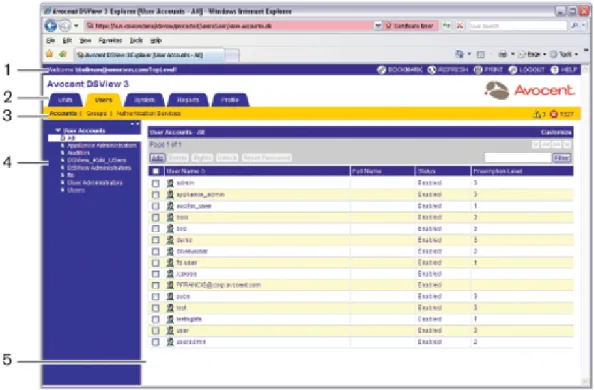
When a user has been logged in and authenticated, the Avocent DSView 3 Explorer window opens. From the DSView 3 Explorer window, you may view, access and manage units.
Figure 3.1: Example Avocent DSView 3 Explorer Window Areas Table 3.1: DSView 3 Explorer Window Area Descriptions
Number Description
1
Top option bar - Use the top option bar to bookmark a DSView 3 software window, refresh a window display, print a page, log out of a software session or access online help. The name of the logged in user appears on the left side of the top option bar.
2 Tab bar - Use the tab bar to display and manage units, user accounts, reports, system settings and
session profiles.
3 Top navigation bar - The selections in the top navigation bar vary, depending on the active tab in the
tab bar. Topics relevant to each selection display in the side navigation bar.
4 Side navigation bar - Use the side navigation bar to select system information to display or edit in the
content area. The side navigation bar contains arrows that affect its display.
5 Content area - The information specified by the tab bar, top navigation bar and side navigation bar
selections is displayed and changed in the content area.
Accessing Target Devices
Target devices (TDs) that may be accessed system-wide are displayed in a Units View window. You may initiate a session with a target device from a Units View window by clicking the link in the Action column. SeeUnits View Windowson page 113.
You may also initiate a session with a target device from a Unit Overview window. SeeUnit Overview Windowson page 123.
For information about controlling the power of target devices attached to power devices, see Power Control of Devices Attached to Power Deviceson page 190.
Using the Side Navigation Bar
The side navigation bar is used to display windows that specify settings or perform operations. The contents of the side navigation bar varies, depending on the tab and top navigation bar selections and the window that is displayed.
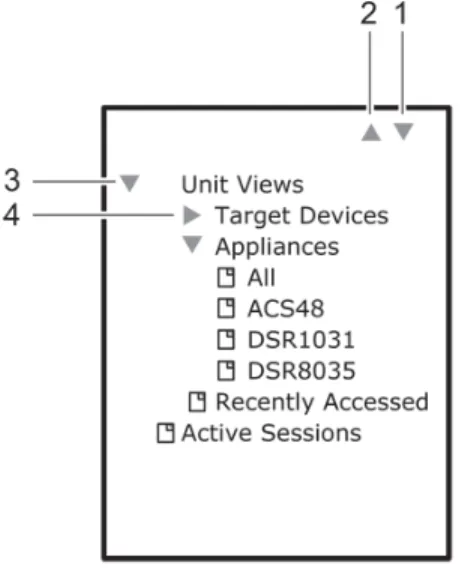
Figure 3.2: Example Side Navigation Bar Table 3.2: Side Navigation Bar Descriptions
Number
Description
1 Expand All Nodes - Click this arrow in the upper right corner to expand all nodes and
display additional links.
2 Collapse All Nodes - Click this arrow in the upper right corner to collapse all nodes and
their links.
3 Collapse Node - Click this arrow to collapse an opened tree branch and its links.
4 Expand Node - Click this arrow to expand a closed tree branch and display its links.
You may choose whether an expanded node will collapse when another Expand Node arrow is selected. SeeChanging user optionson page 39.
Clicking on a link that does not contain an arrow will display its corresponding window. Some windows contain additional links, which may display another window and a side navigation bar with different content.
Using Windows
Sorting information in a window
The order of rows in a list may be changed by clicking the heading of one of the displayed columns. When you click a column heading, the order of the list rows will change to
alphabetically ascending, based on that column. If you click the column heading a second time, the order will change to an alphabetically descending order. An up arrow indicates ascending order and a down arrow indicates descending order.
If you are using the topology feature in a Units View window, seeTopology viewon page 114 for sorting criteria.
Filtering information in a window
Some DSView 3 software windows allow you to filter list information by providing a text string that will be used to retrieve matching items. Filtering is useful if you have many target devices or other items that extend over many pages. Windows that allow filtering contain a text field and a Filter button in the content area, as shown in Figure 3.1.
Filtering is performed either over the entire list of items or of specified columns, and can provide a shorter, more exact list of items. When filtering is performed, each row and column is searched for the specified text string. For example, you may wish to perform filtering to list only DSR1031 switches in the Name column, target devices with KVM connections in the Action column, idle ACS console servers in the Status column and so on. Additionally, from a Units View window, you can use theCustom Fields and Filterlink to exclude columns from the filter and provide a more exact list of filtered items. SeeUsing the Customize link in windowson page 30.
When the topology feature is enabled in a Units View window, both parent and child units will display in the filtered view. For example, if you filter for a child named target device 1 that is attached to a DSR1031 switch, target device 1 will appear below the DSR1031 switch in the filtered view.
When filtering, you may use an asterisk (*) before and/or after text strings as a wildcard. For example, typingemailserver*and clicking Filterwill display items with emailserver at the beginning (such as emailserver, emailserverbackup). Typing*emailserver*and clickingFilter will display items containing emailserver in any part of the name (such as emailserver, emailserverstore, tdemailserver, tdemailserver1).
Table 3.3 lists the ways you may specify text strings for filtering.
Typed in the Filter Field Results
<String>
Entering a string displays a filtered list of items that contain the ‘word’ (that is, it will find matching strings that are followed by anything other than a letter or number). For example, typingemailwill list any items that contain the string email, followed by a space or punctuation mark. If you enter multiple words separated by spaces but without logical operators, OR is assumed, and each word is treated separately. For example, typingemail serverwill display items containing email or server.
"<String>"
Surrounding the string with quotation marks displays a filtered list of items containing the exact string, including spacing and punctuation. For example, typing"email server”will display items that contain email server. The DSView 3 software will provide a closing quotation mark if it is omitted.
<String1> AND <String2>
Using the AND logical operator displays the items that contain both strings. For example, typingemail and serverwill display items named email-server-3, email-server-2, server email and so on.
<String1> OR <String2>
Using the OR logical operator displays the items that contain at least one of the strings. For example, typingemail or serverwill find any items that contain the string email or the string server.
(<String>)
Parentheses may be used to override the default (left to right) order of
precedence during evaluation of a filter string. For example, searching foremail and server or servicewould be the equivalent of ((email and server) or service), which may not be the intended search. The user may choose instead to change the order of precedence by grouping the search terms with
parentheses, such as(email) and (server or service).
NOT <String>
Preceding the string with NOT displays all items that do not contain the string. For example, typingnot emailwill display all items except those containing email (email, email server, email-server-1 and so on will not display).
To filter the list in a window:
1. In a window containing a Filter field, type a text string in the field. Searches are not case sensitive.
2. ClickFilter. A filtered list of the information in the window will be displayed. 3. ClickClearto return to a non-filtered list.
Saving information in a window
When you change information in a window, you must clickSavein order to apply the changes. By default, a message box will appear if you clickCloseor try to exit the window by clicking a link in the top bar, top navigation bar or side navigation bar without first clickingSave. ClickingOKin the message box will exit the current window without saving the changes. If you want to save the changes you have made, clickCancelin the message box, then clickSave in the window.
You may choose whether you will be reminded to save changes made in windows before exiting them. SeeChanging user optionson page 39.
Using the Customize link in windows
Windows that contain aCustomizeorCustomize Fields and Filterlink allow you to change the following information:
• The number of items displayed per page in the window
• Which columns of information are displayed in Units View windows
• Which columns are included in a filter from a Units View window (available from the Customize Fields and Filter link only)
By clicking theCustomizelink, you can also show units that have been hidden in a Units View window.
NOTE:If you are in a Units View window, the link is displayed as “Custom Fields and Filter” and this window contains additional filtering options. On any other window, the link is displayed as “Customize”. The term “Customize link” is used throughout this document to refer to both links.
The items available for customizing and methods for changing them will vary, depending on the window being customized. Although the items that appear in windows may vary, the items that do appear are modified identically regardless of the window in which you clicked the Customizelink.
DSView 3 software administrators may also configure the default display for customizable windows, that is, which columns will be displayed and how many items will be displayed per page by default. The default values will be used by all new users and by existing users who have not already customized their views.
To customize a window using the Customize link:
1. In a window containing a Customize link in the upper right corner, click the link. A View Customization window will open.