Sewer System
Management Plan
September 2013 Update
Prepared by
EOA, Inc.
and
District Staff
Sewer System
Management Plan
September 2013 Update
Prepared by
EOA, Inc.
and
District Staff
Table of Contents
Introduction ... 1
LGVSD Service Area ... 1
Definitions and Abbreviations ... 1
1.0 Goals (D.13.i)... 6
2.0 Organization (D.13.ii) ... 6
3.0 Emergency Response Plan (D.13.vi) ... 9
3.1 District Notification of SSOs ... 9
3.2 Response... 10
3.3 Impact Mitigation and Monitoring ... 10
Impact Mitigation (Clean-up) ... 10
SSO Volume Estimation ... 11
Water Quality Impact Monitoring ... 11
3.4 SSO Regulatory Notification, Reporting and Record Keeping ... 12
Staff Responsibility ... 12
Spill Categories ... 12
Notification, Reporting, and Certification ... 12
Amending and Recertifying SSO Reports ... 13
Private Sewer Lateral Discharge ... 13
No spill Certification ... 13
Annual Questionnaire ... 13
Spills Exceeding 50,000 Gallons that Reach Surface Waters ... 13
Record Keeping ... 13
4.0 FOG Program (D.13.vii) ... 16
5.0 Legal Authority (D.13.iii) ... 17
5.1 Requirements ... 17
5.2 District Ordinances Relevant to the SSMP ... 17
5.3 Documentation of Legal Authority ... 18
6.0 Measures and Activities (D.13.iv) ... 23
6.1 Collection System Maps ... 23
6.2 Resources and Budget ... 23
Funding Sources ... 23
Formal Operating Budget and Funding Plan ... 24
Capital Improvement Plan... 24
6.3 Prioritized Preventative Maintenance ... 24
6.4 Scheduled Inspections and Condition Assessment ... 25
6.5 Contingency Equipment and Replacement Inventories ... 26
6.6 Training ... 27
6.7 Outreach to Plumbers and Building Contractors ... 27
7.0 Design and Construction Standards (D.13.v) ... 28
7.1 Installation, Rehabilitation and Repair ... 28
7.2. Inspection and Testing ... 29
8.1 Capacity Assessment ... 29
8.2 Capacity Assurance Plan ... 30
9.0 Monitoring, Measurement, and Program Modifications (D.13.ix) ... 31
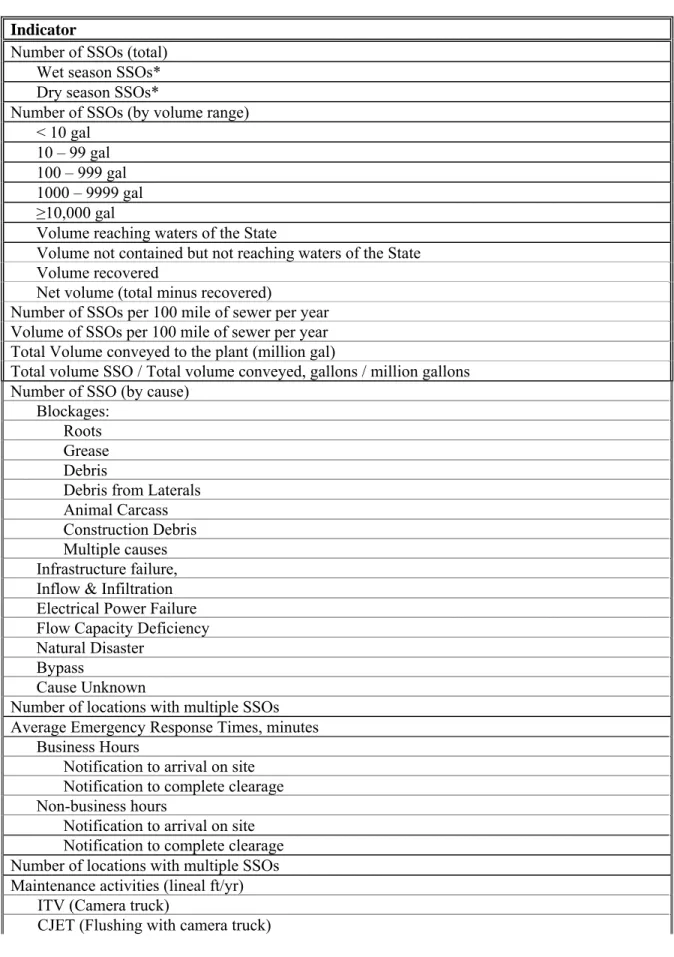
9.1 Performance Indicators ... 31
9.2 SSMP Updates and Modifications ... 35
10.0 SSMP Audits (D.13.x) ... 35
11.0 Communication Program (D.13.xi) ... 36
12.0 SSMP Approval and Certification (D.14) ... 37
List of Figures
Figure 1. LGVSD Service Area ... 5Figure 2. LGVSD Organization Chart ... 8
List of Tables
Table 3-1. Spill Categories and Definitions ... 14Table 3-2. Notification, Reporting, Monitoring, and Record Keeping Requirements ... 15
Table 5-1. Documentation of Legal Authority ... 19
Table 8-1. Summary of Capacity-Related Capital Projects ... 33
Table 9-1. SSMP Performance Indicators ... 34
Appendices
A. Emergency Response Documents1. LGVSD SOP for Sewer Overflows, updated January, 2010. The SOP provides a
quick reference guide to the Districts emergency response documents, which include:
LGVSD Incident Report
Reference sheet and photos for estimating sewer overflow rates
SSO Spill Containment and Cleanup Procedures
Sewer Overflow Response Manual
Emergency call list
Marin County SSO Report
SOP – Reporting of SSOs to State
SOP – Water Quality Sampling for SSOs.
B. LGVSD FOG Documents:
1. LGVSD Ordinance Code provisions related to FOG 2. List of FOG “Hot Spots”
C. SSMP Development Documents (Regional Water Board documents only)
1. RWB Resolution R2-2003-0095. In Support of Collaboration between the Regional Board and Bay Area Clean Water Agencies to Report and Manage Sanitary Sewer Overflows
2. RWB letter: New Requirements for Preparing Sanitary Sewer Management Plans, July
7, 2005
3. SSMP Development Guide, RWB and BACWA, June 2005
4. RWB letter: Discontinuation of Requirements for Annual Reports of Sanitary Sewer Overflows (SSOs), and Annual Sewer System Management Plan (SSMP) Audits
(October 3, 2012)
D. Documents Related to Statewide General Order 2006-003-DWQ
1. SWRCB Order 2006-003-DWQ, Statewide General Waste Discharge Requirements for Sanitary Sewer Systems, May 2, 2006, with revised self monitoring requirements from
SWRCB Order 2013-0058-EXEC (7/30/13)
2. CIWQS Enrollee’s Guide to the SSO Database, SWRCB, August 2013*
3. Marin County Environmental Health Services Memorandum to County Sanitation Districts regarding Response to Sewage Spills in Marin County, May 6, 2008
4. LGVSD Resolution No. 2009-1881 approving the final SSMP and its implementation. 5. LGVSD Resolution No. 2014-1954 approving the September 2013 revised SSMP and
its implementation
E. Documents Related to Section 6 (Measures and Activities):
1. Collection System Map Key and Example Map 2. Example PM Schedule Printouts
3. Blank Field Inspection Forms
4. Example Maintenance History Printout 5. Example “Areas of Concern” Printout
6. Permit Application – District Mainline or Property Lateral 7. Brochure for Plumbers and Sewer Contractors
F. SSMP Audits G. SSMP Update Log
* Cover and table of contents only. This 100+ page document is available on the SWRCB SSO Program web site at http://www.swrcb.ca.gov/water_issues/programs/sso/docs/discharger_workbook.pdf. The Collections Manager also keeps a complete printed copy in the Collections Office.
Introduction
This sewer System Management Plan (SSMP) has been prepared pursuant to the requirements of the San Francisco Bay Regional Water Quality Control (RWB), as described in a letter to collection system operators dated July 7, 2005, and the SSMP requirements contained in the State Water Resources Control Board Order No. 2006-003-DWQ, Statewide General Waste Discharge Requirements for Sanitary Sewer Systems. The Monitoring and
Reporting Program (MRP) associated with the Statewide Order were amended in July 2013 (SWRCB Order WQ-2013-0058-EXEC). In preparing this SSMP, the District utilized the
SSMP Development Guide developed jointly by the RWB and the Bay Area Clean Water
Agencies (BACWA). Except for Sections 11 and 12, the section numbering and headings in this SSMP follow those of the RWB/BACWA document. In each heading, the corresponding provision from Order No. 2006-003-DWQ is indicated in parentheses.
LGVSD Service Area
The Las Gallinas Valley Sanitary District (District) serves a population of approximately 32,000 persons in the northern portion of the City of San Rafael and neighboring unincorporated areas of Marin County. The service area covers approximately 20 square miles. The District’s collection system consists of about 105 miles of gravity sanitary sewers, 6.7 miles of pressure sewers, and 28 pump stations. The District also operates the wastewater treatment plant. Figure 1 shows the service area and the location of key District facilities. The District’s wastewater collection and treatment operations are closely integrated, and utilize common administrative facilities and staff.
Definitions and Abbreviations
The following are acronyms and abbrviations used in this SSMP and associated documents Bay Area Clean Water Agencies (BAWCA)
Best Management Practices (BMP)
Refers to the procedures employed in commercial kitchens to minimize the quantity of grease that is discharged to the sanitary sewer system. Examples include scraping food scraps into a garbage can and dry wiping dishes and utensils prior to washing.
California Integrated Water Quality System (CIWQS)
Refers to the State Water Resources Control Board online electronic reporting system that is used to report SSOs, certify completion of the SSMP, and provide information on the sanitary sewer system.
California Office of Emergency Services (CAL-OES) Capital Improvement Plan (CIP)
Refers to the document that identifies future capital improvements to the District’s sanitary sewer system.
Capacity, Management, Operations, and Maintenance (CMOM)
Refers to the federal (USEPA) program for regulating operation of sewer collection systems. CMOM requirements were incorporated into draft regulations that were subsequently withdrawn. The SSMP and its requirements closely resemble the CMOM program.
Property Line Clean Out
Refers to the clean out that is typically located on the building lateral near the sidewalk or at the edge of the District’s right-of-way. The property line clean out is used to provide access to maintain the lower lateral.
Closed Circuit Television (CCTV)
Refers to the process and equipment that is used to internally inspect the condition of gravity sewers. CCTV video is typically recorded on tape, DVD, or hard drive.
Computerized Maintenance Management System (CMMS)
Refers to a database application used manage and document maintenance activities of a collection system.
Data Submitter (DS)
Refers to the individual(s) designated by the District to submit SSO reports on the CIWQS system. The DS must be formally designated and registered with the SWRCB, with an assigned user name and password. A DS cannot certify SSO reports. (See also LRO)
Fats, Oils, and Grease (FOG)
Refers to fats, oils, and grease typically associated with food preparation and cooking activities that can cause blockages in the sanitary sewer system.
Fiscal Year (FY)
Food Service Establishment (FSE)
Refers to commercial or industrial facilities where food is handled/prepared/served that discharge to the sanitary sewer system.
Geographical Information System (GIS)
Refers to the system that it uses to capture, store, analyze, and manage geospatial data associated with the District’s sanitary sewer system assets.
Global Positioning System (GPS)
Refers to the handheld unit that can be used to determine the longitude and latitude of sanitary sewer overflows for use in meeting CIWQS reporting requirements.
Grease Removal Devices (GRDs) Infiltration/Inflow (I/I)
Refers to water that enters the sanitary sewer system from storm water and groundwater and increases the quantity of flow. Infiltration enters through defects in the sanitary sewer system after flowing through the soil. Inflow enters the sanitary sewer without flowing through the soil. Typical points of inflow are holes in manhole
lids and direct connections to the sanitary sewer (e.g. storm drains, area drains, and roof leaders).
Lateral
Refers to the piping that conveys sewage from a building to the District’s sewer main. The distinction is sometimes made between the upper lateral (from building to property line) and the lower lateral (from property line to the sewer main).
Legally Responsible Official (LRO)
Refers to the individual(s) designated by the District to certify SSO reports on the CIWQS system. The LRO must be formally designated and registered with the SWRCB, with an assigned user name and password. Both data submitters or LROs can submit reports in CIWQS, but only LROs can certify reports.
Manhole (M/H)
Million Gallons per Day (MGD)
Monitoring and Reporting Program (MRP)
Refers to the Monitoring and Reporting Program section of the Statewide Order. The MRP has been amended twice since first being adopted in 2006.
Operations and Maintenance (O&M) Preventative Maintenance (PM)
Refers to maintenance activities intended to prevent failures of the sanitary sewer system facilities (e.g. cleaning, CCTV, repair).
Regional Water Quality Control Board (RWQCB or Regional Water Board) Refers to the San Francisco Bay Regional Water Quality Control Board. Sanitary Sewer Overflow (SSO) [Definition from Order 2006-003-DWQ]
Any overflow, spill, release, discharge or diversion of untreated or partially treated wastewater from a sanitary sewer system. SSOs include:
(i) Overflows or releases of untreated or partially treated wastewater that reach waters of the United States;
(ii) Overflows or releases of untreated or partially treated wastewater that do not reach waters of the United States; and
(iii) Wastewater backups into buildings and on private property that are caused by blockages or flow conditions within the publicly owned portion of a sanitary sewer system.
Sanitary Sewer System
Refers to the portion of the sanitary sewer facilities that are owned and operated by the District.
Sewer System Management Plan (SSMP) SSO Report
State Water Resources Control Board (SWRCB)
Refers to the California Environmental Protection Agency (EPA) State Water Resources Control Board.
Statewide Order
Refers to SWRCB Order No. 2006-003-DWQ, Statewide General Waste Discharge Requirements for Sanitary Sewer Systems, and its Monitoring and Reporting Program
(MRP) as amended by Order WQ-2013-0058-EXEC. Supervisory Control and Data Acquisition (SCADA)
Refers to the system that is employed by the District to monitor the performance of its pump stations and to notify the operating staff when there is a condition that requires attention.
Surface Water
In the context of SSOs, refers to streams and creeks, the Bay and its sloughs, wetlands, ocean, lakes, and other water bodies. SSOs that flow into drainage channels that are tributary to surface water are considered equivalent to having reached surface water for purposes of defining a Category 1 spill. However, SSOs that enter municipal storm sewer systems (MS4) and which are fully contained and recovered are not considered as having reached surface water.
Water of the State [Definition from California Water Code]
Water of the State means any water, surface or underground, including saline waters, within the boundaries of California.
Waste Discharge Requirements (WDR)
Refers to an order regulating the discharge of wastes issued under the authority of the California Water Code. WDRs are issued by both the SWRCB and Regional Water Boards, and may apply to individual dischargers or groups of dischargers (the latter are typically referred to as General or Statewide Orders). SWRCB Order No. 2006-003-DWQ is a WDR.
Figure 1. LGVSD Service Area
(replace this page with Fig 1 from 2008 Nute Engr. Capacity Assessment Report. Above title is for Table of Contents only)
1.0 Goals
(D.13.i)The District’s goals in developing this SSMP are as follows:
To properly manage, operate, and maintain all parts of the wastewater collection system, so as to preserve and protect the public’s investment in that system
To provide a safe working environment for District employees
To provide adequate capacity to convey peak flows to the treatment plant
To minimize the frequency and duration of SSOs
To mitigate the impact of SSOs on public health and the environment
To respond quickly and respectfully to public notifications of SSOs or other collection system problems
To collect complete and accurate information regarding SSOs for reporting to the appropriate regulatory agencies
To provide District employees with the tools and training needed to perform their work effectively and achieve the District’s goals
To document system O&M activities using tools that support efficient utilization of staff and resources, and which provide a means for long-term assessment of trends and effectiveness.
2.0 Organization
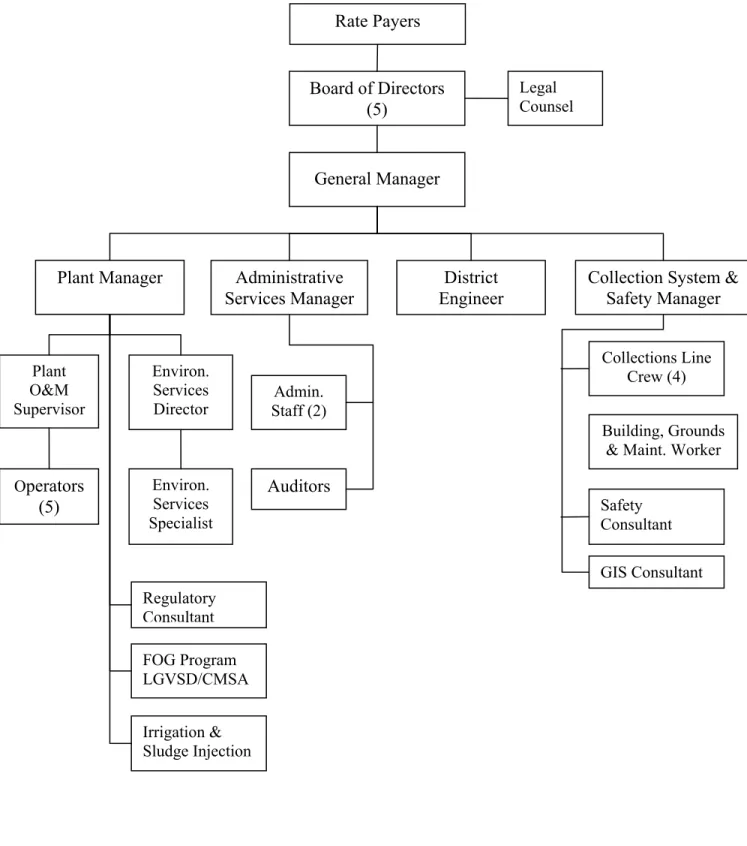
(D.13.ii)The District’s organization chart is presented in Figure 2. Roles and responsibilities of key personnel relative to the wastewater collection system are as follows:
Ratepayers: Elect members of the District Board of Directors. Ratepayers are the primary source of funding for District capital and operating budgets.
District Board of Directors: Sets overall direction for the District through mission statement, and establishment of goals and objectives. Adopts policies, procedures and ordinances consistent with this direction. Enters into contracts and agreements, hires employees and agents. Provides oversight of District operations, including review and approval of capital and operating budgets, acquisition and disposal of property and equipment, payment of bills, setting of connection fees, and establishment of user rates. Represent the District on other boards, committees and associations. The Board of Directors is assisted by District counsel. General Manager: Develops alternatives and recommendations for District policies, budgets, Capital Improvement Program and strategies for consideration by the Board of Directors. Coordinates Board meetings and agenda, serves as staff liaison with Board, and as District liaison with other agencies, utility users, and the general public. Has overall responsibility for District operations and implementation of Capital Improvements Program. Oversight responsibility for development, implementation, and updating of SSMP
Collection System/Safety Manager: Responsible for day-to-day implementation of SSMP. Manages collection system field operations and maintenance activities. Coordinates District response to emergencies, line blockages, and SSOs. Coordinates and documents investigations and follow-up. Serves as legally responsible official (LRO) for reporting SSOs to local and State agencies. Maintains collection system data management systems, contingency plans, and provides summary reports to General Manager and District Board. Collections Field Crew: Conducts collection system corrective and preventive maintenance activities, including emergency response for blockages and SSOs. When directed, coordinates with vendors and outside contractors for equipment and services.
Treatment Plant Manager and Plant Operations Staff: Responsible for operation of collection system pump stations. Available as needed to respond to collection system emergencies and SSOs.
District Engineer: With assistance from outside engineering consultant(s), conducts collection system capacity analysis, and develops recommendations and budgets for Capital Improvements Program. Develops or manages others in the development of engineering designs for new or rehabilitated facilities, coordinates bidding process, oversees construction and inspection. Responsible for review and updating of District’s standard specifications for sewer construction, and for maintaining sewer system maps.
Regulatory Consultant: Provides technical support for permitting, monitoring, reporting, compliance, SSMP development, collection system status reports, and data management.
Figure 2. LGVSD Organization Chart Board of Directors (5) General Manager Legal Counsel
Plant Manager Administrative Services Manager
Collection System & Safety Manager Collections Line Crew (4) Safety Consultant Auditors Admin. Staff (2) Rate Payers FOG Program LGVSD/CMSA Regulatory Consultant GIS Consultant District Engineer Building, Grounds & Maint. Worker Plant O&M Supervisor Environ. Services Director Operators (5) Environ. Services Specialist Irrigation & Sludge Injection
3.0 Emergency Response Plan
(D.13.vi)The District’s Emergency Response Plan is documented in the District’s SOP for Sewer Overflows, which was updated in 2013 to incorporate changes in notification, certification,
and reporting requirements. A copy of the SOP and its attachments are included as Appendix A of this Plan. The key elements of the SOP are the LGVSD Incident Report, the SSO Spill Containment and Cleanup Procedures checklist, and the District’s Sewer Overflow Response Manual. The LGVSD Incident Report is a two sided form used to track and document all
reported problems in the collection system. It provides much of the information needed for SSO documentation and reporting. The checklist is a one-page form that provides a concise summary of key response actions and SSO-specific documentation to supplement the
Incident Report. The Sewer Overflow Response Manual provides more detailed guidance to
line crew for responding to, evaluating, and documenting overflows. A laminated copy of the Sewer Overflow Response Manual is kept in every District vehicle for quick reference.
The following describes key elements of the Response Plan: 3.1 District Notification of SSOs
Incidents may be reported by telephone to the District’s main number (415-472-1734), in person at District offices, to the police department/sheriff department (see below) or by cellular phone (e.g., by LGVSD field crew). The telephone notification number is listed in the Marin County phone book, on utility bills sent to customers, in newsletters and educational materials distributed by the District, and on the District’s web site (www.LGVSD.org). The web site also provides the Collections System pager number and phone numbers for individual District staff. For backups, spills and related collection system emergencies, callers are encouraged to continue calling the numbers provided until a person is reached.
During District business hours (6:30 am – 3:00 pm) calls are routed directly to the Collection System/Safety Manager (hereafter referred to as the Collection System Manager), who then contacts field crew by cellular phone. During non-business hours, calls to District offices are automatically routed to an answering service. The answering service takes essential information and then notifies District staff using the Call List (see Appendix A). The Call List starts with the collection pager number, which has the page number of the on-call line crew worker. If there is no answer to the page, calls are made in sequence to the listed District staff via cell or home numbers until contact is made. The on-call staff person makes a decision regarding the resources needed (including the possible need for an outside contractor), coordinates the response, and calls the Collection System Manager. If an emergency notification is made to the Police Department or other agency, that agency will forward information to the District (business hours), or initiate the Call List sequence described above (non-business hours). If it is determined that the SSO has occurred in another jurisdiction, the responding party notifies the appropriate agency.
The LGVSD Incident Report is used to document the contact and response for each incident
the form is entered immediately by the Collection System Manager (or other call responder). Line crew staff fill in the remainder of the form upon completion of the response
3.2 Response
District line crew are the first responders during both business and non-business hours. The crew responds to the incident in accordance with the procedures outlined in the Sewer
Overflow Response Manual. In addition to the normal response activities (i.e. clearing
blockages and clean-up) the crew video the affected sections of sewer line. The Manual’s
procedures include instructions for overflows occurring on private property. In cases where the outside emergency contractor is the first responder (e.g., if contacted directly by a homeowner), the contractor will contact the District if the problem is on a District line. Should an overflow occur inside a home or on private property, District staff contact TMB, LLC (800-413-2999), or Restoration Management (707-760-6326). These firms provide environmental project management for coordinating the clean-up.
3.3 Impact Mitigation and Monitoring Impact Mitigation (Clean-up)
Following the initial response outlined in Section 3-1 of the Sewer Overflow Response Manual, the responding crew initiates cleanup and assessment, as outlined in Sections 3-2
and 3-3. The District has a variety of equipment available for clearing blockages and impact mitigation/clean-up activities, including:
Vactor truck
Flusher truck
Hybrid Line Camera/Flusher truck
Rodder Truck
Trailer mounted rodder
Two push cameras and portable rodders
Emergency Response Trailer - contains Shop Vac, absorbent materials and containment berms, cones/signage, lighted barricades, generator, flashlights, fire extinguishers, air blower, disinfectant (for use on spills to soil or porous material, not surface waters)
Signs, cones, or other means should be used if necessary to prevent public contact with the spill. The cleanup procedure is to contain and remove all spilled material (plus any washdown water). Current District policy is to mobilize most of the above emergency equipment in response to a reported spill. In addition to collection system line crew, treatment plant operators are available to assist in the spill response if needed.
Should an overflow occur inside a home or on private property, District staff contact TMB, LLC, which provides environmental project management for coordinating the clean-up.
SSO Volume Estimation
Procedures for estimating the volume of SSOs are described in Sections 3-4 through 3-6 of the Sewer Overflow Response Manual. The specific method(s) used to estimate the SSO
volume and all supporting calculations must be thoroughly documented in the SSO spill report. If volumetric formulas are used, calculations should be checked by the District Engineer. Regulatory agencies will scrutinize spill volume estimates closely as part of inspections or enforcement actions.
Water Quality Impact Monitoring
Visual observations and water quality monitoring of surface water that may be impacted by an SSO are mentioned briefly in the Manual, and thus will be described in greater detail here.
Visual monitoring is part of the initial response to determine what immediate actions should be taken, as described in Section 3-1. After the initial response and documentation of spill volume, an assessment of possible impacts on surface water should be conducted as part of the spill evaluation process. The City/County storm drain maps can aid in determining if surface water has been impacted. For assistance in shutting down stormwater pump stations District staff should call City of San Rafael (485-3375) or Marin County (499-6528). Where it is safe and practical, surface water in the vicinity of the SSO should be inspected visually, with observations recorded on the LGVSD Incident Report. Signs of receiving water impacts
include tell-tell signs of sewage (solids, grease, paper), abnormal color, fish kills, etc. Photographs should be taken for documentation using the collection crew’s digital camera. Each vehicle also has a disposal camera for backup.
For those SSOs that may imminently and substantially endanger human health and SSOs that cause fish kills, and if feasible and safe, water quality monitoring of surface waters should be conducted. For less serious circumstances, monitoring can be conducted if doing so is likely to provide useful information and does not impede clean-up activities. (Note: Monitoring is required for large SSOs as described below). Ideally, samples should be collected at the point of discharge and at upstream and downstream locations. Samples should be analyzed for ammonia and a bacterial indicator. (The LGVSD lab is set up to perform enterococcus analysis during the discharge season, and total coliform during the reclamation season. The enterococcus analysis is preferred to characterize SSO impacts, as it is a more reliable indicator of the presence of sewage. The Marin County Environmental Health Department may require monitoring of additional bacterial indicators). If tidal conditions are such that it is unclear as to what is “upstream” and “downstream” from the discharge location, analysis for electrical conductivity (a measure of salinity) may be useful.
Field crew should exercise their best judgment in deciding whether to conduct monitoring, and consult with the Collection System Manager, Plant Manager, or General Manager if uncertain. Water quality monitoring should not be given precedence over stopping the SSO or protection of public health. However, if sufficient personnel are available, monitoring can be conducted in parallel with these activities or with the clean-up effort. District SOP Water Quality Monitoring Program for SSO’s describes how samples are to be collected. A copy of
The 2013 revisions to the Monitoring and Reporting Program for Order No. 2006-003-DWQ require water quality monitoring (sampling) within 48 hours after initial SSO notification for Category 1 SSOs in which 50,000 gallons or greater are spilled to surface water. Any sampling conducted under this requirement shall be in accordance with the above-referenced SOP. Results shall be reported in CIWQS and in the Technical Report that must be
submitted for Category 1 SSOs in which 50,000 gallons or greater are spilled to surface waters.
3.4 SSO Regulatory Notification, Reporting and Record Keeping Staff Responsibility
The Collection System Manager (with General Manager, District Engineer, and Plant Manager providing backup) is responsible for reporting SSOs to the SWQCB via the CIWQS SSO electronic reporting database. Reporting requirements are summarized below and in in Sections 4-1 through 4-3 of the Sewer Overflow Response Manual, with greater detail
provided in the CIWQS Enrollee’s Guide to the SSO Database, included in Appendix D, and
in the District’s “SOP - Reporting of SSO’s to State” included in Appendix A. Spill Categories
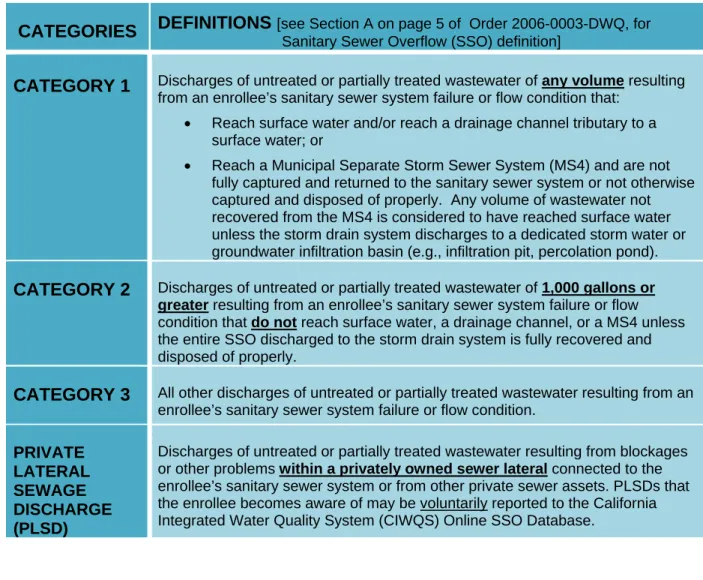
Table 3-1 summarizes the categories of spills as defined in the Statewide Order. Correct identification of the spill category is important because reporting requirement vary depending on the spill category. The most critical is a Category 1 spill, for which a 2-hr notification requirement applies.
Notification, Reporting, and Certification
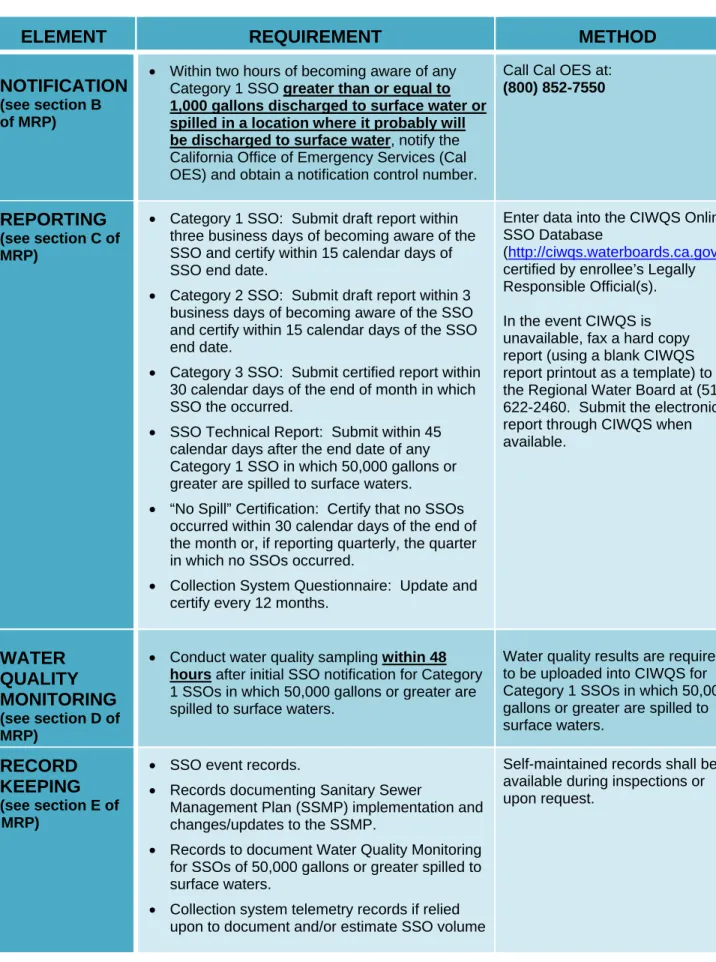
Table 3-2 (from Order the 2013 MRP) summarizes notification, reporting, monitoring and record keeping requirements. More detailed information is provided in the text of the MRP, which is included in Appendix D (follows Order 2006-003-DWQ). The Enrollee’s Guide to the SSO Database provides guidance in use of the online reporting system (CIWQS). The
District’s “SOP - Reporting of SSO’s to State”, included in Appendix A, also serves as an aid
to managers in meeting the 2-hr notification requirements. It contains the same basic information requirements listed in the MRP, plus some additional District-specific procedures.
The requirement for 2-hr notification requirement applies to any Category 1 SSO greater than or equal to 1,000 gallons discharged to surface wateror spilled in a location where it probably will be discharged to surface water, The 2-hr period starts upon the District “becoming aware” of such a spill. In some cases, such awareness will require field verification.
For both Category 1 and Category 2 SSOs, a draft report must be submitted through CIWQS within three business days of becoming aware of the SSO. (This is in addition to the 2-hr notification for Category 1 spills of greater than 1000 gallons).1 The draft reports must be
1 The CIWQS system allows a user to save a “work in progress” version of the SSO report online. Saving a “work-in-progress” version does not meet the requirement for submitting a draft report.
“certified “within 15 calendar days of the SSO end date. In the event CIWQS is unavailable, fax a hard copy report (using a blank CIWQS report printout as a template) to the Regional Water Board at (510) 622-2460. Submit the electronic report through CIWQS when available.
For Category 3 SSOs, no draft report is required. Instead, a single (certified) report must be submitted within 30 calendar days of the end of the month in which the SSO has occurred. The 2-hr notification and draft reports can be submitted online by either a designated “Data Submitter” or by a designated “Legally Responsible Official (LRO)”. However, only a LRO can certify reports. Currently, the District’s Collections Manager and General Manager are designated LROs. Normal practice at LGVSD is for the Collections Manager to conduct all on-line reporting. However, circumstances may require other staff to file the 2-hr notification or draft reports.
Amending and Recertifying SSO Reports
A certified SSO report can be amended (or additional information attached) for up to 120 calendar days after the SSO end date. After 120 days, special approval is required to amend a report. See Section C.4.b.iv of the MRP.
Private Sewer Lateral Discharge
CIWQS provides the option for reporting SSOs from private sewer laterals, which are not consider the responsibility reporting agency. In CIWQS, records of PSLDs are maintained separately from records of SSOs the agency’s own facilitities. The District typically does not report PSLDs.
No spill Certification
For months during which there are no SSOs, a “no spill certification” must be submitted in CIWQS by an LRO within 30 days after the end of the month. [Note: The 2013 MRP amendment allows no spill certifications to be filed quarterly; however, it is the District’s intent to continue filing these reports monthly].
Annual Questionnaire
The District must annually update and certify certain information regarding the collection system. The questionnaire must be certified in CIWQS by an LRO.
Spills Exceeding 50,000 Gallons that Reach Surface Waters
The MRP requires that water quality sampling be conducted for spills of 50,000 gallons or greater that reach surface waters, and that the SSO be documented in an SSO Technical Report. Requirements for the report are described in Section C.5 (pp, 5-6) of the MRP.
Record Keeping
The MRP requires that records be maintained for a minimum of five years for all SSOs, including complaints received by the District that do not result in an SSO. See MRP Section
creating detailed and complete documentation of SSO. A copy is included in Appendix A. In documenting SSOs, particular attention should be given to the method(s) by which spill volumes are estimated.
Records documenting changes to the SSMP since the last certification must be maintained and attached to the SSMP. See MRP Section C.E.3. The Collections Manager has
responsibility for maintaining these records.
Table 3-1. Spill Categories and Definitions
CATEGORIES DEFINITIONS [see Section A on page 5 of Order 2006-0003-DWQ, for
Sanitary Sewer Overflow (SSO) definition]
CATEGORY 1 Discharges of untreated or partially treated wastewater of any volume resulting
from an enrollee’s sanitary sewer system failure or flow condition that:
Reach surface water and/or reach a drainage channel tributary to a surface water; or
Reach a Municipal Separate Storm Sewer System (MS4) and are not fully captured and returned to the sanitary sewer system or not otherwise captured and disposed of properly. Any volume of wastewater not recovered from the MS4 is considered to have reached surface water unless the storm drain system discharges to a dedicated storm water or groundwater infiltration basin (e.g., infiltration pit, percolation pond).
CATEGORY 2 Discharges of untreated or partially treated wastewater of 1,000 gallons or greater resulting from an enrollee’s sanitary sewer system failure or flow condition that do not reach surface water, a drainage channel, or a MS4 unless the entire SSO discharged to the storm drain system is fully recovered and disposed of properly.
CATEGORY 3 All other discharges of untreated or partially treated wastewater resulting from an enrollee’s sanitary sewer system failure or flow condition.
PRIVATE LATERAL SEWAGE DISCHARGE (PLSD)
Discharges of untreated or partially treated wastewater resulting from blockages or other problems within a privately owned sewer lateral connected to the enrollee’s sanitary sewer system or from other private sewer assets. PLSDs that the enrollee becomes aware of may be voluntarily reported to the California Integrated Water Quality System (CIWQS) Online SSO Database.
Table 3-2. Notification, Reporting, Monitoring, and Record Keeping Requirements
ELEMENT REQUIREMENT METHOD
NOTIFICATION (see section B of MRP)
Within two hours of becoming aware of any Category 1 SSO greater than or equal to 1,000 gallons discharged to surface wateror spilled in a location where it probably will be discharged to surface water, notify the California Office of Emergency Services (Cal OES) and obtain a notification control number.
Call Cal OES at:
(800) 852-7550
REPORTING (see section C of MRP)
Category 1 SSO: Submit draft report within three business days of becoming aware of the SSO and certify within 15 calendar days of SSO end date.
Category 2 SSO: Submit draft report within 3 business days of becoming aware of the SSO and certify within 15 calendar days of the SSO end date.
Category 3 SSO: Submit certified report within 30 calendar days of the end of month in which SSO the occurred.
SSO Technical Report: Submit within 45 calendar days after the end date of any Category 1 SSO in which 50,000 gallons or greater are spilled to surface waters.
“No Spill” Certification: Certify that no SSOs occurred within 30 calendar days of the end of the month or, if reporting quarterly, the quarter in which no SSOs occurred.
Collection System Questionnaire: Update and certify every 12 months.
Enter data into the CIWQS Online SSO Database
(http://ciwqs.waterboards.ca.gov/), certified by enrollee’s Legally Responsible Official(s). In the event CIWQS is unavailable, fax a hard copy report (using a blank CIWQS report printout as a template) to the Regional Water Board at (510) 622-2460. Submit the electronic report through CIWQS when available. WATER QUALITY MONITORING (see section D of MRP)
Conduct water quality sampling within 48 hours after initial SSO notification for Category 1 SSOs in which 50,000 gallons or greater are spilled to surface waters.
Water quality results are required to be uploaded into CIWQS for Category 1 SSOs in which 50,000 gallons or greater are spilled to surface waters.
RECORD KEEPING (see section E of MRP)
SSO event records.
Records documenting Sanitary Sewer
Management Plan (SSMP) implementation and changes/updates to the SSMP.
Records to document Water Quality Monitoring for SSOs of 50,000 gallons or greater spilled to surface waters.
Collection system telemetry records if relied
Self-maintained records shall be available during inspections or upon request.
4.0 FOG Program (D.13.vii)
The District’s FOG Program was developed in collaboration with the Central Marin Sanitation Agency (CMSA), which provides pollution prevention and related services to the District on a contract basis. CMSA staff conduct inspections and provide other services related to the FOG Program, and reports monthly to the District on these activities.
Legal authority for the FOG Program is provided by the District’s FOG Ordinance No.135, and the related Ordinance 136 that prohibits food grinders in commercial food service establishments, both of which were adopted by the District’s Board on August 17, 2006. The FOG Ordinance cites general authority provided by Ordinance No. 112, adopted in 1995. Complete copies of Ordinances 135 and 136, and of the relevant section of Ordinance 112 are included in Appendix B.
The FOG Ordinance calls for installation of grease removal devices (GSDs) in all new construction and for major remodels. Requirements for existing food service establishments (FSEs) vary depending on the location of the FSEs relative to identified FOG “hot spots”. This targeted approach to regulating FOG sources is consistent with both State and RWB guidance. In addition to the GSD requirements, the FOG Ordinance provides a detailed framework for permitting, inspections, enforcement, and Program funding. Approximately 70 inspections of FSEs were conducted when the program was initiated in 2007. Waivers were granted for certain FSEs as provided for in the Ordinance. The remaining FSEs were issued permits and are subject to ongoing inspections. Results of inspections and records of interceptor pumping submitted by FSEs are tracked in a FOG database. Example reports from the database are included in Attachment B.
Implementation of the FOG Ordinance required that the District identify hot spots within the collection system. The list of District hot spots is included in Appendix B. The list is maintained and updated annually by the Collections Manager based on information from District line crew, and from analysis of maintenance records and incidence reports. A schedule and maintenance history for routine preventative maintenance of each hot spot has been developed, and is tracked in the District’s maintenance database (OASIS).
In 2008, the District completed the first cycle of CCTVing the entire collection system, a process that takes approximately four years, and which is an ongoing element of the District’s maintenance program. (“PMs” for CCTVing and cleaning are generated automatically by OASIS). The CCTV process includes an assessment of each line segment, with results recorded in OASIS. OASIS provides standardized codes to indicate condition of the line segment (e.g. grease, roots, debris, excessive I&I, deterioration, etc). Results from other preventative and corrective maintenance activities are also tracked in OASIS.
The FOG Program includes additional non-regulatory elements, which may be expanded over time. The District’s quarterly newsletter periodically features information regarding proper grease disposal practices for homeowners, and such FOG-related messages are integrated into the District’s Public Outreach / Pollution Prevention Program). Letters are sent to homeowners along main lines that show an excess amount of grease accumulation.
5.0 Legal
Authority
(D.13.iii)5.1 Requirements
The RWB’s Development Guide describes the requirement for Legal Authority as follows: Requirement: Each wastewater collection system agency shall, at a minimum, describe its legal authority, through sewer use ordinances, services agreements, or other legally binding procedures to:
Control infiltration/inflow (I/I) from satellite wastewater collection systems and laterals
Require proper design and construction of new and rehabilitated sewers and connections
Require proper installation, testing, and inspection of new and rehabilitated sewers Additional details are provided in the RWB’s Development Guide “points to remember”. (See Appendix C)
Requirements related to legal authority in the SWRCB’s Statewide General Order 2006-003-DWQ are as follows:
Each Enrollee must demonstrate, through sanitary sewer system use ordinances, service agreements, or other legally binding procedures, that it possesses the necessary legal authority to:
(a) Prevent illicit discharges into its sanitary sewer system (examples may include I/I, stormwater, chemical dumping, unauthorized debris and cut roots, etc.);
(b) Require that sewers and connections be properly designed and constructed;
(c) Ensure access for maintenance, inspection, or repairs for portions of the lateral owned or maintained by the Public Agency;
(d) Limit the discharge of fats, oils, and grease and other debris that may cause blockages, and
(e) Enforce any violation of its sewer ordinances. 5.2 District Ordinances Relevant to the SSMP
The District’s primary legal authority is provided through Ordinances adopted by the District’s elected Board of Directors. Additional authority is provided by service agreements with several private collection systems that discharge to the District’s system. Over its history, the Board has adopted over 150 Ordinances. These are organized sequentially by date of adoption, and in 2010 were codified into an Ordinance Code (see below). A majority of the Ordinances relate to adjustments to service rates and connection fees, and as such, supersede previous Ordinances. Ordinances relevant to this SSMP include:
Ord 9: Regulates use of sewers, establishes construction standards (by reference to District’s Specifications for Sewer Construction). Largely superseded by
subsequent ordinances.
Ord 10: Prohibits use of impact and vibratory machines, heavy equipment, etc during construction.
Ord 40: Requirements for installation of backwater prevention devices Ord 56: Requirements for construction of sewers underlain by Bay mud
Ord 63: Regulations regarding discharge of Industrial Wastes and regulating use of public sewers (Note: Listed for historic purposes only. Superseded by Ord 112)
Ord 64: Various additional definitions; amended “Sewer Required” provision of Ord 9; added a “Use of Public Sewers” provision to Industrial Waste Ordinance (at that time Ord 63).
Ord 66: Use of sewers. Note: Portions of this may be superseded by Ord 112. Portions supercede previous ordinances.
Ord 92: Amends Ord 63 (industrial waste) to refer to Ord 66
Ord 112: Primary sewer use ordinance (a.k.a. Industrial Waste Ordinance). General discharge prohibitions, industrial pretreatment requirements, local limits, enforcement authority. Does not address construction standards. Repeals Ord 63 and other ordinances “inconsistent herewith”.
Ord 113: Includes requirements regarding backflow prevention and backwater prevention devices
Ord 135: FOG Ordinance
Ord 136: Food Grinder Ordinance
Ord. 121, 124, 130, 131, 133: Ordinances related to current sewer service rates and fees. Ord 146: Regulates dental amalgam to minimize discharge of mercury to the sanitary sewer. Ord 153 Lateral Rehabilitation Assistance Program
In addition to the legal authority based on Ordinance, the District has service agreements with Contempo Marin, Sade Apartment Development, and Marin Valley, Inc.
In 2010, the District completed the compilation and consolidation of its ordinances into a new Ordinance Code. The Ordinance Code is more accessible, and its organization by titles and chapters greatly facilitates the search for legal authority on a given topic. The Ordinance Code is available on the District’s web site.
5.3 Documentation of Legal Authority
Table 5-1 correlates the LGVSD Ordinance sections with the RWB and Order 2006-003-DWQ SSMP requirements listed above (supplemented by the “points to remember” from the RWB Development Guide). Columns 2 and 3 provide references to the original ordinance sections and to those in the new Ordinance Code, respectively. The fourth column in Table 5-1 provides additional notes and comments.
Table 5-1. Documentation of Legal Authority
Requirement / Measures Ordinance Reference
Ordinance Code
Reference Notes & Comments I. SSMP Requirements (RWB and
Order 2006-003-DWQ):
Control infiltration/inflow (I/I) from satellite wastewater collection systems and laterals
Stormwater run-off prohibited Ord 112, Section 3B Title 2, Chapter 2,
Art.IV, §402
Prohibits discharge of “any storm water, surface water, groundwater, roof runoff or subsurface drainage, except in cases of discharge of contaminated groundwater in
accordance with Article IX.”
Discharge from swimming pools Ord 9, Section 711 Allows discharges up to 100 gpm
Maintenance of laterals Ord 9, Section 510 Title 2, Chapter 1, Art.IV, §510 “Side sewers shall be maintained by the owner of the property served thereby.”
General Prohibition on causing
pass-through or interference Ord 112, Section 3A
Title 2, Chapter 2, Art.IV, §401
Although intended to prohibit the discharge of toxics, may apply to excessive I/I (alone or in conjunction with discharges from other sources) could contribute to “pass through” of pollutants resulting in a violation of NPDES permit limits.
Specific prohibition on discharge of stormwater, subsurface drainage, groundwater
Ord 112, Section 3B8 Title 2, Chapter 2, Art.IV, §402 Could be applied to I/I into laterals.
Require proper design and
construction of new and rehabilitated sewers and connections,and require proper installation, testing, and inspection of new and rehabilitated
Requirement / Measures Ordinance Reference
Ordinance Code
Reference Notes & Comments
Building sewers laterals and connections – permits and construction requirements
Ord 9, Section 501-508
Title 2, Chapter 1 , Art. V (all)
Construction shall be in accordance with County and District’s requirements
Building sewers laterals – Testing
required Ord 9, Section 511
Title 2, Chapter 1 , Art. V, §511
Public Sewer Construction – Permits and designs required
Ord 9, Section 601-602
Title 2, Chapter 1 , Art. VI (all)
Public Sewer Construction - Design
and construction standards Ord 9, Section 609
Title 2, Chapter 1 , Art. VI (all)
Refers to District’s Specifications for Sewer Construction (a.k.a. Standard Specifications and Drawings)
Inspections required for sewer construction, building sewers, plumbing and drainage systems
Ord 9, Section 811, Plumbing and Building Codes
Title 2, Chapter 1 , Art. VI (all)
Prohibition on use of heavy
equipment Ord 66
Title 2, Chapter 1 , Art. VI §619
Special requirements for construction
on Bay mud Ord 56
Title 2, Chapter 3 , (all)
Interceptor required Ord 135, Section 5 Ord 9, Section 704 Title 2, Chapter 4 , Art. V
Maintenance of interceptor required Ord 135, Section 7 Ord 9, Section 705 Title 2, Chapter 4 , Art. VII
Ensure access for maintenance, inspection, or repairs for portions of the lateral owned or maintained by the Public Agency Ord 9, Section 506, 609, 1002 Ord 112, Section 4 Title 2, Chapter 1 , Art. V (cleanout on lateral required in new construction or alteration)
Section 506 requires a cleanout. Section 609 references District Standards, which show a clean-out is required on user’s property (for access to lower lateral). Ord 112, Section 4.A.2.g, provide for access for inspection, sampling, etc, but do not explicitly mention repairs.
Requirement / Measures Ordinance Reference
Ordinance Code
Reference Notes & Comments
Prevent illicit discharges Ord 112, Section 3 Title 2, Chapter 2 , Art. IV Limit FOG and other debris Ord 135, Section 5, 7 Ord 112, Section 3.B1
Title 2, Chapter 4(all); Title 2, Chapter 2, Art IV
FOG is very well covered. It would be desirable if roots were more explicitly covered in the Ord 112, Section 3.B.1 wording.
Enforce any violation of its sewer
ordinances Ord 112, Section 10
Title 1, Chapter 1, Art III
Title 2, Chapter 2, Art. XI
These are the primary enforcement sections. There are additional enforcement provisions that accompany other sections..
II. Items from RWB Development Guide “Points to Remember”:
Ordinance, permits, agreements should have authority to require compliance with District Standards
Ord 9, Section 609
Ord 112, Section 5C4 Title 2, Chapter 1, Art V
Agency should have ability to
ultimately disconnect a user that fails to comply
Ord 9, Section 903 Ord 112 Section 4A2c
Title 2, Chapter 2, Art. XI, §1101
Title 2, Chapter 1, Art IX, §903
Authority to disconnect applies to all users.
Illegal Discharges should be subject to corrective action regardless of user class (domestic, commercial, industrial)
Ord 112, Section 3 Title 2, Chapter 2, Art.IV
The general and specific prohibitions in
Ordinance 112 apply to all users, (see Section 1B and definition of “person”).
Prohibition of downspout, roof drain, and area drain connections to sanitary sewer
Ord 112, Section 3B Title 2, Chapter 2,
Art.IV, §402 See comment for stormwater runoff.
Legal Authority for proper
construction of privately owned lines is normally provided by Building
Title 2, Chapter 1, Art V
Building Code requirements are supplemented by District-specific requirements
Requirement / Measures Ordinance Reference
Ordinance Code
Reference Notes & Comments
Some agencies have lateral
inspection/repair program applicable when property is sold
Ord 153 Title 2, Chapter 8, Art I-III
District has no mandatory lateral inspection program, except in the case of newly constructed laterals. Ordinance 153 provides funding and cost recovery for private lateral repair/replacement that is not tied to point of sale. Ordinance Code also has general wording regarding maintenance of side sewers. See Title 2, Chapter 1, Art.IV, §510.
6.0 Measures
and
Activities
(D.13.iv)6.1 Collection System Maps
Detailed collection system maps are maintained in digital electronic form in the District’s GIS System (ARC-ESRI). Development of this system was completed in 2012, and required conversion of mapping data from the previous system based on AutoCad. The GIS system is linked to the OASIS maintenance management database.
Hard copy map are printed from the GIS system onto tear and water resistant paper. Map books are available at District offices, and a set is carried in each collection system vehicle. The map books contain a key sheet plus 69 individual map sheets printed at 1”=200’ scale. Each map covers an area of approximately 2000’ x 2900’ (0.38 mi x 0.55 mi). The maps show the location and size of all sewer lines and force mains (color coded), manholes (with ID #), pump stations, street names and boundaries, parcel addresses and boundaries, and ground surface elevation contours. The map key and an example map sheet are included in Appendix E. In addition to the sewer system maps, each collection system vehicle carries a City of San Rafael mapbook showing storm drain locations and a County map of storm drains in the Santa Venetia area. .
As part of the GIS system development process, the District completed a systematic review and update of each map sheet. Nevertheless, the process for updating and correcting map errors is an ongoing one. During video inspections, any errors or omissions are recorded by the collection system camera crew. The information is passed on to the Collections Manager, who revises the map and (if changes are significant) prints new copies.
For the design of capital improvement projects, shapefiles can be exported from the GIS system into CAD programs for use in development of construction plan sheets.
6.2 Resources and Budget Funding Sources
District revenues are derived primarily from sewer rates paid by users of the collection system and treatment plant, plus a property tax assessment. In 2004, the District Board raised sewer rates (from $146/yr to $303/yr over a 4 year period) to finance increased costs for operations, maintenance, capital improvements and to maintain the District’s reserve fund. The property taxes component provides an additional $35/yr per dwelling unit.
Additional sources of revenue include annex and connection fees, interest on capital reserves, and other sources. In 2009, the District completed a Proposition 218-compliant process to increase sewer rates from the 2008/09 level of $303/yy to $608/yr in 2013/14 in order to finance treatment plant improvements, collection system rehabilitation projects, pump station and force main improvements, and other programs.
Formal Operating Budget and Funding Plan
The District operates under a formal operating budget prepared by District management (the Administrative Manager is a certified CPA), and approved by the District Board. Operating expenses for the treatment plant and collection system are broken down into 79 primary categories and 24 sub-categories. In general, the operating budget does not provide separate accounting for the collection system and treatment plant, although in some cases (e.g., operating supplies, equipment maintenance) the distinction is made. The District’s capital and operating budgets are posted on the District web site.
Collection system staffing consists of four full-time line crew workers in the field, a full time Collection System Manager, plus additional support from the General Manager, administrative and laboratory staff, and outside consultants. Over the past several years, the District has made significant additions and upgrades to collection system equipment including additional new flusher and rodder trucks, video cameras, and portable flowmeters. The District has also implemented maintenance management and GIS software for inventory, inspection, work orders, scheduling, reporting, and mapping. An annual Collection System report is submitted to the Board each year. Additional information regarding resources allocated to the collection system are described in the Collection System Improvements and Wastewater Treatment Facility Improvements Annual Update and the Facility Review and Evaluation Annual Status Report, submitted to the RWB in February and June, respectively,
in accordance with the District’s NPDES permit.
Capital Improvement Plan
Capital projects are budgeted separately from operating expenses. Approximately $1 million is budgeted each year to fund a major main replacement (pipebursting) project, plus a number of smaller replacement/rehabilitation projects for the collection system/pump stations. (Main replacement budgets from several years may be combined for larger projects). Starting if FY2011/12, an additional $1.5 million per year has been allocated for capacity related mainline projects, based on the analysis described in Section 8 of this SSMP.
The District recently completed of a multi-year project to install variable speed drives and SCADA systems at the five primary collection pump stations, upgrade their control systems, and tie those systems into the treatment plant’s SCADA system.
6.3 Prioritized Preventative Maintenance
The District operates a prioritized preventative maintenance (PM) program designed to maintain the integrity of the system, reduce the frequency of SSOs, and reduce I/I. The program uses the OASIS (Operator Assisted Sewer Information System) database the primary data management tool, in conjunction with inspection forms, the GIS application, and other management tools. PM activities are prioritized based on results from historic PM and corrective maintenance (CM) activities. Prioritization is an ongoing process, with PM schedules continually being updated based on recommendations contained in the inspection or maintenance reports.
Activity Performed by
ITV - inspection by TV Camera crew
CJET – Flushing with camera truck Camera crew CLEAN - Flushing with flusher truck Maintenance crew
ROOTCT - Rodding Maintenance crew
CVAC – Vactor Truck Maintenance crew
IRO – TVing with push camera Maintenance crew
SMOKE – smoke testing Camera or Maint. crew
OASIS issues a monthly schedule that specifies PM activities for that month. Separate schedules are issued for the Camera Crew and for the Maintenance Crew. Example schedules are included in Appendix E. The location of the PM is specified in terms of structure ID or sewer line segment identified by upstream and downstream manholes. The schedule specifies the PM activity, and includes the date and condition scores from the previous PM on that segment. The crew documents the PM activity by filling out the appropriate inspection form, copies of which are included in Appendix E. The forms include detailed information regarding the inspection, time spent, a revised condition assessment, and recommended frequency for the next inspection. For Camera Crew inspections, the default return frequencies are four years for segments with no identified problems, or three years if cleaning was needed. For Maintenance Crew inspections/activities, the return frequencies vary widely depending upon the inspection findings. Information documented on inspection forms is entered into OASIS and becomes part of the historic record for that structure or line segment. A PM history can be generated from OASIS for any structure/segment, as illustrated by the example in Appendix E.
Collection system O&M activities are summarized monthly in tabular and graphical form using data derived from OASIS. The Collections Manager also summarizes collection system activities in an annual report to the District Board. Appendix E includes examples of these summaries.
Maintenance of the larger collection system pump stations is performed by treatment plant operators working under the supervision of the Plant Manager. The five largest pump stations are inspected by operators three times per week; mid-size stations are inspected twice each week. The 15 smallest pump stations (9 at Marin Lagoon and 6 at Captain’s Cove) are inspected weekly by Collection System line crew. Inspections include a visual check of equipment, logging of run-time hours, and washdown of the wet well if needed. Alarms are tested and emergency backup generators are run monthly. The District has implemented a maintenance management software system (CMMS) for the pump stations, and is in the process of implementing the same application for the treatment plant.
6.4 Scheduled Inspections and Condition Assessment
The District’s system for inspections and condition assessment is closely integrated into the preventative maintenance program described in the previous section. The system is designed to proactively identify problem areas and structural deficiencies, and to take appropriate
actions before these problems result in blockages, SSOs, or structural failures. Problem areas are identified using a variety of tools, including visual inspection, video inspections, smoke testing, and flow monitoring. Referring to the inspection forms in Appendix E, inspection results are characterized in both qualitative terms (recommendations, observations and notes) and in qualitative scores that include an overall structural rating and ratings for specific categories (debris, grease, roots, I&I, etc).
The District has established goals for inspecting the entire collection system over a four year period. Progress toward meeting those goals is included in the annual collection system O&M summary reports.
As described in Section 6.3, preventative activities by line crew include flushing, rodding, and video inspections at frequencies designed to prevent or minimize blockages and/or SSOs. Other preventative activities performed by the District include implementation of the FOG program (Section 4.), outreach to plumbing contractors (Section 6.7), and implementation of design and construction standards (Section 7.0)
Finally, the correction of structural deficiencies (e.g., line segments with excessive I&I, offsets or sags, or excessive root intrusion) is also an essential preventative activity. Information regarding structural problems identified during inspections is entered into OASIS, and is also logged into a separate “Areas of Concern” spreadsheet that includes a description of the problem and the proposed remedy. The spreadsheet, a copy of which is included in Appendix E, is used in planning and budgeting capital projects in the next budget cycle. A separate spreadsheet is developed for locations identified that year.
Planning for corrective actions, particularly long-term actions and larger projects, will typically require engineering analysis, such as the Capacity Management and CIP element of this SSMP, and preparation of construction contract documents (plans and specifications). In prioritizing the correction of structural deficiencies, a number of factors in addition to the specific structural condition must also be considered, including:
Budgeting and timing considerations vis-à-vis other District projects
Grouping of corrective actions into coherent projects that are large enough to attract highly qualified contractors and maximize the benefit attained for the funds expended.
Ability to maintain service during construction, including consideration of reasonable “worst-case” flow scenarios. (This may limit construction to dry season).
Environmental and customer impact issues.
Coordination with projects by other agencies
6.5 Contingency Equipment and Replacement Inventories
The District uses the Contingency Plan, prepared in accordance with the District’s NPDES permit and RWB Order 74-10 to document the contingency equipment used to respond to emergencies and spare/replacement parts intended to minimize equipment/facility downtime. The Contingency Plan is reviewed and updated annually.
Emergency equipment includes a variety of trailer mounted portable generators (up to 400 kw), portable pumps (up to 12 inch), spare electric submersible pumps that are direct replacements for the pumps used in many of the District’s smaller collection system pump stations, piping and hoses, samplers, warning signs, and other equipment. The emergency response trailer is equipped with most of the small items normally needed in an emergency response situation (see Section 3.3).
For the collection system, repair parts consist primarily of repair clamps in those sizes needed to match District lines.
6.6 Training
The District’s training activities fall into two categories, safety and job skills. The two are closely related insofar as safety is of prime consideration in performance of any job activity. Annual safety training is conducted by District staff or outside consultants in the areas listed below. One or more topics is covered during monthly training sessions.
Chemical Hygiene Forklift
CPR / First Aid Hazard Communication
Driver Training Heat Stress
Electrical lockout/tagout Respiratory Protection
Emergency Response Wastewater Pathogens
Fire Prevention/Fire Extinguishers Confined Space Hearing Protection
Job skills training include in-plant and external components. The Collection System Manager conducts in-plant training for Sewer Overflow Response two to three times per year. In addition to SSO response, the training includes methods to collect the information required for notification and reporting of SSOs under Order 2006-003-DWQ, and sampling of SSOs. Informal training is achieved through mentoring of new operators by experienced operators. External training opportunities include participation in the CWEA Technical Certification Program and CWEA conferences, and in some cases, specialized off-site training for specific job skills. Each employee has a file which documents training received. Currently (September 2013), the collections line crew includes one Grade III-certified collection system maintenance person, two Grade II, one Grade I and one uncertified. Two of the line crew are also certified as Grade I plant maintenance technologists. Three collections employees are certified under the National Association of Sewer Service Companies Pipe Inspection and Certification Program.
6.7 Outreach to Plumbers and Building Contractors
The District’s public outreach efforts include both educational and regulatory elements. Because the actions of plumbers and sewer contractors working on private systems can result in SSOs from either the private or public systems, it is essential that those contractors be aware of management practices to prevent such occurrences. To that end, the District