DRAFT ENTSO-E WORK
PROGRAMME
AUTUMN 2013 THROUGH DECEMBER 2014
VERSION: ASSEMBLY APPROVED
1. EXECUTIVE SUMMARY ... 3
2. GENERAL DESCRIPTION OF THE WORK PROGRAMME ... 3
3. NETWORK CODES ... 5
4. MARKET DEVELOPMENT ACTIVITIES ... 7
5. SYSTEM DEVELOPMENT ACTIVITIES ... 11
6. SYSTEM OPERATIONS ACTIVITIES ... 14
7. RESEARCH AND DEVELOPMENT ACTIVITIES ... 17
8. LEGAL ®ULATORY GROUP (LRG)ACTIVITIES ... 21
1.
E
XECUTIVES
UMMARY ENTSO-EENTSO-E is established under Regulation 714/2009 and was founded in December 2008. Key activities are delivery of draft network codes to ACER and the European Commission (EC), Ten Year Network Development Plans (TYNDP), and an annual work programme that details plans for delivery of these items and many more deliverables that are identified here.
ENTSO-E’s fifth Work Programme for the year 2014 is dominated by the continuing focus on network codes delivery and Comitology and the preparations and delivery of the 2014 TYNDP. This focus is partly derived from the three year work plan agreed and updated between ACER – EC and ENTSO-E. However, network codes are only part of the ENTSO-E work programme and this wider work load is important for meeting the other duties described in Regulation (EC) 714/2009 and for the successful cooperation of European TSOs in support of the European energy policy goals of security of supply, sustainability and competitiveness.
2.
G
ENERAL DESCRIPTION OF THE WORK PROGRAMME INTRODUCTIONThis work programme covers the period from autumn 2013 through to the end of 2014. Because of the importance of the network codes for ENTSO-E's work and for the European electricity market and system, and also because the codes constitute one coherent overall project with many relationships between them, the work programme contains a separate network code chapter. The other chapters follow the organisation of ENTSO-E work in committees.
ENTSO-E is organised into four committees responsible for delivering the work programme of projects and on-going work, and this work programme describes the deliverables and calendars under the headings of these member-lead committees. These Committees are ‘System Development’ – planning and development of the transmission infrastructure, ‘System Operation’ – enhancing cooperation in the secure operation of the transmission system including emerging relationships with non-ENTSO-E TSOs, ‘Market’ – developing and implementing the commercial rules necessary to support the internal market for energy; finally Research and Development, with content scope covering all three aforementioned committees, to keep TSOs at the vanguard of innovative solutions to energy and power challenges in Europe. Chapters on the Legal and Regulatory Group and on corporate affairs complete the work programme.
RESOURCES
The work programme described in this document covers the tasks which the ENTSO-E Secretariat will be involved in during 2014. However, even on this horizon, significant uncertainties exist around some tasks. For example, the timing of the Comitology proceedings for the various network codes is more uncertain than anticipated, and the amount of Member TSO and Secretariat experts needed to explain certain network code provisions before and during Comitology is also only a rough estimate.
DRIVERS OF WORKLOAD
A recurring theme of this work programme is the volume of resource which is devoted to the delivery of tasks which ENTSO-E is legally required to deliver. The breakdown in the combined estimated Member TSO and Secretariat effort for the main task categories is shown in the diagram below.
The diagram is based on the input of both the ENTSO-E Secretariat and of Committee Chairs. It was developed as part of longer-term strategic resource requirement estimation, the intermediate results of which are shown below. Increased pressure is likely to be faced by ENTSO-E members during and after 2014 due especially to the network code implementation work, by each TSO in its own country and also jointly. The work programme is based on an assumption that Member contributions can develop accordingly and that sufficient expert staff can be found; though this is not a given.
3.
N
ETWORKC
ODESAt the time of writing, ENTSO-E has resource committed to nine different network codes (covering connection requirements, the coordination of system operations and the creation of an internal electricity market). Each code is at a different phase; though all nine should have entered the process of becoming law by 2014. For detailed information on network codes please see the dedicated section of the ENTSO-E website.
OVERALL ACTIVITY
The calendar below shows the expected timelines for work on each of the nine network codes. The calendar covers the period 2013-2015. As discussed above, there are considerable uncertainties around timings; though no question that the effort required at European, regional and national level will be not only substantial but also increasing especially with respect to imple
m
entation.J F MA M J J A S O N D J F MA M J J A S O N D J F MA M J J A S O N D
Network Codes
Capacity Allocation & Congestion Management (CACM) Forward Capacity Allocation (FCA)
Electricity Balancing (EB) Requirements for Generators (RfG)
Demand Connection Code (DCC) HVDC connection code (HVDC)
Operational Security (OS) Operational Planning & Scheduling (OPS) Load Frequency Control & Reserves (LFCR)
Scoping NC Implementation
Drafting Pre-Comitology
Consultation Comitology
Acer Opinion
Assumptions based on the EC priority list 2014 and on current information Regulatory procedure
with scrutiny
2013
2014
2015
NETWORK CODE DRAFTING
At the start of this work programme time only 3 network codes will still be at the drafting phase. Work on these network codes will focus on ensuring codes meet framework guidelines, ENTSO-E consults fully and effectively including responding to comments received via workshops and public feedback, and working closely with the European Commission and ACER so that the overall time needed until the codes take effect is minimised while they provide the largest possible benefit to European customers and energy policy.
It is possible that ENTSO-E may be requested to begin work on additional network codes late in 2014; though this will be driven by the European Commission’s priority list and work of European regulators and ACER. The Framework Guideline on Electricity System Operation asked for key criteria for emergency and restoration. ENTSO-E already started the scoping of the Network Code on Emergency Requirements and Procedures. Interactions with NC LFCR and NC EB will be carefully taken into consideration.
SUPPORTING THE PROCESS OF MAKING NETWORK CODES LAW
At the time of writing five network codes have been submitted to ACER. The most advanced network code, Capacity Allocation and Congestion Management, is expected to begin the Comitology process (i.e. scrutiny by Member State representatives) in autumn 2013. It is expected that the Demand Connection code and network code on Requirements for Generators will be considered in parallel after CACM. The third tranche of codes to be considered will be those related to operational issues.
The timescales for the Comitology process are uncertain; as are the steps, including the preparation of a final text, translation and the completion of an impact assessment, which will need to take place before that process can begin. Nevertheless, ENTSO-E expects to play a role in both these phases. During the pre Comitology phase there will be a need to work with the European Commission to clarify aspects of the text and, if necessary, fine tune the draft code according to the Commission's legal review. ENTSO-E will also produce material to explain the content and purpose of each network code, to place it within the wider context of European energy policy and to demonstrate the benefits it will deliver.
NETWORK CODE IMPLEMENTATION
Despite the likelihood that the first network code will not become law until late 2013, ENTSO-E Members have already begun work to implement the provisions of the network codes. This challenging is considerable, will require action at European, regional and national level and will involve hugely significant volumes of TSO resource.
Each network code sets a series of rights and obligations on various market players; most often TSOs. In many cases, network codes also require actions to be taken or parameters to be specified in order to implement that code. For example, the connection codes require about 40 provisions to be set at national level and the CACM code requires various methodologies (essentially more detailed specifications of subjects that could not be specified within the code itself) to be developed. This workload is summarised in section 2 above.
In ENTSO-E’s view, beginning implementation work ahead of the formal approval of a network code is a pragmatic approach (though is not entirely without risk of proving redundant) and is a prerequisite for delivering the benefits of network codes quickly. However the work carries a risk that the level of expertise available to ENTSO-E for European work will decline as experts are required to implement network codes within their home countries.
4.
M
ARKET DEVELOPMENT ACTIVITIES REGIONAL MARKET DEVELOPMENTRegional developments complement the top-down approach provided by network codes and streamline bottom-up cooperation to achieve the goal of completing the European Internal Electricity Market (IEM).
November 2013 is the expected go live date for the North-West Europe (NWE) Day Ahead (DA) Market Coupling. ENTSO-E in cooperation with the relevant power exchanges will implement full price-coupling throughout the whole NWE region. This will cover the Central-West Europe (CWE) region, the Nordic region, the Baltic Region and Great Britain and will be key milestone in the European-wide roll out of market coupling.
As for the Intraday Market, ENTSO-E has decided to launch a pilot for the design and implementation of a cross-zonal intraday solution, as defined in the CACM code, once the on-going PXs run process for the Intraday platform selection concludes. This pilot will be largely centred around (but not limited to) the NWE area. During 2013 and 2014, ENTSO-E will continue working on enhancing the coordination of the different initiatives to pave the way for a European-wide roll-out of the solutions in a consistent manner with the CACM code.
UNPLANNED FLOWS -BIDDING ZONES STUDY AND CROSS-BORDER REMEDIAL ACTIONS TASK FORCE
To define a regulatory framework for coordinated cross-border redispatching and countertrading including cost-sharing arrangements is important not only from a market perspective but also from a network security point of view. Such a framework is to support the EU wide implementation of the CACM target model by delivering an especially valuable contribution to Central-East European (CEE) region unplanned flows for which international redispatching cost allocation rules are urgently needed. Following the Florence Forum request last May 2012, ACER and ENTSO-E created a joint task force to analyse a regulatory framework for cross-border redispatch including cost sharing arrangements. The joint work of this task Force will continue during 2013 and 2014.
In April 2013 ENTSO-E has launched a pilot project to test CACM code provisions on bidding zones. The pilot project tackles the question of where and how the geographical boundaries of bidding zones should be determined, looking to improve the current market design. The project covers Belgium, France, Germany, Luxembourg, the Netherlands, Denmark-West, Austria, Czech Republic, Hungary, Poland, Slovakia, Slovenia, Switzerland and Italy. The study will be carried out in close cooperation with ACER in particular on the Market Structure evaluation as defined in the CACM code and stakeholders will be consulted. The technical report is foreseen for the end of 2013 and the analysis and bidding zone review are due by the end 2014.
LONG TERM MARKET DESIGN
There is consensus that the target model needs to be implemented as soon as possible across Europe, underpinned by timely and adequate transmission investments. However, there are growing concerns about the ability of current market designs to cope with very high percentage of variable RES generation and to manage the transition towards future power systems beyond 2020. This creates challenges to design appropriate market mechanisms and investment incentives to efficiently address such issues (which may or may not include capacity mechanisms). ENTSO-E intends to deepen its analysis to explore alternative options and propose solutions for a market and system design that is able to meet long term policy objectives while reflecting the reality of the technical challenges.
RESSUPPORTS AND CAPACITY MECHANISMS
In order to improve the coherence of security of supply, decarbonisation and completion of the IEM, ENTSO-E believes that the implementation of both RES support mechanisms and capacity remuneration mechanisms (where needed) should be market based. In this context, ENTSO-E will continue working to propose solutions for improving the efficiency and effectiveness of RES support mechanisms. Moreover, ENTSO-E will provide advice to policy makers on how capacity mechanisms, should be designed and implemented to ensure consistency with the internal energy market while minimising distortions of cross-border trade.
THE CHALLENGES OF FINANCING INFRASTRUCTURE –INVESTMENT INCENTIVES
It is vital that the regulatory and financial barriers to making infrastructure investments are tackled. ENTSO-E will continue to work with the Commission and ACER to encourage National Regulatory Authorities and Member States to improve the regulatory certainty for investors in transmission projects to encourage vital investment. In particular, ENTSO-E will work closely with ACER and lawmakers so that appropriate Europe-wide rules on investment incentives can be made binding.
INTER TSOCOMPENSATION
ENTSO-E will continue to manage the Inter TSO Compensation (ITC) process under the framework of ITC Multiannual Contract. The tasks involved will be the coordination of the ITC settlement process, annual ITC audit process and preparation and delivery of the ITC data for annual monitoring report developed by ACER.
DELIVERY OF THE ANNUAL TARIFFS REPORT AND CONGESTION REVENUE MANAGEMENT REPORT
ENTSO-E will continue to develop two separate annual reports:
‘ENTSO-E Overview of Transmission Tariffs in Europe’ is a report showing a comparative
overview of 2013 transmission tariffs for 32 European countries, including the components of the transmission tariffs and other regulatory charges recovered by TSOs.
As set out in Regulation No. 714/2009 ENTSO-E delivers its annual Congestion Revenue
Management report to regulators. TRANSPARENCY:
The Regulation and Manual of Procedures (MoP)
The 'Regulation on Submission and Publication of Data in Electricity Markets' is expected to be published towards the end of June 2013 and shall enter into force 20 days later, circa mid July.
A public consultation on the MoP will take place during the summer and following the analysis of the comments received, a final version of the MoP will be submitted to ACER for its opinion within 4 months of the entry into force of the Regulation.
The Central Information Transparency Platform
Given no unforeseen delays, the central information transparency platform is expected to complete acceptance testing circa July 2014 and will be available for testing with data providers. According to the Regulation, the platform should be fully operational 18 months after entry into force of the Regulation (i.e. Dec 2014).
In parallel to this process, during November 2013, the existing platform (entsoe.net) shall terminate operation and a first release of the new central information platform shall take over the publication of information.
ELECTRONIC DATA INTERCHANGE (EDI)
ENTSO-E’s EDI activities will continue to focus on harmonisation and implementation of standardised electronic data interchange. ENTSO-E will continue to develop and maintain the detailed descriptions of common business processes and ‘role models’, in formats which are easily understood and implemented by the software industry, partially in collaboration with other electricity and gas associations and by liaison with European and International standardisation bodies.
Additionally, drafting of network codes will be monitored closely to ensure alignment with current and future common business processes’ descriptions.
Highlights of the main activities and deliverables:
1) Throughout 2013 and 2014, standardisation work on the IEC 62325 series (CIM for Market) will be carried out. This includes the drafting of the documents necessary to inform the stakeholders of the way relevant ENTSO-E recommendations can be incorporated into IEC
62325 standards, involvement in drafting of the numerous corresponding standards, and also conducting the necessary interoperability tests (IOPs) to ensure conformity.
2) By July 2013, the first set of EMFIP’s draft implementation guides for generation and load, outages, balancing and transmission will be available for approval by the Market Committee. WG EDI will provide further support throughout the public consultation process which is expected to take place in the second half of 2013 until early 2014.
3) By July 2013, a new version of ENTSO-E’s Reserve Resource Process implementation guide will be available taking into account all maintenance requests received.
4) Development, throughout 2013 and 2014, of the necessary electronic documents in support of the network codes under development/approval.
OVERALL ACTIVITY
The diagram below shows the expected timelines for work on each of the market activities which ENTSO-E is involved in covering the period 2013 and to the end 2014.
J J A S O N D J F M A M J J A S O N D J F M A M J J A S O N D
Market Section
Regional Market Integration Unplanned flows – BZ study
Unplanned flows – incl XB Redispatching Long Term Market Development RES Supports and Capacity Mechanisms
Investmentincentives Inter TSO Compensation
Annual report on Congestion Revenue Management Annual report on Tariffs
Central Information Transparency Platform 1
Manual of Procedures 2 3
Interoperability test - CIM market standards
Drafting of standard CIM Market 62325 series (451-4, 5 and 6)
EMFIP data exchange implementation guides 2 3
ENTSO-E’s Reserve Resource Process implementation guide
* As s umptions ba s ed on the EC pri ori ty l i s t 2014 a nd on current i nforma tion
2013
2014
2015
Acer Opinion Regulatory procedure w scrutiny (RPS) EMFIP platform cut-over EMFIP release 2 testing
EMFIP platform R2 Operational Platform development & acceptance
Consultation Pre-Comitology
Scoping Comitology
Drafting NC Implementation
ENTSO-E activity ENTSO-E decsions
5.
S
YSTEMD
EVELOPMENT ACTIVITIES TEN YEAR NETWORK DEVELOPMENT PLANThe Ten Year Network Development Plan (TYNDP) is published by ENTSO-E every two years; it consists of eight documents: a European-wide TYNDP, six Regional Group Investment Plans (RgIPs) and a Scenario Outlook and Adequacy Forecast (SOAF).
Under Reg. (EC) 714/2009, ENTSO-E was entrusted to produce TYNDPs with the objective to provide a long-term vision for the electricity grid, including a generation adequacy outlook, and increase transparency to market participants. The new Reg. (EC) 347/2013 that entered into force on 15 May 2013 has expanded the role of the TYNDP making it the foundation of the European grid planning and the unique source of transmission and storage projects that are eligible to be characterised as of “Common Interest” (PCI). Such a label aims to address a chronic problem in electricity infrastructure development, namely the long permitting times, by providing for mechanisms at national level to limit the duration of the process; the strict and reliable application of those mechanisms is the key for succeeding this objective.
The new Regulation also asks ENTSO-E to provide the methodology that assists in the selection of the PCIs (cost-benefit analysis, CBA). This methodology is to be applied to all TYNDP projects and is a natural consequence of the ENTSO-E efforts already evident in the TYNDP 2012 to harmonise in a pragmatic manner the assessment of infrastructure projects throughout Europe. According to the timeline of the Regulation, the CBA methodology will be formally approved in August 2014. Nevertheless, ENTSO-E shall continue working on improving the methodology, in particular concerning the assessment of storage infrastructure, for the remainder of 2014.
The above requirements make it even more evident that stakeholder input to the TYNDP is crucial. Through the launch of the Long-Term Network Development Stakeholder Group at the end of 2012, ENTSO-E has created a platform in which stakeholders can contribute to the strategic orientations of the TYNDP and share their expertise in areas of mutual interest. In the summer of 2013, ENTSO-E and its partners in the Stakeholder Group will launch an expert group to study the best way to jointly work on the scenarios for the TYNDP in order to ensure balanced input and wide acceptability of the results. This work is expected to result in a set of recommendations to be put for public consultation alongside the TYNDP in autumn 2014.
In 2012 ENTSO-E opened the TYNDP for projects not promoted by its members. The role of the TYNDP in the new Regulation contributed in seeking an improved procedure for doing so and
ENTSO-E has proposed, in consultation with all impacted parties and EC and ACER, a new procedure in February 2013. Given the entry into force of the new Regulation in May 2013, this procedure will be formally re-opened at the end of 2013, potentially driven by the guidelines of EC that are expected at the same period. Such a late integration into the TYNDP process jeopardises the quality of these projects’ assessment. This is the main reason that ENTSO-E decided, based on the suggestion of EC, to move the delivery of the TYNDP 2014 at the end of that year instead of the summer.
The long-term adequacy forecast report (SOAF) is incorporated every two years into the TYNDP package. ENTSO-E established the year 2030 as the reference point for the TYNDP studies proposing four distinct visions for that horizon; nevertheless, even before, the generation and system adequacy are issues that merit a closer examination. ENTSO-E, in collaboration with EC and ACER, will build on its adequacy methodologies in order to better respond to the need of a Europe-wide evaluation of system adequacy and better inform Member State initiatives. The challenge is to keep the simplicity and wide applicability of the current methodology, and at the same time make better use of probabilistic market studies at European level making use of the climatic data acquired and improved by ENTSO-E. This effort is expected to continue throughout the beginning of 2014.
J J A S O N D J F M A M J J A S O N D
Cost-Benefit Analysis Methodology
CBA methodology development w
ACER, EC, Member States' opinion
TYNDP 2016
Preparation
TYNDP 2014
Assessment of TYNDP 2014 projects (CBA)
Second call for 3rd party projects 2
Communication of assessment results to 3rd party promoters (1st and 2nd calls) 1 2
2030 Visions development w w
Regional consultation workshops of preliminary TYNDP results w w
TYNDP Drafting w
Interaction with EC and ACER
Long-term development stakeholder group meetings w w w w
ENTSO-E activity ENTSO-E decision Consultation Project start
Scoping Call launch
Drafting Publication
Acer Opinion w Workshop
SHORT-TERM ADEQUACY FORECASTS
The short-term adequacy reports (Winter and Summer Outlooks) have proven valuable and comprehensive inputs to policy makers as well as crucial coordination tools between TSOs. Given that the power system is expected to continue working closer and closer to its physical limits, it makes it even more important to improve on the methodologies and scope of the reports in line with the works on long-term adequacy assessment methodologies. Improving on the short-term adequacy reports may entail a series of compromises; ENTSO-E plans to involve all stakeholders in making those choices through a public consultation at the end of 2013, the results of which shall be evaluated and specific proposals on methodological advancements to be elaborated by the relevant working groups.
Short-term adequacy reports will be published as required by the draft Network Code on Operational Planning and Scheduling, i.e. by 21 May for the summer 2014 outlook and 21 November for the winter 2014-2015 outlook.
J J A S O N D J F MA M J J A S O N D
Interaction with ACER and EC Improvements on methodology Data collection from TSOs
Drafting of short-term reports ENTSO-E internal approval
Publication and submission to ACER
Short-Term Adequacy
Reporting
ENTSO-E decisions Project start2013
2014
Summer Outlook 2014 Winter Outlook 2014 Winter Outlook 2013 Call launch Publication GAS SYSTEM INTERACTIONSENTSO-E and ENTSOG are working together for ensuring consistency of their TYNDPs. Through exchange of data sets and expert meetings both associations aim to reach a common approach in scenario building. In late 2014 works on delivering common gas and electricity network models (as required by Reg. (EC) 347/2013 should commence. Also, the development of the CBAs (also required by the same Regulation) is moving in parallel with regular exchanges between the experts to exploit to the maximum the potential synergies.
PROJECTS AND TOOLS
TYNDP is a core ENTSO-E product. In order to be produced in the required scope and quality, several data collection processes, calculations and analyses have to be performed within ENTSO-E. This involves mainly market modelling, network modelling, system adequacy analysis and information
on network projects and investments. All 41 member TSOs and also the Secretariat participate in these extensive data exchanges and calculations.
ENTSO-E has already developed a pan-European network modelling database for the purposes of the TYNDP. The success of this tool that collects in a harmonised format national network models and merges into a single European network available to all TSOs is a critical component for delivering a successful TYNDP. ENTSO-E will devote significant resources in 2013 and 2014 to perfect this tool in a way to further streamline and automate the TYNDP process ensuring the consistency of its data. To this end, the main focus in the following months is the integration of data used for market studies in the same platform and a rationalisation between the data collections for the purposes of the TYNDP and other ENTSO-E deliverables.
6.
S
YSTEMO
PERATIONSA
CTIVITIES TSOCOOPERATIONCoordination concepts will be developed as TSOs need a strong view on coordination and the need to derive a strategy and proposals. The experience of TSOs’ Regional Security Coordination Initiatives such as Coreso, SSC, TSC as well as Iberian and Nordic initiatives will continue to be analysed in a working group with a view to defining where in Europe such initiatives may still be needed, and how power flow security calculations with common grid models are performed in best practice to identify operational risks which are visible only in regional analysis (and not in national analysis), as a foundation for coordinating regional remedial actions. This work is also strongly related to the operational network codes, in particular the Operational Planning and Scheduling NC. The year 2013 and 2014 (Q4 2014) will be crucial for completing the necessary definitions of the roles and possible tools for these Regional Initiatives.
The ENTSO-E Awareness System (EAS) software was finalised in the first quarter 2013 and full deployment to all TSOs is in progress. The aim of EAS is to enable TSOs to exchange relevant operational information in real-time, increasing the awareness of all operators with regards to actual situation in the grid. After successful implementation of EAS at pilot TSOs, the other TSOs are being connected throughout 2013. A plan for enhancing EAS functionality is being developed for implementation by the end of 2014 (Q4 2014).
QUALITY OF THE FREQUENCY
A joint ad-hoc working group composed of experts from the System Operations and Market Committees as well as EURELECTRIC has been set up in order to analyse the origin of the deterministic frequency deviations, to evaluate the impact and to propose solutions for their mitigation. Two reports have been issued in 2012. The implementation of short term measures is underway and will be continued in 2014.
Until the end of 2013 (Q4 2013) an analysis of the possible technical benefit of ¼ hour market products in energy markets with regard to reducing deterministic frequency deviations in Continental Europe will be done. In case this analysis yields a positive result, the impact of this measure on the market will be analysed in 2014 (Q3/2014). In 2014 ENTSO-E will continue monitoring and assess the impact of the penetration of dispersed generation on the security of supply, especially on the quality of frequency or risk of loss of frequency stability.
ELECTRONIC HIGHWAY
ENTSO-E has established a communication network (Electronic Highway - EH) that provides the necessary infrastructure to support all data exchanges among TSOs, including the EAS.
By the end of 2013 Electronic Highway upgrades to meet the increased challenges and coordination needs of the future, including also those related to EAS, will be accomplished to about 90%. The remaining upgrades will be performed in 2014 (Q2 2014).
A proposal for an alternative to the current Electronic Highway for Market Business Processes is under investigation and will be developed in 2014 (Q4 2014).
GRID MODEL
ENTSOE is developing a dynamic model for the synchronous area of Continental Europe, that will serve as a complement to the load flow study model and be made available to TSOs (full dynamic model) and other interested parties (study model) following the rules of procedure of ENTSO-E. As a first step towards the full dynamic model an initial dynamic model (using simplified controllers) will be finished till end 2013 (Q4 2013) and it will be extended to the full dynamic model in different software tools until the end of 2014 (Q4 2014). The model for interested parties (study model) will be set up in 2015.
ENTSO-E is preparing guidelines for the creation of a pan-European Common Grid Model (CGM) for the operational planning, scheduling and capacity allocation in the timeframes from year-ahead to intraday. This activity means definition of scenarios, collection of data (from TSOs and other grid users), preparation of Individual Grid Models by TSOs and finally collection and merging for the creation of the CGM. The approval of the principles and a roadmap is expected in the second half of 2013 (Q3 2013). An implementation plan will follow at the beginning of 2014 (Q1 2014). Its details will be elaborated during the whole year 2014 and also in the following years.
SYNCHRONOUS OPERATION WITH TURKEY
The synchronous trial operation of the Turkish system with the system of the Continental Europe synchronous area will be finished in autumn 2013 (Q3 2013). The operational performance of the Turkish system is continually being analysed. If the final result of the trial operation would be positive, the Turkish TSO TEIAS would be invited to perform a self-assessment with regard to its compliance with the Policies of the ENTSO-E Regional Group Continental Europe Operation Handbook. In case no critical non-compliances would be found, ENTSO-E would take a decision on permanent synchronous operation, and TEIAS could be invited to sign a contract with the TSOs of Continental Europe. This contract would stipulate the legal aspects of TEIAS participation in the operation of the synchronous area.
CRITICAL INFRASTRUCTURE PROTECTION
The ENTSO-E WG Critical Systems Protection will perform a holistic risk analysis of Electronic Highway (EH) cyber security risks, continue defining minimum cyber security standards and monitoring and reviewing the EPCIP revision process, and analysing the current state of physical protection needs concerning critical infrastructure (sharing experiences and best practices, analysis of criminal acts like copper thefts) (Q4 2014).
INTEROPERABILITY OF SYNCHRONOUS AREAS
To help counter instances of critical frequency excursions, the WG Interoperability of Synchronous Areas is implementing a proposal to develop the facility known as “Stop ramp”. This uses an automatic response of HVDC links to change output at specified frequency levels. Pilot installations are taking place on some HVDC links between the Nordic and Continental Europe synchronous areas. The WG is working with TSOs and Regional Groups and an assessment of the pilot schemes will be carried out regarding the technical and market impacts by Q1 2014.
A ‘Continuous Ramping’ project has been set up to meet one of the recommendations of the Eurelectric/ENTSO-E deterministic frequency control report. The recommendation is to improve the frequency quality on the intra hour imbalance. The frequency quality would be improved by adjusting the flow rate and ramping period of the output of HVDC links. The project will produce investigate and produce recommendations by Q1 2014 and work on implementation by Q4 2014.
As the number of HVDC links increase across Europe the WG is investigating new technological advances in the properties of HVDC links, and assessing how TSO coordination especially between synchronous areas could increase by using reserve exchange provided by the HVDC links. A vision paper is due by Q4 2013 and a scoping study is planned by Q4 2014 to assess the feasibility for better harmonised frequency operation between synchronous areas using the properties of HVDC links.
ENTSO-EACADEMY
Job-related education and support of training of engineers continues to be an emphasis of TSOs and ENTSO-E so as to ensure the development of skills and in-depth knowledge required for different roles to operate, plan and manage the European transmission systems. In 2014, the ENTSO-E Academy will further develop its activities, continue organising dedicated workshop/seminars to further selected TSO-specific aspects of education and training on the pan-European level, and improve the sharing of information and documents through dedicated web tools (Q4 2014).
INCIDENT CLASSIFICATION SCALE
The Incident Classification Scale annual report 2013 will be prepared in Q2 2014 on the basis of the reports during the year 2013 from the TSOs on the incidents classified in the ICS. The Incident Classification Scale will continue to be improved and updated according to the network codes input on performance indicators by Q2 2014, and specific web based software will be developed by the end of 2014 (Q4 2014).
J J A S O N D J F MA M J J A S O N D
Regional activities (definition of roles & tools)
EAS (Implementation) Quality of frequency (analysis of technical benefits of ¼ hour market
Quality of frequency (impact of 1/4 products in the market)
Electronic Highway (90%
accomplishment of upgrades including Electronic Highway (10% remaining
connections accomplished)
Electronic Highway for Market Business processes
Dynamic study model (Initial) Dynamic study model (Integration into
full dynamic model)
Common Grid Model (Implementation Plan)
Synchronous trial operation with Turkey
Permanent synchronous operation with Turkey
Critical infrastructure protection (risk analysis and best practices sharing) Interoperability of synchronous areas (Stop ramp, pilot schemes assessment)
Continuous ramping project (recommendations) Continuous ramping project
(implementation)
ENTSO-E Academy (Development new trainings/seminars and dedicated web
tools)
Incident Clasification Scale (2013 report)
Incident Clasification Scale (Update Network Code input of performance
indicators)
System Operations Activities
2013 2014
ENTSO-E activity
7.
R
ESEARCH ANDD
EVELOPMENTA
CTIVITIES R&DPLANNINGThe ENTSO-E R&D Roadmap 2013-2022, published in Dec 2012, is closely tied to the EU’s Strategic Energy Technology (SET) Plan and in particular to the European Electricity Grid Initiative (EEGI), one of the SET Plan’s industrial initiatives combining EU and Member State R&D activities to achieve synergies. Together with the R&D Roadmap, ENTSO-E published R&D Implementation Plan 2014-2016 which outlines planned activities for the next three years.
In 2013 and in 2014 ENTSO-E will issue R&D Implementation Plans in which on-going R&D activities are considered in order to define R&D priorities on the basis of the objectives of the R&D Roadmap and TSOs’ needs. The consultation process for the Implementation Plans foresees interactions with DSOs, manufacturers, EC, relevant European Industrial Initiatives (EII), and stakeholder - members of the EEGI. The indicative schedule is provided in the calendar below.
ENTSO-E takes part in a consortium for the GRID+ project which is to support the EEGI activities over the years 2011-2014, both within and beyond the European borders, thus enhancing the delivery by the European network operators of the new knowledge needed to deploy smart grid solutions in EU27 in the most effective way.
The coordination work related to defining priorities, R&D Roadmap, Implementation Plan and activities such as knowledge exchange, KPI’s and gap analysis is driven by ENTSO-E based on input from TSOs, while the execution of projects is driven by TSOs themselves.
STANDARDISATION
In 2013 ENTSO-E the R&D Committee is working to set up an ENTSO-E coordinated process in following international standardisation activities. The ENTSO-E feedback to standardisation considers needs of the market, system operations, system development activities, and also results from R&D activities performed in various projects driven by TSOs. A Memorandum of Understanding between ENTSO-E and CEN/CENELEC was approved in 2013. Significant effort is on-going with improving interoperability using the IEC Common Information Model (CIM) and IEC 61850 standards. Interoperability testing related to these standards is planned in 2013 and 2014.
TSOCOOPERATION ON R&D
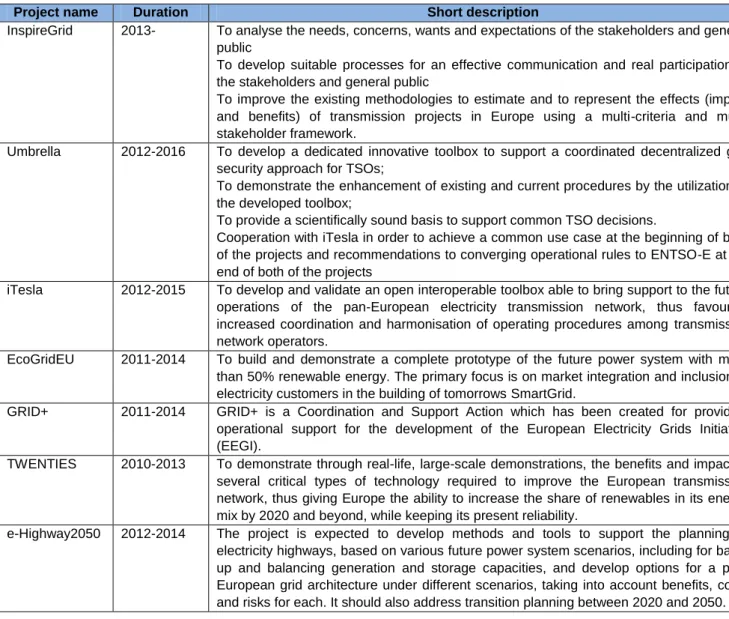
The following table presents TSO-driven R&D Projects on-going or triggered in the period 2013-2014. On-going and starting TSO-driven R&D projects
Project name Duration Short description
GARPUR 2013- To develop a new security criteria instead of N-1 or modify existing N-1 criteria
To develop new tool to determine how RES will influence on the security of supply connected to network expansion
To calculate risk levels connected to long term planning, given demand forecast, generator mix and needed network expansion
To use test cases to learn about risk management in own control-zones and impact on neighbouring control zones
Best Paths 2013- To demonstrate HVDC for connecting offshore RES, multi-terminal HVDC, HVDC – HV AC interface, repowering of AC corridors, and superconductivity
To propose dedicated, intelligent monitoring with temperature measurements for dynamic line rating
Table continued
Project name Duration Short description
InspireGrid 2013- To analyse the needs, concerns, wants and expectations of the stakeholders and general public
To develop suitable processes for an effective communication and real participation of the stakeholders and general public
To improve the existing methodologies to estimate and to represent the effects (impact and benefits) of transmission projects in Europe using a criteria and multi-stakeholder framework.
Umbrella 2012-2016 To develop a dedicated innovative toolbox to support a coordinated decentralized grid security approach for TSOs;
To demonstrate the enhancement of existing and current procedures by the utilization of the developed toolbox;
To provide a scientifically sound basis to support common TSO decisions.
Cooperation with iTesla in order to achieve a common use case at the beginning of both of the projects and recommendations to converging operational rules to ENTSO-E at the end of both of the projects
iTesla 2012-2015 To develop and validate an open interoperable toolbox able to bring support to the future operations of the pan-European electricity transmission network, thus favouring increased coordination and harmonisation of operating procedures among transmission network operators.
EcoGridEU 2011-2014 To build and demonstrate a complete prototype of the future power system with more than 50% renewable energy. The primary focus is on market integration and inclusion of electricity customers in the building of tomorrows SmartGrid.
GRID+ 2011-2014 GRID+ is a Coordination and Support Action which has been created for providing operational support for the development of the European Electricity Grids Initiative (EEGI).
TWENTIES 2010-2013 To demonstrate through real-life, large-scale demonstrations, the benefits and impact of several critical types of technology required to improve the European transmission network, thus giving Europe the ability to increase the share of renewables in its energy mix by 2020 and beyond, while keeping its present reliability.
e-Highway2050 2012-2014 The project is expected to develop methods and tools to support the planning of electricity highways, based on various future power system scenarios, including for back-up and balancing generation and storage capacities, and develop options for a pan-European grid architecture under different scenarios, taking into account benefits, costs and risks for each. It should also address transition planning between 2020 and 2050.
R&DTOPICS SUGGESTED FOR THE 1ST CALL OF HORIZON2020
In the Implementation Plan 2014-2016 ENTSO-E defined a set of priorities that formed two topics suggested for the 1st call of Horizon2020 scheduled for the end of 2013. These topics are:
Topic 1-2014: Demonstration of future smart HV substations. This topic deals with issues related
to upgrading and building of "greenfield" HV substations, with emphasis on minimised time for upgrading along with low investment and maintenance costs while meeting normal requirements on reliability, security of power supply and personal safety. Integration of advanced functions in substations for enhanced operation, monitoring and maintenance based on full digitalisation of existing substations or new modern substations is also in the scope.
Topic 2-2014: Integration of local balancing resources in a cross border balancing market by use
of market tools. The project on this topic will be working on approaches to let, in the long run, all local balancing resources (demand, production, RES) fully participate in the cross border balancing markets. The topics deals with questions such as: How can flexibility triggered by price reactions are exchanged between TSOs? How can the physical limitations of the electrical system are optimised with regard to economic efficiency and system reliability?
INDICATIVE PLAN
J J A S O N D J F MA M J J A S O N D J F MA M J J A S O N D
Implementation Plan 2015-2017
Consultation with stakeholders: DSOs and manufacturers
Main consultation: EEGI stakeholders
R&D Implementation Plan 2016-2018
Consultation with stakeholders: DSOs and manufacturers
Main consultation: EEGI stakeholders
Dissemination activities
InnoGrid2020+, 2013 InnoGrid2020+, 2014
Knowledge sharing (incl. G+)
Implementation Dry-run period
R&D proposed topics
Topic 1-2014 Topic 2-2014
TSO driven R&D projects
GARPUR BEST PATHS InspireGrid
Standardisation
Interoperability test - CIM market standards
Drafting of IEC standard CIM Market 62325 series (451-4, 5 and 6)
Interoperability test - CIM system developlopment and operation standards
Interoperability test - IEC 61850
Call launch Publication
Research and Development
Projects
Drafting Acer Opinion Scoping ENTSO-E activity Consultation2013
2014
2015
ENTSO-E decsions Project startLRG work and involvement can be distinguished in two broad categories:
legal support to all network codes throughout their elaboration and during Comitology; and legal support of the Association activities via its sub-groups and ad hoc teams.
NETWORK CODE RELATED ACTIVITIES
The LRG will be called to provide legal support regarding the network codes in three challenging ways:
firstly, it will continue performing its main activity so far, i.e. supporting the drafting of the network codes under elaboration [i.e. NC EB, NC HVDC, …]; while doing so, the LRG has to ensure the legal coherence of all network codes over time as the NCs develop further and to effectively coordinate legal work on the different NCs, especially in light of the different NCs elaborated in parallel;
secondly, it will assist the Comitology process for a number of network codes (i.e. NC RfG, DCC, NC CACM, NC FCA), which will result in the first network codes becoming legally binding; and
finally, LRG will support the network code implementation work.
To achieve the above in the best possible way, the LRG, supported by the Secretariat, interacts with the drafting teams of the NCs and all bodies of the Association, as well as with ACER and the European Commission.
OTHER NON-NETWORK CODE RELATED LEGAL WORK
LRG via its sub-groups (Sub-Group Market Committee, Sub-Group System Operations Committee, Sub-Group System Development Committee and Sub-Group Permits and Licenses) and ad hoc dedicated teams advise on legal matters upon questions of other bodies of the Association or on its own initiative in their area of expertise (drafting legal reports, evaluating contracts, supporting implementation of contracts etc.). As examples of this activity for the upcoming period referred to in this Work Program, the sub-groups will support:
Market Committee on the implementation of the Inter-TSO Compensation Agreement (ITC); System Development Committee on all legal questions raised during the preparation of the
TYNDP 2014 and the selection of the PCIs as well as on other projects as the e-Highways2050 project;
System Operations Committee regarding the implementation of the ENTSO-E Awareness System contracts; and
Corporate Affairs Section of the Secretariat on the legal evaluation of future EU legislation proposals and ENTSO-E’s positioning in public consultations.
9.
C
ORPORATEA
CTIVITY REPORTSBesides this Work Programme, the Annual Report is another legal requirement and also important information tool for E. It informs stakeholders on the achievements and progress of ENTSO-E in delivering its annual work programme and carrying out its obligations under ENTSO-European regulations. ENTSO-E will publish its Annual Report in May 2014. This report will build on the feedback provided by stakeholders and ACER on the 2013 Annual Report.
EUROPEAN CONSUMERS AND GRID INFRASTRUCTURE
The European Commission is launching an initiative to investigate how best to communicate the importance and necessity of grid infrastructure for energy security and energy policy objectives. ENTSO-E will coordinate the involvement of member TSOs in this work. The majority of this work will commence in the autumn 2013 and will involve wider stakeholder engagement.
RELATIONSHIP WITH ACER/COMMISSION/EUPARLIAMENT
In order to promote greater understanding and awareness of work products and deliverables of ENTSO-E, greater focus on key partners is planned. This work will involve developing less technical information on many deliverables in order to communicate the benefits of this work to less technical audiences and to explain more its relevance to European and regional decision making. There are three fora that ENTSO-E focuses on for most of the formal communications; these are the Cross Border Committee, the Electricity Coordination Group, and the Florence Forum. In addition the Planning Group helps define the agreed work programme for the Three-Year Plan.
LIKELY OTHER ACTIVITIES
ENTSO-E held its first conference in early 2011. Over the rest of 2013 it will review the need for another conference in 2014 to bring stakeholders together and to share and inform them about the work we have done on the future of the power system beyond 2020.
With the network code work's focus shifting from development to implementation, the ENTSO-E Assembly and Board have embarked on a strategic review which could lead to adjustments in the Articles of Association and Rules of Procedure of ENTSO-E.
Also international interactions beyond the European countries in which ENTSO-E members are active frequently lead to useful exchanges of information.
CALENDAR OF EVENTS AND PUBLICATIONS
J J A S O N D J F MA M J J A S O N D J F MA M J J A S O N D
Annual work programme
Winter Outlook Report & Summer Review Statistical Yearbook
System adequacy retrospect
Annual Report
ENTSO-E Memo 2013
ENTSO-E Grid Map
Calendar of Publication Dates Drafting Acer Opinion ENTSO-E decsions Comitology NC Implementation Publish Scoping ENTSO-E activity Consultation