ANNEX
1:
Progress
Performance
Measurement
Framework
Data sources and collection methods
Progress Annual Performance Report monitors and reports on immediate outcomes, as well as outputs
produced by Progress in the period of 2007‐2008. As this is the first performance monitoring report of this
kind, it serves as a piloting of the performance monitoring system, testing its data sources, collection and
analysis strategies and means of reporting.
Information on outputs was collected using the primary sources of information. First, standard reporting templates for collection of information on outputs in different policy areas of Progress were prepared on
the basis of Annual work plans for the years 2007 and 2008. In addition, a separate reporting template for
key EU networks and NGOs was created. Then, sources of information on outputs were identified: these
were either the Commission officials or beneficiaries/contractors. Finally, the identified persons were
contacted with the request to fill in the templates. Thus, detailed information on outputs produced by
Progress in the reference period was collected. Moreover, the missing or ambiguous information was
double‐checked during telephone interviews with the Commission officials and beneficiaries/contractors.
Information on outcomes was collected using both primary and secondary sources of information.
Information collection methods included qualitative desk research and a Progress annual survey. The
survey was conducted between December 2008 and January 2009. Qquestionnaires tailored for each of
the five Progress policy areas were developed and sent to a list of pre‐defined respondents. 1333
questionnaires were sent and 474 responses were received, which makes a 36% average return rate. The
data was analyzed through SPSS system. The survey targeted EU and national level officials and other
relevant key stakeholders (NGOs, social partners, civil society) involved in the programme implementation.
A separate annual survey targeted EU‐wide networks and served as an important source of information on
the capacity of national and pan‐European networks.
Among the key primary sources for the desk research, there was the Strategic Framework and General
Guidelines for the Implementation of Community Action Programme for Employment and Social Solidarity
Progress (2007‐2013), which provided guidelines for monitoring and performance expectations, official
websites of the Commission, other EU institutions, networks and NGOs, Commission staff working
documents, communications from the Commission, proposals for Directives, Impact Assessment Reports,
Eurobarometer surveys, etc.
Since data from primary sources was not always sufficient for assessing all performance measures, some secondary sources were used (i.e., data collected by other outside organizations, reports by independent
experts), namely, peer reviews and assessments in social inclusion, by the Network of independent social
inclusion experts, regulatory impact assessment and Impact Assessment Board findings. While analysing
these document, going into too much detail was avoided, given that Progress will be subject to mid‐term
and final evaluations. Secondary sources have some limitations in that their conclusions are not always
unequivocally accepted and, thus, they have to be treated with caution. Therefore, secondary sources were
never treated as the only or the most important ones in this report.
One of the major challenges of Progress performance monitoring was to create links between outputs and
immediate outcomes. This was done through the desk research, templates and interviews. In particular,
reference lists, lists of contributors and responses to public consultations were scrutinized to identify
specific outputs of Progress that contributed to the policy outcomes in Progress policy areas. Interviews
with the Commission officials were very helpful in this respect.
Table 1 Data sources for performance measures
Performance measure Data Sources Immediate Outcome 1: Effective information sharing and learning 1. Greater awareness of policy‐and decision‐ makers, social partners, NGOs and networks regarding their rights/obligations in relation to Progress policy areas Progress annual survey Official websites (on peer reviews, EU networks) Expert analysis and Recommendations 2. Greater awareness of policy‐and decision‐ makers, social partners, NGOs and networks regarding EU objectives and policies in relation to Progress policy areas Progress annual survey Official websites (on peer reviews, EU networks) Expert analysis and Recommendations 3. Satisfaction of clients with information Progress annual survey Immediate Outcome 2: Evidence‐based EU policies and legislation 1. EU policies are grounded in thorough analysis of situation and responsive to conditions, needs and expectations of Member States in Progress areas Progress annual survey Impact Assessment Reports 2. Extent to which Progress‐supported policy advice feed into the development and implementation of EU legislation and policies Communications from the Commission, Commission staff working documents, proposals for Directives, Impact Assessment reports Immediate Outcome 3: Better integration of cross‐cutting issues and greater consistency in EU policies and legislation 1. Cross‐cutting issues are addressed in Progress policy sections Annual Progress work plan Progress annual survey 2. EU policies and legislation in relation to Progress issues display a common underlying logic of intervention Communications from the Commission, Commission staff working documents, proposals for Directives, Impact Assessment reports 3. Gender mainstreaming is systematically promoted in Progress Communications from the Commission, Commission staff working documents, proposals for Directives, Impact Assessments 4. Share of funding devoted to support or undertake cross‐cutting issues Annual Progress work plans Immediate Outcome 4: Greater capacity of national and pan‐European networks 1. Number of individuals served or reached by networks supported by Progress Standard reporting templates for EU networks and NGOs 2. Extent to which advocacy skills of Progress‐ supported networks have improved Progress annual survey Standard reporting templates for EU networks and NGOs 3. Satisfaction of EU and national authorities with contribution of networks Progress annual survey Interviews 4. Extent to which Progress‐supported networks take a cross‐cutting approach Communications from the Commission, Commission staff working documents, proposals for Directives, Impact Assessments, reports on public consultations launched by the Commission Immediate Outcome 5: High‐quality and participatory policy debate 1. Extent to which principles of good governance are respected in policy debate Progress annual survey Official websites (European Commission, EU networks and NGOs) 2. Extent to which the outcomes of policy debate feed into the development of EU law and policy Communications from the Commission, Commission staff working documents, proposals for Directives, Impact Assessments, reports on public consultations launched by the Commission
ANNEX
2:
Technical
notes
on
charts
This Annex includes a detailed explanation on calculations behind each chart included in the Progress Annual Report 2008, which present the results of the Progress Annual Survey 2008. The detailed information on the survey and its results is available in the Annex 3 of this report. Chart 2: Share of respondents stating they are familiar with EU objectives and policies, by policy section Indicator: Share of respondents stating they are familiar with EU objectives and policies Data Source: Progress Annual Survey 2008, question “7. To what extent are you aware of the following aspects of the EU
policies in the area of employment/social protection and social inclusion/working
conditions/antidiscrimination/gender equality: [multiple choice answers]?”
Definition: Respondents are said to be familiar with EU objectives and policies in their respective policy areas if they chose the answer “(3) I am sufficiently familiar”, “(4) I am very familiar” or“(5) I am an expert”.
Formula: X/Y * 100 where: X= total number of respondents who answered “(3) I am sufficiently familiar”, “(4) I am very
familiar” and “(5) I am an expert”; Y= total number of respondents giving valid answers to the question.
Chart 3: Share of respondents stating they acquired relevant knowledge through the information sharing and learning activities, by policy section
Indicator: Share of respondents stating they acquired relevant knowledge through the information sharing and learning activities
Data Source: Progress Annual Survey 2008, questions “10. Would you say that in the events you participated: [multiple choice answers]?”, “12. With regard to the training/mutual learning activities on employment/social protection and social inclusion/working conditions/antidiscrimination/gender equality you have been involved in, would you say that: [multiple choice answers]?”, “14. With regard to exchange of good practices and innovative approaches, would you say that: [multiple choice answers]?” and “16. In your opinion, to what extent the assessment and monitoring reports you are familiar with contributed to the development of the European policy in the area of employment/social protection and social inclusion/working conditions/antidiscrimination/gender equality?” Definition: Respondents are said to have acquired relevant knowledge through the information sharing and learning
activities if they chose the answer “a) We acquired relevant knowledge, but we do not have plans to use it for policy making or policy advocacy”, “b) We acquired relevant knowledge and we intend to use it for policy making or policy advocacy” or “c) We acquired relevant knowledge and we have already used it for policy making or policy advocacy”.
Formula: X/Y * 100 where: X= total number of respondents who answered “a) We acquired relevant knowledge, but we do not have plans to use it for policy making or policy advocacy”, “b) We acquired relevant knowledge and we intend to use it for policy making or policy advocacy” and “c) We acquired relevant knowledge and we have already used it for policy making or policy advocacy”; Y= total number of respondents giving valid answers to the questions.
Chart 4: Share of respondents stating they acquired relevant knowledge through the information sharing and learning activities, by type of activity
Indicator: Share of respondents stating they acquired relevant knowledge through the information sharing and learning activities, by type of activity
Data Source: Progress Annual Survey 2008, questions “10. Would you say that in the events you participated: [multiple choice answers]?”, “12. With regard to the training/mutual learning activities on employment/social protection and social inclusion/working conditions/antidiscrimination/gender equality you have been involved in, would you say that [multiple choice answers]?” “14. With regard to exchange of good practices and innovative approaches, would you say that [multiple choice answers]?” and “16. In your opinion, to what extent the assessment and monitoring reports you are familiar with contributed to the development of the European policy in the area of employment/social protection and social inclusion/working conditions/antidiscrimination/gender equality?”
Definition: Respondents are said to have acquired relevant knowledge through the information sharing and learning activities if they chose the answer “a) We acquired relevant knowledge, but we do not have plans to use it for policy making or policy advocacy”, “b) We acquired relevant knowledge and we intend to use it for policy making or policy advocacy” or “c) We acquired relevant knowledge and we have already used it for policy making or policy advocacy”.
Formula: X/Y * 100 where: X= total number of respondents who answered “a) We acquired relevant knowledge, but we do not have plans to use it for policy making or policy advocacy”, “b) We acquired relevant knowledge and we intend to use it for policy making or policy advocacy” and “c) We acquired relevant knowledge and we have already used it for policy making or policy advocacy” (disaggregated by type of activity: information sharing and learning events, training/mutual learning activities, exchange of good practices and innovative approaches, assessment and monitoring reports); Y= total number of respondents giving valid answers to the questions (disaggregated by type of activity: information sharing and learning events, training/mutual learning activities, exchange of good practices and innovative approaches, assessment and monitoring reports).
Chart 5: Share of respondents stating they have already used or intend to use the acquired knowledge for policy making or policy advocacy, by policy section
Indicator: Share of respondents stating they have already used or intend to use the acquired knowledge for policy making or policy advocacy
Data Source: Progress Annual Survey 2008, questions “10. Would you say that in the events you participated: [multiple choice answers]?”, “12. With regard to the training/mutual learning activities on employment/social protection
and social inclusion/working conditions/antidiscrimination/gender equality you have been involved in, would you
say that; [multiple choice answers]?”, “14. With regard to exchange of good practices and innovative approaches, would you say that: [multiple choice answers]?” and “16. In your opinion, to what extent the assessment and monitoring reports you are familiar with contributed to the development of the European policy in the area of employment/social protection and social inclusion/working conditions/antidiscrimination/gender equality?” Definition: Respondents are said to have used or intended to use the acquired knowledge for policy making or policy
advocacy if they chose the answers “b) We acquired relevant knowledge and we intend to use it for policy making or policy advocacy” or “c) We acquired relevant knowledge and we have already used it for policy making or policy advocacy”.
Formula: X/Y * 100 where: X= total number of respondents who answered “b) We acquired relevant knowledge and we intend to use it for policy making or policy advocacy” and “c) We acquired relevant knowledge and we have already used it for policy making or policy advocacy”; Y= total number of respondents giving valid answers to the questions.
Chart 7: Share of respondents stating that the EU policy is grounded in thorough analysis of situation
Indicator: Share of respondents stating that the EU policy is grounded in thorough analysis of situation
Data Source: Progress Annual Survey 2008, question “17. How much would you agree with the following statements on
the European policy in the area of employment/social protection and social inclusion/working
conditions/antidiscrimination/gender equality?”, a sub‐question „a) European policy and legislation in the area of employment/social protection and social inclusion/working conditions/antidiscrimination/gender equality is grounded in thorough analysis of situation”.
Definition: Respondents are said to be stating that the EU policy is grounded in thorough analysis of situation if they chose the answers “(4) Rather agree” or “(5) Strongly agree”.
Formula: X/Y * 100 where: X= total number of respondents who answered “(4) Rather agree” and “(5) Strongly agree”; Y= total number of respondents giving valid answers to the sub‐question.
Chart 8: Share of respondents stating that the EU policy is responsive to conditions, needs and expectation in Member States
Indicator: Share of respondents stating that the EU policy is responsive to conditions, needs and expectation in Member States
Data Source: Progress Annual Survey 2008, question “17. How much would you agree with the following statements on
conditions/antidiscrimination/gender equality?”, a sub‐question „b) European policy and legislation in the area of employment/social protection and social inclusion/working conditions/antidiscrimination/gender equality is responsive to conditions, needs and expectations in Member States”.
Definition: Respondents are said to be stating that the EU policy is responsive to conditions, needs and expectation in Member States if they chose the answers “(4) Rather agree” or, “(5) Strongly agree”.
Formula: X/Y * 100 where: X= total number of respondents who answered “(4) Rather agree” and “(5) Strongly agree”; Y= total number of respondents giving valid answers to the sub‐question.
Chart 9: Share of respondents stating that they use policy advice, research and analysis initiated by the European Commission
Indicator: Share of respondents stating that they use policy advice, research and analysis initiated by the European Commission
Data Source: Progress Annual Survey 2008, question “18. Are you aware of policy advice, research and analysis initiated by the European Commission in the policy area of employment/social protection and social inclusion/working conditions/antidiscrimination/gender equality?”.
Definition: Respondents are said to be stating that they use policy advice, research and analysis initiated by the European Commission if they chose the answers “c) Yes, somewhat aware” or “d) Yes, very well aware”.
Formula: X/Y * 100 where: X= total number of respondents who answered “c) Yes, somewhat aware” and “d) Yes, very
well aware”; Y= total number of respondents giving valid answers to the question.
Chart 10: Share of respondents stating that they are aware of policy advice, research and analysis initiated by the European Commission
Indicator: Share of respondents stating that they are aware of policy advice, research and analysis initiated by the European Commission
Data Source: Progress Annual Survey 2008, question “18. Are you aware of policy advice, research and analysis initiated by the European Commission in the policy area of employment/social protection and social inclusion/working conditions/antidiscrimination/gender equality?”
Definition: Respondents are said to be aware of policy advice, research and analysis initiated by the European Commission if they chose the answers “c) Yes, somewhat aware” or “d) Yes, very well aware”.
Formula: X/Y * 100 where: X= total number of respondents who answered “c) Yes, somewhat aware” and “Yes, very well aware”; Y= total number of respondents giving valid answers to the question.
Chart 11: Share of respondents stating that Progress‐funded policy advice, research and analysis of which they were aware, has …
Indicator: Share of respondents stating that Progress‐funded policy advice, research and analysis of which they were aware, has [statements]...
Data Source: Progress Annual Survey 2008, question “21. How would you assess the quality of this policy advice, research and analysis?”, statements “a) Addressed issues that are highly relevant”, “b) Used the concepts which accurately defined and reflected the nature of problems and challenges analysed”, “c) Accurately identified the conditions, needs, concerns and expectations in Member States”, “d) Proposed the best solutions and policy options in response to these conditions, needs, concerns and expectations” and “e) Identified and presented policy practices, which are innovative, transferable or demonstrating results”.
Definition: Respondents are said to agree with the statements if they chose the answers “(4) Rather agree” or “(5) Strongly agree”.
Formula: X/Y * 100 where: X= total number of respondents who answered “(4) Rather agree” or “(5) Strongly agree”; Y= total number of respondents giving valid answers to the question.
Chart 12: Share of respondents stating that Progress‐funded policy advice, research and analysis, which they were aware of, had contributed (in their respective Progress policy area) to:
Indicator: Share of respondents stating that Progress‐funded policy advice, research and analysis, which they were aware of, had contributed (in their respective Progress policy area) to [statements]...
Data Source: Progress Annual Survey 2008, question “22. In your opinion, to what extent the policy advice, research and analysis you are familiar with contributed to the development and implementation of the European policy and law
in the policy area of employment/social protection and social inclusion/working
conditions/antidiscrimination/gender equality as regards the following aspects?”, aspects in the policy areas of
employment and social protection and social inclusion: “ a) Reaching the agreement of stakeholders on common
concepts, objectives”, targets, indicators and policy solutions at EU level”, “b) Triggering/strengthening national policy debate on the basis of policies, practices and achievements in the Member States”, “c) Triggering new national policy initiatives on the basis of policies, practices and achievements in the Member States”, “d) Establishing/improving methodologies and indicators for policy evaluation at national level” and “e) Improving governance of the European policy”; aspects in the policy areas of working conditions, antidiscrimination and
gender equality: “a) Adopting/amending the EU legislation”, “b) Adopting/amending national legal acts
implementing the EU law”, “Reaching the agreement of stakeholders on common concepts, objectives”, targets,
indicators and policy solutions at EU level”, “d) Triggering/strengthening national policy debate on the basis of policies, practices and achievements in the Member States”, “e) Triggering new national policy initiatives on the basis of policies, practices and achievements in the Member States”, “f) Establishing/improving methodologies and indicators for policy evaluation at national level” and “g) Improving governance of the European policy”. Definition: Respondents are said to be stating that Progress‐funded policy advice, research and analysis, which they were
aware of, had contributed to the abovementioned aspects if they chose the answers “(2) They were rather useful” or “(3) They were very useful”.
Formula: X/Y * 100 where: X= total number of respondents who answered “(2) They were rather useful” and “(3) They
were very useful” (disaggregated by aspects); Y= total number of respondents giving valid answers to the question (disaggregated by aspects).
Chart 13: Share of respondents stating that Progress‐funded statistical indicators, tools and methods, which they were aware of, had contributed (in their respective Progress policy area) to:
Indicator: Share of respondents stating that Progress‐funded statistical indicators, tools and methods, which they were aware of, had contributed (in their respective Progress policy area) to [statements]...
Data Source: Progress Annual Survey 2008, questions “24. In your opinion, to what extent the statistical indicators, tools and methods you are familiar with contributed to the development and implementation of the European policy in the area of employment/social protection and social inclusion/working conditions/antidiscrimination/gender equality as regards the following aspects?”: “a) Reaching the agreement of stakeholders on common targets and indicators at EU level”, “b) Triggering/strengthening national policy debate”, “c) Triggering new national policy initiatives” and “d) Establishing/improving methodologies and indicators for policy evaluation at national level”. Definition: Respondents are said to be stating that Progress‐funded statistical indicators, tools and methods, which they
were aware of, had contributed to the abovementioned aspects if they chose the answers “(2) They were rather
useful” or “(3) They were very useful”.
Formula: X/Y * 100 where: X= total number of respondents who answered “(2) They were rather useful” and “(3) They were very useful” (disaggregated by aspect); Y= total number of respondents giving valid answers to the question (disaggregated by aspects).
Chart 15: Share of respondents stating that the principles of good governance had been followed in the policy debate at the European level, by policy section
Indicator: Share of respondents stating that the principles of good governance had been followed in the policy debate at the European level
Data Source: Progress Annual Survey 2008, question “4. Please, assess the extent to which the principles of good governance have been followed in the policy debate you have been involved at the European level”, sub‐ questions: “a) Clarity of the policy issues discussed”, “b) Involvement of all relevant EU and national policy‐ and decision‐makers”, “c) Involvement of all relevant stakeholders (social partners, networks, NGOs, independent experts, etc.)”, “d) Adequacy of time given to prepare and plan participation” and “e) Dissemination of results of policy debate”.
Definition: Respondents are said to be stating that the principles of good governance had been followed in the policy debate at the European level if they chose the answers “(3) Sufficient”, “(4) Good” or“(5) Very good”.
Formula: X/Y * 100 where: X= total number of respondents who answered “(3) Sufficient”, “(4) Good” and “(5) Very good”; Y= total number of respondents giving valid answers to the question.
Chart 16: Share of respondents stating that the principles of good governance were respected in the Progress‐funded events, by policy section
Indicator: Share of respondents stating that the principles of good governance were respected in the Progress‐funded events
Data Source: Progress Annual Survey 2008, question “9. Please, assess the extent to which the principles of good governance were respected in the events you attended?”, sub‐questions: “a) Clarity of the policy issues discussed”, “b) Involvement of all relevant EU and national policy‐ and decision‐makers”, “c) Involvement of all relevant stakeholders (social partners, networks, NGOs, independent experts, etc.)”, “d) Adequacy of time given to prepare and plan participation” and “e) Dissemination of results of policy debate”.
Definition: Respondents are said to be stating that the principles of good governance had been followed in the policy debate at the European level if they chose the answers “(3) Sufficient”, “(4) Good” or “(5) Very good”.
Formula: X/Y * 100 where: X= total number of respondents who answered “(3) Sufficient”, “(4) Good” and “(5) Very good”; Y= total number of respondents giving valid answers to the question.
Chart 17: Share of respondents stating that involvement of all relevant stakeholders in the policy debate at European level was satisfactory and very satisfactory, by policy section
Indicator: Share of respondents stating that involvement of all relevant stakeholders in the policy debate at European level was good and very good
Data Source: Progress Annual Survey 2008, question “4. Please, assess the extent to which the principles of good governance have been followed in the policy debate you have been involved at the European level”, a sub‐ question “c) Involvement of all relevant stakeholders (social partners, networks, NGOs, independent experts, etc.)”.
Definition: Respondents are said to be stating that involvement of all relevant stakeholders in the policy debate at European level was good and very good if they chose the answers “(4) Good” or “(5) Very good”.
Formula: X/Y * 100 where: X= total number of respondents who answered “(4) Good” and “(5) Very good”; Y= total number of respondents giving valid answers to the sub‐question.
Chart 19: Share of respondents stating that EU contribution to the integration of cross‐cutting issues into their respective policy area is high, by policy section
Indicator: Share of respondents stating that EU contribution to the integration of cross‐cutting issues into their respective policy area is high
Data Source: Progress Annual Survey 2008, question “25. To what extent EU has contributed to integration of these cross‐cutting issues into the policy area of employment/social protection and social inclusion/working conditions/antidiscrimination/gender equality”, sub‐questions: “a) Gender equality”, “b) Non‐discrimination” and “c) Combat against poverty”.
Definition: Respondents are said to be stating that EU contribution to the integration of cross‐cutting issues into their respective policy area is high if they chose the answers “(3) The contribution is rather high” or “(4) The contribution of the EU is very high”.
Formula: X/Y * 100 where: X= total number of respondents who answered “(3) The contribution is rather high” and “(4) The contribution of the EU is very high”; Y= total number of respondents giving valid answers to the question.
ANNEX 3:
Detailed information on Progress Annual Survey 2008
Overview
The Progress Annual Survey was a web‐based survey (i.e., data collection was done using Internet), which
was conducted in December 2008 ‐ January 2009. 1333 questionnaires have been sent to representatives
of the five policy areas covered by Progress (Table 1). A total of 474 respondents returned a completed
questionnaire. The overall average response rate amounted to 36%, which by the standards of social
research is a good level of response. The data analysis was done using SPSS.
Table 1: Response rate by policy sections
Policy sections Requests sent Responses Response rate
Employment 169 76 45%
Social protection and social inclusion 351 132 38%
Working conditions 174 53 30%
Anti‐discrimination 409 129 32%
Gender equality 230 84 37%
Total 1333 474 36%
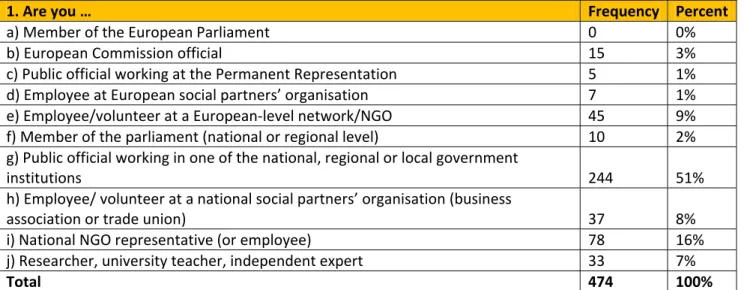
Table 2: Respondents by type of involvement
1. Are you … Frequency Percent
a) Member of the European Parliament 0 0%
b) European Commission official 15 3%
c) Public official working at the Permanent Representation 5 1%
d) Employee at European social partners’ organisation 7 1%
e) Employee/volunteer at a European‐level network/NGO 45 9%
f) Member of the parliament (national or regional level) 10 2%
g) Public official working in one of the national, regional or local government
institutions 244 51%
h) Employee/ volunteer at a national social partners’ organisation (business
association or trade union) 37 8%
i) National NGO representative (or employee) 78 16%
j) Researcher, university teacher, independent expert 33 7%
Total 474 100%
Table 3: Geographical profile of respondents (EU and Member State levels)
Total respondents, of which Public officials Other partners and stakeholders (social partners, NGOs)
I. Member State level representatives
Austria 16 9 7 Belgium 17 17 0 Bulgaria 22 12 10 Cyprus 35 16 19 Czech Republic 9 4 5 Denmark 6 2 4 Estonia 3 2 1 Finland 25 17 8 France 2 1 1
Germany 7 6 1 Greece 15 14 1 Hungary 7 7 0 Ireland 6 4 2 Italy 9 8 1 Latvia 16 10 6 Lithuania 22 11 11 Luxembourg 11 10 1 Malta 19 10 9 Netherlands 7 6 1 Poland 27 11 16 Portugal 6 5 1 Romania 11 9 2 Slovakia 16 9 7 Slovenia 19 11 8 Spain 34 26 8 Sweden 7 5 2 United Kingdom 9 5 4 Unspecified* 19 7 12 Sub‐total: 402 254 148
II. EU‐level representatives
Sub‐total: 72 20 52
Total 474 274 200
* Respondents which were impossible to attribute to a specific Member State.
Survey Data
The tables below present the key survey data by question of the questionnaire used for the Progress
Annual Survey 2008.
Please note that there was a separate questionnaire for each of the five policy sections covered by
Progress:
‐ Employment;
‐ Social protection and social inclusion;
‐ Working conditions (including management of change, labour law, health and safety at work) ‐ Anti‐discrimination and diversity;
‐ Gender Equality.
All these below are referred to as [Progress policy sections].
1. Are you … (N=474) Frequency Percent
a) Member of the European Parliament 0
b) European Commission official 15 3,2
c) Public official working at the Permanent Representation 5 1,1
d) Employee at European social partners’ organisation 7 1,5
e) Employee/ volunteer at a European‐level network/ NGO 45 9,5
g) Public official working in one of the national, regional or local government
institutions 244 51,5
h) Employee/ volunteer at a national social partners’ organisation (business
association or trade union) 37 7,8
i) National NGO representative (or employee) 78 16,5
j) Researcher, university teacher, independent expert 33 7
k) Journalist 0
l) Student 0
2. How much have you been involved in the formulation and implementation of
the national and EU policies aimed at improving [Progress policy section]?
(N=474) Frequency Percent
a) I was a member of a committee, working group at the EU level 103 21,7
b) Was submitting proposals, aimed to provide suggestions for the improvement of
the management of change and/ or the European working conditions and/ or
health and safety at work policy, and/ or labour law 65 13,7
c) Took part in the national policy process on management of change, working
conditions, labour law, health and safety at work (participated in drafting
legislation, public consultation, implementation, etc.) 230 48,5
d) Not involved 102 21,5
e) I am not familiar with the EES; (N=208) 10 2,1
3. Did you take part in such policy debate in 2008? (N=472) Frequency Percent
a) Yes, at the European as well as at the national level 177 37,3
b) Yes, at the European level 49 10,3
c) Yes, at the national, regional, local or sectoral level 146 30,8
d) No 100 21,1
4. Please, assess the extent
to which the principles of
good governance have been
followed in the policy
debate you have been
involved at the European
level (1) Very poor (2) Poor (3) Sufficient (4) Good (5) Very good Do not know
a) Clarity of the policy issues
discussed (N=224) 2 21 67 86 46 2
b) Involvement of all
relevant EU and national
policy‐ and decision‐makers
(N=225) 6 31 65 77 41 5
c) Involvement of all
relevant stakeholders (social
partners, networks, NGOs,
independent experts, etc.)
(N=223) 8 29 76 69 36 5
d) Adequacy of time given to
prepare and plan
participation (N=223) 6 44 90 59 16 8
e) Dissemination of results
f) Other (please, specify):
(N=17) 1 3 2 1 10
5. To what extent the quality of
the national/regional/local
policy debate in the area of
working conditions was
influenced by initiatives
coming from the European
level? (N=374) (1) No susceptible influence (2) Limited influence (3) Some influence (4) Significant influence (5) Crucial influence Do not know
a) Clarity of the policy issues
discussed 14 43 99 157 47 14
b) Involvement of all relevant
stakeholders (social partners,
networks, NGOs, independent
experts, etc.) 10 52 124 121 56 11
6.1. To what extent the development of European law and policies in the
[Progress policy section] was influenced by policy debate you have been involved
in at the EU level? (e.g., this debate contributed to the adoption/ amendment of
legislation or agreement on objectives, policy solutions, targets and indicators)?
(N=374) Frequency Percent a) No susceptible influence 21 4,4 b) Limited influence 57 12 c) Some influence 128 27 d) Significant influence 96 20,3 e) Crucial influence 20 4,2 f) Do not know 43 9,1
6.2. To what extent the development of European law and policies in the
[Progress policy section] was influenced by policy debate you have been involved
in at the national / regional / local level? (e.g. this debate contributed to the
adoption/ amendment of legislation or agreement on objectives, policy
solutions, targets and indicators)? (N=367) Frequency Percent
a) No susceptible influence 33 7 b) Limited influence 95 20 c) Some influence 118 24,9 d) Significant influence 74 15,6 e) Crucial influence 19 4 f) Do not know 28 5,9
7. To what extent are you
aware of the following aspects
of the EU policies in the
[Progress policy section]
(1) I am not at all familiar with this aspect (2) I am vaguely familiar (3) I am sufficiently familiar (4) I am very familiar (5) I am an expert Do not know
a) Key challenges and problems
facing the European labour
market (N=205) 3 27 80 80 14 1
b) Targets and indicators to
measure them (N=204) 16 41 83 48 14 2
c) Solutions, policy options and
d) Governance process, your
role in this process (N=204) 9 39 79 53 20 4
e) Other; (N=9) 1 1 4 2 1
a) Legal protection against
direct and indirect
discrimination (N=129) 1 7 33 54 31 3
b) Guidance for victims of
discrimination (N=129) 5 20 37 49 15 3
c) National Equality Bodies
(N=129) 6 7 25 57 31 3
d) Diversity management
(N=129) 9 20 38 41 15 6
e) Governance process, your
role in this process (N=128) 13 13 32 39 21 10
f) Other; (N=9) 1 4 4
a)Management of change,
anticipating and accompanying
restructuring in order to
develop employment (N=53) 5 19 19 5 3 2
b)Setting minimum
requirements to improve
working and employment
conditions and strengthen
workers' rights (labour law)
(N=53) 2 6 18 18 8 1
c)Improving and simplifying
existing legislation on working
conditions and health and safety
and enhancing its
implementation in practice
(N=53) 2 5 15 17 13 1
d)Fostering definition and
implementation of national
strategies on occupational
health adjusted to the specific
context of each Member State
(N=52) 1 6 18 18 8 1
e)Promoting changes in
behaviour, a general culture
which values health, risk
prevention and goes beyond the
workplace and working
population; (N=53) 2 6 16 22 6 1
f)Better identifying, assessing
and confronting new and
increasing risks to occupational
health; (N=53) 1 9 17 18 7 1
g) Other; (N=8) 1 2 1 1 3
a) Equal economic
independence of women and
men (N=82) 1 8 18 38 16 1
b) Reconciliation of work,
c) Equal participation of women
and men in decision making
(N=82) 1 3 19 37 21 1
d) Eliminating gender
stereotypes in society (N=82) 2 1 19 38 21 1
e) Governance process, your
role in this process (N=81) 5 15 20 29 12 1
f) Other; (N=9) 1 1 3 2 2
8. Did you take part in these events? (N=471) Frequency Percent
a) Yes, I participated in these events 236 49,8
b) No, I did not participate in these events 233 49,2
9. Please, assess the extent to which the
principles of good governance were
respected in the events you attended:
(1) Very poor (2) Poor (3) Sufficient (4) Good (5) Very good Do not know
a) Clarity of the policy issues discussed
(N=238) 2 18 67 100 48 3
b) Involvement of all relevant EU and national
policy‐ and decision‐makers (N=237) 3 26 70 79 56 3
c) Involvement of all relevant stakeholders
(social partners, networks, NGOs, independent
experts, etc.) (N=236) 2 27 67 81 57 2
d) Adequacy of time given to prepare and plan
participation (N=237) 6 31 97 74 25 4
e) Dissemination of results of policy debate
(N=236) 8 47 77 78 21 5
f) Other (please, specify): (N=13) 2 3 1 7
10. Would you say that in the events you participated: (N=240) Frequency Percent a) We acquired relevant knowledge, but we do not have plans to use it in policy
making or policy advocacy 31 6,5
b) We acquired relevant knowledge and we intend to use it for policy making or
policy advocacy 114 24,1
c) We acquired relevant knowledge and we have already used it for policy making
or policy advocacy 80 16,9
d) The information presented during these events was not relevant 9 1,9
e) Do not know 6 1,3
11. Did you take part in these activities of training/ mutual learning? (N=471) Frequency Percent
a) Yes, I participated 128 27
b)No, I did not participate in these activities 343 72,4
12. With regard to the training/ mutual learning activities on
[Progress policy section] you have been involved in, would
you say that: (N=132) Frequency Percent
a) We acquired relevant knowledge, but we do not have plans
to use it in policy making or policy advocacy 15 3,2
b) We acquired relevant knowledge and we intend to use it
for policy making or policy advocacy 63 13,3
c) We acquired relevant knowledge and we have already used
d) The information presented during these seminars was not
relevant 3 0,6
e) Do not know 2 0,4
13. Did you take part in these activities of development of
practical tools to facilitate the exchange of good
practices/innovative approaches? (N=470) Frequency Percent
a) Yes, I participated in most of the exchanges of good
practices/ innovative approaches 129 27,2
b) No, I did not participate in these activities, however I was
aware of them 341 71,9
14. With regard to the development of practical tools to facilitate the exchange
of good practices and innovative approaches, would you say that: (N=132) Frequency Percent a) We acquired relevant knowledge, but we do not have plans to use it in policy
making or policy advocacy 12 2,5
b) We acquired relevant knowledge and we intend to use it for policy making or
policy advocacy 73 15,4
c) We acquired relevant knowledge and we have already used it for policy making
or policy advocacy 39 8,2
d) The information we acquired in these events was not relevant 5 1,1
e) Do not know 3 0,6
15. Are you familiar with these assessment and monitoring reports? (N=469) Frequency Percent
a) Yes, most of the above‐mentioned reports 93 19,8
b) Yes, few of them 151 32,2
c) No, I am not familiar, however I am aware that such reports are being (or have
been) produced 116 24,7
d) No 109 23,2
16. In your opinion, to what extent the assessment and monitoring reports you
are familiar with contributed to the development of the European policy in the
[Progress policy section]? Frequency Percent
a) They provide relevant knowledge, but we do not have plans to use it in policy
making or policy advocacy 33 7
b) They provide relevant knowledge and we intend to use it for policy making or
policy advocacy 133 28,1
c) They provide relevant knowledge and we have already used it for policy making
or policy advocacy 59 12,5
d) They do not provide knowledge which would be of relevance to us 4 0,8
e) Do not know 20 4,2
17. How much would you agree with the
following statements on the European
policy in the [Progress policy section]:
(1) Strongly disagree (2) Rather disagree (3) Neither agree, nor disagree (4) Rather agree (5) Strongly agree Do not know
a) European policy and legislation in the
area of working conditions (including
management of change, labour law,
health and safety at work) is grounded in
b) European policy and legislation in the
area of working conditions (including
management of change, labour law,
health and safety at work) is responsive
to conditions, needs and expectations in
Member States; (N=471) 7 64 104 221 55 20
18. Are you aware of policy advice, research and analysis
initiated by the European Commission in the [Progress policy
section]? (N=471) Frequency Percent
a) No, not at all 10 2,1
b) No, rather not 26 5,5
c) Yes, somewhat aware 258 54,4
d) Yes, very well aware 163 34,4
e) Do not know 14 3
19. Do you use policy advice, research and analysis initiated by
the European Commission in the [Progress policy section]?
(N=471) Frequency Percent
a) No, not at all 16 3,4
b) No, rather not 50 10,6
c) Yes, somewhat 253 53,4
d) Yes, very much so 134 28,3
e) Do not know 18 3,8
20. Are you familiar with the aforementioned PROGRESS‐funded
policy advice, research and analysis? (N=472) Frequency Percent
a) Yes, most of the above‐mentioned reports 80 16,9
b) Yes, few of them 193 40,7
c) No, I am not familiar, however I am aware that such advice
(research, analysis) is being (or has been) produced 119 25,1
d) No 80 16,9
21. How would you assess the
quality of this policy advice,
research and analysis:
(1) Strongly disagree (2) Rather disagree (3) Neither agree, nor disagree (4) Rather agree (5) Strongly agree Do not know
a) Addressed issues which are highly
relevant; (N=273) 2 4 30 149 84 4
b) Used the concepts which
accurately defined and reflected the
nature of problems and challenges
analysed; (N=271) 1 9 41 165 51 4
c) Accurately identified the
conditions, needs, concerns and
expectations in the Member States
as regards the implementation of EU
legislation on working conditions
(including management of change,
labour law, health and safety at
d) Proposed the best solutions and
policy options in response to these
conditions, needs, concerns and
expectations; (N=272) 2 30 76 128 28 8
e) Identified and presented policy
practices, which are innovative,
transferable or demonstrating
results; (N=269) 2 22 63 131 44 7
f) Other (please, specify); (N=22) 2 4 5 2 9
22. In your opinion, to what extent the policy advice,
research and analysis you are familiar with contributed
to the development and implementation of the
European policy and law in the [Progress policy section]
as regards the following aspects:
(1) They were useful only to a limited extent or not useful (2) They were rather useful (3) They were very useful Do not know
a) Adopting/ amending the EU legislation in this policy
area; (N=153) 10 80 52 11
b) Adopting/ amending national legal acts implementing
the EU law in this policy area; (N=153) 22 66 51 14
c) Reaching the agreement of stakeholders on common
concepts, objectives, targets, indicators and policy
solutions at EU level; (N=175) 27 135 71 32
d) Triggering/ strengthening national policy debate on the
basis of policies, practices and achievements in the
Member States; (N=175) 45 124 85 21
e) Triggering new national policy initiatives on the basis of
policies, practices and achievements in the Member
States; (N=175) 51 125 75 24
f) Establishing/ improving methodologies and indicators
for policy evaluation at national level; (N=175) 50 129 62 34
g) Improving governance of the European policy in the
field of working conditions; (N=175) 27 140 73 35
23. Are you familiar with these surveys and tools? Frequency Percent a) Yes, most of the above‐mentioned surveys and tools 121 25,5
b) Yes, few of them 148 31,2
c) Aware but not familiar 138 29,1
d) No 67 14,1
24. In your opinion, to what extent the statistical
indicators, tools and methods you are familiar with
contributed to the development and implementation
of the European policy in the [Progress policy
section] as regards the following aspects:
(1) They were useful only to a limited extent or not useful (2) They were rather useful (3) They were very useful Do not know
a) Reaching the agreement of stakeholders on
common targets and indicators at EU level; (N=269) 29 131 80 29
b) Triggering/ strengthening national policy debate;
(N=269) 40 134 81 14
c) Triggering new national policy initiatives; (N=269) 61 111 77 20
d) Establishing/ improving methodologies and
indicators for policy evaluation at national level;
25. To what extent EU has
contributed to integration of these
cross‐cutting issues into the
[Progress policy section]
(1) No contribution (2) The contribution is limited (3) The contribution is rather high (4) The contribution of the EU is very high Do not know a)Gender equality; N=390 9 84 144 120 33 b)Non‐discrimination; N=345 6 77 141 97 24
c)Combat against poverty; N=474 18 192 127 72 65
26. How would you assess the
activity of EU‐level networks/
NGOs/organizations?
(a)I am
aware of
this
network
(b)It is a source of useful and
appropriate information on the
implementation of EU law
and/or conditions, needs and
expectations of relevant target
groups
(c)It is successful in
increasing awareness
and exerting pressure
on policy makers in
the relevant policy
area
1. IF (International Federation
for Spina Bifida and
Hydrocephalus) 130 33 11
2. FEANTSA (The European
Federation of National
Organisations Working with the
Homeless) 159 72 62
3. Mental Health Europe 148 75 41
4. EMN (European Microfinance
Network) 121 36 21
5. European Anti Poverty
Network 191 107 105
6. European Federation for
Street Children 123 35 12
7. Caritas Europa 208 95 69
8. Equinet Europe (European
Network of Equality Bodies) 151 74 56
9. AGE ‐ the European Older
People’s Platform 167 99 67
10. Autism Europe 131 49 29
11. CECOP (European
Confederation of Worker
Cooperatives and Social and
Participative Enterprises) 134 60 29
12. European Disability Forum 168 101 95
13. European Women’s Lobby 182 107 118
14. Inclusion Europe 137 53 47
15. Workability Europe 120 33 15
16. Eurodiaconia (European
Federation for Diaconia) 134 32 15
17. EASPD (European
Association of Service Providers
for Persons with Disabilities) 131 47 32
18. European Roma Information
Office 149 76 42
19. European Social Network 165 104 55
20. European Network on
21. European Network Against
Racism 169 98 74
22. International Lesbian and
Gay Association Europe 151 88 79
23. Eurocities 163 63 34
24. COFACE‐EU (Confederation
of Family Organizations in the
European Union) 135 46 26
25. European Blind Union 113 47 23
26. European Agency for Safety
and Health at Work (Bilbao) 161 97 84
27. European Foundation for
the Improvement of Living and
Working Conditions (Dublin) 163 134 121
ANNEX
4:
List
of
acronyms
ANED Academic Network of European Disability Experts
ASISP Analytical Support on the Socio‐Economic Impact of Social Protection Reforms DG EMPL Directorate‐General for Employment, Social Affairs and Equal Opportunities
ECJ European Court of Justice
EEA European Economic Area
EES European Employment Strategy
EFTA European Free Trade Area
EMCO Employment Committee
ESF European Social Fund
EU European Union
EU‐SILC European Union Statistics on Income and Living Conditions
EU‐12 New EU Member States (after January 2007)
EU‐15 EU Member States prior to May 2004
EU‐27 EU Member States after January 2007
IA Impact Assessment
INGO International Non‐Governmental Organization
MISSOC Mutual Information System on Social Protection
MS Member States
NGO Non‐Governmental Organization
NRP National Reform Programme
NSR National Strategy Report
OECD Organisation for Economic Co‐operation and Development
OMC Open Method of Co‐ordination
PES Public Employment Services
SLIC Senior Labour Inspectors Committee
SME Small and Medium Enterprises
SPSI Social Protection and Social Inclusion
SSGI Social Services of General Interest