STRATEGIES FOR ACHIEVING SELECTIVITY IN HOMOGENEOUS CATALYSIS
Christina A. Roselli
A dissertation submitted to the faculty at the University of North Carolina at Chapel Hill in partial fulfillment of the requirements for the degree of Doctor of Philosophy in the
Department of Chemistry.
Chapel Hill 2018
Approved by: Michel R. Gagné Alexander J. M. Miller Gerald J. Meyer Wei You
iii
ABSTRACT
Christina A. Roselli: Strategies for Achieving Selectivity in Homogeneous Catalysis (Under the direction of Michel R. Gagné)
A hallmark of gold(I)-catalyzed enyne cycloisomerization reactions is their unique ability to generate complex scaffolds from simple unsaturated starting materials. Initial work focused on the development of a gold-catalyzed cascading cycloisomerization of alkylidene cyclopropane bearing 1,5-enynes that terminated in a cyclo-addition of aldehydes. In one pot, we transformed a simple enyne starting material into a complex terpene-like polycyclic scaffold. This
diastereoselective reaction provides convergent access to novel molecular scaffolds and tolerates a diverse scope of aldehydes. Mechanistic studies revealed the catalyst rests as an off-cycle digold vinyl intermediate. Further investigations focused on expanding the scope and diversity of the products. We found that an enantioselective variant was not feasible and that electrophilic halogenation could not outcompete protodemetallation. Through the development of an alternate reactivity pathway, we incorporated ketone and nitrile nucleophiles into our scaffold to develop more diverse heterocycles.
iv
preferences might correlate with the observed chemoselectivity in complex molecules. The relative free energies of various Lewis base relevant to catalysis were compared to develop a thermodynamic scale of stabilities. As expected from experimental studies, both the choice of phosphine and silane impact the thermodynamics of this transfer.
The final chapter focuses on the development of a living, chain-growth polymerization of a donor-acceptor (D-A)monomer. While donor-acceptor conjugated polymers have many
v
ACKNOWLEDGEMENTS
During the past five years, I have relied on several people for help, guidance and support, and there is no way I would be where I am today without them.
I must first thank my advisor, Professor Mike Gagné, for all of his help throughout my time at UNC. I truly appreciate the freedom and trust he had in me to allow me to work on several different projects throughout my graduate student career. His encouragement, patience and mentorship helped motivate me throughout the past five years and helped strengthen me as both a chemist and professional.
There are several Gagné lab members I would like to thank for helping me with
synthesis, practice talks, and problem solving. Thanks to Dr. Laura Adduci, Dr. Mike Geier, Dr. Pippa Payne and Dr. Mee-Kyung Chung for helping me out in my early days in the lab. Thanks to Dr. Pippa Payne, Dr. Stephanie Kramer, Mike Peruzzi and Anton Gudz for making room 225 such a fun place to work. I’d also like to thank all past and present members of the group that I overlapped with, as you all have helped me in some way– whether it was brainstorming new ideas, sharing reagents and chemicals, or offering advice. To current members new Nick, old Nick, Youngran, Mike, Andreas, Anton, Jared, Hannah and Bingyu; thanks for being such fun and interesting people to work with.
vi
and to never give up, no matter how challenging the situation. Thanks to Mary Kate Schaible, my best friend since kindergarten, for always being by my side. I would also like to thank my grandparents, aunts and uncles for always supporting me in what I do.
I also wouldn’t be here without the friends I have made in graduate school. Thanks to Mike Peruzzi for being my best friend since we both joined the Gagné lab. Thanks for always listening to my ideas, helping troubleshoot a failed reaction, and for being a friend outside of the lab. Having you by my side as we went through the ups and downs of grad school together helped make this journey so much better. Thanks to Javier Grajeda for being a great friend and an awesome co-worker to build the catalysis center with. I am excited to see what Tennessee will have in store for us. To Seth, Pippa, John, Kendrick and Jeremy: I am grateful for your
friendship over the years. I must also thank my cat Elliot for his love and support every day after work.
vii
TABLE OF CONTENTS
LIST OF FIGURES ………...xii
LIST OF TABLES ... xvii
LIST OF SCHEMES... xix
LIST OF EQUATIONS ... xxii
LIST OF SYMBOLS AND ABBREVIATIONS ... xxii
Chapter 1: Gold(I)-Catalyzed Addition of Aldehydes to Cyclopropylidene Bearing 6-Aryl-1,5-Enynes ... 1
1.1 Introduction ...1
Transition metal catalyzed enyne cycloisomerizations ... 1
Alkylidene cyclopropane incorporation into substrates ... 1
Au-catalyzed couplings of enynes with carbonyl compounds ... 5
1.2 Initial reactivity of enyne with aldehydes ...7
1.3 Substrate scope ...10
1.4 Stereochemical analysis ...14
1.5 Mechanistic studies ...15
1.6 Conclusions ...19
1.7 Acknowledgements ...20
1.8 Experimental section ...20
viii
Preparation of starting materials ... 21
Synthesis of enyne 1.1c ... 25
Gold-catalyzed addition of aldehydes to 1,5-enynes ... 26
Isolation of di-gold vinyl 1.7 ... 40
Isolation of cycloisomer 1.5 ... 42
Experimental procedure for acid/base experiments ... 42
Experimental procedure for competition experiments ... 43
NMR spectra of new compounds ... 44
Gradient 1D NOESY stereochemical assignment ... 71
Single Crystal X-ray diffraction analysis ... 73
REFERENCES ...75
Chapter 2: Expanding the Scope of the Intermolecular Addition of Aldehydes to Enynes ... 79
2.1 Introduction: addition of aldehydes to cyclopropylidene-bearing 1,5-enynes...79
2.2 Enantioselective catalysis ...80
Background ... 80
Results and discussion ... 82
2.3 Intercepting protodemetallation with halonium sources ...85
Background ... 85
ix
2.4 Moving beyond aldehydes: trapping with other unsaturated
nucleophiles ...91
Introduction ... 91
Gold-catalyzed addition of unsaturated nucleophiles to 1,5-enynes ... 92
In-situ generation of tertiary carbocation for nucleophile incorporation ... 93
2.5 Conclusion ...99
2.6 Experimental section ...99
General Methods ... 99
Preparation of starting materials and products ... 100
NMR spectra of new compounds ... 106
REFERENCES ...114
Chapter 3: Computed thermodynamic stabilities of silylium Lewis base adducts ... 117
3.1 Introduction ...117
Silylium ions in catalysis ... 117
Combination of BCF and silane for chemoselective reductions ... 119
Research objective ... 120
3.2 Results and discussion ...120
Variation of silane ... 120
Variation of phosphine ... 122
Variation of heteroatom Lewis base silylium acceptors ... 124
x
3.3 Conclusions ...132
3.4 Acknowledgements ...133
3.5 Experimental Section ...133
Computational Methods ... 133
Basis set comparison ... 134
Table of summarized energies ... 135
3.6 Associated content ...143
REFERENCES ...144
Chapter 4: Towards a controlled Kumada catalyst-transfer polycondensation of a fluorine-incorporated donor-acceptor conjugated monomer ... 147
4.1 Introduction ...147
π-Conjugated polymers ... 147
Catalyst transfer polycondensation ... 150
Donor-acceptor conjugated polymers ... 152
4.2 Results and discussion ...156
Monomer synthesis and Grignard metathesis ... 156
Initial reactivity ... 158
Ligand screen ... 162
The switch to palladium ... 163
4.3 Catalyst loading study and block co-polymer synthesis ...166
4.4 Summary ...169
xi
4.6 Experimental Section ...170
General methods ... 170
Preparation of starting materials ... 171
Polymerization reactions ... 175
NMR spectra of new compounds ... 177
Representative GPC traces ... 184
REFERENCES ...186
xii
LIST OF FIGURES
Figure 1.1. Resonance forms of auro-allyl cation A. ... 4
Figure 1.2. Diversity-oriented synthesis. ... 7
Figure 1.3. Mayr’s π-nucleophilicity parameters. ... 14
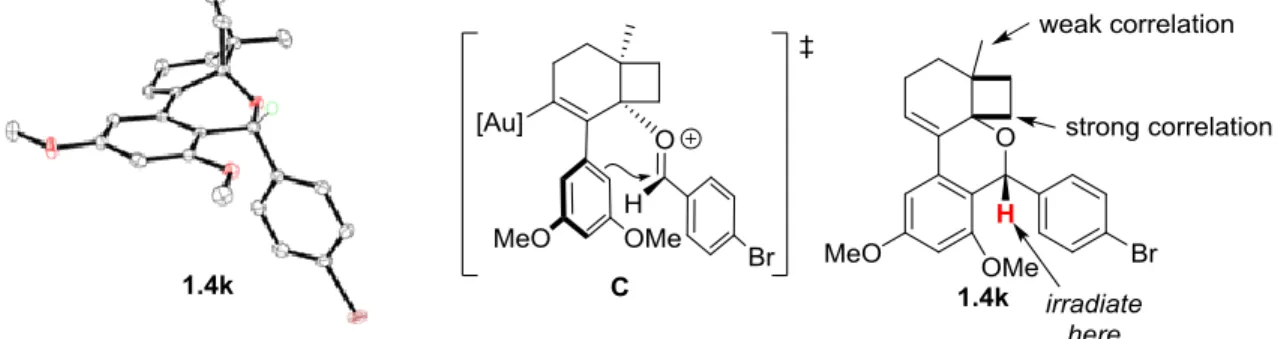
Figure 1.4. ORTEP representation of the solid state molecular structure of 1.4k; ellipsoids drawn at 50% probability, only one enantiomer of the asymmetric unit, and majority of the hydrogen atoms omitted for clarity. ... 14
Figure 1.5. 1-D NOE spectra of 1.4j. ... 15
Figure 1.6. Selected examples of di-gold intermediates. ... 18
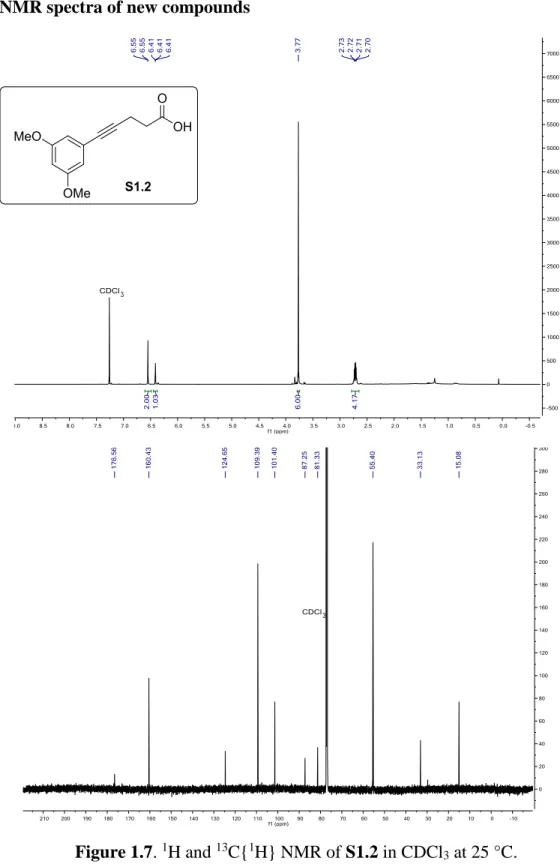
Figure 1.7. 1H and 13C{1H} NMR of S1.2 in CDCl3 at 25 °C. ... 44
Figure 1.8. 1H and 13C{1H} NMR of S1.3 in CDCl3 at 25 °C. ... 45
Figure 1.9. 1H and 13C{1H} NMR of S1.4 in CDCl3 at 25 °C. ... 46
Figure 1.10. 1H and 13C{1H} NMR of 1.1b in CDCl 3 at 25 °C. ... 47
Figure 1.11. 1H and 13C{1H} NMR of S1.7 in CDCl3 at 25 °C. ... 48
Figure 1.12. 1H and 13C{1H} NMR of 1.1c in CDCl3 at 25 °C. ... 49
Figure 1.13. 1H and 13C{1H} NMR of 1.4a in CDCl3 at 25 °C. ... 50
Figure 1.14. 1H and 13C{1H} NMR of 1.4b in CDCl3 at 25 °C. ... 51
xiii
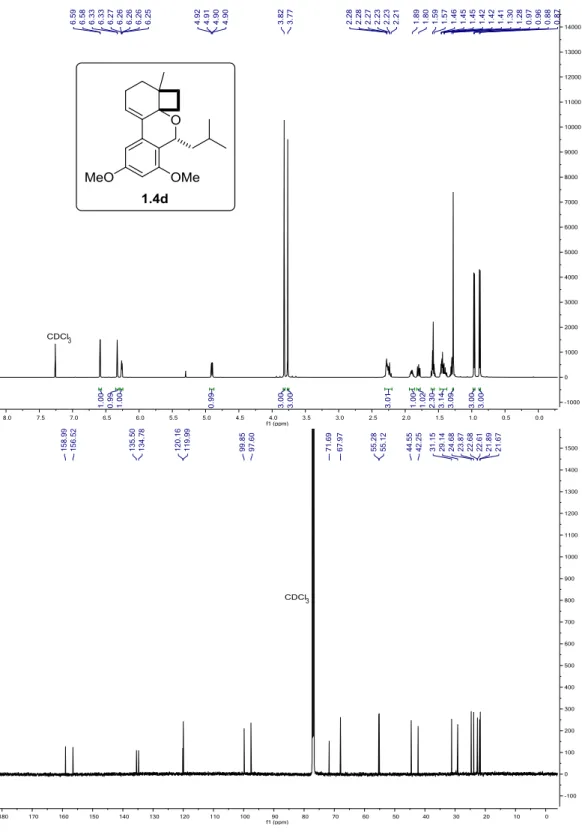
Figure 1.16. 1H and 13C{1H} NMR of 1.4d in CDCl3 at 25 °C. ... 53
Figure 1.17. 1H and 13C{1H} NMR of 1.4e in CDCl 3 at 25 °C. ... 54
Figure 1.18. 1H and 13C{1H} NMR of 1.4f in CDCl3 at 25 °C. ... 55
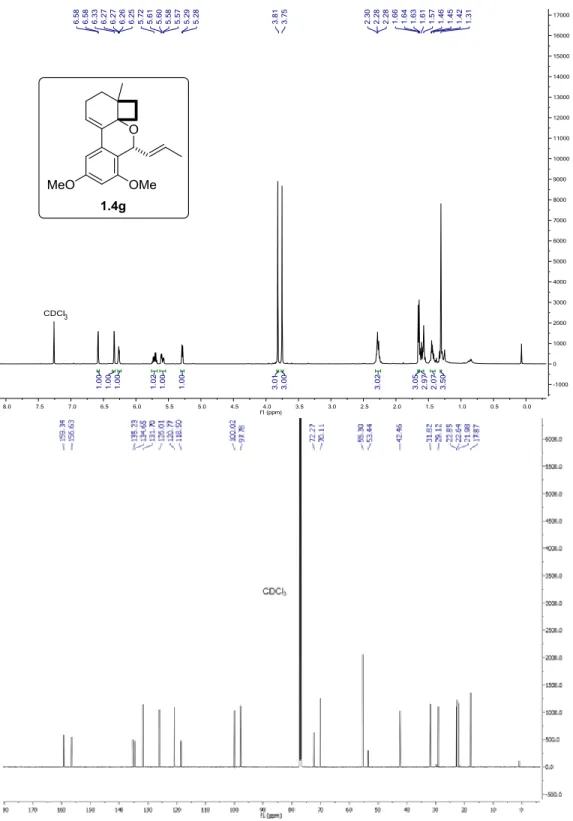
Figure 1.19. 1H and 13C{1H} NMR of 1.4g in CDCl3 at 25 °C. ... 56
Figure 1.20. 1H and 13C{1H} NMR of 1.4h in CDCl3 at 25 °C. ... 57
Figure 1.21. 1H and 13C{1H} NMR of 1.4i in CDCl3 at 25 °C. ... 58
Figure 1.22. 1H, 13C{1H}, and 19F{1H} NMR of 1.4j in CDCl 3 at 25 °C. ... 60
Figure 1.23. 1H and 13C{1H} NMR of 1.4k in CDCl3 at 25 °C. ... 61
Figure 1.24. 1H and 13C{1H} NMR of 1.4l in CDCl3 at 25 °C. ... 62
Figure 1.25. 1H and 13C{1H} NMR of 1.4m in CDCl3 at 25 °C. ... 63
Figure 1.26. 1H, 13C{1H}, and 19F{1H} NMR of 1.4n in CDCl3 at 25 °C. ... 64
Figure 1.27. 1H and 13C{1H} NMR of 1.4o in CDCl 3 at 25 °C. ... 65
Figure 1.28. 1H and 13C{1H} NMR of 1.4p in CDCl3 at 25 °C. ... 66
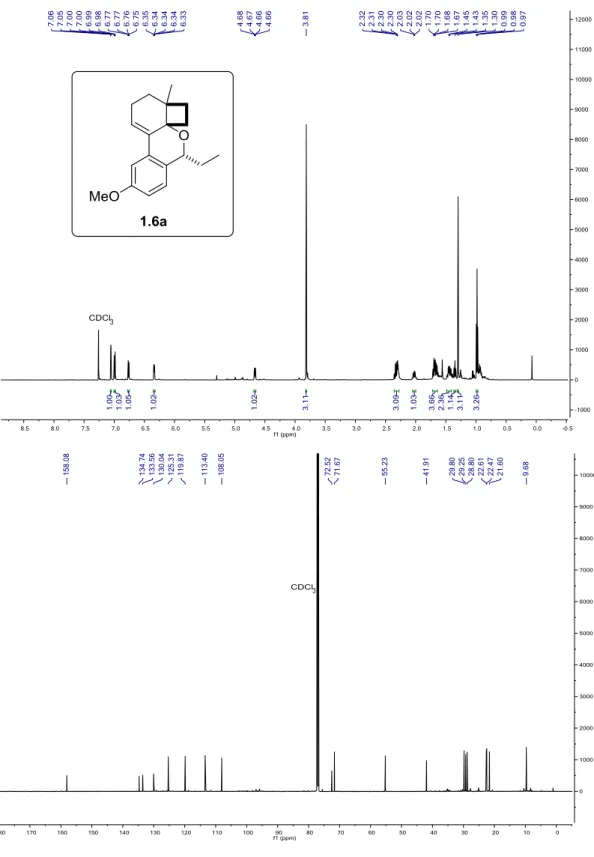
Figure 1.29. 1H and 13C{1H} NMR of 1.6a in CDCl3 at 25 °C. ... 67
Figure 1.30. 1H and 13C{1H} NMR of 1.6b in CDCl3 at 25 °C. ... 68
Figure 1.31. 1H, 13C{1H}, and 31P{1H} NMR of 1.7 in CDCl3 at 25 °C ... 70
xiv
Figure 2.1. Linear coordination mode of gold(I). ... 80
Figure 2.2. Gold activation of alkynes. ... 85
Figure 2.3. Common electrophilic halogen sources. ... 86
Figure 2.4. The proposed use of other nucleophiles as cation traps. ... 92
Figure 2.5. 1H and 13C{1H} NMR of 2.11 in CDCl3 at 25 °C………..………..106
Figure 2.6. 1H and 13C{1H} NMR of 2.12 in CDCl3 at 25 °C. ... 107
Figure 2.7. 1H and 13C{1H} NMR of 2.13b in CDCl 3 at 25 °C. ... 108
Figure 2.8. 1H and 13C{1H} NMR of the major diastereomer of 2.13c in CDCl3 at 25 °C. ... 109
Figure 2.9 Crude 1H of 2.13c in CDCl3 at 25 °C. ... 110
Figure 2.10. 1H and 13C{1H} NMR of 2.13d in CDCl 3 at 25 °C. ... 111
Figure 2.111H and 13C{1H} NMR of 2.13e in CDCl3 at 25 °C. ... 112
Figure 2.12. 1H and 13C{1H} NMR of 2.13f in CDCl3 at 25 °C. ... 113
Figure 3.1. Isolated silylium ions. ... 118
Figure 3.2. Phosphine-modified catalytic cycle for the BCF-catalyzed reduction of ethers... 118
xv
heterolysis of Me3Si–PPh3+to PPh3 and Lewis base free Me3Si+ is
endergonic by 24.0 kcal/mol. ... 127
Figure 3.4. Silylium Lewis base adducts of bio-mass derived sugar substrates. ... 129
Figure 3.5. Free energy diagram for the demethylation of α- and β-OMe-glucose. Each horizontal line represents the energy of the most stable energy minimized conformer. ... 130
Figure 3.6. Reactivity hierarchy observed experimentally with natamycin (using B(3,5-(CF3)2C6H3)3 and Me2EtSiH). ... 131
Figure 4.1. Comparison of band gap in conjugated systems. ... 148
Figure 4.2. Common structural features of conjugated polymers. ... 149
Figure 4.3. Step-growth vs. chain-growth and living chain- growth polymerization... 150
Figure 4.4. Proposed mechanism for Kumada CTP... 152
Figure 4.5. Frontier molecular orbital interactions of D-A units. ... 153
Figure 4.6. Our D-A conjugated monomer precursor. ... 156
Figure 4.7. Synthesis of monomer precursor 3. ... 157
Figure 4.8. Ni(diimine) complexes. ... 159
Figure 4.9. Polymerization of 3 with (NHC)Ni complexes. ... 163
Figure 4.10. Room temperature GPC trace. ... 166
xvi
Figure 4.12. Catalyst loading screen. ... 167
Figure 4.13. GPC trace of block copolymer ... 168
Figure 4.14. 1H, 13C{1H}, and 19F{1H} NMR of 4 in CDCl3. ... 178
Figure 4.15. 1H, 13C{1H}, and 19F{1H} NMR of 5 in CDCl3. ... 179
Figure 4.16. 1H, 13C{1H}, and 19F{1H} NMR of 7 in CDCl3. ... 181
Figure 4.17. 1H, 13C{1H}, and 19F{1H} NMR of 3 in CDCl3. ... 182
xvii
LIST OF TABLES
Table 1.1. Gold(I)-catalyzed cyclo-coupling of 1.1b and aliphatic aldehydes.a,b ... 11
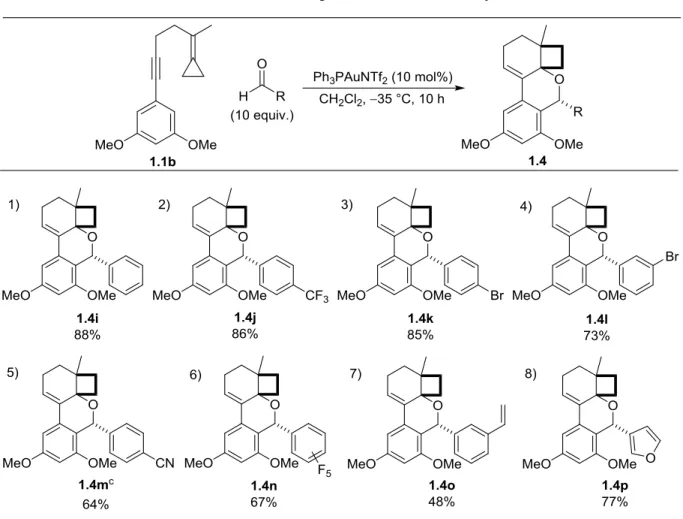
Table 1.2. Substrate scope with aromatic aldehydes.a,b ... 12
Table 1.3. Reaction optimization to favor the aldehyde trapped product 1.4. ... 17
Table 1.4. Single crystal X-ray diffraction analysis of 1.4k. ... 73
Table 2.1. Chiral gold complex screen.a ... 83
Table 2.2. Silver screen. ... 85
Table 2.3. Stoichiometric reactivity with halogen sources. ... 89
Table 2.4. Lewis acid screen with 2.11. ... 96
Table 2.5. Reactivity of 2.12 with ketones and nitriles. ... 98
Table 3.1. Effect of substituents on free energy of transfer to 2-Me-THF. ... 122
Table 3.2. Steric and electrons perturbations of phosphine Lewis base acceptor. ... 123
Table 3.3. Effect of substitution on methyl ether silylium acceptors. ... 125
Table 3.4. Calculations for the splitting of trimethylsilane with BCF and PPh3.a ... 134
Table 3.5. Relevant energies of all optimized coordinates. ... 135
xviii
Table 4.2. Solvent screen for the polymerization of 3-MgCl with
(N-Mes-diimine)NiBr2.a ... 162
Table 4.3. Concentration screen for the polymerization of 3 with
xix
LIST OF SCHEMES
Scheme 1.1. Recent gold-catalyzed transformations in the Gagné group. ... 2
Scheme 1.2. Proposed mechanism for the formation of 1.2. ... 3
Scheme 1.3. Methanol trapping experiment. ... 4
Scheme 1.4. Proposed reactivity with aldehydes. ... 5
Scheme 1.5. Reactivity of 1,5- and 1,6-enynes with aldehydes. ... 6
Scheme 1.6. Initial aldehyde trapping experiments. ... 8
Scheme 1.7. Reaction pathway for cycloisomerization vs. aldehyde addition. ... 8
Scheme 1.8. Gold-catalyzed intramolecular hydroarylation of allenes. ... 9
Scheme 1.9. Synthetic route to 1.1b. ... 9
Scheme 1.10. Reactivity of auro-allyl cation with aldehydes. ... 10
Scheme 1.11. Cyclo-coupling with enynes 1.1c and 1.1d... 13
Scheme 1.12. Acid/base dependent competition from intermediate B. ... 17
Scheme 1.13. Synthesis of di-gold vinyl 1.7. ... 18
Scheme 1.14. Proposed catalytic cycle. [Au]+= Ph3PAu+; counterion [NTf2-] omitted for clarity. ... 19
xx
Scheme 2.2. Common approaches to enantioselective gold catalysis. ... 81
Scheme 2.3. Enantioselective cycloisomerization of 1,5-enynes. ... 82
Scheme 2.4. Synthesis and activation of chiral gold complexes. ... 82
Scheme 2.5. Gold-mediated halogenation of pyranones. ... 86
Scheme 2.6. Gold-catalyzed halocyclization... 87
Scheme 2.7. Proposed reactivity pathway. ... 88
Scheme 2.8. Synthesis of model gold vinyl compound 2.6... 89
Scheme 2.9. Catalytic reactivity with enyne 2.3. ... 90
Scheme 2.10. Addition of nitriles and imines to gold intermediates... 92
Scheme 2.11. Reactivity of 2.1 with nucleophiles ... 93
Scheme 2.12. Proposed reactivity of key carbocation B. ... 94
Scheme 2.13. Ritter reaction. ... 94
Scheme 2.14. Synthesis of water-trapped product. ... 95
Scheme 2.15. Nitrile trapping with 2.12... 97
Scheme 3.1. BCF catalyzed reductions ... 119
Scheme 3.2. Chemoselective reduction of natamycin. ... 120
xxi
Scheme 3.4. Potential reactivity pathway for N-methylacetamide. ... 126
Scheme 3.5. Bond lengths for the cis and trans 2,5-Me2-THF silylium ions. ... 128
Scheme 3.6. Potential reactivity pathway for isobutyric acid. ... 128
Scheme 4.1. Discovery of living chain-growth mechanism for synthesis of P3HT. ... 151
Scheme 4.2. D-A conjugated polymers. ... 154
Scheme 4.3. Selective Grignard formation. ... 158
Scheme 4.4. Polymerization of 3. ... 160
Scheme 4.5. Living chain growth polymerization using NHC-Pd pre-catalysts. ... 164
xxii
LIST OF EQUATIONS
xxiii
LIST OF SYMBOLS AND ABBREVIATIONS
ACP alkylidene cyclopropane
Å angstrom
Ac acetyl
aq aqueous
Ar aryl
ArF fluoro-aryl
α alpha (opposite side of pyranose ring) β beta (same side of pyranose ring)
B base
BCF tris(pentafluorophenyl)borane calcd calculated
CTP catalyst transfer polycondensation
D-A donor-acceptor
DABCO 1,4-diazabicyclo[2.2.2]octane dba dibenzylideneacetone
DCC N,N’-dicyclohexylcarbodiimide DCM dichloromethane
1D 1-dimensional
°C degrees Celcius
xxiv DMAP 4-(dimethylamino)pyridine
DMS dimethylsulfide
DOS diversity-oriented synthesis
dppp 1,3-bis(diphenylphosphino)propane dppe 1,2-bis(diphenylphosphino)ethane DTBP 2,6-ditertbutylpyridine
Ɖ Dispersity
δ delta– chemical shift (NMR) EDG electron donating group
Eg band gap
equiv. equivalents
ESI electrospray ionization
ΔG free energy
g gram
GC-MS gas chromatography – mass spectrometry GPC gel permeation chromatography
h hour
HOMO highest occupied molecular orbital HRMS high resolution mass spectrometry Hz hertz (NMR coupling constant) i-Pr iso-propyl
K Kelvin
xxv
L liter
LB Lewis base
LC-TOF liquid chromatography time-of-flight LDA lithium diisopropylamide
LTQ-FT linear ion-trap quadrupole Fourier transform LUMO lowest unoccupied molecular orbital
m- meta
M molar
Me methyl
mg milligram
MHz megahertz
min minute
mL milliliter
mmol millimol
Mn number average molecular weight
mol mole
mol% mole percent (catalyst loading) MTBE methyl tertbutyl ether
NaHMDS sodium bis(trimethylsilyl)amide NHC N-heterocyclic carbene
NIS N-iodosuccinimide
xxvi
NR no reaction
NTf2 bis(trifluoromethylsulfonyl)imide
Nu nucleophile
o- ortho
OTf trifluoromethylsulfonyl
p- para
P3HT poly-3-hexylthiophene
PEPPSI pyridine-enhanced precatalyst preparation stabilization and initiation
Ph phenyl
ppm parts per million
PTFTAZ poly-thiophene-fluorobenzotriazole π pi – electrons involved in multiple bonds π* anti-bonding π orbital
R any unspecified carbon-containing group RI refractive index
RT room temperature
σ sigma – electrons involved in sigma bonds σp Hammet sigma constant (para)
SM starting material t-Bu tert-butyl
xxvii TLC thin layer chromatography
μm micrometer
UV ultraviolet
X halogen
1
Chapter 1: Gold(I)-Catalyzed Addition of Aldehydes to Cyclopropylidene Bearing 6-Aryl-1,5-Enynes
Reproduced in part with permission from Roselli, C. A.; Gagné, M. R. Org. Biomol. Chem.
2016, 14, 11261. Copyright © 2016 Royal Society of Chemistry.1
1.1 Introduction
Transition metal catalyzed enyne cycloisomerizations
Transition metal catalyzed enyne cycloisomerizations proceeding via novel reaction
pathways have enabled the construction of complex molecular scaffolds to be realized.2–8 The
effectiveness of electrophilic gold(I) complexes for activating unsaturated carbon-carbon bonds9
is key to initiating and guiding the reactivity of these fragments. Coupling enyne
cycloisomerization processes to the addition of heteronucleophiles, including alcohols10–12 and
aldehydes,13–17 in enyne cycloisomerization reactions has created new transformations that
multiply the molecular complexity of the products.
Alkylidene cyclopropane incorporation into substrates
Alkylidene cyclopropanes (ACPs) are versatile and reactive building blocks in organic
synthesis, and several groups have been instrumental in developing their unique reactivity
profiles.18–23 A key property is the inherent ring strain in the ACP moiety (ca. 40 kcal/mol),22
relief of which can provide a thermodynamic driving force for otherwise unfavorable reactions.
Recent work in the Gagné group has explicitly sought ring strain release protocols through the
strategic incorporation of ACPs into substrates.24–26 Our first use of this strategy was in the
development of the first enantioselective Cope rearrangement of achiral 1,5-dienes (Scheme
2
formation of the more substituted olefins in the products, limiting the synthesis of certain diene
motifs through this reaction.27 The reversibility of the rearrangement also presents a challenge in
the development of enantioselective processes.28 Our group overcame both of these challenges
by installing a terminal ACP in the diene in combination with the use of a chiral bis-gold
catalyst. Under these conditions, the diene products could be obtained in high yields with high
enantioselectivities. Density functional theory (DFT) calculations suggest that the reaction is
thermodynamically driven by the release of ring strain from the ACP and that the gold catalyst is
significant in lowering the kinetic barrier of the transformation by roughly 20 kcal/mol.
Scheme 1.1. Recent gold-catalyzed transformations in the Gagné group.
The group next looked to expand this Cope rearrangement to cyclic dienes that contained
ACPs with the goal of developing a cyclooctene ring (Scheme 1.1B).25 Surprisingly, upon
3
instead, a fused tricyclic product was obtained. While the substrate scope was very limited, the
reaction provided products that contained a bicyclo[4.2.0]oct-1-ene core, a structural motif
common in a number of natural products.29,30
Next, the group looked to expand upon the synthesis of compounds that contained this
[4.2.0]-skeleton by designing a 1,5-enyne that contained an ACP (Scheme 1.1C).31 When enyne
1.1a was treated with the Gagosz catalyst (Ph3PAuNTf2),32 it underwent cycloisomerization to
form the expected bicyclo[4.2.0]octadiene product 1.2. The reaction was very versatile,
tolerating a variety of different substituents on both the alkyne and the alkylidene cyclopropane.
Expanding upon the method, the use of a chiral bis-gold catalyst enabled the development of an
asymmetric reaction with chiral products obtained with good to moderate enantioselectivities.
Scheme 1.2. Proposed mechanism for the formation of 1.2.
The proposed mechanism for this transformation is shown in Scheme 1.2. Gold
coordination to the alkyne triggers a 6-endo-dig cyclization to afford a transient cyclopropyl
auro-4
allyl cation. The reaction turns over with a net 1,2-hydrogen shift to generate the bicyclic product
1.2 and regenerate the gold catalyst. To probe this mechanism, methanol was added to the
catalytic reaction as an external nucleophile as a means to trap the auro-allyl cation. Consistent
with this proposal, the [4.2.0] bicyclo methoxy compound 1.3 was obtained as a single
diastereomer (Scheme 1.3). A control experiment was run in which 1.2 was treated with
methanol and gold catalyst. Compound 1.3 was not obtained, suggesting the feasibility of the
generation and subsequent trapping of auro-allyl cation A.
Scheme 1.3. Methanol trapping experiment.
This cycloisomerization project was the main inspiration for the development of our
gold-catalyzed addition of aldehydes to 1,5-enyne 1.1a. The key auro-allyl carbocation A, shown
in Figure 1.1, can also be described as a cationic vinyl carbene, which rationalizes the
electrophilic centers in the structure.
Figure 1.1. Resonance forms of auro-allyl cation A.
We hypothesized that the auro-allyl cation A might be sufficiently electrophilic to also be
trapped by an aldehyde to generate an oxocarbenium ion poised to annulate a THP ring (Scheme
5
that A might also be trapped by aldehydes, to yield oxo-carbenium ions that are poised to
annulate to novel terpene-like ring structures.
Scheme 1.4. Proposed reactivity with aldehydes.
Au-catalyzed couplings of enynes with carbonyl compounds
The most typical coupling reactivity of 1,n-enynes (n = 6,7) with carbonyl compounds are formal [2 + 2 + 2] cycloadditions to yield O-heterocycles.15,16 Helmchen13,14 and later Echavarren15 in particular have studied the gold(I) catalyzed reaction of aldehydes with 1,6-enynes (Scheme 1.5). The reaction pathway is governed by the substituents on the olefin and the alkyne, as well as the identity of the nucleophile.17 In the system developed by Helmchen,
1,6-enynes with monosubstituted olefins first undergo a rearrangement to form a cationic gold carbene, which is then intercepted by an aldehyde (or ketone) to form the oxocarbenium intermediate (Scheme 1.5, A).13 This is followed by a Prins cyclization and demetallation to yield the novel tricyclic products. Helmchen later carried out an extensive mechanistic DFT study on this system, which supported the proposed addition of aldehydes to an electrophilic carbene intermediate.14
6
attacked by the aldehyde to form the oxocarbenium. This then undergoes a Prins-type cyclization, followed by demetallation to yield the bicyclic product.
Scheme 1.5. Reactivity of 1,5- and 1,6-enynes with aldehydes.
In Scheme 1.5C, we propose a similar reactivity pathway for our 1,5-enyne. The reaction begins as previously described31 with a gold catalyzed 6-endo-dig cyclization followed by
7
Diversity-oriented synthesis (DOS) targets the development of novel molecular scaffolds in an effort to identify new drug candidates.36 The goal is to expand the chemical space through
the synthesis of a diverse range of structures, rather than to target or modify a known scaffold or natural product. DOS pathways typically transform a common intermediate into a diverse library of structures. Our reaction features a sequential cycloisomerization-cycloaddition to generate a complex, fused molecular scaffold in one step (Figure 1.2). Starting from a common linear enyne we generate a novel, rigid skeleton which can be easily diversified through variation of the unsaturated trapping nucleophile. Additionally, these products can be further manipulated at the olefin or through cross-coupling reactions on the arene to build chemical compound collections.
Figure 1.2. Diversity-oriented synthesis.
1.2 Initial reactivity of enyne with aldehydes
To test our hypothesis, we began looking at the reactivity of the phenyl-substituted enyne
1.1.a that was previously developed in the group. Our initial hypothesis suggested an electron-rich aldehyde would best facilitate the trapping, as extra electron density would render the oxygen of the carbonyl more nucleophilic. We began using Ph3PAuNTf2 as a catalyst due to its
success in the cycloisomerization chemistry and because it does not require pre-activation with silver salts. Preliminary studies focused on the use of p-anisaldehyde (5 equiv.) as the
8
trapped product. Propionaldehyde was also screened under these conditions and similarly only returned 1.2.
Scheme 1.6. Initial aldehyde trapping experiments.
The rapid cycloisomerization at both ambient and reduced temperatures led us to propose that the phenyl ring of the enyne was insufficiently electron-rich to nucleophilically add to the oxocarbenium intermediate (Scheme 1.7). We proposed that the oxocarbenium could be forming, however the subsequent Friedel-Crafts annulation is unable to outcompete with the 1,2-hydrogen shift and protodemetallation.
Scheme 1.7. Reaction pathway for cycloisomerization vs. aldehyde addition.
9
intramolecular Fridel-Crafts reaction (Scheme 1.8).38 In this study, viable arenes for the Friedel-Crafts reaction included naphthalene, ethers and a pyrrole, but were limited when it came to those with electron-deficient groups and even a t-butyl group.
Scheme 1.8. Gold-catalyzed intramolecular hydroarylation of allenes.
Following this strategy, activated enyne 1.1b was synthesized following a modified literature procedure (Scheme 1.9).31 The synthesis begins with a Sonogashira cross-coupling to afford the substituted alkyne in 62% yield. The corresponding alcohol was oxidized to the carboxylic acid with Jones reagent. Formation of the Weinreb amide, followed by methyl Grignard addition yielded the ketone. The final step in the synthesis was the modified Julia-Kocienski olefination to afford 1.1b in an 11% overall yield.
10
We began screening 1.1b with electron-rich aromatic aldehydes. With p-anisaldehyde at room temperature, only the cycloisomer 1.5 was obtained (Scheme 1.10). Lowering the
temperature to 0 °C or –30 °C did not change the outcome of the reaction. Switching to more electron-rich aldehydes such as p-(dimethylamino)benzaldehyde or
3,4,5-trimethoxy-benzaldehyde still only returned the cycloisomerized product. Acetonitrile and nitromethane were screened as alternative solvents, however this did not change the reaction outcome.
Scheme 1.10. Reactivity of auro-allyl cation with aldehydes.
To our delight, upon switching to propionaldehyde (5 equiv, RT), we obtained a single diastereomer of 1.4 as the major product, along with a lesser quantity of 1.5 (3:1 ratio). We initially began screening protic additives to increase selectivity for 1.4 (see section 1.5). Ultimately, we found that by increasing the equivalents of aldehyde to 10 and lowering the temperature to 0 °C, we were able to obtain complete selectivity (>99%) to our desired product
1.4.
1.3 Substrate scope
11
cycloisomerization became increasingly competitive as the resulting oxocarbenium intermediate is more sterically hindered at carbon, thus slowing down the subsequent Friedel-Crafts
annulation. Lowering the temperature to –35 °C returned our desired selectivity for aldehyde trapping. In each case the products were isolated by column chromatography in good to excellent yields and as a single diastereomer. NMR analysis along with an X-ray structure of an aromatic aldehyde derivative (vide infra) led to our proposal of the indicated diastereomer.
Table 1.1. Gold(I)-catalyzed cyclo-coupling of 1.1b and aliphatic aldehydes.a,b
In contrast, aromatic aldehydes were found to not add to B as efficiently (1:1 mixture of
12
1.2). Meta and para substituted arenes bearing electron-withdrawing groups showed excellent reactivity, as did vinyl arenes and furaldehyde. However, as demonstrated in our earlier optimization reactions, electron rich aldehydes, including p-anisaldehyde,
3,4,5-trimethoxybenzaldehyde, and p-(dimethylamino)benzaldehyde, only returned cycloisomerized product.
Table 1.2. Substrate scope with aromatic aldehydes.a,b
13
aldehydes, providing only the cycloisomerized product. The requirement of at least a single activating group on the nucleophilic arene suggests that this Friedel-Crafts addition may be product determining (c.f. 1.1a). This reactivity can be rationalized looking at both the Hammett parameters and nucleophilicity of the arene. Enyne substrates with electron donating groups such as p-OMe have a σp value of -0.27, which is significantly lower than that of p-Me (σp= -0.17) and
benzene (σp= 0).39 Alternatively, Mayr’s nucleophilicity reactivity scales can be used to
rationalize this reactivity. These scales measure the relative nucleophilicity of a variety of π-nucleophiles with a common electrophile. The nucleophilicity parameters for dimethoxybenzene and methoxybenzene, 2.48 and -1.18, respectively, are both higher than those of toluene (-4.36) and benzene (-6.3), confirming these arenes are more nucleophilic (Figure 1.3).40
14
Figure 1.3. Mayr’s π-nucleophilicity parameters.
1.4 Stereochemical analysis
To confirm the relative stereochemistry of the products an X-ray structure of crystalline
1.4k was obtained. This product was chosen for the X-ray analysis as the incorporation of the bromoarene allowed for a crystalline product. Most of the products that incorporated aliphatic aldehydes resulted in oils rather than solid material. As shown in Figure 1.2, the proton from the aldehyde is cis to the cyclobutane ring. This relative stereochemistry suggested the indicated orientation of the oxocarbenium ion on attacking the arene (C, Figure 1.4).
Figure 1.4. ORTEP representation of the solid state molecular structure of 1.4k; ellipsoids drawn at 50% probability, only one enantiomer of the asymmetric unit, and majority of the hydrogen
atoms omitted for clarity.
15
experiments. For this analysis, we first looked at the 1D-NOE of compound 1.4k as a starting point. In the NMR experiment, the α-ether proton was irradiated and correlations through space to the various nearby protons were measured (Figure 1.4). A relatively strong correlation to the cyclobutane protons was observed, with only a small correlation to the methyl protons. The analogous NMR experiment with 1.4a was conducted to confirm the stereochemistry of an aliphatic aldehyde trapped product. This was also repeated with 1.4j to confirm that other
aromatic aldehydes provided the same relative stereochemistry (Figure 1.5). In all cases, stronger correlations to the cyclobutane protons than to the methyl group was observed. Had the other diastereomer been formed in which this α-ether proton was trans to the cyclobutene ring, we would not expect to observe such a strong NOE correlation (if any) to the cyclobutane protons.
Figure 1.5. 1-D NOE spectra of 1.4j.
1.5 Mechanistic studies
Our methodological studies sparked a number of mechanistic questions about additions to the putative auro-allyl cation, B. A competition experiment between benzaldehyde and p-CF3
-benzaldehyde (5 equiv. each) with enyne 1.1b and Ph3PAuNTf2 (10 mol%) revealed that the
16
(which is not viable in Table 1.2) and p-CF3-benzaldehyde, however only provides the p-CF3
-benzaldehyde trapped product 1.4j. These data, combined with the need for an electron-rich arene on the enyne, show that electron rich aldehydes can better trap the auro-allyl cation but the resulting oxo-carbenium ion is proportionately less electrophilic. This renders very electron rich aromatic aldehydes (p-OMe, p-NMe2, etc), effectively incapable of competing with the 1,2-shift.
If the addition of aldehyde to B is reversible, then the product determining step is the Friedel-Crafts annulation.
An analysis of the competing manifolds for the formation of 1.4 versus 1.5 in Scheme 1.12 suggested that the partitioning of B might be sensitive to protic additives. We reasoned that the net 1,2-H shift might be the result of an allylic proton loss followed by protodemetallation. To test this notion, the relatively strong acid [Ph2NH2][BF4] (pKaH2O ~1)41 was added to gauge
17
Scheme 1.12. Acid/base dependent competition from intermediate B.
Table 1.3. Reaction optimization to favor the aldehyde trapped product 1.4.
Entry Additive + Equiv. Pdt ratio (1.4 : 1.5)
1 None 3:1
2 [Ph2NH2][BF4], 1 equiv. 4:1
3 [Ph2NH2][BF4], 5 equiv. 10:1
4 Ph2NMe, 1 equiv. 1:2
5 Ph2NMe, 5 equiv. 1:10
Information on the catalyst’s resting state was obtained by in situ monitoring using 31P
18
have been reported in both catalytic and stoichiometric reactions and are ubiquitous in gold catalysis.42
Figure 1.6. Selected examples of di-gold intermediates.
Evidence supporting the assignment of this species to a geminally diaurated vinyl
intermediate45 was obtained from stoichiometric reactions of 1.1b with Ph3PAuNTf2 (2 equiv),
4-Br-benzaldehyde (10 equiv.), and a polymer-bound 2,6-di-tert-butylpyridine, which yielded a product with the same two distinct peaks as observed in the in situ 31P NMR experiments (Scheme 1.13). A combination of HRMS and NMR spectroscopy suggested di-gold vinyl complex 1.7. Isolated 1.7 was always contaminated by traces of protodemetallated product 1.4k
and (Ph3P)2Au+, a common decomposition product in gold catalysis.53 Several gold complexes
and bases (to arrest protodemetallation) were screened, however the purity of the isolated 1.7
could not be improved above ~90% due to the sensitivity of the product in the removal of the excess aldehyde.
19
The proposed mechanism for this transformation is shown in Scheme 1.14. Au activation of alkyne 1.1b triggers a 6-endo-dig cyclization to 1.8, which ring expands to form the more stable auro-allyl cation 1.9 (equivalent to B). Distal attack of the aldehyde generates
oxocarbenium intermediate 1.10, which cyclizes, facilitated by the electron-rich methoxy groups. Re-aromatization affords gold-vinyl intermediate 1.11, which may be directly protodemetallated to form 1.4 or trapped by [Au]+ to yield the digold resting state 1.12. Previous investigations of our group in collaboration with the Widenhoefer group46 have shown that digold intermediates
are usually off-cycle and that trapping of monogold vinyls by [Au]+ is fast and can be competitive with protodemetallation.49
Scheme 1.14. Proposed catalytic cycle. [Au]+= Ph3PAu+; counterion [NTf2-] omitted for clarity.
1.6 Conclusions
20
to aldehydes is significant, and once again digold structures dominate the speciation of reactions generating a vinyl gold intermediate.
1.7 Acknowledgements
The National Institutes of Health (GM-60578) is gratefully acknowledged. We thank Drs. Peter White and Philippa Payne for assistance acquiring and analyzing crystallographic data. Dr. Mee-Kyung Chung and the UNC Dept. of Chemistry Mass Spec Core Laboratory are thanked for HRMS analyses.
1.8 Experimental section
General methods
Unless otherwise stated, all commercially available reagents were used as received. Anhydrous tetrahydrofuran (THF, Stabilized, 99.9%, Acros Organics, purchased from Fisher Scientific) and anhydrous 1,4-dioxane (99.8%, purchased from Sigma Aldrich) were used as received. Anhydrous dichloromethane and diethyl ether were passed through a column of alumina.54 The polymer-bound 2,6-di-tert-butylpyridine (200-400 mesh, ~1.8 mmol/g loading, 1 % cross-linked with divinylbenzene) was purchased from Sigma Aldrich. Column
chromatography was performed using SilaFlash P60 40-63 µm (230-400 mesh). Thin layer chromatography (TLC) was performed on SiliCycle Silica Gel 60 F254 plates and was visualized with UV light and either KMnO4 stain or 2,4–dinitrophenylhydrazine stain. NMR spectra were
21
t, triplet; q, quartet; dd, doublet of doublets; dt, doublet of triplets; ddd, doublet of doublet of doublets; m, multiplet. High resolution mass spectra for organic compounds were obtained on an Agilent Accurate LC-TOF Mass Spectrometer (Agilent Series 6220) operating in positive ion mode with an electrospray ionization source (fragmentor = 175 V) by Dr. Mee-Kyung Chung. The data were analyzed using an Agilent MassHunter Workstation Software, Qualitative Analysis (V.B.02.00). High resolution mass spectra for Au-containing intermediates were obtained with a hybrid LTQ FT (ICR 7T) (ThermoFisher, Bremen, Germany) mass spectrometer where samples were introduced via a micro-electrospray source and analyzed using Xcalibur (ThermoFisher, Breman, Germany) by the UNC Chapel Hill Chemistry Department Mass Spec Facility.
Preparation of starting materials
Synthesis of enyne 1.1b.
Preparation of 5-(3,5-dimethoxyphenyl)pent-4-ynoic acid, S1.2
The alcohol S1.1 was synthesized following a literature procedure.55
22
M NaOH. The aqueous layer was washed with Et2O and acidified by adding conc. HCl until
reaching pH ~1. This was then extracted with Et2O. The organic layer was washed with brine,
dried over MgSO4, filtered and concentrated to afford S1.2 as a rusty orange solid, which was
used without further purification (1.788 g, 72%). 1H NMR (600 MHz, CDCl
3) δ 6.55 (d, J = 2.3
Hz, 2H), 6.41 (t, J = 2.3 Hz, 1H), 3.77 (s, 6H), 2.75 – 2.68 (m, 4H). 13C NMR (151 MHz, CDCl3) δ = 176.6, 160.4, 124.7, 109.4, 101.4, 87.2, 81.3, 55.4, 33.1, 15.1. HRMS (ESI): calcd
for C13H15O4 [M+H]+ 235.0965, found 235.0971.
Preparation of 5-(3,5-dimethoxyphenyl)-N-methoxy-N-methylpent-4-ynamide, S1.3
The following procedure was adapted from a literature procedure.31
To a solution of acid S1.2 (0.871 g, 3.72 mmol) in CH2Cl2 (60 mL) at room temperature
was added N,O-dimethylhydroxylamine hydrochloride (0.435 g, 4.46 mmol),
N,N’-dicyclohexylcarbodiimide (0.920 g, 4.46 mmol), 4-(dimethylamino)pyridine (0.045 g, 0.372 mmol), and triethylamine (0.62 mL, 4.46 mmol). The reaction mixture was stirred at room temperature for 16 hours. H2O (25 mL) was added to quench the reaction. The reaction mixture
was extracted with CH2Cl2, and the organics were washed with brine, dried over MgSO4,filtered
and concentrated under reduced pressure. The product was purified by silica gel column chromatography (Hexanes/EtOAc = 3:1) to afford the Weinreb amide as a viscous yellow oil (0.571 g, 55% yield). 1H NMR (600 MHz, CDCl
23
Hz, 1H), 3.77 (s, 6H), 3.72 (s, 3H), 3.21 (s, 3H), 2.77 – 2.72 (m, 4H). 13C NMR (151 MHz, CDCl3) δ = 172.6, 160.4, 125.0, 109.4, 101.2, 88.7, 80.9, 61.4, 55.4, 32.2, 31.3, 14.9.HRMS
(ESI): calcd for C15H20NO4 [M+H]+ 278.1387, found 278.1397
Preparation of 6-(3,5-dimethoxyphenyl)hex-5-yn-2-one, S1.4
The following procedure was adapted from a literature procedure.31
To a solution of Weinreb amide S1.3 (0.498 g, 1.80 mmol) in anhydrous THF (20 mL) at 0°C was slowly added a solution of MeMgBr (3 M in Et2O, 0.78 mL, 2.34 mmol). The reaction
mixture was stirred for 3 hours at 0°C. A saturated solution of NH4Cl (25 mL) was added to
quench the reaction, and the mixture was extracted with EtOAc. The organics were washed with brine, dried over MgSO4, filtered and concentrated to afford the ketone as a pale yellow waxy
solid (0.387 g, 92% yield). The product was taken to the next step without further purification. 1H NMR (400 MHz, CDCl
3) δ = 6.53 (d, J = 2.2, 2H), 6.40 (t, J = 2.2, 1H), 3.76 (s, 6H), 2.77 (t,
J = 7.1, 2H), 2.65 (t, J = 7.1, 2H), 2.20 (s, 3H). 13C NMR (151 MHz, CDCl
3) δ = 206.7, 160.6,
125.0, 109.5, 101.4, 88.3, 81.1, 55.5, 42.6, 30.1, 14.1. HRMS (ESI): calcd for C14H17O3 [M+H]+
24
Preparation of 1-(5-cyclopropylidenehex-1-yn-1-yl)-3,5-dimethoxybenzene, 1.1b
The Julia-Kocienski S1.5 reagent was synthesized following a literature procedure.56 The
following procedure was adapted from a literature procedure.31
The ketone S1.3 (0.387 g, 1.67 mmol) and Julia-Kocienski reagent S1.5 (0.399 g, 1.73 mmol) were dissolved in anhydrous THF (20 mL) and cooled to –78 °C. Sodium
bis(trimethylsilyl)amide (1 M in THF, 2 mL, 2 mmol) was added, and the reaction was allowed to warm to room temperature and stirred overnight. A saturated aqueous solution of NH4Cl (10
mL) was added to quench, and the reaction mixture was extracted with Et2O. The organics were
washed with brine, dried over MgSO4 and concentrated to afford a yellow oil. The crude product
was purified by silica gel column chromatography (Hexanes:EtOAc 10:1) to give the title compound 1.1b as a pale yellow oil (0.333 g, 78% yield). 1H NMR (600 MHz, CDCl
3) δ 6.53 (d,
J = 2.1 Hz, 2H), 6.39 (t, J = 2.0 Hz, 1H), 3.77 (s, 6H), 2.60 (t, J = 7.6 Hz, 2H), 2.47 (t, J = 7.4
25
Synthesis of enyne 1.1c
Preparation of 6-(3-methoxyphenyl)hex-5-yn-2-one, S1.7
The alkyne S1.6 was synthesized following a literature procedure.57 The following procedure was adapted from a literature procedure.58
Pd2(dba)3 (0.250 g, 0.242 mmol) and tris(2,4-di-tert-butylphenyl) phosphite (0.313 g,
0.483 mmol) were added to a flame-dried Schlenk flask under N2. Anhydrous dioxane (40 mL)
was added and the resulting solution was sparged for 30 minutes. Methyl vinyl ketone (0.39 mL, 4.83 mmol) was added, and the reaction mixture was heated at 90 °C in a flask equipped with a reflux condenser under N2. A solution of alkyne S1.6 (1.278 g, 9.66 mmol) in dioxane (10 mL)
was added dropwise to the reaction mixture over the course of 10 h, then continued to reflux for 14 h. The reaction was allowed to cool to room temperature, diluted with Et2O, and filtered
through a plug of Florisil®, eluting with Et
2O. The filtrate was concentrated and purified via
silica gel column chromatography (Hexanes:EtOAc 30:1/ 20:1/ 10:1) to afford the title compound S1.7 as a dark yellow oil (0.228 g, 23% yield). 1H NMR (600 MHz, CDCl
3): δ = 7.18
(t, J = 7.9 Hz, 1H), 6.97 (dt, J = 7.6, 1.2 Hz, 1H), 6.91 (dd, J = 2.7, 1.4 Hz, 1H), 6.83 (ddd, J = 8.2, 2.7, 0.9 Hz, 1H).3.79 (s, 3H), 2.77 (t, J = 7.3 Hz, 2H), 2.66 (t, J = 7.3 Hz, 2H), 2.21 (s, 3H). 13C NMR (151 MHz, CDCl
3) δ = 206.7, 159.2, 129.3, 124.5, 124.1, 116.4, 114.4, 88.4, 80.9,
26
Preparation of 1-(5-cyclopropylidenehex-1-yn-1-yl)-3-methoxybenzene, 1.1c
The ketone S1.7 (0.228 g, 1.13 mmol) and Julia-Kocienski reagent S1.5 (0.286 g, 1.24 mmol) were dissolved in anhydrous THF (15 mL) and cooled to –78 °C. Sodium
bis(trimethylsilyl)amide (1 M in THF, 1.4 mL, 1.4 mmol) was added, and the reaction was allowed to warm to room temperature and stirred overnight. A saturated aqueous solution of NH4Cl (~10 mL) was added to quench, and the reaction mixture was extracted with Et2O. The
organics were washed with brine, dried over MgSO4 and concentrated to afford the product as a
pale yellow oil. The crude product was purified by silica gel column chromatography
(Hexanes:EtOAc 30:1) to give the title compound 1.1c as a pale yellow oil (0.091 g, 37% yield). 1H NMR (600 MHz, CDCl
3): δ = 7.18 (t, J = 7.9 Hz, 1H), 6.96 (dt, J = 7.6, 1.2 Hz, 1H), 6.90
(dd, J = 2.6, 1.4 Hz, 1H), 6.82 (ddd, J = 8.4, 2.7, 0.9 Hz, 1H), 3.79 (s, 3H), 2.61 (t, J = 7.6 Hz, 2H), 2.47 (t, J = 7.5 Hz, 2H), 1.86 (s, 3H), 1.12 – 1.09 (t, J = 7.5 Hz, 2H), 0.99 – 0.97 (t, J = 7.4 Hz, 2H). 13C NMR (151 MHz, CDCl
3) δ = 159.2, 129.2, 125.1, 124.0, 122.7, 116.5, 116.3,
114.1, 90.4, 80.4, 55.2, 35.9, 20.7, 18.1, 3.1, 1.4. HRMS (ESI): calcd for C16H19O [M+H]+
227.1430, found 227.1432.
Gold-catalyzed addition of aldehydes to 1,5-enynes
27
General procedure for Au-catalyzed addition of aldehydes to 1,5-enynes
Method A, procedure for aliphatic aldehydes, reaction run at 0 °C
The 1,5-enyne 1.1b (0.1 mmol) was dissolved in anhydrous CH2Cl2 (1 mL) in an
oven-dried 1 dram vial. The aldehyde (1.0 mmol, 10 equiv.) was added to the vial, and the contents were stirred and cooled to 0°C in an ice bath. Ph3PAuNTf2 (0.01 mmol, 0.1 equiv.) was added to
the vial, and the reaction mixture was stirred for 2 hours. Upon evaporation of the solvent under reduced pressure, the residue was purified by silica gel column chromatography to afford the polycyclic product in pure form.
Method B, procedure for aromatic aldehydes, reaction run at –35 °C
The 1,5-enyne 1.1b (0.1 mmol) was dissolved in anhydrous CH2Cl2 (1 mL) in an
oven-dried 1 dram vial. The aldehyde (1.0 mmol, 10 equiv.) was added to the vial, and the contents were stirred and cooled to –78°C in a dry ice/acetone bath. Ph3PAuNTf2 (0.01 mmol, 0.1 equiv.)
28
temperature. Upon evaporation of the solvent under reduced pressure, the residue was purified by silica gel column chromatography to afford the polycyclic product in pure form.
Synthesis of 7-ethyl-8,10-dimethoxy-3a-methyl-2,3,3a,4,5,7-hexahydrobenzo[c]cyclobuta[i]
chromene, 1.4a
Propionaldehyde was distilled prior to use. The product 1.4a was prepared following Method A and purified using hexanes: ethyl acetate (10:1), (pale yellow oil, 91% yield). 1H
NMR (600 MHz, CDCl3): δ = 6.58 (d, J = 2.3 Hz, 1H), 6.33 (d, J = 2.3 Hz, 1H), 6.25 (dd, J =
5.0, 3.5 Hz, 1H), 4.82 (dd, J = 7.4, 3.3 Hz, 1H), 3.82 (s, 3H), 3.77 (s, 3H), 2.31 – 2.24 (m, 2H), 2.24 – 2.19 (m, 1H), 2.00 – 1.91 (m, 1H), 1.68 – 1.55 (m, 3H), 1.49 – 1.44 (m, 1H), 1.43 – 1.37 (m, 1H), 1.34 – 1.30 (m, 1H), 1.29 (s, 3H), 0.83 (t, J = 7.4 Hz, 3H). 13C NMR (150 MHz, CDCl3): δ = 159.0, 156.6, 135.6, 135.2, 120.1, 119.3, 99.8, 97.5, 71.7, 70.5, 55.3, 55.2, 42.3,
31.5, 29.2, 28.4, 22.6, 22.6, 22.0, 9.6. HRMS (ESI): calcd for C20H27O3 [M+H]+ 315.1955, found
29
Synthesis of 8,10-dimethoxy-3a-methyl-7-nonyl-2,3,3a,4,5,7-hexahydrobenzo[c]cyclobuta[i]
chromene, 1.4b
The product 1.4b was prepared following Method A and purified using hexanes: ethyl acetate (10:1), (pale yellow oil, 85% yield). 1H NMR (600 MHz, CDCl
3): δ = 6.57 (d, J = 2.3
Hz, 1H), 6.33 (d, J = 2.3 Hz, 1H), 6.24 (dd, J = 5.3, 3.2 Hz, 1H), 4.85 (dd, J = 8.0, 3.1 Hz, 1H), 3.82 (s, 3H), 3.76 (s, 3H), 2.30 – 2.25 (m, 2H), 2.24 – 2.19 (m, 1H), 1.96 – 1.89 (m, 1H), 1.62 – 1.55 (m, 3H), 1.48 – 1.43 (m, 1H), 1.43 – 1.38 (m, 1H), 1.31 – 1.28 (m, 1H), 1.28 (s, 3H), 1.27 – 1.21 (m, 14H), 0.87 (t, J = 7.0 Hz, 3H). 13C NMR (151 MHz, CDCl
3) δ = 159.0, 156.5, 135.6,
135.0, 120.1, 119.8, 99.8, 97.5, 71.7, 69.5, 55.3, 55.2, 42.4, 35.4, 32.0, 31.5, 29.7, 29.6, 29.5, 29.4, 29.2, 25.3, 22.7, 22.7, 22.6, 21.9, 14.2. HRMS (ESI): calcd for C27H41O3 [M+H]+
413.3050, found 413.3049.
Synthesis of
30
The product 1.4c was synthesized following Method A and purified using hexanes: ethyl acetate (10:1), (yellow oil, 82% yield). 1H NMR (600 MHz, CDCl
3): δ = δ 7.27 (d, J = 7.5 Hz,
2H), 7.22 (d, J = 7.5 Hz, 2H), 7.17 (t, J = 7.1 Hz, 1H), 6.62 (d, J = 2.3 Hz, 1H), 6.34 (d, J = 2.3 Hz, 1H), 6.33 – 6.29 (m, 1H), 4.89 (d, J = 7.7 Hz, 1H), 3.85 (s, 1H), 3.76 (s, 1H), 2.71 (t, J = 8.0 Hz, 2H), 2.40 – 2.22 (m, 4H), 1.99 – 1.91 (m, 1H), 1.65 – 1.57 (m, 2H), 1.54 – 1.44 (m, 2H), 1.39 – 1.34 (m, 4H). 13C NMR (151 MHz, CDCl
3) δ = 159.1, 156.6, 143.2, 135.4, 135.0, 128.6,
128.1, 125.3, 120.1, 119.0, 105.4, 99.8, 97.5, 71.8, 68.8, 55.3, 55.1, 42.2, 36.7, 31.5, 31.1, 29.2, 22.7, 22.6, 22.0. HRMS (ESI): calcd for C25H28NaO3 [M+Na]+ 399.1931, found 399.1918.
Synthesis of
7-isobutyl-8,10-dimethoxy-3a-methyl-2,3,3a,4,5,7-hexahydrobenzo[c]-cyclobuta[i] chromene, 1.4d
The product 1.4d was synthesized following Method A and purified using hexanes: ethyl acetate (10:1), (pale yellow oil, 78% yield). 1H NMR (600 MHz, CDCl
3): δ = 6.59 (d, J = 2.3
Hz, 1H), 6.33 (d, J = 2.3 Hz, 1H), 6.26 (dd, J = 5.3, 3.2 Hz, 2H), 4.91 (dd, J = 9.2, 2.7 Hz, 1H), 3.82 (s, 3H), 3.77 (s, 3H), 2.31 – 2.19 (m, 3H), 1.94 – 1.87 (m, 1H), 1.80 (ddd, J = 13.5, 9.4, 2.8 Hz, 1H), 1.62 – 1.52 (m, 2H), 1.49 – 1.36 (m, 3H), 1.28 (s, 3H), 0.96 (d, J = 6.5 Hz, 3H), 0.88 (d, J = 6.7 Hz, 3H). 13C NMR (151 MHz, CDCl
3) δ = 159.0, 156.5, 135.5, 134.8, 120.2, 120.0, 99.9,
97.6, 71.7, 68.0, 55.3, 55.1, 44.5, 42.3, 31.2, 29.1, 24.7, 23.9, 22.7, 22.6, 21.9, 21.7. HRMS
31
Synthesis of
7-isopropyl-8,10-dimethoxy-3a-methyl-2,3,3a,4,5,7-hexahydrobenzo[c]-cyclobuta[i] chromene, 1.4e
The product 1.4e was synthesized following Method B and purified using hexanes: ethyl acetate (10:1), (waxy yellow solid, 74% yield). 1H NMR (600 MHz, CDCl
3): δ = 6.55 (d, J = 2.3
Hz, 1H), 6.33 (d, J = 2.2 Hz, 1H), 6.20 (t, J = 4.3 Hz, 1H), 4.75 (d, J = 3.7 Hz, 1H), 3.82 (s, 3H), 3.76 (s, 3H), 2.27 (m, 3H), 2.23 – 2.15 (m, 1H), 1.69 – 1.54 (m, 2H), 1.46 (dt, J = 13.6, 4.7 Hz, 1H), 1.41 – 1.36 (m, 1H), 1.32 – 1.29 (m, 1H), 1.29 (s, 3H), 0.96 (d, J = 6.9 Hz, 3H), 0.59 (d, J = 6.7 Hz, 3H). 13C NMR (151 MHz, CDCl
3) δ = 159.0, 156.6, 135.9, 135.8, 120.1, 119.0, 99.9,
97.4, 73.4, 71.5, 55.3, 55.2, 42.7, 32.4, 32.2, 29.4, 22.7, 22.6, 22.1, 19.7, 16.0. HRMS (ESI): calcd for C21H29O3 [M+H]+ 329.2111, found 329.2114.
Synthesis of
7-(tert-butyl)-8,10-dimethoxy-3a-methyl-2,3,3a,4,5,7-hexahydrobenzo[c]-cyclobuta[i] chromene, 1.4f
The product 1.4f was synthesized following Method B and purified using hexanes: ethyl acetate (10:1), (pale yellow oil, 68% yield). 1H NMR (600 MHz, CDCl
32
Hz, 1H), 6.34 (d, J = 2.3 Hz, 1H), 6.14 (t, J = 4.2 Hz, 1H), 4.87 (s, 1H), 3.84 (s, 3H), 3.72 (s, 3H), 2.31 – 2.25 (m, 2H), 2.13 – 2.06 (m, 1H), 1.53 – 1.46 (m, 2H), 1.46 – 1.40 (m, 2H), 1.34 (s, 3H), 1.28 – 1.19 (m, 1H), 0.77 (s, 9H). 13C NMR (151 MHz, CDCl
3) δ = 159.2, 157.4, 137.7,
137.4, 120.5, 116.9, 100.8, 97.0, 75.9, 72.1, 55.3, 54.8, 43.9, 39.7, 36.1, 29.1, 26.5, 23.1, 22.8, 21.8. HRMS (ESI): calcd for C22H31O3 [M+H]+ 343.2268, found 343.2269.
Synthesis of
(E)-8,10-dimethoxy-3a-methyl-7-(prop-1-en-1-yl)-2,3,3a,4,5,7-hexahydrobenzo-[c]cyclobuta[i]chromene, 1.4g
Crotonaldehyde (99% trans) was distilled prior to use. The product 1.4g was synthesized following Method A and purified using hexanes: ethyl acetate (10:1), (white solid, 71% yield). 1H NMR (600 MHz, CDCl
3): δ = 6.58 (d, J = 2.4 Hz, 1H), 6.34 (d, J = 2.0 Hz, 1H), 6.26 (dd, J =
5.4, 3.2 Hz, 1H), 5.76 – 5.67 (m, 1H), 5.59 (ddd, J = 15.1, 6.1, 1.7 Hz, 1H), 5.29 (d, J = 6.1 Hz, 1H), 3.75 (s, 3H), 2.32 – 2.24 (m, 3H), 1.65 (d, J = 6.3 Hz, 3H), 1.64 – 1.55 (m, 3H), 1.47 – 1.40 (m, 2H), 1.31 (s, 3H). 13C NMR (151 MHz, CDCl
3) δ = 159.3, 156.6, 135.2, 134.6, 131.7, 126.0,
120.8, 118.5, 100.0, 97.8, 72.3, 70.1, 55.3, 53.4, 42.5, 31.8, 29.1, 22.9, 22.6, 22.0, 17.9. HRMS
(ESI): calcd for C21H27O3 [M+H]+ 327.1955, found 327.1960.
Synthesis of
33
The product 1.4h was synthesized following Method A and purified using hexanes: ethyl acetate (10:1), (waxy yellow solid, 67% yield). 1H NMR (600 MHz, CDCl
3): δ = 7.34 (d, J = 6.8
Hz, 2H), 7.26 (t, J = 7.7 Hz, 2H), 7.17 (t, J = 7.3 Hz, 1H), 6.65 – 6.59 (m, 2H), 6.35 (d, J = 2.3 Hz, 1H), 6.36 – 6.30 (m, 1H), 6.30 (dd, J = 5.5, 3.0 Hz, 1H), 5.51 (d, J = 6.2 Hz, 2H), 3.83 (s, 3H), 3.76 (s, 3H), 2.37 – 2.27 (m, 3H), 1.69 (ddd, J = 11.0, 8.7, 2.6 Hz, 1H), 1.64 – 1.59 (m, 1H), 1.52 – 1.43 (m, 2H), 1.36 – 1.32 (m, 4H). 13C NMR (151 MHz, CDCl
3) δ = 159.6, 156.7, 137.7,
135.1, 134.8, 130.6, 129.9, 128.3, 127.0, 126.5, 121.2, 117.8, 100.2, 97.8, 72.4, 70.2, 55.4, 55.3, 42.6, 32.0, 29.2, 22.9, 22.7, 22.0. HRMS (ESI): calcd for C26H29O3 [M+H]+ 389.2111, found
389.2120.
Preparation of
8,10-dimethoxy-3a-methyl-7-phenyl-2,3,3a,4,5,7-hexahydrobenzo[c]-cyclobuta[i] chromene, 1.4i
The product 1.4i was synthesized following Method B and purified using
dichloromethane: petroleum ether (1:1), (white solid, 88% yield). 1H NMR (600 MHz, CDCl
3):
34
2.32 – 2.26 (m, 2H), 1.71 (ddd, J = 11.0, 8.7, 2.5 Hz, 1H), 1.61 (q, J = 9.8 Hz, 1H), 1.42 (ddd, J = 13.6, 5.3, 3.4 Hz, 1H), 1.37 – 1.30 (m, 2H), 1.23 (s, 3H). 13C NMR (151 MHz, CDCl
3): δ =
159.6, 156.8, 144.0, 135.1, 135.0, 128.1, 127.5, 126.8, 120.6, 118.7, 99.8, 98.0, 72.7, 72.7, 55.3, 55.1, 42.3, 31.3, 29.0, 22.8, 22.7, 21.9. HRMS (ESI): calcd for C24H27O3 [M+H]+ 363.1955,
found 363.1973.
Preparation of
8,10-dimethoxy-3a-methyl-7-(4-(trifluoromethyl)phenyl)-2,3,3a,4,5,7-hexa-hydro-benzo[c]cyclobuta[i]chromene, 1.4j
The product 1.4j was synthesized following Method B and purified using
dichloromethane: petroleum ether (1:1), (pale yellow crystalline solid, 86% yield). 1H NMR (600 MHz, CDCl3): δ = 7.47 (d, J = 8.2 Hz, 2H), 7.33 (d, J = 8.1 Hz, 2H), 6.67 (d, J = 2.3 Hz,
1H), 6.38 (dd, J = 5.4, 3.2 Hz, 1H), 6.27 (d, J = 2.3 Hz, 1H), 5.86 (s, 1H), 3.83 (s, 3H), 3.48 (s, 3H), 2.40 (q, J = 10.1 Hz, 1H), 2.32 – 2.28 (m, 2H), 1.71 (ddd, J = 11.0, 8.7, 2.5 Hz, 1H), 1.63 (q, J = 9.5 Hz, 1H), 1.46 (ddd, J = 13.6, 5.2, 2.9 Hz, 1H), 1.39 – 1.33 (m, 2H), 1.23 (s, 3H). 13C
NMR (150 MHz, CDCl3): δ = 159.9, 156.6, 148.1, 135.0, 134.7, 128.9 (q, 2JCF = 32 Hz), 128.4,
124.5 (q, 3JCF = 3.8 Hz), 124.4 (q, 1JCF = 271.9 Hz), 121.1, 117.6, 99.9, 97.9, 72.8, 72.3, 55.3,
55.0, 42.2, 31.2, 29.0, 22.7, 22.6, 22.0. 19F NMR (376.3 MHz, CDCl
3): δ = -62.25. HRMS
35
Preparation of
7-(4-bromophenyl)-8,10-dimethoxy-3a-methyl-2,3,3a,4,5,7-hexahydro-benzo[c] cyclobuta[i]chromene, 1.4k
The product 1.4k was synthesized following Method B and purified using
dichloromethane: petroleum ether (1:1), (colorless crystalline solid, 85% yield). 1H NMR (600 MHz, CDCl3) δ = 7.33 (d, J = 8.4 Hz, 1H), 7.09 (d, J = 8.4 Hz, 1H), 6.65 (d, J = 2.3 Hz, 1H),
6.35 (dd, J = 5.0, 3.5 Hz, 1H), 6.26 (d, J = 2.3 Hz, 1H), 5.77 (s, 1H), 3.83 (s, 3H), 3.49 (s, 3H), 2.37 (q, J = 9.9 Hz, 1H), 2.31 – 2.27 (m, 2H), 1.70 (ddd, J = 10.9, 8.7, 2.5 Hz, 1H), 1.61 (q, J = 9.5 Hz, 1H), 1.44 (ddd, J = 13.6, 5.4, 3.1 Hz, 1H), 1.37 – 1.32 (m, 2H), 1.22 (s, 3H). 13C NMR (151 MHz, CDCl3) δ = 159.9, 156.8, 143.3, 135.1, 135.0, 130.8, 130.1, 121.0, 120.7, 118.1,
100.0, 98.0, 72.9, 72.3, 55.4, 55.2, 42.3, 31.3, 29.2, 22.8, 22.8, 22.1. HRMS (ESI): calcd for C24H27BrO3 [M+H]+ 441.1060, found 441.1044.
Preparation of
36
The product 1.4l was synthesized following Method B and purified using
dichloromethane: petroleum ether (1:1), (pale yellow crystalline solid, 73% yield). 1H NMR (600 MHz, CDCl3): δ = 7.36 (t, J = 1.8 Hz, 1H), 7.30 (ddd, J = 7.8, 2.1, 1.2 Hz, 1H), 7.14 (dt, J =
7.7, 1.4 Hz, 1H), 7.08 (t, J = 7.8 Hz, 1H), 6.65 (d, J = 2.3 Hz, 1H), 6.35 (dd, J = 5.4, 3.1 Hz, 1H), 6.27 (d, J = 2.2 Hz, 1H), 5.76 (s, 1H), 3.83 (s, 3H), 3.50 (s, 3H), 2.37 (q, J = 10.0 Hz, 1H), 2.31 – 2.27 (m, 2H), 1.69 (ddd, J = 11.0, 8.7, 2.5 Hz, 1H), 1.61 (q, J = 9.5 Hz, 1H), 1.44 (ddd, J = 13.6, 5.7, 2.8 Hz, 1H), 1.39 – 1.32 (m, 2H), 1.23 (s, 3H). 13C NMR (151 MHz, CDCl
3) δ = 159.8,
156.7, 146.4, 135.0, 134.7, 131.2, 129.8, 129.2, 126.8, 121.5, 121.0, 117.8, 99.9, 98.0, 72.8, 72.2, 55.3, 55.1, 42.3, 31.2, 29.0, 22.7, 22.6, 22.0. HRMS (ESI): calcd for C24H25BrNaO3 [M+Na]+
463.0879, found 463.0871.
Preparation of
4-(8,10-dimethoxy-3a-methyl-2,3,3a,4,5,7-hexahydrobenzo[c]cyclobuta-[i]chromen-7-yl)benzonitrile, 1.4m
The product 1.4m was synthesized following Method B and purified using
dichloromethane: petroleum ether (1:1), (white crystalline solid, 64% yield). 1H NMR (600 MHz, CDCl3): δ = 7.51 (d, J = 8.3 Hz, 2H), 7.32 (d, J = 8.3 Hz, 2H), 6.65 (d, J = 2.3 Hz, 1H),
37
110.4, 99.9, 97.8, 72.9, 72.3, 55.3, 55.0, 42.2, 31.1, 29.0, 22.6, 22.6, 21.9. HRMS (ESI): calcd for C25H26NO3 [M+H]+ 388.1907, found 388.1910.
Preparation of
8,10-dimethoxy-3a-methyl-7-(perfluorophenyl)-2,3,3a,4,5,7-hexahydro-benzo[c] cyclobuta[i]chromene, 1.4n
The product 1.4n was synthesized following Method B and purified using
dichloromethane: petroleum ether (1:1), (tan solid, 67% yield). 1H NMR (600 MHz, CDCl
3): δ =
6.66 (d, J = 2.3 Hz, 1H), 6.43 (dd, J = 5.9, 2.7 Hz, 1H), 6.25 (d, J = 2.3 Hz, 1H), 6.14 (s, 1H), 3.83 (s, 3H), 3.56 (s, 3H), 2.39 (q, J = 9.7, 8.7 Hz, 1H), 2.36 – 2.25 (m, 2H), 1.72 – 1.61 (m, 2H), 1.49 – 1.44 (m, 1H), 1.43 – 1.35 (m, 2H), 1.21 (s, 3H). 13C NMR (151 MHz, CDCl
3) δ = 159.8,
156.1, 145.40 (d, JC-F = 254.8 Hz), 140.21 (d, JC-F = 251.8 Hz), 137.08 (d, JC-F = 248.8 Hz),
136.3, 134.9, 133.5, 121.1, 117.3, 114.6, 99.6, 97.5, 73.0, 63.4, 55.3, 55.2, 41.8, 30.0, 29.0, 22.6, 22.5, 22.0. 19F NMR (376 MHz, CDCl
3) δ = -143.20 (d, J = 16.3), -157.33 (t, J = 20.9), -164.19
38
Preparation of 8,10-dimethoxy-3a-methyl-7-(3-vinylphenyl)-2,3,3a,4,5,7-hexahydrobenzo[c]
cyclobuta[i]chromene, 1.4o
The product 1.4o was synthesized following Method B and purified using
dichloromethane: petroleum ether (1:1), (white solid, 48% yield). 1H NMR (600 MHz, CDCl
3):
δ = 7.28 (s, 1H), 7.24 (d, J = 7.8 Hz, 1H), 7.17 (t, J = 7.6 Hz, 1H), 7.08 (d, J = 7.5 Hz, 1H), 6.67 (dd, J = 17.6, 10.9 Hz, 1H), 6.65 (d, J = 2.3 Hz, 1H), 6.34 (t, J = 4.3 Hz, 1H), 6.27 (d, J = 2.2 Hz, 1H), 5.82 (s, 1H), 5.68 (d, J = 17.6 Hz, 1H), 5.17 (d, J = 10.9 Hz, 1H), 3.83 (s, 3H), 3.47 (s, 3H), 2.39 (q, J = 10.1 Hz, 1H), 2.32 – 2.26 (m, 2H), 1.71 (ddd, J = 11.0, 8.6, 2.5 Hz, 1H), 1.61 (q, J = 9.7 Hz, 1H), 1.44 – 1.40 (m, 1H), 1.36 – 1.31 (m, 2H), 1.23 (s, 3H). 13C NMR (151 MHz, CDCl3) δ = 159.6, 156.8, 144.3, 137.3, 136.7, 135.1, 135.1, 127.7, 127.7, 126.4, 124.6, 120.7,
118.6, 113.1, 99.9, 98.0, 72.8, 72.6, 55.3, 55.2, 42.3, 31.4, 29.0, 22.8, 22.7, 21.9. HRMS (ESI): calcd for C26H29O3 [M+H]+ 389.2111, found 389.2116.
Preparation of
39
The product 1.4p was synthesized following Method B and purified using
dichloromethane: petroleum ether (1:1), (yellow solid, 77% yield). 1H NMR (600 MHz, CDCl
3):
δ = 7.23 (t, J = 1.7 Hz, 1H), 7.19 – 7.17 (m, 1H), 6.60 (d, J = 2.3 Hz, 1H), 6.33 (d, J = 2.3 Hz, 1H), 6.26 – 6.24 (m, 2H), 5.91 (s, 1H), 3.83 (s, 3H), 3.67 (s, 3H), 2.32 (q, J = 10.0 Hz, 1H), 2.28 – 2.24 (m, 2H), 1.69 (ddd, J = 11.1, 8.7, 2.6 Hz, 1H), 1.59 (q, J = 9.5 Hz, 1H), 1.45 – 1.40 (m, 1H), 1.34 – 1.28 (m, 2H), 1.27 (s, 3H). 13C NMR (151 MHz, CDCl
3) δ = 159.7, 156.5, 141.9,
140.2, 135.3, 135.2, 128.2, 121.3, 118.3, 110.2, 100.2, 97.7, 72.7, 64.6, 55.3, 55.2, 42.8, 32.5, 29.0, 22.9, 22.7, 21.8. HRMS (ESI): calcd for C22H25O4 [M+H]+ 353.1747, found 353.1749.
Preparation of 7-ethyl-10-methoxy-3a-methyl-2,3,3a,4,5,7-hexahydrobenzo[c]cyclobuta[i]
chromene, 1.6a
Propionaldehyde was distilled prior to use. The product 1.6a was synthesized following Method A and purified using hexanes: ethyl acetate (9:1), (yellow oil, 79% yield). 1H NMR (600 MHz, CDCl3): δ = 7.06 (d, J = 2.6 Hz, 1H), 6.99 (dd, J = 8.6, 0.9 Hz, 1H), 6.76 (dd, J = 8.5, 2.6
Hz, 1H), 6.36 – 6.31 (m, 1H), 4.67 (dd, J = 8.7, 3.2 Hz, 1H), 3.81 (s, 3H), 2.36 – 2.26 (m, 3H), 2.06 – 1.99 (m, 1H), 1.72 – 1.63 (m, 3H), 1.48 – 1.41 (m, 2H), 1.35 (td, J = 10.8, 10.1, 2.1 Hz, 1H), 1.30 (s, 3H), 0.98 (t, J = 7.3 Hz, 3H). 13C NMR (151 MHz, CDCl
3) δ = 158.1, 134.7, 133.6,
130.0, 125.3, 119.9, 113.4, 108.1, 72.5, 71.7, 55.2, 41.9, 29.8, 29.3, 28.8, 22.6, 22.5, 21.6, 9.7.
40
Preparation of 7-(4-bromophenyl)-10-methoxy-3a-methyl-2,3,3a,4,5,7-hexahydrobenzo[c]
cyclobuta[i]chromene, 1.6b
The product 1.6b was synthesized following Method B and purified using
dichloromethane: petroleum ether (1:1), (pale yellow crystalline solid, 74% yield). 1H NMR (600 MHz, CDCl3): δ = 7.45 (d, J = 8.4 Hz, 2H), 7.20 (d, J = 8.4 Hz, 2H), 7.08 (d, J = 2.6 Hz,
1H), 6.64 (dd, J = 8.6, 2.6 Hz, 1H), 6.56 (dd, J = 8.6, 0.8 Hz, 1H), 6.42 (dd, J = 5.9, 2.9 Hz, 1H), 5.68 (s, 1H), 3.80 (s, 3H), 2.47 (q, J = 10.1 Hz, 1H), 2.37 – 2.29 (m, 2H), 1.83 (ddd, J = 11.1, 8.7, 2.6 Hz, 1H), 1.69 (q, J = 9.4 Hz, 1H), 1.51 – 1.46 (m, 1H), 1.45 – 1.38 (m, 2H), 1.23 (s, 3H). 13C NMR (151 MHz, CDCl
3): δ = 158.4, 142.1, 134.1, 133.4, 131.4, 130.4, 128.9, 127.5, 121.7,
120.7, 113.4, 107.8, 74.5, 73.7, 55.2, 41.9, 29.9, 29.3, 22.7, 22.6, 21.7. HRMS (ESI): calcd for C23H23BrNaO2 [M+Na]+ 433.0774, found 433.0762.