ENGAGED OR FRUSTRATED? DISAMBIGUATING ENGAGEMENT AND FRUSTRATION IN SEARCH
Ashleé Edwards
A dissertation submitted to the faculty of the University of North Carolina at Chapel Hill in partial fulfillment of the requirements for the degree of Doctor of Philosophy in the School of
Information and Library Science.
Chapel Hill 2015
Approved by: Diane Kelly Ioannis Arapakis Jaime Arguello Heather O’Brien
iii ABSTRACT
Ashleé Edwards: Engaged or Frustrated? Disambiguating Engagement and Frustration in Search
Under the direction of Diane Kelly
One of the primary ways researchers have characterized engagement is by an increase in search actions. Another possibility is that instead of experiencing increased engagement, people who click and query frequently are actually frustrated; several studies have shown that frustration is also characterized by increases in clicking and querying behaviors. This research seeks to illuminate the differences in search behavior between participants who are engaged and frustrated, as well as investigate the effect of task interest on engagement and frustration. To accomplish this, a laboratory experiment was conducted with 40 participants. Participants completed four tasks, and responded to questionnaires that measured their engagement, frustration, and stress. Participants were asked to rank eight topics based on interest, and were given their two most interesting and two least interesting tasks. Poor search result quality was introduced to induce frustration during their most interesting and least interesting tasks.
iv
were found for heart rate in the window analysis, indicating that heart rate fluctuations over time can be most effective in distinguishing engagement from frustration. The multilevel modeling of engagement and frustration confirmed this, showing that interest contributed significantly to the model of skin conductance, while frustration contributed significantly to the model of heart rate.
This study also found that interest had a significant effect on engagement, while the frustrator effectively created frustration. Frustration also had a significant effect on self-reported stress. Participants exhibited increases in search actions such as clicks and scrolls during periods of both engagement and frustration, but a regression analyses showed that scrolls, clicks on documents, and SERP clicks were most predictive of a frustrating episode. A significant main effect for interest was found for time between queries, indicating that this could be a useful signal of engagement. A model including the physiological signals and search behaviors showed that physiological signals aided in the prediction of engagement and frustration.
Findings of this research have provided insight into the utility of physiological signals in distinguishing emotional states as well as provided evidence about the relationship among search actions, engagement and frustration. These findings have also increased our
v
ACKNOWLEDGEMENTS
I would like to thank my advisor, Dr. Diane Kelly, for being a source of support, guidance, and mentorship throughout my doctoral program. Her advice and encouragement have been invaluable throughout this process.
I would also like to thank Dr. Robert Capra for lending me his experimental search system. I’d also like to thank the other members of my committee, Drs. Ioannis Arapakis, Jaime Arguello, and Heather O’Brien, for their helpful feedback and guidance in developing
and executing this dissertation.
I would like to thank Dean Gary Marchionini, and Associate Dean Barbara
Wildemuth, for their support as I transitioned from the bachelor to doctoral program, and for their acknowledgement and encouragement of my potential. I would also like to thank my managers at ibiblio, Paul Jones and Cristóbal Palmer, for providing me with valuable years of work experience, flexibility, and the best work environment I could ever hope to work in. I’d
like to specifically thank my coworker and friend, David Cowhig, for his help with troubleshooting many of the technical aspects of the project and providing a listening ear.
vi
vii
TABLE OF CONTENTS
LIST OF TABLES……….….….xii
LIST OF FIGURES………..……….….xvi
CHAPTER I: INTRODUCTION ... 1
1.1. Research Questions ... 6
1.2. Implications... 9
CHAPTER II: LITERATURE REVIEW ... 11
2.1. Emotion ... 11
2.1.1. Definitions of Emotion ... 11
2.1.2. Theories of Emotion ... 12
2.1.3. Physiological and Behavioral Expression of Emotion ... 13
2.1.4. Individual Differences in Emotional Response. ... 14
2.1.5. Emotion and the Stress Response ... 16
2.2. Modeling Emotion and Information Behavior ... 17
2.2.1. Emotion in Human Computer Interaction... 22
2.3. Stress ... 24
2.3.1. Theories of Stress ... 24
2.3.2. Definitions and Types of Stress ... 25
2.3.3. Physiological and Behavioral Expression of Stress ... 26
2.3.4. Individual Differences in Stress Response ... 27
viii
2.4. Engagement... 30
2.4.1. Definitions of Engagement ... 31
2.4.2. Defining and Measuring User Engagement in Search ... 32
2.4.2.1. Redefining Engagement in Information Retrieval ... 34
2.4.3. Search Tasks ... 36
2.4.4. Simulated Work Tasks ... 38
2.4.4.1. Natural Tasks ... 40
2.4.4.2. Assigned Tasks ... 41
2.4.4.3. Natural versus Assigned Tasks ... 42
2.4.4.4. Defining Simulated Work Tasks ... 43
2.4.4.5. Early Work in Simulated Work Tasks ... 44
2.4.4.6. Creating Simulated Work Tasks ... 47
2.4.4.7. Measuring Performance with Simulated Work Tasks. ... 48
2.4.5. Search User Interfaces ... 52
2.4.5.1. Perceived Usability and Control ... 55
2.4.5.2. Content and Architecture ... 56
2.4.6. Individual Differences and Engagement ... 64
2.5. Frustration ... 66
2.5.1. Theories of Frustration ... 66
ix
2.5.3. Methodological Implications of Frustration Induction ... 68
2.5.4. Physiological Indicators of Frustration. ... 69
2.5.4.1. Reduction of Physiological and Emotional Symptoms of Frustration . 71 2.5.5. Frustration in Interactive Information Retrieval ... 73
2.6. Disambiguating Engagement and Frustration ... 76
2.7. Physiological Signals and their Role in IR Evaluation ... 78
2.7.1. Electrodermal Activity ... 78
2.7.2. Electrocardiography ... 80
2.7.3. Physiological Measures in Information Retrieval Studies ... 83
2.7.4. Problems and Recommendations for Measurement ... 87
CHAPTER III: METHODS ... 90
3.1. Experimental Setup ... 90
3.1.2 Pilot Tests... 90
3.2. Search Task Development ... 91
3.3. Task Interest ... 92
3.4. Frustrator ... 93
3.5. Cover Story ... 94
3.6. Search System ... 95
3.7. Pre – Search Questionnaire ... 96
3.8. Post – Task Questionnaire ... 97
x
3.10. Measurement of Frustration ... 98
3.11. Measurement of Stress ... 99
3.11.1. Measurement of Physiological Stress. ... 99
3.11.2. Biopac ... 100
3.11.3. Measurement of Self-Reported Stress ... 102
3.12. Search Behavior ... 103
3.13. Procedure ... 105
3.14. Participants ... 106
CHAPTER IV: RESULTS ... 108
4.1. Task Topic Ranking Questionnaire ... 108
4.2. Pre-Search Experience Questionnaire... 109
4.3. Post - Task Questionnaire ... 110
4.4. UES (User Engagement Scale) ... 113
4.5. SSSQ (Short Stress State Questionnaire) ... 117
4.6. Post-Search Frustration Questionnaire ... 119
4.6.1. Summary of UES, SSSQ, and Frustration Questionnaire Data ... 121
4.7. Search Behavior Data ... 121
4.7.1. Queries ... 122
4.7.1.1 Number of Queries Submitted ... 122
4.7.1.2 Words Per Query ... 123
4.7.1.3 Clicks per Query ... 124
4.7.1.4. Term Uniqueness for Queries ... 125
xi
4.7.2.1. SERPs Displayed ... 126
4.7.2.2. Scroll Behavior on the SERP ... 127
4.7.2.3. Bookmarks ... 128
4.7.3. Clicks ... 129
4.7.3.1. SERP Clicks ... 129
4.7.3.2. Clicks on Documents ... 130
4.7.4. Time ... 131
4.7.4.1. Time on SERP ... 132
4.7.4.2. Time Spent on Documents ... 134
4.7.4.3. Query Time Intervals... 135
4.7.5. Queries Without Clicks ... 136
4.7.6. Multiple Regression Analysis of Search Behavior ... 136
4.7.7. Logistic Regression of Search Behavior ... 140
4.7.8. Summary of Search Behavior ... 141
4.8. Physiological Data ... 143
4.8.1. Overview ... 140
4.8.2. Analysis of Physiological Methods ... 142
4.8.3. Window Analysis ... 145
4.8.4. Skin Conductance Responses ... 148
4.8.5. Changes in Physiological Data in Initial Task Stages ... 152
4.8.6. Mixed-Effects Multilevel Models of Physiological Data ... 155
4.8.7. Summary of Physiological Data ... 162
xii
4.10. Results Summary ... 164
CHAPTER V: DISCUSSION ... 166
CHAPTER VI: CONCLUSION ... 186
APPENDIX A: SEARCH TASKS ... 190
APPENDIX B: PRE - SEARCH QUESTIONNAIRE ... 192
APPENDIX C: POST – TASK QUESTIONNAIRE ... 193
APPENDIX D: THE USER ENGAGEMENT SCALE ... 194
APPENDIX E: FRUSTRATION QUESTIONNAIRE ... 198
APPENDIX F: DIAGRAMS OF ELECTRODE PLACEMENT ... 199
APPENDIX G: SHORT STRESS STATE QUESTIONNAIRE ... 200
APPENDIX H: DEMOGRAPHIC QUESTIONNAIRE ... 203
APPENDIX I: RECRUITMENT EMAIL ... 204
xiii
LIST OF TABLES Table
1. Search Behavior Measures and Definitions ... 104
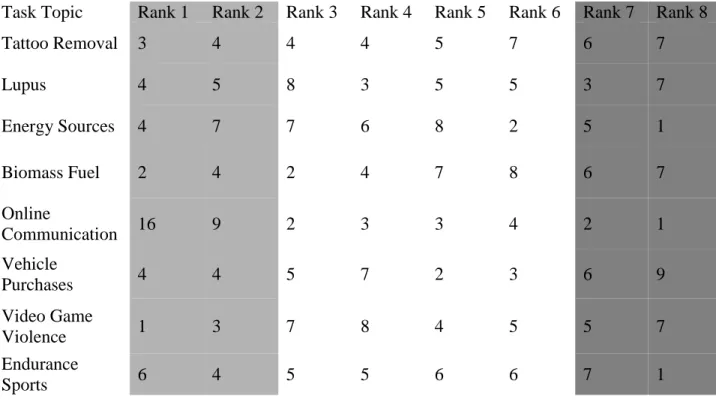
2. Frequencies of Participant Rankings for Each Task Topic ... 109
3. Pre-Search Questionnaire Item Means According to Interest ... 110
4. Post-Task Questionnaire Results by Interest and Frustration Levels ... 111
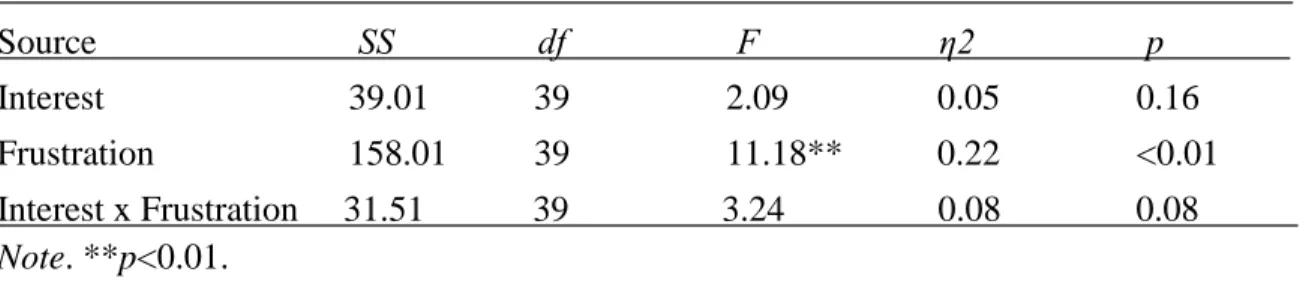
5. Results of ANOVA for Post-Task Questionnaire Items ... 112
6. Range of Values for UES Subscales ... 113
7. UES Scores for Each Subscale by Interest and Frustration Levels ... 114
8. Results of ANOVA of UES data by Subscale ... 116
9. SSSQ Results by Distress, Worry and Overall Stress by Interest and Frustration Levels... 117
10. Results of ANOVA of SSSQ Data by Subscale ... 119
11. Frustration Questionnaire Results by Interest and Frustration Levels ... 120
12. Results of ANOVA of Frustration Questionnaire Data ... 120
13. Summary of UES, SSSQ and Frustration Questionnaire Data ... 121
14. Queries Submitted by Interest and Frustration Levels ... 122
15. Results of ANOVA of Queries Submitted ... 123
16. Query Length by Interest and Frustration Levels ... 123
17. Results of ANOVA of Query Length Data ... 124
18. Clicks Per Query by Interest and Frustration Levels ... 124
19. Results of ANOVA of Clicks Per Query Data... 125
20. IDF Scores for All Task Types ... 126
xiv
22. Results of ANOVA for SERPs Displayed ... 127
23. Scrolls on SERP by Interest and Frustration Levels ... 128
24. Results of ANOVA for Scrolls on SERP ... 128
25. Documents Bookmarked by Interest and Frustration Levels ... 129
26. Results of ANOVA of Documents Bookmarked ... 129
27. SERP Clicks by Interest and Frustration Levels ... 130
28. Results of ANOVA of SERP Clicks ... 130
29. Clicks on Documents by Interest and Frustration Levels ... 131
30. Results of ANOVA of Clicks on Documents ... 131
31. Time Spent on Task by Interest and Frustration Levels ... 132
32. Results of ANOVA for Total Task Time ... 132
33. Time Spent on SERP by Interest and Frustration Levels ... 133
34. Results of ANOVA of Time Spent on SERP... 133
35. Time Spent on Documents by Interest and Frustration Levels ... 134
36. Results of ANOVA on Time Spent on Documents ... 134
37. Query Time Intervals (in Minutes) by Interest and Frustration Levels ... 135
38. Results of ANOVA of Query Time Intervals ... 136
39. Summary of Multiple Regression Analysis for Behavioral Signals Predicting Engagement ... 139
40. Summary of Multiple Regression Analysis for Behavioral Signals Predicting Frustration... 139
41. Results of Logistic Regression of Engagement, Frustration and Search Actions ... 141
42. Summary of Search Behavior Results by Interest and Frustration Levels ... 142
xv
44. Results of ANOVA of Skin Conductance Data ... 147
45. Heart Rate Results by Interest and Frustration Levels... 147
46. Results of ANOVA of Heart Rate Data ... 148
47. Window Analysis of Skin Conductance Results by Interest and Frustration Levels... 149
48. Results of ANOVA of Window Analysis of Skin Conductance Data ... 149
49. Window Analysis of Heart Rate Results by Interest and Frustration Levels ... 150
50. Results of ANOVA of Window Analysis of Heart Rate Data ... 150
51. Skin Conductance Responses by Interest and Frustration Levels ... 151
52. Results of ANOVA of Skin Conductance Response Data... 152
53. Skin Conductance Values and Valence of Change for First 60 Seconds by Interest and Frustration Levels... 153
54. Results of ANOVA of Skin Conductance Data for First 60 Seconds... 154
55. Heart Rate Values and Valence of Change for First 60 Seconds by Interest and Frustration Levels... 155
56. Results of ANOVA of Heart Rate Data for First 60 Seconds ... 155
57. Fixed and Random Effects, Correlation Coefficients, BIC values, and L-Ratios for Models of Skin Conductance Data ... 158
58. Fixed and Random Effects, Correlation Coefficients, BIC values, and L-Ratios for Models of Heart Rate Data ... 159
59. Multiple Regression Analysis of Search Actions and Physiological Signals Predicting Engagement ... 157
60. Multiple Regression Analysis of Search Actions and Physiological Signals Predicting Frustration ... 158
xvi
LIST OF FIGURES
Figure 1. Proposed Model, Relationships and Research Questions... 6
Figure 2. Task Template Used to Create Evaluate Tasks ... 92
Figure 3. Example Task from the Science Domain ... 92
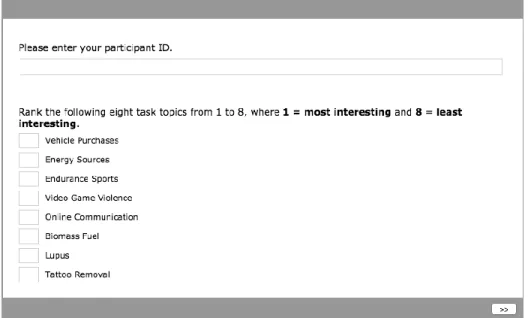
Figure 4. Ranking Questionnaire with Task Topics Presented to Participants ... 93
Figure 5. Example of Poor Quality Search Results ... 94
Figure 6. Example of Cover Story Implementation ... 95
Figure 7. Screenshot of Search System... 96
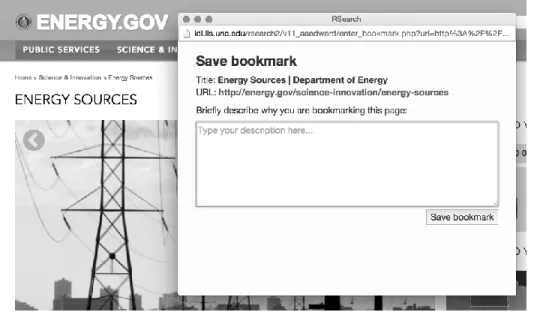
Figure 8. Screenshot of Bookmarking Process ... 96
Figure 9. Skin conductance data (in seconds) for all participants for all tasks by task dimensions ... 145
1
CHAPTER I: INTRODUCTION
Interactive information retrieval is the study of how the user interacts with a search system (Kelly, 2009). Work in this area is concerned with modeling both the search system as well as the cognitive and affective states of the user. According to Savolainen (1995), cognitive orientation in information seeking refers to “an analytic and systematic approach to problems” and research has identified cognitive structures as crucial to understanding search
behavior (Ingwersen, 1996). The importance of the study of cognition in search has been demonstrated in many areas such as relevance judgments (Saracevic, 2007; Brennan, Kelly & Arguello, 2014), mental models (Vakkari, 2001; Zhang, 2008) and information-seeking behavior (Savolainen, 1995). Cognitive attributes of search have also gained prominence in many foundational models of search (Kuhlthau, 1993; Borlund, 2003). Affect and emotional states are also important to interactive information retrieval, as these offer utility in
understanding concepts such as motivation and self-efficacy in search. Affective components are also present in models of search (Nahl & Bilal, 2007), and represent the emotional state of the user throughout the search.
Engagement is one cognitive and affective component of interactive information retrieval that has not been modeled as extensively as others. Engagement has been defined differently in different areas; in organizational psychology engagement is defined as when employees are filled with “vigor” and dedication” (Schaufeli et al., 2008). In cognitive
2
the creation of a positive experience for the user in order to encourage them to continue performing a particular activity. In contrast to this subjective approach, engagement in interactive information retrieval has been studied primarily from a behavioral perspective, with a focus on defining engagement through search actions (Jiang, He, & Allan, 2014; Teevan, Collins-Thompson, White, Dumais, & Kim, 2013; Lehmann, Lalmas, Dupret & Baeza-Yates, 2013). These measures have primarily been frequency-focused: frequency of unique clicks, issuing of more queries and more query reformulation, as well as greater frequency in overall activity per session. This research is beneficial because it demonstrates how engagement may manifest itself behaviorally.
Research in interactive information retrieval could benefit from more investigation of the cognitive and affective components involved in frustration. Frustration has a much more universal definition than engagement; it is most often defined as a “response to impediment of progress towards a goal” (Amsel, 1992). Work in information retrieval has shown that
frustrated participants tend to exhibit both decreases in performance and increases in negative emotion (Aula, Khan & Guan, 2010; Poddar & Ruthven, 2010). Research has also shown that frustrating experiences occur when the participant experiences difficulties using the search system (Hoppmann, 2009), and that frustration can occur at different points in a search session (Hertzum, 2010). Frustration is typically also characterized by an increase in search actions, specifically an increase in clicks (Field, Allan & Jones, 2010).
3
important as it determines the strength of goal orientation and thus the valence of emotion when progress is either made or blocked. Work in engagement and flow theory has also shown that goal orientation is key; Pace (2004) stated that directed attention (a component of flow and engagement) occurs when there is congruence between novelty, interest, and the goals of the searcher. Pace also stated that when a person either fails to find an item of interest or fails to do so quickly, they may become frustrated, emphasizing how easily
engagement can shift to frustration. Similarly, Amsel (1992) defined frustration as a response to a system of “intermittent reward and non-reward” as a person progresses towards a goal. In frustrated states, participants can experience “behavioral activation” or an increase in
behavioral response. Given the similarity in the cognitive and affective basis of these two states, it is possible that instead of experiencing engagement, people who click and query frequently are actually frustrated.
While behavioral signals can be useful, other work has offered greater focus on subjective measures. O’Brien and Toms have made significant advancements in shifting the
perception of engagement as completely interaction-based to a focus on the cognitive and affective experience of engagement. O’Brien and Toms (2008) offer a definition of
engagement which states it is a “category of user experience characterized by attributes of challenge, positive affect, endurability, aesthetic and sensory appeal, attention, feedback, variety/novelty, interactivity, and perceived user control” (p.7). With this definition O’Brien
and Toms successfully capture engagement as an interaction between system and user variables. This more holistic understanding of engagement has contradicted other frequency-based notions. O’Brien and Lebow (2013) investigated the relationship between engagement,
4
the lowest reading times overall, lowest browsing times, and lowest total session times. Participants who rated their engagement highest visited the fewest pages and used the least recommended links, suggesting that participants who were the most engaged had the least amount of search interaction.
There is a theoretical basis for the similarities and differences between engagement and frustration. O’Brien and Toms (2008) identified challenge as a key component of
engagement, however, other work has shown that frustration can occur when a participant perceives a challenge, but believe they do not have the resources to overcome it (Amsel, 1992). This difference in responses when one identifies a challenge versus an obstacle is encapsulated in the inverted-U theory (Yerkes & Dodson, 1908). The inverted-U theory of performance states some amount of stress can improve performance, while too much stress inhibits it (Muse, Harris, & Feild, 2003). This finding has been replicated in some of the literature on task performance in human factors. For example, Helton, Shaw, Warm,
5
Cognitive indicators of stress and their accompanying physiological signals hold promise for disambiguating engagement and frustration. While it is well known that frustration generally produces higher stress (Scheirer et al., 2002), there is conflicting evidence about the relationship between engagement and stress. Work in psychology has found that as engagement increases, stress hormones also linearly increase (Nes, Segerstrom, & Sephton, 2005), which is supported by the underlying belief that cognitive activity
expresses itself physiologically as stress (Cannon, 1927). However, O’Brien and Lebow (2013)’s work found negative correlations between electrodermal activity, heart rate, and self-report measures, indicating that as engagement increases, physiological stress decreases. Even if we place engagement and frustration at opposite ends of a spectrum, it is not clear how participants shift from being engaged to frustrated, or how this change is reflected in their stress response and search actions.
6
Figure 1. Proposed Model, Relationships and Research Questions. 1.1. Research Questions
The research questions for this study are:
RQ1: To what extent can physiological signals of stress help disambiguate the emotional states of engagement and frustration?
O’Brien and Lebow (2013) found that for an online news context, participants who
7
H1: Physiological signals of stress during frustrating experiences will exceed those experienced during engaging experiences.
RQ2: To what extent do search actions differ for participants who are engaged versus frustrated?
Research has shown that there is a relationship between search behavior and
emotional state. Aula et al. (2010) found that participants attempted longer queries and more frequent query reformulation when struggling with difficult tasks. Other work has shown that frustrated participants exhibit distinct click behaviors (Field et al., 2010). O’Brien and Lebow (2013)’s work on engagement and stress showed that participants with the highest levels of engagement performed the fewest search actions. Hassan, White, Dumais and Wang (2014) tried to classify search actions as either “struggling” or “exploring,” and found that query similarity was a good indicator of struggling, as participants who were struggling tended to have less query diversity than participants who were exploring, as supported by Aula et al. (2010). They also found that dwell time was lower for participants who were struggling, and (though not significant) participants clicked more in exploratory sessions than struggling ones. Using this information, they found that behavioral information in the aggregate increased prediction accuracy; for example, query information up to and after the second query was highly predictive of a struggling vs. exploring session. This suggests that there are distinct patterns of behavior associated with positive and negative search experiences.
8
found that participants expanded their query terms by adding more words to form natural language queries, while Hassan et al. found that participants who struggled were more likely to substitute terms than add them. There were methodological differences in these studies that may have explained the opposing results; Aula et al. performed a user study, while Hassan et al. examined log data. Therefore, it was difficult to formulate a hypothesis about the relationship between engagement, frustration, and search actions. Therefore, this will be treated as an exploratory research question.
RQ3: How does interest in the task affect engagement, frustration, and stress? What effect does interest in the task have on search actions?
Previous work has shown that interest is critical to engagement (Csikszentmihalyi, 1991; Pace, 2004), and that users feel more frustrated during tasks that are important to them (Hertzum, 2010). My manipulation of engagement is constructed around these findings, but it will be necessary to check if this manipulation works, which is part of what this research question addresses. Research has also shown that some arousal is experienced during both engagement (O’Brien & Lebow, 2013) and frustration (Scheirer et al., 2002), but I believe it
9
H3: Engagement will be greater during tasks that participants rated as interesting. I believe this is because participants will be more motivated to complete these tasks, given that we know that motivation, interest and goal orientation are integral to engagement
(Csikszentmihalyi, 1991; Pace, 2004). This motivation will be reflected in increases in search actions.
RQ4: How does the presence of a frustrator moderate the relationship between interest in the task and search behavior, engagement, frustration, and stress?
Research has shown that motivation and goal-orientation are integral to the
experience of engagement (Matsumoto & Sanders, 1988). Work has also shown participants feel most frustrated when they face an obstacle (Hoppmann, 2009), during tasks that are important to them (Hertzum, 2010), and that poor search result quality can induce search abandonment (Song, Shi & Fu, 2013). Therefore, I hypothesized that:
H4: Participants will also feel more frustrated (as induced by reversed search result rankings) during tasks that are interesting versus tasks that are not interesting. This frustration will be exhibited through physiological signals of arousal that are above and beyond those of engagement, as well as higher reported frustration.
1.2. Implications
10
have made use of these techniques, and this dissertation will add to this body of research. This research will also provide evidence about the relationships between search actions, engagement and frustration. Other studies have characterized both engagement and frustration by an increase in search actions, and this research, through its linkage of subjective evaluation and search actions, can clarify the intricacies of these relationships. Lastly, this study will add to a larger understanding of the role emotions play in search behavior, and how information about a searcher’s emotional state can be used to improve the
11
CHAPTER II: LITERATURE REVIEW
This chapter reviews previous work related to engagement, frustration, simulated work tasks, and the study of physiological signals. This review first examines theories of emotion, including engagement and frustration, and how these have been studied in
interactive information retrieval. Lastly, the review concludes with a review of literature on physiological signals and recommendations for measurement, as well as a review of the literature on the development and use of simulated work tasks.
2.1. Emotion
The study of emotion occurs at three levels: at a physiological level, via endocrine and autonomic processes; at a neurological level, via neural activity and brain structures; at a cognitive level, by examining how people think about, process, and regulate their emotions; or at a behavioral level, by studying how emotion is physically expressed. This means there are many bases for defining emotion.
2.1.1. Definitions of Emotion. “Affect” is an umbrella term that has often come to
describe three commonly grouped yet distinct phenomena: emotion, affect, and mood. Though emotion and affect are often used interchangeably, the psychological community understands affect and emotion as distinct concepts. Emotion is made up of seven
components: core affect, behavioral response, attention, cognitive appraisal, attribution, and neurophysiological changes in the body in response to the emotion (Russell, 2003). “Affect” most frequently refers to “core affect,” which is a combination of “hedonic values” (ranging
12
(Russell, p. 154). The primary difference between core affect and emotion is that core affect does not involve the cognition inherent to emotion, such as cognitive appraisal and
attribution. Mood, in contrast, is affect that persists over time and is not directed at any particular object. Together, these concepts can describe a person’s emotional state. For the
purposes of this review, I use the term emotion, since most work in the area focuses on emotion and not core affect.
2.1.2. Theories of Emotion. A common approach to studying emotion and cognition is the constructivist approach (Mandler, 1990), which states that emotion is the result of cognitive analysis and physiological response. William James and Carl Lange, considered the founding fathers of this approach (Cannon, 1927), believed that emotions were the result of a response to a physiological stimulus. Lazarus (1991) elaborated on this further, stating that cognition is a necessary but not sufficient part of emotion, meaning that thoughts can
engender emotions (i.e., in cognitive appraisal) but emotions cannot occur without thoughts. Lazarus’ (1991) interpretation of the relationship between cognition and emotion
served as the basis for appraisal theories, which state that the brain evaluates events for emotional cues. Reisenzein and Hoffmann (1990) mapped emotions to appraisal of specific events, and found that emotions like pride, shame and guilt are caused by events that are believed to be a result of a person’s actions, while emotions like love and anger are caused by events that are believed to be the result of someone else’s actions. Roseman, Dhawan, Rettek,
13
consistent with the user’s effort to complete their search effectively. In the search context
example, if the user were randomly presented with completely irrelevant documents, they would appraise this as inconsistent with their objective and would experience negative emotions.
In contrast to the constructivist approach, which posits that emotions occur after a person has evaluated a situation, there is the fundamentalist approach which states that there are fundamental emotions which are discrete patterns of behavior and experience. The embodied appraisal approach represents a middle ground between the constructivist and fundamentalist approaches. Prinz (2003) developed the embodied appraisal theory which states that emotions occur as a set of physiological changes, which over time become linked with emotions through learned patterns of behavior. This approach appears to successfully reconcile the multi-process nature of emotion.
2.1.3. Physiological and Behavioral Expression of Emotion. Another theory that links emotion and physiology is the James-Lange theory of emotion (1927), which states that emotion is the manifestation of a response to a physiological stimulus. Schachter and Singer (1962) tested the James-Lange theory of emotion by performing a series of experiments manipulating participants’ physiological states and measuring their emotional responses.
14
The relationship between emotion and behavior is less well understood. Laird (1974) found that participants changed their description of their emotion based on what facial expressions they were told to make, indicating that the relationship between emotion and behavior is bidirectional. Baumeister, Vohs, DeWall and Zhang (2007) saw the relationship between unconscious emotion and behavior as dependent upon type of emotion, i.e., core affect could engender a “fight or flight” response, while conscious emotion is a mediated
process in which emotion influences cognitive processes which then, in turn, affect behavior. Though Clore (1994) believed that emotions existed entirely in the realm of the conscious, Zemack-Rugar, Bettman and Fitzimmons (2007) unconsciously primed participants to experience an emotion, and observed that the primed emotion affected behavior. This shows that non-conscious emotions can have an effect on behavior.
2.1.4. Individual Differences in Emotional Response. Individual differences in the psychophysiological makeup of people can influence measures of emotion. Feldman (1995) identified two constructs key to understanding individual differences: valence focus and arousal focus. Valence focus is “the degree to which individuals attend to the hedonic component of their affective experience” (p. 295), which means the degree to which an
individual notices and reports pleasant or unpleasant feelings. Arousal focus, similarly, refers to “the degree to which individuals attend to the arousal component of their affective
experience” (p. 295), specifically physiological signals of arousal. Feldman conducted a longitudinal study of personality and mood, and found that participants’ reporting of their
15
point in time later produced ratings more in line with a high-valence-focus because of temporal changes.
Individual differences may manifest themselves in various forms of emotion suppression and regulation. Gross and John (2003) separated emotion regulation processes into antecedent-based (before an emotion occurs) and response-based (after an emotion has occurred). They then looked at individual differences with respect to cognitive reappraisal (an antecedent-based strategy) and expressive suppression (a response-based strategy). Cognitive reappraisal is defined as when an individual reconstructs an emotional situation in a way that lessens its emotional impact (Lazarus & Alfert, 1964). Gross and John performed several experiments comparing individuals along racial, gender, and ethnic lines, and found that individuals who employ expressive suppression experience negative affect more often, perhaps related to feelings of inauthenticity. Expressive suppression is when an individual purposefully inhibits emotionally expressive behavior. Reappraisers, in contrast, experience more positive affect due to the “early intervention” of their emotion regulation strategy which shapes the way they feel/express emotions. Emotion regulation strategies can
influence self-perception, self-reporting measures and behavior. Ohira et al. (2006) looked at the relationship between neural and physiological expressions of emotion during emotion suppression episodes and found that not only did certain brain regions such as the
16
2.1.5. Emotion and the Stress Response. Four concepts are key to the understanding of stress and emotion: an agent that causes the stress (the stressor), the evaluation of the stressor, a coping process to deal with the stress, and the effects of that stressor on the mind and body. The coping processes employed in stressful situations involve both a psychological and physiological response. It is well understood that emotional regulation mechanisms can inform the experience of stress. Lok and Bishop (1998) looked at emotion regulation
strategies and perceived stress, and found that benign impulse control and mental rumination were related to lower perceived stress. They also found that emotion inhibition was
negatively correlated with stress. Gohm, Carser, and Darsky (2005) looked at emotional intelligence and stress among freshmen, and found that individual differences played a key role in whether emotional intelligence reduced stress; individuals’ confidence in their
17 2.2. Modeling Emotion and Information Behavior
Emotion is important to information behavior, as evidenced by the presence of emotional components in information-seeking models. However, affect in these models deviates from the psychological understanding of affect. “Affect” and “affective” are used in
the information-seeking literature to represent any model or process with an emotional component. Affective will be used in this section where researchers make use of the term.
The Information-Seeking Process model (ISP) developed by Kuhlthau (1993) describes both the cognitive and affective states of students engaged in information-seeking to complete a class assignment. This model consists of six stages: initiation, selection, exploration, formulation, collection, and presentation. Each of these stages has an affective component: the person has apprehension at the beginning of the task, feels a sense of optimism followed by confusion and uncertainty, which culminates in a feeling of preparedness once the task has been completed and new information has been acquired.
Kracker (2002) used Kuhlthau’s model to explain library and research anxiety.
Library anxiety refers to anxiety experienced as a result of needing to use library services to complete an assignment. This anxiety may at times affect the patron’s ability to effectively use the library. Research anxiety is similar to library anxiety except that research frequently occurs outside of the library. Kracker asked participants to rate their anxiety and cognitive and affective awareness levels over eight weeks after listening to a 30-minute presentation of Kuhlthau’s Information-seeking Process Model. Kracker found that participants who listened
to the presentation had less anxiety than participants who had listened to a generic
18
A different, perhaps better application of Kuhlthau’s model was done by Hyldegård
(2009), who wanted to explore whether the model was applicable within the context of academic group work. Hyldegård makes it clear that emotion, not affect, is being measured and asks participants to indicate their emotional state by rating their emotional experience on a scale of 0-5 in relation to six positive feelings (confidence, satisfaction, optimism, relief, motivation, and clarity) as well as seven negative feelings (confusion, doubt, stress, frustration, uncertainty, and worry). While the items on this questionnaire are problematic because many of them deviate from Ekman’s six basic emotions, the emotions measured are closely aligned with the stages outlined in Kuhlthau’s model. Hyldegård also explores a key
component in the measurement of emotion: valence, which refers to the degree a person experiences feelings as well as how aware they are of what they feel. This is a slightly more effective application of emotion measurement, because of the specificity in construct
definition as well as in emotion measurement.
Another model proposed in information science that has emotional components is Savolainen’s (1995) model of Everyday Life Information-Seeking. Savolainen breaks everyday life into three components: (1) way of life, referring to a person’s time budget,
hobbies, and models of consumption; (2) mastery of life, referring to the kinds of approaches people take to solve problems; and (3) problem solving behavior. The model also takes into account variables like social, cultural, and material capital, values, and health. The emotional component of this model is in the mastery of life portion, which contains four types:
19
orientation means “emotionally laden and rather unpredictable reaction to issues at hand” (p.
265). With these descriptions, Savolainen remains closer to the definition of affect as emotion without cognitive appraisal. He also introduces attitudinal components (optimism and pessimism) that offer deeper insight into problem-solving. In the world of emotion literature, psychologists typically refer to these attitudinal components as “dispositional”
optimism or pessimism, and have long known that disposition can have lasting effects on affect or mood (Frijda, 1988).
Though the model is in keeping with affect as understood in psychology, Savolainen does not explore the validity of the affective components through traditional psychological tests. Instead, he pursues an indirect method of observing problem-solving behavior in order to understand emotional experience. Using critical incident technique and asking participants to extensively document a non-work information-seeking context, Savolainen found the participants (teachers and workers) were mainly located in the pessimistic-cognitive mastery of life. This orientation is described as systematic problem solving with less than optimal expected outcome. Fewer participants fell into the optimistic-cognitive category, which refers to systematic problem solving with the expectation of positive outcomes. One participant was placed in the pessimistic-affective category, which Savolainen calls “learned helplessness,” or avoiding systematic problem-solving. This classification was related to how affect was elicited through the critical incident technique. The outcome of the incident affects the post-incident emotion and the participant’s feelings are directly related to the type of post-incident used
20
chosen different incidents, including one that might have been less “affectively sensitive,” they might have been placed in different orientations. Savolainen’s model offers a more
nuanced way of looking at how emotional differences may impact information-seeking behavior.
Nahl (2004) moves closest to the traditional definition and measurement of affect by defining specific affective components of the information-seeking process. Nahl sought to understand the emotional environment of searchers by measuring motivation, information-seeking, self-efficacy, time pressure, search optimism feeling, coping skills, effort,
acceptance of search environment, and affective load. These constructs were measured using a 26-item questionnaire. Students who completed research projects for a writing class were asked to fill out these items related to searches they did for their research projects. Nahl found high ratings of affective variables such as felt effort, satisfaction, and affective load. One challenge in interpreting Nahl’s findings is due to the way in which affective concepts were defined and measured. Nahl describes "affective load" as being composed of uncertainty and time pressure, but the definition involves the person employing "coping skills to avoid giving up on the task" (p. 3), which seems more indicative of cognitive load than affective experience. The components of this cognitive load, uncertainty and time pressure, both involve distinct cognitions, further reinforcing the idea that this is a purely cognitive rather than affective state. Nahl's definition of search environment acceptance, which focuses on how supported a person feels during search, is also unusual. Nahl's questionnaire asks the participant if he/she feels supportive of the search engine and how easy it was to use the search engine, but these items seem to deal more with perceptions of search engine
21
“emotional,” but the use of a self-report questionnaire helps paint a more complete picture of
emotional state as tied to an information-seeking event.
The affective sub-components Nahl defines outline a key part of affective experience: valence focus (Feldman, 1995). The sub-components that measure positive or negative feelings such as search optimism facilitate the participant’s reporting of valence focus. However, Nahl’s sub-components do not include another important component of affective
experience, arousal focus. The modeling of affective information behavior in information science has provided us with clues as to what role emotional state can play in information-seeking behavior and information processing. However, these models could be expanded to include a deeper understanding of the distinction between emotion and affect and applied in such a way as to measure emotion more broadly, as well as taking into account physiological factors.
The discussion of affect within the information-seeking community has focused on how a person feels as they engage in information search. Though this approach borrows heavily from psychology’s understanding of cognition as a process of self-reflection, it is
unique because of the focus on individual differences in how a person responds to and interacts with their information environment. Nahl and Bilal (2007) in their book, Information and Emotion, outline a theoretical framework specifically for understanding information-seeking and affective principles. Nahl and Bilal place their definitions of affective behaviors in an information-seeking context within the same groups as
22
However, for Nahl and Bilal, these groups act in sequence: first, the sensorimotor action occurs, where the person takes note of their environment, then the cognitive, where the person interprets the information around them, and then affective, where the person evaluates information emotionally. This model is quite different from the way cognition, affect, and behavior are understood in psychology; behavior is seen as directly influenced by cognition and affect rather than cognition and affect following behavior.
This work, combined with studies of emotion done using web search tasks, shows that a person’s mood influences their search efficacy as well as their information-seeking
strategies. This body of work also shows that search can engender different valences of emotional response (Lopatovska & Arapakis, 2011).
2.2.1. Emotion in Human Computer Interaction. Affective computing in human computer interaction research has focused on measuring frustration and other negative emotions experienced while interacting with interfaces, as well as how to decrease negative emotions. For example, Fogg and Nass (1997) found that participants responded to negative and positive feedback from computers similarly to the way they responded to the same types of feedback from humans. This study found that participants reported more positive affect and spent longer on the task when they received help. Conversely, participants who received little help made significantly more mistakes, spent less time on the task, and reported less positive affect. This demonstrates that the way a user perceives the sympathetic response of the computer affects emotional state and performance on the task.
23
this way is an automatic response and is as natural as interactions between humans. Other work done by Reeves and Nass (1996) found that humans respond to computers socially. In their study, a computer congratulated itself on its performance, and participants were asked to rate its performance electronically or via a paper questionnaire. Participants rated the computer more positively on the electronic evaluations, almost as though participants did not feel comfortable being honest with the computer “to its face” versus “behind its back.” This
study found that when computers initiated a social situation, participants would respond in kind and even consider the “feelings” of the computer when responding to it. Other
researchers have explored these ideas within the context of frustration (Kapoor, Burleson, & Picard, 2007; Grafsgaard et al., 2013). Frustration will be covered elsewhere in this review, in section 2.5.
Within the area of affective computing and search, behavioral signals have been combined with subjective response to show that affect detection can be used to improve the Web search experience (Wang, Chignell, & Ishizuka, 2006; Klein, Moon, & Picard, 2002). Lopatovska (2009) explored the relationship between mood and search task, using
measurement of stress via the Positive and Negative Affect Schedule (PANAS). The PANAS is used to measure the degree to which a participant feels positive affect, characterized by attributes such as alertness, enthusiasm, and negative affect, or the degree to which a participant feels distress. This study found that search task difficulty, topic, and complexity did not have an impact on pre-task or post-task mood.
24
and poorer search outcomes. They also found that participants judged a task to be more difficult if it took longer to complete, and participants were unable to accurately predict difficulty before engaging in the task. In terms of behavioral signals, they found participants who viewed more pages reported feeling lost during the search less often but were overall less satisfied with their searches. Moving from detection and classification, to prediction, Lopatovska (2011) found correlations between emotions and search actions such as mouse clicks and scrolling, and suggested that these behaviors could potentially be used to detect a user’s affect and trigger interventions to improve the user’s emotional state.
2.3. Stress
2.3.1. Theories of Stress. Theories of stress, similarly to theories of emotion, have focused on people’s perception of stress and their physiological response to it. Selye (1976),
an endocrinologist, developed a theory of stress called General Adaptation Syndrome (GAS), which consists of three stages: alarm reaction, resistance, and exhaustion. Selye recognized that acute and chronic stress were processed by different parts of the body. Acute stress is processed by the sympathetic adrenal-medullary system (SAM), and chronic stress is
processed by the hypothalamic pituitary adreno-cortical system (HPA). In the alarm stage, an acute stressor is detected, a fight or flight response is triggered, and the sympathetic branch of the autonomic nervous system sends electrical signals to the brain which trigger an adrenaline response. In the resistance stage, the stressor persists and the endocrine system sends signals to the pituitary gland to release cortisol, which becomes detectable in the saliva and the blood. During exhaustion, the last stage, the body becomes very susceptible to illness as the adrenal glands lose functionality. Chemicals such as adrenaline and cortisol are
25
conductance. Selye’s GAS theory ties stress to the physiological response, as the
constructivist theories of emotion tie emotion to physiological responses.
Other researchers have pointed out several weaknesses in Selye’s characterization of stress (Hobfoll, 1989). The most prominent one is that in his GAS model, responses such as anxiety or fear, which may precipitate stress but have different origins, become
indistinguishable from the stress Selye identifies. Lazarus and Folkman (1984) characterized stress as a process of coping and appraisal, rather than a series of physiological responses. Though the concept of appraisal has already been covered earlier in this review, Lazarus states that primary appraisal (which is key to stress), is made up of goal relevance, goal congruence, and ego-involvement. Goal relevance refers to whether a situation is meaningful to the person experiencing it. Goal congruence refers to the extent to which an experience is in line with the person’s overall goals. Ego involvement refers to whether the person
experiences ego-related feelings such as self-esteem. These cognitive appraisals allow an individual to determine whether the stimulus is a stressor. Specifically, Lazarus and Folkman identify the three types of appraisals that are involved in stress: harm, which refers to
psychological damage or stress that has already happened, threat, which is the anticipation of harm, and challenge, which is stress someone feels from a demand they feel they can
overcome. This cognitive understanding of stress can also help us understand coping behaviors that occur in the presence of a stressful situation.
2.3.2. Definitions and Types of Stress. Lazarus and Folkman define psychological stress as a “relationship between the person and the environment that is appraised by the
26
relationally-defined. The relational definition of stress states that a stress response occurs as the result of a combination of individual differences and environmental variables. Stimulus-response stress involves stimuli that engender a stress Stimulus-response; these kinds of events are outside of an individual’s control and can be global (natural disasters, war), or part of a local
environment (chronic illness, divorce). People respond to these stressors by employing coping mechanisms that are highly individualized. However, there are also smaller events outside of one’s control (referred to as daily hassles), which Lazarus and Folkman consider
even more impactful because they help establish long-term patterns of coping.
Selye (1976) and other researchers also recognized the importance of differentiating between environmental eustress and distress. Eustress is defined as the “good” kind of stress, primarily occurring as a result of positive motivation. Distress, the “bad” kind of stress, is the
result of negative feelings. The important distinction between these two kinds of stress is the perception of the stressor by the person. If the stressor is perceived in a positive light, then it will be considered eustress, and if it is perceived negatively, then it is considered distress. There is evidence to support eustress’ ability to enhance immune systems while distress
impairs it (Selye, 1975).
27
association. Other studies have suggested that increased heart rate and cortisol are linked to increased anger and sadness respectively (Lewis, Ramsay, & Sullivan, 2006), confirming that different physiological responses to stress are controlled by different mechanisms (the
cortisol by the adreno-cortical system, the heart by the autonomic nervous system). Lazarus and Launier (1978) posited that coping behavior in stressful situations depended on the person’s ability to identify resources for dealing with the stressor, and if their resources were
minimal, they could attempt to regulate their distress but very little could be done to
ameliorate it. Krantz (1983) placed participants within the stressful condition of preparing for an exam, and measured their stress responses, cognitive appraisals, and coping mechanisms. Krantz found that identification of a large and diverse number of options prior to a stressful event was related to more efficient coping behavior after the stressful event, confirming the complexities of the behavioral and physiological response to stress.
28
looked at the role of personality and environmental factors with regards to stress, and identified several kinds of interactions that produce stress. One kind is person-environment interactions, which consist of neuroticism and work demand, where individuals who are more neurotic are less likely to be adaptive to stressful events. Parkes found that while all variables were important individually, the only two that had significant interactive effects were person and situation, which, when combined, had a direct effect on coping strategies.
Given that the psychological community has explored the relationship between emotion, stress, and their physiobehavioral expression, we can learn a lot about how these relationships may be observed in the fields of affective computing and information science. Possible areas for exploring the relationship between stress and emotion in the field of information science include exploring whether participants’ emotional experiences of an
information retrieval session are related to greater reports of subjective stress, given that we already know participants can identify and report frustrating search experiences (Feild et al., 2010).
2.3.5. The Inverted-U Theory. The inverted-U theory, based on work done by Yerkes and Dodson (1908), states that there is a middle ground at which more arousal stimulates a positive response, and too much or too little results in negative response. Yerkes and Dodson experimented with stimulation of mice and maze navigation and found that “as the difficultness of discrimination is increased the strength of that stimulus which is most favorable to habit-formation approaches the threshold” (p. 22). The researchers conclude that there is a point above and beyond which the strength of the stimulus does not encourage the formation of habits. This basic idea has been applied in many different fields, in
29
activation and appetitive motivation (see section 2.5), the inverted-U theory lends itself to understanding where appetitive motivation becomes aversive and leads to frustration.
Näätänen (1973) saw the relationship between the inverted-U, activation, and performance as when a participant experiences a moderate level of activation during which they experience an optimum level of performance. Once they move past this, they experience an “increasing level of activation” past the optimal point and a subsequent “deteriorating
level of performance” (p. 160). Näätänen suggests that five reactions can occur when a participant performs a task: anxiety, a “try harder” reaction, a “task-fatigue” reaction, self-consciousness (awareness of one’s actions), and free association (thinking aloud to make
sense of the task attributes or requirements). These reactions act as stimuli to spur the participant into activation. Note that while this effort will show traditional signals of
“activation” which may manifest physiologically, the underlying emotions will be negative,
behavior will change, and performance will decrease. This fits well into our understanding of frustration mirroring engagement because while the participant may appear to be engaged, the effort they expend during a frustrating session is markedly different in terms of the rate of expenditure of cognitive resources as well as affective state.
Work using the inverted-U model has also investigated whether adding more workload improves some aspects of participant performance. Wiener, Curry, and Faustina (2003) gave participants vigilance tasks, increased the mental workload of these tasks, and then measured the number of errors committed by each participant as an indicator of
30
workload are already requiring the participant to be more vigilant, so they will be more aware of potential pitfalls and avoid committing errors. Participants who feel less stimulated are not as vigilant and thus may be more prone to making mistakes. This idea helps us make the case that a small amount of stress has the potential to increase performance, but an abundance of stress can cause errors in performance. Muse, Harris and Feild (2003) suggest that the literature on the inverted-U theory and the relationship between stress and performance can be improved and expanded by employing objective measures of stress instead of relying solely on self-report data. This study seeks to do this by using physiological stress as an objective measure.
2.4. Engagement
Engagement in pyschology has been characterized by a focus on creating a positive subjective experience to encourage people to continue performing a particular activity
(Schaufeli & Salanova, 2008). Engagement in information search research has been anchored by these same ideas: discovering what makes a system engaging, and creating search
experiences that promote engagement. While some researchers have created and evaluated psychometric scales for measuring engagement (c.f., O’Brien & Toms, 2008), engagement
has become increasingly characterized by definitions that rely heavily on extrapolation of behavioral signals, such as number of clicks and dwell time.
31
2.4.1. Definitions of Engagement. Engagement has been defined as a persistent and pervasive state containing both affective and cognitive attributes, but not focused on any particular object or event (Schaufeli & Salanova, 2008). It has been understood as related to, and perhaps a subset of, flow, which is defined as a state of complete cognitive absorption and focus on an activity (Csikszentmihalyi, 1991). Csikszentmihalyi stated that flow occurs when a proper balance between challenge and skill is reached. He conducted a study
examining flow states and participants described their experiences of flow as balancing their need for information with search challenges and the limits of their own search skills. Some of the attributes of flow identified in this study were mental alertness, a sense of control and a reduced awareness of irrelevant factors. Schaufeli and Salanova (2008) extended this by stating that engagement is the peak of flow, suggesting that engagement causes flow, or at least creates the psychological state through which flow may be experienced.
Some of the work done on flow can help us understand and situate the work done on engagement and web search. Pace (2004) used grounded theory to investigate participants’
experience of flow and information-seeking behavior during both directed searching and exploratory episodes. Pace wanted to observe the goal-orientation integral to flow. In
32
influenced the user’s experience of feeling challenged, which is integral to flow attributes
such as mental alertness and engagement attributes such as focused attention.
33
Lehmann et al. (2013) continued this work by proposing the concept of networked user engagement, which refers to engagement within a network of websites. This work focused on user clicks among different websites and posited users with high network engagement would make clicks among the websites within the network. They found that users performed more goal-oriented behaviors on a weekday (Wednesday), while they performed more browsing activities on the weekend. They also found that some users who were more active with regards to search behavior (referred to as VIP users) navigated more frequently between sites and had higher rates of return to previously visited sites than users who were less active. This conceptualization differed from the previous one in that it focused on activity within a collection of websites as opposed to activity at an individual website.
Lehmann, Lalmas, Dupret and Baeza-Yates (2013) furthered their work on
engagement by focusing on user engagement with many tasks simultaneously, and analyzed online multitasking and engagement using two behavioral signals: dwell time and page views. Transforming these signals into metrics like attention shift, attention range, cumulative
actions, visits, and sessions, Lehmann et al. grouped different kinds of sites based on levels of engagement and proposed a model in which dwell time and page views were
34
attention shift and attention range, indicating that when participants did return to the site, they spent more time than before.
Though behavioral signals are useful in that they can serve as an indicator of variance in what the user is viewing and clicking on, using behavioral signals alone to define
engagement is problematic because of their noisiness; some of these signals could also indicate confusion about the task or uncertainty about where to find information. They also do not effectively capture the cognitive or affective parts of engagement (Schaufeli & Salanova, 2008). Nonetheless, these signals still offer scalable and useful measurements of user behavior at relatively low cost, and so do offer their merits.
2.4.2.1. Redefining Engagement in Information Retrieval. O’Brien and Toms have
made significant advancements in shifting the perception of engagement as completely interaction-based to include the cognitive and affective components of engagement. In their paper defining a conceptual framework of engagement, O’Brien and Toms (2008) state that engagement is a “category of user experience characterized by attributes of challenge,
positive affect, endurability, aesthetic and sensory appeal, attention, feedback,
variety/novelty, interactivity, and perceived user control” (p. 7). With this definition O’Brien
and Toms capture how system properties and user behavior combine to create engaging experiences. Through analysis of semi-structured interviews, the authors isolate elements within the process of engagement, which is made up of four stages: point of engagement, period of engagement, disengagement, and reengagement. In this process, engagement begins when something captures the user’s attention, and this attention is sustained, assisted by the
35
decides to return to the task. Non-engagement, or not becoming engaged at all, occurs when users feel time pressure or are multitasking. This process-oriented model is useful not only because it can be used to track how engagement changes throughout an information-seeking task, but it also provides some context for interpreting interaction signals and engagement.
Building upon this work, O’Brien and Toms (2010) created a 31-item scale to
measure engagement, called the User Engagement Scale (UES). Six attributes of engagement were identified using factor analysis: perceived usability, aesthetics, focused attention, felt involvement, novelty, and endurability. These factors capture the cognitive, affective, and usability-related attributes of user experience. A second study reported in this paper explored the relationships between these factors, and found, among other things, moderate correlations between novelty and felt involvement, and focused attention and felt involvement. They also found that focused attention predicted felt involvement, and felt involvement predicted endurability.
The UES has been used to measure engagement in interactive information retrieval studies. O’Brien and Lebow (2013) used the UES in conjunction with the Cognitive Absorption and System Usability Scales to examine what attributes were important during information-seeking experiences within an online news context. They found that participants who rated their level of interest in an article higher were also more engaged, solidifying the relationship between engagement and interest. They also found that participants who were less engaged spent more time browsing and visited more web pages, but participants who reported the highest levels of engagement spent the least amount of time browsing, visited the least amount of web pages, and spent the least time reading. Arapakis, Lalmas,
36
conjunction with other measures to observe what attributes of news articles and comments were important. They found that participants who read articles they labeled as interesting exhibited higher levels of focused attention. They also found that interest in the article and enjoyment experienced from reading it were higher when the participant had a strong sentiment and negative connotations.
2.4.3. Search Tasks. Search tasks are an important part of information retrieval, and engagement with search tasks has been explored in the literature. Though behavioral signals can consist of many types of interaction data, the behavioral signals used in engagement work are generally very focused on frequency - frequency of visits, frequency of re-use of search engines, and frequency of clicks. This approach is based on the belief that more interaction indicates more effort, more cognition and perhaps more investment in completing the task. Though measuring interest instead of engagement, Jiang, He and Allan (2014) illustrated this when they measured how different kinds of tasks over the course of a long session (10 minutes) affected search behavior, relevance judgments, and interest in the task over time. Participants were given tasks that varied across two axes: factual (information gathering) or intellectual (enhancing the participant’s understanding of the topic) and specific (with a specific goal) or amorphous (without a specific goal). These two dimensions created four sets of tasks: known item (factual and well-defined), known subject (factual and
amorphous), interpretive (intellectual and well-defined) and exploratory (intellectual and amorphous).
Jiang et al. found varying patterns of activity depending on the type of task.
37
for known subject and interpretive tasks. In terms of “activeness,” participants spent more
time on the SERP for the KS and IN conditions and clicked on more results. Overall, participants in the exploratory search session were the most active in terms of frequency of search and SERP views. Though Jiang et al. were measuring interest, this kind of activity gives us important clues about engagement. Given that this task was the most open-ended of all the tasks, it may have encouraged more active search actions and thus been more
engaging. Based on gaze fixations, Jiang et al. also note that participants spent more effort examining result abstracts for known item and exploratory tasks. In general, Jiang et al. found that more complex tasks led to more complex browsing and searching behavior. This reminds us that different task attributes can foster different indicators of engagement.
Engagement and cognitively complex tasks has also been examined. Arguello, Wu, Kelly and Edwards (2012) investigated whether blending vertical results into web results or allowing the verticals to be accessed indirectly had an effect on search behavior with
complex tasks. Part of this study design was to measure how participants assessed the system, and this was done using the focused attention, felt involvement, perceived usability,
endurability, subscales taken from the UES. Though they did not find any significant differences in interface ratings based on the subscales, they did compare interface
38
Kelly et al. (2015) created cognitively complex tasks with five levels: analyze, create, evaluate, understand, and remember. These tasks were also developed within four domains: health, entertainment, science and technology, and commerce. Forty-eight participants evaluated these tasks for difficulty, engagement, and their search behavior was recorded. There was a significant difference in engagement ratings between tasks, such that
participants rated evaluate and create tasks as more engaging than remember tasks. Even though there were no significant differences in pre-search ratings of interest between tasks, post-search, participants rated evaluate and create tasks as significantly more interesting than remember tasks. Also, levels of interest increased significantly for create tasks over the course of the search.