Christopher D. Bravo. The Design and Development of a New Web Database for Oberlin Cemetery, Raleigh, North Carolina. A Master’s Paper for the M.S. in I.S. degree. April, 2019. 39 pages. Advisor: Fei Yu
This study describes the needs of users seeking information about deceased individuals on cemetery websites. What should a web database designer keep in mind when creating a new database of burial records for a cemetery website? Through the use of usability testing on three different cemetery websites, this study reveals behaviors that distinguish cemetery website usage from that of other websites.
Usability tests were performed with nine participants from the Friends of Oberlin Village organization. The results demonstrated that users seeking
information about deceased individuals prefer visual and geospatial information in addition to textual data. Cemeteries are inherently visual and physical places, and search results should reflect this through the use of photographs, maps, and visual aids. Moreover, many users value the ability to share knowledge with others. The information gathered in this study will be used in the design of Oberlin Cemetery’s new web database of burial records.
Headings:
Web databases
Internet users -- Research User experience
Needs assessment Cemeteries
THE DESIGN AND DEVELOPMENT OF A NEW WEB DATABASE FOR OBERLIN CEMETERY, RALEIGH, NORTH CAROLINA
by
Christopher D. Bravo
A Master’s paper submitted to the faculty of the School of Information and Library Science of the University of North Carolina at Chapel Hill
in partial fulfillment of the requirements for the degree of Master of Science in
Information Science.
Chapel Hill, North Carolina
April 2019
Approved by
Table of Contents
Introduction ... 2
Literature Review ... 5
Test Design and Methodologies ... 11
Results ... 17
Discussion ... 26
Conclusions ... 30
Bibliography ... 32
Introduction
Just outside of downtown Raleigh, North Carolina is the small community of Oberlin. This community traces its roots back to former African-American slaves from throughout the southern United States. Today, many descendants of these original residents still reside in this community, and over the generations, a small cemetery was established near the center of the community. This cemetery, named Oberlin Cemetery, today is a major component of a local campaign to preserve and celebrate Oberlin’s history and cultural heritage.
In order to preserve the history contained within Oberlin Cemetery, it needs to become more digital. The Friends of Oberlin Village (FOV) nonprofit group cares for the history and maintenance of the site, and have flat, local records of many people interred in the cemetery organized in a digital
This scenario presents several questions. How does the FOV wish to present this information to the public, and conversely, how would potential users want to see these records displayed? What kinds of interactions do users typically have with cemetery records online, and how can these interactions be optimized? Given the constraints of the FOV’s status as a nonprofit, how can the records be implemented into an online database that meets users’ needs?
In this study, I propose to gather data about user needs on cemetery websites and online research. Up to this point, no scholarship has investigated user experiences on cemetery websites or with archival records of those interred in physical cemeteries. Using a number of usability tests, I will conduct user research with members of the FOV as well as members of the neighborhood surrounding Oberlin. In turn, using the findings of the user needs research, I will implement a preliminary version of this database into the FOV’s existing site (www.friendsofoberlinvillage.org).
Second, the new web database of Oberlin Cemetery’s burial records that results from this study will allow for greater dissemination of this collection of historical data. Currently, these records are stored digitally on the personal computers of various members of the FOV and in separate and incomplete death records stored in the North Carolina State Archives collection of government records. With the publication of the records in a web database on the FOV’s website, a much wider audience will be able to access this historical information. As a result, more members of the general public may be able to perform
genealogical research concerning their own families. For a historical community such as Oberlin that is at risk of being overrun by encroaching commercial development, this database will aid in the preservation in Oberlin Village’s history in perpetuity.
Literature Review
Website Usability
For this portion of the literature review, I am trying to establish best practices for testing usability for websites. Website usability testing, however, is a broad subject, so I tried to limit my literature search with two methods: (1) I wanted to evaluate the System Usability Scale, a standard measurement tool that researchers developed for general application. Banger, Kortum, and Miller (2008) detail the benefits and drawbacks of this approach, which boil down to the generalization of the scale. While a decent tool for measuring the usability of many products, alone, is it detailed and thorough enough to measure every attribute required?
offers more exact language for the experiments that human-computer interaction researchers conduct.
While Tractinsky’s work provides much to consider, the work is more philosophical in nature. Thus, I have also included many more practical case studies that can provide both positive and negative examples of usability testing. Myatt’s 2010 dissertation provides a great, comprehensive example of an
iterative design of a university organization’s website. Her work offers a plethora of good examples, such as the use of personas, prototype creation, and interview examples.
study’s current scope of cemetery records, Benson and Karger’s methods prove to be exemplary.
In general, however, the methods of this study are heavily influenced by the works of Steve Krug (2010 and 2014). Krug’s direct and practical approach toward usability testing established that digital usability tests may provide useful insight with even a modest amount of preparation and controlled experimentation. His methods do not include more sophisticated methods of eye-tracking, A/B testing, or in-depth focus group sessions. Rather, it involves participants performing tasks on the digital platform under investigation while being observed by researchers, followed by a simple survey or interview. While this approach was adapted to fit the needs of my study, Krug’s pragmatic approach to usability testing served as an underlying motivation to my own approach to the design of the future database of Oberlin Cemetery.
Nonprofit Software Development Issues
various nonprofit and volunteer organizations. For instance, the 2011 study by Voida highlights the ephemeral nature of volunteer and nonprofit staffs which make having a stable, long-term vision for technological goals difficult to maintain.
Similarly, the 2011 study by Voida, Harmon, and Al-ani point out the numerous issues that can arise in a nonprofit organization with particular regard for volunteers’ handling of databases and related information systems. The example case used in this study showed a system plagued with issues, such as inconsistent recordkeeping and erroneous metadata being entered into the record sheets. Individual volunteers were found to be using their own
“homebrewed” databases, such as personal spreadsheets, paper notebooks, text documents, etc., to organize their work and thoughts. Any effort for information specialists to implement a new database within a nonprofit organization needs to keep these realities in mind. People very often use their own methods to organize information, even if they are not formal “databases.”
Cultural Heritage Concerns
Reconstruction era. There are very specific concerns that a scholar dealing with such important historical information must keep in mind. The database contains information that is valuable not just to the imagined personas or anonymous web user, but to a real community with a shared sense of pride and identity. Much of this identity stems from the historical past, and much of that past lies in the community cemetery.
Many studies have looked at these aspects of heritage, memory, and best preservation practices. Hurley (2013) keeps these heritage concerns in mind during her examination of a historical cemetery, though tourism is a main motivating concern of hers as well. In her thesis, Hurley desires to balance the desires of the local community as well as industry-set standards for preservation and the promotion of the site to the public.
Test Design and Methodologies
In order to understand potential user needs for the purposes of a cemetery database, I decided to perform a series of observational tasks and interviews with various members of the community around Oberlin. I asked individuals to
perform certain tasks on existing cemetery websites and share their opinions on the sites’ features and functionality. After observing a number of participants, I would then be able to organize and analyze the qualitative data gathered from these tests in order to qualify what features are desired for a new database for Oberlin Cemetery. There is also the possibility that these findings may be applicable to a wider community of cemetery websites as a whole.
Participant recruitment efforts were conducted through the FOV
Brief demographic information was collected from each participant, including age group, profession, and city of residence. Common pieces of information such as race and gender were not collected, even though Oberlin Cemetery’s burial database may have a significant impact on the community’s cultural heritage as a historical African-American cemetery. Nonetheless, web behaviors on cemetery websites should remain consistent across all races and genders. Ages and professions were collected in order to give a general sense of proficiency with computers and web searching, and place of residence would demonstrate users’ general vicinity to the Oberlin Village.
I followed up via email with each of these volunteers and scheduled individual tests with them. The testing locations were chosen dependent on times and locations that were convenient for the participants. For eight of the nine participants, the tests were held in the Wake County Public Library, Cameron Village Branch, in Raleigh, North Carolina. The ninth test was held in Davis Library on the University of North Carolina at Chapel Hill campus. The tests were all held over the course of three weeks in February 2019.
ensured that every task for each participant contained the same objectives. See Appendix A for the full script for these tests.
To sum up, every participant used a provided laptop and visited three websites in order: the Oakwood Cemetery website, the Find-a-Grave website, and the Friends of Oberlin Village website. Oakwood Cemetery is a well-known historical cemetery in Raleigh whose website contains records for hundreds of interred individuals. Because of its prominence as a historically significant cemetery in Raleigh, including many Confederate soldiers, its user could potentially exhibit similar behaviors while using their web database as future users would use a similar website for Oberlin Cemetery.
Find-a-Grave is a privately-owned website that uses crowdsourced information to encompass the majority of graveyards and cemeteries in the United States, with coverage growing to many countries across the world as well. Despite its differences with any future Oberlin Cemetery database, the Find-a-Grave website contains a number of interesting and potentially useful facets that many individual cemetery sites do not have, such as crowdsourced information, information-building features such as comments, tagging, and photo-sharing, and user profiles that allow web users to build a profile of contributions to the site, and thus, the wider community of graveyard
possible on a site such as Oberlin Cemetery, mainly because of Oberlin’s much smaller scope, some features that allow for a degree of collaboration may be able to benefit the site’s usefulness.
The FOV website does not currently include any burial records for the buried individuals of Oberlin Cemetery. It does, however, contain many
documents and pages concerning the history and heritage of Oberlin Village, the historically African-American neighborhood that utilized Oberlin Cemetery. The FOV website, moreover, demonstrates the current version of the website
(designed by a web developer contracted by the FOV management) that will eventually house the burial records of Oberlin Cemetery.
For the first two websites, users were tasked with finding the burial record of “Victoria Green.” The users were also asked to think aloud as much as
Village organization to varying degrees, I sought more qualitative and subjective opinions to measure in an effort to discern more in-depth sentiments regarding both the database itself, but also its importance to the organization’s effort to preserve and celebrate the history of Oberlin Village.
After each task, I then asked the participant about their general opinions of the sites’ search interfaces, data organization, and overall enjoyability. These responses were also recorded in order to facilitate closer analyses.
This concluded the testing portion of the study. I then went back over each test’s audio and screen recordings, noting prominent sentiments that each participant held concerning each site’s components, organization, and search capabilities. These opinions were organized into a simple spreadsheet, with which popular opinions about and difficulties with each of the sites were grouped together and counted. These sentiments were coded either as “Positive,” “Negative,” or “Other.”
With the results from this round of testing, guidelines for the
development of a new web database for the burial records of Oberlin Cemetery could be produced. In the future, these guidelines will be presented to the
Results
The nine participants, all of whom were active or semi-active members of the FOV group, all lived in central North Carolina, either in the city of Raleigh, Cary, or Holly Springs. Four of the participants were aged between 70 and 79 years old, two were between 50 and 59 years old, one was between 60 and 69 years old, one between 30 and 39 years old, and one between 18 and 29 years old. Thus, while the group skewed older, there was still a wide representation of ages in the participant pool. Three of the participants were retired professionals, two were currently professors at local universities, and the remaining four were other professionals. All participants had at least moderate experience with internet searching and accessing digital information.
Positive Sentiments
Number of Users (out of 9)
Negative Sentiments
Number of Users (out of 9)
Overhead or satellite map provided context
5
Search bar was not prominently located 4 Information about surrounding occupants 3 Detailed pictures of gravestones were lacking 3 Desired information was found 9
Table 1 - Opinions concerning the Oakwood Cemetery website (http://historicoakwoodcemetery.org)
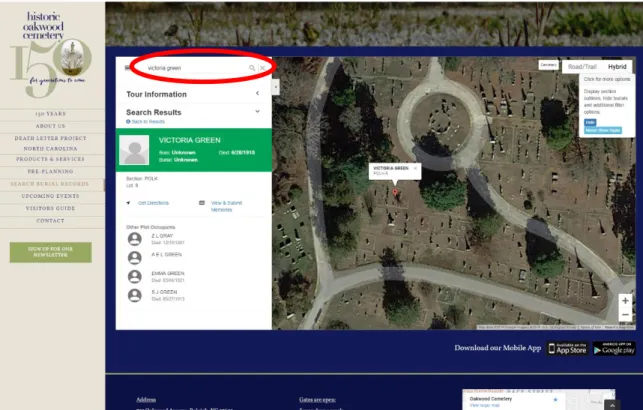
In the first usability test, which focused solely on the Oakwood Cemetery website (https://www.historicoakwoodcemetery.org), all users were able to use the sites search interface to find the deceased individual “Victoria Green”. Visual cues, such as a fairly detailed satellite view of the cemetery with graves and plots demarcated also helped the users situate themselves in the wider geographic context of the cemetery and surrounding neighborhood of East Raleigh. Even though the users were not going to visit the grave or needed the context for this test, they liked the capability of being able to find the gravestone if they so desired. This notion of capability, even in imagined scenarios such as this one, seem to have a positive impact on the users’ experience.
result, four of the nine users demonstrated difficulty finding the search bar for several seconds.
Moreover, three users expressed a desire to zoom in even further on the satellite image, perhaps even as far in so that they could read the inscriptions on the gravestone. Images of the gravestone itself also could have satisfied this desire. This underlies the seemingly common sentiment that users want and expect images, especially when considering that most graves in cemeteries have evocative visual imagery and inscriptions upon headstone and gravestones. When visual aides are a potential returned result for a given search query, such as within a cemetery website, a lack of such images may be detrimental to the search engine.
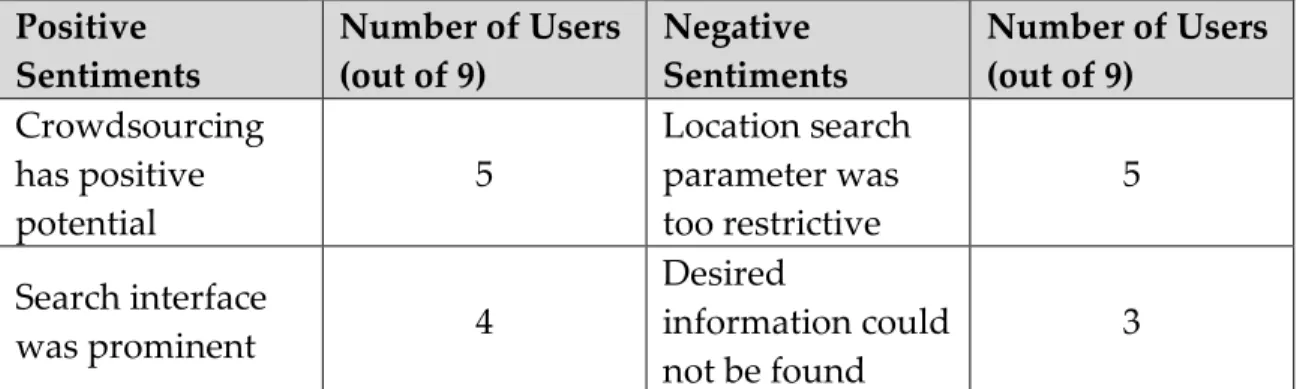
On the second site, findagrave.com, three users were actually unable to find the correct “Victoria Green” using the site’s search interface. Since the site’s data is crowdsourced from internet users across the world, its coverage is much more extensive than either of the other sites used for this usability testing. Moreover, search queries generally returned many more results on this site, requiring the user either to manually sift through long lists of returned results or to use a search parameter to filter the search results in some manner.
Positive Sentiments
Number of Users (out of 9)
Negative Sentiments
Number of Users (out of 9)
Crowdsourcing has positive potential 5 Location search parameter was too restrictive 5 Search interface
was prominent 4
Desired
information could not be found
3 Table 2 - Opinions concerning the Find-a-Grave website (https://www.findagrave.com)
restriction to users, thus resulting in three failed tasks to find Victoria Green, buried in Raleigh, North Carolina.
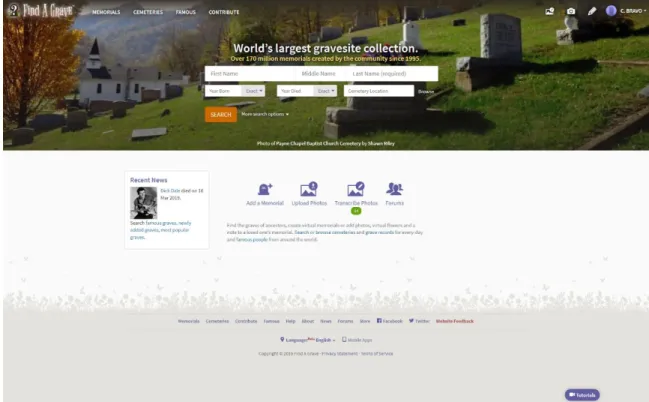
Nonetheless, many users found the simplicity of the site’s search interface to be a highly intuitive and satisfying experience. The search fields are displayed largely and centered on the site’s home page (see Figure 2). No users had any trouble locating this search interface, implying that having a search bar located centrally and as a focus to the page would make it much more obvious than having it located to the side of a page or behind a menu.
Moreover, users also expressed support for the notion of a cemetery’s data being crowdsourced from the public. While few expressed concerns about
Figure 2 - Home page of the Find-a-Grave website
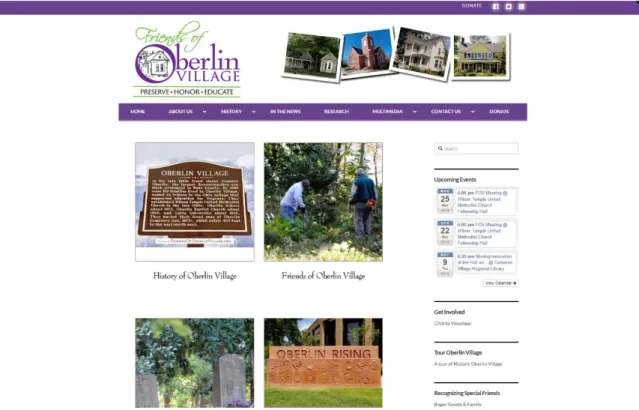
For the third website used for testing, users tried to find Victoria Green on the FOV’s organizational website, even though it does not currently have any burial records or other information about individuals buried in Oberlin Cemetery. As a result, users were instructed to explore the site as if they
expected to find information about Victoria Green on the site. Thus, they clicked on various menu items, explored a number of different pages on the site, and overall saw more of the content on this site than the other two websites.
prominence, and ample use of white space contributed to these positive opinions.
Positive Sentiments
Number of Users (out of 9)
Negative Sentiments
Number of Users (out of 9)
Pleasing
aesthetics 4
Information about the cemetery was lacking
4
Good amount of historical
information
4 The site seems
“partially done” 4 Important
information like Events is
prominent
4
The site needs more and higher quality photographs 4 Historical information needs expansion 3 Unexpected PDFs made navigation difficult 3 Table 3 - Opinions regarding the FOV website (https://friendsofoberlinvillage.org)
thus was of no use to the users of this test. Moreover, a few users expressed feeling overwhelmed by the large amount of text that the pdf file presented to them, not to mention the fact that the file took them away from the website itself, disorienting some users.
Moreover, while some users were satisfied with the historical information on the site, an equal number of users felt that the historical information on the site needed either an expansion or even a complete reorganization. The
dissatisfied users expressed that the pdf files that contain much of the historical information on the site were not wholly appropriate for casual visitors to the site. Also, as mentioned before, biographical information about individuals buried in the cemetery was not present on the site, either in the form of burial records or as more detailed biographies. Also, some users expressed dissatisfaction with the quality and number of photographs on the site.
a single article from 2013 to the present. This imbalance of the chronological representation of news items contributes to the notion that the site is not regularly maintained or is even “incomplete.”
Discussion
The users who participated in these usability tests have demonstrated very particular expectations and needs with regards to searching for a particular individual on various cemetery websites. Some of these needs mirror findings regarding more general search engines—namely, information seekers desire simple, easy-to-use interfaces and highly relevant search results. Indeed, the users of these tests preferred prominent, distinguishable search bars, relevant search results, and forgiving interfaces that allow for a wide variety of search behaviors.
There were, however, certain behaviors that distinguished the needs of those using cemetery websites from other sites. First of all, according to the results of this study, for cemetery websites, images are expected. Burials and graves are often associated with material and cultural objects such as
associated with the individual are expected to be returned along with other biographical information. In digital searches, these artifacts are manifested as digital photographs, illustrations, or some other form of visual representation.
This expectation of images of objects relating to a search query parallels the user expectations of visitors to websites of another cultural institution: museums. As noted by Skov and Ingwersen (2014), users of museum website search engines use the site in a highly visual manner. This is demonstrated by the frequent inspection of images of museum artifacts, using visual multimedia features on the site (such as photo slideshows), and exploring the museum sites through visual indices. Even when users were researching a particular topic or artifact, they preferred to interact with search results that contained images over those that did not.
Museums and cemeteries have much in common. They both contain cultural artifacts of communities from both the past and present. Many of these artifacts commemorate and memorialize both individuals and aspects of the culture to which they belonged. Indeed, museums often collect gravestones and other funerary goods that were once located in cemeteries and tombs.
It should then come to no one’s surprise that users interact with these two institutions in similar fashions. While both ultimately serve a multitude of
a web user is searching for information about a deceased individual in a
cemetery database, they are searching for that person’s memorial. In cemeteries, these memorials often come in the form of inscribed gravestones, but also as statues, obelisks, engraved tombs, and other artistic representations of that person’s life. While an information seeker may not be able to experience a
memorial on a website in the same manner as they would in person, much like a visitor to a museum website would experience a picture of a statue online
differently from viewing it in person, the expectation is that the site should replicate the experience as closely as possible. Cemeteries in their very nature are visual experiences, and their associated websites should reflect this reality.
In a similar manner, cemeteries are geographical places with areas and regions that are distinct from another. An individual grave does not exist in a vacuum; rather, they all exist in the vicinity of other graves, and physical
arrangement of these graves can also be a piece of important information that can reveal much about a person’s life. These “neighborhoods” can reveal a person’s familial relationships, when they were buried, or to which class they belonged.
use of the satellite maps and the textual listings of other individuals buried in the same plot of land.
Cemeteries are an integral component of our current societies, and this is evidenced by the proliferation of sites like Find-a-Grave (which had an estimated 14 million visitors in February 2019, according to similarweb.com). Not only is it a popular website with information seekers of deceased individuals, but it also serves as a compendium to which people can contribute their own information about the deceased to the site in order to share it with the wider public. This distribution of information that can be deeply personal and sensitive betrays a tendency in some people to place a high value on the collaborative effort to learn about human history, especially concerning one’s personal and familial history.
Cemetery websites can benefit from this human propensity by allowing users to share information on their sites as well. This information can be limited to whatever formats the site administrators are comfortable with, such as
Conclusions
The results of these observational tests have demonstrated some unique needs of visitors to cemetery websites who are looking for a deceased individual. Of course, web users may visit cemetery websites for a number of reasons
outside of researching interred individuals: inquiries into funeral services; options for purchasing burials plots for themselves or recently deceased family; and, research into wider cultural phenomena of past periods of history (such as the Normandy American Cemetery representing the events of the Normandy landings of World War II). The present study does not encompass these kinds of user behaviors and needs. Rather, this study attempts to expose the user needs of web users seeking burial records for people buried in a particular cemetery.
expectations. By doing so, cemetery websites can not only increase their own websites’ user traffic, but they can also better serve the reason for their very existence: to memorialize the dead for the living.
Bibliography
Bangor, A., Kortum, P. T., & Miller, J. T. (2008). An empirical evaluation of the system usability scale. International Journal of Human-Computer Interaction, 24(6), 574–594. https://doi.org/10.1080/10447310802205776
Benson, E., & Karger, D. R. (2014). End-users publishing structured information on the web: an observational study of what, why, and how. In Proceedings of the 32nd annual ACM conference on Human factors in computing systems - CHI ’14 (pp. 1265–1274). https://doi.org/10.1145/2556288.2557036
Crystal, A., & Ellington, B. (2004). Task analysis and human-computer interaction: approaches, techniques, and levels of analysis. In AMCIS 2004 Proceedings. Retrieved from
http://aisel.aisnet.org/amcis2004http://aisel.aisnet.org/amcis2004/391
Krug, S. (2010). Rocket Surgery Made Easy: The Do-It-Yourself Guide to Finding and Fixing Usability Problems. San Francisco: New Riders.
Krug, S. (2014). Don’t Make Me Think, Revisited. A Common Sense Approach to Web Usability. San Francisco: New Riders.
Hurley, M. L. (2013). Bringing New Life to an Old Cemetery: The Preservation of Oak Grove Cemetery for Heritage Tourism Interpretation in Nacogdoches, Texas. M.A. Thesis. Stephen F. Austin State University.
Myatt, A. J. (2010). Within the interface: Visual rhetoric, pedagogy, and writing center website design. Georgia State University. M.A. Thesis.
Rainville, L. (2009). Protecting Our Shared Heritage in African-American Cemeteries. Journal of Field Archaeology, 34(2), 196–206.
Skov, M. & Ingwersen, P. (2014). Museum Web search behavior of special interest visitors. Library & Information Science Research, 36(2), 91–98.
https://doi.org/10.1016/j.lisr.2013.11.004
Tractinsky, N. (2018). The Usability Construct: A Dead End? Human-Computer Interaction, 33(2), 131–177. https://doi.org/10.1080/07370024.2017.1298038
Voida, A. (2011). Shapeshifters in the Voluntary Sector: Exploring the Human-Centered-Computing Challenges of Nonprofit Organizations. Interactions, 18(6), 27. https://doi.org/10.1145/2029976.2029985
Appendix A: Observational Test Script
University of North Carolina at Chapel Hill Observation and Interview Script
Script Form Version Date: ___2-4-2019___ IRB Study # 18-2662
Title of Study: The Design and Development of a New Web Database for Oberlin Cemetery, Raleigh, North Carolina
Principal Investigator: Christopher Bravo
Principal Investigator Department: School of Information and Library Science Principal Investigator Phone number: (919) 962-8366
Principal Investigator Email Address: [email protected] Faculty Advisor: Fei Yu
Faculty Advisor Contact Information: (919) 451-5464
Hi, ___________.
My name is Chris, and I’m going to be walking you through this session today. I’m going to be reading off a script so that other sessions I conduct are as similar to each other as possible.
Before we begin, I have some information for you, and I’m going to read it to make sure that I cover everything.
You probably already have a good idea of why we asked you here, but let me go over it again briefly. I am asking people to test out a few different cemetery websites and share their thoughts and opinions on them. The session should take about 30-45 minutes.
As you use the site, I’m going to ask you as much as possible to try to think out loud: to say what you’re looking at, what you’re trying to do, and what you’re thinking.
Also, please don’t worry that you’re going to hurt our feelings. We’re doing this the Friends of Oberlin Village’s website, so we need to hear your honest
reactions.
If you have any questions as we go along, just ask them. I may not be able to answer them right away since we’re interested in how people do when they don’t have someone sitting next to them to help. But if you still have any
questions when we’re done I’ll try to answer them then. And if you need to take a break at any point, just let me know.
With your permission, we’re going to record what happens on the screen and our conversation. The recording will only be used to help us figure out how to improve the Friends of Oberlin Village site, and it won’t be seen by anyone except me and possibly my faculty adviser. And it helps me because I don’t have to take as many notes.
If you would, I’m going to ask you to sign an informed consent form for us. It just says that we have your permission to record you and that the screen and voice recordings will only be used by the people working on the project. All of the information I document today will not have your name on it, just a user ID number.
Give them informed consent form and a pen
While they sign it, START the SCREEN RECORDER if you are using it Open up your observation checklist to take notes with.
Do you have any questions so far?
Give them Demographic Survey Form. Collect when done.
Point browser to historicoakwoodcemetery.org homepage, findagrave.com, and friendsofoberlinvillage.org in different tabs, and press F11 to go full-screen.
Thank you!
First, we will test out the website, historicoakwoodcemetery.org. Imagine you wanted to search for your ancestor named “Victoria Green.” And you think she is buried at Oakwood Cemetery. Please search for that person now.
Allow the user to navigate the site and find “Victoria Green.” Answer any questions as well as possible.
When done, ask the following questions.
Okay, now let’s talk about this site.
• What did you find useful about this website’s interface, if anything? Could you elaborate?
• What did you find not useful about this website’s interface, if anything? Could you elaborate?
• What changes would you recommend to the site’s developers, if any? Why would you suggest these changes?
• What are your overall feelings about this website?
Now, we will move onto the next website, findagrave.com. Like last time, find your ancestor named “Victoria Green.” All you know is that she is buried somewhere in Raleigh, North Carolina.
Switch tabs to the Findagrave.com website.
Allow the user to navigate the site and find “Victoria Green.” Answer any questions as well as possible.
When done, ask the following questions.
Great! Now let’s talk about this site.
• What did you find not useful about this website’s interface, if anything? Could you elaborate?
• What changes would you recommend to the site’s developers, if any? Why would you suggest these changes?
• What are your overall feelings about this website?
Lastly, let’s visit the Friends of Oberlin Village website. All I want you to do here is navigate to the page that you would expect to be able to search for individuals buried in Oberlin Cemetery.
Switch tabs to the Friends of Oberlin Village website (friendsofoberlinvillage.org).
Allow the user to navigate to the page they would want to search through the cemetery records.
Answer any questions as well as possible. When done, ask the following questions.
Okay, just one final set of questions.
• What did you find useful about this website’s interface, if anything? Could you elaborate?
• What did you find not useful about this website’s interface, if anything? Could you elaborate?
• What changes would you recommend to the site’s developers, if any? Why would you suggest these changes?
• What are your overall feelings about this website?
Excellent work! Remember, there’s no right or wrong way to go about the tasks I just asked you to complete. Your work and think-aloud feedback were really helpful to us. That wraps up our testing session! Thank you so much for
participating. Do you have any questions for me? If you do, please reach out to me via email.
Stop the screen recorder or voice recording and save the file. Thank them and escort them out.