Hunter J. Corb. Women in the Book Trade in Revolutionary England: A Social Network Analysis. A Master’s Paper for the M.S. in L.S degree. April, 2019. 51 pages. Advisor: David Baker
The role of women in the early modern book trade is a topic of increasing emphasis and discussion among scholars of the history of the book. Many scholars have compiled extensive bibliographic entries and conducted in-depth archival research of individual women, yet their sporadic appearance in the historical record has led to a less-than-full picture of the realities of the working book trade. The researcher has used social network analysis in an attempt to answer this question by positioning and analyzing the status of women within the total book trade network of Revolutionary England. Through statistical tests such as eigenvector centrality, betweenness centrality, and community detection, the researcher has identified specific communities and important women figures in the network, as well as hubs and connecting nodes—key figures in the network—that warrant further localized attention.
Headings:
Women -- Books and reading -- England -- History
Women in the book industries and trade -- England -- History -- 17th century Social networks -- Research
WOMEN IN THE BOOK TRADE IN REVOLUTIONARY ENGLAND: A SOCIAL NETWORK ANALYSIS
by Hunter J. Corb
A Master’s paper submitted to the faculty of the School of Information and Library Science of the University of North Carolina at Chapel Hill
in partial fulfillment of the requirements for the degree of Master of Science in
Library Science.
Chapel Hill, North Carolina April 2019
Approved by
Table of Contents
Acknowledgments ... 2
Introduction ... 3
Literature Review ... 6
Methods ... 9
Data Collection ... 13
Data Analysis and Discussion ... 18
Conclusions and Further Research ... 33
Notes ... 37
Acknowledgments
There are a number of people who were instrumental in the formation of this study and to whose help I am forever grateful. Alyssa Spoonts helped to formulate the initial idea for this project and gave me express permission to run with it. Ian Gadd, Elizabeth Ott, and Kate Ozment were kind and patient enough to answer any and all questions that I posed to them regarding the subject matter in this thesis. They and their comments have been instrumental in the reworking of several sections and in pointing me to new sources which were most enlightening. David Baker has also brought to bear his comments and expertise as my thesis advisor, supervising each stage of this project from beginning to end. His keen eye for critique and argument has helped to flesh out and thoroughly revise this paper and, perhaps more importantly, push me as a scholar and as a researcher. Any errors that remain, therefore, are wholly and completely my own.
Introduction
The role of women in textual production has become a topic of increasing emphasis in recent decades, coinciding with a new focus in the history of the book to what D.F. McKenzie has termed the “sociology of texts.”1 These women tended to be “wives or widows, appearing in the historical record only when their husbands were absent from the business,”2 yet they have also been signaled in paratexts as patrons and “identified in imprints as printers, publishers, sellers and distributors of printed books and pamphlets.”3 Recent research has attempted to parse this record and give women back their voices in this history in the hopes of presenting a much broader and fuller picture of the book trade. For example, Maureen Bell has analyzed a myriad of primary source material to create a table of approximately 350 names of women who were involved in the book trade from 1557-1700 and details their relationships to it.4 These women include printers, booksellers, hawkers, and others who worked in the print shop, though only a few figures have been given a thorough investigation, such as Bell’s treatment of Hannah Allen,5 Elizabeth Calvert,6 and Mary Westwood.7 Despite this extensive list, there is an important caveat to investigating the role of women in the book trade: the lack of material available for what one can suppose is the majority of women involved in the trade in some manner. Indeed, “extant records inevitably serve only as imperfect snapshots of the complex realities of early-modern book trade practices.”8
social network analysis to effectively trace the activities of women and accurately place them within the context of the larger book trade. Social network analysis (SNA) views society through a structuralist lens and posits that “the structure of society and the relationships that form these societies are as important as the attributes of individuals in explaining what happens in society” (Jackson and Hammond 3).9 Network analysis can thus point to larger, overarching trends in the dataset, such as community identification and influential figures, that traditional archival work is simply unable to do. Network analysis, therefore, can shed light on implicit relationships embedded in the larger community. In doing so, we can show the influence and public prominence of women within the larger network, positioning and analyzing them within the data structure rather than as individual studies as has been the case previously.
Traditional archival material has thus far been used to analyze individuals or individual events in the book trade. For example, the Stationers’ Company Registers (SCR), as a list of entries detailing the intellectual and conceptual ownership of copies (licensing and rights before copyright), portrays potential business relationships between members of the trade.10 Scholars such as Helen Smith and Maureen Bell have used the SCR, other archival material from the Stationers’ Company, and early modern imprints as source material for examples of women’s activities. They have analyzed the day-to-day activities of women in the Stationers’ Company and traced the inheritance of rights of production from deceased Stationers to their widows or next of kin. Their studies
would generally continue on in the business until one of two things happened: either their sons came of age and took over the business themselves, or they married another within the Stationers’ Company.12 However, these studies have often focused too acutely on individual women and consequently may have overemphasized their overall involvement and influence. Additionally, individual case studies based on traditional archival material are quick to overshadow the larger network by focusing on minute details. The picture that we get from archival sources and the conclusions that we can draw from individual analysis alone, therefore, is incomplete.
narrative of women’s involvement in the book trade in Revolutionary England and suggests that we should be careful not to place all women within the same community of thought, role, and type. But in light of the total network, these comparatively hyper-active figures can also be said to be anomalous themselves, as the majority of women in the book trade seem to follow the established pattern of traditional domestic roles, helping the husband or son with his business rather than running one themselves, though, of course, active nonetheless. Using social network analysis and its accompanying statistical tests, therefore, I have identified specific communities and important women figures in the book trade network, as well as hubs and connecting nodes—key figures in the network—that warrant further localized attention.
Literature Review
still “their sporadic appearance in the ‘visible’ record” has led to a less-than-full picture of the concrete realities of the working book trade.13 Certainly, however, though these women were involved in some form or fashion (speaking to those hidden by the historical record), their place of prominence, (and by this I mean total influence) within the
economic sphere and the book trade in general, in an objective sense, is not large. Thus, the fact that much of the records of the day-to-day operations of these women are not available, though important to keep in mind, should be mitigated by an analysis of the larger dataset, particularly when investigating their overall influence. Yet, we must still keep in mind that correspondence, in letter or in person, and thus relationships, between the women involved in the printing houses may not be able to be determined, and therefore may limit the complete picture that we wish to acquire.
Additional work on women in the early modern book trade has been done by Helen Smith and Paula McDowell, the latter of whom deals almost exclusively with the book trade after the Restoration, though many of the women both discuss, such as Elizabeth Calvert, Hannah Allen, and Jane Bell, straddle both periods.14 McDowell generally deals in case studies, most notably her study of Elinor James, though her monograph The Women of Grub Street investigates women in the trade in the final decades of the seventeenth century and the beginning of the eighteenth and their
relationship to questions of politics and religious ideologies. She questions how women in the print trade might have been aware of themselves as having a gendered, as well as a partisan, identity.15 Helen Smith’s article, “Print[ing] Your Royal Father Off,”
Women’s influence on and within the total book trade network cannot simply be reduced to printers and booksellers, nor to wives working in their husband’s trade; they also fulfilled other roles in textual production as patrons, scribes, editors, collaborators, and co-authors, hidden work of a difficult nature to extrapolate. Additionally, they were involved in important roles in the distribution chain as hawkers and mercury women. The earliest list of names of these figures that we have found so far is from 1668 where, out of forty-four hawkers named, thirty were women.21 Additionally, the influence and status of women in the Stationers’ Company can be seen in partnerships in the English Stock, where, by 1644, over 25 per cent of shares were held by women.22 However great or small their influence on the working book trade was, their social and professional activities were important to the status and overall functioning of the Company. Indeed, “women owned businesses, managed apprentices, and ensured the safe transmission of copy,” yet the extent to which women participated in the actual mechanical means of book production remains elusive.23 However, as Smith notes, the “final responsibility for the quality of publication lay with the widow who ran the print shop,” which suggests that women as the public faces of their shops were known in the book trade community, and therefore they, and not necessarily the others who worked in their shops, had higher influence on the total book trade network.24
Methods
ground in the humanities. As it is almost solely predicated on the existence of large quantities of data, it is an especially helpful tool in creating a visualization for analyzing patterns that may not be easily seen through traditional scholarship methods. Numerous historical case studies have been conducted using this method, of particular note being Ruth Ahnert’s “Protestant letter networks in the reign of Mary I.” Ahnert takes a quantitative approach to analyzing her networks, using Franco Moretti’s concept of distant reading “to measure the relative centrality of each of its members using a range of different mathematical tools.”25 In this way, she is able “to identify the individual people and letters that require localized attention and close reading,” a result which I intend to achieve with my own network analysis.26 SNA requires a combination of traditional archival work and computational analysis, using statistical tools such as betweenness and eigenvector measures. These are quite effective for finding communities of nodes, the extent to which they interact, and influential figures within those communities.
running the same statistical tests on both sets of data and comparing the findings. For the book trade, there will always be missing information. Marten Düring, in the same
collection, investigates the reliability of centrality measures on data collected from fragmentary and heterogenous historical sources, determining how good these algorithms are at describing social reality as we reconstruct it in his case study of support networks for persecuted Jews in the Second World War.29 Düring compares the results of seven different centrality algorithms: eigenvector, betweenness, and closeness centrality; PageRank; and degree, in-degree, and out-degree. He found that for each of the six networks, each measure was rather low in its ability to identify key actors, ranging from a 27% match to 100%. Thus, Düring concludes: “no one algorithm is suitable for detecting influential actors in a network.”30 Yet, he did find two networks which the centrality algorithms worked reliably well, with most scores above 70% match. Incidentally, these networks are most similar to the book trade, concerning “a stable group of key actors interact[ing] with each other for long periods of time.”31 Accordingly, I have employed two different centrality algorithms, eigenvector and betweenness centrality, on the total network and various communities within the network as a way to check my results.
value, and ultimately ending with a dataset to test and extract our conclusions from. For the purposes of this study, I chose to create a total network for my temporal period, and defined my edges in terms of relationship type, not allowing for more than one relation to be established between two nodes, always taking the earliest established relationship as the one which is mapped. These parameters are in place because I wanted to study the network in its entirety, and I assumed that a relationship, once established, has the
potential for further collaboration. I will regard time as a non-factor. Any figure who dies will cease to connect with other nodes, and those figures which span the entirety of the period will acquire more relationships, thereby increasing in their influence and overall activity within the total network. This allows my conclusions to be valid for the book trade as a whole during this time.
I used Gephi for my network visualization, as it is an open source software for graph and network analysis which “allows for spatializing, filtering, navigating, manipulating, and clustering” of network data.33 It has been used in network analysis projects ranging from networks of biological data, analyzing flight paths and patterns, word frequency analysis, and, as in my study, historical network analysis. Gephi also is a highly extensible software, making it easy for an algorithm or tool to be added to the base platform as a plugin. Currently available plugins include multiple algorithms for
my study are: eigenvector centrality, community detection,35 and betweenness centrality,36 all of which are built into the Gephi platform.
Data Collection
The core of my data was gathered from the London Book Trades database based at the Centre for the Study of the Book at the Bodleian Library. Dr. Ian Gadd, one of the compilers of the dataset, gave me a copy of the Access database from 2007, data which I supplemented through the current web interface. Though the book trade as it is
understood by scholars today has been expanded from its historical focus on printers, stationers, and booksellers to include type-founders, engravers and illustrators, paper makers, and the like,37 I was compelled to narrow my study to printers and booksellers as primary groups in the Stationers’ Company and in consideration of their close interaction with one another.38 Using the London Book Trades dataset, I extracted all entities which were known to be active during the period 1641-1661, and their corresponding
relationships which included master/apprentice, marriage, and familial (siblings, children, and the like). I imported this information into Excel and kept two spreadsheets, Nodes and Edges, which I could easily import into Gephi when it came time to create the network. In keeping with the tab labels necessary for correct implementation in Gephi, I labelled the entities’ corresponding LBT number as their Gephi ID, and the other
The Edges table was compiled with information on relationships between nodes that I extracted from the LBT database, having a source and target node to establish the relationship. Most edges are undirected, though master/apprentice relationships were denoted as directed, with the apprentice as a source node having a directed relationship with the master as a target node. I also added a type_rel column to label each relationship type, whether master/apprentice, marriage, familial, or business, and a weight column to denote my level of certainty regarding the establishment of a particular relationship. The total number of nodes in this iteration of the network came to 3091, and the total number of edges to 3229.
names were written, whether with Master or without Master, sometimes with a full name and others with just a last, were actually denotations of ranking within the Company. Not every member of the Stationers’ Company was clothed, and when they were their name in the SCR acquired “Master” in front of it. Additionally, I assumed that apprentices were not the ones making entries in the SCR and registering copies. For relationships which I still had a degree of uncertainty about, I denoted them, in increasing certainty, with an edge weight of either 0.25, 0.5, 0.75, and 1.0. In this way, I could check the conclusions of my data analysis against a kind of null value, running statistics and data analysis with and without the uncertain nodes to see if there was any statistically significant difference in the output, as well as factoring in a measure of human error in the attribution of certain relationships. In instances of a father/son pair, I assigned these relationships to the father, especially if there is a proven history of a working relationship with another figure, though it is also possible that, before he passed on the business completely, the father would help establish his son through these prior partnerships.
Short Title Catalogue in counting women’s work, reiterating the point that “many women worked invisibly during the lives of their husbands and sons.”49 However, the example she gives, that of Richard Woodriffe and Bernard Alsoppe, lends weight to the use of imprints for determining partnerships in social network analysis. Even though one particular imprint may misattribute its own printing, the partnership attributed is still a very real one, and other imprints may indeed bear the names of Woodriffe and Alsoppe as working partners. Though using imprints to build relationships may provide examples of faulty ones, this does not detract from a figure’s individual influence, nor their
purported community of partnerships. The use of a large dataset in social network analysis nullifies those individual case studies in light of the whole.
In the same way, Maureen Bell has noted in her work on the printer Hannah Allen that her relationship with Gertrude Dawson, attested on a few imprints, might be the result of a kind of joke, given the nature of the content of the books.50 Whether this can be said to be true or not (and I think my network analysis may in fact show that a
relationship between the two is not out of the question), it does further imply the prospect that title pages may be doctored up or, at least, not entirely reliable. Indeed, there is also the added consideration of secret presses and seditious publications, many of which may not bear any evidence of who was involved in its printing. Seditious publications may provide false attributions that suggest false partnerships or be completely silent on the matter, hiding the partnerships that made such a publication possible. Additionally, it is well known that not all purported imprints have survived into the present day.51
documented elsewhere. Other areas of potential missing data are to be found in distribution groups such as hawkers, mercury women, and peddlers, who were often business nomads, having no set location or shop within which to conduct their business, and thus are mostly anonymous. Other than general figures, and this more often for a later period,52 if these figures are known at all it is by the casual mention of a name in the historic record or through ephemera such as ballads, as in the case of Margery Trundle and “Will You Buy a New Merry Booke?”53
I should also note here that I have mapped working relationships, not social or organizational. To do so would require a different area of research and a different network entirely, which is beyond the scope of this current study. Additionally, I have chosen to stick to the SCR and the secondary literature in compiling working
relationships for this network, though remaining aware of McKenzie’s estimate that only about 20% of books and pamphlets printed in 1644 were entered in the SCR, and the number decreases from there.54 There are many potential relationships not mapped that can only be found on imprints, and there are some women who never used own names on title-pages.55 Yet, for my focus, I believe that the data that I have collected will provide accurate conclusions about the nature of the book trade as a whole and will have mapped most, if not all, of the prominent partnerships. It is unlikely that there were many
Data Analysis and Discussion
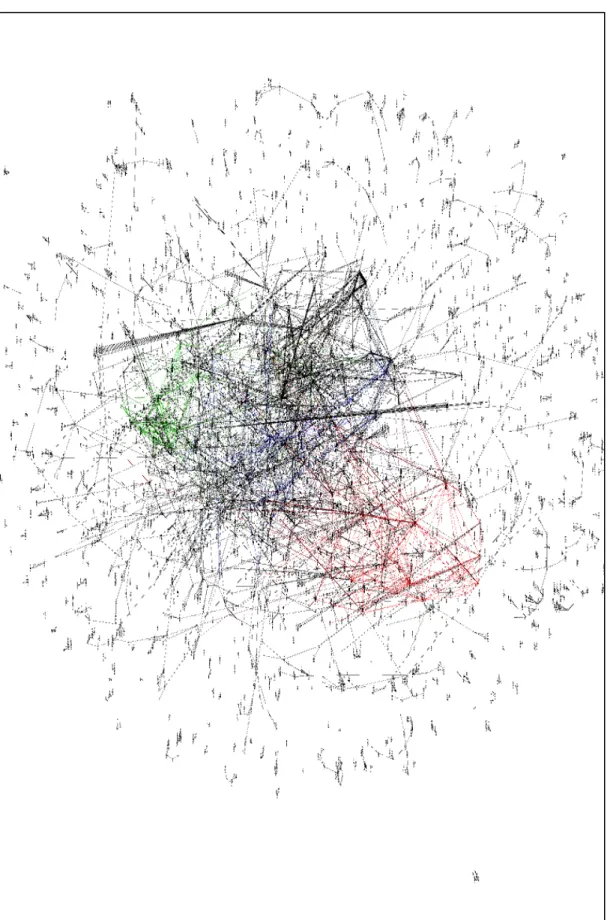
A cursory glance at the network reveals a power law at work.56 There are approximately 30-40 individuals who are shown to possess the majority of the
connections in the network, while the rest of the nodes have very few. Furthermore, there is a large number of very small, isolated node communities and individual isolated nodes, which could be extraneous nodes not a part of this particular network for temporal or other reasons (i.e. a mistake); apprentices who were bound and did not finish their apprenticeship, or who decided to pursue other trades; apprentices who were freed and, upon completing their apprenticeships, returned to their provincial hometowns having learned enough to practice their trade; or journeyman or apprentices who worked in printing houses and yet are not mentioned in the historical record.
overall connectedness and a lower value a low degree of integration and connectedness. In this way, we can determine if any communities existed within the book trade, who was a part of them, and, perhaps, along what lines they were formed. Betweenness centrality is how often a node appears on the shortest paths between nodes in the network, meaning that a node with a high betweenness centrality is more likely to appear on a path between two nodes and thus more likely to form a connection. The betweenness centrality
measure is found in Gephi as part of the average path length statistic.
At first, the major difference seems to be the fact that, in contrast with other women participating in the book trade during this time, their husbands were deceased. John Dawson, husband of Gertrude Dawson, died in 1648, Edward Brewster in 1647, and Richard Cotes in 1653. Benjamin Allen, husband of Hannah Allen, died in 1646, at which point Hannah Allen took over the business until her marriage in 1651 to Livewell
Chapman, an apprentice of Benjamin Allen who continued his apprenticeship under his widow until his freedom in November 1650. As Bell points out, she continued to remain an active participant in the book trade throughout and, indeed, after the career of her second husband. In contrast, Giles Calvert, husband of Elizabeth Calvert, continued in the trade until his death in 1663 (outside of my temporal scope), and, as the network shows, remained an influential figure throughout the period, having an eigenvector score of 0.739. It can be reasonably argued that women worked in and through their husbands while they remained alive, and it was only after their husbands were deceased and the shop and its apparatus passed to them that women were able to make a name for themselves.59
though we have no way of knowing the social side of her husband’s partnerships,
whether or not they might have helped her through introductions and the like, we see very few imprints bearing the names of these figures. Out of the 47 working relationships which I was able to glean from the SCR and imprints in the ESTC from 1641 to John Dawson’s death in 1648, and taking into account the deaths of about ¼ of these, I have found only 6 to also be linked to Gertrude Dawson: Francis Egglesfield, Henry Overton senior (through his wife, Elizabeth Overton), Ralph Mabb, John Williams, Andrew Crook, and Richard Thrale. Dawson seems to have quickly formed a network of her own in a new community, with figures such as Giles Calvert, Livewell Chapman, and George Sawbridge, adding to her overall influence within the network. Of course, if some successful entrepreneurial male printers “operated within a complex and ever-changing web of interconnectivity,” why should she not?60
shown on the network to be linked also to Eleanor Brewster. Considering Eleanor
Brewster’s obvious connectedness and influence in the book trade during this period, it is curious that the LBT does not yet have much information on her, and the BBTI does not have an entry on her at all.
Ellen Cotes, on the other hand, retained quite a few more of her husband’s
previous partnerships, a total of 12 out of the more than 40 established between the years 1641 and Edward Brewster’s death in 1653, which is quite a lot considering that
approximately ¼ of these figures can also be said to be either deceased or no longer active participants in the book trade at the time of his death. These preexisting
relationships do seem to make up the core of Cotes’s first few years of printing, including the likes of Michael Sparke junior, Henry Seile, Andrew Crook, Richard Royston, John Place, Richard Lownes, and Thomas Williams. However, there are also examples of new partnerships, such as with Nathaniel Brookes, George and Henry Eversden, and William Thompson, all within the first year of her activity. Though the partnerships inherited from her husband might have helped her in her nascent stages, they were certainly not the only business relationships she formed, even in her earliest months.
most likely to interact with. Additionally, this was a way for me to factor out isolated and loosely connected nodes to determine if these had any significant effect on my results.
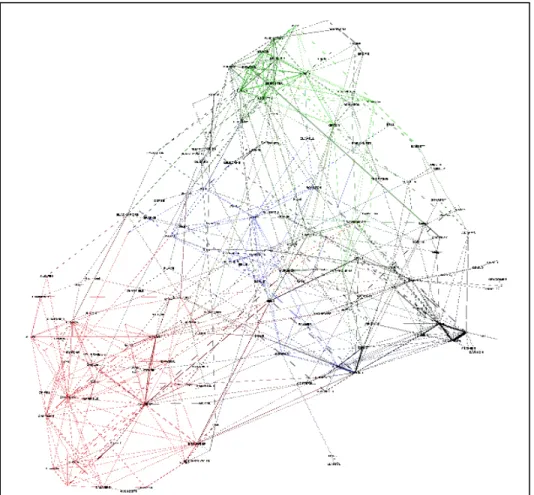
Figure 2. The top women figures and their communities compared with the central component of the network. Hannah Allen (Chapman) and Gertrude Dawson's networks are in red, Eleanor Brewster is in green, and Ellen Cotes is blue. Note also their positions as connecting nodes to other communities.
Running the community detection algorithm in Gephi, first without filtering out the stated isolated nodes and communities and with a resolution score of 1.0, I was able to find six communities of some prominence. The largest one contained approximately 74 nodes, three had between 43 and 53 nodes, and two with 11-12 nodes. The other
suggests that the book trade in Revolutionary England was a highly and sophistically integrated structure, containing a central unit with a high degree of integration which is then connected through a variety of avenues and relationships to the other parts of the network, made up of journeymen, apprentices, and links to the provincial book trade. Indeed, when I ran the modularity test, the large central component of the total network has a degree of 0.8, again indicating the high connectivity present in the network. The modularity then drops exponentially on the graph, possibly due to the copious number of individually isolated nodes and communities from the total network. To add further weight to a highly connected central unit, the eccentricity measure, the distance from any given starting node to the farthest node in the network, of all nodes within the four largest communities were between 8.0 and 11.0, whereas those nodes which are relatively
unconnected often had eccentricity scores hovering between 0.0 and 2.0.
After determining the major communities in the network, I used the k-brace filter in Gephi to remove isolates and loosely connected communities (nodes with less than one common neighbor), and then filtered out all but the three largest communities which contained the female figures with the highest eigenvector centrality score in the total network. I then proceeded to run the eigenvector measure again on each community to see if the resulting scores differed and to more fully determine the extent of women’s influence in the central portion of the network. In addition to maintaining a high
respectively. For the former, this may in part be due to the presence of Hannah Allen, Giles Calvert, and other figures with high eigenvector centrality scores in her community. However, it does suggest that Gertrude Dawson and Ellen Cotes may not have been as influential in their immediate communities as in the total network, being potential bridge figures between multiple communities; or, as another possibility, highly connected individuals with little real influence on the network. If we run the community detection algorithm again with a lower resolution score of 0.5 to get at smaller communities, Gertrude Dawson remains in the same community as Giles Calvert, John Rothwell, Hannah Allen, and Thomas Brewster, Eleanor Brewster and Elizabeth Allot are placed into a community with Richard Thrale, Nicholas Bourne, and Philemon Stevens, and Ellen Cotes is placed in a separate community with Richard Royston and Henry Seale.
characterized the output of Hannah Allen.63 On the other hand, the community which places Eleanor Brewster and Elizabeth Allot alongside such influential figures as Christopher Meredith, Philemon Stevens, Richard Thrale, and John Legatt seems to be formed along, again, printed subject matter, with Brewster, Thrale, Meredith, and Legatt being engaged in material related to Puritan tracts and religious independence (including some Calvinist works), husbandry, and domestic roles. Though related to the religious print community dominated by the Calverts and the Chapmans, their engagement in other subject matters just as much (at least, according to surviving imprints) puts them squarely in a different community. It is only when the resolution score of the community detection algorithm is increased are they then seen to be one large community melded together.64
Additionally, Ellen Cotes is placed into a community with Henry Seile, Michael Sparke senior, and Richard Royston, which interestingly are also those which figure prominently in her husband’s network. It is possible that, though Cotes did venture out into other partnerships, her husband’s preexisting relationships may be the core basis for her network.65 In any case, this community seems to be tied together by texts on religion and, bound up with that, legal and social criticism. This is a community with imprints much more focused on social and moral decay, often with a legal bent and foundation. The determination to print or publish certain texts is likely embedded in these
communities, driven at times “by what was to hand, or what they had inherited,” as in the case of Ellen Cotes, and at other times informed by more complex motivations such as religious or political ideology, as evidenced in Gertrude Dawson’s network.66
community, Giles and George Calvert resided in St. Paul’s Churchyard (at the Black Spread Eagle and Half-moon, respectively) whereas the Chapmans kept shop in Pope’s Head Alley off of Lombard Street.67 Though not very far away, all things considered, this is still some distance to traverse. Henry Overton also dwelt in Pope’s Head Alley,
whereas Gertrude Dawson was at Aldersgate near St. Bartholomew Circle and Halfmoon Tavern’s Alley, of much closer proximity to the Calverts than both Overton and the Chapmans. The second community, which includes Eleanor Brewster at Ludgate-hill, Christopher Meredith at the Crane in St. Paul’s Churchyard, Richard Thrale at Cross Keys near Paul’s Gate, and John Legatt in St. Bodolph’s Parish, is of much closer geographic proximity than the first, forming a kind of triangle on the north-west side of St. Paul’s Churchyard. The third community follow suite, with Ellen Cotes at Barbican near Aldersgate, Richard Royston at the Angel in Ivy Lane near St. Bartholomew’s Hospital, and Michael Sparke senior at the Blue Bible in Green Arbour Court on Old Bailey. The closeness in location between nodes in the second and third communities may also offer an explanation as to the highly integrated nature of the book trade network, a majority of the nodes being located in one central location, as well as give further evidence for why some nodes, and which ones, bridge communities.
Though these are solely the communities in which the most prominent women of the network figure, it is interesting to note that the book trade seems to be comprised of concentric circles of communities. With a higher resolution score in running the
and booksellers formed along ideological lines, even identifying some figures which, though predominant and highly influential in one community, may be said to bridge multiple communities and thus participate, even minimally albeit importantly, in different circles, such as John Sweeting, Gertrude Dawson, or Ellen Cotes. If we move the score even lower, below 0.5, we begin to see communities emerge which are founded upon familial ties, and even some small closely connected communities which may indicate shop partnerships, such as that between Gabriel Bedell, Thomas Collins, and Daniel Pakeman.
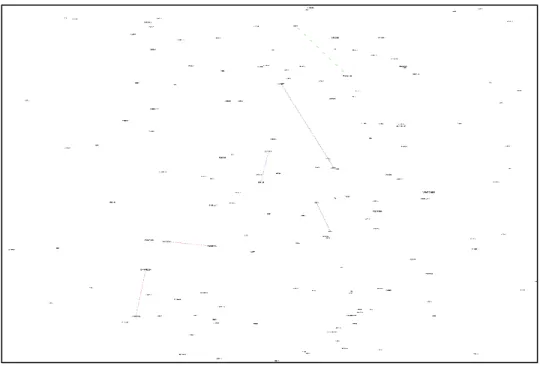
Figure 3. Women isolated in the total network. Note how very few women, according to the visible record, seem to be connected to one another.
or did not have some measure of relationship, but rather that these relationships, however important personally to these women, did not have much, if any, impact on the
functioning of the book trade as a whole. Indeed, any edges established between women shown on the network seem to be due to close working relationships between husbands in a particular community, such as that between Hannah Allen, Elizabeth Calvert, Anna Brewster, and Joan Darby who are known to have engaged together in seditious
publications, particularly when their husbands were in jail for the same and thus absent from the center of the business. While these women are known to have engaged in printing and distributing material together, they are connected first of all through their husbands.
The betweenness centrality measure for the total network further proves the highly connected nature of the central unit of the network, while simultaneously
in the total network at 1.0, has a betweenness centrality score of 0.027, barely above that of Ellen Cotes and Gertrude Dawson at 0.019 and 0.017, respectively. Hannah Allen comes in next at 0.010, her lower betweenness centrality score possibly due to her high influence and grounding in one particular community, with Eleanor Brewster much further down on the list at 0.004. Brewster’s low score, like Allen’s, can be due to her high connectedness within her immediate community combined with a sparse
connectedness to much smaller and relatively less significant communities. For
comparison, isolated nodes and node communities have a betweenness centrality score of 0.0, being not connected at all to the larger network.
Calvert. Second, that, as more nodes are added to the network, women are seen to be minor bridging figures comparatively. While Gertrude Dawson and Ellen Cotes may be significant bridging figures in their own communities (which of course form one larger community within the central unit), other figures such as John Sweeting, Thomas Underhill, and Richard Dawlman come into play. Not that the women’s significance as bridging nodes is diminished, but rather that other prominent figures in the network are
primarily connecting nodes and thus exhibit a greater degree of bridging communities than the women, who may only connect to one or two other figures in other communities.
After this first round of statistical testing and data analysis, I ran the three tests again without the uncertain nodes and compared my findings. For eigenvector centrality of the total network, all four women studied drop slightly, with Hannah Allen having a score of 0.572, Dawson with 0.527, Cotes at 0.456, and, surprisingly, Eleanor Brewster dropping down to 0.369 from her original score of 0.503. The edges which are uncertain for these figures are with potentially prominent members of the book trade, each having a high eigenvector score as well. Brewster’s drastic fall in eigenvector centrality, however, should not be taken as a sign for complete misattribution and undermining of her
prominence. The edges that are uncertain are for those figures that have alternatives also influential in the network, such as the John Clarkes and John Rothwells. Thus, though she may indeed be less of an influential figure than Gertrude Dawson and Ellen Cotes,
as a bridging figure as well, having more influence in her immediate community, yet with the potential for a reduction of her influence on the total network. With Cotes, it can be said, as before, that her immediate influence in her community is minimal, while her influence within a larger community of the book trade and on the total network is much greater. She may be an outlying figure in her immediate circle, in line with the notion that her immediate group of relationships are with her husband’s former partnerships,
rendering her a kind of outlier in the midst of a highly connected community; yet she exerts a larger influence on the total central component of the network, having
connections with high eigenvector centrality scores in a few different communities of a smaller size, but no less important. The difference in betweenness centrality scores between the two tests is negligible, with Hannah Allen dropping to 0.058, Brewster to 0.017, and Cotes to 0.287. Dawson remains the same with a score of 0.354.
Conclusions and Further Research
assertion. Furthermore, some women who became prominent after their husbands died, such as Ellen Cotes and Eleanor Brewster, continued to work along preexisting
relationships established by their husbands even while they created networks and communities of their own, as is most evident in the network of Gertrude Dawson. Considering the speed with which these women took over their husbands’ businesses, (often, it seems, in the first few weeks or months following), we must agree with Bell and Kastan that women were active in the business with their husbands long before their sudden appearance in the historical record.71 And yet, it is equally true to say that women in the book trade occupied liminal spaces while their husbands were alive. Indeed, there were gendered spaces which Coker writes of, women connected and active in the book trade in a very limited way. And, even then, these women were generally connected through their husbands.72 However, these three particular women seem to have been influential members of their respective communities, having high eigenvector and betweenness centrality scores on par with the men. Ellen Cotes and Gertrude Dawson also seem to have served as important bridging nodes for the disparate communities that make up the central unit of the book trade, connecting communities that had a
multiplicity of religious and political ties.
each instance of the partnership rather than a one-off, thereby identifying potential shop partner and providing more concrete evidence for community existence. Additionally, it would be interesting to extend the network to include those figures active in the
provincial trade. We may see new important figures to the total network, including those that may not provide heavy influence on the London book trade but that are highly connected to the provincial trade.
One goal of this exploratory study was to identify areas in the book trade for further research, specifically among women. In consideration of the conclusions above, it is important to factor in time in the development of the book trade network. While this may entail pushing the temporal scope 10 years either side in order to get the full effect of the changing network during Revolutionary England, creating a dynamic graph will allow greater insight into the formation of individual node networks, important for continuing research into Gertrude Dawson, Eleanor Brewster, and Ellen Cotes, and how women, once their husbands died, became such prominent and active participants in the book trade. Because there is no specific community of women apparent in the network, it would also be interesting to compare the growth of women’s network to that of new male figures and determine if they do indeed grow and form in a similar way. Along these same lines, extending the network past the first few decades immediately after the Restoration would allow for comparison with women in this later time period.
Restoration, it would be interesting to see how earlier women compare to these later ones, and if the former can be said to be anomalous.
Notes
1. See D. F. McKenzie, Bibliography and the Sociology of Texts (Cambridge: Cambridge University Press, 1999).
2. Gardner, Victoria. “Introduction: Practices, Perceptions and Connections” in John Hinks and Victoria Gardner (eds.), The Book Trade in Early Modern England
(Delaware: Oak Knoll Press, 2014), xi; Smith, ‘Grossly Material Things’: Women and Book Production in Early Modern England (Oxford: Oxford University Press, 2012), 111-114.
3. Bell, Maureen. “Women and the Production of Texts: The Impact of the History of the Book” in John Hinks and Victoria Gardner (eds.), The Book Trade in Early Modern England (Delaware: Oak Knoll Press, 2014), 108. The use of the term “publisher” is somewhat anachronistic in terms of our current usage, and in the early modern book trade meant something akin to “financier” or “investor,” who then went on to sell copies paid for wholesale. For further information about “publisher” as an early modern term, among other early printing terms, see
Blayney, “The Publication of Playbooks,” in John D. Cox and David Scott Kastan (eds.), A New History of Early English Drama (New York: Columbia University Press, 1997), 389-392.
4. Bell, Maureen. “Women in the English Book Trade 1557-1700.” Leipziger Jahrbuch zur Buchgeschichte 6 (Dec. 1996): 13-45.
5. Bell, Maureen. “Hannah Allen and the Development of a Puritan Publishing Business, 1646-51.” Publishing History 26 (1989): 5-66.
6. Bell, Maureen. “Elizabeth Calvert and the ‘Confederates.’” Publishing History 32 (1992): 5-49; “‘Her Usual Practices’: The Later Career of Elizabeth Calvert, 1664-75.” Publishing History 35 (1994): 5-64.
7. Bell, Maureen. “Mary Westwood, Quaker Publisher.” Publishing History 23 (1988): 5-66.
8. Kastan, David Scott. “In Plain Sight: Visible Women and Early Modern Plays” in Gordon McMullan, Lena Cowen Orlin, and Virginia Mason Vaughan (eds.),
Women Making Shakespeare: Text, Reception and Performance (London: Bloomsbury Arden Shakespeare, 2014), 48.
9. Jackson, Cornell, and Matthew Hammond. “Use of Social Network Analysis to Explore the People of Medieval Scotland” in Clare Mills, Michael Pidd, and Jessica Williams (eds.), Proceedings of the Digital Humanities Congress 2014. Studies in the Digital Humanities (Sheffield: HRI Online Publications, 2014), 3. 10.Following the 1643 Star Chamber, the Stationers’ Company made mandatory the
Routledge, 2006), 51; McKenzie, “The London Book Trade in 1644” in Peter D. McDonald and Michael F. Suarez, S.J. (eds.), Making Meaning: ‘Printers of the Mind’ and Other Essays (Amherst: University of Massachusetts Press, 2002), 131. McKenzie suggests that economic rather than political reasons motivated the lack of entries in the SCR: “a function of the increase in the number of titles published and a reduction in their length.” He goes on to note that few texts were likely to be pirated and run past a first edition, which, coupled with a 6d. fee for entering copies in the Register, provides an apt explanation.
If two or more persons entered copies together, they held a share in the rights to that copy and thus had the right to print and distribute it or assign
someone else to do so as happened frequently with publishers.10 When an owner of copies died, whether printer, publisher, or bookseller, his rights as a member of the Stationers’ Company and his rights of production would often be passed on through his widow or next of kin, upon which the widow was granted full membership in the Stationers’ Company. She then had the right to do with her property however she wished. But if she married outside of the Company, she would forfeit her rights to copies and business, which would be passed to the eligible next of kin or be subsumed into the English Stock.
11.Bell, Maureen. “Women Publishers of Puritan Literature in the Mid-Seventeenth Century: Three Case Studies.” Diss. (Loughborough University, 1987), 1.
12.For more information on the organizational structure and internal workings of the Stationers’ Company, see Blagden, The Stationers’ Company, 34-46.
13.Coker, Cait. “Gendered Spheres: Theorizing Space in the English Printing
House.” The Seventeenth Century 33.3 (2018): 328; Bell, “Women in the English Book Trade 1557-1700.”
14.Smith, Helen. ‘Grossly Material Things’: Women and Book Production in Early Modern England (Oxford: Oxford University Press, 2012); “‘Print[ing] Your Royal Father Off’: Early Modern Female Stationers and the Gendering of the British Book Trades.” Text 15 (2003): 163-186.
15.McDowell, Paula. The Women of Grub Street: Press, Politics, and Gender in the London Literary Marketplace, 1678-1730 (Oxford: Oxford University Press, 1998); “‘On Behalf of the Printers’: A Late Stuart Printer-Author and Her Causes” in Sabrina Alcorn Baron, Eric N. Lindquist, and Eleanor F. Shevlin (eds.), Agent of Change: Print Culture Studies after Elizabeth L. Eisenstein
(Amherst: University of Massachusetts Press, 2007), 125-139. 16.Smith, “‘Print[ing] Your Royal Father Off’”, 167.
17.Smith, ‘Grossly Material Things’, 111. 18.Ibid., 89.
19.Ibid., 4.
20.Bell, Maureen. “Seditious Sisterhood: Women Publishers of Opposition Literature at the Restoration” in Kate Chedgzoy, Melanie Hansen, and Suzanne Trill (eds.),
Voicing Women: Gender and Sexuality in Early Modern Writing (Edinburgh: Edinburgh University Press, 1996), 185.
21.Bell, “Women and the Production of Texts,” 117.
22.Johns, Adrian. The Nature of the Book: Print and Knowledge in the Making
23.Smith, ‘Grossly Material Things’, 96. 24.Ibid., 99.
25.Ahnert, Ruth, and Sebastian E. Ahnert. “Protestant Letter Networks in the Reign of Mary I: A Quantitative Approach.” ELH 82.1 (2015): 3.
26.Ibid., 3.
27.Peeples, Matthew A. et. al. “Analytical Challenges for the Application of Social Network Analysis in Archaeology” in Tom Brughmans, Anna Collar, and Fiona Coward (eds.), The Connected Past: Challenges to Network Studies in
Archaeology and History (Oxford: Oxford University Press, 2016), 59-84. 28.Ibid., 74.
29.Düring, Marten. “How Reliable are Centrality Measures for Data Collected from Fragmentary and Heterogenous Historical Sources? A Case Study” in Tom Brughmans, Anna Collar, and Fiona Coward (eds.), The Connected Past: Challenges to Network Studies in Archaeology and History (Oxford: Oxford University Press, 2016), 85-101.
30.Ibid., 94 31.Ibid., 94.
32.Brughmans, Tom, Anna Collar, and Fiona Coward. “Network Perspectives on the Past: Tackling the Challenges” in Tom Brughmans, Anna Collar, and Fiona Coward (eds.), The Connected Past: Challenges to Network Studies in Archaeology and History (Oxford: Oxford University Press, 2016), 10.
33.Bastian, Mathieu, Sebastien Heymann, and Mathieu Jacomy. “Gephi: An Open Source Software for Exploring and Manipulating Networks.” (Third International AAAI Conference on Weblogs and Social Media, 2009), 1.
34.Traag, V. A., L. Waltman, and N. J. van Eck. “From Louvain to Leiden: Guaranteeing Well-Connected Communities.” Scientific Reports (Nature Publishing Group) 9.1 (2019): 1-12.
35.Blondel, Vincent D., Jean-Loup Guillaume, Renaud Lambiotte, and Etienne Lefebvre. “Fast Unfolding of Communities in Large Networks.” Journal of Statistical Mechanics: Theory and Experiment (2008); Hage, Per, and Frank Harary. “Eccentricity and Centrality in Networks.” Social Networks 17 (1995): 57-63.
36.Brandes, Ulrik. “A Faster Algorithm for Betweenness Centrality.” Journal of Mathematical Sociology 25.2 (2001): 163-177.
37.Morgan, Paul. “The Provincial Book Trade Before the End of the Licensing Act” in Peter Isaac (ed.), Six Centuries of the Provincial Book Trade in Britain
(Winchester, England: St. Paul’s Bibliographies, 1990), 31.
38.Though other groups are inevitably a part of the textual production process, including its circulation and distribution, the inclusion of communities with different attributes and different relationships to these other communities would skew the results of the statistical tests and may show undue influence on the central community of printers and booksellers. However, the existence of other communities operating in the total book trade network is an important point to bear in mind.
40.Oxford University. Bodleian Libraries. Centre for the Study of the Book. The London Book Trades. The Bibliographical Society and the Oxford Bibliographical Society.
41.Stationers’ Company (London, England). A Transcript of the Registers of the Worshipful Company of Stationers; From 1640-1708 A.D, 3 vols.Ed. G. E. Briscoe Eyre. Vol. 1, 2. London, 1913.
42.Oxford University. Oxford University Press. Oxford Dictionary of National Biography. Oxford University Press.
43.The British Library. English Short Title Catalogue. The British Library. 44.Early English Books Online. Chadwyck-Healey.
45.Plomer, Henry R. A Dictionary of the Booksellers and Printers Who Were at Work in England, Scotland and Ireland from 1641 to 1667. London: for the Bibliographical Society, 1922.
46.For a freeman of the Company, part of the Yeomanry, to be clothed meant that they had become a Liveryman. See Blagden, The Stationers’ Company, 37-38. 47.Pratt, Aaron T. “Sophisticated Texts.” Keynote Lecture at the Book History
Workshop. College Station, TX. 4 Jun. 2018. 48.Smith, ‘Grossly Material Things’, 100-101. 49.Ibid., 100, footnote 58.
50.Bell, “Hannah Allen and the Development of a Puritan Publishing Business, 1646-51,” 34-35.
51.Not all purported imprints have survived today – for detailed estimates of statistics and figures, see McKenzie, “The London Book Trade in 1644,” 126-143.
52.See Margaret Spufford, Small Books and Pleasant Histories: Popular Fiction and Its Readership in Seventeenth-Century England (Athens: The University of Georgia Press, 1982), 111-128.
53.Smith, ‘Grossly Material Things’, 152-153.
54.McKenzie, “The London Book Trade in 1644,” 131. 55.Smith, “‘Print[ing] Your Royal Father Off’”, 173.
56.For an explanation of power laws in social networks, see Barabàsi, Albert-Làszlò,
Linked: The New Science of Networks (Cambridge: Perseus Publishing, 2002), 65-92.
57.Düring, “How Reliable are Centrality Measures for Data Collected from Fragmentary and Heterogenous Historical Sources?”, 99.
58.Bell, “Women Publishers of Puritan Literature in the Mid-Seventeenth Century,” iii.
59.Helen Smith notes and elaborates on this in ‘Grossly Material Things’, 102-103. 60.Gardner, “Introduction: Practices, Perceptions and Connections,” xii.
61.Ashe, Simeon. Self-surrender Unto God, Opened and Applied… (London: for E. Brewster, 1648).
62.Bell, “Seditious Sisterhood.”
63.Bell, “Hannah Allen and the Development of a Puritan Publishing Business, 1646-51,” 6.
husband’s relations, with whom she entered copies once on 10 June 1653. See
SCR vol. 1, 419.
65.We must be careful not to assume that what is true for one figure in terms of community formation and continuation must be true of all others. There are, of course, overlapping community ties as we have in our own lives, belonging to a variety of spheres, and this is no less true of figures in the book trade.
66.Smith, ‘Grossly Material Things’, 91; “‘Print[ing] Your Royal Father Off’”, 183. 67.Jenstad, Janelle. The Map of Early Modern London. The University of Victoria. 68.Brandes, Ulrik. “A Faster Algorithm for Betweenness Centrality,” 165.
69.See Smith, ‘Grossly Material Things’, 91, 93; Bell, “Women Writing and Women Written”, 443; McDowell, Women of Grub Street, 11.
70.Smith, “‘Print[ing] Your Royal Father Off’”, 177.
71.Smith quoting Bell, ‘Grossly Material Things’, 109; Kastan, “In Plain Sight,” 50. 72.Coker, “Gendered Spheres: Theorizing Space in the English Printing House.” 73.Brughmans et. al., “Network Perspectives on the Past: Tackling the Challenges,”
Bibliography
Sources for Data Collection
Bell, Maureen. “Women in the English Book Trade 1557-1700.” Leipziger Jahrbuch zur Buchgeschichte 6 (Dec. 1996): 13-45. Print.
The British Library. English Short Title Catalogue. The British Library. Web.
Early English Books Online. Chadwyck-Healey. Web.
Oxford University. Bodleian Libraries. Centre for the Study of the Book. The London Book Trades. The Bibliographical Society and the Oxford Bibliographical Society. 12 Dec. 2013. Web.
Oxford University. Bodleian Libraries. Centre for the Study of the Book. British Book Trade Index. Bodleian Libraries. Web.
Oxford University. Oxford University Press. Oxford Dictionary of National Biography. Oxford University Press. March 2019. Web.
Plomer, Henry R. A Dictionary of the Booksellers and Printers Who Were at Work in England, Scotland and Ireland from 1641 to 1667. London: for the
Stationers’ Company (London, England). A Transcript of the Registers of the Worshipful Company of Stationers; From 1640-1708 A.D. Ed. G. E. Briscoe Eyre. Vol. 1, 2. London, 1913. Print. 3 vols.
Secondary Sources
Ahnert, Ruth, and Sebastian E. Ahnert. “Protestant Letter Networks in the Reign of Mary I: A Quantitative Approach.” ELH 82.1 (2015): 1-33. Print.
Ashe, Simeon. Self-surrender Unto God, Opened and Applied… London: for E. Brewster, 1648. Print.
Barabàsi, Albert-Làszlò. Linked: The New Science of Networks. Cambridge: Perseus Publishing, 2002. Print.
Bastian, Mathieu, Sebastien Heymann, and Mathieu Jacomy. “Gephi: An Open Source Software for Exploring and Manipulating Networks.” Third International AAAI Conference on Weblogs and Social Media, 2009. Print.
Bell, Maureen. “Women and the Production of Texts: The Impact of the History of the Book.” The Book Trade in Early Modern England. Ed. John Hinks and Victoria Gardner. Delaware: Oak Knoll Press, 2014. 107-131. Print.
---. “Women Publishers of Puritan Literature in the Mid-Seventeenth Century: Three Case Studies.” Diss. Loughborough University, 1987. ProQuest Dissertations Publishing. Web.
---. “‘Her Usual Practices’: The Later Career of Elizabeth Calvert, 1664-75.” Publishing History 35 (1994): 5-64. Print.
---. “Elizabeth Calvert and the ‘Confederates.’” Publishing History 32 (1992): 5-49. Print.
---. “Mary Westwood, Quaker Publisher.” Publishing History 23 (1988): 5-66. Print.
---. “Women in the English Book Trade 1557-1700.” Leipziger Jahrbuch zur Buchgeschichte 6 (Dec. 1996): 13-45. Print.
---. “Hannah Allen and the Development of a Puritan Publishing Business, 1646-51.”
Publishing History 26 (1989): 5-66. Print.
---. “Seditious Sisterhood: Women Publishers of Opposition Literature at the
Restoration.” Voicing Women: Gender and Sexuality in Early Modern Writing.
Ed. Kate Chedgzoy, Melanie Hansen, and Suzanne Trill. Edinburgh: Edinburgh University Press, 1996. 185-195. Print.
Blagden, Cyprian. The Stationers’ Company: A History, 1403-1959. Cambridge: Harvard University Press, 1960. Print.
---. “The Stationers’ Company in the Civil War Period.” The Library 13.1 (1958): 1-17. Print.
Blayney, Peter. “The Publication of Playbooks.” A New History of Early English Drama. Ed. John D. Cox and David Scott Kastan. New York: Columbia University Press, 1997. 383-422. Print.
Blondel, Vincent D., Jean-Loup Guillaume, Renaud Lambiotte, and Etienne Lefebvre. “Fast Unfolding of Communities in Large Networks.” Journal of Statistical Mechanics: Theory and Experiment (2008). Web.
Brandes, Ulrik. “A Faster Algorithm for Betweenness Centrality.” Journal of Mathematical Sociology 25.2 (2001): 163-177. Print.
Brughmans, Tom, Anna Collar, and Fiona Coward. “Network Perspectives on the Past: Tackling the Challenges.” The Connected Past: Challenges to Network Studies in Archaeology and History. Ed. Tom Brughmans, Anna Collar, and Fiona Coward. Oxford: Oxford University Press, 2016. 3-19. Print.
Capp, Bernard. “The Book Trade and the Distribution of Print in the 1650s.” The Book Trade in Early Modern England. Ed. John Hinks and Victoria Gardner. Delaware: Oak Knoll Press, 2014. 209-228. Print.
Coker, Cait. “Gendered Spheres: Theorizing Space in the English Printing House.” The Seventeenth Century 33.3 (2018): 323-336. Print.
Connected Past: Challenges to Network Studies in Archaeology and History. Ed. Tom Brughmans, Anna Collar, and Fiona Coward. Oxford: Oxford University Press, 2016. 85-101. Print.
Feather, John. A History of British Publishing. 2nd ed. New York: Routledge, 2006. Print.
Gardner, Victoria. “Introduction: Practices, Perceptions and Connections.” The Book Trade in Early Modern England. Ed. John Hinks and Victoria Gardner. Delaware: Oak Knoll Press, 2014. vii-xv. Print.
Hage, Per, and Frank Harary. “Eccentricity and Centrality in Networks.” Social Networks
17 (1995): 57-63. Print.
Hamill, Frances. “Some Unconventional Women Before 1800: Printers, Booksellers, and Collectors.” The Papers of the Bibliographical Society of America 49.4 (1955): 300-314. Print.
Jackson, Cornell, and Matthew Hammond. “Use of Social Network Analysis to Explore the People of Medieval Scotland.” Proceedings of the Digitsal Humanities Congress 2014. Ed. Clare Mills, Michael Pidd, and Jessica Williams. Sheffield: HRI Online Publications, 2014.
Jenstad, Janelle. The Map of Early Modern London. The University of Victoria, 19 Jun. 2018. Web.
Kastan, David Scott. “In Plain Sight: Visible Women and Early Modern Plays.” Women Making Shakespeare: Text, Reception and Performance. Ed. Gordon McMullan, Lena Cowen Orlin, and Virginia Mason Vaughan. London: Bloomsbury Arden Shakespeare, 2014. 47-55. Print.
Kirk, Rudolf. “Jane Bell: Printer at the East End of Christ-church.” The Parrot Presentation Volume: Essays in Dramatic Literature. Ed. Hardin Craig. Princeton: Princeton University Press, 1935. 443-454. Print.
McDowell, Paula. The Women of Grub Street: Press, Politics, and Gender in the London Literary Marketplace, 1678-1730. Oxford: Oxford University Press, 1998. Print.
---. “‘On Behalf of the Printers’: A Late Stuart Printer-Author and Her Causes.” Agent of Change: Print Culture Studies after Elizabeth L. Eisenstein. Ed. Sabrina Alcorn Baron, Eric N. Lindquist, and Eleanor F. Shevlin. Amherst: University of Massachusetts Press, 2007. 125-139. Print.
McKenzie, D. F. “The London Book Trade in 1644.” Making Meaning: “Printers of the Mind” and Other Essays. Ed. Peter D. McDonald and Michael F. Suarez, S.J. Amherst: University of Massachusetts Press, 2002. 126-143. Print.
---. “Printing and Publishing 1557-1700: Constraints on the London Book Trades.” The Cambridge History of the Book in Britain, 7 vols. Ed. John Barnard, D. F. McKenzie, and Maureen Bell. Cambridge: Cambridge University Press, 2002. Vol. 4. 553-567. Print.
Morgan, Paul. “The Provincial Book Trade Before the End of the Licensing Act.” Six Centuries of the Provincial Book Trade in Britain. Ed. Peter Isaac. Winchester, England: St. Paul’s Bibliographies, 1990. 31-39. Print.
Peeples, Matthew A. et. al. “Analytical Challenges for the Application of Social Network Analysis in Archaeology.” The Connected Past: Challenges to Network Studies in Archaeology and History. Ed. Tom Brughmans, Anna Collar, and Fiona Coward. Oxford: Oxford University Press, 2016. 59-84. Print.
Pratt, Aaron T. “Sophisticated Texts.” Keynote Lecture at the Book History Workshop. College Station, TX. 4 Jun. 2018. Lecture.
Smith, Helen. ‘Grossly Material Things’: Women and Book Production in Early Modern England. Oxford: Oxford University Press, 2012. Print.
---. “‘Print[ing] Your Royal Father Off’: Early Modern Female Stationers and the Gendering of the British Book Trades.” Text 15 (2003): 163-186. Print.
Spufford, Margaret. Small Books and Pleasant Histories: Popular Fiction and Its Readership in Seventeenth-Century England. Athens: The University of Georgia Press, 1982. Print.
Traag, V. A., L. Waltman, and N. J. van Eck. “From Louvain to Leiden: Guaranteeing Well-Connected Communities.” Scientific Reports (Nature Publishing Group) 9.1 (2019): 1-12. Print.
van Ostade, Ingrid Tieken-Boon. “Social Network Analysis and the History of English.”
Wasserman, Stanley, and Katherine Faust. Social Network Analysis: Methods and Applications. Cambridge: Cambridge University Press, 1994. Print.
Wetherell, Charles. “Historical Social Network Analysis.” International Review of Social History 43 (1998), supplement: 125-144. Print.
Withington, Paul, and Alexandra Shepard. “Introduction: Communities in Early Modern England.” Communities in Early Modern England: Networks, Place, Rhetoric.