Understanding Writing Problems in Young Children: Contributions of Cognitive Skills to the Development of Written Expression
Amy Childress
A dissertation submitted to the faculty of the University of North Carolina at Chapel Hill in partial fulfillment of the requirements for the degree of Doctor of Philosophy in the
School of Education (School Psychology).
Chapel Hill 2011
Approved by:
Committee Chair: Barbara H. Wasik, Ph.D. Advisor: Stephen R. Hooper, Ph.D.
Reader: Steven Knotek, Ph.D. Reader: Rune Simeonsson, Ph.D.
ABSTRACT
Amy Childress: Understanding Writing Problems in Young Children: Contributions of Cognitive Skills to the Development of Written Expression
(Under the direction of Dr. Barbara H. Wasik and Dr. Stephen R. Hooper) While several models of adult writing have been proposed and studied, the development of writing skills in young children has only recently garnered attention. Using measures of fine-motor, language, working memory, and attention/executive functions, the current study explored motor and cognitive skills that may contribute to writing skill in first grade.
Structural equation modeling techniques were used to examine the Not-So-Simple View of Writing. This study addressed the following questions: (a) do the cognitive variables represented in the Not-So-Simple View of Writing contribute to text generation of students in first grade; (b) do demographic variables contribute to text generation of students in first grade; and (c) is there a hierarchy of predictive power of motor and cognitive skills for text generation of children in first grade? The structural equation modeling techniques did not result in interpretable findings due to the covariance model being underidentified and nonpositive definite.
developing students on the motor and cognitive components of fine-motor skills, language skills, attention/executive functioning skills, and working memory skills; and (b) are fine-motor skills, language, working memory, and attention/executive functions predictive of writing skill for children in first grade?
Results showed differences on measures of fine-motor skills (dominant hand dexterity), language (rapid letter naming and orthographic processing), working memory (nonverbal and verbal), and attention/executive functions (word retrieval, planning, and inhibition of response). Results of the logistic regression analysis indicated that the motor and cognitive variables were predictive of text generation performance.
ACKNOWLEDGEMENTS
Thank you to all of the people who made the completion of this dissertation possible. Dr. Hooper, my advisor, for giving me the opportunity to work with the Writing Skill Development Project and teaching me the art and science of research. Dr. Wasik, my committee chair, for supporting and guiding me throughout the process of writing this dissertation. Dr. Knotek, Dr. Simeonsson, and Dr. Ware, my committee, for reading, editing, and providing feedback on all the iterations of this document.
I owe a debt of gratitude to the Writing Skills Development Project team, Kathleen Anderson, Donna Yerby, Sean Knuth, and Lara-Jeane Costa, you all provided me with shoulders to lean on and ears to bend. Your help with obstacles big and small, personal and professional will always be remembered and appreciated.
Thanks to all of my professors for not only expanding my knowledge, but also providing me with fantastic models for how to be a professional. Thanks to all the graduate students, interns, and research assistants I have worked with over the last few years for being sounding boards and friends.
TABLE OF CONTENTS
LIST OF TABLES………...x
LIST OF FIGURES………xi
Chapter I INTRODUCTION ………. 1
Current Study ……… 5
Statement of Purpose……….. 6
Questions and Hypotheses……….. 6
II LITERATURE REVIEW ……….. 8
Introduction ……… 8
Models ……… 8
Hayes and Flower (1980) ………... 8
Hayes Model (1996)……….………. 11
Juel, Griffith, and Gough Simple View of Writing….……….. 14
Berninger and Colleagues Simple View of Writing ….……… 15
Berninger and Winn (2006) Not-So-Simple View of Writing…...17
Summary of Writing Models ……… 19
Text Generation in First Grade ………. 20
Cognitive Processes Supporting Text Generation ……… 20
Transcription ………. 20
Executive Functions ………. 23
Other Factors Influencing Writing ………..… 24
Characteristics of Children At-Risk for Writing Problems ………... 25
Conclusions ……….…... 27
III METHODS ……….…… 28
Participants ……….….... 28
Measures ……….…… 29
Criterion Measure ……….….. 29
Fine-Motor Measures ………..……… 30
Language Measures……….……... 30
Working Memory Measures.……….……….. 34
Attention/Executive Functions Measures ………... 36
Intellectual Ability Measures ………. 37
Procedures ……….. 38
Data Analysis ………. 39
Data Screening……… 43
Analyzing the Model……….. 43
Application of Data to Research Questions……….. 44
Review of Questions ……….. 44
Data Analysis ...……….. 45
IV RESULTS………..47
Data Screening………...47
Additional Exploratory Analysis of the Model………..51
Individual Path Models………..51
Analysis of Variance Method………53
Preliminary Analysis………..55
Question 1a………57
Fine Motor Skills………...57
Language Skills………..58
Attention/Executive Functioning Skills……….59
Working Memory………...60
Question 2a………61
V DISCUSSION………64
Measures………64
Additional Analysis………...67
Question 1a………68
Question 2a………72
Limitations……….73
Future Directions………...74
APPENDIX A………76
APPENDIX B………77
APPENDIX C…...……….80
LIST OF TABLES
Table
1. List of Measures: Block A …...……….………..……40
2. List of Measures: Block B………...41
3. Measures of Normality………48
4. Univariate Analysis of Fine Motor Skills………58
5. Univariate Analysis of Language Skills………..59
6. Univariate Analysis of Attention/Executive Functioning Skills………..60
7. Univariate Analysis of Working Memory………...61
LIST OF FIGURES
Figure
1. The Hayes-Flower Model………..………..10
2. The Hayes Model..………...12
3. The Simple View of Writing Model.……….……….……….17
4. The Not-So-Simple View of Writing Model...18
5. Structural Equation Model...42
6. Measures’ Alignment with the Not-So-Simple View of Writing...43
7. Measurement Model...50
8. Fine Motor Skills Path Model...51
9. Language Path Model...52
10. Attention/Executive Functions Path Model...52
ABBREVIATIONS AR……… At Risk for Writing Problems CPT……….. Continuous Performance Test
CREVT……… Comprehensive Receptive and Expressive Vocabulary Test CTOPP……… Comprehensive Test of Phonological Processing
PAL……… Process Assessment of the Learner PPVT……….. Peabody Picture Vocabulary Test RAN………... Rapid Automatized Naming SEM……… Structural Equation Modeling TD……….. Typically Developing Writing Skills WASI………. Wechsler Abbreviated Scale of Intelligence WIAT……… Wechsler Individual Achievement Test WISC……… Wechsler Intelligence Scale for Children
CHAPTER I INTRODUCTION
As humans have evolved, so has the complexity of their writing systems. Early writing systems were ideographic, using pictures and easily recognizable symbols. Then logographic systems using written signs to represent each actual spoken word evolved. The next evolution was syllabic systems, using written signs to represent syllable units. The most recent evolution was the alphabetic system, the one most languages use today (Leonard, 2001). In the United States, our system of written expression, an alphabetic system, is based on a phonological code of sound symbol relationships and is governed by rules and principles that allow us to communicate effectively with each other. As in Mesopotamia and nearly all civilizations since then, writing is an essential tool used to organize and manage not only monetary matters, but also our thoughts and opinions, our workday and personal lives, and even to entertain ourselves and others.
Lerner (1976) proposed that writing difficulties were the most prevalent communication disability. Data from both research and national statistics suggest that writing problems in early elementary education are pervasive. Berninger and Hart (1992) reported that of the 300 primary school children included in their study 1.3% to 2.7% had problems with handwriting, 3.7% to 4% had problems with spelling, and 1% to 3% had problems with written narratives. Hooper et al. (1993) found significantly higher rates of text generation problems in a large epidemiological sample of middle school students, with rates ranging from 6% to 22% depending on region of the country, gender, and ethnic status. The National Center for Education Statistics reported that only about 28% of fourth graders write at a proficient level or above, 58% write at a basic level, and 14% write below basic level (NCES, 2003). Over the past few years writing research has shown that children have trouble with the writing process from the time they begin writing in early elementary school to later in their academic careers. Having identified this problem, the question becomes how to solve it. The first step in solving the problem is having an understanding of the writing process and what factors affect writing.
Research on the writing process has revealed that, quite frankly, learning to write is hard. It is a complex process incorporating many different cognitive skills working simultaneously and in a coordinated effort to produce understandable written output. Skills ranging from those needed for low level transcription skills, higher level
of English writing. Given the great complexity of writing, it is, as Singer and Bashir (2004) observed, perhaps more surprising that there are children who do not have problems with writing.
Early writing research focused on the method of adult skilled writing (Berninger, 1996). Several theoretical models have been proposed to explain and organize the
cognitive functions involved in writing (Ellis, 1983; Kellogg, 1996; Roeltgen, 1985). One of the most recognized and influential models was developed by Hayes and Flower (1986) and then later revised by Hayes (1996, 2000). The Hayes and Flower cognitive model of writing has been influential in the field of written expression; however, little work has been done to see how the model works for elementary students who are just beginning to develop writing skills.
In the last few decades research interests have moved to questions of the normal process of writing acquisition. The initial focus on adult skilled writing has begun to shift to the developmental processes involved in learning to write (Berninger, 1996). The increased demands of educational accountability and increased funding to research efforts in literacy skills have contributed to this increase in interest. This shift is new and our understanding of the development of written expression in the early elementary school years is in its infancy (Edwards, 2003; Graham & Harris, 2005). Berninger and
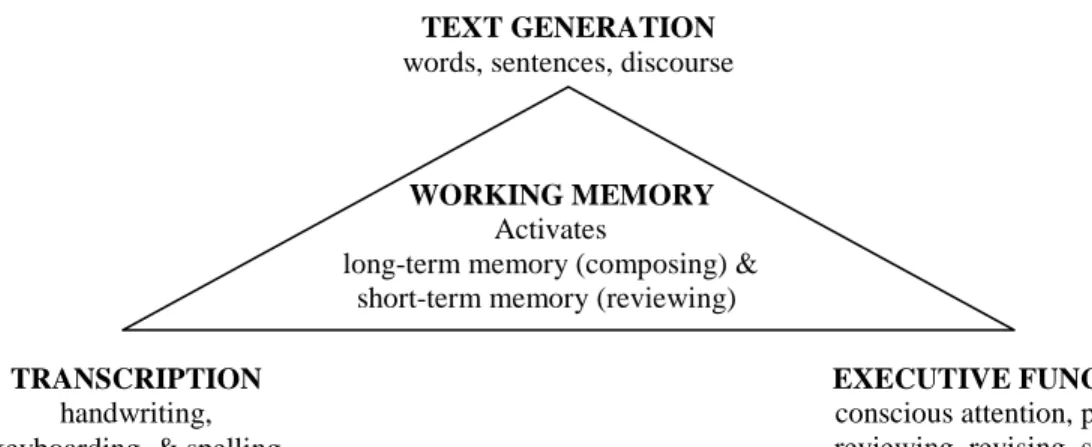
The three major components of the model are transcription, executive functions, and text generation. Transcription encompasses handwriting or letter production and spelling or word production. Executive functions necessary for writing include planning, monitoring, and revising. Text generation refers to the main writing goal of the beginning writer; which occurs at the word, sentence, and text levels. The Simple View of Writing suggests that transcription skills and executive functions support text generation in an environment of working memory (Berninger & Amtmann, 2003).
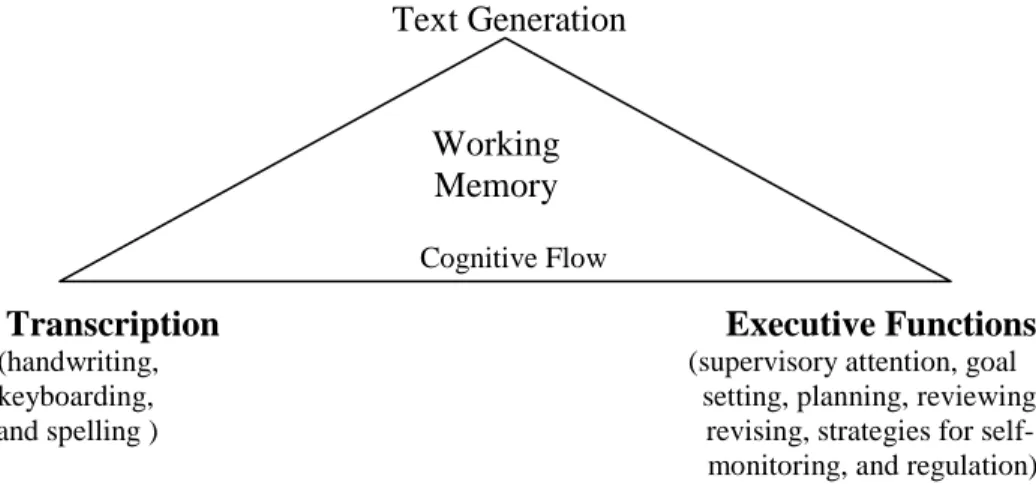
In 2006, Berninger and Winn made modifications to the Simple View of Writing resulting in the Not-So-Simple View of Writing. Findings from the application of brain scanning technology to the study of adult and developing writers contributed to the changes made in the model. The structure of the model remained the same; however, additions were made to the concepts of working memory and attention reflecting a deeper understanding of these concepts and their role in written expression. In the
Not-So-Simple View of Writing, working memory activates long-term memory during planning, composing, reviewing, and revising. Short-term memory is activated by working memory only during reviewing and revising. The Not-So-Simple View of Writing does more to define the role of supervisory attention as a system that focuses attention to allow writers to stay on task and switch between mental states as they write.
writing. During the initial stages of writing development, children will be constrained by factors related to graphomotor output (the physical act of letter formation), memory for letters and words, emergent working memory capacities, and linguistic capabilities (Berninger & Winn, 2006; Berninger et al., 1992). In order to become efficient writers, children must first master transcription skills so that lower level abilities; such as, forming letters and using correct spelling and structural forms become automatic. Automaticity with these skills frees up working memory and cognitive energy for the more demanding executive function tasks (Bruning et al., 2004). In order to develop automaticity, children need repetition and practice. For the majority of children, sufficient transcription skills will have developed by the middle of elementary school from which point writing development progresses with increased focus on text generation and attention to executive functions.
Current Study
Statement of Purpose
This study looked closely at the process of writing during early development. The motor and cognitive skills that have been shown to contribute to writing development were examined within a developmental model of writing, the Not-So-Simple View of Writing. The study served to both further understanding of what motor and cognitive skills contribute to the writing process at the beginning of writing (first grade) and how those skills differentially contribute to the process.
Questions and Hypotheses Question 1
Do the motor and cognitive variables represented in the Not-So-Simple View of Writing contribute to text generation of students in first grade?
Hypothesis 1-1: It is hypothesized that the fine-motor variable will contribute to text
generation for children in first grade.
Hypothesis 1-2: It is hypothesized that the language variable will contribute to text
generation for children in first grade.
Hypothesis 1-3: It is hypothesized that the attention/executive function variable will
contribute to text generation for children in first grade.
Hypothesis 1-4: It is hypothesized that the working memory variable will contribute to
text generation for children in first grade, as well as mediate the contribution of fine-motor, language, and attention/executive functions.
Question 2
Hypothesis 2-1: It is hypothesized that gender will contribute to text generation for
children in first grade (Berninger & Fuller, 1992; Hooper et al., 1993; NCES, 2003).
Hypothesis 2-2: It is hypothesized that race will contribute to text generation for children
in first grade (Berninger & Fuller, 1992; Hooper et al., 1993; NCES, 2003).
Hypothesis 2-3: It is hypothesized that socioeconomic status (SES), represented by
mother’s education, will contribute to text generation for children in first grade. Question 3
Is there a hierarchy of predictive power of motor and cognitive skills for text generation of children in first grade?
Hypothesis 3-1: It is hypothesized that the fine-motor variable will contribute more to
text generation than the attention/executive function variable.
Hypothesis 3-2: It is hypothesized that the language variable will contribute more to text
CHAPTER II LITERATURE REVIEW
Introduction
The study of the cognitive processes of writing does not have a long history, with interest from researchers, clinicians, and school personnel arising only in the last two to three decades (Hooper, 2002). The development of writing skills in elementary school has an even shorter timeline with our understanding of the factors contributing to written expression in young children still in its infancy (Edwards, 2003; Graham & Harris, 2005). To extend our knowledge in this area, this study has focused on understanding written expression in early elementary school children. The Not-So-Simple View of Writing (Berninger & Winn, 2006) provided a structure to explore the cognitive factors that contribute to writing skills of first grade students. In the following literature review models that contributed to the formulation of the Not-So-Simple View of Writing are examined as well as research on the cognitive components in the Not-So-Simple View of Writing and their link to written expression. Previous research on the characteristics of poor writers is also reviewed.
Models Hayes and Flower (1980)
movement, grounded in cognitive research, suggested that writing should be looked at as a process from the point of assignment to final draft (Hayes & Flower, 1986; Hayes & Flower, 1987). A cognitive based process approach to writing research focuses on the connections among thinking, learning, and writing (Hayes & Flower, 1986; Hayes & Flower, 1987) and attempts to construct a model of how these elements work together as a person writes.
In 1980, Hayes and Flower proposed a conceptual model of writing as a problem-solving process, based on their cognitive approach to writing research. Their model became the most recognized model of writing. This model was developed using protocol analysis with skilled adult writers. Protocol analysis had previously been used to identify processes in problem solving tasks (Hayes & Flower, 1980). In the Hayes and Flower study, adult writers were asked to describe the activities they engaged in as they completed an expository writing task. The writers’ descriptions were analyzed to see if the process the writers used matched the proposed model. The model was a product of two years of analyzing a number of writing protocols (Hayes & Flower, 1980).
Long-TASK ENVIRONMENT
term memory also holds discourse process knowledge. Discourse process knowledge is information about the process of writing; such as, audience design, mechanics of writing, and structures of different forms of written text. Procedural and declarative knowledge are also held in long-term memory and are essential to writing. Procedural knowledge is information about how to write: how to form letters and words, how to construct
sentences and paragraphs, how to edit, etc. Declarative knowledge is information about what to write; i.e., the factual knowledge about a subject. The task environment and writer’s long term memory are the context in which the model works (Hayes & Flower, 1980).
Figure 1. The Hayes-Flower Model (Hayes & Flower, 1980)
COGNITIVE WRITING PROCESSES Planning
-idea generation -organizing - goal setting
Translating -text generation
THE WRITER’S LONG-TERM MEMORY
Knowledge of the topic Knowledge of the Audience
Stored Writing Plans Writing
Assignment topic audience motivating cues
Text Production
Revision Reading
The writing process consists of three major processes: planning, translating, and reviewing. Planning includes generating ideas, organizing, and goal setting. The
translating process uses the writing plan to generate text that corresponds with
information in the writer’s memory. Reviewing includes reading and editing. Editing is an automatic process that can interrupt other processes as the writer recognizes potential errors or unclear writing. Reviewing only happens when a writer decides to
systematically evaluate their written product (Hayes & Flower, 1980). Hayes Model (1996)
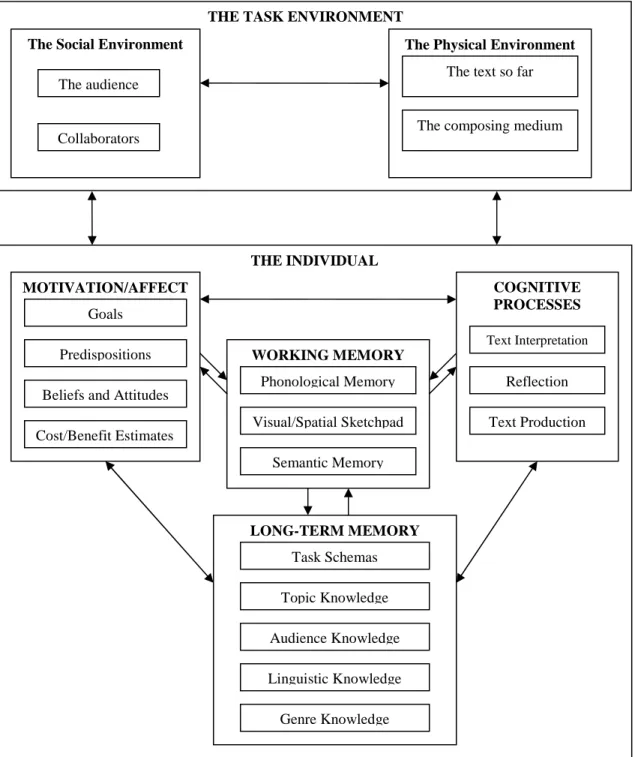
The model Hayes presented in 1996 was a reaction to research findings that had accumulated over the years since the Hayes-Flower Model had been presented. He suggested that this model was just another step in finding a model that explained writing, and intended for the model to continue to be adapted as new discoveries were made (Hayes, 1996). The Hayes Model can be described as an individual-environmental model rather than a social-cognitive model as all the elements that effect and support writing can be placed in the realm of the task environment or the individual (Hayes, 1996).
The Social Environment The Physical Environment The audience
Collaborators
The text so far
The composing medium
THE INDIVIDUAL MOTIVATION/AFFECT
Goals
Predispositions
Beliefs and Attitudes
Cost/Benefit Estimates
COGNITIVE PROCESSES
WORKING MEMORY
Text Interpretation
Reflection
Text Production Phonological Memory
Visual/Spatial Sketchpad
Semantic Memory
LONG-TERM MEMORY Task Schemas
Topic Knowledge
Audience Knowledge
Linguistic Knowledge
Genre Knowledge
Figure 2. The Hayes Model (Hayes, 1996)
labels of reflection and text production, respectively; and revision was replaced entirely by text interpretation (Hayes, 1996). These changes in cognitive processes create more general categories that have more flexibility to define the complex processes that support writing.
Working memory is where the major cognitive activity of writing takes place. This is where all the elements from long-term memory (content knowledge and discourse process knowledge), external information about the writing assignment, and new content knowledge that has not yet made its way into long-term memory, come together and are integrated to produce the physical product of the written text. Working memory has a limited capacity; only so much information can be held and manipulated in working memory at one time. Creating automaticity through repetition frees up “cognitive space” for more complex processes in working memory. In writing, the automaticity with which we form letters and words makes room in working memory for consideration of content, organization, and the recursive aspects of producing a written product.
A major revision in the Hayes Model is the revamping of the cognitive processes section. The section now includes text interpretation, reflection, and text production. Text interpretation includes cognitive processes such as reading, listening, and interpreting graphs or diagrams to create internal representations of the linguistic and graphic inputs (Hayes, 1996). Reflection encompasses the cognitive processes of problem solving, decision making, and making inferences to use the internal representation from text interpretation and produce other internal representations through integration and analysis (Hayes, 1996). Text production is the process by which the internal representations created in text interpretation and reflection are turned into written, spoken, or graphic output (Hayes, 1996).
important to understand the final result of developing writing skills in the form of adult writing, the process of development of writing skills can not be understood as simply a less complex version of adult writing (Berninger, 1996).
Juel, Griffith, and Gough Simple View of Writing
In the late 1980s, Juel, Griffith, and Gough proposed the “simple view of reading and writing” to explain the development of these skills in elementary school children. They conducted a longitudinal study with children in first through fourth grades to test the model. The researchers suggested as simple a model as they felt could explain the processes of reading and writing in an effort to see how far it would take them. They also suggested that simple models have the advantage of being easy to break apart to see what elements work and what elements are incorrect or should be modified (Juel, Griffith, & Gough, 1986).
Their simple view of writing proposed that writing is composed of spelling and ideation. While they acknowledge that each of these processes is complex, they felt that the two processes encapsulated what it takes to write. The model suggested that cipher knowledge, which they use to refer to the set of spelling-sound correspondence rules of the language, and lexical knowledge contribute to spelling ability. Phonemic awareness, which is influenced by ethnicity and oral language ability, contributes to cipher
knowledge. Exposure to print also contributes to cipher and lexical knowledge. Ideation is not outlined further in this model and is an area that is open to further investigation (Juel, Griffith, & Gough, 1986).
factor. Word-level skills such as decoding and spelling were influential in first grade writing, but as these skills became more automatic in later grades higher order processes, such as idea generation, held more influence over writing success. An additional finding of interest was that idea generation contributed to successful writing over and above the influence of IQ and oral language proficiency (e.g., listening comprehension) (Juel, Griffith, & Gough, 1986; Juel, 1988).
Berninger and Colleagues Simple View of Writing
In 1996, Berninger and colleagues proposed seven modifications to the Hayes-Flower Model of the writing process that would allow the model to address beginning and developing writing. The modifications included: (1) translation is comprised of the two separable components of text generation and transcription which may develop at different rates; (2) translation is affected by individual differences in oral language and levels of written language; (3) planning and reviewing have temporal and spatial dimensions; (4) the skills of planning, translating, and revising emerge systematically during the development of writing skills; (5) developing writers’ metacognitions about writing are not organized around the three processes in the Hayes-Flower Model; (6) working memory should be included in the model; and (7) gender differences in writing affect transcription more than translation (Berninger, 1996; Berninger et al., 1996; Swanson & Berninger, 1996). The addition of working memory was part of the Hayes Model; however, other suggested modifications were not incorporated as they apply only to the development of writing skills and not adult writing skills.
category is that the cognitive processes necessary for writing do not all emerge or develop at the same rate. Planning, translating, and revising develop along their own trajectories and are not always balanced at a given time in development. The second category is that there are additional cognitive processes and sub-processes not outlined in the Hayes-Flower Model that affect developing writing. An important addition is the distinction between text generation and transcription under the heading of translation. Text generation is the ability to translate ideas into a linguistic representation in memory. Transcription is the ability to create written symbols to signify the linguistic
representation in memory. As with planning, translating, and revising, these subprocesses of translation may develop at different rates. This results in children who have good ideas, but lack the ability to effectively convey them in writing, or children who have good transcription skills, but have trouble coming up with things to write (Swanson & Berninger, 1996).
coordinates the contributions of short-term and long-term memory. In early stages of development, transcription plays a larger role in text generation. As children get older, many transcription skills become automatic and executive functions begin to take a larger role in the writing process (Berninger & Amtmann, 2003).
WORKING MEMORY Activates
long-term memory (composing) & short-term memory (reviewing)
Figure 3. The Simple View of Writing Model (Berninger & Amtmann, 2003)
Berninger and Winn (2006) Not-So-Simple View of Writing
The development of brain scanning technology starting in the 1980s has contributed to writing research by being applied to the study of adult writers and, to a lesser extent, developing writers. An accumulation of findings from brain imaging technology led to Berninger and Winn’s (2006) additions to the Simple View of Writing, resulting in the Not-So-Simple View of Writing (Figure 4). The modifications reflect a deeper understanding of the role of working memory and the role of attention within the executive functions domain.
TEXT GENERATION words, sentences, discourse
TRANSCRIPTION handwriting, keyboarding & spelling
EXECUTIVE FUNCTIONS conscious attention, planning, reviewing, revising, strategies
Text Generation Working Memory
Cognitive Flow
Transcription Executive Functions
(handwriting, (supervisory attention, goal keyboarding, setting, planning, reviewing,
and spelling ) revising, strategies for self- monitoring, and regulation)
Figure 4. The Not-So-Simple View of Writing Model (Berninger & Winn 2006)
Two additions were made in the relationship of working memory to other
segments of written expression. The first outlines the differences between short-term and long-term memory and their contribution to the writing process. Working memory
activates long-term memory during the processes of planning, composing, reviewing, and revising; whereas, short-term memory is activated only during reviewing and revising. The second addition to working memory is the breakdown of the components of working memory. These components include “… (1) orthographic, phonological, and
morphological storage units for verbal information, (2) a phonological loop for learning words and maintaining verbal information actively in working memory, and (3) executive supports that link verbal working memory with the general executive system (a
and switch between mental states as they engage in the act of writing (Berninger & Winn, 2006).
Summary of Writing Models
The writing models discussed use a cognitive based approach to studying writing that focuses on the connections among thinking, learning, and writing. The Hayes-Flower Model and the Hayes Model provide a framework for thinking about how expert adult writers take in, process and out-put information during the process of writing. In the more recent Hayes Model, the cognitive processes include text interpretation, reflection, and text production. Working memory and long-term memory are also included in the model, and working memory is recognized as where the major cognitive activity takes place (Hayes, 1996).
Text Generation in First Grade
Text generation is typically thought of as functioning on three levels: word, sentence, and text. Writers differ in their strengths and weaknesses across these levels of text generation (Berninger, 2000). First grade writers are just beginning to develop the skills necessary to generate text at the word, sentence, and text levels, and these skills are developing at different rates. Even within the broad areas of transcription and executive functions, sub-processes have differential developmental trajectories. Within
transcription, handwriting skills tend to develop quicker than the linguistic skills
necessary for spelling (Berninger, 2000). Executive functions are in their infancy in first grade student and require a great deal of scaffolding from adults (Berninger, 2000). Working memory is a limited capacity system that may not have reached its full capacity at this young age, particularly in at-risk writers (McCutchen, 1996). For these reasons, compositions in first grade generally consist of a single clause, a complex sentence, or a few related sentences and clauses (Berninger, 2000; Traweek & Berninger, 1997). According to the Not-So-Simple View of Writing, as skills in the areas of transcription, working memory, and executive functions develop, text generation will become more fluent and better organized.
Cognitive Processes Supporting Text Generation Transcription
component of writing requires skills in two areas: graphomotor and linguistics.
Graphomotor skills, including fine-motor skills, indirectly affect transcription. Linguistic skills, including orthographic and phonological skills, directly affect transcription
(Abbott & Berninger, 1993; Swanson & Berninger, 1996).
Graphomotor skills are the skills that allow us to create the ultimate goal of the writing process; i.e., written output. Without the development of these low-level motor skills, it is impossible to demonstrate the higher-order skill of writing. The development of graphomotor skills applied to writing begins with a child’s discovery that he or she can leave a mark with a writing instrument. From there, skills develop through a predictable course: random scribbling, zigzag lines, letter-like marks, true letters, single words, clauses, and sentences (Gibson & Levin, 1975; Traweek & Berninger, 1997, Berninger, 2000). Initially children learn to form letters accurately, and then automatically. The automaticity of letter production allows writing to take place with little cognitive energy spent on forming letters. This allows more energy to be spent on higher-order cognitive processes (Berninger et al., 1991, Berninger, 2002).
Working Memory
In both the Not-So-Simple View of Writing and the Hayes Model of adult writing, working memory is identified as a critical component of the writing process. The Not-So-Simple View of Writing places working memory in the center of the triangle to represent its central role as the environment in which the coordination of the other cognitive skills takes place. Working memory develops during the elementary school years (Berninger et al., 1994; Berninger, 2000). Short-term memory and long-term memory are accessed via working memory for processing during text generation (Berninger, 2000; McCutchen, 1996; Swanson & Berninger, 1996).
Both the adult model and the developmental model use Baddeley’s (1990) model of working memory to conceptualize the process. This model is comprised of a
Working memory draws information from short-term memory and long-term memory to be processed and used in writing. Short-term memory briefly stores incoming information including word recognition and transcription during the reviewing and revising processes (Berninger et al., 1991; Swanson & Berninger, 1996). Long-term memory includes content knowledge, which is a source for domain-specific idea
generation and discourse structure knowledge, which provides a mechanism for schemas for different genres of writing (Berninger, 2000).
Executive Functions
In the Not-So-Simple View of Writing, executive functions include supervisory attention, goal setting, planning, reviewing, revising, strategies for self-monitoring, and the overall regulation of writing (Berninger & Winn, 2006). These components are the higher-order skills that help a writer compose an organized, cohesive, and understandable written output. Evidence from adult writers indicate that expert writers are goal directed and move recursively through the Hayes and Flower’s steps of planning, translating, and revising. They are able to continuously evaluate their output for its relevance in meeting proximal and distal goals. Poor writers produce unorganized text at both sentence and paragraph levels, and are not as likely to revise (Hooper et al., 2002).
Relatively little research has looked into the role of executive functions in the developing writer. Graham and colleagues have used their empirically-based findings to develop an intervention targeting self-regulation, Self-Regulated Strategy Development (SRSD). Their model has aided students in the development of reflective writing
students using Denckla’s (1996) four-factor model of executive functions. In this model executive functions included initiating behavior, sustaining behavior, inhibiting/stopping behavior, and set-shifting. Initiating includes organizing and planning activities.
Sustaining behavior relies on regulating attention to continue a task. Inhibiting/stopping behavior is the ability to refrain from inappropriate or distracting behavior. Set-shifting is related to cognitive flexibility and self-monitoring. Findings from this study suggested that the executive functions of initiation, set-shifting, and sustaining behavior separate good from poor writers in elementary school (Hooper et al., 2002).
Executive functions are a higher-order set of cognitive skills, and are likely to be less influential to writing during the early years. Most studies of executive functions and writing, including those mentioned above, have used children in upper elementary school or above. Hooper and colleagues (2002) reported moderate effect sizes and this may be, in part, because of the age of the children. Executive functions are expected to be present in early elementary school students; however, they are just developing and require a great deal of scaffolding from adults (Berninger, 2002).
Other Factors Influencing Writing
As the Hayes Model demonstrates, writing is an interaction between the
individual and the environment. Although the model is intended to describe adult writers, the influence of environment on writing extends to developing writers. There are
continue to show males as less proficient than females (Berninger & Fuller, 1992; Hooper et al., 1993) and Caucasian students more proficient than African American and Hispanic peers (Hooper et al., 1993; NCES, 2003).
In general, children from higher socioeconomic strata or with parents who are highly educated are more likely to perform better in school (Duncan & Brooks-Gunn, 1997; Perez-Johnson & Maynard, 2007). These general findings have not been applied directly to written expression performance; however, it may be that the influence of socioeconomic factors can be explained by exposure to prewriting skills. Children in homes or preschools where prewriting skills such as letter formations and exposure to print are stressed enter school in a better position to move forward with writing skill development. Students who enter school without these advantages begin building literacy skills later than children who have had prewriting experience.
There is evidence that academic performance in school is also affected by the relationship between students and teachers. Teacher’s perception of their relationship with students has been shown to be an important factor in early academic progress (Burchinal et al., 2002). The teacher-student relationship’s effect on writing skill development has not been explored. The pursuit of an explanation for the influence of gender, race/ethnicity, socioeconomic status, and teacher-student relationship to the development of writing skills is important, but little data are available for this part of the model.
Characteristics of Children At-Risk for Writing Problems
several constraints that can limit writing development including limited instruction, poor oral language abilities, cognitive deficits, limited cultural experiences, delayed neural or motor development, and poor motivation. Some research has been done to look at delays or deficits in cognitive skills that are characteristic of poor writers at different
developmental stages. Early in writing development (early elementary school) neurodevelopmental constraints in orthographic coding, fine-motor function and
orthographic-motor integration are likely to interfere with rapid and automatic production of written language. In the intermediate grades, writing is constrained by verbal working memory and the ability to generate word, sentence, or text-level structures. At the junior-high school level, problems with planning, translating, and revising constrain writing (Berninger & Rutberg, 1992).
In the first grade, it is expected that fine-motor skills and orthography skills will constrain writing. Higher-order cognitive skills have not developed in children this young and; therefore, are not expected to be used in developmentally appropriate writing
assignments. The absence or delay of fine-motor skills that allow a child to hold a pencil and write affects current writing performance and constrains the acquisition of writing skills (Berninger & Rutberg, 1992). If a child has to devote a lot of cognitive energy to the task of manipulating the pencil, he or she is less likely to be able to attend to what is being written. This can delay the development of letter writing automaticity and
Conclusions
The study of the cognitive processes that are necessary for writing and how they are coordinated has led to the development of several models of writing. Each model builds on new research to further our understanding of writing. These models can be used as a framework to study the development of writing. The Not-So-Simple View of Writing is a model that strives to explain how children generate text through the coordination of transcription skills and executive functions in an environment of working memory. Some evidence has been found to support these elements as the primary processes at work in developing writers. Research has suggested that deficits in fine-motor skills and orthographic skills constrain early writing, deficits in memory constrain writing in the intermediate years, and deficits in executive functions, such as planning, constrain later writing (Berninger & Rutberg, 1992). This study adds to the, as yet small, body of research on how young writers’ skills in the areas of transcription (fine-motor and
CHAPTER III METHODS Participants
Participants were recruited from a single suburban-rural public school district. The sample was drawn from a single school district to prevent potential differences that may arise from implementation of curriculum and instructional practices in different school districts. All seven elementary schools in the school district participated in the study resulting in the initial screening of 950 first-graders in 54 classes. The Written Expression subtest of the Wechsler Individual Achievement Test – Second Edition (WIAT-II; Wechsler, 2002) was used as a screening tool to identify students at-risk for written expression problems. In accordance with the IRB proposal (Appendix A), a letter describing the study, two consent forms, and a flyer were sent home via the backpack to families whose children met at-risk criteria from the screening. In compliance with the school district administration, students receiving the lowest scores on the WIAT-II Written Expression subtest were recruited first for the study. In total 545 students,
including all students meeting at-risk criteria during screening, were recruited and 223 of the 545 had parents sign consent forms. Scheduling conflicts resulted in dropping 17 students from the study.
their primary language. The sample included 118 (57%) males and 88 (43%) females. Information on race and maternal education was gathered through parent reports. Maternal education was used as a measure of socioeconomic status.
Measures Criterion Measure
The Wechsler Individual Achievement Test – Second Edition form A (WIAT-II; Wechsler, 2002) Written Expression Grade-Based Composite score was used as the criterion measure to identify students as at-risk for written expression problems or typically developing in the area of written expression. The WIAT-II Written Expression Composite measures individual achievement skills in the areas of handwriting, timed alphabet writing, written word fluency, and sentence combining. Reported inter-item reliability is strong (grade 1 r = 0.91; Wechsler, 2002). Content validity was monitored through the participation of subject area expert judges during the development of the WIAT-II. Item Response Theory methods were also used to document empirical
Fine-Motor Measures
The Process Assessment of the Learner: Test Battery for Reading and Writing (PAL; Berninger, 2001) Finger Sense-Finger Succession subtest was used as a measure of fine-motor control. Students were asked to hold their hands up by their ears (out of their line of vision) and touch each finger to their thumb. A raw score was generated by recording the time it took for the students to complete five rounds of touching each finger to their thumb. Scores were obtained for their dominant hand (the hand they wrote with) and their nondominant hand. These raw scores were converted into decile scores from the published normative data. This measure has been found to be a strong predictor of
handwriting, spelling, and writing skills acquisition for elementary school children (Berninger et al., 1992). Reported reliability coefficients for this measure are strong (dominant hand r = 0.89, nondominant hand r = 0.87; Berninger, 2001). The validity of the Finger Succession subtest as a measure of writing ability was supported by a study of 300 primary-grade students. The results of the study showed that Finger Succession correlated significantly with both handwriting (dominant hand r = -0.32, nondominant hand r = -0.33) and narrative compositional fluency (dominant hand r = -0.31,
nondominant hand r = -.30; Berninger & Rutberg, 1992). Language Measures
The assessment of language ability included measures of basic phonological awareness, receptive vocabulary skills, orthographic processing, and orthographic-phonological coordination. The Comprehensive Test of Phonological Processing
scores were translated into scaled scores in accordance with the test manual. Reported content sampling alpha coefficients are strong (age 6 r = 0.92, age 7 r = 0.91, age 8 r = 0.89; Wagner et al., 1999). Validity studies during test development used item
discrimination and difficulty statistics, parameters in Item Response Theory models, and examination of item and test information to identify unsatisfactory items, which were removed from the test. Criterion validity studies included comparison studies with other measures of language ability. The correlation between the CTOPP Elision subtest and the Woodcock Reading Mastery Tests-Revised (WRMT-R) Word Analysis subtest was .74, and between the CTOPP Elision subtest and the WRMT-R Word Identification subtest was .73. The correlation between the CTOPP Elision subtest and the Test of Word Reading Efficiency (TOWRE) Sight Word Efficiency subtest was .67, and between the CTOPP Elision subtest and the TOWRE Phonetic Decoding Efficiency subtest was .68 (Wagner et al., 1999).
After the first year of assessment, the CTOPP Elision subtest was removed from the test battery at the request of the school district because of its use by school
ensure content validity. Construct validity was examined with comparison studies with tests that measure similar constructs. One study compared the PAL subtests with WIAT-II subtests. The correlation between the PAL Syllable subtest and the WIAT-WIAT-II Written Expression subtest was .30, and the correlation between the Syllable subtest and the WIAT-II Pseudoword Decoding subtest was .49. The correlation between the PAL Phoneme subtest and the WIAT-II Written Expression subtest was .50, and the
correlation between the Phoneme subtest and the WIAT-II Pseudoword Decoding subtest was .56 (Berninger, 2001).
The Peabody Picture Vocabulary Test – Forth Edition (PPVT-IV; Dunn & Dunn, 2007) was administered to measure the participants’ receptive vocabulary skills.
Participants are shown a sheet with several pictures and asked to point to the picture that matches the word the examiner says. Standard scores were generated from the raw scores according to the test’s published normative tables. Reported alpha coefficients indicate strong reliability of the test (age 6:0-6:5 α = 0.97, age 6:6-6:11 α = 0.94, age 7 α = 0.94, age 8 α = 0.99; Dunn & Dunn, 2007). Convergent evidence of construct validity was reported through the results of correlation studies with other tests of expressive
vocabulary and language ability, and reading achievement. The correlation between the PPVT-IV and the Expressive Vocabulary Test, 2nd edition (EVT-2) is .84 for ages 5-6 and .80 for ages 7-10. The correlation between the PPVT-IV and the Clinical Evaluation of Language Fundamentals, 4th edition (CELF-4) is .67 for receptive language in the age range 5-8 (Dunn & Dunn, 2007).
battery of tests in the second year of the study to replace the PPVT-IV. The PPVT-IV was removed at the request of the school district because of its use by school
psychologists. The CREVT-2 was chosen to replace the PPVT-IV because it measures receptive vocabulary using a similar method. Participants are presented with different plates of several pictures from different categories (i.e., animals) and asked to point to the picture that goes with stimulus words. Reported reliability alpha coefficients are strong (age 6 α = .88, age 7 α = .91, age 8 α = .91). Evidence of validity includes correlation studies with other language measures. The CREVT-2 has a reported correlation of .59 with the PPVT-IV, .66 with the Wechsler Intelligence Scale for Children – 3rd edition (WISC-III) Vocabulary test, and .74 with the Clinical Evaluations of Language Fundamentals (CELF-R) (Wallace & Hammill, 2002).
The PAL Rapid Automatized Naming (RAN) Letters or Digits subtest measures orthographic-phonological coordination through the rapid automatized naming of letters or digits. Decile scores were generated from raw scores using the test’s published
normative tables. Reported stability coefficients for this task’s scores were strong (letters
r = 0.92, digits r = 0.84; Berninger, 2001). To demonstrate content validity expert judges
and empirical item analysis were used during the development of the PAL. Construct validity was examined with comparison studies with tests that measure similar constructs. One study compared the PAL subtests with WIAT-II subtests. The correlation between the PAL RAN subtest and the WIAT-II Written Expression subtest was -0.78. The correlation between the PAL RAN subtest and the WIAT-II Pseudoword Decoding subtest was -0.72 (Berninger, 2001).
Working Memory Measures
Working memory in the visual and auditory mode was assessed. The Wechsler Intelligence Scale for Children – Fourth Edition Integrated (WISC-IV-I; Wechsler, Kaplan, Fein, Kramer, Morris, Delis, & Maerlender, 2004) Spatial Span subtest measures visual-spatial working memory. After assessors tapped blocks in a certain order,
Language Fundamentals, 4th edition (CELF-4) was conducted with children with language disorders. The result of the Working Memory Index (including Spatial Span) comparison was a correlation of .69 (WISC-IV-I; Wechsler et al., 2004).
The Comprehensive Test of Phonological Processing (CTOPP; Wagner, Torgesen, & Rashotle, 1999) Nonword Repetition subtest measures auditory memory. Participants were asked to repeat fictitious words after hearing them from a recording. Scaled scores were generated from the raw scores according to the measure’s published standardization tables. Content sampling reliability alpha coefficients were strong for CTOPP Nonword Repetition (age6 α = 0.80, age 7 α = 0.80, age 8 α = 0.80; Wagner et. al., 1999). During the development of the test, content validity was evaluated using item discrimination and difficulty statistics, parameters in Item Response Theory models, and examination of item and test information to identify unsatisfactory items, which were removed from the test. Results of a confirmatory factor analysis of the CTOPP showed that the Nonword Repetition subtest loaded on the same factor as the Memory for Digits subtest, which created the Phonological Memory factor. The result of the confirmatory factor analysis provided evidence for the validity of using the Nonword Repetition subtest as a measure of auditory memory (Wagner et al., 1999).
moderate (age 6 DSpF r = 0.83, DSpB r = 0.83, age 7 DSpF r = 0.79, DSpB r = 0.69, age 8 DSpF r = 0.82, DSpB r = 0.68; Wechsler et al., 2004). Research studies, review of theoretical literature, and expert reviews were utilized during the development of the test to support the validity of the measure. The results of a comparison study with the Clinical Evaluation of Language Fundamentals, 4th edition (CELF-4) included a Working
Memory Index (including Digit Span) comparison, and a correlation of .69 was found (WISC-IV-I; Wechsler, Kaplan, Fein, Kramer, Morris, Delis, & Maerlender, 2004). Attention/Executive Functions Measures
Sustained attention, speed and consistency of responding, and response inhibition in the visual mode were examined using the Vigil Continuous Performance Test (Vigil CPT; Psychological Corporation, 1998). Using a laptop computer, the test showed a series of letters in which participants were asked to press the spacebar in response to seeing a certain sequence of letters (AK). Age-based standard scores were generated by the computer scoring program. The reported reliability estimates for errors of omission, errors of commission, and reaction time were good (omissions α = .91, commissions, α = .956, reaction time α = .896; Psychological Corporation, 1998). A comparison study with other tests of attention was performed to provide evidence of validity. In one study, the Vigil CPT and the Stop Signal Task (SST) had a correlation coefficient of .648 for errors of omission and a .337 for errors of commission.
Intellectual Ability Measures
Reading, r = .66 with Math, r = .63 with Language, r = .72 with Writing; Wechsler et al., 2004).
Procedures
The parents of all first grade students in a single school district in North Carolina were invited to have their child participate in a fifteen minute group screening assessment of written expression skills. All of the first graders who participated in the initial
screening (950) were tested within their class groups (20-25 students per group). The WIAT-II Written Expression subtest was used as the screening assessment. The results of the screening were used to tentatively place students in at-risk and typically developing groups for written expression. After receiving parent consent for the study, the children were assessed during their first grade year with the administration of a battery of neuropsychological and cognitive assessments. All measures in the battery were
administered, scored, and standardized according to their published test manuals. Trained researchers and graduate students administered and scored the measures. The measures were also second scored by a researcher or graduate student that had not originally administered the measure. The Frank Porter Graham Child Development Institute (FPG) Data Management and Analysis Center double-entered the raw scores and standardized the scores (e.g., standard score, scaled score) according to each measure’s published norms.
(WASI) Vocabulary and Matrix Reasoning subtests; the Wechsler Individual
Achievement Test – Second Edition, form A (WIAT-II) Reading and Written Expression subtests; the Process Assessment of the Learner: Test Battery for Reading and Writing (PAL) RAN, Finger Succession, and Word Choice subtests, the Peabody Picture Vocabulary Test – Fourth Edition (PPVT-IV), and the Wechsler Intelligence Scale for Children - Fourth Edition Integrated (WISC-IV-I) Spatial Span. Block B consisted of the Wide Range Assessment of Memory and Learning – Second Edition (WRAML-2)
Picture Memory Immediate and Delayed Recognition and Story Memory Immediate and Delayed Recognition subtests, the Woodcock Johnson III Tests of Cognitive Abilities (WJ-III Cog) Planning and Retrieval Fluency subtests, the Comprehensive Test of Phonological Processing (CTOPP) Elision and Nonword Repetition subtests, and the Vigil Continuous Performance Test (Vigil CPT). After the first year of data collection, The CTOPP Elision subtest was replaced by the PAL Syllable and Phoneme subtests. The PPVT-IV was replaced by the Comprehensive Receptive and Expressive Vocabulary Test – Second Edition (CREVT-2) Receptive Vocabulary subtest. The CTOPP Nonword Repetition subtest was replaced by the WISC-IV-I Digit Span subtest. This new battery of assessments was used to collect data from the cohort 2 first graders in the second year of the study. The list of measures separated in blocks and listed in the order presented is in Tables 1 and 2.
Data Analysis
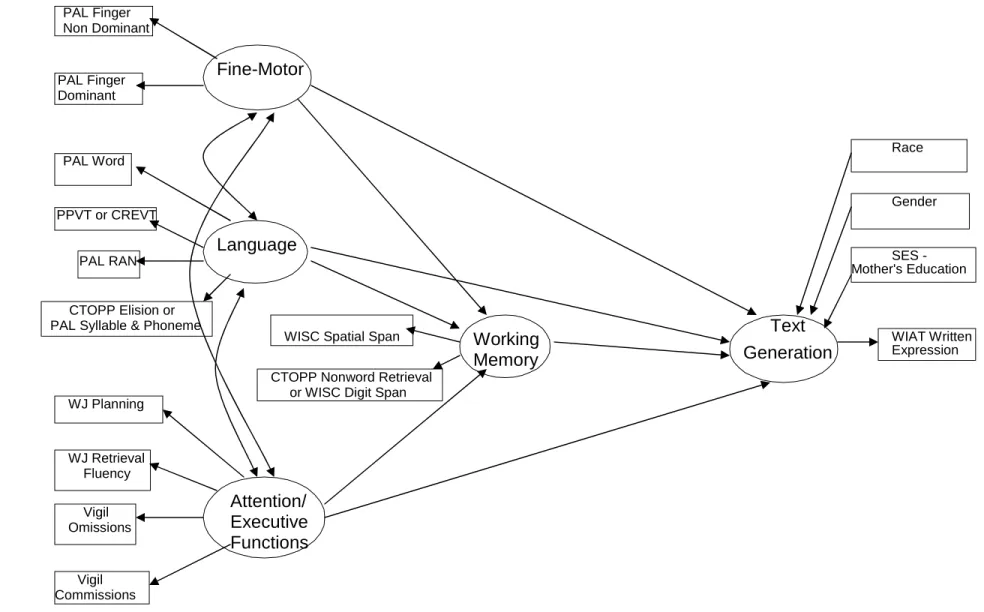
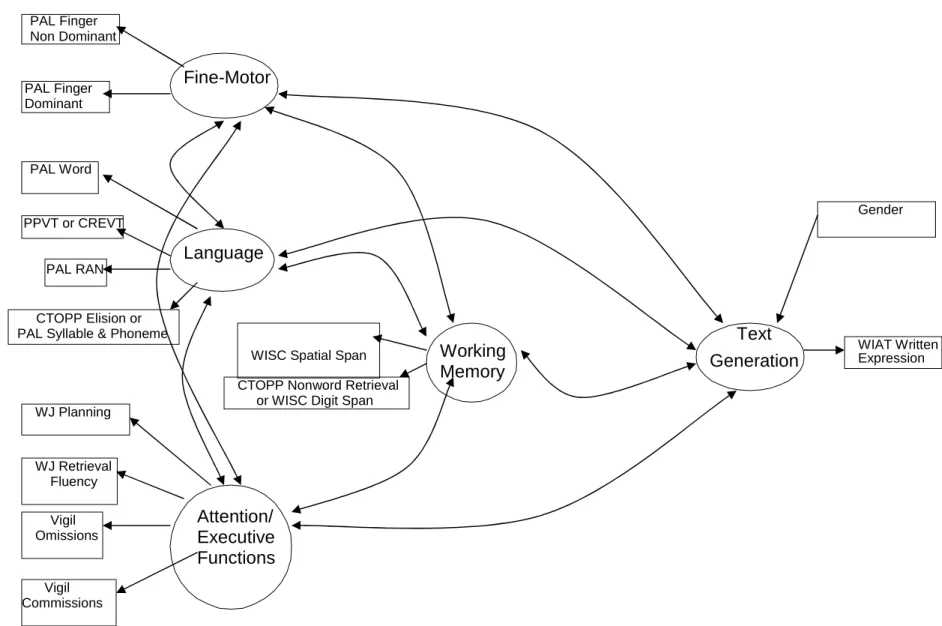
measures given as well as the latent variables that underlie those measures. An outline of the proposed model is displayed in Figure 5. The latent variables are enclosed in circles and the tests used to measure them are in rectangles. The relationship between the latent variables in the proposed model and the Not-So-Simple View of Writing is explained in Figure 6.
Table 1
List of Measures: Block A
Cohort 1
BLOCK A Can be administered in any order
Cohort 2
BLOCK A Can be administered in any order
WASI Vocabulary WASI Vocabulary
WASI Matrix Reasoning WASI Matrix Reasoning
WIAT-II Reading* WIAT-IIA Reading*
WIAT-II Written Expression (Alphabet, Fluency, Sentences)
WIAT-II Written Expression (Alphabet, Fluency, Sentences)
PAL RAN – Letters or Digits PAL RAN – Letters or Digits
PAL Finger Sense – Finger Succession PAL Finger Sense – Finger Succession
PAL Word Choice PAL Word Choice
PPVT-IV PAL Syllables
WISC-IV Spatial Span PAL Phonemes
Table 2
List of Measures: Block B
Cohort 1
BLOCK B – FIXED ORDER due to timing for memory items
Cohort 2
BLOCK B – FIXED ORDER due to timing for memory items
WRAML-2 Picture Memory Immediate* WRAML-2 Picture Memory Immediate*
CTOPP Elision WISC-IV Spatial Span
(forward/backward)
WJ-III Cog Planning Subtest WJ-III Cog Planning Subtest
WJ-III Cog Retrieval Fluency Subtest WJ-III Cog Retrieval Fluency Subtest WRAML-2 Picture Memory Recognition* WRAML-2 Picture Memory Recognition* WRAML-2 Story Memory Immediate* WRAML-2 Story Memory Immediate*
Vigil CPT Vigil CPT
42
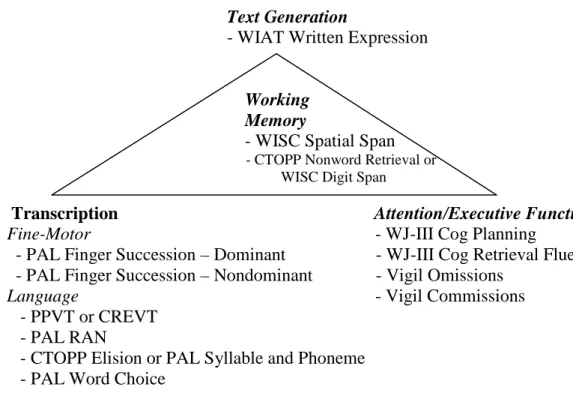
Text Generation Working
Memory
WIAT Written Expression WISC Spatial Span
CTOPP Nonword Retrieval or WISC Digit Span
SES -Mother's Education
Gender Race
Attention/ Executive Functions
WJ Planning
WJ Retrieval Fluency
Vigil Omissions
Vigil Commissions PPVT or CREVT
PAL RAN PAL Word
CTOPP Elision or PAL Syllable & Phoneme
Language
PAL Finger Dominant
PAL Finger Non Dominant
Fine-Motor
Text Generation
- WIAT Written Expression
Working
Memory
- WISC Spatial Span
- CTOPP Nonword Retrieval or WISC Digit Span
Transcription Attention/Executive Functions
Fine-Motor - WJ-III Cog Planning
- PAL Finger Succession – Dominant - WJ-III Cog Retrieval Fluency - PAL Finger Succession – Nondominant - Vigil Omissions
Language - Vigil Commissions - PPVT or CREVT
- PAL RAN
- CTOPP Elision or PAL Syllable and Phoneme - PAL Word Choice
Figure 6. Measures’ Alignment with Not-So-Simple View of Writing Model (Berninger & Winn 2006) with latent variables italicized and measures bulleted.
Data Screening
Initially, the data were screened to ensure that they met the criteria necessary for a Confirmatory Factor Analysis using structural equation modeling methods to be
interpreted. The data was analyzed to check the assumptions of univariate and
multivariate normality based on measures of skewness and kurtosis, and the Mahalanobis D test was conducted to check for possible outliers. The measurement model was then run to check for fit and modified as necessary.
Analyzing the Model
latent variables to their indicator variables (the administered tests) to be estimated to explore if the indicator variables were supporting the latent variables as the proposed model suggests. The chi-square statistic (χ2), standardized root mean square residual (SRMR), and the root mean square error of approximation (RMSEA) were assessed to judge measurement model fit. Modification indices were requested so that any potential beneficial adjustments to the model could be made. Decisions to modify the model were based on theory and the results of the measurement model analysis.
Application of Data Analysis to Research Questions Review of Questions
Question 1. Do motor and cognitive variables represented in the Not-So-Simple View of Writing contribute to text generation of students in first grade?
Hypothesis 1-1: It is hypothesized that the fine-motor variable will significantly
contribute to text generation for children in first grade.
Hypothesis 1-2: It is hypothesized that the language variable will significantly contribute
to text generation for children in first grade.
Hypothesis 1-3: It is hypothesized that the attention/executive function variable will
significantly contribute to text generation for children in first grade.
Hypothesis 1-4: It is hypothesized that the working memory variable will significantly
contribute to text generation for children in first grade, as well as mediate the contribution of fine-motor, language, and attention/executive functions.
Hypothesis 2-1: It is hypothesized that gender will significantly contribute to text
generation for children in first grade (Berninger & Fuller, 1992; Hooper et al., 1993; NCES, 2003).
Hypothesis 2-2: It is hypothesized that race will significantly contribute to text generation
for children in first grade (Berninger & Fuller, 1992; Hooper et al., 1993; NCES, 2003).
Hypothesis 2-3: It is hypothesized that socioeconomic status (SES), represented by
mother’s education, will significantly contribute to text generation for children in first grade.
Question 3. Is there a hierarchy of predictive power of motor and cognitive skills for text generation of children in first grade?
Hypothesis 3-1: It is hypothesized that the fine-motor variable will contribute more to
text generation than the attention/executive function variable.
Hypothesis 3-2: It is hypothesized that the language variable will contribute more to text
generation than the attention/executive function variable. Data Analysis
In order to establish a valid measurement model before the evaluation of the structural component of the hybrid model (Kline, 2005), the latent variables of Fine-Motor, Language, Attention/Executive Functions, Working Memory, and Text
Generation were allowed to co-vary. The analysis did not result in convergence of a non-identified model; therefore, the analysis of the measurement model could not be
CHAPTER IV RESULTS Data Screening
To conduct the analyses for this study, the data were first entered into PASW Statistics 18.0 statistical software for data screening. The structural equation model was analyzed with the Mplus version 6 (Muthen & Muthen, 2010) software program. An examination of the data was conducted to assess for missing information and the results of this examination showed that two variables had considerable missing data. The SES-Mother’s education variable was missing in 27 cases (13.1%), resulting in a decision to exclude this variable from the model because the missing data was too high to impute values and retain interpretable results. Other variables with missing data included PAL Word Choice (1 case, 0.5%), PAL RAN (4 cases, 2%), PAL Finger Succession-Dominant (3 cases, 1.5%), PAL Finger Succession-Nondominant (4 cases, 2%), WJ-III Cog
Retrieval Fluency (1 case, 0.5%), Vigil Omissions (3 cases, 1.5%), and Vigil Commissions (3 cases, 1.5%). From a visual inspection of the missing data for the existence of patterns, results showed data were scattered across cases and no pattern was evident. PASW Statistics 18.0 was used to impute missing values using the regression-based method of linear trend at point (Kline, 2005).
kurtosis (Table 3). A Mahalanobis D test was run to assess the presence of any outliers and none were detected.
Table 3
Measures of Normality
Variable Skew Kurtosis
WIAT Written Expression 0.650 0.286
PAL Finger Non Dominant -0.878 0.817
PAL Finger Dominant -0.780 0.831
PAL Word 0.298 -1.034
Receptive Language (PPVT or CREVT) 0.178 0.237
PAL RAN -1.452 3.027
Phonemic Awareness
(CTOPP Elision or PAL Syllable and Phoneme)
-0.058 1.369
WJ-III Cog Planning -0.394 -0.451
WJ-III Cog Retrieval Fluency -1.048 2.380
Vigil Omissions 0.965 0.554
Vigil Commissions 1.035 0.347
WISC Spatial Span 0.096 0.458
Auditory Working Memory (CTOPP Nonword Retrieval or WISC Digit Span)
0.267 0.106
Measurement Model
potential beneficial adjustments to the model could be made. The covariance matrix of the analyzed data can be found in Appendix C. Since the analysis did not result in
convergence of a non-identified model, the analysis of the measurement model could not be completed.
Inspection of the model revealed that the model was underidentified and the covariance matrix was nonpositive definite. In order for a model to be identified it must have as many or more observations as free model parameters, which can be determined by assessing if the degrees of freedom are more than or equal to zero. In the measurement model analyzed, the degrees of freedom equaled 69. Another potential problem with identification is the presence of multicollinearity of the data which can also be a cause of nonpositive definite matrices. Examination of the correlation matrix did not reveal any correlations above .90; however, multicollinearity may lie in the multivariate
50
Text Generation Working
Memory
WIAT Written Expression WISC Spatial Span
CTOPP Nonword Retrieval or WISC Digit Span
Gender
Attention/ Executive Functions
WJ Planning
WJ Retrieval Fluency
Vigil Omissions
Vigil Commissions PPVT or CREVT
PAL RAN PAL Word
CTOPP Elision or PAL Syllable & Phoneme
Language
PAL Finger Dominant
PAL Finger Non Dominant
Fine-Motor
Additional Exploratory Analysis of the Model Individual path models
The full structural equation model that was designed to explore the Not-So-Simple View of Writing could not be analyzed with the current data. In an effort to explore the model further, identify areas of multicollinearity, and identify any other problems in the model design that may inform future research, the variables were analyzed separately.
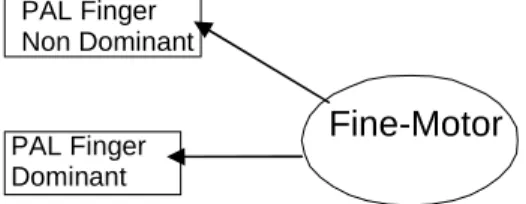
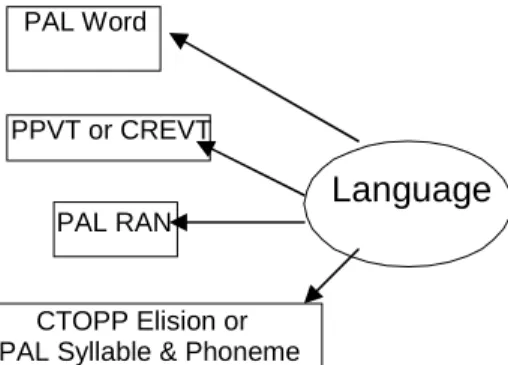
The proposed path models for each variable are in Figures 8 - 11. The path models for the Fine-Motor and Working Memory variables could not be analyzed due to negative degrees of freedom. The path models for the Language and Attention/Executive Functions models resulted in non-positive definite matrices. The Language variable output indicated a problem with the PPVT or CREVT indicator. This variable was negatively correlated with the PAL RAN indicator. Also, this variable is one of the indicators that had to be created from two different subtests which may have caused problems with the analysis. For the Attention/Executive Functions variable, there was a problem with the indicator WJ-III Cog Retrieval Fluency. This indicator was negatively correlated with the Vigil Omissions indicator.
Figure 8. Fine-Motor Skills Path Model PAL Finger
Dominant PAL Finger Non Dominant
Figure 9. Language Path Model
Figure 10. Attention/Executive Functions Path Model
Figure 11. Working Memory Path Model Working Memory WISC Spatial Span
CTOPP Nonword Retrieval or WISC Digit Span
Attention/ Executive Functions WJ Planning
WJ Retrieval Fluency
Vigil Omissions
Vigil Commissions
PPVT or CREVT
PAL RAN PAL Word
CTOPP Elision or PAL Syllable & Phoneme