Research Paper
Aurora A
Functional Single Nucleotide Polymorphism (SNP) Correlates
With Clinical Outcome in Patients With Advanced Solid Tumors Treated
With Alisertib, an Investigational Aurora A Kinase Inhibitor
Huifeng Niu
a,⁎
, Hyunjin Shin
a, Feng Gao
a, Jacob Zhang
a, Brittany Bahamon
a, Hadi Danaee
a,
Bohuslav Melichar
b, Russell J. Schilder
c, Robert L. Coleman
d, Gerald Falchook
e, Antoine Adenis
f,
Kian Behbakht
g, Angela DeMichele
h, Elizabeth Claire Dees
i, Kimberly Perez
j, Ursula Matulonis
k,
Piotr Sawrycki
l, Dirk Huebner
a, Jeffrey Ecsedy
aa
Millennium Pharmaceuticals, Inc., Cambridge, MA, USA
b
Department of Oncology, Palacky University Medical School and Teaching Hospital, Olomouc, Czech Republic
cDepartment of Medical Oncology, Thomas Jefferson University Hospital, Philadelphia, PA, USA dThe University of Texas MD Anderson Cancer Center, Houston, TX, USA
e
Sarah Cannon Research Institute at HealthONE, Denver, CO, USA
f
Centre Oscar Lambret, Lille, France
g
Department of Gynecologic Oncology, University of Colorado School of Medicine, Aurora, CO, USA
h
Abramson Cancer Center of the University of Pennsylvania, Philadelphia, PA, USA
iUNC Lineberger Comprehensive Cancer Center, Chapel Hill, NC, USA
jDepartment of Medical Oncology, Dana-Farber Cancer Institute, Boston, MA, USA k
Gynecologic Oncology Program, Dana-Farber Cancer Institute, Boston, MA, USA
l
Department of Oncology and Chemotherapy, L. Rydygiera District Hospital, Torun, Poland
a b s t r a c t
a r t i c l e i n f o
Article history:
Received 13 September 2017
Received in revised form 12 October 2017 Accepted 13 October 2017
Available online 16 October 2017
Background:Alisertib (MLN8237) is an investigational, oral, selective Aurora A kinase inhibitor.Aurora Acontains two functional single nucleotide polymorphisms (SNPs; codon 31 [F/I] and codon 57 [V/I]) that lead to functional changes. This study investigated the prognostic and predictive significance of these SNPs.
Methods:This study evaluated associations betweenAurora ASNPs and overall survival (OS) in The Cancer Ge-nome Atlas (TCGA) database. TheAurora ASNPs were also evaluated as predictive biomarkers for clinical out-comes to alisertib in two phase 2 studies (NCT01045421 and NCT01091428).Aurora ASNP genotyping was obtained from 85 patients with advanced solid tumors receiving single-agent alisertib and 122 patients with ad-vanced recurrent ovarian cancer treated with alisertib plus weekly paclitaxel (n = 62) or paclitaxel alone (n = 60). Whole blood was collected prior to treatment and genotypes were analyzed by PCR.
Findings:TCGA data suggested prognostic significance for codon 57 SNP; solid tumor patients with VV and VI al-leles had significantly reduced OS versus those with II alleles (HR 1.9 [VI] and 1.8 [VV]; pb0.0001). In NCT01045421, patients carrying the VV alleles at codon 57 (n = 53, 62%) had significantly longer progression-free survival (PFS) than patients carrying IV or II alleles (n = 32, 38%; HR 0.5; p = 0.0195). In NCT01091428, pa-tients with the VV alleles at codon 57 who received alisertib plus paclitaxel (n = 47, 39%) had a trend towards improved PFS (7.5 months) vs paclitaxel alone (n = 32, 26%; 3.8 months; HR 0.618; p = 0.0593). In the paclitaxel alone arm, patients with the VV alleles had reduced PFS vs modified intent-to-treat (mITT) patients (3.8 vs 5.1 months), consistent with the TCGA study identifying the VV alleles as a poor prognostic biomarker. No signif-icant associations were identified for codon 31 SNP from the same data set.
Interpretation:Thesefindings suggest thatAurora ASNP at codon 57 may predict disease outcome and response to alisertib in patients with solid tumors. Further investigation is warranted.
© 2017 The Authors. Published by Elsevier B.V. This is an open access article under the CC BY license (http://creativecommons.org/licenses/by/4.0/).
Keywords:
Aurora A kinase inhibitor Alisertib
SNP Prognosis Predictive biomarker Correlative analysis
1. Introduction
Aurora A kinase (AAK), a member of the conserved serine/threonine protein kinase family, is a key mitotic regulator with a critical role in
⁎ Corresponding author at: Translational Medicine, Millennium Pharmaceuticals, Inc., 40 Landsdowne St, Cambridge, MA 02139, USA.
E-mail address:[email protected](H. Niu).
https://doi.org/10.1016/j.ebiom.2017.10.015
2352-3964/© 2017 The Authors. Published by Elsevier B.V. This is an open access article under the CC BY license (http://creativecommons.org/licenses/by/4.0/). Contents lists available atScienceDirect
EBioMedicine
centrosome maturation and separation, spindle assembly, chromosome alignment, and cytokinesis (Barr and Gergely, 2007; Marumoto et al., 2003). Overexpression and/or amplification of AAK has been observed in a variety of cancers (Dar et al., 2008; Hoque et al., 2003; Mazumdar et al., 2009) and tends to be associated with a poor patient outcome (Nikonova et al., 2013). Furthermore, AAK inhibition results in mitotic progression abnormalities leading to cell death (Marumoto et al., 2003; Gorgun et al., 2010; Zhou et al., 2013). As such, AAK represents an attrac-tive target for anti-cancer therapy.
Aurora Ais an oncogene located on chromosome 20q13.2, a locus fre-quently amplified in solid tumors (Bischoff et al., 1998). Two functional single nucleotide polymorphisms (SNPs) (rs2273535 and rs1047972) inAurora Agene, located at codon 31 and codon 57 in the NH2-terminal region of the Aurora A protein, have been reported to be associated with functional consequences and increased cancer risk (Chen et al., 2007, 2015; Ewart-Toland et al., 2005; Kimura et al., 2005; Miao et al., 2004). The T91A SNP at codon 31 results in a phenylalanine to isoleucine (F31I) change; homozygous T/T at this locus codes for FF, T/A leads to FI, and A/A codes for II. This SNP is associated with increased frequency of aneuploidy in human colon tumors (Ewart-Toland et al., 2005), in-creased breast cancer risk, especially in Asian patients (Dai et al., 2004), and low penetrance cancer susceptibility for other cancer types including lung and oesophageal cancer (Ewart-Toland et al., 2005). The G169A SNP at codon 57 results in a valine to isoleucine amino acid substitution (V57I); homozygous A/A genotype at this locus codes for II, A/G leads to IV, and G/G codes for VV. Studies indicate the II variant reduces AAK activity (Kimura et al., 2005), and may be a protective factor for risk of developing cancer, especially in Caucasian patients and those with breast cancer (Dai et al., 2004). Studies investigating the association between Aurora ASNPs and clinical outcomes are limited. The heterozygous A/T at codon 31 (FI) has been shown to be associated with a significantly higher risk of tumor relapse, shorter disease-free survival, and shorter median survival time in oesophageal cancer patients treated with preop-erative chemoradiation (Pan et al., 2012). In particular, in patients treat-ed with cisplatin-bastreat-ed chemoradiation, this genotype at codon 31 was associated with poor response and shorter survival (Pan et al., 2012). The variant I31/V57 haplotype also carried a significant risk for a low rate of complete response and higher recurrence rate (Pan et al., 2012). The investigational oral agent alisertib (MLN8237) is a selective, small-molecule AAK inhibitor that has demonstrated preclinical activity against a broad range of tumor types (Manfredi et al., 2011; Sehdev et al., 2013). In pilot studies, alisertib demonstrated antitumor activity with manageable toxicity in patients with solid tumors (Cervantes et al., 2012; Melichar et al., 2015) and haematological malignancies (Goldberg et al., 2014; Kelly et al., 2014). Two phase 2 clinical trials inves-tigating single-agent alisertib (NCT01045421) in patients with advanced solid tumors, or alisertib in combination with weekly paclitaxel (NCT01091428) in patients with recurrent ovarian cancer, have recently been completed (Coleman et al. 2014 ESMO Congress) (Melichar et al., 2015). In NCT01045421, an overall response rate (ORR) of 13% was re-ported in the response-evaluable population, with patients in the breast cancer and small-cell lung cancer (SCLC) cohorts showing response rates of 18% and 21%, respectively (Melichar et al., 2015). In NCT01091428, alisertib plus weekly paclitaxel significantly increased median progres-sion free survival (PFS) compared with paclitaxel alone (hazard ratio [HR] 0.740 [80% CI 0.563, 0.971]) (Falchook et al. manuscript submitted in parallel).
Although alisertib has demonstrated promising clinical activity, its
ef-ficacy has been variable (Friedberg et al., 2014; Goldberg et al., 2014; Matulonis et al., 2012; Melichar et al., 2015). Therefore, it is important to identify potential predictive marker(s) that could be used to select pa-tients likely to benefit from alisertib treatment (Hadley and Hendricks, 2014; Kap et al., 2016). This study aimed to assess the potential associa-tion between twoAurora ASNP genotypes (rs2273535 and rs1047972) at codons 31 and 57, and clinical endpoints in patients from the NCT01045421 and NCT01091428 trials.
2. Methods
2.1. Study Design and Participants
The Cancer Genome Atlas (TCGA) database was searched for 10,403 patients with solid tumors who had recorded information on the SNPs of interest. RNA sequencing (RNA-seq) and overall survival (OS) data from 10,034 patient samples were available to assess the association be-tweenAurora ASNP genotypes and OS. Since the SNPs are not somatic mutations and there are no reported cases with somatic mutations at those sites, variants found from RNA-Seq can be thought of as germline SNPs. The genotypes of a particular SNP were called based on the allele fraction of its SNP allele.
Details of both phase 2 alisertib studies have been published previous-ly (Melichar et al., 2015); additional study information (patient consent, treatment regimen, and study endpoints) can be found in the appendix. In brief, NCT01045421 was an open-label, multicentre study of single-agent alisertib in 249 adult patients with advanced, relapsed solid tumors including breast cancer, small cell lung cancer (SCLC), non-SCLC (NSCLC), head and neck squamous-cell carcinoma (HNSCC), and gastro-oesopha-geal adenocarcinoma (GE). NCT01091428 was a randomised, open-label study of alisertib plus weekly paclitaxel compared with paclitaxel alone in 142 adult patients with previously treated recurrent epithelial ovarian, fallopian tube, or primary peritoneal cancer. Correlative analyses of Aurora A SNPs and clinical efficacy outcomes were conducted in the subgroup of patients (85 of 249) from the study NCT01045421 and the subgroup of patients (122 of 142) from the study NCT01091428.
2.2. Procedures
To analyzeAurora ASNP data in TCGA, SNPs were genotyped based on RNA-seq results from patients (see appendix for details). Once geno-types at the SNP sites were assigned to each sample, the potential asso-ciation between genotype and OS was investigated. At each SNP site (i.e. codon 31 and codon 57), survival curves for the three strata (homozy-gous reference, heterozy(homozy-gous, and homozy(homozy-gous SNP) were plotted and HR were calculated using the Cox proportional hazard model with re-spect to homozygous reference (FF at codon 31 and II at codon 57), with no clinical covariates considered; the p-value was computed usingχ2 (Marumoto et al., 2003) test.
Whole blood samples were collected prior to administration of alisertib or paclitaxel, and genomic DNA was isolated from peripheral blood mononuclear cells.Aurora ASNP genotypes were analyzed by real-time polymerase chain reaction (PCR; see appendix for details). Whole exome next-generation sequencing (NGS) was also carried out on a subset of tumor samples (from 47 patients) from NCT01045421.
Details of the statistical methodology utilized in both phase 2 studies have been previously described (Melichar et al., 2015). In this analysis, a correlative study was performed to assess the relationship ofAurora A SNP genotypes with alisertib treatment outcomes (PFS, best tumor size change, and best response). For NCT01045421, a Cox regression model was used to analyze possible associations betweenAurora A SNPs and PFS, stratified by tumor indication. The p-value was adjusted for tumor indication. Analysis of variance (ANOVA) was used to analyze best tumor size change, adjusting for tumor indication and baseline tumor size. A simpleΧ2 (Marumoto et al., 2003) test on the contingency table was used to test the independence between genotype and patient response status. For NCT01091428, PFS was analyzed using log-rank test to compare treatment arms in different populations.
3. Results
3.1. Prognostic Implication of Aurora A SNP at Codon 57
were the most frequent alleles at codon 57 (5649). The distribution ofAurora ASNPs in patients with different tumor types was similar to population data in the dbSNP database (data not shown). A similar
pattern ofAurora ASNP distribution at codons 57 and 31 was seen in the NCT01045421 and NCT01091428 populations (Supplementary Fig. 1).
Using the data in the TCGA database, we carried out a correlative study to assess the potential association betweenAurora ASNP geno-types and OS from 10,034 patients whose survival data were available for the analysis. The prognostic significance of codon 57 SNP was evident across tumor types and stages. In patients with solid tumors, II alleles at codon 57 (2548) were associated with improved OS compared with IV (1837) or VV (5649) alleles (IV: HR 1.9 [95% CI 1.6, 2.1]; VV: HR 1.8 [95% CI 1.6, 2.1]; pb0.0001); OS was similar in patients with IV or VV al-leles (Fig. 1A). In patients with tumors relevant to the phase 2 studies (breast, HNSCC, NSCLC, GE, and ovarian), II at codon 57 (308) was again associated with improved OS compared with IV (749) or VV (2325) (IV: HR 1.5 [95% CI 1.1, 2.0]; VV: HR 1.4 [95% CI 1.1, 1.9]; p = 0.0184;Fig. 1B). Patients with solid tumors carrying II at codon 31 (604) demonstrated a decrease in OS compared with patients with FF al-leles (7197) (HR 1.4 [95% CI 1.2, 1.6]; pb0.0001;Fig. 1C), although the number of patients with II alleles was limited (604).
3.2. Predictive Potential of Aurora A SNPs for Alisertib Treatment Outcomes
We assessed potential associations betweenAurora ASNPs and alisertib clinical efficacy (PFS, best tumor size change, and best re-sponse). In total, 85 patients from the NCT01045421 study and 122 pa-tients from the NCT01091428 study (62 in the alisertib plus paclitaxel arm and 60 in the paclitaxel alone arm) with evaluable clinical data were genotyped forAurora ASNPs. No significant associations were iden-tified for codon 31 SNP (Supplementary Fig. 2); therefore, this SNP was not described further in this study.
Demographics and baseline characteristics for response-evaluable patients with genotyping data available for codon 57 are shown in Table 1. Overall, characteristics were comparable with the overall popu-lations for each study. Although numbers were small, a greater propor-tion of patients in NCT01091428 with II alleles (n = 4) rather than VV or IV at codon 57 (n = 118) had a long period to relapse since receiving prior platinum therapy, consistent with the TCGA data indicating that II alleles at codon 57 are a positive prognostic marker.
As no somatic mutations have been found in theAurora Agene thus far, in TCGA or the phase 2 clinical trials, germline SNPs are identical to tumor DNA. In this analysis, it was assumed that SNPs detected in blood samples will be the same as those in the patients' tumors, and may lead to differential Aurora A kinase activity. Correlative analysis showed that patients treated with alisertib in the NCT01045421 study
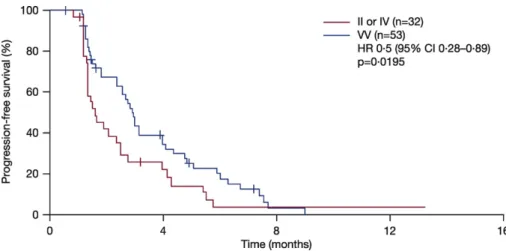
who carried VV alleles at codon 57 had significantly increased PFS com-pared with patients with the IV or II alleles (HR 0.5 [95% CI 0.28, 0.89]; p = 0.0195;Fig. 2). Similar PFS improvements were seen among different tumor types in a subgroup analysis; GE patients who had VV alleles had a significant improvement in PFS compared with patients with the II or IV alleles (HR 0.16 [95% CI 0.04, 0.65]; p = 0.0103;Fig. 3A), although total patient numbers were small. Similarly, patients with SCLC, HNSCC, or NSCLC who had VV alleles also had improved PFS compared with pa-tients with the II or IV alleles (Figs. 3B–D). In contrast, patients treated with alisertib who had breast cancer and were carrying VV alleles were associated with a trend towards reduced PFS compared with patients with II or IV alleles (HR 3.8 [95% CI 0.94, 15]; p = 0.0608;Fig. 3E). It is worth noting that among 11 VV breast cancer patients analyzeanalyzed,
five had triple-negative breast cancers, a subtype previously associated with a minimal response to alisertib (Melichar et al., 2015). Overall, there was a trend towards improved tumor size reduction from baseline in patients with VV vs IV vs II alleles at codon 57 (p = 0.0776; p-value adjusted by tumor type;Fig. 4A); also when VV was compared with IV or II alleles (p = 0.074; p-value adjusted by tumor type;Fig. 4B). The same was true when IV was grouped with VV and compared with II (p = 0.0545; p-value adjusted by tumor type;Fig. 4C). Best response (CR + PR) assessed by Response Evaluation Criteria In Solid Tumors (RECIST) was comparable between groups (5 [16%] vs 6 [11%] patients; p = 0.811; Fig. 5).
In NCT01091428, the 47 patients with the VV alleles at codon 57 who received alisertib plus paclitaxel demonstrated an improved PFS com-pared with the 32 patients who received paclitaxel alone (7.5 vs 3.8 months; HR 0.618 [95% CI 0.37, 1.03]; p = 0.0593;Fig. 6A). This PFS benefit was greater than in the overall modified intent-to-treat (mITT) population (7.6 vs 5.1 months; HR 0.74 [95% CI 0.49, 1.12]; p = 0.1534;Fig. 6B). Paclitaxel-treated VV patients had reduced PFS com-pared with the overall mITT population (3.8 vs 5.1 months), which fur-ther implicates VV as a poor prognostic biomarker. Similarly, although the number of patients was small (n = 3; n = 1), those with II alleles showed improved PFS in both arms (alisertib plus paclitaxel 9.2 months; paclitaxel alone 13.3 months).
Intra-arm comparisons showed that patients treated with alisertib plus paclitaxel who had VV alleles had a similar outcome to patients with IV and II alleles (median PFS 7.5 vs 7.6 months; p = 0.651; Supple-mentary Fig. 3A). Patients treated with paclitaxel alone who had VV al-leles had 3.8 months median PFS compared with 5.1 months in
Table 1
Demographics and baseline characteristics for response-evaluable patients with genotyping data in phase 2 alisertib studies.
NCT01045421 Overall mITT population
(N= 249)
Codon 57 SNP genotype
VV (n = 53)
IV (n= 27)
II (n = 5)
Total (N= 85)
Median age, years (range) 61 (30–88) 57 (30–88) 62 (33–76) 63 (36–68) 57 (30–88)
Male/female, n (%) 141 (57)/108 (43) 33 (62)/20 (38) 18 (67)/9 (33) 1 (20)/4 (80) 52 (61)/33 (39)
Race, n (%)
White 231 (93) 45 (85) 25 (93) 5 (100) 75 (88)
Black/African American 12 (5) 5 (9) 1 (4) 0 6 (7)
Other/not reported 6 (2) 3 (6) 1 (4) 0 4 (5)
NCT01091428 Overall mITT population
(N= 142)
Codon 57 SNP genotype VV
(n= 94)
IV (n = 24)
II (n = 4)
Total (N= 122)
Median age, years(range) 62 (30–81) 62 (30–81) 65 (48–81) 62 (52–74) 62 (30–81)
Male/female, n (%) 0/142 (100) 0/94 (100) 0/24 (100) 0/4 (100) 0/122 (100)
Race, n (%)
White 121 (85) 77 (82) 22 (92) 4 (100) 103 (84)
Black/African American 8 (6) 7 (7) 1 (4) 0 8 (7)
Other/not reported 13 (9) 10 (11) 1 (4) 0 11 (9)
Months of relapse since prior platinum therapy, IVR n (%)
Refractory 18 (13) 9 (10) 5 (21) 0 14 (11)
0–≤6 months 71 (50) 54 (57) 11 (46) 1 (25) 66 (54)
N6–12 months 53 (37) 31 (33) 8 (33) 3 (75) 42 (34)
patients with IV and II genotypes (p = 0.400; Supplementary Fig. 3B). There was no significant association between codon 57Aurora ASNP and objective response to alisertib (data not shown).
4. Discussion
The results from this retrospective correlative study suggest that the Aurora ASNP at codon 57 may have prognostic and predictive value for
cancer patients, and may provide a possible patient selection strategy for treatment with alisertib in some cancers.
In all tumor types analyzed in the TCGA database, regardless of stage and treatment history, patients carrying the II alleles at codon 57 had a significantly improved OS compared with patients with the VV and VI alleles (pb0.0001). Therefore, the II alleles at codon 57 could be considered a favorable prognostic biomarker in cancer patients.
Fig. 2.PFS according toAurora ASNP at codon 57 in patients treated with alisertib in the NCT01045421 study. p-Value calculated using proportional hazard model and stratified by tumor indication. CI, confidence interval; HR, hazard ratio; PFS, progression-free survival; SNP, single nucleotide polymorphism.
The predictive potential of thisAurora ASNP for alisertib response was supported by correlatives studies in two independent trials investi-gating alisertib as a single agent or in combination with paclitaxel in solid tumors. In the NCT01045421 study, which enrolled patients with breast cancer, SCLC, NSCLC, HNSCC, and GE, patients with VV alleles at codon 57 had significantly improved PFS compared with patients with the IV or II alleles. Although patient numbers were small, PFS improve-ments were demonstrated across different tumor types, with the
exception of breast tumors. This could be due to the fact that among the 11 VV breast cancer patients analyzed,five had triple-negative breast cancers, while only two out of eight II/IV patients had triple neg-ative breast cancers. As previously reported in heavily-pretreated breast cancer patients, hormone receptor-positive and human epidermal growth factor receptor 2 (HER2)-positive subgroups responded to alisertib treatment, but minimal activity was seen in the triple-negative subtype (Melichar et al., 2015). Patient subgrouping based on HER2 and estrogen receptor (ER) status may override the ability of theAurora A SNP to predict sensitivity to alisertib.
In the NCT01091428 study, ovarian cancer patients treated with alisertib plus paclitaxel did not demonstrate a difference in PFS within the arm of patients with VV versus IV or II, which is likely due to the fact that IV and II patients have a better prognosis in responding to pac-litaxel. However, patients with VV demonstrated a trend towards im-proved PFS with alisertib plus paclitaxel versus paclitaxel alone, with a slightly greater apparent treatment effect than in the mITT population. The apparent greater PFS benefit with alisertib plus paclitaxel versus pac-litaxel alone in VV compared with IV or II patients is mainly due to poorer outcomes with paclitaxel in VV-carrying patients, although this may be a multifactorial phenomenon. These results suggest that alisertib may pro-vide greater benefit to patients with the VV alleles, which is a biomarker predictive of poor response to standard-of-care agents. Interestingly, in both studies, treatment of patients carrying theAurora AVV SNP at codon 57 with alisertib was not associated with an increase in response rate. Additional studies would be useful in order to understand the un-derlying mechanism for the effect of alisertib on PFS, but not objective re-sponse. A preliminary analysis to assess associations betweenAurora A SNP status and safety outcomes found no significant correlation (data not shown).
It has been reported that Aurora A V57V has higher kinase activity than Aurora A I57I (Kimura et al., 2005); overexpression and amplifi ca-tion of Aurora A are frequently found in solid tumors and are associated with poor disease outcomes (Chen et al., 2015; Chen et al., 2007; Ewart-Toland et al., 2005; Hoque et al., 2003; Kimura et al., 2005; Pan et al., 2012). In multiple preclinical models,Aurora Ahas been identified as an oncogene that drives tumor growth and confers chemoresistance (Sun et al., 2015; Zhang et al., 2014). Consistent with thesefindings, the presence of VV alleles at codon 57 (conferring higher kinase activity) correlated with poor OS in our analysis of TCGA data. Alisertib, as an Au-rora A protein kinase inhibitor, may deliver greater benefit in patients with VV alleles and therefore high Aurora A kinase activity. In contrast, patients with II alleles with a good prognosis may have low Aurora A ki-nase activity in tumors and for this reason they derive less benefit from Aurora A inhibition by alisertib. In the NCT01091428 study, II patients treated with alisertib plus paclitaxel had reduced PFS compared with paclitaxel treatment alone (9.2 vs. 13.3 months).
This study has a number of limitations. Firstly, these correlative stud-ies were carried out retrospectively with a limited sample size. The pa-tient population with blood samples available for genotyping in NCT01045421 was relatively small (approximately one quarter of the entire study population). Response measures were not confirmed by in-dependent review in either study and a limited number of solid tumor types were assessed. Prospective validation of these observations in an independent clinical study will be needed to establish the predictive value of theAurora Acodon 57 SNP. Moreover, the predictive value of this SNP for alisertib activity may be dependent on additional factors, in-cluding cancer subtype, whether alisertib is administered as single or combination therapy, risk stratification, and other predictive biomarkers. It remains to be seen whether thesefindings can be applied to other tumor types including haematological malignancies.
In conclusion,Aurora ASNP genotype was associated with differential outcomes to alisertib treatment and may have potential as a biomarker in patients with solid tumors; further investigation is warranted. These
findings may ultimately provide a patient selection strategy for alisertib treatment.
Fig. 4.Percentage tumor size change from baseline in patients treated with alisertib in the NCT01045421 study according toAurora ASNP at codon 57: A) II vs IV vs VV, B) II or IV vs VV, and C) II vs IV or VV. p-Value calculated by ANOVA, adjusted for tumor indication, SNP, single nucleotide polymorphism.
Funding
Millennium Pharmaceuticals, Inc., Cambridge, MA, USA, a wholly owned subsidiary of Takeda Pharmaceutical Company Limited.
Role of the funding source
The study was funded by Millennium Pharmaceuticals, Inc., Cam-bridge, MA, USA, a wholly owned subsidiary of Takeda Pharmaceutical Company Limited. Employees participated in trial design, study monitor-ing, data collection, analysis, and interpretation, and manuscript writing. The corresponding author had full access to all the study data and had
final responsibility for the decision to submit for publication.
Prior presentation of this study
Hiufeng Niu, Hyunjin Shin et al. AnAurora Asingle nucleotide poly-morphism (SNP) correlates with clinical responses to alisertib in patients (pts) with advanced solid tumors. Presented as a poster at the 2016 American Society of Clinical Oncology annual meeting, 2–6 June, Chicago, IL, USA (J Clin Oncol 2016;34:abstr 2583).
Contributors
Study conception and design–HN, HS, BB, RJS, RLC, KB, AD, UM, DH, JE.
Collection and assembly of data–HN, HS, BB, HD, BM, RLC, GF, KB, AD, UM.
Data analysis and interpretation–HN, HS, JZ, HD, BM, RJS, RLC, GF, AA, KB, AD, UM, DH, JE.
Provision of study materials or patients–RJS, RLC, AA, UM. Drafting or revising the manuscript–all authors.
Review and approval of thefinal version of the manuscript–all authors.
Declaration of interests
RC.
Employment: BB, HD, DH are employees of Millennium Pharmaceu-ticals, Inc., a wholly owned subsidiary of Takeda Pharmaceutical Company Limited.
Financial activity outside the submitted work: BM reports person-al fees and honoraria for lectures and advisory boards for Roche, AstraZeneca, Novartis, Pfizer, Bristol Myers Squibb, Astellas, Merck, MSD, Janssen, Bayer and Amgen and reports travel support from Roche, Novartis, Bristol Myers Squibb, and Merck; RJS reports per-sonal fees and ad hoc advisory boards from Millennium, Clovis, Ver-tex, Merrimack and Merck Serono and chair and IDSM for Merck Serono; GF reports personal fees and travel reimbursement from Millennium; AD reports grants for institutional support for clinical trial from Novartis, Pfizer, Calithera and Genentech, scientific adviso-ry board from Pfizer, Novartis, Calithera and educational program participation from Pfizer; ECD reports personal fees, consulting and endpoint adjudication committee activity from Novartis and con-tract for trial from Merck, Cerulean, Bayer, and Pfizer.
Intellectual property: HN, HS, and JZ have a provisional patent ap-plication for‘Method for identification, evaluation and treatment of patients having cancers’.
No conflicts of interest to disclose: AD, KB, KP, UM, JE having noth-ing to disclose.
Acknowledgments
This study was funded by Millennium Pharmaceuticals Inc., a wholly owned subsidiary of Takeda Pharmaceutical Company Limited. The au-thors would like to thank the patients who participated in these studies and their families, the staff at all investigational sites, and the Millennium alisertib project team for conducting the studies and managing the sam-ples. The authors would also like to acknowledge Dawn L. Lee and Helen Johns of FireKite (an Ashfield Company, part of UDG Healthcare plc) for writing assistance in the development of this manuscript, which was funded by Millennium Pharmaceuticals, Inc., in compliance with Good Publication Practice 3 ethical guidelines (Battisti et al.,Ann Intern Med 2015;163:461–4).
Appendix A. Supplementary data
Supplementary data to this article can be found online athttps://doi. org/10.1016/j.ebiom.2017.10.015.
References
Barr, A.R., Gergely, F., 2007.Aurora-A: the maker and breaker of spindle poles. J. Cell Sci. 120 (Pt. 17), 2987–2996.
Bischoff, J.R., Anderson, L., Zhu, Y., et al., 1998.A homologue of Drosophila aurora kinase is oncogenic and amplified in human colorectal cancers. EMBO J. 17 (11), 3052–3065.
Cervantes, A., Elez, E., Roda, D., et al., 2012.Phase I pharmacokinetic/pharmacodynamic study of MLN8237, an investigational, oral, selective aurora a kinase inhibitor, in pa-tients with advanced solid tumors. Clin. Cancer Res. 18 (17), 4764–4774.
Chen, C.H., Chang, A.Y., Li, S.H., et al., 2015.Suppression of Aurora-A-FLJ10540 signaling axis prohibits the malignant state of head and neck cancer. Mol. Cancer 14, 83.
Chen, J., Li, D., Wei, C., et al., 2007.Aurora-A and p16 polymorphisms contribute to an ear-lier age at diagnosis of pancreatic cancer in Caucasians. Clin. Cancer Res. 13 (10), 3100–3104.
Dai, Q., Cai, Q.Y., Shu, X.O., et al., 2004.Synergistic effects of STK15 gene polymorphisms and endogenous estrogen exposure in the risk of breast cancer. Cancer Epidemiol. Biomark. Prev. 13 (12), 2065–2070.
Dar, A.A., Zaika, A., Piazuelo, M.B., et al., 2008.Frequent overexpression of Aurora Kinase A in upper gastrointestinal adenocarcinomas correlates with potent antiapoptotic func-tions. Cancer 112 (8), 1688–1698.
Ewart-Toland, A., Dai, Q., Gao, Y.T., et al., 2005.Aurora-A/STK15 T+91A is a general low penetrance cancer susceptibility gene: a meta-analysis of multiple cancer types. Car-cinogenesis 26 (8), 1368–1373.
Friedberg, J.W., Mahadevan, D., Cebula, E., et al., 2014.Phase II study of alisertib, a selective Aurora A kinase inhibitor, in relapsed and refractory aggressive B- and T-cell non-Hodgkin lymphomas. J. Clin. Oncol. 32 (1), 44–50.
Goldberg, S.L., Fenaux, P., Craig, M.D., et al., 2014.An exploratory phase 2 study of inves-tigational Aurora A kinase inhibitor alisertib (MLN8237) in acute myelogenous leuke-mia and myelodysplastic syndromes. Leuk. Res. Rep. 3 (2), 58–61.
Gorgun, G., Calabrese, E., Hideshima, T., et al., 2010.A novel Aurora-A kinase inhibitor MLN8237 induces cytotoxicity and cell-cycle arrest in multiple myeloma. Blood 115 (25), 5202–5213.
Hadley, K.E., Hendricks, D.T., 2014.Use of NQO1 status as a selective biomarker for oesoph-ageal squamous cell carcinomas with greater sensitivity to 17-AAG. BMC Cancer 14, 334–342.
Hoque, A., Carter, J., Xia, W., et al., 2003.Loss of aurora A/STK15/BTAK overexpression cor-relates with transition of in situ to invasive ductal carcinoma of the breast. Cancer Epidemiol. Biomark. Prev. 12 (12), 1518–1522.
Kap, E.J., Seibold, P., Scherer, D., et al., 2016.SNPs in transporter and metabolizing genes as predictive markers for oxaliplatin treatment in colorectal cancer patients. Int. J. Cancer 138 (12), 2993–3001.
Kelly, K.R., Shea, T.C., Goy, A., et al., 2014.Phase I study of MLN8237-investigational Aurora A kinase inhibitor-in relapsed/refractory multiple myeloma, non-Hodgkin lymphoma and chronic lymphocytic leukemia. Investig. New Drugs 32 (3), 489–499.
Kimura, M.T., Mori, T., Conroy, J., et al., 2005.Two functional coding single nucleotide poly-morphisms in STK15 (Aurora-A) coordinately increase esophageal cancer risk. Cancer Res. 65 (9), 3548–3554.
Manfredi, M.G., Ecsedy, J.A., Chakravarty, A., et al., 2011.Characterization of Alisertib (MLN8237), an investigational small-molecule inhibitor of aurora A kinase using novel in vivo pharmacodynamic assays. Clin. Cancer Res. 17 (24), 7614–7624.
Marumoto, T., Honda, S., Hara, T., et al., 2003.Aurora-A kinase maintains thefidelity of early and late mitotic events in HeLa cells. J. Biol. Chem. 278 (51), 51786–51795.
Matulonis, U.A., Sharma, S., Ghamande, S., et al., 2012.Phase II study of MLN8237 (alisertib), an investigational Aurora A kinase inhibitor, in patients with platinum-re-sistant or -refractory epithelial ovarian, fallopian tube, or primary peritoneal carcino-ma. Gynecol. Oncol. 127 (1), 63–69.
Mazumdar, A., Henderson, Y.C., El-Naggar, A.K., Sen, S., Clayman, G.L., 2009.Aurora kinase A inhibition and paclitaxel as targeted combination therapy for head and neck squamous cell carcinoma. Head Neck 31 (5), 625–634.
Melichar, B., Adenis, A., Lockhart, A.C., et al., 2015.Safety and activity of alisertib, an inves-tigational aurora kinase A inhibitor, in patients with breast cancer, small-cell lung can-cer, non-small-cell lung cancan-cer, head and neck squamous-cell carcinoma, and gastro-oesophageal adenocarcinoma: afive-arm phase 2 study. Lancet Oncol. 16 (4), 395–405.
Miao, X., Sun, T., Wang, Y., Zhang, X., Tan, W., Lin, D., 2004.Functional STK15 Phe31Ile poly-morphism is associated with the occurrence and advanced disease status of esophage-al squamous cell carcinoma. Cancer Res. 64 (8), 2680–2683.
Nikonova, A.S., Astsaturov, I., Serebriiskii, I.G., Dunbrack, R.L., Golemis, E.A., 2013.Aurora A kinase (AURKA) in normal and pathological cell division. Cell. Mol. Life Sci. 70 (4), 661–687.
Pan, J.Y., Ajani, J.A., Gu, J., et al., 2012.Association of Aurora-A (STK15) kinase polymor-phisms with clinical outcome of esophageal cancer treated with preoperative chemo-radiation. Cancer 118 (17), 4346–4353.
Sehdev, V., Katsha, A., Ecsedy, J., Zaika, A., Belkhiri, A., El-Rifai, W., 2013.The combination of alisertib, an investigational Aurora kinase A inhibitor, and docetaxel promotes cell death and reduces tumor growth in preclinical cell models of upper gastrointestinal adenocarcinomas. Cancer 119 (4), 904–914.
Sun, J.M., Yang, L.N., Xu, H., Chang, B., Wang, H.Y., Yang, G., 2015.Inhibition of Aurora A pro-motes chemosensitivity via inducing cell cycle arrest and apoptosis in cervical cancer cells. Am. J. Cancer Res. 5 (3), 1133–1145.
Zhang, K., Chen, J., Chen, D., et al., 2014.Aurora-A promotes chemoresistance in hepatocelluar carcinoma by targeting NF-kappaB/microRNA-21/PTEN signaling path-way. Oncotarget 5 (24), 12916–12935.