REVIEW
Moving from Novice to Expertise and Its Implications for Instruction
Adam M. Persky, PhD,aJennifer D. Robinson, PharmD a
University of North Carolina at Chapel Hill, Chapel Hill, North Carolina
bWashington State University College of Pharmacy, Spokane, Washington
Submitted September 12, 2016; accepted December 18, 2016; published November 2017.
Objective: To address the stages of expertise development, what differentiates a novice from an expert, and how the development and differences impact how we teach our classes or design the curriculum. This paper will also address the downside of expertise and discuss the importance of teaching expertise relative to domain expertise.
Summary:Experts develop through years of experience and by progressing from novice, advance beginner, proficient, competent, and finally expert. These stages are contingent on progressive problem solving, which means individuals must engage in increasingly complex problems, strate-gically aligned with the learner’s stage of development. Thus, several characteristics differentiate experts from novices. Experts know more, their knowledge is better organized and integrated, they have better strategies for accessing knowledge and using it, and they are self-regulated and have different motivations.
Keywords:expert, expertise, novice, instructional design, deliberative practice
INTRODUCTION
Your child wants to play baseball. As a parent, you are weighing options on how to get your child to the goal of becoming a professional baseball player. Option 1 is to go to a local major sports university and have the pitchers throw 90 mph fastballs at your child to improve his or her hitting or hit line drives until he or she adapts or fails at fielding. Option 2, do the same thing but start with little leaguers who are a few years older than your child. Option 3, start with T-ball. Remove the barrier of pitching error. Make sure the basics of hitting and running the bases are down – that first base is down the right field line, not the left field line. You help them learn to catch with two hands and build confidence and skill to prevent from being hit in the face with a pop-up. Once they manage T-ball, progress to little league, you let them go to camps and then advance them to higher leagues as their skillset and competency in baseball develops. Most people would say option 3 makes the most sense. We intuitively understand expertise re-quires experience and the importance of strategically in-creasing the challenge of the task. The sink or swim mentality does not work. However, do we do this when teaching? What differentiates a novice from an expert and
how does that impact how we teach our classes or design the curriculum?
First, we can accomplish skills with some degree of automaticity, but it does not mean we are experts in that skill. We can acquire most everyday skills at an accept-able level of performance over a short period (eg, driv-ing), maybe as little as 50 hours of practice.1-3After this time, we can maintain an acceptable level of performance with a minimal amount of cognitive effort. Expertise, however, is more than just performing at an acceptable level semi-automatically.
Experts have built substantial knowledge bases that affect what they notice, and how they organize, represent and interpret information. These adaptations lead to better problem solving and performance. Researchers have in-vestigated the differences between experts and novices in a variety of fields and from this research, we have learned that expertise is more than an accumulation of knowledge or experience. We also learned experience alone is insuf-ficient to guarantee the development of expertise.1,4,5The idea that 10,000 hours of practice is needed to develop exper-tise is a fallacy;6 it may require much more practice and a specific type of practice. The purpose of this review is to discuss differences in experts and novices and based on that development process, identify areas of how instruction, course and curriculum development can be used to educate future health professionals effectively. In addition, we will discuss how being an expert could be a hindrance when train-ing novices and how to overcome the expert-novice divide. Corresponding Author:Adam M. Persky, 2312 Kerr Hall,
How does expertise develop?
We develop expertise through years of experience, but years of experience do not guarantee an individual will become an expert. Only a small fraction of people become experts; the rest remain as “experienced non-experts.”1Ulle´n and colleagues recently found that exper-tise might have a genetic component which may explain why only a few people become experts in their domain.7 Experts excel mainly in their domains, and there is little evidence that a person highly skilled in one area (eg, medicinal chemistry) can transfer or teach the skill to another (eg, pharmacotherapy).7
The development of expertise occurs over several stages.8 As a rule, a learner cannot directly move from novice to expert; he or she must progress through each stage and may demonstrate characteristics of two stages simultaneously. For instructors, it may be helpful to stage learners to optimize or personalize instruction. There is no clear way to stage a learner, but there are key features and behaviors which may assist in the staging process. Within graduate medical education, the Dreyfus model has been adopted, and we can apply this model to pharmacy educa-tion.9,10The stages in the Dreyfus model include novice, advanced beginner, competent, proficient, and expert.10
In the novice stage (Table 1), pharmacy students are learning the foundational science related to pharmaco-therapy (eg, pharmacology, physiology, medicinal chem-istry) and the basics of pharmacotherapy. They learn the patient care process including patient history, medication list/history, immunization schedules, and clinical note writing. They will spend their time memorizing facts and are only capable and responsible for following the rules or clearly defined processes.
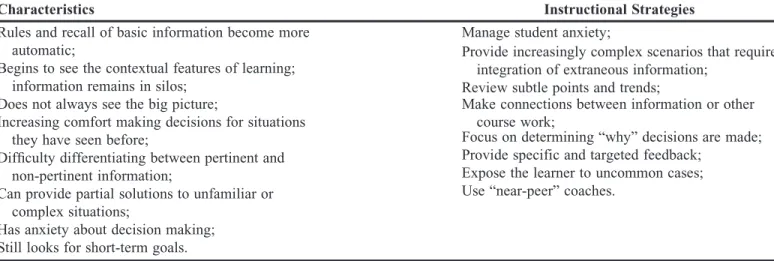
In the advanced beginner stage (Table 2), the learner begins to see aspects of everyday situations. These things can only be learned through experience and the heuristics (rules of thumb) emerge from these experiences to guide the learner. This stage can start because of introductory pharmacy practice experiences (IPPE) but most likely occurs in early advanced pharmacy practice experi-ences (APPE). Within this stage, essential information is more automatic, less effortful to retrieve but learners still silo information and need assistance making meaningful connections.
In the competent stage (Table 3), the learner has in-creased autonomy and ability to develop patient-specific care plans. When the learner develops a patient care plan, there are risks involved but are attenuated by the preceptor oversight. Because the learner has planned the care, the consequences are foreseeable and present a learning op-portunity. This stage may occur in latter APPEs, but most likely this skill is honed during residency training or the first few years of practice. During this stage, the learner starts to develop a routine and is more deliberate in plan-ning for long-term success.
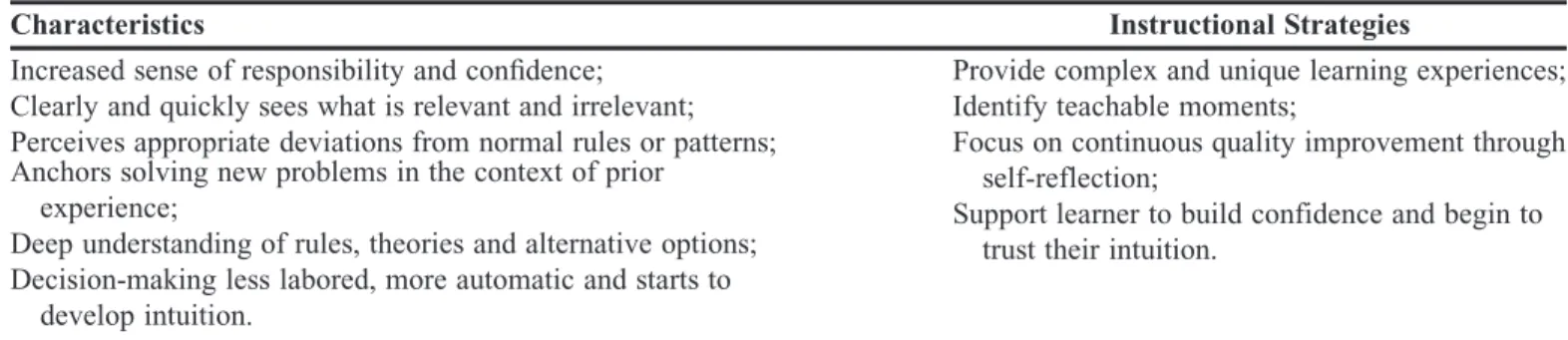
In the proficient stage (Table 4), specialty residents or pharmacists early in practice struggle with developing routines that can streamline patient care. They are man-aging multiple distractions (e.g., new patients, training learners) but incorporating the intellectual and emo-tional stimuli into a learning experience. They start to rely more on intuition, display more confidence and account-ability. They quickly filter information as pertinent and non-pertinent.
In the expert stage (Table 5), a mid-career pharmacist has learned to recognize patterns of clues and makes
Table 1. Characteristics of the Novice Stage and Related Instructional Strategies10,41
Characteristics Instructional Strategies
Follows the rules and plans. Acquires information as a prerequisite to learning;
Provide basic and straightforward cases with no extraneous information;
Does not feel responsible except for following the rules; Provide appropriate feedback;
Has no discretionary judgment; Balance freedom with step-by-step directions;
Spends time remembering information; Emphasize basic science knowledge that underpins the clinical situation;
Attempts to conform behavior to the rules;
Help learners organize their knowledge (tables, concept maps); Learning is context dependent.
Help learners prioritize information importance; Put learning in context;
Help learners discriminate features of situations.
decisions quickly using “intuition.” The pharmacists are attuned to patient nuances and proceed with caution when the unexpected occurs.
How does expertise develop?
The stages of development are contingent on pro-gressive problem solving, which means individuals must engage in increasingly complex problems, strategically aligned with the learner’s stage of development. Because progressive problem solving is critical, Ericsson and col-leagues proposed the concept of deliberate practice.11In
deliberate practice, problems need to be challenging and relevant to the current situation while also being attain-able at each level. Progressive problem-solving seems intuitive to most, however, in practice, we might overlook some of these steps or assume learners are at a different stage. In the classroom paradigm, we may start with cases on a single, uncomplicated disease state. As the learner masters the simple problem, complexities such as comor-bidities, social disparities or special populations are added to make the problems challenging, but continually attain-able. We develop expertise because of the quality of the Table 2. Characteristics of the Advanced Beginner Stage and Related Instructional Strategies10,41
Characteristics Instructional Strategies
Rules and recall of basic information become more automatic;
Manage student anxiety;
Begins to see the contextual features of learning; information remains in silos;
Provide increasingly complex scenarios that require integration of extraneous information;
Does not always see the big picture;
Review subtle points and trends;
Increasing comfort making decisions for situations they have seen before;
Make connections between information or other course work;
Difficulty differentiating between pertinent and non-pertinent information;
Focus on determining “why” decisions are made;
Can provide partial solutions to unfamiliar or complex situations;
Provide specific and targeted feedback;
Has anxiety about decision making;
Expose the learner to uncommon cases;
Still looks for short-term goals.
Use “near-peer” coaches.
At the beginning of her community APPE, Bridgette is taking a history and performing a medication therapy management (MTM). She begins to generate a differential assessment based on the patient’s medication history and chief complaint; this differentiation drives a new line of questioning to ascertain the information in a more focused direction. Because she is capable of filtering information and focusing on what is relevant, she develops an integrated summary of the case. She writes up her notes, synthesizing the relevant positives and negatives and appropriately incorporates them into the patients’ history
Table 3. Characteristics of the Competent Stage and Related Instructional Strategies10,41
Characteristics Instructional Strategies
Starts to see how decisions and actions relate to long-term goals;
Provide supportive coaching;
Develops conscious and deliberate planning;
Manage student emotions;
Follows a consistent routine and procedure and develops guidelines;
Provide authentic and complex learning experiences;
Can make decisions with new problems;
Encourage explanation of “why” decisions are made and follow through in gut reactions;
Develops emotional reactions to outcomes of decisions.
Encourage self-reflection with a focus on continuous quality improvement;
Balance supervision with autonomy;
Hold learners accountable for their decisions; They should be “asked” not “told” what to do.
design and execution of the learning experience, not just the experience itself.
The theories of deliberate practice suggest that it is more than the number of hours of practice but also the quality of practice that supports the development of ex-pertise.12Maintaining conscious effort helps to deliberately refine the cognitive skills required to exceed a current level of performance. It should be noted by educators, that this conscious effort will cause discomfort and require work on the part of the learner.1
How do Experts and Novices Differ and how does this impact instruction?
Several characteristics differentiate experts from novices: experts know more, their knowledge is better organized and integrated, they have better strategies for accessing knowledge and using it, and they are self-regulated and have different motivations.4We will address each of these differences, especially regarding problem-solving, and how these differences can impact instruction, course or curriculum development.
Knowledge Capacity, Patterns, and Organization
Experts are better problem solvers because of the large amount of domain knowledge and organization of information that reflects a deep understanding of the sub-ject matter.13 An expert’s brain organizes their knowl-edge around core components that guide thinking. This pattern differs from novices who organize knowledge as a list of facts, formulas, or heuristics. Thus, novices approach a problem by slowly searching for a correct formula or heuristic which can slow down the problem-solving process and lead to errors or omissions. In addi-tion, novice heuristics may lead to bias and inappropriate decision making. In one study, medical students were more prone to anchoring to one diagnosis and failing to modify the diagnosis when additional information arose (anchoring bias) and accepted a diagnosis before it had been fully vetted (premature closure).14When designing instruction, it is important that learners grow their knowl-edge base while also learning how to organize informa-tion to see relainforma-tionships and linkages to the material within a course and across a curriculum. These ties can Table 4. Characteristics of the Proficient Stage and Related Instructional Strategies10,41
Characteristics Instructional Strategies
Increased sense of responsibility and confidence; Provide complex and unique learning experiences; Clearly and quickly sees what is relevant and irrelevant; Identify teachable moments;
Perceives appropriate deviations from normal rules or patterns; Focus on continuous quality improvement through self-reflection;
Anchors solving new problems in the context of prior
experience; Support learner to build confidence and begin to
trust their intuition. Deep understanding of rules, theories and alternative options;
Decision-making less labored, more automatic and starts to develop intuition.
Kerri is a clinical pharmacist and preceptor in her department. During a patient encounter, she begins to match the patient’s signs, symptoms and laboratory values to those prior clinical experiences. This process results in developing a differential diagnosis and treatment plan. This ability drives the data gathering more effectively and efficiently. When a learner presents a patient to her, she can see the patient through a different lens than the learner. For example, the learner presents the case that reflects a stable patient, however, Kerri has an intuitive sense from the findings that the patient is unstable, requiring a more immediate intervention. Kerri engages in clinical reasoning to find the best intervention and explains the thought process to the learner
Table 5. Characteristics of the Expert Stage and Related Instructional Strategies10,41
Characteristics Instructional Strategies
Thinks intuitively; Continual domain specific development;
No longer relies on rules, guidelines or principles; Focus on teaching others or discovery of new knowledge; Analytical approaches used only in novel situations or
when problems occur;
Improvement comes from sharing, seeking a deep understanding and being challenged by others. Has responsibility for self, others, and the environment.
be made possible through cases encompassing multiple courses,15developing concept maps,16experiential edu-cation17or potentially capstone experiences (Table 6).18 As expertise develops, knowledge transitions from being a collection of isolated facts to a heavily integrated network of information and decision-making process, conditional on a set of circumstances. The conditional knowledge allows experts to retrieve the information they need under the current conditions selectively and includes the contexts in which the information is useful. Novices see knowledge as context dependent and do not easily
make connections to other information previously learned (eg, I learned this in this class, it does not apply to other classes or real life). With experience, knowledge becomes decontextualized, but its conditions for use are still evolving. For these reasons, approaching con-tent or problems from various perspectives can help decontextualize the process. Instructors should focus on repeated opportunities for retrieval of information, manipulating testing format (short answer vs. multiple choice vs. generative), spacing testing to optimize re-tention, providing various contexts to make connections
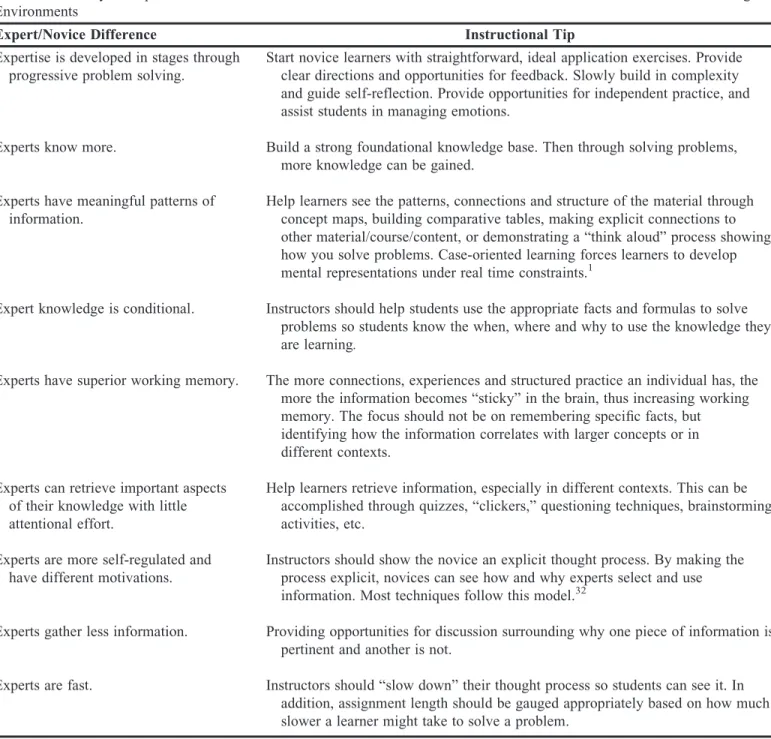
Table 6. Summary of Experts/Novice Differences and Recommendations on How to Address These Differences in Learning Environments
Expert/Novice Difference Instructional Tip
Expertise is developed in stages through progressive problem solving.
Start novice learners with straightforward, ideal application exercises. Provide clear directions and opportunities for feedback. Slowly build in complexity and guide self-reflection. Provide opportunities for independent practice, and assist students in managing emotions.
Experts know more. Build a strong foundational knowledge base. Then through solving problems, more knowledge can be gained.
Experts have meaningful patterns of information.
Help learners see the patterns, connections and structure of the material through concept maps, building comparative tables, making explicit connections to other material/course/content, or demonstrating a “think aloud” process showing how you solve problems. Case-oriented learning forces learners to develop mental representations under real time constraints.1
Expert knowledge is conditional. Instructors should help students use the appropriate facts and formulas to solve problems so students know the when, where and why to use the knowledge they are learning.
Experts have superior working memory. The more connections, experiences and structured practice an individual has, the more the information becomes “sticky” in the brain, thus increasing working memory. The focus should not be on remembering specific facts, but identifying how the information correlates with larger concepts or in different contexts.
Experts can retrieve important aspects of their knowledge with little attentional effort.
Help learners retrieve information, especially in different contexts. This can be accomplished through quizzes, “clickers,” questioning techniques, brainstorming activities, etc.
Experts are more self-regulated and have different motivations.
Instructors should show the novice an explicit thought process. By making the process explicit, novices can see how and why experts select and use information. Most techniques follow this model.32
Experts gather less information. Providing opportunities for discussion surrounding why one piece of information is pertinent and another is not.
(pharmacology vs. pharmacotherapy), and providing specific feedback including where students can get more help.19
Experts can retrieve important aspects of their knowledge with little attentional effort – that is, their in-formation has a high retrieval strength. With novices, re-trieving information places heavy cognitive demands on their attention. Over time and with repeated retrieval of information, the cognitive effort of remembering facts and lists is replaced by making connections and using the information to solve problems. If a student is trying to learn pharmacokinetics and they are not competent in manipulating logarithmic equations, then they will be giving attention to the equation manipulation instead of learning the principles of pharmacokinetics. Therefore, instructors need to scaffold problems to reduce exces-sively high strains on cognitive load (see article by Sanders and Welk20for scaffolding tips).
This ease of retrieving information does not mean that experts solve problems faster than novices. An expert can take longer to solve a problem when attempting to understand the problem deeply. Experts may be faster at routine problems, problems that might be onerous for a novice but have become second nature for an expert.21 For routine tasks, experts complete tasks anywhere from 1.3 to multiple times faster.22-24 In one study, experts were 17 times faster than novices in tying laparoscopic knots while using fewer movements.23From an instruc-tional design standpoint, instructors need to allow suffi-cient time for novices to solve problems. The allocation of time may be difficult as experts may anchor their judg-ments on how long it takes themselves to address the problem. The problem-solving process also may frustrate instructors since they tend to take deeper approaches to understanding the problem where novices may take a more superficial approach.
During the problem-solving process, expert pattern recognition differs from novices. An expert detects and identifies problem patterns more readily; they notice fea-tures and meaningful connections with the information that are not noticed by novices. For example, an expert clinician may see within a conversation with a heart fail-ure patient a statement about how they sleep on three pillows instead of two. To a novice, this may not be rel-evant because they are focused on more textbook features or physical assessment but for a clinician, this is an im-portant piece of information that impacts the clinical de-cision, especially if the information is consistent with other signs or symptoms. An instructor can facilitate this process by having students find themes within the prob-lem or list possibilities that could link to a certain aspect of the problem.
Experts solve problems by forming mental repre-sentations of the problem, which are used to infer rela-tionships that define the situation and its constraints. Defining the situation and its constraints leads to a clear picture of the problem and identification of a clear solution. From an instructional standpoint, have learners sketch out the process they will use to identify the prob-lem and have them recognize important and relevant information and less important but still pertinent infor-mation related to the problem. It also is important to determine constraints on the problem – what is likely versus least likely. Finally, problems an expert view as easy, may be quite challenging for the novice. This dis-connect resolves by using more advanced trainees (up-perclassmen, residents) to help vet problems and ensure the complexity is appropriate.
Ultimately, experts want to understand deeply what the problem means or identify what the root of the issue is rather than just plug-in numbers (or facts) in a formula to get an answer. By understanding the nuances of the prob-lem and corresponding constraints, experts can then ex-plain why they used the tactics they did to come to a solution. Novices just want to solve the smaller compo-nents of a larger problem which they consider in individ-ual silos and address each element at a superficial level, ultimately treating their knowledge like a list of inflexible and unrelated artifacts. For example, imagine a student-pharmacist approached by a patient presenting with a pre-scription for benzonatate to treat a cough. The novice may focus on verifying that the order is correct and begin to start thinking about how to best counsel the patient on this medication – the superficial approach. An experienced preceptor would take a more holistic approach and con-sider the entire patient when verifying the prescription. This process would allow the preceptor to identify if one of the patient’s other medications, like an ACE inhibitor, is causing the cough and ultimately determine that the benzonatate is not needed. The siloed approach used by novices to solve problems superficially without consider-ing the larger picture can frustrate the instructor, there-fore, patience is required to coach students through the process. Instructors can remediate this by highlighting the importance of deeply understanding the problem and modeling that behavior explicitly.
Motivation and Self-Regulation
practice, be open to challenging new experiences and engage in self- reflective processes.
Due to a high level of understanding of how they know what they know and what they do not know, experts have greater metacognitive awareness than novices. This awareness allows experts to be sensitive to task demands (eg, time, effort, resources needed) and more strategic and flexible in their planning and actions.26Experts also know when they need to check for errors, the reasons why they fail to comprehend a situation and how they need to redirect their efforts to attain better outcomes. This self-regulation makes experts better learners. For example, experts can predict accurately which problems were chal-lenging and which were easy.27This awareness enables them to monitor how they should allocate time for solving problems correctly.
This metacognitive ability allows experts to monitor their thinking and problem solving. This helps experts ask more questions especially for difficult concepts.28 Novice learners, on the other hand, ask more questions on the easier material or superficial aspects of the prob-lem. Novice learners are not as likely to monitor their learning and do not have a good idea about whether they have comprehended and mastered the information pre-sented. This phenomenon relates to the Dunning-Kruger effect, a cognitive bias in which relatively unskilled in-dividuals mistakenly assess their ability to be much higher than it is.29, 30Novices are unlikely to use self-tests and self-question as a source of feedback to correct misinfor-mation or misconceptions or change learning strategies to more efficiently or effectively learn.31These differences point to a meaningful distinction between experts and novices about learning expert notice when they are not learning and thus are highly likely to seek a strategic rem-edy when faced with learning difficulties. The solution is to help students develop metacognitive skills so they can become independent monitors of their work.32,33
Is there a downside to Expertise?
Think back to our baseball example presented ear-lier. If you had to teach a child how to throw a baseball, which has become an automatic process for you, could you accurately articulate the process involved in throwing the ball into a list of directions? You are likely right now picturing someone slowly throwing a ball and trying to identify the smaller movements involved in the process so you can translate those movements into words. Unless you previously coached little league, you probably have not already thought intensively about the nuances in-volved in throwing a ball. The point being, an expert in a domain, is not inherently proficient in teaching domain specific information to novices. To become an effective
educator can take practice, time and dedication. This ef-ficiency experts developed can make identifying the exact process that they go through difficult to articulate since the thinking process itself has become intuitive.
Finally, experts are at risk for metacognitive biases in areas that they once “knew.” Individuals understand their knowledge degrades over time but may be prone to mis-judging the rate of this decline.34By misestimating the rate of decline, individuals rate themselves highly in their domain knowledge (a metacognitive miscalibration). Only after noticing they have knowledge gaps or a domain spe-cific deficiency can the judgments become better cali-brated. What is occurring is a misattribution of “peak” knowledge (what I once knew) for current knowledge (what I know now).34 This may impact instructors who are teaching slightly outside their domain expertise or who no longer practice pharmacy. For this reason, experts are always learning and practicing to reduce this metacog-nitive error – without the practice, they may end up in an arrested development stage.42
Instructional approaches and the Expertise Reversal Effect
Within health professional education we tend to use the clinical or scientific experts to teach within their re-spective area. To date, there is no correlation, or a slight negative correlation, between research productivity (as a measure of expertise) and measures of teaching effec-tiveness.35,36Expertise can hurt student learning because experts forget what is easy and what was difficult to learn. For experts, it all seems natural.37If experts do not have the pedagogical knowledge, they may be more prone to rely on textbooks on how to teach their students. The book authors do not know anything about their classroom, the students, students’ prior knowledge or other factors that impact instruction or student development.
Individuals who have developed an expertise in teaching know the difficulties that students are likely to encounter when learning. They have a reasonable idea of the level of existing knowledge (or can assess current knowledge) so they can make new information more meaningful. Expert teachers formatively assess a stu-dent’s progress to the goal, not just summative at the end. Finally, expert instructors have integrated the con-tent knowledge (domain specific expertise) with the ped-agogical knowledge (teaching expertise) that underlies effective teaching. Ultimately if a content expert wants to be an excellent educator, he or she will need to dedicate time and energy to improve instruction continually and work toward becoming an expert teacher.
memory. This load is reduced after repeated retrieval practice because the information is organized and stored in long-term memory resulting in information processing that is more efficient. There are instructional techniques that facilitate this organization and automation by re-ducing working memory. However, evidence suggests the effectiveness of these techniques depends on the learner expertise. Instructional methods that are useful for inexperienced learners can lose their effectiveness or have negative consequences when used with more experienced learners. This phenomenon is the expertise reversal effect.38
One of the reasons for this effect is cognitive load. Within the cognitive load framework, there is the ger-mane load (load devoted to processing information, con-structing and automating schemas), intrinsic load (load imposed by learning the task) and extraneous load (load imposed by the presentation of information to learners). The concept of the extraneous load is not only related to the capacity or duration of working memory, but also to the amount of cognitive processing. An instructor can impose an extraneous load on the learner if it requires irrelevant cognitive activities, which do not result in learning.39,40Figure 1 summarizes some of the instruc-tional techniques that may be more helpful for novices and learners with higher baseline knowledge.
SUMMARY
Table 6 summarizes differences between experts and novices and how these differences inform instruction. Expertise develops through deliberate practice. The cur-riculum should provide an opportunity for students to learn the necessary background knowledge, make mean-ingful connections to previously learned content and re-inforce that information over time. This practice requires intentional scaffolding (lesson, course, and curriculum) and collaboration between course instructors to provide progressively challenging and integrated problems that are appropriate for the learner.
Courses should support students, so they are en-couraged to retrieve information actively repeatedly. This retrieval should happen in both structured classroom
environments and independently outside of classroom settings. For any class activities, instructors need to provide adequate time for students to complete the as-signment. This time-allocation may seem simple, but frequently experts underestimate the time required to solve more common problems. Students may be at differ-ent levels, so you need to have the flexibility to match the student ability level with the activity presented.
Finally, students require metacognitive development. There should be a focus on being explicit about the thought processes, especially when it comes to clinical decision making and applying knowledge to increasingly complex situations. Provide precise and actionable feedback, so the learner has the opportunity and support to increase their self-awareness about ability level and confidence.
REFERENCES
1. Ericsson KA.The Cambridge Handbook of Expertise and Expert Performance. New York, NY: Cambridge University Press; 2006. 2. Anderson JR. Acquisition of cognitive skill.Psychol Rev.1982; 89(4):369-406.
3. Shiffrin RM, Schneider W. Controlled and automatic human information processing: II. Perceptual learning, automatic attending and a general theory.Psychol Rev.1977;84(2):127-190.
4. Chi MTH, Glaser R, Farr MJ.The Nature of Expertise. Hillsdale, NJ: L. Erlbaum Associates; 1988.
5. Swanson HL, O’Connor JE, Cooney JB. An information processing analysis of expert and novice teachers’ problem solving.
Am Educ Res J.1990;27(3):533-556.
6. Macnamara BN, Hambrick DZ, Oswald FL. Deliberate practice and performance in music, games, sports, education, and professions: a meta-analysis.Psychol Sci.2014;25(8):1608-1618.
7. Ulle´n F, Hambrick DZ, Mosing MA. Rethinking expertise: a multifactorial gene-environment interaction model of expert performance.Psychol Bull.2016;142(4):427-446.
8. Dreyfus HL, Dreyfus SE. Expertise in real world contexts.Org Studies.2005;26(5):779-792.
9. Batalden P, Leach D, Swing S, Dreyfus H, Dreyfus S. General competencies and accreditation in graduate medical education.
Health Aff (Millwood).2002;21(5):103-111.
10. Carraccio CL, Benson BJ, Nixon LJ, Derstine PL. From the educational bench to the clinical bedside: translating the Dreyfus developmental model to the learning of clinical skills.Acad Med.
2008;83(8):761-767.
11. Ericsson KA, Krampe RT, Tesch-Ro¨mer C. The role of deliberate practice in the acquisition of expert performance.Psychol Rev.1993;100(3):363-406.
12. Kuhlmann DO, Ardichvili A. Becoming an expert: developing expertise in an applied discipline.Eur J Train Develop.2015; 39(4):262-276.
13. Johnson PE, Dura´n AS, Hassebrock F, et al. Expertise and error in diagnostic reasoning.Cogn Sci.1981;5(3):235-283.
14. Rylander M, Guerrasio J. Heuristic errors in clinical reasoning.
Clin Teach.2016;13(4):287-290.
15. Kolluru S, Roesch DM, de la Fuente AA. A multi-instructor, team-based, active-learning exercise to integrate basic and clinical sciences content.Am J Pharm Educ.2012;76(2):Article 33. 16. Daley BJ, Torre DM. Concept maps in medical education: an analytical literature review.Med Educ.2010;44(5):440-448. 17. Kolb DAa.Experiential Learning: Experience as the Source of Learning and Development. Upper Saddle River, NJ: Pearson Education, Inc.; 2015.
18. Conway JM, Ahmed GF. A pharmacotherapy capstone course to advance pharmacy students’ clinical documentation skills.Am J Pharm Educ.2012;76(7):Article 134.
19. Larsen D, Butler A. Test-enhanced learning. In: Walsh K, ed.
Oxford Textbook of Medical Education. Oxford, UK: Oxford University Press; 2016.
20. Sanders D, Welk DS. Strategies to scaffold student learning: applying Vygotsky’s Zone of Proximal Development.Nurse Educ.
2005;30(5):203-207.
21. Schmidt HG, Norman GR, Boshuizen HP. A cognitive perspective on medical expertise: theory and implication.Acad Med.
1990;65(10):611-621.
22. Judkins TN, Oleynikov D, Stergiou N. Objective evaluation of expert and novice performance during robotic surgical training tasks.
Surg Endosc.2009;23(3):590-597.
23. Haji FA, Khan R, Regehr G, Drake J, de Ribaupierre S, Dubrowski A. Measuring cognitive load during simulation-based psychomotor skills training: sensitivity of secondary-task performance and subjective ratings.Adv Health Sci Educ Theory Pract.2015;20(5):1237-1253.
24. Jaarsma T, Boshuizen HPA, Jarodzka H, Nap M, Verboon P, van Merrie¨nboer JJG. Tracks to a medical diagnosis: expertise differences in visual problem solving.Appl Cogn Psychol.2016;30(3):314-322. 25. King G, Currie M, Bartlett DJ, Strachan D, Tucker MA, Willoughby C. The development of expertise in paediatric rehabilitation therapists: the roles of motivation, openness to experience, and types of caseload experience.Aust Occup Ther J.
2008;55(2):108-122.
26. Weinstein CE, Stone GVM. Broadening our conception of general education: the self-regulated learner.New Dir Comm College.1993;1993(81):31-39.
27. Fakcharoenphol W, Morphew JW, Mestre JP. Judgments of physics problem difficulty among experts and novices.Physical Rev Spec Topic Phys Educ Res.2015;11(2).
28. Miyake N, Norman DA. To ask a question, one must know enough to know what is not known.J Verb Learn Verb Behav.
1979;18(3):357-364.
29. Kruger J, Dunning D. Unskilled and unaware of it: how difficulties in recognizing one’s own incompetence lead to inflated self-assessments.J Personal Soc Psychol.1999;77(6):1121-1134. 30. Serra MJ, DeMarree KG. Unskilled and unaware in the classroom: college students’ desired grades predict their biased grade predictions.Mem Cognit.2016;44(7):1127-1137.
31. Stein BS, Bransford JD, Franks JJ, Vye NJ, Perfetto GA. Differences in judgments of learning difficulty.J Exp Psychol Gen.
1982;111(4):406-413.
32. Medina MS, Castleberry AN, Persky AM. Strategies to improving learner metacognition in health professional education.
Am J Pharm Educ.2017;81(4):Article 78.
33. Tanner KD. Promoting student metacognition.CBE Life Sci Educ.2012;11(2):113-120.
34. Fisher M, Keil FC. The curse of expertise: when more knowledge leads to miscalibrated explanatory insight.Cogn Sci. 2016;40(5):1251-1269.
35. Carter RE. Faculty scholarship has a profound positive association with student evaluations of teaching – except when it doesn’t.J Market Educ.2016;38(1):18.
36. Feldman KA. Research productivity and scholarly
accomplishment of college teachers as related to their instructional effectiveness: a review and exploration.Res Higher Educ. 1987;26(3):227-298.
37. Carraccio CL, Benson BJ, Nixon LJ, Derstine PL. From the educational bench to the clinical bedside: translating the Dreyfus developmental model to the learning of clinical skills.Acad Med.
2008;83(8):761-767.
38. Kalyuga S, Ayres P, Chandler P, Sweller J. The expertise reversal effect.Educ Psychol.2003;38(1):23-31.
39. van Merrienboer JJG, Sweller J. Cognitive load theory and complex learning: recent developments and future directions.Educ Psychol Rev.2005;17(2):147-177.
40. Kalyuga S, Singh A-M. Rethinking the boundaries of cognitive load theory in complex learning.Educ Psychol Rev.2016;28(4): 831-852.
41. Pen˜a A. The Dreyfus model of clinical problem-solving skills acquisition: a critical perspective.Med Educ Online.2010;15:1-11. 42. Ericsson KA. Deliberate practice and acquisition of expert performance: a general overview.Acad Emerg Med.2008; 15(11):988-994.
43. Rey GD, Buchwald F. The expertise reversal effect: cognitive load and motivational explanations.J Exp Psychol Appl.2011; 17(1):33-48.