FOOD EXPLORERS: FAMILY EDITION
A THEORY-BASED TEXT MESSAGE AND SOCIAL MEDIA PILOT INTERVENTION FOR FAMILIES TO ADDRESS CHILD DIET
Linden M. Thayer
A dissertation submitted to the faculty at the University of North Carolina at Chapel Hill in partial fulfillment of the requirements for the degree of Doctor of Philosophy in the Department of
Nutrition in the Gillings School of Global Public Health.
Chapel Hill 2016
ABSTRACT
Linden M. Thayer: Food Explorers: Family Edition
A Theory-Based Text Message and Social Media Pilot Intervention for Families to Address Child Diet
(Under the direction of Alice Ammerman)
Health disparities persist in the United States despite numerous policies, interventions, and programs to address the issue. Rural children are at a higher risk for poor health outcomes because of their geographic location, household income, and/or parent education. Incidence of childhood obesity and Type 2 diabetes are directly related to food access and eating behaviors, including vegetable and sugary beverage consumption. In North Carolina in 2011, 74% of children age 0-17 did not consume the recommended daily serving of vegetables, and at least 67.7% of all NC children age 0-17 consumed one or more sugary beverages per day.
Families and school nutrition services (SNS) are key to shaping elementary school children’s eating behaviors, but few published studies have successfully leveraged the strengths of both entities in a coordinated fashion to meaningfully impact child eating behavior. A few interventions have tried to improve urban child eating behavior with mixed success, but barriers in rural settings, which include limited time, transportation, parent education, and funding, make replication of other interventions in rural settings difficult.
To D, for everything
To my parents, who shaped my path with incredible experiences, education, love and support To Alice, for supporting wild, crazy ideas
ACKNOWLEDGEMENTS
This work would not have been possible without the incredible support, enthusiasm, and leap of faith of the staff, students and families at Henderson Collegiate Charter School. These are the individuals who said “Yes!” to a Crazy Lunch Lady. None of my dreams of understanding school nutrition from the inside out, to build truly community-based, practice-based solutions to some of our most frustrating public health challenges, could have been possible if I was not offered the opportunity to experiment and build a 21st Century school nutrition program in Henderson.
Along the way, families and students opened their minds to new ideas, participated in our technology-based research, and laid the foundation for an incredible future of food at
Henderson Collegiate, in North Carolina, and beyond. I will treasure the lessons, easy and hard, from my experiences there, and will move everything I have learned forward to build equitable, sustainable, and delicious advances in school nutrition and public health.
PREFACE
Food, and access to good food, is a human right. My passion is working at the
intersection of child health, schools, and resilient food systems to make access to good food a reality for all children, regardless of race/ethnicity, family income or education, geography, or other characteristics associated with health disparities and disparities in access to fundamental rights.
TABLE OF CONTENTS
LIST OF TABLES………..xii
LIST OF FIGURES………...xiii
LIST OF ABBREVIATIONS ………xiv
CHAPTER I: INTRODUCTION………..………...1
A. Overview………...1
B. Specific Aims………3
CHAPTER II: BACKGROUND AND SIGNIFICANCE………...5
A. Current child eating behaviors………..5
B. Intervention design………..5
C. Evidence-based behaviors to improve rural child health….……….7
D. Where to intervene to improve child health...……….9
E. Advantages of social media and new health communication technologies.………...12
F. Elevating the status of School Nutrition Services………14
G. Significance………15
CHAPTER III: FOOD EXPLORERS: A SOCIAL MARKETING PROGRAM TO INCREASE STUDENT FRUIT AND VEGETABLE CONSUMPTION………..16
A. Overview……….16
B. Introduction……….16
C. Methods………..18
D. Results………24
CHAPTER IV: FOOD EXPLORERS: FAMILY EDITION - DEVELOPMENT OF A THEORY-BASED TEXT MESSAGE AND SOCIAL MEDIA INTERVENTION FOR
FAMILIES TO ADDRESS CHILD DIET………....32
A. Overview……….32
B. Introduction……….32
C. Methods………..33
D. Results………38
E. Discussion………..45
CHAPTER V: FOOD EXPLORERS: FAMILY EDITION - RESULTS OF A RANDOMIZED TEXT MESSAGE AND SOCIAL MEDIA INTERVENTION FOR FAMILIES TO ADDRESS CHILD DIET………...48
A. Introduction……….48
B. Methods………..49
C. Results………52
D. Discussion………..65
CHAPTER VI: SUMMARY AND RECOMMENDATIONS...………...69
A. Summary of Findings………...69
B. On Being a Lunch Lady………70
C. Recommendations………72
D. Future Directions………...73
APPENDIX 1: FOOD EXPLORERS………..75
1.1 FOOD EXPLORERS LOGO ………..……….75
1.2 FE PASSPORT, TRADING CARDS, CERTIFICATE, BANNER, POINT-OF-SALE SIGNS……….76
1.3 CHILD INTERVIEWER-ADMINISTERED SURVEY (PRE/POST)………81
1.4 CHILD IN-DEPTH INTERVIEW (POST)………84
1.5 PARENT IN-DEPTH INTERVIEW (POST)………...86
1.7 SCHOOL NUTRITION SERVICES STAFF IN-DEPTH INTERVIEW (POST)………90
1.8 TEACHER TRAINING GUIDE (SHORT)………...92
1.9 TEACHER TRACKING FORM………95
1.10 PROCESS EVALUATION FORM………..………..96
APPENDIX 2: FOOD EXPLORERS: FAMILY EDITION (FE2) DEVELOPMENT MATERIALS………..98
2.1 FORMATIVE IN-DEPTH INTERVIEW GUIDE (PARENT)……….…...98
2.2 FORMATIVE IN-DEPTH INTERVIEW GUIDE (TEACHER)………101
2.3 FOCUS GROUP GUIDE (PARENT)………...104
2.4 FOCUS GROUP GUIDE (CHILD)………108
2.5 PARENT SURVEY (PRE/POST)………..………...111
2.6 CODEBOOK FOR IN-DEPTH INTERVIEW ANALYSIS………..115
APPENDIX 3: FOOD EXPLORERS: FAMILY EDITION (FE2) INTERVENTION MATERIALS………116
3.1 CHILD SURVEY (PRE/POST)………...………..116
3.2 PARENT SURVEY (PRE/POST)……….……120
3.3 FULKERSON ET AL. HOME FOOD INVENTORY (HFI) (2008)………...…….125
3.4 POST-STUDY IN-DEPTH INTERVIEW GUIDE (PARENT)………134
3.5 POST-STUDY IN-DEPTH INTERVIEW GUIDE (CHILD)………....137
3.6 POST-STUDY IN-DEPTH INTERVIEW GUIDE (TEACHER)……….139
3.7 POST-STUDY IN-DEPTH INTERVIEW GUIDE (SCHOOL NUTRITION SERVICES STAFF)………..………...141
3.8 FE2 REMIND TEXT MESSAGE SERVICE ILLUSTRATION………..…....143
3.9 FE2 FACEBOOK IMAGES ………...145
3.10 FE2 WEBSITE IMAGES………..………148
3.11 FE2 EMAIL NEWSLETTER IMAGES………...………152
3.13 FACEBOOK MESSAGE LIBRARY………158
3.14 GOAL TRACKING SHEET ……….170
3.15 FE2 PARENT NUTRITION EDUCATION BINDER (INTERVENTION
EXAMPLE) ……….………171
LIST OF TABLES
Table 3.1 Descriptive Statistics of Rural Elementary School Children……….19
Table 3.2 Plate Waste Analysis – Descriptive Statistics ………28
Table 4.1 School Demographics ………35
Table 4.2 FE2 Program Development Participants……….39
Table 4.3 Parent Formative Survey Demographics………41
Table 5.1 FE2 Pilot Study Demographics ………54
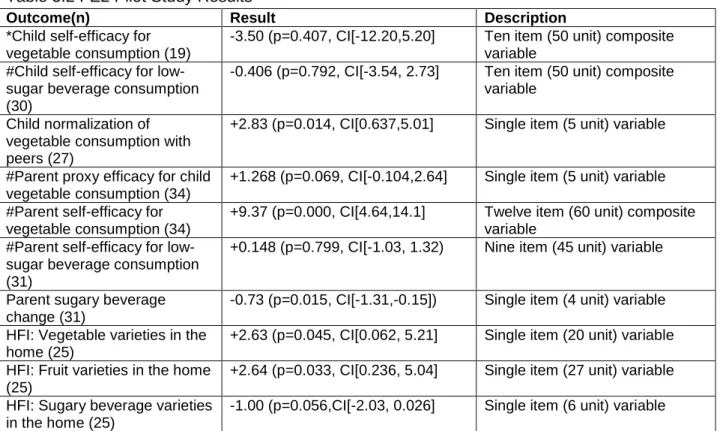
Table 5.2 FE2 Pilot Study Results….………55
Table 5.3 Sample Text Messages/Facebook Posts………...60
Table 5.4 Mapping Text Messages to Theoretical Constructs ……….61
LIST OF FIGURES
Figure 1.1 Conceptual Model of the School Nutrition Program Text Message
& Social Media Family Intervention……….7
Figure 3.1 Food Explorers Conceptual Model……….22
Figure 3.2 Food Explorers Study Design………..24
Figure 3.3 Mean Change in FV Consumption………..26
Figure 4.1 Food Explorers and Food Explorers: Family Edition Components………45
LIST OF ABBREVIATIONS
FE Food Explorers
FE2 Food Explorers: Family Edition
FG Focus group
FV Fruits and vegetables FVJ Fruits, vegetables, and juice HFI Home Food Inventory IDI In-depth interview NC North Carolina
SCT Social Cognitive Theory SES Socio-economic status SNS School Nutrition Services
CHAPTER I. INTRODUCTION A. Overview
Health disparities persist for rural children in the United States, who are at elevated risk for poor health outcomes like obesity and Type 2 diabetes because of their geographic location, household income, and/or parent education.1-3 Childhood obesity prevention is linked to four key behaviors, and two of those behaviors are diet-related: consuming three or more cups of fruits and vegetables per day, and replacing sugary beverages with sugar-free options.4 Many studies have tried to address these eating behaviors to reduce the rates of childhood obesity, but almost none of the research has occurred in rural communities, where poor child health outcomes are higher compared to urban peers.5, 6
In North Carolina in 2011, 63% of children age 0-17 did not consume the recommended daily serving of fruits and vegetables, and 74% of children did not consume the recommended daily serving of vegetables. In addition, at least 67.7% of all NC children age 0 - 17 consumed one or more sugary beverages per day.7 Fruit/vegetable (FV) and sugary beverage
Families and school nutrition services (SNS) are two key groups that shape elementary school children’s eating behaviors and child health.14 Families and SNS have each been the target of policies and interventions to improve child eating behavior, but few published studies have successfully leveraged the strengths of both entities in a coordinated fashion to impact child eating behavior in a meaningful and sustained way.6, 14 Recent changes to USDA
guidelines that govern national school meal programs have improved the variety and quantity of fruits and vegetables, as well as overall meal patterns, available to urban children through school meal programs.15 But outdated negative perceptions of school meals persist among children and parents alike; families continue to blame school food, and SNS continue to blame families, for children’s poor eating behaviors and health outcomes.
Limited research has only demonstrated that these changes have not made student diets worse in urban settings; no data are available to understand their impact of the guidelines (positive or negative) in rural communities.16 The home environment, as well as attitudes toward and actual consumption of school meals, temper the effects of federal policy changes. One recent study in rural North Carolina (NC) schools (Food Explorers, “FE”) did have some positive and protective effects on child exposure to FV during school lunch (Thayer, submitted). A greater effect on child FV preference, and self-efficacy to consume FV and low-sugar beverages, might be achieved with the addition of a family component.
The United States Department of Agriculture (USDA), through the 2010 Healthy Hunger-Free Kids Act, has charged SNS with nutrition education for students and families, but local staff in rural schools often do not have the time or training to create or deliver evidence-based
nutrition programming.17 A technology-based nutrition intervention, targeting families and marketed as a product of SNS, is a unique approach that could be accessed by most NC
enhance the modest effects of FE, and it may also position NC SNS as a leader in family nutrition education to fulfill the USDA’s education mandate.
What follows in Chapter I are the specific aims of this research, to develop a technology-based nutrition intervention (FE2) to increase the effects of a previously developed social marketing nutrition intervention implemented in rural elementary schools. Chapter II includes background information that builds the case for a need for, and potential significance of, such programs in rural North Carolina. Chapter III reports on the outcomes from the initial FE school-based study, Chapter IV describes the community-school-based approach to developing the FE2 technology-based program, and Chapter V reports on the outcomes from the initial twelve-week trial of the FE2 intervention. Chapter VI includes a summary of findings, recommendations, and future directions for research.
B. Specific Aims
OVERALL AIM: Determine whether a theory-informed, technology-based nutrition
intervention, targeting families with messages “from” SNS designed for 4th and 5th grade
students/families (FE2), will enhance the impact of a streamlined school-based Food Explorers
intervention (FE) by increasing child self-efficacy for vegetable consumption (primary outcome),
and child self-efficacy for low-sugar beverage consumption (secondary outcome).
AIM 1. Formative Research: Determine through focus groups, in-depth interviews, and surveys: (1) the community context (including local and regional culture and preferences) that can inform and improve targeting of messages and materials; (2) the community’s
reactions to the original Food Explorers program (style, design, content), and how the original FE project should be adapted and streamlined for this community context; (3) the message source(s) families prefer to receive child eating and nutrition information from SNS (e.g. the voice of the SNS director, the voice of the local SNS manager, an independent nutrition expert, a USDA-affiliated nutrition expert, etc.); (4) what social media channels of
communication frequency; (5) what specific nutrition and parenting knowledge/skills families want from a SNS technology-based program; (6) what nutrition/parenting knowledge content experts (including nutrition experts, parenting experts, state-level SNS staff, and others) believe families could benefit from in this kind of intervention.
AIM 2. Intervention Development: Develop a 12-week theory- and technology-based family nutrition intervention delivered “from SNS” (FE2) that improves child self-efficacy for vegetable (and low-sugar beverage) consumption, as well as parent self-efficacy (and parent proxy efficacy for their child) for vegetable (and low-sugar beverage) consumption.
Subaim 2a. Message Testing/Pilot: Assess acceptability, perceived effectiveness, feasibility, and cultural relevance of FE2 intervention components, communication tools, and proposed measures with a sample of the target population in a two-week trial.
AIM 3. Intervention Impact: Determine whether a 12-week theory-informed and technology-based family nutrition intervention delivered “from SNS” (FE2) to 4th and 5th grade students/families results in the following, as compared to 4th and 5th grade
students/families randomized to a delayed FE2 intervention control:
Primary outcome: Increased child self-efficacy for vegetable consumption.
Secondary outcomes: Increased child self-efficacy for low-sugar beverages; increased child preferences for vegetables; improved parent self-efficacy for vegetable/low-sugar
beverage consumption.
Hypothesis: Relative to the standard FE program, students randomized to the FE2
intervention will increase self-efficacy for vegetable consumption, and parents will
CHAPTER II. BACKGROUND AND SIGNIFICANCE A. Current child eating behavior
In North Carolina in 2011, 63% of children age 0 – 17 did not consume the
recommended daily serving of fruits and vegetables (74% of children did not consume the recommended daily serving of vegetables). In addition, at least 67.7% of all NC children age 0 - 17 consumed one or more sugary beverages per day.7 Nationally, 78.4% of males and 80.6% of females age 9 - 13 did not meet minimum fruit recommendation; 96.2% males and 94.6% females did not meet minimum recommended vegetable intake (2001-2004).1 As children age, fruit and vegetable consumption tends to decrease, not increase.8
In addition, 86.0% of males and 92.0% of females age 9 - 13 exceeded added sugar guidelines.1 Overall, soda consumption is decreasing in the US, but as children age they increase sugary beverage consumption, and sports/energy drink consumption has tripled among adolescents between 2000 and 2008.18 Children in lower income/lower education/racial minority households are also more likely to consume sugary beverages.18
B. Intervention Design
B1. Community-based research
formative phase of development for both Food Explorers and Food Explorers: Family Edition included iterative work with stakeholders to build a community-responsive program, similar to other community-supported health intervention development and research.19
B2. Conceptual Model – Theory Base
Intervention development was guided by a conceptual model grounded in Social Cognitive Theory (SCT), plus two additional behavior change constructs (Figure 1). The intervention capitalized on social media and text messaging tools to bolster families’ observational learning, facilitation, self-efficacy, awareness, and social support. Nutrition interventions are more effective when intervention development is guided by theoretical and conceptual models.20
Reciprocal determinism: Behavior is the result of interactions between individuals and their environment. FE2’s text message and social media components included a variety of messages and tools that empower participants to understand and/or make changes to personal characteristics, behavior, and environment.
Facilitation: Text message and social media tools facilitated both learning and practice related to key behavior change strategies.
Observational Learning: The social media component included a variety of tools to help parents learn from peers and content experts, such as sharing photos and short stories with other participants (e.g. Facebook wall) and prompts via text message to participants to view brief video clips (e.g. a YouTube cooking demonstration).
Goal setting/self-regulation: Participants practiced goal setting and techniques to maintain accountability. Participants were prompted to report on their goals once per week, via text and social media.
Self-efficacy: Messages and program content were designed to increase self-efficacy for child healthy eating, parent/family healthy eating, and parent nutrition knowledge.
Consciousness Raising: Emphasis was placed on the most current evidence-based nutrition science.
Social Support: Parents shared stories, recipes, and more via social media with other participants; the program encourages families to interact to increase social support online. The study also included messages about how parents could build successful social support networks offline.
C. Evidence-based behaviors to improve rural child health C1. Eating behaviors
Higher fruit and vegetable (FV) consumption is associated with reduced risk of chronic disease, including cardiovascular disease and some cancers, in addition to healthy weight management.9, 10, 21, 22 Fruit/vegetable consumption and sugary beverage consumption are two key child diet behaviors associated with immediate health outcomes in children, and future health outcomes when children become adults. The American Medical Association identified four key behaviors associated with prevention and treatment of child and adult obesity: (1) 60 minutes of physical activity per day; (2) eating 3 or more cups of fruit and vegetables per day; (3) replacing sugary beverages with sugar-free beverages; and (4) limiting screen time (computer, television, etc.) to a maximum of 2 hours per day.4
increased insulin sensitivity)11, in addition to long-term associations with reduced
overweight/obesity and related diseases. And there is ample evidence that sugary beverage consumption is associated with increased obesity risk and decreased micronutrient intake in children.12, 23, 24 Intervening on these two diet behaviors is even more important in rural areas because, to date, relatively few studies have been conducted in these communities, even though children living in rural areas are more likely to be overweight and obese and more likely to engage in poor diet behaviors, when compared to their urban and suburban peers.2, 3, 13
The newly-announced Dietary Guidelines for Americans (DGA) 2015 draws on some of this literature and also emphasizes the need for increased vegetable, fruit, and low-sugar beverage consumption.25 These new guidelines govern SNS programs and the dietary behavior and nutrition education of millions of Americans, so it is timely to address some of these
concerns now in a technology-based intervention for families. The DGA suggest several ways to address child dietary behavior at the individual, family, school, and community levels. At the school/community-level, the DGA calls for the design and implementation of healthier environments, healthier social norms, greater focus on prevention, and dissemination of evidence-based nutrition information over pop-science and outdated standards. All of these concepts can be addressed in the program outlined below.
C2. Self-efficacy for FV/low-sugar beverages
Actual behavior change is the ultimate goal of nutrition interventions; certain
determinants of behavior change highlight trends suggesting positive impact on diet change without actually measuring diet change directly. Eating behaviors are preceded and predicted by several factors, including self-efficacy (SE) for FV consumption (and low-sugar beverage
clear.27 Self-efficacy has successfully been targeted in a variety of school and technology-based internet interventions for children. For example, a 2008 internet-based intervention for 8 - 10 year old female African-American children showed a positive impact on SE for fruit, vegetable, and juice (FVJ) consumption, as well as actual FVJ consumption.28
Self-efficacy for fruit and vegetable consumption are related but separate constructs, and while historically they were measured in tandem, recent research suggests there are enough differences that a programs’ impact may be greater for one over the other.29 Self-efficacy for non-starchy vegetable consumption may be more difficult to increase than SE for fruit consumption among rural, low-SES students and their families; actual consumption of non-starchy vegetables is considerably lower for these groups as compared to fruit consumption. As such, the pilot study described below addresses both fruit and vegetable consumption, but the primary outcome of interest is SE for vegetable consumption.
D. Where to intervene to improve child health D1. Why school meal programs are important
Schools are a common site to intervene to improve child eating behavior, in part because most children are accessible through schools and schools offer an existing structure through which to deliver interventions. In 2014, over 30 million students (roughly 67% of the total school-age population) participated in national school lunch programs, and almost 900,000 (more than 50% of total NC school-age population) participated in NC school meal programs.30 Experts have identified schools as important intervention areas, and recent changes to federal school meal programs were made specifically to improve child dietary behaviors.31-33 While some evidence exists for positive effects of these federal changes on fruit selection and
from home in rural NC, but students’ school meal consumption is not enough to improve child diet behaviors and child health overall.16
In an effort to extend SNS’s positive effects on child health beyond the cafeteria, federal nutrition policy mandates that school meal programs engage in nutrition education for students and families, but the majority of school meal programs have limited tools, time, knowledge, and resources to actively engage these groups in meaningful, evidence-based programming.35 For example, NC’s Department of Public Instruction (DPI) School Nutrition website has a page for “Nutrition Education Resources for Schools” with limited and static information, including links for fruit and vegetable fact sheets, local wellness policy information, basic classroom nutrition education curricula, school gardens information, and guides for staff wellness.36 Although many of the resources are designed to be delivered through classrooms, most NC school meal programs do little more than put up posters and link to this resource page from their own webpages. Classroom teachers are often overwhelmed with other state and federal
requirements and have limited interaction with SNS that might otherwise foster collaborative efforts. NC DPI and federal policy do not make much effort to describe how to implement nutrition education through schools, which is a lost opportunity to engage students and families in important learning and behavior change.
D2. Why families are important
Schools are one important place of influence on child diet behavior; families are another. A review of experimental trials and correlative studies with children and families found the following from family interventions had positive effects on child diet behavior for children age 8 - 12: reward/positive reinforcement (a parental strategy); parent involvement (in prevention
programs); parental monitoring of child diet; lack of restrictive control over food choices; parent’s and sibling’s increased intake of healthy foods and reduced intake of unhealthy foods; and low
pressure to consume foods.37 Other reviews suggest that parent obesity status is also
associated with positive diet and physical activity behaviors in young children.38, 39 And another recent study suggests that family and home environment account for more than 50% of effects of an online intervention to improve child diet in 4th and 5th grade students.5 Clearly, families are an important player in child healthy diet behavior. Families need effective, engaging, evidenced-based tools to help promote child health.
D3. Combining family and school meal programs
Previous interventions tended to work with schools OR families; a few combined programs were implemented in urban settings, but they presented some barriers to
implementation in more rural communities.6, 14 In a review of 15 combination school and family intervention programs, authors cited seven behavior change techniques characteristic of effective interventions.14 These include:
Behavior Change Techniques (*indicates most common):
1. Prompt intention formation
2. Provide general information on behavior-health links* 3. Provide instruction
4. Model/demonstrate the behavior 5. Prompt self-monitoring of behavior 6. Prompt practice*
7. Plan social support/social change*
In addition to targeting these behavior change techniques, theory-based programs tended to have greater effects than non-theory-based interventions. Social cognitive theory was the most commonly cited theory in the review, with combination school/family programs most focused on the construct reciprocal determinism (the interaction between behavior,
E. Advantages of social media and new health communication technologies The widespread use of new technologies, including texting and social media, is a
relatively recent phenomenon, and it is unclear how these technologies could improve access to and engagement with important nutrition information and behavior change education. New research is needed to understand how rural families might engage with and learn from diet behavior change programs that use such new technologies and tools. The reasons in support of using these new technologies are three-fold: (1) they allow for near-universal access to
programs and information, regardless of transportation, financial, and time-related barriers in rural communities; (2) they allow for fast, easy, and wide-spread dissemination of information; and (3) they tap into current trends in the general population’s use of such technologies, meeting families and students where they are comfortable (online/on their phones). E1. Mobile phone and text message use
Mobile phones are fast becoming ubiquitous in American households. As of January 2014, Pew Internet Research studies indicated at least 90% of American adults, regardless of race/ethnicity, have a cell phone and 58% of American adults have a smartphone. 84% of households earning less than $30,000 per year and 88% of individuals living in rural
communities own a cell phone, suggesting most families in rural NC have access to mobile phone technology.40 Although smartphone ownership is less than total mobile phone ownership, the rate of increase in smartphone ownership far outpaces the rate of increase in general mobile phone ownership. Black and Latino adults are more likely than Whites to own a smartphone (59%, 61%, and 53% respectively); only 47% of households earning less than $30,000 per year have smartphones; and 43% of rural adults own smartphones as of January 2014.40
community was assessed during formative research; previous interactions in this community suggested mobile phone ownership and use was on par with national trends.
E2. Social media use
Social media is yet another way to access families where they are, namely online. Social media programs offer the potential to engage families directly with evidenced-based
programming and allow for social support and observational learning regardless of individuals’ actual location. As of September 2014, Pew Internet Research data indicated 81% of American adults use the internet. Of those online adults, 71% use Facebook; 28% use LinkedIn; 28% use Pinterest; 26% use Instagram; and 23% use Twitter.42
Where are people accessing social media sites? As of May 2013, 63% of mobile phone users access the internet from their phone. As of September 2013, at least 70% of Americans had broadband internet at home, but that access is not equal across groups: 74% of Whites, 62% of Blacks, and 56% of Hispanics have internet access at home; 52% of households earning less than $30,000 per year have broadband internet at home, and 60% of rural
residents have broadband at home.43 What does this mean for a text message and social media intervention in rural NC? Formative research determined what the internet access and social media use looks like in the target community; anecdotal evidence suggested internet access was not a barrier to participation for this community. Trends in mobile internet and broadband internet use suggest more and more of the U.S. population gains access each year, so the development of an effective text message and social media program now will position the program for widespread dissemination as more rural families gain easy access to home and mobile internet.
E3. Advantages of new health communication technologies
take advantage of mobile phone technologies to improve eating behaviors and health outcomes for children and families, and the research and pilot study described in Chapters IV and V add to a growing body of evidence and best practices for family nutrition interventions.44, 45 Several systematic reviews of text message (SMS) programs aimed at behavior change suggest that this technology offers several advantages for behavior change interventions. According to Bauer et al, text messaging’s advantages include: “(1) SMS is accessible at almost any time and everywhere, (2) SMS is a fast and interactive medium, (3) SMS can be used with little effort, and (4) communication via SMS is inexpensive”.46 Text message and social media
technologies offer the opportunity to bring nutrition interventions to families in real time, wherever they are, instead of having to attend in-person intervention sessions that may be precluded by limited transportation, time, and/or resources in rural NC.
A text message and social media intervention is one innovative method to overcome barriers to traditional diet intervention delivery and success because text messages can also be a “push technology” that demands user engagement and attention, and social media can be a place for comfortable and sustained observational learning and social support beyond the limits of traditional text message programs.
F. Elevating the status of School Nutrition Services
The importance of child participation in school meal programs (as opposed to packing lunch from home), in order to improve diet during the school day in rural communities, is described above; one way to increase child participation in SNS programs is to elevate the status of SNS in the eyes of students, families and the community. If SNS programs are seen as a trusted source of nutrition and health information, as well as a provider of nutritious and
appealing foods, more students and families will participate in the programs. This will
For that reason, this pilot study, using text message and social media to improve student and family diet attitudes/beliefs/behaviors, was delivered using the “voice” and personae of someone from SNS (the details of the messaging and channel will be determined during formative
research). This provides the opportunity to combat the negative impressions SNS and recent changes to federal meal programs have left on students and families in rural NC, and fulfills SNS’s mandate to provide families with nutrition and diet behavior education.
G. Significance
North Carolina’s rural children are at higher risk for poor eating behaviors and poor health outcomes when compared to their urban peers. Few studies have successfully leveraged the influential power of schools and families to address child eating behaviors comprehensively, and new mobile technologies may be part of the solution to successful nutrition behavior
CHAPTER III. FOOD EXPLORERS: A SOCIAL MARKETING PROGRAM TO INCREASE STUDENT FRUIT AND VEGETABLE CONSUMPTION IN SCHOOLS
A. Overview
In Chapter III, I review the outcomes from the initial Food Explorers study, which was a BlueCross BlueShield Foundation of North Carolina-funded project designed to increase
elementary school student consumption of fruits and vegetables during lunch at school. I served as the project manager coordinating efforts between UNC-Chapel Hill’s Center for Health Promotion and Disease Prevention, UNC-Chapel Hill’s School of Media and Journalism, and Rockingham County Schools to develop a social marketing program that engaged students, teachers, and school nutrition services to promote child healthy eating behaviors. The research team included Jayne Jeffries, Heidi Hennink-Kaminski, Seth Noar, and Alice Ammerman. B. Introduction
Childhood obesity, and subsequent adult obesity and associated medical complications, remain challenges for our national fiscal, social, and physical health.18, 47-53 Healthy eating behaviors are associated with better health outcomes, but children living in rural communities are more likely to have poor eating behaviors and are at greater risk for obesity compared to their urban peers.54 In North Carolina (NC), rural children are 50% more likely to be obese compared to their urban peers.54-57 Fruit and vegetable (FV) consumption is one healthy eating behavior associated with better health outcomes for children, but in NC 63% of children (<18) do not consume the recommended daily servings of FV.7
participated in national school lunch programs, and almost 900,000 (more than 50% of total NC school age population) participated in NC school meal programs.30 Schools are important individual and environmental intervention areas, and recent changes to federal school meal programs were made specifically to improve child dietary behaviors.58-61 While some evidence exists for positive effects of these federal changes on fruit selection and vegetable consumption in urban schools, there remains a paucity of evidence for improvements in rural communities.62 In addition, there is continued concern that current guidelines are difficult for some schools to implement, and the guidelines are sometimes blamed for declining meal participation because students perceive the new foods as unappealing.
To improve child eating behaviors in schools, we developed Food Explorers (FE). FE is a social marketing intervention that combines feasible, evidence-based intervention strategies at the individual level with health-promoting behavioral economic-based modifications in the
cafeteria environment. Formative research guided by the socio-ecological model (SEM) and the integrated behavioral model was conducted to develop the program (Hennink-Kaminski, in process).63-67
Previously tested individual-level interventions have used classroom curricula to teach students about health-promoting behaviors, employed token reinforcement to increase FV consumption, and promoted teacher modeling of daily fruit consumption.58-60, 68 FE included similar individual-level strategies to increase FV consumption by offering free tastes of menu items, having nutrition staff verbally encourage students to try FV, and incentivizing students to try FV using intra- and inter-individual competition, games, and rewards (e.g. classroom
celebrations).
apples), and preparing visually appealing and delicious FV. Feasible and practical changes based on previously successful interventions include placing point of sale (POS) promotional signs above foods to make them more exciting to children, teaching school nutrition staff to create and prepare new foods, and making FV easier to eat through alternative serving methods.
The purpose of this research was to develop and test a school-based food and social marketing intervention to increase child consumption of FV during lunch in four rural elementary schools. We wanted a program that addressed actual consumption behavior, not just FV selection on the lunch line. NC’s Department of Public Instruction, along with a state and a local foundation, pooled resources and support around this project to facilitate implementation of new USDA guidelines.15 The primary research question was, “To what extent was the Food
Explorers intervention positively associated with increasing FV consumption among students in
the intervention (vs. control) elementary schools during lunch?” We predicted that a school-based intervention, informed by behavioral and organizational theory and requested by key stakeholders in rural NC communities, would increase elementary school child FV consumption during school lunch.
C. Methods
In order to increase child consumption of FV during school lunch, we used community-informed intervention design, with stakeholder and expert interviews, to develop this school-based intervention to increase child consumption of FV during lunch. We used a
mixed-methods, quasi-experimental design to measure and evaluate the reach, impact, efficacy, and feasibility of a one year pilot trial of the intervention program in four rural North Carolina elementary schools. The research was conducted between April 2013 and May 2014.
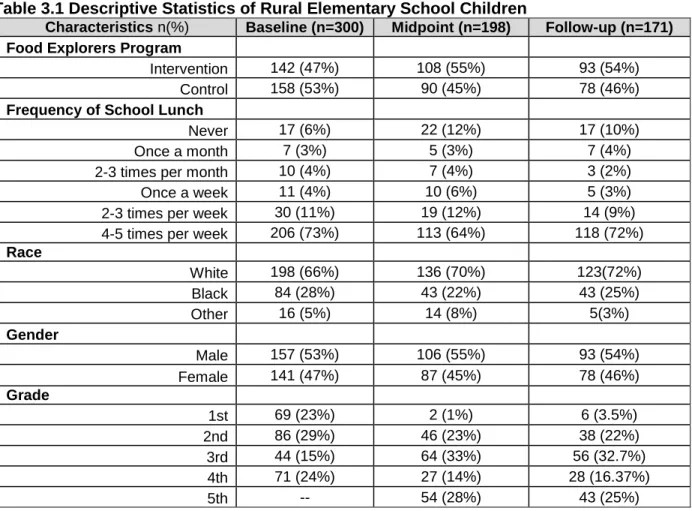
county, more than 50% of children ages 2-18 years are overweight or obese. Prior to researcher involvement with the study, an advisory group, which included the county’s school nutrition director, superintendent, and representatives from the funding agencies, selected four (of 16) rural elementary schools (grade k-5) to participate in the intervention development and testing. Schools were selected to reflect the diversity of schools in the county: two buildings with new (post-2010) kitchen facilities and two buildings with old (pre-1990) kitchen facilities; one new and one old building were located in more rural areas, and the others were located in small towns. The research team matched four control schools to the four intervention schools based on school size, family socioeconomic status, age of school facilities, and student racial/ethnic makeup (Table 3.1). After baseline data collection in April 2013, one control school merged with one intervention school; consequently, all subsequent data analyses were conducted using four intervention and three control schools.
Table 3.1 Descriptive Statistics of Rural Elementary School Children
Characteristics n(%) Baseline (n=300) Midpoint (n=198) Follow-up (n=171) Food Explorers Program
Intervention 142 (47%) 108 (55%) 93 (54%)
Control 158 (53%) 90 (45%) 78 (46%)
Frequency of School Lunch
Never 17 (6%) 22 (12%) 17 (10%)
Once a month 7 (3%) 5 (3%) 7 (4%)
2-3 times per month 10 (4%) 7 (4%) 3 (2%)
Once a week 11 (4%) 10 (6%) 5 (3%)
2-3 times per week 30 (11%) 19 (12%) 14 (9%)
4-5 times per week 206 (73%) 113 (64%) 118 (72%)
Race
White 198 (66%) 136 (70%) 123(72%)
Black 84 (28%) 43 (22%) 43 (25%)
Other 16 (5%) 14 (8%) 5(3%)
Gender
Male 157 (53%) 106 (55%) 93 (54%)
Female 141 (47%) 87 (45%) 78 (46%)
Grade
1st 69 (23%) 2 (1%) 6 (3.5%)
2nd 86 (29%) 46 (23%) 38 (22%)
3rd 44 (15%) 64 (33%) 56 (32.7%)
4th 71 (24%) 27 (14%) 28 (16.37%)
Participants were recruited via a letter sent home to families of grades k-4 in
participating schools. 376 families returned the parental consent form, 325 students completed verbal assent and baseline assessments, and 300 were included in baseline analyses
(impossible diet recalls were dropped, e.g. six or more side dishes were reportedly consumed by one student during one lunch period). Twelve percent of the total student body participated in intervention schools; 12.5% participated in control schools.
After baseline data collection and formative researchc,32 the scope of the classroom program was narrowed to 3rd and 4th grade for two reasons: (1) budget limitations, and (2) age appropriateness (students needed to be old enough to understand and young enough to be excited about program features). However, all students in the intervention schools ate the improved school lunch and were exposed to FE materials in the cafeteria. Also, five teacher “ambassadors” (two in one intervention school, one in each of the three other intervention schools) were recruited for the program before its launch in August 2013 to gain teacher investment in the program and facilitate program implementation.
Instruments: All surveys were orally administered by trained research staff, and data were recorded in a secure digital collection form; responses were recorded using participant ID and no identifying information was included with responses.
School Lunch Recall. We used a validated school lunch recall, with added visual scales
(e.g. picture of a whole apple indicated “ate none of it”, while a half-eaten apple indicated “ate half of it”) to measure reported student consumption during school lunch.71 The recall included all possible menu items on a given day, as well as amount consumed, level of enjoyment, and preference for future consumption of the item; additional questions captured any foods
consumed not on the school menu (including foods brought from home).
Mediators/Psychosocial Metrics. After the school lunch recall, students answered
expectations for FVe; ten items measured descriptive norms for FV using a five-point scale73; six items measured injunctive norms for FV using a five-point scale74; and six items measured self-efficacy to consume FV using a five-point scale.75
Demographics. All student demographics were self-reported by the students except for
race, which was interviewer-determined.
Process Evaluation. Process evaluation instruments included monthly
researcher-recorded cafeteria reports, monthly FE passport and trading card reports, monthly FE Ambassador school-level reports, and in-depth, semi-structured interviews with students, teachers, administrators, school nutrition staff, and parents at follow-up.
Procedure: Food Explorers was developed using a social marketing approach (January to July 2013) that focused on key stakeholder input to develop a cafeteria-based campaign to inspire elementary school students to eat more fruits and vegetables; students, school nutrition staff, and educators reacted to three different campaign prototypes, and the best components of each were combined into what became Food Explorers (Hennink-Kaminski, in process).63 The program includes cafeteria components and classroom components.
Cafeteria. With foundation support, the county school system hired an expert
chef-consultant who worked closely with the nutrition director to develop new FV recipes and trained SNS staff on best-practices for recipe execution and service. The local foundation also funded purchase and installation of small equipment in intervention schools (valued at $3600.00) to facilitate new recipe creation (e.g. immersion blender; sectionizer; knives; cutting boards). All equipment was installed prior to the study launch in August 2013. Elements of the social marketing campaign were created to promote and enhance the changes made to the cafeteria and classroom. These included banners, point of sale signs, Food Explorer-themed monthly menus, new recipe names, and a Master Explorer Challenge (see Appendix 1).
Classroom. In July 2013, research staff trained Teacher Ambassadors on program
in August 2013. Research staff delivered materials (passports, trading cards, stamps, stamp ink, FE manuals, data collection forms, pouches, and containers to hold all materials) to teachers at the training events. They also held promotional events for families and students at Back to School Events in August 2013 to build support and excitement for the program. The chef-consultant attended these events and provided samples of new FV recipes for families.
Ambassadors met bi-monthly with research staff to report on progress, address challenges, and maintain connections between the community and research team. To complete the Master Explorer Challenge, students had to collect at least 12 stamps in their passports (earned by trying FV in the cafeteria) and effectively collect/trade cards over the course of a semester in one of four “tracks”; successful students were awarded a certificate, the designation of Master Explorer, their name and photo on a cafeteria wall, and participation in a frozen yogurt
celebration at the end of the school year. For a conceptual model of the FE program, see Figure 3.1.
Data Collection. Data was collected at baseline (April 2013), midpoint (October 2013),
Data Analysis: School Lunch Recall/Surveys/Demographics: Latent growth curve
analysis was used to explore distinct and mean trajectories of individual and group FV consumption over time because it can better identify intra-and inter-individual change in a behavior as compared to other regression analyses; trajectory types were limited because there were only three waves of data collected during the FE trial. A preliminary unconditional latent growth curve model for FV consumption provides individual specific trajectories—with a slope and intercept for every individual in the analysis—and provides the overtime trajectory for the entire group. We assessed the intervention effects of the FE program by constructing two latent growth curve models (LGMs) using Mplus version 7.76 Separate models were constructed for the intervention and control groups; both models had three time points of FV consumption during school lunch. Growth curve models have several advantages over traditional methods of assessing change: for this analysis, a LGM is particularly useful because it allows for multiple outcome measures to be combined in a single analysis.
Plate Waste: Plate waste data from the first 50 students (grades k-5) to enter the
each photo and came to consensus on quantities consumed for each plate waste photo. We report descriptive statistics analyzed in Microsoft Excel (2016).
School Meal Participation/Costs: Program and meal participation data were compiled by
the school nutrition director and reported.
Process Evaluation: Details of the process evaluation component can be found
elsewhere (Jeffries, in process). D. Results
Recruitment flow and participation is shown in Figure 3.2. A total of 300 participants completed baseline data collection from both intervention (n=142) and control schools (n=158). Thirty-three participants were excluded from analysis: 28 were excluded based on their status as kindergarteners, which yielded questionable self-report information, and five participants were excluded based on duplicate identification numbers (n=2) or information missing on grade level (n=3). Therefore, the total analysis sample at baseline was 267.
follow-up between baseline and midpoint, those who were retained were more likely to identify as white, to eat school lunch 4-5 times per week, and to be in the 2nd or 3rd grade (Table 3.1). Participants lost to follow-up (midpoint/follow-up) did not statistically differ from those retained with respect to their grade, sex, school they attended, intervention group, or how often they ate school lunch.
Ninety-six of the 267 children were missing data from either midpoint or follow-up on the main outcome variable (36%). To accommodate these missing data without dropping cases, full information maximum likelihood estimation was used (which makes use of all available data to maximize the information available for data analyses), yielding optimal parameter estimates and standard errors.32,33 Under most conditions, this approach produces less biased parameter estimates than alternatives in the presence of missing data.77
School Lunch Recall: Latent growth curve analysis predicting a child’s FV consumption
is estimated in two models using the robust maximum likelihood estimator (MLR) in Mplus. A MLR takes into account possible non-normality in the distribution of the errors in the model. The MLR standard errors are computed using a sandwich estimator, which is necessary as the sample is clustered within schools.
To evaluate model fit, we conducted several tests of baseline fit indices and descriptive indices. The intervention and control data fit the model, which demonstrates the LGM is
reasonably consistent with the data (data available upon request). The signs of the intercept coefficients are as predicted: all have positive and statistically significant effects on FV
consumption. The intercept coefficients demonstrate that there are individual differences in the starting point of FV consumption for both the control and intervention groups. The mean initial level of fruit consumption in the intervention group was 4.84 (p<0.001); while the mean initial level of fruit consumption in the control group was 5.72 (p<0.001). The mean intercept level for vegetable consumption among both groups was also statistically significant, with the
with 1.00 (p<0.001). The slope estimates for the intervention group were not statistically significant, which suggests there are no group trajectories in regards to FV consumption. The slope estimates for control group demonstrates there is not a significant difference for vegetable consumption; however, there is a negative and statistically significant slope for fruit consumption (β= -0.657, p<0.05). The significant negative slope suggests a downward trend in the entire group fruit consumption among the control schools.
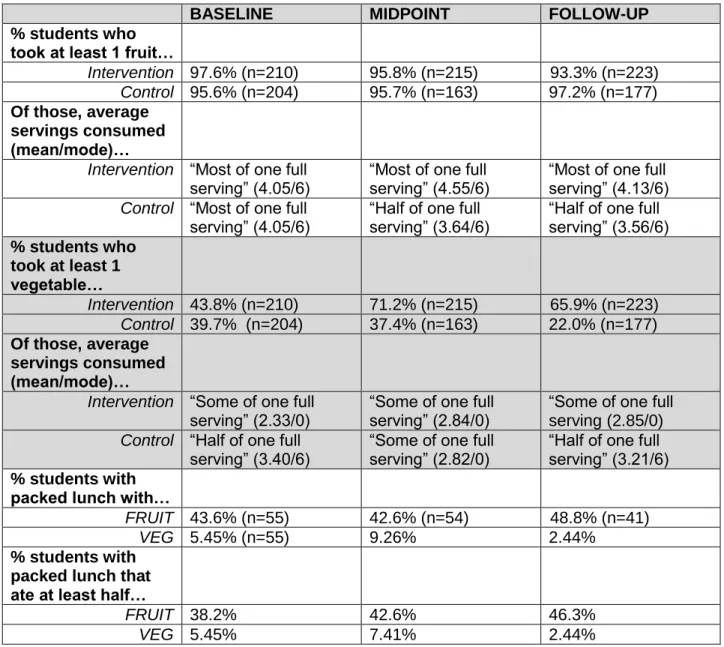
Illustrated in Figure 3.3 is the mean change in consumption of FV between the intervention and control schools across three time points. These data include relatively few (n=55) recalls with students who brought lunches from home, but the trends show packed lunches contained far fewer FV compared to school meal lunches.
Surveys: The data collected did not indicate significant differences by condition
increased self-efficacy for FV consumption in intervention students, when compared to control students at follow-up.
Plate Waste Analysis: Intervention and control students were likely to select a fruit at
Table 3.2 Plate Waste Analysis – Descriptive Statistics
BASELINE MIDPOINT FOLLOW-UP
% students who took at least 1 fruit…
Intervention 97.6% (n=210) 95.8% (n=215) 93.3% (n=223) Control 95.6% (n=204) 95.7% (n=163) 97.2% (n=177) Of those, average
servings consumed (mean/mode)…
Intervention “Most of one full
serving” (4.05/6) “Most of one full serving” (4.55/6) “Most of one full serving” (4.13/6) Control “Most of one full
serving” (4.05/6)
“Half of one full serving” (3.64/6)
“Half of one full serving” (3.56/6) % students who
took at least 1 vegetable…
Intervention 43.8% (n=210) 71.2% (n=215) 65.9% (n=223) Control 39.7% (n=204) 37.4% (n=163) 22.0% (n=177) Of those, average
servings consumed (mean/mode)…
Intervention “Some of one full serving” (2.33/0)
“Some of one full serving” (2.84/0)
“Some of one full serving (2.85/0) Control “Half of one full
serving” (3.40/6) “Some of one full serving” (2.82/0) “Half of one full serving” (3.21/6) % students with
packed lunch with…
FRUIT 43.6% (n=55) 42.6% (n=54) 48.8% (n=41)
VEG 5.45% (n=55) 9.26% 2.44%
% students with packed lunch that ate at least half…
FRUIT 38.2% 42.6% 46.3%
VEG 5.45% 7.41% 2.44%
In brief, fruit selection and consumption did not vary significantly between control and intervention students over time; however, vegetable selection (i.e. exposure) trended toward significance, with almost two to three times greater vegetable selection on intervention school lunch trays compared to controls during the pilot intervention period.
Student school meals participation/costs: Schools often express concern that school
significantly in any school baseline to follow-up in the intervention schools (84.4% vs. 83.7%) or control schools (74.4% vs. 68.8%).
The average cost of a FV serving in the intervention schools was $0.25 per serving, compared to $0.24 per serving in control schools. There is no significant difference between the FV costs, and the school nutrition director reported the FV costs were within her target range. On average, about $3600 worth of equipment was installed in each school to facilitate new recipe production (knives, cutting boards, etc.); about $2700 was needed to implement the classroom components and signage/marketing materials in each school.
E. Discussion
This was a pilot trial of a novel social marketing study in rural, high-poverty schools. Trends in student surveys and plate waste photos hint at the potential for the program to increase student exposure to FV, increase student self-efficacy to consume FV, and even protect against further reductions in fruit consumption, as compared to students in schools without FE. And observation of lunches brought from home suggests packed lunches contained far fewer FV as compared to school meals, limiting pack-lunch students’ exposure to healthy options. The limited data, in addition to post-pilot qualitative feedback31, suggest that a large and rigorous study be conducted to understand the potential effects and feasibility of the Food Explorers Program on a broader scale.
The 2012 Healthy Hunger Free Kids Act (HHFKA)33, 78 requires schools to serve more FV, but provides limited guidance on serving kid-friendly options to encourage consumption. Given that rural communities are at higher risk for child obesity and food insecurity compared to urban peers, we especially need strategies to encourage FV consumption in rural school lunch settings. Schools can be a powerful proponent of health, but only if we equip schools with tools to serve fun, healthy foods. The FE pilot trial was one attempt to do so.
interventions: (1) schools should celebrate Master Explorers each semester (not just at end of year) to maintain student engagement and excitement; (2) passports can be smaller (fewer, more generic food items) to reduce costs without compromising student appeal; (3) SNS need to designate one person to maintain and update daily signage; (4) the program should target 4th and 5th instead of 3rd grade (to reach similarly-aged students without placing undue burden on 3rd grade teachers tasked with heavy testing requirements); (5) FE staff should train teachers and school nutrition staff on FE program together for greater support between the classroom and cafeteria; (6) trim survey instruments to focus on a narrow range of mediators to relieve student survey fatigue.
FE program costs are reasonable; daily operational costs did not increase as a result of the program, and onetime equipment costs ($3600 per school) could be covered by USDA small equipment grants. Program material costs ($2700 per school) can be modified with scaled down passports, the reuse of trading cards, and potential sponsorship by local organizations.
Limitations: These data are limited by recruitment procedures (parents had to opt children into the study, so these families may be different than families that did not opt in); limited sample size due to study capacity and burden of collecting parent consent via printed letter; and the possible non-equivalence of intervention and control schools. These factors limit the application of findings, but qualitative post-pilot feedback was incredibly positive and suggested this program did have an impact on student exposure and consumption of vegetables and fruits; combined with suggestive study trends, this program warrants further research (Jeffries, in process).
exposure. A well-powered study could illuminate these trends and identify key program elements.
The FE program was well received at every level of the school: classroom teachers noted a brief learning curve but reported the program was not burdensome, students reported positive experiences, principals were open to the program because it involved no additional burden to the administration, SNS staff were generally positive about the program, and the school nutrition director indicated the program was cost-neutral (Jeffries, in process). Future programs should consider targeting vegetable consumption specifically (as this is generally lower than fruit consumption) and ask how FE can be paired with additional components (parent/family- or community-level, technology, etc.) to address students’ whole food
CHAPTER IV. FOOD EXPLORERS: FAMILY EDITION - DEVELOPMENT OF A THEORY-BASED TEXT MESSAGE AND SOCIAL MEDIA INTERVENTION FOR FAMILIES TO
ADDRESS CHILD DIET A. Overview
The school-based Food Explorers social marketing program was not enough to affect
measurable change in child eating behaviors, but post-intervention interviews and other
community interactions suggested that a school-plus-parent intervention might have greater
effects on individual children and the community more broadly. This led to the development and
pilot testing of additional family components to complement and enhance the school-based
social marketing program.
B. Introduction
Health disparities persist in the United States despite numerous policies, interventions, and programs to address the issue. Many children are at a higher risk for poor health outcomes because of their geographic location, household income, or parent education.1-3 Incidence of childhood obesity and Type 2 diabetes are directly related to food access and eating behaviors, including vegetable and sugary beverage consumption.4, 8-13 In North Carolina in 2011, 74% of children age 0-17 did not consume the recommended daily serving of vegetables, and at least 67.7% of all NC children age 0-17 consumed one or more sugary beverages per day.7
include limited time (parents work long/atypical hours; greater travel distances in sparsely populated areas increase travel time between work/school/home), lack of transportation, parent education level, funding, and access to nutrition experts.2, 6
To overcome these barriers, we developed a theory- and technology-based nutrition intervention delivered by SNS (Food Explorers: Family Edition, “FE2”) that targets parents of 4th and 5th grade children. Our objective was to build a program that can improve child and parent self-efficacy for vegetable consumption (a determinant of actual consumption), as well as parent proxy efficacy for child vegetable consumption. (Proxy efficacy refers to parents’ perception of their ability to help their children consume vegetables.) The parent component was designed to complement a previously developed school-based program (Food Explorers “FE”; Hennink-Kaminski, in draft) to address child eating behavior through families and schools. Using this program, rural families engage in eating behavior change through a blend of new technologies (text messages and social media on mobile phones).
This article reports findings from formative research in a rural community that informed development of a program (FE2) that was both feasible and culturally relevant; a separate pilot will assess the impact of the FE2 program on child and family health.
C. Methods
Overview: We employed a mixed-methods approach to iteratively develop FE2.
Formative research included focus groups with 4th and 5th grade children and parents; in-depth interviews with teachers, parents, and a content expert; and a parent survey. Emergent themes from these qualitative interviews informed targeting of the program to the community and local culture. This formative work, a conceptual framework, and the current literature informed intervention development; this prototype was assessed in a two-week test with six parent-child dyads. Post-test in-depth interviews and process evaluation data further informed FE2
Conceptual Framework: Intervention development was guided by a conceptual model
grounded in Social Cognitive Theory (SCT), with two additional behavior change constructs (Figure 1.1). The intervention capitalizes on social media and text messaging tools to bolster reciprocal determinism, facilitation, observational learning, goal setting/regulation, and self-efficacy from SCT, plus consciousness raising and social support. Each construct’s role in the model is described below:
Reciprocal determinism: Behavior is the result of interactions between individuals and
their environment. FE2’s text message and social media components included a variety of messages and tools that empowered participants to understand and/or make changes to personal characteristics, behavior, and environment.
Facilitation: Text message and social media tools facilitated learning and practice related
to key behavior change strategies.
Observational Learning: The social media component included a variety of tools to help
parents learn from peers and content experts, such as sharing photos and short stories with other participants (e.g. Facebook wall) and sending prompts via text message to participants to view brief video clips (e.g. a YouTube cooking demonstration).
Goal setting/self-regulation: Participants practiced goal setting and techniques to
maintain accountability. Participants were prompted to report on their goals once per week (twice during the two-week test), via text and social media.
Self-efficacy: Messages and program content were designed to increase self-efficacy for
child healthy eating, parent/family healthy eating, and parent nutrition knowledge.
Consciousness Raising: Emphasis was placed on the most current evidence-based
nutrition science.
Social Support: Parents shared stories, recipes, etc. via social media with other
study also included messages about how parents could build successful social support networks offline.
These theoretical constructs guided initial program planning and were revisited at each step in program development.
Population: The program was developed at a public charter school, serving
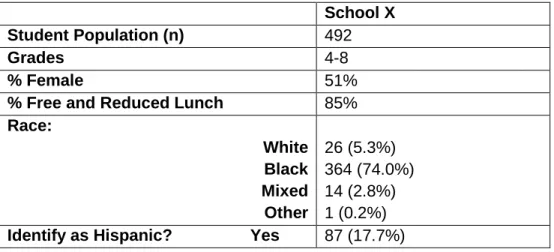
predominantly children of color in a high poverty, rural county in North Carolina.79-81 As of September 2014, the school had 104 4th grade and 96 5th grade students, and a total of 492 children grades 4-9. The school participated in USDA school meal programs and all children participated in school meals free of charge (Table 4.1). The county in which the school was located had twice the statewide childhood obesity rate (32% vs.16.5%), and about 28% of the county’s families lived below the poverty level, compared to 17.5% statewide (2009-2013).81, 82
Table 4.1 School Demographics
School X Student Population (n) 492
Grades 4-8
% Female 51%
% Free and Reduced Lunch 85% Race:
White Black Mixed Other
26 (5.3%) 364 (74.0%) 14 (2.8%) 1 (0.2%) Identify as Hispanic? Yes 87 (17.7%)
Formative Research - Understanding Community Context
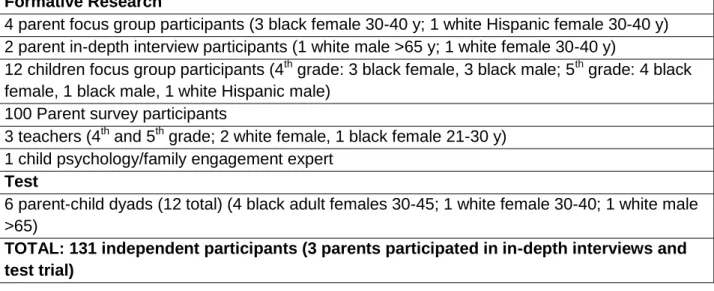
Parent focus groups/interviews: One focus group (four participants) and two in-depth
conducted the in-depth interviews using an IRB-approved interview guide, and two audio recorders recorded the twenty to forty-five minute sessions. Basic demographic data were collected from parents via written surveys at the end of the focus group session and through in-depth interviews. Trained research staff transcribed audio recordings verbatim; transcripts were reviewed for themes by PI and research assistant, and these themes guided intervention development.
Parent survey: A one-page survey was distributed through child backpacks to 490
families at the participating school (grades 4-9) in order to enhance findings from the focus group and in-depth interviews. The survey assessed social media use, text
message/smartphone use, preferred communication mode/frequency/message-source, nutrition subjects of interest, and basic demographic information. The survey was anonymous and designed to take no more than ten minutes; it was paper-based to mitigate skewed sampling of parents comfortable with computer/phone technology. Participating parents could enter a drawing to win one of two $20 Walmart gift cards. Survey data were analyzed using descriptive statistics to inform FE2 development.
Children: Six 4th grade and six 5th grade children participated in two grade-specific focus groups. The focus group was conducted by a facilitator and observer. The facilitator followed an IRB-approved focus group guide; the observer recorded non-verbal communication and general notes during the discussion; and two audio recorders recorded the thirty to forty-five minute sessions. Research staff identified child gender and race. Transcripts were analyzed using the same methods described above for the parent focus group.
Key Informants-Teachers/Expert: Using interview methods described above, we
conducted in-depth interviews with two 4th grade teachers, one 5th grade teacher, and one child psychology/family engagement expert.
Formative research recruitment: Parent and child focus group/in-depth interview
school Facebook page, and print flyers sent home in 4th and 5th grade children’s backpacks. Parents who responded to the recruitment message were screened by the PI via phone; parents had to have at least one 4th or 5th grade child currently enrolled in the school, speak English, and be available for a forty-five minute focus group or interview. Eligible children had to be enrolled in 4th or 5th grade, speak English, and have their parent complete and return a consent form. Teachers and the content expert were recruited through convenience sample (PI
contacts). All participant contact information was stored on a password protected system and maintained separately from the data.
Adult consent/child assent to participate in a focus group or interview was reviewed and collected at the time of the session. All focus groups/interviews were conducted in private rooms at the participating school. Parent participants received a $20 Walmart gift card; children
received small incentives (e.g. stickers). Light healthy snacks and beverages were provided during focus groups.
Intervention development and test: The development of the FE2 program was based on
previous studies, the conceptual framework described above, and the formative findings described below. Acceptability, feasibility, and the cultural relevance of FE2 intervention
components, technologies, and proposed measures were assessed with a sample of the target population in a two-week trial (“test”). This test included six parent-child dyads (children enrolled in 5th grade at the participating school). Program components included daily text messages, a Facebook group, and one weekly email newsletter; measures included pre/post-surveys for parents/children and one home food inventory.83
Two-week test recruitment: Six parent-child dyads were recruited during the formative