WHO’S AFRAID OF FILE FORMAT OBSOLESCENCE?
EVALUATING FILE FORMAT ENDANGERMENT LEVELS AND FACTORS FOR THE CREATION OF A FILE FORMAT ENDANGERMENT INDEX
Heather Ryan
A dissertation submitted to the faculty of the University of North Carolina at Chapel Hill in partial fulfillment of the requirements for the degree of Doctor of Philosophy in
the School of Information and Library Science.
Chapel Hill 2014
© 2014 Heather Ryan
ABSTRACT
Heather Ryan: Who’s Afraid of File Format Obsolescence Evaluating File Format Endangerment Levels and Factors for the Creation of a File Format Endangerment Index
(Under the direction of Christopher A. Lee)
Much digital preservation research has been built on the assumption that file format
obsolescence poses a great risk to the continued access of digital content. In an endeavor to
address this risk, a number of researchers created lists of factors that could be used to assess
risks associated with digital file formats. This research examines these assumptions about file
format obsolescence and file format evaluation factors with the aim of creating a simplified
file format endangerment index.
This study examines file format risk under a new lens of file format endangerment, or
the possibility that information stored in a particular file format will not be interpretable or
renderable in human accessible means within a certain timeframe. Using the Delphi method
in two separate studies, this exploratory research collected expert opinion on file format
endangerment levels of 50 test file formats; and collected expert opinion on relevance of 21
factors as causes of file format endangerment.
Experts expressed the belief that generally, digital information encoded in the rated
file formats will be accessible for 20 years or more. This indicates that file format experts
believe that there is not a great deal of short-term risk associated with encoding information
preservation activities for these and other file formats. Furthermore, the findings show that
only three of the dozens of file format evaluation factors discussed in the literature exceeded
an emergent threshold level as causes of file format endangerment: rendering software
available, specifications available, and community/3rd party support.
These factors are ideal candidates for use in a file format endangerment index. Such an
index allows only for the inclusion of formative indicators, or factors that indicate a cause of
file format endangerment. In contrast, a scale can contain factors that reflect, rather than
indicate a cause of a particular phenomenon. The three factors shown to be the most relevant
as causal indicators of file format endangerment, rendering software available, specifications
available, and community/3rd party support are the best candidate indicators to build into the
index. The intention is to construct and validate an index using these three candidate factors
as part of a future research agenda.
ACKNOWLEGEMENTS
It’s been a long, wild ride. It’s been a ride that has never once been lonely. Many,
many people have been there with me on the path leading up to and through this moment,
and I’d like to express my tremendous gratitude to all of you. I’m going to try to start at the
beginning and catch everyone who has helped and encouraged me along the way.
I am going to follow in my committee chair’s footsteps a little here and thank the most
important person first: Joseph Dennis Ryan. I don’t know where to start except to say that he
has been the most incredible partner imaginable. His unwavering strength, resilience,
support, patience, kindness, love, compassion, humor, prodding, encouragement, and well,
everything he’s done for me in these past years have helped me get to where I am now. I
honestly don’t know if I could have done it without him.
I had many wonderful teachers in high school. Three have stayed with me over all of
these years. First, was Dr. B, or Dr. Bishop. She asked a lot of her students, but was always
kind and exceptionally supportive. It is in part because of her that I have such a love of
literature, writing, and critical thinking today. She passed away the year after I took her class,
but I am still influenced by her joy and passion for knowledge and teaching. The second is
Raul Dorn. There was some special kind of magic that happened in his art classes that I’ve
never known since. We were a tight-knit group of misfits back then, but this smart, kooky
class, where he asked us to really think about and question everything around us. He also
exhibited a true joy for teaching that serves as a model for my teaching today.
In my years as an undergrad student at New Mexico State University, one professor
shines the brightest as having a profound effect on my belief in myself and on the direction
my life took after meeting him: Dr. Alvin Keaton. I have to speak somewhat more at length
about him now; first because he made such a difference in my life, and second because he
passed away just a few weeks ago. One of the first things he taught me was that the best way
to learn something is to teach it. In his philosophy class, he excused the students from taking
all future exams who made the top grades on his first exam, with the stipulation that they
would serve as exam tutors for the rest of the semester. I was one of these “lucky” tutors, but
of course, I had to study ten times harder to be a tutor than I ever did to take exams. But this
was just the beginning of my relationship with Dr. Keaton. I used to meet with him and my
then boyfriend, Cassidy King, for breakfast every Friday. He would buy us breakfast and we
would talk endlessly about philosophy, science, and life. At these breakfasts he would often
look at me and, shaking his head, ask me why I wasn’t achieving more, why I wasn’t living
up to my potential. Before Al Keaton, I can honestly say that I didn’t believe I had much
potential beyond working menial jobs and being a “starving artist.” I knew I was wildly
curious about the world and was constantly thinking about how everything worked and fit
together; but I had never had an outlet for these thoughts, and I had never received validation
from the external world that the things I think and care about were actually worth a damn. It
was from those moments with Al that the first sparks were ignited that propelled me to where
I am today. The last time I had any real interaction with him, I was headed off to Houston,
Kelly’s Out of Control, both of which had a big impact on me.
As soon as I got to Houston, I found and devoured a copy of Out of Control. It left me
with a sense that I wasn’t quite as alone in my thinking as I thought. After living in a desert,
both literally and figuratively, it was like a long, cool drink of water. Years after my last
encounter with Al, I found myself exploring digital preservation as a masters student at the
University of Denver. In my studies, I stumbled across Time & Bits: Managing Digital
Continuity, a book about a collaborative conversation between members of the Getty
Conservation Institute, the Getty Information Institute, and the Long Now Foundation. I read
the book, and lo and behold, there was Kevin Kelly again. And there was Long Now, and
they were accepting members. As soon as I could scrounge together enough money for the
membership dues, I joined. Not too long after, I flew out to San Francisco for a Brian Eno art
exhibit they were hosting, where I met and talked to Kevin Kelly about my research. After a
short conversation with him and Alexander Rose, we agreed that I would do my master’s
practicum with them that following summer. It’s a bit of a long story, but suffice it to say that
the people of Long Now have had a big impact on my research. In particular, Alexander
Rose, Laura Welcher, and Kurt Bollacker (one of my committee members, whom I will talk
more about later) have all been tremendously gracious and supportive of me. I would also
like to acknowledge my long-time friend, Richard Mortimer Humphrey, for supporting my
goals and hosting me in San Francisco while I worked with Long Now.
During my master’s program at the University of Denver, I had two advisors who
supported me in my digital preservation research: Dr. Denise Anthony and Dr. Rich Gazan. It
was in Rich’s classes that I first realized that I wanted to get my Ph.D. Denise has been my
While many of my friends were not directly involved with my research, they were all
wonderful to and supportive of me as I worked toward my goal of getting my Ph.D. First, I’d
like to mention one of my oldest friends, Rowan Russell. In Colorado, the most notable of
my support-team friends were: Radovan Anzulovic, Matthew Brown, Andrea Davis, Nancy
Dituri, Michael Doherty, Donna Goben, Hayley Helmericks, Jaime Jennings, Tara Leedom,
Mark Phillips, Julie Rockwell, Amanda Rybin, Doug Spencer, Carissa Sullivan, Katie
Thomas, and Zarin Xavier. Of these people, I would like to give extra acknowledgement to
Donna Goben, my new honorary sister. In North Carolina, my most notable supporters were:
Earl Bailey, Mike Brown, Michelle Corbin, Josh Hockensmith, Erin Kawamata, Kelly
Marks, Renee McBride, Margarite Nathe, Ericka Patillo, Rachel Powers, Terrell Russell,
Mike Sonnichsen, Liz Wing, and Kam Woods. Of these people I would like to particularly
thank Margarite Nathe and Josh Hockensmith for boosting my spirits every week at game
night, camping and beach trips together, and for being the best damn wedding helpers a lady
could ask for. I’d also like to thank Earl Bailey and Michelle Corbin for introducing us to the
fantastic world of “Euro” games, all of the shared meals, and for being family. I’d also like to
thank Mike Brown for all of the support and encouragement he gave me during his brief stint
as my writing coach. I’d also like to thank all of my friends on Facebook from all over the
world who cheered me on when I most needed it. Last, but not least of my friends, I’d like to
acknowledge those doctoral student colleagues not already mentioned here. It’s been a long,
wild ride for all of us. I’ve learned a little something from all of them and I am grateful for it.
I wish them all the best and hope our paths cross again, preferably in less challenging
circumstances.
Information and Library Science helped me in small and big ways throughout my career as a
doctoral student. To name a few of the faculty: Dr. Gary Marchionini, Dr. Barbara
Wildemuth, Dr. Evelyn Daniel, Dr. Reagan Moore, Dr. Jeff Pomerantz, Dr. Deborah
Barreau, and Paul Jones. Staff to whom I am grateful are: Lara Bailey, Aaron Brubaker,
Tammy Cox, Wanda Monroe, Kaitlyn Murphy, Michael Penny, Susan Sylvester, and
Shaundria Williams. I’d like to note especially that it was Deb Barreau who talked me into
applying for the program. During the time that I was able to spend with her, she was
unfailingly kind and compassionate. Though I did not spend time with her regularly, her
passing affected me deeply, and I miss her kindness and support.
I’d also like to acknowledge my new colleagues at the University of Denver: Mary
Stansbury, Clara Sitter, Shimelis Assefa, and Krystyna Matusiak. Joining their team has been
perhaps the biggest motivator to finish my dissertation! Thank you! I’d also like to extend
special thanks to Jen LaBabera for her last minute help with tables.
Since I started the program in 2008, several people in my life, not mentioned yet,
passed away. Three of these people were particularly important to me in different stages of
my life. I have to admit that it is particularly difficult to relive the losses, but I believe it’s
important to honor their memory here for posterity. First is tS. Pureé Tomatoes, the
backwards saint. Describing Tomatoes and his importance to me would fill a book on its
own. He was one of the most brilliant and genuine people I’ve ever known. There never was
and never will be another like him. Second is Dylan Williams. He was the first person I ever
interviewed in my zine-making days. He was a brilliant comics artist and started a great
comics publishing empire, Sparkplug Comics. We never met in person, but we stayed in
and encouragement. His passing grieved me terribly. Last, and most importantly, is my
Grandma, Barbara Bowden. Of all the people in my blood family, she supported me the
most. She was the great matriarch of my family, and while she was not always the kindest,
she was the strongest. I always think of her when I have something particularly difficult to
do. She took on all of life’s challenges with a no-nonsense, single-minded fire, and she
always succeeded in her goals. I owe a lot of my successes in life to her. Look Grandma, I’m
finishing my Ph.D.!
It is with mixed emotions that I mention my blood family here. Obviously, I would not
be here if it were not for them. Their confused and fearful encouragement certainly helped
me to a degree. I do love them and recognize that they all gave me the most that they could
with what they had.
Where I was a misunderstood and frightening black sheep in one family, I found
myself right at home in another. Thank you to Dr. Dennis Ryan, Linda Ryan, Dr. Jennifer
Ryan, Dr. Tim Bryant, and Miranda Bryant (and special thoughts for Grace Bryant) for
welcoming me into your family. Thank you for all of the books (books!!), the understanding,
the support, and the love. It means more to me than you can imagine. And I am thrilled to
finally become a member of the illustrious the Dr. (B)Ryan(t) club!!
I want to give some very, very special thanks to another part of my non-traditional
family, the Schroecks. Not only did they provide a home, love, care, a sister (Anna!!) and
support for my son, but also they served as a model of what I might be able to achieve in my
life. Their kindness, stability, and successes in life served as a solid guidepost to what I
wanted to accomplish in mine. I would like to acknowledge Anna: she has never ceased to
beauty. She is growing into an amazing young woman, and it is an inspiration to see. I would
also like to acknowledge my son, Adrian. The love I feel for him surpasses any feeling I’ve
ever had. It is the most beautiful gift. I am so proud of him and I have thrilled at watching
him grow in the brilliant, curious, focused, hard working, playful, handsome young man he is
today.
Getting down to the nitty gritty of my actual dissertation, I’d like to thank my intrepid
pilot study participants. Their hard work and feedback were tremendously helpful. Their
answers were so thoughtful that I regretted the fact that they would not be included in the
data analysis. The pilot participants were: Jefferson Bailey, Shane Beers, Brendan Donahe,
Chien-Yi Hou, Marcos Martinez, Matthew Mayernik, Trevor Owens, Sam Meister, Dave
Pcolar, Terrell Russell, Bill Schulz, and Kam Woods.
I’d like to extend a very special thanks to all those who participated in the study. I am
overwhelmed with gratitude for the amount of time and depth of thought they put into this
study. They made an invaluable contribution to my research, and I am truly indebted to all of
them. Thank you very much to: Stephen Abrams, Micah Altman, Kevin Ashley, Euan
Cochrane, Maurice deRooij, Kevin DeVorsey, Mark Evans, Carl Fleischhauer, Jay Gattuso,
Andrea Goethals, Sergiu Gordea, Hans Hofman, Matt Holden, Andrew Jackson, Catherine
Jones, Steve Knight, Peter May, Jerome McDonough, Erin O’Meara, Nicholas Taylor, and
William Underwood.
I feel incredible gratitude toward my dissertation committee. I’ll start with Dr. Kurt
Bollacker, my external committee member. As I mentioned earlier, I met him during my
practicum experience with the Long Now Foundation. Though everyone at Long Now was
under his wing and provided me with invaluable mentorship. After I was accepted to the
Ph.D. program, I immediately asked him to be on my dissertation committee. I am thrilled
that he accepted. The kind and enthusiastic mentorship he exhibited during my master’s
practicum has not ceased. It is with a cringing smile that I share what he wrote on my
practicum evaluation: “She’s too polite!” I’m still working on that.
Dr. Richard Marciano and I arrived at UNC at the same time and I started working
with him almost immediately. Richard was always kind, funny, enthusiastic, and
encouraging. One of his great skills is that of a connector. He connected me with a number of
great people and great resources throughout my career as a doctoral student. Both he and
Marc Fresko independently helped me formulate the notion that file formats can be viewed
similarly to living organisms.
Dr. Diane Kelly is special to me for several reasons. First, she provided invaluable
direction and advice in the development of my research methods. Second, her intelligence,
wit, and genuine love for her work and this field have been truly inspiring. I see her as a great
model researcher and educator. If I manage to be anything like her in my career, I will
consider it a great success. Third, it was in her Research Methods class that I met my
husband, Joe. While all of her contributions to my research and career are great, this special
contribution to my life is the best. Thank you, Diane, for everything.
Dr. Helen Tibbo will always, always have a special place in my academic and
personal heart. Her trailblazing work in this field is astonishing. Without her foresight in
brining digital curation education to information and library science programs at both the
masters’ and the doctoral level, I doubt I would be here at all. She brought me into the
figures in the field, fought for me, and ceaselessly encouraged me to keep going to the end. I
could not have asked for a better advisor, mentor, and committee member.
Similarly, Dr. Cal Lee has surpassed my expectations in a chair and advisor. I have
joked about how thoroughly he reviews and edits my work, but in all honesty, it is his
thoroughness and attention to accuracy and detail that have pushed me to grow and improve.
I am very grateful to have a mentor and advisor who took the time to always push me to be
and do better. He has provided me with many opportunities connect with noteworthy
professionals in my research area. It is thanks to his support of me and my research that I
have successfully launched my career in academia. He is also one of the busiest people I
know, both as an academic and as a father and husband. Knowing this, it fills me with
gratitude that he has given so much of his time in shepherding me to this point. His unceasing
energy, care, innovation, and drive are an inspiration and model for me as I move forward in
my career.
Last, but by no means least I would like to thank the Institute of Museum and Library
Services (IMLS) and the National Science Foundation (NSF). It was thanks to an IMLS
grant, DigCCurr II (#RE-05-08-0060-08), and an IMLS cooperative agreement award,
Closing the Digital Curation Gap II (#LG-05-09-0040), that I received tuition and stipend
fellowships for most of my time at UNC. I also received tuition and a stipend for one
TABLE OF CONTENTS
LIST OF TABLES ... xviii
LIST OF FIGURES ...xx
LIST OF ABBREVIATIONS ... xxi
CHAPTER 1: INTRODUCTION ...1
1.1. Research Framework ...5
1.2. Expected Contributions ...8
CHAPTER 2: LITERATURE REVIEW ...9
2.1. Conceptual and Theoretical Foundations ...9
2.2. The Problem of File Formats in Digital Preservation ...14
2.3. File Formats in Digital Preservation Research and Development ...19
2.4. File Format Assessment Criteria ...30
2.5. Parallel Problems in Conservation Biology ...54
2.6. Formative Indicators and Index Construction ...59
CHAPTER 3: RESEARCH DESIGN AND METHODS ...64
3.1. Research Questions ...66
3.2. Units of Analysis ...66
3.3. Definitions...67
3.4. Research Design ...67
3.6. Participants ...75
3.7. Design and Administration of Questionnaire 1 ...81
3.8. Design and Administration of Questionnaires 2 and 3, Round 1 ...82
3.9. Design and Administration of Questionnaires 2 and 3, Round 2 ...86
3.10. Using Spearman’s Rank Correlation Coefficient to Signal Delphi Termination ...88
3.11. Design and Administration of Questionnaire 3, Round 3 ...90
3.12. Design and Administration of Questionnaire 4 ...91
3.13. Design and Administration of Special Rater Follow-Up Interview ...92
3.14. Data Collection and Analysis ...94
CHAPTER 4: RESULTS ...100
4.1. Questionnaire 2. File Format Rating ...100
4.2. Questionnaire 3. Factor Rating ...144
4.3. Questionnaire 4. Special Rater Test and Follow-up Interview ...176
4.4. Results Comparison ...178
CHAPTER 5: DISCUSSION ...189
5.1. Questionnaire 2. File Format Rating ...189
5.2. Questionnaire 3. Factor Rating ...192
5.3. Questionnaire 4. Special Rater Test and Follow-up Interview ...194
5.4. Results Comparison ...195
5.5. Test Application of Index Factors and Rating Guide ...198
5.6. Implications ...209
CHAPTER 6: CONCLUSIONS AND FUTURE RESEARCH ...219
6.1. Further Research ...221
APPENDIX A: RECRUITMENT TEXT ...225
APPENDIX B: QUESTIONNAIRE DESIGNS ...232
APPENDIX C: FILE FORMAT RATING GUIDE FOR PARTICIPANTS ...241
LIST OF TABLES
Table 2.4.1. File format evaluation criteria from the literature ...30
Table 2.4.2. File format risk factors created for the Plato 2 tool ...48
Table 2.4.3. Format Evaluator criteria ...49
Table 3.5.1.1. The fifty test file formats presented to Delphi participants to rate ...73
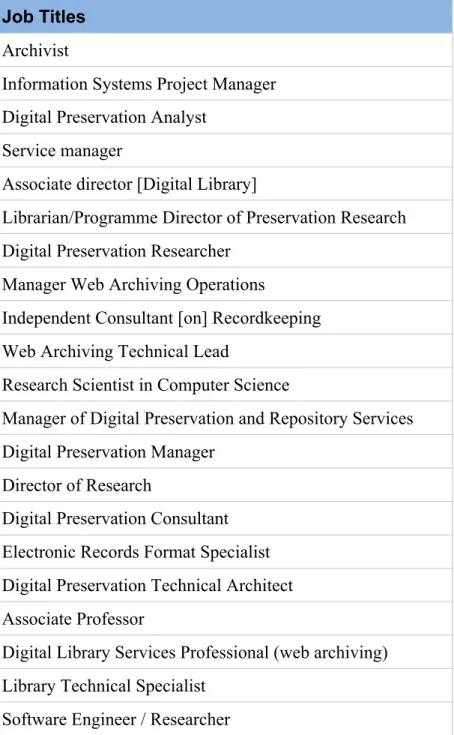
Table 3.6.1. Reported participant job titles ...78
Table 3.6.2. Participant ratings of importance of file format endangerment in access to digital information.. ...80
Table 3.9.1. File formats not included in Questionnaire 2, Round 2 ...86
Table 3.14.1. Participant group assignment ...94
Table 4.1.1.1. File format rating means, standard deviations, mean differences between rounds, and Spearman’s rank correlation coefficient values ...101
Table 4.1.2.1. Round 2 file format rating distribution and mean scores, arranged by mean rank ...104
Table 4.1.4.1. Round 1 file format rating distribution, mean scores, and standard deviation for removed file formats, ranked by mean value ...134
Table 4.1.6.1. Appearance count of file format endangerment factors in justification text ...140
Table 4.2.1.2. Factor means (where -0.50 is ‘Not Relevant,” 0.50 is ‘Somewhat Relevant,’ and 1.50 is ‘Very Relevant’), standard deviations, means differences, and Spearman’s rank correlation coefficient values ...144
Table 4.2.2.1. Round 2 factor rating distribution and mean scores ...146
Table 4.2.4.1. Ratings of new factors ...169
Table 4.4.1. Format rating value differences between the format rating Delphi mean and the special rater score ...179
Table 4.4.3. Ranked factor comparison chart with delineated cutoff points ...186
LIST OF FIGURES
Figure 2.1.1. OAIS Information Object ...11
Figure 2.1.2. OAIS Representation Information Object ...12
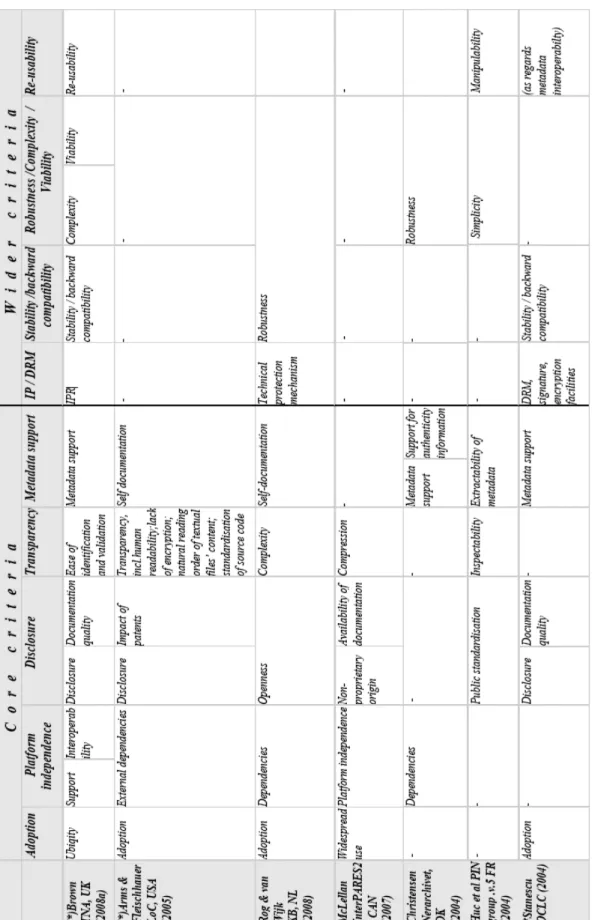
Figure 2.4.1. Table of core and wider criteria ...52
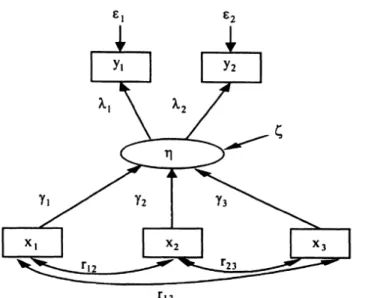
Figure 2.6.1. Causal direction in reflective and formative measurement models ...60
LIST OF ABBREVIATIONS
AIHT Archive Ingest and Handling Test
AIP Archival Information Package
AONS Automated Obsolescence Notification System
APSR Australian Partnership for Sustainable Repositories
CRL Center for Research Libraries
DIAS Digital Information Archiving System
DIP Dissemination Information Package
DPSP Digital Preservation Software Platform
DRM Digital Rights Management
DROID Digital Record Object Identifier
DSTC Cooperative Research Centre for Enterprise Distributed Systems Technology
EDVAC Electronic Discrete Variable Automatic Computer
ENIAC Electronic Numerical Integrator and Computer
FIDO Format Identification for Digital Objects
FITS File Information Toolset
FTC Fundação para Ciência ea Tecnologia, Portugal
GDFR Global Digital Format Registry
GTRI Georgia Tech Research Institute
HTML Hypertext Markup Language
HUL Harvard University Library
INFORM INvestigation of Formats based on Risk Management
IRB Institutional Review Board
iRODS integrated Rule Oriented Data System
IUCN International Union for Conservation of Nature
JHOVE JSTOR/Harvard Object Validation Environment
JSTOR Journal Storage
NCAST National Archives and Record Administration’s Center for Advanced Systems and Technologies
NDIIPP National Digital Information Infrastructure & Preservation Program
OAIS Open Archival Information System
OCLC Online Computer Library Center
OPF Open Planets Foundation
PANIC Preservation Architecture for New Media and Interactive Collections
PRESERV Preservation Eprint Service
PVA Population Viability Analysis
ROAR Registry of Open Access Repositories
SDB Safety Deposit Box
SIP Submission Information Package
SOA Service Oriented Architecture
TNA The United Kingdom National Archive
TRAC Trustworthy Repositories Audit and Certification
UDFR Unified Digital Format Registry
UN ISDR United Nations International Strategy for Disaster Reduction
CHAPTER 1 : INTRODUCTION
With the creation of the first computer program, there came the need for a method to
save the output of the program as well as the program itself. Developers of one of the
earliest computers created the Electronic Numerical Integrator and Computer (ENIAC),
which produced content encoded in the first and only “file format” of its time. The ENIAC
could store up to twenty numbers as pulses in electronic tubes. Its successor, the Electronic
Discrete Variable Automatic Computer (EDVAC), came with a new method of storage, the
mercury delay-line, which could store 1,000 bits of information. The mercury delay-line was,
for all intents and purposes, the beginning of persistent read/write storage of computer
programs and operational data (Campbell-Kelly and Aspray, 2004).
Since then, people have been using computers to create and collect an increasing
amount of binary information. This capability has not only changed the way we preserve our
cultural memory, but also our ability to compute and create new knowledge. In his 1984
report on The Archival Appraisal of Machine-readable Records, Harold Naugler commented
that “technology has introduced a different type of information, namely ‘processable
information.’ The information is accessible, interpretable, manipulable, and transmittable
only by automated or electronic means” (1984, p. 14).
David Bearman said of this shift: “Over the next twenty-five years we can expect to
(1994b). Seamus Ross noted that digital information is “changing the way in which our
culture is recorded…digital information is a cultural product” (2000, p. 3).
Preserving access to cultural products in digital form has posed many challenges.
Information stored in digital form has a much shorter shelf life than information stored in
analog forms. Digital information does not stand up to “benign neglect” (Bennett, 1997)
nearly as well as information stored on analog media. Whereas information recorded on stone
and paper can ideally last thousands of years, digital media such as magnetic and optical
disks are predicted to last only decades (Bollacker, 2010).
Even if the bitstreams survive the decay of the physical storage media, they still
require specific software and operating systems to translate them into human-usable form.
The rate at which software changes makes it increasingly difficult to maintain meaningful,
trustworthy access to digital information over time. One such challenge is associated with
digital file formats, or the “internal structure and/or encoding of a file which allows it to be
interpreted or rendered in human accessible form” (The National Archive [TNA], 2005, p.1).
File format obsolescence is a phrase commonly used to describe the phenomenon that
occurs when information stored in a particular file format is no longer accessible using
current technology. Although it has often been the focus of research and discussion in digital
preservation throughout the years, there are surprisingly few formal definitions of file format
obsolescence in the literature. Even a paper entitled Defining File Format Obsolescence
(Pearson and Webb, 2008) does not present a formal definition of the term.
According to Merriam-Webster’s Collegiate Dictionary, obsolescence is “the process
of becoming obsolete or the condition of being nearly obsolete,” where obsolete is defined
the case, file format obsolescence could be defined as the process of a file format becoming
no longer useful or no longer in use.
While the term file format obsolescence is still useful to describe a state in which a file
format is no longer in use, I will use the term file format endangerment to describe the
possibility that information stored in a particular file format will not be interpretable or
renderable using standard methods within a certain timeframe. This term will be used in a
way that is similar to its application to animal species. According to Merriam-Webster,
endanger means, “to bring into danger or peril,” where an endangered species is “a species
threatened with extinction,” or more broadly, “anyone or anything whose continued existence
is threatened” (Merriam-Webster, 1994, p. 381). A file format is not threatened with
extinction or a discontinued existence; rather the threat is to the user’s ability to access
information from a file that is encoded in that format.
Using the phrase file format endangerment provides a new perspective for studying
the nature of these risks. By studying a file format’s ability to be rendered as being similar to
animal species endangerment, potentially useful parallels may be created that can lend new
insight into the problem. Animal species have been studied for hundreds of years, and the
methods used to document and assess the factors that contribute to their thriving or extinction
can be applied to the viability or inaccessibility of the different “species” of file formats.
From this we can learn which factors most heavily contribute to the risk of file format
endangerment, and we can use this knowledge to identify this risk and take action to
ameliorate it. Finally, the term “endangerment” embodies a sense of hope and urgency that
hopefully incites action; much more so than the term obsolescence, which emits a sense of
Researchers and practitioners have developed a number of theoretical frameworks,
tools, and systems to address the social and technical challenges inherent in digital
preservation. The Consultative Committee for Space Data Systems (CCSDS) created the
Reference Model for an Open Archival Information System (OAIS) (2002; 2012), the Digital
Curation Centre developed the Digital Curation Lifecycle model (Higgins, 2008), the Online
Computer Library Center (OCLC) and the Center for Research Libraries (CRL) released the
Trustworthy Repositories Audit and Certification (TRAC) Criteria and Checklist (2007;
2012); all of which provide frameworks from which the digital preservation community has
created workflows, tools and systems that address the challenges of file formats in digital
preservation.
The OAIS Reference Model and the Criteria and Checklist both indicate a need for
technology monitoring to track potential risks associated with file format endangerment. The
OAIS Reference Model has a Monitor Technology function that is “responsible for tracking
emerging digital technologies, information standards and computing platforms (i.e. hardware
and software) to identify technologies which could cause obsolescence in the Archive’s
computing environment and prevent access to come of the archives current holdings”
(CCSDS, 2012, p. 4-14). The functional entity B3.2 in the TRAC Criteria and Checklist
states that a repository should have “mechanisms in place for monitoring and notification
when Representation Information (including formats) approaches obsolescence or is no
longer viable” (OCLC & CRL, 2007, p. 31).
A close examination of the existing digital preservation tools and systems, however,
reveals a gap in this area of need: none of them have yet to operationalize file format risk
their file format risk analysis components will come from PRONOM, a registry of file format
information; but PRONOM does not currently contain information on file format risk
information. Systematic file format endangerment monitoring is essential to the functioning
of these systems and to the broader community’s need to understand the risks that may be
associated with the file formats in their digital collections.
While there have been a number of attempts to make systematic file format risk
analysis possible, such as the numerous lists of file format evaluation criteria shown in the
literature review, they have yet to be operationalized. This lack of file format risk
information leaves the community with only a sense that file formats are a problem for
digital preservation, but little information about the degree to which certain file formats are
endangered. This lack of data makes it difficult for researchers and practitioners to make
solid decisions about policies, models, tools, and systems that involve file formats.
The problem of file format risk analysis is similar to problems found in the research
area of conservation biology. Conservation Biology uses a method called Population
Viability Analysis (PVA) where data about individual species is collected and analyzed for
several formative indicators, such as population count and environmental health that feed
into the International Union for Conservation of Nature (IUCN) Red List Index for
Threatened Species.
1.1. Research Framework
I have examined the research methods used in digital preservation and conservation
biology and have used them to inform the design of a methodology that addresses the need
following steps:
1. Collect baseline knowledge of file format endangerment levels
2. Select formative indicators for a file format endangerment index
3. Collect data for file format endangerment index indicators
4. Test and validate the file format endangerment index
5. Begin implementation of the file format endangerment index to create file format
endangerment ratings that can be used to inform digital preservation decision-making
Merriam Webster defines an index as, “a number derived from a series of observations
and used as an indicator or measure” (1994, p. 591). In the context of a file format
endangerment metric, the derived number will be a calculated file format endangerment
level, and the indicators are the factors that directly affect the endangerment level of a
particular file format.
This research addressed portions of the first three of these steps, and through this
research I sought to answer the following four research questions:
1. Do digital preservation experts believe that certain file formats pose a risk for digital preservation?
2. Which file formats do digital preservation experts believe are more endangered than others?
3. What are the most relevant formative indicators of file format endangerment, and how can these indicators be measured?
4. How effectively can the expert-chosen file format endangerment factors be applied to rating file format endangerment?
First, I collected baseline expert opinion of file format endangerment levels for fifty
asked a group of digital preservation experts to rate levels of endangerment for each of the
test file formats. Additionally, I asked them to write a brief justification for each of their
choices. I compiled participants answers into one document and shared this document with
participants. I asked participants to review the document and then asked them to re-rate the
file formats after considering the judgments and justifications of their fellow expert
participants.
I addressed the second step of my outlined methodology by similarly employing the
Delphi method. I presented a second group of experts with a list of file format evaluation
factors compiled from a dozen file format evaluation factor lists found in the literature, and I
asked them to rate the factors according to their relevance as a cause of file format
endangerment. I asked them to explain the rationale for their answers as well as their
thoughts on how the factor should be measured and how data should be collected for the
factor. As with the file format endangerment rating exercise, I compiled participants answers
into one document, shared this document with participants, and then I asked them to re-rate
the factors after considering the judgments and justifications of their fello participants.
During the first Delphi round, I asked participants to suggest additional factors that were not
on the list that they believe should be included, and why. During the second round, I
presented them with any non-redundant factors suggested in the first round as well as any
factors that may emerge through analysis of the justification data collected during the first
Delphi study.
Lastly, I brought the elements of the two Delphi studies together in a final phase of
guide comprised of information collected from Delphi participant comments, the reviewer
then rated each file format’s level of endangerment based on the collected factor data, and
then rated each factor for relevancy as a cause of file format endangerment. I interviewed the
reviewer at the end of this process to collect feedback on the process he used to collect
information for each factor, how useful they found each factor to be in assessing file format
endangerment, and any other thoughts and opinions they had about the process.
1.2. Expected Contributions
Through answering these research questions I will contribute to digital preservation
research in several ways. First, I have collected expert opinions on the endangerment levels
of the fifty test file formats that I can share with the community. The digital preservation
community may use this information to guide their digital preservation decisions. Second, I
have collected information that informs the selection of indicators for a file format
endangerment index that can provide much needed file format risk assessment information to
the digital preservation community. Finally, I have performed initial tests of the resulting
proposed file format endangerment index factors and have built a foundation from which
CHAPTER 2: LITERATURE REVIEW
This literature review examines the key areas of research and development that inform
the design of the study conducted and discussed here. First, I cover the key conceptual and
theoretical foundations that have shaped digital preservation and file format research and
practice over the years. Then I cover the discussion in the literature about the challenge that
file formats pose to digital preservation. I then examine existing research and development of
file format management tools and demonstrate the gap in file format risk analysis within the
digital preservation research and development landscape. Next, I review the criteria for
evaluating file formats previously published in the literature. Then, I explore how methods
from conservation biology can be applied to the problem of file format endangerment
analysis. Finally, I review index development methods and how they will be applied in this
study.
2.1. Conceptual and Theoretical Foundations
Over the past several decades, researchers and practitioners have developed a number
of theoretical models and concepts that have had a clear impact on digital preservation
research, practice and tool development. Three such contributions are the Reference Model
for an Open Archival Information Systems (OAIS), the concept of Significant Properties, and
the Digital Curation Lifecycle.
Model for an Open Archival Information Systems (OAIS) as a “technical Recommendation
for use in developing a broader consensus on what is required for an archive to provide
permanent, or indefinite long-term, preservation of digital information” (2002, p. iii; 2012, p.
iii). The OAIS reference model tied together critically important concepts that have informed
digital preservation research and practice throughout the years, and as Lee stated, “the OAIS
has come to be a widely assumed basis for research and development on digital archiving”
(2005, p. 4). The elements of the reference model that are most relevant to this research are
the Information Object, the Representation Information Object, and Transformational
Information Properties, which best illustrate the function of the file format in digital
preservation.
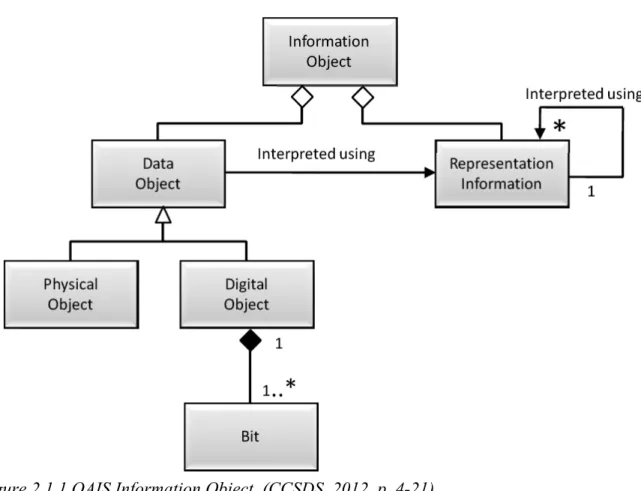
According to the OAIS, an information object is, “composed of a Data Object that is
either physical or digital, and the Representation Information that allows for the full
interpretation of the data into meaningful information” (CCSDS, 2012, p. 4-20–4-21). These
relationships are illustrated in Figure 2.1.1. Representation Information is the information
that accompanies the digital or physical object and is necessary to interpret or render the
Figure 2.1.1 OAIS Information Object. (CCSDS, 2012, p. 4-21).
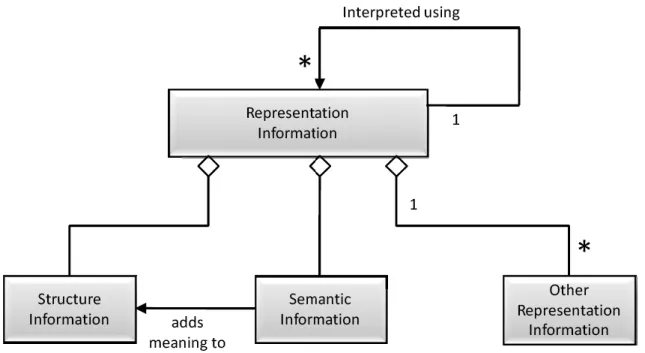
There are three different types of Representation Information: Structure Information,
Semantic Information, and Other Representation Information. Structure Information provides
the structural information necessary to translate the bit sequences of the digital object into a
form that is meaningful and understandable to humans. Semantic Information provides
additional meaning to the structural information such as the language used in the information
object. Figure 2.1.2 illustrates these relationships and also illustrates the possibility that
Other Representation Information can be part of the Information Object. According to the
OAIS, “information defining how the Structure and the Semantic Information relate to each
Figure 2.1.2. OAIS Representation Information Object. (CCSDS, 2012, p. 4-23).
A notion introduced in the 2012 version of the OAIS Reference Model is
Transformational Information Properties, or what are often referred to as Significant
Properties. Hedstrom, Lee, Olson, and Lampe refer to significant properties as the, “features,
attributes, or properties that impinge upon future use and understanding” (2006, p. 161).
Significant properties can be things like the “look and feel,” functionality, and behavior of
the digital content.
Reagan Moore wrote that digital preservation is “communication with the future” and
a major challenge of preservation is to “incorporate new technology effectively, while
(2008, p. 64). Allison, Currall, Moss and Stuart wrote that, “Even if the bitstream has been
dignified with an ISBN or ISSN number, it does not exist like a printed book in multiple
identical copies but only in multiple almost certainly nonidentical renditions. Across the
board, the bitstream is the constant, although behaviors are not” (p. 368).
Significant properties are important when considering file format endangerment
levels. While there may be software available that can render the information stored in a
particular file format, that software might not faithfully reproduce all of the significant
properties that maintain the information’s authenticity and integrity. In certain contexts
significant properties can be the line between whether or not meaningful access to a digital
object has been preserved. This distinction has a definite impact on a file format’s
endangerment level.
David Levy describes long-term digital preservation as a “socio-technical
accomplishment” where a balance must be struck between the technological demands and the
need to focus on the human and organizational factors that affect digital preservation (1998).
The two are inextricably linked in that the technological aspects of preserving access to
digitally encoded information are created by and must be managed by people. It is people
who are charged with making the best digital preservation decisions so that not only are the
bitstreams preserved, but so too are the significant properties, authenticity, and other
contextual information that maintain a digital object’s value. In the context of file formats,
decisions must be made around perceived and actual risks associated with particular file
2.2. The Problem of File Formats in Digital Preservation
In terms of the OAIS Reference Model, file formats are a part of the structural
component of representation information, and maintaining access to digitally encoded
information is dependent on the presence of representation information. Preserving access to
digitally encoded information is a challenge due to the continually changing nature of the
technology that people use to produce and render it. The literature portrays an evolving
discussion of the problem of file formats in digital preservation over four decades.
In 1971, Dollar cited having documentation on the software used to create and
manipulate machine-readable records as a necessity to continued digital data access:
…A computer program directory would at the least describe the programs used to manipulate the data and the computer employed. For the second and twenty-third centuries a source listing of the programs and a flow chart should be included (p. 30).
Margaret Hedstrom also discussed the challenges of archiving machine-readable
records due to “software dependence”:
The need for special software to access a data file and retrieve information from it is a major obstacle to transfer, processing, and distribution of a data set. Some software-dependent data sets are unusable if transferred to the archives without companion software (1984, p. 44).
In 1992, Michael Lesk wrote at length of the problems created by file formats and the
constant change in the software that creates them. He pointed out, “Format, software and
hardware are often intermingled: information may be preserved but if the software to print,
search, and edit it has gone, it may be quite costly to make any use of it” (New Media are a
Problem, ¶6). Note that he did not say that the bitstreams cannot be preserved, just that it
about the challenge of file formats: “Unfortunately there is also a much wider variety of
logical formats, and much more varied expertise is required to deal with the software content
than with the physical material” (New Media are a Problem, ¶6).
In 1994, David Bearman made note of the same problem when he wrote, “Electronic
records are always virtual documents, that is they exist under software control and are
dependent on some hardware, even if they are (someday) truly ‘inter-operable’ across
hardware platforms. Because a generation of hardware and software (the length of time
before obsolescence) is less than five years and because storage media generations are
equally volatile, the electronic records must be regularly migrated to new hardware, software,
and media” (1994a, p.21).
Soon after, Paul Conway wrote on the obsolescence of data retrieval systems. He said,
“Digital storage media must be handled with care, but they most likely will far outlast the
capability of systems to retrieve and interpret the data stored on them. Since we can never
know for certain when a system has become obsolete, libraries must be prepared to migrate
valuable image data, indexes, and software to future generations of the technology” (1996,
Priorities for Action, ¶1). Here he spoke of never knowing when a system becomes obsolete,
and he suggested that libraries must be ready to take action to preserve access to their digital
collections. It is important to note this sense of uncertainty around when and if the risk will
materialize.
Margaret Hedstrom rang an alarm bell when she said, “More insidious and challenging
than media deterioration is the problem of obsolescence in retrieval and playback
technologies. Innovation in the computer hardware, storage, and software industries
costs” (1998, p. 191). In the same publication Hedstrom suggested that, among other things,
a digital object’s file format should serve as a basis for what an institution can invest in
digital preservation initiatives. The implication here is that if an institution cannot guarantee
access to the information encoded in a particular file format, it may not, or even should not
spend time and money on trying to preserve digital objects stored in that format.
In reference to the longevity of file formats, Jeffrey Rothenberg famously said,
“digital information lasts forever—or five years, whichever comes first” (1999b, p. 2). In
another publication from the same year, he wrote, “Digital documents are vulnerable to loss
via the decay and obsolescence of the media on which they are stored, and they become
inaccessible and unreadable when the software needed to interpret them, or the hardware on
which that software runs, becomes obsolete and is lost” (1999a, p. v).
Software and file formats continued to be cited as core sources of digital preservation
trouble through the 2000’s. In 2000, Seamus Ross said, “Access to material created using
superseded operating systems (e.g. CP/M) or word-processing (e.g. WordStar) and database
(e.g. Dbase III) applications is difficult…resources created in digital form are fragile and
easily prone to becoming physically and logically inaccessible” (p. 12). In 2002, Kenneth
Thibodeau named file formats as the “starting point for all digital preservation.”
A sense of urgency around file formats is instilled in the statement:
Because of the peculiarities of the problem, however, we cannot afford to wait any longer: New digital formats are being invented all the time. Most of them, like their hard- and software environments, live a short life until they are supersede by new formats. Access to documents stored in an obsolete format is restricted at best” (Borghoff, Rödig, Scheffczyk, & Schmitz, 2006).
as one of the premier challenges in digital preservation. The National Digital Information
Infrastructure and Preservation Program (NIIIPP) reported, “Content formats can be complex
and fragile. They are often not well documented and frequently become obsolete” (p. 12).
Kurt Bollacker agreed that, “with all digital media, a machine and software are required to
read and translate the data into a human-observable and comprehensible form. If the machine
or software is lost, the data are likely to be unavailable or, effectively, lost as well” (2010, p.
106).
In contrast to this, Sarah Higgins had a more positive perspective of progress in the
field: “After a period of definition and consolidation, the subject now boasts a growing
international professional base, a developing research agenda, practical tools and
collaborative projects and a workforce trained to Higher Education level” (2011, p.11).
However, the majority of the literature reflects a darker view. This includes Seamus Ross, as
reflected in several comments he wrote in 2007:
The preservation community has not yet carried out sufficient underlying experimental and practical research either to deliver the range of preservation methods and tools necessary to support preservation activities or to provide us with sufficient data to reason effectively about preservation risks or how to manage them (p. 7).
An early but influential report in 1996 conveyed that technological aspects of digital
preservation still needed to be researched and addressed. “Even after more than forty years of
growth, the digital world of information technology and communication is still relatively
young and immature in relation to the larger information universe, parts of which have been
under development for centuries” (Task Force on Archiving of Digital Information, 1996,
Need for Deep Infrastructure, ¶1). Without focused research in the finer points of digital
Little data has been collected about the risks file formats may pose, and consequently,
it is challenging to develop solutions-based research. It is necessary to implement continued
data collection so that we may better understand the problem and to better understand where
the risks lie. Seamus Ross summed up this sentiment:
Not only do we need to try to better understand what we might do to alleviate obstacles to the longevity of digital materials, we must do more to define the uncertainties related to digital preservation and to convert these uncertainties into known, measurable and mitigatable risks. We should, of course, make a genuine distinction here between perceived risk and ‘actual’ risk; an actual risk represents an assessed and measurable risk – we just do not know in a measurable way in the context of digital objects which risks are actual (2007, p.17).
A report from DigitalPreservationEurope from the same year stated:
Appropriate metrics for various types of risks as well as for their economic and other consequences have to be defined. Algorithms should also be developed that support the measurement of various types of risks on the basis of such metrics. …
Furthermore, methods of knowledge representation and reasoning can be utilised to represent these risks in an explicit, machine readable form that can be automatically processed and analysed by applying methods of machine learning and automated reasoning (2007, Risk, ¶1).
Not everyone believes that file formats and the technological advances in rendering
software pose a risk to our ability to access digital information over time. David Rosenthal
and Chris Rusbridge both published papers that brought into question the degree of severity
the community believed the problem possessed.
Rosenthal wrote, “format obsolescence is not a significant threat to the overwhelming
majority of digital content we wish to preserve” (2010). He went on to say, “If we ask ‘what
would have to happen for these formats no longer to be renderable?’ We are forced to invent
implausible scenarios in which not just all the independent repositories holding the source
code of the independent implementations of one layer of the stack were lost, but also all the
the much larger number of copies of the binaries of this layer” (p. 206). He goes on to argue
that file format obsolescence is technically impossible for most file formats:
Any format that has an open-source renderer is effectively immune from format obsolescence because there is no plausible scenario in which it will stop working in the current environment and, if it does, the environment in which it did work can be re-created. Further, any format that can be rendered by a binary plugin for an open source environment can be made immune simply by preserving the bits of the binary plugin…Thus the practical questions about the obsolescence of the formats used by today’s readers are really how convenient it will be for the eventual reader to access the content, and how much will be spent when in order to reach that level of
convenience (p. 207).
Ultimately, he says, “format obsolescence is a rare problem that happens infrequently
to a minority of unpopular formats” (p. 208). Chris Rusbridge agreed that file format
endangerment does not pose the immediate threat that the community thinks. He wrote, “File
formats become obsolete rather more slowly than we thought” (2006).
The literature demonstrates the importance of file formats to a large portion of digital
preservation community. It also demonstrates the need to clarify the nature and degree of any
risks that may be associated with accessing information encoded in particular file formats
over time.
2.3. File Formats in Digital Preservation Research and Development
Research and Development in file formats in digital preservation has focused on the
development of file format identification tools, file format registries, risk notification tools,
and systems that integrate two or more types of file format tools. My examination of the
digital preservation software development landscape reveals progress in file format
identification and digital preservation system development, but little forward movement in
2.3.1 File Format Identification Tools
The Harvard University Libraries (HUL) explained the value of knowing the format of
a digital object:
The format of a digital object must be known in order to interpret the information content of that object properly. Without knowledge of its format, a digital object is merely a collection of undifferentiated bits. Thus, format typing is fundamental to the effective use, interchange, and preservation of all digitally-encoded content (2008, p.
1).
In some cases it is difficult to accurately identify the format of a digital object,
particularly in the context of large, heterogeneous digital collections. As a result, a number of
developers created tools to aid in identifying file formats. Some of these tools include the
UNIX file utility, Digital Record Object Identifier (DROID), JSTOR/Harvard Object
Validation Environment (JHOVE), Format Identification for Digital Objects (FIDO), File
Information Toolset (FITS), TrID, Filereg, Mfile, Validate, File Fingerprints, Token
Intersection, and Probabilistic Token Validation.
The UNIX file command is the predecessor to all of the file format identification tools
discussed here. The file command has been used to identify file formats since 1973
(Underwood, 2009). The file format identification tool, DROID was created by The National
Archives (TNA), of the UK in order to “extend the functions of the PRONOM technical
registry [discussed below] by performing automated batch identification of file formats” (The
National Archives [TNA], n.d.-a). JHOVE is a file format identification and characterization
tool developed in a cooperative effort between Harvard University Libraries (HUL) and
Journal Storage (JSTOR). Marco Pontello created a lesser-known file format identifier
called, TrID (Pontello, n.d.).
relatively new tool, first released in December 2010 with an additional version released in
March 2011. The File Information Toolset (FITS) is a wrapper around several standalone file
identification and characterization tools: JHOVE1, Exiftool, National Library of New
Zealand Metadata Extractor, DROID 3.0, FFident, and the UNIX File command (McEwen &
Goethals, 2009). As part of the File Format Identification research project sponsored by the
MITRE Corporation (2009), the MITRE team developed several prototypical file format
identification tools to aid in digital file forensics. These tools are Filereg, Mfile, Validate,
File Fingerprints, Token Intersection, and Probabilistic Token Validation.
2.3.2 File Format Registries
File format registries are designed to collect and share information about file formats,
the software that can be used to render them, the risks associated with particular file formats
and what actions can be taken if the formats are at risk of being unrenderable. Notable file
format registries are PRONOM, the Global Digital Format Registry (GDFR), the Unified
Digital Format Registry (UDFR), and the Archive Team’s “Let’s solve the file format
problem” wiki.
PRONOM is a “database of the technical components necessary for accessing and
processing electronic records” (Brown, 2005b). It contains information about file formats,
software products, operating systems, hardware components, and storage media. It was first
released in 2004 by The National Archives (TNA) of the United Kingdom as a component of
its government dataset preservation service (Brown, 2007). In each file format entry, there is
a field designated for “format risk,” but inspection of the live database reveals that there is
The Global Digital Format Registry (GDFR) is a similar project that was initiated in
2002 as a result of discussions between team members of the Harvard Library Digital
Initiative and MIT DSpace project (Abrams & Seaman, 2003). Like PRONOM, the GDFR
aims to collect and share representation information about digital file formats, but what
distinguishes it from PRONOM is that it aims to “define a common network protocol by
which multiple independent, but cooperating, registries can communicate with each other and
synchronize their holdings of format representation information” (Abrams & Flecker, 2005).
In other words, instead of being a standalone database it is intended to ingest and manage
format data from a distributed network of databases, of which PRONOM data could be one
of many components.
The GDFR team created a data model, originally informed by the PRONOM 4
information model (Harvard University Libraries, 2006), but adapted to include more
granular information on the file formats that can be used to monitor and address file format
endangerment issues. For example, the data model includes space for human or corporate
agent information associated with a file format. This information could be used to contact
parties with the knowledge and ability to provide access to information stored in a particular
file format if rendering software has become unavailable.
In 2009, the Unified Digital Formats Registry (UDFR) Working Group announced
their intentions to form a Unified Digital Formats Registry that combined the contents of
TNA’s PRONOM and the GDFR into one central repository (Unified Digital Formats
Registry [UDFR] Working Group, 2009b). This new registry is technically based on
PRONOM’s existing architecture and database, but has been expanded to include the data in
data contribution, and distributed data hosting” (Unified Digital Formats Registry Working
Group, 2009a). The project was completed in the summer of 2012. Unlike PRONOM and the
GDFR, UDFR allows contributions from the public. It has an open contributor policy that
states:
There are no prescriptive requirements for contributor eligibility other than providing minimum personal information: name, email address, and institutional affiliation and job title. Instead, the UDFR relies on strong provenance and complete change history at the level of each individual assertion (Regents of the University of California, 2012).
Challenges common to many of the funded format registry projects, particularly
GDFR and UDFR, include the problem of ongoing maintenance and development. In a 2013
publication, McGath reported no ongoing activity for either project. In contrast to this more
traditional model, the “Let’s solve the file format problem” project seeks to provide “an
institution-neutral, public-domain, easy to navigate site containing this information, the
“problem” can be addressed both by users of the Wiki and the many, many related attempts
to achieve this goal” (Archive Team, 2012). Continuing activity on the Archive Team wiki
suggests but does not prove that this alternate model may be a more sustainable means of
collecting and providing access to file format information.
2.3.3 Risk Assessment and Notification Tools
Several projects have approached the process of file format risk assessment and
notification. These are the Automated Obsolescence Notification System (AONS), AONS II,
parts of the Archive Ingest and Handling Test (AIHT), Plato, Scout, and research conducted
at the Austrian Institute of Technology.
Partnership for Sustainable Repositories (APSR) and built upon work of the Preservation
Architecture for New Media and Interactive Collections (PANIC) project, discussed later. In
2006, AONS was developed to create a file format obsolescence alert system, specifically for
the DSpace digital repository platform. The alert system was to be built on an architecture
that used DROID for file format identification, and PRONOM and Library of Congress
Directory of Formats to provide obsolescence risk evaluation. If file formats found in the
repository are identified to be at risk, the system generates a risk report and sends the report
to the repository manager (Australian Partnership for Sustainable Repositories, 2006).
In 2007, work on AONS II began in order to refine the AONS services. Notably, the
AONS II report stated, “an initial business driver for the project was a perceived need for a
tool which could automate much of the assessment process, using standardized metrics that
would support machine-formulation of recommendations on risk levels” (Pearson & Webb,
2008). Unfortunately, the project relied heavily on risk reporting capabilities of PRONOM,
which have yet to come to fruition. Since the AONS II report was issued, there has been no
further development of AONS.
The Archival Ingest and Handling Test (AIHT) project was funded by the Library of
Congress to “assess the digital preservation infrastructures of four small, real-world digital
archives” (Anderson, Frost, Hoebelheinrich, & Johnson, 2005, ¶1). The four partners were
Johns Hopkins University, Sheridan Library; Harvard University Library; Old Dominion
University Department of Computer Science; and Stanford University, Libraries and
Academic Information Resources (Library of Congress, n.d.). As part of the AIHT, the
Stanford University participants developed a file format risk-assessment system. They based
Arms and Fleischhauer (2005) list of preferred file formats, from which they created a matrix
for risk-assessment. From this they developed what they call the Empirical Walker Process,
intended to be a fully automated metadata and risk-assessment generator that flags materials
that may be in danger of becoming obsolete (Anderson, Frost, Hoebelheinrich, & Johnson,
2005).
After developing this prototype system, Anderson, Frost, Hoebelheinrich, and Johnson
evaluated the resources required to automate and maintain a preservation assessment of the
Empirical Walker Process, such as maintaining the infrastructure to support the process.
While they have yet to fully develop this process, they suggested that the cost to manage
such a system was too much for one institution to bear and suggested that “perhaps a
federated approach to some of this activity, as a service to a community of repositories and
their users, would be most economical” (2005, General Conclusions, ¶2).
Plato was developed as part of the Planets preservation-planning project. Plato
addresses many aspects of preservation planning (Becker & Rauber, 2011). Among them is
assessing file format criteria that could indicate risk. They propose to evaluate file formats
based on the criteria: browser support, standardization, ubiquity, stability, licensing,
compression, format documentation, tool support, comparative file size, complexity,
disclosure, master can be used as access copy, Optical Character Recognition (OCR
applicable, and adoption. Becker and Rauber cite several obstacles toward realizing the goal
of automating the process of measuring and evaluating formats based on these criteria: 1.
only roughly 20% of the criteria can be automatically measured, 2. external sources of data
or not complete and, 3. there is a lack of standardized benchmarks that can be used in